Home Blog Page 537

Gabon president woos Dangote amid business tycoon’s row with Nigerian government

THE President of Gabon, Brice Oligui Nguema, has invited the Chairman of Dangote Industries Limited, Aliko Dangote, to invest in cement and fertiliser production in his country.

This is even as the Association of Nigeria (MAN) has called for the protection of local businesses following the yet-to-be-resolved feud between the Dangote Refinery and the regulatory authorities in the Nigerian oil and gas sector.

In a statement on Tuesday, July 23, the company said the Gabonese President asked the Dangote chairman to explore potential investment opportunities in the country’s cement and fertiliser sectors, specifically urea and phosphate production.

President Nguema’s invitation comes amid Dangote’s recent decision to halt investment in Nigeria’s steel industry to avoid the accusations of being considered monopolistic.

The meeting focused on how the Dangote Industries could contribute to Gabon’s economic growth by establishing cement and fertiliser plants, which are vital for the country’s infrastructure development and agricultural productivity.

Dangote’s potential investment in Gabon is expected to bolster the country’s industrial landscape, ensuring a steady supply of essential materials for construction and agriculture.

“This development aligns with President Nguema’s vision of transforming Gabon into a diversified and self-sustaining economy,” it stated.

The request by the Gabonese government underscores Dangote Industries’ vision of fostering economic development across the African continent.

However, the Dangote Group boss recently faced an outburst for seemingly exuding a monopolistic tendency in the Nigerian oil and gas market.

The company had been at loggerheads with the Nigerian petroleum regulators over the control of the petroleum downstream market in the past couple of months.

Of particular emphasis recently is the comment by the chief executive officer of the Nigerian Midstream and Downstream Petroleum Regulatory Authority (NMDPRA), Farouk Ahmed.

Ahmed alleged petroleum products from the Dangote Refinery were of inferior quality compared to imported products.

His comment sparked criticism and had been interpreted to mean the seemingly demarketing of the Dangote Refinery.

At its plenary session on Tuesday, July 23, the House of Representatives called for the removal of the NMDPRA boss.

While the Gabon government desires Dangote’s investment, the Manufacturers Association of Nigeria (MAN) said the Nigerian government needed to support and protect local businesses.

The director-general of MAN, Segun Ajayi-Kadir, in a statement on Tuesday, July 23, said it was expected that agencies of government providing regulatory oversight functions should promote an enabling business environment for local investments to thrive.

He expressed worries that no regulatory agency should be seen to be casting a shadow over a homegrown investment like the Dangote Refinery, urging the government to clarify the issue.

“The allegations of poor quality, monopolistic tendencies, and non-issuance of licence have since been roundly debunked. There may then be the need to issue a clarification that absolves the Dangote Refinery of the negative perception generated by the news report,” he said.

Ajayi-Kadir noted that local investors including the Dangote Industries played a vital role in driving economic growth, paying taxes, creating jobs, and fostering development within the country.

“As such, it is important that these investors are protected and given the necessary support to thrive in this business environment,” Ajayi-Kadir maintained.

He said particularly that a business tycoon like Dangote, with investments in diverse sectors of the economy and across the African continent, should be accorded all needed support to grow and invest in more sectors and positively impact the well-being of the people.

“There is no gainsaying the fact that Dangote Refinery is deserving of government’s protection and support,” he said.

The 650,000-capacity Dangote refinery described as the largest single-train refinery in the world, will significantly reduce Nigeria’s dependence on imported petroleum products, reduce cost and energy poverty, and boost its energy sufficiency, among other benefits, many industry watchers believe.

“We should never encourage or promote a preference for imported products over local alternatives. This amounts to importing poverty and exporting prosperity.

“As you are aware, the manufacturing sector is beset with multifaceted challenges. They include the high cost of electricity, high cost of compliance with regulatory requirements, lack of access to financing, unfavourable foreign exchange and unfair competition from imported and smuggled products.

“It is therefore imperative that the Nigerian government takes proactive steps to address these binding constraints in order to improve the competitiveness of local industries and enhance their contribution to the GDP,” Ajayi-Kadir added.

Also, Nigerian businessman and billionaire Femi Otedola has likewise urged the government to support local businesses, stressing that supporting Dangote was crucial to the country’s growth and economic development.

Hardship: NLC denies withdrawing from planned mass protest

0

THE Nigeria Labour Congress (NLC) has debunked reports on its alleged withdrawal from the planned mass protest by some Nigerians against economic hardship.

The president, Joe Ajaero in a statement released on Wednesday, July 24, noted that the NLC could not withdraw from a protest it did not organise.

“A news report of the withdrawal of the Nigeria Labour Congress from the widely discussed national protest has been brought to our attention. The Nigeria Labour Congress debunks such a story as patently false.

“The truth is that the Nigeria Labour Congress cannot withdraw from a protest that it did not organise. It is only the organisers of the speculated national protest that can decide to pull out or continue with the protest,” Ajaero stated.

He further noted that the NLC had a process which it follows for industrial actions such as protests, adding that despite not being the body responsible for the protest, they were aware of the living conditions Nigerians had been subjected to by the harsh economic policies of the government and would stand with Nigerians.

“The Nigeria Labour Congress has internal trade union mechanisms, especially leadership decision-making processes that its industrial actions such as protests pass through before such activities are undertaken.

“Yet, the fact that the Nigeria Labour Congress is not the body organising the protest does not mean that organised labour is oblivious of the dire living conditions Nigerians have been subjected to by the harsh economic policies of government. The Nigeria Labour Congress stands in solidarity with the Nigerian people in these very trying and excruciating times.”

On Monday, July 22, The ICIR reported that the NLC warned the government against engaging in a “war-war” situation with Nigerians by trying to suppress citizens’ fundamental right to protest.

The union noted that it was condescending and dismissive to label the daily harsh struggles faced by Nigerians as a politically motivated dissent, urging the government to negotiate with the protesters instead of taking actions that could undermine citizens’ rights to express their grievances.

The ICIR reports that some Nigerians, along with a group led by former presidential candidate Omoyele Sowore, have been mobilising to start nationwide protests in the first week of August.

The posts and tweets on the protest carry different hashtags, ranging from #RevolutionNow, #EndBadGovernanceInNigeria, #TakeItBack, #DaysofRage and #TinubuMustGo.

NDLEA nabs ‘most wanted Lagos drug baron’

0

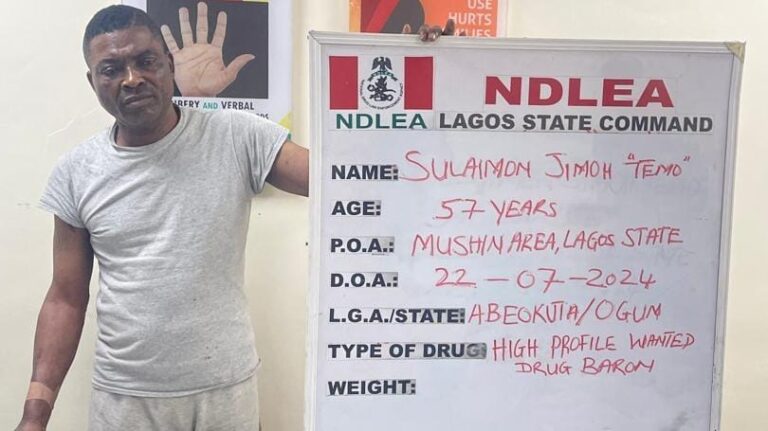
AFTER years of evading arrest, operatives of the National Drug Law Enforcement Agency (NDLEA) said it had arrested 57-year-old Sulaiman Jimoh (popularly known as Temo).

The NDLEA described him as the overall head of the drug cartel of the Mushin area of Lagos State.

According to the agency, Jimoh was arrested at his enclave after initial resistance from him and his followers.

This was disclosed in a statement released on Wednesday, July 24, by the agency through its spokesperson, Femi Babafemi.

According to the statement, in the last two years, the NDLEA has intercepted large consignments of illicit drugs worth billions of naira owned by Temo but he has remained largely evasive while a few encounters with him and his armed gangs in his Mushin enclave had resulted in gunfight.

The NDLEA said some of the recent seizures of his shipments include 14, 524.8 kilogrammes of Ghana Loud, a strong strain of cannabis sativa smuggled into Lagos from Ghana in two trucks and a J5 bus intercepted at the Ojuelegba area of the state.

Others are two truck-loads of the same substance weighing 8,852 kilogrammes intercepted at Eleko beach, Lekki Lagos on May 4, 2023, and 252 kilogrammes of Loud seized from his enclave in Mushin on Wednesday, July 26 2023.

“The drug kingpin was very notorious for always being on the move to evade arrest but with persistence and determination of the agency, aided by modern tools and intelligence, the concerted effort to get him paid off at 10 am on Monday 22nd July 2024 when NDLEA’s surveillance teams on his trail tracked and pinned him down at Igbarere street, Mushin.

“A reinforcement of about 50 operatives was immediately mobilised to the area while he was attempting to escape in a Mercedes Benz SUV GLE 350 marked 01G-300G.

According to the NDLEA, Jimoh’s attempt to escape by mobilising hoodlums to engage and distract its operatives failed after which he was overpowered and whisked away from the scene.

It added that some of his men surrendered to the superior firepower of the anti-narcotic agents who also succeeded in recovering the Mercedes Benz SUV the suspect was found in.

Lagos has been the hotbed of drug-related issues in recent years.

In 2023, The ICIR reported that the NDLEA seized 8,852 kilograms (8.8 tons) of Canadian Loud, an imported synthetic strain of cannabis, in the Lekki area of  Lagos after a 30-minute gun battle with armed men escorting the consignment loaded in two long trucks.

The NDLEA, in a statement by Babafemi on Sunday, May 7, said acting on credible intelligence, its operatives laid ambush for the traffickers along the Eleko beach road in Lekki at about 4:51 am on Thursday, May 4.

According to him, two long trucks conveying the illicit consignments were flagged down, but rather than stopping, the trucks escorted by armed men sped off, as a result of which there was an exchange of gunfire that lasted 30 minutes.

He added that after they were overpowered by the NDLEA operatives, the truck drivers and their armed escorts escaped into the bush, abandoning the trucks and the drug consignments.

Investors lost N46.7bn in stock trading over CBN’s 26.75% rate hike

FOLLOWING the benchmark interest rate hike by the Central Bank of Nigeria (CBN) on Tuesday, July 23, the Nigerian stock market reacted negatively as investors lost N46.70 billion at the close of the day’s trading.

At the end of its two-day bi-monthly monetary policy committee (MPC) meeting, the apex bank raised the benchmark interest rate by 50 basis points to 26.75 per cent for the fourth consecutive time to fight inflation.

The ICIR reports that the monetary policy rate, otherwise known as the benchmark interest rate, is a tool the apex bank uses to tame inflation which rose to 34.19 per cent in June.

At the close of the trading session on Tuesday, the stock market reversed its gain on Monday, July 22, amid a wide sell-off and negative sentiment from investors.

The Nigeria stock market All-Share Index declined to 100,486.12 points on Tuesday from 100,568.60 points on Monday and the market capitalisation dropped to N56.89 trillion as investors lost N46.70 billion.

Of the 113 transactions that took place on the floor of the Nigeria Exchange Limited (NGX), only 14 companies’ shares gained. While 27 companies’ shares traded at a loss, other companies’ shares remained unchanged.

Trading activity was largely downbeat as the total number of deals, volume, and value declined to 8,403 deals, 280.92 million units, and N3.63 billion market turnover from 8,760 deals, 335.70 volume, and N3.72 billion.

John Holt, Omatek Ventures, Deap Capital Management and Trust, and Secure Electronic Technology were the top losers.

On the contrary, Ikeja Hotel, Linkage Assurance, Caverton Offshore Support Group, and Sovereign Trust Insurance were the companies that topped the gainers’ chart.

On sectoral performance, the bank and insurance stocks declined to 842.15 points from 847.79 points and 377.72 points from 378.27 points, respectively; consumer goods companies’ shares rose to 1,565.47 points from 1,564.51 points; and the oil and gas and industry closed flat.

At the close of Tuesday’s trading activity, Veritas Kapital Assurance trading led the total transaction volume with 22.51 million units, while United Capital led in traded value amounting to N817.09 million.

The CBN Governor Olayemi Cardoso-led monetary committee has hiked the benchmark interest rates four times this year by 800 basis points.

In its first meeting for the year, the committee raised the rate to 26.75 per cent from 18.75 per cent, tightening the cycle in February with a 400 basis point hike. It was followed by additional increases of 200 basis points in March,150 basis points in May, and 50 basis points in July.

“We project the market will continue to witness the seesaw in performance as investors continue to react to the market based on the prevailing micro and macroeconomic indicators,” analysts at GTI Group said.

In April, The ICIR reported that investors lost over N3 trillion in one month after CBN’s rate hike.

An investment and portfolio analyst, Abel Ezekiel, told The ICIR that CBN’s rate hike made investors shift portfolios from higher-risk stocks to the fixed-income market.

“If MPR increases, the rate at which the government wants to borrow money from investors will rise. This will now make investors dump the stock market for the bond market, treasury bill, and other fixed-income assets,” he said.

Introductory workshop on art criticism seeks applications

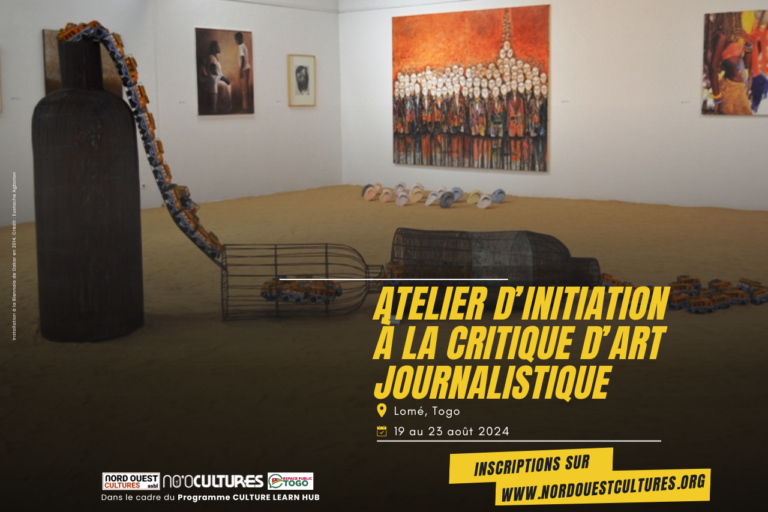
The NORD OUEST CULTURES association is organising and seeking entries, with Espace Public Togo, to its introductory workshop on art criticism to offer journalists the opportunity to discover the methodological basis of art criticism.

Through interactive sessions and hands-on activities, journalists will learn to analyse, interpret and write reviews of artworks professionally and ethically.

The organiser says, “This introductory workshop on art criticism offers you the opportunity to discover the methodological bases of art criticism.

Through interactive sessions and practical activities, you will learn to analyse, interpret and write critiques of works of art in a professional and ethical manner”.

Aspiring cultural journalists or content creators looking to deepen their understanding of art criticism are invited to apply.

The deadline for the submission of applications is August 2, 2024. Interested applicants can apply here.

Stakeholders bemoan hindrances to freedom of speech, proffer solutions

0

STAKEHOLDERS have bemoaned the stifling of freedom of speech in Nigeria amid purported surveillance practices by government agencies.

They also proffered solutions to the challenge currently affecting the country with the spate of the arrest of journalists and other Nigerians simply for expressing their views.

The stakeholders agreed that the situation called for urgent collaboration among citizens to fight the enemies of free speech who are using the need to survey the digital space as a reason to arrest innocent Nigerians.

The stakeholders stated this at a one-day roundtable organised by Accountability Lab in Abuja on Tuesday, July 23, with the theme, “Enhancing Accountability in Freedom of Expression and Surveillance Practices.”

While highlighting the objective of the roundtable, the Programmes and Learning Manager of Accountability Nigeria, Ehi Idakwo, listed various persons who had been arrested, detained or harassed in recent months due to their utterances or actions.

She stated that a lot of people had argued that Nigeria needed a legal framework to guide the evolving landscape of technology advancements but stressed that the government must be able to draw the line between safeguarding the digital space and interfering with the freedom of expression.

“As technology advances, the legal infrastructure must also involve protecting the fundamental rights of individuals.”

According to her, the digital rights and freedom bill is being reassessed at the National Assembly. “The bill was thrown out in 2018 but thankfully it is being reassessed now, which is also the right approach.”

She said the bill was a legislative framework designed to secure the fundamental rights of internet users in Nigeria, and if passed, would boost freedom of speech.

According to Idakwo, another regulation that has impacted the digital rights of Nigeria is the Nigeria Data Protection Act 2023.

She called for a delicate balance in ensuring that the government safeguard national security and also safeguards the individual private rights of citizens in Nigeria.

In his address, a legal consultant with Hope Behind Bars (HBB) Africa, Olukade Samuel Idowu, explained how reluctant he was to express his opinion on the internet for fear of being misunderstood.

He said Nigeria lacked the necessary laws that regulate the social media space.

“Whenever there is a challenge that happened on social media, what happens is the police is usually the first point of call and their initial response to everything relating to this extremism is that they go to Cybercrime Act and irrespective of whatever you are saying, whether it’s true whether its a lie, they say you are cyberbullying someone and they use that as an excuse to detain,” Olukade stated.

In her remarks, the Executive Director of Digi Civic Initiative, Mojirayo Ogunlana bemoaned the level of nepotism in the judiciary and called on the media to start showing interest in the election and leadership issues in the Nigeria Bar Association to encourage accountability in the judiciary.

Another participant, a senior communications officer at HBB Africa, Ejiogu Obinna, said making one’s opinion heard online was resulting in more persons going to prison.

“I don’t see any reason why somebody who is expressing their opinion online would be incarcerated. it doesn’t make any sense and it is presenting another challenge to us, increasing the problems that we’re facing in our criminal justice system,” Obinna stated.


READ ALSO:


The gathering agreed on intensive collaboration, training for judiciary officers, the establishment of accountability mechanisms, alliances, and media oversight among others as solutions to the stifling of freedom of speech.

In his closing remark, the Country Director of Accountablibilty Lab in Nigeria, Odeh Friday, called for more collaboration in the fight against the prevention of free speech.

He called for alliances among like-minded groups to champion press freedom.

Some of the organisations that participated in the discussions included The International Centre For Investigative Reporting (ICIR), Centre for Journalism Innovation and Development (CJID), Global Rights Nigeria, Tap Initiative, and Nigeria Data Protection Commission (NDPC).

Businesses’ borrowing costs to rise as CBN hikes interest rate to 26.75%


BUSINESSES and manufacturers would have to borrow funds at a higher interest rate for their operations as the Central Bank of Nigeria’s (CBN) monetary policy committee (MPC) has hiked the interest rate to 26.75 per cent.

The rate hike was announced on Tuesday, July 23, by the Governor of CBN, Olayemi Cardoso, at the end of the 296th meeting held in Abuja.

The MPC meeting had maintained a hawkish stance amid soaring inflation at 34.19 per cent which pressures businesses and increases their borrowing costs from commercial banks.

The rate was raised from 26.25 per cent announced at the previous MPC meeting in May.

Apart from the rise in the monetary policy rate (MPR) rate by 50 basis points to 26.75  per cent, the committee announced the adjustment of the asymmetric corridor from +100/-300 to +500/-100 around the MPR.

The committee also retained the cash reserve ratio of commercial banks at 45.00 per cent while the liquidity ratio was retained at 30.00 per cent.

Cardoso said the MPC was mindful of the effect of the rising inflation on household consumption and purchasing power of Nigerians, but noted efforts were on top gear to put inflation under control.

He said the inflation surge was expected to moderate as monetary policy measures were being taken in addition to recent fiscal incentives on duty importation directives of the federal government to address food inflation.

“The committee noted a persistent rise in food inflation, which continues to undermine price stability,” he said.

“Rising food and energy costs continue to sustain upward pressure in price moderation. The prevailing insecurity in food-producing areas and high cost of transportation in farm produce are also contributing to the inflation trend,” he added.

In its last three meetings since January, the apex bank tightened the benchmark interest rate to control the rising inflation figures driven by key factors including a loss in the value of the naira.

Headline inflation surged to 34.19 per cent in June and food inflation, the major driver of the pressure, to 40.87 per cent.

Commenting on the rate hike, Partner, Head of Africa Tax, KPMG  Wale Ajayi, said the federal government needed to pay closer attention to Nigeria’s dwindling oil production to grow support for the foreign exchange market.

“We are not meeting up with our Organisation of Oil Producing Countries (OPEC) quota and it’s not good for our foreign exchange market and budget funding. We have 1.7 million barrels per day in the budget and we are not doing up to 1.5 million barrels per day production, ” he said.

He suggested proper alignment of monetary and fiscal policies, to lessen the sufferings of the people and grow the manufacturing sector.

Meanwhile, the organised private sector had called on the CBN to exercise caution in further raising benchmark interest rates.

The chief executive officer of the Centre for the Promotion of Private Enterprise (CPPE),  Muda Yusuf, said the hike in monetary rates had been overstretched with a greater burden on businesses and the manufacturing sector.

Also, the National President of the Nigerian Association of Chambers of Commerce, Industry, Mines, and Agriculture (NACCIMA), Dele Oye, said a hike in the benchmark interest rate could have several potential consequences for businesses.

According to Oye, loans and lines of credit will become more expensive, which can increase the cost of financing for businesses, leading to higher operational costs.

He added that as borrowing becomes more expensive, businesses might delay or scale back on investments in expansion, new projects, or capital improvements, adding that the development could slow down business growth and innovation.

Supporting ‘local champions’ like Dangote crucial to national development – Otedola

NIGERIAN businessman Femi Otedola has weighed in on the rift between the federal government and the chairman of Dangote Industries Limited and Africa’s richest man, Aliko Dangote.

In a post via his X handle on Tuesday, July 23, Otedola said supporting Dangote was crucial to Nigeria’s growth, based on his contributions so far to economic development in the country.

He stated that many developed countries were built by the efforts of some individuals who contributed greatly to industrialisation and were supported by their governments. He urged Nigeria to do likewise.

“In South Africa, government support for the mining industry has been crucial in maintaining its global competitiveness. Brazil has seen substantial government investment in its agricultural sector, transforming it into one of the world’s leading food exporters. In China, government backing for companies like Huawei and Alibaba has propelled them to global leadership in technology and e-commerce.

“In Nigeria, we have our own titans, and it is imperative that we recognise and support them. Aliko Dangote has broken every boundary in worldwide business and industry. His contributions are not just a testament to his brilliance but a beacon of what is possible when vision meets opportunity. Supporting local champions like Dangote is crucial for our national development and economic independence. Let us continue to foster and support these visionaries who drive our nation’s progress,” Otedola wrote in his post.

Dangote expressed frustration recently over hindrances to the survival of his refinery, posed by International Oil Companies (IOCs) operating in Nigeria, which he said had frustrated his company’s requests for locally-produced crude.

The Dangote Refinery was commissioned in May 2023, in an event that had former Nigerian President Muhammadu Buhari in attendance, with expectations that it would generate 9,500 direct and 25,000 indirect jobs.

Before it was commissioned, the Nigerian National Petroleum Company Limited (NNPCL) said it acquired a 20 per cent stake in the refinery.

However, Dangote disclosed in July 2024 that the company failed to fulfill certain obligations, and would now own only 7.2 per cent of the refinery.

Shortly after this disclosure, the Nigerian Midstream and Downstream Petroleum Regulatory Authority (NMDPRA) said the refinery had not been licensed and was still in its pre-commissioning stage.

Chief Executive Officer of the NMDPRA Farouk Ahmed also said Dangote requested a halt to the importation of petroleum products which might lead to a monopoly.

Following these comments, the businessman refuted the comments and announced that he would no longer continue his investments in the country’s steel industry to avoid accusations of monopoly.

He also said that a colleague who advised him against investing in Nigeria had begun to taunt him following the rift between his company and the government.

Alleged treason: Peter Obi threatens to sue Bayo Onanuga, demands ₦5bn

0

THE PRESIDENTIAL candidate of the Labour Party (LP) in the 2023 general election, Peter Obi, has threatened to sue Bayo Onanuga, the Special Adviser on Information and Strategy to President Bola Tinubu over claims that his supporters are behind the nationwide protests scheduled to hold in the first week of August.

In a letter sighted by our reporter, the former Anambra State governor is demanding N5 billion from Onanuga for his claims.

The letter dated July 22 was signed by Obi’s legal team, headed by Alex Ejesieme, a senior advocate.

In the letter, Ejesieme drew the attention of Onanuga to a widely circulated publication titled, “Revealed: Peter Obi’s supporters are the people planning mayhem in Nigeria: Obi should be held responsible for anarchy.”

 He said the statement, circulated on social and mainstream media, had damaged Obi’s reputation, portraying him as someone who favours violence despite his well-documented history of non-violence.

“It’s our client’s conviction that the publication was a calculated plot to demean, ridicule, humiliate, and embarrass him by the estimation of every right-thinking member of society,” part of the letter stated.

The lawyers stressed the emotional distress the allegations by Onanuga had caused Obi and demanded a retraction from the presidential spokesperson.

Obi’s counsels added that the publication has prompted concern for their client from his well-wishers across the globe.

Our Client denies the entirety of the falsehood contained in the said publication and insists that there is no modicum of truth in the allegations preferred against him in your published statement that has since gone viral on the internet and its various social media platforms.

“The said statements are in every sense malicious and convey with them, the potentiality of an ostracisation of our client by well-meaning citizens of Nigeria. It should be stated without any form of equivocation, that our client is an elder statesman, a diplomat and an unwavering democrat.

“He has always tailored his affairs according to the dictates of the Nigerian law. Where there has been any dissatisfaction with any process or procedure, our client’s first and only resort has been to invoke the appropriate legal mechanisms to ventilate his grievances,” the letter reads further.

Obi demanded a retraction and a public apology in four national dailies (Vanguard, THISDAY, Punch, and The Cable) and on Onanuga’s verified X account.

In addition, Obi is requesting ₦5 billion in damages for the humiliation he and his family endured.

His legal team threatened to file libel and slander lawsuits in court if Onanuga did not comply with these demands within the next 72 hours.

Onanuga, on Saturday, took to his X account to state that Obi’s supporters were planning to stage the nationwide protests scheduled for August 1 and accused Obi and his supporters of committing treason by planning to end the government of an elected government. 

He noted that Obi should be held responsible for the planned protest, adding that the protest planners were the same people who instigated the destructive ENDSARS protest in Nigeria in October 2020.

Part of his allegations read, “Don’t be fooled: the malcontents planning to stage nationwide protests are supporters of Peter Obi, the failed presidential candidate of the Labour Party. And he should be held responsible for whatever crisis emanates from the action.

“The protest planners are also the same people who were instigated by IPOB leader Nnamdi Kanu to launch the destructive ENDSARS protest in Nigeria in October 2020. ENDSARS began as a genuine protest by youths against the Police Special Anti-Robbery Squad, notorious for its high-handedness”.

Meanwhile, The ICIR reported that an LP chieftain, Yunusa Tanko, refuted the allegation against Obi, that he was behind the planned nationwide protest.

In an interview with The ICIR on Saturday, July 20, Tanko noted that Obi had nothing to do with the protest, noting that any citizens could plan to protest based on the hardship in the country under Tinubu’s watch.


Hardship: Atiku backs nationwide protest, says attempt to suppress citizens’ rights unconstitutional

0

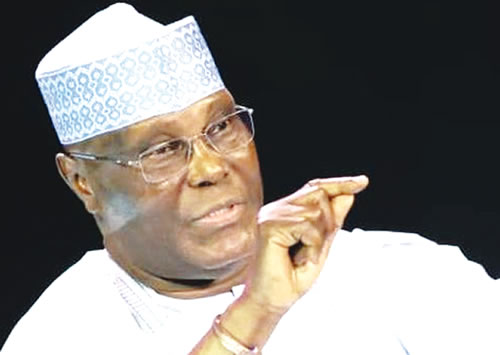
FORMER Vice President Atiku Abubakar has backed the planned protest by Nigerians.

Abubakar, in a statement on Tuesday, July 23 via X, noted that the rights of citizens to protest are enshrined in the Nigerian Constitution and had been affirmed by the courts of law.

He warned of the implications of suppressing protests and said it was not only unconstitutional but a direct affront to the nation’s democracy.

Abubakar emphasised the legal basis for public protests and criticised attempts to discourage or prevent protests.

The People’s Democratic Party (PDP) candidate in the 2023 election argued that “Chasing shadows and contriving purported persons behind the planned protests is an exercise in futility when it is obvious that Nigerians, including supporters of Tinubu and the ruling APC, are caught up in the hunger, anger, and hopelessness brought about by the incompetence and cluelessness of this government.”

“For the avoidance of doubt, the rights of citizens to protest are enshrined in the Nigerian Constitution and affirmed by our courts,” he added.

He mentioned Section 40 of the 1999 Constitution, which “unequivocally guarantees the right to peaceful assembly and association.”

Abubakar also highlighted what he described as hypocrisy among those currently in power.

He urged the government to carry out its obligations to protect citizens’ rights.

“A responsible government must ensure a safe and secure environment for citizens to exercise their constitutionally guaranteed rights to peaceful protest,” the septuagenarian stated.

Screenshot of Abubakar's post on unconstitutionality of government stopping protesters
Screenshot of Abubakar’s post on unconstitutionality of government stopping protesters

Meanwhile, President Bola Tinubu on Tuesday pleaded with those planning the protest to shelve it.

He urged the citizens to allow his administration adequate time to address their concerns.

This was disclosed to State House Correspondents by Minister of Information and National Orientation Mohammed Idris following closed-door meetings with Tinubu at the Aso Rock Villa in Abuja on Tuesday.

“So, there is no need for strike. The young people out there should listen to the President and allow the President more time to see to the realisation of all the goodies he has for them,” Idris stated.

The ICIR reports that some Nigerians, along with a group led by former presidential candidate, Omoyele Sowore, have been mobilising for nationwide protests scheduled for the first week of August.

The posts and tweets on the protest carry different hashtags, ranging from #RevolutionNow, #EndBadGovernanceInNigeria, #TakeItBack, #DaysofRage and #TinubuMustGo.

The ICIR reported earlier that the Nigeria Labour Congress warned the Nigerian government against engaging in a “war-war” situation with Nigerians by trying to suppress citizens’ fundamental right to protest.

The union in a statement, on Monday, July 22, noted that it was condescending and dismissive to label the daily harsh struggles faced by Nigerians as a politically-motivated dissent.

It urged the government to negotiate with the protesters instead of taking actions that could undermine citizens’ rights to express their grievances.

The planned protests in Nigeria are an escalation of a wave of anger against hardship and corruption among public officeholders spreading across Africa.

Many of Tinubu’s economic reforms have worsened inflation, as food prices and the cost of living generally soared within his one year in office.

The ICIR reported how Kenyans, for weeks, took to the streets to protest against the Finance Bill, putting pressure on the President, William Ruto, to decline signing it into law.

The protests also led to the President’s dissolving his cabinet.

In Uganda, protesters are being hounded and detained by state agents as protests raged in the country’s capital, Kampala.

Though Nigerians have protested against hardship under Tinubu in states including Niger, Lagos, Osun, Oyo, the last major protest in Nigeria was the 2020 ENDSARS.