Home Blog Page 538

Tinubu to Nigerians: No need for protest now

0

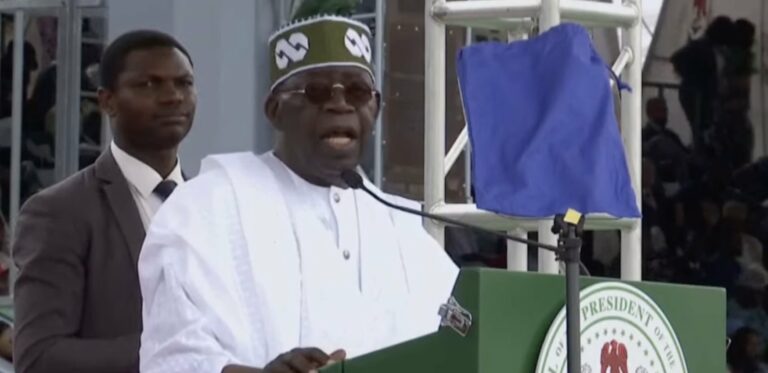
PRESIDENT Bola Tinubu has asked Nigerians to shelve the nationwide protests they plan for the first week of August, saying ‘No need for protest.’

The President also called on the citizens to await his administration’s response to all their demands..

Tinubu’s appeal was conveyed by the Minister of Information and National Orientation, Mohammed Idris, while speaking with the State House Correspondents after closed-door talks with Tinubu on Tuesday, July 23.

“On the issue of the planned protest, Mr. President does not see any need for that. He asked them to shelve that plan and he has asked them to await government’s response to all their pleas.

“So, there is no need for strike. The young people out there should listen to the President and allow the President more time to see to the realisation of all the goodies he has for them,” Idris said.

The ICIR reports that some Nigerians, along with a group led by former presidential candidate, Omoyele Sowore, have been mobilising for nationwide protests scheduled for the first week of August.

The posts and tweets on the protest carry different hashtags, ranging from #RevolutionNow, #EndBadGovernanceInNigeria, #TakeItBack, #DaysofRage and #TinubuMustGo.

The ICIR reported earlier that the Nigeria Labour Congress warned the Nigerian government against engaging in a “war-war” situation with Nigerians by trying to suppress citizens’ fundamental right to protest.

The union in a statement, on Monday, July 22, noted that it was condescending and dismissive to label the daily harsh struggles faced by Nigerians as a politically-motivated dissent.

It urged the government to negotiate with the protesters instead of taking actions that could undermine citizens’ rights to express their grievances.

The union’s reaction trailed a post made by the Special Adviser to the President on Information and Strategy, Bayo Onanuga, on Saturday, July 20, who accused the presidential candidate of the Labour Party in the 2023 elections, Peter Obi, of planning to cause mayhem in the country.

Onanuga wrote, “Don’t be fooled: the malcontents planning to stage nationwide protests are supporters of Peter Obi, the failed presidential candidate of the Labour Party. And he should be held responsible for whatever crisis emanates from the action.

“The protest planners are also the same people who were instigated by IPOB leader Nnamdi Kanu to launch the destructive ENDSARS protest in Nigeria in October 2020. ENDSARS began as a genuine protest by youths against the Police Special Anti-Robbery Squad, notorious for its high-handedness”.

Many of Tinubu’s economic reforms have worsened inflation, as food prices and the cost of living generally soared within his one year in office.

The economic situation is fuelling frustration and anger against the government across the country, with many citizens calling for protests.

In the past couple of days, some governors and regional groups have publicly warned the youth in their states not to join any protest against the federal government.

As a measure to appease the citizens, the members of the House of Representatives resolved to slash their salaries by half. However, the lawmakers only slashed a fraction of their earnings, as their allowances far outweigh their salaries.

The planned protests in Nigeria are an escalation of a wave of anger against hardship and corruption among public office holders spreading across Africa.

The ICIR reported how Kenyans, for weeks, took to the streets to protest against the Finance Bill, putting pressure on the President, William Ruto, to decline signing it into law.

The protests also led to the President dissolving his cabinet.

In Uganda, protesters are being hounded and detained by state agents as protests raged in the country’s capital, Kampala.

Senate passes Police Act Amendment Bill to keep Egbetokun in office

0

THE Senate has passed the Police Act (Amendment) Bill 2024 seeking to amend the Police Act 2020 to among others enable the current Inspector-General of Police, Kayode Egbetokun, to complete his tenure.

The President of the Senate, Godswill Akpabio, announced the passage of the bill after the third reading on Tuesday, July 23.

President Bola Tinubu had also forwarded the Bill to the House of Representatives for consideration.

The arrival of the bill was announced on Tuesday, July 23, by the Speaker of the House of Representatives, Abbas Tajudeen.

The Speaker read the correspondence from the President at the beginning of the plenary.

The bill proposed amendments to the Police Act, with emphasis on the tenure of the IGP.

In July, claims that Kayode Egbetokun attempted to lobby the National Assembly to raise the retirement age of officers were refuted by the police.

Tinubu named Egbetokun the IGP for a four-year term in June 2023.

In accordance with Section 18(8) of the Police Act 2020, Egbetokun, who was born on September 4, 1964, is expected to retire in September 2024 when he clocks 60.

If Egbetokun retires by September, he will have served for one year and three months.

This is not the first time the tenure of a serving IGP has led to controversy.

The ICIR reported in 2021 that former President Muhammadu Buhari in violation of the Police Act, extended the tenure of Mohammed Adamu as IGP.

Muhammad Dingyadi, then Nigerian Minister of Police Affairs, announced this to newsmen in the State House, Abuja.

He said the President’s decision to extend the IGP’s tenure for another three months was to give time for the proper selection of a new police helmsman.

Egbetokun’s predecessor, Usman Baba had the same narrative. Baba reached the required 35 years of service in March 2023 when he became 60, but he stayed in office until Tinubu took over power from Buhari and named Egbetokun as his successor three months later.

The 2020 amended Police Act, signed into law by Buhari in September 2020 specifically spelt out the tenure of the police force personnel.

The Act pegs the retirement age of police officers at 60 years and 35 as years of service.

Part 111 Section 7 (6) of the Act, which repealed the Police Act Cap. P19, Laws of the Federation of Nigeria, 2004, prescribed a four-year single tenure for a person appointed to the office of the IGP subject to the provisions of clause 18 (8), which stipulates that every police officer shall, on recruitment or appointment, serve in the Nigeria Police Force for 35 years or until he attains the age of 60 years, whichever is earlier.


Security forces detain protesters in Uganda

0

SECURITY forces in Uganda have detained some youths in the country’s capital, Kampala, after they took to the streets for an anti-corruption protest on Tuesday, July 23.

In a video posted on X by NTV Uganda, some protesters with placards carrying inscriptions “Speaker Must Resign” were arrested by the police.

A protester, Karungi Hamza, who was detained by the police told newsmen that he agreed to be arrested.

“It is okay to arrest me for asking for accountability,” he said while being dragged away by the police.

The ICIR reported on Monday, July 22, that Ugandan President, Yoweri Museveni, warned the youth planning anti-corruption protests that they were “playing with fire.”

He warned the protest organisers to avoid the temptation of bringing chaos to the country.

“We are busy producing wealth, and you here want to disturb us. You are playing with fire because we cannot allow you to disturb us,” he said.

The country’s police also said they would not allow the march to be held when parliament opens.

The protests by Uganda’s youths are said to be inspired by Kenyan youths’ weeks of protest against the Finance Bill proposed by the country’s government.

Like Kenya and Uganda, in Nigeria, there are plans by some youths to protest against President Bola Tinubu’s administration over the hardship occasioned by his government’s policies.

The protest is scheduled for August 1.

Senate speedily passes bill seeking upward review of minimum wage

0

THE Nigerian Senate on Tuesday, July 23, passed the National Minimum Wage Act 2019, Amendment Bill, after the bill speedily scaled through first, second and third readings.

The Senate unanimously voted for the consideration and approval of the bill minutes after it was transmitted to the lawmakers by President Bola Tinubu.

The bill sought to increase the national minimum wage and reduced the period for periodic review from five years to three years.

This latest development came a few days after Tinubu approved N70,000 minimum wage for Nigerian workers, an over 130 per cent increase from the current minimum wage of N30,000.

The Minister of Information Mohammed Idris, announced the increase at the Presidential Villa in Abuja, on Thursday, July 18.

The President also promised to find ways to assist the private sector and the sub-nationals to pay the minimum wage.

The upward review by the federal government came after a series of negotiations between the government’s representatives and organised labour.

Meanwhile, The ICIR reported that governors across Nigeria’s 36 states opposed the N60,000 minimum wage initially proposed by the federal government.

The governors rejected the proposal in a statement by the director, media and public affairs of the Nigeria Governors’ Forum (NGF), Halimah Salihu Ahmed, on Friday, June 7.

The workers had embarked on a strike on Monday, June 3, and relaxed it the following day, to compel the government to agree on an acceptable minimum wage.

The suspension of the industrial action was at the heel of the resolution reached between the federal government representatives and the labour after a six-hour meeting in the evening of Monday, June 3, in  Abuja.

Nigerian workers had based their demand for a new minimum wage on the snowballing cost of living in the country, largely occasioned by the Tinubu administration’s policies.

NLC warns Tinubu administration against crackdown on protesters

0

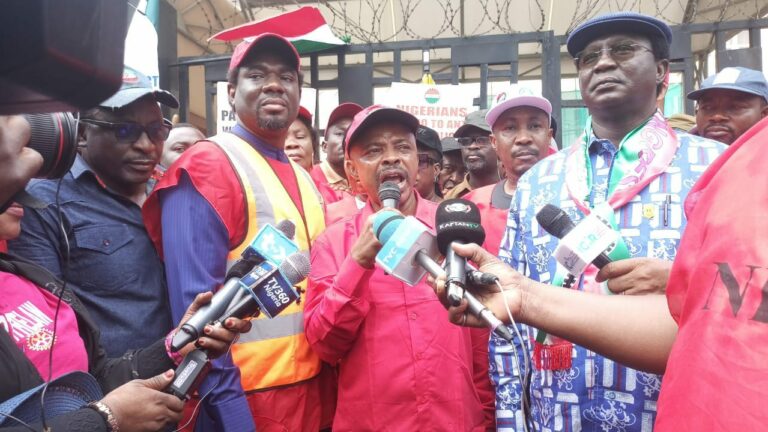
THE Nigeria Labour Congress has warned the Nigerian government against engaging in a “war-war” situation with Nigerians by trying to suppress citizens’ fundamental right to protest.

The union in a statement, on Monday, July 22, noted that it’s condescending and dismissive to label the daily harsh struggles faced by Nigerians as a politically motivated dissent.

It urged the government to negotiate with the protesters instead of taking actions that could undermine citizens’ rights to express their grievances.

The ICIR reports that some Nigerians, along with a group led by former presidential candidate Omoyele Sowore, have been mobilising to start nationwide protests in the first week of August.

The posts and tweets on the protest carry different hashtags, ranging from #RevolutionNow, #EndBadGovernanceInNigeria, #TakeItBack, #DaysofRage and #TinubuMustGo.

However, reacting to the different calls for the protest, the Special Adviser to the President on Information and Strategy, Bayo Onanuga, on Saturday, July 20, said the presidential candidate of the Labour Party in the 2023 elections, Peter Obi, should be held responsible for his supporters’ alleged plans to cause mayhem in the country.

He noted that the “protest planners are also the same people who were instigated by IPOB leader Nnamdi Kanu to launch the destructive ENDSARS protest in Nigeria in October 2020. ENDSARS began as a genuine protest by youths against the Police Special Anti-Robbery Squad, notorious for its high-handedness. 

“IPOB members planning to extricate the South-East region from Nigeria infiltrated the protest and hijacked it for their own agenda. Lagos still bears the scar of the malicious destruction by IPOB elements until today.”

According to him, the IPOB and Obi’s supporters are the people spreading the hashtags ‘EndBadGovernance’, ‘Tinubu Must Go,’ and ‘Revolution2024’. 

He further described them as anarchists and not democrats, noting that they were attempting to call out their people via propaganda due to Obi’s failure to win the presidency in the 2023 election. 

“If they understand the meaning of their hashtags, they will realise they are clarion calls for treason. Wanting to end an elected government is high treason. Wanting revolution is a call for a coup d’etat, which is also high treason,” the presidential aide added.

Reacting to this, the NLC, said the government should negotiate by inviting the leadership of the protest movement for discussions on their grievances.

The NLC president, Joe Ajaero, said in the statement, “The truth is that millions of Nigerians are angry about the state of the national economy. A situation where most Nigerian families are forced to eat one miserable meal a day and eating from the dustbin beckons for serious intervention by the government.”

Ajaero also cited a recent living standards index assessment by the National Bureau of Statistics, revealing that approximately 133 million Nigerians live in multidimensional poverty.

“When this statistics is added to the millions that are being recruited into the armies of the unemployed and under-employed Nigerians, one can easily situate the hardship, pain, frustrations and despair that many Nigerians are going through right now.

“The truth is that Nigerians have been hard pushed and super-pressed right against the walls of deep deprivation and acute want. It is, therefore, condescending and dismissive to describe the daily brutish ordeal that Nigerians are going through as a sponsored political dissent.”

The presidency’s recent reaction was also at the heel of the security agents calling on the citizens not to partake in the planned nationwide protest.

Olympics 2024: Tobi Amusan named Nigeria’s flagbearer

0

NIGERIAN track and field athlete, Tobi Amusan, has been named as Nigeria’s flag-bearer in the opening ceremony of the Paris 2024 Olympic Games.

This was announced on Tuesday, July 23, by the Nigeria Olympics Committee (NOC), in collaboration with the Federal Ministry of Sport via a post on X by Making of Champions.

“Tobi Amusan has been named as Nigeria’s flagbearer for the opening ceremony of #Paris2024 #Olympics – she becomes the first athlete from Athletics in 20 years, since Mary Onyali at the Athens 2004 Games, to have such honours.” the post says in part.

In 2022. Amusan broke the world record in women’s 100-meter hurdles, winning the gold medal at the World Athletics Championship.

She clinched the record with 12.12 seconds, beating Kendra Harrison’s 2016 record of 12.20 by eight seconds.

Amusan’s performance at the final was initially announced as a world record, but later ruled ineligible as the wind speed exceeded the legal limit.

Alongside Amusan, the committee also announced the appointment of Badminton player, Anuoluwapo Opeyori, as the general team captain for Nigeria.

Opeyori has been representing Nigeria since 2017. In 2019, he won the African Championships and African Games in the singles event and also competed at the Tokyo 2020 Olympic Games.

The 2024 Olympics is set to take place from July 26 to August 11, 2024, in France with the opening ceremony scheduled for July 26 at River Seine.

Dangote seeks lawmakers’ probe of poor-quality fuel in filling stations

0

CHAIRMAN of Dangote Industries Limited, Aliko Dangote, has urged federal lawmakers to probe ‘poor quality’ fuel in circulation at various filling stations and other retail outlets in Nigeria.

Dangote said many vehicle issues could be traced to the “substandard” imported fuel.

He urged the House of Representatives leadership to set up an independent committee to verify the quality of petrol available at filling stations.

He also alleged that some Nigerian National Petroleum Company Limited (NNPCL) officials had opened a blending plant in Malta.

Dangote stated these at the House of Representatives on Monday, July 22.

An oil blending plant has no refining capability but can blend re-refined oil (a used motor oil that has been treated to remove dirt, fuel, and water) with additives to create finished lubricant products.

“Some of the terminals, some of the NNPC people, and some traders have opened a blending plant somewhere off Malta,” Dangote claimed.

“We all know these areas. We know what they are doing.”

Commenting on diesel quality, the billionaire said the diesel produced locally at 650 parts per million (ppm) and 700 ppm is of better quality than imported fuel.

“I want you to set up a committee that will come with every representative headed by your chosen honorable member to come and lead in taking samples from filling stations because I must tell you today that all the test certificates that people are busy floating around, where are the labs? Even if they have the labs, I can tell you they are fake certificates,” he said.

“The real one that you now know that they are right is to take from the filling station and also come and take from our production line. Now, you will be able to tell Nigerians that this is it,’ he added.

On Monday, the House of Representatives Joint Committee on Petroleum Resources (downstream and midstream) launched a probe into claims that local refineries, including the Dangote Petroleum Refinery, produce inferior products.

The committee is also investigating the allegations that the international oil companies (IOCs) in Nigeria are frustrating the survival of the Dangote Refinery.

The Nigerian Midstream and Downstream Petroleum Regulatory Authority (NMDPRA) has been daggers-drawn with Dangote Petrochemical Refinery.

On July 18, the chief executive officer of NMDPRA, Farouk Ahmed, said the Dangote refinery, was producing inferior products compared to the ones imported into the country.

The ICIR reported that the oil regulator also accused Dangote of monopoly, claims which have been denied by the billionaire through laboratory test results by some federal lawmakers.


Minister meets with Dangote, oil regulator in bid to resolve raging feud

0

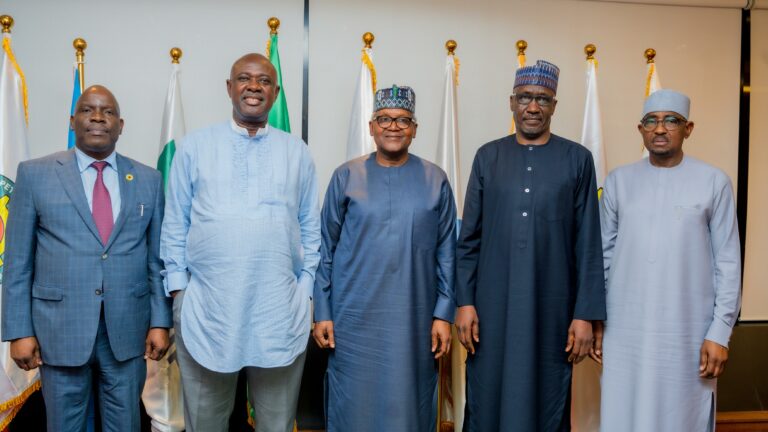
THE Minister of State Petroleum Resources (oil) Heineken Lokpobiri, has met with the chairman and chief executive officer of Dangote Petroleum Refinery, Aliko Dangote, and the chief executive officer of Nigerian Midstream and Downstream Petroleum Regulatory Authority, Farouk Ahmed, (NMDPRA)

The meeting was held on Monday, July 21, to resolve ongoing issues surrounding the Dangote Refinery, according to a statement by the minister’s special adviser on media and communication, Nneamaka Okafor.

It also focused on finding a sustainable and lasting solution to the challenges facing the Dangote Refinery, with the parties promising to jointly address the issues.

At the meeting, the minister emphasised the importance of cooperation and synergy among all stakeholders to ensure the success and optimal performance of the oil and gas sector, which is pivotal for Nigeria’s economic growth and energy security.

Dangote and the Nigerian petroleum regulator – NMDPRA – have been at daggers-drawn over his refinery’s access to Nigeria’s crude with the regulator recently casting doubt over the quality of his diesel.

The impasse between both parties also led to Dangote’s affirmation that the NNPCL did not own a 20 per cent share in his company because of failure to fulfil certain payment obligations.

The business mogul had admitted regrets, in investing over $20 billion in the refinery.

He has been lamenting how difficult it has been to get the feedstock required to keep his company’s 650,000 capacity running, compelling it to source crude oil supply from Brazil and the United States.

Against this backdrop, the minister said that the meeting marked a significant step towards resolving the challenges and underscored his dedication to fostering a conducive environment for Nigeria’s oil and gas sector.

Present at the meeting are the chairman and CEO of Dangote Group, Aliko Dangote,
chief executive of  NMDPRA, Farouk Ahmed, chief executive of Nigerian Upstream Petroleum Regulatory Commission (NUPRC), Gbenga Komolafe, and group chief executive officer of NNPCL, Mele Kyari.

The ICIR reported the visit of the members of the House of Representatives to the Dangote Refinery on Saturday, July 19.

A laboratory test conducted by the lawmakers during the visit, however, showed that Dangote oil was not inferior to those imported as claimed by NMDPRA, prompting the lawmakers to institute an independent inquiry into possible importation of dirty fuels into the country.


Nigerians react to Nigerian government, Dangote’s clash

THE ongoing war between the Dangote Refinery and the Nigerian National Petroleum Corporation (NNPCL) continues to generate reactions from Nigerians as the Chairman of Dangote Group, Aliko Dangote, has challenged the NNPCL to buy out his refinery.

Dangote disclosed this according to a Premium Times report on Sunday, July 21.

The report shows the African richest man saying he is willing to give up ownership of his $19 billion oil refinery to the state-owned energy company NNPCL, following the government’s claim that products refined by the company were of lower quality than those imported by the NNPCL.

“Let them (NNPCL) buy me out and run the refinery the best way they can. They have labelled me a monopolist. That’s an incorrect and unfair allegation, but it’s OK. If they buy me out, at least, their so-called monopolist would be out of the way.

“As you probably know, I am 67 years old, in less than three years, I will be 70. I need very little to live the rest of my life. I can’t take the refinery or any other property or asset to my grave. Everything I do is in the interest of my country,” the report quoted Dangote to have said.

While the refinery can help resolve Nigeria’s fuel and foreign exchange challenges, Dangote stressed that “it does appear some people are uncomfortable that I am in the picture. So I am ready to let go, let the NNPC buy me out, (and) run the refinery. At least the country will have high-quality products and create jobs.”

Since January when the Dangote refinery started diesel and jet A1 production and slashed the pump price of the products, the company’s management has been in a war of words with the regulators.

The Dangote refinery has been lamenting how difficult it has been to get the feedstock required to keep its 650,000 capacity running, compelling it to source crude oil supply from Brazil and the United States.

At various times, it accused the international oil companies and the regulatory authorities of frustrating its efforts to get crude oil supply.

Commenting on the Dangote’s position to throw in the towel, an X user, Okaka Odumodu, tweeted, “You want to hand the refinery to the NNPC which has not been able to get the nation’s refineries to work? It means that the refinery will never work.”

Another X user at @majorlouwe said the NNPC didn’t want any of the nation’s refineries to work, adding that it is a deliberate sabotage that none of the refineries was working.

“We need a revolution to chase out all the corrupt politicians and workers behind NNPC failure not making any of our refinery work,” @ambidehen tweeted, adding that Nigerians needed to rise against those constantly sabotaging things that were supposed to benefit the entire country and share among themselves.

Also, @frankdarl gave a twist, “He wants a way out and that’s the only way out now, let them buy him out. Too much has been invested and the failure of getting anything can be a really big blow.”

Other Nigerians believe that it is a payback time for the wealthiest man in Africa.

“He has been a state-endorsed and backed monopoly for over 25 years. Always backed up by Aso Rock and the CBN @cenbank,” @June12Post commented.

“That monopolist tag really pained Dangote but we have known all along. What is paining him is that the gov’t that he expects to protect him is the one calling him out. But the truth is bitter,” @RolandNGabriel also shared his view.

On Sunday, July 21, The ICIR reported that the Dangote refinery had challenged the Nigerian Midstream and Downstream Petroleum Regulatory Authority (NMDPRA) to conduct tests on its products to determine the credibility of the agency’s claim that its diesel was inferior to those imported.

The Chief Executive Officer (CEO) of NMDPRA, Farouk Ahmed, told journalists that the products from the Dangote refinery were much inferior to the imported quality.

He added that the Dangote Refinery was still in the pre-commissioning stage and had not been licensed yet.

Many industry analysts believe the coming of Dangote Refinery in the Nigeria oil and gas sector was a threat to the government and state-owned oil refinery, NNPCL.

In a recent interview with The ICIR, a former chairman of the Major Oil Marketers Association of Nigeria, Adetunji Oyebanji, while responding to a question about whether he sees the Dangote Refinery emergence as disrupting the market with the NNPCL price-control regime, it was expected that Dangote would try to protect his interests and maximise returns on his refinery.

“The good thing is to know that with the Petroleum Industry Act (PIA), the price has been deregulated. We would sell according to what we buy. On the Nigeria National Petroleum Company Limited-NNPCL, I won’t want to make any speculation, even though commercially, you look at the price they’re selling and you can judge whether it’s a price that makes economic sense,” he added.

Nigeria has been importing refined petroleum products despite producing crude and having four moribund refineries.

Court dismisses Abacha family’s N500m suit against FG over Abuja property

0

A FEDERAL High Court in Abuja has dismissed a suit initiated against the Federal Government by the family of the former Head of State, Sani Abacha.

The suit was filed to prevent the revocation of the late military ruler’s property based in the Maitama District of Abuja.

The Judge,  Peter Lifu, dismissed the lawsuit in a ruling on the nine-year-old dispute in which the Abacha family is requesting N500 million in damages and the return of their father’s house situated on Osara Close, Maitama.

According to the ruling, the lawsuit was dismissed for several reasons, including the fact that the plaintiffs lacked the legal standing to file the lawsuit in the first place and that the complaint was already statute-barred when it was filed in 2015.

The former military ruler’s eldest surviving son, Mohammed Sani Abacha, and his widow, Maryam Abacha, filed the lawsuit on behalf of the late Abacha’s estate managers.

The Federal Capital Territory (FCT) Minister, the Federal Capital Development Authority (FCDA), the President of the Federal Republic of Nigeria, and Salamed Ventures Limited are named as the suit’s first through fourth defendants.

After losing twice at the FCT High Court and once at the Court of Appeal in Abuja due to jurisdictional issues, the family’s lawsuits over the property have now been dismissed for the fourth time.

The family asked the Federal High Court to nullify and set aside the revocation of the certificate of occupancy (C of O) of the property of the late leader.

The family said in its statement of claims that between 2004 and 2005, the FCT under Nasir El-Rufai as the minister ordered it to submit the certificate of occupancy for re-certification.

It claimed that Mohammed Sani Abacha, the second plaintiff, complied with the directive by giving the FCDA the C of O and received an acknowledgement copy for the submission.

According to the family, it was waiting for a new C of O to be provided on February 3, 2006, when Mohammed Abacha got a letter informing him that it had been revoked without any justification.

The fourth defendant, Salamed Ventures Limited, represented by James Ogwu Onoja, a senior advocate, contended that the lawsuit had lost jurisdiction at the time it was commenced since it was not submitted within the legally permitted three-month period.

In his judgment, the judge agreed with Salamed Ventures that the Abacha property was rightfully revoked due to breaches in the right of occupancy, including the erection of structures without first obtaining building plans.

After dismissing the lawsuit, the judge mandated that the Abacha family pay Salamed Ventures N500,000 for legal fees.

The ICIR reported how subsequent governments in Nigeria recovered funds looted by the late Abacha, including the return of about $723 million from Switzerland, and other sums from other countries allegedly running into $5 billion in total.

However, a Federal High Court in Abuja, on July 3, ordered the Nigerian government to disclose how the $5 billion Abacha loot was spent

The court directed the administration of President Bola Tinubu todisclose the exact amount of money stolen by General Sani Abacha from Nigeria, and the total amount of Abacha loot recovered and all agreements signed on same by the governments of former presidents Obasanjo, Yar’Adua, Jonathan and Buhari”.