NIGERIA has lost about 619 barrels valued at $46.16 billion (N16.25trillion) from oil theft as of 2022, the Executive Secretary of the Nigeria Extractive Industries Transparency Initiative (NEITI), has revealed.
The NEITI boss, Orji Ogbonaya Orji, who made this known during an exclusive interview with The ICIR said the losses account for more than the size of the country’s entire foreign reserves and almost 10 times the size of her oil savings(excess crude) account within the period in review.
According to him, NEITI’s audit reports covering a period of twelve years, show that Nigeria loses an average of more than 140,000 barrels of crude oil per day.
“You see, oil theft has done more damage to the oil and gas industry more than any other sector. Nigeria lost about 619 million barrels valued at $46.16 billion or N16.25 trillion. The losses are more than the size of Nigeria’s entire foreign reserves and almost 10 times the size of the country’s oil savings (excess rude) account as of 2022.
“A further analysis shows that on the average, Nigeria lost $10.7 million daily, $320 million monthly every year for 12 years between 2009 and 2020. The average yearly value of crude oil loss is nearly one-fifth of the amount Nigeria earned from the sector in 2020, Orji said.
According to him, the average annual loss (N1.77 trillion) represents 135 per cent of the total proposed infrastructure spending on works, housing, power, transport water resources and aviation for 2023.
On NEITI’s role in addressing the situation Orji said in 2018 the agency produced a policy brief on crude oil theft and held a policy dialogue on the issue.
He said on December 6, 2022, ex-President Muhammadu Buhari set up a nine-member panel of investigation on oil theft and losses chaired by a major general, Barry Ndiomu and coordinated by the former National Security Adviser, a general, Mohammed Muogono.
“NEITI was the only anti-corruption agency to serve on the panel among other reputable Nigerians carefully selected for the assignment. The panel’s report with insightful findings and recommendations was presented to the former National Security Adviser (NSA), Major General Babagana Mungono (Rtd), on March 28, 2023. The Report is current, comprehensive in content with specifics on what needs to be done.
“NEITI has since in its policy advisory to President Tinubu requested the implementation of the findings and recommendations of that report. Our legitimate interest in the report is in view of the terrible damage oil theft has done to the country on revenues loss, environment, terrorism financing, stealing of Nigeria’s crude, transparency and accountability in the oil and gas industry.”
Fuel subsidy removal
Speaking on NEITI’s position on fuel subsidy removal that has thrown Nigerians into untold economic hardship he said the agency’s independent industry reports over the years had consistently raised red flags that the management of the fuel subsidy regime was anything but open, transparent and accountable and advocated its removal.
“From our records, we support the removal of the subsidy as a result of the huge burden it has imposed on the economy over the years but with robust visible and impactful welfare benefits for the citizens, the poor and vulnerable in society.
“Our position remains remove and replace with welfare programmes-based revenues that will be freed from subsidy removal. Other measures we recommended include deliberate policy incentives to encourage private investment in refineries, repair of Nigeria’s four refineries.
“Data from NEITI reports show that over about $74.38 billion (N13.69 trillion) has been expended in the payment of subsidy between 2005 -2021. NEITI’s frustration is in the amount of money spent on subsidy. This amount if available for development was more than enough to address Nigeria’s energy/power sector challenges, repair the refineries, or even build brand new ones to make the country a net exporter of refined petroleum products.
“For instance, in order to accommodate the increase in subsidy expenditure a whopping sum of N4 trillion appropriated in year 2022 budget was suddenly slashed from the budgets of health, education, planned investment in infrastructure, intervention budgets in the Niger Delta and from the North-East development commissions budgets to pay for subsidy,” he said.
AFTER weeks of show-stopping performances, Chima Udoye,also known as Chima, has emerged winner of the Nigerian Idol Season 9.
The ninth edition of the music reality Tv show came to an end on the evening of Sunday, July 14, with Chima claiming the ‘Nigerian Idol’ crown.
Chima was presented mouth-watering prizes including a cash prize of N30 million, a brand-new SUV, record deal, accompanied by a music video shoot, a fully installed DStv Explora with a premium subscription for 12 months., among other prizes.
The presentation was done by the Executive Head, Content & West Africa Channels, MultiChoice Nigeria, Busola Tejumola.
The finale kicked off with a performance by the host, Ik Osakioduwa and the top 10, delivering the song, ‘Glory’ by John Legend.
This was followed by a performance from the season 7 winner, Progress with the song, ‘Uncle Suru’ by Jon Ogah.
After that was a performance by Omawumi, one of the judges of the edition and the top 7 finalists, performing the song, “Thank You”,
Then, a performance by the season 8 winner of the show, Victory Gbakara, who performed the song, ‘Don’t Give up on your Dreams’, followed.
For their final performances, Chioma and Lammy who made it to the top 3. thrilled the audience with their performances.
While Chioma tendered the song, ‘Roar’ by Katy Perry of her 2013 album, Lammyg ave an outstanding performance with, Sam Smith’s Pray from the 2017 album, ‘The Thrill of it All’.
Similarly, Chima performed ‘Feeling Good’ by Micheal Buble from his 2005 album, ‘It’s Time’.
There was also a musical performance by the artistes, Chike with the song, ‘Man Not God’ and Simi with the song ‘Borrow me your baby’.
The top 10 finalists include Jennifer Ugomu, David Garland, Chima, Mira Clear, Gracia, Stevie, Chioma, Lammy, Lady Ruth and Maio.
Chima, the winner, said he loved singing because it is a way for him to express himself.
He explained that he was a participant in the previous edition, season 8 of the show, but failed to make it through.
The ICIR reported that Nigerian Idol has been providing a platform for many talented singers to launch their careers and gain recognition in the Nigerian music industry.
FORMER President of the United States (US) and Republican candidate in the upcoming elections, Donald Trump, was shot in the ear on Saturday, July 13, 2024, during a campaign rally in Pennsylvania.
The ICIRreported that the Federal Bureau of Investigation (FBI) identified the suspected shooter after he was killed at the scene.
The shooter was identified as 20-year-old Thomas Matthew Crooks from Bethel Park, Pennsylvania.
He was killed at the scene by a Secret Service sniper after firing several shots with an AR-15-style semiautomatic rifle during a campaign rally.
A bullet grazed the upper part of Trump’s ear, while a bystander was killed. Two other people were critically injured in the incident.
The ICIR reported that World leaders, including President Joe Biden, a Democratic candidate, who is contesting against Trump at the polls, condemned the attack.
Here are some key details about Trump’s attempted killer.
He was a resident of Bethel Park, Pennsylvania, according to the BBC.
The Pittsburgh Tribune-Review reported that Bethel Park is approximately 70 km (43 miles) from Butler, where the attempted assassination took place.
Crooks attended Bethel Park High School and graduated in 2022 and he received a $500 “star award” from the National Math and Science Initiative.
A video of the ceremony, posted online shows Crooks, wearing glasses and a black graduation gown, receiving his high school diploma and posing with a school official.
According to US media, state voter records reveal that Crooks was a registered Republican. The upcoming November 5 election would have been his first chance to vote in a presidential race.
In 2021, a Federal Election Commission filing showed that Crooks, at age 17, donated $15 to ActBlue, a political action committee supporting left-leaning and Democratic politicians. This donation was part of a national initiative by the Progressive Turnout Project, an organisation that encourages Democrats to vote in elections.
A REPORT by the International Centre for Investigative Reporting (ICIR) has won the maiden edition of the PHC Media Challenge Award floated by the development Research and Projects Centre (dRPC) and the Nigerian Academy of Medicine (NAMED) in 2023.
The ICIR’s News Editor, Marcus Fatunmole, won the award with a N1 million prize and a certificate at an event held in Abuja on Friday, July 12.
He won the award with his investigative report supported by the International Budget Partnership under the Strengthening Public Accountability for Results and Knowledge (SPARK) project.
The report titled, “How inadequate manpower cripples primary healthcare in Nasarawa” exposed the challenges facing primary healthcare in Nasarawa state.
The state government employed 300 new health workers shortly after the report was published.
In 2022, The ICIR, through the IBP’s support investigated the implementation of the
Fatunmole is a health journalist with over a decade of experience in covering Nigeria’s health sector.
The first runner-up at the award was Lara Adejoro of the Punch Newspaper, while a former PREMIUM TIMES reporter, Nike Adebowale, won the second runner-up award.
Adejoro got N500,000, while Adebowale won N300,000. Both reporters were also awarded certificates.
Ten other journalists shortlisted for the award won N50,000 each.
Background to The ICIR’s report that won the award
To bridge gaps in primary healthcare delivery services, particularly for the poor and vulnerable, the Nigerian government, in 2019, rolled out the Basic Health Care Provision Fund (BHCPF) enshrined in the 2014 National Health Act.
It is a pool funded with at least one per cent of the nation’s consolidated revenue and other funding sources, including donor contributions.
Almost three years into the implementation of the Fund, Fatunmole and other journalists, with the support of the International Budget Partnership and the International Centre for Investigative Reporting, visited hundreds of PHCs across 120 local government areas in 12 states of Nigeria to assess the impact of the fund and the implementation of the Midwife Service Scheme (MSS) earlier introduced by the Federal Government to support improved services at the nation’s PHCs.
The states are Anambra, Ebonyi, Cross River, Akwa Ibom, Ogun, Oyo, Kano, Jigawa, Gombe, Bauchi, Niger and Nasarawa. Read the reports here.
The ICIR is an independent, non-profit news agency that promotes transparency and accountability through robust and objective investigative reporting.
Scores of The ICIR’s reports have won awards locally and internationally.
THE Special Adviser to President Bola Tinubu on Health, Salma Ibrahim, has warned of dangers associated with Nigeria’s increasing population.
Ibrahim issued the warning on Friday, in Abuja at a symposium to commemorate the United Nations World Population Day.
The symposium which had reproductive and other health experts in attendance to brainstorm on the challenges associated with Nigeria’s reproductive health.
Convened by the development Research and Project Centre (dRPC), in collaboration with the Population Association of Nigeria, the event had the theme, “Embracing the Power of Inclusive Data Towards a Resilient and Equitable Future for All.”
Ibrahim said unchecked population was a source of worry for any government because it would affect the government’s ability to deliver quality health services.
She argued that the populations of advanced nations were decreasing but those of the developing countries were rising.
She explained that Nigeria’s population would surpass the US in 2050, which could further compound the nation’s socio-economic challenges, maternal health and other crises facing the nation.
Ibrahim said, “The country (Nigeria) has one of the highest populations in the world and is likely to surpass the US by 2050. As a country with high levels of poverty, this is a problem.”
Besides, she said a rapidly growing population would be a problem because many citizens could not feed themselves under the Tinubu government.
While urging states to support the federal government’s efforts to deliver quality and affordable care, Ibrahim said the federal government was firm in its decision to make family commodities available for all who needed them.
The ICIR reports that Nigeria currently ranks sixth globally among most populated nations, trailing India, China, the US, Indonesia and Pakistan.
Efforts by the Nigerian government to conduct a census in the past two years have failed. The last census by the country was done in 2006.
The United Nations recommends that every country conduct a census within ten years.
In her address, Ibrahim said, “There are several policies that are in place beyond the health sector and actually in the health sector. Of course, the health sector is a critical contributor to population management.
“In the area of reproductive, maternal, newborn and child health and family planning, there are several policy documents that we have in Nigeria, including policy with engagement with the private sector on how to improve access to family planning commodities. What is most important is family planning, we need to acknowledge, is a game changer.”
She submitted that family planning was a right issue, and Nigeria signed the declaration in 2012. Nigeria has been providing free family planning services with the support of the Federal Government of Nigeria, she noted, promising that Tinubu’s administration remained committed to it, to the rights of women, improving the health of mothers and children, including improving access to reproductive health commodities.
Ibrahim said family planning was approved in the 2024 budget.
Urging the sub-national governments to support the federal government, she said, “This is just a catalytic support by the Federal Government. The Federal Government cannot do it alone. The responsibility lies with the sub-national government. Every state government has a dedicated budget that is dedicated to the improvement of the health of women and children. Today, Nigeria has one of the burdens of maternal deaths and also new-born deaths, if you look at the picture globally.
“So, federal and state governments must have a programme and dedicated account for reproductive health commodities in their state, as an integral part of their efforts towards improving the health of women. Family planning is part of it.”
In his remarks, the President of Gynaecology and Obstetrics Nigeria, Okechukwu Ikpeze, a professor, said family planning was imperative, given the high population and fertility in the country.
He said in the past, women gave birth believing that at least half of the children they had would survive because of high child mortality.
He argued that the nation had moved past that era and people should have the number of children they could raise to add value to society.
According to him, the nation’s economic situation has been worse than it used to be, as people find it difficult to feed and enjoy basic things they need. Consequently, couples should have the number of children they could train, he urged.
“There are some countries with limitations on the number of offspring allowed and they are doing better than us. But here, we think numerous children are an asset and we need to address this,” he stated.
President of the Nigerian Academy of Medicine (NAMed) Samuel Ohaegbulam, expressed delight with the symposium and hoped that the discussions at the event would be a game-changer for better reproductive health in the country.
In his remarks, the President of the Association of Reproductive Health (ARHF), Oladipo Ladipo, called for more public sensitisation on reproductive health and family planning in Nigeria.
While highlighting the gains of family planning for families, communities and nations, he urged that stakeholders “evangelise family planning. We must also talk about it in the church, in the mosque and use all modes of communication to promote family planning. If we fail to plan, nature will do it for us and nature will do it with planning and that is the phase we are going through now,” he stated.
He called for effective population management in the country, stressing that proper population data management would enhance development.
Similarly, the Project Director of the Partnership for Advocacy in Child and Family Health at the dRPC, Stanley Ukpai, said at the symposium that Nigeria needed good population data to plan for prosperity and development.
“Like every other civil society organisations, what we are doing is research; dRPC, being a research organisation. Our data are in alignment with the theme that is looking at Nigerians all over the world to embrace inclusive data. What we are doing is looking at the data that we currently have to inform the government that the population that we have, if left unchecked, might predispose us to more challenges, especially as our human capital development is not where it should be.
“From the analysis of the human capital development from last year, we haven’t done a census in the last 18 years, which is indicative of the policies that we’ve been churning out in that period is informed by current data to drive that process. Even when you look at issues around population dynamics, health, education, and even social investments, all of these rely on the use of data. We are calling on the government to invest in the census and invest in using data for the right policy-making and policy implementation,” Stanley noted.
The highlight of the event was the presentation of awards to journalists who were shortlisted for the PHC Media Challenge Award floated by dRPC and NAMED in 2023.
The ICIR’s News Editor, Marcus Fatunmole, won the award with a N1 million prize and a certificate.
He won the award with his investigative report supported by the International Budget Partnership under the SPARK project.
The report titled, “How inadequate manpower cripples primary healthcare in Nasarawa” exposed the challenges facing primary healthcare in Nasarawa State.
The state government employed 300 new health workers shortly after the report was published.
The first runner-up at the award was Lara Adejoro of the Punch Newspaper, while a former PREMIUM TIMES reporter, Nike Adebowale, won the second runner-up award.
Adejoro got N500,000, while Adebowale won N300,000. Both reporters were also awarded certificates.
Meanwhile, 10 other journalists shortlisted for the award won N50,000 each.
THE Federal Bureau of Investigation (FBI) has identified the suspected shooter in the attempted assassination of the former president of the United States (US) and candidate in the forthcoming elections, Donald Trump.
According to a report by BBC, the FBI identified the shooter as 20-year-old Thomas Matthew Crooks from Bethel Park, Pennsylvania.
He was killed at the scene by a Secret Service sniper, after firing several shots using an AR-15-style semiautomatic rifle during a campaign rally.
A bullet pierced the upper part of Trump’s ear, while a bystander was killed. Two other persons were left critically injured in the process.
Although investigators are yet to identify the motive behind the shooting, dozens of law enforcement vehicles have been posted to the home of the deceased suspect.
Trump was quickly led off the stage by law enforcement officials, following the shooting on Saturday, July 13.
In a video that has since gone viral online, Trump was seen with blood on his right ear and parts of his face as he was being led out of the scene.
“I knew immediately that something was wrong in that I heard a whizzing sound, shots, and immediately felt the bullet ripping through the skin,” Trump wrote.
“Much bleeding took place, so I realised then what was happening,” he later posted via social media.
World leaders have condemned the attack, including current US president and Trump’s major opponent Joe Biden, who described it as ‘sick’.
“There’s no place in America for this kind of violence. It’s sick. It’s sick. It’s one of the reasons why we have to unite this country. We cannot be like this, we cannot condone this,” Biden told journalists.
He urged everyone to condemn the attack and political violence in the country.
THE Lagos State Police Command has taken one of its officers into custody for allegedly raping a 17-year-old girl at the Area H Command in the Ogudu area of the state.
The command’s spokesperson, SP Benjamin Hundeyin, confirmed the detention in an X post on Sunday, July 14, and denied claims that the police were protecting the suspected rapist.
“The Lagos State Police Command has placed under arrest one of its personnel accused of defiling a 17-year-old girl.
“The Commissioner of Police, Lagos State Command, CP Adegoke Fayoade, mni has, meanwhile, directed a full-scale and thorough investigation into the allegation,” part of the statement read.
The statement further noted that the command reassured the public that it was not attempting to conceal the incident, emphasising that such acts contradicted the Nigeria Police Force’s code of conduct and professional ethics.
It vowed that the officer would face appropriate disciplinary measures and legal action if proven guilty.
It was reported that the police officer, stationed at the Ogudu Police Station in Ojota, had offered to help the teenager recover her phone, which had been stolen by ‘one chance’ robbers on June 16 while she was returning from Ikeja with her relatives.
Reports indicate that the suspect allegedly overheard the teenager narrating the theft to her mother at her shop and offered to assist in finding the missing phone and taking her statement.
According to the teenager, the officer called her mother on June 29, informing her that he had apprehended the person with the phone and asked her mother to send her to the police station.
She stated that upon arriving at the station, the officer sent his personal assistant to bring her to his office.
The teenager alleged that once she entered the suspect’s office, he locked the door, began harassing her, and eventually raped her.
WORLD leaders have condemned Saturday’s shooting of former US President, Donald Trump, and the Republican presidential candidate for the 2024 election.
US President Joe Biden, who is also seeking re-election as Trump, frowned at the shooting and warned that such character should not define the country.
He said, “Everybody must condemn” the act as he awaited more information to formally declare the shooting an attempted assassination on his rival.
“We cannot allow this to be happening,” Biden said, adding that “The idea that there’s violence in America like this is just unheard of.”
Biden, who addressed the nation about two hours after the shooting, expressed delight that Trump was doing well after the incident.
Meanwhile, the White House said he spoke with Trump after the address.
Reacting to the attack, Turkish President Recep Tayyip Erdogan said, “I strongly condemn the attack on the 45th President and presidential candidate of the United States, Donald Trump.”
He expressed hope that an investigation would be launched into the attack and that perpetrators would be identified and punished.
Erdogan sympathised with the Trump family and promised that his country would continue
“to support the friendly and allied American people.”
In Israel, Prime Minister Benjamin Netanyahu said he was “shocked by the apparent attack on President Trump,” as he expressed his sympathy with the Republican candidate.
“We pray for his safety and speedy recovery,” Netanyahu said.
Former Presidents Barack Obama and Bill Clinton also deplored the attack in separatestatements on their X page on Saturday.
The European Union’s foreign policy chief, Josep Borrell, condemned the attack. “Once again, we are witnessing unacceptable acts of violence against political representatives,” the EU said.
Brazil’s President Luiz Inacio Lula da Silva urged that the shooting “must be strongly condemned by all defenders of democracy and political dialogue.”
Similarly, Japanese Prime Minister Fumio Kishida also castigated the masterminds of the attack, urging that “we must stand firm against any form of violence that challenges democracy.”
An independent presidential candidate, Robert Kennedy, whose father was killed during his presidential campaign, also condemned the attack.
Kennedy said in a statement, “Now is the time for every American who loves our country to step back from the division, renounce all violence and unite in prayer for President Trump and his family.”
British Prime Minister Keir Starmer was “appalled by the shocking scenes at the rally,” adding that “Political violence in any form has no place in our societies.”
Argentina’s President Javier Milei blamed the “international left” for the attack.
“In panic of losing at the polls, they resort to terrorism to impose their backward and authoritarian agenda,” he stated.
Trump was shot in his right ear at a political rally in Pennsylvania on Saturday, June 13.
In a viral video on X, the Republican candidate was seen with blood on his right ear being whisked away by Secret Service agents after the incident to a waiting vehicle while he raised his up saying “fight”.
Speaking after the incident, Trump said he was shot with a bullet that pierced the upper part of his right ear.
“I knew immediately that something was wrong in that I heard a whizzing sound, shots, and immediately felt the bullet ripping through the skin. Much bleeding took place, so I realized then what was happening. GOD BLESS AMERICA!” he said.
According to reports, the shooter was said to have been killed while an attendee was also killed. Trump’s campaign says he is “fine” after being whisked off the stage and is being checked out at a local medical facility.
Meanwhile, Trump expressed gratitude to the US Secret Service and law enforcement for their prompt action and offered sympathies to the family of the person who was killed at the rally and the other seriously injured person.
The incident marked the first attempt to kill a president or presidential candidate since Ronald Reagan, the 40th President of the US was shot in 1981.
Gunman, who was reportedly killed by the Secret Service, carried out the attack.
In May, The ICIR reported that Trump was found guilty of all 34-count preferred against him by Biden’s administration in a hush-money case, though the ruling would not affect his participation in the presidential race.
BENUE State in Nigeria’s north-central region has one of the highest maternal mortality rates in Nigeria. This is due to the widespread lack of access to healthcare across its rural communities. In this report, Arinze Chijioke visits Gboko and Ohimini local government areas (LGAs), where he uncovers the tragic stories of maternal and child mortality due to government’s neglect of healthcare needs.
An ancient structure that bears no semblance to a healthcare centre sits at the middle of Affoh, one of the communities nestled in the remotest part of Gboko local government area (LGA) in Benue state.
Built in 1986 through community contributions, the facility has three rooms: one for deliveries, another serving as both a waiting area and patients’ sleeping quarters, and a third, added in 2018, housing a cold room, was also funded through individual contributions.
In 2023, Laadi Terhemba, eight months pregnant, was rushed to this facility after she began bleeding and needed a blood transfusion. Outside the facility, blood donors were on ground, waiting to be called upon to help save her life. But the workers said that they could not attend to her because they lacked essential equipment such as infusion pumps, blood warmers, rapid infusers, and pressure devices necessary for blood transfusion.
Akaayaa Msugh, Terhemba’s relative, recounted that they were referred to the Gboko General Hospital, 30 kilometres away from the community. This journey, fuelled by a desperate hope for a miracle, became a death march. Terhemba died on the way with her unborn child after losing a lot of blood.
This is not an isolated incident. Benue State, situated in north-central Nigeria, has a maternal mortality rate of 1,189 per 100,000 live births as of 2020. These figures are nowhere near the Sustainable Development Goals (SDGs) target of 70 per 100,000 live-births by 2030.
Toilet facility, delivery table, bed and store room Inside Affoh primary health centre
Nigeria accounts for the second-highest number of maternal and child deaths globally, contributing 12 per cent of the world’s total. According to UNICEF global maternal mortality report, about 82,000 Nigerian women die every year due to pregnancy or childbirth complications.
Findings shows how dilapidated rural facilities in Gboko and Ohimini contribute to this national crisis.
“We brought her back home,” Msugh mourns, his voice heavy with grief. “We buried her. The pain is still raw, knowing this tragedy could have been avoided with a functional healthcare centre.”
That would have been Terhemba’s first child. Now, all that is left is her husband.
A helpless community
Stepping inside the so-called “healthcare centre” reveals the extent of the community’s helplessness. Three metal bed frames, one with a single rickety mattress, constitute the facility’s “bed capacity.”
Light blue material, a makeshift shield against mosquitoes and rain, hangs limply on the windows. The delivery room which has a single table where women lay during childbirth paints a picture of despair. Crumbling ceilings expose gaping holes, water stains mar the walls, with a mouldy smell and no electricity. There are also no essential supplies, hospital equipment and drugs.
“These challenges force pregnant women to travel an hour on an untarred road to Gboko main town where they can access care,” said village head of Affoh, Manungu Tyoakaa, who adds: “During dry season the road is wet and muddy and further delay travel time.”
It is a story of pain for residents of Affoh, including Teryima who lost her child in 2022.
Tyoakaa lamented that seeking treatment at the local health centre which he helped build is as futile as staying home. While he lacked specific data, Tyoakaa noted that the community has lost many lives due to the absence of functional healthcare.
He recalled a night in 2023 when a family member needed urgent medical attention and had to be taken to Gboko by a motorcycle, as the local health centre was non-functional.
Akaayaa Msugh, the secretary of the Affoh Village Development Committee, added that delays in accessing medical care have resulted in severe complications for many women.
Shawon Teryima lost her child in 2023 after he became ill and couldn’t get treatment in Affoh. “His skin started peeling off, and we relied on local medication, thinking he would recover. When his condition worsened, we rushed him to Gboko, but it was too late,” she said.
Teryima said she has lost hope in the community health centre and hardly visits the facility. She said she, along with other women who can afford it, prefers to stay near Gboko, where they are confident of receiving the necessary medical care during pregnancy. She explained that this decision is to avoid complications that arise from traveling long hours on bad roads while seated on motorcycles.
Health workers lament
A health worker, Teryila Richard, that has worked at the PHC since 2017 lamented about the shortage of staff alongside the lack of the necessary equipment to make the facility function efficiently. He said that the centre has only three workers attending to the estimated 3,000 people in the community. According to Richard, one of the three health workers is a volunteer.
“The lack of resources is crippling. We resort to measuring pregnancies with tape as there are no scanning machines here. We’re limited to basic tests, and forget about proper checkups, the facilities simply aren’t there,” he lamented.
“The lack of resources is crippling. We resort to measuring pregnancies with tape as there are no scanning machines here. We’re limited to basic tests, and forget about proper checkups, the facilities simply aren’t there” .
“Even basic care comes with challenges. If a treatable case arrives. We often have to travel to Gboko to buy medication. Ideally, we refer patients, especially pregnant women, to Gboko General Hospital to avoid complications.
“The sole important government contribution we have gotten so far is a cold room. Even handling two expectant mothers at once is a struggle, and we have to assess each case individually based on their condition.”
Ohimini locals turn to herbs and concoctions
Communities across Benue grapple with a similar lack of resources. Awulema, a far-flung and deprived community in Ohimini LGA, serves as a prime example. The once-functional healthcare centre in the community now stands as a monument to broken promises.
Built during the administration of ex-governor, George Akume in the early 2000, the PHC brought joy to residents who had suffered for years without access to healthcare. There were midwives, nurses, and doctors.
“Men did not have to take their pregnant wives outside the community, we accessed care because health workers were always on ground,” Aweluma village head, said.
Dilapidated toile facilities, broken walls and roofs inside Aweluma PHC
Now, a sad decline has set in, with investigation revealing the facility’s abandonment for over two years. Its walls adorned with cracks and some parts supported with sticks. The ceilings have fallen off, the roofs and doors are barely hanging on, while shattered windows stare out vacantly.
The surrounding is covered with overgrown bushes. The toilet and bathroom facilities, which are supposed to serve both male and female patients, are destroyed from their foundations with no doors.
Fear, not just of a lack of supplies, also keeps health workers away. Okwubi alleged that the previous administration of Samuel Ortom stopped paying salaries, leading to an exodus of staff. Now, the abandoned structure is said to be home to snakes and other reptiles, further deterring any potential return of healthcare workers.
During pregnancy, women travel on motorcycles to Otukpo, another local government which is a 6km journey from Awulema on a bumpy road. While this might seem manageable, the cost becomes a significant hurdle. A single motorcycle ride can cost N1500, an amount many families simply cannot afford. Private hospitals which are closer charge out of pocket amounts to offer care.
This lack of accessible and affordable care resonates with a statement made by Benue’s commissioner for Women’s Affairs, Mrs. Tabitha Igirigi, at a 2022 public function. She identified three key factors contributing to maternal and child health issues in the state. These factors include, the attitude of some healthcare providers, delays in seeking medical attention, and the burden of transportation costs.
“These challenges have increased the rate at which our women depend on traditional birth attendants in the community who cannot handle some difficulties that women face during pregnancy and delivery, They also depend on local herbs in the absence of a functional health centre,” Okwubi said.
Budgit’s 2023 state of states report showed that as much as 17.7 per cent of women were delivered by traditional birth attendants and 17.2 per cent by a relative or a friend in Benue state. Only 59.1 per cent of women were assisted by skilled health personnel in delivering their children, with only 2.5 per cent of women covered by health insurance.
Residents share their experience amid lack of a functional PHC in Awulema
Both Okwubi and the youth leader of Awulema, Amedu Itodo say that politicians have visited the community severally to canvass for votes, using the opportunity to promise them about reviving the PHC. But they never come back.
“We want the current administration to intervene and make our PHC functional again because we might lose our mothers and children if nothing is done,” said Okwubi.
Even children bear the brunt
In Benue, it is not just women who bear the brunt of lack of access to healthcare, even infants lose their lives.According to the 2021 Multiple Indicator Cluster Survey (MICS report), one out of every 56 children born in the state die within their first 28 days of life. The national average is 34 per 1,000 live births.
Maria Peter is one out of several women who have lost their children due to the absence of healthcare. In 2014, she lost one of her children because she could not access healthcare on time when she was in labour.
“At the Aweluma PHC, there was no health worker on ground, I had to be rushed to Otukpo on a bike, the road was dilapidated. When I got to the hospital, I waited because there were other patients that had to be attended to, the hospital did not also have enough doctors,” she said.
Available reports show that Benue state has less than 600 doctors attending to over 6 million residents, with some general hospitals having only two doctors attending to thousands of patients.
“All of these resulted in complications, leading to the loss of her baby,” Peter lamented. At Otukpo, the doctors told her that it would have been different if her community had a functional PHC. Now, women in the community hardly attend ante-natal care.
“I was sad and would have been dead by now, but I am just trying to stay strong,” she said.
Among the causes of neonatal mortality, premature birth, birth complications (birth asphyxia/trauma), neonatal infections and congenital anomalies remain the leading causes of neonatal deaths.
Like Peter, Cicilia Garba had complications when she was pregnant with her fourth child. After she was rushed to the Awulema PHC, there was nobody to attend to her, she was rushed to Otukpo where she was attended to.
Onyiloko Peter paints a similar picture. While five of her seven children enjoyed smooth deliveries at Otukpo General Hospital, the remaining two deliveries were a harrowing experience. Unable to find any healthcare workers at the deserted Awulema PHC, she was forced to deliver at home, enduring excruciating pain and risking her own life.
Ushakuma Anenga, a Benue state-based Obstetrics and Gynecology specialist highlights a critical, often overlooked hurdle in seeking medical care during pregnancy in these rural communities.
Poor releases worsening situation
Successive governments in Benue state have not prioritised provision of healthcare to underserved communities. An analysis of the state government’s budget performance shows a culture of poor release of funds budgeted for healthcare provision.
For instance, in the 2022 budget, out of N540m budgeted for rehabilitation/ repairs of hospitals/ health centres, only N193.57m, representing 35.8 per cent was released. Out of N979m budgeted for purchase of health, medical equipment, N630m, representing 64.4 per cent was released. Also, out of N1.298bn earmarked for construction of hospitals/health centres, only N532m was released.
The sum of N17m was also budgeted in 2023 for the purchase of maternal and child health care equipment in the State but nothing was released in the first quarter. Furthermore, out of N275,437,109, meant for the purchase of health, medical equipment in the 2023 budget, N84,423,978 was released as at third quarter.Out of N74.56m, earmarked for the construction/provision of hospitals/health centres, N46.148m was released as at third quarter. Also, out of N127.34m, earmarked for the rehabilitation/repairs of hospitals/ health centres, N116.03m was released as at third quarter.
In 2024, the current administration of Governor Hyacinth Alia allocated 15 percent of the budget to the health sector, a significant leap from 9.67 per cent in 2023. However, there are concerns that releases might be a major challenge.
The novel idea that was buried
Between 2007-2015, the administration of Gabriel Suswam introduced the Bond scheme an incentive-based payment system that rewards clinical students of Benue origin who agree to work in underserved communities after their university studies.
Under the programme, medical students received financial support from the state government while at university and were required to serve for at least two years after graduation. According to findings, most of the health officials in the General Hospitals are a product of the arrangement.
However, the administration of Ortom cancelled the programme because it could not sustain payment of N100,000 monthly to student doctors. Health workers are leaving primary and secondary healthcare levels to tertiary level or even NGOs. Some general hospitals still have only two doctors attending to thousands of patients.
Former Nigeria Medical Association, (NMA) chairman, Samuel Otene, once described the acute shortage of medical personnel and critical medical equipment as “dire”, noting that it will ground healthcare services to a halt if urgent steps were not taken.
Road leading to the PHC, room where patients sleep and falling ceiling inside Affoh PHC
In September 2023, the Alia-led administration announced that it was reviving the scheme. But findings show that is yet to happen. Reacting, Anenga said: “Students have filled some data forms and the process has been included in the budget.
“Preparations to commence the scheme is at an advanced stage, if that is done, it will help us retain our doctors because most of them leave the state upon graduation.”
Any way out?
Consultant Obstetrics and Gynaecology at Garki hospital Abuja, Bimbo Akintunde, said that local communities are entitled to the same healthcare treatment given to those in cities, hence the state government must prioritise the provision of health centres that are well equipped.
“There should be no inequality,” she said. “Skilled medical personnel must be given good remuneration and incentives to motivate them to stay back in the local communities.”
On his part, Anenga, who doubles as the second vice president of the NMA adds that tackling maternal mortality in Benue will require investment in infrastructure, roads, availability and accessibility of healthcare service, personnel who have the right skills and essential drugs and empowerment of women to enable them make decisions.
He, however, said that the state government has been working to tackle the widespread lack of manpower by improving the condition of service like increasing hazard allowance that used to be N5000 to N35,000.
“At the Benue State University Teaching hospital, there is massive improvement in terms of health infrastructure, “he said. “There has also been renovation of General Hospitals, but a lot more remains to be done at the primary healthcare level.”
We have basic healthcare – Benue government
When this reporter reached out to the Executive Secretary, Benue State Primary Healthcare Board, Wende Grace, she said that the state governor recently warned them not to talk to the press.
“The person who can respond to your questions as a journalist is the health commissioner. If you go and the honourable commissioner wants me to clarify, he will ask me to come to his office.”
But when this reporter told her about the findings, she said:;“You cannot say a primary healthcare centre is not functional when we have basic healthcare services operating in the state.”
Efforts were made to reach Yanmar Ortese, the Commissioner for Health and Human Resources in the state, regarding the findings.
Severa calls and a text message were sent on June 12, 2024. He responded on Friday, June 14, after a reminder, stating only that the state government, with support from the World Bank, is actively enhancing primary healthcare delivery.
This report republished from Solacebase publication is produced with support from the Wole Soyinka Centre for Investigative Journalism (WSCIJ) under the collaborative Media Engagement for Development, Inclusion and Accountability project (CMEDIA) funded by the MacArthur Foundation
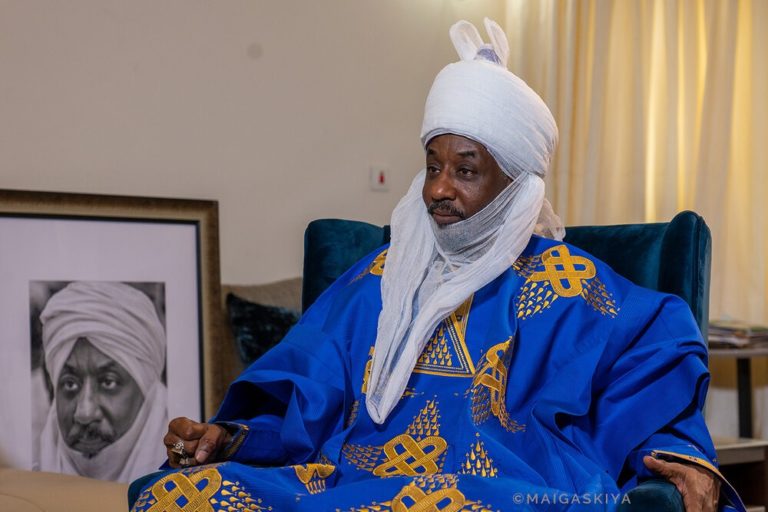
A FIRE outbreak has reportedly destroyed a palace at Gidan Rumfa, the residence of the 16th Emir of Kano, Lamido Sanusi.
Daily Trust quoted sources in the palace, as saying that the incident occurred on Friday, July 12, around 11 pm.
Unknown arsonists allegedly set the palace on fire.
According to the sources, the inferno severely affected one of the palaces at Kofar Kudu, where the Emir holds court every Monday.
“It was the palace at Kofar Kudu. You know the palace has an entrance from inside while the main entrance is from the front (outside). The key was forced open and what was suspected was that they broke in, set the fire and locked the door.
The throne, air conditioners and other valuables in the palace have been destroyed,.” The source said.
In a statement, the Chief of Staff to the Emir, Munir Sanusi Bayero, Dan Buram Kano, also confirmed the incident.
“On Saturday, 13th July 2024 morning, a fire incident occurred at the outer court of His Highness’s Palace, Kofar Kudu. Fortunately, there were no casualties, and the damage was minimal,” part of the statement read.
The statement further noted that the palace was implementing all necessary measures to ensure the safety and security of both the palace and its occupants while also investigating the cause of the fire and taking steps to prevent future incidents.
This comes some weeks after the emirship tussle between Sanusi Lamido and Ado Bayero, the reinstated and deposed emirs, respectively.
The ICIR reports that both emirs are holding court in separate palaces withinKano, the state capital.
While the reinstated emir Sanusi holds court at the main palace, Bayero is occupying the mini palace in Nasarawa, both in Kano.