Home Blog Page 730

Rema cancels December shows to focus on health

0

GLOBAL afrobeats star, Divine Ikubor, professionally known as Rema, has canceled all performances in December to focus on his health.

He made this known in the late hours of Wednesday, November 30, via his Instagram story.

“Breaks my heart to say that I won’t be performing anywhere this December, been years of touring, I’ve ignored my health, and I need time to recuperate. 2024, we go again. Love ❤️,” he stated in the post.

Rema has had a successful year touring and performing in different cities in Europe, Asia, and North America.

The abrupt announcement is a major disappointment for his Nigerian fans, especially after the planned tour in Abuja, Lagos, and Benin.

He was also scheduled to perform at the Hey Neighbor Music Festival, set to take place from December 8 to December 10.

The announcement by Rema to cancel all performances in December came shortly after the Governor of Edo state, Godwin Obaseki, unveiled plans to host him in a grand homecoming music concert on December 21.   

The governor expressed excitement about hosting the artiste while speaking to youths at the Sir Victor Uwaifo Creative Hub, Benin City, the state capital, on Wednesday, November 29.

Obaseki, in a statement by the Edo State Ministry of Arts, Culture, Tourism and Diaspora Affairs, said, “By the grace of God, this Christmas, we will bring Rema home. Rema will have a homecoming concert.”

In 2023, Rema made a mark for himself and the music industry in Nigeria and internationally, with his latest achievement being his song, ‘Calm Downmaking chart history on both Apple Music and Spotify.

The hit song finished 12th on the global top 100 most streamed songs on Apple Music and 8th on Spotify’s top 10 chart of most streamed tracks globally.

After approving Tinubu’s loan, Akpabio urges President to reduce Nigeria’s debt

0

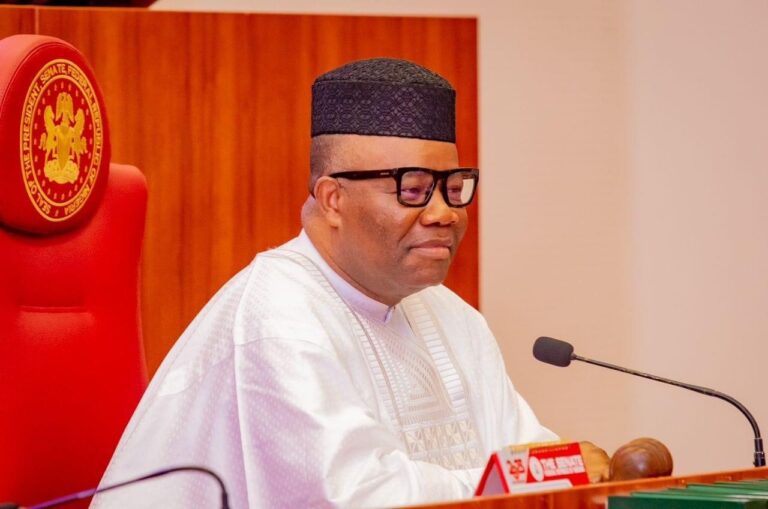
THE Senate President, Godswill Akpabio, has urged President Bola Tinubu to work towards reducing Nigeria’s debt profile.

He said this while delivering a welcome address during the President’s 2024 budget presentation to the joint session of the National Assembly on Wednesday, November 29.

“We also want to plead with the government to do all within its powers to reduce our high debt profile, which we inherited. The mark of a great leader is that he fixes the problems wherever they exist without complaint,” he said.

The ICIR reports that despite his call for a reduction in Nigeria’s debt profile, the National Assembly, under Akpabio’s leadership, approved Tinubu’s request to borrow $800 million from the World Bank to help cushion the effects of the removal of fuel subsidy in Nigeria in July.

Tinubu also recently transmitted a letter to the Senate on November 1, seeking approval for an $8 billion loan, which, according to him, would be utilised for projects across various sectors, including agriculture, health, education, and security.

In a report published on September 19, this organisation revealed how each Nigeria owed N396,376 as the nation’s debt stood at N87.4 trillion, according to data released by the National Bureau of Statistics.

The NBS published that the country’s total public debt jumped by 75.27 per cent from N49.85 trillion in the first quarter of 2023 to N87.38 trillion at the end of the second quarter of 2023. In monetary terms, this is an increase of N37.53 trillion in three months.

The ICIR calculated the debt stock per capita by dividing the total public debts of the country by its population. According to the World Poverty Clock, Nigeria’s population is estimated at 220.4 million.

In his address at the budget presentation on Wednesday, Akpabio expressed optimism that the proposed budget would address hardships being faced by Nigerians as a result of some economic reforms by the current administration.

“We hope these budgetary estimates contain provisions to ameliorate the sufferings that the economic measures so far have exerted on our fellow citizens whom we represent.

“Both chambers believe that we need to encourage the executive arm to unbundle some of the agencies in Nigeria for effectiveness, and even to merge some of them for government to reduce the weight of expenditure,” Akpabio said.

The Senate president also called for the prioritization of education and urged Nigerians to embrace agriculture to reduce dependence on imported food and crude oil.

Tension in Kano as policeman shoots teenager dead

TENSION has engulfed the commercial city of Kano over the killing of a teenager by a Police officer on Wednesday, November 29.

Following altercations among rival groups, reports say, a group of Police officers deployed to the scene of the incident started firing intermittently and used tear gas canisters to disperse the crowd.

The Police intervention took a negative turn after a stray bullet from an officer struck an adolescent.

This led to the protesters barricading the busy Kano-Katsina-Daura highway. 

Reacting to the incident on Wednesday, the Kano state Police command, in a statement signed by its spokesperson Abdullahi Kiyawa, said the Commissioner of Police (CP) in the state, Muhammed Gumel, had ordered the arrest of the officer involved.

Reacting to the killing, the ruling New Nigeria’s Peoples Party (NNPP), in a statement signed by its acting National Chairman, Abba Ali, said the victim, Salisu Player, was one of the three people shot as others were in critical condition. 

 The party claimed the incident occurred during a peaceful protest.

“The NNPP has always asked the citizens to do their protest in a peaceful manner, and the protest around Kurna where Salisu Player was shot, though spontaneous, was no different.

“It would appear that men of the Nigeria Police are ill-trained for handling even peaceful protests as we regret the recorded death, which is painful and unfortunate,” the NNPP stated.

The party commiserated with friends and family of the deceased and urged all Kano residents to remain calm and restrained from acting outside the law.

The situation in Kano has been tense since the Court of Appeal in Abuja sacked Kabir Abba Yusuf as the state governor, affirming the state’s governorship election petitions tribunal ruling.

In a judgment delivered on Friday, November 17, a three-member panel of the appellate court held that the NNPP breached the Constitution by sponsoring Yusuf, who was not a party member.

“All issues in this appeal are dismissed, and the judgment of the tribunal is affirmed,” the court ruled.

The situation worsened when the Appeal Court judgment’s Certified True Copy (CTC) was released.

There was confusion when a portion of the report affirmed the victory of Abba Yusuf as the duly elected governor.

On page 67 of the CTC, sighted by The ICIR on Tuesday, November 21, and signed by the registrar, Jameel Umar, the court upheld Yusuf’s victory.

On page 67 of the CTC sighted, the panel headed by Moore Adumein, in its conclusion, said, “I will conclude by stating that the live issues in this appeal are hereby resolved in favour of the 1st respondent and against the appellant.” 

“In the circumstances, I resolve all the issues in favour of the appellant and against the 1st respondent. Therefore, I find no merit in this appeal, which is liable to be and is hereby dismissed.

The ICIR reported that the state’s Police Command on Monday, November 20, said it had uncovered plans by supporters of some political parties to cause violence in the state.

According to the command’s public relations officer, Kiyawa, the groups wanted to demonstrate against the Appeal Court ruling on the March 18 governorship election.

He, however, said the command had taken necessary security measures to stop hostilities from rising to the point where law and order would collapse.

The command warned the state’s residents to be law-abiding, noting that every protest or procession should follow the law.


.

Capital projects to suffer as FG projects 45% of N18.3 trn revenue for debt service

CAPITAL projects across Nigeria will suffer more as the Federal Government has projected 45 per cent of its N18.3 trillion expected revenue in 2024 to service debts.

The 2024 budget proposed an aggregate expenditure of N27.5 trillion for the Federal Government in 2024, of which the non-debt recurrent expenditure is N9.92 trillion naira, while debt service is projected to be N8.25 trillion naira and capital expenditure is N8.7 trillion.

By implications, capital projects would suffer more, leading to more abandoned projects, with the Minister of Works, Dave Umahi, recently alleging that President Bola Tinubu inherited N6 trillion debts in road projects, compounding the problem.

Tinubu, at the budget presentation on Wednesday, November 29, said the Federal Government would work towards reducing the rising debt.

Nigeria’s total debts now stand at N87.7 trillion, according to data from the Debt Management Office (DMO), which puts pressure on inflation and worsens Nigeria’s currency problems.

For the 2024 budget estimates, the deficit is projected at N9.18 trillion in 2024 or 3.88 percent of gross domestic product (GDP). This is lower than the N13.78 trillion deficit recorded in 2023, representing 6.11 percent of GDP.

The President said the deficit budget would be financed by new borrowings totalling N7.83 trillion, N298.49 billion naira from privatisation proceeds, and N1.05 trillion drawdown on multilateral and bilateral loans secured for specific development projects.

He further said the national social safety net project would be expanded to provide targeted cash transfers to poor and vulnerable households.

Commenting on reforms, Tinubu said tax and fiscal policies would be reviewed to meet Nigeria’s revenue targets.

“Our target is to increase the ratio of revenue to GDP from less than 10 percent currently to 18 percent within the term of this administration,” he said.

Key Budget assumptions

The President noted that the world oil market and domestic conditions informed the government’s adoption of a conservative oil price benchmark of 77.96 US dollars per barrel and a daily oil production estimate of 1.78 million barrels per day.

“We have also adopted a naira to US dollar exchange rate of 750 naira per US Dollar for 2024,” he said.

He stressed that the economy was expected to grow by a minimum of 3.76 percent, above the forecast world average.

“Inflation is expected to moderate to 21.4 percent in 2024,” he added.

Concerns over economy

Amid dwindling revenue resources, the government struggles to meet its projected revenue.

Consequently, projected debt services could suffer setbacks as businesses continue to be squeezed by high inflation and Nigeria’s currency problems.

The budget presentation showed that an aggregate revenue of N11.045 trillion was projected to fund the 2023 budget of 24.82 trillion naira with a deficit of about 6.1 percent of GDP.

As of September 30, the Federal Government’s actual aggregate revenue inflow was N8.65 trillion, approximately 96 percent of the targeted N8.28 trillion naira.

Despite concerns of dwindling revenue, the Nigerian government will spend N9. 92 trillion on recurrent expenditure, servicing over bloated civil service at the expense of road and other capital projects that directly impact the economy.

Experts have argued that a bloated federal executive council of 48 cabinet members has become worrisome for an economy that borrows to fund a large chunk of its national budget.

“Should the government be that large at a time when a lean cabinet seems more needful given the financial state of the country?” a political economist, Segun Sowunmi said in response to Nigeria’s borrowings.

Also, the proposed budget estimates have raised concerns about the impact of the budget on the average Nigerian.

“Our budgets don’t have much impact on an average  Nigerian. The economy is in trouble, and a large chunk of our borrowing is to service consumption of our over-bloated ministry, department, and agencies of government. We must learn from South- East Asia and adopt a budget that is developmental in nature and has a tangible impact on the common man,” a social critique and a professor of Law at the Baze University, Sam Amadi, told The ICIR.

Supreme Court cancels Dec. 31 deadline for old naira notes

0

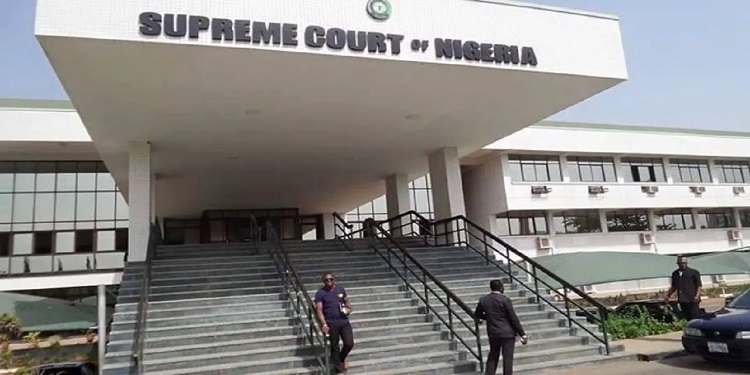
THE Supreme Court has ruled that old and new naira notes would co-exist as legal tender until further notice.

The ruling cancelled the court’s earlier order, putting the notes’ validity as legal tender till December 31, 2023.

On Wednesday, November 29, a seven-member panel of the court’s judges, led by Inyang Okoro, ordered both old and new naira notes to continue as legal tender until the Federal Government sets up a process to carry out the transition after due consultation with stakeholders.

In October 2022, the Central Bank of Nigeria (CBN) announced that it would be redesigning the N200, N500 and N1000 notes.

The then CBN governor, Godwin Emefiele, said the redesign was part of efforts to control the currency in circulation.

Emefiele said N2.7 trillion out of N3.3 trillion of the country’s currency in circulation was outside commercial banks’ vaults and described the development as worrisome.

He noted that new notes would be in circulation by December 15, 2022, and a deadline of January 31, 2023, was fixed for the old notes to cease to be legal tender.

However, as the January 31 deadline inched closer, Nigerians found it more challenging to access the new notes, and it was extended a few more times.

The Federal Government filed an application before the Supreme Court in March 2023, seeking an extension of the deadline to phase out the old naira notes to December 31.

A fresh application to further extend the deadline beyond December 31 was filed by Attorney-General of the Federation (AGF) Lateef Fagbemi, who disclosed that printing the required volume of new notes had been difficult as a result of the economic crisis plaguing the country.

“Since the said consequential order was made, the Federal Government, in compliance with this honourable court’s order, directed the CBN to engage and has been engaging the respondents in their individual capacities and in their capacities as members of the National Council of State and National Economic Council with respect to the Naira redesign policy.

“In between the time the order was made and now, there was a presidential election in the country which has led to a transition from the immediate-past government and the incumbent government which is just settling down,” Fagbemi said.

Super Falcons’ claim 12 of 20 CAF ‘player of the year’ award in 22 years

0

Twelve of Nigeria’s senior women’s football team players – Super Falcons – have emerged as the overall best players of the annual Confederation of African Football (CAF) award in the women’s category since 2001.

Checks by The ICIR show that the 12 awards won by four Nigerians in the ‘Best Female African Player of the Year’ category represent 60 per cent of the total 20 winners since its inception 22 years ago.

The annual event did not hold in 2009 and 2013.

The overall best player category is part of the categories of awards the African football governing body shortlists players to contend against each other.

In Nigeria, the Super Falcons players who have won the individual laurels include the maiden award winner, Mercy Akide, in 2001 and Perpetua Nkwocha, who bagged it four times in 2004, 2005, 2010, and 2011.

Former Super Falcons player Cynthia Uwak smiled home with the award back to back in 2006 and 2007, while in-form Asisat Oshoala has etched her name as the only player to have won the award five times.

Oshoala’s meteoric rise began in 2014 when she stunned the world during the FIFA U-20 World Cup, ending the tournament as the best player.

Also, in the same year, she was pivotal to the success of the Super Falcons winning the Africa Women’s Championship hosted in Namibia, which earned her first CAF award and also recognition as a Member of the Order of Niger bestowed on her by the former President Goodluck Jonathan.

The following year, in 2015, Cameroonian footballer Gaëlle Deborah Enganamouit clinched the award.

In 2016, 2017, 2019, and 2022, Oshoala bagged the award, hoping to clinch it the sixth time when the ceremony holds on December 11, 2023, at the Palais des Congres Movenpickin, Morocco.

Oshoala, Nnadozie, Waldrum shortlisted for 2023 CAF award

Ahead of this year’s edition, current Africa’s best female player, Oshoala, goalkeeper Chiamaka Nnadozie, and coach, Randy Waldrum, made the final shortlist for the 2023 CAF awards.

Also, Nigerians shortlisted in the Young Player of the Year category include Esther Ajakaye and Deborah Abiodun.

Oshoala will contend with Nnadozie, Barbara Babanda from Zambia, and South Africa’s trio of Andile Dlamini, Hilda Magaia, and Thembi Kgatlana for the Player of the Year Award.

Others in that category include Cameroon’s Ajara Njoya and Morocco’s Anissa Lahmari, Fatima Tagnaout, and Ghizalaine Chebbak.

Super Falcons ‘penalty-saver specialist’ Nnadozie is also listed for the Goalkeeper of the Year Award, in which she would contend with the Moroccan duo of Imane Abdelahad and Khadija Er-Rmichi and South Africa’s Andile Dlamini and Kaylin Swart.

Ajakaye and Abiodun will face Ghana’s Comfort Yeboah, Morocco’s Nesryne El Chad, and South Africa’s Thubelihle Shamase in the Young Player of the Year award.

Coach Waldrum, who took Nigeria to the second round of the New Zealand/Australia 2023 Women’s World Cup, is pitched against Mehdi El Qaichouri (SC Casablanca), Reynald Pedros (Morocco), Desiree Ellis (South Africa) and Jerry Tshabalala (Mamelodi Sundowns) for the Coach of the Year award.

Nigeria is listed in the National Team of the Year Award alongside Morocco, Senegal, South Africa, and Zambia.

The regional football governing body, in a statement on Monday, said the winners of each category would be determined after the votes of a panel comprising members of its technical commission, media professionals from member associations, head coaches, and captains of member associations, including clubs involved in the group stages of interclub competitions.

The awards ceremony will be held on December 11, 2023, at the Palais des Congres Movenpickin, Morocco.

Stakeholders knock Lagos gov’t over weak regulation of real estate business

0

Procurement fraud: Court adjourns Emefiele’s case till January 18

0

A FEDERAL High Court, sitting in the Federal Capital Territory (FCT), on Tuesday, November 28, adjourned the procurement fraud suit against former Central Bank of Nigeria’s governor,  Godwin Emefiele, till January 18, 2024.

Emefiele is being arraigned on a six-count charge at an FCT High Court by the Federal Government.

The Federal Government said in the new charge sheet that the former CBN chief unlawfully purchased 43 vehicles for N1.2 billion between 2018 and 2020.

He was charged with ordering 37 Toyota Hilux vehicles, totalling N854 million.

He was also charged with giving corrupt benefits in violation of Section 19 of the Corrupt Practices and Other Related Offenses Act (2000) when he granted N73 million for the supply of a single Toyota Landcruiser in 2019.

Although the initial 20-count charge, totalling N6.5 billion, was lowered to six, Emefiele continued to plead not guilty to the charge, including the alleged procurement fraud against him by the Federal Government when he appeared in court on Friday, November 17, to request bail.

At the resumed hearing, a top official of the Corporate Affairs Commission (CAC), serving as the prosecution witness, informed the court that Emefiele was not the owner or a shareholder of the April 1616 Investment Limited, awarded N1.2bn vehicle supply contract by CBN under Emefiele.

During a cross-examination by the EFCC lawyer, Rotimi Oyedepo, the witness, whose name was not revealed in court, presented several documents detailing how the company was formed on August 1, 2016. 

He also read out the names of the company’s shareholders, including Aminu Yaro, Maryam Abdullahi, and Saadatu Yaro, as joint owners of the entity.

Emefiele’s lawyer, Mathew Burkaa, said his client had not fulfilled his bail conditions. He was consequently escorted by armed personnel from the Nigerian Correctional Service.

The ICIR reports that the FCT High Court, on November 22, granted Emefiele N300 million bail and two sureties in a similar sum.

According to the judge, Hamza Muazu, the titles, and certificates of occupancy for the properties held by the sureties must be from within the Maitama District.

Emefiele was also mandated to stay inside the Abuja Municipal Area Council and deposit his travel documents with the court registrar. He is required to stay at Kuje Correctional Center until he satisfies his bail conditions.

The ICIR reports that the development came four months after he was granted N20 million bail by the Federal High Court Sitting in Lagos in a different case involving the unlawful possession of weapons.

Some 5,000 federal workers may not get Nov., Dec. salaries

2

Five thousand Federal Government workers may not receive their November and December salaries on time due to discrepancies in their records.

The National President of the Association of Senior Civil Servants of Nigeria (ASCSN), Tommy Okon, disclosed this in Abuja on Tuesday, November 28.

He said 2,772 workers had been confirmed and sent to the integrated payroll and personnel information system (IPPIS) for payment. However, there were still discrepancies in the dates of birth and first appointments of about 5,000 federal workers.

He said six teams were working to ensure the exercise finished on schedule. He also advised affected civil servants to regularly check the Head of Service of the Federation’s website for updates.

“As of today, only those who had earlier completed their verification exercise but were mistakenly delisted have had their salaries restored, while 5,000 civil servants still have discrepancies on their date of first appointment and dates of birth…

“It is advisable for a public servant to develop the habit of checking the HOS website for regular updates. We have confirmed that the salary for November 2023 is concluded. Therefore, those affected will not get their salaries for November,” he added.

He implored the Federal Government to find a quick solution to the problem.

Okon urged union members to be patient as, according to him, everything was being done within the limits of the law to ensure that the issues were resolved quickly.

He appealed to the Federal Government through the Office of the Head of the Civil Service of the Federation to expedite action to ensure that December salaries were not delayed.

The ICIR reported in October that federal civil servants who gathered in the Federal Capital Territory (FCT) to be captured by the IPPIS accused the government of neglecting them.

The verification exercise brought civil servants from all over Nigeria to Abuja and was meant to verify their appointments.

The exercise, for employees yet to be captured by the IPPIS, took place at the Public Service Institute at Kubwa and the Conference Hall of the Head of Civil Service of the Federation.

A civil servant from Cross River State who chose to remain anonymous for fear of being victimised told The ICIR that nobody was attending to the workers at both venues, adding they were stranded for days.

He also lamented the suspension of their salaries by the Federal Government because the IPPIS did not capture them.

“Even if you do that, are you supposed to stop people’s salaries? What they are doing is extremely wrong. You asked federal staff to move from their stations to Abuja, and the verification portal is not working,” the worker said.

Another civil servant who preferred anonymity told The ICIR that no provision was made for accommodation, transportation, and feeding despite the increasing costs of living and transport in the city and the nation.

“I saw a woman and her little child sleeping on the floor when I left the venue around 8:30 p.m. yesterday.

“I also saw a woman with her newborn baby at the verification centre on Monday. It is a very serious issue,” said the worker.

But speaking to The ICIR on the matter, the Director of Information and Communication at the office of the Head of Civil Service of the Federation, Mohammed Abdullahi, blamed the unruly attitude of the civil servants for the delay in the verification. He said the portal was working effectively.

Abdullahi added that the verification exercise was mainly to free the civil service of ghost workers.

About 17,000 affected federal civil servants nationwide participated in the activity.

A circular dated October 3, 2023, was issued by the Office of the Head of Service of the Federation with reference number HCSF/HRM/M.1125/T4/194 regarding the activity.

The ICIR reported that the Head of Service of the Federation (HoSF), Folashade Yemi-Esan, said 61,446 civil servants from various government ministries, departments, and agencies were verified on the IPPIS.

Yemi-Esan disclosed this during the 43rd Ministerial Media Briefing organised by the Presidential Communications Team at the State House, Abuja, in July 2022.

She explained that 3,657 civil servants were dragged to the Independent and Corrupt Practices and Related Offenses Commission (ICPC) over their failure to get verified on the platform.

According to her, at least 1,618 applicants floated illegal or fake appointment letters, and 874 workers were suspended from the IPPIS platform.

Tinubu writes Reps, seeks approval for fresh $8bn loan

0

PRESIDENT Bola Tinubu has written the House of Representatives, seeking approval for a fresh $8 billion loan.

This was contained in a letter transmitted by the President to the legislators and read by Speaker Tajudeen Abbas during plenary on Tuesday, November 28.

“Following the removal of fuel subsidy and its attendant impact on our economy. African Development Bank and the World Bank Group have indicated interest in assisting the country to mitigate the impact with the sum of one million and 1.5 million USD respectively, in addition to the FEC-approved 2022-2024 external abridged borrowing plan.

“Consequently, the required approval is in the sum of 8,699 USD, 168,559 USD, and 100m Euro,” the Speaker read.

Tinubu had written to the Senate on Wednesday, November 1, seeking the loan approval.

The sum contained in the letter to the Senate was about $7.8 billion (7,864,508,559 dollars) and €100 million in loans, which is different from what was contained in the letter to the members of the House of Representatives.

According to the letter read by Senate President Godswill Akpabio during plenary on November 1, the loan would be utilised for projects across various sectors, including agriculture, health, education, and security.

“In view of the present economic realities facing the country, it has become imperative that the resolve to use external borrowing to breach the financing gap which will be applied to key infrastructure projects including power, railway, and health, among others.

“Given the nature of these facilities and the need to consolidate the country to normalcy, it has become exigent to request the Senate consideration and approval of the 2022- 2024 external borrowing plans to enable the government to deliver its responsibilities to Nigerians through expeditious disbursement and efficient projects implementation,” the letter further read.

Despite controversies surrounding its details, Tinubu recently passed a N2.17 trillion supplementary budget, approved by the Senate.

Public outrage trailed the President’s allocation of N28 billion for luxury cars for his wife’s (First Lady) office, which is not recognised by law, and the renovation of the President’s residence, among other allocations for the State House.