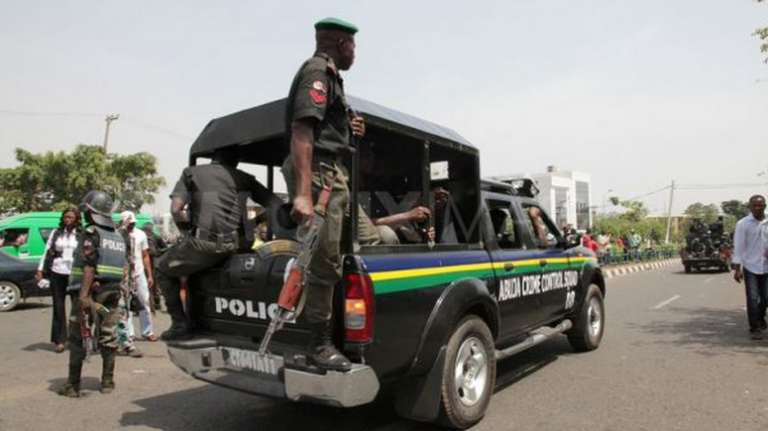
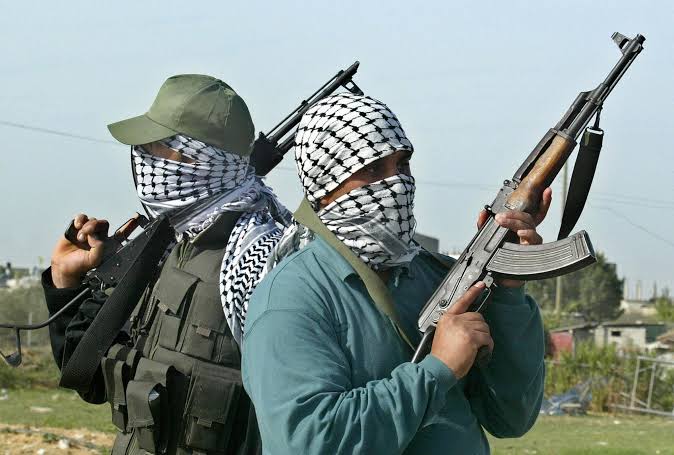
THE Imo state Police command has arrested 18 suspected members of the proscribed Indigenous People Of Biafra (IPOB) over the killing of two officers at Ahiara Junction in Ahiazu-Mbaise local government area of the state.
The officers have been identified as the divisional Police officer (DPO) in charge of Ahiazu Mbaise and an inspector of Police.
The two officers who stopped to refuel their vehicles at BOEK fuel station on Monday, November 27, were attacked by gunmen dressed in military camouflage.
A statement by the Police public relations officer (PPRO), Henry Okoye, on Tuesday, November 28, confirmed that the hoodlums, suspected to be members of the proscribed IPOB and the group’s security arm – the Eastern Security Network (ESN) – swooped on the officers with three vehicles and motorcycles while shooting sporadically.
Although the PPRO stated that the Police officers fought gallantly to resist the attack, they were killed in the ensuing gun duel.
The DPO and inspector of Police died while two other officers survived the attack.
“No stone will be left unturned in ensuring that the perpetrators of the dastardly act are made to face the full wrath of the law. Police operatives led by CP (commissioner of Police) Aboki Danjuma on a confidence-building patrol in Ahiazu Mbaise responded immediately and gave the hoodlums a hot chase, which forced them to flee with various degrees of gunshot injuries, abandoning some of their operational motorcycles.”
According to him, the military swiftly supported the operatives, led by the brigade commander, 34 Artillery Brigade Obinze. He added that intense combing of the area is ongoing.
The Police command reiterated its commitment to collaborating with other sister security agencies to provide adequate security, urging citizens, particularly residents of Ahiazu Mbaise, to report any person seen with or treating gunshot injuries within their vicinity by calling the emergency lines, 08034773600 and 08098880197.
The ICIR reports that the South-East region has been a hotbed of insecurity stemming from agitation by the IPOB.
IPOB has played a major role in the calls for Igbo secession from Nigeria, including engaging in actions considered by the Federal Government as treasonable, culminating in its proscription by former President Muhammadu Buhari’s government in 2017.
Despite the proscription, IPOB has remained undeterred, with its major action being enforcing the Monday sit-at-home directive.
A recent ranking by the Global Terrorism Index listed the group among the 20 deadliest terror groups in the world.
The ICIRreported how insecurity in Nigeria’s South-East region, majorly due to IPOB and its affiliates’ activities, led to the deaths of more than 1,700 people between January 2021 and June 2023.
THE Court of Appeal in Lagos, on Tuesday, November 28, dismissed the suit filed by the governorship candidate of the All Progressives Congress (APC), Tonye Cole, challenging the victory of Siminalayi Fubara of the Peoples Democratic Party (PDP), in the March 18 River state governorship election.
The APC candidate requested that the appellate court order INEC to declare him the winner.
He had informed the court that Fubara continued to sign documents as the state’s Accountant-General even after the PDP nominated him for governor.
Among others, he claimed that there were anomalies in the election.
The Appeal Court, in a unanimous decision, dismissed his petition.
Nevertheless, the court criticised the tribunal’s decision to reject his appeal on the grounds that his party – the APC – had withdrawn its case against Fubara’s victory.
The appellate court ruled further that Cole could file an appeal despite the APC’s decision to withdraw its case against its candidate’s opponent.
The court also dismissed three separate appeals filed by Lulu Briggs Dumo of the Accord Party, Beatrice Itubo of the Labour Party, and Innocent Ekwu of the Allied People’s Movement.
The court ruled that the appellants could not provide evidence supporting their claims that the Electoral Act was not followed in the election.
In October, the Rivers State Governorship Election Petitions Tribunal dismissed Cole’s case contesting Fubara’s election as the Governor of Rivers State.
The tribunal dismissed the petition, saying the APC, who sponsored Cole, had withdrawn its petition against Fubara’s victory.
Dissatisfied with the tribunal’s ruling, the APC candidate challenged the decision at the Appeal Court.
However, the appellate court upheld the tribunal’s decision, which confirmed Fubara’s victory.
IN a striking case of financial impropriety, the Cross-River State Government’s dealings with a contractor have been exposed, revealing instances of overpayment for both rescinded and uncompleted projects, Sylvia Akpan reports.
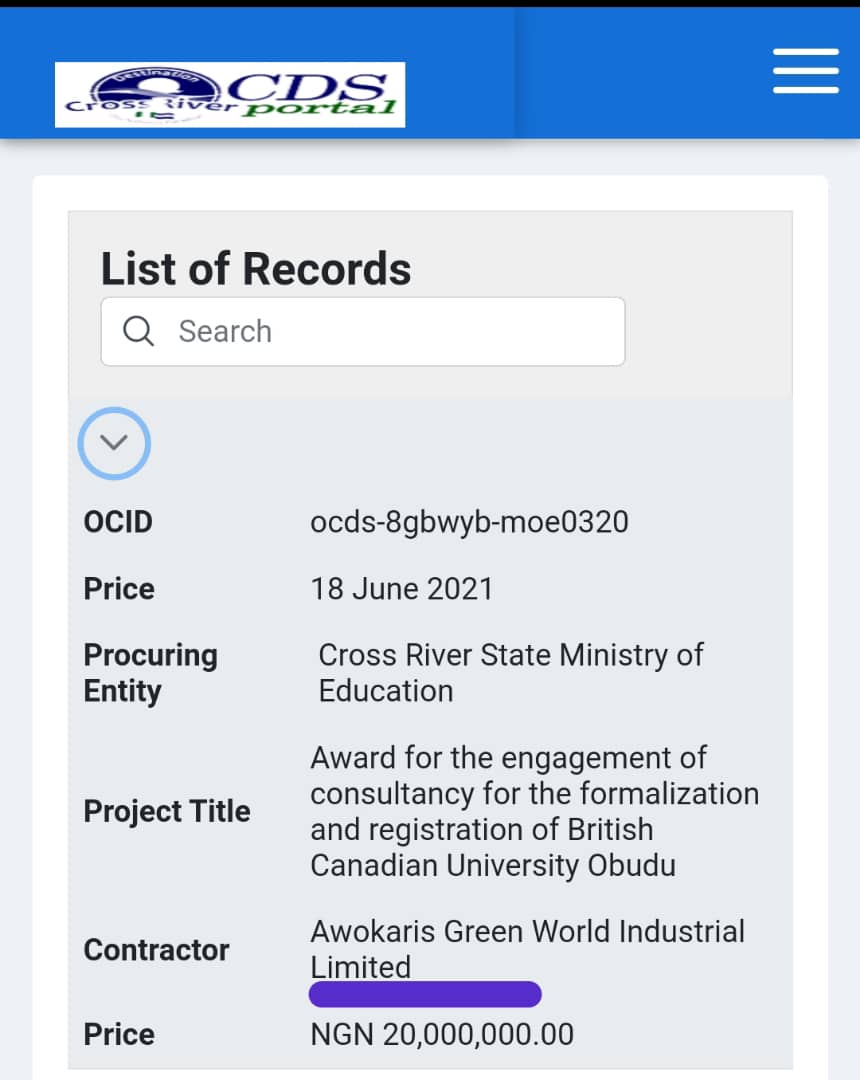
In a curious twist that blurs the line between landscaping, gardening and education, Awokaris Greenworld Industrial Limited, a company registered to provide environmental services, found itself in the spotlight after securing education contracts worth N110m. The company curiously got contracts in the education sector, winning bids to print and deliver state examination materials for N90m and offer consultancy for the formalization of British Canadian University Obudu for N20m.
This unexpected leap from tending greenery to handling crucial educational projects raises eyebrows and questions. How did a garden-focused enterprise venture into shaping minds and curricula?
Awokaris Greenworld Limited was registered with the Corporate Affairs Commission (CAC) on June 11, 2013. The board of directors of the firm include Christian Himabe Awowoh, Ekaete Kate Udo Awowoh, and Christian Himabe Awowoh (jnr) and its headquarters is located at No. 9, Oyenmakeihi Abyosubi Airport Road, Warri, Delta state.
Despite tremendous efforts by the reporter to get Awowoh to answer questions as to why money was received by them, the company has since not responded to mails, SMS and phone calls.
Christian Himabe Awowoh is the South-south representative of Nigeria extractive industry transparency initiative and the Chief Executive Officer of Awokaris Greenworld Industrial Limited.
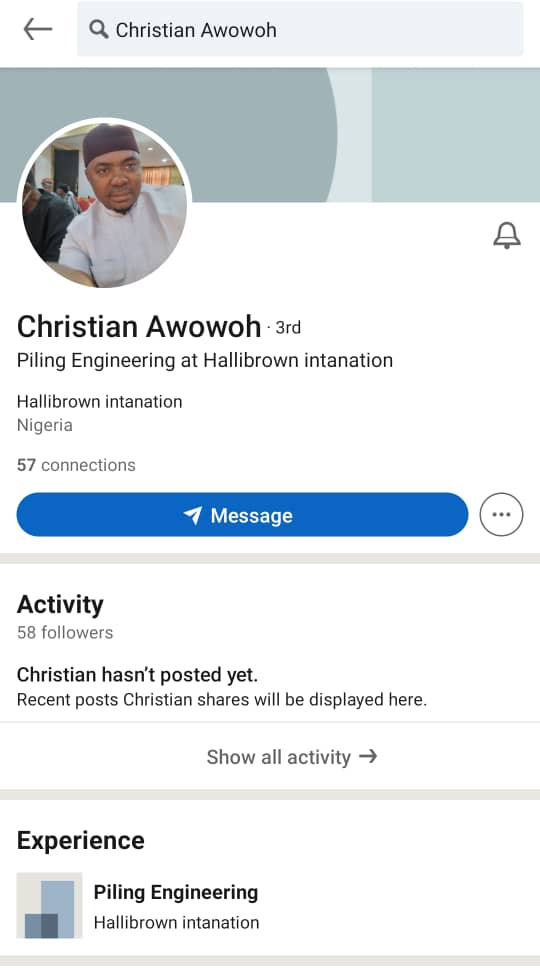
His LinkedIn profile, also shows that Christian Awowoh is a piling engineer at Hallibrown Intanation with 58 followers and 57 connections.
Christian Awowoh LinkedIn chatbox locked
On August 31, 2023, the reporter sent an email to the company’s email address at info@awokarisgroup.com and it was greeted with silence.
Mail sent to Christian Awowoh
On the same, the reporter sent an SMS to the phone numbers attached to the company but the calls went unanswered.
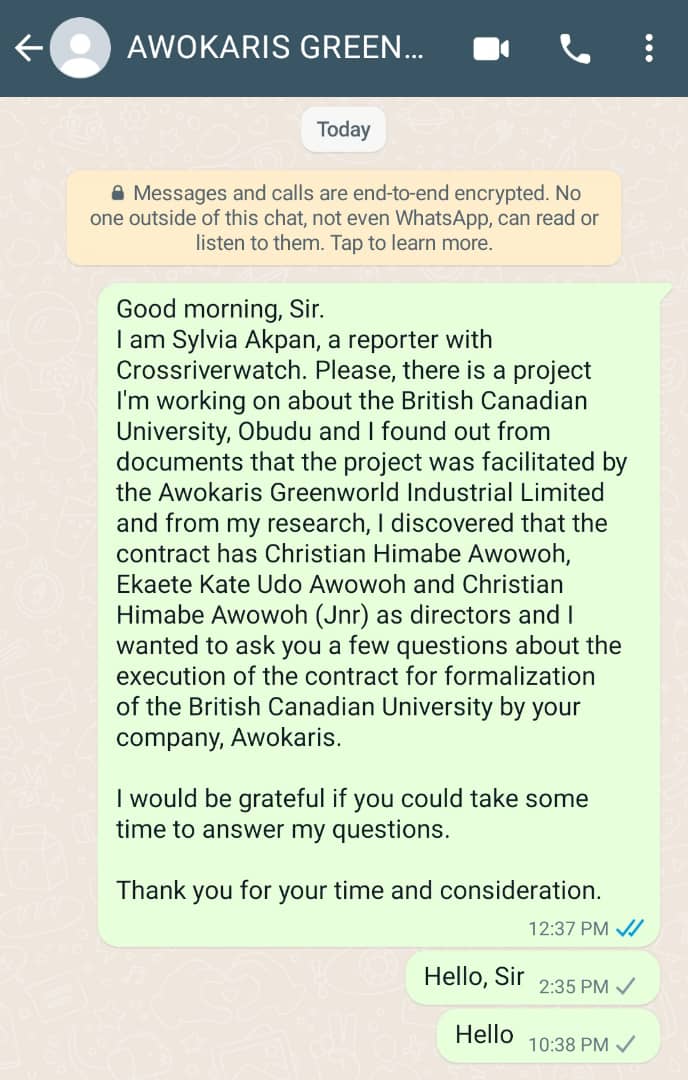
Similarly, the reporter sent a WhatsApp message to Christian Awowoh and observed that when the message was sent, it had his profile picture but when the message was delivered and read, his profile picture changed to that of a woman, probably his wife.
Christian Awowoh before reading the messages delivered to him by the reporterChristian Awowoh blocked the reporter after reading her messages without responding to questions.Christian Awowoh’s contact before blocking the reporter.
On November 4, 2023, the reporter sent the same message to Awowoh’s official Facebook and Instagram accounts, but no response was given, and calls were not received.
The reporter found out through his official Facebook handle that Christian Awowoh is also a politician and a representative of the South-South Geopolitical Zone in the Nigerian Extractive Industries Transparency Initiative, NEITI. In 2019, he declared interest in the position of the Cross River State House of Assembly in Obanliku Local Government Area in the Peoples Democratic Party, PDP and lost.
Awokaris Greenworld Industrial Limited also has Ekaete Kate Udo Awowoh, his wife, and Christian Himabe Awowoh (jnr), his son, as the director.
From all indications, Christian Awowoh has subsequently blocked the reporter on WhatsApp as his profile picture has suddenly disappeared. The reporter confirmed this by sending messages twice, and they were not delivered. This is coming after Christian Awowoh read the message from the reporter by 12:37 PM on November 4, 2023, without any response.
Awarding the N110 million contract to the company is in direct violation of Part 3, Section 6(a) of the Cross River State Procurement Law, 2020 Law No. 9, which stipulates that all bidders must have qualified personnel with pertinent experience to fulfil the obligations of the procurement contract.
Furthermore, findings from the state Due Process and Price Intelligence Bureau lay bare a perplexing scenario: despite prematurely terminating the contract for the supply of examination materials – without providing an explanation – the company still received a N250m from the government. This payment (made in two instalments – N90m on November 23, 2020, and an additional N160m on June 18, 2021) exceeds the contracted sum of N110m by N140m. And the government has given no explanation for this either.
First and second tranches of the money awarded for the contract.
Even in light of these substantial payments, a critical examination of former governor Ben Ayade’s end-of-tenure report reveals a disconcerting reality: the completion of the British Canadian University remains elusive, casting shadows over the effectiveness of the allocated funds.
The status of the university in question raises significant concerns. On one hand, the state government claimed that the institution is a private university, as there is no law enacted by the state House of Assembly to legalise the entity. On the other hand, the government spent state resources by awarding contracts to facilitate its formalization and registration.
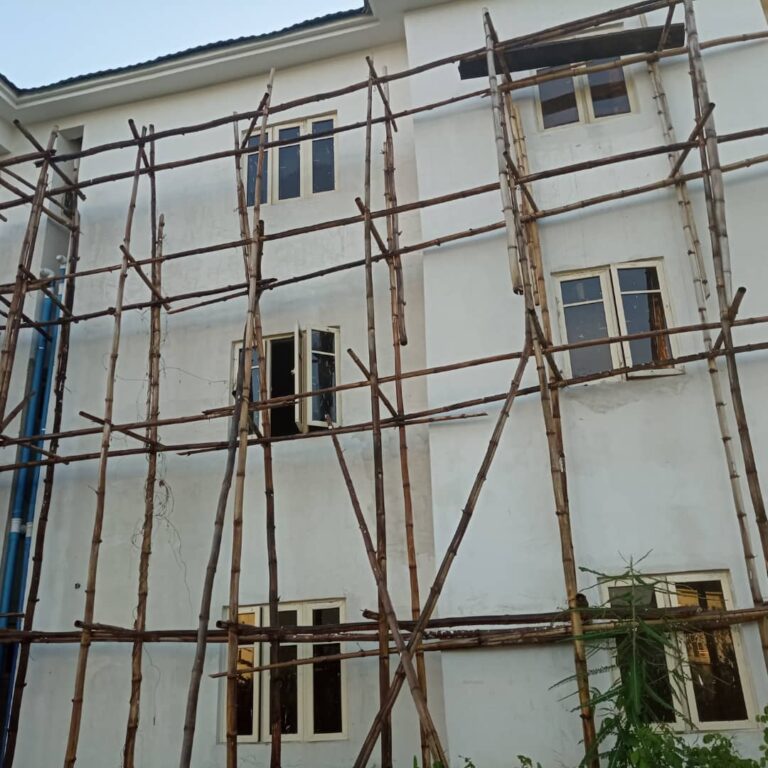
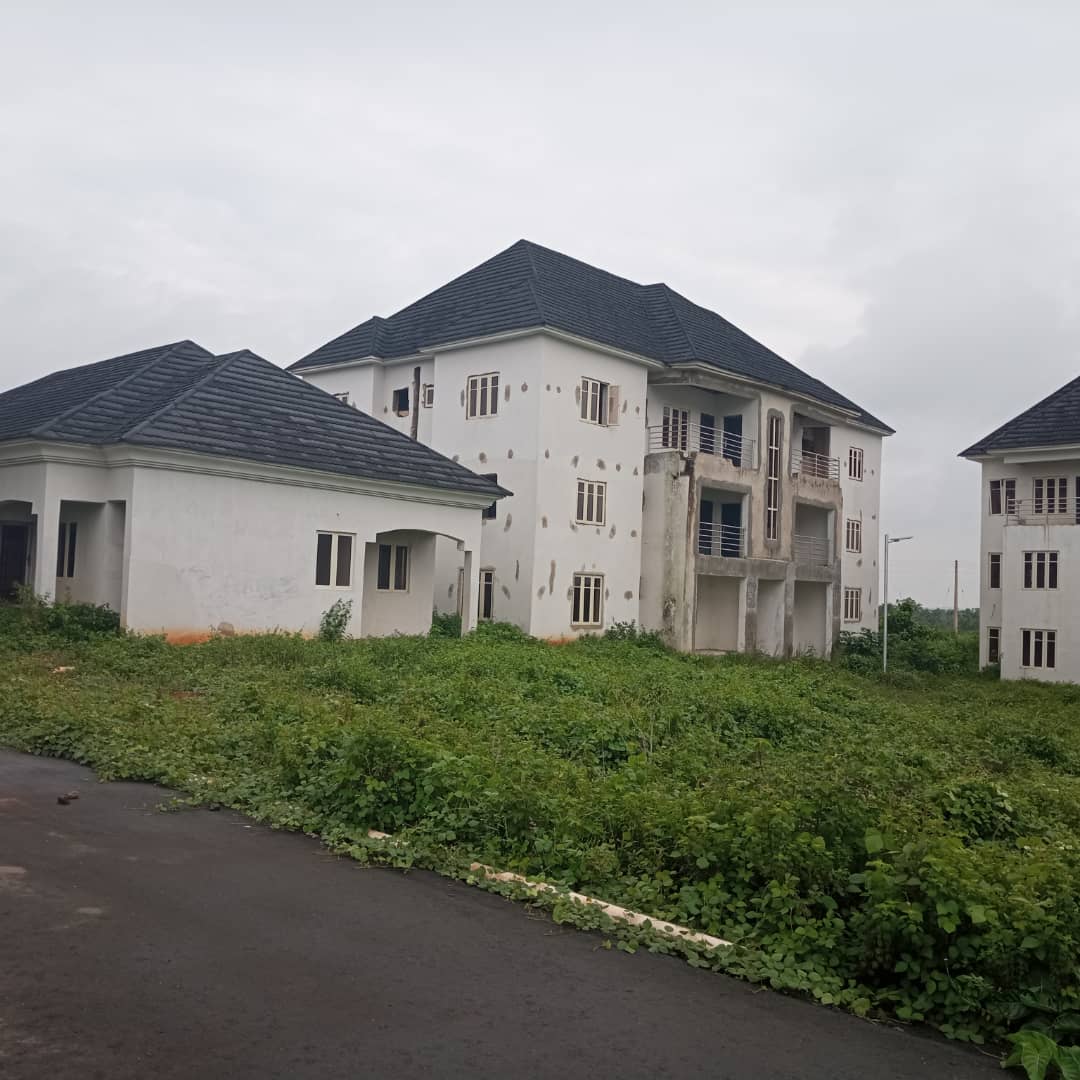
When the reporter visited the British Canadian University, it was discovered that work had long been stopped, and the buildings were stacked with bamboo sticks on the walls while wild grasses were competing for space. A nearby swamp area was left untouched.
An online search on the website on the National Universities Commission (NUC) indicates that the British Canadian University, Obudu, Cross River State was listed as one of the new private universities, with the proprietor listed as Kingshill Education Limited under the mentoring of the University of Calabar, Cross River state.
A search on the CAC portal indicates that the university is not owned by Kingshill Education Limited as captured on the NUC website but by two persons, Ikang Gabriel Francis of No. 8, Itu Okon Street, Ikot Ansa, Calabar, Cross River State and Ekpenyong Aniedi Bassey of No. 4, Ene Okon Crescent, Ene, Calabar, Cross River State. (https://search.cac.gov.ng/psc). While Francis was Permanent Secretary of, the Ministry of Finance, Bassey was Permanent Secretary in the education ministry, both under the immediate past administration of Udom Emmanuel.
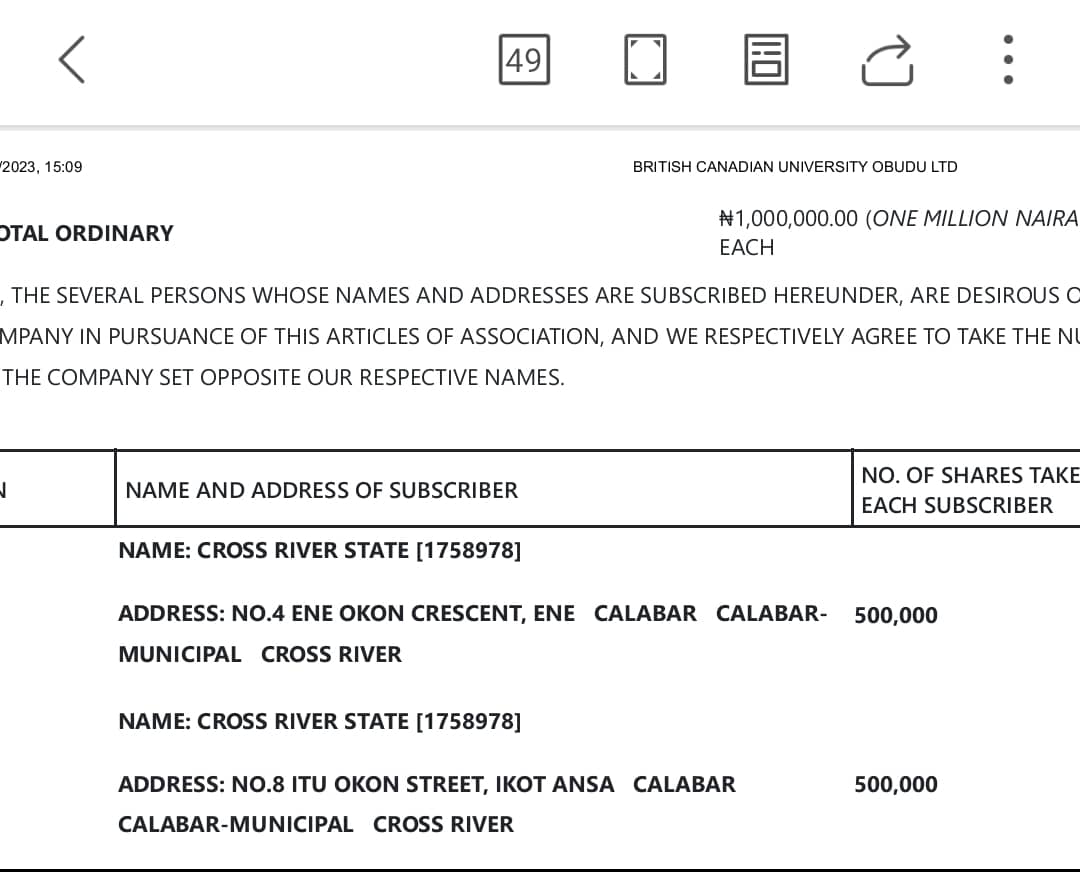
However, a memorandum of Association obtained from CAC on the university shows that it is wholly owned by the Cross River State government. The document indicates that the private university has one million shares, with two shareholders, both Cross River State government, owning 500,000 shares each. Two separate addresses were provided for the government – No 4 Ene Okon Crescent, Ene Calabar, Calabar and No. 8, Itu Okon Street, Ikot Ansa, Calabar. Curiously, these are the same addresses given for Francis and Bassey, the purported owners of the university, meaning that they probably represented the state during the registration process.
Interestingly, deepening the confusion over the ownership of the institution, a CAC search for Heirbase Management Solutions Limited, which is listed by NUC as the owner, indicates two owners, Heirbase Management Solutions Limited and Cross River State Ministry of Finance.
Thus, in three separate filings on the NUC website, the CAC portal and the CAC Memorandum of Association, different owners are indicated as owners of the university, with the Cross River state government being linked to each.
Addresses found in British Canadian University document as visited by the reporter
When the reporter visited No. 4, Ene Okon Crescent, Ene Calabar on November 1, 2023, he met Bassey, the immediate past permanent secretary, Ministry of Education, after being shown the way by passerby. When the reporter knocked on the gate, she responded from inside “Who is that?” and asked the gateman to open the gate. When the reporter gained a slight entrance into the compound, the reporter inquired “Please, I’m looking for Mrs. Aniedi Bassey Ekpenyong” and these were her words “Who is looking for her?”
The reporter introduced herself as Sylvia Akpan, a reporter from Crossriverwatch.
“What’s the issue?” she asked.
As soon as the reporter raised questions about the British Canadian University, Obudu, she responded “I have retired so I’m no longer there. I retired two months ago or thereabout. What do you people have to watch this time around. Well, I don’t know anything about it. Anyway, maybe you will see the Commissioner there now. I think he’ll be in a better position to enlighten you on that.”
Meanwhile, Bassey is the same person that the reporter met in her office on September 8, 2023, before her retirement, and she referred the reporter to SUBEB.
The reporter visited the second address at No. 8, Itu Okon Street, Ikot Ansa, Calabar same day, and when the reporter asked question related to the British Canadian University, Obudu, the occupant said that he should be looking for “Ak” who is the one who knows about the university. AK was not around, but the reporter got his number from a neighbour. When the reporter called the person, he insisted that they meet at the former Chinese Restaurant at State Housing.
On November 2, 2023, the reporter met with AK and he asked how she found his address and insisted that he would not speak until he got an answer. When he was shown a screen grab of the evidence, he finally spoke to the reporter, denying any knowledge of the university registration.
“I never signed anything like this for those two addresses to come because I have Corporate Affairs Certificate and this Memorandum of Understanding so, I understand what is there.
“This thing I’m suspecting it’s not me ooh but fate has made you to meet me to get whatever information you are looking for. It is a white elephant project. To make it easy for you, Ayade is from my place, may be my brother or whatever but every project of his has been like a smoked screen.
“It was like a cunning way for theft. Even the white elephant project called the Cargo Airport, we don’t even know if they’ll start exporting yam and dawadawa. For a place like Obudu going to cite a Cargo Airport in that kind of a place, what are they car-going when we have an airstrip at Obanliku that needed expansion because Obanliku has land.
“So, for your British Canadian University from the little I know, I don’t think it was gazetted in the government whatever. But the only thing that is functional there is the Obudu German Hospital that has already started and the state government has only 5 per cent of shares.
“The Canadian school, if it were like Institute of Management Technology, IMT, Ugep, is an affiliate to Hybrid Polytechnic in the United Kingdom. That was the school built by the previous government (Liyel Imoke), it’s 100 per cent functional. Ayade had wanted to kill it so he tried to replicate it, he went Canada.
The British Canadian University, Obudu.
“For the years they’ve been building whatever they’ve been building, and nothing is really functional. You should understand what it means. It’s a white elephant project because, if they Canadian, you know the foreign clients the government don’t really have hands in their schools, it is private mostly. So, which ever school that thing there is affiliated to in Canada should have been here to at least drive the project fast.
“In all Ayade’s projects across the state, which has he ever completed apart from that death trap at Odukpani?
“When they sign an MoU, monies have exchanged hands, billions. So, that thing there was a systematic way of commandeering land from his people.”
AK’s name was revealed by the true caller as Akomaye Agbabia. His official Facebook handle reveals him to be a Commercial Real Estate Agent. When contacted again on November 4, 2023 after the first meeting, he said he was busy and promised to call back but he never did.
AK’s address No. 8, Itu Okon street, Ikot Ansa, Calabar Municipality, Cross River State, was captured in a Federal Republic of Nigeria Companies and Allied Matters Act, 2020 Companies Limited by Shares Memorandum of Association of the British Canadian University Obudu Ltd and he attested that he subscribed to the project after which he denied and became evasive.
Official explanations remain elusive
When the reporter visited the Permanent Secretary, Aniedie Ekpenyong Bassey on 8th September, 2023, before her retirement, she had insisted that the reporter write to the State Universal Basic Education Board, SUBEB.
“You are the one who dropped that thing that practically threatened our lives. I was just wondering where all that was coming from because I don’t understand if a due process has been followed or something, and it is done to the end, you are now telling me that the person is not qualified, that the person is qualified.”
“Who determines the qualification, is it CrossRiverWatch, is it you, or the ministry? Not even the ministry, not even me, because whatever was done, due process was followed, everything signed, everything done so I don’t know. We were lost as to where are we to begin to answer these questions. So, what information exactly do you want? Do you want it to indict somebody?”
“So what information exactly do you want? Do you want it to indict somebody?
“That contract did not come through the Ministry of Education. It was financed at SUBEB. How did you get to know it was so, so so person because you mentioned the company that was given, how did you get all that, where did you get the information?
You went somewhere and they told you? She queried.
“Well, I don’t know about it. The procurement person will speak to you. Every ministry has a procurement. So, maybe you will discuss it with him.
When the reporter visited the procurement officer, Austin, who refused to give his full name, insisting that the journalist refers to him as ‘Austin Procurement,’ he declined to speak on the matter. He insisted that the reporter should get the consent of the Permanent Secretary first. The reporter returned to the Permanent Secretary who asked him to return to Austim, promising to call him.
When the reporter approached Austin again, he was still adamant that he would not speak.
“Is it the one (FOIA request) from CrossRiverWatch? It won’t be from me because now, once you have a request like that you have to go back to the Permanent Secretary. The internal document has order. A permanent secretary cannot minute a document to me and direct you to come and meet me.”
Expressing scepticism about the investigation’s motives, Austin declined to discuss the contract further but affirmed adherence to due process protocols, concluding that “We follow due process here.”
At the SUBEB office, Ettah Inyang Eyo, who was the acting SUBEB chairman, said, “Because of the screening exercise, the Director DPRS just got the mail now let him study and respond.
During the next visit, Ettah Inyang Eyo, Director of Administration who was acting as Chairman, said that the contract was not awarded by the agency.
“We’ve checked through our records, the contract was not awarded by SUBEB. So you may make further inquiries from the Ministry of Education,” he stated.
Despite repeated visits to the Due Process and Price Intelligence Bureau, no conclusive information emerged.
The secretary ‘Mabah’ who refused to give her other names, said “The man is not around, Director is not around.”
When the reporter asked to get her contact she said, “No Aunty, come back tomorrow” this time with a loud voice.
It was after repeated visits that she felt the reporter was disturbing her, so she wrote her number and her name (Mabah) on a sheet of paper and gave it.
When the reporter called, she said, “Don’t worry, the DG will respond to you via mail or call.
Adding to the opacity, Freedom of Information Act (FOIA) requests sent to the trio, Ministry of Education, SUBEB, and DPPIB were greeted with silence. The FOIA requests specifically asked for the award of contracts to the company that lacks the professional qualification to do both jobs, and why the contracts were awarded in violation of the state public procurement law of 2020, part 3 section 6(a), and why the contractor was paid when the contracts were terminated.
The letters were sent to the Ministry of Education on August 1, 2023; the DPPIB on August 1, 2023 and SUBEB on August 8, 2023.
The FOI requests specifically asked for the award of contracts to the company that lacks the professional qualification to do both jobs and why the contracts were awarded in violation of the state public procurement law of 2020, part 3 section 6(a), and why the contractor was paid when the contracts were terminated.
Development Experts Call For Probe
Richard Inoyo, the Country Director of Citizens Solution Network, and Ukeme-Obong Ekong, State Coordinator of We The People, called for a thorough investigation into the contract in separate interviews.
Expressing their bewilderment, they questioned why a government would allocate funds for the establishment of a private enterprise.
Inoyo conveyed his deep concern, stating, “This development is disheartening. If you examine the Cross River State Government’s track record, you’ll observe an ongoing disregard for the State’s procurement laws. It’s even more disheartening that the current government is continuing this trend of violating its own laws.”
He raised concerns about competence, saying, “When companies lack the necessary expertise, entrusting them with the responsibility of supplying educational materials to the State through the Ministry of Education is fraught with the risk of subpar quality. Such comcannotlity to assess and deliver the required standards, and this is a significant worry for us all.”
In urging the government to take action, Inoyo underscored that “it is crucial for the government to recognize that this prevailing culture of awarding contracts to institutions or companies lacking the necessary qualifications and competence reflects negatively on governance as a whole.”
“This is unacceptable. It’s high time citizens came together to draw the government’s attention to this unacceptable development. Enough is enough, and we must communicate this message to the government without hesitation.”
Ukeme-Obong Ekong, on her part, emphasized the significance of adhering to due process in public contracts.
She stressed that: “Cross River State has well-defined procurement laws and policies that dictate the selection of vendors and contractors for specific services. Following due processes in contracts is crucial. My concern lies in the fact that companies lacking the fundamental prerequisites – essential technical expertise and adequate human resources – should not undertake projects they are ill-equipped to handle.”
Ekong articulated the broader implications, stating, “When entities are aware that deviating from due process can lead to unnecessary complications, it becomes imperative for our State to embrace transparency and accountability. As citizens, we hold a collective responsibility to ensure our government remains accountable.”
She pointed out the potential consequences of disregarding due process, explaining, “When due process is sidestepped, the integrity of the entire contracting process is compromised. While policies are formulated by legislative bodies, executive officers must implement these policies. Effective governance necessitates alignment between policy creation and implementation.”
In her closing remarks, Ekong emphasized the importance of upholding democratic values, saying, “In a democratic society, adherence to protocols is vital. We must operate with integrity, order, and respect for established procedures. A true democracy thrives when all components of the government work together to uphold the principles of due process.”
*This investigation republished Cross River Watch from is supported by the John D. and Catherine T. MacArthur Foundation and the International Centre for Investigative Reporting.”
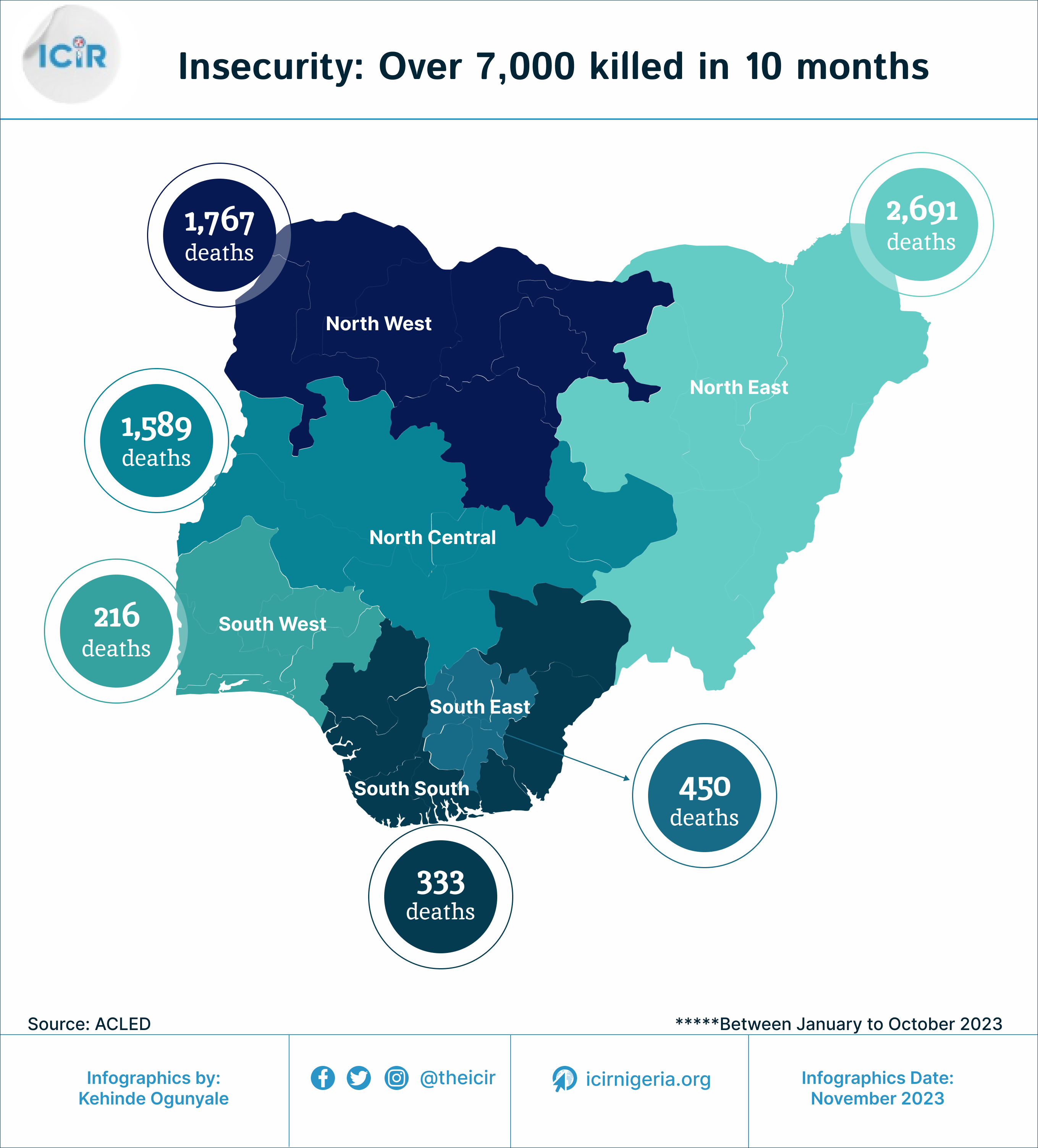
DATA collated by The ICIR have shown that between January and October 2023, 7,046 people were killed in violent attacks across Nigeria.
The ICIR gathered the data from the Armed Conflict Location & Event Data Project(ACLED), a data bureau that collects real-time data on the locations, dates, actors, fatalities, and types of all reported political violence and protest events worldwide.
When broken down, this means that an average of 24 persons were killed daily within the month under review.
Insecurity has been a perennial challenge in Nigeria, ranging from attacks by bandits and secessionist groups to attacks by insurgent groups like Boko Haram/Islamic State’s West Africa Province (ISWAP), and clashes between herdsmen and villagers, among others.
The ACLED documents that 15 people were killed in protests within ten months. Also, 133 people died in several riot attacks between January and October.
According to the data, the states with the highest killings within the ten months are Zamfara (672 deaths), Niger (544 deaths), Benue (454 deaths) and Plateau (362 deaths).
The states with the lowest reported cases of death are Ekiti, Gombe, and Jigawa, with five, three, and two deaths, respectively.
The data means that living in Jigawa state within the first ten months of 2023 is safer than any other state in Nigeria.
When broken down by geopolitical zone, states in the North-Central reported 1,589 deaths, the North-East reported 2,691 deaths, and the North-West region had 1,767 deaths.
For the Sothern region, the South-East recorded 450 deaths, the South-South recorded 333 deaths, and the Sout-West lost 216 people to attacks.
In September, the Chief of Army Staff, Taoreed Lagbaja, said, during the Nigerian Army civil-military cooperation media chat for the third quarter of 2023, that the Nigerian Army would curb the security challenges currently facing the country.
The CoAS stated that the “Nigerian Army will continue to train and equip its forces to carry out kinetic operations in compliance with the approved rules of engagement and code of conduct for various theatres, within and outside the country.
“In this regard, the Nigerian Army under my leadership has emplaced robust strategies across all lines of operations to ensure that the security challenges in the country are resolved favourably within the shortest possible time.”
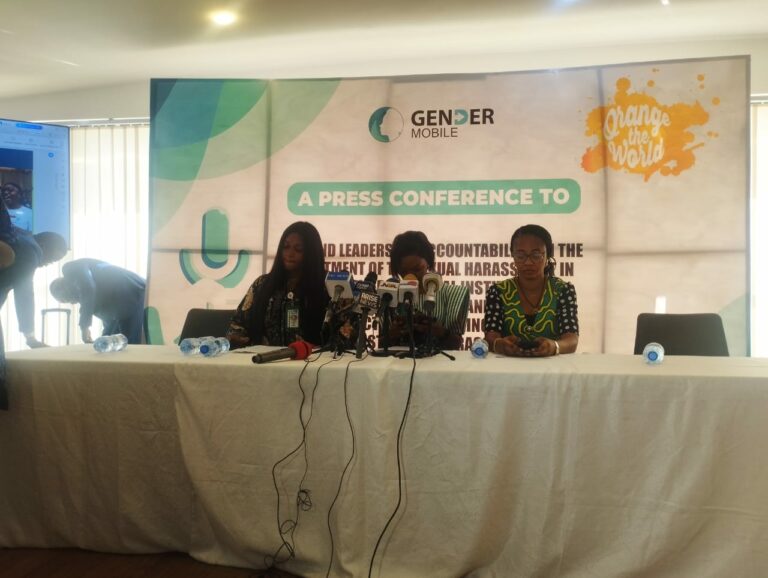
A Civil Society Organisation (CSO), Gender Mobile Initiative (GMI), has called on President Bola Tinubu to sign the bill to prevent sexual harassment in Nigeria’s tertiary institutions.
At a briefing commemorating the global observance of 16 days of activism against gender-based violence (GBV) on Monday, November 27, in Abuja, GMI lead director Omowumi Ogunrotimi described sexual harassment in schools as alarming and inadequately addressed.
“As a collective, we stand at the forefront of a pressing national concern that demands immediate attention. Today, we bring forth a call for urgency, accountability, and transformative change in the face of pervasive sexual harassment and abuse of office on our campuses.
“Alarming statistics reveal that 70 per cent of female graduates from Nigerian tertiary institutions have been subjected to sexual harassment – an epidemic proportion indicative of systemic and structural deficits. These distressing figures are not merely statistics; they represent the lived experiences of countless young women whose educational journey has been marred by the insidious spectre of harassment,” Ogunrotimi noted.
She also stated that the absence of a dedicated legal framework criminalising sexual harassment in educational institutions undermined collective efforts being made to address the issue and decried the delay in presidential assent to the sexual harassment bill.
“This delay is disheartening and raises concerns about the commitment to eradicating sexual harassment within our educational institutions. The need for statutory backing is not just a formality; it is a fundamental requirement to ensure that the provisions of the bill are legally enforceable and carry the necessary gravitas to effect real change,” she said.
The bill, titled “A Bill for an Act to Prevent, Prohibit and Redress Sexual Harassment of Students in Tertiary Institutions and for Matters Concerned Therewith 2019,” was sponsored by former Deputy Senate President Ovie Omo-Agege and 106 other senators.
The bill seeks to eradicate sexual violence in tertiary institutions and proposes a 14-year jail term for offenders.
The bill was passed by both chambers of the National Assembly in 2022, but former President Muhammadu Buhari did not assent to it before leaving office in 2023.
The ICIR reports that President Tinubu cannot outrightly sign the bill as this NGO – Gender Mobile Initiative – is demanding.
Any bill passed by a previous National Assembly cannot be immediately assented to by the succeeding president. It has to be re-introduced to the president by the new National Assembly.
Referring to the recently signed Students Loan Bill, Ogunrotimi said the initiative would not achieve optimal success if the learning environment was made unconducive by threats of sexual harassment and assault.
“As we commemorate the 16 days of activism, our hope is anchored in the belief that immediate action from President Bola Ahmed Tinubu, specifically the prompt signing of the Sexual Harassment Prohibition in Tertiary Education Institutions Bill, will mark a significant milestone in the fight against sexual harassment.
“The delay in presidential assent has left a void in our collective efforts, and we trust that the President’s commitment to the well-being of Nigerian students will translate into swift and resolute action. We look forward to witnessing a tangible demonstration of the President’s dedication to creating safe and nurturing learning environments for all,” she said.
IGP directs institution of GBV desks in schools
Meanwhile, the Inspector General of Police (IGP), Kayode Egbetokun, has directed tertiary educational institutions to have a desk dedicated to GBV.
Represented by Rita Emesim, a chief superintendent of Police (CSP), Egbetokun said at the Gender Mobile Initiative media briefing that the Police had taken bolder steps to address issues of GBV better when reported.
“As it is now, I think my department is overlooking the aspect of gender cases in campuses, and as it is now, the Inspector-General of Police has made it mandatory for all universities to have a section named Gender-Based section in all universities to assist these girls.
“We are open when it is gender, it is a very sensitive thing, and it is not what used to be when you reported such cases that actions were not taken. That is no longer the case,” she said.
PRESIDENT Bola Ahmed Tinubu will present the 2024 appropriation bill on Wednesday, November 29, to the joint session of the National Assembly.
Secretary of the Research and Information Department of the National Assembly, Ali Barde, confirmed the development on Monday to newsmen.
The ICIR reports that the Federal Executive Council (FEC), on Monday, November 27, approved N27.5 trillion as the Federal Government’s aggregate expenditure for 2024.
This is an increase from the N26.01 trillion earlier considered by the council.
The Minister of Budget and Economic Planning, Atiku Bagudu, who spoke to journalists after the meeting presided over by President Bola Tinubu, said the targeted revenue for next year is N18 trillion.
He said further budget details would be released when Tinubu presents it to the National Assembly.
He disclosed that the Medium Term Expenditure Framework (MTEF), passed by the National Assembly, was further reviewed.
Bagudu said: “The federal executive council considered the 2024 appropriation bill. The National Assembly approved the MTEF, with an exchange rate of N700 to a dollar and a crude oil benchmark of $73.
“To improve revenue, the council further reviewed the MTEF, with an exchange rate of N750 to a dollar and a crude oil benchmark of $77. This will significantly improve revenue.”
The ICIRreported that Nigeria’s budgetary provision of 1.78 million barrels per day (bpd) of crude oil production would fall below the benchmark projected in 2024 and lower the country’s revenue prospect for the year.
A daily crude oil production of 1.78 million bpd at $73.96 per barrel was projected for 2024, subject to the Nigerian National Petroleum Company Limited’s (NNPCL) confirmation.
However, a recent reportby the African Energy Chamber (AEC) confirmed that Nigeria’s daily crude production would fall below the 1.78 million bpd approved by the Senate.
According to the report, ‘The State of African Energy 2024 Outlook,’ Nigeria is expected to achieve daily crude oil output of 1.51 million bpd in 2024.
Compared with the approved benchmark of 1.78 million bpd, Nigeria will lose 270,000 per day of crude oil production, reducing its revenue and possibly pushing the government to borrow to fund the budget deficits.
THE Nigeria Civil Aviation Authority (NCAA) has suspended all wet-leased airlines managed by United Nigeria Airlines.
According to aerocorner.com, a wet lease is any leasing arrangement whereby the lessor agrees to provide an aircraft to the customer with at least one crew member.
The suspension followed a drama on Sunday, November 26, where one of the service airlines that took off from Lagos and headed to Abuja landed in Asaba, Delta state, with its crew citing weather concerns.
United Airline’s aircraft NUA 0504 departed Terminal 2 of the Lagos’ Muritala Muhammed International Airport for Abuja. The passengers were confused when the captain grounded the aircraft at the Asaba International Airport before telling them why.
“Nigeria, my country. We departed Lagos about an hour ago on @flyunitedng to Abuja. Upon arrival, the cabin crew confidently announced that we’d arrived in Abuja, only for us to realise that we landed in Asaba. Apparently, our pilot was given the wrong flight plan from Lagos,” one of the passengers, @dawisu, tweeted on Sunday.
In a statement on its X handle on Monday, November 27, the regulatory agency said it had launched an investigation into the incident.
“The Nigeria Civil Aviation Authority (NCAA) has commenced investigation into the circumstances surrounding United Nigeria flight NUA 0506 to Asaba and the confusion it has created in the public domain. However, preliminary steps have been taken pending conclusions of ongoing investigation.
“The authority wishes to reassure the travelling public that it will leave no stone unturned as it has always done in the past to ensure the continued safety of the aviation industry.”
Meanwhile, The ICIR spoke with a senior official at the NCAA who confirmed the suspension. She did not volunteer further information.
Sequel to the Asaba debacle and subsequent investigation by the NCAA, the Minister of Aviation and Aerospace Development, Festus Keyamo, has summoned a meeting of aviation regulatory authorities in Abuja.
Keyamo revealed this in a tweet on his X account on Monday.
The minister said he summoned the heads of the regulatory agencies to review the incidents and causes of the concerns.
He also added that the meeting would take appropriate steps to forestall future occurrences.
“Due to safety concerns in the aviation sector expressed by members of the public, I have summoned the heads of the regulatory agencies to my office later today to review the incidents that are the causes of these concerns and to ensure that appropriate steps are taken to forestall future occurrence and to apply sanctions, where necessary, regarding the past incidents,” Keyamo tweeted.
In October 2023, The ICIRreported how delayed airfare refunds frustrate Nigerian travellers.
Due to insecurity and the growing expense of road transportation, air travel has become one of Nigeria’s most popular means of transportation; nonetheless, travellers there must deal with issues, including flight disruptions and delayed reimbursements.
In May 2023, a resident of Nigeria’s Federal Capital Territory (FCT), Ayanfe John, purchased a Dana Air ticket from Port Harcourt to Abuja scheduled for June 2, 2023.
The evening before the journey, John received a text message from Dana Air stating that the flight had been cancelled. The only explanation by the airline authorities for the cancellation was “operational reasons.”
She told The ICIR that she had been panicked following the cancellation, as she had no alternative means to return to Abuja the following day.
In another incident, a resident of the FCT, Marcus Fatunmole, said his United Airlines flight from Abuja to Port Harcourt on Tuesday, November 21, was delayed for 40 minutes without an apology.
Apart from delayed flights, the airline’s customer care numbers are either unavailable or the persons responsible for picking up the calls refuse to do so.
“I flew United Airlines from Abuja to Port Harcourt last Tuesday. The flight was delayed for 40 minutes without an apology. In Port Harcourt, I needed a document from the airline. I called the customer service line scores of times because the hotel I lodged in was too far from the airport. I didn’t get a response.
“I called the NCAA in Lagos and reported the airline’s attitude. The NCAA unsuccessfully did all it could to help me. On Friday, while returning to Abuja, my flight was for 5:40pm. The flight eventually took off after 8pm without a word from the airline to the waiting and frustrated passengers,” Fatunmole stated.
Delays and cancellations of flights sometimes defeat the aim of air transportation, and travellers spend long hours waiting at airports.
However, flights being rescheduled or cancelled by the airlines hardly come with compensation for the customers. In some cases, no explanations are given.
In developed countries such as the United States of America (USA), when flights are cancelled for any reason by airlines, travellers are entitled to a full refund, which includes the cost of the ticket price, taxes, baggage fees, and any other extra charge regardless of the reason behind the cancellation.
According to the United States Department of Transportation, this refund must be made within seven working days if paid through credit cards or 20 working days if payment was made in cash or cheque. Clients are not under obligation to leave the ticket open for use during subsequent trips.
In the US, 10 of the country’s largest airlines are in binding commitments with the government to take specific compensatory steps in favour of consumers when flights are delayed or cancelled, especially for controllable reasons.
The Nigeria Civil Aviation Regulation of 2015 provides under Part 19 that for delay and cancellation in domestic flights, “when an operating air carrier reasonably expects a flight to be delayed beyond its scheduled time of departure, it shall provide the passengers with reason(s) for the delay within 30 minutes after the scheduled departure time.”
It also provides that if the delay persists for up to two hours, refreshments, two free phone calls, or emails are provided, while reimbursement is made within a prescribed time for domestic flights delayed beyond three hours, depending on the mode of payment.
The regulation also provided hotel accommodation and transportation in cases where the delays continued till airports were closed and a further 25 percent compensation in cases where a 24-hour notice was not given.
However, exceptions are made in cases where flights are delayed or cancelled due to reasons outside the control of airline operators.
Despite the provisions of the law, many travellers do not get refunds within the prescribed time.
In 2022, The ICIRreported that the Federal Competition and Consumers Protection Commission (FCCPC) encouraged Nigerians to seek redress and insist on quality service in flight delays and cancellations.
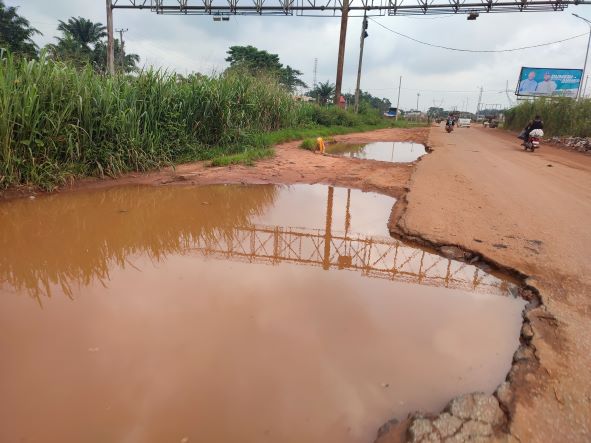
PRESIDENT Bola Tinubu inherited over six trillion debts from road projects not completed by his predecessor, Muhammadu Buhari, the minister of works, David Umahi, revealed on Monday, November 27.
In a statement he shared on his X handle, the minister acknowledged that there were recently completed and ongoing projects badly executed.
These include the Makurdi-Nsukka 9th Mile Road, East-West Road, Lagos-Abeokuta Expressway, Benin Bypass Road, collapsed bridges on the Enugu-Port Harcourt Road, collapsed bridges in Shandam, Plateau State, Abuja-Kaduna-Zaria-Kano Road, and Gombe-Bauchi Road, as reported by media houses.
According to the statement, President Tinubu is aware of many deplorable roads he inherited from Buhari.
“Mr. President is not complaining of the challenges he inherited in nearly all sectors of the economy, especially as it concerns our road infrastructure, but he is quite courageous as he had promised to tackle the problems head-on, which he has started to do not minding the debt burden inherited especially the funding gap of over six trillion naira (₦6 trillion) from most of the inherited on-going road projects.
“Mr. President has since reeled out plans of commitment, consistency, and innovations towards actualising a sustainable road infrastructure development throughout the country. He has just approved a 2023 supplementary budget of three hundred billion naira (₦300B) for the Ministry of Works comprising one hundred billion naira (₦100 billion) for immediate palliative works in 36 States and FCT and two hundred billion naira (₦200 billion) for the continuation of most of the inherited ongoing projects and very few new but critical road projects.”
On November 16, The ICIRexposed how the Senate slashed or completely removed huge funds meant for road construction in the 2022 supplementary budget while reviewing the budget under its present leadership, headed by Godswill Akpabio.
In the report, The ICIR highlighted that the Senate, particularly its president, Akpabio, his deputy, Barau Jibrinand the Senate appropriations chairman, Solomon Adeola (also known as Yayi), diverted over N20 billion in projects to their constituencies, resources that should have gone into solving flooding problems and road projects in several states.
Umahi pledged that his intervention in Nigeria roads would be comprehensive, using approved palliative measures and leveraging the Federal Roads Maintenance Agency’s (FERMA) interventions across all 36 states and the Federal Capital Territory (FCT).
He also charged the public to supervise and report any erring contractors or badly executed projects by contacting 08030986263, 08037086137, or 08106423197.
We have not banned the use of asphalt
Meanwhile, the minister expressed shock over “the various acts of darkening counsel without knowledge of the position of the ministry on the use of asphalt and concrete pavement in the development of our road infrastructure by people who have vowed not to release their hands off the brake of our road infrastructure development just for their selfish gains.”
He explained that the ministry had not banned the use of asphalt or directed that concrete pavement should be the only means of road pavement structure, adding that the ministry’s new policy allowed all contractors for all the ongoing projects to have a choice to continue to use asphalt or have their projects redesigned on concrete at no extra cost to the government following the under listed conditions:
Use of asphalt: contractors shall stick to only five per cent variation on price (VOP) in line with the signed contract agreement throughout the period of the project and the signed contract shall not be subject to review, especially on bituminous items.
The thickness of the asphalt pavement as designed must be strictly adhered to by all such contractors and the design shelf life for the asphalt (at least 15 years) shall be guaranteed by issuing an insurance bond through a reputable insurance company in favour of the Federal Government.
For the use of concrete, contractors must abide by the five per cent VOP and 50 years design shelf life using concrete grade 40.
The ministry said effective December 1, 2023, there would be a revolution in the ways and methods the ministry supervised her projects nationwide.
“The director of works of the 36 States and FCT and FERMA have been directed to audit all projects in their states and FCT, especially equipment on and off sites with their pictures, personnel of contractors, status of all projects including financial status (contract sum, date of award, period of construction and time table, amount paid, challenges, percentage of work completion, augmentation of project if any, VOP claims etc). This assignment must be completed before 30th November 2023. Note that this directive was given since the past two months,” the minister added.
FORMER Chairman of the National Human Rights Commission (NHRC), Chidi Odinkalu, has accused politicians of capturing, weaponising, and corrupting the Nigerian judiciary.
He said the politicisation of judicial appointments and lack of independence, among other challenges facing the judiciary, were the primary causes of its declining integrity.
Odinkalu stated this while speaking on a radio town hall meeting titled Public Sector Integrity in Nigeria, organised by the Progressive Impact Organisation for Community Development, PRIMORG, at the weekend in Abuja.
He claimed that politicians had taken over the judiciary. He also said Nigerians needed to know that elites had corrupted and politically weaponised the court.
Odinkalu maintained that politicians and their allies, whose children, friends, and mistresses were receiving appointments to the bench, used the court to advance their interests rather than the general public’s interests.
” It is not suitable for the Chief Justice of Nigeria to appoint his nephew to the Court of Appeal and his son to the Federal High Court or for the President of the Court of Appeal to appoint her son-in-law to the bench and her daughter appointed to Plateau State High Court where she comes from.
“We are looking for the same people to protect us, and something is fundamentally wrong with them and the masses.
“Everyone should understand that the judiciary has been captured, politically weaponised and corrupted,” he said.
When asked if reforms could save the declining credibility of Nigeria’s legal system, Odinkalu said:” There are no reforms that will work unless we (Nigerians) deepen the de-politicisation of the judiciary. This is because they (politicians) have captured the administrative processes that should have been performed to discipline the judiciary.”
According to him, judges and politicians use the executive arm of the government to unseat people they don’t like, putting the ones they want in power.
He stressed that politicians had also captured the legislative process, and (legislators) were afraid of the judges.
Odinkalu called on Nigerians to understand the issues and realise their responsibilities, adding that citizens were more disempowered than they thought. “Hence, the onus is now on the people to go and get back the institution of justice that politicians and elites have captured,” he stated.
Civil Society organisations and other participants during the town hall meeting also spoke extensively on the administration of justice in Nigeria amidst a growing trust deficit.
Programme Manager at Integrity Organisation, Emmanuel Bosah, spoke extensively on the administration of justice in Nigeria amidst a declining confidence in the judiciary.
He noted that a lot of political will was needed to clean the rot in the judiciary while calling for judicial reforms and citizens to be empowered with the knowledge to follow up and hold the system to account.
A public good advocate and security and energy consultant, Kevin Fyneface, called on the Chief Justice of Nigeria, Olukayode Ariwoola, to come clean with appointments in the judiciary and work towards rebuilding the trust of the third arm of government.
Fyneface lamented that Nigeria was deeply rooted in nepotism and cronyism, noting that “where cronyism thrives, you will find corruption as the order of the day.”
On his part, a public servant, Philip Ezegbulam, advised his colleagues both at the federal and state levels to resist the temptation of corruption, while the programme manager of Accountability Lab Nigeria, Ehi Idakwo, urged Nigerians not to be docile but proactive to corruption issues in the nation.
The PRIMORG’s Town Hall Meeting Against Corruption series is intended to draw the government’s and the public’s attention to instances of corruption in Nigeria.
MacArthur Foundation provides funding for the radio show.
In Niger State, the over 20 communities around Auna River have had their hopes for fresh water, electricity supply and dry season farming dashed for about 38 years after they gave up their lands, when government said it wanted to build a dam around the River. ABUBAKAR ABDULRASHEED visited the communities and uncovered some shocking revelations.
The abundant water flow from the colossal Kontagora-Matandi River surges into Auna community, occupying a vast portion of the landscape. This is why it was named Auna River, after the community. Located in Magama Local Government Area (LGA) of Niger State, the river turns the scorching heat into a refreshing relief for whoever runs to it for relaxation.
Auna River has always been a source of socio-economic blessings for the over twenty farming communities around it, including Auna, a predominant community of farmers and fishers.
However, in a stark twist of fate, the faces of inhabitants of the communities around the river tell a million stories of tragedies, as the government is yet to get value for the billions invested in the multipurpose dam project on the river and has, thus, not met the expectations of residents.
The hope of having running water in their homes first arose thirty-eight years ago when the federal government conceived damming the Auna River to facilitate potable water supply, irrigation, and hydropower to aid effective water and electricity supply to the communities. But that hope was dashed as they still lack water, despite the government having invested billions on the project for over three decades.
Prior to the project, the immediate communities relied on the Auna River for their drinking water and also for dry-season farming, but the project took over the land reduced the quality of the water for their consumption, and forced them to abandon dry-season farming.
On a Saturday in June, when this reporter visited the Auna Dam project, the 8-kilometre road component of the project was smooth but dusty. Inhabitants were seen trekking from Auna River with jerry cans filled with water held above their heads. Meanwhile, farmers were also returning from their farms but in fewer numbers, compared to when the area was notable for farming. That was before they were displaced by the dam project.
The reporter arrived at a wide 340-million cubic meter reservoir compounded by 2,252 meters earth embankment dam crest of 32 meters in height, which is the Auna Dam project that holds many promises of enhancing the socio-economic activities of the country, but the ambitious project still struggles to cone to life down despite multi-billion naira funding.
A stressful climb to the pinnacle of the dam embankment showed devastated agricultural fields that had been vacated by inhabitants and farmers due to the project. On descending from the height, the reporter sighted a large project building bearing S.C.C (Nigeria) Limited, which was found locked with machinery abandoned.
Before the project came, when Umar Hassan, now 56 and a father-of-five, was still young, he maintained a daily routine of a 30-minute trek with his peers to the Auna River to fetch water. Not only them, other children from surrounding villages also gathered every morning for the same task. He said that it was a chore they took turns with their parents, who went to the river in the evening to fetch water.
Mr Hassan expressing how they always go to Auna River to fetch water Photo Credit Abubakar Abdulrasheed
“We were still young when they started the project in 1980s. Before that time, my friends and I and other children in other villages always go to the river to fetch water. If we go in the morning, our parents will go in the evening,” Hassan said.
However, the chore remains what he passed down to other generations, as his children take up the daily routine of searching for water in the morning, while he does the same in the evening.
“Up till now, I still go there to fetch water with my motorcycle. It is my two older children that will go in the morning because I will be at the farm by then. That is how we have been sharing the responsibility of collecting water for our family,” Hassan added.
Despite promises to bring the dam project to its peak target to mitigate the water hardship in the area, it has faced multiple abandonments, cost overruns, and extended timelines. But what could account for the setbacks for the project for which the government had released over N20 billion in thirty-eight years?
The Genesis
Having identified the potential of transforming the ancient Auna River into a multipurpose development that will offer various benefits such as potable water system, irrigation, technology cultivation methods, and hydropower, the federal government earmarked funds for damming the river.
A document obtained from the Fiscal Responsibility Commission (FRC), a government financial management institution that promotes prudent and transparent fiscal management in Nigeria, revealed the history and financial expenditure of the project following its physical verification on the project.
A contract to dam the river was first awarded in 1985 by the Upper Niger River Basin Development Authority (UNRBDA) to S.C.C (Nigeria) Limited at the cost of N27,080,836 during the first tenure of former Nigerian president, Muhammadu Buhari, as military Head of State.
However, the amount could not achieve any substantial work on the project and that accounted for its abandonment until 2007 when the contract was reviewed upward to N11.3 billion with a 24-month completion period. Yet, the project could not achieve any key service for which it was funded.
Before the mobilization, after the 2007 contract review, the consultant for the project, Messrs. TAHAL Consulting Engineers Limited, was re-ordered in association with the Water and Dam Services Company (WADSCO) to revisit the project and review the earlier designs and works done, and, as a result, bring about a new design and detailed construction drawings.
The revisitation was due to the non-availability of project design reports, adequate drawings, and detailed geotechnical and geophysical studies of the area before the project commencement, – as they were identified as major issues for the project being completed.
S.C.C (Nigeria) Limited’s projet office and accommodation under lock with machines and materials abandoned Photo Credit Abubakar Abdulrasheed
Following the completion of the new designs by TAHAL and WADSCO, the contractor submitted a Revised Estimate Total Cost (RETC 1) amounting to N28.92 billion due to changes in designs and the original estimate, but the amount was scaled down and approved at N18.5 billion as the new contract sum.
However, the new cost could only sustain the work up to 2010, when the project was totally abandoned and the hope to complete it dimmed, as no action was taken after the contractor submitted another Revised Estimate Total Cost (RETC II) of N42.84 billion to bring the project to completion.
Once more, in 2017, the high hope to finally complete the project was revived when the former Minister of Water Resources, Suleiman Adamu, assumed office and made commitments to complete high and medium priority projects in the ministry before 2020.
The Auna Dam project was ranked as top priority for completion. At the time, the hydropower feature was excluded from the design while the irrigation component was proposed for extension to “100,000 hectares” to boost agricultural activities in the country.
The RECT II submitted by the contractor was then approved at N40.2 billion as the new contract sum by the Federal Executive Council (FEC) during the council’s meeting in November 2017. This was the second time Buhari’s administration had hoped to bring the project to completion. However, it is not clear why the ministry keeps approving the upward reviews of the project cost despite eliminating some features like hydropower, as the ministry failed to respond to enquiries by Ripples Nigeria.
“As part of our efforts to complete ongoing projects, which were hiked over time, we presented a memo to the Federal Executive Council (FEC) towards resuscitating and completing the Kontagora/Auna dam and Irrigation project in Niger state,” Adamu said while briefing State House Correspondents after the FEC meeting that got the Auna Dam project reapproved in 2017.
“You could recall that we had a technical audit at the beginning of last year [2016] of all the ongoing projects in the ministry and this project (Auna Dam) was ranked as among the top priority projects. It had attained 61 percent progress before it was abandoned in 2010. This is the project that was initiated in 1985,” Adamu stated.
Contrary to this, the FRC’s document revealed that the project only attained 52 percent against 61 percent claimed by Adamu and as recorded by the contractor before his demobilisation in 2010.
The approval to complete the project prompted for the extension of consultant services on the project by three years, which was the completion period of the new award.
“In November 2017, the Federal Executive Council approved another Revised Estimate Total Cost (RETC II) to the present contract sum of N40,273,030,502.88 with a completion/extension period of 36 months. Furthermore, in March, 2018, the contractor remobilized to the site after RETC II approval and commenced work on the rehabilitation of the office and accommodation buildings, access road to site and reconditioning of the Dam embankment,” a FRC’s document read.
When the contractor was remobilised to the site to complete the project in 2018, the heavy moving of machinery, equipment, and the rehabilitation of the project office and accommodation stirred up excitement within the communities that the long-awaited hope to complete the project had finally come.
However, only the rehabilitations, including the re-grading of the access road to the dam site and reconditioning of the dam and its embankment with spillways and intake pipes were achieved, leaving the project to remain a mirage.
Overall, as of 2019, over N20 billion was paid to the contractor following his submission of forty-two claims in the interim certificate, according the FRC document.
“…The Contractor has so far (as at 2019) submitted Forty-Two (42) claims in certificate No. 1–42 with a cumutative consolidated amount of N21,590,706,166.14 and has received a total amount of #20,269,940,492.06, and thus leaving an outstanding payment of #1,320,765,673.46”, the document revealed.
In July 21, 2023, a Freedom of Information Act, FOIA, request was sent to the Ministry of Water Resources. The request, which was addressed to the minister asking for detailed information about the project, including contract description and value, budgetary provision, as well as updated amount released to the contactor, and remarks on the project, was acknowledged but elicited no further action despite follow-up reminders dated 7th September and 20th October.
Losing lives, properties to ‘no success’
During this reporter’s visit in June, he spoke to Garba Taji, a 61-year-old farmer and resident of Molmo Village, who was sitting under one of the straggling trees near Auna River and catching his breath after a strenuous day of farm work. The tree shield, he said, is his regular resting spot every time he goes to the farm before returning home. Attached to his resting is a misery that makes him shed a tear every time alone.
Ostensibly, the stress of regular farm work makes him appear older than his age. Besides, the enduring sorrow stemming from the loss of his son, 16 years ago at the Auna Dam project site continues to weigh heavily on him.
According to him, his son, Mohammed, who was 24 years old when he died, was returning from his farm late in the evening after a heavy downpour that had caused the Auna River to overflow its bank. Tragically, he drowned in the river with his bike at the collapsed bridge that connects his community, which the contractor had failed to repair.
“I lost my 24-year-old son [then] while he was trying to cross the bridge at the dam. Before, our community and other villages had made wooden bridges across some areas of the river that we were using. But the contractor came and removed them, and built a concrete one that wasn’t up to standard because it didn’t take long for the new bridge he constructed to collapse, leaving us with no means of crossing. We struggle to cross the river during the dry season and during the rainy season we only use canoes in crossing the river area,” Taji said as tears rolled down his eyes.
Though Taji had accepted the loss as fate, his mind still grapples with reminiscing. He told this reporter that he got no compensation despite the hardship on his family around the time. But could completing the project compensate him for the loss?
Mr Taji, who lost his son, Muhammed, homes, and farmlands Photo Credit Abubakar Abdulrasheed
Also, a youth in Rafin Gora village, Abdullahi Ibrahim, sustained severe injury at the river when the community replaced the collapsed bridge with pieces of metals.
“I was going to the other village to meet my friends. I accidentally got my left leg caught in a wide-opened iron structure, resulting in an injury around my ankle. I shed a lot of blood before I was taken to the town for treatment.” Ibrahim said
For communities residing around the river area, the onset of the construction of the dam project brought miseries to peasant inhabitants who are majorly farmers.
When the contractor was first mobilised in 1985, all communities around the river were approached to vacate their ancestral homelands for the project. Farmers who had cultivated the area had to give up their farmlands.
The hope that SCC (Nigeria) Limited brought to provide them potable water, irrigation, and the promise to compensate them for giving up their homes and farms made them reluctantly surrender their lands.
However, little or no compensation was paid to the people whose properties were affected by the project. A few of them, it was learnt, received compensation amounts as low as N1,000 – N2,500, while many received nothing.
“The project site was where we had our houses and farms before it started. They came to tell us to relocate and leave our houses and farms. We had relocated for the project two times, and even the last time they came they gave us another notice to relocate from this place again.
“They said the government has already bought all these places to do the project, meanwhile, they just compensated a few people that lost their farms, houses, and trees with small amounts.
“For instance, for those that had around five rooms, they gave them somewhat between N1,000 and N2,000, and in some cases as little as N300 or N600, while some were not even given a Kobo,” said Ibrahim Tanko, assistant Village Head of Molmo.
All residents and landowners of about nine villages, including Molmo, the nearest communities to the project site became inhabitants and tenants in new settlements where this reporter visited them. For many years, they lived with the hope that the project would be completed and they would regain the long-lost potential of the Auna river and recover their earlier livelihoods, with an improvement. However, its abandonment dipped their hope as the site turned into a deserted area.
For Taji, the project had brought multiple tragedies – from losing his son and his previous home, to his big farmland.
“They came, telling us they would do the project that would provide us with clean drinking water and irrigation for farming during the dry season. But as you can see, they left us in hardship without fulfilling any of their promises they made to us,” Taji added.
Yahya Mohammed, a youth resident of Kaso Village, recalls the excitement of his community thirty-eight years ago when they heard that water would soon be running in their homes after the the dam project would have been completed. At that time, his eyes and those of his childhood peers widened with curiosity as they watched machinery being brought into the community to start the construction of the dam. They asked their parents what the machinery was meant for.
Upon hearing that the Auna River which they used to trek to daily to fetch water would be dammed and water would constantly be running right in their houses. Both they and their parents exuded a contagious energy that radiated pure happiness and enthusiasm, coupled with eager anticipation to end the task of fetching water.
Their glee motivated them to visit the workers every day and return home to share their discoveries with their peers who could not go.
However, as Mohammed and his peer grew older, what their parents told them is yet to come true.
“As children then, we were happy when we saw those white men, even our parents were also happy as well. We often go there to play and watch the workers at the site. But see now, we are getting older and nothing has changed. In fact, it has even become worse because we now solely depend on dug wells for water, and the water is not good because many of us often fall sick.” Mohammed bemoaned.
Mohammed’s village and many other communities in the area depend on deep-dug wells which they lament are often short of water and even run dry during dry season. Depending on these wells, residents lament facing various ailments which were attributed to poor water quality for those who sought treatment at health centers.
“Getting water is a big problem for us, particularly during the dry season. At that time, all the wells you see will run dry, and we have to journey to various areas in search of water. Most often, we trek to Auna River because it used to have little water during the dry season”, he lamented.
Rainah Hassan, a resident of Tungan Tsamiyya, is one of the individuals who embarks on journeys to the Auna River to fetch water. The 41-year-old woman said that her community lacks any dug wells, so they must trek long distances to neighboring communities for water or visit Auna River, where they have an area with scratched ground that provides them water.
She added that she always goes to the river with her children to fetch water, but in the morning of the day this reporter visited, she sent her three children to the river while she handled the home chores, but for four hours she waited without seeing their return.
“I am always in fear whenever I don’t go with them, considering the current situation in this country with kidnappings. So when I didn’t see their return after four hours they had gone to the river, I became concerned and went to the river to check on them. Upon arriving there, I found that one of the jerry cans they had taken to fetch water had fallen and broken and they were busy trying to patch it up before returning home.” Mrs Hassan expressed how they trek long distances in search of water.
Scary Data; lack of safe drinking water plagues Nigeria
According to the World Bank’s data in its 2022 Global Water Security & Sanitation Partnership, over 70 million Nigerians live without access to clean water. The data climbed against its 2021 report which stated that approximately 60 million citizens were living without access to basic drinking water.
In Niger State, the over twenty communities that ought to have benefited safe drinking water from the Auna Dam project but now depend on stream water and dug wells, make up the 39 percent the state contributed to the 70 million Nigerians with no safe drinking water.
However, UNICEF identified that the lack of access to safe drinking water increased the vulnerability to water-borne diseases, such as diarrhoea which leads to the deaths of more than 70,000 people annually.
Irrigation, hydropower plans derailed
For optimal utilisation of the potential Auna River, as part of the dam project, the government reckoned to erect the irrigation feature initially covering 11,200 hectares of the project area, but was later reduced to 1,500 hectares during one of the contract reviews, while the hydropower feature had been “excluded from the project,” as revealed by the FRC.
The quest was to provide raw water drawn from the Auna Dam for the irrigation system of farming in the areas to be used by farmers during prolonged dry seasons when most of them are often out of job.
“The project comprises of different components which include:
i. Access road – 8km ii.Earth embankment dam crest length – 2,252m iii.Height of Embankment – 32m iv.Reservoir capacity (storage) – 340MCM v. Spillway Type; Uncontrolled overflow spillway – 60m width vi.Emergency spillway – 300m width vii.Intake/Outlet – 4× 1,400m diameter pipes Viii. Irrigation supply canal -14km length ix. Irrigation area – (initially of 11,200Ha) and now 1,500Ha.”
But in a cruel twist of fate, what they hoped for in the project to nourish their farms turned to misery that left them suffocated.
When farmers heard that the project would provide them irrigation, the news stirred excitement as they hoped it would add value to their farming, little did they know that their hope would stall many ways without coming true.
However, a tour round the project evidently found that no irrigation system component ever existed. As this reporter ventured into the project area, he observed that a few spots at the project site have been turned into small farmlands.
“When they first started we were managing to farm in some areas but the project caused erosion many times that swept all our farmlands. Then they asked us to vacate the land totally.
“They said after they complete the project we will have good water for drinking, fishing, and an irrigation system to farm during the dry season. We were doing the dry season before they started the project but now, we can’t do it again because the land is not even suitable for dry season farming any longer. It has been over 30 years since we stopped the dry-season farming. We always keep part of the profit we make during the little farming we do in the rainy season to sustain ourselves during the dry season.” Mr Magagi said.
Also, Issa Attah, a resident of Auna was once a seasonal and respected farmer in the area as his harvests were always bountiful, but since the project came and affected his farmlands, he has transitioned to being a fisherman which is “not as favourable” for him like farming.
On this reporter’s visit, it was the second time that day that Attah was going to the Auna Dam site to catch fish for sale, but the latter attempt was a failure.
It was in the evening, he cast his net into the river, leaving it for a while with the hope that by the time he drew the net out, it would have caught some fishes, but no fish blessed his net.
Few hours later, upon this reporter’s return, Attah had caught four fishes in addition to the eleven he had caught in the morning; he bemoaned his miserable catch.
“Other fishermen experience the same thing, even some other people had left the business. The reason for the low catches is because the project has affected many areas that we do have good catches.” Attah lamented.
During this reporter’s visit, the Auna River was not at its peak, the large area that residents said shed much water had been occupied by the dam embankment.
Also, excluding the hydropower component from the project burdens the darkness prone communities that had never seen electricity before.
“It is you that is just telling us now that the electricity part has been removed and won’t be done, that means we will continue to suffer in darkness. Can you imagine the sort of life living without electricity all these years? Maybe they came to deceive us that they’ll use the dam to provide us with electricity,” said Yusuf Haruna, a resident of Tunga Washeri.
District Head laments, pleads for project completion
Usman Kibiya, the Emir of Sabon Gari Auna, has a face on the project as he was one the people the S.C.C (Nigeria) Limited met before the construction commenced and engaged with recommending people to work for them as labourers on the site.
Emir of Sabon Gari Auna, Mr Kibiya, bemoaning the hardship of the communities Photo Credit Abubakar Abdulrasheed
However, Kibiya is not pleased with the project’s non-completion, as the communities face increasing water hardship and have lost numerous socio-economic activities that the areas once possessed.
He said their struggle to access water is impacting their well-being and hindering various activities, including their children attending school. He also noted that during dry season, all their dug wells dry up, forcing them to travel as far as six kilometres to fetch water.
“I provided them with more than fifteen boys from my village and also many from other villages to work for them. This entire area was surrounded by a river, but they began by laying some pipes to channel the water. We were very happy with the project back then.
“But at this point, we need to speak out the truth about our hardships. We are facing serious challenges in all our villages, particularly concerning accessing clean drinking water, which was one of the promises they made to us. We have suffered losses; people have lost their houses, farms, and other things.
“We have more wealthy farmers in many communities because we used to do dry season farming but we are not doing it again because the project has taken over the lands, and up till now we have not seen the success of what we gave up our properties and means of livelihood for,” Mr Kibiya lamented, and bemoaned how they suffered to get water and lost many of their means of livelihood due to the project”.
“If I could remember, during their [S.C.C (Nigeria) Limited] last presence on the site they told me the government did not pay them, and so they are going to stop the work, and they left with no hope for when they will come back to complete the project”, he added.
He, however, pleaded with the government to expedite the project completion so as to fulfill its long-intended purpose and bring the targeted benefits to them.
Damning S.C.C (Nigeria) Limited, accomplice with government MDAs
Ripples Nigeria found that S.C.C (Nigeria) Limited is owned by a non-Nigerian, Yuval Levy, who has significant control and owns substantial shares in some other companies linked to S.C.C (Nigeria) Limited. Some of the companies are registered in Nigeria while two are in safe havens.
The managing director, Yuval Levy, during the commissioning of first made-in-Nigeria NNPC gas pipeline
Levy, is an influential business personality in Nigeria and a major player in the oil and gas and construction industries. He was conferred with the national honour of Member of the Order of the Federal Republic (MFR), one of Nigeria’s highest national honours, by the Nigerian former president, Goodluck Ebele Jonathan in 2014. His company’s (S.C.C Nigeria Limited), a multi-million dollar ultra-modern steel pipe manufacturing mill was commissioned by the immediate past president, Muhammadu Buhari, in 2015.
Levy, and his three associates, Patrick Dele Cole, Samuel Umoh, and Ogaji Walter have been managing SCC Nigeria Limited as directors, as well as other companies associated with and having the same office addresses as SCC, where they also hold directorship.
For S.C.C (Nigeria) Limited, the company was registered in Lagos as a private limited company by shares and as a purchase and sewage management company. The company which now has its office at Plot 741, Cadastral Zone B4, Obafemi Awolowo Way, Abuja, has a total company share of 10,000,000 units of which Levy owns 10%, while 25% is owned by Cornwood Investment Nigeria Limited, another company in which Levy owns 99.9% shares.
Records obtained by Ripples Nigeria from the Corporate Affairs Commission (CAC) revealed that the four associates including Levy were appointed into S.C.C Nigeria Limited in October, 2019 although the company was registered in 1976.
Levy’s shares and other shareholders in S.C.C (Nigeria) Limited Photo Credit Abubakar Abdulrasheed
Two other shareholders in S.C.C (Nigeria) Limited are Malangantus Limited, a company registered in the Bahamas, which owns 65% shares, and C.F.S Consulting and Fin services Limited with 0.4% shares. Both companies are registered in safe havens.
It was impossible to get registration information on these companies because of the secrecy around businesses in safe havens, so it could not be determined how or if they are connected to Levy. But the mere fact that SCC Nigeria Limited is significantly owned by a company registered in a safe haven also raised some questions.
As the name implies, in business or investment terms a safe haven is a place where investments are believed to be secure, usually because of lesser taxes and dues. But it also connotes secrecy, as several international investigations, such as the Panama and Pandora Papers have shown that it is a place where businessmen hide their assets and funds, away from the scrutiny of the authorities.
For Cornwood Investment Nigeria Limited, it was registered in October, 2018 in Imo State as a sales company with a total of 1,000,000 shares value. All the existing directors for the company were removed on 24 October, 2022 while Levy and his associates (except Cole who is secretary) were appointed as directors on the same date.
Levy and Samuel are the only shareholders in Cornwood with Levy being the only person with significant control and having 99.9% shares while Samuel owns just 0.1% shares in the company.
A collage grid showing the directors of S.C.C (Nigeria) Limited Photo Credit Abubakar Abdulrasheed
Interestingly, Levy provided false information to the CAC about Cornwood for whether he owns at least 5% shares in any other company as he owns 10% in S.C.C (Nigeria) Limited, which was registered far before Cornwood.
Besides Malangantus Limited, Cornwood, and C.F.S Limited, Levy and his partners, Dele Cole, Umoh, and Walter are also linked to two other companies, E.L.I Security Company Limited and Stacrest Integrated Farms Limited, incorporated in 2014 and 2016 respectively where they are directors as well as shareholders.
Shareholders in cornwood Investment Nigeria Limited with each of their shares Photo Credit Abubakar Abdulrasheed
Back to the project site, the only known face for S.C.C (Nigeria) Limited left on the site for watching over the project declined to speak to the reporter nor disclose his name. He said a request has to be made to his head office in Abuja through the Federal Ministry of Water Resources before he could respond to any inquiries.
FOIA requests and reminder sent to the Federal Ministry of Water Resources Photo Credit Abubakar Abdulrasheed
He, however, did say he believes the place has been shut down following non-release of funds by the government.
“The Ministry of Water Resources has to give you approval, whereby sending a copy to our head office, and our head office will send a memo to us while you also come with your own.
“Because for now, we are not operating, this place [has] been closed down, only a few people are left, so I’m the one in charge. So nobody, we’re not doing anything, no job is going on, no payment from the federal government”, the S.C.C (Nigeria) Limited’s personnel on the ground said.
It was found that S.C.C (Nigeria) Limited has its office at Plot 471, Cadastral Zone B4, Obafemi Awolowo Way, Jabi, Abuja, Federal Capital Territory.
When a phone call was made to its office on enquiries about the project, the receiver who in a subsequent call spoke through the company’s PRO, said the information sought by Ripples Nigeria can not be let out by the company, adding that the request should be redirected to the Federal Ministry of Water Resources.
“S.C.C is just a contractor with that Ministry, and S.C.C which is handling the project, can not just on his own begin to give you information regarding it. Go to the Federal Ministry of Water Resources and get it”, the receiver who claimed to be speaking on behalf of the PRO said.
“What if we are giving you the information and it is not what the Federal Ministry of Water Resources that gave us the job have [with them]?”
When the reporter questioned why the ministry and S.C.C would have contradictory accounts on the project, he declined to answer.
“What I’m letting you know is from the response of the Public Relations Officer, kindly go to the ministry and get your answer.
“You directed the letter to the wrong place (S.C.C Nigeria Limited); there is no need to get an answer from us or reply. You’re supposed to get the information you need from the ministry not from SCC,” he insisted.
However, a FOI request addressed to its Managing Director and delivered to the address on July 21, 2023, was officially acknowledged but not responded to. A reminder was sent on September 11, and on October 9, the company wrote and claimed that it was not obliged to provide any information on a contract.
It stated in its response that, “S.C.C. Nigeria Limited is only the contractor on the project employed by the Federal Government of Nigeria under the direct supervision of the Federal Ministry of Water Resources and thus we are not at liberty to divulge any information to you”.
It advised that “any information sought on the said project should be channelled to the Federal Ministry of Water Resources.”
However, the Freedom of Information Act 2011 mandates private entities that receive public funds to provide access to information to the utilisation of such funds, as they fall under the definition of “Public Institution” in that circumstance.
Section 2 (7) of the Act defines public institutions as “all authorities whether executive, legislative or judicial agencies, ministries, and extra-ministerial departments of the government, together with all corporations established by law and all companies in which government has a controlling interest, and private companies utilizing public funds, providing public services or performing public functions”.
Section 1 (1) also establishes “the right of any person to access or request information, whether or not contained in any written form, which is in the custody or possession of any public official, agency or institution howsoever described, is established.
A letter sent to the company to inform it about its legal obligation under the law was ignored.
Project information missing, as ministry, agency refuse to answer questions
In a quest to obtain detailed information and the technical scope of the project, FOIA requests dated July 21 and 25 were sent to the Federal Ministry of Water Resources and Upper Niger River Basin Development Authority respectively.
In response to the follow up request, the ministry’s Director of Legal Services, Yv. U. OduThomas, who acknowledged receipt of the earlier request, said it was receiving attention, and requested for more time for consultation with other government departments and agencies involved in the project implementation.
“I am also to state that your letter is receiving due attention. However, the Ministry hereby requests for more time, in view of the volume of records involved and the need to hold consultations among relevant Departments and Agencies of the government, in the course of processing your request”, Odu-Thomas said in the acknowledged receipt to RIPPLES NIGERIA in July.
However, four months after the acknowledgement and request for more time, the ministry failed to provide the reponse, and ignored subsequent reminders dated September 7th and October 20th.
Also, in a follow up visit to the UNRBDA on August 17, the Managing Director directed this reporter to the engineering services department to obtain the response. However, a staff member, simply named Steven, confirmed the request was referred to the department but said his boss who was to provide the information was not around. He asked this reporter to come back after a week.
Surprisingly, during a subsequent visit to the office on September 4, Steven was not around, but when his colleague contacted him on phone for this reporter, he said they could no longer find any information about the project.
“We no still get information on that thing project ooo, Oga (his boss) don chat me one time that I should write back to them (RIPPLES NIGERIA) say they should contact more authorities involved in the project”, Steven said in Pidgin when his colleague contacted him on phone.
This report is supported by the John D. and Catherine T. MacArthur Foundation and the International Centre for Investigative Reporting (ICIR).