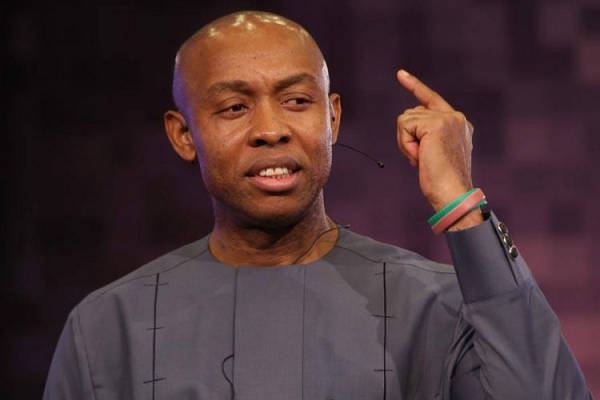
FORMER Chairman of the National Human Rights Commission (NHRC), Chidi Odinkalu, has accused politicians of capturing, weaponising, and corrupting the Nigerian judiciary.
He said the politicisation of judicial appointments and lack of independence, among other challenges facing the judiciary, were the primary causes of its declining integrity.
Odinkalu stated this while speaking on a radio town hall meeting titled Public Sector Integrity in Nigeria, organised by the Progressive Impact Organisation for Community Development, PRIMORG, at the weekend in Abuja.
He claimed that politicians had taken over the judiciary. He also said Nigerians needed to know that elites had corrupted and politically weaponised the court.
Odinkalu maintained that politicians and their allies, whose children, friends, and mistresses were receiving appointments to the bench, used the court to advance their interests rather than the general public’s interests.
” It is not suitable for the Chief Justice of Nigeria to appoint his nephew to the Court of Appeal and his son to the Federal High Court or for the President of the Court of Appeal to appoint her son-in-law to the bench and her daughter appointed to Plateau State High Court where she comes from.
“We are looking for the same people to protect us, and something is fundamentally wrong with them and the masses.
“Everyone should understand that the judiciary has been captured, politically weaponised and corrupted,” he said.
When asked if reforms could save the declining credibility of Nigeria’s legal system, Odinkalu said:” There are no reforms that will work unless we (Nigerians) deepen the de-politicisation of the judiciary. This is because they (politicians) have captured the administrative processes that should have been performed to discipline the judiciary.”
According to him, judges and politicians use the executive arm of the government to unseat people they don’t like, putting the ones they want in power.
He stressed that politicians had also captured the legislative process, and (legislators) were afraid of the judges.
Odinkalu called on Nigerians to understand the issues and realise their responsibilities, adding that citizens were more disempowered than they thought. “Hence, the onus is now on the people to go and get back the institution of justice that politicians and elites have captured,” he stated.
Civil Society organisations and other participants during the town hall meeting also spoke extensively on the administration of justice in Nigeria amidst a growing trust deficit.
Programme Manager at Integrity Organisation, Emmanuel Bosah, spoke extensively on the administration of justice in Nigeria amidst a declining confidence in the judiciary.
He noted that a lot of political will was needed to clean the rot in the judiciary while calling for judicial reforms and citizens to be empowered with the knowledge to follow up and hold the system to account.
A public good advocate and security and energy consultant, Kevin Fyneface, called on the Chief Justice of Nigeria, Olukayode Ariwoola, to come clean with appointments in the judiciary and work towards rebuilding the trust of the third arm of government.
Fyneface lamented that Nigeria was deeply rooted in nepotism and cronyism, noting that “where cronyism thrives, you will find corruption as the order of the day.”
On his part, a public servant, Philip Ezegbulam, advised his colleagues both at the federal and state levels to resist the temptation of corruption, while the programme manager of Accountability Lab Nigeria, Ehi Idakwo, urged Nigerians not to be docile but proactive to corruption issues in the nation.
The PRIMORG’s Town Hall Meeting Against Corruption series is intended to draw the government’s and the public’s attention to instances of corruption in Nigeria.
MacArthur Foundation provides funding for the radio show.
In Niger State, the over 20 communities around Auna River have had their hopes for fresh water, electricity supply and dry season farming dashed for about 38 years after they gave up their lands, when government said it wanted to build a dam around the River. ABUBAKAR ABDULRASHEED visited the communities and uncovered some shocking revelations.
The abundant water flow from the colossal Kontagora-Matandi River surges into Auna community, occupying a vast portion of the landscape. This is why it was named Auna River, after the community. Located in Magama Local Government Area (LGA) of Niger State, the river turns the scorching heat into a refreshing relief for whoever runs to it for relaxation.
Auna River has always been a source of socio-economic blessings for the over twenty farming communities around it, including Auna, a predominant community of farmers and fishers.
However, in a stark twist of fate, the faces of inhabitants of the communities around the river tell a million stories of tragedies, as the government is yet to get value for the billions invested in the multipurpose dam project on the river and has, thus, not met the expectations of residents.
The hope of having running water in their homes first arose thirty-eight years ago when the federal government conceived damming the Auna River to facilitate potable water supply, irrigation, and hydropower to aid effective water and electricity supply to the communities. But that hope was dashed as they still lack water, despite the government having invested billions on the project for over three decades.
Prior to the project, the immediate communities relied on the Auna River for their drinking water and also for dry-season farming, but the project took over the land reduced the quality of the water for their consumption, and forced them to abandon dry-season farming.
On a Saturday in June, when this reporter visited the Auna Dam project, the 8-kilometre road component of the project was smooth but dusty. Inhabitants were seen trekking from Auna River with jerry cans filled with water held above their heads. Meanwhile, farmers were also returning from their farms but in fewer numbers, compared to when the area was notable for farming. That was before they were displaced by the dam project.
The reporter arrived at a wide 340-million cubic meter reservoir compounded by 2,252 meters earth embankment dam crest of 32 meters in height, which is the Auna Dam project that holds many promises of enhancing the socio-economic activities of the country, but the ambitious project still struggles to cone to life down despite multi-billion naira funding.
A stressful climb to the pinnacle of the dam embankment showed devastated agricultural fields that had been vacated by inhabitants and farmers due to the project. On descending from the height, the reporter sighted a large project building bearing S.C.C (Nigeria) Limited, which was found locked with machinery abandoned.
Before the project came, when Umar Hassan, now 56 and a father-of-five, was still young, he maintained a daily routine of a 30-minute trek with his peers to the Auna River to fetch water. Not only them, other children from surrounding villages also gathered every morning for the same task. He said that it was a chore they took turns with their parents, who went to the river in the evening to fetch water.
Mr Hassan expressing how they always go to Auna River to fetch water Photo Credit Abubakar Abdulrasheed
“We were still young when they started the project in 1980s. Before that time, my friends and I and other children in other villages always go to the river to fetch water. If we go in the morning, our parents will go in the evening,” Hassan said.
However, the chore remains what he passed down to other generations, as his children take up the daily routine of searching for water in the morning, while he does the same in the evening.
“Up till now, I still go there to fetch water with my motorcycle. It is my two older children that will go in the morning because I will be at the farm by then. That is how we have been sharing the responsibility of collecting water for our family,” Hassan added.
Despite promises to bring the dam project to its peak target to mitigate the water hardship in the area, it has faced multiple abandonments, cost overruns, and extended timelines. But what could account for the setbacks for the project for which the government had released over N20 billion in thirty-eight years?
The Genesis
Having identified the potential of transforming the ancient Auna River into a multipurpose development that will offer various benefits such as potable water system, irrigation, technology cultivation methods, and hydropower, the federal government earmarked funds for damming the river.
A document obtained from the Fiscal Responsibility Commission (FRC), a government financial management institution that promotes prudent and transparent fiscal management in Nigeria, revealed the history and financial expenditure of the project following its physical verification on the project.
A contract to dam the river was first awarded in 1985 by the Upper Niger River Basin Development Authority (UNRBDA) to S.C.C (Nigeria) Limited at the cost of N27,080,836 during the first tenure of former Nigerian president, Muhammadu Buhari, as military Head of State.
However, the amount could not achieve any substantial work on the project and that accounted for its abandonment until 2007 when the contract was reviewed upward to N11.3 billion with a 24-month completion period. Yet, the project could not achieve any key service for which it was funded.
Before the mobilization, after the 2007 contract review, the consultant for the project, Messrs. TAHAL Consulting Engineers Limited, was re-ordered in association with the Water and Dam Services Company (WADSCO) to revisit the project and review the earlier designs and works done, and, as a result, bring about a new design and detailed construction drawings.
The revisitation was due to the non-availability of project design reports, adequate drawings, and detailed geotechnical and geophysical studies of the area before the project commencement, – as they were identified as major issues for the project being completed.
S.C.C (Nigeria) Limited’s projet office and accommodation under lock with machines and materials abandoned Photo Credit Abubakar Abdulrasheed
Following the completion of the new designs by TAHAL and WADSCO, the contractor submitted a Revised Estimate Total Cost (RETC 1) amounting to N28.92 billion due to changes in designs and the original estimate, but the amount was scaled down and approved at N18.5 billion as the new contract sum.
However, the new cost could only sustain the work up to 2010, when the project was totally abandoned and the hope to complete it dimmed, as no action was taken after the contractor submitted another Revised Estimate Total Cost (RETC II) of N42.84 billion to bring the project to completion.
Once more, in 2017, the high hope to finally complete the project was revived when the former Minister of Water Resources, Suleiman Adamu, assumed office and made commitments to complete high and medium priority projects in the ministry before 2020.
The Auna Dam project was ranked as top priority for completion. At the time, the hydropower feature was excluded from the design while the irrigation component was proposed for extension to “100,000 hectares” to boost agricultural activities in the country.
The RECT II submitted by the contractor was then approved at N40.2 billion as the new contract sum by the Federal Executive Council (FEC) during the council’s meeting in November 2017. This was the second time Buhari’s administration had hoped to bring the project to completion. However, it is not clear why the ministry keeps approving the upward reviews of the project cost despite eliminating some features like hydropower, as the ministry failed to respond to enquiries by Ripples Nigeria.
“As part of our efforts to complete ongoing projects, which were hiked over time, we presented a memo to the Federal Executive Council (FEC) towards resuscitating and completing the Kontagora/Auna dam and Irrigation project in Niger state,” Adamu said while briefing State House Correspondents after the FEC meeting that got the Auna Dam project reapproved in 2017.
“You could recall that we had a technical audit at the beginning of last year [2016] of all the ongoing projects in the ministry and this project (Auna Dam) was ranked as among the top priority projects. It had attained 61 percent progress before it was abandoned in 2010. This is the project that was initiated in 1985,” Adamu stated.
Contrary to this, the FRC’s document revealed that the project only attained 52 percent against 61 percent claimed by Adamu and as recorded by the contractor before his demobilisation in 2010.
The approval to complete the project prompted for the extension of consultant services on the project by three years, which was the completion period of the new award.
“In November 2017, the Federal Executive Council approved another Revised Estimate Total Cost (RETC II) to the present contract sum of N40,273,030,502.88 with a completion/extension period of 36 months. Furthermore, in March, 2018, the contractor remobilized to the site after RETC II approval and commenced work on the rehabilitation of the office and accommodation buildings, access road to site and reconditioning of the Dam embankment,” a FRC’s document read.
When the contractor was remobilised to the site to complete the project in 2018, the heavy moving of machinery, equipment, and the rehabilitation of the project office and accommodation stirred up excitement within the communities that the long-awaited hope to complete the project had finally come.
However, only the rehabilitations, including the re-grading of the access road to the dam site and reconditioning of the dam and its embankment with spillways and intake pipes were achieved, leaving the project to remain a mirage.
Overall, as of 2019, over N20 billion was paid to the contractor following his submission of forty-two claims in the interim certificate, according the FRC document.
“…The Contractor has so far (as at 2019) submitted Forty-Two (42) claims in certificate No. 1–42 with a cumutative consolidated amount of N21,590,706,166.14 and has received a total amount of #20,269,940,492.06, and thus leaving an outstanding payment of #1,320,765,673.46”, the document revealed.
In July 21, 2023, a Freedom of Information Act, FOIA, request was sent to the Ministry of Water Resources. The request, which was addressed to the minister asking for detailed information about the project, including contract description and value, budgetary provision, as well as updated amount released to the contactor, and remarks on the project, was acknowledged but elicited no further action despite follow-up reminders dated 7th September and 20th October.
Losing lives, properties to ‘no success’
During this reporter’s visit in June, he spoke to Garba Taji, a 61-year-old farmer and resident of Molmo Village, who was sitting under one of the straggling trees near Auna River and catching his breath after a strenuous day of farm work. The tree shield, he said, is his regular resting spot every time he goes to the farm before returning home. Attached to his resting is a misery that makes him shed a tear every time alone.
Ostensibly, the stress of regular farm work makes him appear older than his age. Besides, the enduring sorrow stemming from the loss of his son, 16 years ago at the Auna Dam project site continues to weigh heavily on him.
According to him, his son, Mohammed, who was 24 years old when he died, was returning from his farm late in the evening after a heavy downpour that had caused the Auna River to overflow its bank. Tragically, he drowned in the river with his bike at the collapsed bridge that connects his community, which the contractor had failed to repair.
“I lost my 24-year-old son [then] while he was trying to cross the bridge at the dam. Before, our community and other villages had made wooden bridges across some areas of the river that we were using. But the contractor came and removed them, and built a concrete one that wasn’t up to standard because it didn’t take long for the new bridge he constructed to collapse, leaving us with no means of crossing. We struggle to cross the river during the dry season and during the rainy season we only use canoes in crossing the river area,” Taji said as tears rolled down his eyes.
Though Taji had accepted the loss as fate, his mind still grapples with reminiscing. He told this reporter that he got no compensation despite the hardship on his family around the time. But could completing the project compensate him for the loss?
Mr Taji, who lost his son, Muhammed, homes, and farmlands Photo Credit Abubakar Abdulrasheed
Also, a youth in Rafin Gora village, Abdullahi Ibrahim, sustained severe injury at the river when the community replaced the collapsed bridge with pieces of metals.
“I was going to the other village to meet my friends. I accidentally got my left leg caught in a wide-opened iron structure, resulting in an injury around my ankle. I shed a lot of blood before I was taken to the town for treatment.” Ibrahim said
For communities residing around the river area, the onset of the construction of the dam project brought miseries to peasant inhabitants who are majorly farmers.
When the contractor was first mobilised in 1985, all communities around the river were approached to vacate their ancestral homelands for the project. Farmers who had cultivated the area had to give up their farmlands.
The hope that SCC (Nigeria) Limited brought to provide them potable water, irrigation, and the promise to compensate them for giving up their homes and farms made them reluctantly surrender their lands.
However, little or no compensation was paid to the people whose properties were affected by the project. A few of them, it was learnt, received compensation amounts as low as N1,000 – N2,500, while many received nothing.
“The project site was where we had our houses and farms before it started. They came to tell us to relocate and leave our houses and farms. We had relocated for the project two times, and even the last time they came they gave us another notice to relocate from this place again.
“They said the government has already bought all these places to do the project, meanwhile, they just compensated a few people that lost their farms, houses, and trees with small amounts.
“For instance, for those that had around five rooms, they gave them somewhat between N1,000 and N2,000, and in some cases as little as N300 or N600, while some were not even given a Kobo,” said Ibrahim Tanko, assistant Village Head of Molmo.
All residents and landowners of about nine villages, including Molmo, the nearest communities to the project site became inhabitants and tenants in new settlements where this reporter visited them. For many years, they lived with the hope that the project would be completed and they would regain the long-lost potential of the Auna river and recover their earlier livelihoods, with an improvement. However, its abandonment dipped their hope as the site turned into a deserted area.
For Taji, the project had brought multiple tragedies – from losing his son and his previous home, to his big farmland.
“They came, telling us they would do the project that would provide us with clean drinking water and irrigation for farming during the dry season. But as you can see, they left us in hardship without fulfilling any of their promises they made to us,” Taji added.
Yahya Mohammed, a youth resident of Kaso Village, recalls the excitement of his community thirty-eight years ago when they heard that water would soon be running in their homes after the the dam project would have been completed. At that time, his eyes and those of his childhood peers widened with curiosity as they watched machinery being brought into the community to start the construction of the dam. They asked their parents what the machinery was meant for.
Upon hearing that the Auna River which they used to trek to daily to fetch water would be dammed and water would constantly be running right in their houses. Both they and their parents exuded a contagious energy that radiated pure happiness and enthusiasm, coupled with eager anticipation to end the task of fetching water.
Their glee motivated them to visit the workers every day and return home to share their discoveries with their peers who could not go.
However, as Mohammed and his peer grew older, what their parents told them is yet to come true.
“As children then, we were happy when we saw those white men, even our parents were also happy as well. We often go there to play and watch the workers at the site. But see now, we are getting older and nothing has changed. In fact, it has even become worse because we now solely depend on dug wells for water, and the water is not good because many of us often fall sick.” Mohammed bemoaned.
Mohammed’s village and many other communities in the area depend on deep-dug wells which they lament are often short of water and even run dry during dry season. Depending on these wells, residents lament facing various ailments which were attributed to poor water quality for those who sought treatment at health centers.
“Getting water is a big problem for us, particularly during the dry season. At that time, all the wells you see will run dry, and we have to journey to various areas in search of water. Most often, we trek to Auna River because it used to have little water during the dry season”, he lamented.
Rainah Hassan, a resident of Tungan Tsamiyya, is one of the individuals who embarks on journeys to the Auna River to fetch water. The 41-year-old woman said that her community lacks any dug wells, so they must trek long distances to neighboring communities for water or visit Auna River, where they have an area with scratched ground that provides them water.
She added that she always goes to the river with her children to fetch water, but in the morning of the day this reporter visited, she sent her three children to the river while she handled the home chores, but for four hours she waited without seeing their return.
“I am always in fear whenever I don’t go with them, considering the current situation in this country with kidnappings. So when I didn’t see their return after four hours they had gone to the river, I became concerned and went to the river to check on them. Upon arriving there, I found that one of the jerry cans they had taken to fetch water had fallen and broken and they were busy trying to patch it up before returning home.” Mrs Hassan expressed how they trek long distances in search of water.
Scary Data; lack of safe drinking water plagues Nigeria
According to the World Bank’s data in its 2022 Global Water Security & Sanitation Partnership, over 70 million Nigerians live without access to clean water. The data climbed against its 2021 report which stated that approximately 60 million citizens were living without access to basic drinking water.
In Niger State, the over twenty communities that ought to have benefited safe drinking water from the Auna Dam project but now depend on stream water and dug wells, make up the 39 percent the state contributed to the 70 million Nigerians with no safe drinking water.
However, UNICEF identified that the lack of access to safe drinking water increased the vulnerability to water-borne diseases, such as diarrhoea which leads to the deaths of more than 70,000 people annually.
Irrigation, hydropower plans derailed
For optimal utilisation of the potential Auna River, as part of the dam project, the government reckoned to erect the irrigation feature initially covering 11,200 hectares of the project area, but was later reduced to 1,500 hectares during one of the contract reviews, while the hydropower feature had been “excluded from the project,” as revealed by the FRC.
The quest was to provide raw water drawn from the Auna Dam for the irrigation system of farming in the areas to be used by farmers during prolonged dry seasons when most of them are often out of job.
“The project comprises of different components which include:
i. Access road – 8km ii.Earth embankment dam crest length – 2,252m iii.Height of Embankment – 32m iv.Reservoir capacity (storage) – 340MCM v. Spillway Type; Uncontrolled overflow spillway – 60m width vi.Emergency spillway – 300m width vii.Intake/Outlet – 4× 1,400m diameter pipes Viii. Irrigation supply canal -14km length ix. Irrigation area – (initially of 11,200Ha) and now 1,500Ha.”
But in a cruel twist of fate, what they hoped for in the project to nourish their farms turned to misery that left them suffocated.
When farmers heard that the project would provide them irrigation, the news stirred excitement as they hoped it would add value to their farming, little did they know that their hope would stall many ways without coming true.
However, a tour round the project evidently found that no irrigation system component ever existed. As this reporter ventured into the project area, he observed that a few spots at the project site have been turned into small farmlands.
“When they first started we were managing to farm in some areas but the project caused erosion many times that swept all our farmlands. Then they asked us to vacate the land totally.
“They said after they complete the project we will have good water for drinking, fishing, and an irrigation system to farm during the dry season. We were doing the dry season before they started the project but now, we can’t do it again because the land is not even suitable for dry season farming any longer. It has been over 30 years since we stopped the dry-season farming. We always keep part of the profit we make during the little farming we do in the rainy season to sustain ourselves during the dry season.” Mr Magagi said.
Also, Issa Attah, a resident of Auna was once a seasonal and respected farmer in the area as his harvests were always bountiful, but since the project came and affected his farmlands, he has transitioned to being a fisherman which is “not as favourable” for him like farming.
On this reporter’s visit, it was the second time that day that Attah was going to the Auna Dam site to catch fish for sale, but the latter attempt was a failure.
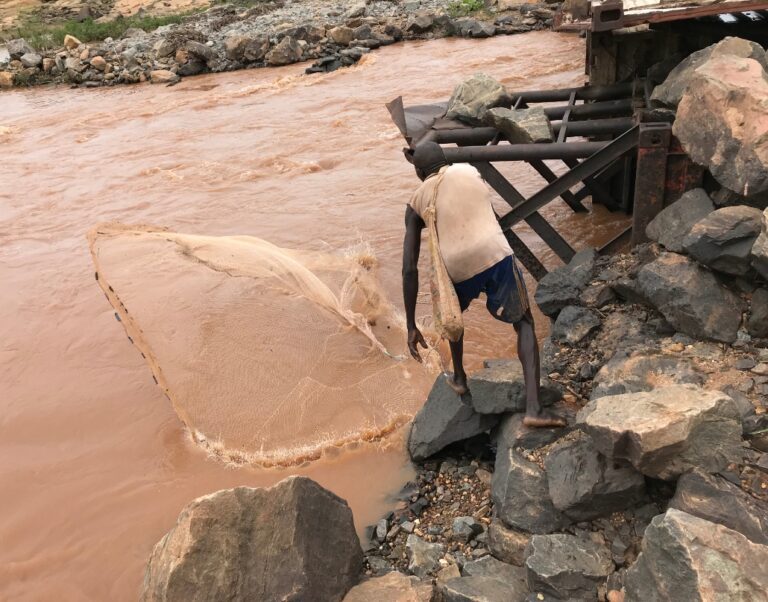
It was in the evening, he cast his net into the river, leaving it for a while with the hope that by the time he drew the net out, it would have caught some fishes, but no fish blessed his net.
Few hours later, upon this reporter’s return, Attah had caught four fishes in addition to the eleven he had caught in the morning; he bemoaned his miserable catch.
“Other fishermen experience the same thing, even some other people had left the business. The reason for the low catches is because the project has affected many areas that we do have good catches.” Attah lamented.
During this reporter’s visit, the Auna River was not at its peak, the large area that residents said shed much water had been occupied by the dam embankment.
Also, excluding the hydropower component from the project burdens the darkness prone communities that had never seen electricity before.
“It is you that is just telling us now that the electricity part has been removed and won’t be done, that means we will continue to suffer in darkness. Can you imagine the sort of life living without electricity all these years? Maybe they came to deceive us that they’ll use the dam to provide us with electricity,” said Yusuf Haruna, a resident of Tunga Washeri.
District Head laments, pleads for project completion
Usman Kibiya, the Emir of Sabon Gari Auna, has a face on the project as he was one the people the S.C.C (Nigeria) Limited met before the construction commenced and engaged with recommending people to work for them as labourers on the site.
Emir of Sabon Gari Auna, Mr Kibiya, bemoaning the hardship of the communities Photo Credit Abubakar Abdulrasheed
However, Kibiya is not pleased with the project’s non-completion, as the communities face increasing water hardship and have lost numerous socio-economic activities that the areas once possessed.
He said their struggle to access water is impacting their well-being and hindering various activities, including their children attending school. He also noted that during dry season, all their dug wells dry up, forcing them to travel as far as six kilometres to fetch water.
“I provided them with more than fifteen boys from my village and also many from other villages to work for them. This entire area was surrounded by a river, but they began by laying some pipes to channel the water. We were very happy with the project back then.
“But at this point, we need to speak out the truth about our hardships. We are facing serious challenges in all our villages, particularly concerning accessing clean drinking water, which was one of the promises they made to us. We have suffered losses; people have lost their houses, farms, and other things.
“We have more wealthy farmers in many communities because we used to do dry season farming but we are not doing it again because the project has taken over the lands, and up till now we have not seen the success of what we gave up our properties and means of livelihood for,” Mr Kibiya lamented, and bemoaned how they suffered to get water and lost many of their means of livelihood due to the project”.
“If I could remember, during their [S.C.C (Nigeria) Limited] last presence on the site they told me the government did not pay them, and so they are going to stop the work, and they left with no hope for when they will come back to complete the project”, he added.
He, however, pleaded with the government to expedite the project completion so as to fulfill its long-intended purpose and bring the targeted benefits to them.
Damning S.C.C (Nigeria) Limited, accomplice with government MDAs
Ripples Nigeria found that S.C.C (Nigeria) Limited is owned by a non-Nigerian, Yuval Levy, who has significant control and owns substantial shares in some other companies linked to S.C.C (Nigeria) Limited. Some of the companies are registered in Nigeria while two are in safe havens.
The managing director, Yuval Levy, during the commissioning of first made-in-Nigeria NNPC gas pipeline
Levy, is an influential business personality in Nigeria and a major player in the oil and gas and construction industries. He was conferred with the national honour of Member of the Order of the Federal Republic (MFR), one of Nigeria’s highest national honours, by the Nigerian former president, Goodluck Ebele Jonathan in 2014. His company’s (S.C.C Nigeria Limited), a multi-million dollar ultra-modern steel pipe manufacturing mill was commissioned by the immediate past president, Muhammadu Buhari, in 2015.
Levy, and his three associates, Patrick Dele Cole, Samuel Umoh, and Ogaji Walter have been managing SCC Nigeria Limited as directors, as well as other companies associated with and having the same office addresses as SCC, where they also hold directorship.
For S.C.C (Nigeria) Limited, the company was registered in Lagos as a private limited company by shares and as a purchase and sewage management company. The company which now has its office at Plot 741, Cadastral Zone B4, Obafemi Awolowo Way, Abuja, has a total company share of 10,000,000 units of which Levy owns 10%, while 25% is owned by Cornwood Investment Nigeria Limited, another company in which Levy owns 99.9% shares.
Records obtained by Ripples Nigeria from the Corporate Affairs Commission (CAC) revealed that the four associates including Levy were appointed into S.C.C Nigeria Limited in October, 2019 although the company was registered in 1976.
Levy’s shares and other shareholders in S.C.C (Nigeria) Limited Photo Credit Abubakar Abdulrasheed
Two other shareholders in S.C.C (Nigeria) Limited are Malangantus Limited, a company registered in the Bahamas, which owns 65% shares, and C.F.S Consulting and Fin services Limited with 0.4% shares. Both companies are registered in safe havens.
It was impossible to get registration information on these companies because of the secrecy around businesses in safe havens, so it could not be determined how or if they are connected to Levy. But the mere fact that SCC Nigeria Limited is significantly owned by a company registered in a safe haven also raised some questions.
As the name implies, in business or investment terms a safe haven is a place where investments are believed to be secure, usually because of lesser taxes and dues. But it also connotes secrecy, as several international investigations, such as the Panama and Pandora Papers have shown that it is a place where businessmen hide their assets and funds, away from the scrutiny of the authorities.
For Cornwood Investment Nigeria Limited, it was registered in October, 2018 in Imo State as a sales company with a total of 1,000,000 shares value. All the existing directors for the company were removed on 24 October, 2022 while Levy and his associates (except Cole who is secretary) were appointed as directors on the same date.
Levy and Samuel are the only shareholders in Cornwood with Levy being the only person with significant control and having 99.9% shares while Samuel owns just 0.1% shares in the company.
A collage grid showing the directors of S.C.C (Nigeria) Limited Photo Credit Abubakar Abdulrasheed
Interestingly, Levy provided false information to the CAC about Cornwood for whether he owns at least 5% shares in any other company as he owns 10% in S.C.C (Nigeria) Limited, which was registered far before Cornwood.
Besides Malangantus Limited, Cornwood, and C.F.S Limited, Levy and his partners, Dele Cole, Umoh, and Walter are also linked to two other companies, E.L.I Security Company Limited and Stacrest Integrated Farms Limited, incorporated in 2014 and 2016 respectively where they are directors as well as shareholders.
Shareholders in cornwood Investment Nigeria Limited with each of their shares Photo Credit Abubakar Abdulrasheed
Back to the project site, the only known face for S.C.C (Nigeria) Limited left on the site for watching over the project declined to speak to the reporter nor disclose his name. He said a request has to be made to his head office in Abuja through the Federal Ministry of Water Resources before he could respond to any inquiries.
FOIA requests and reminder sent to the Federal Ministry of Water Resources Photo Credit Abubakar Abdulrasheed
He, however, did say he believes the place has been shut down following non-release of funds by the government.
“The Ministry of Water Resources has to give you approval, whereby sending a copy to our head office, and our head office will send a memo to us while you also come with your own.
“Because for now, we are not operating, this place [has] been closed down, only a few people are left, so I’m the one in charge. So nobody, we’re not doing anything, no job is going on, no payment from the federal government”, the S.C.C (Nigeria) Limited’s personnel on the ground said.
It was found that S.C.C (Nigeria) Limited has its office at Plot 471, Cadastral Zone B4, Obafemi Awolowo Way, Jabi, Abuja, Federal Capital Territory.
When a phone call was made to its office on enquiries about the project, the receiver who in a subsequent call spoke through the company’s PRO, said the information sought by Ripples Nigeria can not be let out by the company, adding that the request should be redirected to the Federal Ministry of Water Resources.
“S.C.C is just a contractor with that Ministry, and S.C.C which is handling the project, can not just on his own begin to give you information regarding it. Go to the Federal Ministry of Water Resources and get it”, the receiver who claimed to be speaking on behalf of the PRO said.
“What if we are giving you the information and it is not what the Federal Ministry of Water Resources that gave us the job have [with them]?”
When the reporter questioned why the ministry and S.C.C would have contradictory accounts on the project, he declined to answer.
“What I’m letting you know is from the response of the Public Relations Officer, kindly go to the ministry and get your answer.
“You directed the letter to the wrong place (S.C.C Nigeria Limited); there is no need to get an answer from us or reply. You’re supposed to get the information you need from the ministry not from SCC,” he insisted.
However, a FOI request addressed to its Managing Director and delivered to the address on July 21, 2023, was officially acknowledged but not responded to. A reminder was sent on September 11, and on October 9, the company wrote and claimed that it was not obliged to provide any information on a contract.
It stated in its response that, “S.C.C. Nigeria Limited is only the contractor on the project employed by the Federal Government of Nigeria under the direct supervision of the Federal Ministry of Water Resources and thus we are not at liberty to divulge any information to you”.
It advised that “any information sought on the said project should be channelled to the Federal Ministry of Water Resources.”
However, the Freedom of Information Act 2011 mandates private entities that receive public funds to provide access to information to the utilisation of such funds, as they fall under the definition of “Public Institution” in that circumstance.
Section 2 (7) of the Act defines public institutions as “all authorities whether executive, legislative or judicial agencies, ministries, and extra-ministerial departments of the government, together with all corporations established by law and all companies in which government has a controlling interest, and private companies utilizing public funds, providing public services or performing public functions”.
Section 1 (1) also establishes “the right of any person to access or request information, whether or not contained in any written form, which is in the custody or possession of any public official, agency or institution howsoever described, is established.
A letter sent to the company to inform it about its legal obligation under the law was ignored.
Project information missing, as ministry, agency refuse to answer questions
In a quest to obtain detailed information and the technical scope of the project, FOIA requests dated July 21 and 25 were sent to the Federal Ministry of Water Resources and Upper Niger River Basin Development Authority respectively.
In response to the follow up request, the ministry’s Director of Legal Services, Yv. U. OduThomas, who acknowledged receipt of the earlier request, said it was receiving attention, and requested for more time for consultation with other government departments and agencies involved in the project implementation.
“I am also to state that your letter is receiving due attention. However, the Ministry hereby requests for more time, in view of the volume of records involved and the need to hold consultations among relevant Departments and Agencies of the government, in the course of processing your request”, Odu-Thomas said in the acknowledged receipt to RIPPLES NIGERIA in July.
However, four months after the acknowledgement and request for more time, the ministry failed to provide the reponse, and ignored subsequent reminders dated September 7th and October 20th.
Also, in a follow up visit to the UNRBDA on August 17, the Managing Director directed this reporter to the engineering services department to obtain the response. However, a staff member, simply named Steven, confirmed the request was referred to the department but said his boss who was to provide the information was not around. He asked this reporter to come back after a week.
Surprisingly, during a subsequent visit to the office on September 4, Steven was not around, but when his colleague contacted him on phone for this reporter, he said they could no longer find any information about the project.
“We no still get information on that thing project ooo, Oga (his boss) don chat me one time that I should write back to them (RIPPLES NIGERIA) say they should contact more authorities involved in the project”, Steven said in Pidgin when his colleague contacted him on phone.
This report is supported by the John D. and Catherine T. MacArthur Foundation and the International Centre for Investigative Reporting (ICIR).
THE Ogun State Police Command has denied allegations that its officers tortured a suspect remanded in its custody, Seyi Samson, to death.
This was contained in a statement by the state’s Police public relations officer (PPRO) Omolola Odutola on Sunday, November 26.
Odutola said the command was committed to safeguarding citizen’s rights, including those in their custody.
“Ogun state Police command is well versed in the legal framework that safeguards the rights of individuals in custody, free from all forms of cruel, inhuman, or degrading treatment,” she said.
“For the records, the deceased was already charged for cult-related activities, and he was taken to court on Thursday, 23rd November 2023, where he was to be arraigned before a special court on a cultism case in Isabo Abeokuta, but the honourable court did not sit. He was brought back to Eleweran in Abeokuta the same Thursday,” Odutola noted.
She stated that the suspect was to be taken back to the court on Friday, November 24, but began exhibiting strange behaviour early the same day, biting other inmates before he died.
“On Friday, 24th November, at about 0500 hours, Seyi went berserk, shouting, biting with teeth, and assaulted other suspects in the cell until he got exhausted.
“Other suspects in the cell alerted policemen on duty, and he was allegedly taken to the Police hospital and later to Ijaye General Hospital Abeokuta, along with other suspects he gave bites in the cell for medical treatment against infection. Other suspects were treated and discharged, but Seyi, while on medical attention, later gave up the ghost. Every other allegation is hereby debunked,” she noted.
Police accused of killing suspect
On Saturday, a social media user, Anne Abidemi Akinnagbe, who identified herself as the deceased’s cousin, made a post on Facebook accusing the Police of being involved in his death.
She disclosed in the post, which has now been deleted, that the deceased, whom she referred to as Seyi, was arrested on Monday, November 20, when he went to charge his phone.
Screenshot of post calling Ogun Police out over Seyi Samson’s death.
“It was hot, so he had removed his shirt at the front of the house where he sat with another friend. The Police drove by and saw them, parked and started questioning them. They said he was a cultist because he had tattoos. Tattoos he got when he went to SA, mostly Bible verses and DOBs. They took him to Eleweran from Sagamu. They would later release the person he was arrested with but kept my cousin there,” she noted in the post seen by The ICIR.
Akinnagbe, however, noted that when the deceased’s sister visited the Police station to deliver food to him, she was told he had died after being made to wait for hours.
“His sister went on Friday to give him food. She got there, and they asked her to taste the meal, which she did. Then go and bring him; they started turning her round and round. She waited and waited, they didn’t produce Seyi. She went close to the cell, and the inmates told her he wasn’t there. Shortly after, they called her into the DPO’s office. They told Toyin that Seyi suddenly started talking to himself and was restless, so they took him to the hospital, where he stopped breathing.
“Nigeria Police took my cousin who was hale and hearty, sane to the point of prostrating and begging them that he wasn’t a cultist, they took him on Monday, somehow he had managed to become insane and where they took Toyin to was the mortuary where he was embalmed, lying lifeless and cold. Nigeria Police didn’t have anyone to call when Seyi was talking to himself; he had to have died and lying in the morgue, and his sister had to come in and be turned around for hours before they would later take her to the morgue to see him,” she noted.
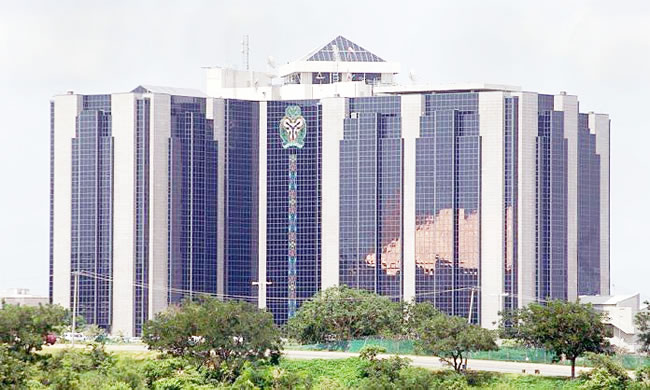
THE Central Bank of Nigeria’s (CBN) proposed commercial bank’s recapitalisation has been described as a timely intervention, as Nigeria’s currency problems remain a major trigger to banking liabilities.
The CBN governor, Olayemi Cardoso, on Friday, November 24, in Lagos, said banks should increase their capital base to match up to the Federal Government’s target of a $1.0 trillion economy.
“Will Nigerian banks have sufficient capital relative to the financial system’s needs in servicing a $10.0 trillion economy in (the) near future? In my own opinion, the answer is “no,” unless we take action. Therefore, we must make difficult decisions regarding capital adequacy. As a first step, we will be directing banks to increase their capital,” he said.
The CBN governor did not state the amount for the bank’s recapitalisation in his address. However, economists believe commercial bank’s recapitalisation is long overdue.
The last banking recapitalisation for commercial banks was in 2005, under the former CBN governor and the current Anambra State Governor, Charles Chukwuma Soludo.
The 18-year gap since 2005 has witnessed capital erosion and inflation upsurge and lessened the N25 billion capital base.
Consequently, Nigeria’s currency problems have further exposed the initial capital base to further risks while widening the risk of most commercial banks.
“Generally, on the recapitalisation, the last one we had was in 2005, and you know what the current value of that amount is with the current exchange rate and inflation in 2023,” former Director-General of the Lagos Chamber of Commerce, Muda Yusuf, told The ICIR.
He stressed the need for a strong capital base to support the liabilities of the financial institutions to ensure depositors’ funds are risk-averse.
“There’s an urgent need for the recapitalisation of the banks because of Nigeria’s currency problems. There has to be a minimum capital base for banks, as some are already raising their own system for stability,” he added.
Also in his address, the apex bank governor admitted technology’s role in advancing financial inclusion but warned that infractions in some payment services platforms would be severely sanctioned.
“Recent developments in the payments services landscape have raised concerns regarding the use of technology and the existing licence and regulatory framework. We have observed that some licensees are operating outside the approved activities, breaching the boundaries set for them.
“Any intention or unintended non-compliance will be subject to sanctions, as operators have the responsibility to ensure that they are licensed for the activities they undertake,” he added.
What the numbers say about bank’s liabilities as of September 2023
The proposed recapitalisation of the Nigerian banking system has raised much concern since the CBN governor hinted at the annual bankers’ dinner on Friday, September 24.
As of the end of June 2023, the banking system’s financial soundness indicators (FSIs) remained stable and robust, CBN disclosed in its monetary committee of that month.
It shows that the capital adequacy ratio (CAR) stood at 11.2 per cent, the non-performing loans (NPLs) ratio at 4.1 per cent and the liquidity ratio (LR) at 48.4 per cent.
However, the new CBN governor has raised concern that it was crucial to evaluate the adequacy of the banking industry to serve the envisioned larger economy.
A look at the financial position of some banks shows a minimal capital base when their total assets are deducted from their total liabilities.
According to Investopedia, a financial media website, capital base, used synonymously with the term bank capital, is the value that results when a bank’s liabilities are subtracted from its assets.
The ICIR looks at Zenith Bank, United Bank for Africa (UBA), Access Holdings, Guaranty Trust Holding Company (GTCO), FBN Holdings, Sterling Financial Holdings Company, and Fidelity Bank banks’ nine-month financial statements.
It revealed that Zenith Bank’s capital base stood at N1.92 trillion when its total liabilities of N16.24 trillion were deducted from total assets of N18.16 trillion.
UBA follows it with a capital base of N1.78 trillion when total liabilities of N14.46 trillion are removed from the bank’s total assets of N16.24.
Although Access Bank has the highest total assets among the other banks, its capital stood at N1.64 trillion when liabilities of N19.77 trillion are subtracted from total assets of N21.41 trillion.
FBN Holdings’ capital base stood at N1.37 trillion when total liabilities of N13.08 trillion were removed from total assets of N14.46 trillion. Also, GTCO has a capital base of N1.27 trillion when total liabilities of N7.34 trillion are deducted from N8.62 trillion.
While Fidelity Bank’s capital base stood at N410.75 billion, deducting total liabilities of N5.00 trillion from N5.41 trillion, Sterling Bank’s capital base stood at N165.84 billion when total liabilities of N2.08 trillion is removed from total assets of N2.25 trillion.
The ICIRreported that the naira’s depreciating value erodes banks’ capital base as the margin between assets and liabilities moderates.
For instance, Zenith Bank’s total liabilities increased by 48.91 per cent, from N10.91 trillion as of December 31, 2022, to N16.24 trillion as of September 30, 2023, while UBA’s financial obligation rose by 45.52 per cent, from N9.94 trillion to N14.46 trillion.
Access Bank’s total liabilities rose by 43.57 per cent, from N13.77 trillion to N19.77 trillion, while GTCO’s financial obligation also increased by 33.13 per cent, from N5.52 trillion to N7.34 trillion in the review period.
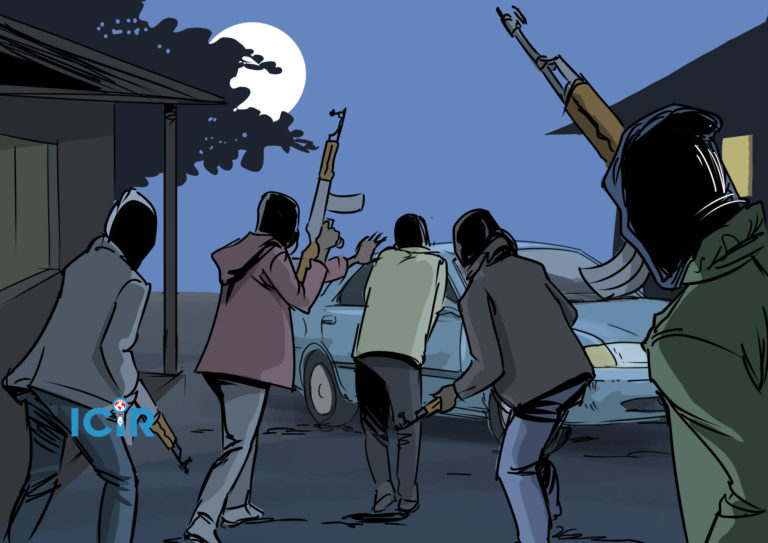
THREE area councils in the Federal Capital Territory Administration (FCTA) have been named as recording the highest kidnapping cases.
They are Bwari, Kuje and Abaji.
The director of administration and finance, FCTA Security Services Department, Ebele Molokwu, in a media briefing on the activities of the department, said major kidnapping incidents in the territory were usually from those councils even though there were some isolated cases in the other area councils.
She said the three councils share borders with neighbouring states where kidnapping is rife.
Molokwu noted that the new administration had made plans to address cases of kidnapping and one-chance syndicates in the Territory.
A report by SB Morgan (SBM), known as SBM Intelligence, revealed that between July 2022 and June 2023, $387,179, translating to N302 million, was paid as ransom to kidnappers in the country.
Within the period the report said N552 million was demanded from kidnappers in the FCT while N13.8 million was paid as ransom.
The ICIR further checked the 2023 kidnapping data from the Nigeria Security Tracker in the FCT.
The councils with these cases are Kwali, Kuje, Bwari, Gwagwala, Kuje and Abuja Municipal. Between January and June 2023, NST data said that 123 people had been kidnapped.
Meanwhile, the Director of the Department (FCTA Security Services Department) Adamu Gwary, added that the security committee had been divided into two, the kinetic, made up of core security agencies, and the non-kinetic, involving the traditional rulers and other relevant stakeholders.
THE Central Bank of Nigeria (CBN)has revealed plans to mop up excess liquidity (cash in circulation) through another round of open market operations (OMO).
The CBN Governor, Olayemi Cardoso, disclosed the plan on Friday, November 24, in Lagos at the Chartered Institute of Bankers of Nigeria’s 58th annual dinner and the Institute’s 60th anniversary.
Open market operations is a monetary policy tool the apex bank uses to control money in circulation and inflation.
“Recently, an OMO auction was conducted by the apex bank, with a stop rate of 17.5 per cent for the one-year tenor, attracting an oversubscription of N350 billion,” he said.
He also disclosed that the apex bank offered N108.1 billion worth of treasury bills with three tenors to the investing public, which can help reduce liquidity in the banking system and support government fundraising.
Available data from the CBN states that the currency in circulation increased by 3.75 percent to N2. 76 trillion in September 2023 from N2. 66 trillion in the previous month. On a year-on-year basis, it declined by 14.6 percent.
Cardoso also said that sustained cash reserve requirement (CRR) debits had moderated liquidity in September and October 2023.
“Liquidity in the entire banking sector has been significantly reduced to under N100 billion in November,” he said.
A report by Afrinvest Securities Limited shows that activity in the money market significantly increased in the week that ended the month of November, as the CBN floated a series of OMO auctions as well as the scheduled T-bills primary market auction to curtail the expected boost to system liquidity from Federal Account Allocation Committee (FAAC) inflow (N405.6bn), coupon payment and maturing instruments.
PRESIDENT Bola Tinubu may not achieve his target of increasing Nigeria’s Gross Domestic Product (GDP) rate to six per cent annually, experts have said.
The experts told The ICIR that his government needed to implement certain reforms to improve some sectors of the economy before the goal could be feasible.
These reforms, the experts said, have to be piloted by the President with fiscal discipline within his cabinet.
Tinubu said in his inaugural speech in May that he would raise the GDP through job creation and food security to mitigate poverty.
He said, “My administration must create meaningful opportunities for our youth. We shall honour our campaign commitment of one million new jobs in the digital economy. We shall remodel our economy to bring growth and develop the GDP much better than we have seen through job creation, food security, and an end to extreme poverty.”
The President announced the immediate removal of fuel subsidy as a first step to meet the objective.
There have been mixed developments months after making the announcement. On the part of the government, the subsidy removal has saved up more spending, thereby increasing the allocation that goes to each state monthly through the Federal Account Allocation Committee (FAAC).
However, the downside to the announcement is the impact on household consumption, increasing the inflation rate to 27.33 per cent, the highest recorded in 18 years. Though the President has announced several palliative schemes to cushion the effects, they have not made a significant impact.
A recent report by the National Bureau of Statistics (NBS) disclosed that Nigeria’s GDP rate was 2.25 per cent as of the third quarter (Q3) of 2023.
The report showed that GDP grew slightly by 0.03 per cent in Q3, higher than the 2.51 per cent reported in the second quarter of 2023 growth.
The performance was driven mainly by the services sector, which recorded a growth of 3.99 per cent and contributed 52.70 per cent to the aggregate GDP growth.
While the agriculture sector grew by 1.30 per cent, from the growth of 1.34 per cent recorded in Q3 2022, the industry sector improved to 0.46 per cent from a negative territory of -8.00 per cent recorded in Q3 2022.
A senior research & policy analyst for BudgIT, Vahyala Kwaga, told The ICIR that to achieve the six per cent target, Tinubu would have to improve infrastructure, optimise regulation, and draw in FDI/FPI to about 4.5% to five per cent.
He said, “The tax-to-GDP question is similar to the ease of doing business question. Can the entire tax process be streamlined so that Nigerians can pay their taxes seamlessly? Also, will the government go after the top percentile of rich and wealthy Nigerians who pay an insignificant amount of tax compared to their earnings and assets?
“It would require intense harmonization of tax policy between not just government agencies but even between the federal and state governments.”
Also, The head of financial institutions ratings at Agusto and Co, Ayokunle Olubunmi, noted that the administration had to maintain consistency in making policies that could pull major economic activities into the country.
Olubunmi said Nigeria’s challenges were largely caused by crude oil theft and dilapidated infrastructure.
The ICIRreported how Nigeria might fail to meet the oil benchmark target for 2023, hence affecting funding of the 2024 fiscal budget.
“For us to really have such economic growth, there need to be policies that would unlock these benefits. It is not that there’s just one particular sector the government needs to focus on, but it needs to increase and make the private sector come into the country. If you are looking at foreign investors, what’s the exchange rate, inflation rate, and friendly environment to drive investment,” Olubunmi said.
AT least 27,698 cases of sexual and gender-based violence (SGBV) were recorded in five states in Nigeria and the Federal Capital Territory (FCT) between 2020 and 2023.
Minister of Women Affairs Uju Kennedy-Ohanenye said this on Friday, November 24, in Abuja, at a press conference commemorating the beginning of 16 days of activism against gender-based violence observed globally between November 25 and December 10.
She listed the states as Lagos, Sokoto, Adamawa, Ebonyi, and Cross River, where the Spotlight Initiative programme, an initiative of the United Nations (UN), funded by the European Union (EU), is being implemented.
“In the recorded cases, there were 1,145 fatal GBV cases, with 393 perpetrators convicted, 9,636 as open cases, 3,432 new cases, 1,741 as closed cases, and 1,895 follow-up cases, among others, within the period under review.
“It is commendable that the states have adopted the VAPP (Violence Against Persons (Prohibition) Act) Act, but governments at that level must ensure full implementation of the Act to protect women and children from all forms of violence,” she said.
Noting that a third of Nigerian women experience intimate partner violence at some point in their lives, Kennedy-Ohanenye called for more investments into ending all forms of violent acts against women to achieve the realisation of relevant Sustainable Development Goals (SDGs).
“Statistics from the GBV data situation room estimates that 35 per cent of women, with one in every three Nigerian females experience violence at some point in their lives, mostly by an intimate partner,” she stated.
On Thursday, November 24, The ICIRreported that the FCT recorded 2344 GBV cases since January 2023.
FCT Mandate Secretary for Women Affairs Adedayo Benjamins-Laniyi, who disclosed this, decried the challenges associated with reporting cases of GBV, adding that the government would take decisive actions to create more awareness of the issue.
Some of the survivors of GBV in the FCT include pre-teen girls, who have been made to endure breast ironing by parents or guardians as part of efforts to make them unattractive and less susceptible to rape.
The ICIRreported in September that breast ironing is being practised in FCT communities, including Pyba Sama in Apo and Kpaduma II, among others.
THE Socio-Economic Rights and Accountability Project (SERAP) has asked the World Bank to suspend further loans and other funding to the 36 states in Nigeria.
The rights group also urged the Bank to conduct an investigation into the spending of over $8.5 billion in loans and other facilities by the governors of the states.
The National Bureau of Statistics reported that the country’s total public debt increased by 75.27 per cent from N49.85 trillion in the first quarter of 2023 to N87.38 trillion at the end of the second quarter of 2023.
In monetary terms, this is an increase of N37.53 trillion in three months. The ICIR reported that when the figures are broken down, each Nigerian currently owes N396,376.19 in terms of debt per capita.
The SERAP’s deputy director, Kolawole Oluwadare, said that the World Bank and its partners could not continue to give loans and other funding to these states where there were credible allegations of mismanagement or diversion of public funds.
He said, “We are concerned that there is a significant risk of mismanagement or diversion of funds linked to the Bank’s investments in many of the country’s 36 states. It is neither appropriate nor responsible lending to give loans to these states only for the loans to be misspent.
“We would consider the option of pursuing legal action should the World Bank fail or fail to implement the recommendations contained in this letter, and we may join the country’s 36 states in any such suit.”
The ICIRreported how some states got the Federal Government allocations but accumulated more public debts while about 31 states survived on more allocation from the Federal Government than their internally generated revenues.
The rights organisation quoted Section 41 of the Fiscal Responsibility Act, which provides that the government at all tiers shall only borrow for capital expenditure and human development, but the World Bank currently has a portfolio of about $8.5 billion spread across the country.
SERAP listed some states with questionable implementation of funding as Abia, Akwa Ibom, Adamawa, Anambra, Bauchi, Bayelsa, Lagos, Benue, Imo, and Ekiti.
Others are Borno, Cross River, Ebonyi, Delta, Jigawa, Kaduna, Kano, Katsina, Kebbi, Kwara and Kogi.
The organisation provided the following explanations to support its claims.
In Abia State, the government reportedly spent N397,520,734.84 on ‘feeding and welfare’ and N223,389,889.84 on ‘refreshments and meals.
The Akwa Ibom State government has reportedly spent N92.54bn on allowances and social contributions, social benefits, travel and transport, utilities such as electricity chargers, internet access charges, and materials and supplies such as office stationery, drugs, laboratory and medical supplies, maintenance, training in the first two quarters alone.
The government has also reportedly spent N10 million on hosting/mobilisation of political associations and interest groups and N841.83 million on entertainment at meetings.
The Adamawa state government has reportedly spent N40.90 billion on non-salary expenditure as of the end of quarter three, 2023, including furniture allowance, travel and training, domestic and foreign, office stationery and consumables, and refreshments and meals.
The Anambra state government also reportedly spent N15.17 billion on frivolous items as of the end of quarter two in 2023.
Bauchi state government reportedly spent N70.25 billion on frivolous items, and Bayelsa state government spent N58.26 billion on travel, welfare packages, burial logistics, meeting expenses, ‘praise night/thanksgiving expenses’, and ‘marriage ceremony support’.
In Lagos state, N440,750,000 was reportedly awarded to the office of the chief of staff for procuring a brand new bullet-proof Lexus LX 600 for use in the pool of the office of chief of staff. Some N2 billion was also reportedly budgeted to buy rechargeable fans, rechargeable lights, and fridges in the office of the deputy governor.
The Benue state government reportedly spent N34.44 billion on ‘special day celebrations’ ‘welfare packages’, ‘security votes’, and materials and supplies such as office stationery and books.
According to reports, Borno, Cross Rivers, Delta, and Ebonyi states also respectively spent N32.63 billion, N43.71 billion, N152.15 billion, N30.91 billion, and N41.11 billion on frivolous items and the public funds may have been mismanaged or diverted.
Ekiti state reportedly spent N31.33 billion on local and international travel and transport, miscellaneous such welfare packages, refreshments, honorarium and sitting allowances. According to reports, both Enugu and Gombe states respectively spent N33.36 billion and N24.73 billion on frivolous items, and the public funds may have been mismanaged or diverted.
The Imo state government reportedly spent N58.21 billion on refreshments, meals, welfare packages, and other allowances.
Jigawa state reportedly spent N49.64 billion on transport and travelling, materials, and supplies, including drugs, vaccines, medical supplies, and stationeries.
According to reports, Kaduna, Kano, Katsina, Kebbi, Kwara, and Kogi states also respectively spent N27.87 billion, N17.79 billion, N40.49 billion, N24.51 billion, N41.19 billion, and N58.02 billion on frivolous items and the public funds may have been mismanaged or diverted.
The ICIR, under its Open Contracting Reporting Project, monitored the failed implementation of several projects across the 36 states. Funding has been provided for most of these projects, but they were not executed.
DESPITE an agreement to reach a four-day pause in fighting with Hamas, Israeli forces have killed about eight Palestinians in the West Bank, including a child.
According to a report, this was disclosed by the Palestinian Ministry of Health on Sunday, November 26.
The ministry said five Palestinians were killed in Jenin late on Saturday and early Sunday, while three others were killed in other parts of the West Bank, bringing the total number of deaths in the West Bank to 239 since the war between Israel and Hamas broke out in October.
Six other Palestinians were injured during the attack by Israel in Jenin.
Palestinian news agency Wafa disclosed that Israeli forces attacked Jenin “from several directions, firing bullets and surrounding government hospitals and the headquarters of the Red Crescent Society.”
On Tuesday, November 21, Israel and Hamas reached the agreement to go on a four-day pause in fighting from Thursday, November 23 to Sunday, November 27, aimed at releasing hostages on both sides.
Israel had, however, said there would be a “lull in fighting” during the period.
This was contained in a statement by the Israeli government late on Tuesday, November 21, via its social media handle on X, stating that the release of every ten additional hostages would translate to an extra day of respite in the war.
“The Israeli government is committed to the return of all abductees home. Tonight, the government approved the outline for the first stage of achieving this goal, according to which at least 50 abductees – women and children – will be released for four days, during which there will be a lull in the fighting. The release of every ten additional abductees will result in an additional day of respite,” an English translation of the statement read.
Hamas released 13 Israeli and four Thai captives on Saturday, November 25, while Israel released a first batch of 39 Palestinian prisoners in exchange. More hostages are expected to be released by Sunday.