Home Blog Page 903

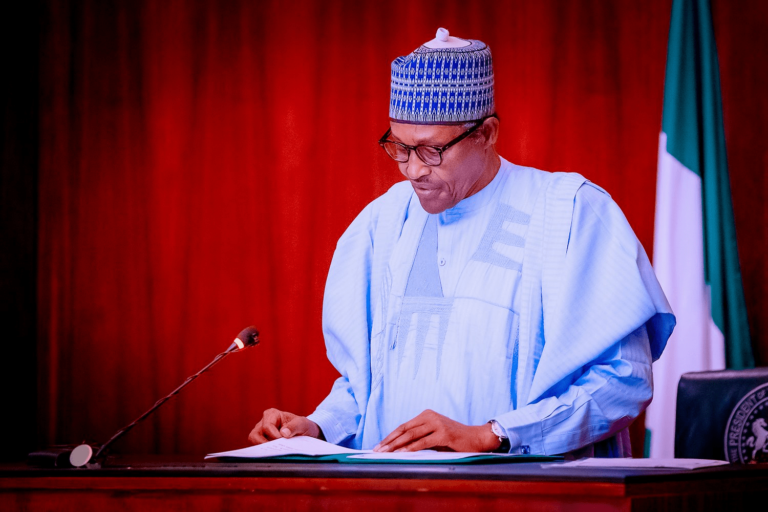
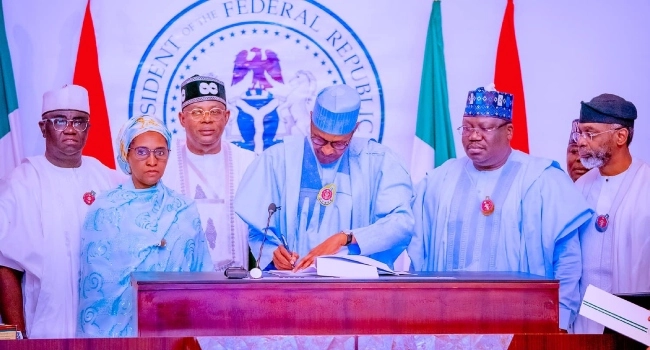
A look at bills Buhari signed into law within eight years

SECTION 5 of the Nigerian 1999 constitution (as amended) confers upon the president the power to sign bills into law after the National Assembly has passed it. Muhammadu Buhari as president, during his eight-year administration, also signed several bills into law.

Some of these include executive orders, establishment bills, constitutional amendments or an amendment to repeal an existing law.

According to the constitution, the president has 30 days to assent to a bill after it has been transmitted to him by the National Assembly. However, if the president withholds his assent for unclear reasons, the bill can be passed by two/third majority of the House. 

The ICIR findings, from multiple media reports showed that over 63 bills were signed into law by the former president. 

Buhari got resounding compliments when he signed some major bills, which created many controversies at the time of deliberation in the National Assembly.

Meanwhile, there are still concerns over implementing some bills despite being assented to by the president. The ICIR reported how there are concerns about the Petroleum Industrial Act signed in 2021.

Also, the aviation workers, in February 2022, threatened strike action over the failure to implement the minimum wage.

As Nigeria transitions government today, here is a look at some of the bills:

Minimum Wage Increase in 2019

The signing of the Labour Act of 2004 provided the country to set a new minimum wage for workers from  N3,000 to N5,500 per month. It was later increased in 2011 to N18,000 in a new minimum wage act signed by President Goodluck Jonathan’s administration. 

As the country’s economy began to worsen, the Nigeria Labour Congress embarked on a strike action demanding an increase in the minimum wage in 2018. This demand created uproar during the deliberation of the National Assembly and Nigerian Governors Forum as to how much should be paid.

The amount revolved between N22,000 to over  N50,00 until the House of Representatives passed N30,000 in January 2019 and Senate in March. In April, Buhari passed into law the new minimum wage of N30,000. 

However, The ICIR reported how the implementation of the new wage stalled for months which led to several strike actions by NLC before coming to an agreement

‘Not too young to Run’ Bill 2018

In 2016, human rights activists and civic organisations campaigned to reduce the age of running for executive offices, permitting candidates as low as 25- 30 years to via for some state or federal positions.

The bill was introduced into the House of Representatives in 2017 and, after deliberation, transmitted to the 36 states’ House of Assembly for them to vote for the amendment. This process saw a lot of delays up until February 2018.

In April, the Senate concluded to transmit the bill to the president. The ICIR reported how Buhari promised to sign the bill while giving his speech on Democracy Day in May 2018. 

Buhari signed the bill two days after, reducing the constitutional age requirement for the office of the President from 40 to 35 years old. Also, the age requirement for the state governor’s office and the Senate automatically drops from 35 to 30 years, while a 25-year-old will now be eligible to run for a seat in state assemblies and the Federal House of Representatives.

Electoral Act 2022

After months of withholding assent, Buhari assented to the electoral bill that repealed and replaced the 2010 Electoral Act. 

The 2022 Electoral Act is intended to bring innovations to regulating Federal, State and Area Council elections in Nigeria. The act gave provisions for the electronic transmission of results, early party primaries and the exclusion of Political appointees from acting as voting delegates or aspirants.

Buhari signed the bill into law in February 2022 after withholding assent five times. 

In 2018 alone, he rejected the proposed amendments to the Electoral Act four times. His reasons ranged from irregularities to drafting issues, the sequence of elections, and the phrasing of words in parts of the bill.

The first time was in February 2018. Buhari cited the re-ordering of the sequence of elections as his reason for rejection. Then in June, the Amendment Bill was passed by the National Assembly and transmitted to Buhari. But the bill was not considered by the President.

In July 2018, Buhari again refused to sign another version of the Electoral Amendment Bill transmitted to him by the national lawmakers. This time, he stated the increased cost of conducting elections, among other reasons for not signing the Bill. He declined again in December.

The fifth time was in November 2021. Buhari cited the cost of conducting direct primaries and infringement on the rights of Nigerians to participate in governance and security as reasons for the rejection.

The Petroleum Industry Bill

In 2021, President Buhari signed the Petroleum Industry Bill into law, closing a 15-year effort to reform Nigeria’s oil industry. Buhari signed the Petroleum Industry Bill in August, weeks after the National Assembly passed the bill.

The bill aimed to create an environment conducive to the growth of the oil sector and address the grievances of communities most impacted by extractive industries.

The bill also sought to regulate the performance of the oil and gas sector and ensure transparency in Nigeria’s state oil company, the Nigerian National Petroleum Corporation (NNPC). The first petroleum industry bill was presented to the National Assembly in 2008 by the administration of late President Umar Yar’Adua.  

But the bill’s passage since then, has suffered multiple setbacks and stalled for almost two decades.

Other Bills signed

Some of the bills assented into law by the outgoing president in 2016 are the Prevention of Crime Amendment Act, the National Crop Varieties and Livestock Breeds (Registration) Amendment Act, the Telecommunications and Postal Offences Amendment Act, The National Agricultural Land Development Authority Amendment Act, The Produce Enforcement of Export Standards Amendment Act‎ , Water Resources Amendment Act‎ among others.

In 2018, he signed the National Senior Citizens Centre Act, Legislative Houses (Powers and Privileges), Rail Loan (International Bank) (Repeal) Act, Avoidance of Double Taxation Agreement between the Federal Republic of Nigeria and the Kingdom of Spain (Domestication and Enforcement ) Act, Extradition (Amendment) Act,  among others.

Also, the Reform Nigeria Prison Bill, Asset Management Corporation of Nigeria, Deep Offshore and Inland Basin Production Sharing Contract (PSC) Amendment Bil, Defence Intelligence Agency Civilian Pensions Board, and Finacial Bill was signed between 2019 and 2020.

While the Mental Health Bill, Increase of Retirement Rate Bill, Nigeria Law Reform Commission Act, Nigeria Start-up Bill, Money Laundering (Prevention and Prohibition) Bill, Terrorism (Prevention and Prohibition) Bill, Health insurance as well as some constitutional amendment among others were signed between 2021 and 2023.
Nigeria risks US, Europe airspace ban over Nigeria Air – AON

1

NIGERIA risks a ban from the airspace of the United States and European countries if the five-phase certification process of obtaining an operating licence for the national carrier, Nigeria Air, is not followed, the Airline Operators of Nigeria (AON) has warned.

The group gave the warning in a statement by its spokesperson, Obiora Okonkwo, on Sunday, May 28, and accused the outgoing minister of Aviation, Hadi Sirika, of pushing to commence Nigeria Air’s operation without undergoing the process to obtain the Air Operators Certificate (AOC).

The AON, a critical stakeholder in the Nigerian aviation industry, stressed that should Nigeria Air be issued the AOC certificate through the back door to hasten its operation, international aviation safety agencies like the US FAA (Federal Aviation Administration) and the EASA (European Aviation Safety Agency) could blacklist Nigeria.

The group maintained that failure to complete the five-phase certification process is considered a serious infraction by the International Civil Aviation Organisation (ICAO).

While the five-phase process involves pre-application, formal application, document evaluation, demonstration and inspection, and certification, AOC is a safety certificate issued by the Nigeria Civil Aviation Authority (NCAA) to an airline that has demonstrated its fitness to conduct safe flight operations through the five-phase certification process.

AON had faulted the handling of Nigeria Air and sued the minister over the controversies surrounding the project.

But on Friday, May 26, the minister received an aircraft branded Nigeria Air at the Nnamdi Azikiwe International Airport, Abuja, The ICIR reported.

The branded aircraft is one of the 30 aeroplanes expected to form the fleet of Nigeria Air in the next five years.

According to the AON, further implications of not following due process by Nigeria Air include that airlines of those countries would not enter Nigeria, and Nigerian airlines would not be allowed to operate in those countries.

“It also means that Nigeria will definitely fail the upcoming ICAO audit and, by way of further penalty, lose its FAA CAT-1 Certification.

“Nigerian airlines will also not be able to lease aircraft to boost their operations because no lessor will trust the safety certification process of the NCAA,” AON stressed.

The NCAA has resisted the pressure from the minister to issue the AOC certificate to Nigeria Air without a standard process.

“As indigenous operators, we are happy and grateful to the NCAA for saving us from this punishment by resisting the pressure from Minister Hadi Sirika to grant an AOC to Nigeria Air without going through the due process.

“If tampered with, it will have negative expanded multiplier effect on all aspects of the economy and life of Nigeria,” the local operators stated.

The group further queried the whereabouts of the promoters of Nigeria Air and why they were not speaking on behalf of the national carrier, considering it is private sector-led and not a government, wholly-owned initiative.

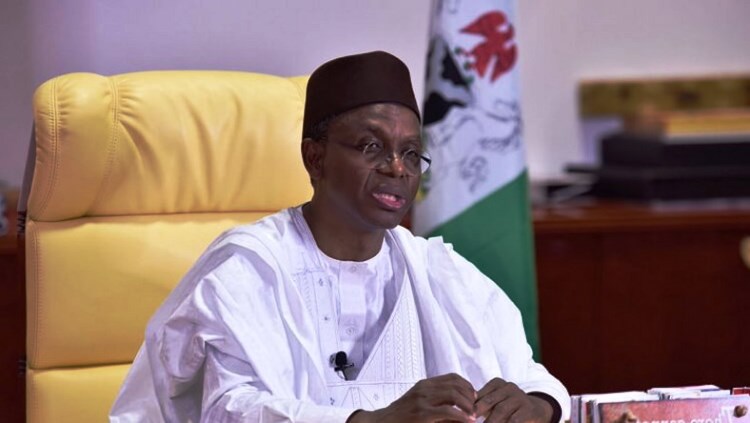
Demolition trails el-Rufai’s last days as governor in Kaduna

ON Friday, May 19, Kaduna state governor Nasir el-Rufai said he would continue to demolish buildings and sack workers till the last minute of his administration.

“Any bad thing we find, we will remove so that the next governor does not need to do it again. Watch out till the eleventh hour when we shall quit office; we will continue to sack bad persons and remove bad things,” el-Rufai said.

In the days following the statement, el-Rufai has been making good his threat of demolishing houses in several areas of the state.

On Monday, May 22, some buildings in the state belonging to Shi’ites, who are members of the Islamic Movement of Nigeria (IMN) led by El-Zakzaky, were demolished by operatives of the Kaduna State Urban Planning and Development Authority (KASUPDA).

The demolished buildings included Islamic schools, a hospital and private buildings, according to Shi’ite leaders during a press briefing held after the demolition.

The exercise attracted severe criticisms from the Shi’ite community and gave rise to fears of possible unrest in the state.

Demolition is not a new development in Kaduna state under the El-Rufai administration.

In 2021, hundreds of houses were demolished in Zaria as the Kaduna state authorities began a major demolition exercise.

During his time as the minister of the Federal Capital Territory (FCT), about 800,000 residents were evicted from their homes due to demolition exercises ordered by el-Rufai between 2003 and 2007.

However, the Shi’ites claimed during the press briefing that they were the target of the recent exercise, which they described as vindictive, adding that the only reason given for pulling down their structures was that they were members of a proscribed group.

One of the group’s leaders, Yunusa Lawal, who spoke during the briefing, said there had been no notice from the government ahead of the demolition, and a leaked memo from the KASUPDA suggested that a total of 48 houses belonging to the IMN would be pulled down.

“We were never served any notice to know the reason for the demolition, so we don’t even know the location of the remaining 42 structures they plan to demolish. The only reason we saw in the leaked memo is that we are a proscribed movement, but we are saying we are a religious community; we cannot be banned.

“El-Rufai is pushing us to the wall. We are law-abiding citizens but there is a limit to everything. We cannot fold our arms.  We must talk. We are bona fide citizens of Nigeria, even though el-Rufai is not a better citizen than us. He is bastardising everything but we will continue to be law-abiding citizens,” Lawal said.

Another group of people affected by the last-minute demolition exercise are residents of the Gbagyi villa community in Kaduna.

Regardless of the uproar from the Shi’ite community, demolition continued across Kaduna and on May 26, barely three days to el-Rufai’s exit from office, at least 20 houses in Gbagyi villa were pulled down by the KASUPDA.

According to a report, protesting youths seeking to resist the demolition were shot at by security agencies attached to the demolition team, with many sustaining injuries.

One resident of Gbagyi villa, identified as Sarah, reportedly slumped and died upon hearing of the demolition.

El-Rufai had attempted to demolish the Gbagyi Villa in the past, though he was restricted by a court order.

A resident identified as Haruna said el-Rufai nullified all building approvals obtained prior to the court case.

“Following the court judgment in favour of the Gbagyi Villa community, el-Rufai asked us to fill a form for regularisation at the cost of N20,000, and majority had done that.

“Again, just about 10 days ago, KASUPDA brought a letter that el-Rufai had ordered that all buildings approvals obtained before the court case are null and void, asking us to start processing new building approvals and new building plans with dates not earlier than May 2023,” Haruna was quoted as saying.

He also noted that the government gave residents 60 days to secure the approval, adding that the time given for the process had not yet elapsed.

“It is not yet 60 days based on the notice KASUPDA gave us, and we didn’t even say we are not ready to abide by the obnoxious policy, just to allow peace to reign.

“They are the people that are not even ready with the forms needed; yet this afternoon, the same Kaduna State government through the KASUPDA invaded Gbagyi Villa and started demolishing our houses,” Haruna said.

For Haruna, Lawal, and many other residents of the state, loss of property and homelessness is a parting memory by which el-Rufai will be remembered.

Weeks after begging Shettima’s wife for N2m, ‘My family doesn’t need Nigeria’s wealth to survive’ says Remi Tinubu

THE wife of the President-elect Oluremi Tinubu has said her family is blessed and does not need Nigeria’s wealth to survive.

Remi stated this at the National Christian Centre, Abuja, during the 2023 Presidential Inauguration Inter-Denominational Service held on Sunday, May 28.

Observers are, however, saying what the incoming first lady said contradicted her words a few weeks when she publicly stated that she begged the wife of her husband’s running mate, Nana Shettima, for N2 million in February in the build-up to the 2023 presidential election.

Remi had stated that her husband, the president-elect, Bola Tinubu, was only generous and compassionate and not wealthy as many people must have thought.

“God has been merciful to us. I can tell you on my own that we never believed this could happen. But thank God for giving us hope, for giving us the resilience to continue in the race of life.

“Asiwaju is 71, and I will be 63. I bet I will be one of the oldest first ladies Nigeria would have. We need the grace of God, and we need everyone to do what Nigerians are expecting.” she said.

She also said that the country must be united at this period, adding that her husband’s Inauguration, which is the seventh since 1999, signifies perfection.

“Nigeria’s wealth is the commonwealth of all. It belongs to everyone. God has blessed my family. We don’t need the wealth of Nigeria to survive but to do the right thing. And I promise you on this altar, that with your help, with the help of God, who will set this nation on the right path,” she added.

The church service was also attended by the Vice President Yemi Osinbajo, former Head of State Yakubu Gowon, Secretary to the Government of the Federation Boss Mustapha, and senator-elect Godswill Akpabio, among other dignitaries.


Four agitators arrested after storming Ibadan Radio station to declare Yoruba nation

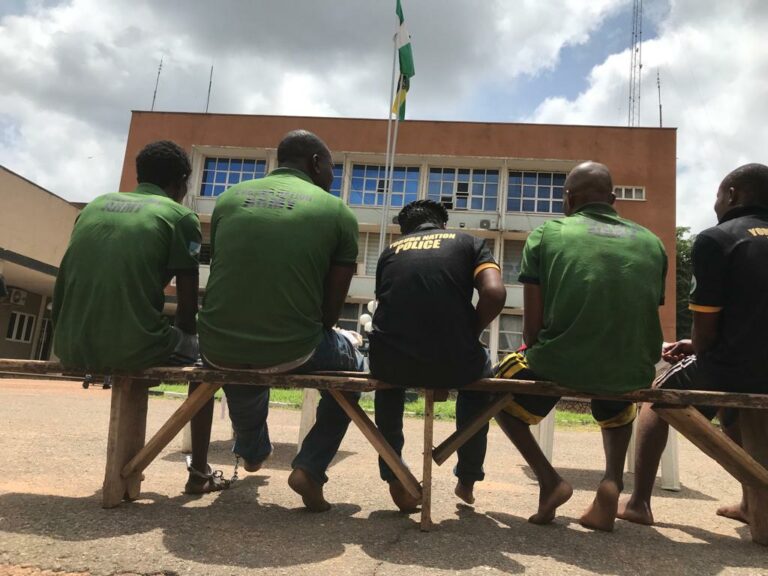
THE Nigerian military and police have arrested four Yoruba agitators who participated in an early morning hijack of Radio Nigeria, Amuludun 99.1 FM in Ibadan, the Oyo State capital, on Sunday, May 28.

According to the Punch newspaper, the agitators stormed the station, located at J&P Bus-stop, Moniya in Akinyele Local Government Area of the state capital in a 18-seater bus, armed with charms and other weapons.

They took over broadcast for more than an hour, after holding staff on duty captive.

They threatened to kill the workers if they scream or attempt to make any call about the invasion.

Besides, they asked the workers to remove the Nigerian flags hung in the building and replace them with the Yoruba nation flag that they brought.

All the agitators wore shirts bearing the ‘Yoruba Nation’s inscription.

There was at least a woman among them.

Only six of the invaders entered the radio studio to make a declaration, including “welcome to Yoruba Nation.”

Others kept watch over the building.

To ensure the operation was successful, they reportedly hijacked some commercial vehicles from their owners within the vicinity, which they used to block the roads leading to the area.

But luck soon ran out of them as military and police officers trooped in and surrounded the premises.

They were able to arrest four of the agitators, while others fled, and were yet to be apprehended as of press time.

The most senior worker on duty at the station, Ajayi Omotola, narrated the invasion, “They told us that they are Yoruba Nation agitators. And in their T-shirt, there was that inscription there. They wrote Yoruba Nation. Only six persons came inside the studio with different charms threatening to kill us if we failed to cooperate. Others were outside manning security at different areas within the premises.

“They collected all our phones and threatened to kill us if we made any noise or phone calls. They said they wanted to broadcast live that Yoruba Nation has taken over. We should remove all Nigeria flags in our studio and replace it with their own.

“They didn’t allow anybody to go outside. The Area Commander came, addressed and even pleaded with them but they ignored him. We later heard sporadic shooting outside. So, one of our staff members then came inside to inform us that police and soldiers had arrived.”

Peace has returned to the area as gun-wielding soldiers and police officers and about a score military vehicles have been deployed to the area.

The incident occurred a day before the President-elect, a Yoruba man, takes oath of office as Nigeria’s president.

Agitation for Yoruba nation has been led by two major people in the South-West, populated by the Yorubas.

They are Sunday Igboho and Banji Akintoye, a professor.

In 2022, Igboho was arrested in Benin Republic while fleeing Nigeria for Germany after he had been involved in activities the Federal Government considered treasonable.

He was detained for several weeks before a court released him. He has since not returned to Nigeria.

Gambo Isah’s posting not connected with Rukayya Jibia assault allegations – FPRO

1

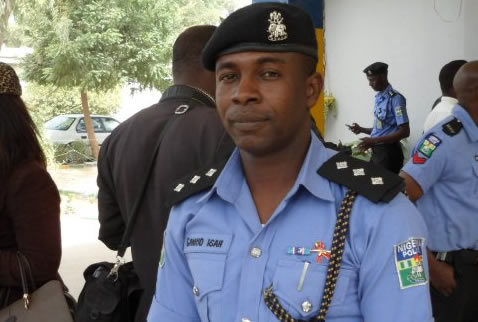
FORCE Public Relations Officer (FPRO) of the Nigeria Police Olumuyiwa Adejobi has said the posting of the Katsina State police public relations officer (PPRO) Gambo Isah is unconnected to allegations of assault that a female journalist Rukayya Jibia levelled against him. 

Speaking to The ICIR on Sunday, May 28, Adejobi said Isah’s posting was part of a routine reshufflement within the public relations unit of the force.

“I don’t see anything special in the allegations made on her TikTok platform. It is not even a matter that the headquarters will take seriously. The public relations officer (PRO) in Katsina has been promoted to CSP (chief superintendent of police) and a CSP will not be in charge of a Command.

“As a CSP, he can be in charge of a Zone, and that is why he has been moved to Zone 14 Katsina. It has nothing to do with the allegations,” Adejobi said.

Isah had announced on Saturday, May 27, that he had been transferred from his position as PRO of the state police command in a new posting by the Inspector-General of Police (IGP), Usman Alkali Baba.

In a post via his official Twitter handle on Saturday, May 27, Isah said he had been assigned a new role as PPRO for Zone 14 in Katsina state.

“After 7yrs of excellent stewardship as PPRO Katsina Police command and with my subsequent elevation to the rank of CSP, the Inspector-General of Police has ordered my posting as PPRO Zone 14, Katsina. I will be supervising the Public Relations units of Katsina and Kaduna states command,” Isah posted on Saturday.

The posting came a few days after Jibia accused him of assault, which led to speculations that both incidents were linked.

The journalist, who works with Cliqq TV in Katsina, said she was assaulted by policemen attached to the state police command, led by Isah.

In a video circulating on social media, Jibia said she was assaulted for speaking up against the parade of four young women arrested over alleged prostitution by the police, though the ladies had not been convicted or tried.

She added that Isah personally dragged her out of her car, twisting her arm in the process and smashed her phone on the floor.


READ ALSO:


She also said there were, at least, 20 policemen present during the assault, after which she was detained for about five hours.

Reacting to Jibia’s allegations through a statement on Twitter, Isah described them as frivolous, adding that the journalist had been maliciously attacking the police via social media.

The assault attracted criticisms from Nigerians, including human rights lawyer Inibehe Effiong, who, in an interview with The ICIR, described it as “outrageous.”

In four years, I grew poorer by 12% — Seyi Makinde

0

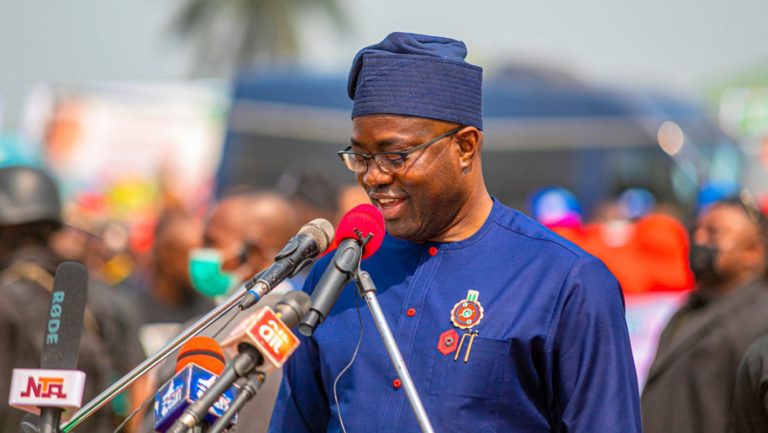
THE Oyo state governor, Seyi Makinde, says he became poorer by 12 per cent during his last four years as the governor.

As Makinde explained, the fall in his finances was due to his inability to manage his business effectively while serving as governor.

The governor, addressing journalists in the state on Sunday, May 28, said his assets had dropped now, compared to what he had in 2019.

He disclosed he had already submitted his asset declaration form at the Code of Conduct Bureau (CCB) office in Ibadan on Friday, May 26, saying the details would be made available to the public soon.

“You are all aware of my assets declaration for the first tenure. I can tell you that in the last four years, I’ve been poorer by 10 to 12 per cent.

“This is because I have not really had the chance to look after my business.

“We have been looking after Oyo state business, so I’m not surprised that there were losses a bit here and there, but I’m still okay,” he said.

The ICIR had reported that Makinde’s assets were worth over N48 billion in cash and other properties when he declared in 2019.

Last Wednesday, the CCB asked all governors-elect to declare their assets before May 29.

Makinde, having won the 2023 governorship election with 563,617 votes, will be retaining his seat as the Oyo state governor.

Speaking on his assets declaration, the governor said, “By law, I have to declare my assets at the end of my first tenure and before assuming office for the next tenure.

“So, I have gone to the CCB office to submit my assets declaration form at the end of my first tenure and also my assets at the beginning of the second tenure.”

Accept court judgments, Buhari urges opposition

0

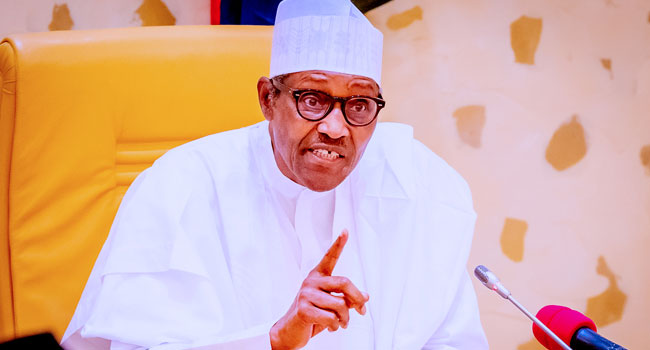
PRESIDENT Mohammadu Buhari has urged opposition parties to accept courts’ verdicts on the presidential election.

Buhari said opposition parties and their presidential candidates should accept courts’ decisions on their respective cases and be willing to unite for the country’s growth.

Buhari said this in his farewell message broadcast nationwide early Sunday, May 28.

After the declaration of Bola Tinubu of the All Progressives Congress (APC) as the winner of the 2023 presidential election, opposition parties, including the Peoples Democratic Party (PDP) and Labour Party (LP), challenged the election result.

They described the poll as a “sham election” with “massive manipulation.”

The PDP and its candidate, Atiku Abubakar, filed a petition challenging the result declared by the Independent National Electoral Commission (INEC).

They alleged that irregularities in thousands of polling units marred the poll.

Abubakar is asking the court to declare him Nigeria’s president-elect or nullify the election and order a rerun.

Similarly, the LP candidate, Peter Obi, who came third in the election, also filed a petition challenging Tinubu’s victory and asking the court to declare him the winner or cancel the election and order a rerun.

The Allied Peoples Movement (APM) equally lodged a petition to challenge the outcome of the presidential election.

Speaking on the election petitions against the president-elect, Buhari said political parties and their candidates should be willing to accept the court rulings on their cases.

“Irrespective of the outcome of the various cases, I urge all parties involved to accept the decision of our courts and join hands to build a better Nigeria.

“As your President, I call on all of us to bring to bear the strength of our individualism, the power of our unity, and the convictions of our beliefs to make Nigeria work better and together with one spirit and one purpose,” he said.

Buhari saluted the opposition for trusting the country’s judicial system with their grievances against the election.

He asked that the parties prioritise the country’s growth above all else.

“I salute the doggedness and resilience of all the presidential candidates and their political parties for believing in our judicial system by taking their grievances with the election results to the court.

“In the course of the campaigns, we had argued and disagreed on how to make Nigeria better, but we never disagreed or had any doubts that Nigeria has to be better,” he said.

The ICIR reported that the presidential election tribunal has merged the petitions challenging the election.

The court has also set May 30 as the date for the commencement of the hearing of the consolidated petition.

Meanwhile, Tinubu will be inaugurated as Nigeria’s president on Monday, May 29.

Buhari claims fair elections amid reported irregularities

PRESIDENT Muhammadu Buhari has again claimed that Nigeria’s electoral process was free, fair and credible under his administration.

Buhari, in a nationwide 7am broadcast on Sunday, May 28, said he would be leaving behind when he exits as President tomorrow an electoral process that guarantees that every Nigerian vote counts, adding that his administration had reduced the influence of money in politics to its barest minimum.

The President’s claims are despite the widespread reported cases of electoral irregularities and violence in the 2023 general elections.

Following the closely contested polls, allegations of voter suppression, irregularities in the electoral process, and concerns over transparency have cast a doubt over the credibility of the results.

The two main opposition parties are still in court contesting the outcome of the elections due, among other reasons, to the failure of the Independent National Electoral Commission (INEC) to transmit the results using the Bimodal Voter’s Accreditation System (BVAS) at the polling station and uploading of results to the viewing centre (IREV). 

The ICIR reported many reported cases of irregularities during the 2019 and 2023 general elections. 

During the 2023 general elections, this platform documented how many Nigerians were disenfranchised due to INEC ad-hoc officers’ lateness to designation polling units, malfunction of BVAS in some polling units, and widespread electoral violence, among others.

According to an analysis published by The ICIR, the 2023 elections fell short of the promises and expectations of Nigerians, in spite of  the deployment of world-class and highly expensive technology. 

“In the presidential election, the electoral umpire’s failure to upload results from polling units granted fraudsters the opportunity to intimidate electoral officials and subsequently announce doubtful results resisted by opposition parties. The governorship elections, promised to be an improvement on the presidential election, was also totally disappointing,” the report noted.

In another report, the Centre for Democracy and Development’s (CDD) Election Analysis Centre (EAC) called for an end to “electoral impunity” in Nigeria in order for democracy to deepen in the country.

This is contained in the centre’s preliminary report on the supplementary governorship elections that held in five states of the federation on Saturday, March 23.

The report showed that there were widespread instances of violence, vote buying, voter intimidation, underage voting, and harassment of journalists in several of the polling units where the supplementary elections were held across Bauchi, Benue, Kano, Plateau and Sokoto states.

The outgoing President, however, remains resolute in his assertion that the election was conducted fairly.

He expressed confidence in the electoral system.

He said, “To ensure that our democracy remains resilient and our elected representatives remain accountable to the people, I am leaving behind an electoral process that guarantees that votes count, results are credible, elections are fair and transparent, and the influence of money in politics is reduced to the barest minimum. And Nigerians can elect leaders of their choice.

“We are already seeing the outcome of this process as it provided an even playing field where persons without any political godfather or access to money defeated other well-resourced candidates.”

Buhari also said that Nigeria witnessed the most keenly contested presidential elections since the first republic, adding that it demonstrated that the country democracy was getting better.

“This year, we witnessed the most keenly contested presidential elections since the first republic, and this demonstrates that our democracy is getting better and more entrenched with each election.

“We must as a nation improve and sustain gains we make in the electoral process on an incremental basis for Nigeria to take its rightful place among nations,” he said.

Nigeria’s economy has become more resilient due to our strategies – Buhari

PRESIDENT Muhammadu Buhari says Nigeria’s economy has become more resilient due to strategies his administration deployed.

Buhari disclosed this while delivering his farewell speech on Sunday, May 28, ahead of his exit from office tomorrow.

“Nigeria’s economy has become more resilient due to various strategies put in place to ensure that our economy remains afloat during cases of global economic downturns,” he said.

Speaking of the economic challenges experienced during the COVID-19 pandemic, Buhari said the swift response of his administration during the period, among other strategies, contributed to strengthening the nation’s economy.

“The deftness of our response to the pandemic still remains a global best practice. Furthermore, we increased the ability of the poor and rural Nigerians to earn a living, provide more food for millions in our villages and gave our women opportunities to earn a living.

“Young men and women in urban centres were also supported to put their skills into productive use. Our administration also provided an enabling environment for the private sector to engage in businesses for which their return on investment is guaranteed,” he said.

The president’s claims are, however, inconsistent with available data on development indices like inflation, foreign exchange and gross domestic product (GDP) rates.

The president’s claim of increasing citizens’ ability to earn a living also contrasts with the current 33.3 per cent unemployment rate, which increased by almost 400 per cent under Buhari’s administration.

Before Buhari assumed office in 2015, Nigeria dealt with a single-digit inflation rate of 9.01 per cent. However, this figure increased by almost 75 per cent in 2016, about a year into his administration, when it rose to 15.68.

The country has witnessed a steady surge in inflation rates, which currently stands at 22.22 per cent, according to data from the National Bureau of Statics (NBS).

Food prices have also soared over the years, and the naira has been steadily devalued under Buhari’s administration.

Due to harmful policies like the naira redesign and consequent cash crunch, which resulted in severe hardship for Nigerians, the nation’s GDP declined by 2.31 per cent in the first quarter of 2023, according to the NBS.

While speaking on Nigeria’s economy at The ICIR Twitter Space on Friday, May 19, a development economist, Kelvin Emmanuel, also pointed out that realities in Nigeria contradict previous claims by the government of economic improvement.

“If inflation is at 22.04 per cent and MPR is at 18 per cent, by the time we add management, appraisal, facilitation, and documentation fees and others, the commercial lending rate would have gone to between 28 per cent and 31 per cent.

“How can a company, for example, borrow money at a 31 per cent interest rate and still be in business?” Emmanuel asked.

Buhari, however, maintained in his farewell speech that difficult economic choices made by his administration yielded desired results.