THE Academic Staff Union of Polytechnics (ASUP) has called on the President-elect Bola Ahmed Tinubu to prioritise education and avoid unnecessary industrial disputes in the sector.
ASUP President Anderson Ezeibe made this plea in an exclusive interview with The ICIR on Tuesday, May 9.
The Academic Staff Union of Polytechnics embarked on a series of industrial actions in the last eight years as the Federal Government failed to meet their demands. Checks by The ICIR show that ASUP went on strike in 2017, 2018/19, 2021, 2022.
According to a report by The Punch, ASUP downed tools for 147 days between January 2017 and December 2021. This figure has, however, increased as the union also embarked on strike in 2022.
Meanwhile, in the interview with The ICIR, the ASUP leader urged the incoming President to address the needs of the lecturers.
“The incoming administration should prioritise education to avoid unnecessary industrial disputes. For our sector, a new compensation package should be released through the conclusion of the renegotiation process.
“Equally, the conclusion of the review of the scheme and conditions of service must be actualised.”
The President Muhammadu Buhari administration in 2015 implemented the Treasury Single Account (TSA) and the Integrated Personnel and Payroll System (IPPIS) as administrative measures aimed at curbing corruption within Nigeria’s public service. The initiatives, according to the Federal Government, were specifically designed to enhance accountability in the management of public finances.
The implementation of the initiatives was the subject of disputes between the Federal Government and lecturers and ASUP had called on Buhari to address the problems and irregularities associated with the implementation of the Integrated Personnel and Payroll Information System (IPPIS).
Speaking further, Ezeibe said ASUP expects a review of the inclusion of Polytechnics in the TSA and IPPIS modules with a view to liberating the sector from the glitches currently being experienced in the payment of salaries and allowances.
“We expect funding to improve significantly, and the alignment of the Nigerian Polytechnics system to global trends and standards by a firm and courageous resolution of the degree question for Polytechnics.
“We look forward to an administration where laws and regulations will be respected in the sector.”
Also speaking on the President Muhammadu Buhari’s refusal to sign the bill seeking to end HND/BSC dichotomy, Ezeibe said the President has continued to relegate the sector by withholding his accent.
“The President has not done well in withholding his accent to the dichotomy bill. By doing so, he has only encouraged the continued relegation of the entire sector including products of the sector to serious discriminatory practices including workplace discrimination.
“It is a sad commentary for the nation as the colour and designation of certificates continue to determine career progression instead of productivity levels. It’s a shame that this question has been left unanswered by this outgoing administration and it is frustrating for everyone associated with the Nigerian Polytechnic System.”
While speaking on the Federal Government’s continuous abuse of the extent law by appointing university professors to head polytechnics, the ASUP President said unfit persons have caused unimaginable damages to the institutions. He noted that law courts have declared the university professors unfit for the position.
“The courageous ruling of the national industrial court on this matter has actually underlined the position of our union that there’s no alternative to obeying the laws of the land.
“The continued stay in office of the impostors who have been validly declared unfit to administer any Federal Polytechnic in Nigeria is an assault on the rule of law. Therefore, what is going on at the Federal Polytechnics in Ugep, Ohodo, Wannune, Monguno, Shendam, Kano and Delta are jokes funded by tax payers. These unfit persons continue to frolic with scarce resources and at the same time doing unimaginable damages to these institutions in the name of administration.
“The courts have declared the appointments of the first five as a nullity. The courts have declared them unfit to hold the position of Rectors of the affected Polytechnics. Same should apply to Kano and Delta as those appointed do not fit the profile established by law to be so appointed.”
He further stressed that those associated with the ‘naked display of absurdity’ should be ashamed of themselves.
“All those associated with this naked display of absurdity should be ashamed of their roles in ridiculing the sector, wasting public funds and generally undermining the mandates for the establishment of the Polytechnics.
“The illegal occupants of these offices are living on borrowed time as Rectors of the affected Polytechnics and history will always remember them as impostors who played ignoble roles in the underdevelopment of Polytechnics in Nigeria.”
THE Wikimedia Foundation is accepting entries for the Open the Knowledge Journalism Awards.
The competition celebrates the contributions of journalists in Africa who prioritise diversity, equity and inclusion in their reporting.
The awards recognise the essential role journalists play in creating well-researched articles that volunteer editors can use as source materials to develop content on Wikipedia and other Wikimedia projects.
Articles published between January 1, 2022 to June 23, 2023 are eligible for submission.
Categories cover topics on culture, sports, health, climate change, women, human rights, and more.
The first-place winner will receive US$2,000 and the second-place winner US$1,500.
Journalists in Africa can enter a competition and win cash prizes.
The deadline for the submission of application is June 30, 2023. Interested applicants can apply here.
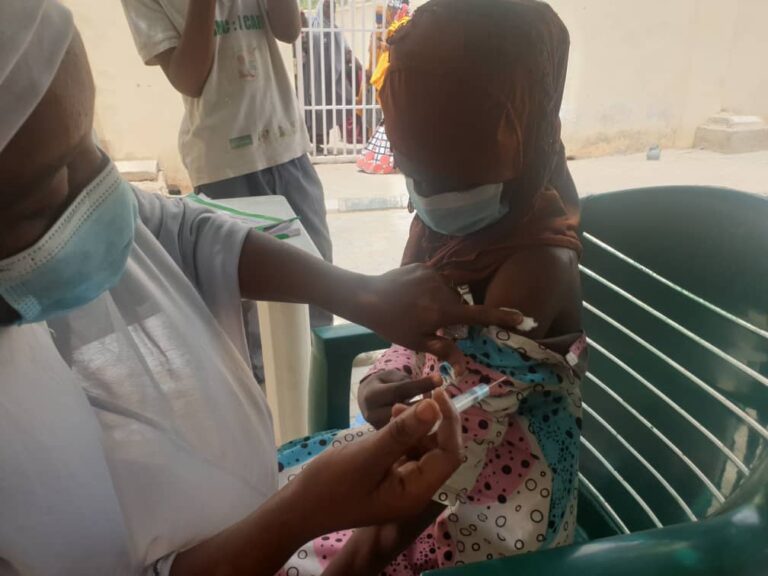
ABOUT 500,000 children have been immunised against Diphtheria in Kano State this year.
Kano State is one of the few states which have been battling with Diphtheria disease. According to the Nigeria Centre for Disease Control (NCDC), Diphtheria is a serious bacterial infection caused by the bacterium Corynebacterium which affects the nose, throat and, sometimes, skin of an individual.
A Kano State primary health care immunisation officer Shehu Abdullahi Muhammad, highlighted how the state is combating the disease while speaking to The ICIR in a special report published on May 11. The report explained how Kano State is mitigating the spread of Diphetria through advocacy and funding.
According to the report, the disease has spread across five local government areas in Kano State, namely, Ndala, Gwale, Ungogo, Nasarawa and Tarauni and has caused the deaths of at least 61 persons while hundreds of residents were admitted in hospitals.
Out of at least 783 patients on admission as of March 2, 2023, 360 are females while 423 are males.
The NCDC attributed the high fatality rate to delays in diagnosis and the absence of diphtheria antitoxin during the early stage of the outbreak.
While the factors for this may also be attributed to low vaccination across the country, Kano State is, however, an exception, according to sources and authorities who spoke to The ICIR. The state has recorded significant progress in vaccination since the outbreak this year.
Some residents explained that advocacy and house-to-house immunisation efforts by the Kano State Government are mitigating the spread of diphtheria.
Speaking on how Kano State is mitigating the spread, Muhammad said the state constituted a technical working group under the rapid response in January 2023, to tackle the outbreak.
According to him, the committee identifies the victims of the disease and the plagued areas and proceeds to take their samples to determine who has the disease and further isolate them from the population.
Muhammad also noted that the state healthcare sector engages in outreach to every part of the state to provide vaccines for the people, especially in the five most affected LGAs.
“We have even concluded the second phase of vaccinations in five LGAs, Ndala, Gwale, Ungogo, Nasarawa and Tarauni, these are the five epic centres LGAs who have high burdens of transmission of these diseases and people were reached since February, and we did the second phase in March/April. We are now preparing for the third phase because the national body has planned for three consecutive months of RI intensification activities campaign in all 23 LGA and intensified the diphtheria activities in five LGA that I mentioned earlier.
“We have vaccinated over 500,000. The first concerning phase one is that the national will require one million doses of TD vaccine, and unfortunately national didn’t have this quantity, they gave us 500,000, and we were able to immunise more than 270,000. The recent conclusion of this RI intensification phase two, which we finished yesterday (April), is that over 350,000 (eligible from four years to fourteen years of age) were vaccinated. So if we sum it all up; 270,000 people plus 350,000 people, we were able to reach more than 600,000 people who have benefited from the vaccine in the state.”
Muhammad further explained that the state target population for Diphtheria vaccination coverage is 1.5 million and has, however reached 50/60 per cent, adding that the third round of the exercise will start in May.
IN Kano state, some communities have been plagued with Diphtheria – an infection caused by strains of bacteria that can lead to difficulty breathing, heart rhythm problems, and even death. Advocacy through community leaders and improvement in epidemic preparedness are factors mitigating the spread of the disease in the state, Mustapha Usman reports.
Abdullahi Kabir’s family, in Tudun Fulani, is one of the families hit with diphtheria, as three of his children, including Umar, contracted the disease early this year. Despite medical attention, the youngest child passed away in February, while his eldest child is still hospitalised.
Umar Kabir, 6 years old survivor of diphtheria with his father at Tudun Fulanin Barebari in Ungogo LGA, Kano state.
Umar, 6, who is the second child of Kabir has, however, been discharged and is currently on medication to treat the remnant of the disease.
Initially, Umar’s father wasn’t aware of the disease and didn’t see the need to immunise his children until his children were infected and had to take them to the nearest public health centre-Mongoro PHC. However, the medication given to Umar at the centre was ineffective, prompting him to seek treatment at another hospital, Dala Hospital, located a few kilometres away.
At Dala Hospital, Umar was admitted and was confirmed to have diphtheria.
The father said, “He (Umar) started with a fever, so I decided to take him to our PHC, Mongoro Hospital, they gave him some drugs which were ineffective, I further took him to Dala Hospital, where he got treated.
“At first, when I took him to Mongoro PHC, they confirmed that it was not diphtheria, but later when I went to Dala Hospital, they confirmed that my child has diphtheria.”
“He’s living together with his siblings now, but his sister is still on admission at Murtala Muhammad Hospital, while I lost my three-year-old child Hauwau Kabiru to diphtheria,” Kabir added.
Kano state is one of the few states which have been plagued with diphtheria-a disease, according to NCDC, is a serious bacterial infection caused by the bacterium called Corynebacterium species that affects the nose, throat and, sometimes, skin of an individual.
The disease has spread across five local government areas in Kano state, namely, Ndala, Gwale, Ungogo, Nasarawa and Tarauni. It has caused the deaths of at least 61 lives while hundreds of other residents were admitted to hospitals.
Data from NCDC showed that 783 patients were on admission, of which 360 were females and 423 were males, as of March 2, 2023.
The NCDC attributed the outbreak and the high fatality rate to delays in diagnosis and the absence of diphtheria antitoxin during the early stage of the outbreak.
While the factors for this may also be attributed to low vaccination across the country, Kano state is, however, an exception, according to sources and authorities who spoke to The ICIR, they recorded significant progress in vaccination since the outbreak this year.
Residents of these communities who spoke to The ICIR explained that advocacy and house-to-house immunisation efforts by the Kano State Government are mitigating the spread of diphtheria.
Government quick intervention
Although the diphtheria outbreak in Kano has claimed a few lives in the state this year, The ICIR gathered that Government’s quick intervention in some affected communities and provision of free and adequate health care is curbing the spread of the disease.
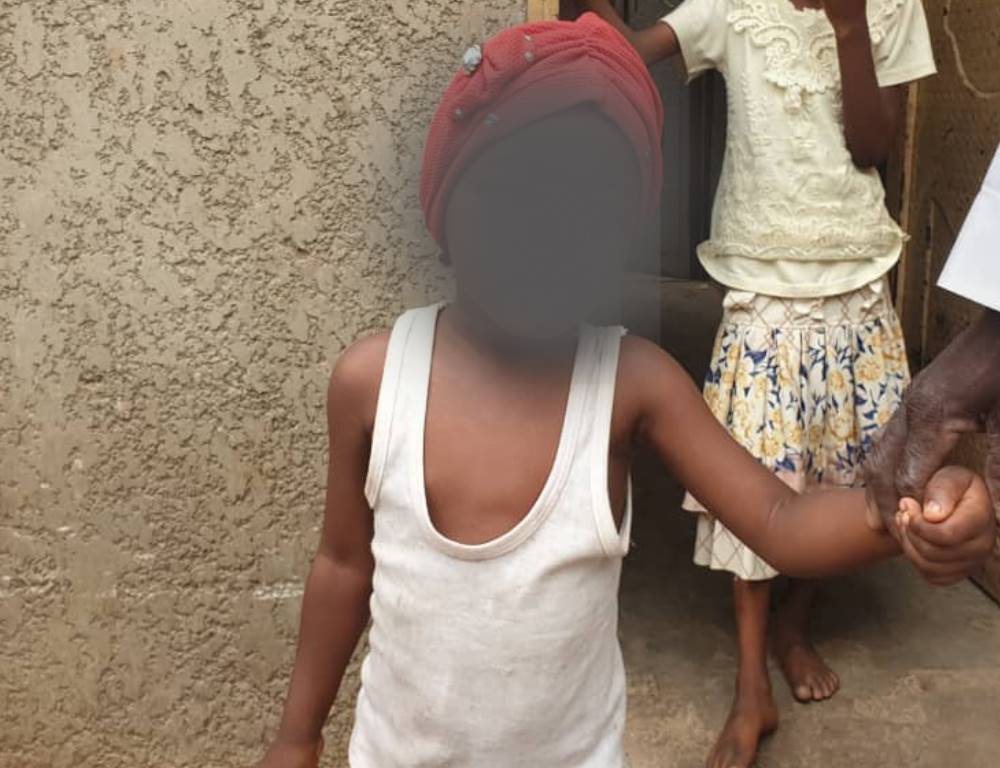
Hajara Haladu, another survivor of Diphtheria at Barebari in Ungogo LGA, Kano.
Haladu Muhammad, a resident of Tundun, is a parent to one of the children who contracted the disease in the state. His daughter, Haladu Hajara, who is four years old, was infected with diphtheria in January.
“It was just one sudden night, I met my daughter ill, so due to the awareness of the outbreak of diphtheria, I took her to Murtala Muhammad General Hospital, they ran a test and confirmed that she has diphtheria.”
Muhammad explained that the treatment fee for Diphtheria at the Murtala Muhammad General Hospital was free, adding that his other children were vaccinated with their mother.
“We didn’t spend a kobo at the hospital, all treatment was free of charge. After that other children were vaccinated, together with her mother.”
Other families of the survivors who spoke to The ICIR also shared the same testimony on the government’s quick response to their wards.
The Kano state Epidemiologist and Incident Manager, Abdullahi Issa while speaking to The ICIR stressed that the state emergency preparedness and response committee (EPR committee) has been reactivated to contain and control all public health emergencies and threats in the state.
Issa aligned their recent success and development to the creation and approval of budget lines for epidemic preparedness and response.
In 2020, Kano created a budget line for epidemic preparedness and response, totalling 300 million naira and allocating two million naira each toward strengthening preparedness in the 44 local government areas in the state.
“We are currently responding to the diphtheria, and evidence has shown that we have made a remarkable improvement and currently, the patients have been treated at the designated treatment centre and we have seen a significant reduction in the number of cases. Regarding the creation of budget ideas, we must commend the effort of the current government under the leadership of his excellency Governor Abdullahi Umar Gaduje for approving the creation of the budget line for emergency preparedness and response and also announced some amount of money is appropriated for EPR activity in the state.
“Not only that, the most welcome development in the EPR budgeting and financing is a recent approval by his excellency of a monthly stand in other that guarantees the monthly release of some amount of money to the state EPR committee under the Ministry of health, so that whenever there is any outbreak, there’s no need to wait and begin to write memo seeking for approval when there’s money in the ministry of health already,” Issa added.
The ICIRgathered that only Kano and Lagos states have created a budget line for the epidemic preparedness and response among Nigeria’s 36 states.
Although The ICIR could not ascertain if the actual amount budgeted for the EPR was released in 2022 by the state government, it was said that not less than 30 million was released for the project in 2022.
This was according to the Kano state Lisdel coordinator an NGO that focuses on advocacy initiatives for sustainable development goals – Shuaib Mohammed, who was part of the campaign on the state taking ownership of health and creating a budget line for epidemic preparedness.
He disclosed that the increased Health funding by the state government in recent years is reducing the rate at which some of these diseases spread across the state. He said, “The state has taken charge of the management of diphtheria like treatment, sensitisation, vaccination, etc. While partners such as: WHO, MSF, UNICEF are technically and financially supporting the state.”
Mohammed stated that a sum of N30 million was released out of the amount approved for preparedness.
Diphtheria vaccination coverage in the state
Misinformation, illiteracy and lack of proper sensitisation were some of the reasons why many people were reluctant to take vaccines in Kano state. The reluctance towards getting vaccinated might have originated from 1996, when some children were reported dead barely one month after receiving Trovafloxacin/Alatrofloxacin and Ceftriaxone, the standard vaccine for meningitis.
Nigeria faced one of Africa’s most severe Meningitis outbreaksduring that period and was approached by a research team of six members from one of the biggest research-based pharmaceutical companies in the United States, Pfizer, who promised tocombat the outbreak by conducting tests on the efficacy of their new antibiotic, ‘Trovan,’ on 200 young meningitis patients in Kano State.
Although Pfizer asserted that the drugs were not responsible for the children’s deaths, the company was found to have conducted human trials without obtaining informed consent during the investigations. The ICIR did a more detailed report on vaccine hesitancy and how religious clerics drove the vaccination coverage in Kano state, see report here.
The scenario has, however, changed as community leaders, health workers, and relevant non-government organisations are preaching the importance of receiving vaccines to people.
Ado Isah (with one of his children that contracted diphtheria), the village head of Tudun Fulanin Barebari in Ungogo LGA, Kano state.
The Head of Tudun Fulani Barebari of the Ungogo LGA, Ado Isah, explained to The ICIR that after one of his children was discharged from the hospital, he met with healthcare workers and stakeholders to sensitise the other residents on the need to take vaccines.
“During the outbreak of diphtheria in my community, I have been relentlessly moving from one LGA to another and also engaging with different stakeholders. From there, the LGA took a step by sending health personnel and also drugs to the Mangoro Primary Health care, were they started vaccinating residents.
“As the village head, I have been trying my best to see that I curtail the widespread of the epidemic in my community by meeting with healthcare workers and also stakeholders. We used to sensitise the residents on how to protect themselves from contracting such viruses.”
Isah noted that he went to mosques and public gatherings with public healthcare workers to educate people on preventive measures, adding that the state government has done well in vaccination coverage in his LGA as “they spent almost a week administering the vaccination.”
He also confirmed that most people who contracted the disease in the village received free treatment at the Murtala Hospital.
We have vaccinated over 500,000 children on Diphtheria-Official
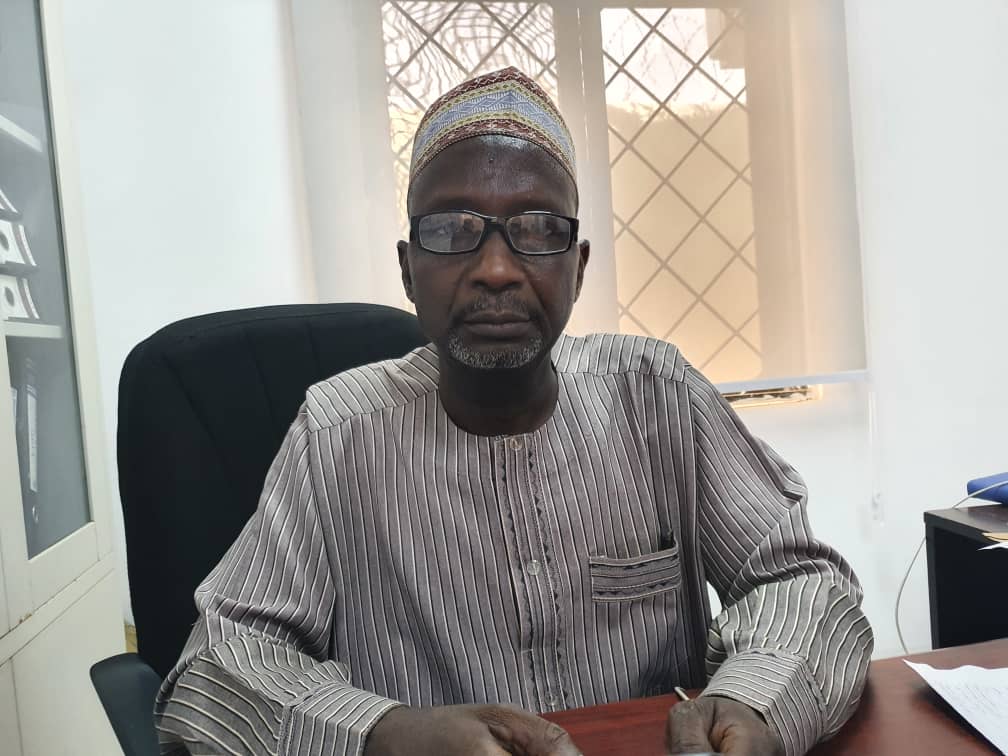
Kano state primary health care immunisation officer Shehu Abdullahi Muhammad.
Over 500,000 children have been immunised against Diphtheria in Kano this year. The Kano state primary health care immunisation officer Shehu Abdullahi Muhammad said the state constituted a technical working group under the rapid response in January 2023, to tackle the outbreak.
According to him, the committee identifies the victims of the disease and the plagued areas and proceeds to take their samples to determine who has the disease and further isolate them from the population.
He stated that the state healthcare sector engages in outreach to every part of the state to provide vaccines for the people, especially in the five most affected LGAs.
“We have even concluded the second phase of vaccinations in five LGAs, Ndala, Gwale, Ungogo, Nasarawa and Tarauni, these are the five epic centres LGAs who have high burdens of transmission of these diseases and people were reached since February, and we did the second phase in March/April. We are now preparing for the third phase because the National body has planned for three consecutive months of RI intensification activities campaign in all 23 LGA and intensified the diphtheria activities in five LGA that I mentioned earlier.
“We have vaccinated over 500,000. The first concerning phase one is that the National will require one million doses of TD vaccine, and unfortunately National didn’t have this quantity, they gave us 500,000, and we were able to immunise more than 270,000. The recent conclusion of this RI intensification phase two, which we finished yesterday (April), is that over 350,000 (eligible from four years to fourteen years of age) were vaccinated. So if we sum it all up; 270,000 people plus 350,000 people, we were able to reach more than 600000 people who have benefited from the vaccine in the state.”
Muhammad further explained that the state target population for Diphtheria vaccination coverage is 1.5 million and has, however reached 50/60 per cent, adding that the third round of the exercise will start in May.
Strides in Kano state health budget
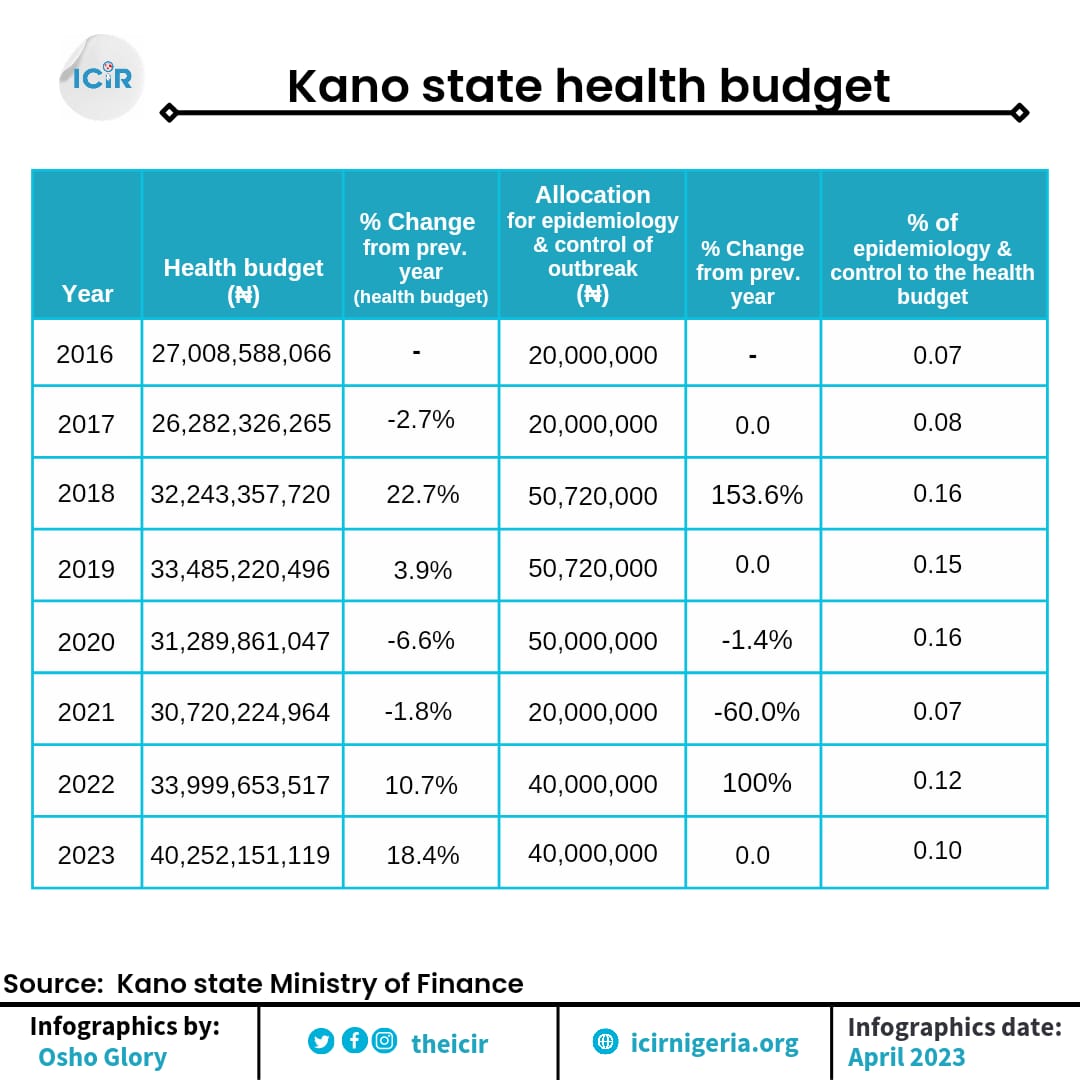
Aside from the creation of a budget line for Epidemic preparedness, the Kano state health budget has seen an increase in recent years.
The budgetary allocation for health increased from 27 billion in 2016 to 40.2 billion in 2023, and the health budget as a percentage of the total state budget has increased from 9.85 per cent in 2016 to 15.01 per cent in 2023. This demonstrates the state government’s efforts to comply with the Abuja declaration that requires FG, state, and local governments to allocate at least 15 per cent of their total budgets to health.
infographic showing the Kano state approved budget for health from 2016-2023
However, despite this positive development, the amount allocated for epidemic preparedness is still relatively low. Less than 1 per cent of the health budget was dedicated to epidemic preparedness in recent years. For instance, in 2019, only N50.7 million, which is 0.15 per cent of the total approved budget for the health sector, was approved for epidemics.
This amount remained almost the same in 2020, with N50 million (0.16 per cent of the total approved health budget) being spent on epidemics. In 2021, the allocation for epidemics dropped significantly to N20 million, which is only 0.07% of the state’s health budget for the year.
Meanwhile, in 2022 and 2023, the amount allocated for epidemic preparedness increased again, with N40 million allocated in both years.
Expert concerns…
Muhammad, the Kano state Lisdel coordinator, raised concerns over the issue of the state government not releasing the actual money budgeted for healthcare, noting that there would have been a more improved epidemic preparedness and disease control in the state.
According to him, sometimes, a single release takes a whole year of advocacy. He said, “Creating a new budget line is a good achievement and you know releasing funds is not something easy in the government. Budget is always a proposal of what’s expected from the revenue generation, at times it takes the whole year advocating for a single release. The Government mostly has some priorities from the physical structures and all that.”
Also, a report from a Civil Society Organisation working in Kano, the development Research and Projects Centre (dRPC) shows there were poor releases in 2018, 2019, and 2020. The report stressed that there were less than 50 per cent releases in all, far less than the required 75 per cent. The released amounts for 2015 and 2016 were merely 7.3 per cent and 3 per cent, respectively, resulting in a substantial deficit of over 90 per cent in both years, according to the report.
However, the total health capital releases for 2018 and 2019 accounted for 25 per cent and 32 per cent, respectively, showing a significant increase from the previous years.
The report further stated that only 2 per cent was the total released for the health capital expenditure in 2020.
NIGERIAN singer and songwriter, Oyinkansola Sarah Aderibigbe popularly known as Ayra Starr, has disclosed how she came about her stage name.
She made the revelation in an interview on an episode of The Afrobeats Intelligence Podcast, hosted by Joey Akan.
During the episode of the podcast titled ‘Ayra Starr – Nigeria’s Celestial Being’, the singer revealed that before being famous, she was known as Oyin.
“Everybody called me Oyin. Literally, until the day I released my EP, my name was Oyin,” she said.
The singer went further to say that it was very important for her to pick a name that meant something significant.
She said, “We are Africans, I’m a Nigerian and a Yoruba girl, every Yoruba name means a prayer. It was so important for my name to mean something that I want to stand for and that’s what I did.
“Oyin means honey, I love it and would have gone for it but my team, Don Jazzy, Rema and others all thought about it and we got something – Ira.”
The artist added that people might not get the correct pronunciation of how she wants to be called so she prayed about it.
“I don’t know how it happened, I decided to google it one time, I spelt AYRA and it means someone that is highly respected and open-minded in Arabic and it just made sense.”
Ayra Starr Before Fame
Ayra Star before fame. Source: Instagram
Born in Cotonou, Benin, Ayra Starr is originally from Kwara State, Nigeria and grew up in three different cities, Cotonou, Lagos and Abuja.
She has four siblings of which they all did music together with the support of their mum. She added that they’re all in the entertainment industry.
“My brother is a video director, my younger brother a song writer and my sister is a model.”
The artist also said before she came into limelight, the people around her said many positive things to her and told her she will be a star.
She added that her teachers in high school also inspired her and predicted she would be signed to Mavin records.
“I have a teacher that inspired me. He literally said ‘Mavin is going to sign you, start making videos.’ I was like 14 then and whenever I sang in school, he would tell me to go to church and sing in the choir.
“He was my mathematics teacher and even Muslim, also my Civic teacher. Mr Saheed and Mr Yinka God bless you guys,” she said.
She did a lot of covers for different songs and in December 2020, she posted her own song via a video post on her Instagram page which got Don Jazzy’s attention.
Ayra Starr as a Mavin Signee
Ayra Starr’s 19 and Dangerous album. Source: Instagram
After being discovered by Don Jazzy, Ayra Starr was signed on by Mavin Records on January 21, 2021.
This was made public by the company’s official Instagram handle through a video post with the caption ‘As a global music company, we are on a mission to develop global hitmakers. Tonight, we introduce the world to a one of a kind talent. Welcome @ayrastarr💎⭐️ #MavinActivated #ayrastarr’.
She achieved recognition after the release of her debut Extended Play and it’s hit track, AWAY which had over a million streams on audiomack few weeks upon release and topped charts.
Since then, she had successfully released other songs including Bloody Samaritan of which she later had a remix collaboration with US star, Kelly Rowland. She also released the hit track Rush, Sability, among others.
She has been nominated for various awards and won the Viewers Choice Award at the 15th Headies in 2022.
A STUDY conducted by Heinrich Boll Foundation has revealed that some hazardous pesticides banned in Europe are being used in Nigeria despite attempts by the National Agency for Food and Drug Administration and Control (NAFDAC) to clamp down on the importation of harmful chemicals into the country.
The report stated that Nigeria imports 147,446 tonnes of pesticides annually, more than the total imports of Southern Africa, 87,403 tonnes, and North Africa, 109,561 tonnes.
However, the report further noted that despite the increasing imports, the informal nature of agricultural production in the country has made it difficult to record how pesticides are used.
“Surveys have shown that 80 per cent of the pesticides used most frequently by small-scale farmers are highly hazardous pesticides. Among the most commonly used are atrazine, chlorpyrifos and mancozeb – all of which are prohibited in the European Union,” the report said, adding that 58 per cent of the existing pesticides in the country are already banned in Europe.
The report noted that it is illegal to purchase, sell, import, transit, transport, deposit and/or store any banned or obsolete chemical or any other form of waste in the Nigeria territory or water.
The banned pesticides are prevalently used for agricultural commodities produced like cassava, yam, maize, fruits, cocoa, beans, among others.
Responding to the report’s findings in a statement released on May 7, the Director General of NAFDAC Mojisola Adeyeye stressed that the agency is set to ban another 12 pesticides and agrochemical active ingredients in the country.
The NAFDAC boss called for the cooperation of stakeholders and the general public to rid the country of hazardous pesticides.
According to her, pesticides are applied both indoors and outdoors for the management of pests, vector-borne diseases, and crop protection.
Adeyeye emphasised that some pesticides are impregnated in textiles, paints, carpets, and treated wood to control pests and fungi.
She expressed concerns about the toxicity associated with the misuse and abuse of pesticides as it affected food safety and security.
“There was also an alert received from the Federal Ministry of Agriculture and Rural Development, cautioning on the possibility that the European Union and the United Kingdom were exporting banned neonicotinoid pesticides to Nigeria and other poorer countries.
“Emphasis was placed on chlorpyrifos and its variants due to their harmful effects on humans, animals, beneficial insects, and the environment.”
Adeyeye lamented the rising increase in the use of European-banned pesticides in Nigeria.
“This necessitated the review and analysis of the list of registered pesticides and agrochemical active ingredients in the NAFDAC registered product automated database vis-à-vis actives banned, non-approved.”
Adeyeye said the aim of the agency is to safeguard the health of the nation.
She disclosed that the review meeting focused much on the proposed phase-out/ban of these active ingredients and it had in attendance proponent holders of marketing authorisations and NGOs.
“At the end of the meeting, it was agreed that pesticides and agrochemical importers and manufacturers would be advised to institute stewardship plans such as post-marketing surveillance and research in their companies.”
Adeyeye stated that NAFDAC would collaborate with research institutes in the conduct of research and scientific data generation on pesticides to enable the Agency to make evidence-based decisions and policies.
The NAFDAC boss said that the agency would further intensify post-marketing surveillance nationwide, as well as sensitisation and education of relevant stakeholders on the responsible use of pesticides.
She added that NAFDAC would collaborate with sister agencies like the Federal Ministry of Agriculture and Rural Development, the Standards Organisation of Nigeria, the National Environmental Standards and Regulation Enforcement Agency and the Nigeria Agricultural Quarantine Service.
NAFDAC had earlier phased out 30 hazardous pesticides from the Nigerian market, including Aldrin, Binapacryl, Monocroptophos, Mirex, Ethylene, Dichloride Fluoroacetamide, and Chlorobenzilate.
The ICIR had, in a report titled “Death in small doses: How food vendors, fruit sellers, farmers poison Nigerians with agrochemicals’, exposed the continuing use of some chemicals which were banned due to their unsafe nature.
The report stated that fruit, fish and meat sellers and farmers flagrantly use the chemicals to ripen or preserve their goods. They adopt the banned pesticides to maximise profit, without having regard for the health of the consumers.
Further findings by The ICIR indicated that the banned pesticides, fungicides, herbicides and other chemicals were available in the market.
The report observed that the chemicals are used on foods such as grains, cereals, legumes, and are later taken to the market against the approved duration when the potency of the chemicals should have worn off.
The ICIR’s findings further show that although the administration of some of the chemicals is allowed at permissible levels for food storage to avoid post-harvest losses, those who administer the chemicals on the food items are untrained.
Reacting to the findings of the recent study by Heinrich Boll Foundation in an interview with The ICIR, a Medical Consultant, Obstetrics and Gynecology, at Wuse District Hospital, Abuja, Ifiok Ikpe, stressed the need for NAFDAC to recall pesticides that are banned and dangerous to human health.
Ikpe spoke of the need for NAFDAC to strengthen the implementation of its regulations to curb the production of locally banned pesticides, and cease the importation of foreign banned ones.
“The locally produced chemicals and foreign banned pesticides need to be recalled from the wholesalers to the retailer because they all have both long-term and short-term effects, they can cause cancer of the blood at the long run. The effects cannot be imagined now.”
He as well urged that farmers to consider human lives over profit making in their practices.
“It is more than increasing their yields or bountiful harvest and profit alone, it is about human lives.”
Ikpe added that the use of dangerous harmful chemicals substances as pesticides can also distort the ecosystem.
OPERATIVES of the Economic and Financial Crime Commission (EFCC) have arrested a former minister of power Saleh Mamman in connection with an alleged N22 billion fraud.
Mamman, who served as a minister under President Muhammadu Buhari between 2019 and 2021, was arrested in the early hours of Wednesday, May 10 and detained at the headquarters of the EFCC in Abuja.
The arrest is said to be in connection with the Commission’s ongoing investigation into alleged corruption in the execution of some power projects.
Mamman is accused of conspiring with staff of the ministry in charge of the accounts of the Zungeru and Mambilla power projects to divert and share N22 billion among themselves.
It was gathered that the investigations have uncovered properties in Nigeria and abroad allegedly linked to the suspects, while millions of naira and dollars have reportedly been recovered.
President Muhammadu Buhari on September 1, 2021, sacked Mamman and Sabo Nanono, the minister of agriculture and rural development, in a cabinet reshuffle.
The ICIRreported that Mamman’s two-year tenure as power minister was marred by policy inconsistency and non-constitution of the board of the Transmission Company of Nigeria (TCN).
Nigeria’s power sector is strategic for the economic advancement of Africa’s largest economy but has been leapfrogging despite privatisation in 2013.
Mamman took over from Babatunde Fashola, who worked as the supervising minister of the ministry in the first tenure of President Muhammadu Buhari’s administration.
He was sworn in on 21st August 2019 as the minister of power.
The ministry, according to its mandate, is the policy-making arm of the Federal Government in charge of providing direction for enforcement of the right framework and efficient running of the policies of the government in the sector.
However, The ICIR reporter that a key concern that weakened the policy direction in the power sector under Mamman’s leadership was the regulator -the Nigerian Electricity Regulatory Commission (NERC) – shifting grounds on eligibility customer status.
The eligible customer status came into effect in 2017.
The eligible customer policy allows the generation companies (GENCOS) to sell power directly to consumers without passing through the electricity distribution companies (DisCos).
The policy comes with great assurance of constant power supply, a departure from the epileptic power supply that is the main characteristic of on-grid power supply.
Fashola came up with customer policy to enable bulk electricity buyers and industrial layouts to take up power from generating companies and pay to them directly.
This initiative was to lessen pressure on the collapse-prone grid and ensure power access directly to industrial clusters and other eligible customers through the generation companies.
But with Mamman as supervisory minister, the NERC halted acceptance of eligible customers, despite Nigeria’s grid failure, epileptic power supply and the national grid only able to take less than 5000 megawatts of power.
Another key issue during his tenure as minister in the power sector was non-constitution of the board of the Transmission Company of Nigeria (TCN), which weakened investors’ appetite for long in the sector.
According to a report by The ICIR, under Mamman as minister, the TCN was not unbundled. This led to market inefficiency, resulting in grid collapse and blame-trading between the DisCos and the TCN.
HEARING on the petition filed by Labour Party (LP) candidate, Peter Obi, to challenge the election of Bola Tinubu of the All Progressives Congress (APC) in the 2023 presidential election l has been adjourned till May 17.
The five-member panel of the Presidential Election Petition Tribunal, led by Justice Haruna Tsammani, adjourned the hearing on Wednesday, May 10, following a request by Obi’s lawyer, Livy Uzoukwu.
Uzoukwu had informed the court of an agreement by lawyers to parties in the petition to file and exchange necessary documents for a smooth hearing of the substantive petition.
The defence lawyers, including Abubakar Mahmoud, Wole Olanipekun, Lateef Fagbemi, who represented the Independent National Electoral Commission (INEC), Tinubu and the APC, respectively, confirmed Ozoukwu’s submissions before the court.
INEC had declared Tinubu as the winner of the February 25 presidential election.
According to INEC, Tinubu secured 8,794,726 votes, the Peoples Democratic Party (PDP) candidate, Atiku Abubakar had 6,984,520, while the Labour Party (PDP) presidential candidate, Peter Obi, polled 6,101,533.
The PDP and LP candidate rejected the result and approached the Tribunal with separate petitions to challenge Tinubu’s victory.
They alleged that Tinubu was not qualified to contest the election and that he failed to secure the majority of lawful votes cast at the poll.
They are also contesting that Tinubu’s running mate, Kashim Shettima, had a double nomination contrary to the Electoral Act.
The court, which had its inaugural sitting on Monday, May 8, had dismissed the petition filed by the Action Alliance (AA) after it was withdrawn by the party.
The ICIR had also reported earlier that the Action Peoples Party (APP) also withdrew its case at the Tribunal.
THE Whistleblowing Advocacy Coalition (WAC) has commended President Muhammadu Buhari for transmitting the draft whistleblower protection bill to the National Assembly for further consideration and passage before the end of his administration.
The bill, which was approved by the Federal Executive Council (FEC) in December 2022, is to strengthen the fight against corruption and protect whistleblowers that provide helpful information to the government.
The Minister of Finance, Budget and National Planning, Dr. Zainab Ahmed, speaking after the bill was approved by the FEC, said the memo was reviewed and approved by the Council with a provision to ensure alignment with the Evidence Act.
“The purpose of operationalising and putting in place a whistleblower bill is to strengthen the fight against corruption and to enable protection for whistleblowers that provide information for use by the government.
“As you know, since 2016, the Council has approved the setting up the Presidential Initiative of Continuous Audit. PICA has been working in partnership with EFCC, ICPC, DSS, and NFIU and the Office of the Attorney-General of the Federation.”
Meanwhile, in a statement released on Wednesday, May 10, the Whistleblowing Advocacy Coalition noted that a whistleblowing protection law for Nigeria is long overdue, adding that it’s been an interest of different Civil Society Organisations over the last two decades.
The Coalition noted that the whistleblowing policy has been in operation for more than six years but is not backed by a legal framework that would strengthen implementation and boost citizen confidence.
Part of the statement read: “Thus, the president’s decision to send the bill to the National Assembly for passage is a huge affirmation of his commitment to making whistleblowing an important mechanism for fighting corruption and wrongdoing, as well as for doing away with the culture of silence that has been the citizens’ traditional way of life.
“We salute Professor Yemi Osinbajo, the vice president, who presided over the cabinet meeting at which the draft bill was approved, for his unbounded thoughtfulness for the needs of the people for a law that would improve their lives and society at large. According to the vice president, the whistleblowing law is one important piece of legislation that Nigerians have long been waiting for.
“The Coalition also acknowledges the significant role played by Dr. Zainab Ahmed, Minister of Finance, Budget and National Planning, and the whistleblowing unit, the Presidential Initiative on Continuous Audit (PICA), that worked with stakeholders, including civil society organisations, to ensure that a new whistleblower protection bill was drafted and presented to FEC for approval and adoption as an executive bill.”
The Coalition reiterated the importance of protecting whistleblowers facing retaliation for exposing wrongdoings in the society, stressing that workers who show courage to report fraud are subjected to all kinds of punishment at workplace.
“The importance of protection for citizens facing retaliation for blowing the whistle for the good of society cannot be overemphasized. Almost daily, workers who show the courage to report fraud and other wrongdoing in their workplaces are subjected to all kinds of punishment, including suspension without pay, withholding of salary, denial of promotion, outright dismissal, threats, and intimidation which hint at physical harm or even death in some cases.
“Therefore, we believe that more than any other time, a piece of legislation that ensures effective protection for whistleblowers is urgently needed as a means of encouraging citizen participation in whistleblowing as an effective mechanism for fighting corruption. The only way Nigerians can be motivated to blow the whistle is when they know there is a law that fully protects them from retaliation.
“Now that the whistleblower protection bill is before the National Assembly, we are calling on the lawmakers to respond positively to the President’s gesture by giving the bill the urgent treatment it deserves, so that the President can sign it into law and cap his tenure which ends May 29, 2023, with a fitting legacy of bequeathing to Nigerians one of the most critical instruments for achieving transparency, accountability and good governance in the country.”
ONDO State governor Oluwarotimi Akeredolu, has described the zoning formula released by the All Progressives Congress (APC) for the 10th National Assembly as lopsided and unjust.
According to the zoning formula approved by the ruling party, the South-South will produce the Senate President while the position of Speaker of the House of Representatives goes to the North-West.
Akeredolu, who doubles as the Chairman of the South-West of Governors’ Forum, said the arrangement reinforces injustice and inequality.
This was disclosed in a statement he signed and posted on his official Facebook page on Wednesday, May 10.
Akeredolu said the contents, intentions and motives of the zoning formula presented by the APC is an early sign of steps to ‘enclose’ the victory of President-elect Bola Ahmed Tinubu.
“It is trite to aver that it stands logic on the head that one geo-political zone, North-West in this regard, will be favoured with two presiding officers positions out of four while North-Central suffers the consequences for its innocence and shrewd loyalty by having none.
“It is an insidious permutation that North-East will be deprived in the face of the unsavoury generosity dispensed through two slots to a particular geo-political zone. It is self-repudiating for one to argue, therefore, that the Speaker of the House of Representatives cannot also emerge from the North-East.
“Therefore, the move to zone the National Assembly leadership positions on the behest of interested personalities with perceived closeness to the President-elect manifestingly lays the dangerous foundation of distrust, needless suspicion even as it structures nothing but a combination of booby traps. We must avoid all these,” Akeredolu stated.
He added that the North should be allowed to play a stronger role in the selection process, especially for the position of Speaker of the House of Representatives.
“As leaders of the Party in their respective States, there cannot be a greater disservice to them that a consensus was yet to be reached when the NWC hurriedly released a dangerous tool for the opposition in the guise of a zoning formula. To me, even on this note, it’s unacceptable.
“Does it not also exude a serious discomfort that the aspirants to the Speakership were not consulted, approached and effectively engaged before the purported zoning formula?” he asked.
Akeredolu praised the courage of the Speakership aspirants for their show of solidarity and objection to the “brazenly teleguided zoning arrangement that is skewed”.
He went ahead to state that the arrangement by the party promotes inequity.
“This is an unworkable arrangement that reinforces injustice and enhances inequity, and I join them in rejecting this zoning formula.
“I call on the NWC of our great Party to follow the path of purity and Justice. It is perhaps expedient that Mr. President-elect interrogates this skewed arrangement and give direction that reflects our collective commitment to equality and fairness.”
He advised the APC National Working Committee (NWC) to immediately summon the National Executive Committee (NEC) to agree on terms that would strengthen the Party.
TheNWC of the APC had on Monday, May 8, zoned the leadership positions of the 10th National Assembly.
The NWC committee nominated Godswill Akpabio, Akwa Ibom, South-South, as the Senate President and Abass Tajudeen, Kaduna, North-West, as the Speaker of the House of Representatives.
This was disclosed by the National Publicity Secretary of the APC, Felix Morka.
Similarly, the NWC nominated Barau Jibrin from Kano, North-West, as Deputy Senate President and Ben Kalu, Abia, South-East, as Deputy Speaker.
The endorsement of the zoning formula for the 10th National Assembly followed a meeting held by the NWC to discuss the results of discussions and meetings with Bola Tinubu, the President-elect, and other stakeholders.
Commenting on the same issue, an APC supporter Dominic Alancha said the zoning arrangement should not be allowed to stand.
He added that the decision might affect the Party in the 2027 general elections if not reversed.
Alancha spoke on Arise TV Newsday programme on Wednesday, May 10.
“If this decision is allowed to stand, it will mark the end of the independence of the National Assembly. The only way to balance it is to engage all members and consider all the other zones.
“The South-West and North-East have both President and Vice presidents
The most important thing is that all the zones should be carried along
If it is not carried along, it will affect us,” Alancha said.