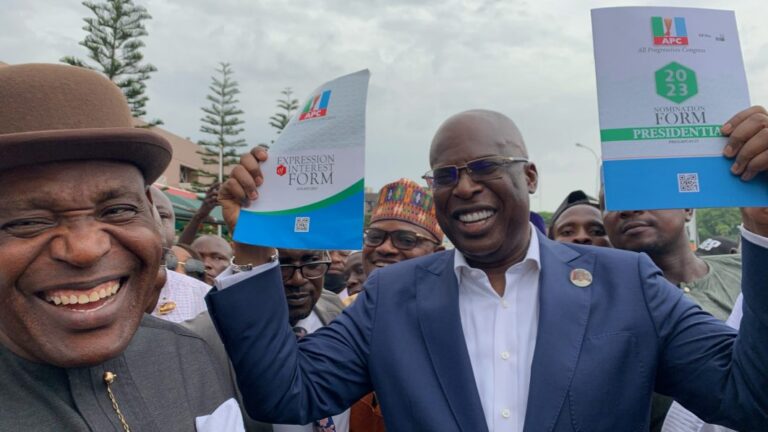
MINISTER of State for Petroleum Resources, Timipre Sylva, has reportedly resigned from his post to contest the All Progressives Congress (APC) ticket for the Bayelsa State governorship election.
According to Reuters, Sylva handed his resignation letter to President Muhammadu Buhari and stopped coming to the office last week.
Also, Punch newspaper reported that senior officials in Sylva’s ministry have refused to confirm or deny his resignation.
However, the Presidency on Friday, March 31, confirmed the minister’s resignation. Special Assistant to the President on Digital Communications, Bashir Ahmad, confirmed the development in a tweet in his official Twitter handle,
Ahmad tweeted: “Minister of State for Petroleum Resources, and former Bayelsa state governor, H.E. Timipre Sylva, has resigned his appointment to contest in the next Bayelsa governorship election.”
The APC holds a primary on April 14 to select its candidate for the gubernatorial election in Bayelsa State.
This is not the first time Sylva has contested a gubernatorial election. In 2007, he won the Bayelsa State gubernatorial election under the Peoples Democratic Party (PDP) and served for one term between 2008 and 2012. He was later replaced by an acting governor following the nullification of his election by the Appeal Court in Port Harcourt.
Sylva was again elected governor in a new election held on May 24, 2008, under the PDP banner.
However, his tenure was terminated by the Supreme Court on January 27, 2012, and an acting governor was appointed to oversee the state until the election of February 2012.
He was appointed Minister of State for Petroleum Resources by President Buhari in 2019.
Meanwhile, party members from 43 Wards in Ekeremor, Ogbia, Sagbama, Kolokuma/Opokuma, and Southern Ijaw Local Government Areas of Bayelsa State hsve called on the APC national leadership to disqualify Sylva.
They argued that the former minister had not resigned at the time of his screening for the governorship primary.
OVER 7,000 internally-displaced persons (IDPs) at El-Miskin Camp in Maiduguri, Borno State, have alleged that the Nigerian government no longer support them.
The IDPs made the allegation in a statement mailed to The ICIR by the United Nations Office for the Coordination of Humanitarian Affairs (OCHA) on Friday, March 31.
Mattias Schmale, Resident Coordinator of the programme in Nigeria, said he visited the IDPs on Friday, March 30, and was shocked by their condition.
In addition to hunger, Schmale said officials at the centre’s Outpatient Therapeutic Feeding Programme said dozens of children were admitted with acute malnutrition.
“Yesterday, I visited El-Miskin Camp in Maiduguri, Borno State, where approximately 7,200 internally displaced persons (IDPs) have sought safety. The food situation is severe for many families in the camp due to a lack of funding for operations.
“Women told me that they had not received food assistance in more than three months and were struggling to feed their families. Some children described going for several days without eating enough. Mothers told me their children go to bed crying from hunger.”
The IDPs are among an estimated 4.4 million people who will need sustained emergency food assistance in Borno, Adamawa, and Yobe states, according to the October 2022 Cadre Harmonisé food and nutrition analysis, the UN Chief stated.
Because of the lack of food, Schmale explained that people at the camp warned of increased malnutrition figures in the coming months.
“Severe acute malnutrition is expected to double compared to last year, affecting some 690,000 children. Government and the humanitarian community must redouble efforts to prevent this from happening. Financial resources are needed now to take the necessary action to save their lives.
“Without assistance, cases of life-threatening severe acute malnutrition will increase, and more people will resort to negative coping mechanisms such as begging, survival sex and child labour to survive,” he added.
Many children are out of school at the camp, claimed Schmale. He said over 4,000 school-age children in the camp were unable to attend school for years.
According to him, only one of the 17 women he met could read or write.
Schmale urged the government at all levels and other partners to ensure they support the women and children to live their dreams and contribute meaningfully to the growth and prosperity of their nation.
He noted that aid agencies had received only eight per cent of the US$ 1.3 billion required to reach six million people identified for emergency assistance in Borno, Adamawa and Yobe states.
“I urge donors, the private sector, and other well-wishers to urgently provide additional funding and resources to enable national and international humanitarian organisations working with the government to act early and at scale to deliver assistance to save lives, improve living conditions and protect those most in need ahead of the lean season.”
The Director of Resettlement and Durable Solution at the National Commission for Refugees, Migrants, and Internally Displaced Persons, Kangiwa Musa, could not comment on the IDPs’ allegation of neglect by the government when contacted by The ICIR on Friday.
Kangiwa, whose office supports the IDPs, said he was on study leave at the National Institute for Policy and Strategic Studies, Kuru Jos, but handed over to an Assistant Director.
He promised to send the Assistant Director’s contact but did not do so for over an hour before this report was filed.
On March 29, The ICIRreported how the Foreign, Commonwealth and Development Office (FCDO) of the UK Government and the United Nations Children Fund (UNICEF) launched a new lifesaving programme for children in the country’s North-East.
The ICIR reports that the North-East has faced an over-a-decade security crisis arising from scores of attacks by the Boko Haram insurgents.
The crisis reportedly displaced about a million people, orphaned hundreds of children, and caused high-scale destruction of infrastructures, including schools, hospitals and power sources.
THE United Nations (UN) Foundation’s Universal Access Project is inviting applications for its press fellowship.
The programme is focused on sexual and reproductive health, rights and justice to Women Deliver 2023, the world’s largest conference on gender equality and the health, rights, and well-being of girls and women.
The conference is slated for July 17–20, 2023 in Kigali, Rwanda.
The organiser says, “The Women Deliver 2023 Conference comes at a critical time when sexual and reproductive health and rights are under threat in the US and abroad. The location in Rwanda, which has made strides in expanding reproductive health access, offers an opportunity to explore country-level progress and challenges in making sexual and reproductive health and rights a reality for all.”
Selected journalists will have the opportunity to explore the myriad issues that feed into sexual and reproductive health, rights and justice. Journalists will also attend a local site visit the day before the conference (to be confirmed) as well as exclusive briefings with experts, including those from UN agencies and global policymakers, global and local NGO leaders, and world-renowned researchers.
This fellowship is intended for journalists who work for US media outlets and who are interested in global sexual and reproductive health and rights issues, international development, US foreign policy, and the United Nations.
The fellowship will cover travel, food and lodging costs for the duration of the conference and any site visits beforehand, to be determined. COVID-19 vaccination and compliance with all current US Center for Disease Control and Prevention, Rwanda Ministry of Public Health, and Women Deliver 2023 safety guidelines are required for participation.
The deadline for submission of applications is April 27, 2023. Interested applicants can apply here.
THE Carter Center is inviting applications for the Rosalynn Carter Fellowships for Mental Health Journalism.
The programme aims to train reporters covering mental illness.
Eight United States candidates will be selected for the yearlong journalism fellowship starting in September, which includes a US$10,000 stipend, training and networking opportunities. Selected international journalists are awarded a comparable stipend.
Fellows should have at least three years of experience in print or electronic journalism (writing, reporting, editing, producing, filmmaking) and be citizens or legal residents of the United States, Qatar, the United Arab Emirates, or any country in Latin America.
Applicants must provide a resume, objectives for the fellowship and project description, samples of professional work and three letters of recommendation.
Journalists in the United States, Latin America, Qatar and the United Arab Emirates are encouraged to apply for this program.
The deadline for the submission of application is April 7, 2023. Recommendation letters must be submitted by April 14, 2023. Interested applicants can apply here.
NEWSROOMS are tightening their digital security measures out of concerns that new spy technologies have exposed journalists to even greater threats of surveillance and harassment.
A PREMIUM TIMES’ reporters in 2018, Samuel Ogundipe and Azeezat Adedigba, spoke often over the phone. They had no idea that their regular conversations about work and their personal lives were creating a record accessible for use by the Nigerian state.
On a partly cloudy Saturday in August 2018, Adedigba received a call from a police superintendent that essentially ruined her weekend. The officer, identified as Emmanuel Onyeneho, told Adedigba she was being investigated for criminal offences. The reporter quickly alerted the PREMIUM TIMES management to the development.
Adedigba, then 27, demanded a formal invitation, written on police letterhead, from Onyeneho. The invitation was delivered on August 13 2018. In the letter, police alleged criminal conspiracy, cyber crime, attempted kidnapping and fraud against Adedigba and ordered her to turn herself in to the force headquarters on 14 August that year.
When she honoured the police invitation, a fully armed police officer forcefully confiscated Adedigba’s telephone. She was then detained for four hours, a distressing experience, she said, that left her with psychological torture to deal with.
Soon, security operatives would order Adedigba to call Ogundipe, who was later arrested for refusing to disclose the source of his story that revealed communication between a former Inspector-General of Police, Ibrahim Idris, and then Acting President Yemi Osinbajo. Ogundipe was released on bail.
Nigerian journalists are increasingly under threat from digital and physical surveillance.
Attacks on Nigerian journalists
The gestapo manner in which the police arrested Ms Adedigba and Ogundipe is part of a growing trend of telecom surveillance used by security agents to lure and then arrest journalists. In the case of Ms Adedigba and Ogundipe, the police made no secret they used call records to establish that the duo had a relationship.
The police methods reinforce the value of internet-based, encrypted communications at a time when authorities have also targeted journalists’ phones and computers to reveal their sources. Newsrooms are tightening their digital security measures out of concerns that new spy technologies have exposed journalists to even greater threats of surveillance and harassment.
“You need basic security tools just to make sure you don’t get hacked — in life, because it really is now your responsibility as a journalist to have good digital hygiene,” says Kano-based journalist, Aliyu Muhammad, who also works as a cybersecurity expert. “Surveillance is already pervasive and now certain kinds of surveillance are being legitimised and legalised.
“And we’re also spending a lot more time online, which means some of the reporting we used to do face to face, we’re doing it digitally, whether through Zoom, which is not end-to-end encrypted, and even just phone calls with sources.”
Muhammad added that journalists need to adopt safety and security measures such as not opening attachments and links on emails and texts from strangers to prevent malware attacks as well as using strong passwords.
“We should always use VPNs and two-factor authentication on our online accounts and above all we need to maintain privacy, especially on social media, and not share personal information carelessly online,” he said.
Last November, Tom Kidwell, a British Army and UK Government intelligence specialist and founder of Ecliptic Dynamics, gavesolutions on persistent cyber threat and surveillance.
Kidwell said, “The best way for journalists and media organisations to be proactive in protecting themselves is to implement basic access control and device management. It’s not necessarily the most technical or high-end aspect of cyber, but implementing good procedures and processes makes you a much harder target to exploit.”
The rapid expansion of the digital surveillance industry has enabled governments around the world to acquire new technologies to monitor journalists, silence independent journalism, and control the flow of information. As of April 2021, the Committee to Protect Journalists (CPJ) had identified 38 cases of spyware targeting journalists, commentators, and their associates.
cases of spyware targetting journalist
The University of Toronto’s Citizen Lab suggests the true figure could be over 50. There are reports of spyware targeting journalists working with international media outlets, including Al Jazeera and the New York Times.
On its part, the Nigerian government has continued to increase budgetary allocation to surveillance technology. In 2021, the government allocated N4.8 billion to the National Intelligence Agency (NIA) to procure equipment that will “monitor WhatsApp messages, phone calls, and text messages.”
“More than ever before, journalists are monitored when they are online, and when they are not, they are followed; journalists’ email and social media handles are hacked,” said Lekan Otufodunrin, the executive director of Media Career Development Network.
The confidentiality of sources is central to journalists’ ability to properly investigate stories, and to the protection of individuals and whistleblowers who provide information to them, he said.
“Therefore, efforts to compel the disclosure of sources have a chilling effect on freedom of speech and media freedom,” Otufodunrin added.
Like the case of Ogundipe and Adedigba, police used call records to identify individuals that could be used to lead them to their targets.
In December 2021, investigative journalist Fisayo Soyombo was grilled at the police headquarters in Abuja after his platform published a story on fake police camp projects. Soyombo said the police extracted the phone numbers of everyone connected to the Foundation for Investigative Journalism (FIJ) — including reporters, lawyer and board members —- texting them to appear at the force headquarters.
“If I had not honoured their invitation, they would have tracked our lines to arrest one of us. I do know from experience that if the authorities are interested in you, they will track your phone and get you to your location. They have the equipment, it is just a question of how high you are on their priority list,” Soyombo said at the time.
A former staffer of the FIJ, Ibrahim Adeyemi, said he received threatening phone messages from the police at the time.
Before Soyombo’s incident, two journalists – Gidado Yushau and Alfred Olufemi– were charged in November 2019 with criminal conspiracy and criminal defamation in connection with a complaint over a May 2018 article Olufemi wrote. The police used a mutual contact to track Yushau and Olufemi who are still facing trial in a court in the north-central Kwara State.
Surveillance activities carried out against journalists run the risk of fundamentally undermining the source protection to which journalists are entitled. Principle nine of the Global Principles on the Protection of Freedom of Expression and Privacy provides the protection of sources.
However, while the right to privacy is also a fundamental human right enshrined in Nigeria’s constitution, the 1962 Official Secrets Act empowers security forces to grant themselves warrants to search and seize all materials considered evidence and arrest those suspected of committing offences under the act.
In 2019, the Committee to Protect Journalists accused the Nigerian military of using surveillance technology to spy on ordinary Nigerians and the press. The CPJ stated this in a report titled “Nigerian military targeted journalists’ phones, computers with forensic search for source.”
According to the report, the Nigerian military procured a forensic technology designed to extract information from phones and computers. The report stated that two companies – Israel-based Cellebrite and US-based Access Data – that produce and market such technologies used by security forces to monitor and interrogate journalists, were already operating in Nigeria. Between 2014 and 2017, CPJ added that the Nigerian government has spent at least N127 billion ($350 million) on surveillance and security equipment.
Experts believe when the devices of journalists and their sources are vulnerable to surveillance, the ability of journalists to carry out their newsgathering function is significantly diminished.
“Journalists who fear they are a target of surveillance may self-censor. Credible sources may be less likely to talk to the press, and media outlets may struggle financially to keep pace with the increasingly sophisticated threats facing their staff,” Otufodunrin of media career development said.
Nigeria has 214 million active mobile phone lines, with roughly two million lines added every month, according to 2022 data released by the national telecom regulator, the Nigerian Communications Commission (NCC). SIM card ownership for these lines is tracked under a 2011 regulation that mandates the collection of personal information, including fingerprints and photos, that police can access without a warrant as long as a senior-ranking security officer gives written approval. Other NCC regulations, released in October 2019, detail police permissions to intercept communications under certain circumstances.
The police also use this instrument to harass critics.
Recently, police officers attached to Nigeria’s first lady, Aisha Buhari, tracked Aminu Adamu, a Nigerian student, through his phone. He was arrested and detained on the orders of Buhari in late 2022.
In Nigeria, it’s an addition to physical attacks and harassment journalists face.
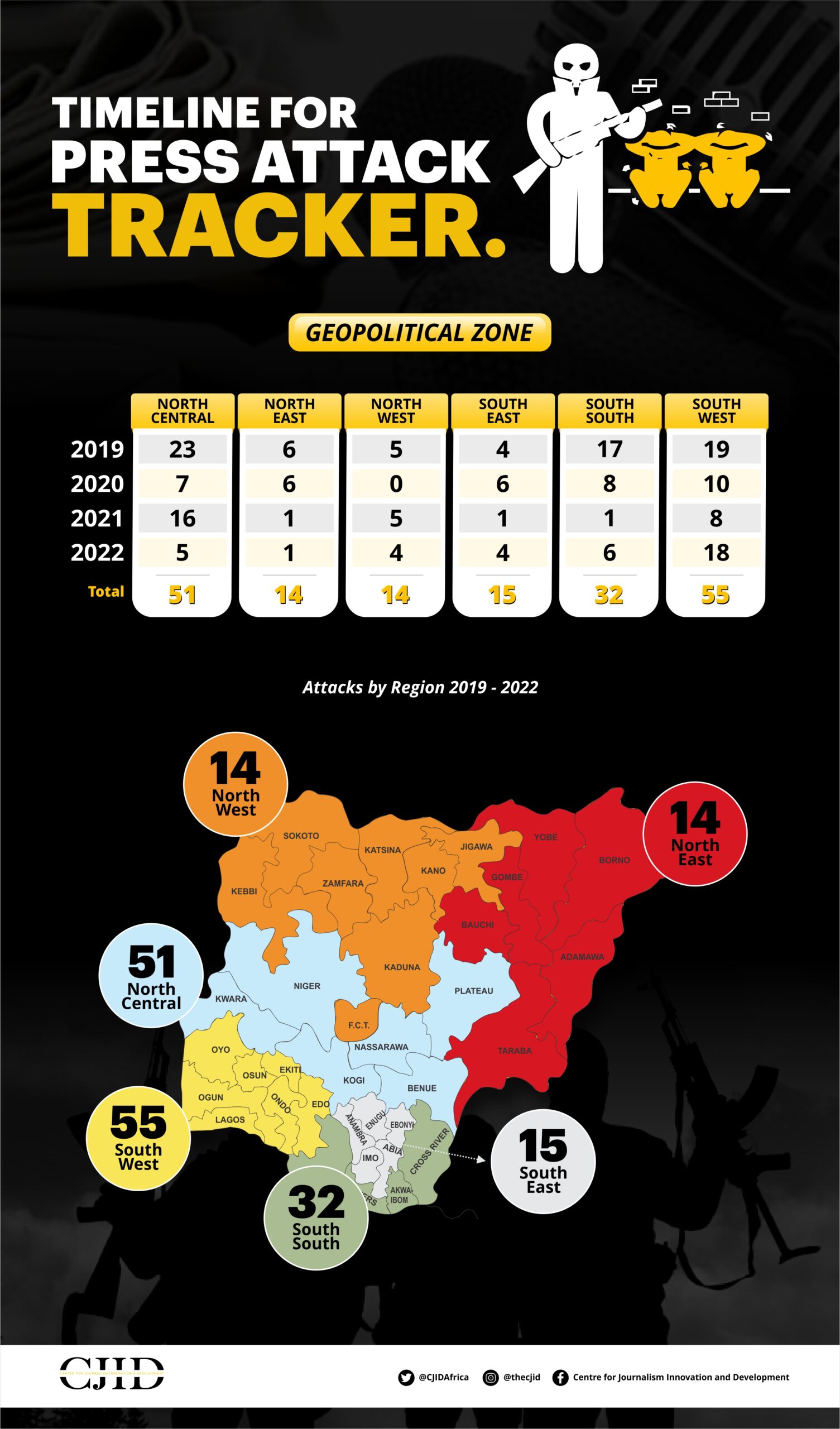
The Press Attack Tracker, a platform that tracks attacks on journalists in Nigeria, reported that at least 179 cases of attacks on journalists were recorded in the last four years. State actors account for half of the attacks, while non-state actors account for 36.4 per cent and unknown persons for 13.6 per cent.
Timeline-for-press-attack-tracker-iii-scaled
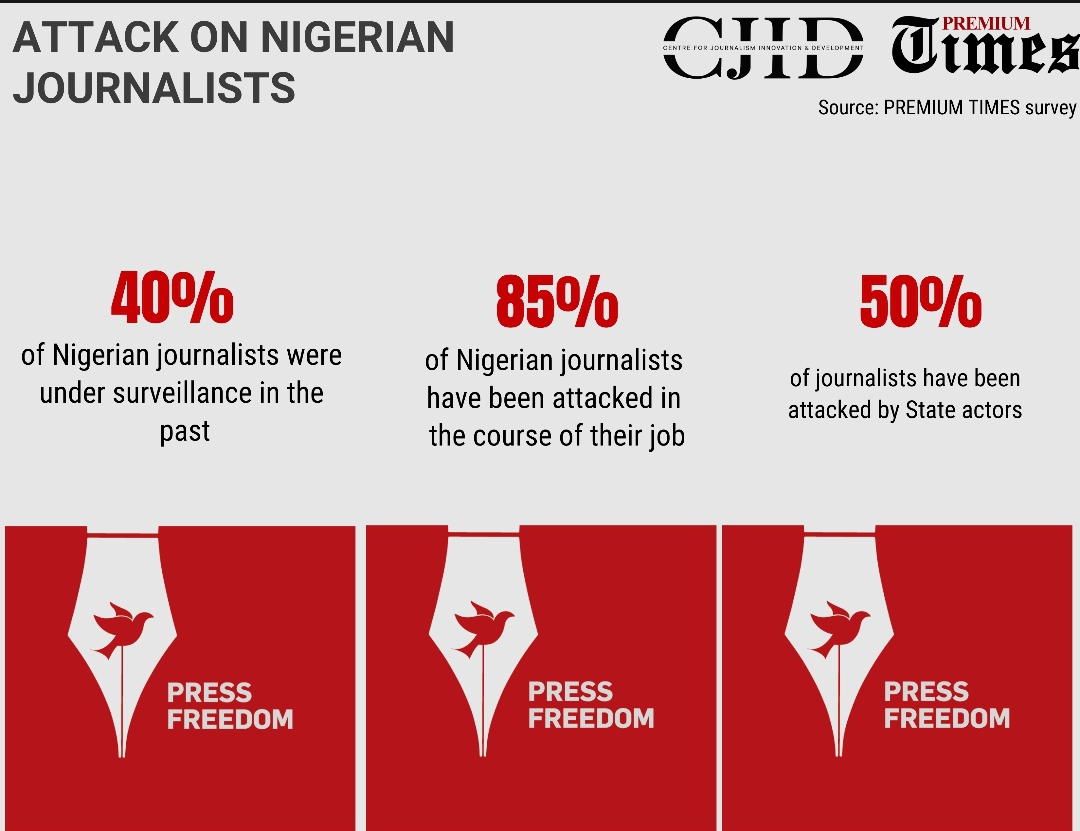
A PREMIUM TIMES’ survey – part of reporting for this article – also shows that journalists (and their collaborators like fixers) have become increasingly vulnerable to attacks from state and non-state actors that compromise their security, threaten source confidentiality, and ultimately undermine journalism.
At least 40 per cent of journalists polled in the survey said they were under surveillance in the past, while 85 per cent said they had been attacked in the course of their job.
“It’s wrong to put journalists under surveillance,” Otufodunrin said. “If journalists violate any law, let them go through the process but putting them under surveillance is a violation of their privacy and creates undue pressure that affects their productivity,” he added.
When asked about the solutions to surveillance, Otufodunrin said: “You cannot prevent somebody trying to monitor you but what you can do is to be security conscious. If you have a feeling you are being monitored, then you have to find a way to protect yourself,” he said. “Part of security consciousness also is to always alert your office and your family about your movement.”
The senior journalists advised that the union of journalists can also file complaints about these problems.
“Since we know that journalists are being put under surveillance, the Nigerian Union of Journalists (NUJ), the Nigerian Guild of Editors (NGE) and any other media group and civil society can come together to challenge the security agents on this issue.”
Nigeria is ranked 129/180 by Reporters Without Borders (RSF) in its chart on the safety of journalists. The RSF said: “Nigeria is one of West Africa’s most dangerous and difficult countries for journalists, who are often watched, attacked, arbitrarily arrested and even killed.’’
A FORMER President of the United States (US) Donald Trump has been indicted by a Manhattan grand jury for his alleged involvement in a hush money payment and cover-up involving adult film star Stormy Daniels that dates to the 2016 presidential election.
It is the first time in American history that a current or former President has faced criminal charges.
Trump faces more than 30 counts related to business fraud, incitement of the January 6 attack on Congress, his attempts to overturn the 2020 presidential election result in Georgia and his retention of classified records.
The news is also set to shake the race for the Republican presidential nomination in 2024, in which Trump leads most polls.
While the charges are not publicly known yet, the indictment has been filed under seal and will be announced in the coming days.
Daniels claimed she had an affair with Trump in 2006, and although Trump denied the affair, he admitted directing his one-time lawyer and fixer Michael Cohen to pay the actress $130,000 for her silence.
Trump, in a statement released shortly after the news broke, claimed the indictment amounted to “political persecution”.
“I believe this witch hunt will backfire massively on Joe Biden,” Trump said. “Our movement, and our party – united and strong – will first defeat Alvin Bragg, and then we will defeat Joe Biden.”
Within hours of the news of his indictment, Trump’s campaign sent out fundraising pleas to counter what it called “the darkest chapter in American history”.
It also accused the Democrats of weaponising the justice system to punish a political opponent.
Republican Senator Lindsey Graham, a longtime Trump ally, called it a “shocking and dangerous day for the rule of law in America” and “one of the most irresponsible decisions in American history by any prosecutor”.
Celebrating the news of the indictment, Daniels tweeted: “Thank you to everyone for your support and love! I have so many messages coming in that I can’t respond … also don’t want to spill my champagne.”
Trump is expected to appear in court for his arraignment on Tuesday, Trump’s lawyer Susan Necheles said, and he would be able to enter a plea on the charges.
New York Police operatives have been told to report for duty on Friday and be prepared to deal with “unusual disorder”, according to a memo seen by NBC.
For any New York defendant, answering criminal charges means being fingerprinted and photographed, fielding basic questions such as name and birthdate.
A former President is not likely to be paraded in cuffs across a sidewalk or through a crowded courthouse, but he will be fingerprinted, photographed and processed for a felony arrest.
Trump’s legal team is expected to vigorously fight the charges, and a timeline for a potential trial remains unclear.
However, nothing in the US Constitution prevents someone from running for President while facing charges and even a conviction would not bar them from the nation’s highest office.
The 14th Amendment does prohibit anyone who has “engaged in insurrection or rebellion” from holding elected office.
Trump is therefore, expected to continue with his 2024 White House campaign despite facing criminal charges.
COAL was first discovered in Nigeria in 1909 at Udi in Enugu, south-eastern Nigeria. The country’s first coal mine, the Ogbete mine, opened six years later. The Nigerian Coal Corporation (NCC) was formed in 1950, taking on operations of Ogbete and other major coal mines across the country.
Coal was one of Nigeria’s primary exports for much of the 20th century. However, significant changes in the Nigerian energy market increased the utilisation of petroleum as a fuel source. Further disruption to the coal industry due to the outbreak of the Nigerian Civil War in 1967 and the Nigerian Enterprise Promotion Decree in 1972, which sought to transfer business ownership to Nigerians, contributed to significant declines in foreign investment and many foreign mining companies left the country.
The Nigerian Coal Corporation eventually went bankrupt in 2002, leaving many of its mines abandoned without proper closure. The country has considerable remaining coal reserves. Production has dwindled over the past 20 year, hitting a record low of 40,000 metric tonnes in 2012. Olajide Adelana reports.
Enugu – A once-forested valley sits silently as a graveyard. The scars left by heavy machinery on the swaths of forest are still evident, with chunks of coal waste littering the ground. Once seething like a beehive, the now abandoned Onyeama Coal Mine in southeastern Nigerian city of Enugu has become a shadow of itself. The coal mine is one of Nigeria’s derelict coal fields which was closed in 2002 when the Nigerian Coal Corporation went bankrupt. Now the area is mostly farmland.
But the land is not fertile.
An abandoned underground mine in Enugu. Photo Nelson Apochi
Sunday Okeke, a farmer, walks along one of the narrow paths into the mine, looking very upset. The maize he planted sprouted into healthy green stalks, and there was hope for a moment –until the stalks started wilting. Unemployed and with dim prospects of getting a job, Okeke and some residents of Onyeama, who once worked in the mine, resorted to farming to feed their families. This decision was their undoing as they rarely make a profit.
“The land is not very fertile. I only plant vegetables and some crops that are not deep-rooted because they do not require as much nutrients and fertilisers,” he says. “I tried planting maize, and I am disappointed at the outcome.”
Many farmers in the areas are unaware that mining activities in their community years ago removed the topsoil, which contains much of the moisture and nutrients that crops need. They end up spending money on fertilisers, which reduces their profit.
Communities across Nigeria face danger and pollution from abandoned mines
As of 2017, Nigeria had an estimated 1,200 identified abandoned mining sites—sites where mining activities ceased without proper closure or reclamation and continue to degrade the environment and pose physical dangers in the form of weakened and collapsing mine shafts, sinkholes, and water-filled pits.
The 2007 Nigerian Minerals and Mining Act, requires “progressive reclamation” – reclamation activities carried out simultaneously with mining operations – in newly approved industrial mining projects. The act also calls for mining companies to establish a reserve fund for environmental protection, mine rehabilitation, reclamation, and closure costs. Although most of the now-abandoned mines in Nigeria, including in Enugu, predate the 2007 legislation, there have been few material changes in practice since the act was passed.
Simon Ude, a resident, worked as a security guard at the mine from 1996 and 2006, says he was laid off after the mine closed and given no severance pay. Photo Nelson Apochi.
Section 30 of the Act stressed that, “a tax-deductible reserve for environmental protection, mine rehabilitation, reclamation and mine closure costs shall be established by companies engaged in the exploitation of mineral resources.”
Reclamation includes filling depressions or hollows with soil or rock removed during excavation and planting trees to stabilise and restore the mined area. Best practices also include repairing wildlife habitats; removing office buildings, processing facilities, and transportation equipment; and sealing mine shafts and other openings.
In Akwuke community,Enugu South Local Government Area (LGA), Enugu state, close toOkpara Mine, there is a complete collapse of mining infrastructure years after mining activities had taken place. The mining site was abandoned by the operators without efforts to address impacts on the community, residents alleged.
“With the exception of those who were employed when the coal mine was still active, there is no tangible benefit our community has gained from mining,” says youth community leader Sunday Nsude, pointing to an untarred road that has deteriorated due to flooding and poor maintenance.
Simon Ude, a resident, worked as a security guard at the mine from 1996 and 2006, says he was laid off after the mine closed and given no severance pay.
“I was not compensated, and I am not the only one. I have a friend whose years of service was just nine years and nine months, and he was also laid off without pay.” Nigerian labor laws require compensation for laid-off employees based on the length of their employment.
“I had to restart my life from scratch. I started a firewood business, but the income is not sufficient to take care of my family’s needs,” Ude says with a tingeof regret in his voice.
Since the Onyeama, Iva Valley, Ribadu, Okpara and Ogbete Mines (all located in Enugu) were abandoned, locals have had to contend with varying degrees of environmental and physical hazards.
Mike Achio – Photo Nelson Apochi
Mike Achio, who once worked in the Onyeama Coal Mine and now heads a community-led security team, says that the abandoned mine is now a hideout for criminals.
“We regularly contend with criminal elements who have mastered the art of coming into the community to inflict pain on residents and escape through the abandoned mine,” he says. “Recently, we arrested some people at night peddling hard drugs, including cocaine and heroin, in the community.”
Achio, pointed out that respiratory diseases —including coal workers’ pneumoconiosis, commonly known as black lung disease —are also common among miners, due to long-term exposure to airborne coal dust.
“Although I am lucky and have no issues with my health, many of my colleagues are not,” says Achio. “They are battling with different health problems such as chest pains and breathing problems. The majority of them were left to bear the consequences of long years of working at the mine without any help.”
Onwubere Basden Jones, a medical expert specialising in cardiovascular and congestive heart diseases, says that elderly people in mining communities are likely to have co-morbidities associated with mining.
“Years back when mining was still actively going on in these communities, there was an upsurge in the number of patients seeking medical attention for different diseases, including respiratory diseases,” he says.
A city on the verge of collapse
Communities along the mining corridors in Enugu are also facing various environmental challenges, including flooding, landslides, and significant erosion. Residents of Enugu-Ngwo, Amuzam, Agbaja Ngwo, and Nsude said that houses and properties have been washed away by gully erosion caused by heavy rains and landslides.
Despite these challenges, little research has been conducted on the impact of these abandoned mines on the environment.
“A lot of people do not really know the extent of the damage mining did to Enugu,” says Chinedu Nwafor, executive director of Africa for Africa Initiative. He adds a warning about the state’s capital city of Enugu: The city is sitting on a ticking time bomb. If nothing is done, Enugu might collapse. “I don’t know why the government is yet to see this as an emergency.”
In particular, the network of underground mining tunnels in Enugu is poorly mapped, so no one knows their full extent or how it may be exacerbating flooding and erosion issues. The local media have reported that the area is at risk of cave-ins. “Sometimes in the city, you will notice a lot of earth movements and the land will collapse inward. This shows that that place is empty below,” says Nwafor.
Local sources, including former miners, estimate that the underground tunnels from Onyeama and Ribadu mines lead to Nsude (18 miles) and Abor (12 miles), respectively.
Lack of government action
State and federal officials have paid some lip service to the impacts of abandoned mines on human health and the environment but have made little effort to address them. Ayodeji Adeyemi, a special adviser to the minister of mines and steel development, did not respond to requests for comment, despite promising on several occasions to forward queries to the appropriate desk and provide a response.
Senator Ike Ekweremadu, the chairman of the Senate Committee on Environment and one of the three senators representing Enugu State in the National Assembly, did not respond to multiple emails [sent in 2022], His personal assistant, Uche Anuchukwu, acknowledged receipt of the inquiries made but did not reply.
Enugu state’s Environment and Mineral Resources commissioner, Chijioke Edeoga denied knowledge of any challenges posed by abandoned mines in his state. He maintains that his office has never received an official complaint.
“I am not aware. There is no official complaint from these communities to my office. “The state government cannot be blamed, as the mining sector is under the federal government. They (the federal government) should be the ones to put things in order.”
The federal government is undertaking some interventions to mitigate the impacts of abandoned mines in Enugu State as part of the Nigeria Erosion and Watershed Management Project (NEWMAP), but experts say that an expansive and thorough environmental audit needs to be conducted across the entire mining corridor in Enugu to inform strategies for long-term, sustainable solutions.
Commercial transportation in Enugu. Photo Nelson Apochi
“Any palliative or reclamation done without a comprehensive environmental audit to ascertain the level of devastation and the funding required to remedy it is unlikely to be a sustainable solution,” says Nwafor. “It is superficial and amounts to poor utilization of funds.”
Residents consider government’s efforts to be merely cosmetic. A resident of Enugu- Ngwo, who identified himself as Chinedu acknowledged the efforts but said more funding and commitment are needed given the number of affected sites.
This report was supported by Result for Development (R4D) under its Leveraging Transparency to Reduce Corruption (LTRC) project.
DANGOTE Industries Limited (DIL) said it has listed its N300 billion Series 1 and 2 bonds to partly finance the Dangote Petroleum Refinery expected to be commissioned by President Muhammadu Buhari before he leaves office on May 29.
A multi-billion-dollar project, the refinery is estimated to cost $19 billion to build, and is expected to create a market for about $21 billion per annum of Nigerian crude.
The bonds were primarily for part-financing the Group’s 650,000 barrels per day refinery project, the Group Managing Director of DIL, Olakunle Alake, said, according to a statement made available to The ICIR on Monday, March 30.
He noted that the bonds were issued under the Dangote Industries Funding Plc at both the Financial Markets Dealers Quotations (FMDQ) and Nigeria Exchange Limited (NGX) in Lagos.
A bond is a type of security under which the issuer owes the holder a debt, and is obliged – depending on the terms – to provide cash flow to the creditor.
The DIL operates as a holding company through its subsidiaries and offers building products such as cement and aggregates, as well as provides food and beverages, packaging.
“Today, we are delighted to have successfully completed the largest aggregate local currency bond issuance by a corporate in the Nigerian capital markets within a calendar year. The proceeds from the Series 1 and 2 bond issuances were dedicated to part-financing the Dangote Petroleum Refinery Project which is the initiative by the Group to establish an integrated petrochemical complex, and the largest single train petroleum refinery in the world,” Alake said.
He disclosed that the company recorded N187 billion series 1 bonds under the N300 billion programme, being the largest corporate bond ever issued in the Nigerian capital markets.
“The bond issuances were well received by the market and recorded participation from a wide range of investors, including domestic pension funds, asset managers, insurance companies, and high net-worth investors.
“Indeed, these are very exciting times for us as a business, and so we would continue to welcome opportunities to work with stakeholders in the domestic capital markets towards accelerating the economic activities across Africa, while maximizing stakeholder returns,” the managing director said.
Yemisi Deji-Bejide, the lead issuing house for series 1 of the bonds and chief executive officer of Standard Chartered Capital and Advisory Nigeria Limited, said, “Every time we gather at FMDQ for the listing ceremony of an issuance by the Dangote Group, it is always a record milestone.
“Early in 2022, we issued a bond for Dangote Cement, which was the largest corporate bond issuance at the time, and little did we know that a few months down the line, the Group would comfortably break that record.
“Lastly, and most importantly, investors are keen to support impactful infrastructure projects in Nigeria, as the proceeds of the bond are being used to fund the largest single train refinery in the world.”
THE Debt Management Office (DMO) revealed today that Nigeria’s total public debt stock increased to N46.25 trillion, or $103.11 billion, in the fourth quarter of 2022.
The new figure, according to a statement by the DMO, consists of the domestic and external total debt stocks of the federal government and the sub-national governments (36 state governments and the Federal Capital Territory).
A report by The ICIR on January 18 had projected that every Nigerian would be owing N384,864 each when President Muhammadu Buhari leaves office on May 29, as the debt profile was expected to spiral to N77 trillion by the end of his administration.
The DMO confirmed that the national budget is largely funded through borrowing. Sub-nationals also rely so much on both domestic and foreign debts to drive some of their major projects.
On Tuesday this week, the Federal House of Representatives informed that the China Development Bank had rejected Nigeria’s $22,798,446,773 loan request earlier approved by the National Assembly. Experts fear this development could distort funding of projects outlined in the 2023 fiscal year.
An economist also warned that such persistent borrowing puts Nigeria’s currency at devaluation risk and heightens inflationary pressure.
“There is a strong link between ballooning debt, weak exchange rate, and Nigeria’s rising hyper inflation. This is already taking its toll on Nigeria’s assesment by global rating agencies like Fitch and Moody. The worst of it all is that indigenous companies quoted on the Nigeria Exchange Limited are also donwgraded,” a development economist, Kelvin Emmanuel, told TheICIR.
According to the DMO, the comparative figure of public debt by December 31, 2021 was N39.56 trillion, or $95.77 billion.
By implication, the country’s debt increased by N6.69 trillion, or $7.34 billion within one year.
The DMO cited reasons for the debt rise to include new borrowings by the Federal government and sub-national governments, primarily to fund budget deficits and execute projects, and the issuance of promissory notes to settle some liabilities.
“Ongoing efforts by the government to increase revenues from oil and non-oil sources through initiatives such as the Finance Act and the Strategic Revenue Mobilization initiative are expected to support debt sustainability,” the DMO stated.
It further explained that the debt figure under review was 23.20 per cent of the gross domestic product, indicating that it was well within the limits set by both the federal government and international organisations.
“The total public debt-to-gross domestic product (GDP) ratio for December indicates a slight increase from the figure for December 31, 2022, at 22.47 per cent.
“The ratio of 23.20 per cent is within the 40 per cent limit self-imposed by Nigeria, the 55 per cent limit recommended by the World Bank/International Monetary Fund, and the 70 per cent limit recommended by the Economic Community of West African States,” the DMO said.
THE National Working Committee (NWC) of the Peoples Democratic Party (PDP) has reversed the suspension of some leaders of the party, including former governor of Ekiti State Ayo Fayose, former Senate President Anyim Pius and former Katsina State governor Ibrahim Shema.
The decision to suspend the members was reversed barely 48 hours after Umar Damagum assumed office as the Acting National Chairman of the PDP.
A statement released on Thursday, March 30 by the spokesperson of PDP, Debo Ologunagba, explained that the development was aimed at reconciling the waring camps and factions in the party.
A PDP member in Benue, Dennis Ityavyar, and a chieftain of the party in Zamfara, Aslam Aliyu, were among those whose suspension was reversed.
The PDP NWC as well reversed the referral of the incumbent governor of Benue State, Samuel Ortom, to its National Disciplinary Committee.
The statement noted that the PDP recognized the importance of a total reconciliation among party leaders and critical stakeholders in the overall interest of members and the country at large.
The statement said, “The decision of the Damagum leadership is without prejudice to the powers of the NWC to take necessary disciplinary action against any member of the Party at any time pursuant to the provisions of the Constitution of the PDP (as amended in 2017).
“The NWC charges all leaders, critical stakeholders and teeming members of our Party across the country to be guided by the provisions of the PDP Constitution (as amended in 2017) as well as the new spirit and necessity of reconciliation, unity and harmony in our Party at this critical time.”
The ICIR earlier reported that the National Working Committee (NWC) of the Peoples Democratic Party (PDP) appointed the party’s Deputy National Chairman (North), Umar Damagum, as Acting Chairman.
Damagun replaced Iyorchia Ayu as the national chairman of the party after a High Court in Benue State ordered Ayu to stop parading himself as the National Chairman of the PDP on Tuesday, March 28.
This followed the suspension of the former chairman of the party by the Executive Committee of the PDP in Igyorov Ward of Gboko Local Government Area of Benue State on Sunday, March 27, for alleged anti-party activities.







![Abandoned mines: Enugu’s charred past hurting its present [1]](https://www.icirnigeria.org/wp-content/uploads/2023/03/Abandoned-Enugu-mines-2-768x576.jpg "Abandoned mines: Enugu’s charred past hurting its present [1]")