
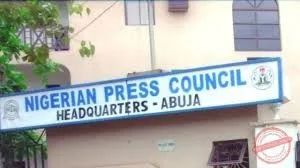

THE Nigerian Press Council has defended its role in overseeing hundreds of millions of naira worth of classroom and streetlight projects captured under its portfolio in the 2026 Federal Government’s budget, insisting that the interventions were nominated by lawmakers rather than the agency.
However, the council’s response does little to address the central issue raised by The ICIR’s report: why a federal agency established to regulate journalism practice and uphold professional standards in the media has a budget that bears no connection to its statutory mandate. It also could not answer another basic question: why it should be involved in implementing such projects.
In a statement issued after The ICIR reported that the council was allocated N329 million for classroom projects and over N311 million for streetlight installations, the agency argued that the projects were constituency and zonal intervention projects nominated by federal lawmakers.
Part of the Council’s response reads: “The role of the implementing Ministry, Department or Agency (MDA), in this instance the Nigerian Press Council, is limited to procurement streamlining, supervision and monitoring of such projects in accordance with the provisions of the Public Procurement Act, the Financial Regulations, and other extant government guidelines.
“Neither the Nigerian Press Council nor any other MDA originates or allocates these projects but serve solely as the supporting agency responsible for their supervision as mandated. The projects are not executed by the MDAs and do not form part of their budgets as @TheICIR’s misleading story suggests.”
The ICIR emphasises that this explanation does not clarify why the projects were assigned to the Press Council in the first place.
The original report did not claim that the Council conceived or nominated the projects. Rather, it highlighted that budget documents identified the agency as the implementing body for interventions associated with ministries and agencies responsible for education, power, health, and rural development.
The Council’s responsibilities are media related under its Act. They include promoting professional standards in journalism, investigating complaints against the press, accrediting journalism training institutions, conducting research on media issues, and safeguarding ethical standards within the industry.
The Act contains no provisions relating to classroom construction, streetlight installation, healthcare infrastructure or agricultural interventions.
Indeed, concerns about assigning projects to agencies outside their mandates have been raised for years by anti-corruption and budget transparency organisations and experts.
In its Constituency and Executive Projects Tracking Initiative, the Independent Corrupt Practices and Other Related Offences Commission warned against the practice and recommended that “no agency should be allowed to accept and execute any constituency projects outside its mandate or the law.”
The commission noted that such arrangements weaken accountability because agencies often lack the technical expertise and institutional responsibility required to effectively oversee projects outside their core functions.
Speaking on the implications of assigning projects to agencies outside their mandates, Country Director at BudgiT, Vahyala Kwaga, previously told The ICIR that many such projects are unlikely to be executed because the institutions receiving the allocations are not designed for such.
“We need to understand that corruption is not a ‘technical’ matter but one that is fundamental to our governance and government. Not only are monies almost never used for these projects, they are often diverted to other uses or not even released by the Accountant General’s office.
“This would even lead to poor budget performance because the releases intended by the budget were not even made, though they were ‘saved’, by not disbursing them to these so-called projects outside the mandate of MDAs,” he said.
Vahyala noted that there had never been any consequence for these infractions.
“Ordinarily, the NASS should alert Nigerians on suspicious budget line items, since they are meant to be the ‘oversight’ body of the government. However, because the MDAs and the NASS are in bed together, there will be no way either of them will work in the interest of the people or ensure savings, value for money, and efficiency of government spending,” he said.

Nurudeen Akewushola is an investigative reporter and fact-checker with The ICIR. He believes courageous in-depth investigative reporting is the key to social justice, accountability and good governance in society. You can reach him via nyahaya@icirnigeria.org and @NurudeenAkewus1 on Twitter.