
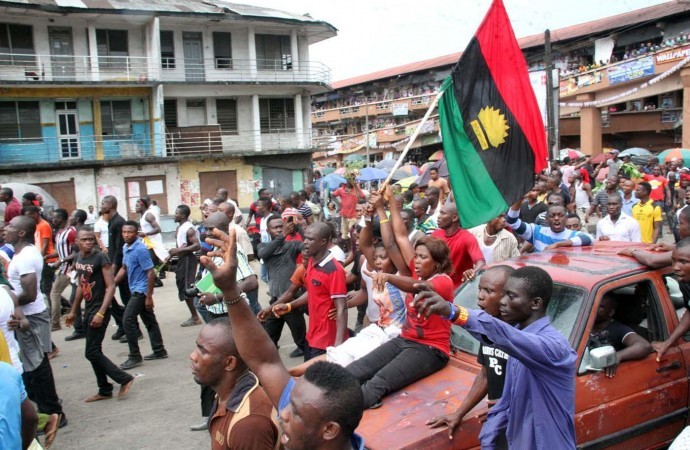
FIVE years after the #EndSARS protests that shook Nigeria, Human rights activist Omoyele Sowore is leading some Nigerians in a protest to demand the release of the detained leader of the proscribed Indigenous People of Biafra (IPOB) Nnamdi Kanu.
The protest tagged #FreeNnamdiKanuNow, is scheduled for Monday, October 20, 2025, in Abuja.
In the buildup to the protest, Sowore, on Friday, October 10, met with former President Goodluck Jonathan in Abuja, as he rallied support from prominent leaders in the country to back the demonstration.
Sowore, while addressing the public after the meeting, stated that Jonathan “agreed that there is an urgent and compelling need to address this matter decisively and justly.”
The activist had also called on political, traditional, and religious leaders across Nigeria, including Former Vice President Atiku Abubakar, Labour Party’s Peter Obi, Anambra State Governor Charles Soludo, Abia State Governor Alex Otti, and Ebonyi State Governor Francis Nwifuru, to join in demanding Kanu’s release.
Backstory
Nnamdi Kanu was first arrested in 2015 on charges including treasonable felony and incitement.
He fled the country after being granted bail in 2017 but was later re-arrested in Kenya and repatriated to Nigeria in June 2021 under controversial circumstances.
Since then, he has remained in the custody of the State Security Services (SSS), despite multiple court rulings ordering his release or the discontinuation of his trial.
In October 2022, the Court of Appeal discharged and acquitted him of terrorism charges, ruling that his extraordinary rendition from Kenya violated international law.
However, the Federal Government appealed the decision at the Supreme Court, which later ordered that his trial resume at the Federal High Court in 2023.
The ICIR reports that Kanu is facing a seven-count charge bordering on terrorism, treason, incitement, and defamation of Nigerian authorities. In a recent ruling, An Abuja High Court judge, James Omotosho, dismissed his no-case submission. He said the prosecution had established a prima facie case warranting that Kanu opens his defence.
His trial has been marked by repeated adjournments, judicial recusals, and controversies surrounding his detention and access to medical care.
‘Stay away from Aso Rock, others’
Meanwhile, the Nigeria Police Force warned that protests must not take place near Aso Rock Villa and other restricted government zones in Abuja.
Force Public Relations Officer CSP Benjamin Hundeyin said the directive followed a Federal High Court order restraining gatherings around sensitive areas such as the National Assembly Complex, Force Headquarters, Eagle Square, and Shehu Shagari Way.
Hundeyin advised intending protesters and counter-protest groups to avoid restricted zones and to channel their grievances through lawful and peaceful means.
He said the police would ensure the free flow of traffic, protection of lives and property, and security of all law-abiding citizens.
“Any person or group that uses protests as a cover to incite violence, carry or use offensive weapons, vandalise public or private property, or engage in acts likely to cause loss of life or serious injury will be dealt with decisively,” Hundeyin warned.
He added that the Inspector-General of Police, Kayode Egbetokun, had directed the FCT Commissioner of Police to ensure strict enforcement of the order and strategic deployment of officers across the city.
Sowore warns against brutality
Following the warning by the NPF, Sowore in a statement on Sunday, October 19, cautioned the Federal Capital Territory Commissioner of Police, Miller Dantawaye, and officers of the Nigeria Police Force against using force or making unlawful arrests during the protest.
He warned that any officer found guilty of brutality against peaceful demonstrators would face consequences.
“Any use of excessive force or unlawful arrests will attract repercussions,” Sowore said on his X handle. “The Nigerian people will hold accountable those who attempt brutality swiftly.”
Sowore urged the police to respect citizens’ rights to peaceful assembly and uphold their constitutional duty to protect lives and property.
October 2020 EndSARS protests
Recall that on October 20, 2020, security forces opened fire on unarmed protesters gathered at the Lekki Toll Gate in Lagos State.
Although the Nigeria government denied the shooting at protesters, Amnesty International and several media investigations confirmed that live rounds were fired, leading to multiple deaths and injuries.
The shooting ignited nationwide outrage and international condemnation.
The nationwide protests had started as a call to end police brutality and reform the disbanded Special Anti-Robbery Squad (SARS) but spiraled into one of the most traumatic events in Nigeria’s history.
The protest began with many youths taking to the social media platform to share their experiences and videos of abuses by SARS operatives.
The online grievances gathered momentum and moved to the streets as young people started converging in major cities across the country, demanding that the Federal Government put an end to the deployment of SARS operatives.
In the aftermath, several states reported death and arrest of protesters. According to Amnesty International, which joined other concerned entities, home and abroad, to condemn the crackdown. Not less than 12 protesters were killed during the shooting.
The aftermath also saw a massive government crackdown on citizens, frozen bank accounts, and surveillance of activists.
In addition to protesters and other civilians who were killed, the country lost a number of police officers. Police stations were attacked by hoodlums who hijacked the protest. In several states, shops and warehouses were looted, while public infrastructures were destroyed.
In Lagos State, many high-capacity public vehicles were burnt, while other public and private buildings were torched.
Although the protest led to the disbandment of SARS’ and partial police restructuring, many protesters remain detained without trial, facing trumped-up charges despite multiple denials by the authorities.
While the Human Rights Organisation and individuals, including former senator, Shehu said that some protesters were still being detained, the Nigerian government has continued to deny that protesters are still in custody.
The ICIR report Sowore, the #RevolutionNow convener, has led protests over human rights abuses in Nigeria since after the EndSARS demonstrations, including the #EndBadGovernance protest in August 2024.
NOTE: The headline of this report was updated.

Mustapha Usman is an investigative journalist with the International Centre for Investigative Reporting. You can easily reach him via: musman@icirnigeria.com. He tweets @UsmanMustapha_M