
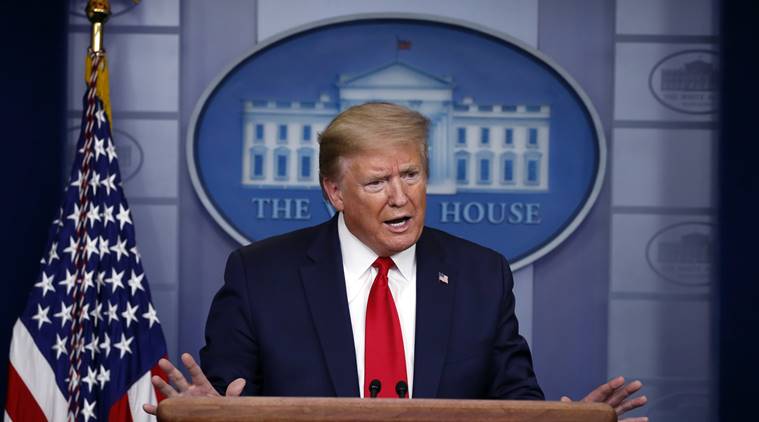
THE United States government shutdown began early Wednesday, October 1, after lawmakers and President Donald Trump were unable to reach a deal on the federal budget.
Trump threatened mass firings and to slash government departments, marking the first government shutdown of his current term since a similar halt during his previous administration and blaming Democrats for Congress’ failure to resolve a funding stand-off.
The stalemate revolved around democratic calls for increased healthcare funding, resulting in a suspension of financing for numerous government operations.
Both Republicans and Democrats have pointed fingers at each other for the deadlock, which is anticipated to impact hundreds of thousands of government employees and millions of Americans dependent on federal services.
In a statement issued late Wednesday, October 1, the Department of Energy (DOE) said it would revoke 321 financial awards tied to 223 projects. While it did not specify which projects were affected, the department noted the grants came from six of its offices overseeing clean energy, efficiency, grid deployment, advanced research, manufacturing, and fossil fuels.
The shutdown has halted operations across numerous federal departments and agencies, amid sharp partisan divisions in Washington, raising concerns about its duration and potential impact.
Many federal employees are now placed on temporary unpaid leave unless their work is classified as “essential”, and some “excepted” personnel may be required to continue working without pay until funding is restored.
Reports indicate that once the shutdown ends, furloughed employees typically receive retroactive pay under the Government Employee Fair Treatment Act of 2019.
However, this time, the new wrinkle is that the administration is proposing permanent lay-offs in addition to routine furloughs.
Why the US Embassy in Nigeria is pausing social media updates
On Wednesday, The ICIR reported that the United States Embassy in Nigeria has announced that it will halt routine updates on its social media channels following the lapse in appropriations.
It further stated that essential consular services such as passport issuance and visa processing will continue in the US, at embassies and consulates abroad, “as the situation permits.”
The Embassy also warned that service disruptions might emerge if the funding stoppage continues.
This move is not unique to Nigeria, as US diplomatic missions globally are receiving the same constraints under the lapse in appropriations.
The Embassy’s social media feeds are an important channel of public diplomacy, alerting US citizens abroad and local audiences about security, visa notices, and outreach. The pause means fewer updates, potentially lengthening reaction times or leaving gaps in information flow.
Furloughs and layoffs
The government announced on Wednesday that it has halted funding for several major New York transit projects, including the Hudson Tunnel and the Second Avenue Subway, as the Department of Transportation investigates whether small-business contractors involved are participating in improper diversity programs.
On Tuesday, the US Department of Transportation (USDOT) informed New York transit officials that the Second Avenue Subway extension and the Hudson Tunnel reconstruction must undergo a review to “ensure nondiscrimination.”
USDOT said it targeted the two New York projects located in a Democratic-run state in part because of their symbolism, noting that $18 billion in federal funding remains earmarked for them, though it is unclear how much of that involves Disadvantaged Business Enterprise programs currently under review.
The White House Budget Director, Russ Vought, said Wednesday that the Trump administration is also scrapping nearly $8 billion in climate-related funding affecting 16 states, including California and New York.
The DOE announced Wednesday that it intends to withdraw $7.56 billion in financing for hundreds of energy projects it says would not deliver adequate returns for taxpayers.
Labour unions have sued, arguing that threatened layoffs during a funding lapse exceed legal authority.
Estimates suggest that roughly 750,000 federal employees could be furloughed under the current shutdown scenario. Some media reports put the number higher when including workers forced to work without pay.
According to reports, the share of employees furloughed will be particularly high in some agencies like the Department of Health and Human Services, where 41 per cent of its workforce may be furloughed.
Department of Transportation, with more than 11,000 employees, could be furloughed, and the Federal Communications Commission, which reported having suspended most operations and furloughed 81 per cent of staff.
The longer Congress fails to pass funding bills, the more severe the impacts on federal employees and diplomatic missions will be.
What’s next?
Whether threatened layoffs beyond furloughs proceed, and how courts or unions respond, is a key legal and political question.
However, the Senate will return on Friday to vote on bills to reopen the government.
“I keep telling them: When they have eight or 10 — preferably 10, or more — when they have a critical mass, let me know if there’s a conversation they want to have,” Senate Majority Leader John Thune said.
He maintained that he would not negotiate the details of an extension while the government remains shut down. However, when asked if he was willing to engage with Democrats on how health care talks could proceed after the shutdown or on advancing full-year spending bills, Thune responded, “We are.”
“Some of those conversations are happening,” he added. “With our members and their members, there’s a lot of back-and-forth going on right now about some of the things they would like to see happen.”
However, President Donald Trump’s administration on Wednesday did not make conciliatory gestures.
The pressure tactics came as the 15th government shutdown since 1981 suspended scientific research, financial oversight, environmental cleanup efforts and a wide range of other activities.

Nanji is an investigative journalist with the ICIR. She has years of experience in reporting and broadcasting human angle stories, gender inequalities, minority stories, and human rights issues. She has documented sexual war crimes in armed conflict, sex for grades in Nigerian Universities, harmful traditional practices and human trafficking.