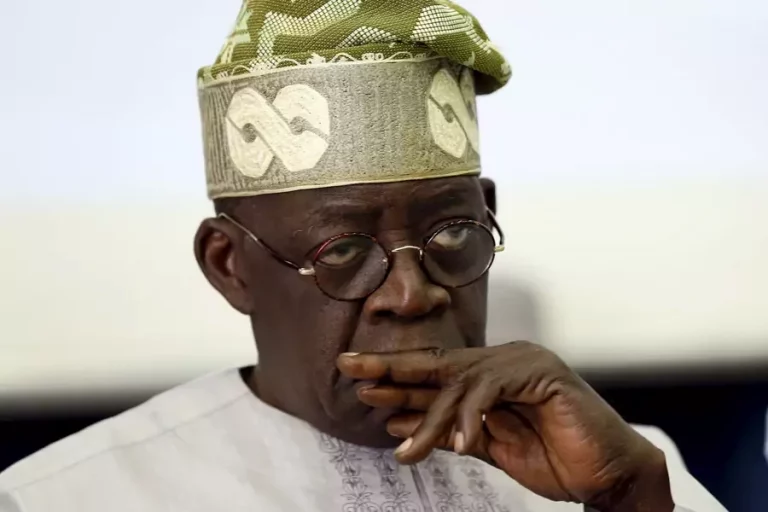
THE Court of Appeal in Abuja has dismissed an appeal by the Peoples Democratic Party (PDP) seeking to disqualify the All Progressives Congress (APC) presidential candidate, Bola Tinubu and his running mate Kashim Shettima, from the just concluded February 25 election.
In a unanimous judgment delivered by a three-member panel led by Justice James Abundaga on Friday, March 24, the court held that the PDP failed to demonstrate locus standi to institute the case.
The PDP had filed an appeal to reverse the Federal High Court’s January 13 judgment, which dismissed its suit on the grounds that it lacked locus standi.
The Independent National Electoral Commission (INEC), APC, Tinubu, and Shettima were respondents in the appeal, while the PDP was the appellant.
The PDP’s suit, filed on July 28, 2022, challenged the validity of the Tinubu/Shettima ticket for the 2023 presidential election. The party argued that Shettima’s nomination as the running mate violated the provisions of Sections 29(1), 33, 35, and 84(1)(2) of the Electoral Act, 2022 (as amended), claiming that Shettima had double nominations.
It argued that Shettima’s nomination as a vice-presidential candidate and the candidate for the Borno Central Senatorial seat contravened the law.
The PDP had sought an order to disqualify the APC, Tinubu, and Shettima from contesting the presidential election scheduled for February 25 and an order nullifying their candidacy.
The party also asked the court to compel INEC to remove their names from its list of nominated or sponsored candidates eligible to contest the election.
However, the defendants urged the court to dismiss the suit for lack of jurisdiction, arguing that the plaintiff lacked locus standi to institute the case, which challenged APC’s decision and its nomination of candidates for the election, which were within the confines of the party’s internal affairs and thus, non-justiciable.
Justice Abundaga, delivering the lead judgment, agreed with the respondents’ lawyers’ submissions that the PDP was a busybody meddling in the APC’s internal affairs.
He held that the trial court was right to have held that the PDP failed to establish its locus standi.
“The appellant, having failed to disclose its locus standi, this appeal fails, and it is hereby dismissed,” he said, affirming the judgment of the Federal High Court.
The judge also awarded N5 million cost against the appellant’s lawyer, J. O. Olotu.
THE Lagos State Government is set to charge Chrisland School, some members of staff, and a vendor to court in relation to the death of a student, Whitney Adeniran.
The charges are for involuntary manslaughter, reckless and negligent acts, and will be brought under sections 224 and 251 of the Criminal Law, Laws of Lagos State, 2015.
The state Attorney-General and Commissioner for Justice, Moyosore Onigbanjo, disclosed this through the Office of the Director, Public Affairs, Lagos State Ministry of Justice on Friday, March 24.
Adeniran reportedly slumped during her school’s inter-house sport on February 9. She was rushed to Agege Central Hospital, Agege, Lagos, but was confirmed dead on arrival by the doctor on duty. An autopsy conducted by the state government later revealed that the 12-year-old died from asphyxia and electrocution.
The state government subsequently ordered a coroner’s inquest to determine the cause of death. The Coroner, Magistrate Olabisi Fajana, announced that the inquest would commence on April 4.
The case was referred to the Nigerian Police Force, which carried out a thorough investigation with the help of other agencies. The file was subsequently forwarded to the Director of Public Prosecution’s Office on March 20 for the duplicate case file review.
On March 23, the DPP issued legal advice stating that a prima facie case of involuntary manslaughter and reckless and negligent acts had been established against the School, some members of staff, and one of the vendors.
While noting that the culprits will be filed in accordance with the legal advice issued by the DPP, Onigbanjo added that the Certified True Copies of the Legal advice will also be available on the state’s Ministry of Justice website.
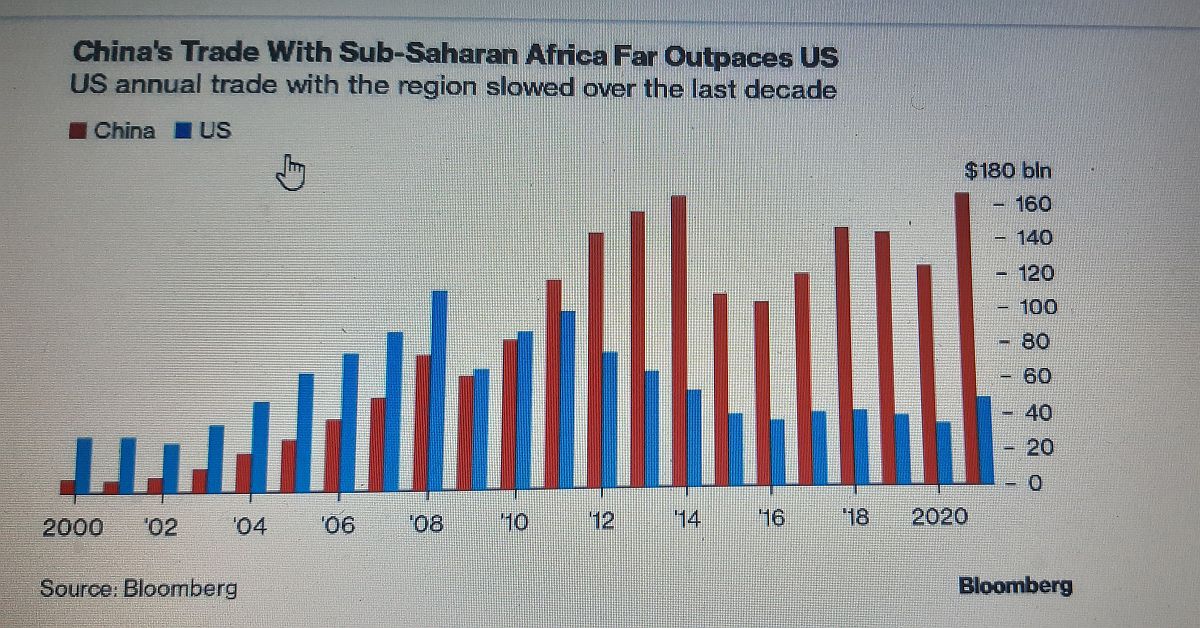
AS part of a pushback strategy to China’s trade influence in sub-Saharan Africa (SSA) which far outpaced that of the United States (US) over the last decade, US Vice President, Kamala Harris, will start an official visit to the region next week.
The US annual trade value with the region has slowed over the last decade, relative to before 2010, as China’s trade had surpassed the country since 2011 and has maintained that lead in the region.
“The Biden administration has been accelerating its campaign to rebuild American influence in Africa, where it lost ground to soft influence via Chinese investment,” Bloomberg reported on Friday, March 24.
A week-long trip, Harris’ next week – starting Monday, March 27 through April 1 – becomes the latest top official to visit, with stops scheduled in Ghana, Tanzania and Zambia.
“She’s following Treasury Secretary Janet Yellen and Secretary of State Antony Blinken,” Bloomberg stated, recalling that at a December summit with the Africa continent’s leaders, US President Joe Biden pledged a $55 billion support package for Africa.
“But that’s a drop in the bucket,” Bloomberg added.
Between 2000 and 2010, US annual trade with SSA grew more than China’s in the region, findings by The ICIR has shown.
Between 2000 and 2010, the East Asian country’s trades with SSA were lower with minimal margin, compared to US.
But between 2011 and 2021, China trade surpassed that of the U.S., and with a sharp margin from 2012 to become the region’s largest trading.
Trade with China is growing much faster than that with the US as China boosted over $160 billion annual trade in 2021, compared to $50 from the US.
In its Global Economic Prospects, June 2015, the World Bank stated that China’s economic ties with SSA expanded “greatly” over the past decade.
The report showed that trade increased from negligible levels in 2000 to more than $170 billion in 2013, the Bretton Woods Institution said. “Chinese direct investment in SSA also grew more than six-fold,” adding that China’s official development assistance to SSA expanded from $0.5 billion in 2000 to $3.2 billion in 2013.
WHEN a group of armed men walked pass *Chidera Okoro on her way back from New Years’ service on January 1, 2023, she did not have a sense of foreboding. Unknown to her, they were on a mission, to burn houses and destroy properties.
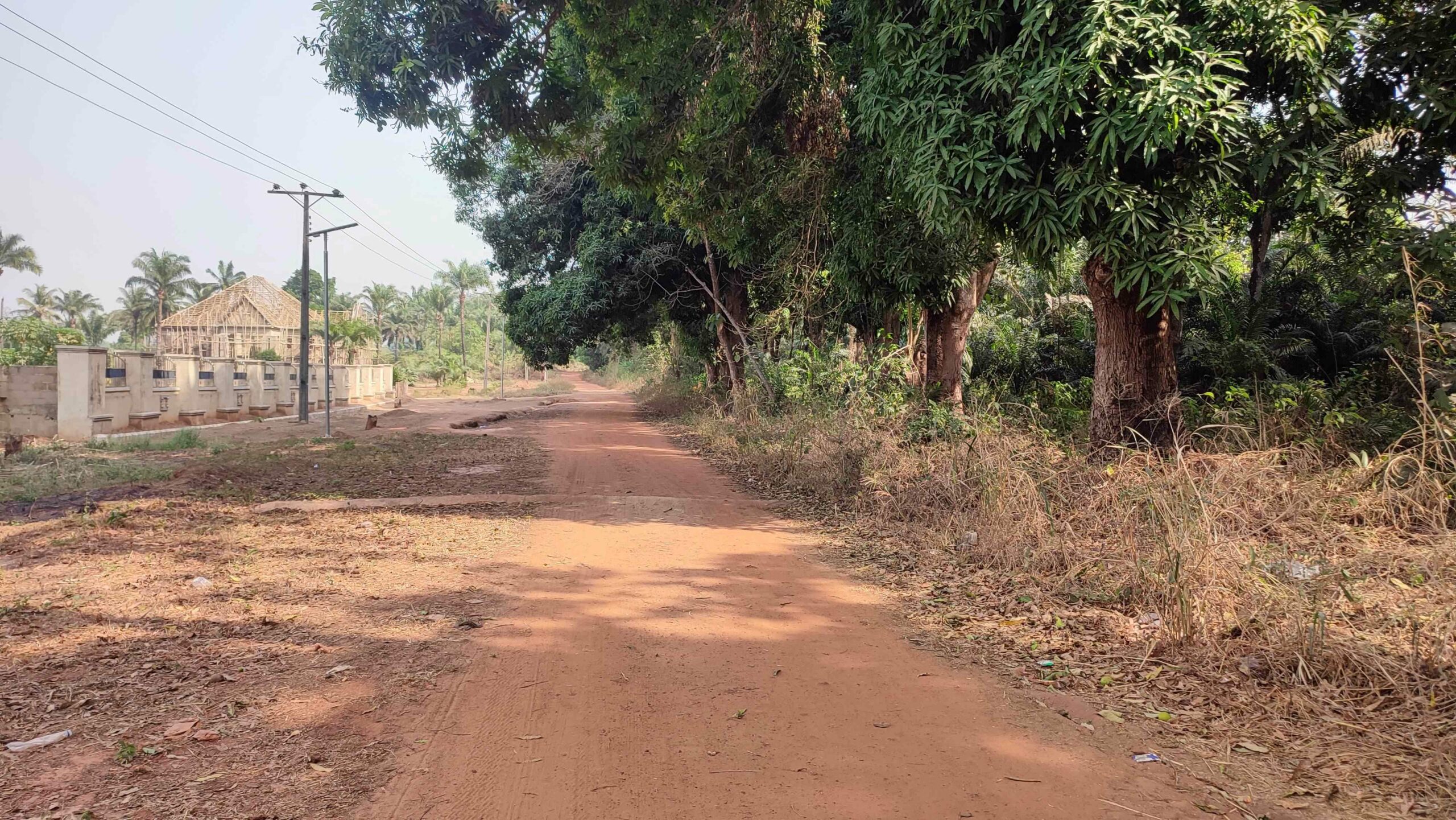
Road leading to Oruku
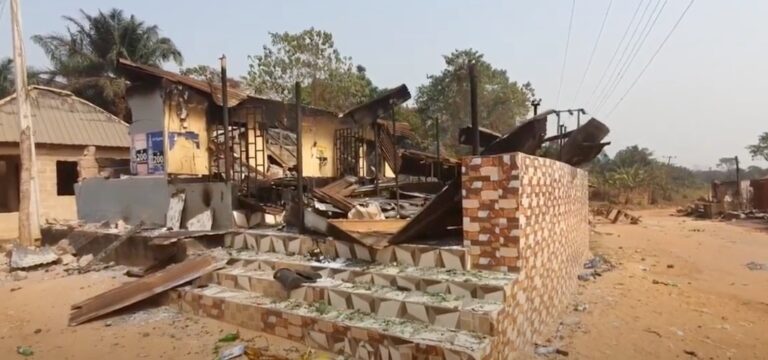
The time was exactly 1: 45pm. As she got to her house in Oruku, one of the communities in Nkanu East local government in Enugu State, she met the young men setting fire to it and as she tried to intervene, they threatened to kill her.
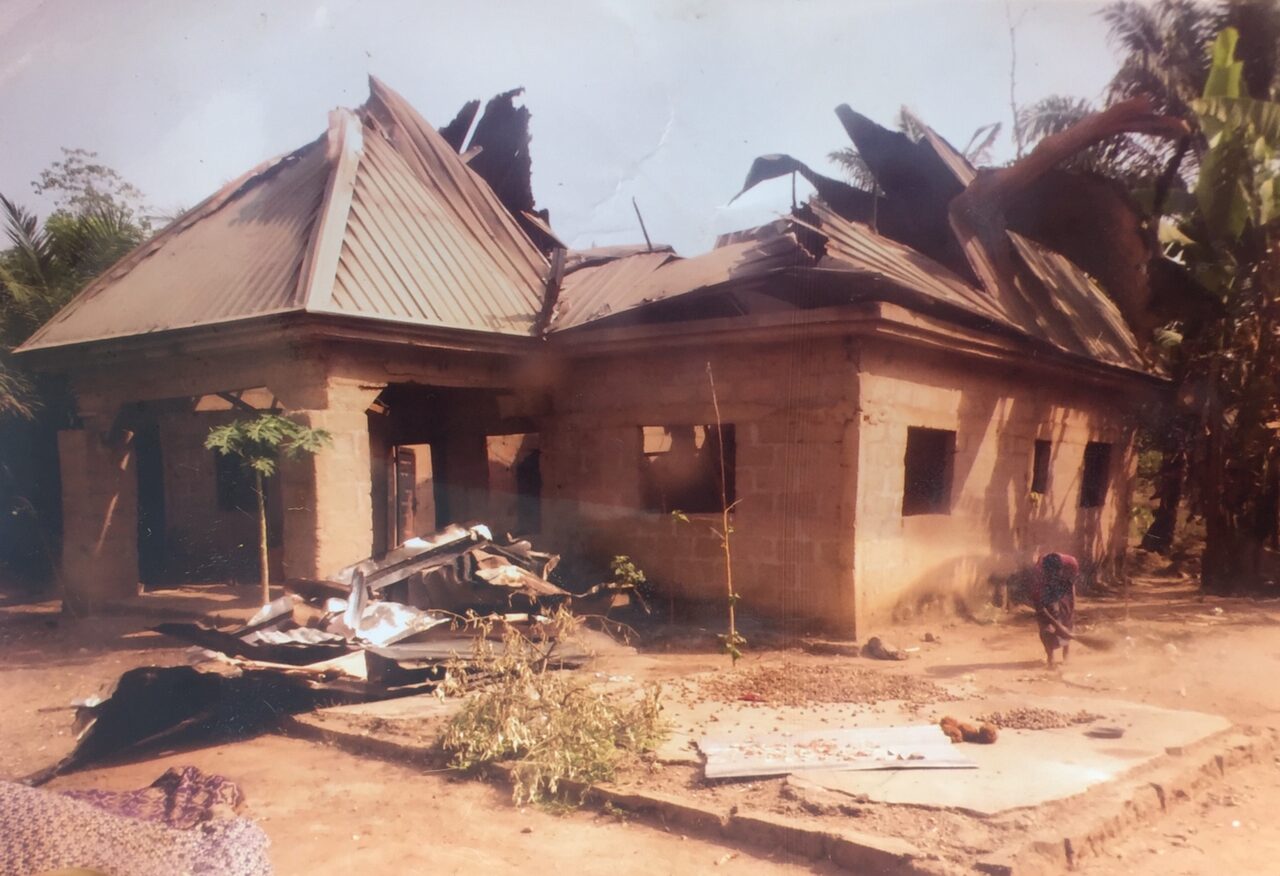
“I was the only one at home; I was helpless and watched my house go up in flames, Okoro said. “They destroyed every property I had, both the ones that were outside the compound”.
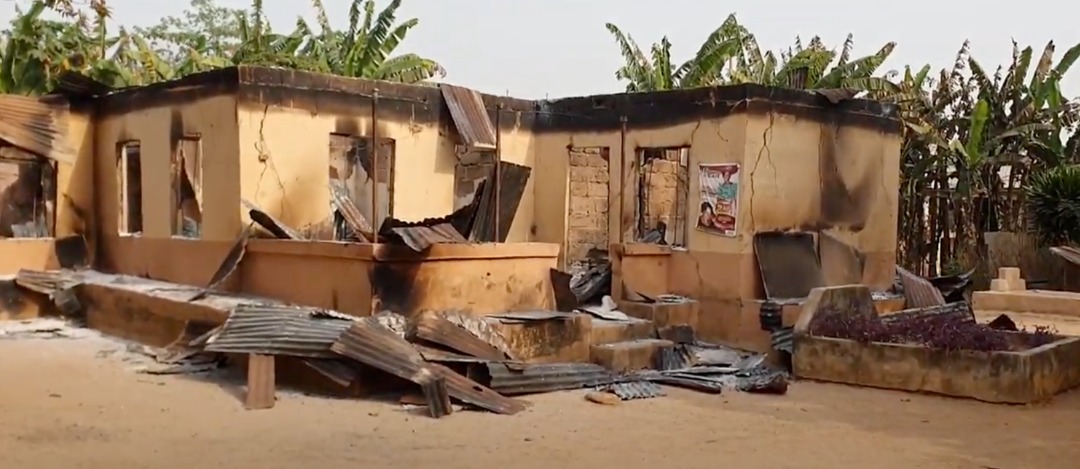
Okoro’s house is only one out of an estimated 70 houses that were burnt in the new year’s day attack. While some residents like Okoro watched their property rise in flames, others ran.
Now, Okoro manages the only room left after the attack.
Since 2020, Oruku has been engulfed by communal crisis that has claimed at least 10 lives and resulted in the wanton destruction of houses and property worth millions of naira.
Now, the community has been deserted. Residents are finding refuge in neighbouring communities and towns, including Idodo, Akpoga, Onuogba and Emene. Only a few houses are still standing.
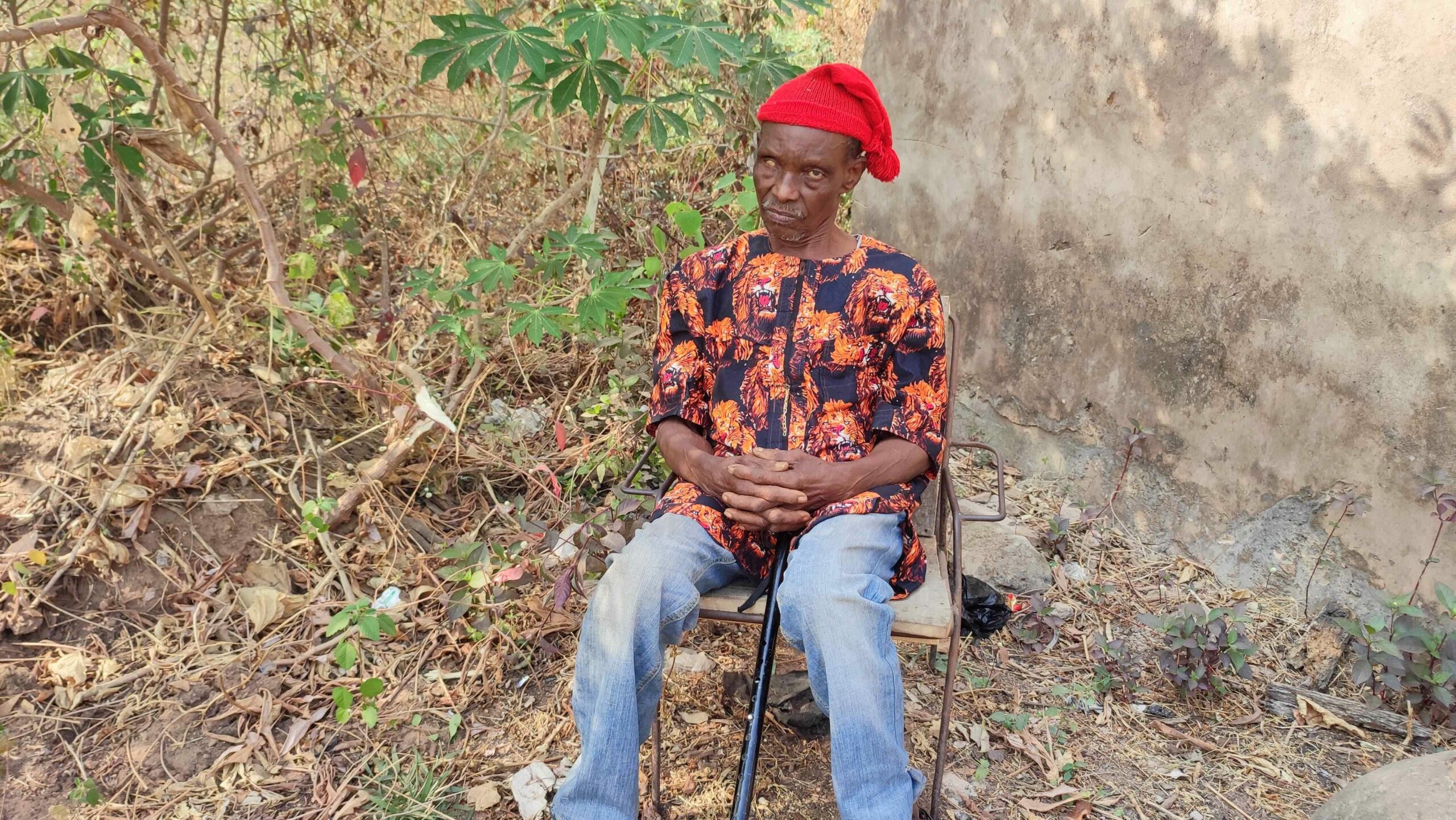
An elder in the community, Boniface Okafor
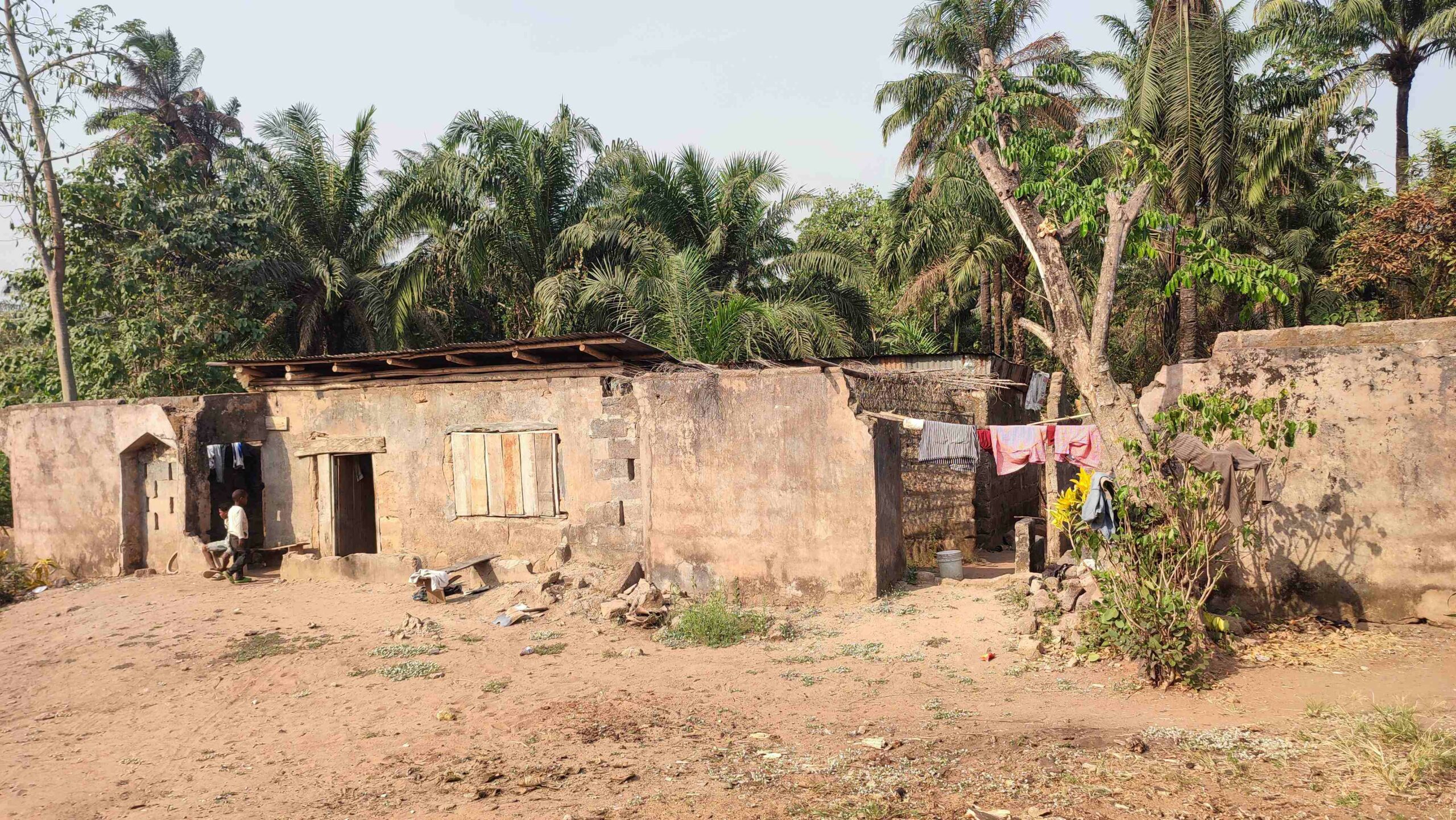
In one of the series of attacks, an elder in the community, Boniface Okafor claimed that his house and property were burnt. Now, he lives at the boundary between Oruku and Umode, another community, with his wife and children in an uncompleted building that exposes them to rain and sunshine. His children have fallen sick severally as a result.
“I have lost a family member to the crisis; we are tired of the killings and want the government to step in, “he said. “I cannot go back to my community; I am not even sure of my life because I have been threatened severally”.
Burnt house
How renewed conflict started
The lingering crisis in Oruku began in the 1990s as indigene-settler-driven conflict between Oruku and Umuode, another community, documents and oral testimonies suggest.
From the testimonies it was gathered that before the conflict broke out, there was only one community known as Oruku with Umuode as one of the kindreds which made up the original community. Considering themselves as natives/indigenes, Oruku excluded Umuode, which they considered as “strangers” from access to certain environmental resources and political patronages.
This created a major crisis which erupted into fatal confrontations between the two communities. For over two decades, the communities engaged each other in battle – burning houses on several occasions, killing themselves with economic and other activities coming to a standstill.
Where Boniface and his family currently live after his house was burnt down
Government moves to restore peace
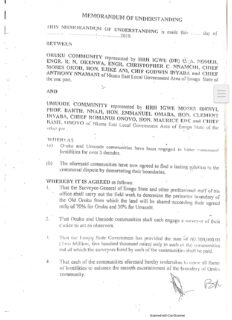
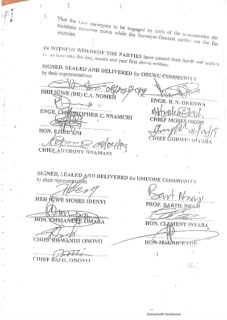
The age-long communal crisis defied measures by previous administrations to resolve it. But at the instance of the incumbent governor, Ifeanyi Ugwuanyi on June 15, 2019, (April 8, 2019) leaders of the two communities signed the first of two memoranda of understanding, (MOU) on land ownership and boundary delineation, at the meeting held at the government house, Enugu, each community was represented by a seven-man delegation.
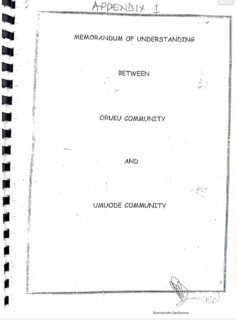
A copy of the MOU reads, “whereas Oruku and Umuode communities have been engaged in bitter communal hostilities for over three decades, the aforementioned communities have now agreed to find a lasting solution to the communal dispute by demarcating their boundaries.”
CopY of MOUCopy of the MOUSignatures appended to the MOU
“The Surveyor-General of Enugu State and other professional staff of his office shall carry out the fieldwork to determine the perimeter boundary of the old Oruku from which the land will be shared according (to) their ratio of 70 per cent for Orukuand 30 per cent for Umuode,” the MOU read.
The two communities were asked to engage a surveyor of their choice to act as observers while the government provided the sum of N2.5 million to each community, out of which the surveyors hired will be paid. They both undertook to cease all forms of hostilities to enhance the smooth ascertainment of the boundary of Oruku community.
But on June 14, 2019, when the final ratification of the agreement was slated, the leader of the Oruku team reportedly announced that he was withdrawing support from the agreement.
The state government proceeded with the peace process and created another community, Agu-Ikpa, out of Oruku. It dissolved Oruku town union executives and appointed a five-man caretaker committee to be chaired by Emmanuel Mbah, who was subsequently made the traditional ruler of the community in a bid to restore peace and reduce tension.
“But the cabals were not still happy,” a member of the community who prefers not to be mentioned said. “They wanted the fight between Oruku and Omuode to continue because they were benefitting from the sale of lands,”.
A new era of crisis
While the establishment of a caretaker committee finally laid to rest the decades of conflict between Oruku and Umuode, another era of conflict soon emerged, this time, within Oruku community.
Sources in the community who spoke to this reporter said that Mbah’s emergence as caretaker chairman and later traditional ruler did not go down well with the cabals, who felt betrayed and left out in the scheme of things.
On Saturday, December 26, 2020, officers from the Police Force Headquarters, Abuja, stormed the venue of a meeting between Mbah and his cabinet members as well as the leadership of the Town Union in the company of some of the cabals.
“Part of the agenda of the meeting was how we will return peace to the community and compensate those whose houses were affected during the land delineation, “said *Joseph Chidi, a member of the community.
But as Mbah addressed the assembly, the officers emerged from their vehicles, and one of the individuals, identified as Emmanuel Nwobodo pointed at him, and he was seized by the officers who reportedly shot sporadically in the air, dispersing the assembly, Chidi narrates.
They also shot Mbah who later bled to death and was pronounced dead on arrival at the National Orthopedics Hospital in Enugu. Some members of the community believe that Mba was killed because of his plan to review land transactions.
Chidi, who held a leadership position under the late Mbah and was in the meeting when the officers stormed the venue claimed that he and Ejike Ani, a former Chairman of Nkanu East Local Government were also targets of the attack.
“Ani did not attend the meeting, I escaped with other attendees, “he said. I lost my house and that of my father, and a shop to the crisis in December 2022,”.
Chukwukadibia’s house
In the aftermath of the new year’s day attack, Chukwukadibia Nnaji, convener of Ije Udo Oruku Forum created in 2020 to find lasting solutions to the crisis, also lost his house.
“Our parents cannot go to their farms or do business anymore; our children cannot go to school, “he said. “I cannot go into my community any longer for fear of being attacked and killed”.
He said that vulnerable members of the community, especially women, have had their rights trampled upon.
In December last year, for instance, he claimed that a woman identified as Ngozi Ogbunaeke was tied to a tree and beaten mercilessly.
Death trails the community
On Wednesday, February 24, 2021, the vice chairman of Oruku Town Union, Samuel Ani was murdered, two days before he will appear before the judicial commission. Following his gruesome murder, the state government imposed a 12-hour curfew.
In August 2022, the President-General of the Town Union, Linus Nwatu, a retired police officer, was killed by gunmen who broke into his house in the community. Nwatu had, before a Judicial Commission of Inquiry investigating Mba’s killing, alleged that ‘23 collaborators and sponsors were fueling cult activities in Oruku’ to destroy lives and property.
Three weeks after Nwatu was killed, another native of Ameke village in the crisis-torn Oruku community, identified as Chikodili Ngwu was murdered within the Oruku market square.
So far, those who have been killed in the crisis include, Igwe Emmanuel Mbah, a honourable, Linus Nwatu, Samuel Ani, Okechukwu Ogbodo, Calistus Amushi, Dennis Ike, Zik Mba and Okenwa Mbah, The ICIR gathered from speaking to relevant community stakeholders.
The Panel of inquiry
After the murder of Mbah, Uguwanyi, the state governor inaugurated a five-member Judicial Commission of Inquiry to investigate and ascertain the remote and immediate causes of the internal crisis.
The terms of reference of the panel constituted, pursuant to Section 4(1) of the Commission of Inquiry Law, Cap. 24, Revised Laws of Enugu State 2004, include to ascertain the number of persons killed or injured, identify persons, group or institutions who either by acts or omissions were directly or indirectly involved in, or sponsored the crisis, and investigate any other matter(s) that may come to the knowledge of the Panel in the course of the inquiry, not covered in these terms of reference.
Others are to make recommendations regarding persons whom the Panel finds culpable and/or blameworthy in connection with the crisis, and generally make recommendations, in the light of its findings, on how to prevent similar crisis in future and make other recommendations which the panel may consider appropriate in view of its findings.
In April, 2021, a Justice, Harold Eya-led Judicial Commission of Inquiry submitted its report to governor Uguwanyi. During the submission, Eya said that the findings and recommendations of the commission would go a long way to bring lasting peace and security in Oruku.
Eya was also quoted as saying, “the Oruku crisis was a matter of ego tussle among the elites that brought the youth and tore them apart.
Receiving the report, Ugwuanyi said that his administration would expeditiously and diligently study, accept and implement it as appropriate, with the hope that the findings and recommendations of the commission, as well as the consequential government action, will restore peace and order to the community.
Panel report delayed
More than a year after the Harold Eya-led Judicial Commission of Inquiry submitted its report to the state government, it is yet to be implemented and members of the community say they are worried that the crisis may persist.
When this reporter reached out to the government to confirm the reasons for the delay, Special Adviser to the governor on media, Samson Eze said that he was busy with the campaign and could not respond to the question concerning the delay. The ICIR also contacted the Chief Press Secretary to the governor, Chucks Uguwoke, who also said he was busy with campaigns.
For Nnaji, what is most worrying is that there is no presence of security operatives in the community; hence the attackers walk freely in search of those they consider enemies to kill.
“The government needs to take necessary steps to forestall further destruction of lives and property, and this begins with the implementation of the recommendations, “he said. “We have lost several lives to the crisis already; we cannot afford to lose more”.
THE Islamic Movement of Nigeria (IMN) also known as Shi’ites has threatened to resume daily protests in Abuja to demand the release of the passports of its leader, Ibraheem El-Zakzaky and his wife, Zeenah Ibraheem.
In a statement by Fatima Aliyu Adam of the Academic Forum of IMN, on Friday, March 24, the group said the seizure of the passports by the Federal Government has denied the duo much needed medical services abroad.
Shi’ites said the health of El-Zakzaky and his wife deteriorated following injuries they sustained when the Nigerian Army invaded their residence in Zaria, Kaduna State in 2015.
“Certainly, the deteriorating health condition of His Eminence, Sheikh Ibraheem Zakzaky (H), while in detention is the main reason behind the commencement of the daily Free Zakzaky protest in Abuja.
“The public should note that Sheikh Zakzaky (H) and his wife have multiple life-threatening health challenges as a result of the Zaria massacre, and up to this moment, there are numerous bullets in their bodies, and fractures of the bullets are releasing poison into their blood,” the statement said.
The group noted that despite several court judgments which ordered the unconditional release of the leader and his wife, the Federal Government directed the Attorney General of the Federation, the National Intelligence Agency (NIA), the Department of State Services (DSS), and the Nigeria Immigration Service (NIS) to withhold the couple’s passports.
Adam said, “It is obvious that the Buhari regime has no respect or regard for court orders; hence, we are calling for more protests to demand the release of travel documents of Sheikh Ibraheem Ya’qoub El-Zakzaky (H) and his wife Zeenah Ibraheem, as well as removing the travel ban placed on them.
“Despite police brutality, the protest started on January 8, 2018, and it is on record that from 2018 to 2021, police and army have killed 78 Free Zakzaky protesters, 2 journalists, and numerous passers-by (Abuja residents),” the statement added.
THE election tribunal in Kebbi said it has received eight petitions on the National Assembly polls held in the state on February 25.
This was disclosed by the tribunal secretary Abdul-Rahman Muhammad while speaking to journalists on Friday in Birnin-Kebbi.
He said two of the petitions were based on the Senate elections while six were on the House of Representatives polls.
Some of the petitioners include the All Progressives Congress (APC) candidate for Kebbi Central Senatorial District Abubakar Atiku-Bagudu who filed a petition challenging the victory of Muhammad Adamu-Aliero of Peoples Democratic Party (PDP) at the polls.
The APC candidate for Kebbi South Bala Na’Allah also filed a petition against the PDP’s victory in the district.
“Muhammad Bala-Usman of PDP with suit marked number EPT) KB/ HR/02/ 2023 is challenging the election outcome of Yauri/Shanga/Ngaski federal constituency.
“Muhammad Umar-Jega with suit marked number EPT/ KB/ HR/ 03/ 2023 is challenging election outcome of Gwandu/Jega/Aliero federal constituency,” he said.
Muhammad said the tribunal would pick a date for the hearing following the completion of court processes between both parties.
Following the conclusion of the 2023 general elections, tribunals across the country have received petitions from aggrieved candidates.
The Anambra State election tribunal also received at least 31 petitions from various political parties on Friday.
THE Peoples Democratic Party (PDP) has commenced the screening of aspirants for the Kogi State gubernatorial election.
PDP screened ten aspirants for the Kogi election on Friday, March 24, at the party headquarters in Abuja.
Some party members present for the screening include Yomi Awoniyi, Senator Dino Melaye, Barrister Muhammed Kabiru Usman, Engineer Musa Wada, Reuben Atabo and Idoko Kingsley Ilonah.
Atabo, one of the aspirants, told journalists during the screening session that he was optimistic that the party will win the state election.
He expressed confidence in his chances of clinching the party ticket ahead of the other aspirants.
Atabo said: “Nothing is working in Kogi. Is it the percentage payment? I am ready to change the narrative of Kogi State for the better. The roads are bad. Infrastructure is non-existent, poverty is pervasive, the government is to provide security for the people, but there is nothing like that at present.”
The Independent Electoral Commission (INEC) recently conducted the presidential and governorship elections in 28 states.
Governorship elections did not hold on March 18 in Anambra, Bayelsa, Edo, Ekiti, Imo, Kogi, Osun and Ondo, as gubernatorial polls in those states are off-cycle and not part of the general election.
Kogi’s off-season governorship election will hold in November 2023.
NIGERIANS have expressed disappointment as the Super Eagles lost to Guinea Bissau at the MKO Abiola Stadium in Abuja.
The Nigerian national football team lost the match by a lone goal.
The match which kicked off by 5:00 pm on Friday, March 24 is a qualifier to determine the participating nations ahead of the 2023 Africa Cup of Nations.
Speaking with The ICIR after the match, a football fan, Duru Emeka expressed anger at the defeat of Nigerian national football team at home.
“The worst that I expected from the players is at least a draw but it is a great loss for Nigeria to be defeated at home. Super Eagles lacked creativity.
“Bringing in a key player like Ahmed Musa in the last minute is a very big mistake and it does not guarantee Nigeria’s win at that point, the management need to work more to ensure that Nigeria qualifies,” he said.
Duru stressed that the Super Eagles’ four consecutive losses would make Nigerians and global fans have less faith in their ability.
In the same vein, Chukwuemeka Dike stated that he was very disappointed with the players.
“Nigeria is one of the most respected teams in African football but disappointedly, they performed below expectation.
“There was no game plan in the match and the midfield was lacking depth, the technical team need to understand that not every player must be on the field and they must utilize the valuable players available,” Chukwuemeka said.
One of the fans, Udimaco Ekpo, stressed that the Super Eagles lost because the stadium.
“Nothing good comes from this stadium. look at the players, they all tried their best but the stadium is diabolical. The fault is not from the coach, not from the player but the stadium.
“Most of these players are playing well in their respective club sides. Unfortunately, you will see that most of the players are struggling to play,” Udimaco said.
Udimasco further bemoaned the exorbitant cost of the tickets for the match at a time Nigeria is facing economic challenges.
THE Central Bank of Nigeria (CBN) has described as fake a news item trending on the social media that it has suspended the accounts of some financial technology (fintech) companies.
Fintech companies alleged to have been affected included O’PAY and PALMPAY.
A report today by the News Agency of Nigeria (NAN) quoted the CBN’s acting Director of Corporate Communications, Isa AbdulMumin, as saying the news “is simply fake.’’
The fake report, credited to AbdulMumin, stated that the CBN was about to suspend the accounts of some fintech companies because they were being used to perpetrate fraud.
The debunked report read, “Please if you are using O’PAY, PALMPAY or any of these China apps or their point-of-sale operations, stop keeping much money in the account or stop using it.
“The CBN is about suspending their accounts because these apps are being used to perpetrate fraud.”
O’PAY and PALMPAY had in separate social media messages also debunked being under the radar of the CBN.
O’PAY had stated that “the post mentioning the CBN as shutting down our operations is false and misleading to the general public.’’
PALMPAY also posted a similar disclaimer, stating, “We are aware of news currently being spread on the social media about the CBN shutting down the operations of PALMPAY.
“Please ignore all such misleading news of this nature.”
OPAY and PALMPAY are licensed under the CBN mobile payment regulatory framework to provide mobile money services, including mobile payment services, to both the banked and unbanked, and to drive financial inclusion.
THE Central Bank of Nigeria (CBN) has moved more banknotes to commercial banks to ease the pain of the cash crunch across the country.
Acting Director of the Corporate Communications Department of the CBN, Isa AbdulMumin, disclosed this in Abuja on Friday, March 24, in a statement.
The bank did not disclose how much it took to the commercial banks.
The ICIR reports that the CBN’s decision is an apparent move to avert planned invasion by the Nigerian Labour Congress (NLC), which directed its members on Wednesday to picket the apex bank’s offices nationwide, from Monday, March 27, over the currency crunch.
In its Friday statement, the CBN said banks must operate on Saturdays and Sundays to attend to their customers.
The CBN governor, Godwin Emefiele, will visit banks with his team to ensure compliance, the statement said.
He directed all commercial banks to load their automated teller machines (ATMs) with cash and conduct physical operations in the banking halls.
He also urged Nigerians to be patient and pledged that the challenges caused by the naira redesign would soon ease.
The ICIR reported how the Supreme Court nullified the currency redesign on March 3, after governors elected on the ruling party – the All Progressives Congress (APC), approached the court to declare the policy nullity.
President Muhammadu Buhari authorised the policy, which made the old N200, N500 and N1,000 cease to be legal tender.
The policy has brought multi-dimensional suffering to Nigerians since it took effect on February 10, as the new notes which replaced the old ones have been very scarce.
In one of its many reports on the hardship the policy brought to people in the country, The ICIRreportedhow Nigerians went nude, fought in banks and engaged in other habits that counted as offences when things were normal.
Though Buhari directed that the old N200 notes be returned into circulation in a nationwide broadcast on March 8, the Supreme Court’s judgment of March 3 nullified the policy. The court ordered that new and old notes should remain legal tender until December 31, 2023.
Despite the ruling, nothing changed in virtually all banks across the country as the banks waited for Buhari or the CBN to react to the Supreme Court judgment before issuing the notes.
Most citizens also refused to accept the old N500 and N1,000 notes because of the President’s and CBN’s silence on the court judgment.
Buhari eventually spoke on the judgment on March 11, saying the CBN and the country’s Attorney-General, Abubakar Malami, had no reason to disobey the court.
Despite the President’s reaction, cash has not been available across Nigeria.
The ICIR reporters monitored banks in Abuja, Lagos and Enugu while filing this report on Friday and observed long queues at several banks, with some people arriving the banks as early as 5:00 am without getting either cash or having other problems resolved.