THE Center for Democracy and Development (CDD) said it had tracked 109 deaths linked to electoral violence in Nigeria between January and March 10.
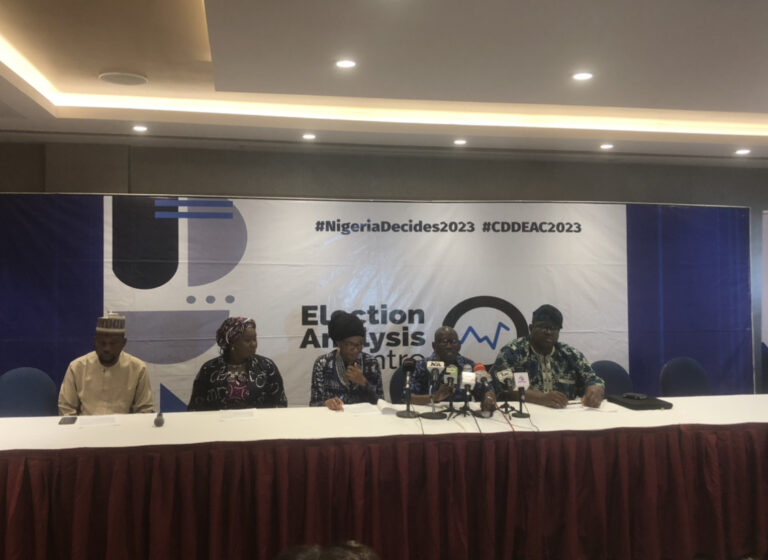
CDD Director Idayat Hassan, who spoke at a press briefing organised by the organisation’s Election Analysis Centre (EAC) in Abuja on Friday, March 17, also highlighted ten states as potential violence hotspots in the March 18 governorhip elections.
The states are Rivers, Kano, Lagos, Kaduna, Oyo, Cross River, Enugu, Delta, Gombe and Zamfara.
She said the credibility of the March 18 governorship election is threatened by insecurity, logical obstacles, scarcity of cash and fuel scarcity.
“Credible votes are vital but will be challenged by threats of violence, Logistical obstacle and insecurity. Also, the cash and fuel scarcity are yet to dissipate completely.
“There are also critical issues that we highlighted. Political violence is one of them. For instance, our data showed that between January and March 10, 2023, there were 109 deaths linked to political violence. And this is likely to worsen with the involvement of groups like Yan sa Kai, Neighbourhood watch, Amotekun and Civilian JFT and others in the election violence, and this is likely to continue in the governorship election,” she said.
According to her, insecurity poses a “serious threat in this election and increases the likelihood of inconclusive elections in some states just as seen in past elections.”
Hassan also said the CDD EAC analysis showed that the preparedness of the Independent National Electoral Commission (INEC) is vital to the election credibility as the gubernatorial polls have been conducted amidst diminished trust for the commission following the February 25 polls.
She also noted that of the 28 gubernatorial elections on Saturday, 17 are without an incumbent contender.
This, she says, will provide room for more competition among the candidates
“INEC preparedness and diminished violence are critical for credible elections. While there will be governorships election, 17 of them are new, with no incumbent governor contesting as they are time-barred from competing in the election. This will provide room for intense competition in this election,” she added.
AHEAD of the Governorship and State House of Assembly elections that will be holding on Saturday, March 18, here are the options before Kano voters as they go to the polls to elect a new governor.
The current governor, Abdullahi Umar Ganduje’s second term ends on May 29.
Seventeen candidates will be vying for the office of governor; however, there are only three front runners among them.
Top 3 candidates
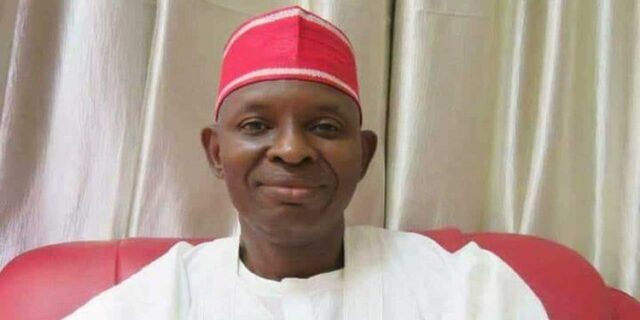
Deputy Governor of Kano State, Nasir Gawuna (APC)
Gawuna won the ticket after defeating his only challenger Sha’aban Sharada, during the All Progressives Congress (APC) primary.
Deputy Governor of Kano state and APC Governorship candidate, Nasiru Gawuna
He was a two-time chairman of the Association of Local Governments of Nigeria (ALGON) in Kano State and a former commissioner for local government.
He has promised to improve the state’s education sector if elected.
He has also promised to build on the successes recorded in the sector by two previous administrations in the state and the current Umar Ganduje administration if he wins.
Gawuna has hinged his campaign on providing infrastructure like new classrooms, furniture, and accessible and compulsory primary and secondary education.
Gawuna’s strengths
He is an experienced politician, having served at the grassroots as local government chairman.
In Nigeria’s politics, the power of incumbency is always an advantage.
NNPP candidate, Abba Kabir Yusuf
Abba Kabir Yusuf, known as Abba Gida-Gida, is the governorship candidate of the New Nigerian Peoples Party (NNPP).
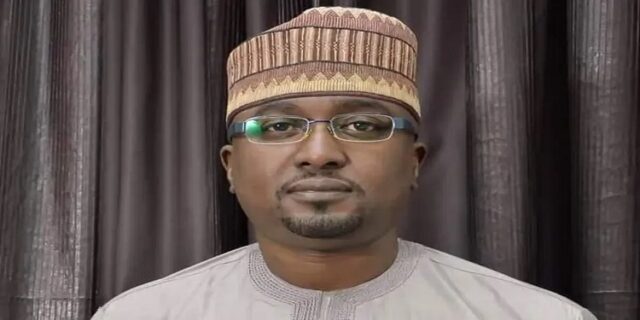
NNPP governorship candidate for Kano state, Abba Yusuf
Following the gubernatorial primary election of the NNPP, Yusuf, a loyalist of Rabiu Musa Kwankwaso, emerged as the party’s governorship candidate for the 2023 general elections.
Yusuf has previously worked with the Kano State Water Resources Engineering and Construction Agency (WRECA) and the Kano State Water Board.
He was later moved to the state Ministry of Water Resources.
Between 1999 to 2003, he served as Kwankwaso’s assistant and afterwards as a special assistant (administration).
He once served as the State’s Commissioner for Works, Housing and Transport under Kwankwanso.
He was the governorship candidate of the Peoples Democratic Party (PDP) in the 2019 governorship election.
He contested against the incumbent Ganduje in an election declared inconclusive but later lost after a rerun.
He has promised to end the persistent scarcity of potable water in Kano State if elected in the forthcoming election.
His strengths
The NNPP is a very popular party in Kano, and winning the Presidential race in the State is an added advantage.
The towering influence of the Party’s presidential candidate in the just concluded Presidential election, Kwankwanso, is also an advantage.
Sadiq Aminu Wali of the PDP
Sadiq Aminu Wali won a parallel governorship primary of the PDP, held at Sani Abacha Youth Centre, Kano, to emergeas the party’s candidate.
Wali beat other contestants, such as Ibrahim El Amin Little.
He is a former commissioner for Water Resources.
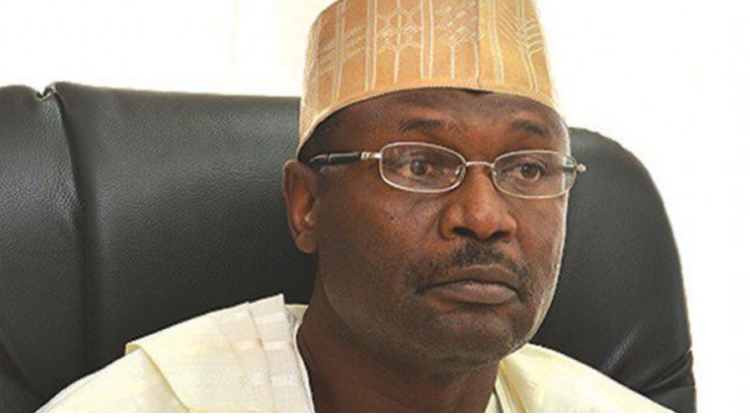
PDP Kano governorship candidate, Sadiq Aminu Wali
Wali is the eldest son of a former Minister of Foreign Affairs, Aminu Wali.
His candidacy has been plagued by litigations.
He has been in and out of court since the primary in 2022 after a Federal High Court in Kano declared Mohammad Sani Abacha, the son of former military dictator late Sani Abacha as the duly-elected governorship candidate of the PDP in Kano State.
He was only officially affirmed as the party’s authentic candidate by the Supreme Court on March 1, 2023.
His strengths
His strength lies in the popularity of the PDP in Kano. The goodwill and experience of his father and his youthful look are added advantages.
The trend of Kano politics in recent years
The political tendency concerning governorship elections has never been steady in Kano State.
Since the restoration of democracy in 1999, no party has held complete power over the top position in Kano State.
Since 1999, the State has been led by the ANPP, PDP and APC.
In 1999, Kwankwaso was elected on the PDP platform.
In 2003, he was defeated by All Nigeria Peoples Party (ANPP) candidate Ibrahim Shekarau.
Kwankwaso won again in 2011 under the PDP.
In 2015, Ganduje of the APC took over.
How Kano voted in recent elections
In the Presidential and National Assembly elections held on February 25, the presidential candidate of the NNPP, Kwankwaso, polled a total of 997,279 votes, according to the results announced by the Independent National Electoral Commission’s (INEC) in the State.
The candidate of the PDP, Atiku Abubakar, scored 131,716 votes while the candidate of the Labour Party, Peter Obi, got 28,513 votes.
In the national assembly elections in the State, the NNPP won two of the three senatorial tickets and 17 of 24 House of Representatives seats.
According to INEC, around 5.9 million voters were registered in the state, and 1,769,525 were accredited.
There were 1,702,005 legitimate votes cast, while 44,405 ballots were rejected,
Kano residents react
According to a resident of Kano, Hassan Kurewa, the governorship election would differ from the presidential and national assembly elections.
He affirmed that elections in Kano always followed different patterns.
“The election will be distinct compared to the presidential election. There is the power of the incumbency (Ganduje) and the strong effect of winning the last election. It is a fight to finish between Gawuna (APC) and Gida Gida (NNPP); let us see how it goes.
“We are all looking forward to it, Insha Allah, we pray for peace,” he said
Another resident, Onileowo Dauda, on his part, said the election might throw up a surprise.
He said the APC and NNPP are the two parties to slug it out on Saturday, but according to him, PDP might pull a surprise.
“The battle for me is between the NNPP because they won the presidential election and the APC due to the power of the incumbent, but please don’t rule out the PDP. The party is very popular here, too,” Dauda said.
An image showing Olumide Oworu, the Labour Party’s candidate for Lagos State House of Assembly in Surulere Constituency 1, with blood on his face and shirt, has surfaced online with a claim that it shows the moment after he was reportedly attacked by hoodlums in a part of the state.
Olumide and his supporters were reportedly attacked by thugs on Thursday, March 16, 2023, Channels TV reported.
Following the attack, a photo of Oworu covered by blood began to circulate on social media with a claim that thugs hired by the All Progressives Congress (APC) bruised him during the attack.
A Twitter user, @omolerinjare, tweeted the photo with a caption that read:
“Hope the whole world have seen what Desmond Elliot did to Olumide. This won’t stop his retirement. It’s inevitable.”
Another Twitter user, @ayemojuba tweeted the photo with another caption thus: “Olumide Oworu was attacked by APC thugs.”
CLAIM
Photo shows Olumide Oworu after he was attacked by thugs in Lagos.
Screenshot of one of the viral posts
THE FINDINGS
A quick check by TheFactCheckHub shows that the image has been online more than five months ago.
Olumide is a Nigerian actor who has featured on several Nollywood movies and won a number of awards for his roles in various movies.
Findings show that the picture in circulation had earlier been uploaded on his Instagram handle with a caption indicating that photo was taken during a movie production.
He shared the photo on October 3, 2022 with a caption that reads: Alagbado John Wick. #OntheEdge on his Instagram page.
Similarly, the claim that he was attacked by APC thugs could not be independently verified by The FactCheckHub as of the time of filing this report.
THE VERDICT
The claim that the image shows Olumide Oworu after he was attacked by thugs in Lagos is MISLEADING; findings show that the photo is not connected with Thursday’s incident in Lagos.
THE Independent National Electoral Commission (INEC) has warned its adhoc staff in Benue State against compromising the credibility of the gubernatorial and state assembly polls.
The Commission said it was “deeply troubled” by the perception that some adhoc staff in the state “work at the behest of politicians” to influence the outcome of the elections.
In a statement issued on Thursday, March 16, the state’s Resident Electoral Commission (REC), Samuel Agwu warned that INEC will prosecute officers at polling units and collation centres who “deliberately” undermine the polls rescheduled for Saturday, 18th February.
“For the avoidance of doubt, section 120 of 2022 Electoral Act provides provides that officers on election duty who, without lawful excuse, commit acts or omits to act in breach of official duty for which they have sworn an oath of neutrality will be prosecuted, and, if convicted shall be imprisoned.
“This applies to all the ad hoc mentioned above. The term of imprisonment is three (3) years for collation officers and twelve months for presiding officers and other polling level staff”, parts of the statement read.
Agwu, a professor also warned political parties and agents “who conspire” to make or publish false declaration of election results other than the one announced by INEC.
Meanwhile, the Benue state’s REC commended the Nigeria Police for “promptly” completing investigations into alleged offences committed during the February 25th presidential and National Assembly elections in the state.
THE random blaring of sirens along the streets of Port Harcourt and dozens of security vans spotted on the highways suggest a heightened sense of insecurity within the city ahead of the March 18 Governorship and House of Assembly elections in Rivers State.
Assistant Inspector-General of Police, Elections, in the state Kayode Egbetokun, on Thursday, March 16, told journalists that the Command had deployed operatives massively and was better prepared to handle security issues which may arise during the exercise.
However, this has not eased the concerns of residents, many of whom are unwilling to participate in the election for fear of violence.
Some residents of Port Harcourt, including Victor Bassey, told The ICIR that they would not be involved in the March 18 election.
“I gave a man a ride last week, and he was in a long conversation with somebody on the phone. I realised from the discussion that he was probably one of these key grassroots politicians.
“His statements suggested that the elections will be rough. I also know that some of the candidates have has thugs, including APC or PDP candidates. They have boys who work for them. So no, I will not even come out on that day,” Bassey said.
Further suggesting that Saturday’s election may be marred by violence, Publicity Secretary for the All Progressives Congress (APC) in Rivers state Darlington Nwauju accused the ruling Peoples Democratic Party (PDP) of recruiting thugs to destabilise the exercise.
“We want to put it on record to the Federal Government and the security agencies that lives are not safe in Rivers State on March 18,” Nwauju said while addressing journalists in Port Harcourt on Thursday, March 16.
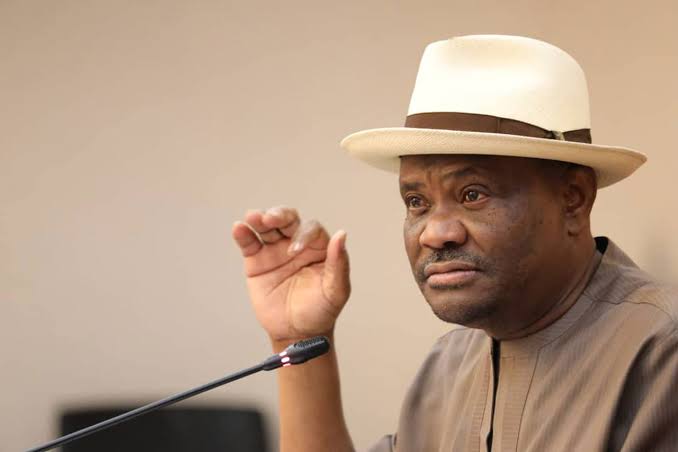
He further alleged that the state governor Nyesom Wike was encouraging anti-democratic activities ahead of the exercise.
In the build up to the election, several cases of abduction have been recorded in the state.
Nwauju noted that gunmen dressed in police uniforms abducted the APC secretary in Ikwerre Local Government Area (LGA), Amadi Osaronu, on Wednesday, March 15.
Earlier in the week, the police had also confirmed another abduction involving the Accord Party’s candidate for the State House of Assembly, Ogba/Egbema/Ndoni constituency, Chukwudi Ogbonna. He was kidnapped by gunmen while driving in his car at Rumuigbo, near Port Harcourt, on Monday, March 13.
The Presidential and National Assembly elections February 25 was also characterised by incidents of violence across several areas of the state, suggesting a possible repeat during the gubernatorial polls.
At least two persons were reported to have died from the violence that erupted during the elections, including a pregnant woman. Two houses were also burnt down in the Emohua LGA.
Our votes will not count
Other residents of the state have given more reasons why they may not participate in the governorship election.
A cab driver in Port Harcourt Kenneth Barry told The ICIR that he was disappointed with the outcome of the presidential election conducted in the state. He alleged that election results had been manipulated, noting that the development affected his confidence in the electoral process.
“As it stands, people are not interested. I predict there will be so much voter apathy. People are not happy. This was not what we envisaged from the previous exercise. People expected something better from INEC, and they got something totally different.
“We can go and do our voting, but at the end of the day, we do not know what the result will turn out to be. And from what INEC has shown us with the first one, the confidence is not there,” Barry said.
For Ben Karigia, who lives along Aba Road, Port Harcourt, the voting process is a waste of time.
“I am discouraged. During the presidential elections, I left my house very early and stayed at the polling unit till almost 12:00 am, counting votes. Still no results. It is a total waste of time,” he said.
These fears are also shared by hundreds of women in the state, who staged a protest at the headquarters of the Independent National Electoral Commission (INEC) in Rivers on Wednesday.
The women warned against a repeat of the February 25 election process, during which results were not uploaded from polling units and, in some cases, original results sheets were missing.
Leading the protest, reality TV star, Natacha Akide urged INEC to conduct the elections according to the Electoral Act.
“We are urging INEC to please do the right thing come March 18. It is a lot of sacrifice for us to come out to vote. We are voting because we are deciding our future and those of our unborn children. It is important to us. We are begging, INEC please, stick to the Electoral Act and deliver free, fair and credible elections to us,” she said.
As Nigerians nurse their disappointment from INEC’s unfulfilled promises during the presidential election, states like Rivers may experience low turnout of voters in the March 18 governorship election.
FOLLOWING the recent collapse of the Silicon Valley Bank (SVB) in the United States of America, an economic expert, Kazeem Bello, has hinted that “seven major banks in Nigeria” could be struck by the “wave of storm that will sweep banks and other financial institutions in the U.S. as it manifests.”
Just on Monday, March 13, another major regional bank, Signature Bank, was wound up by the U.S. authorities.
To avert the impending crisis, the Central Bank of Nigeria (CBN) governor, Godwin Emefiele, has asked the African central banks to tighten their regulatory frameworks.
Emefiele raised the alert at the opening of the 2023 African Central Bank Conference held at the Global Leadership Center, Johannesburg, South Africa on Wednesday, March 15.
He warned that African central banks and other financial sector regulators needed to draw lessons from the SVB collapse by playing their regulatory and supervisory roles effectively to forestall any run on banks in their respective jurisdictions.
The SVB’s astonishing fall began on Friday, March 10, when its customers rushed to draw down their accounts all at once in a destabilising event known as a bank run.
According to a report by the Cable News Network (CNN), SVB provided financing for almost half of the United States venture-backed technology and health care companies. This is the largest failure of a U.S. bank since Washington Mutual in 2008, during the Great Recession.
Bello, who is the chief executive officer/principal partner at Afrique Capital and Equity Funds Limited in New York, told The ICIR that “about seven major Nigeria’s banks already known in the global banking terrain or financial circles are running seriously below their distress parity lines.”
Bello, a global development economist, did not disclose the banks, but stressed, “They are technically distressed, and they are just floating, waiting to be buried as we speak.”
He believed that the scorching naira redesign policy of the CBN would eventually expose the banks once depositors were able to pull their money out when the current abnormal financial landscape subsides.
“Those banks and others will see a massive deposit run,” he said, as he explained that customers would, in both the short and medium terms, resort to holding cash at home or out of the traditional banking system.
“We shall see more Naira being held outside the banking industry on a massive scale never before due to the usual phobia people are nurturing that when something happens in Nigeria, there is always a tendency that it will happen again.
“More traders and rural population people will resort to holding more cash until we are able to see confidence built in the system by the CBN and the banking system,” Bello added.
A lecturer at the Department of Finance, University of Lagos, Abu Noruwa, also told The ICIR that there was a need to regulate the Nigerian banking system for effective and efficient performance.
Noruwa argued that “tightening the regulations” was not the best word but a good regulatory framework to ensure total compliance.
“The regulatory frameworks or the laws are already in place, but there is the need to ensure full compliance,” he said, adding, “When the rules of the game or regulatory frameworks are not followed or complied with, the end result is devastating to both the banking industry or individual, and the economy generally.”
There are so many consequences for not following the regulations or rules and procedures of the system, the lecturer warned.
THE Nigeria stock market steeped further on Thursday, March 16, as market capitalisation fell to N29.92 trillion from N30.23 trillion at the close of the day’s trading, leaving investors to lose a total of N313.02 billion.
The benchmark index, known as the All-Share Index, also declined by 1.04 per cent to close lower at 54,915.61 basis points as investors continued to pull their money out of quoted companies.
Market data showed that the Year-to-Date gain of the domestic bourse fell to 7.15 per cent even as the market breadth printed on the negative as 25 quoted companies’ shares fell relative to eight companies that gained.
The 4.95 per cent decline to N236 in the share price of MTN Nigeria Communications partly accounted for the weak performance witnessed in the equities market on Thursday.
At the close of the day’s trading at the floor of the Nigerian Exchange Limited (NGX), sustained sell-offs recorded on banking stocks further dragged the index down.
The bearing sentiment, market analysts say, contributed to a depressed stock market session saw Ecobank Transnational Incorporated lost 10 per cent to close at N10.80; FBN Holdings shed 2.73 per cent to close at N10.70; Fidelity Bank dipped 2.72 per cent to close at N5.01; while Guaranty Trust Holding Company moderated by 1.20 per cent to close at N24.70.
Performance across the sub-sector was generally bearish, except for the NGX oil/gas index, which closed flat. The NGX banking, insurance, consumer goods, and industrial indices rose by 1.00 per cent to 432.13 basis points; 0.36 per cent to 175.50 basis points; 0.17 per cent to 703.12 basis points; and 0.10 per cent to 2,551.32 basis points, respectively.
In the broad and narrow markets, the NGX Premium, NGX Mainboard, and NGX-30 indices decreased by 206 bps, 28 bps, and 117 bps, respectively.
Trading activity also dipped with total deals moderating by 10.72 per cent to 3,489 trades; volume 24.23 per cent to 137.29 million units; and value 55.66 per cent to N1.51 billion, respectively.
Transnational Corporation of Nigeria traded as the most active stock in volume, with 26.08 million shares worth N33.98 million and changing hands in 113 deals.
Meanwhile, the naira depreciated against the green beg by 0.20 per cent at the Investors and Exporters (I&E) foreign exchange window to N462.00 from N461.09, while at the parallel market (black market), it appreciated by 0.53 per cent to N750 from N754.
Passengers overwhelmed with fear screamed and called on God to save them from impending doom through different means as the aircraft’s wings flapped raucously.
Many called ‘Jesus’, and others shouted ‘Allah’ as the hope of escaping death waned.
The incident happened between 4:25pm and 4:40pm.
Awojebe Akinwale was the flight’s captain. Elated passengers praised his team when the flight eventually landed at about 4:45pm.
The cabin crew and the captain’s co-pilot beamed with smiles as they watched the passengers disembark.
The ICIR reporter, who was on the flight, noted that the aircraft spent about one hour 20 minutes in the air instead of the one hour indicated in the flight schedule.
One of the passengers, Mrs Ugwu Divine, a Lagos resident, said, “This is my second time experiencing this turbulence. But today’s experience was more. I was terrified, but the pilots did justice to the situation. I thank God for everything. As I talk to you, I am still feeling the shock in my body. It was just God and the pilot.”
Another passenger, Agnes Kayode, said, “I was very scared when the crisis started. Immediately after the turbulence started, I developed a running stomach. I was so scared that I thought everything was over.”
Similarly, Cynthia Titilayo, a passenger on the flight, said she was scared because she had never experienced such a crisis all her life.
Meanwhile, a male passenger, a pastor, who identified himself as Njoku, told The ICIR he was not afraid because God “is on the throne.” The reporter sat beside Njoku and saw him pray noisily during the turbulence.
Aero Contractor relaunched its services last December after it suspended operations over financial crisis.