Home Blog Page 1030

International Center for Journalists offers News Corp Media Fellowship

International Center for journalist is inviting applications for its 2023 News Corp Media Fellowship for Digital Innovation

The program aims at providing journalists from across the world with the opportunity to hone their digital journalism abilities, as well as assistance in developing data- and/or digitally-driven projects.

The Fellowship includes digital innovation training, grant support, and exclusive virtual newsroom placement with the Wall Street Journal.

During the fellowship, fellows will attend training virtually for three months September 15, 2023, to December 15, 2023.

The selected News Corp Media Fellows will have the opportunity to contribute to projects on analyzing audience engagement and newsletter interactions, Lead peer-to-peer discussions, Promote exchange of ideas and knowledge, and establish new partnerships and relationships with teams.

The deadline for the submission of the application is March 26, 2023. Interested applicants can apply here.

Kwara govt warns against rejection of old naira notes

0

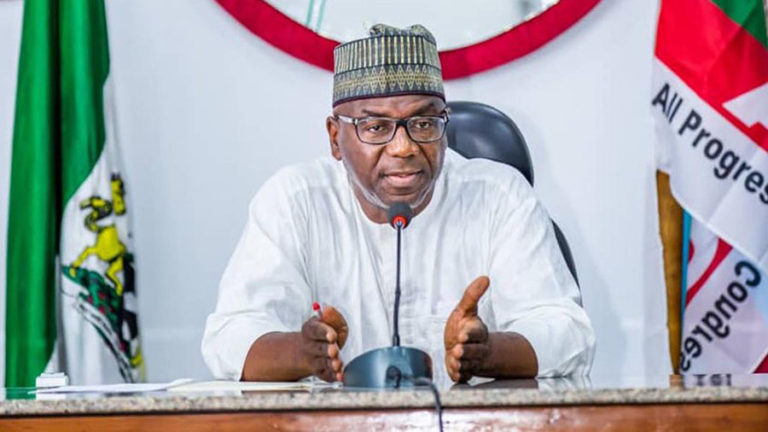
KWARA state governor AbdulRahman AbdulRazaq has warned residents against rejecting the old naira notes.

A statement by Rafiu Ajakaiye, Chief Press Secretary to the Governor, on Tuesday, March 14, described the rejection of the naira notes as a criminal offence.

“As per the judgment of the Supreme Court of Nigeria and the latest circular of the Central Bank of Nigeria (CBN), the old naira notes still remain a legal tender in the country. Banks are now officially issuing the old Naira notes (including N500 and N1,000).

“I, therefore, urge all residents of our state to spend and receive both the old and the new Naira notes. This appeal especially goes to our marketers/traders. Further rejection of the old Naira notes is in breach of the Supreme Court judgment,” he said.

The governor also implored banks to support the people and ease their transactions.

Last week, Kogi State governor Yahaya Bello also issued a warning to residents over the rejection of old naira notes.

Bello had threatened to arrest and prosecute residents rejecting the notes, adding that a committee would be set up to ensure strict compliance.


READ ALSO:


The Central Bank of Nigeria (CBN) had fixed January 31 as the deadline for using the old naira following a redesign of the notes, despite the scarcity of the new notes.

The deadline was moved to February 17 by the CBN, but the Supreme Court of Nigeria, on Friday, March 3, nullified the Federal Government’s naira redesign policy and declared that the old N1000, N500 and N200 notes remain legal tenders till December 31, 2023.

More than a week after the court ruling, the CBN remained silent on the official deadline for using old naira notes before releasing a statement on Monday, March 13, complying with the court order.

NCC introduces uniform short codes for mobile networks

IN its bid to improve telecommunication services, the Nigerian Communications Commission (NCC) has directed mobile network operators (MNOs) to implement the approved harmonised short codes (HSC) for providing certain telecom services to consumers in Nigeria.

The development was disclosed in a statement released by the Commission via its twitter handle on Tuesday, March 14.


READ ALSO:

NCC investigating data depletion, wrongful deductions by mobile networks

Claim that mobile networks in Nigeria are giving free data is FALSE

Hackers can access mobile phones when charging in public, NCC warns


According to the NCC, the old and new harmonised short codes will run concurrently until May 17, when all networks are expected to have fully migrated to full implementation of the new codes.

Parts of the statement read: “The use of harmonised short codes is aimed at achieving uniformity in common short codes across networks. This means that the code for checking airtime balance is the same across all mobile networks for the same function, irrespective of the network a consumer uses.

“With the new codes, the telecom consumers using the over 226 million active mobile lines in the country can now use the same codes to access services across the networks.

“Consequently, under the new harmonised short codes regime, 13 common short codes have been approved by the Commission. They include the following codes: 300 to be used as the harmonised code for Call Centre/Help Desk on all mobile networks; 301 for voice Mail Deposit; 302 for Voice Mail Retrieval; 303 for Borrow Services; 305 for STOP Service; 310 for Check Balance, and 311 for Credit Recharge.

“Also, the common code for Data Plan across networks is now 312. In line with the new direction, 321 is for Share Services, while 323 is for Data Plan Balance. The code, 996, is now for Verification of Subscriber Identity Module (SIM) Registration/NIN-SIM Linkage. The code, 2442, is retained for Do-Not-Disturb (DND) unsolicited messaging complaint management, while the common code, 3232, is also retained for Porting Services, otherwise called Mobile Number Portability.”

NCC added that the window period, until May 17, is to enable telecom consumers to familiarise themselves with the new codes for various services.

The statement stressed that the initiative, which is in line with NCC’s regulatory modernisation programme, is essentially to make life much easier for telecom consumers, noting that it is easier for Nigerians to memorise single codes for various services across all mobile networks.

“In addition, the new policy will provide opportunity for licensees in the Value-Added Services (VAS) segment of the telecoms sector to be able to use freed-up/old codes for other services, as well as enhance cohesive regulatory framework in keeping with world-class practices.”

Meanwhile, subscribers who reacted to the development on Twitter commended the initiative, describing it as an excellent approach to improving telecommunications services in the country.

A Twitter user, ‘AsksWatchdog’ quoted the tweeted: “Excellent stuff, well done NCC. No need to remember different codes for different networks anymore.”

Another twitter user who is also a journalist, @AkinpeluYusuf, wrote: “Irrespective of the network you use, you can now check your balance and perform other operations using these harmonised codes.”

@IbrahimShehu tweeted: “This is a welcome development, if implemented.”

2023 election: Female representation continues to decline

DESPITE efforts to improve women’s participation in governance, female representation in government has continued to decline in Nigeria.

Following the just concluded 2023 presidential and national assembly elections, the number of female senators in Nigeria took a plunge from seven in the 9th Assembly to three senators-elect, announced by the Independent National Electoral Commission (INEC).

All three senators-elect are first-timers in the senate, including Iretiola Kingibe representing the FCT, Idiat Adebule for Lagos West and Ipalibo Harry Banigo in Rivers West.

There were also 11 women elected into the House of Representatives, as with the 9th Assembly, from seven states: Anambra, Bayelsa, Benue, Borno, Delta, Imo, and Yobe.

Anambra had the highest figure with three female representatives, followed by Benue and Yobe with two each.

However, this figure is inconclusive as supplementary elections will be held to fill eight senate seats and 36 seats in the House of Representatives, which are still vacant for various reasons, including election irregularities.

Ahead of the 2023 general elections, there was more female participation in the 2023 electoral process, as more women than men completed registration for their Permanent Voter Cards (PVCs).

Of 12.29 million people who completed the PVC registration, 6.22 million are women, which is 50.6 per cent.

However, the decline in females elected into government may have resulted from the low levels of female candidacy recorded during the process.

Only 1,550 out of 15,307 candidates in the 2023 general elections are women. There was only one female presidential candidate and no female Vice-Presidential candidate across the 18 parties that contested the presidential elections.

This has caused a lot of anxiety among women groups, as the fight for gender inclusion in government seems not to yield the desired result.

However, speaking on the decline, Senator-elect representing the FCT Ireti Kingibe has vowed to bring more women into the government.

Kingibe noted that she would achieve this by involving more women in political processes and encouraging them to occupy sensitive positions at the party level.

“If there are more women in the party, then it goes without saying that getting those councillors and chairmen will be much easier than when it is only men. So that is where I am going to start,” she said.

Gender inequality in government is prevalent not only in Nigeria but across the globe.

Although efforts are being made to address this challenge globally, progress is slow. At the current rate, gender inequality in the highest levels of government will persist for the next 130 years, according to the United Nations (UN).

Nigeria, however, ranks very poorly according to the 2022 Gender Gap Report by the World Economic Forum. The country is at 141st place out of 146 countries rated in terms of female political participation.

Reasons for low female representation

Several reasons have been given for low female candidacy during elections, including cultural and religious factors.

Lower education and employment levels also adversely affect female candidacy in Nigerian politics.

Speaking on the issue, Tari Oliver who was a presidential aspirant under the People’s Democratic Party (PDP) held in 2022 had also identified funding as a significant issue affecting Nigerian women in politics.

“The number one issue with women in politics in Nigeria today is funding. Poverty wears the face of a woman, and most women in Nigeria today are unable to play the money politics that goes on during elections in Nigeria,” she said.

Violence against women in elections also serves as a significant deterrent to women’s political participation.

On December 3, 2022, suspected political thugs attacked the campaign team of the People’s Democratic Party (PDP) candidate for the Kogi Central Senatorial district, Natasha Akpoti-Uguaghan’s during her rally from Okene to Adavi, injuring several persons and shooting one.

Like Akpoti-Uduaghan, several female contestants in the Nigerian political atmosphere have come under physical attacks and, in many instances, online bullying.

Former member of the Kwara State House of Assembly Nimota Ibrahim, who spoke to The ICIR, further identified discrimination and sexual harassment as factors that discourage women from vying for elective positions.

“The issue of sexual harassment is paramount in politics as against women. I was a state secretary of my party in the 90’s and held that crucial position for a long time. I had a number of cases of women that could not get anything until they slept with whoever was responsible for getting them nominated or whatever.

“I had to intervene in a number of cases. It is an established fact that men in authority may want to sleep with women because they want to aspire,” Ibrahim noted.

She also noted that men and women perpetrated discrimination against women in politics.

“Another factor is women against women. Sometimes, men even use women against women. People like us are trying to educate women. A woman has to be well-equipped going into politics. At the point where we have women like that, politics will be better,” she said.

African Democratic Congress (ADC) candidate for the AMAC/Bwari House of Representatives, Juliet Isi Ikhayere, also noted that discrimination by women against female candidates and stereotyping were discouraging factors, especially for young female contestants.

“For me, the most scary place to go to when it comes to campaigns is the women’s camps. There, they tend to look at you as a small girl, and for them to even warm up to you, it takes a while.

“There is a stereotype, questions like ‘is she married,’ and sometimes, they make nasty comments suggesting that I should be more focused on getting married than contesting. Women need to trust each other more and vote for each other,” she said.

The way forward…

Ibrahim advised experienced women in government to be involved in grooming younger women venturing into politics on how best to make an impact and be successful.

“In the present National Assembly, how many women are there? The one coming in this year is worse! How can a nation be playing with about 50 per cent of its population? It is very sad,” she said.

Oliver – the PDP presidential aspirant, also encouraged women to work harder to raise funds and support groups early enough ahead of elections. Oliver noted that the implementation of the 35 per cent affirmative action for women would further improve support for female political candidates.

“If the 35 per cent affirmative action is implemented, then everyone would know that certain positions are reserved for just women.

“You know that even if it is your sister or mother or someone else, that position must be occupied by a woman. That way, people begin to get used to voting women into political positions,” she said.

Yobe LG auditor-general jailed over N19.9m fraud

JUSTICE Muhammad Lawan of the Yobe State High Court has sentenced the Auditor-General for Local Government in the state, Idris Yahaya, to five years imprisonment over a N19.9 million fraud.

The case was brought against Yahaya by the Economic and Financial Crimes Commission (EFCC), Maiduguri Zonal Command.

A statement released by EFCC spokesperson Wilson Uwujaren disclosed that the auditor-general diverted funds meant for the purchase of an official vehicle for his personal use.

The EFCC explained that Yahaya received funds from the Office of the Auditor General for Local Government and Emirate Affairs, Yobe State, for the purchase of an official vehicle, a 2015 Toyota Corolla, and diverted part of the money to his personal use.

The statement further disclosed that Yahaya would spend five years in prison following his conviction on Monday, March 13.

“Alhaji Idris Yahaya, the Auditor-General for Local Government, Yobe State, is to spend five years in prison, following his conviction today, Monday, March 13, 2023, by Justice Muhammad Lawu Lawan of the Yobe State High Court.”

The charge against the auditor-general read: “That you, Yahaya Lawal Idris, being the Auditor General for Local Government, Yobe State, between the 20th to 21st day of May, 2017 at Damaturu, Yobe State within the jurisdiction of this Honourable Court, received the sum of N19,900,000.00 via your personal account number 1001480930 with account name Alhaji Yahaya Idris domiciled in United Bank for Africa Plc (UBA) from the Local Government Audit Account Number 5030030060 domiciled in Fidelity Bank Plc for the purchase of a brand new Toyota Corolla 2015 Model, did dishonestly misappropriated the gross sum of N10,100,000.00 (Ten Million, One Hundred Thousand Naira) only.”

In his judgment, the judge stated that the auditor general should pay the sum of N10 million as restitution to the Yobe State Government through the EFCC or serve additional two years in prison.

Presidential election: Why Obi won in SE, SS – Okowa

0

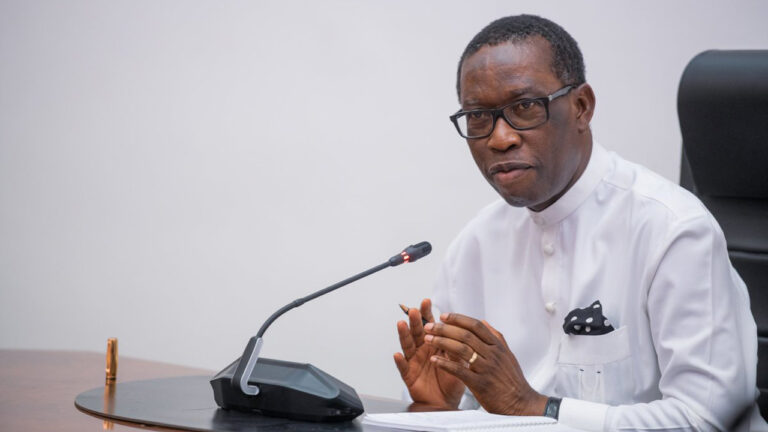
THE vice presidential candidate of the Peoples Democratic Party (PDP), Ifeanyi Okowa, has attributed the victory of Labour Party (LP) flagbearer Peter Obi in the South-East and South-South regions to ethnic and religious sentiments.

The Delta State governor stated this on Monday, March 13, while reacting to the outcome of the disputed presidential poll which Bola Tinubu of the ruling All progressives Congress (APC) was announced winner.

Okowa said: “A lot of factors contributed to the sweeping victory of Obi in South-South and South-East.

“The agitation that the Presidency should come to the Southern part of the country, religion and Igbo presidency are key factors.

“The Obidient movement is a movement that swept across the South-South and South-East. The people wanted Obi as a change. They believe it is the turn of South-East.”

According to results announced by the Independent National Electoral Commission (INEC), the LP presidential candidate won in all the five southeastern states of Abia, Ebonyi, Enugu, Imo and Anambra.

He also won in Okowa’s Delta state, as well as Cross River and Edo in the South-South region of the country.

However, Okowa faulted the conduct of the presidential election by INEC.

“I believe that people have exercised their rights in a democratic process but INEC did not follow the Electoral Act.”


READ ALSO:


Both PDP and LP are challenging the result announced by INEC.

The PDP had accused INEC of “criminal manipulation and alteration of election results” in favour of the APC.

Also, spokesperson for the Obi-Datti Presidential Campaign Council, (PCC) Yunusa Tanko in a press statement issued last week said LP had “lost confidence in INEC’s capacity to conduct a free and fair election”.

CBN confirms old N200, N500, N1,000 for use till December 31

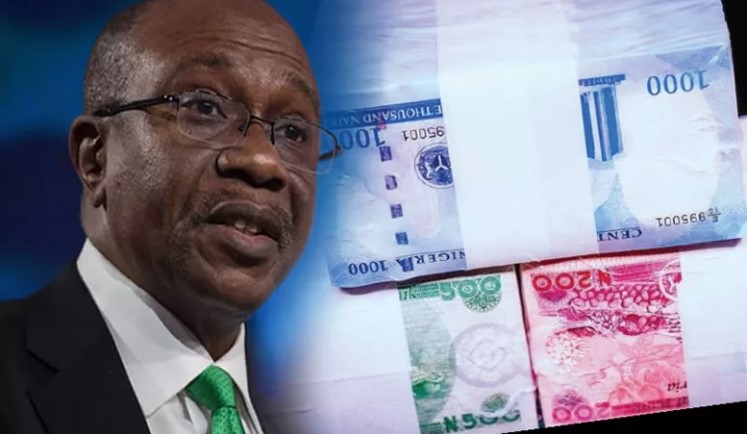
THE Central Bank Nigeria (CBN) has finally bowed to pressure and has validated the use of the old N200, N500 and N1,000 notes till December 31, 2023, following the March 3, 2023 Supreme Court judgment on deadline for the notes as legal tender.

Confirming this development in an official statement issued today, the CBN’s Acting Director, Corporate Communications, Isa AbdulMumin  said the validity date was in compliance with the Supreme Court order.

“In compliance with the established tradition of obedience to court orders and sustenance of the rule of law principle that characterised the government of President Muhammadu Buhari, and by extension, the operation of the Central Bank of Nigeria as a regulator, Deposit Money Banks operating in Nigeria have been directed to comply with the Supreme Court ruling of March 3, 2023.

“Accordingly, the CBN met with the Banker’s Committee and has directed that the old N200, N500 and N1,000 banknotes remain legal tender alongside the redesigned banknotes till December 13, 2023,” AbdulMumin stated.

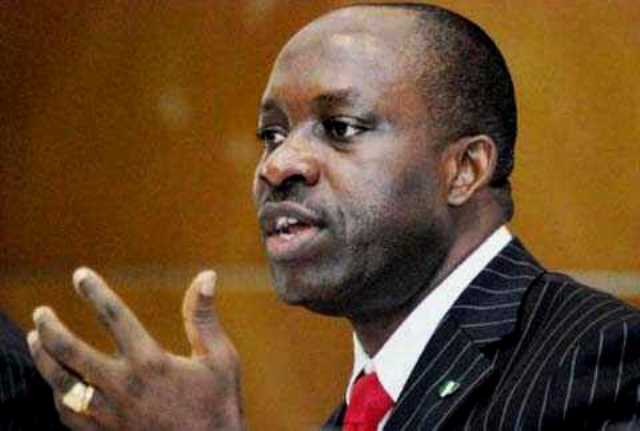
Prior to this official announcement, the Anambra State governor, Charles Chukwuma Soludo, had stated in his official Facebook account that the incumbent CBN governor, Godwin Emefiele, told him in a telephone chat that he had directed commercial banks to dispense the old currency notes and also receive same as deposits from customers following the outcome of a Bankers Committee meeting on March 12, 2023.

Apart from Soludo’s revelation, the Presidency had also told the CBN in an official statement issued earlier today and signed by Garba Shehu, the Senior Special Assistant on Media to President Buhari, to obey the Supreme Court judgment on extension of the validity of the old notes.

Notably, The ICIR had written several reports that revealed drag-down of businesses and economic activities, on the back of the currency redesign policy of the apex bank, while calling on the CBN to rescue the economy.

Last week, for instance, The ICIR reported how businesses had been hit by problems arising from weak banking applications, as online transactions suffered long delays and, in many cases, absolute failure.

The CBN had last October announced it would be redesigning the N200, N500 and N1,000 notes. The new notes were introduced into the system on December 15, 2022, with the CBN initially setting January 31, 2023 as the deadline, as legal tender, for the old notes being rested.

One of the reasons the CBN gave for its naira redesign decision was its resolve to strengthen Nigeria’s cashless economy.

But the policy has brought so much agony to individuals, families and businesses as the new notes have remained scarce. The CBN has not helped matters with its decision somersaults on the swap of the old with the new.

With the new directive, analysts say businesses would gradually have a breathe of fresh air.

“I will have to observe the market by tomorrow to see the market reactions and how businesses will adapt to the development,” a point-of-sale merchant, Ikenna Nosike, told The ICIR.


FAAN shuts Lagos airport runways for maintenance

FEDERAL Airports Authority of Nigeria (FAAN) has informed of plans to close runways 18R and 36L at the Murtala Muhammed International Airport (MMIA) in Lagos for maintenance.

FAAN confirmed this development in a tweet today.


READ ALSO:
FAAN: Lagos domestic runway reopens after repairs

FAAN apologises as power outage leaves passengers stranded at Lagos airport

FAKE NEWS: FAAN debunks reports of Lagos plane crash


“The Murtala Muhammed International Airport, Lagos Runway 18R/36L is closed for maintenance effective 11th March for a period of 8weeks, while Runway 18L/36 remains open to full flight operations,”@FAAN_Official said in a tweet.

“We request the kind understanding and cooperation of all our stakeholders towards achieving this very important safety/security objectives,” it added.

The agency said work on the runways would span eight weeks.

It also assured that the normal airlines’ activities would not be affected, as taxiway B-18L would be used for all flight operations.

In June 2022, the agency had closed runways 18L/36R of the MMIA for 90 days for renovation.

During the period the runways were closed, airline operators said they incurred huge losses due to the shut-down, despite assurances by FAAN that operations would not be affected.

CBN remains silent despite Soludo’s revelation on use of old notes

THE Central Bank of Nigeria (CBN) is yet to issue an official confirmation that Nigerians can spend both the old and new N500 and N1,000 notes, as stated by the Anambra State governor, Chukwuma Soludo. 

Soludo, a former CBN governor, had stated in his official Facebook account that the incumbent CBN governor, Godwin Emefiele, told him in a telephone chat that he had directed commercial banks to dispense the old currency notes and also receive same as deposits from customers following the outcome of a Bankers Committee meeting on March 12, 2023.


READ ALSO:
Naira redesign: Buhari courting anarchy by ignoring Supreme Court – ACF

Naira redesign: CBN’s silence on Supreme Court judgment worsens Nigerians’ economic woes

Yahaya Bello threatens to arrest residents rejecting old naira notes in Kogi

Abuja residents reject old Naira notes over Buhari, CBN’s silence on court ruling


There, however, has been no indication that Emefiele had, indeed, issued any directive to that effect as  commercial banks were today still rejecting the old N500 and N1000 notes, neither had they resumed loading their automated teller machines (ATMs) with them.

Emefiele’s refusal to issue an official instruction to banks and the general public to transact in the old notes is a brazen shun of the judgment of the Supreme Court, which ruled on March 23 that the old N500 and N1,000 notes shall remain legal tender till December 31, 2023.

Checks by The ICIR showed that where commercial banks were even ready to issue the old notes, they would not accept them from any customer.

With the new notes very scarce to effect daily transactions, Nigerians have been finding survival difficult. Sourcing few naira notes to live on has been further impoverishing the poor, as point-of-sale operators have been compelling them to pay, for example, as high as N300 to get a sum of N1,000.

Some banks were, however, seen paying out the new notes, though sparingly. An Access Bank branch in Kubwa, the Federal Capital Territory, was seen today paying customers N2,000 each.

In major markets across the country, traders were rejecting the old notes.

At the busy Computer Village in Ikeja, Lagos, a mobile phone accessories dealer, Kenneth Udeh, said, “Nobody is accepting the old notes.”

The ICIR had reported the difficulties businesses had been going through to sustain their businesses amid the cash crunch occasioned by the currency redesign policy.

Some state governors that included Nasr el-Rufai of Kaduna State, Babajide Sanwo-Olu of Lagos State and Soludo himself had issued statements directing their people to transact in the old notes, and even threatening to punish anybody who rejected them.

The Anambra State governor called on residents to report any bank that refused to accept deposits of the old notes.

“Anambra State Government will not only report such a bank to the CBN, but will also immediately shut down the defaulting branch,” Soludo added.

But the people, especially traders, would rather wait for Emefiele’s statement to give the all clear rather than obey the governors as they fear being stuck with the old notes if they collected them.

In Lagos State, where Sanwo-Olu issued a statement today that residents can spend and trade in the old notes, caution is still the word.

“I can’t accept the old notes because nobody will accept them from me. Even banks won’t accept them from me,” a foodstuffs dealer at the Ojuwoye market, Mushin, Adewole Badru, told our correspondent.

Badru added, “Sanwo-Olu’s statement to Lagosians to accept the old notes cannot work because he is not the CBN governor.”

Naira redesign: CBN, AGF have no reason to disobey Supreme Court – Presidency

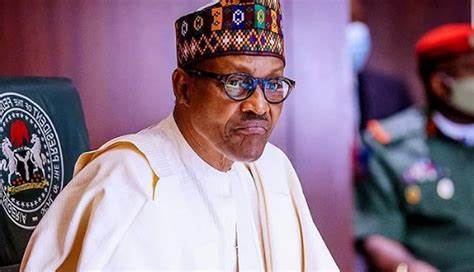
PRESIDENT Muhammadu Buhari has cleared the air on the raging controversy trailing the Supreme Court judgment nullifying the naira redesign policy, saying the Central Bank of Nigeria (CBN) and the Attorney-General of the Federation (AGF) Abubukar Malami, should not wait for him to implement the ruling.

Buhari said he had never directed any of his officials or institutions of government to disobey court orders since he became President on May 29, 2015.


READ ALSO:
Naira redesign: Buhari courting anarchy by ignoring Supreme Court – ACF

Naira redesign: CBN’s silence on Supreme Court judgment worsens Nigerians’ economic woes

CBN remains silent despite Soludo’s revelation on use of old notes


A statement signed by his special assistant on media and publicity, Garba Shehu, on Monday, March 13, said Nigeria could not practice democracy without the rule of law, noting that his administration’s commitment to this principle remained sacrosanct.

“The CBN has no reason not to comply with court orders on the excuse of waiting for directives from the President. 

“President Buhari has also rejected the impression that he lacks compassion, saying that “no government in our recent history has introduced policies to help economically marginalised and vulnerable groups like the present administration,” part of the statement stated.

However, while vindicating himself, Buhari said it remained debatable if there was proof of willful denial by the CBN and the Attorney-General on the Supreme Court ruling.

The ICIR reports that since the Supreme Court declared the naira redesign a nullity, commercial banks have waited for either the President or the CBN to speak on the ruling.

The ICIR further reports that with the President’s reaction, commercial banks are expected to disburse the old N500 and N1,000 notes, thus ending weeks of suffering by Nigerians, who have battled to get a few naira notes in bank outlets and point-of-sale operator’s shops and have failed to get any in many instances.

The statement issued by the Presidency on Monday noted that it is “an established fact that the President is an absolute respecter of the judicial process and the authority of the courts. He has done nothing in the last eight or so years to act in any way to obstruct the administration of justice, cause a lack of confidence in the administration of justice, or otherwise interfere or corrupt the courts and there is no reason whatsoever that he should do so now when he is getting ready to leave office”.

The statement said the negative campaign and personalised attacks against the President by the opposition and all manner of commentators were unfair and unjust, as, according to the Presidency, no court order at any level has been directed at him.

“As for the cashless system the CBN is determined to put in place, it is a known fact that many of the country’s citizens who bear the brunt of the sufferings, surprisingly support the policy as they believe that the action would cut corruption, fight terrorism, build an environment of honesty and reinforce the incorruptible leadership of the President. 

“It is therefore wide off the mark to blame the President for the current controversy over the cash scarcity, despite the Supreme Court judgment.”

 The ICIR reported how the Supreme Court nullified the currency redesign on March 3, after governors elected on the platform of the ruling party – the All Progressives Congress (APC), approached the court to declare the policy nullity.

Buhari authorised the policy, which the CBN said made the old notes cease to be legal tender from February 10.

In one of its many reports on the hardship the policy has brought to people in the country, The ICIR reported how Nigerians went nude, fought in banks and engaged in other habits that counted as offences when things were normal. 

Though Buhari directed that the old N200 notes be returned into circulation in a nationwide broadcast on March 8, the Supreme Court’s judgment of March 3 nullified the policy. The court ordered that new and old notes be legal tender until December 31, 2023.

While most banks await Buhari and the CBN’s reaction to the judgment, some banks issue the old notes, but many citizens reject them because the government did not authorise their use.

Zamfara, Ekiti, and Kogi governors are among the states that threatened to arrest and prosecute anyone who rejects the old money.

On Sunday, March 12, The ICIR reported how the Arewa Consultative Forum warned that the President was courting anarchy with his silence on the court ruling.