Home Blog Page 14

Rise Networks launch AI for elections hackathon across Nigeria 

0

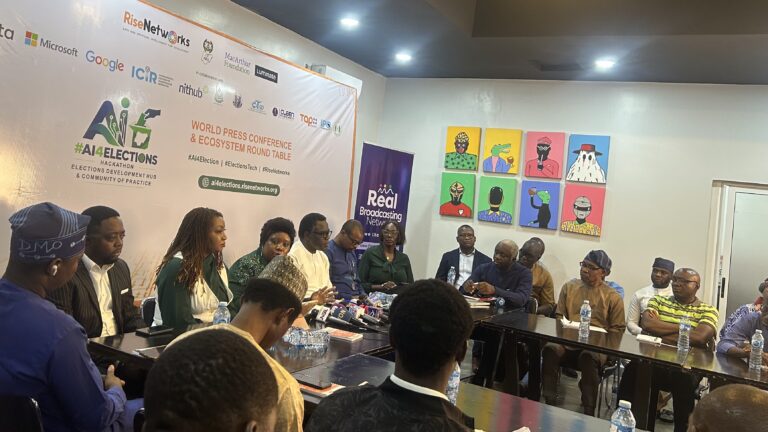
RISE Networks, a Nigerian Artificial Intelligence (AI) for development organisation, has launched its AI for Elections Programme, a pioneering initiative designed to harness technology for a more credible and inclusive electoral process.

Speaking at the launch in Abuja on Thursday, October 22, the organisation’s Chief Executive, Toyosi Akerele-Ogunsiji, a doctorate holder, said the programme would run in three phases and was open to all Nigerians 18 years and above.

She said the first phase would be a hackathon, a national innovation programme that would bring together young developers, researchers, students, entrepreneurs and technology innovators to develop responsible AI solutions to address real challenges in Nigeria’s electoral and civic information ecosystem.

“Whether you’re a software developer, elections expert, public policy analyst, journalist, or AI technologist, you are welcome to participate,” she said.

Akerele-Ogunsiji said the hackathon would close on November 12, after which finalists would be selected and supported by global technology partners including Meta, Microsoft, and Google, ahead of the grand finale in Lagos on December 16.

The second phase, she said, would establish an AI4Elections Development Hub, a physical world-class facility equipped with GPUs, microcontrollers, and advanced sensors.

She added that the hub would provide Nigerian developers the tools to build globally competitive hardware and software solutions but stressed that it would not interfere with the Independent National Electoral Commission (INEC)’s infrastructure in the forthcoming elections.

The convener said the third phase would create an AI4Elections Community of Practice, bringing together Nigerians worldwide to contribute to electoral innovation.

“Elections belong to the people. They are not just a government or civil society conversation,” she noted, adding that the community would serve as a think tank to support INEC and government in co-creating credible, people-centred electoral processes.

While acknowledging the International Centre for Investigative Reporting (The ICIR) and other organisations as partners, Akerele-Ogunsiji said the Hackathon itself would cover five thematic tracks.

She outlined them as “Trustworthy electoral information and special intelligence, electoral data analysis and decision-making support, inclusive and multilingual civic technology, electoral cybersecurity and resilience, and election observation and citizen accountability.” She mentioned that an optional cross-cutting area would focus on climate resilience and environmental innovation.

Earlier, while emphasising inclusivity and diversity, Akerele-Ogunsiji noted that solutions must reach Nigerians across diverse communities and languages and emphasised the importance of strong cybersecurity standards to ensure Nigeria’s electoral data remains within national jurisdiction.
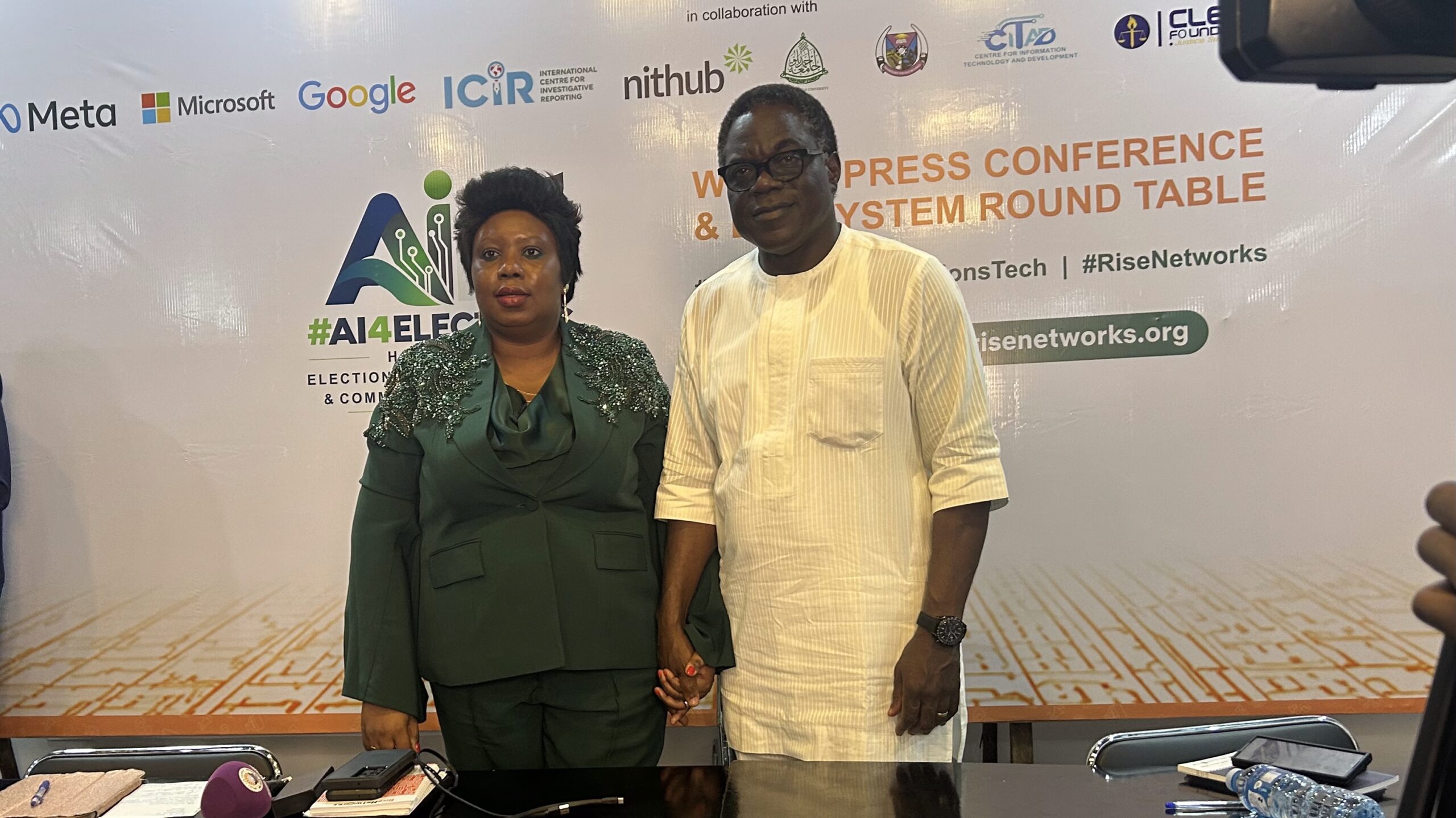
Chief Executive, Rise Networks, Dr Toyosi Akerele-Ogunsiji, with INEC Head of ICT, Dr Lawrence Bayode at the launch of AI for Elections Programme in Abuja on Thursday, October 22

Also speaking, the Head of Information and Communication Technology at INEC, Lawrence Bayode, a doctorate holder, said the commission recognised that AI represents significant opportunities to improve electoral administration, which he said was why it had taken deliberate steps towards responsible AI adoption, including the establishment of an AI division within the commission’s ICT department as well as the development of an AI framework to guide responsible application in its operations.

Bayode explained that the commission was also exploring practical applications of AI in areas such as voter information services, electoral data management, operational efficiency and detection of disinformation and misinformation.

He described the deployment of AI in the election management system as an important area of innovation because it uses intelligent document processing to digitise polling unit result sheets and perform consistency checks between the figures entered on the BVAS and the scanned results before transmission.

“If the scanned form EC8a, which is the result, is consistent with the result entered on the machine electronically, then the system allows the result to be uploaded to IREV. But where we have discrepancies between what was entered electronically and the scanned results, then, that discrepancy has to be fixed before the result is allowed to be uploaded to the IREV. This is to ensure that the result we have on the IREV is the result that emanated from that polling unit, and also to improve accuracy and reduce human error and strengthen transparency,” he said.

He described the innovations as a demonstration of INEC moving from conversation around AI to practical implementation while maintaining human oversight, accountability and appropriate safeguards.

While commending Rise Networks, he said the AI4Election hackathon creates an opportunity to harness the creativity of young Nigerians in addressing real electoral challenges.

“We welcome innovations that can improve voter education, expand accessibility for persons with disabilities, breach language barriers, strengthen information integrity and make election information more accessible to citizens,” he said.

He, however, added that innovation must never come at the expense of electoral security, operational stability or public confidence.

Meanwhile, Meta’s Head of Public Policy for Anglophone West Africa, Sade Dada, said Meta had employed a strategy of removing, reducing and informing to counter disinformation.

“What this means is that we are removing content that causes any harm or has the risk of interfering with people’s ability to vote, reducing the distribution of false claims so they don’t go viral and informing and giving people context through our independent fact-checking networks,” she said.

Police warn officers, public against paying for bail

0

THE Nigeria Police Force has warned that officers who demand money for bail will face disciplinary action, while members of the public who pay for bail risks arrest and prosecution.

 The Head of the Complaints Response Unit (CRU), Force Headquarters, Abuja, Awu Fidelis, gave the warning during a sensitisation rally in Lagos on Friday.

The rally was organised by the CRU in partnership with the Eagle Crime Awareness and Prevention Initiative (ECAPI).

Fidelis. a superintendent of police, said the Inspector-General of Police, Olatunji Disu, had repeatedly emphasised that bail was free and that no money should be demanded or paid for the release of arrested persons.

He urged residents to report officers who demanded money for bail, stressing that both the giver and receiver would be arrested and prosecuted.

According to Fidelis, the partnership between the police and ECAPI is an important initiative towards rebuilding public trust, strengthening accountability and improving police-public relations.

He said complaints against police personnel were investigated and appropriate disciplinary measures taken against officers found culpable.

“The increasing number of people reporting misconduct through the CRU’s offices and communication channels indicated the growing public confidence in the complaint-handling process, ” he said.

He said members of the public could report police misconduct through the CRU’s telephone lines – 08057000001 and 08057000002 for calls, and 08057000003 for WhatsApp complaints – as well as its social media platforms.

Also speaking, the Officer-in-Charge of the CRU, Lagos State Command, Idris Mogaji, a deputy superintendent of police, said the unit had recorded successes in addressing complaints against police officers through prompt investigations and disciplinary measures.

“We keep the complainants informed about the progress and outcomes of investigations, including disciplinary decisions taken against officers found culpable,”he said.

He said the Commissioner of Police in the state, Fatai Tijani, had convened a meeting with officers to address concerns, including personnel using unregistered vehicles, particularly buses,

“The command has taken steps to ensure compliance with the directive and had acted on a recent incident involving some police officers,” he said.

He urged residents to report unprofessional conduct through 09111111151, 09111111150, the command’s social media platforms or written petitions to the CP, reaffirming the command’s commitment to accountability.

The founder of ECAPI, Samuel Eniola, said the organisation would extend its campaign on police accountability and crime prevention to communities, markets, motor parks and police formations across Lagos State.

Eniola said the campaign aimed to educate residents, particularly youths, on the functions of the CRU and how to report police misconduct.

He said the exercise would cover local government areas, communities, police stations, barracks, area commands, transport unions and other associations across the state.

According to him, .the campaign will also target police personnel to help improve their understanding of the CRU and its role in receiving and addressing complaints against officers.

Eniola said the ECAPI had begun engaging local governments and had received encouraging responses, adding that the outreach would continue across the state.

He identified the youths as key target, noting that sustained sensitisation was necessary to educate them on criminal behaviour and its consequences.

The ECAPI founder said community-based engagements would help reach young people who might not regularly have access to information through television, radio or newspapers.

He added that the initiative’s mandate extended beyond advocacy against police brutality. It also includes crime prevention, responsible behaviour and cooperation with law enforcement agencies to build a safer society and strengthen police-public relations.

In his remarks, Tijani, represented by the Deputy Commissioner of Police in charge of Administration, Anthony Placid, expressed the command’s support for the partnership.

He commended the leaderships of the CRU and the ECAPI, describing the collaboration between the police and advocacy organisations as timely and important for strengthening public trust.

Tijani said such cooperation could improve information sharing, promote accountability and enhance security at the community level.

The News Agency of Nigeria (NAN) reports that the sensitisation campaign featured roadshows, market outreach, distribution of information materials and demonstrations of the CRU’s complaint-reporting platforms. (NAN)

Atiku to Tinubu: You claim Nigerians love you, yet your billboards in Kaduna require security guards

0

FORMER Vice-President Atiku Abubakar has criticised President Bola Tinubu over the reported deployment of security operatives to protect his campaign billboards in Kaduna, questioning the government’s priorities amid persistent insecurity across Nigeria.

In a post on his social media account on Friday, October 23, Abubakar, the presidential candidate of the African Democratic Congress (ADC) in the January 16, 2027, election, reacted to a Daily Trust report that security personnel had been assigned to guard Tinubu’s campaign posters and billboards ahead of the planned flag-off of the All Progressives Congress (APC) presidential campaign in Kaduna on Saturday, October 24.

“Bola, you claim Nigerians love you, yet your billboards in Kaduna require security guards. Bandits raid villages, terrorists attack communities, and families live in fear. Your posters enjoy protection that millions of Nigerians can only dream of,” Abubakar wrote.

He described the situation as a tragic statement of Tinubu government’s priorities and urged the president to extend the same urgency to protecting Nigerians.

“Bola, please protect Nigerians with the same urgency you protect your image!” he added.

The ICIR reports that Daily Trust reported on Friday that personnel of the Kaduna State Traffic Law Enforcement Authority (KASTLEA) and the Nigeria Security and Civil Defence Corps (NSCDC) were among those assigned to protect Tinubu’s campaign billboards, particularly along major roads leading to the Kaduna Township Stadium, the venue of the expected rally.

According to the report, a security operative involved in the assignment said personnel had been directed to protect the billboards and posters from vandalism, particularly at night.

“We were assigned alongside KASTLEA marshals to protect Tinubu’s billboards and posters from being vandalised before the campaign rally. Our duty is mostly at night because that is when the youths can carry out such acts,” the operative was quoted as saying.

The source added that the assignment followed a circular issued by the unit directing some personnel to provide security for the campaign materials.

Tinubu is expected to be present at the campaign with other APC stalwarts, including governors.

The ICIR reports that Abubakar will face other candidates, including Tinubu and former Anambra State Governor and candidate of the Nigeria Democratic Congress (NDC), Peter Obi, in the election.

2027: INEC explains how AI will be deployed for elections

0

THE Independent National Electoral Commission (INEC) has explained how it will deploy Artificial Intelligence (AI) in the forthcoming general elections.

Over 103 million Nigerians are expected to go to the polls on January 16 in a highly tensed presidential election with incumbent President Bola Tinubu of the All Progressives Congress (APC) being challenged by two major rivals: former Vice President Atiku Abubakar of the Africa Democratic Congress (ADC) and former Anambra State Governor Peter Obi of the Nigeria Democratic Congress (NDC).

Explaining the practical steps INEC had taken, the commission’s Head of Information and Communication Technology, Lawrence Bayode, said AI would be deployed in result management to reduce errors.

The ICIR reports that a former National Commissioner of INEC, Okechukwu Ibeanu, had warned that the commission’s plan to deploy AI in election results management could undermine confidence in the 2027 polls if clear rules and safeguards are not established.

However, providing further insights, Bayode, a doctorate holder, who spoke at the launch of the AI4Elections Programme and Hackathon organised by Rise Networks in Abuja on Thursday, 22 October, said AI would be deployed to ensure only Form EC8A is uploaded to the INEC Result Viewing (IREV) portal. He said the system had been trained using election result sheets.

In the 2023 general election, he said, INEC discovered that many inappropriate pictures found their way into the portal. “We saw images of buildings and other things. Now, only the form EC8a will find its way on IREV,” he said.

Secondly, Bayode said AI would be deployed to check discrepancies between data entered in the Bimodal Voter Accreditation System (BVAS) and the uploaded result. He said the system would flag any inconsistencies between the results entered on the BVAS and the scanned result being uploaded to IREV.

“Therefore, if there are discrepancies, they must be resolved before the results can be uploaded,” he said, adding, “We are deploying AI for consistency between the scanned result and BVAS. We piloted this during the Ekiti and Osun elections.”

Responding to a question on the legality of using AI ahead of the country’s elections, Bayode said, “AI is a technology and the law allows the use of technology. An example is the BVAS machine and IReV. They are technologies.”


Actors Guild, fans mourn late Nollywood veteran Francis Duru

0

THE National President of the Actors Guild of Nigeria (AGN), Abubakar Yakubu, has mourned veteran Nollywood actor Francis Duru, describing his death as an immeasurable loss to the creative sector.

The family of the actor announced his passing in a statement posted on his verified Instagram account, saying he died after a brief illness.

Speaking with the News Agency of Nigeria (NAN) on Friday, the AGN helmsman described Duru as “an iconic actor, a revered veteran and an exceptional practitioner”.

“Beyond his remarkable performances, he was a mentor and inspiration to generations of practitioners. He nurtured emerging talents, leaving behind not only a remarkable body of work, but also a legacy of excellence, discipline and professionalism,” he said.

Yakubu said Duru’s contribution to the growth and development of the Nigerian movie industry would remain a lasting reference point for practitioners.

“Indeed, Francis has written his name on the sands of time. His artistic legacy transcends generations,” he stated.

The AGN president expressed condolences to Duru’s family, praying that God would grant them the strength to bear the loss.

“We mourn him, and we pray that God will grant the family the fortitude to bear this irreparable loss,” Yakubu added.

Duru’s death has continued to generate frenzy on social media platforms, with fans across Nigeria and beyond pouring in condolence messages and tributes.

On X, @Happy wrote, “Rest in peace, Francis Duru. This is a real reminder that none of us is promised tomorrow. Thank you for the memories on screen”.

@Jay commented, “I always saw him at Family Worship Church here in Abuja. A very jovial and down-to-earth guy. God rest his soul”.

@BhurteeFFS! wrote, “God rest his soul. He made our childhood, mehn”.

@Enebeli commented, “Terribly saddened to hear of his demise. I remember him most as Ahanna in ‘Rattle Snake’. An enormous talent. Rest in peace”.

@ReallyChiggy wrote, “An era is ending. Only a few are remaining. The generation that gave Nollywood a face is going really fast, I pray for Duru’s soul to rest in peace”.

@Mafia Boss said, “Life expectancy is now 55 years? Then we need to develop this country and improve healthcare for people to live longer”.

@Madam Gist wrote, “We should endeavour to monitor our health. May the Lord comfort his family”.

@Obi said, “And all this struggle for a day that can be taken away from us anytime”.

NAN reports that Duru, born on July 27, 1969, hailed from Imo State. He studied Theatre Arts at the University of Port Harcourt in Rivers State.

Duru debuted in the Nigerian movie industry in 1989 with a movie titled Missing Mark, and  came to limelight  after featuring in the 1995 acclaimed  action-comedy ‘Rattlesnake,’  playing  the character ‘Ahanna’.

He featured in many Nollywood films and won several awards, including the Best Actor in a Leading Role (Igbo) at the 2020 Best of Nollywood Awards for his role in ‘Mboputa’.

Besides acting, Duru also worked extensively with local and international NGOs in order to ensure that African children have a better education and a higher standard of living.

In 2007, he received the United Nations Ambassador of Peace award for his positive influence on the youths.(NAN)

Kaduna police criticise media over coverage of journalist Farida Isiak’s arrest

0

THE Kaduna State Police Command has criticised the media for covering and amplifying the case involving Farida Isiak, a journalist with Nagarta Radio, Kaduna, following allegations of arbitrary arrest, detention, and immediate sentencing. 

In a press statement issued by its spokesperson, Mansur Hassan, the command said the matter arose from a Facebook post in which Isiak criticised the Nigeria Police Force and the DPO, making comments he claimed referred to the officer’s wife.

“The Command wishes to state that the matter arose from a social media post made by the journalist on her Facebook page, containing statements directed at the Nigeria Police Force, the police officer concerned, and his family,” Hassan said.

The police spokesperson claimed that the post included the following words: “THE POLICE FORCE IS FUCKED UP THAT’S WHY THEY DON’T END WELL. I’M GOING TO TAG YOU TO THIS POST SO YOU KNOW I’M TALKING ABOUT YOUR WIFE, NOT SO SORRY TO SAY, YOU MARRIED WRONG. MARABAN JOS DPO, I’M NOT SORRY TO SAY, YOU’VE FAILED AS A LEADER.”

However, a review of the original screenshot of the post obtained by The ICIR indicates that the police misrepresented the content of the post in their statement.

The ICIR reports that in the original post, Isiak tagged one Abdulmudallib Abubakar, whom she identified as the husband of the neighbour accused of orchestrating her mother’s initial arrest. She maintained that although the post referenced the Police and the DPO, it was made in the context of ongoing disagreement between her mother and Abubakar’s wife as well as what she described as the poor handling of the matter by the police in Maraban Jos, Kaduna.

In the original post sighted by the ICIR, Isiak wrote: “I don’t know settling conflict between people of Maraban Jos now has to do with who has some so-called money and who doesn’t. The police force is so fucked up that’s why they don’t end well. I’m going to tag you to this post, so you know I’m talking about your wife, not so sorry to say, you married wrong. Maraban Jos DPO, I’m not sorry to say you’ve failed as a leader. Anyways, thank God for Education,” she wrote.

The ICIR reported that the post had triggered the arrest of her parents. The journalist was then forced to delete the Facebook post, apologise to the DPO, Usman Adamu, before her parents were released.

Isiak was then detained and taken to a sharia court the following day, where she was sentenced to four years in prison or a fine of N1.75 million without legal representation.

The ICIR had earlier contacted the Kaduna Police PRO, Hassan, via phone and text messages to verify the details, but he ignored them.

In his latest statement, Hassan failed to provide details on the circumstances of the alleged detention, including why her parents were taken into custody, the legal basis for their detention and the conditions attached to their release. He also did not specifically address allegations that deleting the Facebook post was made a condition for her parents’ release.

Instead, he described media publication of reports alleging arbitrary arrest, detention and hasty sentencing as concerning, arguing that the incident should not be portrayed solely as an attempt to silence the media without a comprehensive assessment of the facts.

“The Command, however, expresses concern over publications that condemn the Police without adequate verification of the facts or efforts to obtain the Command’s position. Such reporting risks presenting an incomplete or misleading account of events and may unfairly damage the reputation of the Police and the individuals involved,” he said.

Amnesty International had since condemned the arrest, detention and sentencing of Isiak, describing the proceedings as vindictive and a travesty of justice.

The organisation, in a statement on Wednesday, urged the Nigeria Police Force to launch a full and independent investigation into the conduct of the officers involved in the alleged detention of Isiak and her parents.

Amnesty International further called on Nigerian authorities to stop using defamation charges and the courts to harass journalists and restrict press freedom.

As of Wednesday, the journalist told reporters that the judge had revoked his judgment and she has been released on bail, while the case is scheduled for November 3.

Reps introduce FCT Rent Regulation Bill to curb hikes, protect tenants

THE House of Representatives has introduced the Federal Capital Territory (FCT) Rent Regulation and Tenants’ Protection Bill, 2026, seeking to address rising accommodation costs and strengthen protections for tenants in Abuja.

The bill, sponsored by the lawmakers representing Enugu East/Isi-Uzo Federal Constituency and Bindawa/Mani Federal Constituency of Katsina State, Paul Nnamchi and Ahmed Doro, respectively, on Thursday seeks to regulate rent payments, curb arbitrary rent increases and establish mechanisms through which tenants can seek redress when landlords violate prescribed rental rules.

The bill comes amid growing concerns over the cost of accommodation in the FCT, where tenants frequently face demands for one or two years’ rent upfront, placing considerable pressure on households already struggling with the cost of living.

One of the proposed measures would prohibit landlords, property managers and estate agents from demanding more than 12 months’ rent as a condition for granting or renewing a tenancy.

The bill also seeks to prevent landlords and their agents from circumventing the proposed restriction through compulsory service charges, separate agreements, artificial tenancy renewals or other arrangements designed to compel tenants to pay more than the permitted advance rent.

However, tenants would be allowed to voluntarily pay for a period exceeding 12 months if they initiated the arrangement without coercion, threats, discrimination or retaliation, provided the agreement and payment were documented in writing.

The proposal also provides for written tenancy agreements before or at the commencement of a tenancy. Such agreements would specify the rent payable, payment schedule, duration of the tenancy, refundable deposits, additional charges and the respective rights and obligations of landlords and tenants.

The bill seeks to establish the Federal Capital Territory Rent Regulation and Tenants’ Protection Authority to monitor compliance, investigate complaints and facilitate the resolution of landlord-tenant disputes.

The proposed authority would also have the power to order refunds of unlawful rental payments. Where a tenant has paid rent in violation of the proposed law, the authority could direct a refund within 30 days of serving the relevant order.

If enacted, the legislation would provide tenants with a more structured avenue to challenge unlawful rental demands instead of relying solely on negotiations with landlords or pursuing disputes through the courts.

For many residents of Abuja, the proposed law could provide relief from the pressure of raising large sums of money before securing or retaining accommodation.

The ICIR reports that rent has remained a huge challenge for residents of the FCT where many people battle with homelessness.

The city is responsible for, at least, 10 per cent of the housing deficit in the country, which stands at 17 million, with the likelihood of the figure increasing to 22 million by 2030, according to experts.

The high cost of rent is a factor in the housing deficit in Abuja, which has left many houses in the city unoccupied, with many residents living in slums, or worse, homeless.

These empty houses can be found littering the highbrow areas of the city, priced beyond the reach of average residents, and rotting away in large quantities.

The latest bill follows years of concerns over rising rents in the FCT and calls for stronger government intervention in the rental market.

In October 2025, the House of Representatives adopted a motion urging the Federal Government to work with state governments to regulate rent increases and consider capping annual increases at no more than 20 per cent of existing rent.

The motion, sponsored by Bassey Akiba, highlighted sharp rent increases in areas benefiting from public infrastructure, including roads and other amenities.

Housing advocates have also called for a more comprehensive tenancy framework for Abuja, arguing that existing rules focused on recovering possession of rented premises do not adequately address wider issues such as rent-setting, advance payments and accessible dispute resolution.

A September 2026 policy brief by the Heinrich Böll Stiftung and HipCity Innovation Centre identified the absence of a comprehensive tenancy framework in the FCT as a regulatory gap contributing to excessive advance rent demands, exploitative practices and limited access to affordable dispute resolution.

The proposed legislation therefore represents a further attempt to establish clearer rules governing the relationship between landlords and tenants in the nation’s capital.

Daily Trust Foundation to launch Journalism Academy

DAILY Trust Foundation (DTF), the non-profit arm of Media Trust Group, has announced plans to launch a journalism academy aimed at strengthening professional training and development for journalists across Nigeria.

According to a statement issued by the Foundation’s Programme Director, Theophilus Abbah, the DTF Journalism Academy will be officially launched on Tuesday, October 27, 2026, at the Media Trust Group premises in Abuja.

The Guest of Honour at the event will be Kole Shettima, a doctorate holder and Africa Director, MacArthur Foundation.

The Editor-in-Chief of Premium Times and President of the International Press Institute (IPI), Nigerian Chapter, Musikiliu Mojeed, will give the keynote address, according to the statement.

It added that the initiative would provide journalists with opportunities to improve their skills through seminars, workshops, conferences, webinars and other capacity-building programmes organised in collaboration with local and international organisations.

“Our goal is to provide journalists with the tools and knowledge they need to thrive in a rapidly evolving media environment,”  the foundation stated.

It said that as part of the launch, the DTF would also unveil a free digital learning platform offering courses in media and communication to support continuous professional development among journalists.

“This innovative platform has been developed in partnership with Bayero University, Kano, and will serve as a hub for continuous learning and professional growth.

“The Academy is a registered member of the Nigerian Institute of Training and Development (NITAD), underscoring its commitment to global standards in training and development,” he added.

The foundation said the academy would build on its journalism training and capacity-building efforts since its founding in 2017, adding that with support from the MacArthur Foundation, it had trained more than 2,000 journalists across Nigeria in various aspects of journalism, while also implementing humanitarian initiatives and other capacity-building programmes.

The launch marks a new phase in the foundation’s efforts to strengthen journalism practice and build media capacity in Nigeria, particularly as journalists contend with changes in technology, news production and audience engagement.

How Kaduna court jailed journalist for 4 years after posting about her parents’ detention

A DISPUTE over N100 in change from a charcoal sale escalated into a police case, leaving 23-year-old journalist Faridat Isiak facing a four-year prison sentence after she criticised the handling of her mother’s arrest on Facebook.

She was also given the option of paying a N1.75 million fine by the court.

The journalist, who reports for Nagarta Radio and lives in Mararaban, Jos, Kaduna State, recounted her experience in an exclusive interview with The ICIR on Thursday. She said she witnessed the confrontation on Sunday, October 18, after her neighbour’s child returned with N100 instead of the N200 change her mother expected.

“My mum sells charcoal. They came because they wanted to buy charcoal, and she didn’t have change. So, she asked the girl to go with the money and bring N200 back for her when they changed the money. After some minutes, the girl brought back N100. So, my mom was like, ‘Why N100?’ She said her money was N200.”

According to Faridat, the neighbour insisted that her mother was owed N100. However, her mother explained that she had given the N100 to the neighbour’s sister about two months earlier and asked that she be contacted to clarify the matter.

The neighbour allegedly refused to accept her explanation, and the disagreement escalated into an exchange of insults. She explained that the neighbour later met her mother at her husband’s hospital and allegedly continued to abuse her.

The woman insulted her mother again on Tuesday, October 20, when her mother returned to the hospital to visit a sick child, she further stated.

“On Tuesday, I went to work. I got a call from my dad. He asked if I knew that my mum had been arrested. I said,  arrested for what? My dad said the woman and her elder sister came in with sticks and they wanted to beat her,” she recalled.

Isiak said the neighbour called in the police to arrest her mother and detain her at the Mararaban Jos police station, where she was later told that the dispute should be resolved at home.

“My mum said immediately the woman’s husband came, and they were asking my mum to get bailed out; he paid the sum of N35,000 and bailed my mum,” she added.

She said her mother explained that she was not allowed to tell her side of the story despite the neighbour threatening her in the presence of the police.

However, the journalist said it hurt her that her mother was not treated fairly and decided to share the experience in a Facebook post.

“My dad called me and said, ‘You were insulting the DPO of Police.’ I said no. I explained that the post was intended to express my disappointment over how the dispute had been handled, and it was aimed at our neighbour’s husband, not the DPO.”

Isiak alleged that the neighbour’s husband took a screenshot of the post and sent it to the DPO, Usman Adamu, claiming that she had insulted the police officer.

“The police then came back that day and rearrested my mum since they couldn’t find me. They said if I heard that my mum was detained, I would come. My dad went to bail my mum, but the DPO said they should detain my dad too,” Isiak said.

She said the decision prompted her to report herself at the police station around 10 pm on Tuesday, adding that she was asked to apologise to the DPO and explain why she published the post.

“I apologised to him that the post was not intended for him. I did not call him names. Then the next question was, ‘Who sent you? Who asked you to make a post like that? I am very sure it is not your doing. Someone at the top was asking you to do this.’ I told the officer that nobody sent me.”

The journalist alleged that the police forced her to delete the Facebook post before her parents could be released.

The ICIR contacted the Kaduna State Police Public Relations Officer, Mansur Hassan, via phone calls and text messages to verify the details. However, the messages had not been answered, and the calls had not been returned as of the time of filing this report.

Four years in prison or N1.75 million 

Isiak said she spent the night at the police station before she was taken to a Sharia Court in Kawo on Wednesday, October 21. She alleged that the proceedings moved swiftly and that she was not represented by a lawyer when she first appeared before the court.

“It was around 4 pm that I was taken to Sharia court in Kawo. I did not have a lawyer. When they asked me if I wrote the post, I said yes. The prosecutor said that I did it intentionally. He then asked if I went to school. I said yes. I told him that I am a graduate. He spent like minutes writing. Then, the next thing he was like, “This is a sentence,” she recalled.

According to her, the judge remarked that her education meant she should have understood the implications of publishing material capable of defaming someone, noting that he sentenced her to four years’ imprisonment or a fine of N1.75 million.

She also alleged that her sister, a lawyer, attempted to inform the prosecutor that the family had legal representatives, but the information was not conveyed to the judge before the judgment was delivered.

The judgment raised questions about the circumstances of the proceedings, particularly whether Isiak was allowed to get counsel.

Amnesty International immediately condemned the arrest, detention and sentencing of Isiak, describing the proceedings as vindictive and a travesty of justice.

In a statement on Wednesday, the human rights organisation alleged that authorities in Kaduna State targeted Isiak for criticising police conduct following the dispute between her mother and a neighbour.

Describing the proceedings as a sham trial, Amnesty International said the sentence disregarded the alleged misconduct that preceded the journalist’s arrest.

The organisation called on the Kaduna State Police Command and Nigerian judicial authorities to release Isiak, drop the charges against her and cancel the fine imposed by the court.

It also urged the Nigeria Police Force to launch a full and independent investigation into the conduct of the officers involved in the alleged detention of Isiak and her parents.

The organisation further called on Nigerian authorities to stop using defamation charges and the courts to harass journalists and restrict press freedom.

The ICIR reports that Section 36 of Nigeria’s Constitution guarantees fair hearing and provides that a person charged with a criminal offence is entitled to defend themselves in person or through legal practitioners of their choice.

Lawyers intervene as initial judgment is revoked

The case took another turn after lawyers intervened following the initial judgment, as the lawyers returned with her to the judge, who asked whether she understood the charge and whether she pleaded guilty or not guilty.

“The lawyers went to meet him, and they talked things through. So, the judge asked me whether I understood what I was being charged of. I said yes. Did I plead guilty or not guilty? I said I am not guilty. The judge then said he revoked his judgment that I should bring the guarantor who will stand for me,” she said.

She said she would provide the guarantor who would stand for her, with a further court appearance scheduled for November 3.

Ebola: Keyamo orders no-fly list for 46 contacts of infected diplomat

0

THE Minister of Aviation and Aerospace Development, Festus Keyamo, has directed the Nigeria Civil Aviation Authority (NCAA) to notify local and international airlines to place 46 people who had contact with Nigeria’s confirmed Ebola patient on a no-fly list for 21 days.

Keyamo gave the directive following a virtual meeting on Wednesday with the Coordinating Minister of Health and Social Welfare, Muhammad Ali Pate, to discuss measures to contain Nigeria’s first confirmed Ebola case since 2014.

In a statement, the aviation minister said Pate briefed him on the contact-tracing exercise and the need to prevent the potential spread of the virus.

“Whilst efforts are ongoing to isolate them for now until there is certainty they had not been infected with the virus, the aviation authorities are required to put them on a no-fly list for at least 21 days,” Keyamo said.

The ICIR reported that the patient tested positive for the Bundibugyo strain of Ebola virus disease following laboratory confirmation on October 20.

According to Nigeria Centre for Disease Control and Prevention (NCDC) the woman travelled from Uganda to Nigeria, with symptoms reportedly beginning on October 7, four days after her arrival. She sought medical attention at a private health facility in Abuja on October 11.

NCDC indicated that the patient was initially treated for malaria-like symptoms, noting that her condition failed to improve, prompting doctors to investigate further after reviewing her travel history. The centre said that the woman’s condition had deteriorated into multi-organ failure.

Pate had earlier confirmed that the patient was in isolation and receiving medical care, while health authorities intensified contact tracing and other containment measures.

However, Uganda’s Ministry of Health clarified that the patient is Nigerian and that her travel through the East African nation did not establish that she contracted the virus there.

It noted that the woman had travelled to the eastern Democratic Republic of the Congo (DRC) for business before transiting through Uganda in early October.

The Ugandan government said the woman reportedly showed no symptoms while in the country but developed symptoms after arriving in Nigeria.

Keyamo in his latest statement said that the health minister identified 46 people who had come into contact with the patient.

“He shared with me a list of 44 persons with whom the affected person came in contact at the hospital when she had developed the symptoms and an additional two persons who are her domestic staff,” he stated.

The minister said arrangements were underway to isolate the contacts while health authorities determine whether they had contracted the virus.

“I have therefore directed the NCAA to immediately inform all local and international airlines of this development,” he said.

Keyamo also directed the Federal Airports Authority of Nigeria (FAAN) to strengthen Ebola surveillance and response measures at all international airports.

He said existing measures included enhanced health screenings, temperature checks, travel history tracking, digital health declarations and closer coordination with the NCDC following regional outbreak alerts.

The WHO has confirmed that the patient was infected with the Bundibugyo virus, a strain for which no approved vaccine or specific treatment is currently available.

The organisation said investigations were ongoing to determine the likely source of infection and reconstruct the patient’s travel and exposure history.

It added that the WHO and other partners were supporting Nigerian health authorities with case investigations, contact tracing, infection prevention and control, and the provision of essential supplies, including personal protective equipment for health workers.

The agency has also urged countries in the region to strengthen disease surveillance, laboratory testing, rapid-response capacity and monitoring at points of entry.

Ebola spreads through direct contact with the blood or other bodily fluids of an infected person who is symptomatic, or with contaminated materials. Its incubation period ranges from two to 21 days, making the identification and monitoring of exposed persons essential to preventing further transmission.

The ICIR reported that Nigeria previously contained an Ebola outbreak in 2014 after an infected traveller introduced the virus into the country. The response relied on isolation, contact tracing and coordinated public health interventions.

For the current outbreak response, authorities are prioritising the monitoring of identified contacts, strengthening infection prevention measures at the health facility where the patient received treatment, and maintaining heightened surveillance at airports and other points of entry.