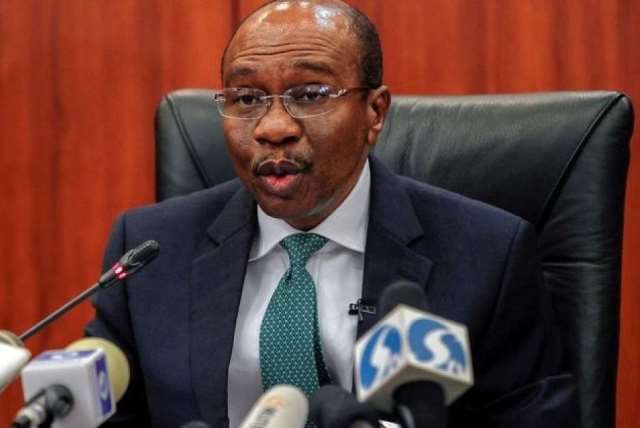
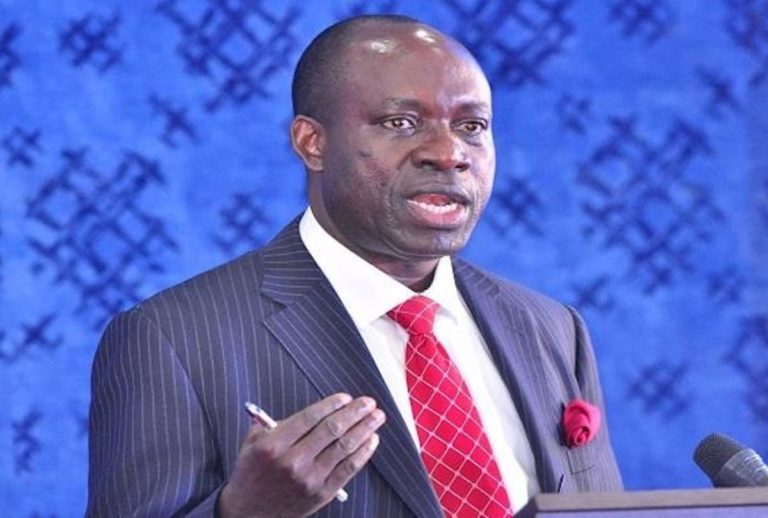
A former Governor of the Central Bank of Nigeria (CBN) Charles Soludo has emerged as the governorship candidate of the All Progressives Grand Alliance (APGA) in Anambra State.
He was announced the winner of the party’s primary held in Awka, the state capital, on Wednesday.
Soludo polled 740 out of 792 votes cast in the election to defeat other contestants, including his closest rival Ezenwankwo Christopher, who polled 41 votes.
Other aspirants in the election are ThankGod Ibe and Okolo Chibuzor, who got four and seven votes, respectively.
In his acceptance speech, Soludo thanked God and promised to consolidate the achievements of the outgoing administration of Willie Obiano, the state governor.
“It is with humility, gratitude and total submission to the will of God that I hereby accept your nomination as the gubernatorial candidate of APGA in the November 6 governorship election,” he said.
“I want to thank the Alpha and the Omega, who in his infinite wisdom, decided that I should come from Anambra State of Nigeria. In gratitude to Him, I will devote every moment of my remaining life on earth to serving Him by working hard to leave here better than I met it”.
He will represent the party in the governorship election scheduled to hold on November 6.
Soludo’s election was endorsed by incumbent governor Obiano, who is the party’s Board of Trustees Chairman. Obiano congratulated party members for the peaceful conduct of the primary, adding that Soludo’s emergence shows that APGA party remains a united family.
But a factional national committee of the party led by Jude Okeke had accused the Victor Oye-led faction which organised the primary election won by Soludo of alleged refusal to submit the statutory 21 days notice on the Special Ward Congress to the Independent National Electoral Commission (INEC).
The Publicity Secretary of the Okeke-led faction, Ikechukwu Chukwunyere, made the allegations on Monday in Abuja while addressing journalists on developments within the party.
Chukwunyere specifically said the Oye faction did not duly notify INEC on the plan to hold ward congresses ahead of the governorship poll within the 21 days recommended by its regulations and Section 85 of the Electoral Act.
Meanwhile, the National Working Committee of the Okeke-led faction, at a press briefing in Abuja on Wednesday, announced Soludo’s suspension from the party over alleged anti-party activities.
Chukwunyere said the decision to suspend Soludo was taken at an emergency meeting held in Abuja on Tuesday.
The Okeke-led faction has announced plans to hold its primary election to produce a governorship candidate on July 1.
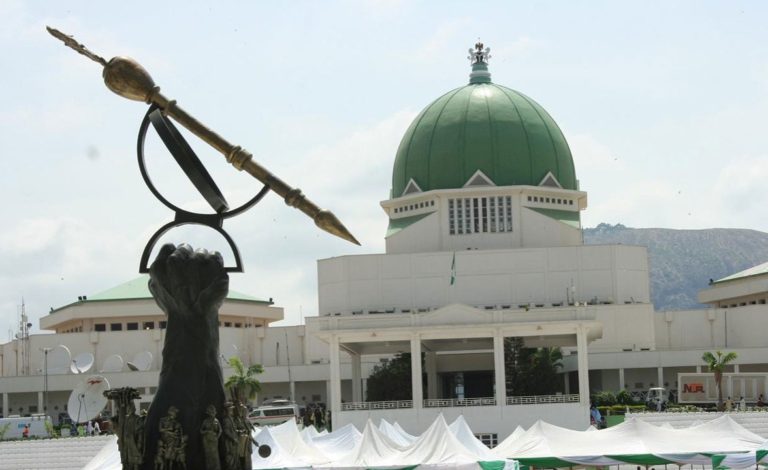
ON TUESDAY, June 22, 2021, the media reported that the roof of the National Assembly Complex in Nigeria was leaking and the building flooded following a rainfall.
A video of cleaners scooping water from the floor of the complex was also shared on Twitter.
These reports generated reactions on social media with a number of people stating the National Assembly Complex got N37bn for its renovation.
Reacting to one of the reports, a Twitter user Morris Monye [@Morris_Monye] stated that a sum of N37 billion was approved and paid in 2020 for the National Assembly to be renovated.
Monye tweeted “For context, N37,000,000,000.00 (Thirty seven Billion naira only) was approved and paid in 2020 for the National Assembly complex to be renovated. Nigerians shouted and shouted back then on Twitter and forgot after a month.”
Another Twitter user Wale Adetona [@iSlimfit] also tweeted that the building was leaking less than a year after it got N37 billion for renovation.
He wrote, “What happened to the N37bn approved to renovate the National Assembly in 2020? It’s not even a year yet and the structure is leaking when rain falls. This country truly deserves a YouTube channel.”
A Twitter user misleading reaction to a news report.
The Claim
The sum of N37 billion was approved for the renovation of the National Assembly Complex in 2020.
The Findings
Findings by the FactCheckHub showed that the claim was misleading.
In 2019, the President of Nigeria Muhammadu Buhari approved N37 billion for the renovation of the National Assembly Complex.
This sum, included in the 2020 budget, was different from the N128 billion allocated for the National Assembly in the 2020 budget.
The N37 billion was included in the 2020 budget of the Federal Capital Development Administration (FCDA).
However, in 2020, the Federal Government slashed the initially approved budget allocation by 75 per cent, thereby reducing the N37 billion to N9.25bn.
This, therefore, means it was misleading to claim that the the amount for the renovation of the renovation of complex was N37 billion since it had been reduced to N9.25bn.
National Assembly’s response
The chairman of the Senate Committee on Media and Public Affairs Ajibola Basiru in statement clarified that N37bn is not the sum approved for the renovation of the National Assembly Complex.
Basiru said “While it is true that an initial appropriation of the above stated sum was made due to the decaying nature of the complex which has not witnessed any major maintenance or overhauling since construction, the said amount was reduced to N9 billion after the breakout of COVID-19 pandemic.
“Even with this reduction, the sum of N9 billion or any amount is yet to be cash backed or released to the National Assembly. None of this amount is even appropriated for the National Assembly bureaucracy or its leadership,” he stated.
The National Assembly complex houses the Senate and the House of Representatives chambers.
The Verdict
The claim that N37 billion was approved for the renovation of the National Assembly Complex in 2020 was MISLEADING. This was because the N37 billion, which was initially approved, was eventually slashed to N9.25 billion.
ONE of the giants of 20th century African nationalism, Kenneth Kaunda, former president of Zambia was to many, the gentle giant who pioneered African socialism.
The ‘patriarch of African independence’ passed away June 17 at a military hospital in Zambia’s capital, Lusaka. He was 97.
Kenya’s President Uhuru Kenyatta eulogised him for bravely hosting various liberation groups and he received international kudos for bowing out peacefully after losing an election.
But as there are two sides to every coin, Kaunda was also the authoritarian, who introduced a one-party state. He cut a supply-side deal with the International Monetary Fund (IMF) and he planned to give huge tracts of farmland to Maharishi Mahesh Yogi after he promised to create a ‘heaven on earth.’
The revolutionary, who gave sanctuary to liberation movements, was also a friend of US presidents, recalled Gavin Evans, writing for The Conversation, a newsletter of university scholars and researchers
In a final coup de grace, the government that succeeded him placed him under house arrest after alleging a coup attempt; then declared him stateless when he planned to run in the 1996 election.
He survived an assassination attempt in 1997, getting grazed by a bullet. One of his sons, Wezi, was shot dead outside their home in 1999.
The 1986 AIDS death of another son, Masuzgo, motivated him to campaign around HIV issues far earlier than most, and he stepped this up over the next two decades.
In the obituaries that proliferated after his death, Kaunda was described as an impassioned orator who could bring an audience to its feet and to tears; a schoolteacher who quoted Lincoln and Gandhi; and a physically striking man who brushed his hair to stand at attention so that it added inches to his six-foot-tall stature.
Kenneth David Kaunda was born in Chinsali, Northern Zambia, on Oct. 24 1924. Like many of his generation of African liberation leaders, he came from a family of the mission-educated middle class. He was the youngest among eight children. His father was a Presbyterian missionary-teacher and his mother was the first qualified African woman teacher in the country.
He became a head teacher before his 21st birthday, teaching in the former Tanganyika (Tanzania), where he became a lifelong admirer of future president Julius Nyerere, whose ‘Ujamaa’ brand of African socialism he tried to follow.
As the leader of the United National Independence Party (UNIP)), he travelled to America and met Martin Luther King. Inspired by King and Mahatma Gandhi, he launched the ‘Cha-cha-cha’ civil disobedience campaign.
Although his government became increasingly autocratic and intolerant of dissent, Kaunda will go down in history as a relatively benign autocrat who avoided the levels of repression and corruption of so many other one-party rulers.
THE family of Paul Rusesabagina, the hotel manager who inspired the acclaimed film Hotel Rwanda, has accused the Rwandese government of reducing the food and water rations for their jailed relative in order to force him to plead guilty to terror-related crimes.
Rusesabagina is best-known for saving over a thousand lives during the Rwandan genocide, as depicted in the 2004 film that starred Don Cheadle. He disappeared Aug. 27, 2020 while on a flight to Burundi to address church leaders there.
The 66-year-old said he was kidnapped after being tricked into getting onto a plane to Kigali when he thought he was going to Burundi. Four days later, he appeared in the custody of the Rwanda Investigation Bureau which charged him with being “the founder, leader, sponsor and member of violent, armed, extremist terror outfits.”
Rusesabagina’s family believes Paul ‘s arrest violates international law.
President Paul Kagame, in an interview with the French news agency France 24, dismissed the accusation. “I don’t see why people make a lot of noise. He is in a court of law. He is not being hidden somewhere.”
“What’s wrong with tricking a criminal you are looking for?” he added. “When you get him, where do you put him? If it is in a court of law, I think that’s okay.”
Whether the trial was fair, Kagame responded: “I want to see a fair trial myself. Why do you think being fair belongs to Europe or U.S. or anybody and not for us?”
Kagame’s government accuses the hotelier of supporting the National Liberation Front (FLN), a rebel group which is blamed for a series of gun, grenade and arson attacks in 2018 and 2019 that killed nine people.
“As a leader, sponsor and supporter of FLN, he encouraged and empowered the fighters to commit those terrorist acts against Rwanda,” said prosecutor Jean Pierre Habarurema.
“Even if he did not actively take part in these attacks, he is considered as one who played a role by simply being a sponsor to these fighters.”
In the years since he fled Rwanda, Rusesabagina has been an outspoken opponent of Rwanda’s ruling party, which he holds responsible for numerous human rights violations. In 2018, he co-founded the Rwandan Movement for Democratic Change (MRCD), a coalition of opposition groups in exile.
Rusesabagina says the MRCD uses diplomacy to represent the millions of Rwandan refugees and exiles. But he has publicly expressed ‘unreserved support’ for the FLN, encouraging the use of any means possible to bring about change in Rwanda.
Since March, Rusesabagina has refused to attend his own trial in protest at the court’s refusal to grant a postponement for him to prepare his defense.
UZOCHUKWU Moghalu, an unemployed caterer, visits the newspaper stand at Wuse Abuja, Nigeria’s capital city four times a week to read free news.
He has been doing this for the past eight years since he arrived the Federal Capital City.
“News in the papers and television are more truthful than news on social media,” he told The ICIR.
Moghalu, a native of Anambra State in south-eastern Nigeria, believes that newspapers report ‘the truth’ about politics and government.
Like Moghalu, many other Nigerians between the ages of 18 and 50 interviewed for the 2021 Reuters Digital News Report also believe that news reports in their country are credible.
Uzochukwu Moghalu at a newspaper stand in Wuse, Abuja, on Tuesday, June 23
But fewer Americans, Britons and other Europeans have trust in the news they consume.
According to the report published Wednesday, June 23, while more than half of the 2,051 Nigerians interviewed (52 per cent) agreed that they trust the news, only 36 per cent of the 2,039 British respondents believe the news contents are trustworthy.
The Americans who have confidence in the news they consume are even fewer. They are 29 per cent, which represents barely three in every 10 Americans among the total of 2,001 respondents interviewed for the survey.
Cable news channels such as Fox News, CNN, and MSNBC attract the highest levels of distrust from Americans, thanks to former President Trump who disparaged many news outlets as ‘fake news’ purveyors, especially liberal news outlets.
Many Americans have attributed the slump in the media rating in their country to Trump.
Despite taking almost the worst hit from Trump, CNN remains the most popular online news brand in the States, Mexico, Indonesia and Nigeria, according to the survey.
In Nigeria, CNN is the online news outlet with the highest access followed by BBC News online.
Digital News Report in its tenth edition features Nigeria, India, Indonesia, Thailand, Colombia, and Peru for the first time in the global media scorecard.
Channels TV is the most trusted news platform in Nigeria
Channels TV ranks as the most trusted news brand at 84 per cent score, followed by Vanguard (82 per cent), The Punch (82 per cent), and the Guardian (80 per cent) – all privately owned daily newspapers.
The rest are TVC News, The Sun, Arise TV, The Nation, ThisDay, Premium Times, African Independent Television, The Cable, New Agency of Nigeria, and Stears Business.
New outlets with the highest offline reach are Channels TV and The Punch, while the highest online news outlets remain CNN, BBC, The Punch and Vanguard in that order.
Considering the high level of the gatekeeping process of the American newsroom, one would expect that Americans trust their news contents more than Nigerians. But the Reuters’ report has invalidated this assumption.
The findings of this report did not come as a surprise to Farooq Kperogi, Professor of Journalism and Emerging Media at Kennesaw State University in the United States.
Kperogi believes the level of distrust for news has everything to do with political polarisation in America.
In a comment shared with The ICIR, the media scholar noted that the findings of the Reuters’ survey is typical of the research based on data collected from personal interviews.
“That’s the problem with research based on self-reported data. It usually only reflects the feelings, however inaccurate, of the people surveyed.”
He said the Reuters report merely shows that there’s more political partisanship in America and Europe than there is in Africa.
Indeed, a study by Pew Research Centre has shown growing intense partisan division and animosity in the US. Most Democrats and Republicans find little common ground with those they disagree with politically.
“Hyper-partisans tend to distrust the institutional news media and rely on alternative media sources that give comfort to their points of view. The internet has enabled the proliferation of alternative news platforms,” Kperogi explained.
Dr. Yemisi Akinbobola of the Birmingham City University, United Kingdom, noted that there is partisanship in the Nigerian press too.
Stressing the factors limiting the trust of the British in the news, she said news from tabloid journalism overshadows more credible news like Guardian UK, and this reason is partly responsible for the distrust in the media.
There is also the issue of Rupert Murdoch owning a majority of the UK press which people do not trust.
Dr. Akinbobola faulted the BBC representation of race and ‘establishment’ reputation of the royal family, the old school, boys club, conservativism and the rest, which she believes fuels resistance from the citizens.
With the rising of fake news on social media and blogs, she also blamed the distrust on the proliferation of social platforms as news sources.
Earlier report from Reuters Institute confirmed that news audience has a complicated relationship with social media.
Head of Mass Communication Department at Baze University, Abuja, Dr. Abiodun Adeniyi said the statistics from the Reuters report could be interpreted in different ways.
One of the ways of looking at it is to say the finding represents “the higher level of consciousness in those climes, leading to the independence of thought, a critical mind, and therefore an increased state of criticalness, or unbelievability,” Dr. Adeniyi said.
He added: “The enhanced media sophistication, such that the audience is availed and assailed by multi-channels, even ahead of any particular one, that necessarily have gone through editing mills. This creates a condition for an epistemic posture and eventually heightening doubts around all news.
“Three, is the level of economic development, wellbeing and security, evening up to predictability of life, and a nonchalance around news; much unlike the other countries, where news may be relied on for directions on survival and for earning a living.”
It is also true that many Nigerians do not have as many choices of news outlets as their counterparts in the US or Europe, therefore constrained to trust the few accessible news outlets.
Dr. Akinbobola stressed this point when she said average Nigerians rely on the physical paper and the radio.
“In Nigeria, Kenya and South Africa, we need to consider the ‘choices’ people have in terms of access to a wider range of information and how that correlates with trust.”
She however suggested a review of journalism production system.
“I think there is a question of reviewing how we do journalism, for example, the focus on balance and simply presenting the facts has not really helped the current political environment. It is not just enough to present both sides anymore.
“So trust is not necessarily always about not trusting the facts. But more on not trusting what each media represents.”
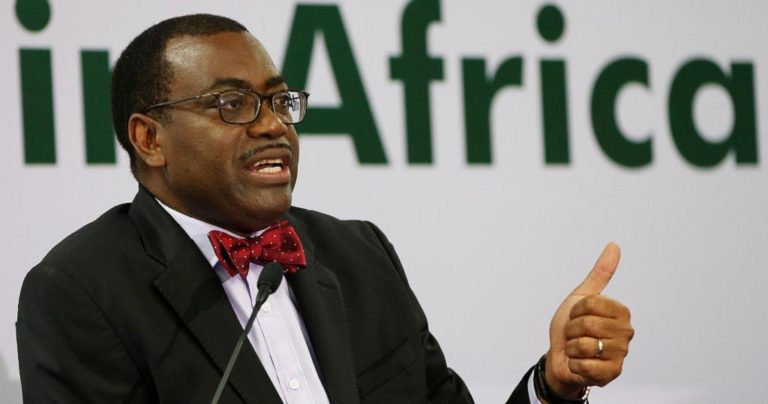
THE African Development Bank (AfDB) has put its feet forward in driving and re-boosting investments into the African economy amid concerns of rising poverty fuelled by coronavirus pandemic.
The bank, in its annual meeting held in Accra, Ghana, harped on the economic importance of quick restoration of the African economy, expressing deeper concern that the 30 million Africans had been pushed into extreme poverty as a result of the pandemic. It emphasised that Africa needed strong actions to support its recovery.
President of African Development Bank Group Akinwumi Adesina, at the meeting which had several African heads of states and governments, said an estimated 39 million people could fall into poverty by the end of 2021, as 30 million people had already sunk into extreme poverty on the continent owing to coronavirus pandemic effects.
“The effects of the pandemic on the continent’s economy have been massive. Africa’s cumulative Gross Domestic Product,(GDP)losses are estimated between $145 billion and $190 billion. Africa will need a lot of resources to support its recovery. Low-income sub-Saharan African countries alone will need $245billion by 2030, while all of the sub-Saharan African countries alone will need $425billion by 2030.”Adesina said in a statement issued on Wednesday.
Speaking on some of the efforts to restore the continental economy, he said: “The African Development Bank will continue to invest in regional infrastructure, promoting regional integration, including the integration of financial and capital markets.
“We remain highly committed to the success of the African Continental Free Trade Area, (AFCTA). That’s why the Bank provided $4.8 million to support the establishment of the AFCTA secretariat.”
On some of the efforts of the bank in tackling the concern, he said it had launched a $3 billion social impact bond on global capital markets,$10 billion crisis response facility, and $28 million to the African Centres for Disease Control.
In further remarks on the weak participation of the continent in global vaccine production, he noted that Africa missed an opportunity in the vaccine economy with the production of one per cent of its vaccine.
Africa should not be begging for the vaccines but should produce them, he stressed.
To ensure Africa participates in the global vaccine production, Adesina noted that the African Development Bank would support efforts to produce vaccines as part of the vaccine plan of the Africa Union.
“The bank will also plan to commit $3 billion to develop the pharmaceutical industry in Africa while leveraging on its resources.”
On plans to tackle Africa’s debt concern, Adesina said:” We have launched a debt Action Plan and a New Strategy for Economic Governance in Africa. Both will support countries to tackle debt and to embark on bolder economic governance reforms to forestall the debt crisis.”
Adesina also stated that there was an opportunity to tackle Africa’s debt challenges more decisively with the recent decision by the International Monetary Fund to issue $650 billion special drawing rights.
“As agreed by the African Heads of States and global leaders at the summit on the financing of African economies, called by President Macron of France, $100 billion of those SDRs should be provided to support Africa. I am delighted that the G7 Heads of State and government agreed to this call at their recent summit,” he said.
Adesina, while stating that Africa was not looking for a free pass, said debt resolution must be reinforced by stronger economic governance, public financial management, better and transparent management of Africa’s natural resources, and mobilisation of domestic resources.
President Muhammadu Buhari risks losing over four million followers on Twitter, except he reverses his suspension on the microblogging platform.
He may also lose his position as African president with the second-highest Twitter followers if the suspension remains.
The president’s verified Facebook page has been more active since he suspended the operations of Twitter in Nigeria on June 4.
Why president suspended Twitter
Angered by the deletion of his controversial post on June 2 by Twitter, Buhari ordered the suspension of the social networking service in Nigeria.
He had made the post while reacting to attacks on security agents and government facilities in the South-East.
The post read: “Many of those misbehaving today are too young to be aware of the destruction and loss of lives that occurred during the Nigerian Civil War. Those of us in the fields for 30 months, who went through the war, will treat them in the language they understand.”
The post was reminiscent of the Nigerian civil war that spanned 30 months between July 6, 1967 and January 15, 1970.
Twitter claimed Buhari’s post contravened its rules.
Following the suspension, the president has switched to Facebook to communicate with his followers.
Buhari only present African leader to interrupt the platform for social interaction
Screenshot of Buhari’s verified Facebook page
Buhari’s decision to suspend Twitter makes him the only sitting African leader to block a platform for social interaction at present.
Prominent Nigerians, including the General Overseer of the Redeemed Christian Church of God Enoch Adeboye and General Superintendent of the Deeper Christian Life Ministry Williams Kumuyi, have defied the order.
They claimed the president’s action conflicted with Article 19 of the UN Universal Declaration of Human Rights.
Many rights advocates also said the suspension was akin to dictatorial tendencies that characterised the Buhari regime when he ruled the nation as a military head of state between 1983 and 1985.
But the government has repeatedly defended the suspension and gave conditions for Twitter to resume operations in the country.
It said Twitter had been biased and constituted a threat to the corporate existence of Nigeria.
The government cited instances where Nnamdi Kanu, leader of the Indigenous People of Biafra (IPOB), a proscribed group, had posted many offensive messages allowed by Twitter.
It also explained that the public misconstrued Buhari’s message to mean that he threatened the entire Igbo and not troublemakers in the South-East.
IPOB, a secessionist group, had attacked security formations and killed operatives in different communities in the South-East. They had also burnt many Independent National Electoral Commission (INEC) in their quest to create Biafra out of Nigeria.
Buhari’s followers low on Facebook, shrink on Twitter
Checks by The ICIR showed that while Buhari had over four million followers before he banned Twitter, his present verified Facebook account shows he has a little over one million (1,002,584) followers as of June 21.
The ICIR reported, on Tuesday, that the president had lost 8,000 of his Twitter followers in less than a month that he placed the ban.
Buhari’s social media followers compared with other African leaders
Compared with other African leaders who have over a million followers on Twitter, Facebook, and Instagram, some of Africa’s most prominent social media platforms, the president enjoys a low following on Facebook.
But he had the second-highest followership among sitting African presidents on Twitter, which he suspended.
Buhari joined Twitter in December 2014 in the build-up to the election that produced him as Nigeria’s president.
He has since made 5,180 tweets on the platform.
The president has a paltry 240,000 followers on Instagram with 290 posts.
He is, however, one of the few presidents in Africa with accounts in each of Twitter, Facebook and Instagram.
Wordometres, a platform that provides statistics on major issues worldwide, shows that Nigeria had 206 million people in 2020, from which he draws most of his followers.
Buhari comes behind Egypt President Abdel Fattah el-Sisi, who has 9.6 million Facebook followers.
El-Sisi has attracted 5.1 Twitter followers and parades 2.4 million Instagram followers.
He joined Twitter in March 2014 and has made 2,862 tweets.
As of 2020, Egypt had a population of 102,334,404, according to Wordometres.
Ghana’s Nana Akufo Addo has 2.1 million Facebook followers and 1.9 million on Twitter. He also has 1.4 million on Instagram.
He joined Twitter in February 2011 and has made 7,738 tweets.
Ghana’s population in 2020 was 31 million.
Algerian president Abdelmadjid Tebboune has 1.1 million followers to himself on Facebook. But he has fewer than a million followers on Twitter (720.9 thousand).
He has made 88 tweets, and there are 43.8 million people in his country.
South Africa President Cyril Ramaphosa has 209,504 followers on Facebook and 1.9 million on Twitter. He joined in January 2015, and he has made 469 tweets.
The country had 59.3 million people in 2020.
In Rwanda, Paul Kagame has garnered 1.2 million followers on Facebook. and 2.3 million on Twitter. He also enjoys 759,000 Instagram followers.
He joined Twitter in May 2009 and has tweeted 2,924 times.
Rwanda has a population of 12.95 million.
Senegal’s Macky Sall has attracted 598,086 Facebook followers and 1.6 million on Twitter.
He joined Twitter in October 2010 and has tweeted 3,385 times.
Senegal had a population of 16.7 million in 2020.
A screenshot of Buhari’s Instagram Page
In Uganda, Yoweri Museveni has 997,445 Facebook followers and 2.2 million on Twitter.
He joined the platform in March 2010 and has 7,524 tweets.
Uganda has an estimated population of 45.7 million.
Zambia’s Edgar Lungu has 1.2 Facebook followers. His country had 18.3 million people in 2020.
Guinea President Alpha Conde has won 1.08 million followership on Facebook. His country has 13.1 million people.
Meanwhile, Nigeria’s former President Goodluck Jonathan has 2.3 million followers on Facebook and. 1.5 million on Twitter.
He has made 1,018 tweets since joining in November 2015.
Whereas Nigerian are accessing Twitter through the Virtual Private Network (VPN), the government may have met a brick wall in its threat to prosecute users who flout the ban.
The government also said Twitter was liable for losses occasioned by #EndSARS protests in October 2020 in Nigeria.
The ECOWAS Court on Tuesday restrained the government from prosecuting users of the microblogging site.
POLICIES initiated by the Central Bank of Nigeria (CBN) have led to worsening poverty, food inflation and foreign exchange (FX) scarcity in Africa’s most populous nation, The ICIR analysis has shown.
In the last six years, the CBN under Godwin Emefiele has excluded certain items from the official market. This means that importers of those items cannot get dollars from the official market, which is often cheaper. The items include tomatoes, milk, roofing sheets, textiles, soaps and cosmetics, among others.
In 2015, the CBN began with 41 items, but the number has since reached 45.
“For the avoidance of doubt, please note that these items are not banned, thus importers desirous of importing these items shall do so using their own funds without any recourse to the Nigerian foreign exchange markets,” said Director of Trade and Exchange Department Olakanmi Gbadamosi on June 23, 2015, when the FX restriction began as the apex bank’s policy.
But the reality on ground has been different from the CBN’s claim. Once the apex bank restricts any item from the FX market, banks stop issuing FX form known as ‘Form M’ to importers – a signal that the only way they can bring in the commodity is by seeking FX from the unpredictable and expensive parallel market. Also, the Nigeria Customs Service sometimes follows it up with either a tariff increase or other forms of restriction.
This explains why economists refer to the CBN’s FX restriction as a technical ban.
In the last two years, CBN has added milk, maize, and textiles to the growing list. Experts say the CBN’s FX restrictions have forced up prices of food items and created artificial scarcity in the economy. As of the week of July 13, 2020 when the CBN restricted maize from the FX market, a ton of the commodity was sold for N160,000, according to Afex Commodities, which provides pricing updates on food items. On June 21, 2021, a ton of maize stood at N222,690, according to Afex, representing 39 per cent increase in the price of maize in a space of 11 months.
FX restrictions and impact
Nigeria is Africa’s second largest maize producer after South Africa. The country produces 10.5 million metric tons of maize per annum with a demand of 15 million metric tons (MT), leaving a supply-demand gap of 4.5 million MT annually, according to data from the Federal Ministry of Agriculture and Rural Development, a Nigerian government’s ministry.
Analysts explain that apart from insecurity which has raised maize price, the FX restriction by the CBN has led to the scarcity of the commodity as a result of huge demand. Maize has since become more expensive as local production is not enough to satisfy demand, and importers have had to get dollars at over N400-N500/$ to bring the commodity into Nigeria. Many of the importers have been manufacturers using the commodity as a raw material.
Maize is an essential raw material that is used by the production of noodles, starch, cornflakes, sweeteners, oil, beverages, glue, industrial alcohol, and fuel ethanol. It also serves as feed for the poultry industry and for consumption.
“The rising cost of maize is threatening livelihoods of small businesses in Nigeria. It is not only poultry farmers’ investments that are threatened; the investments of other players in the value chain are also under threat, thus plunging the economy into deeper crisis,” Chairman of Poultry Association of Nigeria in Delta State Alfred Mrakpor said while talking about the impact of the restriction on the local poultry industry.
Due to this policy, maize price has risen and manufacturers have responded by increasing the price of finished products. Major noodles manufacturers have raised prices by N400 to N700 per carton since the FX restriction in 2020, according to The ICIR‘s findings.
The Lagos Chamber of Commerce and Industry (LCCI) has explained that when prices rise and income remains stable, more people would be unable to afford essential goods – and could be forced into extreme poverty.
Few weeks after, when the CBN discovered that it had shot itself in the foot, it granted waivers to four firms – Wacot Limited, Chi Farms Limited, Crown Flour Mills Limited and Premier Feeds Company Limited – for the importation of 262,000 metric tons of maize. By so doing, the bank excluded other players from getting foreign exchange at the official market to import the product. Despite CBN’s waivers to the companies, demand for maize is still far higher than supply.
The apex bank is now extending Anchor Borrowers funds to 120,000 maize farmers, Managing Director/Chief Executive Officer of Unity Bank Tomi Somefun said last month. One manufacturer explained that this decision was informed by growing scarcity and price increase of the product.
The CBN has also barred milk importers from the FX market. Nigeria produces 700,000 metric tons (MT) of dairy products annually but demand stands at 1.3 million MT, according to the Federal Ministry of Agriculture. The CBN, after the ban, gave waivers to Nestle, Integrated Dairies Limited, FrieslandCampina WAMCO Nigeria, Chi Limited, TG Arla Dairy Products Limited and Promasidor Nigeria Limited to import milk, which, again, was heavily criticised as a one-sided policy targeted at helping the bank’s friends.
Director-General of the LCCI Muda Yusuf told one of our reporters that the Nigerian economy was not ripe for the policy and argued that it was tantamount to a ban on importation of milk in whatever form as most banks would not process Form M for any product on the CBN forex exclusion list.
“We currently do not have dairy cows in the country,” Yusuf said.
“The dominant milk producing system in Nigeria is the Fulani Nomadic System whose cows have a milk yield of less than two litres a day, whereas a good dairy cow will produce an average of 28 litres of milk per day over ten months. During peak lactation, a high yielding dairy cow can produce as high as 60 litres of milk per day.”
Muda Yusuf, DG of LCCI
He said Nigerian cows had very low yield because of poor genetic composition, poor feeding practices and the laborious nomadic system of breeding, which should first be addressed.
He further said there were over one million direct and indirect jobs that would be in jeopardy across the value chains of the industries.
“Enough timeline should be given to diary companies for a sustainable transition from the current state of affairs to the desired level of backward integration in the dairy industry,” Yusuf said.
The same situation applies to tomatoes, textiles and other products. The CBN’s restriction on tomatoes has yielded little result. The Dangote Tomato Factory has not been fully operational since 2016 when it was set up, and some tomato processors only import and package locally, so cannot be classified as full-fledged manufacturers. Tomato prices have since risen, with a sachet of tomato paste, which was sold for N40 prior to the FX restriction, now selling for N100 in Abuja and Lagos markets, indicating a 150 per cent rise in price. Similarly, 100g of tomato paste, which was sold for N50 before 2015, now sells up to N120.
Tomato production is also not increasing. Africa’s biggest economy produces 1.5 million tons of tomato per annum, with 0.7 million metric tons post-harvest loss. Tomato demand in Nigeria is estimated at 2.2 million metric tons per annum, leaving a gap of 700,000 metric tons, according to official data from the Agricultural Ministry.
The CBN argues that the essence of the FX restriction is to increase local production and reduce pressure on foreign reserves. But manufacturers have contended that some of the items restricted by the bank are raw materials for them. This explains why there is a disconnect between CBN policies and manufacturers in Nigeria.
In the wake of President Muhammadu Buhari’s directive to the CBN governor to restrict access to foreign exchange for food importers, the Manufacturers Association of Nigeria (MAN) told one of our reporters that the policy could be counterproductive.
“We need to know the local capacity available compared to national demand and if not adequate, creditably determine what time and resources are needed to ramp up capacity and production. It is pertinent to pre-determine these suggestions as part of the implementation strategy. To achieve sustainable self-
sufficiency, local producers ought to be incentivized otherwise we may be inviting a looming barrage of smuggling activities,” Director-General of MAN Segun Ajayi-Kadir said.
Founder and Managing director of Cowry Assets Management Limited Johnson Chukwu told The ICIR that he did not subscribe to the use of ‘fiat’ to discourage consumption.
Johnson Chukwu, CEO of Cowry Asset Management Limited
“I encourage the use of trade tools. The reality is that you cannot ban the consumption of commodities that people have demand for. When you do that, you force that commodity to black market, where the people will now have to pay extra cost to keep them. You cannot legislate against human consumption,” Chukwu said.
“My approach is to say, for instance, let us use ‘trade tools’ such as higher tarrif to discourage such commodities that we do not want people to bring in. So their cost becomes more expensive. That way the government makes money and local firms are incentivised to produce more locally,” he explained.
“Overtime as the local production improves, and tarrif is lowered.”
Foreign exchange management
The CBN’s management of the FX market has been rated poor by local and international institutions.
The bank has refused to float the FX market since 2015 when oil prices began to trend south, and it has since maintained multiple exchange markets from Importers/Exporters (I &E) window to NAFEX. This has sent negative signals to investors.
The bank has preferred intervening in the market, rather than allow the market to function effectively, experts say.
MAN President Mansur Ahmed said in 2020 that 40 per cent of manufacturers were unable to access dollars to import inputs.
Mansur Ahmed, President of Manufacturers Association of Nigeria (MAN)
Unification of the FX market creates certainty and forces investors to come in with their money, thereby raising the Foreign Direct Investment (FDI), said Financial Derivatives Company Managing Director Limited Bismarck Rewane.
Economists have explained that if the FX market is determined by the forces of demand and supply, the market resolves the problem of availability and price on its own.
At a meeting attended by one of our reporters in July 2020, the International Monetary Fund (IMF) Mission Chief for Nigeria Jesmin Rahman asked the CBN to unify the FX market to achieve flexibility and certainty.
The FDI into Nigeria in 2018 stood at $1.9bn, down from $3.5bn in 2017. Ghana, in comparison, recorded $3.5bn in FDI in 2018, up from $3.2bn in 2017. Also, Ghana recorded total investments of $869.47 million, with total foreign direct investments (FDI) value estimated at $785.62 million between January to June 2020. On the other hand, Nigeria, over the same period, had $362.84 million in foreign direct investments, representing a 29.70 per cent drop from $470.51 million reported in the corresponding period of 2019 (H1’19).
Food inflation, poverty
The general impact of the CBN’s policies can partly be felt on food inflation and poverty.
The composite food index rose to 22.28 per cent in May 2021 compared to 22.72 per cent in April 2021, the National Bureau of Statistics (NBS) said this month. A report said Nigeria’s food inflation rose 105 per cent between September 2015 and September 2020.
About 87 million Nigerians lived in extreme poverty in 2017, said World Poverty Clock. Since 2017, Nigeria has continued to be world’s poverty capital.
According to the World Poverty Clock, the number rose in 2019. Nigeria had a total population of 205.32 million in 2019, with 105.097 million living in extreme poverty, representing 51 per cent of the population. This means the number of extremely poor people rose from 87 million to 105 million in two years.
An individual is classified as living in extreme poverty if the person earns below $1.90 per day.
The NBS said in a 2020 report, covering September 2018 to October 2019, that 40 per cent of people in the country lived below poverty line of N137,430 ($381.75) a year, representing 82.9 million people.
No, there is no dollar anywhere
However, Johnson Chukwu, earlier quoted, said the major problem was that Nigeria did not have multiple sources of foreign exchange.
“In as much as a liberalised foreign exchange market is ideal, our situation is peculiar in some instances. You cannot have a perfect market if you do not have perfect market conditions,” he said.
“We do not have multiple supply sources of the foreign exchange. What we have is a monopoly supply from the oil sector. Our FX earning source is from the sale of crude. The Central Bank is the recipient of the proceeds from the sale of crude.
“The Central Bank is the sole market maker in our FX market. In that case of not having many suppliers in the FX, you cannot have equilibrium price. We must recognise that we do not have multiple suppliers and that makes our case peculiar.
“To expand the sources, we must have multiple export commodities, multiple export sources, several exporters receiving export proceeds, and people accessing FX easily from the banks. That is only when we will have a liberalised market.
“Until we achieve this, we are going to live with this kind of situation, which is not a perfect market condition. We must recognise the peculiarities of our own economic environment in as much as we desire for a more liberalised FX market.
“At this point even if you want to liberalise, the CBN will still be the sole supplier, hence market price will be determined by what the CBN supplied. Because they are the sole supplier or what you call the market price, they determined price.”
Chijioke Ekechukwu, former DG of Abuja Chamber of Commerce
In his view, Former Director General of Abuja Chamber of Commerce and Industry (ACCI) Chijioke Ekechukwu, an economist, told The ICIR that floating the exchange rate now would spike inflation and worsen Nigeria’s economic problems.
“We cannot float the exchange rate now because of our peculiar situation and having one major source of foreign exchange which is the oil revenue resources. It is still necessary that the central bank keeps intervening in foreign exchange market, pending when there is enough supply of the foreign exchange,” he said, noting that “because we don’t have enough supply, the CBN strategy is good.
“As they’re intervening,they should ensure that the supply end is enhanced.”
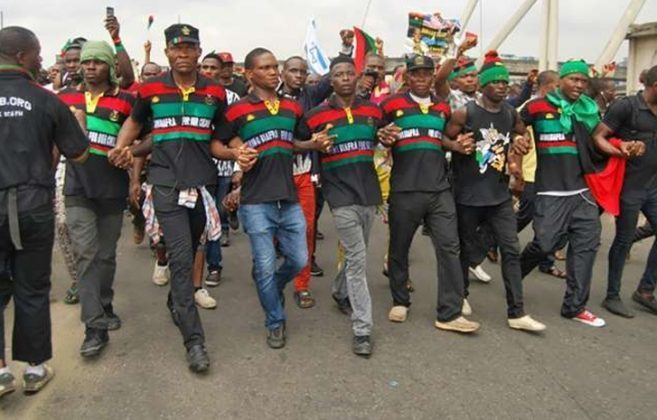
THE Indigenous People of Biafra (IPOB) has reacted to a statement by governors of the South-East in which they denounced and rejected secession calls by the group.
The governors had, shortly after a meeting with other socio-political leaders from the region on Saturday in Enugu, said that IPOB’s calls for secession did not represent the wish and interest of the people of the region.
Ebonyi State Governor David Umahi, on behalf of the governors, condemned the activities of the group in the South-East and elsewhere in the country
“We firmly proclaim that we do not support them, they do not speak for the people of the South-Eastern Nigeria,” Umahi said.
“The impression that South-East leaders are silent over some of our youths’ agitations for secession is not true.
“South-East governors, Ohanaeze President, National Assembly members, notable leaders had come out publicly many times in the past to speak against such agitations.
“In order not to mismanage the unfortunate situation, South-East leaders have set up a committee to engage such youths to stop and allow elders speak to address such fears.”
Reacting, IPOB’s Director of Media and Publicity Emma Powerful said the governors lacked the power to decide for the people of the region on issues concerning Biafra.
IPOB noted that the governors had already lost grip with the masses, owing to their desperation to regain the trust of their ‘paymasters.’
“The purported statement by these shameless political generals without foot soldiers has only further exposed them as Caliphate boot-leakers. They know too well that they have since lost grip and control of the masses, hence, their desperation to regain the trust of their paymasters,” IPOB said.
“They only publicly disowned IPOB, thinking that doing so will make them regain the trust and favour of the Caliphate. The governors, Ohaneze Ndigbo and the handful of traitors masquerading as the Igbo political elite should wake up to the realities that they have since lost the confidence of the people.”
The statement noted that it was unfortunate and shameful for the leaders to disown and betray their own. It cited how the governors connived with the Federal Government to proscribe IPOB in 2017.
“The South-East governors again, in 2017, sat together in Enugu State to proscribe IPOB and the Federal Government declared them terrorists with the support of South-East governors while they are not.
“To their shame, how many times have their northern counterparts disowned the bloody terrorists, bandits and Fulani herdsmen rampaging the country? So, the South-East self-acclaimed leaders are quick to disown IPOB and ESN, yet they are calling us to accept the calls for peaceful negotiations? What hypocrisy!”
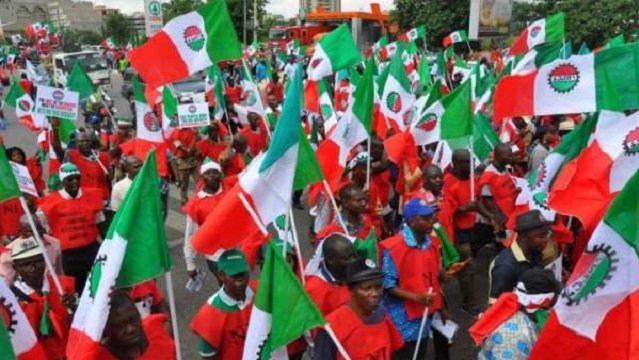
NIGERIA Labour Congress (NLC) has threatened to embark on a nationwide strike over the victimisation of Kaduna State workers by Governor Nasir El-Rufai.
The NLC Head of Information Benson Upah disclosed this in a telephone interview with The ICIR on Wednesday.
Upah said the NLC Chairman Ayuba Wabba had, on Tuesday, said that the union would embark on nationwide strike because the Kaduna State government was victimising workers for partaking in the 3-day warning strike earlier in June.
The NLC, Federal Ministry of Labour and Productivity and the Kaduna State government had signed a memorandum of understanding (MoU) to call off the warning strike and negotiate.
However, the NLC said the Kaduna State government had failed to fulfil its part of the agreement.
“The content of that MoU says that the processes adopted by the Kaduna State government would need to be revised because they did not follow due process in sacking workers.
“A ten-person committee was set up to review what the Kaduna state did that led labour to that warning strike, but until the moment I speak with you, the government has not constituted that Joint Committee; we’ve been waiting it has not done so,” Upah said.
He also said that the content of the MoU signed with the Kaduna State government read that there would be no victimisation of workers who took part in the strike action.
“In utter contempt and violation of that agreement, the Kaduna State Government has set in motion processes of sacking workers including 18 lecturers from its state university and some of those lecturers were not even available during the strike,” Upah noted.
He noted that the NLC would embark on the nationwide strike if the Kaduna State government did not constitute the committee or reverse the sack of the workers.
Upah further said that the union had informed the president, Ministry of Labour and Productivity and other stakeholders involved in the agreement earlier reached in May.
“So we are going forth in the exercise of the rights and privileges conferred upon us by the full force of the labour law in Nigeria to scale up this action,” NLC said.
However, he said that the union could suspend the planned action if the government of Kaduna urgently retraced its steps or any other body sufficiently advised it to do so.
The Spokesperson for the Kaduna State government Muyiwa Adekeye did not respond to calls and text messages from The ICIR over the allegations of the NLC.
The ICIR had reported that the NLC embarked on five-day warning strike over the mass sack of more than 21,000 workers and the refusal to pay entitlements to about 50,000 workers by the Kaduna State government.
During the first day of the strike, activities in major sectors, including banks, railway, airport, and hospitals, were put on hold.
The NLC President Wabba and some other protesters were declared wanted by El-Rufai over alleged economic sabotage and attacks on public infrastructures.
However, the warning strike was called off on the third day following an agreement with the state government, the Federal Government and the NLC.



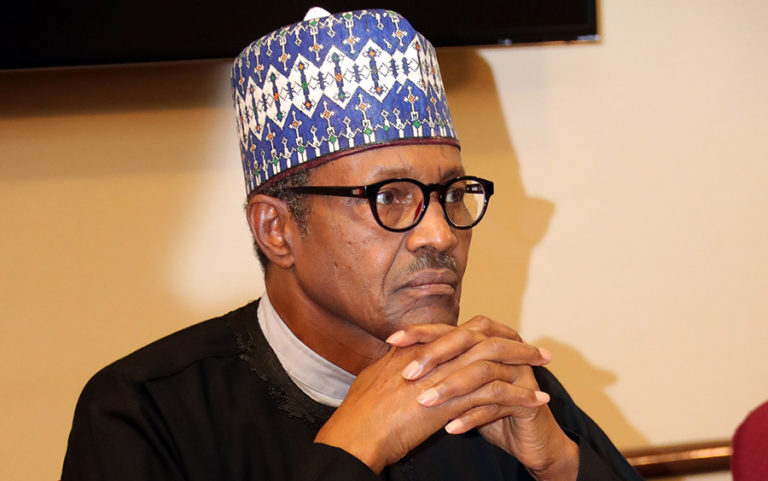

 He is, however, one of the few presidents in Africa with accounts in each of Twitter, Facebook and Instagram.