Home Blog Page 1942

‘How SARS operatives killed my husband, carted away our belongings’ woman tells panel on police brutality

WE were in our house in Awka that fateful day in August 2017 when some gunmen broke into our house and took my husband. They also took away almost all our household properties and told me to go and marry another man that this one is as good as dead.”

Those were the words of Chidimma Edozieuno, when she appeared before the Anambra Judicial Panel of Inquiry on police brutality on Friday to give an account of what men of the disbanded Special Anti-Robbery Squad (SARS) did to her spouse.

The bereaved woman told the panel that her husband whom she said lived in Benin Republic, visited Nigeria after she gave birth to a baby and was arrested in the early hours of August 1, 2017 by policemen on mufti at their Ichida street residence in Awka.

“They said my husband was a kidnapper. I didn’t even know where they came from, and at first, I didn’t even know they were policemen,” she added.

She stated that after concerted searches with a friend in police stations in the state, she found the men that took away her husband were dreaded SARS operatives from Awkuzu office.

She said the SARS operatives who came to arrest her husband took away the refrigerator, television, a generator set, laptop, iPhone and her husband. She got to know about the death of her husband through the counsel of the dreaded disbanded police unit in court.

“With the help of a friend, who is a police officer, we started looking for my husband. He took me around many police stations to know if they had him, but none of them had him. We went to the Awkuzu SARS office where I saw three of the men who came and arrested my husband.

“I took a lawyer and we went to court. It was in court that the counsel representing the SARS told us that my husband was dead. They said he was a kidnapper. I dated my husband for a long time before we got married. He is not a kidnapper. I lived in Benin and that was where we knew each other. I later relocated to Nigeria. My husband is from Aguleri.”

She demanded that the body of her husband be given to her for burial and compensation for the household items taken from her home.

V.N. Umeh, a retired justice  and chairman of the panel assured her that the panel would investigate and make recommendations on her matter.

Following the demand and protest to end police brutality in the country, President Muhammadu Buhari directed that the tactical unit of the police be disbanded with a promise to investigate allegations of misconduct levied against men of the unit and to give reprieve to the victims or their families.

WTO: Despite opposition from US, AU reiterates its full support for Ngozi Okonjo-Iweala

0

DESPITE the stiff opposition from the United States, the African Union has reiterated its full support for Nigeria’s candidate, Ngozi Okonjo-Iweala, The African Union (AU), for the position of lDirector-General of the World Trade Organization (WTO).

Matamela Cyril Ramaphosa, President of the Republic of South Africa and chairperson of the AU, who made the latest position known in a statement commended the WTO member states for following an agreed fair, robust, and transparent process in the election of the next Director-General of the WTO.

“His Excellency, Mr Matamela Cyril Ramaphosa, President of the Republic of South Africa and Chairperson of the African Union (AU), commends all WTO member states for following an agreed fair, robust, and transparent process in the election of the next Director-General of the WTO. This process, led by the Chair of the General Council assisted by two others to comprise a Troika, has been followed meticulously. The Troika has executed its task with diligence and fairness, allowing all member states to participate and express themselves fully on the candidates,” he said.

“Thus far member states have accepted the recommendations of the Troika at each stage of the process. This has brought us to the point where at the consultation meeting of the General Council held on 28 October 2020, the Chair of the General Council on behalf of the Troika reported that Dr Ngozi Okonjo-Iweala has emerged as the only candidate proposed for endorsement by the General Council on 9 November 2020. The AU is deeply appreciative of the supportive comments by member states on Dr Okonjo-Iweala’s excellent qualifications for the post.”

He expressed confidence and trust that the organisation would follow due process to ensure that Dr Okonjo-Iweala emerges WTO DG.

“The AU trusts that, in the same spirit, nothing will stand in the way of the WTO making the right decision for the organization. At a time when the credibility of the WTO is sorely tested, it is important that the organization honours its own rules and procedures. The African Union reiterates its full support for Dr Okonjo-Iweala.”

The ICIR had reported yesterday, how the United States said it is supporting Okonjo-Iweala’s rival, Yoo Myung-hee, Korean Trade Minister as the next WTO Director-General because she is “a bona fide trade expert who has distinguished herself during a 25-year career as a successful trade negotiator and trade policy maker.”

The US also stated that Yoo Myung-hee has all the skills necessary to be an effective leader of the organization.

While stating that the WTO is facing a very difficult time because of the challenges confronting it, the US said it needs to be led by someone with trade experience to drive the reforms it needs.

“This is a very difficult time for the WTO and international trade.  There have been no multilateral tariff negotiations in 25 years, the dispute settlement system has gotten out of control, and too few members fulfill basic transparency obligations.  The WTO is badly in need of major reform.  It must be led by someone with real, hands-on experience in the field,” the statement said.

However, the Nigerian government has said that it will continue to work with relevant stakeholders in the World Trade Organisation to realise Nigeria’s dream of leading the international trade body.

Why Ngozi Okonjo-Iweala should lead the World Trade Organization

0

By K.Y. AMOAKO


IN the coming weeks, the World Trade Organization faces an historic choice. For the first time in its 25-year history, a woman will be named Director-General. The finalists have been narrowed to two outstanding candidates—Ngozi Okonjo Iweala, Nigeria’s former Finance Minister, and Yoo Myung-hee, the current Minister of Trade in South Korea.

Both women are highly accomplished and well equipped to lead the WTO. Minister Yoo has worked in Korean trade circles for decades. She is the first woman to hold her position in a country that has successfully transformed its economy. I am certain that if chosen she would reform and strengthen the 164-member global institution.

But Ms. Okonjo Iweala is more suited to the need of the moment when the global economy faces profound uncertainties. The WTO’s greatest challenge right now is to restore faith in an organization weakened by a power struggle between China and the United States.

Ms. Okonjo Iweala, bringing a fresh perspective that is sorely needed, has the depth of experience and persistence to help both inject new life into the global trading system after its mauling from the COVID-19 pandemic and the multinational credentials to address global divisions in broad and innovative ways.

Ms. Yoo presents herself as a “bridge” candidate, aiming to overcome the divide between the U.S. and China, and also between rich countries and developing nations.

But the Nigerian-born economist and international development expert who was a former Managing Director of the World Bank, as well as having chaired the board of Gavi, the vaccine alliance. has a wider range of contacts and experience that will ensure she can deliver at this crucial time for the international community.

The world is at an inflection point, with free and fair trade near the top of the list. Trade wars have returned, trading blocs have weakened, and the multilateral approach to addressing trade issues and disputes has waned. Plus, the COVID-19 pandemic has closed borders, upended supply chains, and dragged down the world economy at the same time as global warming is taking its toll on society and infrastructure.

A revival of world trade is one of the most important pillars for accelerated growth and sustainable development. This is true for everyone but especially true in Africa. Given that almost 1 in 4 of the world’s people will be African by 2050, strong and diversified African markets will therefore contribute to strong global markets. Trade is critical.

Ms. Okonjo Iweala combines both an international and an African perspective that will suit these times of extreme stress and inject a new dynamism to help revive the global economy.

Nearly all African countries are still dependent on exports of commodities and extractives, mostly unprocessed. Africa’s economic future will depend upon modernizing those sectors and finding fair global markets to sell high-quality processed foods, fertilizers, and petroleum products.

The African Continental Free Trade Area—delayed due to COVID-19 but still on track to come into effect in 2021—will address Africa’s fragmentation by creating the world’s largest common market. According to World Bank estimates, the trade pact could boost regional income by $450 billion and lift 30 million people out of extreme poverty by 2035.

But internal commerce alone, no matter how large, will not be enough to carry African economies into sustainable middle-income status. That will require extensive global investment and trade.

A broader imperative also exists for fostering a prosperous Africa fully engaged in global trade: it is vital to the world’s future peace and prosperity.

Due to its large youth population, Africa needs to generate 20 million jobs per annum over the next 20 years. Some of this job growth will come from services, but the bulk will come from commercialization of agriculture and expanded manufacturing. Those products will seek global markets. If those markets are not fair and transparent, and those 20 million jobs are not created, Africa will not break free of cycles of poverty, migration, and conflict—which will continue to have global consequences in terms of a growing refugee crisis and escalating damage to Africa’s environment.

I’ve known Ms. Okonjo Iweala for many years and can vouch for her tenacity, savvy, and commitment to forging consensus.

Building on her unique African cultural perspective and deep understanding of the international community, I believe Ms. Okonjo Iweala will reinforce the case for the value of the open trade system supported by the WTO’s multilateral role and methodology for dispute solving. This is in everyone’s interest.

Combining her skills as an international civil servant and a national minister of finance minister, along with her roles in private enterprise, civil society, and in addressing health issues and climate change, she will bring an inclusive, problem-solving approach that can help revive world trade at this crucial juncture.

 -END-

Originally published by African Center for Economic Transformation

The author is founder and President of the African Center for Economic Transformation (ACET) and formerly served during 1995-2005 as the Executive Secretary of the UN Economic Commission for Africa.

I’m ready for investigation, says #EndSARS Lawyer as Immigration confirms search on missing passport

MODUPE Odele, one of the #EndSARS promoters whose passport was reportedly seized by the Nigerian Immigration Service (NIS) on Thursday says she is willing to be investigated by the authorities.

The lawyer disclosed that though the rationale for withholding her passport has not been made known, and no official information was passed across for a possible investigation, thus she would remain in the country.

She  tweeted this concerns on her verified social media handle: @Mochiovous.

Odele had coordinated release of some #EndSARS protesters who were unduly arrested during the nationwide  demonstration.

“Today is the 5th day that my passport is still being held after it was seized at the Lagos international airport. If there’s no no-fly list, that’s okay but why has my passport not being released yet?

“Holding on to my passport without giving me any reason for it is a breach of my constitutional right. I’ve not been informed of any investigation against me, I’m not running. I am here. Investigate. Ask me questions but do not continue to hold on to my passport with NO reasons,” she stated.

Narrating her ordeal, Odele said her passport was taken from her on November 1st while attempting to travel out of the country for her birthday.

According to her, no explanation was offered for the passport seizure other than, ‘you are under investigation’.

The same immigration officer who had initially allowed her passage returned to detain her, she added.

“Okay, at this point I’m like excuse me, my flight is in an hour. On what grounds are you detaining me? He didn’t respond. Instead, he goes to his computer where he typed in my name and something that looked like a ‘wanted poster’ popped up on the portal,” she stated in a report by Punch.

“He blocked my view so I couldn’t see most of it but I saw some of it. And it read something like – This person is under investigation by XYZ Intelligence Agency. If seen, they should be apprehended on sight.”

The incident had since caused public debate especially among supporters of the #EndSARS movement.

While some said the international passport remains the property of the Federal Government, others argued otherwise describing the action as an abuse of her human right.

On November 3rd, the Ministry of Interior debunked claims of compiling a ‘No-fly’. The accused is believed to be included in the purported list.

“The ministry of interior did not, has not and will not generate any no-fly list,” the ministry tweeted through its verified handle.

However, The ICIR contacted Sunday James, Public Relations Officer of the NIS to verify the claims and why the accused’s passport was seized as reported. He initially denied knowledge of the incident.

“I am in Abuja so I’m not aware of the issue,” he said.

Meanwhile, James had on Tuesday told a national daily he could not ascertain the incident. He, therefore, requested for more time.

The ICIR reminded him of this promise to verify the incident. At this point, he changed his statement stressing that “If I say I’m not aware, it means I’m still finding out.”

Uzodinma expresses support for social media regulation

0

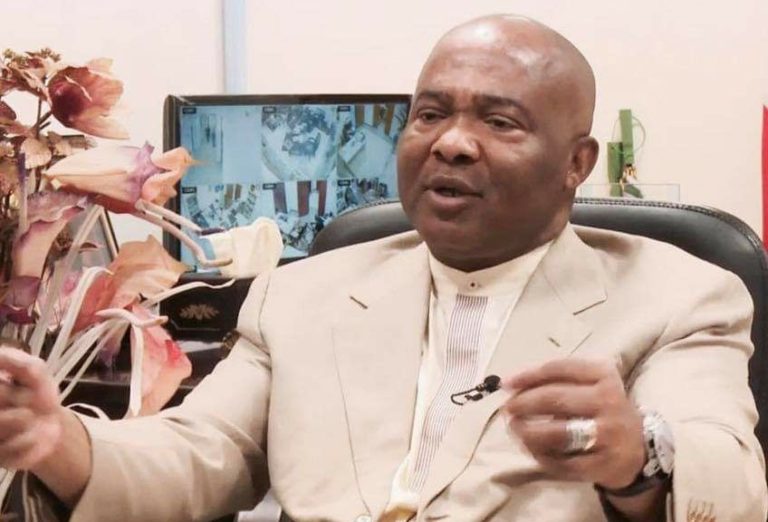
GOVERNOR Hope Uzodinma of Imo state has expressed support for the move to regulate social media in Nigeria.

The governor made this known when he received Mohammed Adamu, Inspector General of Police, in Owerri, capital of Imo, on Thursday, saying he is strongly in support of the move.

“I am strongly advocating that social media should be regulated in Nigeria,” he said.

“Opposition party incited hoodlums to cause trouble in Imo, because the real protesters went off the street after my address and assurances to them.”

Adamu who claimed his men acted professionally all throughout the protest despite the provocations and killings of some of them, said he was in the state to boost the morale of his men and to access the level of damage done to police facilities in the state.

“I can tell you that our men acted professionally during the protest, they had their guns, they were being killed, yet they respected human dignity,” Adamu said.

“I came specifically to visit vandalised property and to see the level of damage done to police facilities in Imo.’’

Adamu said he would also address key police officers to encourage and boost their morale which he said was low due to the protest.

He said he would strengthen community policing and partner with relevant parties in achieving the aim.

Opposition party kicks

Meanwhile, the People’s Democratic Party (PDP) has tackled renewed calls by the  ruling All Progressives Congress (APC),  to regulate social media.

Kola Ologbondiyan, PDP National Publicity Secretary, said in a statement on Wednesday that the plan by the APC-led government is unconstitutional, anti-people and suppressive designed to “asphyxiate” Nigerians.

While stating that there are implementable laws in the nation’s law to curb fake news and to punish offenders, the opposition party emphasized that the move by the APC is targeted against outspoken Nigerians and media houses for demanding accountability from the federal government.

“The PDP asserts that the renewed frenzy to censor the social media is ostensibly targeted at muzzling outspoken Nigerians, particularly the youths, media and civil society organizations, from demanding for accountability and competence, as well as exposing the widespread corruption, unbridled treasury looting, barefaced injustice, human right abuses, constitutional violations and divisive actions of the APC administration,” the statement read.

“Our party rejects the claims that the regulation bill is targeted at checking fake news. This is because our nation already has enough implementable laws to counter the dissemination of fake news and punish offenders.

“It is clear that the APC administration is rather xenophobic of criticisms from citizens against its manifest atrocities that it seeks to surreptitiously reenact the obnoxious military decree 4 to suppress Nigerians.

“Instead of this desperation to gag the citizens and curtail their constitutionally guaranteed rights, our party counsels the APC administration to rather take steps to reassure Nigerians by ending its manifest corruption, treasury looting, abuse of human rights, nepotism and unaccountability for which the citizens demands answers.”

Rather than working hard to regulate the social media, the PDP counseled the federal government to become more accountable, particularly, by ending its arrogance as well as shielding corrupt officials, especially those allegedly involved in the criminal diversion of funds voted for COVID-19 palliatives.

Controversial social media bill

In 2019, a bill to regulate the social media space was proposed and sponsored by Muhammad Musa, an APC lawmaker representing Niger East senatorial district.

The bill christened the “Protection from Internet Falsehood and Manipulation Bill” better known as Social Media Bill prescribes sanction for abuse of social media was rejected by overwhelming Nigerians.

On Monday, the Northern Governors’ Forum shortly after its meeting in Kaduna, issued a communique issued by  Simon Lalong, its Chairman and Governor of Plateau, to express support for the government’s move to regulate the social media.

The meeting, which said it took note of the devastating effect of the uncontrolled social media in spreading fake news, called for major control mechanisms and censorship of social media practice in Nigeria.

RMAFC drags feet on review of political office holders’ pay, revenue sharing formula

CHAIRMAN of the Revenue Mobilisation Allocation and Fiscal Commission (RMAFC), Mr Elias Mbam, on Wednesday, November 4, informed the House of Representatives Committee on Finance that the agency has commenced preliminary processes in its plan to review of the remuneration of political office holders in the country.

Mbam also said the RMAFC has started preliminary procedures for the review of the country’s revenue sharing formula.

Mbam, who appeared before the committee to defend the RMAFC’s 2021 budget, noted that the two reviews were at a preliminary stage which involve ‘literature’ review, collection of relevant data and engagement with stakeholders.

However, Mbam had, earlier in January 2020, also said the RMAC had commenced ‘preliminaries’ in the review of the salaries, allowances and other financial entitlements of the President, Vice President, governors, members of the National Assembly and other category of political office holders.

Mbam told journalists on January 27, 2020 that the review of the remuneration of political office holders would be done in 2020.

The planned review is aimed at aligning the remuneration of the political office holders to ‘current realities’ in the country.

Mbam had observed that the salaries and allowances of political office holders could go up, or go down, after the review.

Speaking on the matter on January 27, he said, “It is the intention of the Commission to review remuneration of public office holders this year and the process will determine whether it will be a reduction or an increase. That is part of our primary responsibilities.

“It is one of the areas we intend to address this year, so that the remunerations will reflect current realities. I don’t want to pre-empt what will be the result. It is a process and the process, if followed appropriately, will arrive at the appropriate answer. The preliminaries has commenced.”

About 10 months later, Mbam’s comments at the National Assembly on November 4 suggests that the RMAFC has not made much progress with the ongoing review.

If the review is to actually align the remuneration of political office holders to ‘current realities’, as suggested by Mbam, then it is expected that official financial benefits accruing to persons holding political offices in the country would be slashed.

Nigeria’s political office holders are reputed to be among the highest-paid in the world, despite the country’s rating as a ‘Lower Middle Income Country’ by the World Bank.

Also, Nigeria is currently battling severe revenue challenges, largely due to the sharp decline in the price of crude oil. In recent years, the Federal Government have been borrowing to fund annual budgets.

Perks enjoyed by political office holders contribute a large proportion to the high cost of governance in the country.

For instance, a breakdown made available by the RMAFC indicate that Nigeria’s President and Vice President earn N3.5m and N3.03m as basic salary, per annum, respectively.

Also, the annual basic salary of some other political office holders are – minister, N2.02m, minister of state, N1.95m, Special Adviser, N1.94m, governor, N2.22m, deputy governor, N2.11m, and commissioner, N1.33m.

In addition to the the basic salary, the President is entitled to allowances such as hardship allowance, which is 50 per cent of his salary, about N1.757m, and consistency allowance – 250 per cent of his salary, which amounts to about N8.786m.

In the same vein, the President’s gratuity is 300 per cent of his salary, amounting to N10,544,115. The President is also entitled to a leave allowance of 10 per cent of his salary, as well as a vehicle loan which amounts to 400 per cent of the salary.

The vice president, governors, members of the National Assembly and some other category of political office holders also receive similar allowances in different amounts.

Other regular allowances enjoyed by political office holders such as the President, Vice President, governors and members of the National Assembly include Personal Assistant, constituency, vehicle fuelling/maintenance, domestic staff, entertainment, recess, newspaper/periodicals and utilities.

Such category of political office holders are also provided with house maintenance, furniture, wardrobe, duty tour, accommodation, estacode and medical allowances, among others.

When all the allowances are summed up, the President’s monthly pay will amount to N1,171,568.33, and N14,058,820 per annum, while the Vice President will earn N1,010,524.17 monthly, and N12,126,290 yearly.

The RMAFC had reviewed the salary structure in 2007.

Mbam had also, on January 27, 2020, said the RMAFC was engaged with the preliminary processes in the review of the revenue sharing formula.

The commission commenced the current review of the revenue sharing formula with the inauguration of 18 standing committees, comprising 12 constitutional committees and six in-house committees, on August 15, 2019.

Noting that committees set up by the RMAFC were still researching and reviewing ‘literature’, Mbam had said, “It is after this review that we will invite stakeholders like the Federal Government, state governments, LGAs, National Assembly, state assemblies, civil society organisations and other Nigerians. After that we will go into public hearings. We have not dropped the review – we are still on preliminaries.”

According to the current revenue sharing formula, the Federal Government takes the lion share – 52.68 percent – from the Federation Account. The 36 states collect 26.72 percent, while the 774 local government areas receive 20.60 percent.

After the RMAFC announced plans to review the formula in 2019, the governors had declared their intention to demand that the states be allocated 42 percent of the federal revenue. The governors also said they will push for the slash of the Federal Government’s share to 37 percent.

However, months after it announced the commencement of the ‘preliminaries’ of the review, the RMAFC is yet to issue invitations for memorandum, or hold public hearings on the subject.

Not much has been heard of the planned reviews of the remuneration of political office holders and the revenue allocation sharing formula, until Mbam told the National Assembly, on November 4, 2020, that the assignments are still at preliminary stage.

The House of Representatives Committee on Finance frowned at the slow pace of work on the review of the revenue sharing formula, noting that Nigerians desire a new revenue sharing formula which would not place most of the country’s revenue in the hands of the Federal Government.

Asking the RMAFC to expedite action on the review of the revenue sharing formula, chairman of the committee, Mr James Faleke, told Mbam, “Let us make it very clear, Chairman; the Revenue Mobilisation Allocation and Fiscal Commission is purely established to mobilise revenue for Nigerians and a very core responsibility is the issue of new revenue formula.

“If you are unable to do this core responsibility, then Nigerians will not be happy with us. Nigerians are saying that the money at the centre is too much. Where you just sit down and you see the Federal Government sponsoring a lot of projects like N-Power, N-Agric that they have no business with, it shows us that that there is so much money at the centre to the detriment of the states.

“Please take this your function as very critical. If by next year we are not getting anywhere towards a new bill, this committee might be forced not to consider your budget.”

Speaking with The ICIR on Thursday, November 5, the National Coordinator of the Human Rights Writers Association of Nigeria, Mr Emmanuel Onwubiko, noted that systemic challenges might be undermining the RMAFC’s ability to effectively undertake the reviews.

Onwubiko said, “The RMAFC is one of those commissions that ought to be constitutionally independent but something is wrong somewhere. It is either that it is being deliberately starved of funds or the people heading the RMAFC are careful not to step on the toes of more powerful ‎institutions. The RMAFC is supposed to have oversight powers over all tiers of government and curtail leakages in the revenue of the government. The RMAFC should be a very strong institution but in Nigeria, such institutions are deliberately undermined. The problems affecting Nigeria in terms of systemic distortion in the country’s structure are also the same factors that have affected the functions of that agency.”

Stressing the need for an urgent review of the remuneration of political office holders, the HURIWA National Coordinator added, “It is a notorious fact that Nigerian legislators are the highest paid in any part of the world. How can you have less than 500 Nigerians in the National Assembly earning more than what can be used to fund strategic sectors of the economy? And you have a situation where the agency that should allocate the remuneration of these political office holders being systematically sabotaged. It is unfortunate.”

However, spokesman of the RMAFC, Mr Chris Nwachukwu, told The ICIR that the reviews are still on course.

Responding to observations that the RMAFC is dragging its feet on the reviews, Nwachukwu said, “The committee (set up by the RMAFC) is still working, until they finish up their work. Like the chairman told the House of Representatives committee yesterday, it is not a process that is to be rushed. It takes time. The committee is on the process and they are still working.”

Attempts by the RMAFC to review the country’s revenue sharing formula in 2013 ended on an ‘inconclusive’ note, even after the commission had undertaken a tour of the 36 states.

A proposed revised revenue sharing formula, which was ready by December 2015, was never implemented.

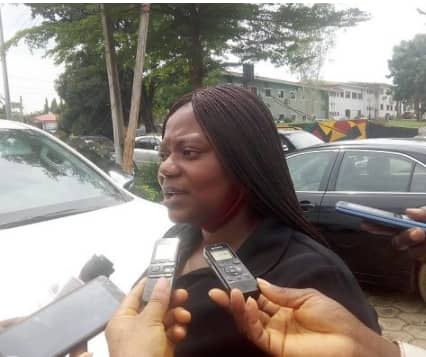
Senate panel asks Buhari to stop traveling abroad for medical trips

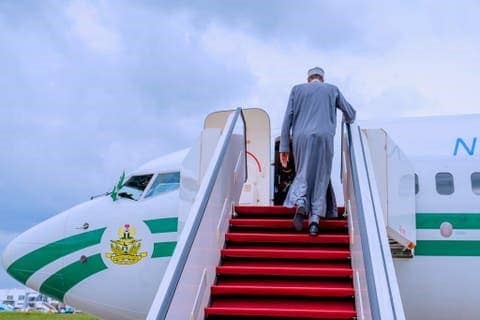
The Senate committee on federal character and intergovernmental affairs has asked State House officials to stop President Muhammadu Buhari from traveling on medical trips abroad.

Danjuma Laah, the senator representing Kaduna south and the panel chairman, stated this on Thursday when Tijjani Umar, the permanent of the State House came before it to defend its budget for 2021 budget.

In his defence, Umar told the panel that N19 billion was budgeted for the State House in 2021 out of which N1.3 billion was proposed for the State House clinic.

While addressing newsmen shortly after the budget defence session, Laah said that the amount budgeted for the State House clinic in the 2021 budget has been approved so that the president and his officials will stop traveling abroad for medical treatments.

He added that the president is not a man that should be taken outside the country frequently for medical treatments.

“Our president is not a man to be taken out anytime or anything that happens to him on matters of sickness matter.

“He must attend our clinic here and we must make sure that we equip our hospital to the best of our ability so that any emergency will be first taken care here before flying him out of  the need arises.

“It is already approved N1.3 billion for state house clinic. I want this thing done and I want the credit to go to the whole committee – leave a legacy for the State House, that the clinic we requested was done within the shortest time.”

Also, Umar told journalists that 1.3 billion naira proposed to fix the presidential arm of the State House clinic is not enough compared to what is obtained in other parts of the world and the number of principal officers it is going to serve.

He denied claims that the Aso Rock clinic is in a “comatose” state.

“It is not correct to say the State House clinic is in comatose, it is not. We have realigned some many things and one of the fundamental challenges we have dealt with is the sustainable supply of drugs and consumables. Don’t forget that this is derived from the budget,” the permanent secretary said.

“We have appealed to the committee to assist us with the presidential wing of the State House clinic.

“The N1.3 billion is absolutely inadequate when you juxtapose the amount proposed and the labour – the status of the principals that that project is going to serve, and you compare with worldwide standards you see that it is not anything near what we need.”

In 2017, President Buhari spent over 150 days in the United Kingdom, treating an undisclosed ailment. He returned back to the country amidst speculations that he had passed away. The president has since then visited the UK several times for medical trips.

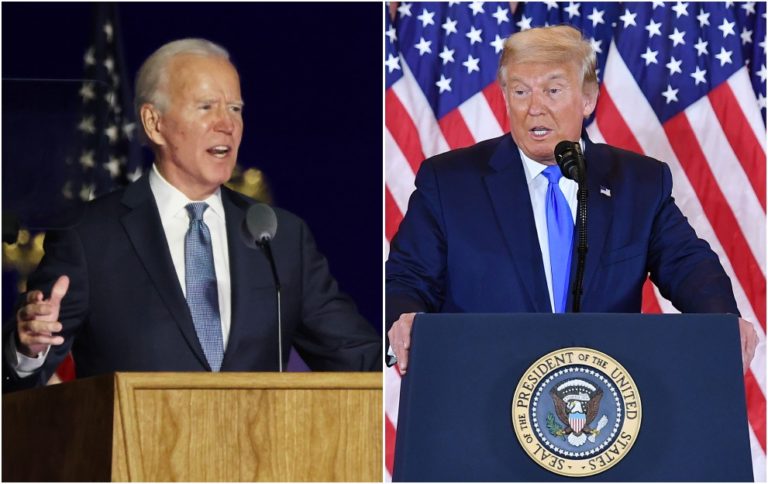
Analysis: Trump or Biden win at US elections could be a lose-lose for Nigeria

WITH the US presidential elections results due in a matter of a few days, countries around the world are monitoring the race closely as the outcome could mean different things to different nations.

President Donald Trump, though, perceived in some quarters as a polarizing figure, his brand of politics and foreign policies have favoured countries like Isreal and Sudan amongst others. 

For Joe Biden, the Democratic Party hopeful, if he wins, his victory could usher in a breath of fresh air to several countries who are hoping for relief from the crippling sanctions by Trump administration.

However, based on the positions of both candidates during the Presidential debates, America’s foreign policies may not be significantly favourable to Nigeria.

On October 22, when Biden was asked if he would weaken the US oil industry to pursue a more environmentally friendly energy policy.

“I would transition away from the oil industry, yes. The oil industry pollutes, significantly…It has to be replaced by renewable energy over time,” Biden stated.

A Biden-win with a preference for a diversified energy option will certainly affect the fortune of Nigeria, a country that relies majorly on oil revenue.

However, President Trump’s administration has already seen an increased US oil production at its peak, lifting a 40-year ban placed on oil importation and stopped the imports of crude oil from Nigeria.

The energy policies of President Trump and Biden do not involve Nigeria in its scheme considering its preparation for a post-oil future.

Nigeria boasts of the world’s ninth-largest proven gas reserves but a potential Biden administration could settle on the possibility of deploying natural gas as a transition fuel to a low carbon emissions economy.

In January, President Trump expanded his administration’s travel ban to include Nigeria, along with five other countries its likely with a Trump win the immigration restrictions will still be in place.

The ban on Nigerian immigrants which took effect on Feb. 22, would not prevent travel by Nigerians coming to the US on student and employment visas.

A question most Nigerians have ahead of the US election is who will be most likely to rescind the US restrictions on immigration from Africa’s most populous nation.

According to a  Gallup poll in July, despite the immigration ban placed on Nigeria by the US, a majority of Nigerians have a positive view of the U.S.’s leadership.

Though Biden is yet to pick interest in Nigeria from his position during the debates but apart from revoking the travel ban on Nigeria it is hard to know his stand on US interests in Nigeria.

Joe Keshi, a former Nigerian consul to the US who spoke on a breakfast programme on Arise TV said Nigeria’s interests will be largely represented if more American – Nigerians seek for elective positions in the US.

“The Democratic Party has a liberal-leaning towards countries where they have strategic interests but I have always advocated for Nigerian – Americans to seek elective positions in the US that is the only way we can retain Nigeria’s interests in the US,” he said.

Corroborating his stance, Pat Utomi, a Professor of Political Economy in an interview said today’s Nigeria would be marginal to U.S.’ strategic interests, except concerning terrorism and regional security interests.

He stated the scenario would change, “if the considerable number of Americans of Nigerian descent vote as a block, then they are consequential in affecting outcomes.”

In recent times, the US has consistently revealed that its protectionism policy of placing America’s interest first before other countries under President Trump has not put Nigeria’s interest in its crosshairs.

This has seen the US under President Trump opposed Adewunmi Adesina’s re-election bid as President of the Africa Development Bank, AfDB

Adesina’s re-election bid as President of the AfDB was threatened by the US request for an independent probe into whistleblower allegations levelled against him despite being absolved by the ethics committee of the bank’s board of governors.

The findings of the independent probe panel exonerated Adesina and cleared him for the elections which he won by a landslide victory.

In the build-up to the race to succeed Brazil’s Roberto Azevedo as Director-General of the World Trade Organisation, WTO took an unexpected turn last week after the US rejected Nigeria’s candidate, Ngozi Okonjo-Iweala.

Okonjo-Iweala has gathered support from most WTO member countries, but the US-supported her only opponent, South Korea’s Trade Minister Yoo Myung-hee, indicating her skills and experience in international trade dealings.

This shows that US policy under President Trump favours countries always entail enormous lobbying efforts built on goodwill.

President Trump’s trade policy of prioritising the US interests first has resulted in a low volume of trade between Africa and the US, which continues to diminish as the US also grows less reliant on Nigeria’s oil exports.

Mike Pompeo, US Secretary of State in a New York Times report stated its security ties between both nations, exemplified after the US sold 12 combat propeller planes worth $500 million to combat insecurity in Nigeria.

“Nigeria has room to grow in sharing important national security information. I am optimistic that’s going to happen,” Pompeo said.

The security ties between the US and Nigeria has been strained in recent times but it had improved significantly under the Trump administration.

In 2014, the Barack Obama administration had blocked a transfer of US-manufactured military helicopters from Israel to Nigeria due to human rights
concerns under former President Goodluck Jonathan.

US security cooperation with Nigeria improved after the 2015 inauguration of President Buhari, who pledged to investigate the abuses.

The Obama administration had sought congressional approval for the sale of 12 A-29 Super Tucano attack aircraft to Nigeria but stopped the sale after a Nigerian jet struck a camp for displaced people during a bombing raid.

The Trump administration had revisited that decision, and in late 2017 approved the sale, despite opposition from some members of Congress.

With the US elections result due in a few days,  a Biden or Trump win does not guarantee any significant gain for Nigeria.

PDP tackles APC over renewed plans to regulate social media

0

THE People’s Democratic Party (PDP) has tackled the ruling All Progressives Congress (APC) on its renewed plan to regulate social media.

Kola Ologbondiyan, PDP National Publicity Secretary, said in a statement on Wednesday that the plan by the APC-led government is unconstitutional, anti-people and suppressive designed to “asphyxiate” Nigerians.

While stating that there are implementable laws in the nation’s law to curb fake news and to punish offenders, the party emphasized again that the move by the APC is targeted against outspoken Nigerians and media houses from demanding accountability from the federal government.

“The PDP asserts that the renewed frenzy to censor the social media is ostensibly targeted at muzzling outspoken Nigerians, particularly the youths, media and civil society organizations, from demanding for accountability and competence, as well as exposing the widespread corruption, unbridled treasury looting, barefaced injustice, human right abuses, constitutional violations and divisive actions of the APC administration,” PDP said.

“Our party rejects the claims that the regulation bill is targeted at checking fake news. This is because our nation already has enough implementable laws to counter the dissemination of fake news and punish offenders.

“It is clear that the APC administration is rather xenophobic of criticisms from citizens against its manifest atrocities that it seeks to surreptitiously reenact the obnoxious military decree 4 to suppress Nigerians.

“Instead of this desperation to gag the citizens and curtail their constitutionally guaranteed rights, our party counsels the APC administration to rather take steps to reassure Nigerians by ending its manifest corruption, treasury looting, abuse of human rights, nepotism and unaccountability for which the citizens demands answers.”

Rather than working hard to regulate the social media, the PDP counseled the federal government to become more accountable, particularly, by ending its arrogance as well as its shielding corrupt officials, especially those allegedly involved in the criminal diversion of funds voted for COVID-19 palliatives.

Controversial social media bill

In 2019, a bill to regulate the social media space was proposed and sponsored by Muhammad Musa, an APC lawmaker representing Niger East senatorial district.

The bill christened the “Protection from Internet Falsehood and Manipulation Bill” better known as Social Media Bill prescribes sanction for abuse of social media was rejected by overwhelming Nigerians.

On Monday, the Northern Governors’ Forum shortly after its meeting in Kaduna, issued a communique issued by  Simon Lalong, its Chairman and Governor of Plateau, to express support for the government’s move to regulate the social media.

The meeting, which said it took note of the devastating effect of the uncontrolled social media in spreading fake news, called for major control mechanisms and censorship of social media practice in Nigeria.

Ayade presents N277 bn budget of ‘Blush and Bliss’ to State Assembly

BEN Ayade, the governor of Cross Rivers state has presented the 2021 appropriation bill of N277,708 billion tagged ‘budget of blush and bliss’ to the State House Assembly.

Ayade made this known via his social media page on Thursday saying that the total budget for 2021 stands at N277,708,738, 550.50.

“Today I presented the CRS 2021 budget of Blush and Bliss to the H.O.A which stood at the sum of two hundred and seventy-seven billion, seven hundred and eight million, seven hundred and thirty-eight thousand, five hundred and fifty naira, fifty kobo (#277,708,738, 550.50),” his tweet read.

According to Ayade, the capital expenditure of the budget is NGN85,196,800.00 while recurrent expenditure is NGN192,511,985,550.

Unlike the government’s initial budget proposal in 2020, N911 billion was budgeted for capital expenditure while recurrent expenditure was pegged at N188 billion leading to a total budget of N1.1 trillion tagged ‘Olipotic Meristemasis’.

The ICIR in a data analysis had reported that the budget was unrealistic considering the Internal Generated Revenue (IGR) of the state and its allocation from the federal government.

The budget was eventually slashed to N147 billion following the outbreak of the Coronavirus pandemic in Nigeria.

The state government said the ‘olympotic budget’ was reduced due to the ‘fall in federal revenue and allocation of expenditure’.

On Thursday while presenting the 2021 appropriation to the Cross River State House of Assembly, Ayade said he would focus on security and neighbourhood watch to combat insecurity in the state.

The previous budgets passed by Ayade administration which many consider as high sounding but deliver marginal public service are:

2021 – Budget of Blush and Bliss
2020 – Budget of Olimpotic Meristemasis
2019 – Budget of Qabalistic Densification
2018 – Budget of Kinetic Crystallisation
2017 – Budget of Infinite Transposition
2016 – Budget of Deep Vision.