Home Blog Page 205

Fire wreaks havoc on Fresh FM station in Ibadan

0

FRESH FM Nigeria and Yinka Ayefele Limited group, a renowned radio station based in Ibadan, the capital of Oyo State, has announced that its head office in Challenge, Ibadan, was destroyed in a devastating fire incident on the evening of August 15, 2025.

The Group Head of Corporate Affairs, Samson Akindele, revealed this in a statement released on Saturday a few hours after a staff member, Sanuel Ibikunle Arugboboisi, raised the alarm on his Facebook page on Friday night, appealing to emergency responders and members of the public for urgent intervention.

“We are sad to inform the general public that the head office of Fresh FM Nigeria, Challenge – Ibadan was razed by a devastating fire incident this evening, August 15, 2025.”

Akindele explained that the studios of Fresh 105.9 and Blast 98.3 were severely damaged by fire, with nearby facilities such as the newsroom, transmitter, server room, and various equipment also being destroyed during active operations.

“All efforts to fight the fire, before the arrival of the professional fire fighters, with our in-house fire extinguishers proved abortive because of the strength of the inferno.

“We can’t immediately quantify the extent of the damage caused by the devastating inferno, the cause of which is also yet to be ascertained presently,” Akindele said.

The Head of Corporate Affairs expressed gratitude to Nigerians who helped combat the inferno.

The ICIR reports that this latest incident adds to the challenges the media outfit has experienced in recent times.

Recall that the Fresh FM building formally ‘Music House’ was demolished in August 2018 by the former Governor, Abiola Ajimobi, despite a subsisting court directive restraining the state government from going ahead with the exercise pending the determination of the case.

The governor had justified the demolition of the ‘Music House’, insisting that the building contravened the laws of the state, and one cannot be allowed to get away with illegality just because one has a disability, or has employed people in one’s firm.

12 Nigerians rescued from CAR allege sexual abuse by Chinese employers

0

TWELVE Nigerian men rescued from forced labour in the Central African Republic have returned home, recounting harrowing experiences of abuse, including allegations of sexual assault by their Chinese employers.

The Nigerians in Diaspora Commission revealed in a statement on Saturday, noting that the chairman and Chief Executive Officer of the commission, Abike Dabiri-Erewa, received the group in Abuja on Friday.

Recall that in a video released three weeks ago, the group appealed to the Nigerian government for help, explaining that a Chinese mining company in Nigeria called Rado Central Coal Mining had taken them ten months ago to CAR for work but abandoned them in a bush without pay.

In the video, one of the men alleged that the company’s Nigerian general manager, Abdul-Almaruf Ademola Aregbe, returned to Nigeria shortly after their arrival in CAR and showed no concern for their welfare when they reached out to him.

“His partner,  Amos, a CAF citizen, seized our passport, and doesn’t want to give it to us, even though some of us here are ready to transport ourselves back to Nigeria but without our passports we can not.

“The distance from this place to Bangi is 8,050 kilometres… our location is Senye under Bambari region,” the man said in the video. 

The commission said that after the video appeal, the federal government, working through the Ministry of Foreign Affairs and the Nigerian Mission in Bangui, facilitated the workers’ relocation to the CAR capital, offered them medical care, and arranged their safe return to Nigeria.

Dabiri-Erewa denounced the abuses as inhumane and unacceptable, assuring the returnees that the government would seek justice on their behalf, the statement noted.

Speaking for the group, their leader, Igorigo Freeborn, recounted their ordeal, revealing that they suffered months of unpaid labour and sexual abuse.

“We were homosexually abused by our Chinese employers in CAR. I am not ashamed to say it. I want other people to learn from it.

“They owe us 11 months of salaries. We were treated badly there, but thank God we are alive to tell our stories,” Freeborn said.

Freeborn noted in the statement that the workers faced nearly two years of hardship after leaving Nigeria in pursuit of better opportunities.

He expressed gratitude to Nigerian government, and orther partners that facilitated their return for intervening swiftly after their situation became public.

“I used to think nothing good could come out of Nigeria, but we were so happy to receive help and succour from our own country.          “Let me use this opportunity to thank President Bola Tinubu, the minister of Foreign Affairs, the CAR Ambassador in Bangui, NIDCOM, NEMA, Immigration and all those who helped.”

Ecobank confirms Nedbank sale of 21.22% stake

ECOBANK Transnational Incorporated (ETI), the parent company of the Ecobank Group has confirmed the sale of 21.22 per cent stake by South Africa’s Nedbank Group.

The pan-African bank confirmed this in an official disclosure to the Nigerian Exchange Limited (NGX) on Friday, August 15.

It said Bosquet Investments Ltd, the private investment vehicle of Alain Nkontchou, acquired the Nedbank stake, noting that the transaction remains subject to regulatory approvals.

According to Ecobank, Enko Capital Management LLP served as the lead advisor for the transaction, while Absa Bank Limited (acting through its Corporate and Investment Banking division) was appointed as the co-financial advisor.

The sale follows Nedbank’s decision to realign its strategy towards its core markets in Southern and Eastern Africa where the Group owns and controls businesses.

Commenting, Ecobank Group Chief Executive Officer, Jeremy Awori, said, “Having been part of the bank’s journey for many years, initially joining as a member of the Board of Directors, then serving as ETI Chairman, Alain has demonstrated unwavering dedication, strategic vision, and leadership that have significantly contributed to the bank’s achievements, bringing the bank to an era of profitability.

“I also take the opportunity to extend deep appreciation to Nedbank for 17 years of constructive partnership. They remain a valued commercial partner of Ecobank.”

The transaction is said to have been valued at $100 million as Nedbank cited regulatory uncertainties, potential higher capital requirements and plans to focus on Southern and East Africa,Reuters reported.

The ICIR reported recently that the Ecobank Group has revealed plans to exit the Mozambique market, hinting at its strategic change in ownership and operational management, and assuring it will not have any disruption to its banking operations, assets, or employees.

July inflation drops to 21.88%,linked to food prices decrease-NBS

NIGERIA’s inflation rate decreased to 21.88 percent in July from 22.22 per cent in June, mainly due to a drop in food prices, according to the National Bureau of Statistics (NBS).

The statistics office reported this in its latest consumer price index (CPI) report, released on Friday, August 15.

The monthly report showed that on a year-on-year basis, the headline inflation rate was 11.52 per cent lower than the 33.40 per cent rate recorded in July 2024.

“This shows that the Headline inflation rate (year-on-year basis) decreased in July 2025 compared to the same month in the preceding year (i.e., July 2024), though with a different base year, November 2009 = 100,” NBS stated.

The NBS had at the beginning of the year changed the methodology for calculating the consumer price index (CPI) used to measure the inflation rate.

In January, the statistics office rebased the CPI to a 2024 base year from a 2009 base year.

In its latest report, NBS indicated that on a month-on-month basis, the headline inflation rose to 1.99 per cent in July, higher than the 1.68 per cent rate in June.

Food inflation dropped to 22.74 per cent on a year-on-year basis from 39.53 per cent in July 2024.

This significant decline in the annual food inflation figure was also technically due to the change in the base year.

“The decrease can be attributed to the rate of decrease in the average prices of vegetable oil, Blbean (white), rice local, maize flour, guinea corn (sorghum), wheat flour, millet whole grain, etc,” NBS stated.

A cursory look at the food inflation figure of 22.74 per cent in July showed that it rose compared to 21.97 per cent in June this year. The ICIR can spotlight.

While the July inflation signifies the third consecutive monthly decline in inflation, there are still worries that it has yet to correlate with the economic reality of rising food and commodity prices.

The disconnect has continued to be of concern to industrial watchers and economic experts.

“The disconnect is highly suspicious and distorted,” the Chief Executive Officer (CEO) of CFG Advisory, Tilewa Adebajo, told The ICIR earlier.

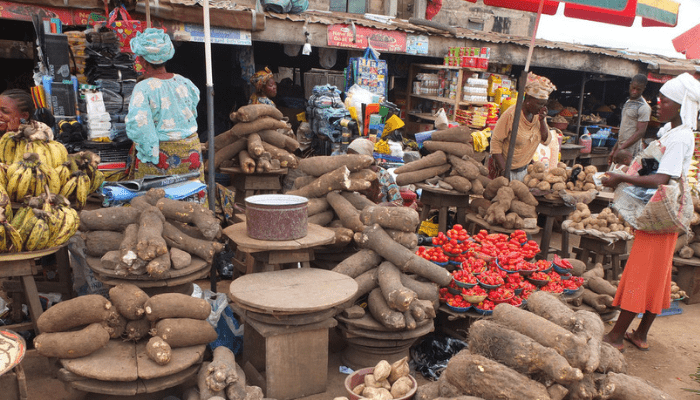
The ICIR recently, in a report, documented the unbearable outcry of farmers and traders on the high costs of food and commodities prices, which pose a challenge for many Nigerians and worsen their hardship.

Again, NNPC reduces fuel price after Dangote’s slash

0

THE pricing competition among petroleum marketers continued this week as the Nigerian National Petroleum Company Limited (NNPCL) reduced its petrol prices across its retail outlets to N865 per litre in Lagos and N890 per litre in Abuja.

The reduction noticed on Friday, August 15, came two days after Dangote Petroleum Refinery reduced its price to N820 per litre.

Dangote Refinery’s Chief Branding and Communications Officer, Anthony Chiejina, announced the reduction in a statement on Tuesday, August 12.

The cut in the ex-depot price, also known as the gantry price, represented a N30 reduction from N850 per litre.

However, the NNPCL’s price slash represents a N10 cut in Lagos and Abuja, from the previous N875 per litre and N900 per litre, respectively.

The ICIR reporter observed that the product was sold for N865 per litre in Lagos and N890 per litre in Abuja.

Further checks by The ICIR revealed that some NNPCL filling stations have yet to commence sales, with some still unprepared to dispense, citing downward pricing fluctuations and unsold old stocks.

For instance, the NNPCL retail outlet on Arab Road, Kubwa, and the one near the Directorate of Road Traffic Services (hDRTS) headquarters, in Mabushi area of the Federal Capital Territory (FCT), did not sell.

One of the pump attendants, Memunat Abdullahi, told our reporter that her station was expecting a directive from  the management.

At the NNPC outlet in Abule Ado in Lagos, the price of petrol dropped to N865 per litre.

Similarly, at the NNPCL outlet at Federal Housing Authority, Kubwa, the commodity’s price dropped to N890 per litre.

On August 6, the NNPCL reduced petrol price at its retail outlets to N875 per litre in Lagos and N900 in Abuja.

This came two days after the national oil company hike the product’s price to N915 per litre and N955 per litre in both cities.

On August 12, Dangote Petroleum Refinery reduced its petrol price to N820 per litre — six days after increasing the price to N850.

The refinery also said it had started deploying 4,000 compressed natural gas (CNG)-powered trucks for fuel distribution nationwide from August 15.

Although some filling station retail outlets are still selling within N930-N960, the price competition is a result of the deregulation of the petroleum upstream, midstream, and downstream sectors, which allows market forces to determine prices.

On Monday, August 4, the NNPCL sold N950+/litre in most of its retail outlets in Abuja, dropping its price barely 48 hours later to N900 per litre, reported, The ICIR.

The ICIR reports that global movement of crude oil prices in the international market are key factors affecting the price drop in filling stations.

Obi blames Nigeria’s declining FDI on poor leadership

FORMER Labour Party presidential candidate, Peter Obi, has blamed Nigeria’s declining foreign direct investment (FDI) on poor leadership and weak governance.

Obi made this position known about the poor investment inflow under the President Bola Tinubu-led administration in a statement on Friday, August 15.

He pointed out that FDI declined in the first quarter (Q1) of this year by over 70 per cent despite several official business trips Tinubu and his officials have embarked on.

“While the President, Ministers, and other government officials continue their global galivanting in search of FDI, our poor performance in key governance indicators – such as rule of law, regulatory quality, government effectiveness, and voice and accountability – continues to prove that you cannot attract sustainable foreign investment with poor leadership and governance,” he said.

Referring to a recent report by the National Bureau of Statistics (NBS), which revealed that  FDI to Nigeria declined by about 70 per cent in the first quarter of 2025, falling to only $126.29 million from $421.8 million in the last quarter of 2024, Obi stressed the role of strong public institutions in attracting investment.

He noted further that of the total capital importation of about $5.64 billion in the first quarter of 2025, FDI accounted for only about 2.24 per cent, compared to 8.2 per cent in the fourth quarter of 2024.

“Disturbingly, about 90% of the imported capital went into speculative money market instruments. With such a high proportion of capital importation flowing into speculative investments, the impact on industrial growth or job creation is highly insignificant and elusive, given the ease with which such “hot money” can exit the economy.

“Let me reiterate: sustainable economic growth and development cannot be achieved through poor leadership and weak governance—problems that are reflected in declining FDI and our poor performance in key governance indicators,” he stressed.

He buttressed his points further that capital flows to the manufacturing sector declined exponentially by 32.1 per cent, dropping to only $129.92 million in the first quarter from $191.92 million in the same quarter of 2024

According to Obi, there is no better confirmation of the lack of trust in the current government, whose reforms remain uncoordinated and largely reactive.

“In 2024, while global FDI flows declined, FDI to Africa significantly increased to $97 billion—a rise of about 75% compared to 2023. Europe, the United States, and China were the main sources of this FDI. Egypt attracted the highest share in Africa, with $46.58 billion.

“Other top recipients included Ethiopia ($3.98 billion), Côte d’Ivoire ($3.80 billion), Mozambique ($3.55 billion), Uganda ($3.30 billion), Democratic Republic of Congo ($3.11 billion), South Africa ($2.47 billion), Namibia ($2.06 billion), Senegal ($2.02 billion), Guinea ($1.83 billion), and Morocco ($1.64 billion),” he cited.

He said it was disappointing to note that Nigeria — the so-called “Giant of Africa”—received only $1.08 billion, only about one per cent of Africa’s total FDI, representing a decline of about 42 per cent from 2023.

“Worse still, after this 42% drop between 2023 and 2024, FDI to Nigeria has further declined by 75% between Q4 2024 and Q1 2025. We cannot achieve sustainable growth and development with ineffective leadership and a weak government,” Obi added.

The ICIR had reported that the National Bureau of Statistics (NBS) released the ‘Nigeria Capital Importation Q1 2025’ on Tuesday, August 5.

The report revealed that portfolio investment stood at $5.2 billion, accounting for 92.25 per cent of the total inflows.

Other investment inflow stood at $311.17 million, while FDI recorded the least inflow with $126.29 million.

The report noted that only the Abuja ($3.04billion), Lagos ($2.5billion), Ogun ($7.9million), Oyo ($7.81million) and Kaduna($4.06 million) states attracted foreign direct investment in Q1, leaving questions about the other 30 states, despite collecting huge federation allocations.

The ICIR had, in this publication, analysed why Nigeria needs to attract more FDI as it will strengthen the naira against other currencies and bring about foreign exchange liquidity in the country.

Peter Obi endorses ADC as INEC conducts polls for 16 legislative seats

0

THE Independent National Electoral Commission (INEC), will on Saturday, August 16, hold bye-elections across 16 constituencies in 12 states, filling two senatorial seats, five House of Representatives positions, and nine state assembly slots.

 The polls follow vacancies caused by resignations, deaths, and court-ordered reruns.

The INEC, on Thursday, August 14, announced that all sensitive materials for the elections had been delivered to state offices, with the Bimodal Voter Accreditation System (BVAS) fully configured. 

It also noted that recruitment and training of ad hoc staff, as well as logistics arrangements, had been concluded, adding that the final batch of sensitive materials was delivered on Thursday.

The elections will take place in Anambra, Edo, Jigawa, Kaduna, Kano, Ogun, Adamawa, Kogi, Niger, Taraba, Zamfara, and Oyo states. 

The commission warned stakeholders to adhere strictly to electoral laws and guidelines to ensure a smooth process.

Meanwhile, as Nigerians prepare to cast their votes, a wave of political tension surrounds the polls.

Obi endorses ADC, cites internal crisis

The Labour Party presidential candidate in the 2023 election, Peter Obi, on Thursday, urged his supporters, popularly known as the “Obidient Movement”, to back the African Democratic Congress (ADC) in the bye-elections, claiming the Labour Party had no recognised candidates due to internal disputes.

“Kindly note that because the Labour Party has no recognised candidates by INEC due to the internal crisis, I humbly urge every member of Obidient and COPDEM families to go out and vote for the coalition political party, African Democratic Congress (ADC), in their respective states,” he said.

The endorsement came amid a protracted leadership crisis in the Labour Party.

The Anambra LP chapter had lauded INEC for excluding candidates produced by the Julius Abure-led faction from the state’s bye-elections.

The move sparked a protest to INEC headquarters in Abuja on August 6.

In Oyo, the LP state chairman Sadiq Atayese disclosed to the News Agency of Nigeria that the party’s candidate for Ibadan North Federal Constituency had also been omitted from the list.

LP accuses Obi of sabotage 

Reacting, the Abure-led LP faction has accused Obi of attempting to undermine the party, alleging that he fuelled the crisis he now claims.

The party insisted it had candidates cleared to contest in the polls and called on members to ignore Obi’s directive.

“Nigerians should not forget in a hurry that it was Peter Obi that created the crisis in the Labour Party which he is now citing as a reason why people should not vote for the party.  Peter Obi and Alex Otti the Governor of Abia State hosted the ill-fated and illegal expanded stakeholders meeting in Umuahia, September 4, 2024. 

“He has also co-funded the crisis all these while and went as far as leading a protest match to INEC headquarters against his own party. His desperation to control the soul of the party has made him go haywire,” the party said in a statement.

It also accused INEC of bias and threatened to seek nullification of the elections if its candidates or logo were excluded from the ballot.

The crisis deepened in July when the party’s National Executive Committee, chaired by Abia State Governor Alex Otti, appointed Nenadi Usman as Interim National Chairman and Darlington Nwokocha as Interim National Secretary.

The NEC also approved a timetable for ward, local government, state, and zonal congresses.

But Kennedy Ahanotu, the National Youth Leader and prominent member of the Abure-led faction, dismissed the move as ‘unconstitutional.’ 

He insisted that Abure remained the legitimate national chairman, citing provisions of the Labour Party’s constitution and the Electoral Act.

ADC-SDP coalition alleges APC sabotage in Kaduna

In Kaduna, the ADC and Social Democratic Party (SDP) accused the All Progressives Congress (APC) of plotting to “sabotage the bye-elections, distort the process, and steal the elections” through thuggery, vote-buying, and other tactics.

The allegation was contained in a statement signed by the ADC National Vice-Chairman (North-West) Jafaru Ibrahim Sani, ADC Kaduna Chairman Patrick Ambut, and SDP Kaduna Chairman Nasiru Maikano.

However, the state government through its Commissioner for Information, Ahmed Maiyaki, dismissed the allegations, describing them as ‘lies’.

“We will not sit idly by while political opportunists smear the name of our administration and malign innocent officials with wild, unsubstantiated claims,” Maiyaki said.

NSCDC, Police beef up security 

Meanwhile, the Nigeria Security and Civil Defence Corps (NSCDC) said it had deployed 20,850 personnel to secure polling stations and election materials and to ensure peace during the voting process.

In a statement on Friday in Abuja, the NSCDC Public Relations Officer, Babatunde Afolabi, assured the public of the Corps’ readiness to protect election materials, safeguard officials, and monitor the entire electoral process in collaboration with the Nigeria Police Force, the lead agency for election security operations.

Also, some police commands in affected states have reaffirmed their commitment to safeguarding the integrity of the electoral process.

UPDATED: APC, PDP reject Canadian court’s ruling widely misinterpreted as labelling them terrorists

THE ruling All Progressives Congress (APC) and the main opposition Peoples Democratic Party (PDP) have reacted to viral reports claiming that a judge of the Federal Court of Canada, Phuong Ngo, labelled them as ” terrorist organisations”.

The reports said the court upheld a ruling that classified APC and the PDP as terrorist organisations, while denying asylum to a Nigerian politician, Douglas Egharevba, over his decade-long affiliation with both parties.

However, details of the court’s ruling showed the judge declined to rule on the Canadian Immigration’s argument that the parties were terrorist organisations.

In his judgment delivered on June 17, 2025, Ngo dismissed Egharevba’s application for judicial review of his asylum request after the Immigration Appeal Division (IAD) found him inadmissible under Canada’s Immigration and Refugee Protection Act (IRPA).

The Canadian Minister of Public Safety and Emergency Preparedness had reportedly argued that the APC and PDP were involved in political violence, subversion of democracy, and electoral bloodshed in Nigeria.

Egharevba was a member of the PDP from 1999 until he quit the party in 2007. He later joined the APC and also left the party 2017. Upon arriving in Canada, he disclosed his party affiliations.

The court ruled that his PDP membership made him inadmissible under Canadian law due to the party’s involvement in violence, intimidation, and other unlawful acts, which the court deemed to fit the definition of terrorism.

The court found both parties culpable but noted the PDP’s longer tenure in power meant it committed more offences. As a result, membership in these parties is grounds for inadmissibility in Canada, said the court.

The ICIR reports that the APC and the PDP reacted to the reports without first finding out what the court actually said.

In its response, the APC national secretary, Ajibola Basiru, described the presiding judge as an ‘ignoramus’.

“We are not party to the suit and the court has no jurisdiction to determine the status of a Nigerian recognised political party, not to talk of declaring it as a terrorist organisation,” Basiru stated.

He described the APC as a credible democratic political organisation and expressed disappointment that some Nigerians, whom he characterised as desperate and unpatriotic, were allowing the country’s name to be dragged into “unfavourable international commentary due to their self-initiated asylum applications.”

He further stated that the judgment in question appeared to be biased and was narrowly focused on determining the applicant’s eligibility for asylum.

“The APC is a credible democratic political organisation and does not seek legitimacy from a foreign bench and under a law that has no extraterritorial application,Bashiru stated.

Similarly, the PDP described the ruling asmisinformed, biased, and lacking evidence.”

The PDP Deputy National Youth Leader, Timothy Osadolor, in an interview with Vanguard, said the ruling was unfounded and unjustified. He emphasised that Nigeria and Canada were both democracies and that such allegations should be handled with caution and precision.

He noted that people had the right to freedom of speech but should exercise it with circumspection.

He argued that there was no evidence to support the claim that either party is a terrorist organisation.

He suggested that Canadian authorities should focus on specific allegations against individuals rather than making sweeping accusations.

Hours after the parties reacted to the reports, the National Publicity Secretary of the APC, Felix Morka, said the court never described the parties as terrorists.

“We wish to state categorically that the Canadian court did not declare APC as a terrorist organisation, contrary to highly erroneous media reports in circulation,” he wrote in a statement.

He added, “For the record, APC was not in existence as of 2007. The party was registered in 2013. The applicant’s claim of membership of APC as of 2007 is evidently false as he could not have been a member of APC that didn’t exist at the time.

“For the avoidance of doubt, we make bold to state that the court never made any determination on the question of terrorism in its decision. In the judge’s own words: ‘Having found that the IAD’s analysis on subversion was reasonable, this is sufficient to dismiss the application for review. I will therefore refrain from anaylysing the IAD’s findings on terrorism.”

NOTE: This report has been updated to reflect that the Canadian court never ruled that the APC and PDP were terrorist organisations.

The ICIR did not publish the initial report that erroneously described the parties as terrorists.

.


Photobook showcases heritage of Abuja’s indigenous communities

0

TRICOM Productions has unveiled a photobook capturing the heritage of Abuja’s indigenous people.

Titled ‘On the Edges of the City,’ the work seeks to preserve the history of the indigenous people of Nigeria’s capital.

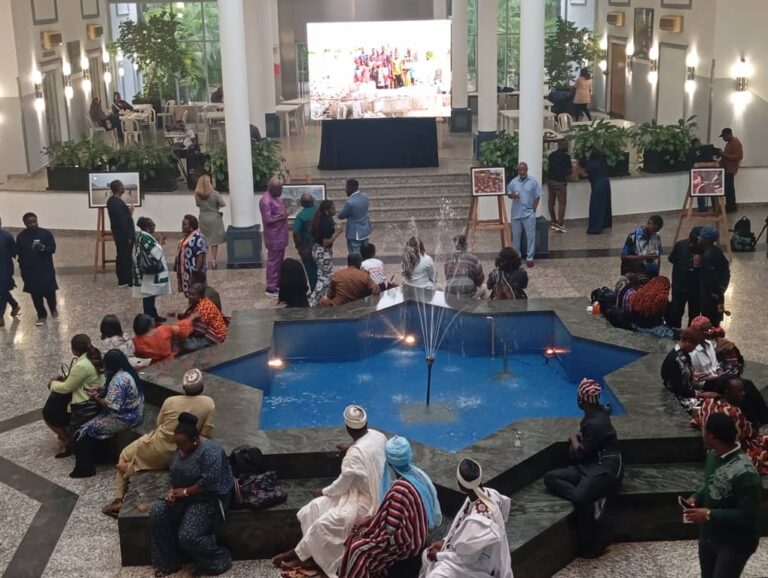
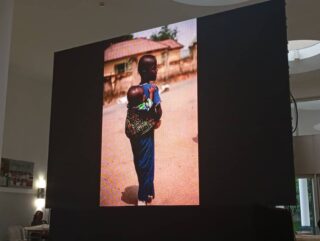
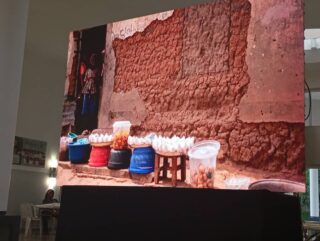
Exhibition of a selection of the photographs at the Shehu Yar’Adua Centre, Abuja

The initiative was funded by the MacArthur Foundation, according to Tricom’s Chief Executive Officer, Paul Nwulu, who addressed a gathering of dignitaries and residents of the city at the book’s unveiling in Abuja, on Thursday, August 14.

Nwulu said of the project, “Over the years, as Abuja has grown into a big city, those communities have been largely displaced, disenfranchised, and marginalised. Nobody knows their story anymore.”

He explained that between December 2024 and March 2025, Tricom Productions deployed at least 20 photographers to various indigenous settlements in and around Abuja to collect stories and visually document the lives of the people.

“Eighteen Photographers brought over 8,000 images that were captured during the four months. We selected only 250 and made them into the final photobook” he added.

Nwulu said the Shehu Yar’Adua Centre had allocated a permanent space to display the photos, and a website would be launched next week to host the online collection.

He expressed hope that the project would inspire similar initiatives, including documentaries and films.

Exhibition of a selection of the photographs at the Shehu Yar’Adua Centre, Abuja

The Country Director of the MacArthur Foundation, Kole Shetima, noted that while many Nigerians see Abuja as a modern, planned city, the area was home to vibrant indigenous communities long before it was designated the Federal Capital Territory in 1976.

“The copy book on the original inhabitants of Abuja, which is titled ‘On the Edges of the City’, is a depiction of the original inhabitants. When you are a visitor to Abuja, you really don’t have a sense of what this city is all about, because of the big buildings, but when you ask what is the soul of Abuja? It’s very difficult to say,”Shetima said.

While urging other cultures in Nigeria to draw inspiration from the initiative, one of the photographers, Segun Ogunleye, said he learned the importance of documenting history and culture in a fast-evolving world, as it would help to preserve identity and ensure future generations connect with their roots.

“You can imagine tribal marks. That was my takeaway. We didn’t see any child with tribal marks of these indigenous tribes. So, if nobody takes a picture or makes a video, then it means that in 20 years time, you will not have anybody with tribal marks” Ogunleye said.

Exhibition of a selection of the photographs at the Shehu Yar’Adua Centre, Abuja

Similarly, the village head of Karmu Sabo, Sarkin Umar Gani, from the Gede tribe, one of the nine indigenous tribes of Abuja, said he was delighted to see his people’s stories and traditions documented, as it would help safeguard their heritage and such would be passed on to the younger generation.

“I am extremely excited that we are being exposed to the world,” Gani said.

The ICIR reports that the launch showcased a public exhibition featuring a beautiful selection of the photographs.

Exhibition of a selection of the photographs at the Shehu Yar’Adua Centre, Abuja

Old video of stranded Ibom Air passengers falsely tied to KWAM 1 controversy

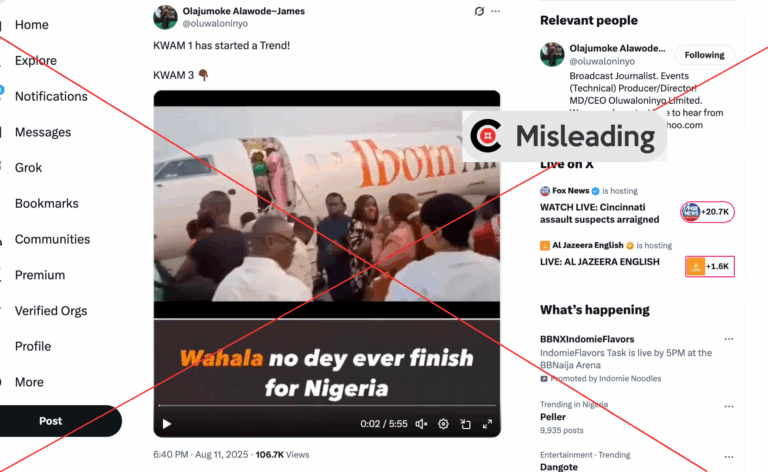
A video circulating on X shows Ibom Air passengers being disembarked from a plane as security operatives arrest a woman. The clip is being shared alongside claims that the incident followed the recent controversy involving popular Fuji musician Wasiu Ayinde, also known as KWAM 1.

An X user, @Oluwanyo, posted the video with the caption:

“KWAM 1 has started a Trend!”

As of August 13, 2025, the post had generated over 700 reposts and 900 likes.

CLAIM

The video shows chaos on an Ibom Air flight following the KWAM 1 incident.

screenshot of the viral post

THE FINDINGS

Findings by The FactCheckHub show that the claim is MISLEADING.

On August 5, 2025, KWAM 1 was reported to have disrupted a ValueJet flight at Abuja’s Nnamdi Azikiwe International Airport after a confrontation with airline staff. Following the incident, the Nigerian Civil Aviation Authority (NCAA) suspended the pilots involved, while ValueJet placed the musician on a no-fly list.

Just days later, on August 10, another viral incident occurred when passenger Comfort Emmanson disrupted an Ibom Air flight from Uyo to Lagos by not switching off her phone which escalted into violence.

However, a reverse image search on keyframes from the video circulating on social media traced it back to January 8, 2025. According to multiple reports, including TheCable, the January incident involved a passenger who refused to allow an Ibom Air flight from Uyo to Abuja to depart after discovering her luggage had not been loaded due to weight constraints.

Despite interventions from airline staff, Aviation Security (AVSEC) personnel, and the pilot, the woman blocked the aisle and insisted her bag be loaded before departure. The flight was eventually cancelled when Uyo airport’s airspace closed at sunset, leaving 89 passengers stranded.

The NCAA later confirmed the disruption and said the passenger would face prosecution.

This January case is entirely separate from both the KWAM 1 and Comfort Emmanson incidents in August 2025.

THE VERDICT

The claim is MISLEADING. The video does not show chaos on an Ibom Air flight linked to the KWAM 1 saga. It is footage from a January 8, 2025, incident in Uyo, when a passenger’s refusal to fly without her luggage caused a flight cancellation.

Republished from the FactCheckHub.