Home Blog Page 2058

FACT-CHECK: Do Nigerians enjoy 18 to 24 hours of power supply daily?

NIGERIA’s minister of Power, Sale Mamman, had on June 9 claimed that Nigerians now enjoy 18 to 24 hours of power supply daily.

He made the claim while featuring in an interview with the Nigerian Television Authority (NTA), according to a news report published by ThisDay newspaper. The interview was also published by other news media including Daily Times of Nigeria, RipplesNigeria, etc.

The claim generated a lot of public debate and reactions from Nigerians.


THE CLAIM

“…Before this government, they gave light for less than 10 hours a day, but today I can tell you that we give light from 18 to 24 hours in a day,” Mamman was quoted in the news report.

Mamman added: “Before now, we had less than 3,000mw of capacity generation but today we can generate up to 5,500mw capacity although we cannot transmit all due to some constraints.”

The minister made three claims. They are:

  1. Nigerians have light (electricity) for 18 to 24 hours daily in this government (post-2015)
  2. Nigeria had less than 3,000MW of (electricity) capacity generation before this government (pre-2015)
  3. As of June 2020, Nigeria can generate up to 5,500MW of (electricity) capacity.
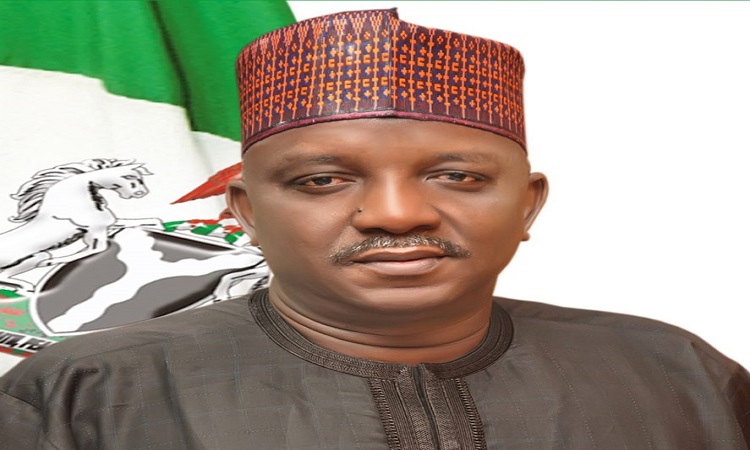
Engr. Sale Mamman, Nigeria's Minister of Power.
Engr. Sale Mamman, Nigeria’s Minister of Power.


THE FINDINGS

Claim 1

Checks by The ICIR revealed that most Nigerians get electricity for an average of 19 hours daily during the second week of June 2020 when the Minister made the claim, but none got 24 hours power supply daily, according to the data obtained from the Independent Energy Watch Initiative (I-WIN) on June 16.

I-WIN is an enterprise of Energy ConServ and the Roundtable for the Growth and Development of Power (RODEP) – an online-based power sector portal that strives to engage stakeholders and the Nigerian public on topical issues in the power sector.

According to the data, the Enugu Electricity Distribution Company (Enugu Disco), which covers its five franchise states, namely: Abia, Anambra, Ebonyi, Enugu, and Imo, had the least daily power supply of 17hours during the second week of June 2020.

Similarly, Ikeja Distribution Company (Ikeja Disco) which covers Lagos North had the highest daily power supply of 22 hours during the same period.
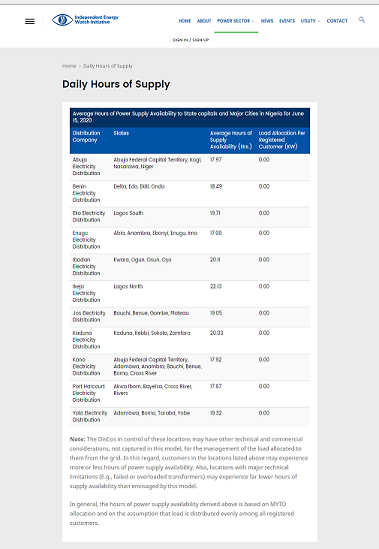
Screenshot of I-WIN website on June 16, 2020.

Responding to a telephone enquiry from The ICIR on how it calculates the average daily hours of power supply in Nigeria as displayed on its website, an I-WIN official, Chidi Ike, said the data were based on energy supplied to the 33Kva feeders across the federation by the electricity distribution companies.

“We may not be able to divulge our methodologies to a third party without all the necessary agreements. However, suffice to state that data for the calculation come from industry statistics from responsible government organizations,” Ike stated in a subsequent email enquiry following the phone conversation.

I-WIN on its website noted that “the hours of power supply availability derived above is based on Multi-Year Tariff Order (MYTO) allocation and on the assumption that load is distributed evenly among all registered customers.”

The ICIR reports that the I-WIN regularly updates its website weekly with “Average Hours of Power Supply made available to State capitals and major cities in Nigeria.”

The 19 hours average hours of electricity supply is not applicable to all the duration and cities post 2015.

Further findings by The ICIR revealed that the average power supply was 11 hours daily with some places having as low as 4 hours daily in September 2018. This was during the first tenure of President Muhammadu Buhari-led administration, contrary to the claim by the minister.

Similarly, an Opinion Poll on social media created by Adetutu Balogun, a Twitter user with the handle @Tutsy22, on June 18 – days after the minister made the claim – showed that 56 per cent of the respondents which is 2,223 of the total 3,969 votes had less than 6 hours of power supply daily.

In addition, the ‘Nigeria Living Standards Survey – 2018/2019’ released by the National Bureau of Statistics on Wednesday (July 8, 2020) stated that Nigerians only enjoy an average of 6.8 hours of electricity supplied to them from the national grid daily.
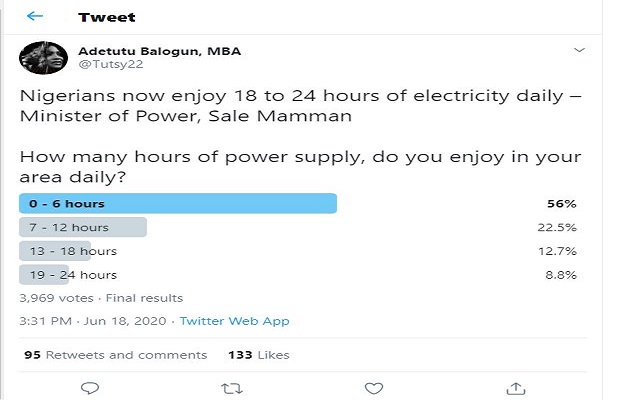
Screenshot of the Opinion Poll on Twitter.

The survey, carried out in collaboration with the World Bank, collated responses from about 22,110 households which cut across the 36 states of the federation.

It noted that slightly over 63 percent of households said they have access to electricity from various sources as the numbers vary depending on location. For instance, in Taraba state, only 19.2 percent of households reported having electricity, compared with the over 98 percent of households with access to the power supply in Lagos.

“Respondents of the survey also reported having experienced 10 blackouts in the past 7 days with an average duration of 12 hours,” the Business Day newspaper reported.


Claim 2

A fact-check done earlier by Africa Check in November 2014 stated that Nigeria’s Presidential Task Force on Power recorded generation of 3,800 MW in December 2013, adding that as of 28 October 2013, it was generating 4,327MW. It however puts the nation’s installed generation capacity in December 2013 at 6,953MW.
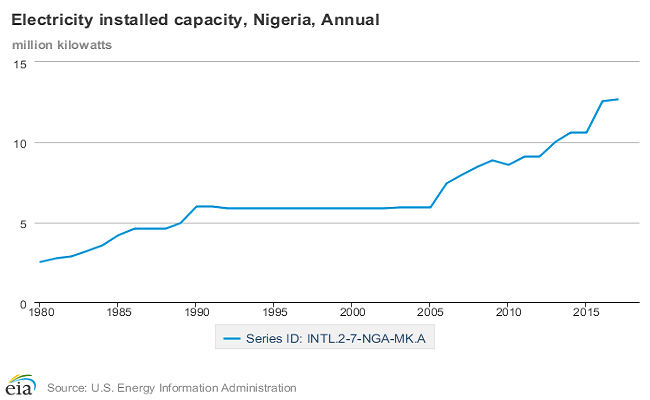
Chart showing Nigeria’s Electricity installed capacity (1980 – 2017). CREDITS: U.S. EIA.

Electricity generation capacity, according to the United States Energy Information Administration (EIA), is the maximum electric output an electricity generator can produce under specific conditions.

Whereas “electricity generation is the amount of electricity a generator produces during a specific period of time. For example, a generator with 1 megawatt (MW) capacity that operates at that capacity consistently for one hour will produce 1 megawatthour (MWh) of electricity. If the generator operates at only half that capacity for one hour, it will produce 0.5 MWh of electricity. Many generators do not operate at their full capacity all the time. A generator’s output may vary according to conditions at the power plant, fuel costs, and/or as instructed by the electric power grid operator,” it stated on its website.

Further data obtained by The ICIR shows that Electricity Production in Nigeria averages at 6,890 GWh from Mar 2005 to Dec 2019, adding that the data reached an all-time high of 9,936 GWh in Sep 2015 and a record low of 3,247 GWh in Jun 2009.

Contrary to the minister’s claim, peak electricity generation first attained the 5,000MW threshold in 2012, according to a Daily Trust newspaper report.
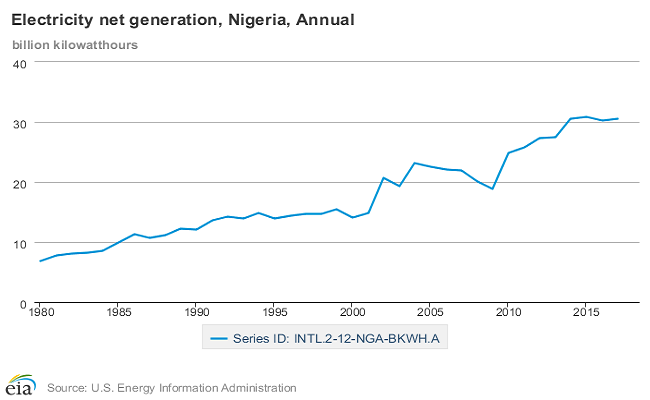
Chart showing Nigeria’s Electricity net generation (1980 – 2017). CREDITS: U.S. EIA.

Although The ICIR could not independently ascertain if the minister meant the pre-1999 era when he said “before now,” but data from the Nigerian Electricity Regulatory Commission (NERC) revealed that electricity generation in 1999 stood at only 1,750 MW while installed capacity stood at 5,906 MW.

Based on all available data, it is evident that Nigeria actually had over 3,000MW of (electricity) capacity generation before President Buhari assumed power in 2015.


Claim 3

Data obtained from the website of NERC shows that Nigeria currently has a total installed electricity generation capacity of over 20,000MW, but with an available capacity of over 12,000MW.
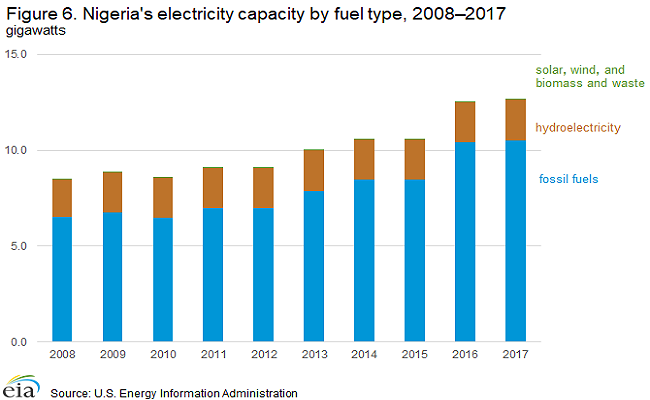
Chart showing Nigeria’s Electricity capacity by fuel-type (2008 – 2017). CREDITS: U.S. EIA.

“The generation sub-sector presently includes 23 grid-connected generating plants in operation with a total installed capacity of 10,396 MW (available capacity of 6,056 MW) with thermal-based generation having an installed capacity of 8,457.6MW (available capacity of 4,996 MW) and hydropower having 1,938.4 MW of total installed capacity with an available capacity of 1,060 MW. This comprises of the privatized GenCos, Independent Power Producers (IPPs) and the generating stations under the National Integrated Power Project (NIPP).

“IPPs are power plants managed by the private sector prior to the privatisation process. These include Shell-operated – Afam VI (642MW), Agip operated – Okpai (480MW), Ibom Power, NESCO and AES Barges (270MW),” it stated on the website.

This was corroborated by data from USAID’s Power Africa Fact Sheet on Nigeria which was last updated in April 2020, as well as from the European Union-supported GET.invest website and document.

Daily Trust also reported that while GenCos, Transmission Company of Nigeria (TCN) and the DisCos claim to have over 5,000MW power supply capacity, none has delivered that to electricity consumers across the nation. It added that the highest peak electricity ever generated is 5,375MW on February 7, 2019.

The report noted that as of Tuesday, June 23, 2020, statistics show that generated electricity on the national grid was 4,693MW, but fell to 2,642MW the same day.

Between January and June 2020, the peak daily power generation which was witnessed in April 2020 was 5,316MW, as reported by Punch.

When contacted via email by The ICIR, the I-WIN official stated that “as at six years ago (2014), we had not started monitoring hours of power supply availability. So, it may be difficult to state if the figures have improved. However, from a general non-committal perspective, one can safely state the little or nothing has improved.”
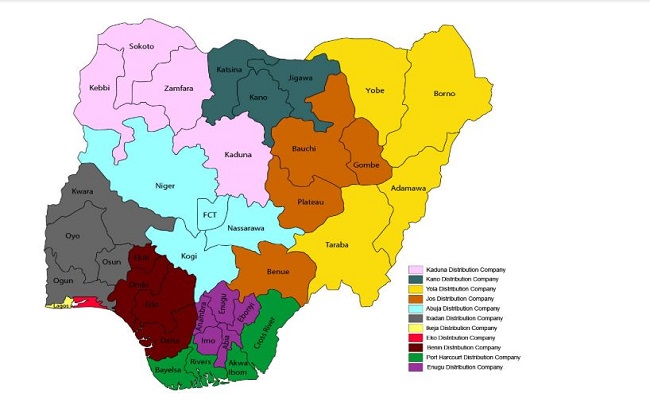
Map showing Nigeria’s Electricity Distribution Companies. CREDITS: NERC.

But can Nigeria generate up to 5,500MW of electricity capacity?

Yes!, says Dr. Joy Ogaji, the Executive Secretary, Association of Power Generation Companies (APGC), thus corroborating the minister’s claim.

She told The ICIR on Thursday that over 13,000MW is the current installed (electricity) capacity of the GenCos on the national grid in the country.

“The over 13,000MW is the current installed capacity of the GenCos on the grid. Generation is at the instance of the off-taker or buyer of the power. Again, full payment of the power taken helps the investors to increase production,” Dr. Ogaji said.

She added that there are constraints facing the power supply sector in the country.

“The market is faced with financial, operational, construction, market, macroeconomic, contract and regulatory risks. Given that, decisions about investments in power generating capacity depend on expected returns and costs, the illiquid state of the NESI in addition to the fact that all plants are performing below optimum does not encourage the discourse of capacity utilization at all.

“Hence, GenCos can and are willing to generate the over 13,000MW if they are paid as at when due and transmission and distribution cannot take those power generated. Electricity as you know is not bottled. It is instantaneous and dependent on demand.

“Nigeria’s potential to become one of the world’s best economy is dependent on energy use. The NESI should therefore focus on maximizing capacity utilization, so as to achieve lowered power generation costs and in the process address the existing excess capacities,” the APGC scribe told The ICIR.


THE VERDICT

From all data obtained, The ICIR is able to confirm that:

  1. The claim that Nigerians enjoy electricity for 18 to 24 hours daily, post-2015, is MOSTLY FALSE.
  2. The claim that Nigeria had less than 3,000MW capacity (electricity) generation before 2015 is FALSE.
  3. The claim that Nigeria can, as of June 2020, generate up to 5,500MW of (electricity) capacity peak is TRUE.
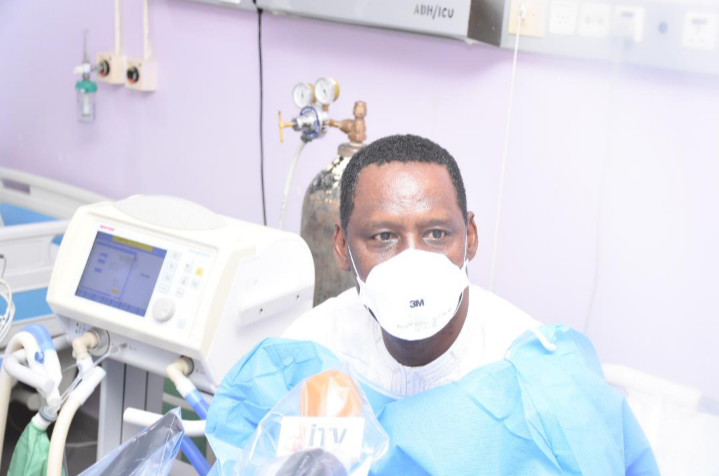
Head of FCT health services, Mohammed Kawu tests positive for COVID-19

MOHAMMED Kawu, acting Secretary of the Federal Capital Territory (FCT) Health and Human Services Secretariat has tested positive for COVID-19.

Kawu confirmed this development to journalists at the Asokoro District Hospital, where he is currently receiving treatment.

The acting secretary said he had been quarantined at the Isolation Center in Gwagalada for 12 days emphasising that the threat of COVID-19 was real.

“I want every Nigerians as I’ve always told them in the media, that this thing is real and anybody can be infected, especially those of us that are on the frontline,” he said.

“The disease can be fatal and it is important that everyone follows all the extant guidelines of hand washing or sanitizing, maintain social distancing, wearing of facial covering and staying at home.”

While saying his major concern as a frontline health worker was exposing members of his family to the infectious virus, Kawu also described his health status as “not severe”.

“I got some symptoms that were not very severe. I had to be on intravenous (IV) drugs for about 10 days. I’m stronger now. Probably they will discharge me anytime soon,” he said.

Osagie Ehanire, Minister of Health in April announced that over 113 health workers in Nigeria tested positive for COVID-19 stating they “had been quarantined due to exposure and have not been able to contribute to efforts of the health sector.

He said most of the infected healthcare workers were from private hospitals and urged those unqualified in treating the virus to desist from doing so.

Aliyu Yakubu, a medical doctor aged 60, died at the Nigeria Air Force Reference Hospital, Daura, Katsina State in April after contracting the deadly virus. A week later, his wife and children tested positive for COVID-19.

In May, Murtala Isa Umar, chairman of the Joint Health Sector Union (JOHESU), Aminu Kano Teaching Hospital (AKTH) branch, had said 11 health workers at the hospital tested positive for COVID-19.

While the Kano State chapter of the Nigerian Medical Association (NMA) also confirmed that 34 doctors had tested positive for COVID-19.

Low patronage, hiked ticket fares, strict protocols as Abuja airport reopens

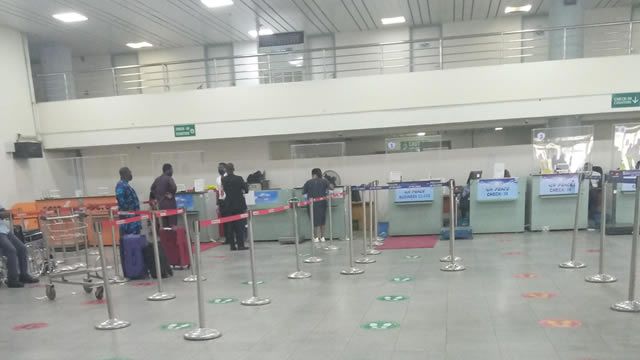
TWENTY-FOUR hours after Nnamdi Azikwe International Airport Abuja re-opened for domestic operations three months after it was shut due to COVID-19 pandemic, business activities are yet to pick up.

When The ICIR visited the airport on Thursday, there were few passengers at the ticketing and checking lounge of the airport.

Domestic flight operations were suspended in the country late March as cases of COVID-19 were growing after the index case was recorded on February 27.

At about 9 am when this reporter arrived at the airport, it was observed that life was yet to return to the ever-bubbling airport, as it witnessed low passengers’ patronage.

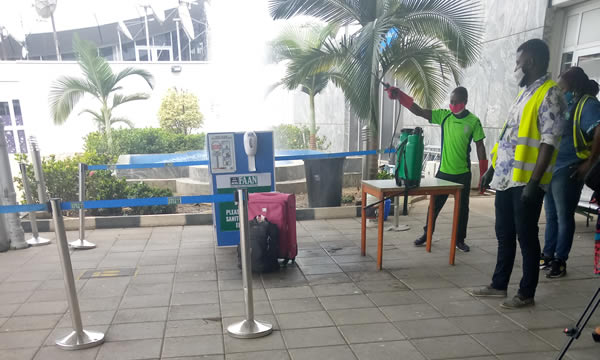
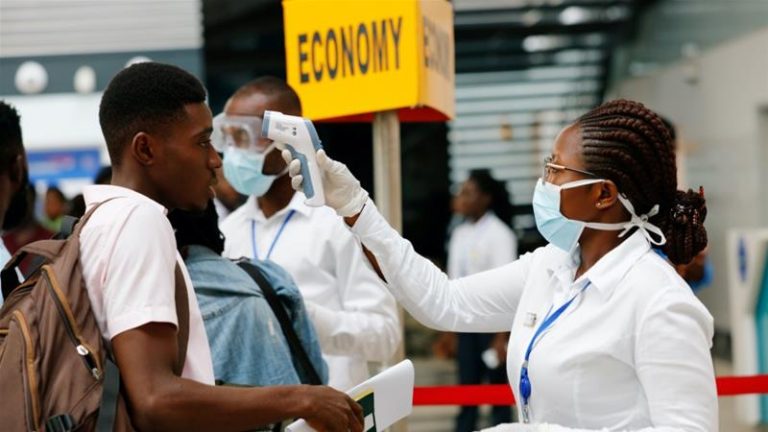
An environmental health officer checking the temperature of a passenger at the entrance of the airport terminal


Compliance with COVID-19 guidelines

Hours passed, then passengers started arriving, each subjected to strict observance of COVID-19 guidelines.

The Federal Airports Authority of Nigeria (FAAN) had issued guidelines for the re-opening of airports to be observed by passengers, airport staff and security operatives.

Almost everyone at the airport was wearing face masks with security men prompting those who wore their own on the chin to wear it properly to cover their mouth and nose, while those without it were sent back at the terminal.

Hand sanitisers, water and soap were placed at strategic locations at the airport while security agents ensured that passengers wash hands before entering into the terminal.

Passengers’ luggage was also decontaminated at the entrance with people maintaining social distancing both inside and outside the terminals.

an official of the airport disinfecting the luggage of a passenger

The ICIR observed that sniffer dogs were also deployed to screen bags for contrabands and explosives ahead of the bags’ disinfection protocol.

Two environmental health officers were seeing at the entrance of the airport screening people’s temperature with thermometers.

Although not many passengers arrived at check-in two hours before departure time, those who accompanied their relatives and friends to the airport were disallowed from entering the terminal building.

Airline and business operators complain of low patronage

For operators of different businesses at the airport, patronage has not been so encouraging since Wednesday when the airport re-opened. Airline operators and shop owners at the airport also lament of low patronage.

One of the shop owners inside the airport, a middle-aged man, who simply identified himself as Mallam Garuba said he has not recorded any sale for the day.

Garuba sells phone accessories in one of the shops located within the airport.  While he was yet to record patronage for the day, he was optimistic things would get better in the coming days.

“I am yet to sell a single thing today but I believe the market will start moving in the coming days,” Garuba said.

At the time of filing this report only five airlines were operating at the airport― Air peace, Dana air, Arik, Aero Contractor, and Ibom Air with their ticket fees ranging from N32,500 to N33,000 for economy class and N66,000 to N70,000 for business class. Previously, economy -class flight tickets cost between N21,000 and N30,000.

One of the Aero Contractor ticketers anonymously told The ICIR that the only airline’s flight scheduled for the day would be moving to Lagos by 2:15 pm, even as just a few people had purchased the ticket from her hand.

“Our flight would be departing for Lagos by 2:15 pm and from my end here, I just sold out close to 30 tickets.”

Another airline worker, who works with the Air Peace but would not want his name mentioned, said the flight that departed for Lagos in the morning had only 74 passengers on board.

While the airline workers were complaining of low patronage, the passengers were glad that the airport had commenced operations.

One of the passengers scheduled to travel to Lagos on Dana Air, Mariam Subair  said she was happy to witness the flight resumption, adding that she had been anticipating the reopening of the airport for a while.

“I have been here for over two hours, though my flight is scheduled for 1 pm, that is to let you know how excited I am to fly to Lagos,” she said.

Samson Adelowo, another passenger boarding Arik Air was happy about the atmosphere at the airport, noting that everything was in order.

“I like how everything is in order. No crowd, and social distancing is being strictly observed,” Adelowo said.

Taxi drivers’ endless wait for passengers

Taxi drivers sitting under the shed while waiting for passengers

Outside the airport were the taxi riders who were just sitting under a shed as a result of no patronage. Most of those who spoke to The ICIR disclosed how it has been difficult for them to make ends meet since the closure of the airport.

John Odeh, one of the airport taxi drivers who recounted the hardship he had faced since the airport closure said he was forced to go into farming in the neighboring Nasarawa state.

“Our business was greatly affected during the pandemic and I had to just park my car at home while I moved to Nasarawa to start farming.

I resumed back here yesterday upon reopening of the airport but we are being faced by low patronage again,” Odeh narrated.

Another taxi man who gave his name as Ibrahim Abdul said he has not been able to pick any passenger since Wednesday when the airport reopened.

Low turnout of passengers, he noted poses a serious threat to their business.

“I came here yesterday, no passenger and today again, I am yet to carry any passenger, though I think business should start moving from next week when more passengers are more likely to come to the airport,” Ibrahim said.

Airport official reacts

Idris Abu, an official of the airport who spoke with The ICIR noted that the airport authority has put in place several protocols to ensure the safety of everyone who comes into the airport.

“We have put in place several measures to ensure people who come into the airport, either as a worker in the airport, passenger or anyone who accompanies passenger down here are well protected,” he said

He also noted that although the airport is currently being faced by low patronage but would come back to life soon.

“The airport just reopened yesterday and that’s why everywhere is dry like this but I can assure you that this place would soon start recording a large turnout of passengers in the coming days,” Abu said

Cash ‘gift’ to former NNPC boss can pay monthly salaries of 117,518 N-Power beneficiaries

ANDREW Yakubu, a former Group Managing Director (GMD) of the National Petroleum Corporation (NNPC) had on Wednesday said the $9.7 million and £74, 000 found in his Kaduna house in 2017 were gifts from his friends. The ICIR check shows that the ‘gifts’ when converted to naira at official rates can pay the salaries of over a hundred thousand N-power beneficiaries.

In 2017, operatives of the Economic Financial Crimes Commission (EFCC) raided Yakubu’s house on Chikun Road in the Kaduna South Local Government Area from where the $9.7 million and £74, 000 were recovered.

EFCC filed a suit of seven-count charges against Yakubu bordering on possession of a huge sum of money without going through a financial institution.

Appearing before the court on Wednesday, Yakubu said he received the monies in tranches of not more than $10, 000 and not more than £5, 000 from friends during occasions like birthdays, thanksgiving services and marriage of his daughters.

When combined, these monies, currently confiscated to the Federal Government would amount to a total of N3.5 billion naira at the official rate of N360 Naira to a dollar.

While the official exchange rate of N401 for a pound, the £74, 000 cash found in his apartment would total N33,536,800.

N3.5 billion on N-Power

The ICIR checks revealed that the N3.5 billion naira confiscated by an FCT Court in 2017 could pay the N30, 000 monthly salaries of 117,518 N-Power beneficiaries.

The N-Power is a youth empowerment scheme initiated by the Federal Government under the Social Investment Program (SIP) in the Ministry of Humanitarian Affairs.

In the scheme, selected beneficiaries are paid a salary of N30, 000 during the duration of their engagement.

 The ICIR had reported the travails of some N-Power beneficiaries who said they are yet to be paid by the Federal government for months of March, April, and May during the COVID-19 lockdown.

As at the moment of filing this report, there are 300,000 Nigerians who are active beneficiaries of the N-Power initiative but are due to pass out by the end of July while another batch of 400,000 are due for engagement soon.

Out of the 300,000 active beneficiaries are some who lamented their condition due to the nonpayment of their monthly salary.

Meanwhile,  Justice Ahmed Mohammed on Wednesday  adjourned the cross-examination of the former MD by the prosecution counsel to July 22.

Osinbajo wants publisher of Pointblank investigated, prosecuted over false Magu claim

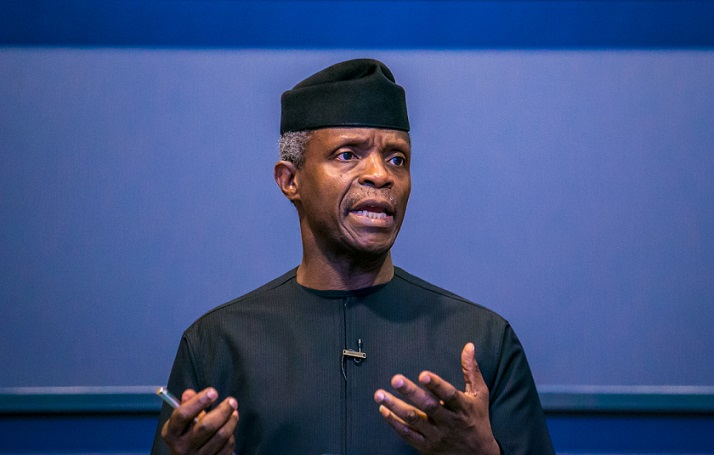
VICE President Yemi Osinbajo has denied receiving funds from Ibrahim Magu, the embattled acting chairman of the Economic and Financial Crimes Commission (EFCC) chairman, demanding that a criminal defamation suit be launched to investigate the allegation.

An online newspaper, PointBlank had reported that Magu allegedly embezzled over N39 billion and gave the Vice President  N4 billion to give him soft landing.

But the Vice President in a petition addressed to Muhammed Adamu, the Inspector General of Police, Osinbajo through his lawyer, Taiwo Osipitan described the report as false and defamatory.

The report claimed that private sources within the panel investigating the suspended EFCC chairman “exposed the vice president’s involvement in the scandal.”

Osinbajo’s lawyer in the petition, said tweets and publications by Jackson Ude, publisher of the Pointblank were made on a public platform on a Twitter account with over 46, 000 followers.

He said, some of the social media followers of Ude have retweeted same hundreds of times, arguing that the false allegations have elicited responses targeted at the Vice President ranging from shock, outrage to comments that cast aspersion on his integrity.

“Our instruction is that the above statements published by Mr. Ude are false in every material respect and same are designed to injure the reputation of our client,” Osipitan said.

He further stated that the vicious and malicious publications were meant to achieve one objective only, which according to him was to present the Vice President as a dishonest and disloyal public officer and consequently unfit for his current position.

Osipitan maintained that unless an action for criminal defamation is commenced against the Jackson Ude, he will continue to use his social media platform to publish materials that are false and criminally defamatory of Osinbajo’s reputation.

He called on the Inspector General of Police to investigate the allegations against the Vice President, noting that if they were found to be false, the police should initiate criminal proceedings pursuant to the provisions of Sections 391 – 395 of the Penal Code Act for Criminal Defamation against the said Jackson Ude.


Five months after, police arrest seven over Ile-Oluji, Oye-Ekiti bank robberies

THE police on Thursday said a seven-man robbery gang that attacked three commercial banks in Ile-Oluji town, Idanre both in Ondo State, on February 7, 2020 and Oye-Ekiti in December 2019 has been arrested.

Six police officers were among those killed by the armed robbers during the robbery attacks while the several millions of naira were carted away.

A statement issued by the police revealed that operatives attached to the Special Tactical Squad arrested the daredevil armed robbers.

The statement by the police revealed that the armed robbers – Tunbosun Ojo, Ismaila Ojo, Victor Oyeyemi, Dele Ariyo , Shola Oladimeji , Olubodun Folayemi and Adeniyi John carried out the robbery of a commercial bank in Ile-oluji, Ondo State on February 7, 2020 where four  policemen were killed.

It added that they were also involved in the robbery of a Microfinance Bank in Idanre, Ondo State in December, 2019 and a commercial bank at Oye Ekiti, Ekiti State where two policemen lost their lives.

The statement also disclosed that efforts were being intensified to arrest other members of the gang still at large and to recover other sophisticated weapons used in the operations.

In a similar vein, 23 other suspects were also arrested by the police operatives for their involvement in various crimes including armed robbery, kidnapping, illegal possession of prohibited firearms, car snatching at gun point, among other offences.

The following were recovered from the suspects: One AK49 rifle, one AK47 rifle, two pump action guns, five  locally made guns, 19 locally made short guns, 125 cartridges, 145 AK47 ammunition, locally fabricated  explosives and a Toyota Corolla vehicle with Reg. No. LSR 490 GC.

The suspects will be charged to court on conclusion of investigations, the statement said.


FACT-CHECK: Claim about snow in Lagos is FALSE

A VIDEO clip shared on July 8 by Sahara Reporters has gone viral on social media. The footage headlined: “Video: Snow-like Chemical Surge Causes Panic in Lagos” shows snow-like foams that purportedly prevented Lagosians from accessing their homes.

As of the time of filing this report, the video has garnered 12,011 views on YouTube and has gone viral on Whatsapp.

The spilled substance. Photo Source: Lagos State Government

CLAIM

Arising from the footage, many have claimed that it is snowing in Lagos.

FINDINGS

Close examination of the video footage revealed there were two separate videos merged as one.

The first part of the footage showed the snow-like foamy substance truly blocking the entrance to people’s homes. Underground female voices called for help in panic.

Someone was also being helped down the ladder from a storey-building apartment.

The second part of the video revealed a typical snow-like foam covering the major highway. But further findings showed it was not snowing, unlike the claim in the second video footage.

Meanwhile, the snow-like material is a foam often used by firefighters to suppress fire incidents.

Though the foam is not unusual for fire control, it is mainly recognised as Aqueous Film Forming Foam (AFFF) solutions which could also cause health hazards if wrongly managed.

Findings revealed that the AFFF blanket blocks oxygen supply to inflammable petroleum materials. It suppresses fuel vapour through aqueous film and produces a cooling effect as part of the fire suppressing measures.

The United States Fire Administration, an institution of government that works to prevent fire outbreaks says AFFF could be a combination of Per and polyfluoroalkyl Substances (PFAS) – the Perfluorooctane Acid (PFOA) and Perfluorooctanesulfonic Acid (PFOS) but warned against long term exposure to the chemicals.

The accident scene
Photo Source: Gbenga Omotoso, Commissioner for Information and Strategy

The ICIR reached out to Gbenga Omotoso, the Lagos State Commissioner for Information and Strategy to clarify the viral footage and the exact incident. But contrary to the popular belief, he said the incident could be an outcome of a chemical reaction to avert a fire incident.

He said a truck approaching from the Lagos Sea Port fell due to an accident along Anthony axis. The truck, he noted was conveying an inflammable material, so the Lagos State Fire Service was deployed to intervene. The firefighters reportedly sprayed the AFFF on the spilled content to avoid fire incident.

“There was an accident involving Petroleum Tanker with heavy Petroleum spillage and in order to prevent further hazard, the State Fire Services quickly coated the road and area with foam-like material which is not poisonous or injurious to the environment and human health,” Omotoso told The ICIR.

“The thing is that our colleagues are very quick to publish whatever they see. You see a video somewhere; you did not bother to find out what was the matter. But when you explain, they don’t want to care anymore.

“This is something the government should be earning praises for. You can imagine such a fire on Ikorodu road.”

As a proof, Omotoso shared another video showing activities of firefighters while spraying the chemical to avoid an inferno.

Nosa Okundor, Public Affairs Officer, Lagos State Emergency Management Agency (LASEMA) was contacted to further verify the claim. He said the decision to deploy the foamy blanket was to prevent fire accident.

“In extreme cases, it can get volatile but it may not be as extreme as other petroleum materials.”

Officials of the Lagos State Fire Service
Officials of the Lagos State Fire Service supported by Lagos State Emergency Management Agency (LASEMA) at the scene of the accident that led to the use of foamy substance to prevent fire incident

VERDICT

From the available evidence gathered, the purported snow incident reported in Lagos is FALSE.

Millions of children at risk of missing out on routine vaccines− DG WHO

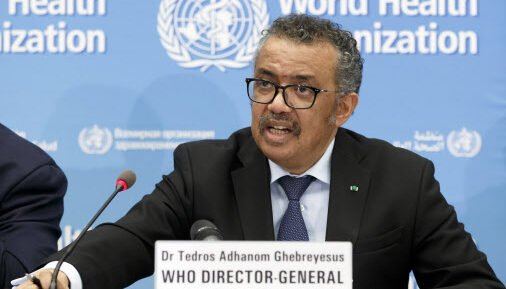
TEDROS Ghebreyesus, Director General of the World Health Organization (WHO) says hundreds of millions of children are at risk of missing out on routine vaccines for tuberculosis, pneumonia, measles, polio, cholera, diarrhea and others as COVID-19 pandemic ravages on.

Many countries are running low on HIV medicines due to the coronavirus pandemic, Ghebreyesus said on Thursday in his opening remarks during a member state briefing on the COVID-19 pandemic.

“The virus has upended health systems in some of the world’s wealthiest nations, while some countries that have mounted a successful response have been of modest means,” he said.

“We know that when countries take a comprehensive approach based on fundamental public health measures – such as find, isolate, test and treat cases, and trace and quarantine contacts – the outbreak can be brought under control.”

He however, lamented that in most of the world, ‘the virus is not under control’, adding, ‘It is getting worse.’

Ghebreyesus stated that more than 11.8 million cases of COVID-19 have now been reported to WHO and more than 544,000 lives have been lost.

“And the pandemic is still accelerating. The total number of cases has doubled in the last six weeks.”

Ghebreyesus also pointed out that refugees are among the most vulnerable to the pandemic, already facing limited access to adequate shelter, water, nutrition, sanitation and health services.

“COVID-19 could push them over the brink,” he said.

He added that in countries rich and poor, around the world many more people are now going hungry, saying “we can see poverty visibly now, with estimates from the World Food Programme that global hunger could increase to more than 270 million people. These are not numbers: these are people.’’

While recalling the resolution reached at the first virtual World Health Assembly by 194 member countries called, WHO DG called  on member states to implement a whole-of-government and whole-of-society approach to ensure a more coherent, fairer and effective global response for a fair distribution of vaccines, diagnostics and therapeutics.


Expert urges more COVID-19 tests, use of face masks, Africa’s confirmed cases crosses 500,000

JOHN Nkengasong, Head of the Africa Centres for Disease Control and Prevention (CDC) has urged African countries to scale-up coronavirus testing and encourage more use of face masks to forestall an escalating disaster.

Nkengasong stated this, as confirmed cases of COVID-19 in Africa crossed the half a million mark.

He revealed in a tweet that new cases of COVID-19 went up by 24 per cent in Africa in the past week, indicating an unprecedented rise in the rate of infections.

“The pandemic is gaining full momentum. We must adopt an aggressive and bold approach: #maskonallfaces, ramp up Test, Trace, and Treat, strengthen community response. This will save lives and save (the) economy,” Nkengasong said.

Data from the World Health Organisation (WHO) shows that Africa had 512,039 confirmed COVID-19 cases, with 11,915 deaths, as of Thursday.

Five countries namely: Egypt, Nigeria, South Africa, Ghana, and Algeria account for 71 per cent of the infections.

South Africa has the most cases on the continent, with just under 76,000 confirmed, Egypt comes next at nearly 50,000. Algeria, Ghana, and Nigeria respectively have between 10,000 and 20,000 confirmed cases according to a report.

The Nigeria Centre for Disease Control (NCDC) also announced the country is experiencing a high level of community transmission of the virus as 73 per cent of the total diagnosed cases reported unknown sources of exposure to the virus.

The NCDC stated that two per cent of confirmed cases were detected in people with a travel history and 25 per cent of confirmed cases were reported to have contact with persons with travel history.

“Till date, 30249 cases have been confirmed, 12373 cases have been discharged and 684 deaths have been recorded in 36 states and the Federal Capital Territory,” the NCDC said.

With the increasing number of confirmed cases in Nigeria, NCDC  said compliance with Infection Prevention and Control (IPC) measures remains the most effective intervention to control the COVID-19 outbreak, especially in the absence of a vaccine.

Mixed opinion trails use of masks

Several countries have made wearing of face masks mandatory in public spaces, with citizens facing a possible fine if caught without one.

However, there is no general consensus if face masks can prevent coronavirus from transmitting from one person to another.

The World Health Organization (WHO) recommends that healthy people do not need to wear a mask, but those who are feeling unwell and are coughing and sneezing, or caring for someone who is infected, should do so.

“Masks are effective only when used in combination with frequent hand-cleaning with alcohol-based hand rub or soap and water,” WHO stated.

Germany’s central research institute, Robert Koch Institute (RKI) advocates the compulsory use of face masks saying it is designed to protect the wearer from carriers of the virus.

Though, available evidence shows that self-protection, involving covering the mouth and nose can trap infectious droplets that are expelled when the wearer is speaking, coughing or sneezing.

The United Kingdom, UK, and Singapore have urged the public not to wear masks in order to ensure enough supplies and Personal Protective Equipment (PPE) for healthcare workers.

Also, the United States Centers for Disease Control and Prevention (CDC) does not specifically advocate the use of surgical masks but recommends the use of “simple cloth face coverings” made from common household materials to slow the spread of the virus and prevent asymptomatic people from transmitting it to others.

Gbajabiamila blames successive governments over poor power supply, but fails to identify role played by institution he leads

FEMI Gbajabiamila, Nigeria’s Speaker of the House of Representatives on Wednesday condemned the inability of successive governments to improve power generation and distribution in the country

Gbajabiamila said there is a need for legislative intervention in the power sector.

He spoke through Idris Ahmed Wase, the Deputy Speaker who represented him at the declaration of a two-day investigative public hearing.

According to him, a very little has been achieved in the power sector despite the huge investments that have gone into the sector.

“It is no longer news that despite huge investments in the power sector, little progress may have been made,” Gbajabiamila said.

“It is becoming increasingly, worrisome that successive governments have been unable to fix the issue of power in our country.”

Explaining the crux of the problem, the speaker said that Nigeria has struggled with the issue of power for a long time despite the efforts made by many to revive the sector.

He was however silent on how the National Assembly that approves budget for capital projects in the country performed its function in all the contracts awarded to revamp the power sector.

Gbajabiamila announced that a ad-hoc committee was set up on May 12, to undertake a holistic review of the power sector and to recommend legislative action to the House of Representatives.

Alhassan Ado Doguwa, Chairman of the Committee, said  the Committee has started taking steps to understand the problem and proffer solutions.

“While we appreciate the agency for generating 10,000 MWs, the greatest issue bedevilling the sector after the unbundling of the defunct National Electric Power Authority is the inability to effectively transmit & distribute electricity supply across the country,” Doguwa said.

According to Power Africa fact sheet, the biggest problems facing Nigeria’s power sector include, Macroeconomic forces, lack of creditworthy utilities and lack of transparent regulator.

However, Bukola Saraki, a former Senate President, in 2017, submitted that the government is to be blamed for the failure of the Nigerian power sector.

While speaking at a two-day stakeholders interactive workshop/dialogue on finding a lasting solution to the challenges facing the power sector, Saraki noted that the current state of the country’s power industry was not an accident but a result of deliberate and sometimes innocent mistakes by the government over the years.

Meanwhile, in October 2019, Zainab Ahmed, Minister of Finance disclosed that the country acquired a new loan of $3 billion from the World Bank to address transmission and distribution challenge in the power sector.

Ahmed said that the loan was to be released in four tranches of $750 million each, with an aim for the first bulk to be released in April 2020.