Home Blog Page 2104

COVID-19: Nigeria might not expose Madagascan herbal drug to clinical trials. Here is why


PRESIDENT Muhammadu Buhari has directed the Presidential task force on COVID-19 to order Madagascars COVID-Organics, CVO, a herbal tonic touted as a cure for COVID-19 but the odds stands against the country to carry out proper verification tests on the drug.

Boss Mustapha, Secretary to the Government of the Federation, SGF, who confirmed this during the daily presidential briefing stated that the herbal remedy would be subjected to checks before it is considered fit for consumption.

“The President has given instructions for the airlifting of Nigeria’s allocation of the Madagascar COVID-19 syrup from Guinea Bissau. And he has also given clear instructions that it must be subjected to the standard validation process for pharmaceuticals and there will be no exceptions for this,” he said.

Andry Rajoelina, Madagascar’s President who started promoting the tonic in April, said it is a preventive and curative remedy against COVID-19“,  attributing the recovery of 105 people in his country to the drug.

CVO is produced from the artemisia plant, the source of the ingredient used in a malaria treatment which was developed by the state-run Malagasy Institute of Applied Research.

The World Health Organisation, WHO in a tweet warns against the use of untested remedies in a virtual meeting with 70 traditional medicine experts from countries across Africa on the role of traditional medicine to the COVID-19 response.

Despite the reservations of the global health body, several African countries, namely Nigeria, Guinea-Bissau, Equatorial Guinea and Liberia have ordered for doses of the herbal remedy from Madagascar.

Available data suggest that Nigeria’s research organisations currently do not have the resources to conduct “in vitro” laboratory tests on the herbal remedy before it can be used for clinical trials in line with WHO guidelines.

“In vitro” laboratory tests mean cell cultures are isolated with the coronavirus and is tested with drugs to show an effect against the virus without harming the cells.

Stalled on the tracks

Nigeria is ranked 114 of 118 countries on the 2019 Global Innovation Index which measured each country’s contribution to global research and international patent applications, including mobile-phone application creation and high-tech exports.

The Nigeria Institute for Medical Research, NIMR, is saddled with the responsibility of leading the country’s medical research into finding possible solutions to several outbreaks including the current COVID-19.

Between 2015 and 2019, NIMR had received N160 million ( $410,256 using the official exchange rate of N305 to a dollar) as funding for research purposes from the Federal Government which pales into insignificance when compared to South Africa which spent R38.7 billion ($2.09 billion) on research and development in 2018 according to a National Research and Experimental Development Survey.

South Africa launched the first known biosafety laboratory isolate of SARS-Coronavirus 2, SARS-CoV-2, in Africa on April 1, through a joint effort of the University of the Western Cape and Stellenbosch University.

This means the scientists in South Africa would be able to grow the virus outside the human body and perform research on the drugs to be used for treating COVID-19 directly before proceeding to the clinical trials stage.

Currently, there are no level 3 and 4 biosafety laboratories in Nigeria which are designed to handle respiratory viruses, though the country boasts of level 4 laboratories that can culture non-respiratory viruses.

In an interview, Director General of NIMR, Prof. Babatunde Salako, admitted that to set up a national clinical trial that is wholistic would cost about N200 million which is more than its budget for research in four years.

“Initially, we wanted a national clinical trial that would factor in the six geo-political zones. But that may gulp about N200 million and we don’t have such money. As it stands, we may have to start small. As I mentioned earlier, the major challenge is funding,” he said.

The Federal Ministry of Science and Technology under which NIMR is domiciled was allocated N35 billion by the Federal Government in 2019 for research indicating a notable decline from its 2017 allocation of N65 billion.

Mateon Therapeutics, a US pharmaceutical firm announced that its COVID-19 directed antiviral screening program discovered that artemisinin is highly potent at inhibiting the ability of the COVID-19 causing virus, SARS-CoV-2, to multiply while also having an excellent safety index.

Unrecognised by regulatory agencies

Herbal medicine registration by the National Agency for Food and Drug Administration Control, NAFDAC, is placed on a listing status that is effective for a one year period while other scientific pharmaceutical drugs have the full registration period that lasts for five years.

Johnson Idowu, Director of Research Institute of Traditional and Alternative Medicine, RITAM, speaking to The ICIR said it was worrisome that Nigeria is importing herbal medicine from Madagascar but fails to recognise herbal remedies made in the country.

“It is a shame that we are importing herbal medicine from Madagascar because we have several research institutions, universities and private companies that the country has invested billions of naira annually and they are not asking them questions?

“Does it mean there is nothing to show for all these investments in researches in the country that we have to go outside to import untested herbal medicine we have failed to recognise in the country?” he queried.

He stated that clinical trials had not been conducted on herbal drugs in the country for over twenty years because of the aversion of the regulatory agencies to herbal medicine.

“They are saying we would carry out clinical trials on the Madagascan tonic in six months but for more than 20 years they have stonewalled herbal medicine research in the country. For example, NAFDAC refers to herbal medicine as an unevaluated drug by the agency and that means no doctor in his right mind will recommend alternative medicine for his patients,” he said.

In April, Max Planck Institute of Colloids and Interfaces, based in Germany collaborated with ArtemiLife Inc, a US-based company to test Artemisia annua plant extract and artemisinin derivatives in laboratory cell studies against the novel coronavirus Sars-CoV-2.

Technical Assistant at the Nigeria Natural Medicine Development Agency, NNMDA, Bibinu Daniels told The ICIR that the agency has an Artemisia annua plant in their farm in Delta State with several teams working on its research since 2006.

“We have had teams working on different research studies on artemisia since 2006 and the agency currently has a farm in Delta State where the plant is cultivated but lack of funding has not allowed the development of drugs as clinical trials take time,” he said.

The successful development of a drug from herbal remedy in Nigeria is Niprisan which is used for the treatment of sickle cell anaemia.

The effort by Nigerian scientists was widely regarded as a very significant breakthrough in medicine in 1998 before the conclusion of clinical trials in 2002.

However, commercial production of the drug was bogged down because of lack of financial support to mass-produce the drug.

COVID-19: Nigeria launches solidarity support fund

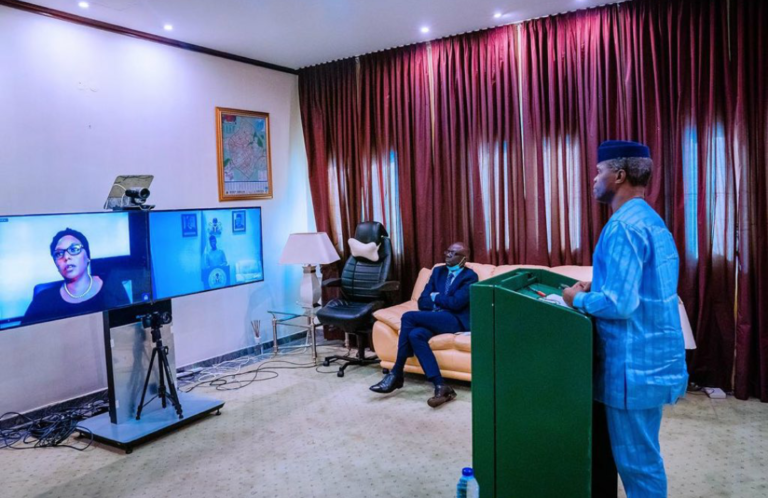
VICE President Yemi Osinbajo on Thursday participated in the virtual launch of the Nigeria Solidarity Support Fund, NSSF, an initiative of the Nigeria Sovereign Investment, Authority.

The NSSF is designed to provide additional support for Nigeria’s response to COVID-19.

The Fund will enable Nigerian citizens resident at home or abroad as well as international donors to come together and directly contribute to Nigeria’s fight against the pandemic.

According to the vice president, although the Coronavirus pandemic has affected the lives and livelihoods of Nigerians in different ways, it also offers an opportunity for the Nigerian people and government to have a reset in critical sectors of the economy and social services.

Osinbajo said the establishment of the Nigeria Solidarity Support Fund would support “the creation of a stronger, more resilient, more inclusive political economy and healthcare system.”

“This is a creative, forward-looking and thoughtful response to what is perhaps the most profound global and domestic challenge to health and the economy in human history.

“We need not belabour the point that the COVID-19 challenge is also an unprecedented opportunity for us as a nation and people to reset in critical sectors of the economy and social services,” Osinbajo said.


Revenue from VAT increases by N30bn in first quarter – NBS

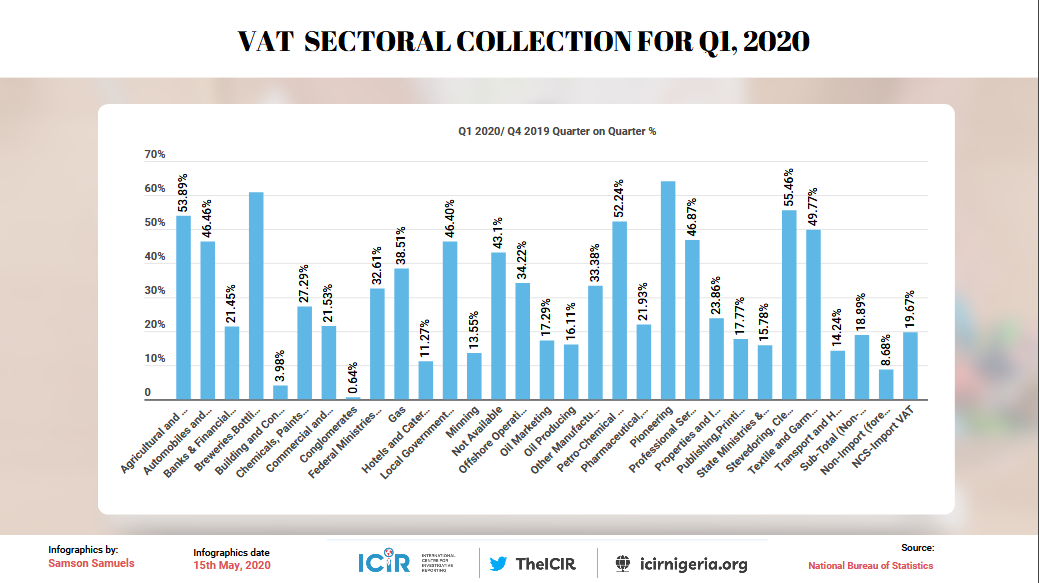
VALUE Added Tax (VAT) data for the first quarter (Q1) of  2020 has shown that the sum of N338.94 billion was generated against N308.48 billion generated in the fourth quarter (Q4) of 2019, the National Bureau of Statistics (NBS) has reported.

This figure represents an increase of N30.46 billion compared to Q4 2019 before the tax amendment from 5 per cent to 7 per cent.

According to the report, N293.04 billion generated in Q1 2019 representing 9.87 per cent increase Quarter-on-Quarter and 15.66 per cent increase Year-on-Year.

Professional Services generated the highest amount of VAT with N38.30 billion generated and closely
followed by manufacturing generating N37.37 billion and commercial and trading generating N17.19 billion.

Mining generated the least (N61.83 million) and closely followed by textile and garment industry (N306.05 million) and local government councils (N319.04 million), the report stated.

Out of the total amount generated in Q1 2020, N172.67bn was generated as Non-Import VAT locally while N93.67bn was generated as Non-Import VAT for foreign.

The balance of N72.59bn was generated as NCS-Import VAT.

Aboderin Martins a financial consultant who spoke to The ICIR said “Nigerians should expect increased revenue from taxes because of the recent increase in VAT, but the question is, would it be channelled into the right place.”

It will be recalled that on the 13th of January, 2020, President Muhammadu Buhari signed the Finance Bill (now Finance Act 2019 (the “Finance Act”)) into law.

The finance act was gazetted on 14th January 2020 with a commencement date of 13th January 2020.

The Finance Act amends the major tax statutes in Nigeria to align with the Federal Government of Nigeria’s monetary and fiscal reform policies.

Of particular concern to businesses and consumers with regard to the Finance Act is perhaps, the introduction of a new VAT system, and an increase in the VAT rate from 5 per cent to 7.5 per cent.

Besides the increment of the VAT rate, there are other notable amendments to the VAT Act which will significantly impact the business landscape in Nigeria.

Group urges NAFDAC to fast track process of Trans-fat regulations

A CIVIL Society Organisation, Environmental Rights Action/Friends of the Earth Nigeria (ERA/FoEN) has urged the National Agency for Food Drugs Administration and Control (NAFDAC) to hasten the process of trans-fat regulations.

The group in a statement signed by its head of media and campaign, Philip Jakpor said NAFDAC should take actions to ensure speedy approval of the ‘’Pre-packaged Food, Water and Ice Labelling Regulation, 2019’’ and ‘’Fats & Oils Regulation, 2019’’

Marking the two years anniversary of the Replace Package of the World Health Organisation (WHO) the group said the two guidelines are aimed at regulating the amount of trans fatty acids in the nation’s food chain.

The statement futher read that the regulation is a step-by-step guide for the elimination of industrially-produced trans-fatty acids from the global food supply.

The WHO had on May 14, 2018, released the replace package, advising governments across the world that eliminating trans fat is key to protecting health and saving lives.

According to the group, WHO estimates that every year, trans fat intake leads to more than 500,000 deaths of people from cardiovascular disease.

ERA/FOEN wrote that the world is currently battling the covid-19 pandemic and scientific evidences have shown that people with existing CVD conditions are prone to complications if they contract COVID-19.

“More than ever before the nation needs to work fast on laws and policies that will promote healthy lifestyles and approval of the regulations speedily will go a long way in that direction’’, Akinbode Oluwafemi, ERA/FoEN Deputy Executive Director said.

“Industrially produced trans fats are contained in hardened vegetable fats, such as margarine and ghee, and are often present in snack food, baked foods, and fried foods,” the statement read.

The group also urged Nigerians to abstain from all foods laced with industrial trans fat.

Atiku tells FG to cut 2020 budget by at least 25 per cent

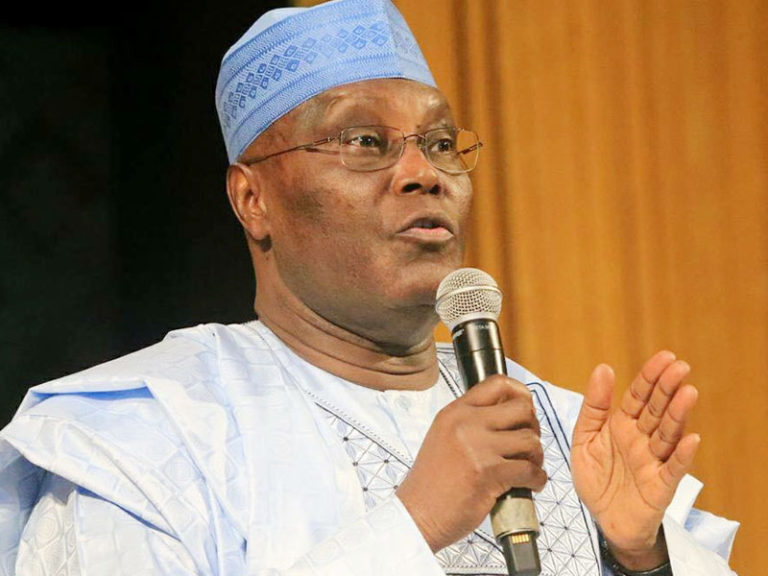
THE former PDP presidential candidate, Atiku Abubakar on Thursday criticised the Nigerian government’s decision to cut down the 2020 budget by only o.6 per cent which he describes as “grossly insufficient”.

Nigeria cannot afford luxuries during austerity, Atiku has said.

In a series of tweets, the former vice president expressed his dismay that despite the crash in the price of oil, and the inability of Nigeria to expand her revenue base through the non-oil sector, the FG has only considered slashing its budget by a mere 0.6 per cent, which represents a reduction of only ₦71 billion.

He added that the decision by the FG is grossly insufficient and betrays the fact that the nation has lost touch with the current realities in the global political economy.

For the avoidance of doubt, Atiku referenced when the budget was presented to the National Assembly on Tuesday, October 8, 2019, which he stated was predicated on a projection that the nation would generate crude oil production of 2.18 million barrels a day, at an expected oil price of $57 per barrel.

This he said is no longer the case today, adding that both the country’s production and the price of oil have been severely affected by the coronavirus pandemic, to the extent that Nigeria has unsold vessels, and its income has tanked by more than 50 per cent.

He stressed that Nigeria cannot be the only nation by bucking the trend as it not justifiable for a reduction in expenditure of just 0.6 per cent.

Atiku cited example of a country like Saudi Arabia with a much stronger production capacity than Nigeria and with a larger global market share, as well as a foreign reserve that is 12 times of Nigeria but has slashed her budget by almost 30 per cent.

“Nigeria cannot make up for the loss of expected revenue by taking out more loans and issuing out more bonds. Debt will be the death of our economy, and bonds will put our people in bondage,” Atiku tweeted.

The best way out of this economic quagmire is to reduce our expenditure, and a 0.6 per cent reduction is no reduction, it is only window dressing, Atiku said.

He, therefore, urged the federal government to put Nigerians first in its decisions.

“My counsel to @NigeriaGov is this: put Nigerians first and cut your coat, not according to your size, but according to your cloth,” Atiku added.

He recommended that the federal government should realistically slash the budget.

Atiku also added that billions budgeted for the travels and feeding of the president and vice president should be reduced. The ₦27 billion budget for the renovation of the National Assembly should also go.

The massive budgets to run both the Presidency and the Legislature should be downsized. The budget for purchasing luxury cars for the president, his vice, and other political office holders must be abandoned, he tweeted.

However, he added that the salaries of civil servants should be left alone, while the salaries of political appointees must be reduced.

He further advised that 8 or 9 of the jets in the Presidential Air Fleet should be sold.

In his opinion, any budget slash that is less than 25  per cent will not be in the interest of Nigeria.

Adding that beyond a budget slash, Nigeria needs a budget realignment, to redirect expenditure away from running a massive bureaucracy, into social development sectors like education, infrastructure, and above all, healthcare.

“We must invest in the goose that lays the golden egg – the Nigerian people.”

The former vice president said these are the types of sacrifices that Nigeria needs in a time of crisis and “not empty gestures that will lead to empty treasuries.”


All African countries now with coronavirus as Lesotho confirms first case

LESOTHO, the last African country to be affected by coronavirus, on Wednesday announced it has detected its first case of COVID-19.

The virus was detected on an individual among 81 people who were tested after arriving last week from Saudi Arabia and neighboring South Africa, the health ministry said in a statement.

“The Ministry of Health informed the Basotho nation and the entire community living in Lesotho, that the country now has the first confirmed case of COVID-19,” Director-General  Nyane Letsie said.

The patient is a Lesotho national studying in Saudi Arabia.

Lesotho went into lockdown on March 29 to protect itself from a potential spread of the virus from South Africa, which entirely surrounds the kingdom and has the highest number of confirmed cases on the continent.

Prime Minister Thomas Thabane loosened the restrictions on May 6 allowing “all non-essential services and enterprises to temporarily open shop”.

There are now more than over 70,000 confirmed cases of coronavirus across the continent, with a number of African countries imposing a range of prevention and containment measures against the spread of the pandemic.

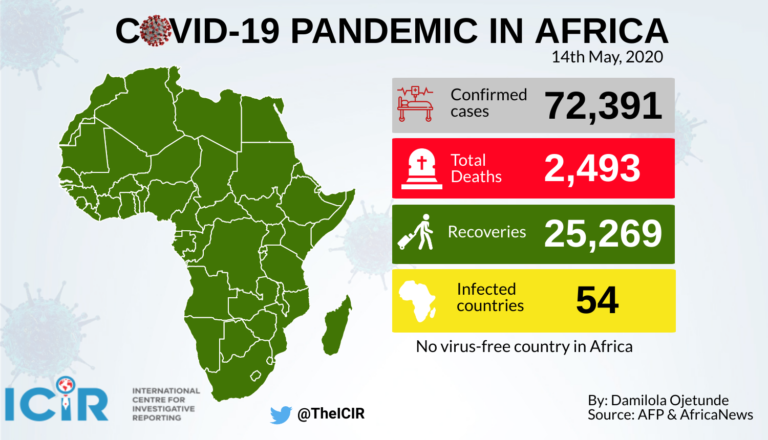
African COVID-19 data

  • Confirmed cases = 72,391
  • Number of deaths = 2,493
  • Recoveries = 25,269
  • Infected countries = 54
  • Virus-free countries = 0

Source AFP and AfricaNews

FG approves revised budget based on $25 per barrel oil price

THE federal government on Wednesday, approved the revised 2020 budget, adopting a benchmark of $25 per barrel after months of reviewing.

As of the third week of March, the country was contemplating revising the benchmark downward from $57 per barrel to $30 based on an estimated daily crude oil production of 2.18 million barrels.

Fiscal authorities have been grappling with deep fall in income as the government suggested last week that an 80 per cent in the projected net oil and gas revenue could trigger a slash of the fund available.

These funds are to be distributed among government tiers through the Federation Account Allocation Committee from the N5.5 trillion earlier proposed to N1.1 trillion.

Minister for finance Zainab Ahmed said the government is in the “process of an amendment that is bringing down the revenue indicator to $20 per barrel.”

“The council has approved our recommendations and the approval has these key parameters; the crude oil price is approved at $25 per barrel,” Ahmed added.

According to the minister, crude oil production is at 1.94 million barrels per day and then an exchange rate of N360 to $1.

The revised budget is now in the total sum of N10.523 trillion, a difference of about N71.5 billion when compared to the approved budget.

So the borrowing, the drawdown of the multilateral loan coming from special accounts, and coming from the privatisation will fund the fiscal deficit of N5.365 trillion that we have in the proposed amendment of the 2020 budget, the minister revealed.

COVID-19: Bauchi lawmakers insist churches, mosques be reopened, lament rights violation by security agents

By Haruna Mohammed SALISU


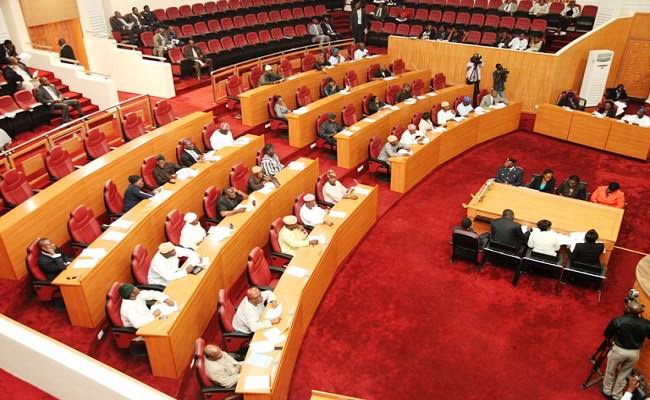
SOME members of the Bauchi State House of Assembly have insisted that the state government has to open churches and mosques to enable people worship since markets are also open from time to time.

A member representing Giade local government area in the state assembly, Hon. Dan’umma Bello during the house plenary on Wednesday argued that there is a need to go spiritual to end COVID-19, hence the need to allow people observe Juma’at prayers and church services.

A summary of the House proceedings dispatched to newsmen by the spokesperson of the Speaker, Abdul Burra quoted the lawmaker saying; “since people are allowed to go to market for three days per week, people should equally be allowed to go and pray Juma’at prayers on Fridays and church service on Sunday.”

Hon. Dan’umma also said the government should reduce the number of mosques and churches by selecting a few that the prayers will be allowed.
In addition, Hon Yusuf Inuwa Dadiye, member representing Ganjuwa West in the state assembly reminded the members that they will account for all their deeds and actions on the day of judgement.

He described as unfortunate the banning of Juma’at prayers and church services in Bauchi State.

“Every day, our constituents are calling us to inquire whether they can go to Juma’at prayers and church services or not”, he said.

Hon. Dadiye who quoted some verses of the Holy Qur’an on the necessity and sanctity of Juma’at prayers to all Muslims, called on the members of the assembly to call for the opening of Juma’at mosques on Fridays and churches on Sunday ‘because the solution to COVID-19 is prayers.’

The member, therefore, calls on the government to increase the number of mosques for Juma’at prayers so that people will not congest the existing mosques.

He said “when that is done, government should order for strict compliance to the guidelines of fighting the disease in all Juma’at mosques and churches,” he said.
The lawmakers also described as unacceptable, the high-handedness of security agencies on unarmed civilians while enforcing the partial lockdown imposed by the state government.

A member of the assembly, Jamilu Umaru Dahiru has lamented that the behavior of the security agents trying to enforce the lockdown is highly unacceptable.

Jamilu who observed during House plenary on Wednesday said many citizens of the state receive bashings from ‘overzealous security personnel’ in the name of enforcement of the lockdown order.

“There is the need for government to call the attention of the security agents to be professional and respect the dignity of human beings while enforcing government’s directives on COVID-19 lockdown,” the lawmaker said.

Mining host communities, CSOs want FG to prosecute sponsors of illegal mining 

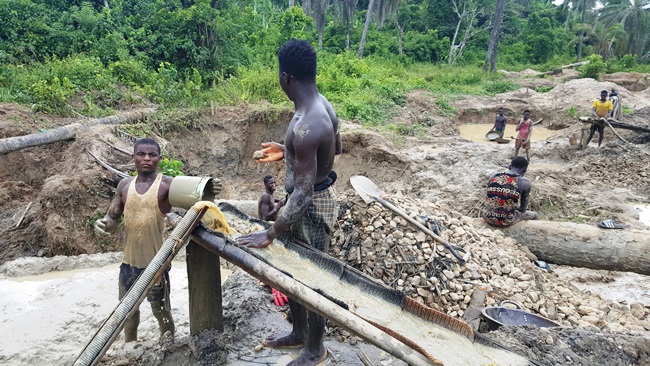
THE Federation of Nigerian Mining Host Communities, and Civil Society Coalition on Nigeria’s Mining Sector, Wednesday called on the Federal Government to prosecute sponsors of illegal mining in the country. 

The group said beyond the recent arrest and planned prosection of the 19 foreigners accused of illegal gold mining, prefrential treatments should be avoided.

They said both foreigners and 21 Nigerians involved in the illegal activities in Osun and Zamfara states should be prosecuted accordingly.

Some of the Non-profit Organisations include: Global Rights, Women in Mining, Praxis Centre, Centre for Community Excellence (CENCEX-Zamfara), SilverChip Fox and Foundation for Environmental Rights Advocacy.

Others are: Follow the Money, CSR-In-Action, Community Enlightenment & Development Initiative, Zamfara, Third Eye, Environmental Rights Action/Friends of the Earth Nigeria, Neighbourhood Environment Watch Foundation etc.

While they called for speedy prosecution of the suspects, the CSOs reacted to statement of Olamilekan Adegbite, Minister of Mines and Steel Development, who said the ministry was under pressure from some “godfathers” to release the Chinese culprits, and dismiss the case.

“We therefore hold the federal government to their pledge to ensure the prosecution of all suspects of illegal mining in the country, and call for a full  and  immediate investigation of each case, and where found culpable, the arrest and prosecution of their ‘godfathers’ and enablers,” the group said in a joint statement by Abiodun Baiyewu, Executive Director of Global Rights and Janet Adeyemi, Executive Director, Women in Mining.

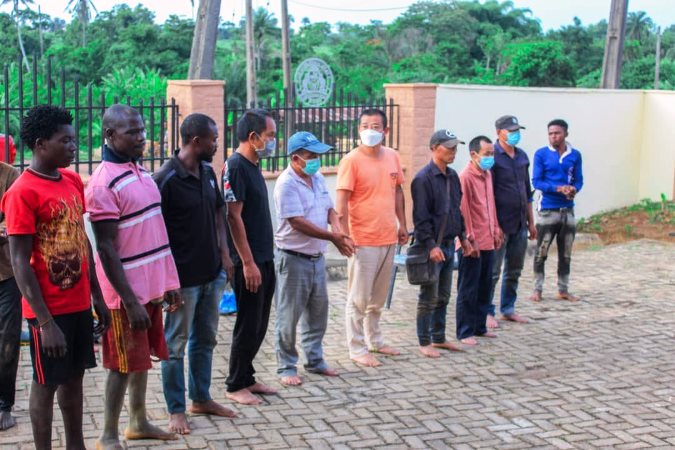
Illegal goldminers paraded by the Osun State government Photo Credit: Osun Govt

“The government’s efforts must not end with just knee-jerked arrests and prosecution of foreign illegal miners, it must include concerted efforts to ensure that the avenues through which solid minerals are ferried out of Nigeria without due process are blocked.”

The group further advocated that the FG should end the thriving illicit trade within, and smuggling of solid minerals out of the country, stressing that government policies should support main beneficiaries of such minerals to enhance value, and other monetary benefits of the sector.

The Osun State government last week paraded some Chinese and Nigerians involved in illegal gold mining in the state.

However, the stakeholders advised government to prepare for the Post Coronavirus Disease (COVID-19) by genuinely diversifying the economy.

They urged government to block all leakages in the sector, citing instance that Nigeria loses about $1.54 billion annually from illegal gold exploitation alongside other revenues and royalties.

“More particularly, we ask that the government fulfil its obligations of ensuring the reform of Nigeria’s Minerals and Mining Act and other extant regulations to conform to the ECOWAS mining directive in order to holistically develop the sector.”

The ICIR earlier did a two – part investigation on illegal gold mining in Osun and its implication on the environment and the health of the locals.

The report also highlighted the connivance of traditional rulers with illegal miners.

How Nigeria’s ICIR Pushes for Accountability in the COVID-19 Response


Benon Herbert OLUKA


AN investigative journalism nonprofit based in Nigeria, the International Centre for Investigative Reporting (ICIR), has pushed the envelope with its approach to investigating the country’s response to the COVID-19 pandemic.

In this interview with GIJN’s Africa Editor Benon Herbert Oluka, ICIR Executive Director Dayo Aiyetan discusses the team’s work. Aiyetan, an investigative reporter, newsroom mentor, and media trainer, will be speaking at Investigating the Pandemic: The Threat to Africa, a GIJN webinar, on Thursday, May 14 at 9 am EDT.

You have investigated the COVID-19 story for about six weeks now. What have been your most impactful investigations?

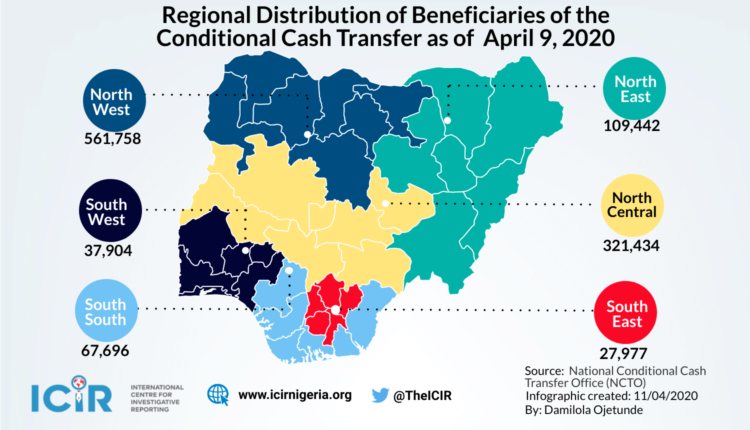
The first would be our data-driven report on cash transfers, which interrogated efforts to offer financial support to vulnerable families in Nigeria. The president had ordered that 20,000 Nigerian Naira (about US$51) be paid to the most vulnerable households, drawn from the National Social Register, a register of the poorest people in the country. But our investigation revealed that less than half of the vulnerable households on the register were receiving help from the government.

The data also showed the skewed nature of the distribution of cash as more households in states in the northern part of Nigeria were getting far more than households in the south … The government was forced to find a more equitable means of distributing palliative [food parcels] to reach as many Nigerians as possible.

Regional distribution of beneficiaries of the Conditional Cash Transfer as of  April 9, 2020

Then there is our story about what doctors and other health workers earn as hazard allowance. In some places, doctors earned as low as N5,000 ($13.64) per month. We compared this with what doctors in other West African countries earned — $361 in Ghana, $460 in Sierra Leone and $825 in Liberia — and within weeks the state and federal governments reversed the situation.

For me, the report with perhaps the biggest impact is that which called out the minister of health, who overstated the extent of Nigeria’s preparedness to deal with a coronavirus outbreak. He visited one hospital in Lagos and declared that Nigeria was ready. The World Health Organisation (WHO), too, sang the same song. But our investigation revealed that Nigeria did not even have adequate isolation centers and was not prepared for the health crisis that the pandemic would bring. I believe that our calling out the minister informed the new government strategy… There has been more transparency in providing credible information to Nigerians and now the presidential task force on COVID-19 briefs the nation daily.

The COVID-19 story started as a health story before roping in all other reporters as it swept across the world. As an investigative unit with wide-ranging reports, how did your team cover issues around COVID-19 that would have an impact?

The ICIR runs a small newsroom. We do not have reporters in the states, only in the capital Abuja. And there was a lockdown. Every journalist reported from their different location so we were able to get a broad view at least of what was happening in the whole of the Federal Capital Territory.

But we were not covering stories around the country and there was a lot going on. So we reached out to journalists in other newsrooms that we had worked with on our funded investigative projects to report for us on specific projects… and jointly published. We did this particularly in the early days to report on state responses to the pandemic and unearthed a lot of initial mismanagement of responses, denial, and cover up of COVID-19 cases.

Could you share with us some of the investigations you’ve done during the lockdown and explain how you were able to pull them off?

The story on prison congestion and the risk of an outbreak of the pandemic in prisons, called correctional centers in Nigeria, was done through undercover reporting in at least one prison. I cannot speak about the details, but our reporter got into Maiduguri Maximum Security Prison and was able to paint a picture of what could happen in the facility if [overcrowding wasn’t alleviated] and if protective equipment was not provided to the prisoners.

Another investigation we did was about the response of the Akwa Ibom State government to the pandemic. We learnt what was going on and got a trusted journalist in the state to report for us. The investigation was important because the state government was living in denial, suppressing testing, and frustrating medical personnel. The investigation exposed all this.

The interesting thing is that an official of the state government who had followed some of our reporting on the pandemic reached out to us all the way from Akwa Ibom State to provide information about what was going on. As we had no reporter there, we got a trusted journalist to do the report, giving him access to our source.

One of the biggest challenges for journalists covering COVID-19 has been the reliability of figures. Have you had instances where you and your team faced this challenge? How were you able to overcome it?

The example that readily comes to mind is the story we ran on the social register of the poor. The government had refused to give exact figures about the number of households and many people — including journalists — were quoting all kinds of figures that could not be verified. We were fortunate. We kept looking and eventually found a source in the right place who provided the data in a government document. Once we verified that the document was authentic, we ran with the figures and the government could not deny it.

What have been the greatest challenges that you’ve faced while doing investigations during the pandemic? 

I believe it is the frustration we have faced reporting from the front line, particularly in hospitals and isolation centers. We wanted to tell the story of our health workers and how they cope treating COVID-19 patients, what welfare packages they enjoy, if they had adequate personal protective equipment (PPE) and medical equipment to work with. However, the government refused to give us access. We can understand that the government would not want the truth about some of the inadequacies in our treatment of COVID-19 patients to come out but these are stories that need to be told.

Another challenge has to do with covering stories of human right abuses during the lockdown. Because most of our journalists do not have cars we are sometimes limited in the scope of stories we want to cover. But we quickly learnt a few lessons and adapted.

Are there particular tools and resources that have aided you and your team in your effort to carry out investigations during the pandemic?

Sometimes, the tools could be as simple as apps such as Twitter or [smartphone app] Truecaller… and Wayback Machine. For some of our verification stories — and there have been loads — we have used TinEye and Google’s reverse image search. In the early days of the pandemic and after the lockdown and airport shutdowns, we used Flightradar24 for tracking flights. For example, while investigating the whereabouts of Abba Kyari, the former chief of staff to the president of Nigeria, who died from COVID-19, we used it to try to get the dates he flew out of Abuja and where he had gone. [Editor’s note: He died later that month.]

What have been the missed opportunities for investigative journalists that you would want them to keep in mind going forward?

Using data not only to make government accountable, but also to set the agenda, and influence government policy. For example, the government eased the lockdown in Nigeria at a time when infections were rising. Journalists should put such government action in context through what data says. At the ICIR, we are now tracking the data of infections and doing stories showing whether the ease in lockdown regulations makes sense or not.

Also, I do not think journalists in Nigeria are using data enough to set [the] agenda in the areas of health, education, infrastructure, etc. One of the stories we want to do at the ICIR is to look at the education data, particularly dealing with the number of schools and children in schools. We want to force the government to start thinking of the future when schools should resume. We want to use this data to project how many more schools the government needs to build, because our kids need to observe social distancing when they return to school. Journalists can use data…. like this to set the agenda, to influence policy in virtually every facet of the economy.

On World Press Freedom Day you said journalists and media organizations must innovate in order to adapt and survive after the pandemic is brought under control. What kind of innovations do you have in mind?

Journalists must learn new, cost-effective ways of telling stories, particularly using technology. Today’s investigative reporting work — in fact, any kind of journalism — is driven by technology and journalists must embrace tech tools and not rely on old, traditional methods. So, instead of pounding the streets looking for sources, data or documents, we should learn that a whole lot of this we can get online.

This interview is published with permission from Global Investigative Journalism Network