Home Blog Page 2107

REPORT: One week after lockdown suspension; banks, customers violate rules on social distance in Abuja


A WEEK after the phased easing of lockdown  for residents of Abuja, Lagos and Ogun states to go back to their businesses, The ICIR can report that guidelines issued by Federal Capital Territory Administration (FCTA) to operate were not adhered to by banks and their customers.

Part of the guidelines was for banks to open between the hours of 8:00am and 2:00pm and to observe temperature checks, hand sanitizing protocols as well as the use of face masks for staff and customers.

The guidelines released by Muhammad Bello, Minister of the FCT included that banks limit access by customers in order to allow for safe distancing reasons and limit the number of staff working on their premises to between 30 percent and 50 percent.

Bello then said, residents were encouraged to patronize online banking services as much as possible.

Checks however, by The ICIR across Abuja where banks are located revealed flagrant violation of the guidelines.


From Mpape, one of Abuja’s densely populated satellite towns to Area 3 considered as the headquarters of banks in the nation’s capital, banks and their customers disregarded the laid down rules.

No hand sanitizer, no social distancing, customers flood banks in Mpape

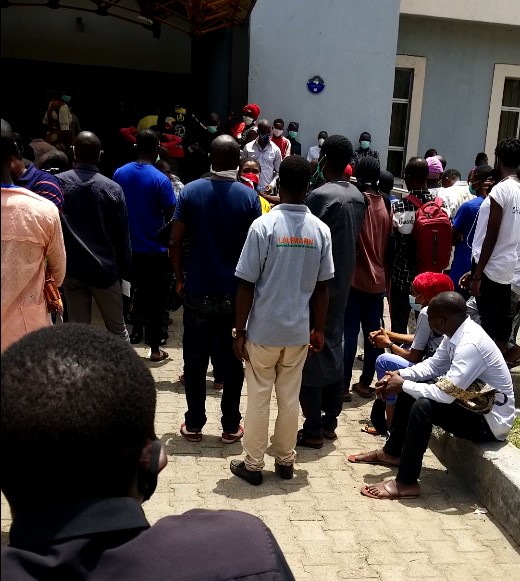
At a branch of Zenith Bank in Mpape, hundreds of customers were observed sitting and standing in front of the bank building, waiting for the security operatives to allow them in.

Customers were issued tally numbers in order to take turn to enter the banking hall and also to maintain the quorum stated in the guideline. The ICIR reporter was issued number 137th tag.

Though, the bank provided a mini tent for the customers with plastic chairs to sit, there was however no observance of social distancing in the sitting arrangement.

Those who could not find space under the tent stood under the scorching sun waiting for the security operatives to either give them tally or allow them in.

A customer who came out of the banking hall during the time of the visit and did not want his name in print disclosed that the laid down rule was that the security operatives should allow three persons to enter at the same time.

However, the crowd inside the banking hall, according to him, meant that majority of people among the hordes of customers waiting outside would have to visit other time.

” I can tell you most of this people need to come back tomorrow as the inside is full already,” he said.

While he confirmed that hand sanitizer was being dispensed before customers gain entrance into the banking hall, he declined to comment on the social distancing, because according to him, he did not  understand the meaning.

Security operatives at the bank’s entrance ensured that only customers with facemask  were allowed into the main building.

Those without facemasks were directed to use the Automated Teller Machine (ATM) gallery which was, at that moment, overwhelmed.  But the bank did not provide equipment to measure the temperature of customers going into the bank’s environment.

Meanwhile, a branch of First Bank at Mpape closed its doors to customers. They were only allowed to use the ATM gallery. But the breakdown of guidelines here was clear as many of the customers did not wear  facemask. Social distancing rule was also not adhered to and no bank’s security personnel to enforce it.

As observed, the bank has drawn over 60 square-like shapes on the floor of the gallery, expected to guide the customers to follow the 2 meters social distancing rule, the scorching sun and lack of orientation pushed many to defy the rule.

The bank did not also provide hand sanitizer at the ATM gallery which led to customers using bare fingers to operate ATMs.

A fact-check by The ICIR about the aerosol nature of the virus,  revealed that the COVID-19 is not airborne but can spend hours on stainless steel and plastic objects from which it can be contracted.

At about 10:57am when this reporter visited a Polaris Bank branch, he was issued number 97th tag and the security personnel detailed to call in customers just called a customer with tag number 42.

Other customers waited in the sun for their turn as only those with tags were allowed access to the banking hall. But to use the ATM at the gallery, there was no need for customers to wear facemask, sanitizer or hand gloves.

According to a male customer, the security operative allowed seven persons to enter the bank at a same when the bank first opened “but now it is two persons at a time.”

At Zone 3 and Area 3, no social distancing

While banks at Zone 3, Abuja managed to put certain things in place to follow the guidelines, it was lot difficult to enforce social distancing rule among customers.

A a branch of Access Bank, security operatives ushered this reporter into the bank premises with tally number. At that time, this reporter was 166th customer after having his temperature checked.

Aside from this, another important entry pass is your face mask.

But with all these, the bank failed to enforce social distancing-rule just as it did not provide chairs to all  customers after the few ones under a canopy provided were fully occupied. Those waiting to be called in were seen sleeping around the flower lawn of the bank while others rested on the tall Logo stand of the bank.

At Ecobank, two canopies provided by the bank were fully occupied by customers which made social distancing impossible.  Customers without facemask were seen leaving the bank as they were turned back by security operatives. Others were seeing lurking around the bank’s premises.

At Area 3 which is known as Abuja banking village due to the clusters of banks’ headquarters there, there was a total break down of guidelines for operation.

Customers were all concerned about finding their ways into the banking hall or to the ATM galleries.

There was a horde of customers forming a long queue at the entrance of the GTB branch there. The crowd, about a thousand of customers was beyond the control of the bank’s security personnel.

Though the bank had marked the two meter marks on the floor at the entrance, no one actually followed the marks. Frustrated customers who wanted to get tags to be able to gain entrance into the banking hall accused security personnel of collecting bribes to issue tag.

At a time, a security officer asked the crowd with tally numbers from 200 to 300 to move outside the barricade of the bank’s gate. This order made the customers rush out of the premises.

A customer who pleaded for anonymity,  said she had been on the queuefor three hours before the whole noisy situation, alleging that the security operatives were handling the issue based on favouritism.

An old man who also spoke wearing an Ankara fabric face mask said the bank had been negligent of what may cause community spread of COVID-19 as the bank failed to prepare for the enormous number of their customers that turned out.

“Can you see that these people are very very negligent? as old as I am, I came from a far place. They knew they would have hundreds of people coming here and they still fail to prepare for it,”  he said.

Checking the ATM gallery of the bank, it was a similar case as it was filled with customers without space for anyone to stand again. This was happening just the second day of the lockdown ease.

The story was no different at Zone 3 branch of UBA. No bank official or a security person was on duty during the time of the visit. Out of the six ATMs at the gallery, only two were active and dispensing. This led to overcrowding at the ATM section.

At the other side leading to the entrance of the bank, customers were provided with no hand sanitizer nor while there was no officer on ground to check their temperature.

Most of the customers interviewed  by The ICIR were at the bank to solve one problem or another requiring the attention of the Customers’ Service Officer.They argued that they had waited for the lockdown to be lifted so they could come to the bank and resolve the problems.

With the heavy crowds seen across Abuja banks,  the Central Bank Of Nigeria (CBN)’s vision 2020 goal of being among the top 20 economies by the year 2020 with the aim to drive development and modernization in Nigeria’s payment system through the means of cashless policy is far from being a reality.

What Nigerians should know about the Control of Infectious Diseases Bill

By, Kingsley Ogundu CHINDA


I should start this analysis by commending the sponsors of the Bill for the idea that there is need to review and update our public health laws as they relate to infectious diseases to meet the changing times. What I call the spirit behind the law is very laudable but the letters of the law are poorly couched or copied and should be re-drafted to suit our Nigerian realities. However, credit still goes to the sponsors of the Bill. This Bill, after the rushed 1st and 2nd readings, should be referred to the relevant committees of the House and subjected to rigorous public scrutiny (Public Hearing) for all stakeholders to make inputs, with the objective of coming out with a more comprehensive draft Bill that takes the concerns of all into account.

If we do otherwise and send it to the committee of the whole, we will end up with a bad law that cannot stand judicial scrutiny and invariably the test of time, or it would be killed in the Senate. For a Bill to suffer still birth, or to acquire some dubious reputation in the eyes of the public, raises fundamental issues about the standard and quality of law-making, and more importantly creates suspicion when the members of the public have a poor purchase on the Bill, it must seek to legitimise itself by possessing the consent of those whose behavior it seeks to regulate.

Law cannot exercise its authority and give life to its legitimacy and performative character without the public providing flesh, blood and consent to it and law-making.

So, my purpose here is to provide some clarity to the Bill, critique some of its provisions and pose alternatives, hoping that as the nation proceeds along, we will have the discernment to address some of the concerns that many Nigerians have raised about the Bill.

Bill with connection to a dubious history

The Bill is ninety-seven percent copied from the Singapore Infectious Disease Act,1977. While we concede that statutes and legislations generally are exempted from the legal burden of plagiarism, they are, however, not exempted from the moral burden of copious reproduction of a work. The copious reproduction of the Singaporean law leaves the impression of parliamentary laziness and clearly, the 9th House of Representatives is not that lazy. A lot of industry abound within and this has been demonstrated several times. Again, where Bills are imported, they are adapted to the local circumstances. It is interesting to note that Singapore was under the reign of a maximum ruler, Lee Kuan Yew, who operated a one-party socialist state.

Some of Lee’s famous quotes amongst others are: “Between being loved and being feared, I have always believed Machiavelli was right. If nobody is afraid of me, I’m meaningless. If you can’t force or are unwilling to force your people to follow you, with or without threats, you are not a leader.” This theory of leadership though moved Singapore forward, will be out of place in our Nigerian setting today. Thus, the Bill is draconian in a multi-party federal system democracy as practiced in Nigeria. We cannot domesticate the law of another nation. The Singapore Infectious Disease Act 1977 is not an international protocol that we should adopt wholesomely without any changes. While we can borrow the idea of the law from Singapore, we must adapt it to our local circumstances and bring it in line with existing local Statutes.

What Nigerians should know about the Bill

  1. The long title of the Bill is “A BILL FOR AN ACT TO REPEAL THE QUARANTINE ACT, CAP. Q2, LAWS OF THE FEDERATION OF NIGERIA, 2004 AND ENACT THE CONTROL OF INFECTIOUS DISEASES BILL, MAKE PROVISIONS RELATING TO QUARANTINE AND MAKE REGULATIONS FOR PREVENTING THE INTRODUCTION INTO AND SPREAD IN NIGERIA OF DANGEROUS INFECTIOUS DISEASES, AND FOR RELATED MATTERS (HB.836)”.
    While the short title is “Infectious Diseases Act 2020”, a closer look at the content of the Bill reveals that the title of the Bill is deceptive. Whereas it purports to regulate “infectious diseases’, it actually goes beyond infectious diseases and regulates diseases of any nature, depending on the discretion of the Minister – Section 5(1)(b) of the Bill.

The short title of the Bill should actually be Control of Diseases Bill 2020 rather than “Control of Infectious Diseases Bill, 2020” as contained in Section 81 of the Bill.

  1. The power to administer the Bill is vested in the Director General (DG) of Nigeria Centre for Disease Control (NCDC) under the directive of the Minister. Please note that the office of the DG was created by another Act, the Nigeria Centre for Diseases Control Act, 2018 with powers and functions bestowed on him under that law.

- The powers vested in these political appointees are humongous and bound to be abused. More so, they are accountable to their appointer and take instructions from him and not from the Nigerian people.
– The NCDC Act that created the office of the DG gave him powers and also gave some powers to the Board of NCDC. Some of the functions of the Board under the NCDC Act are given to the Director under this current Bill.

3.  The Bill as stated in the introductory paragraphs above, failed to take cognizance of our local circumstances, consequently, the Bill has some serious Constitutional and statutory contradictions. Several sections that are the life wire of the Bill conflict with existing laws and the 1999 Constitution.
- The federal system of government in Nigeria was not considered in the Bill, thus there are no role(s) for other tiers of government- (states and local governments), particularly the states as a federating unit. This is more serious, recognizing the fact that health is an item in the concurrent legislative list in the 1999 Constitution.

- The powers of governors to take steps and come up with executive orders in times of public heath emergencies contained in the Quarantine Act sought to be repealed were jettisoned. Thus, state governors have no role and are merely at the mercy of the DG, NCDC and the Minister for Health. This is abnormal and would be counter productive.

- All state governors are today relying on the Quarantine Act to come up with executive orders to manage the COVID-19 peculiar situations in their respective states. If this power is removed, it means that the DG, NCDC has to micro- manage all the states and local government areas in the country in times of health crises (as we have now). This will be most inefficient.

  • The Bill severally and frontal attacks the rights of citizens under Chapter 4 of the Constitution dealing with Fundamental Human Rights, and also the African Charter on Human and Peoples’ Right (Ratification and Enforcement) Act, Cap. A9 Laws of the Federation of Nigeria, 2004: the United Nations Declaration on Human Rights, 1948 and International Convention on Civil and Political Rights, 1976 which are ratified by Nigeria and are thereby local legislations.

- The Bill also conflicts with the Environmental Health Officers (Registration ETC) Act 2002. The DG is empowered in Section 2 of the Bill to determine who a Health Officer is against the clear provision of sections 13(1) and 14 of the Environmental Health Officers Act which outlaws any practice or provision of health services in Nigeria without certification by the Council – Health Officers are professionals and cannot be picked discretionally by any individual.

- The National Programme on Immunization Act, Cap. N.71, LFN 2004, Vol.9. Section 6 of the Act covers some contagious diseases like Tuberclosis (TB), Whooping Cough etc, with an omnibus clause in Section 6 (f) which empowers the Minister of Health to cover any other disease he deems fit. These are the same diseases the present Bill seeks to take care of. The Immunization Act is a specific law on immunization, whilst the present Bill has immunization as one of the items covered in the Bill.

- Nigerian National Health Act 2014 regulates health practice and practitioners in Nigeria, including the protection of the fiduciary relationship of medical practitioners and their patients.

  1. Section 3 of the Bill, which empowers the President to declare a public emergency and public health emergency zones in the country or any part thereof, did not state the method of publishing the declaration. Under Section 3(5) of the Bill, the method of publication is left at the discretion of the President and there is no time frame within which same should be sent to the National Assembly (NASS) for ratification. It only says “as soon as possible”, which is subject to interpretation of the operators.

  2. Section 6 of the Bill provides for compulsory testing based on mere suspicion by the DG, NCDC. Failure to test at one’s own cost, attracts legal sanctions, including a conviction. This provision can and would be abused by power drunk officers without an option of legal challenge to such abuses. There are people whose religion does not permit injections or blood test or transfusion. This could thus be a breach to the right to freedom of thought, conscience and religion in Section 38 of the 1999 Constitution.

  3. Section 7 of the Bill empowers the DG, NCDC to order a post-mortem test, based on suspicion. No exception was considered and it is entirely at the discretion of the DG. This could breach the right to freedom of thought, conscience and religion in Section 38, 1999 Constitution.

  4. Section 8 of the Bill removes the fiduciary relationship (the duty of confidentiality) between patients and their personal physicians on mere suspicion. The Nigerian Health Act still protects this relationship and is therefore in conflict with this Bill. This can only be reasonable after a test is carried out and the person is confirmed to be infected. A citizen can be subjected to inhumane treatment and denied his right to privacy by publishing his/her medical history without his/her consent and refusal is a crime.

  5. Section12 of the Bill empowers the DG on mere suspicion to stop a wake keep and prohibit the burial of a deceased by his/her family. This again violates Sections 34 and 38 of the Constitution on the Citizens’ Right to Human Dignity and Right to Thought, Conscience and Religion. Burial rites are mostly cultural or religious-based. This would be reasonable if it is confirmed that the corpse is infected. Even at that, the infected corpse does not need to be present at the wake-keep.

  6. Section13 empowers the DG on mere suspicion to detain a citizen as long as he wishes without an order of a competent Court of law and he, of course, cannot be sued even where his suspicion turns out afterwards to be false or wrong, as Section 70 protects the DG and his agents from personal liability.

This runs fowl of the victim’s fundamental Right to Liberty (S.35) and movement (S.41) of the Constitution. Also, note that Section 35 (e), which provides an exception only contemplates those suffering from a disease not “suspected” as provided in the Bill. Thus, the Bill tends to surreptitiously amend Section 35 (e) of the Constitution through the back door.

  1. Section 14 again gives the DG the power to place a citizen under surveillance on mere suspicion. The worry is that these encroachments on rights of citizens are done on mere suspicion and since no personal liability is incurred for any default, the DG or his representative could be careless. This contravenes Section 37 of the Constitution (Right to private and family life).

  2. Section 15 of the Bill empowers the DG to issue a notice to take over a citizen’s property and declare it an isolation center without the consent and permission of the owner. This provision is subject to serious abuses as perceived political enemies and or opposition party members could be easily targeted and/or abused in the guise that their property is declared an isolation center without recourse to a court of law. It runs foul of Section 44 of the Constitution (Right against compulsory acquisition of property). Again the section conflicts with the right of governors over lands in their states under the Land Use Act, as property can now be acquired in a state without the governor’s consent.

  3. Section16 of the Bill is a very potent instrument against religious and social organizations. Thus, if in the opinion of the DG any building is deemed overcrowded, the DG can make an order dispersing the crowd and anybody who goes in commits an offence. How do you opine or conclude that the gathering is likely to expose occupants to infectious diseases?
    Once a decision is taken, it becomes effective regardless of any protest or appeal. The appeal is to the Minister of Health whose decision is final and he is an interested party. Thus he is a final arbiter in his own matter. This again violates the citizens’ right to fair hearing in Section 36(2)(a) and (b) of the Constitution.

  4. Section 19 of the Bill gives the DG the power to stop any meeting or gathering as he deems fit on the ground that such activity is likely to increase the spread of infectious diseases for 14 days, renewable thereafter. The concern is the exercise of excessive discretion, which leads to abuse. Sections 35 and 40 of the Constitution which deal with Personal Liberty and Right to peaceful assembly and association are breached by this provision.

  5. Section 20 of the Bill talks about a carrier unlike other sections where a suspect is made to suffer

  6. Section 24 empowers an enforcement officer to get order from a court (magistrate) to destroy a building where infectious disease occurred. This is too draconian as fumigation or disinfection of such building will sanitize it rather than outright destruction. Also, note that the owner has no claim against the officer under S.70 of the Bill.

  7. Section 27 also allows the DG to exempt a vessel coming from an infected area from being deemed to be infected. There are no grounds for the DG to arrive at that conclusion, it is left to his discretion.

  8. Section 30 also gives the DG the discretion to determine any vaccine that will be compulsory for citizens to take before they can travel out of Nigeria. Note that vaccines are made from animal genes and it could be one made from a prohibited animals such as swine that are forbidden by Moslem and some Christian sects and citizens will be compelled to take it. This is most unconventional. What is obtainable is that countries, depending on their peculiarities request that visitors must be vaccinated against certain diseases so if you are travelling to such countries, it is one of the requirements, but not to impose on its citizens that you must be vaccinated before travelling out of the country.

  9. Sections 46 and 47 of the Bill provide for compulsory vaccination of children and adults with some specified vaccines. This should not be compulsory as in some climes, there are incentives given to encourage vaccination. There must also be an exception on health or religious grounds. Recall the Pfizer experience in Kano where vaccines turned a killer injection and in South Africa where HIV vaccines were deliberately administered on blacks. Vaccines sometimes have turned out to be dangerous.

To compel one to take a vaccine made of stuff that is against his belief is a breach of Section 38 of the Constitution (Freedom of thought, conscience and religion). More so, under Section 47(4) of the Bill, the DG is required to give notice of the order for vaccination as non-compliance is a crime under section 51, yet he still has discretion on the method of notice.

Thus, the DG could simply paste the order for vaccination on his office notice board and if you fail to vaccinate within the prescribed time, you commit and offence.

  1. Section 49, which provides exception to the vaccination, only allows medical grounds without the very important religious ground and the exemption is also at the discretion of the DG. He determines who will be exempted or not and issues exemption certificate.

  2. Section 53 provides for fees for vaccination, which the Bill makes compulsory. If compulsory vaccination is not free to all, it should at least be free to the vulnerable class as poverty is not defense under 51. Someone who cannot afford the vaccination commits an offence, as poverty will not be an excuse.

  3. Section 54 empowers the DG to enter any premises at anytime and without warrant and with such force as may be necessary. Note that the Bill did not even provide for use of “reasonable force” to enter, search or cease any book or material suspected to be connected to disease out brake. The force that is necessary is determined by the Enforcement Officers.

  4. In Sections 55, 56 and 57 of the Bill authorise the entry, search, arrest, seizure and disposal of any premises, thing, vehicle, document or person as the case may be without warrant based on mere suspicion and the private opinion of the DG of NCDC, Health Officers and Police Officers. These sections are wrong on every level, because they give the Police officers unfettered powers to cease, arrest and detain based on mere suspicion and without proof of guilt, thereby taking away the all important legal rule that an accused is deemed innocent until proved guilty.

Under the Bill, the reverse is the case as a suspect is deemed guilty until he proves otherwise. The DG’s power under Section 56(1) to seize information considered relevant to public health in his opinion may be abused to interfere with the Constitutional right to freedom of speech and press in Nigeria.

  1. The Bill also allows the executive officers to take extra-judicial decisions to the detriment of citizens’ Constitutional rights to freedom of movement and dignity of human person. This can be seen in Section 57, (7-8) of the Bill. Clearly, Subsection 8 of the Bill gives meaning to the measures referred to in Subsection 7 which include the entry into a place without warrant and the use of such force as maybe necessary. The question now is what force can be used by the police officers that will be deemed necessary? This is unconstitutional as section 34 of the 1999 Constitution as amended clearly stipulates that no person shall be subjected to torture, inhuman and degrading treatment.

  2. Section 62 is merely repetitive and superfluous as it is the primary function of Police to execute laws. It is not necessary to state that the “Inspector General of Police shall provide such Police assistance as may be necessary to carryout any of the provisions of this Act”.

  3. The reference to Section 64 is wrong as it should be actually be Section 63.

  4. The immunity provided in Section 70 of the Bill is unconstitutional because this effectively ousts the jurisdiction of the court to hear human rights abuse claims, as the Bill provides that no liability shall lie personally against the DG, health officer and police officers who does anything in the execution of the Act. Human rights abuses are usually personal.

  5. General remarks on the defense that Section 45 of the 1999 Constitution as amended allows derogation from certain fundamental rights pursuant to a law made for the purpose of securing public health cannot hold water in all the abuses or fundamental human rights derogations in this Bill, as follows:

a) The provisions of the Bill are so wide and not reasonably justifiable in a democratic society having been fashioned after a single party communist state.
The provisions of Section 45 of the 1999 Constitution as amended may not be sufficient to save the Bill from being declared unconstitutional if passed in its present state and tested in a court of law;

b) The derogation in Section 45 does not apply to infractions of sections 42, 43 and 44 of the Constitution (Freedom against discrimination: right to acquire private property and right against compulsory acquisition of property). Thus, all the sections of the Bill on compulsory acquisition of property are outside the exemption;

c)  By Section 45(2) derogation of of Sections 33 (Right to life) and 35 (Right to personal liberty) are allowed in an Act only during “emergency period”. This is only when the President under Section 305 of the Constitution declares a state of emergency. Even under such emergency period, the measures must be “reasonably justifiable in dealing with the emergency situation”. Even in a state of emergency, is it reasonably justifiable to demolish a property for the singular reason that an infected person was therein?

d) The derogation under Section 45 of the Constitution applies only during emergency period and so reliance on the section to breach the liberty of citizens is unconstitutional.

* Rep Ogundu Kingsley Chinda is the member of the House of Representatives representing Obio-Akpor Federal Constituency, Rivers State.

Over 300 people ‘mysteriously’ died in Azare within 14 days

By Haruna Mohammed Salisu


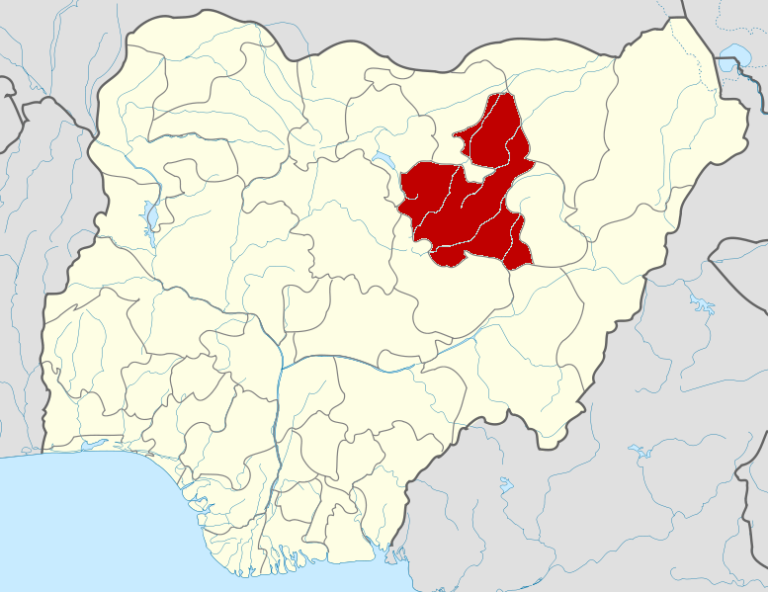
About 310 people have reportedly died of undisclosed ailments in Azare, the headquarters of Katagum local government area of Bauchi State.

In a letter written to President Muhammadu Buhari by Hon. Ibrahim Baba, a former lawmaker representing Katagum who was deposed of his position by an Appeal Court in Jos, the former lawmaker alleged that there was “massive outbreak of coronavirus in Azare town and environs in Bauchi State, which has already resulted in over 100 fatalities in the last one week.”

The former lawmaker attributed the mysterious death to COVID-19, saying the incident has “thrown the entire area into great mourning, panic and confusion.

Ibrahim in the letter indicated that the “centrality and proximity of Azare to Bauchi, Kano and some major cities of Jigawa State make the town’s large population susceptible to the virus due to the already existing large cases of the disease in those areas.”

An independent verification conducted by The ICIR to ascertain the authenticity of the claims made in the letter to President Buhari by the former lawmaker shows that not fewer than 310 people have died ‘mysteriously’ within a span of 14 days.

Muhammad Muktar MK, a resident of Azare told The ICIR that a total of 310 people whom he described as “aged” have died in Azare in the last 14 days.

Another resident, Salisu Azare said “of course what you heard is true, the deaths may be more than that even and most of them are within the range of 60 years and above.

“But no one would tell you what killed them for a fact, I think only scientific examination could prove the kind of ailment that killed them, but we are really scared”, he said.

The ICIR recalls that a pioneer Chief Judge of the Federal Capital Territory, Justice Muhammad Dahiru Saleh, who annulled the June 12 election, was among prominent people of Azare extraction that died during the period.

He died on Thursday at the aged of 83 and was since buried according Islamic rites.

When The ICIR placed a question to the Bauchi State Deputy Governor, Senator Bala Tela who is also the chairman of the state’s taskforce on COVID-19 and Lassa Fever regarding the actual figures of fatalities and the ailment that killed them, Baba Tela debunked the reported figures, saying the numbers have been exaggerated.

“I don’t know the exact number of casualties, but what I have gathered is that about six persons die every day for a period of 7 days”, Baba Tela said.

The Deputy Governor also said about 7 medical health personnel consisting of 5 doctors and 2 nurses have tested positive for the virus in Azare.

Baba Tela said the ailment that killed the people in Azare town were yet to be established by health workers in the state; “but we are liaising with the WHO and UNICEF to retrain our health care workers in Azare to boost their capacity to respond to the situation on ground”, he added.

The Deputy Governor also debunked the figures unveiled by Hon. Ibrahim Baba who wrote a letter to the Presidency alleging that about 100 persons have died of COVID-19.

“I’m sure he has not counted the deaths and he has not gone to the grave yard or had a conversation with people who buried the deaths, so how could someone come up with figures just like that”, he insisted.


Kwara police intercept, return home 200 “Almajiri” youths

THE  Kwara State Police Command on Saturday intercepted and returned 200 suspected Almajiri youths traveling to the state.

According to a press statement signed by the police spokesperson in Kwara state, Okesanmi Ajayi, the 200 youths traveled in a lorry with registration number Kaduna MKA 54 XL.

He stated said the lorry was intercepted at Kanbi/Oloru axis of Bode Sadu-Okoolowo express way in Kwara state following an intelligence report.


Read Also:

The driver of the lorry, Shehu Hashim from Manigi in Niger State, told the police they were traveling from Funtua in Kaduna State.

Ajayi noted that upon the instruction of the State Police Commissioner, Kayode Egbetokun, the 200 suspected Almajiri youths and lorry were escorted by armed policemen to the state boundary of Kwara and Niger states.

The statement further appealed to residents of border communities in Kwara to cooperate by providing information on illegal movements of people and vehicles.

COVID-19: Nigeria ranks second out of 10 countries with highest confirmed cases in Africa

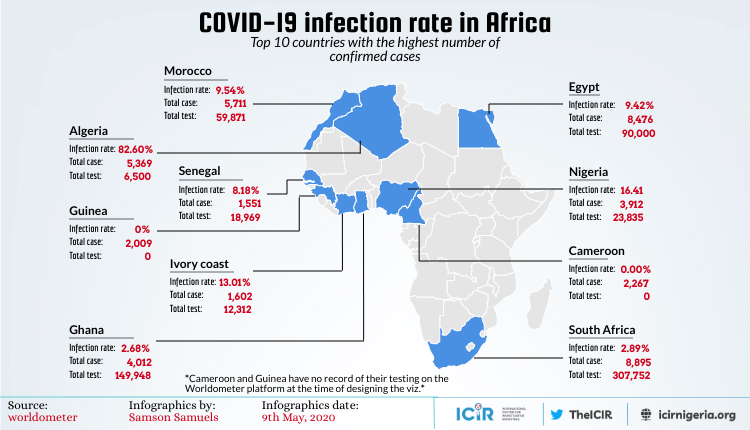
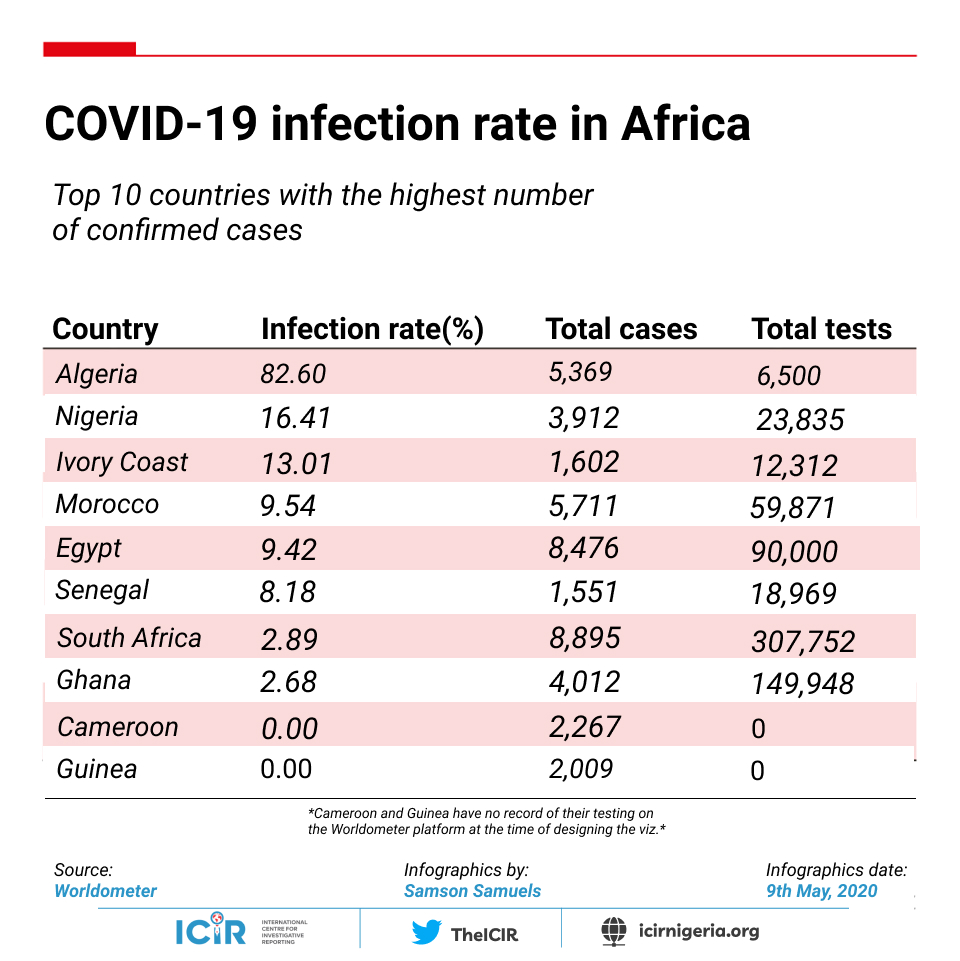
NIGERIA, with a 16.4 percent infection rate is the second most infected country of the Coronavirus disease (COVID-19) out of the 10 countries with the highest number of confirmed cases in Africa, analysis by The ICIR reveals.

The infection rate of COVID-19 is calculated as the percentage of the number of confirmed cases as against the number of tests carried out by each country.

As at 8am, May 9, COVID-19 data from Worldometer reveals that Algeria sits first on the ladder with 82.60 percent infection rate after carrying out 6,500 tests with 5,369 confirmed cases. Nigeria, coming second had carried out 23,835 tests with 3,912 confirmed cases reported.

Other countries include Ivory Coast with an infection rate of 13.01 percent, Morocco- 9.54 percent, Egypt-9.42 percent, Senegal- 8.18 percent; South Africa 2.89, Ghana- 2.68 percent, and. Cameroon and Guinea have no record of their testing on the Worldometer platform at the time of writing this report.

The current rate of COVID-19 may be far from reality. This is because testing for the virus is yet to be comprehensive. The Nigeria Centre for Disease Control (NCDC) has increased testing by activating more molecular laboratory for testing.

However, Nigeria has dipped to the 34th position in Africa from 31st about a week ago in the area of tests per million.

The infection rate in Nigeria may continue to rise because the NCDC is scaling up testing across the country to detect cases that may arise from recent ease of the lockdown.

The epicentre of COVID-19 in Nigeria, Lagos state, may record between 90,000 and 120,000 cases between July and August.

Akin Abayomi, Lagos State commissioner for health made the prediction during a media briefing on the update of the virus on Friday in Lagos.

The number of confirmed cases in Nigeria keeps increasing by the day. As of 8th April, 276 confirmed cases were reported. Exactly one month later, May 8, the conformed cases in Nigeria has increased to 3,912, representing an increase of about 1,317 per cent in the last one month.

Eleven ways to appropriately report on COVID-19

WHEN  it comes to reporting on COVID-19, language and images matter. Here are the reasons why, and how we can report appropriately to prevent stigma and discrimination.

In the nineties, many reports around HIV on the news media were horrific. Pictures of bones and skulls were used on TV to portray HIV as a “death sentence.” This may have been well- intentioned – perhaps to persuade people to take heed to advice on preventative measures, but it ended up proliferating stigma and discrimination, even hampering public health intervention.

Conversations around HIV at the time quickly moved underground, giving room for misinformation and myth-spreading. Several people even avoided knowing their HIV status because of the damaging ways HIV was portrayed. Some news agencies described HIV as a “curse” and even official reports described the virus as a “deadly killer.”

The imagery surrounding HIV were perpetuated to the point that even those who gained the confidence to publicly disclose their HIV status were often met with disbelief on the grounds that they didn’t look “skinny” or “sickly” as the media had portrayed people living with HIV to be. One man I interviewed in 2006 said he was skeptical about being around anyone wearing red in a hospital because he assumed the colour red and HIV were synonymous.

As a community radio presenter anchoring the radio magazine “Flava” for a decade, my colleagues and I regularly travelled across Nigeria’s 36 states producing programmes in the bid to change some of the negative public perception around HIV, some of which were perpetuated by other media platforms. With a more positive application of language and imagery, the landscape of reporting HIV changed in Nigeria.

Now with COVID-19 (not similar to HIV, of course), there seem to be some similar concerns with how the current use of language could perpetuate negative stereotypes, create widespread fear, and dehumanize those who are affected. Perhaps some of the tips we had developed from HIV reporting could also be applicable here. This article seeks to propose some terminologies and images to avoid (and what to use instead) when reporting on COVID-19.

1.     Avoid using combative metaphors, such as “‘the war’ or ‘battle’ against COVID-19”, as this tends to give people an inaccurate or exaggerated perception of COVID-19. Some might imagine there exists a physical enemy to “fight”, perpetuating stigma on persons affected. A “response to COVID-19” is more appropriate.

2.     Avoid using sensationalist terms such as “scourge” or “plague”. This may, in some cases, cause people to link the infection to diabolical or supernatural origins, and has a a tendency to heighten panic, resulting in stigma and discrimination.

3.     Avoid distinguishing persons affected by COVID-19 from the “general population.”  For example, saying that “people with COVID-19 shouldn’t mix with the general population” implies that those affected are not part of the general population, creating a notion of division.

4.     Avoid using images of dead or dying people. It fuels hysteria.

5.     Avoid using images that may perpetuate bias against a certain country, race, age group or other demographic.

6.     Factual accuracy is crucial. It may be more accurate to report that someone has died of “COVID-19-related illnesses” or “complications arising from COVID-19” than to state categorically that they “died of COVID-19”.  Several cases exist of deaths caused not by infection itself, but by predisposition to other illnesses, caused by the infection.

7.     Avoid using terminal expressions such as “deadly virus” or making extreme statements such as “COVID-19 kills”. This is too conclusive, and it is not entirely factual. There are thousands of people who have recovered from the infection. And many more thousands who are infected and asymptomatic. Such a statement can perpetuate fear and notions of helplessness.

8.     It may be better to refer to COVID-19 as an “infection” than a “disease.” This is because the word “infection” denotes the virus entering the body, while the word “disease” usually refers to cells damaged as a result of an infection. Since evidence has revealed that some people who contract the virus remain asymptomatic, it may be more appropriate (and mindful) to refer to COVID-19 as an “infection” and not categorically a “disease.”

9.     Try not to say that one can “catch COVID-19”, or that one is “carrying the virus”. No one “carries” COVID-19. It is not an object. Using active words like “catch” and “carry” implies deliberate action by those affected. The same applies to using the words “transmit” or “spread”. These terms connote wilful intention and could fuel criticisms. It is better to use the word “contract” as in “…one may contract the virus…”

10.  Try not to use the phrase “risk group” when reporting on COVID-19. This is because no age, social, or racial group is exclusively at risk for COVID-19. Erroneously identifying “risk groups” increases stigma and discrimination. It also lulls those outside said demographics into a false sense of security. Whilst data may show that certain people may be disproportionately affected, similar exposures put other people at risk for COVID-19 and not just a “group” they belong to.

11.  The WHO has cautioned against the use of terms like “COVID-19 sufferers”, “COVID-19 victims”, “COVID-19 suspects” etc. The first two imply powerlessness and the latter denotes criminality. Conversely, a statement such as “innocent children are affected by COVID-19,” is problematic too. This is because the use of the word “innocent” is discriminatory as it implies that others are “guilty.”

There is always a message within a language. Words and images by themselves can shape public opinion, perception, and attitudes. They could also readily promote stigmatization and discrimination even when unintended. The language we use as we report on COVID-19 should be constructive; It should dispel myths and stereotypes, and not contribute to prejudice. When reporting on COVID-19, our language should be straightforward, positive, and non-judgmental.

Jake Okechukwu Effoduh is a human rights lawyer and Vanier Scholar at York University in Canada. He can be reached on Twitter @effodu

Cryptocurrency market spikes by $13 billion after recording poor trades in March

THE cryptocurrency market has recorded a $13 billion market capitalisation rise which was largely driven by bitcoin trade that made the most of the figure, putting the value of the entire market at $268.07 billion.

According to the report, a number of factors like Central Bank monetary policies, increased interest rates influenced the heavy spike in market capitalisation of the cryptocurrency market.

Bitcoin spiked up by over 150 per cent after suffering a low price of $3,867 in March, as at today bitcoin crossed $10,000 since March.

Bitcoin tumbled as much as 18 per cent in March with risk aversion the dominant theme across asset classes amid the COVID-19 outbreak.

The market players have said the market has picked up very well and investors are happy to investments to yield greater returns.

While many in the bitcoin industry have been hailing bitcoin as a new safe-haven asset, at this point it seems clear that proponents of this status have probably gotten a bit ahead of themselves, sai the market player.

According to the report, these miners receive 12.5 bitcoin per block mined, the reward is halved every few years to keep a lid on inflation. By May 12 the reward per miner would be cut in half again to 6.25 new bitcoin.

The effect is that the supply of bitcoin coming into the market is reduced, previous halving events that happen every four years have preceded big price increases in bitcoin.

Additional players have entered into the market as prices have trended upwards in anticipation of the halving events as bulls saw this as an opportunity to buy bitcoin ahead of a price pop, the report showed.

Market players are optimistic that the market might pull back to $8,000 and then back up to $15,000 price range.

Why Supreme Court annulled conviction of ex-Gov Orji-Kalu

FIVE months after a Federal High Court sitting in Lagos State convicted and sentenced an ex-governor of Abia State, Orji Kalu, to 12 years in prison for N7.65 billion fraud, the Supreme Court on Friday, annulled the conviction.

Kalu was tried alongside his company, Slok Nigeria Limited, and Udeh Udeogu,  a former Director of Finance and Accounts at the Abia State Government House during Kalu’s tenure as governor.

In an amended 39-counts charge, the Economic and Financial Crimes Commission(EFCC) accused them of conspiring and diverting over N7 billion from the state’s coffers.

As a result, in a judgement delivered by Justice Mohammed Idris, he was declared guilty of the charge against him and sentenced to a 12-year jail term.

However, in a new development, the apex court through a decision reached by a seven-man panel of Justices, led by Justice Amina Augie held today, that the Federal High Court in Lagos acted without jurisdiction when it convicted Kalu, his firm and Udeogu.

According to the panel, Justice Idris who delivered the previous judgement had already been elevated to the Court of Appeal, and as such, had no power to sit as a High Court Judge.

It also held that the fiat that was issued to him (Kalu) by the Court of Appeal pursuant to section 396 (7) of the Administration of Criminal Justice Act was unconstitutional.

As a result, the apex court quashed the judgement that convicted the defendants and ordered a fresh trial process.


We will launch new trial – EFCC

Meanwhile, the EFCC says it will immediately commence the re-arraignment of the former governor.

The Commission in a statement issued by Dele Oyewale Head,  Media and Publicity described the apex’s court judgement as ‘unfortunate’ and ‘technical ambush’ against trial of Kalu.

It emphasised its readiness to commence a fresh and immediate retrial as the evidence against Kalu and others joined in the suit were enormous.

“The corruption charges against Kalu still subsist because the  Supreme Court did not acquit him of them. The entire prosecutorial machinery of the EFCC would be launched in a fresh trial where justice is bound to be served in due course,” the statement partly read.


I look forward to joining my colleagues in the Senate-Orji-Kalu

However, the former Governor expressed readiness to resume his duties at the upper chamber of the National Assembly.

The ICIR earlier reported why the lawmaker would continue to retain his seat despite serving term.

But Orji-Kalu said his five-month in jail, although challenging, provided him with the opportunity to learn invaluable lessons about Nigeria’s justice system and the country as a whole.

The lawmaker, in a statement issued and signed by him after the judgment, maintained that he was unjustly convicted, stressing that his case had broadened his perspective on issues of justice and injustices in Nigeria.

“My case is a true Nigerian story with a bold MADE-IN-NIGERIA stamp on it. It is a story of initial injustice that was caught and ultimately corrected. It is a story of restoration,” he stated.

“It is a story of how wrong was righted and how justice and truth prevailed in the end.”

In view of this, Kalu vowed to pursue justice for Nigerians irrespective of tribe, noting that a system where over 70 per cent of all prison inmates population is made up of people awaiting trial should not persist.

“A situation where innocent people are falsely charged with murder just to get them out of the way does not dignify our country and cannot continue. Justice must now mean justice for all. That is my pledge to Nigerians,” he stated.

COVID-19: Groups demand action as survey reveals poor attention to journalists’ safety

JOURNALISTS covering the Covid-19 pandemic in Nigeria have said they lack sufficient protection and are not adequately catered for.
The journalists disclosed this in a survey conducted between April 27 and May 1 by a group of media and civil society groups.

The survey was designed by the coalition to assess the support available to journalists covering COVID-19 pandemic in Nigeria.

The groups include: The Wole Soyinka Centre for Investigative Journalism (WSCIJ), Enough is Enough (EiENigeria), International Press Centre (IPC), the International Centre for Investigative Reporting (ICIR), and Premium Times Centre for Investigative Journalism (PTCIJ)

The coalition commissioned the survey following the perceptions that journalists might be having a hard time doing their jobs during this period.

The participants, 463 in number, comprise correspondents, reporters, editors, freelancers and presenters from 73 print, broadcast and online media across 33 states and the Federal Capital Territory.

Of the 463 respondents, 65 per cent said their employers had not provided them with any support during assignment while only 35 per cent said they had been provided with some form of support.

Findings of the survey showed  that the topmost needs of journalists covering the COVID-19 pandemic include
additional monetary allowance separate from salary and payment of outstanding salaries by owing employers, special Covid-19 coverage insurance package,
specialised training on COVID-19 reporting, provision of face masks and provision of specialised equipment to enable social distancing while on the field.

The groups have therefore recommended the following to media owners and managers:
Widen the scope of their support to ensure that reporters on the field are adequately insured and financially empowered while those owing
salaries should have them paid; establish workplace policy and follow the same to equip their journalists with specialised and personal protective equipment including for observation of social distancing while on the field; provide training to journalists on how to crowdsource information for their stories without having to necessarily go to the field; and finally, explore technological options for interviews while in-house infrastructure should be put in place to ensure the safety of employees
and guests (particularly for broadcast media) in line with the safety advisory of the government and health authorities.
They also enjoined freelance journalists to take advantage of reporting grants and other opportunities available during this period.

The six organisations also charged media development, civil society groups and other stakeholders to lead campaigns and advocacy for the safety of and support for journalists covering the COVID-19 pandemic.


NAFDAC obtains approval to assess herbal mixture as possible COVID-19 treatment

THE Federal Government of Nigeria has given approval to National Agency for Food and Drug Administration and Control (NAFDAC) to carry out necessary procedures for the assessment of a plant-based cough mixture as a possible treatment for Coronavirus disease (COVID-19) pandemic.

The directive was sent to NAFDAC DG, Mojisola Adeyeye, through a memo from the Ministry of Health with REF no. TCAM/077/I/6.

Also confirming the development is the personal assistant to President Muhammadu Buhari, Bashir Ahmad on his official Twitter page, on Friday.

This is coming as a follow up on The ICIR’s report on the Federal Ministry of Health plans to unveil a herbal formulation for the treatment of cough associated with COVID-19 and respiratory infections.

It also came amid growing calls to the government to consider local herbal mixture alternative as a possible cure to COVID-19 since there has been no vaccine yet to fight the virus.

Nigeria is not the first country to consider herbal medicine as an alternative treatment for COVID-19 patients.

Last Month, the Madagascan president, Andry Rajoelina, launched a herbal remedy that he said could prevent and cure patients infected with the virus. Countries like Tanzania, Comoros, Guinea-Bissau, and the Republic of Congo have indicated interest in the herbal remedy.

Meanwhile, the World Health Organisation (WHO), has said it did not recommend “self-medication with any medicines as a prevention or cure for COVID-19”.

There are “no short-cuts” to finding effective medication to fight COVID-19, WHO has said.