Home Blog Page 2120

More than quarter of a billion people could be affected by acute hunger by end of 2020 – UN

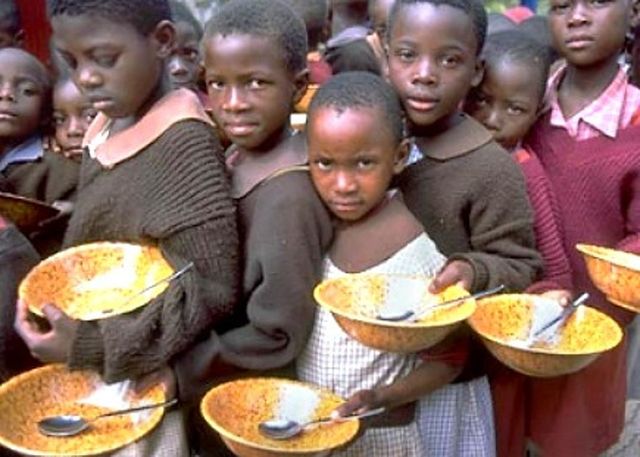
THE number of victims of COVID-19 pandemic could almost double the number of people suffering acute hunger, pushing it to more than a quarter of a billion by the end of 2020, the United Nations (UN) World Food Programme (WFP) warned today in a new report.

According to the UN report, the number of people facing acute food insecurity stands to rise to 265 million in 2020, up by 130 million from the 135 million in 2019, as a result of the economic impact of COVID-19, according to a WFP projection.

Global Report on Food Crises showed that Nigeria was among the ten countries that constituted the worst food crises in 2019: Yemen, the Democratic Republic of the Congo, Afghanistan, Venezuela, Ethiopia, South Sudan, Syria, Sudan, and Haiti.

The estimate was announced alongside the release of the global report on food crises, produced by WFP and 15 other humanitarian and development partners.

It is vital that the food assistance programme is maintained, including WFP’s own programmes which offer a lifeline to almost 100 million vulnerable people globally, the report showed.

WFP’s Senior Economist, Arif Husain said “COVID-19 is potentially catastrophic for millions who are already hanging by a thread. It is a hammer blow for millions more who can only eat if they earn a wage.”

“Lockdowns and global economic recession have already decimated their nest eggs. It only takes one more shock-like COVID-19 – to push them over the edge. We must collectively act now to mitigate the impact of this global catastrophe,” he added.

According to the report, the pandemic was first felt in some of the world’s biggest economies, originating in China, then hitting Italy and Spain, and now the United States has become the centre.

There is less data available on the spread in developing countries, where widespread testing is not being done and healthcare systems are often lacking.

Ganduje condemns organisers of football game despite lockdown order

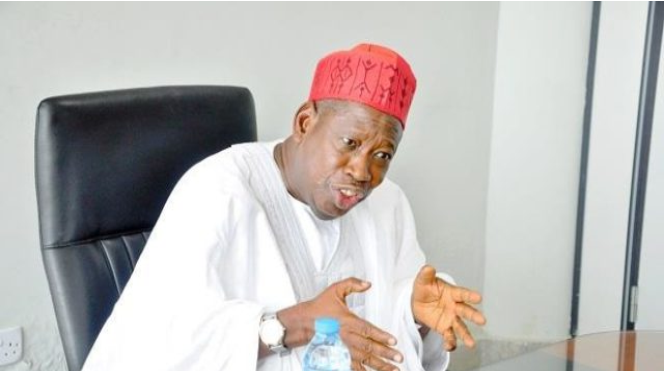
ABDULLAHI Ganduje, the Kano State Governor on Tuesday chastised organisers of a football game in the state despite the compulsory lockdown announced by the state government to check spread of the Coronavirus disease (COVID-19) pandemic.

A viral video of some Kano residents yesterday flooded the social media, where spectators defied the lockdown directive to watch a football match.

He said all individuals should work in support of the government, stressing that 23 additional cases were already recorded in the state.

“It’s a bit unnerving to have select people still disregard the lockdown up to the point of organising football games. We need every hand on deck to beat #COVID19 and I ask that everyone puts in their own shift to make sure we contain this pandemic as soon as possible,” Ganduje announced on his social media handle.


READ ALSO:

“The number of infected persons in our wonderful state of Kano is now 59, while additional 23 cases were registered yesterday and I would like to appeal to everyone to obey the lockdown rules.”

The Nigeria Centre for Disease Control (NCDC) as of 20th April stated that the nation had so far recorded 665 cases, 22 deaths while 188 cases had been discharged.

In its latest public data shared on its verified Twitter handle, 23 cases were confirmed in Kano state.

The recent figure, however, put total cases in Kano at 59. This ranks Kano state third in the list of states with the highest number of COVID-19 cases after Lagos and the Federal Capital Territory as at the time of this report.

Lagos state with the highest number of confirmed infected persons has so far recorded 376 cases while FCT has 89.

Other states with average cases are Osun (20), Oyo (16), Edo (15) and Ogun state (12).

The pandemic which broke-out in Wuhan China, last year December, as reported officially by the World Health Organisation (WHO) has so far spread to 213 countries, killing 163, 097 people among 2,402,250 confirmed cases globally.

If Well Managed, N500 billion FG intervention could provide 9 ventilators, 9 laboratories for each LGA In Nigeria

JUST  like many other countries, Nigeria is currently in a difficult situation with the rise in cases of Coronavirus disease pandemic. The virus, spread across the world has infected over a million people and more than 60,000 have died. Across many nations, authorities have ordered many individuals to stay at home to curb the widespread of the deadly virus. 

As at 21st April 2020, Nigeria has recorded 665 confirmed cases, 188 discharged and 22 deaths in the country. Experts have repeatedly warned of a possible spike in the number amidst difficulty to enforce lockdown in many states.

COVID-19 is a respecter of no one regardless of age, position or gender as many nations’ leaders also have their share.  In fact, last weekend, Nigeria lost the Chief of Staff to the President, Abba Kyari, to the deadly virus. While experts are still in search of a vaccine, the World Health Organisation (WHO) said the only “vaccine” at the moment is “stay at home”.


READ ALSO:

As of the time of this report, it is understood that in April, the Federal Government has earmarked the sum of 500 billion special funds to fight coronavirus. Meanwhile, DATAPHYTE analysis shows that if properly managed, the funds have the potential of boosting Nigeria’s health sectors across all local government areas in the country.

The funds could provide each of the 774 local governments in Nigeria nine ventilators, construction and equipment of nine laboratory centres, employment of 18 health workers and at least 1 laboratory scientist, DATAPHYTE analysis shows.

Provided the N500 billion intervention fund gets legislative approval, it would require strategic management to respond to the immediate crisis with COVID-19. Meanwhile, it is of utmost importance that necessary quarters charged with the responsibility to contain the virus use the funds judiciously to respond to key challenges in the health sector.

If shared equally across all Local Government Areas (LGAs), each will get about N640 million which can help in providing a complementary healthcare system to successfully contain the spread of the virus in the country.

Using cost estimation sourced from the budget document of the federal government and reliable web platforms, DATAPHYTE computes what N640 million could do for each of the LGAs.

6,966 Ventilators across 774 LGAs

The shortage of ventilators in the country has been a source of concern for many Nigerians including lawmakers and public health experts. Currently, there is a global scramble for ventilators following the outbreak of the coronavirus. Countries, like the United States and China, have ramped up the manufacture and supply of ventilators to deal with the growing cases of the disease in their countries.

Though the exact number of ventilators in Nigeria is unknown, the number of functional ones in the country is estimated to be under 500. Experts have said Nigeria needs 10,000 Ventilators and based on the estimated number, the country has a deficit of 9,831 ventilators. With the N500 billion, the country can afford 6,966 ventilators at N10 million each.  If properly shared, each of the LGAs will get 9 ventilators at the total cost of N69.6 Billion and the country will still have N430 billion balance.

6,966 Testing Centres and Laboratory Equipment

One of the most criticised aspects of Coronavirus menace in Nigeria is testing centres. The country has so far tested less than 10, 000 residents in comparison to countries like South Africa and Ghana with less population.  Our inability to do this cannot be disconnected from lack of enough testing facilities as the country has thirteen (13) laboratory centres across states which is not enough to fight the pandemic.

According to Architect Olarinde Olakunle Joshua,  it would cost N9 million to construct a mini-laboratory. A laboratory will require health equipment like testing kits including microscope electrophoresis machine, Micro Hematocrit Centrifuge, incubator, weighing scale, reagents, etc, DATAPHYTE’s Price review and checks showed that these laboratory equipment will cost about  N11.3 million, this means the government will construct and equip a mini-laboratory for N20.3 million.

From N430 billion remaining, each local government can have nine laboratory centres with equipment, worth N182.7 million and the required biosafety materials such as biosafety cabinets and personal protective equipment needed to keep frontline healthcare workers safe in all states in Nigeria and help increase testing capacity in the country.

With N20.3 million for construction and equipping of a laboratory, it will cost N141.4 billion to have the same in 774 LGAs. By simple arithmetic, added to the 69.9 billion for ventilators, the sum will be 211.3 billion. The balance from N500 billion is N288.7 billion.

6,966 fully equipped primary health centres

With the inadequate health care centres in Nigeria and going by the Universal Declaration on Human Rights, Nigeria needs more than enough well equipped primary health centres across Local government areas for easy accessibility of people in the community.

These health care centres are crucial during and post COVID-19. They serve as the first point of call for ailing residents. According to Architect Olarinde Joshua, it would cost N15 million to build a standard Primary Health Centre.

DATAPHYTE’s research showed that a Primary Health Centre would require basic health equipment like Emergency equipment and supplies (airways, aspirators, oxygen, mask, resuscitation bag/mask, etc.) Electrocardiography (ECG) unit and accessories, Personal Protective Equipment  (gloves, facemasks), Stethoscopes, Microscope, sonogram machine, labour bed, Scaling machine, ambulance, Washing basin, running water, toilet, light and etc. According to Dr Olatunji Omololu A. who works at Grover Medical’s Lifestyle Clinic Victoria Island, Lagos and our price survey of these equipment shows that equipping a primary healthcare centre is estimated to cost N17.3 million.

Therefore, with N15 million for construction and another N17.3 million to equip, It makes a total of N32.3 million for a well equipped primary health centre in Nigeria. A careful analysis shows that the country can afford 6,966 primary health centres across LGAs with each having nine Primary Healthcare Centres at the estimate of N225 billion in total, remaining N63.7 billion.

N63.7 billion to hire 13,932 health officials

While many people can afford to stay home, this is not the same with health workers in different isolation centres in different states with confirmed cases. From the remaining N63.7 billion, the Government can afford to employ 13,932 health officials and pay them an annual salary of N3,000,000.

With this, each local government will have at least 18 health officials to operate in the new Primary Health care Centres to be built at the cost of 54 million, 2 health officials per primary health centre.

The cost of employing additional 13,932 health officials across LGAs with an annual salary of N3 million is estimated to cost N41.7 Billion.

N16.7 billion for 6,966 laboratory scientists 

A laboratory scientist also has an important responsibility in promoting the practice of public health as they perform diagnostic analyses on body fluids such as blood, urine, sputum, stool, as well as other specimens. Medical laboratory scientists work in clinical laboratories at hospitals, reference labs, biotechnology labs and non-clinical industrial labs.

From the remaining  N22 billion, the government can afford to hire 6,966 laboratory scientists with a sum of N2.4 million per year. With this, each local government will have 9 laboratory scientists in the new laboratory centres to be built at the cost of N21.6 million, one lab scientist per laboratory centre.

The cost of hiring 6,966 laboratory centres across LGAs with the annual pay of N2.4 million is estimated to cost N16.7 billion.

Altogether, the equipment and human resources across the country will cost N493.8 billion and about N6 billion will be left for logistics purposes.

State of Diseases and Deaths

UNICEF (2016) reported that preventable or treatable infectious diseases account for 71 per cent of the estimated 1 million deaths of under-fives in Nigeria every year, with deaths being attributable to malaria (24 per cent), pneumonia (20 per cent), diarrhoea (16 per cent), measles (6 per cent), and HIV/Aids (5 per cent). From the number of people who die from Lassa fever, tuberculosis, to mothers who die during childbirth or children who die due to malaria or malnutrition, the statistics reveal a terrible state of Nigeria’s healthcare system.

According to the current National Health Policy document, which was last revised in 1996, local government authorities are mandated to implement primary health policies and programmes. This is further supported by the PHCUOR programmes which pushes for the administration, financing, monitoring and evaluation, under the LG administration. While the state and federal governments are financiers based on the policy framework, the burden of LG-level procurement has not been relinquished to the local government authorities.

Trump set to suspend immigration to US over Coronavirus pandemic

DONALD Trump, President of the United States (US) has announced plans to suspend immigration into the US, in a bid to protect ‘American jobs’ as the effect of Coronavirus disease (COVID-19) pandemic takes its toll globally.

Trump shared his plan in a tweet shared on his official Twitter page on Monday, leaving out details of measures that would be taken to effect the immigration suspension plan.

“In light of the attack from the Invisible Enemy, as well as the need to protect the jobs of our GREAT American Citizens, I will be signing an Executive Order to temporarily suspend immigration into the United States!,” his tweet reads.

At the moment, the US has taken the worst hit of COVID-19 cases in the world, with over 790,000 confirmed cases and over 42,000 deaths, according to Worldometer.

Despite worrying indices of COVID-19 in the US, an overwhelmed health care system and struggling economy, Trump’s proposed approach to getting the country back on its feet is to suspend immigration.

A move that would completely shut down the legal immigration system and see to the denial of applications of foreigners who desire to live and work in the US for an unspecified period of time.

Since becoming President, Trump has consistently advocated for and against closing the borders and illegal immigration, all of which have earned him criticisms from many Americans.

In fact, in the last three years, there’s been a decline in the number of visas issued to foreigners abroad looking to immigrate to the US to about 25 percent. Exactly 462,422 in the 2019 fiscal year, from 617,752 in 2016, NYT reports.

While Trump’s immigration suspension plan comes as a rude awakening to many foreigners hoping to relocate legally to the US, for Nigerians; it is no news.

In January, Trump included Nigeria in a list of six African countries facing stringent travel restrictions to the US.

As such, Immigrant visas issued to those seeking to live in the US will be banned for Nigeria.

A presidential proclamation on January 31 cited Nigeria’s failure to comply with security and information sharing requirements, and its high “terror” risk to the US as reasons for imposing the restriction.

Other African countries on the list include; Eritrea, Sudan, Tanzania, Myanmar and Kyrgyzstan.

Consumer price index spikes up to 12.26 per cent in March – NBS

THE Consumer Price Index (CPI) for March 2020 has shown inflation increase up to 12.26 per cent (year-on-year) in March 2020, indicating  0.06 per cent points higher than the rate recorded in February 2020 (12.20) per cent.

This is contained in a report by the National Bureau of Statistics (NBS) released on Tuesday.

The report did not consider the lockdown in Abuja, Lagos and Ogun states as well as major disruptions in normal economic activity in several states which started only in April.

Increases were recorded in all Classification of Individual Consumption by Purpose (COICOP )divisions that yielded the Headline index, the report revealed.

Also, the report showed that the urban inflation rate increased to 12.93 per cent (year-on-year) in March 2020 from 12.85 per cent recorded in February 2020, while the rural inflation rate increased to 11.64 per cent in March 2020 from 11.61 per cent in February 2020.

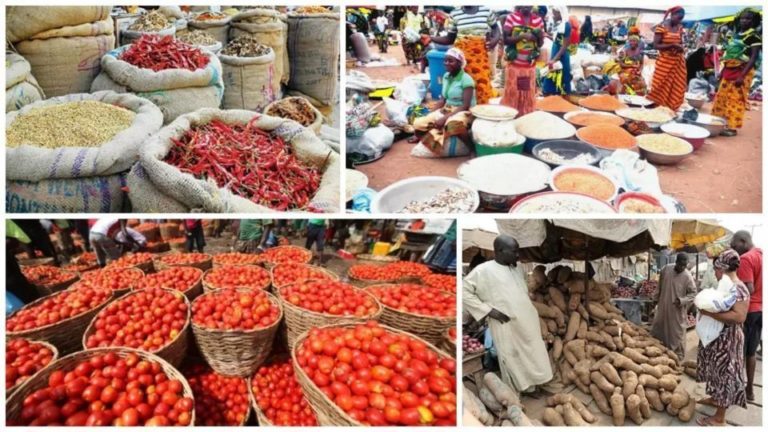
The composite food index rose to 14.98 per cent in March 2020 compared to 14.90 per cent in February
2020. This rise in the food index was caused by increases in prices of bread and cereals, fish, potatoes, yam and other tubers, oils and fats, vegetables, and fruits.

The ”All items less farm produce” or Core inflation, which excludes the prices of volatile agricultural
produce stood at 9.73 per cent in March 2020, up by 0.3 per cent when compared with 9.43 per cent
recorded in February 2020.

The NBS report showed that the highest increases were recorded in prices of passenger transport by air, tobacco, household textiles, major household appliances, domestic services and household services, pharmaceutical products, maintenance and repair of personal transport equipment, water supply and catering services.

According to the NBS report, in March 2020, on a month-on-month basis all items inflation was highest in Bayelsa 1.64 per cent, Bauchi 1.63 per cent and Ondo 1.60 per cent.

Kano, 0.21 per cent; Abia, 0.17 per cent recorded the slowest rise on a month on month inflation while Lagos recorded price deflation or negative inflation

In March 2020, on a month-on- month basis food inflation was highest in Bayelsa 2.36 per cent, Kogi 2.18 per cent and Kebbi 2.17 per cent, while Kano 0.22 per cent.

Cross River 0.09 per cent recorded the slowest rise on a month-on-month inflation with Lagos recorded price deflation or negative inflation, the NBS report revealed.


Covid-19: Protect people living with cancer, diabetes and other underlying conditions – Project Pink Blue to FG

0

The Project Pink Blue on Monday has called on the federal government to protect people living with cancer, diabetes and other underlying conditions from the respiratory COVID-19 infection.

In a statement,  the organisation expressed its concern about the survival of people living with underlying conditions during the period of Coronavirus disease (COVID-19) pandemic.

Other underlying issue identified are heart diseases such as heart failure; chronic kidney disease, liver disease such as hepatitis, diabetes, sickle cell, HIV and AIDS.

Runcie C.W. Chidebe, Executive Director of the Project Pink Blue said: “Some cancer treatments including chemotherapy, targeted therapies, immunotherapy, and radiation can weaken the immune system. People who have weakened immune systems have a much higher risk of complications if they become infected with this coronavirus.”

“People  with cancer that has metastasized (spread) to the lungs also can have lung problems that may get worse as a result of coronavirus infection.

“They should be protected and shielded. The government needs to urgently procure telemedicine to care for these people living with underlying conditions, because if cancer is not treated, it continues to spread to other vital organs,”  Chidebe added.

According to a study cited in the statement  which was conducted in China by Liang et al (2020)  and published on The Lancet Oncology, 1,590 cancer patients who had COVID19, asserted  that “patients with cancer may have the worse outcome, higher risk of severe events than people without cancer.”

Project PINK BLUE, an advocacy group, is committed to protecting all people impacted by cancer in Nigeria, and providing helpful information and support to cancer patients, cancer survivors, caregivers, cancer advocates, and patient navigators.

FLASHBACK: Twelve –two-third, no agitation for breakaway will succeed, other issues Akinjide will be remembered for

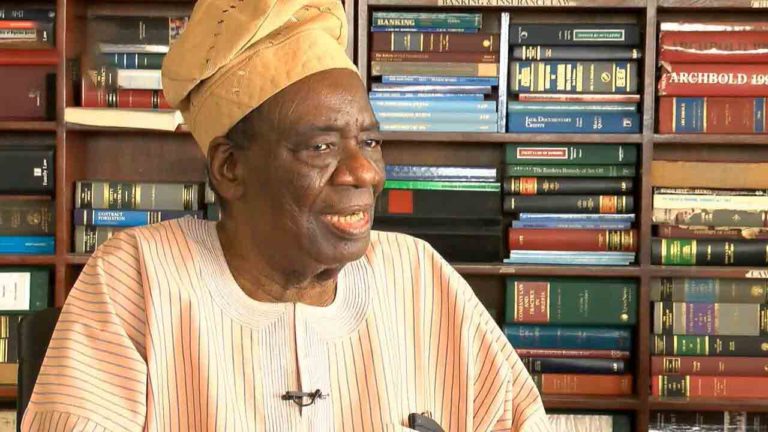
RICHARD Akinjide (1931 -2020), Nigeria’s Minister of Education under late Prime Tafawa Balewa, then and Minister of Justice and Attorney General of the Federation under the government of late President Shehu Shagari etched his name in the country’s political history in a way that it would be hard to forget his role even after death.

Akinjide, a respected lawyer and statesman practiced law for over 60 years before he breathed his last on Tuesday morning after a brief illness in Ibadan, Oyo State capital and his home town.

He is the father of Olajumoke Akinjide, a former Minister of State for the Federal Capital Territory (FCT) under former President Goodluck Jonathan.

The magical twelve-two-third

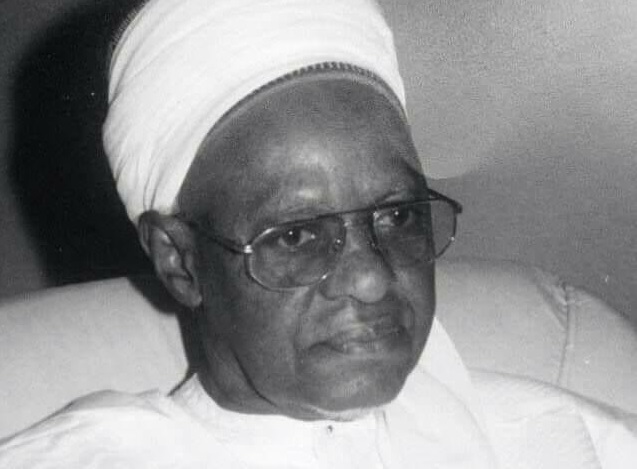
Former second republic president, late Shehu Shagari who benefited from Akinjide’s mathematical wizardry

No one has used Mathematics like Akinjide did to define the country’s political history aftermath of 1979 general elections.

He was the lawyer hired by Shehu Shagari, the presidential candidate of the National Party of Nigeria (NPN) who polled 5,688,857 votes against 4,916,657 votes polled by his closest rival, Obafemi Awolowo of the Unity Party of Nigeria (UPN).  Five parties were registered by the Federal Electoral Commission of Nigeria (FEDECO) headed by Anthony Ani.

Other candidates were Nnamdi Azikwe of National Peoples’ Party (NPP), Aminu Kano of Peoples’ Redemption Party (PRP) and Waziri Ibrahim of Great Nigerian Peoples’ Party (GNPP).

Akinjide was the legal adviser of the NPN.

Though by number of votes, Shagari had more votes than Awolowo, he had to also fulfill the second condition given by the electoral act for a  presidential candidate to be declared a winner, which was that candidate must have one-quarter of votes in two-thirds of the states of the federation.

This was where Akinjide’s mathematical ingenuity played out against a team of seasoned mathematicians assembled by Awolowo who had gone to court to challenge if Shagari had satisfied the requirement of one-quarter of votes in two-thirds of the states of the federation.

Shagari had 25 percent or one-quarter in 12 states but failed to have 25 percent in Kano State where he had 243,423 votes — the equivalent of 19.4percent of the 1,220,763 votes cast in total in the state. The controversy on how to get the two-third of 19 led to a legal tussle between the two parties and their loyalists.

Awolowo took his case to the election tribunal but the ruling was not in his favour. He headed for the Supreme Court. Awolowo engaged the services of Professors Ayodele Awojobi of Mechanical Engineering at the University of Lagos, Chike Obi of Mathematics at the University of Ibadan, J.F. Ade Ajayi of the Department of History in UI. The popular late legal luminary, G.O.K Ajayi was Awolowo’s lead counsel.

These people were joined by Awolowo himself to form a formidable array of intellectuals with heads for figures and history.

While defending Shagari in court,  Akinjide  argued that the two-thirds of 19 is 122/3 and not 13. He came to his rationalisation by dividing the 13th state (Kano) into three and votes cast in two-thirds of the state constituting the figure from where two-thirds of votes were said to have been secured by Shagari, earning Shagari the constitutionally required votes in other words, through fractionalising of Kano State and going for the two-thirds of the votes in the state.

The Supreme Court eventually upheld the verdict of the election tribunal and ruled in favour of Shagari. But the verdict came with a caveat: THE JUDGEMENT SHOULD NOT BE CITED AS A PRECEDENT IN ANY COURT.

When Shagari became Nigerian president, Akinjide was rewarded for his “Mathematical Wizardry” in court with the portfolio of Minister of Justice and Attorney General of the Federation but he was never in the good book of the opposition who described him as a “Shameless manipulator.”

Rated Awolowo as the second greatest politician ever produced by Nigeria

Obafemi Awolowo, the UPN Presidential candidate in the 1979 elections. He suffered electoral loss due to the twelve-two-third argument

Akinjide and late Obafemi Awolowo were in opposing party and it was not clear if they were in good terms till their end aftermath of the twelve-two-third court saga. But the late former legal luminary described Obafemi Awolowo as the second great politician ever produced by Nigeria after late Nnamdi Azikwe, the first president of Nigeria.

“The greatest Nigerians we have ever produced in our history, politics and journalism were the likes of Dr. Nnamdi Azikwe. He was the greatest Nigerian we have ever produced in politics. Second was Chief Obafemi Awolowo who produced the Nigerian Tribune and also worked towards the progress of Western Nigeria. After him, was the second Premier of Nigeria, Samuel Ladoke Akintola, who also did a lot for the development of the country,” Akinjide said in an interview published by the Vanguard in 2016.

According to him, the biggest mistake that Awolowo made was going to the centre

“He thought he could become the Premier but he did not. I don’t want to talk much about the past. We should leave the things that belonged to the past like that,” he said.

Military coups as Nigeria’s biggest mistake

The late Akinjide believed Nigeria’s problems started when the military ventured into government.

“We got it wrong through military coups because the military, instead of staying in the army, interfered several times in politics and some of them became politicians. I think that is the biggest mistake we made in the history of this country and I hope we will never make that mistake again,” he said.

Agitation for breakaway will not succeed

Akinjide was a member of the Parliament when Nigeria was granted independence on October 1, 1960. He was a member of the Confab called in 2014 by former President Goodluck Jonathan to chart a way forward for Nigeria.

But he opined that it was a wrong recipe for somebody or group to say they would break away.

“We are one and we will remain one. It is total nonsense for anybody to talk about breakaway. And if anybody tries it, they will never succeed.”

He stated that the Niger Delta has been a problem since the colonial days.

“In fact, it was the economic problem in the country that brought in the army so to say. I don’t think anybody should think of breakaway.”

COVID-19: Manny Asika, Nigerian survivor who beat coronavirus in 10 days shares his experience

EMMANUEL Manny Asika was amongst 170 survivors who were discharged from various designated infectious hospitals across the country as at April 19, he was given a clean bill of health from the Infectious Diseases Hospital, IDH, Yaba, Lagos following his recovery from COVID-19, a disease caused by the coronavirus according to a Nigeria Health Watch report.

Sharing his experience, Asika a professional IT expert went down memory lane on how he was diagnosed with the disease to his subsequent recovery.

His illness started when he noticed he had symptoms of malaria, associated with body aches and fever while working from home. After taking prescriptions for malaria which persisted for over two days he was self-admitted himself into a private hospital in Victoria Island.

The Nigeria Center for Disease Control, NCDC, was reached to take samples of Asika to determine his status if he had the disease or not.

Despite, having malaria, the doctors suggested that Asika be subjected to tests for COVID-19 and on March 23 the results came back positive.

“I moved from shock, denial, anxiety, questioning and eventually acceptance. I kept the information very close to just my nuclear family, not because I was afraid of stigma but because I knew people who would panic,” he said.

People who had contact with Asika at the private hospital, his office, and home were isolated while those who were showing symptoms were tested.

He was immediately taken to the Infectious Disease Centre at Mainland Hospital in Yaba, where he was admitted into the isolation ward set up at the hospital for COVID-19 patients where he spent 10 days.

“My lowest point was not being able to eat for days I lost a great deal of weight. I knew that I was getting dehydrated and I couldn’t replace or replenish the fluids I was losing. I was throwing up everything I was eating,” he said.

Uncertain days

Asika description of what he felt while he was recovering at the isolation ward was uncertainty as patients didn’t know what to expect because their condition could deteriorate without warning.

“I was a constant name with the doctors because I was always conferring with them. We talked about having a dietician at some point to see what fluids I could take and eventually how they could stop nausea.

“There were bad days and there were good days but it is definitely not a normal flu. This is something serious we all know that it is life-threatening. Every single day you wake up, you are hoping that your condition does not deteriorate this played silently in everyone’s subconscious,” he said.

Asika had trouble with taking food until a dietician was deployed to address his dietary concerns by placing him on oats and custard until he was able to start taking noodles.

Overcoming the virus

After testing negative for the second time on April 1, Asika was elated when he recieved the good news from the doctors the next day that his results showed his third negative result in 10 days.
After being observed he was immediately discharged from the isolation ward explaining that since he got discharged he had not been stigmatised since he returned home.
“At a recent meeting in the estate where I live, to discuss security amidst the currently escalating violence in the state, I mentioned openly that I just recovered from COVID-19 and encouraged everyone to take the disease seriously, to understand that transmission is very easy and to follow safety protocols. I didn’t notice any stigmatisation,” he said.

Speaking on the quality of healthcare service received at the isolation ward, Asika commended the health personnel at the isolation centre, saying they showed empathy to the patients at the centre.

“We had their numbers on speed dial and they were available 24/7 to respond to us. Treatment was personalised, so it was not one-size-fits-all. For instance, people who had underlying conditions had a separate treatment regime,” he said.

It is estimated that 3, 000 health workers, including doctors, nurses and laboratory scientists have been infected by the COVID-19 across the globe since the outbreak of the disease according to the World Health Organisation, WHO.

Asika said patients at the isolation centre were impressed that they made a viral video in appreciation of their efforts in providing care.

“We were so impressed that we created the video appreciating the doctors, nurses, cleaners and all the support staff. It went viral, despite the far from perfect conditions they never had sour dispositions, they were very friendly, supportive and professional,” he stated.

DICON produces PPE kits, hand sanitizers and ventilators to support FG’s war against COVID-19 pandemic

0


THE Nigerian Defence Headquarters (DHQ) has disclosed that the Defence Industries Corporation of Nigeria (DICON) has taken the lead among others, to provide a local content driven response to address the shortage of Personal Protective Equipment (PPE) in Nigeria in the ongoing fight against the spread of Coronavirus disease (COVID-19) pandemic.

This, the Defence Headquarters said was in response to directive by Abayomi  Olonisakin, a General and Chief of Defence Staff (CDS) to the Armed Forces to articulate strategic intervention to support the fight against the COVID-19 pandemic.

In a series of tweets on its verified Twitter handle, the DHQ revealed that the DICON, under the  leadership of Victor Ezugwu, a Major General, has mobilized its management and staff to research, develop  and produce several COVID-19 essential and life saving equipment.

“First is the production of over 1500 dozens of DICSanz, a high-quality hand sanitizer produced under very strict environmental conditions, requested by the COAS Lt Gen TY Buratai for supply to troops of the Nigerian Army,” it said.

“This product is at the last stage of NAFDAC registration in line with extant due diligence provisions.”

The DHQ further stated that the DICON has also responded to the directive by Bashir Magashi, the Minister of Defence  for the Armed Forces to support the indigenous capacity of Nigeria to support the indigenous capacity of Nigeria, to support medical workers by producing thousands  thousands of high quality non permeable Personal Protective Equipment kit.

Each unit of the kits consists of standardized gowns, face shield and nose masks, it said.

The kits, the DHQ explained are currently being produced in large quantities for use by Kaduna State Government and other national stakeholders.

In addition to that, it added that the DICON engineers, consultants and medical teams have successfully produced a digital mechanical ventilator known as DICOVENT.

The newly designed low-cost machine is a simple mechanical ventilator that can deliver positive pressured ventilation using a volume-controlled ventilation (VCV) system, the DHQ said.

” The ventilator has undergone thorough scrutiny and assessment by specialists from top ranging hospitals and experts in the country including Cedar Crest Hospital Abuja, 44 Nigerian Army Reference Hospital Kaduna among others.”

“It  is important to mention that while DICOVENT may not be able to meet the high demands of critical patients, it can be used for Continuous Mandatory Ventilation (CMV) and Intermittent Positive Pressure Ventilation ( IPPV). It can also be used for invasive ventilation and non-invasive ventilation using an endotracheal tube and mask respectively.

Meanwhile, the DHQ stated that Boss Mustapha, the Secretary to the Government of the Federation and Chairman of the Presidential Taskforce on COVID-19 and Osagie Ehanire, the Minister of Health  have commended and approved these equipment produced by DICON.

The CDS according to the tweets therefore directed all the Armed Forces to liaise with DICON for mass production of all prototypes of COVID-19 PPEs for national application.

” As DICON and other military institutions continue their drive to support our national effort to defeat COVID-19, the CDS hereby urges Federal and State Governments to patronize the local content initiative of the Armed Forces of Nigeria,” it said.