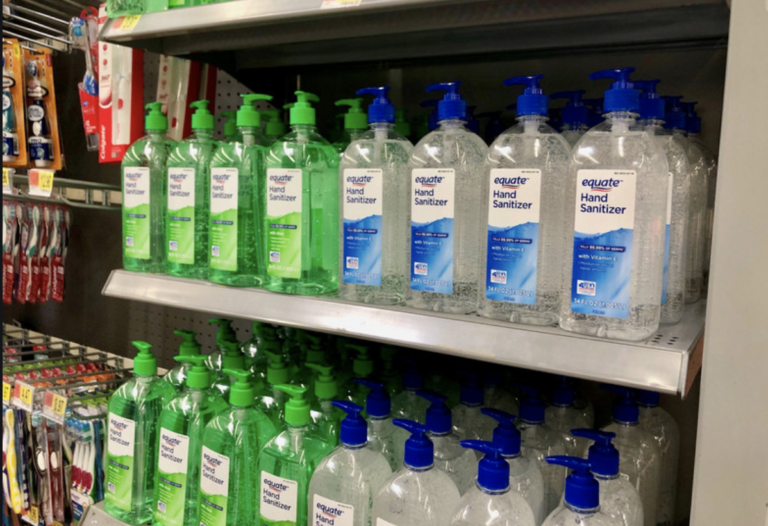
THE Federal Competition and Consumer Protection Commission (FCCPC) on behalf of the Nigerian government, has sued four supermarkets in the Federal Capital Territory (FCT) over price gouging of hand sanitizers, disinfectants, hand-wash liquids and face masks.
The ICIR learned that the stores and their proprietors are to answer to a six-count charge bordering on allegations of “false, misleading, deceptive representation in relation to the price of sanitizers, hand-wash liquids and disinfectants of various existing brands on display at their retail outlets.”
The accused stores in addition to their pharmacies include; H-Medix Pharmacy & Stores Limited, and the representatives, Sandra Ejekwu and John Oluwagbemiga and Prince Ebeano Supermarket Limited and its proprietor, David Ojei.
The others are Bakan Gizo Pharmacy & Stores Nigeria Limited, and the representatives, Ray Opia and Luter Irene, as well as Faxx Stores & Trading Limited and the representative, Adogah Ahmed.
Following the record of coronavirus cases in Nigeria, items such as hand sanitizers, disinfectants and face masks have become necessities.
Due to the increase in demand, some retailers resulted in hiking prices of such items which caused several outcries on social media.
To the effect, the FCCPC issued directives on February 28 and March 24, warning supermarkets and retailers against using the coronavirus pandemic as a means to increase prices of products needed to ward off the virus.
After registering complaints and carrying out investigations, these four stores were found wanting.
According to reports, the charges against them were for violating Section 125 (1) (a) of the Federal Competition and Consumer Protection Act, 2018 and punishable under Section 155 of the Federal Competition and Consumer Protection Act, 2018.
PREMIUM TIMES reports that in the statement of claim filed before the Federal High court, Abuja, the charges were spelled out to be; “exploiting the national public health emergency of COVID-19 (Coronavirus) pandemic to engage in price gouging of hand sanitizers and surgical disposable face masks of various existing brands and thereby engaged in the use of undue influence, pressure, unfair tactics and other obnoxious practices in connection with the supply of goods.”
It was gathered that the Commission accused Bakan Gizo Pharmacy & Stores Nigeria Ltd of committing the offences between February 1 and March 9, 2020, across its retail stores and also accused Prince Ebeano Supermarket Limited and H-Medix Pharmacy & Stores Ltd of committing the offences between February 28 and March 6, 2020.
FAXX Stores & Trading Ltd was accused of committing the offences between February 1 and March 24, 2020.
Meanwhile, Environmental Rights Action/Friends of the Earth Nigeria (ERA/FoEN), has warned that smokers are at higher risk of developing fatal complications if they contract coronavirus.
Quoting a research, the group said “12.4 per cent of current smokers either died, were admitted to an intensive care unit or required mechanical ventilation, compared with 4.7% of non-smokers. Along similar lines, 21.2per cent of current smokers had severe symptoms, as opposed to 14.5% of non-smokers”.
THE Joint Admissions and Matriculation Board has announced the donation of three ventilators to the Federal Government to aid the fight against COVID-19 in the country.
JAMB disclosed the donation through a statement signed by Fabian Benjamin, the Board’s Head of Public Affairs on Wednesday.
According to Benjamin, the ventilators are to serve University of Abuja Teaching Hospital, Gwagwalada and one to the principal hospital in the Board’s host community, the Bwari General Hospital.
“In the Board’s own little way of ensuring that government strategies and preemptive measures yield fruitful dividends, the Board has donated two ventilators to the University of Abuja Teaching Hospital, Gwagwalada and one to the principal hospital in the Board’s host community, the Bwari General Hospital, in preparation for any eventuality,” the statement read.
JAMB said the ventilators were strategically distributed on preparation for COVID-19 case in any part of Abuja.
“The donation of these ventilators which cost several millions is to strategically place these Hospitals in good stead to give necessary treatment to COVID-19 patients whether in Bwari or any other part of Abuja,” the statement further read.
The Board encouraged prospective students of tertiary institutions, parent and Nigerians to stay safe as well as abide with the government’s instructions aimed at combating the deadly virus in the country.
SOME vulnerable households in Kwali Area Council of the Federal Capital Territory have started receiving N20,000 relief fund being disbursed by the Federal Government.
According to a Channels news report, the Minister of Humanitarian Affairs, Disaster Management and Social Development, Sadia Umar-Farouk, said at the launching of the scheme that the relief fund would continue for the next four months.
Farouk added that the relief fund is being distributed as announced by Nigerian President Muhammadu Buhari during his National broadcast on COVID-19 on Sunday evening.
Buhari had said relief fund would be disbursed to vulnerable households following his order for a lockdown of the FCT, Lagos and Ogun states.
The Minister disclosed that the N20,000 would be given to each person in vulnerable households.
Noting the importance of the cash relief, she said the government is aware that most of the vulnerable groups live on daily wage and the lockdown would hinder their livelihood.
“Because of this COVID-19, the vulnerable groups have to expand, because we are aware that there are people who live on daily wage, so we are also going to look at those groups of people to see how we can get this food relief intervention to them in this period,” she said.
PRESIDENT Muhammadu Buhari’s much-delayed and anxiously-awaited authoritative speech on Covid-19, delivered on Sunday, March 29, locked down Abuja, Lagos and Ogun from Monday, March 30. That’s for millions who wake up at sunrise and retire to bed at sunset in these cities. But as for me and the multitude to whom the ritual of filing and marching to worship centres in columns, like ants, every Sunday was life, the government (or is it Covid-19?) had slammed the gate of freedom in our faces twenty-four hours earlier.
This is because social distancing, a precautionary measure, had translated into the closure of churches and mosques in Nigeria. Effectively, my freedom was curtailed and I began to feel the deprivation of ‘lockdown’ from that Sunday.
Having endured a hazardous Saturday night of mosquito bites, sticky sweats and bleary eyes from blackout, I had slumbered into an unusual Sunday; a Sunday devoid of the communal, congregational worship.
As I sat in my book-busy library, poring over church manuals and scriptures, my little Shammah walked in at about 5.30am to stir the odd feeling that had matured in my mind.
“Daddy, how will today’s service look like, now that we’re not going to church,” he asked me.
“We’ll have our Sunday service in this house,” I replied.
Gazing at me, his probing eyes told me my son would not consider a Sunday service in our living room as sacred as congregating at a designated place of worship – as he used to know it. For the eight-year-old, not attending church service on a Sunday morning was sacrilegious. Every dawn, as he grew up, Shammah bathed at 5.00 am; dressed up before 6.00 am; hopped into his mother’s car at 6.15 am; endured his mother’s high-speed ride to beat the 6.30 am deadline for prayer band meeting; and at 8.00 am joined his friends in the children section of our church for worship service and other free gifts like biscuits, birthday cakes, juicy drinks, jokes, and the fun of showing off their new dresses. Since birth, he had not consciously skipped this weekly culture. But he did on March 29.
I had to put on my creative cap to separate the Sunday worship service from our regular morning prayer session in my house. To the amazement of my children and wards, I insisted that everyone must wear ‘Church clothes,’ meaning they must wash up, choose from their best wears and conjure up the special emotion associated with veneration for God on Sunday. As members of the Redeemed Christian Church of God (RCCG) we assembled in my living room, tuned to Dove TV on DSTV at 8.00am for Sunday anointing service, Sunday School, praise and worship, and the sermon by Pastor E.A. Adeboye.
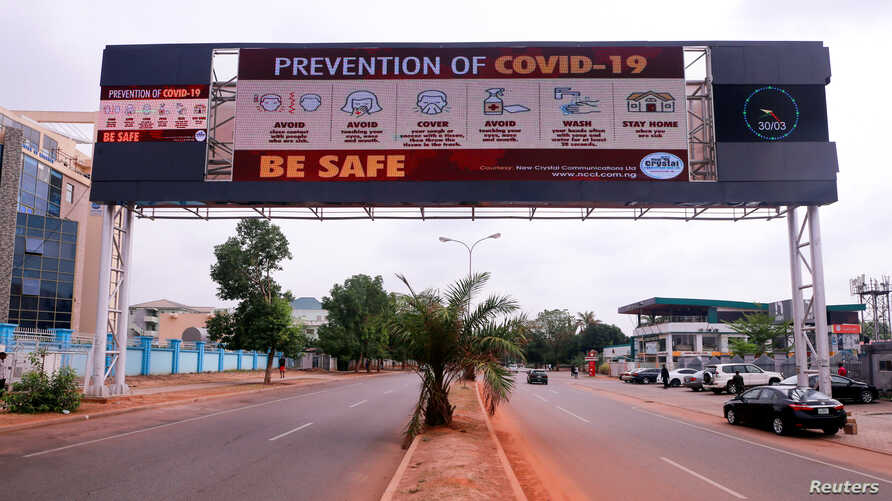
A few cars are pictured on a road, as authorities try to limit the spread of the coronavirus disease (COVID-19) in Abuja, Nigeria March 30, 2020. REUTERS/Afolabi Sotunde
As we congregated around the tv, my mind raced back to the prophecy of John Alexander Dowie, a Nineteenth-Century preacher for two relevant events. First, was his impactful healing ministry whose foundation was laid on a pandemic, like coronavirus, that had spread throughout Australia and sent thousands of persons back to the dust. He had lamented his ordeal as a pastor of a small church in Newton, a suburb of Sidney, saying: “My heart was very heavy, for I had been visiting the sick and dying beds of more than thirty in my flock, and I had cast the dust to its kindred dust into more than forty graves within a few weeks…” Then, he summoned soldierly faith and began to lay hands on the sick for divine healing from city to city and country to country. And they were healed. On a Sunday morning like this, coronavirus reminded me of his remarkable faith and feat that is indelible in church history.
Secondly, Dowie had, in the late Nineteenth Century prophesied the emergence of radio and television, a very remote possibility as at 1907 when he died. He may have foreseen that the audio and visual media would enhance evangelism across time and space. Over a hundred years after Dowie uttered that prophecy, television and radio came to the rescue of the church at a time of mysterious coronavirus pandemic.
Sitting through the Sunday service in my room, my imagination transported me to a larger congregation – a congregation larger than my parish – which constituted the millions of RCCG members hooked on to Dove tv for the Sunday service. Being part of the multitude captured in my imagination gave me a very special feeling as we formally closed the service.
However, the most remarkable and profound experience of that Sunday was the eerie, ghostly spectacle from churches in Italy, where I saw on the Cable News Network (CNN), reports showing thousands of coffins in rows in a Catholic cathedral, as priests performed funeral rites for mass burial.
Unbelievably, coronavirus had claimed 10,000 lives! Indeed, ‘seeing is believing’. Though I had received daily updates of death tolls in Italy, the visual of corpses evoked a different feeling; it was a different experience.
Those columns of coffins in that cathedral belied the sophisticated medical facilities television screens highlighted every time news of how coronavirus pandemic ravaged Italy was aired by international news networks. With well-kitted medical personnel; everyone on the street of Italian cities wearing protective face masks and hand-gloves; and numerous hospital beds supported with state-of-the-art ventilators, the hundreds of corpses prepared for burial, which I saw on CNN, looked strange and ironic.
‘Italy may be under a curse,’ a part of me remarked. But listening to the news broadcast on the deepening pandemic in the US which deflated President Trump’s confidence, making him embrace the worst situation of some 200,000 deaths, and reports that British Prime Minister Boris Johnson, too, was coming to terms with the devil, I soon told myself that Italy was not under any curse.
Italy, though fighting hard to loosen itself from the predicament, was, indeed, in the grip of a wild pandemic; a plague that does not discriminate between saints and sinners.
During my private prayer sessions, I had committed myself to regular intercession for Italy as a result of the hundreds of deaths announced daily since coronavirus spread like satanic fire all over that European country. ‘Lord, have mercy on Italy,’ I had prayed uncountable times. But the spectacle on Sunday, March 29, gave me a different, ominous sense of the pandemic. To my prayer for Italy, I have added this appeal to the Divine Power – ‘Lord, let this deadly cup pass over Nigeria.’
For the rest of that Sunday, I wondered if we, Third World countries in Africa, with our laughable medical infrastructure, would escape a worse, tragic and catastrophic predicament. With tertiary health institutions barely passing as consulting clinics; shortage of medical equipment and consumables; shortage of doctors; wrong, faulty and fraudulent diagnoses; the mercantile attitude of proprietors of private hospitals; non-production of common/essential drugs; lack of motivation and weak morale among medical personnel; and endemic corruption in the medical sector, escaping this curse and woes of coronavirus would be by the skin of our teeth.
Usually, Sundays are my favourite days, as it provided me with the opportunity to socialize with those who wish me well; those who verbalise their love for me; and smile generously with me. At Sunday services, I joined (any) congregation to sing rapturous hymns or high praises which usually lift my spirit and soul from this earthly realm to heavenly realms where all impossibilities fade and dissolve into the eternal possibility in the name of Jesus. But the ominous caskets in Italian cathedrals stole my Sunday-Sunday elixir and tossed me into the dark palm of gloom. Those sights and scenes shattered to pieces all the myths about Africans not being vulnerable to coronavirus. I can’t accept that this death is whiter and lighter than black.
At about 7.00 pm that evening, President Buhari made the lockdown speech. A great speech. But will it conquer the wild beast that has sneaked into Nigeria, wounding us from city to city? Without Covid-19 test kit to quicken detection, isolation and treatment, this beast would pounce on ignorant and vulnerable Nigerians – in their millions – and make the weeping and wailing in Italy a mere whimper.
May that never happen to us.
Theophilus Abbah, PHD is a journalist, writer, researcher and trainer.
Twitter @theophilusa
Nigerian currency, the Naira has depreciated to its weakest level since February 2017 in the unofficial black market after the Central Bank of Nigeria (CBN) cut supply to dealers.
According to abokiFX.com, a forex trading website, the local unit traded at 415 Naira per dollar.
However, official CBN rate of Naira against the dollar stood at N360 as at Monday, March 30, 2020, on its official website.
The CBN announced last week that it was suspending foreign exchange sales to Bureau De Change until further notice. A move it said was in line with curtailing the spread of coronavirus in the country.
This was after devaluing the exchange rate used by foreign bond and stock investors, which had been largely pegged since 2017, by about 4 per cent to N380 per dollar.
ADonald Ademola, a Financial Analyst at Magnartis Portfolio Managers who spoke to The ICIR, said “There is an expectation that Nigeria will have to let its currency weaken more.”
“Bureau De Change account for 30 per cent of foreign exchange transactions and if supply is not coming from there, even people with dollars will hoard,” Robert Omotunde, an analyst at Afrinvest said in a report.
“The foreign reserve is not at a comfortable level. If the major source of supply is now pressured, the exchange rate will feel the pain and the situation will worsen,” Omotunde said.
Chief Executive Officer of Flying Eagles Bureau De Change, Sadiq Abdullahi who spoke to The ICIR said: “People are hoarding dollars, thinking when things become normal they’ll make a profit.”
The CBN sold more than $12 billion to bureau de change operators last year.
Zenith Bank Plc and Guaranty Trust Plc have cut how much foreign currency customers can spend overseas due to expected dollar shortage caused by the coronavirus pandemic and the slump in the price of oil, Nigeria’s main export.
THE National Human Rights Commission (NHRC) has asked Nigerians to report any case of human rights violation and abuse by security agents enforcing compliance of the of 14-day lock down imposed by the Federal Government to prevent the spread of coronavirus.
Executive Secretary of the Commission, Tony Ojukwu, called on members of the public to report such human rights violation.
He called on Nigerians to report either “by telephone calls, text messages or video and ensure that such reports include the location of the violation, date, time of such violations and a clear description of alleged violators and their victims.”
Ojukwu stated this in a press release sighted by The ICIR, in which he pointed that some cases of abuse are already being recorded as security operatives use extreme measures to enforce the lock-down order issued by President Muhammadu Buhari on Sunday, March 29.
President Buhari had in a nationwide broadcast ordered that Lagos and Ogun states, as well as the Federal Capital Territory (FCT), Abuja effect a lock down, restricting movement and gathering of citizens for a period of 14 days.
To ensure compliance, security operatives from the police, paramilitary and military have been dispatched to different areas in the the two states and the FCT to enforce the lock down.
There have however been footage of human rights abuses by these security operatives.
Earlier, The ICIR reported how some Lagos Task Force officials were captured on tape destroying goods and wares of small business owners for disregarding the lock down order.
Meanwhile, Ebun-Olu Adegboruwa, a human rights activist and Senior Advocate of Nigeria (SAN) has said that the Quarantine Act of 1926 does not provide the legal framework to restrict movement of citizens around the country and arguing that presidenr Buhari acted illegally when he declared a lockdown order in FCT, Lagos and Ogun states.
According to Adegboruwa, an executive regulation cannot in law take away a fundamental right of freedom of movement granted by the Constitution.
THE Federal Government has again reduced the pump price of the premium motor spirit (PMS) popularly known as petrol from N125 per litre to N123.50k effective from Wednesday, April 1, 2020.
A statement issued Tuesday night by the Petroleum Products Pricing Regulatory Agency (PPPRA) which contains the new price said the new price regime was in line with the government approval for a monthly review.
President Muhammadu Buhari had on March 18 approved the reduction of the pump price of petrol from N145 to N125 to reflect the declining price of crude oil globally.
The price reduction was announced after the Federal Executive Council (FEC) meeting held at the Presidential Villa in Abuja, by the Minister of State on Petroleum Resources, Timipre Sylva in a statement.
He cited the drop in the price of crude oil at the global market leading to the reduced open market price of imported petrol below the official pump price of N145 per litre.
According to the PPPRA statement signed by its Executive Secretary, Abdulkadir Saidu, “The Guiding price which becomes effective 1st April 2020, shall apply at all retail outlets nationwide for the month of April, 2020.”
“PPPRA and other relevant regulatory Agencies shall continue to monitor compliance to extant regulations for a sustainable downstream petroleum sector.
“Members of the Public and all Oil Marketing Companies are to be guided accordingly,” the statement added.
THE National Electricity Regulatory Commission (NERC) on Tuesday made a temporary U-turn on the date it initially set for a new electricity tariff to take effect.
The NERC had earlier issued a directive for the commencement of new tariff on 1 April, 2020 but it stated in a new order with reference number: NERC/198/2020 “that due to complaints from the end-use customers such as poor service delivery, inadequate provision of prepaid meters, hours of guaranteed supply and the COVID-19 pandemic, the old date set at tomorrow is no longer valid.”
The order was titled: Order on the Transition to Cost Reflective Tariffs in the Nigerian Electricity Supply Industry.
As a result, the NERC had directed the 11 Distribution Companies (DisCos) to present a comprehensive plan to realise the revenue requirements as well as strategies to provide Nigerians with stable power before June 30, 2021.
“The orders of the commission (Order N0: NERC/GL/184/2019 to NERC/GL/184/2019) titled ‘The December 2019 Minor Review of Multi-Year Tariff Order (MYTO) 2015 and Minimum Remittance Order for the Year 2020’ shall remain in force until 30 June, 2020 when a new Minor Review Order shall be issued by the commission,” NERC stated in a document, sighted by The ICIR.
The document was jointly signed by James Momoh, its Chairman and Dafe Akpeneye, the Commissioner, Legal, Licensing and Compliance.
“There shall be no increase in tariffs of end-use customers on 1 April, 2020,” the NERC said.
The NERC said it recognises the economic impact of the global pandemic mostly on Nigerians and why it should be considered in the new directive.
The commission also disclosed that henceforth, the future tariff for customers would be determined after consultations between DisCos and customers clusters, with firm commitments on rates and quality of service.
The NERC further ordered DisCos to disaggregate their service areas otherwise known as customer base in accordance with the quality of service delivered.
It said the DisCos are expected to also provide smart meters to the customers such that the meters could send real-time or close to real-life electricity usage data to the commission.
The orders read in part: “All DisCos are hereby directed to submit a detailed plan for the attainment of full recovery of prudent costs and allowed return on capital (revenue requirement) by 30 June 2021. The revenue recovery and financial sustainability plans shall be submitted to the commission no later than 21 April 2020. The plans shall include a path, with timeliness, for transiting customers to a higher quality of service.
“All DisCos are hereby directed to submit, no later than 21 April, 2020, revised performance improvement plans based on the key objective of improvement in service for end-use customers and transiting to full revenue recovery. The approved plans shall form the basis for future tariff reviews and full cost recovery.”
“All future tariff review shall be on the basis of consultations between the DisCos and customer clusters with firm commitments on rates and quality of service. The service level compact shall include a compensation mechanism for end-use customers to address the DisCos’s failure events to deliver on performance targets.”
However, the Commission announced plans by the Federal Government to provide tariff support during the transitional period to the full revenue recovery target fixed at 30 June, 2021.
It pledged to fix all issues of concern regarding financial records of all DisCos arising from tariff-related deficits as represented and payables to the Nigerian Bulk Electricity Trading Plc (NBET) and the market operator.
THE State High Court sitting Tuesday, March 31,in Sokoto has convicted and sentenced one Freedom Sampson Inah to 10 years imprisonment with an option of fine of two Hundred thousand naira (N200,000.00) over a one-count charge bordering on swindling one Ahmed Jelani to the tune of N1,830,250 (One Million Eight Hundred and Thirty Thousand, Two Hundred and Fifty Naira).
According to Economic and Financial Crimes Commission (EFCC) who secured the conviction, Freedom and his other conspirators, Nwabueze Uzochukwu Joseph and Peter Ike had sometimes in 2019 disguised as travel agents at of Gulf Centre International Travel and Tourism and Top Valley Speciality Hospital United Arab Emirate (UAE) to dupe dupe the job seeker.
Ahmed Jelani was reported to have made the transfer of One Million Eight Hundred and Thirty Thousand, Two Hundred and Fifty Naira on three different occasions into four different accounts.
“That you, Freedom Sampson Inah, while acting as travel agent of Gulf Centre International Travel and Tourism, United Arab Emirate (UAE) and Top Valley Speciality Hospital UAE and Nwabueze Uzochukwu Joseph, Peter Ike (now at large), sometime in 2019 at Sokoto within the judicial division of the High Court of Justice of Sokoto State, dishonestly induced one Ahmed Jelani to pay the total sum of N1,435,250.00 (One Million Four Hundred and Thirty-five Thousand, Two Hundred Naira) into three different accounts including the sum of N395,000 (Three Hundred and Ninety-five Thousand Naira) into your Access Bank account number by deceiving him with an offer of appointment with Top Valley Speciality Hospital, United Arab Emirate and thereby committed an offence contrary to Section 310 of the Sokoto State Penal Code Law 2019 and punishable under Section 311 of the same Law.”
Despite Sampson’s guilty plea, counsel for the EFCC, S.H. Sa’ad asked the court to convict and sentence him in line with the Penal Code Law of Sokoto State.
The defence counsel, Shamsu Dauda, however, pleaded with the court to temper justice with mercy as his client was a first-time offender who had become remorseful. He also told the court that the convict had fully restituted the victim.
Justice M.S. Sifawa of the Sokoto State High court thereafter convicted and sentenced the defendant to 10 years imprisonment with an option of fine of Two Hundred Thousand Naira (N200,000.00)
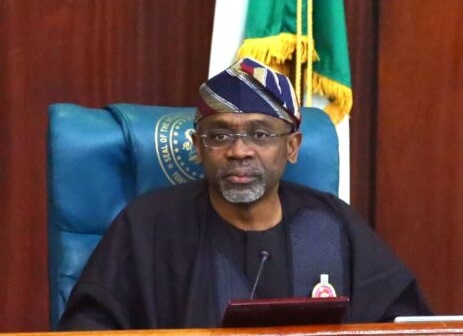
SPEAKER of the House of Representatives, Olufemi Gbajabiamila, has reiterated the fact that Nigeria is facing the spread of the deadly coronavirus due to the unpreparedness of the country.
Gbajabiamila made this statement in a seven-minute video posted on his official Twitter handle on Tuesday. He said the transmission of the disease is presently a big threat to Nigeria.
“The transmission of this disease at a scale at which our systems are not prepared is our biggest present threat. We alleviate that threat by self-isolating. The bad news of this disease, everyone is a potential victim. But the good news, everyone is a potential solution,” the speaker.
The speaker also said that Nigeria is currently witnessing an index experience because of the government’s failure to address healthcare challenges for years.
He assured Nigerians that the current administration will do everything possible to make a change.
“None of us living in Nigeria today has ever experienced such a time as this. At this moment, when our determination to succeed is surpassed only by our recognition of the dire consequences of falling short, we are hopeful that our best effort will be enough,” Gbajabiamila said.
This crisis has exposed in the worst possible way the evident weaknesses of our health system. After this is over, and moving forward, we must do everything in our power to ensure that we would never again come upon a moment such as this as ill-equipped as we are now.”
He also commended President Muhammadu Buhari for the way he has handled the crisis so far.
“The House of Representatives commends President Muhammadu Buhari, GCFR, for the ongoing effort by the federal government of Nigeria to manage this outbreak in Nigeria and alleviate the adverse economic and social impact on all our citizens.
“In every way we can, we will continue to support this effort to ensure that our people make it through this difficult time, with dignity and peace of mind.”
On the containment of the deadly pandemic coronavirus, TheICIRreported how the federal government has pronounced a total shutdown of Abuja, Lagos and Ogun states to mitigate the spread of the virus in the country.
The president also promised in his last broadcast on Sunday to send relief materials to Nigerians who may need it.
“For residents of satellite and commuter towns and communities around Lagos and Abuja whose livelihoods will surely be affected by some of these restrictive measures, we shall deploy relief materials to ease their pains in the coming weeks.”
At the time of filing this report, Nigeria is currently battling with 135 infected victims of the virus as eight persons have been discharged. The deadly virus has killed two persons, according to NCDC.



![[Covid-19: My lockdown diary] Day 1: A ghostly spectacle after unusual Sunday worship](https://www.icirnigeria.org/wp-content/uploads/2020/04/italy.png "[Covid-19: My lockdown diary] Day 1: A ghostly spectacle after unusual Sunday worship")