PRESIDENT Bola Tinubu has awarded national honours on Nigeria’s women’s basketball team, D’Tigress, following the team’s triumph at the 2025 FIBA Women’s AfroBasket tournament.
Each player also received a cash prize of $100,000.
At a reception held on Monday, August 4, at the Presidential Villa in Abuja, Tinubu conferred the national honour of Member of the Order of the Niger (OON) on all 12 players of the victorious squad.
He also announced the allocation of flat to the team.
The coaching crew members will also receive $50,000 each in recognition of their accomplishments.
D’Tigress clinched the AfroBasket championship after defeating Mali 78–64 in the final on Sunday, August 3, at the Palais des Sports Treichville in Abidjan, Côte d’Ivoire.
The victory earned the team its sixth overall title and a record fifth consecutive championship, further cementing Nigeria’s dominance in African women’s basketball.
The victory also secured Nigeria’s automatic qualification for the 2026 FIBA Women’s Basketball World Cup in Berlin.
D’Tigress had a perfect run in the tournament, topping Group D, defeating Cameroon in the quarterfinals, edging Senegal 75–68 in the semis, and sealing the title against Mali.
Amy Okonkwo and Ezinne Kalu were standout performers, with Nigeria also recording the highest offensive average in the tournament.
The reward for D’Tigress came just a week after the Super Falcons won their 10th Women’s Africa Cup of Nations (WAFCON) title in Casablanca.
Following that victory, Tinubu also honoured the football team with national awards, $100,000 each, and the allocation of three-bedroom apartments in the Renewed Hope Housing Scheme.
THE Organisation of the Petroleum Exporting Countries (OPEC) and its allies, known as OPEC+, plan to raise crude oil production by 547,000 barrels per day (bpd) in September could further strain Nigeria’s oil revenue target for the year.
Opec+ members’ decision to increase their crude oil out by the coming month was in response to improved global economic growth and oil market fundamentals.
The decision followed a virtual meeting on Sunday, August 3, where Saudi Arabia, Russia, Iraq, the UAE, Kuwait, Kazakhstan, Algeria, and Oman reaffirmed their commitment to ensuring market stability.
The move marks the fourth monthly increment in a phased rollback of 2.2 million bpd in voluntary production cuts, which were introduced in April and November 2023 to support prices during market uncertainties.
“By the decision agreed upon on 5 December 2024 to start a gradual and flexible return of the 2.2 million barrels per day voluntary adjustments starting from 1 April 2025, the eight participating countries will implement a production adjustment of 547 thousand barrels per day in September 2025 from the August 2025 required production level,” OPEC stated.
However, market watchers are already worried that the decision is going to pressure oil prices, which will negatively impact Nigeria’s oil revenue.
On Monday, crude oil prices fell to their lowest in a week as the OPEC+ agreement set for another large output increase in September.
Brent crude futures fell $1.17 to $68.50 a barrel by 11:27 GMT, while the United States West Texas Intermediate crude declined $1.26 to $66.07.
This raises worries as Nigeria has not been meeting its OPEC crude oil production quota of 1.5 million bpd, and has been far from meeting its budgetary benchmark target of 2.06 million bpd, causing a strain on its crude oil revenue, which makes up a significant portion of the 2025 budget.
Nigeria relies hugely on the proceeds from oil to fund a large chunk of its yearly budget, The ICIR had earlier reported, and a drop below the benchmark rate and output poses an implementation challenge.
In its N54.99 trillion appropriation, the federal government set a crude oil budgetary benchmark price of $75 per barrel and a 2.06 million bpd production target.
It further set a N34.8 trillion revenue target to fund the budget, of which N19.6 trillion will come from oil proceeds and N15.22 trillion from non-oil sources.
Analysts believe that a dropping crude oil price below the $75 per barrel benchmark and an unmet production benchmark target amid the OPEC+ out increase, which will further cause oil prices to steep, however, portends a possible setback for the country while increasing the chances for increasing borrowing by the government.
With a total public debt that has surged to N144.67 trillion as of December 31, 2024, according to the Debt Management Office (DMO), and recent loan approval of $21 billion loans with $347 million hanging in the balance, Nigeria’s debt is expected to widen.
Given its huge implications for the country’s fiscal stability, a former Vice President, Atiku Abubakar, feared that the government could be mortgaging the country’s future with its borrowing spree.
This is even as the Nigerian Economic Summit Group (NESG) has repeatedly expressed that continued underperformance in the oil sector could seriously threaten the federal government’s ability to meet its planned budgetary commitments and sustain key national projects.
THE West African Examinations Council (WAEC) has released the 2025 WASSCE results, showing a drastic fall in candidates’ performance compared to the previous year.
The result showed that only 38.32 per cent of candidates who sat for the exam obtained at least five credits including English and Mathematics, a drop from the 72.12 per cent success rate recorded in 2024.
The examination body said the sharp decline in the pass rate was a result of a crackdown on exam malpractice and a shift toward digital testing.
Addressing journalists at WAEC’s national headquarters in Yaba, Lagos, on Monday, August 4, the Head of the Nigeria National Office, Amos Dangut, attributed the decline to reforms aimed at curbing cheating, particularly the serialisation of objective test papers in major subjects.
“This approach drastically reduced the incidence of collusion and made examination malpractice more difficult. We observed a dip in the performance of objective papers, but essay papers remained consistent with previous years. It’s a strong signal that candidates must rely on their own preparation,” Dangut said.
The ICIR, however, reports that the decline might not be disconnected from the operational failures reported during the conduct of the examination.
In May, The ICIR reported that WAEC detained students in exam halls as late as midnight in several states, including Kwara and Osun, after the leak of the English Language paper.
Some students were forced to write the paper using torchlights, with many parents and rights groups criticising the Council for what they called ‘inhumane’ treatment.
The WAEC initially declined to comment but later admitted the delay was intended to “protect the integrity of our examinations.”
The 2025 examination was conducted between April 24 and June 20, followed by coordination and marking from July 3 to 21.
Dangut stated that the Council also introduced real-time digital scoring to boost result processing speed and accuracy.
He also noted that of the total number of candidates, WAEC released results for 1,517,517 (77.06 per cent), while 451,796 (22.94 per cent) were still being processed due to technical issues the Council promised to resolve in the coming days.
The exam body also withheld 192,089 results (9.75 per cent) for various offences, including the use of mobile phones and group cheating. This was a slight improvement from the 11.92 per cent withheld in 2024.
“These unscrupulous elements have become a thorn in the Council’s flesh. Some even use our name to distribute fake messages. We’ve apprehended some of them, and appropriate sanctions will be applied,” Dangut vowed.
He warned that state governments owing the Council would not have access to the results of students they sponsored until the debts are cleared.
A total of 12,178 candidates with special needs were registered for the 2025 WASSCE. Among them were 112 visually impaired candidates, 615 with hearing impairments, 52 with mental challenges, and 37 with physical disabilities.
On gender distribution, 976,787 candidates (49.60 per cent) were male, while 992,526 (50.40 per cent) were female.
Among those who passed with five credits including English and Mathematics, girls outperformed boys, accounting for 53.99 per cent (407,353) of the successful candidates, compared to 46.01 per cent (347,192) male candidates.
THE Minister of the Federal Capital Territory (FCT), Nyesom Wike, has reaffirmed his vow to seal properties of ground rent defaulters in the nation’s capital.
The ICIRreported in March that Wike approved the revocation of 4,794 land titles in Abuja due to alleged non-payment of ground rent for over 40 years.
On May 23, the FCT Administration announced plans to take over 4,794 properties with outstanding ground rents spanning between 10 and 43 years.
However, on May 26, President Bola Tinubu intervened, forcing the FCTA to issue a two-week ultimatum to ground rent defaulters to settle their debts, following the commencement of property sealing by the administration.
Speaking during his monthly media parley on Monday, August 4, Wike expressed disappointment over the continued failure of some defaulters to settle their debts, despite the grace period granted by the president.
He stressed that without recovering the debts, the administration would be unable to execute critical infrastructure projects.
“You should know what I’m going to do next. I thank God the president said two weeks; we are at more than three months.
“That is Nigeria for you. We have just finished a programme of commissioning projects. Very soon, we are going to seal up all those properties. I am going to seal it up.” Wike said.
He warned that once enforcement begins, he would not be swayed by political sentiments.
“You can’t deny us the taxes we will use for development. You’re talking about the health sector now; you’re talking about education. What have we done in other sectors? With what? You want this. Pay us the taxes that you should pay, but you said no.
“Bear it in mind, I won’t do it. If you have not complied, if you have not paid, we are going to seal it up,” he stated.
The ICIRreported that the FCT administration began sealing the properties of defaulters, including the headquarters of the Peoples Democratic Party (PDP) in the Wuse district of Abuja.
The list includes a number of high-profile institutions and organisations, namely the Central Bank of Nigeria (CBN), the Independent National Electoral Commission (INEC), the Nigerian National Petroleum Corporation (NNPC), the Nigerian Television Authority (NTA), and the News Agency of Nigeria (NAN).
Others sealed were the headquarters of the Federal Inland Revenue Service (FIRS), the Nigerian Security Printing and Minting Company, the Nigerian Postal Service, and the Power Holding Company of Nigeria (PHCN)
The Borno and Kaduna State Governments’ lodges, the Nigerian Security Printing and Minting Company, the Nigerian Postal Service, and the Power Holding Company of Nigeria (PHCN) were also sealed.
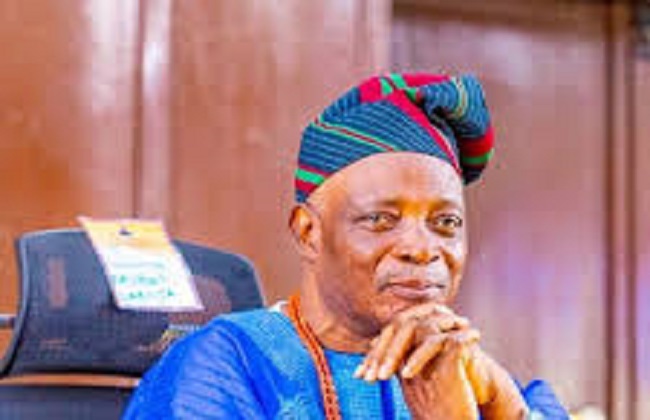
THE Olubadan-In-Council has picked former governor of Oyo State, Rashidi Ladoja, as the 44th Olubadan of Ibadanland.
Ladoja’s nomination took place at the Olubadan’s Palace located at Oke-Aremo, in the Ibadan North Local Government Area (LGA) of Oyo State.
Ladoja was not in attendance during the meeting where he was selected.
Presiding over the meeting, the Balogun Olubadan of Ibadanland, Oba Tajudeen Ajibola, said, “We (members of the Olubadan-In-Council) have all signed and nominated Oba Rashidi Ladoja as the new Olubadan of Ibadanland.
The Balogun Olubadan, Tajudeen Ajibola, announced that the Olubadan-In-Council unanimously nominated and signed in favour of Ladoja as the new Olubadan.
He said the council would forward the resolutions of its meeting to the Oyo State Governor, Seyi Makinde, who would pick a date to present a staff of office to the new Olubadan.
Ladoja served as Oyo State governor from 2003 to 2007. He was impeached in January 2006 and reinstated in December 2006.
His nomination followed the completion of the 21-day mourning period for the late Olubadan, Owolabi Olakulehin.
The ICIR reported that Olakulehin passed away at the age of 90 in the early hours of Monday, July 7.
He died just 15 months after becoming the Olubadan.
THE Lagos State Government has flagged 176 estates for allegedly operating without layout approvals.
A statement on Monday, August 5, by the Ministry of Physical Planning and Urban Development issued a 21-day ultimatum for their promoters to regularise their status or face possible sanctions.
The statement noted that the affected estates were mostly situated in the fast-developing corridors of Eti-Osa, Ajah, Ibeju-Lekki, and Epe.
The list includes notable estates such as Adron Homes in Elerangbe, Aina Gold Estate in Okun-Folu, Diamond Estate in Eputu, Prime Water View Garden in Ikate Elegushi, and Royal View Estate in Ikota.
According to the Permanent Secretary of the Office of Physical Planning, Oluwole Sotire, the estates failed to obtain necessary layout approvals, thereby breaching planning regulations and undermining the Lagos State Government’s T.H.E.M.E.S+ Agenda, which outlined its vision for a smart, organised, and sustainable city.
He directed owners and developers of the estates to submit required documents to the ministry at the Secretariat in Alausa, Ikeja, within 21 days to initiate the approval process.
Sotire explained that the exercise was part of the ministry’s routine oversight to ensure compliance with urban planning standards across the state.
He added that all developers and real estate practitioners were expected to register with the Lagos State Real Estate Regulatory Authority (LASRERA), the body responsible for monitoring and coordinating real estate activities in the state.
The announcement came on the heels of the Lagos State Government’s intensification of its enforcement against alleged illegal constructions across the metropolis.
In recent months, the state has demolished numerous buildings allegedly found to be structurally unsafe, obstructing drainage channels, or lacking statutory approvals.
Several developers and homeowners have been affected by this sustained crackdown, which authorities say is necessary to prevent building collapses, environmental degradation, and flooding.
There have been alarming rates of building demolition in the state, which include Mende Estate in Maryland in 2024. The exercise has also been carried out at Festac, Okota, Lagos Island, Ifako-Ijaiye, Alimosho, Yaba, Ebute Metta, Surulere, Agege, and Oworonshoki.
These result in the loss of assets to estate developers, subscribers, and house owners, who are mostly at the receiving end.
Real estate developers, agents, financiers, realtors, marketers, and other stakeholders in the housing sector have at various times expressed their displeasure.
The ICIR, in one of its publications in November 2023, reported the worries of these actors, including the negligence and fraudulent activities of some government officials.
Other concerns were the rigorous processes for acquiring building permits, the bureaucratic bottlenecks associated with many regulatory authorities—state ministries, agencies, and parastatals related to the building business—and the lack of a central digital system for verifying the genuineness of landed properties.
THE Nigerian Meteorological Agency (NiMet) has predicted three days of heavy downpours and thunderstorms across Nigeria from Monday, August 4, to Wednesday, August 6.
In its weather outlook released on Sunday, August 3, in Abuja, NIMET said early morning thunderstorms were expected on Monday with medium rains over parts of Sokoto, Adamawa, Kebbi, Zamfara, Jigawa, Kano, Katsina, and Taraba states in the northern region.
It added that later in the afternoon or evening hours, thunderstorms with moderate rainswould descend on the entire northern region.
“There is a high possibility of flood occurring over parts of Adamawa, Taraba and Bauchi states during the forecast period.
”In the central region, there are prospects of light rains over parts of Benue, the Federal Capital Territory, Niger, Kogi, and Nasarawa States during the morning hours,” NiMeT stated.
The NiMet predicted that in the afternoon or evening hours of Monday, there would be light rains over parts of Kogi, Kwara, Nasarawa, Plateau, Niger, Federal Capital Territory (FCT) and Benue.
There would also be cloudy skies with light rain in southern states, including parts of Ebonyi, Enugu, Imo, Anambra, Abia, Ogun, Edo, Delta, Lagos, Rivers, Cross River, Akwa Ibom, and Bayelsa, said the organisation.
Light rains are also expected later in the day in parts of Abia, Imo, Ebonyi, Anambra, Osun, Ogun, Oyo, Ondo, Ekiti, Edo, Delta, Bayelsa, Rivers, Lagos, Cross River, and Akwa Ibom states.
The agency anticipated the high possibility of floods happening over parts of Edo, Ogun, Delta, and Oyo States during the forecast period.
NiMet predicts morning thunderstorms over the northern region on Tuesday with moderate rains over parts of Taraba, Katsina, Kebbi, Sokoto, Kaduna, and Zamfara states.
The agency predicted a high possibility of flooding over parts of Anambra, Delta, Bayelsa, Cross River, and Akwa Ibom States during the forecast period.
It advised the public to avoid driving in heavy rain and urged states prone to flash floods to activate their emergency response systems.
It also urged the public to ensure warm clothing for the vulnerable persons due to low night-time temperatures and to ensure that loose objects are fastened to avoid collisions.
The ICIR reported that NiMet, in a weather outlook issued on Saturday, June 7, forecast a period of thunderstorms and rainfall across several parts of Nigeria from Sunday, June 8, to Tuesday, June 11, 2025.
HELL was let loose on Belegete, a border community in Obanliku LGA of Cross River State, on December 5, 2023, when Ambazonia rebels from Cameroon stormed the area and unleashed unspeakable terror, killing a traditional ruler and several others in the process. This led to the displacements of over 1,000 while dozens of houses were razed. Two years after, investigation by The ICIR reveals that about 60 percent of the displaced are yet to return home due to the absence of security, leaving the traumatised residents in limbo for fear of further attacks.
Echoes of agony
Their tales sound like extracts from ‘Hammer House of Horror’, those British television series that graced the screens in the 1980s. Each account, with its shocking narrative and plot, evokes the kind of pathetic emotions capable of turning a sympathiser’s cheeks into an erosion of helpless tears. They bear the trappings of a common, albeit revulsive trademark: anguish!
Two years have gone by, yet the events of that fateful day are still etched on their minds through the mist and dust of remembered agonies, frustrations and even anger.
AI generated image of displaced persons gathered at a community near Obudu Ranch following the 2023 Ambazonia invasion
The sinews of the human artifacts may decompose and return to oblivion, but to an average Belegete resident the sinews of that black Tuesday would remain a sore spot in their memory forever.
Sunday Ashu, a student at the University of Calabar, who hails from Belegete captures the agonising essence in the aftermath of the attack poetically: “Belegete has never been the same again. Our people go to bed at night, only to dream about the horrors of the grave that closed in on the community that day. They eat-if at all they find food to eat- only to feel their gums and palates coated with the grits of that day. They breathe, only to feel the nasty odour of the charred bodies that were littered on their streets on that day…!”
Driving force of the unprovoked attack
Rampaging rebel fighters from the Republic of Cameroon, called Ambazona, had taken advantage of the porous borders and invaded this misbegotten-hard to reach- community in Obanliku LGA of Cross River State.
In the ensuing melee, the sophisticated arms wielding arsonists unleashed terror and paranoia. They held the unprotected, defenceless village hostage for over 24 hours, burnt houses, raped women and left atleast a thousand residents displaced.
The community’s sin was that they had hosted refugees from Cameroon each time they were attacked by the separatist rebels. The terrorists, who were calling for an independent state in the southwest and northwest regions of Cameroon, had been at daggers drawn with the country’s authorities since 2017.
Findings indicate that the English-speaking regions had repeatedly complained that they were marginalised by the majority French-speaking regions and that they were sidelined in the public sector.
In 2017, lawyers and teachers in the English-speaking regions were said to have taken to the streets to express displeasure over domination by the French-speaking majority.
Consequently, security agents responded with firearms, killing 17 protesters, a development that escalated clashes between separatists and the government, leading to over 6,000 deaths and the displacement of nearly 600,000 people.
Smaller militia groups also sprung up, making it difficult for the government of the Francophone country to negotiate with the non-state actors.
In a TikTok video that surfaced on Facebook on June 27, 2025, in the aftermath of the attack, one of the arrested terrorist leaders called “the Giant”, who was being interrogated, claimed that they were pushed into “this mess” by the political leaders of Southern Cameroon.
As the crisis festered, hundreds of undocumented migrants and refugees gained unhindered access to many Nigerian border communities through the forest areas, one of which was Belegete.
Day of the rampaging rebels
In the wake of the December 2023 attack, the Ambazonia rebels stormed Belegete, abducted a chief, Francis Ogweshi, a traditional leader in Belegete and 20 others after holding the village hostage without the intervention of the Nigerian government.
Two days after, distraught and grief-stricken residents were said to have sought the assistance of the Nigerian military to rescue the chief and other kidnapped victims in the forest.
During a search in the forest, the rebels and soldiers exchanged gunshots, leading to the death of one of the fighters. In retaliation, they killed the traditional ruler and threw his corpse in the river, where his body was discovered three days later.
While residents were still mourning the death of their chief and anticipating the return of other victims in captivity, the rebels launched a full scale onslaught on the community in a midnight raid on Friday, December 8.
They opened fire on unarmed residents, cut some with cutlasses, and burnt several houses, leading to the displacement of many, including women, children, and the elderly.
Two years after, security remains elusive as IDPs yet to return
With heavy loads on their shoulders, locals trek their way through the rugged road that leads to the heartland of Belegete. Photo: The ICIRFidelis Mac-Leva
A visit to the community revealed that two years after that horrific attack on Belegete, residents are sill living in awe and bewilderment. An many of them who had fled to take refuge elsewhere are yet to return to their homes which still lay in ruins, according to the community Laison office at the Obudu Ranch.
While some are being hosted in neighbouring LGAs across the South-South State, many who took hours of trekking along the kaleidoscope of bush paths that meander through the scary hills and mountains leading to the popular Obudu Ranch are still living as IDPs among communities around the ranch in Obanliku LGA.
One of them, Benedicta Kakwa, 47, recounted the sad memories of the incident with betrayed emotions. Her sweat-soaked face bore the furrows of sorrow as she fought back tears to narrate her plight in the wake of the deadly invasion.
Clearing the perspiration that formed on her forehead and cascaded down her cheeks with her forefinger, the former Chairman of Obanliku LGA said: “Apart from affecting us individually and collectively, our Chief was brutally killed by the rebels who took advantage of the porous border.
“There was no means to communicate with security agencies and no access road to move away from the community. Consequently, many were killed while others were abducted. Scores of others ran to neighbouring villages through the forests and became IDPs, abandoning their homes and farms.
A few months after the attack, Benedicta lost her younger sister who became sick. “Due to the absence of an access road, it was impossible to convey her in a vehicle. Instead, able bodied men were engaged carry her on their shoulders and were conveying her through the bush footpath that takes three hours of trekking to the Obudu Ranch.
“Unfortunately, she gave up the ghost midway into the journey. Her corpse was taken back to Belegete and buried on the same day due to the absence of a mortuary in the community,” Benedicta said, displaying a framed photograph of her late sister who left behind her husband and two kids.
Lamenting that hunger had taken a telling toll on the community following the attack, Benedicta said residents have abandoned their farms.
“A peak milk sized cup of Garri now sells for N500 in Belegete. There are no security presence and people are afraid of going there or moving about freely for their daily activities.”
Benedicta displays a framed picture of her sister who died while being conveyed on foot to the Obudu Ranch from Belegete for medical attention. Photo: Fidelis Mac-Leva
While calling for urgent security deployment to allow IDPs return to their homes, Benedicta also made a case for GSM services in the community to enhance communication in times of security emergencies.
Atakpe Ebenezer, 47, who also hails from Belegete now resides at the Otanga community around the neighbourhood of Obudu Ranch. Following the attack in 2023 his modest compound became a refuge as it hosted about 25 immediate and extended family members who were displaced from Belegete.
“It was not easy to accommodate and cater for all of them. Even though some have returned, the situation there is still nothing to write home about,” said Ebenezer who said his Cocoa farm was destroyed during the attack.
“As I speak with you, our people are still hiding in the bushes for fear of further attacks as there is no security presence in Belegete. Some people spend one week in their farms and another at home for fear of the Ambazonia rebels.
Speaking in the same vein, Philomena Oliya, 60, said she had been taking refuge at Omana community around the Obudu Ranch since the 2023 invasion on Belegete.
“We trekked for hours up to the ranch and eventually got here with my five children. We survive by farming. I intend going back but we are afraid because the security situation is still precarious,” Oliya said, calling for government assistance to enable them to return home.
Another IDP, Esther Doctor, 50, said even though four of her seven children who ran away to Obudu for refuge in the wake of the attack had returned to Belegete, she was having sleepless nights.
“I am worried because the security situation back home is not good. There is no military presence to give us hope of full return. The rebels can come back anytime and attack us,” she said.
For Maria Akwunda, 48, she has now fully settled at Obudu and does not contemplate returning to Belegete anymore.
Adebo Anthony and his wife who ran away with their family from Belegete to Amana community around the Onudu Ranch following the 2023 Ambazonia attack. Photo: TheICIR Fidelis Mac-Leva
“In the wake of the attack, I was sick and carried on the shoulders for four hours to the hospital here in Obudu. I was later joined by my nine children. I lost my husband since 2001 and I don’t think I can go back to Belegete,” she said, battling to fight back tears.
Adebo Anthony, a 52-year-old civil servant at the Obanliku local government council said he had travelled home (Belegete) when the incident happened. “When the rebels struck, we ran to the bush with my wife and 11 children. From the bush I later took off and trekked to the ranch where my wife and children later joined me.”
‘How we hosted Belegete IDPs at the Ranch’
At the top of the Obudu Ranch lies a sprawling community called Akoranyape. It is the first point of contact for residents of Belegete who usually trek for at least three hours to get to Obanliku and Obudu through the ranch.
Following the 2023 invasion by the rebels, the community hosted scores of displaced persons who followed this difficult footpath that terminates at the ranch.
When our reporter visited the community some IDPs who had risked going back home to fetch some food items from their abandoned farms were sighted arriving from Belegete with heavy loads on their heads.
Two displaced persons arriving at the Obudu Ranch Mountain top after trekking to Belegete to get some food items from their abandoned farms. Photo: Fidelis Mac-Leva
Grace Achue who lives in a dilapidated mud house with tattered roof at Akorayape said she hosted many IDPs from Belegete following the attack.
“This community was like a marketplace, coupled with the bad weather at the time. The displaced people, among them women and children, trooped in from Belegete, mostly at night on a daily basis.
“It was difficult but we managed to keep them. Some have gone back home but many others are still dwelling within this community. They are afraid of going back to Belegete because there are fears of the possible return of the rebels from Cameroon.
Benjamin Okumo, the leader of the community said it took the grace of God and support from government agencies and spirited individuals to provide feeding for the fleeing IDPs.
“The government through its agencies provided relief materials which we gave to the IDPs. Public spirited individuals as well as Non-Governmental Organisations (NGOs) also rose to the occasion. However, we still have some of the displaced persons here who are yet to return to Belegete because there is no security measure put in place to protect them,”Okumo said.
The Community Laison Officer of the Obudu Cattle Ranch, Esalo Anya, decried the porous security situation within the host communities of the ranch. Anya who hails from Belegete said most of the communities share borders with Cameroon, stretching from the ranch, Belegete and others.
“Unfortunately, the borders are porous without security presence to checkmate external attacks. The community has been seriously crying to government on the need to establish a security post but this has not been done.
“Secondly the topography we found ourselves in is so difficult. There are no access roads even for motorcycles, let alone vehicles. As you have seen, people access Belegete by trekking from the ranch to the hinterland.
Community Laison Officer of the Obudu Cattle Ranch, Esalo Anya, says Belegete borders are prone to attacks because they are porous and unprotected. Photo: Fidelis Mac-Leva
“Added to this is the absence of GSM networks for communication. During emergencies, it is always impossible to reach out to security agencies as was the case during the 2023 Ambazonia invasion.”
According to Anya, promises made by government to provide security in the areas have not been kept.
“Following the invasion, the army and police only went there briefly to assess what was on ground and left. We need a permanent solution which includes security and access road to the community, he said.”
He disclosed that about 60 percent of the displaced persons were yet to return to Belegete because of fear of further attacks by the rebels.
Fear, anxiety still envelop Belegete communities
Without a motorable road, there are two difficult routes that lead to the hinterland of Belegete from Obanliku. One is a distance of approximately 10 kilometres from the summit of the Oudu Cattle Ranch which takes between 3-4 hours of trekking through rugged mountainous bush paths.
The other route is from Obanliku town which extends from a settlement called Boki to Belegete. Here, the journey can be undertaken on a motorcycle beginning from another village called Buatong. Even on a motorbike the rugged journey takes approximately three hours.
Relics of destruction like this remain a commonplace in Belegete two years after the attack. Residents are appealing for resettlement to return to their homes. Photo: Fidelis Mac-Leva
It was about midday when this reporter finally arrived Belegete after three hours on a motorbike. The mood and expression on the faces of residents was sill lugubrious. The first port of call was the residence of Aku Simon, who assumed responsibility in acting capacity following the murder of the Chief by the Ambazonia rebels in 2013.
“Recalling the circumstances that led to the killing of the Chief, he said, “The rebel fighters crossed a border community called Umuni to Belegete on that fateful day and kidnapped our chief. They eventually killed him and threw his corpse inside the river on the boundary. They burnt houses, including the town hall, and even raped our women and girls.
“After killing the chief, many of us ran to the ranch to take refuge for four months before returning home. Some of our people hid in the forests and remained there for six months without going to their farms. As you can see, we are still living in fear as there is no security presence. I appeal to the government to provide military personnel to protect us from further attacks.”
Aku Simon, acting leader of Belegete community: ‘We are still living in fear because there is no security presence’. Photo: Fidelis Mac-Leva
Ebi Julius is from Umuni, one of the Belegete communities that were burnt down by the Ambazonia rebels. Julius, who ran to the Obudu Ranch for six months before returning to Belegete, said many displaced residents were still at the ranch and surrounding communities while others were still in the forests.
“Those of us that have taken the risk to come back here are not comfortable because the Ambazonia rebels may return any moment to attack us. As you can see there is no security presence here, no access road or GSM networks to communicate in case of emergency,” he said.
Refuge in the forest
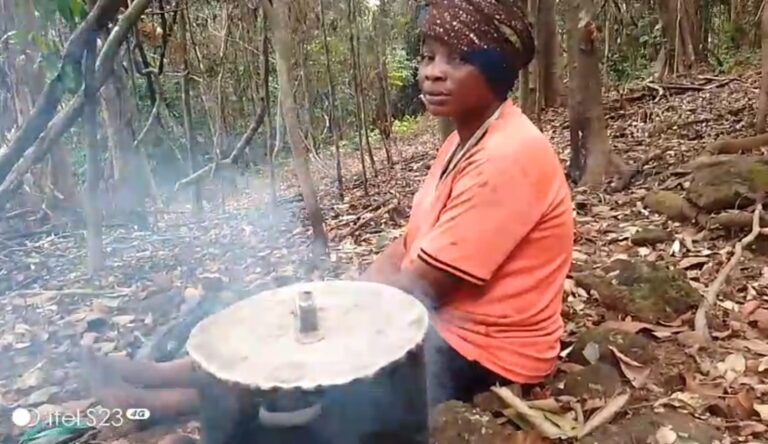
For Achue Beatrice Enya, 47, one of the forests encircling Belegete has become a ‘refuge’ for her family since the Ambazonia rebels attacked. With their house burnt during the invasion, the middle-aged woman, her husband and only son, moved to the forest where they have been hiding.
Come rain and shine, they cook, eat and keep vigil at night in the forest; hoping the Ambazonia nightmare would come to an end sooner than later. But their hope of returning to their destroyed home is fast fading as there seems to be no silver lining in the cloud with regards to the porous security situation in the community.
Shaking her head to dodge the smoke that surged from the fireplace toward her face Beatrice said, “This has become our home. We relocated here with my husband and son when our house was razed by the rebels. We sleep on a mat, the risk of mosquitoes, snakes and other reptiles from the forest notwithstanding. My husband and son have gone to the nearby stream to have their bath….”
Beatrice sits beside the smoking fireplace in the forest, waiting for food to be ready.
Beatrice is not the only displaced family in Belegete that is still hiding in the bushes and forests. The ICIR gathered that many residents in similar situation were yet to return to their abandoned yet destroyed homes.
A cross section of residents of Belegete, mostly women, who spoke with The ICIR, expressed deep worries over their plight, calling on the relevant authorities to come to their assistance by way of resettlement. While some decried the absence of security and basic infrastructure in the area others who had ran to neighbouring communities said even though they returned home they were still gripped by fear and anxiety.
‘We’re sitting on keg of gunpowder’
The Chairman of Obanliku LGA, Sunny Kayang, said the Ambazonia invasion, which was unprovoked, left the entire area in “rude shock, demoralised and dampened in spirit.”
“In the wake of that unprovoked attack, the people of Belegete were dispossessed of their land and houses. They had no places to put their heads as houses were razed.
“Consequently, the people fled for their lives to other places across the state where they became refugees.
“Due to the poor security architecture we have, these so-called Ambazonia come in freely, harass, intimidate, assault, rape our wives and daughters.
“We have been so constrained that I cannot act because it is only a foolish man that can challenge and argue with someone with a gun whose finger is on the trigger.”
Sunny Kayang, Obanliku LGA Chairman: ‘We are sitting on a keg of gunpowder’. Photo: Fidelis Mac-Leva
While appealing to the Nigerian government to beef up security in Belegete and put in place what he called an ‘Amphibious military barracks’, the chief security officer of the LGA said: “If government fails to do this, the tendency that they would expand their nefarious activities in the nearest future is large.
“We are sitting on a keg of gunpowder. The federal government should use her might to give us protection to prevent what happened in the Bakassi Pennisula which we eventually lost to Cameroon. The FG flag must fly very high in Belegete,” he said.
The member representing Obanliku in the Cross River State House of Assembly, Ashakia Pius Ashas, decried the situation in Belegete, and called for urgent security attention.
Confirming that many of the displaced persons were still seeking refuge elsewhere across the state, Ashas said, “They need to be resettled and rehabilitated. Government should do something because the people are still living in fear. So long as the Ambazonia crisis in Cameroon is not yet over, the tendency for the rebels to come back for further attacks is there.”
The ICIR reports that following the attack, the then Director General of Cross River State Emergency Management Agency (SEMA), James Anam, said the agency had not only written to the National Emergency Management Agency, NEMA and the Red Cross, but to the Chief of Army Staff on the dire need to establish special security outfits in Belegete and other borderline communities.
When contacted, the current DG of SEMA, Gill Atinga, a pastor, said in the wake of the attack the state government collaborated with the United Nations High Commission for Refugees (UNHCR) in the provision of relief materials.
“Through that collaboration, the IDP’s were provided with support in the form food, clothing and other forms of relief material to alleviate their pains.”
The Programme Manager of Refugee Intervention, Hillary Ajida, however, said the UNCHR has disengaged from the collaboration following the withdrawal of funding by President Donald Trump.
“Following the attack, the UNHCR supported our relief intervention efforts, including the Red Cross. However, the Trump’s policy led to the partial withdrawal of the UNHCR,” Ajida said, stressing that the issues of food supplies, health and security still pose a serious challenge.
Responding to the situation, the Cross River State Commissioner for Information, Erasmus Ekpang, said the state government had risen to the occasion by providing the necessary relief to the victims.
He, however, decried the difficult terrain in accessing Belegete community, pointing out that this was affecting sustained military presence in the area.
“Following the invasion soldiers were deployed there but due to the difficult terrain, occasioned by snakes and reptiles, they started complaining,” he said.
According to him, the Deputy Governor of Cross River State had held talks with his counterpart from the neighbouring country as part of efforts to address the problem.
Obono Ubi, the Chief Security Adviser to the Cross River State Governor, declined comments when contacted on phone to speak on the matter.
THE Centre for the Promotion of Private Enterprise (CPPE) has said that the rebased gross domestic product (GDP) numbers highlight the need to strengthen productivity in critical sectors such as agriculture, manufacturing, and trade.
The CPPE Chief Executive Officer, Muda Yusuf, made this submission in a statement he signed on Sunday, August 3.
He noted that the sectors are essential for economic inclusion, job creation, self-reliance, economic security, and diversification.
The renowned economist, however, expressed worries that the sectors’ current growth rates remain below expectations, noting that agriculture grew by only 0.7 per cent and manufacturing by 1.7 per cent in the first quarter of this year.
“These sectors require targeted interventions to unlock their full potential and drive sustainable development,” Yusuf stated.
The ICIRreported that the National Bureau of Statistics (NBS), on Monday, July 21, released the long-awaited rebased GDP now anchored to a new base year of 2019.
The rebasing was carried out to reflect current economic realities, including recent changes in consumption patterns, production technologies, and sectoral dynamics, which are essential for effective policy formulation, planning, and investment decisions.
According to the NBS, Nigeria’s nominal GDP stood at 372.82 trillion as of 2024. The economy grew by 3.38 per cent in 2024 but moderated by 3.13 per cent in the first quarter of 2025, with total output for the quarter at N94 trillion, The ICIR had reported.
“This brings Nigeria’s cumulative GDP at the end of Q1 2025 to approximately N466 trillion, or an estimated $300 billion.
“As the Nigerian economy progressively recovers from the shocks of the current economic reforms, the CPPE projects that by year-end, Nigeria’s GDP could reach an estimated $450 billion, barring any major disruption in the economy,” Yusuf said.
A review of the GDP data showed that 37 sectors recorded growth, nine contracted, and three were in recession.
But despite the non-oil sector’s dominant contribution to GDP, its share of government revenue remains disproportionately low.
“This indicates persistent productivity and revenue mobilisation challenges in the non-oil economy, which must be addressed to ensure fiscal sustainability and inclusive growth,” Yusuf said.
He, therefore, urged that special attention be directed to sectors in recession, those that contracted, and those experiencing slow growth.
“Addressing structural challenges, improving access to finance, tackling insecurity, and fostering innovation will be critical to stimulating recovery and growth,” he said.
He also called for sustained support for high-performing sectors to further improve their output, leveraging their potential as engines of growth, revenue generation, and job creation.
In bridging the revenue gap, Yusuf said, “There is a pressing need to address the disconnect between the non-oil sector’s significant GDP contribution and its relatively lower contribution to government revenue.
“Strengthening tax administration, broadening the tax base, optimising non-tax revenues and promoting formalisation of economic activities in the informal sector are essential steps.”
The CPPE boss is also advocating for more frequent and timely GDP re-basing exercises to ensure that economic data remains current and relevant for policy and investment decisions.
He believes this can be better achieved through continuous engagement with stakeholders, including government agencies, private sector participants, researchers, and development partners, as a vital tool for effective policy formulation and implementation.
“The CPPE remains committed to supporting evidence-based policymaking and investment decisions and urges stakeholders to leverage these improved statistics for strategic planning, investment decisions, and policy development.
“Continuous engagement and timely updates will ensure that Nigeria’s economic data remains robust, reliable, and fit for purpose, guiding the nation toward sustainable growth and development,” he maintained.
The ICIR had earlier reported the concerns of the Manufacturers Association of Nigeria (MAN) that the latest rebased GDP figures indicate that the manufacturing sector is underperforming.
MAN director-general Segun Ajayi-Kadir, who shared the worries, had urged the federal government to prioritise the manufacturing sector to reflect the real economic situation and gains of the rebased GDP.
ONE month ago, in Abuja, a small circle of friends, literary enthusiasts, human rights activists, politicians, public intellectuals and thinkers gathered to listen to Chidi Odinkalu read from his latest offering, The Selectorate: When Judges Topple the People. It was a private reading, but the ideas Chidi graciously espoused belong in the public domain. They concern us, citizens of this ruined Republic.
Odinkalu is no stranger to judicial criticism. I have often described him both as a restless ruffler of the judicial nest and a flamethrower who scorches the dark recesses of our judicial quarters, casting light into corners long hidden from public view, so that citizens may, if only for a moment, glimpse the shadows that dwell within. Rightly so. He has spent the better part of his sterling career in the academia and public activism, exposing the inconsistencies, betrayals, and quiet capitulations of the judicial branch. But The Selectorate is more than a critique. It is a mirror, held up to a country whose judicial branch is in utter disrepute.
Odinkalu’s rendering is consistent with the Selectorate Theory popularised by Bueno de Mesquita, Alastair Smith, Randolph Siverson, and James Morrow in their landmark book, The Logic of Political Survival. They divide society into three groups: the nominal selectorate (everyone with formal rights to choose leaders), the real selectorate (those who actually vote or participate), and the essentials – the critical few without whom no leader can hold power.
In functioning democracies, the “essentials” are usually the voting public. In our case, Odinkalu argues that the courts have quietly taken over that role. The judges, especially those presiding over electoral disputes, now determine who governs. Not the people. This shift means power is no longer derived from the consent of the governed but from the decisions of judges that often defy logic or law. Judges have become kings who sit on imperial thrones where they measure justice by the Shekels.
Odinkalu lays out his arguments methodically.
He does not scream. He squares the bull’s eye and scores it well, without being vindictive. He lays accusations where he needs to. He illustrates. Case after case, election after election, state after state, he shows how the judicial branch transformed itself into a class of The Selectorate. Judges now act both as kings and kingmakers. They wield more influence than ballots. They decide contests that citizens thought they had settled at the polling units. He advances the reason, among other reasons, for this, or to put it more simply, he provides an account for the state of affairs, concluding: “This combination of factors was well suited to inspire the onset of a new trend in the cultivation of clientelist relationships between politicians and judicial officers underpinned by bargains, both implicit and sometimes explicit”.
The book cover for ‘The Selectorate: When Judges Topple the People’
Odinkalu’s position is not founded on legal abstractions. He excavates the upper crust of judicial adjudication with the dexterity of the Foucauldian archaeologist, seeking to uncover what lies beneath the surface of mere observations, thereby exposing bargains hidden by client relations.
What he exposes presents itself as the real, clear, present and growing danger to our democracy. But, there’s a point about hegemony and power to be made here, a point that he didn’t allude to, which underpin his arguments. The Italian scholar, Antonio Gramsci, argued in his Prison Notebooks that power can be seized, constructed, and sustained through the subtle architecture of hegemony. He showed that ruling classes rule by force and also by manufacturing consent to legitimise its authority. Once power is seized, it does not serve the common good, but answers only to those who possess and perpetuate it through dubious means, as the Selectorate Theory explains. The danger, again, is that the moral foundations of the state are hollowed out and the institutions of justice are reduced to performances for the powerful. It is through these dubious performances for the powerful that judicial hegemons have taken our country’s democracy.
Drawing from political science, constitutional law, and Nigeria’s political history, Odinkalu makes a powerful case for restraining the judicial branch instead of exalting it. His critique is interdisciplinary, and there lies its strength. He does not merely point out errors of law; he explains how those errors consolidate power in the hands of a few, and how that consolidation hollows out our Republic. He tells the truth many dare not whisper: that judges now select councillors, chairmen, governors, senators, representatives and presidents. Nigeria’s citizens have been turned into mere subjects without the power to decide who represents them. Simply put, they have become a formality in the democratic rituals. They queue in the sun to vote, but the real verdict emerges later from obsequious courts and decisions delivered by judges who do not “act justly, love mercy, and walk humbly”, as Prophet Micah expressed in the Holy Book.
Odinkalu’s work strikes at the core of Nigeria’s political dysfunction. It speaks to the question of legitimacy. A government chosen by judicial fiat is not a government of the people; It is a government of the court. He is not the first to observe this, but he may be the first to frame it so sharply and so brilliantly. By situating his analysis in the Selectorate Theory, he shows that the problem is not only corruption or incompetence. It is also structural and systemic. It is also about how political actors engineer political survival in Nigeria through the manipulation of legal instruments by counting judges among their favourites. In this way, the judges have also transformed themselves from kingmakers into kings.
This is not an attack on the judicial branch. It is a call to conscience. Judges are meant to be neutral arbiters. In Odinkalu’s offering, too many have become embedded in the arena of electoral conflict. They do not interpret the rules; they change them and enter fudged scores on results’ sheets. They act as though democracy begins and ends in their courtrooms. While inside the arena of conflict, their roles aren’t about reviewing the actions of burglars of elections; it is simply about taking sides with election bandits and extending the geography of banditry and the boundaries of judicial conquest.
Odinkalu highlights the notion of “judicial essentials”: those judges whose decisions determine whether a political actor rises or falls. In a country where elections are frequently flawed and where the process is often tainted by violence and rigging, it is easy for judges to claim the role of final referee. But what happens when that referee takes sides? Odinkalu answers this with clarity.
Democracy collapses not with the squeal of “Fellow Nigerians”, martial music, and the bang of a coup, but with the gavel of a judge. Quietly. Slowly. Fatally. He does not argue that all judges are corrupt. Rather, he shows how a politicised judicial process invites corruption. When judges are seen as gatekeepers to power, the temptation to influence them becomes overwhelming. The judiciary, once the last hope of the common man, has become a marketplace of elite bargains.
There are those who will say Odinkalu exaggerates, but the evidence says otherwise. He documents cases in which politicians whose names were not on the ballot ended up being our representatives – with help from the courts, of course. He documents cases in which political careers were extinguished, not by voters, but by panels of judges whose decisions stretched the limits of interpretation. Some of these rulings contradicted precedents. Others ignored the evidence. All of them had political consequences.
What makes The Selectorate compelling is that it does not end in despair. Odinkalu offers suggestions. He calls for transparency in the appointment and disciplinary processes for judges. He urges the Bar to be more assertive in defending judicial integrity. He wants the public to demand better. Most of all, he believes the judiciary must return to its proper role: interpreting the will of the people, not supplanting it. And the citizens must be at the heart of electoral disputes, as parties. It’s a tough ask in a country where institutions are routinely hijacked. But it is necessary.
As I listened to him read that Saturday, I was struck by his calm tone. There was no bitterness. Only resolve. He has written this book not to condemn, but to warn compatriots. He asks citizens to reckon with what the country has become and to confront how that becoming has trumped electoral justice. What was once a noble exercise of the power of choice at the ballot box has, in his offering, turned into absurdity. Here, power is no longer secured through the choices of citizens at the ballot box, but through the meticulous choreography of legal arguments staged not for the people, but for those robed in black who now hold the final say. The will of the electorate has been displaced by shenanigans, which play out in courtrooms that have become the true closets of judicial corruption. Ours is a democracy where the people vote, but the judges choose.
It is easy to look away; and easier still to rationalise. But the consequences are already here. Disillusionment. Voter apathy. Cynicism. When citizens no longer believe their votes count, democracy dies. Odinkalu is urging them to fight back; not with violence, but with vigilance. Not with slogans, but with civic courage. The judicial branch is vital. Its independence must be protected. But that independence is meaningless if it is used to serve power instead of the citizens.
The Selectorate is not just a book about judges. It is about us: our passivity, our complicity, and our silence. It urges us to look at the judicial branch and ask, “Whose interests does it now serve?” In that question lies our fate, our country’s fate and the fate of democracy.
A lawyer and a writer, Abdul Mahmud is President, Public Interest Lawyers League (PILL)