Home Blog Page 2256

Fashola adopts cooperative societies to achieve housing need, create jobs

THE Minister of Works and Housing, Babatunde Fashola on Thursday says it is adopting a new approach, use of cooperative societies as an avenue to realise housing need of Nigerians.

This approach, he stressed, could help generate more jobs through every player across the chain.

“We have resolved to use cooperatives as the vehicle to achieve more construction in many states in order to expand the scale of construction, and therefore maximize the scale of opportunities,” Fashola says.

He disclosed this at the ongoing eight meetings of the National Council on Lands, Housing and Urban Development with the theme,” Housing Development and Consumer Credit as Strategies for National Prosperity.”

According to him, the Federal Mortgage Bank of Nigeria (FMBN) would drive the initiative by providing construction and acquisition finances.

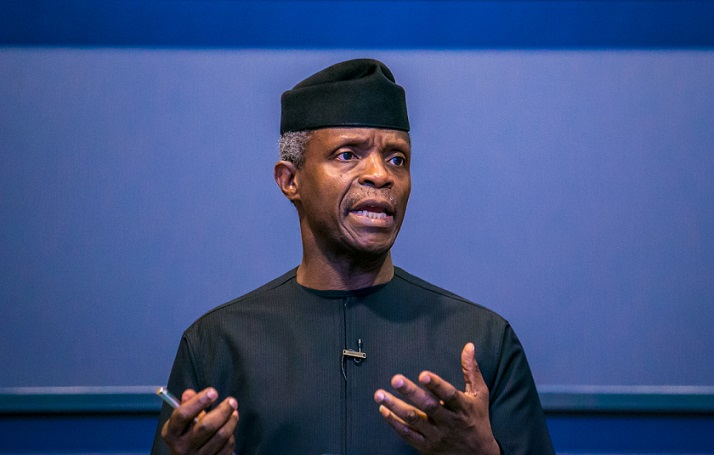
Nigeria currently has about 22 million housing deficit. It was 17 million as at 2015. Prof. Yemi Osinbajo, the Vice President had in September 2017, expressed worry on the increasing rate. He described it as unacceptably high.

As part of efforts to fix the challenge, the Federal Government secured a $150 million World Bank loan facility through the Federal Ministry of Finance. It used its money to setup Family Homes Fund but till date millions of Nigerians are still living in slums or rented apartments.

However, Fashola who emphasised that cooperative groups have thrived in several sectors such as transportation, agriculture, trades and markets including among artisans said supporting them could help deliver more affordable housing.

“We think it can be successful in delivering large scale affordable housing if cooperatives acquire their own land, design what they want to build, get state urban planning approval, and federal government gives them, through the FMBN, loans to construct and loans to members to buy.”

He said the government would also issue backlog of certificates of occupancy and consent to land transactions ( 3,000) and (1,708) respectively.

He also appealed to the 36 states commissioners for Land and Housing who had visited to attend the annual meeting to identify registered cooperative groups as well as keep proper data of them.

Osinbajo aides allegedly fired by the Presidency

0

THE alleged cold war between President Muhammadu Buhari and Vice President Yemi Osinbajo got another twist, as 35 aides working with Osinbajo were shown the exit door by the Presidency according to a Daily Trust report.

The exclusive report listed the affected aides involved in the disengagement of service from the office of the Presidency include Ajibola Ajayi, appointed Special Assistant, SA, Legal to the President (VP’s office) in August. She is also the daughter of Abiola Ajimobi, former governor of Oyo state, Lanre Osinbona, Senior Special Assistant, SSA, on ICT and Imeh Okon, SSA on Infrastructure.

The list also contains Aondaver Kuttuh, Technical Assistant, TA, rule of law; Ife Adebayo, SA, innovation; Yussuf Ali, SA, power regulations; Tola Asekun, SSA, National Boundary Commission; Morakinyo Beckley, SA, off-grid power; Yosola Akinbi, SSA, NEC; Tochi Nwachukwu, SA, power privatisation; Bode Gbore, SSA, political; Abdulrahman Baffa Yola, SA, political and Kolade Sofola, SA, infrastructure.

Others include Jide Awolowo, SA, Oil & Gas, grandson of Obafemi Awolowo, statesman and grandfather of Osinbajo’s wife; Gambo Manzo, SA Political; Edobor Iyamu, SSA, Niger Delta; Akin Soetan, Senior Technical Assistant, STA, on Economic matters; Ebi Awosika, SSA, community engagement; Muyiwa Abiodun, SA, power; Forri Samson – Banu, SA, entrepreneurship; Bege Bala, SA, BPE; Feyishayo Aina, SSA, community engagement; Halima Bawa, SA, community engagement; Nkechi Chukwueka, SA, community engagement, and Ilsa Essien, SA, media.

“The letters were distributed to the affected aides through the Office of the Secretary to the Government of the Federation. They were not working within the precinct of the presidential villa,” an anonymous source in the report stated.

The report hinted that Osinbajo had retrieved the sack letters from the affected aides “pending the return of the president.”

The vice president had over 80 aides who were deployed in many strategic positions, with sources around the corridors of power saying the recent attention around the vice president was aimed at diminishing his influence.

Though, the office of the Presidency is yet to officially announce the termination of their appointments and their portfolios.

The report attributes the sack of the aides of the vice president, to rising tension over the country’s seat of power between Osinbajo and President Buhari with regards to the 2023 presidential election.

President Buhari is currently on a 15-day private visit to the United Kingdom, and he is expected back in the country on November 17.

Appeal Court upholds El-Rufai’s victory

0

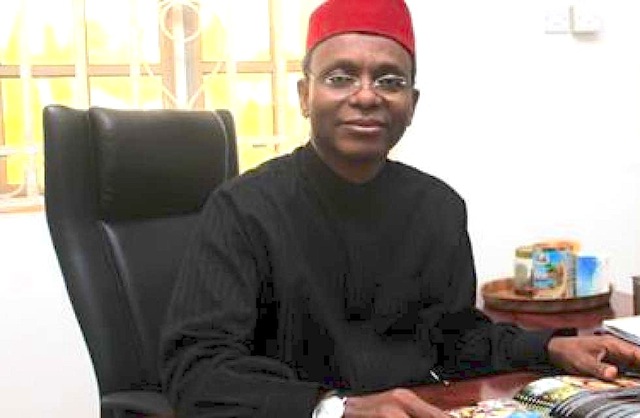
ON Thursday, an Appeal Court sitting in Kaduna has upheld the victory of Governor Nasir El-Rufai as the winner of the March 9 governorship election.

The verdict of the appellant court to uphold El-Rufai winner of the gubernatorial election was the decision of the five-man panel of the Appeal Court judges sitting in Kaduna.

The five-man panel judges in a unanimous decision delivered by Justice Olumuyiwa Aburu, dismissed the petition of the candidate of the Peoples Democratic Party (PDP) Isa Ashiru, upholding the judgment of the tribunal, which stated that the PDP’s petition as lacking in merit.

The Appeal Court consented to the judgment of the Kaduna Governorship Election petition Tribunal, which ruled that Ashiru had no proof for his allegations of rigging and electoral irregularities which he levelled against El-Rufai at the poll.

Recall that Ashiru and the PDP had challenged the declaration of El-Rufai as the winner of the March 9 governorship election by the Independent National Electoral Commission (INEC) demanding the result of the election be cancelled.

They approached the Kaduna Governorship Election Petition Tribunal seeking cancellation of the total of 515,951 votes which they claimed was allocated to the All Progress Congress (APC) as well as 124,210 unlawful votes, which according to them, were added to the PDP.

The PDP alleged that the unlawful votes added to that of the PDP were executed via double entry on the result sheets by the INEC.

The tribunal, however, dismissed Ashiru’s petition, ruling that it lacked merit to substantiate the claims.

Fake news poses threat to Bayelsa governorship election—CDD

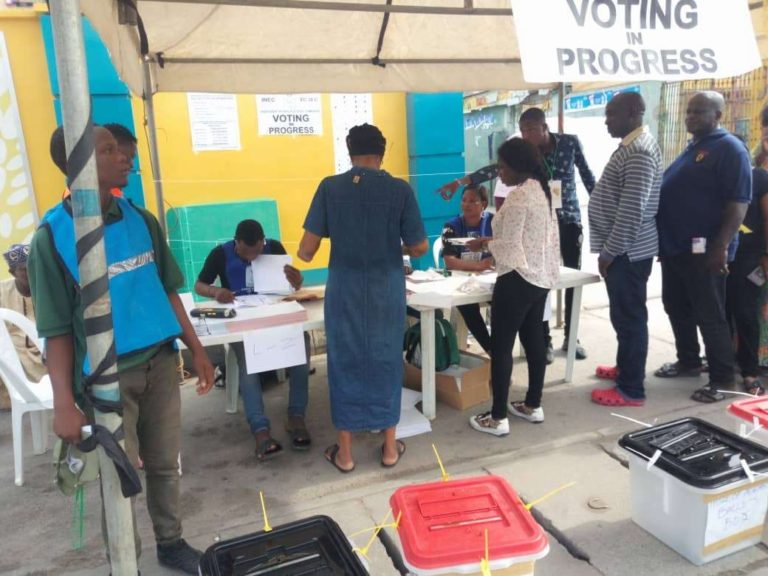
THE Centre for Democracy and Development (CDD) has raised alarm over the activities of media hubs of All Progressives Congress (APC) and Peoples’ Democratic Party (PDP) in Bayelsa State shape the narratives of governorship election by sharing false information.

In a report titled: The Godson Turned Godfather: Governor Dickson & Bayelsa’s 2019 Election, the CDD described fake news as a potent security threat to the forthcoming election in the state.

The report which was released on Tuesday provides an overview of the electoral process and the dynamics of the political environment in Bayelsa.

The CDD noted that Facebook and WhatsApp are the two social media platforms most used to peddle fake news and misinformation in the state.

This is complemented by fake news entrepreneurs who circulate the information in markets, football viewing centres, motor parks and bars, the report stated.

“Fake news spread fast and is a potent security threat to the forthcoming election in Bayelsa State,” CDD said.

“Of particular concern is the deliberate attempt by the political parties to spread false information and shape the narratives before polling day. Both the APC and PDP in Bayelsa run media hubs dedicated to producing and disseminating misinformation and the spread of falsehoods.”

The report also highlighted the tendencies for the poll to be marred by violence citing reported incidents such as the stockpiling of arms and weapons, assassination of PDP ward Chairman, Seidougha Taribi, and sustained and heavy gunfire on 30 September 2019 at the premises of Bayelsa State House of Assembly over its change in leadership.

These it said indicated a strong likelihood that electoral violence will be a significant feature of the election.

“The Pre-election violence witnessed is driven by the political contestations and brinkmanship precipitated by the outcome of the party primaries. The accusations and counter-accusations accentuate the threats of violence on Election Day,” the report said.

It further pointed out the recurrent bickering between the National Publicity Secretary of the APC and his counterpart from the PDP on alleged plans by either party to unleash violence on election day as capable of inflaming supporters.

The report, however, noted that the police in response have announced plans to deploy a total of 31,041 officers for election duty in Bayelsa.

According to the authorities, the report said, the deployed personnel will protect critical locations during the elections, including polling units, Central Bank of Nigeria (CBN) offices, the take-off point of sensitive materials as well as INEC offices in the state.

On the number of political parties contesting the election, the report revealed that a total of 45 political parties are contesting in the governorship election in Bayelsa State.

This, it said represents a significant increase in the number of participating political parties compared with 2015 when just 20 political parties vied for control of the state.

On the number of women contesting for the governorship seat, the report noted that while no woman has either been elected governor or deputy governor in the history of the state, there are three women (7 per cent of the total) that will contest for the governorship while 13 (29 per cent of the total) are seeking to be chosen as deputy governor.

It, however, lamented that with the two leading political parties – APC and PDP-having no female members on the ticket and having won 98 per cent of the votes cast in 2015, Bayelsa’s two-decade wait for a female governor or deputy will continue.

The CDD in the report recommended that regardless of the outcome of the governorship election, what should be of utmost concern to Bayelsans is that peaceful and credible polls take place and reflect the will of the people.

It implored voters to shun violence and peacefully protect their votes just as it called on Independent National Electoral Commission (INEC)to address the incidents of vote-buying ongoing in the form of buying of Permanent Voters Card and also work to stem vote-buying during the elections.

The Centre also called on the leadership of security agencies and her men to maintain a non-partisan stance in the forthcoming elections.

“The security should refrain from being dragged into such sceptre as witnessed during the 2019 general elections,” CDD said.


Despite Nigeria border closure, Benin Republic maintains strong economy-IMF

0

THE International Monetary Fund (IMF) has disclosed that the Republic of Benin has maintained a strong economic performance despite Nigeria’s closure of the land border connecting the two countries.

Nigeria on the 19 September 2019, had abruptly halted import and export activities on the border as one of its strategies of stopping smuggling, trafficking and other criminal activities.

Luc Eyraud, Deputy Division Chief in the IMF’s Fiscal Affairs who led the IMF team in its latest visit to Benin in a press release said the Beninese economic Real GDP is expected to grow by 6.4 per cent in 2019, mostly driven by the agriculture and transport sectors.

“Growth should accelerate in 2020 and remain sustained over the medium term, buttressed by vigorous cotton production, construction, and port activities.


READ ALSO:

“Consumer price inflation, affected by the high agriculture production, has been on a declining trend, falling by 1.4 per cent in the first nine months of 2019, relative to the same period one year earlier.

“It is expected to remain well below the 3.0 per cent regional ceiling in 2019 and 2020. The fiscal deficit for 2019 is estimated at 2.3 per cent of the recently rebased GDP.

“Performance under the IMF-supported program has been very satisfactory so far this year. All end-June 2019 quantitative performance criteria and the end-September structural benchmark program were met,” read the statement

This recent economic outlook differs from the gloomy analysis given by Abebe Aemro Selassie, Director of African Department(IMF) who said that the continuous closure of the Nigerian borders was hurting economies of Benin and Niger Republics.

However, as a result of the closure, analysis by The ICIR suggests that the border closure could inflate the prices of commodities in the Nigerian market.

Revenues lost to oil theft in ten years is the current size of Nigeria’s foreign reserve – NEITI report

0

THE Nigerian Extractive Industries Transparency Initiative, NEITI, raised alarm on the need for government to stem the tide on the increased level of oil theft in the country which has accounted for a $41.9 billion loss of revenue in ten years.

This was revealed by the transparency group in its November report which also highlighted possible solutions which include embracing oil fingerprinting technology and metering infrastructure of all facilities to combat theft of Nigeria’s crude oil and refined petroleum products.

A breakdown by the figures showed that the nation lost $38.5 billion on crude theft, $1.56 billion on domestic crude and another $1.8 billion on refined petroleum products between 2009 and 2018.

The report also disclosed that the Ad-Hoc Committee of the National Economic Council, NEC, on Crude Theft in its findings showed that Nigeria lost an estimated 22 million barrels in the first six months of 2019.

This accounts for a $1.35 billion loss of revenue to the country, which is about 5 per cent of the 2019 budget and more than the capital allocations for education, health, defence and agriculture combined.

It also means that the country lost revenues that would have financed the proposed budget deficit for 2020 or cover pensions, gratuities and retirees’ benefits for five months in 2020 according to the 2020 budget calculations by President Muhammadu Buhari during his budget presentation to the National Assembly.

Infographics

According to the report, Nigeria loses an average of $11 million daily, which translated to $349 million in a month and about $4.2 billion annually to crude oil and refined petroleum products losses resulting from stealing, process lapses and pipeline vandalism.

“While figures from government put the loss at between 150,000 and 250,000 barrels per day, data from private studies estimated the figure to be between 200,000 and 400,000bpd.

“This implies that Nigeria may be losing up to a fifth of its daily crude oil production to oil thieves and pipeline vandals,” the report hinted.

Its assessment and implication of the revenue losses to the country’s dwindling revenue profile, NEITI reiterated its appeal to the government to curb oil theft to reduce budget deficits and external borrowing.

“We are calling attention to the fact that the problem, even in quantitative terms is much more than a 10-year $41.9 billion headache. Pipeline repairs, a direct consequence of vandalism, is a major index of losses in the oil industry.

“For three years covering 2014 – 2016, total expenditure on pipeline repairs was N363 billion. This is excluded from the data in this report as only losses of crude and products are considered,” the report says.

The transparency group stated that the value of crude oil and its allied products which has been stolen for the past ten years is equal to the current size of Nigeria’s entire foreign reserves.

Cumulatively, the total crude oil and petroleum products losses for the period under review amounts to $41.9 billion while Nigeria’s current foreign reserves size is pegged at an estimated $42 billion.

Data from the report indicates that in terms of volume Nigeria has lost 138, 000 barrels of crude oil daily for the past 10 years, representing seven per cent of the average production of two million barrels of crude oil production per day.

The report also showed that 505 million barrels of crude oil and 4.2 billion litres of petroleum products between 2009 and 2018 were lost to vandals.

Other major effects of oil theft were also identified in the report which was detrimental to the nation faltering revenue which includes pipeline vandalism, criminal sabotage and illegal refineries in oil-producing communities.

“What is stolen, spilt or shut-in represents lost revenue, which ultimately translates to services that the government cannot provide for citizens already in dire need of critical public goods.

“Stemming this haemorrhage and leakages should be an urgent priority for Nigeria at a time of dwindling revenues and increasing needs,” the report concluded.

CBN to stop treasury bill sale to individuals and start-ups

0

THE Central Bank of Nigeria has issued a directive to banks and other financial institutions to halt the sale of treasury bills to individuals and small firms.

According to the Punch, the development was a move to stop the mop-up of funds from the system through the treasury bills.

“Many people with huge cash prefer to keep their funds idle in treasury bills instead of investing the funds. Some people collect huge severance package, have huge funds but they have refused to invest the money.”

“We want these funds to be useful in the economy so that they will be available in the banks and can be invested to create more jobs in the country,” a CBN source revealed to the paper.

This latest move by the CBN would mean that only big corporate organisations that would be allowed to do treasury bills investments


READ ALSO:

The unavailability of treasury bills is expected to lead to an increase in savings deposits of the banks attracting interest rates below what the treasury bills offered.

Nevertheless, existing Treasury bills investments would be allowed to continue until the end of their maturity dates.

The directive which is yet to be published by the apex bank is expected to come into effect from November 29. Although, there is stipulations that the date might be moved to a future date for proper public sensitisation.

A Treasury Bill is a short-term debt obligation backed by the Treasury Department with a maturity of one year or less.


Nigeria budgets N2,000 for the healthcare of each citizen in 2020

By Dataphyte

THE federal government has deemed it fit that two thousand naira (N2,000) would be enough in the year 2020 to provide for the healthcare of each of the estimated 200 million Nigerians. This is according to the meager 427.3 billion naira being budgeted for Healthcare in the proposed 2020 national budget.

You may not understand what this means, it means the salaries of all health workers in the Ministry of Health, the fuelling of the ambulances and the generating plants, the rehabilitation and or construction of new hospitals, the drugs for Malaria, Polio, Child Vaccination, Tuberculosis, Meningitis, HIV/AIDS and of course cancer diagnosis machines. The list continues to even health research, training and health promotion.

About three weeks ago, key stakeholders in the health sectors gathered at an event declared open by the representative of the Vice President to discuss the crisis of universal health coverage in the country. At the event organised by the PREMIUM TIMES, Dr Chiedo Nwankwo, a health and gender expert, stressed that Nigeria had failed to properly fund the health sector using the country’s failure to meet the 15 percent benchmark agreed upon in the Abuja Declaration of 2001.

Likewise, there was a recent warning by members of the House of Representatives about a possible Ebola outbreak in Nigeria due to the porousness of Nigeria’s borders and its proximity to the Democratic Republic of Congo, a country currently battling the deadly disease. Previous years’ allocation for the health sector has barely catered to the immediate health needs of Nigerians, talk-less the health structures and facilities to manage and handle a potential national crisis like an Ebola outbreak.

Nigeria’s Healthcare Indices

Some of Nigeria’s health indices provide context to how dire the situation is in the country. According to the World Health Organisation, Nigeria is “the country where nearly 20% of all global maternal deaths happen. Between 2005 and 2015, it is estimated that over 600,000 maternal deaths and no less than 900,000 maternal near-miss cases occurred in the country”. Overall, the maternal mortality rate is approximately 800 per 1000 live births and 58000 maternal deaths in 2015.
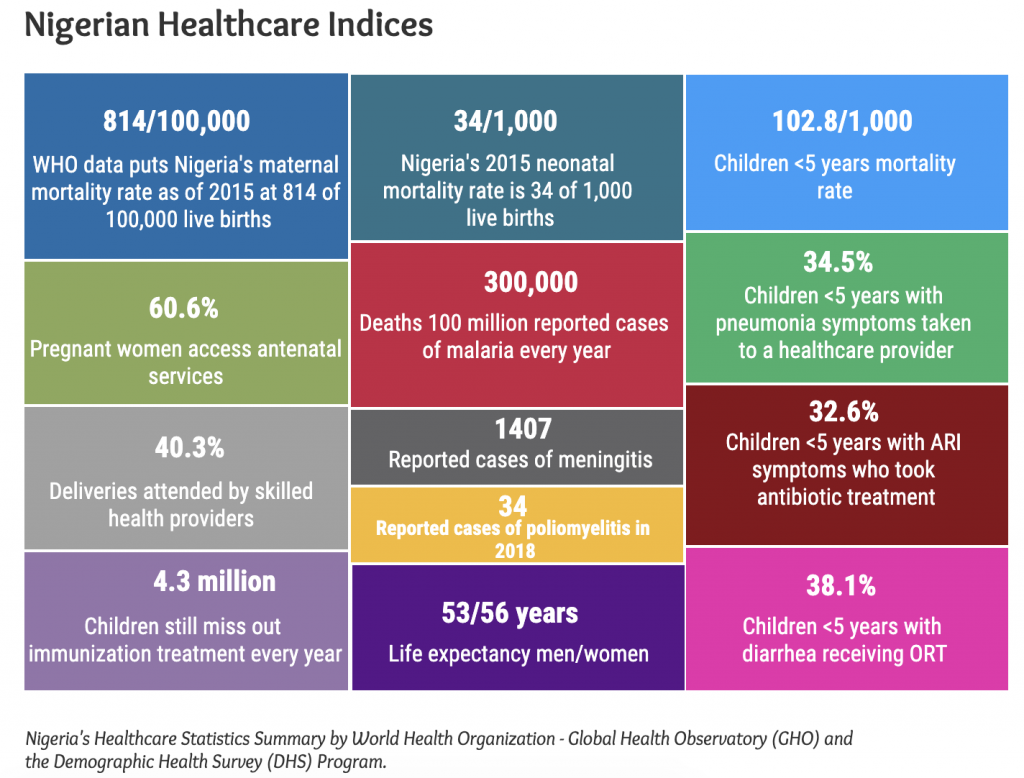
Also, only sixty-one percent (61%) of pregnant women have access to antenatal services according to the HealthCare for Women International and Relief Web while Trading Economics puts birth attended by skilled health staff by. 2014 at 35%.

The picture looks grimmer when UNICEF says that 4.3 Million Children still miss out of immunizations every year and Trading Economics puts the neonatal mortality rate at 34.7 per 1000 live births in 2015. Also, Nigeria Malaria Factsheet estimates that there are over 300,000 malaria deaths per year with 100 million cases. This is besides the fact that Maraia contributes to an 11 % mortality rate in Nigeria.

Furthermore, reported cases of Meningococcal disease by WHO as of March 2017 is a total of 1407 with 211 cases resulting in deaths, although the Nigeria Center for Disease Control puts the number of reported cases at 914. 

Global Polio Eradication Initiative puts reported cases of poliomyelitis in Nigeria at 13 in 2019 and 34 in the year 2018.

Health Financing and Government’s Commitment

A close look at the health budget proposed for 2020 and the trend analysis of government investment since 2010 by DATAPHYTE showed continued lack of commitment to prioritise health funding or adequately provide for universal health coverage of Nigerians.

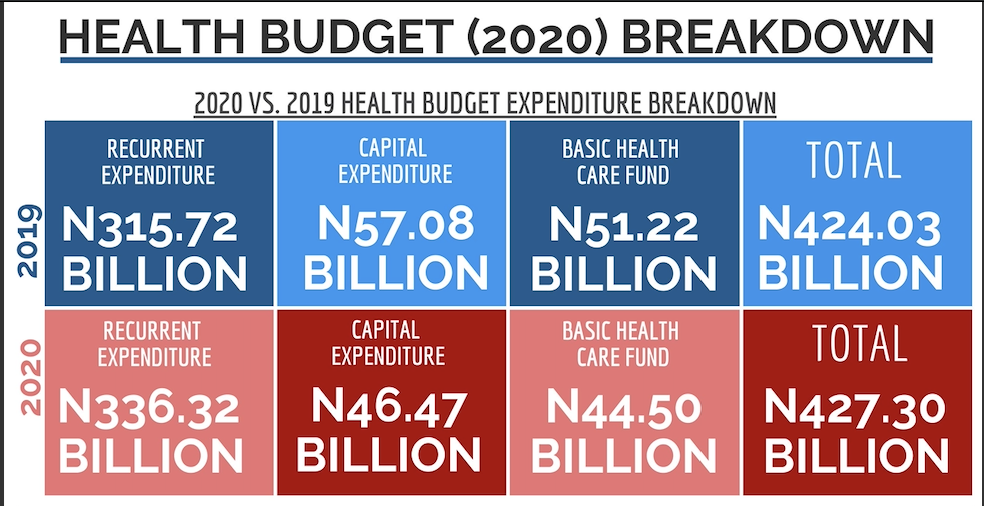
When the 2020 proposed health budget is compared with that of the approved 2019 budget; there is a marginal increase in the overall Budget, from N424.03Bn in 2019 to N427.30bn in 2020. This is 0.77 percent increase in the budgeted expenditure. This reflects on increased recurrent expenditure by 6.53percent, from N315.72Bn in 2019 to N336.32Bn in 2020. However, the Capital Expenditure dropped by -18.58 percent (from N57.09Bn in 2019 to N46.48Bn in 2020) while the Basic Health Care Fund dropped by -13.12 percent (N51.22Bn in 2019 to N44.50Bn in 2020).

Another instance which shows that the priority of this administration is shifting away from healthcare is the fact that out of the three key development sectors (Security, Education, Health) of the country, health sectors got the lowest appropriation in the 2020 national budget. The Health Ministry had a meager budget of N427.30 billion which is only 4.14% of the proposed budget for 2020, while the Ministry of Education has 653.94 billion which represents 6.32% of the total national budget, On the other hand, security  and humanitarian affairs combined has N1.985 trillion which represents 19.23 percent of the national budget.

The latter comprises of Ministry of Defence – N878.46 billion (8.5%), Ministry of Humanitarian Affairs, Disaster Management and Social Development – N444.22 billion (4.30%), Ministry of Police Affairs – N409.14 billion (3.96) and the Ministry of Interior – N254.81 billion (2.47%).
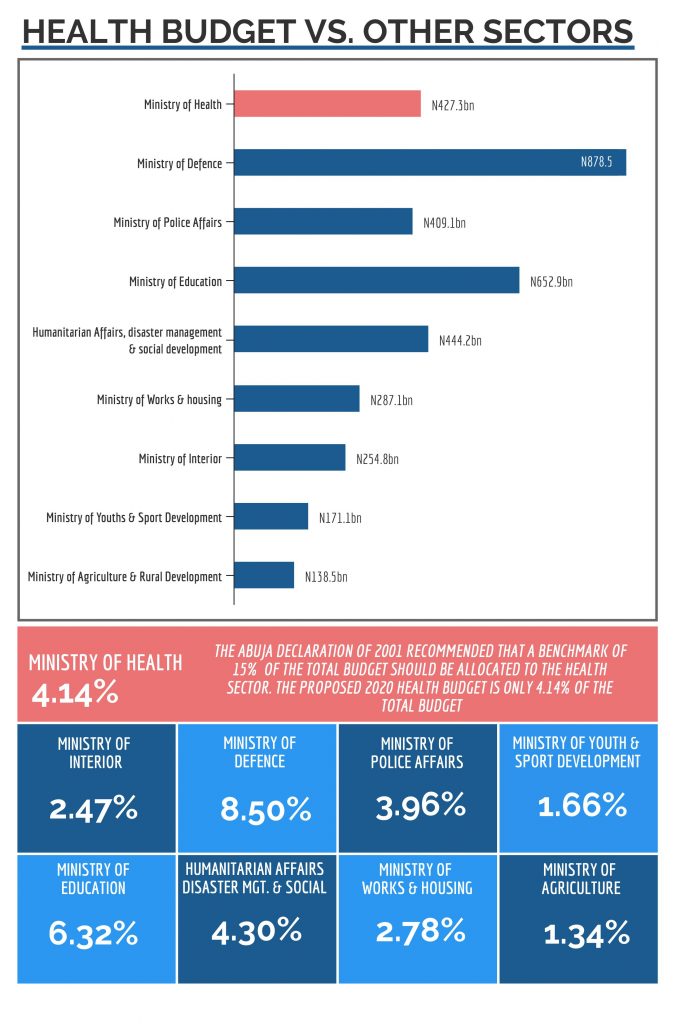
The latter comprises of Ministry of Defence – N878.46 billion (8.5%), Ministry of Humanitarian Affairs, Disaster Management and Social Development – N444.22 billion (4.30%), Ministry of Police Affairs – N409.14 billion (3.96) and the Ministry of Interior – N254.81 billion (2.47%).

Flouting the Basic Health Care Fund (BHCF) Law

Another clear indication of the administration’s low commitment to Healthcare of its citizens is the proposed allocation for the Basic Health Care Fund (BHCF) in the 2020 budget. A check on the budget item for BHCF in the health budget indicates N44.50 billion, and this does not reflect the expected 1% stipulated in the National Health Act (2014).

The National Health Act (2014) states that “at least 1% of the Consolidated Revenue Fund (CRF) shall be allocated to Basic Health Care Fund (BHCF)”. Based on the 2020 Appropriation Bill, the Consolidated Revenue Fund (CRF) is N10.33 trillion, which means that the one percent allocation to BHCF should be N103.3 billion and not N44.50 billion.

Also, it is unclear how the allocation to BHCF was derived especially considering the allocation to another development fund. The Universal Basic Education (UBE) fund which by legislation should have two percent of the CRF just like the BHCF was also significantly reduced with a proposed allocation of N111.79 billion. However, if any consideration is given the revenue constraint of government to explain why N111.79 billion is proposed for UBE, then BHCF, therefore, should at least be allocated half that of the UBE – which is N55.89 billion. However, the allocation to BHCF is less than this amount by over ten billion naira.

In the same manner, though the Consolidated Revenue Fund has been on the increase, and forms the basis for allocating funds to the Basic Health Care Fund (BHCF), this has not reflected in the actual funds allocated to BHCF. The BHCF has been on a downward progression since the first allocation in 2018. For instance, in 2018, N55.15 billion was allocation but in 2019, about N51.22 billion was earmarked and the lowest in 2020 with 44.498 billion.
Rising Recurrent, Oscillating Capital 

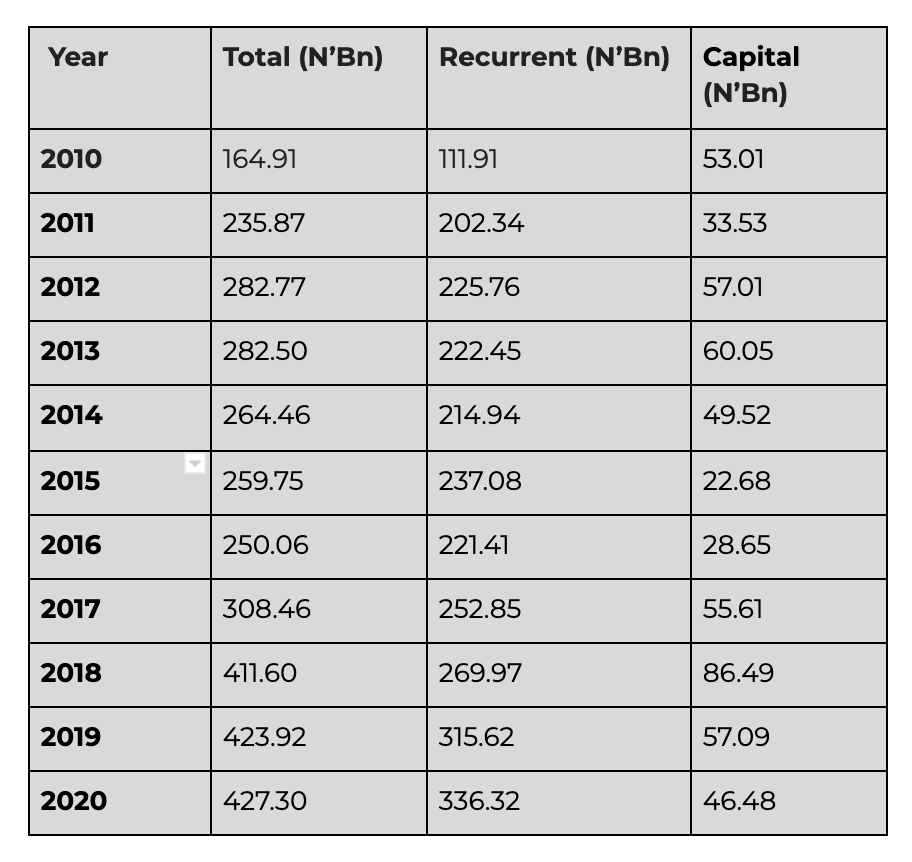
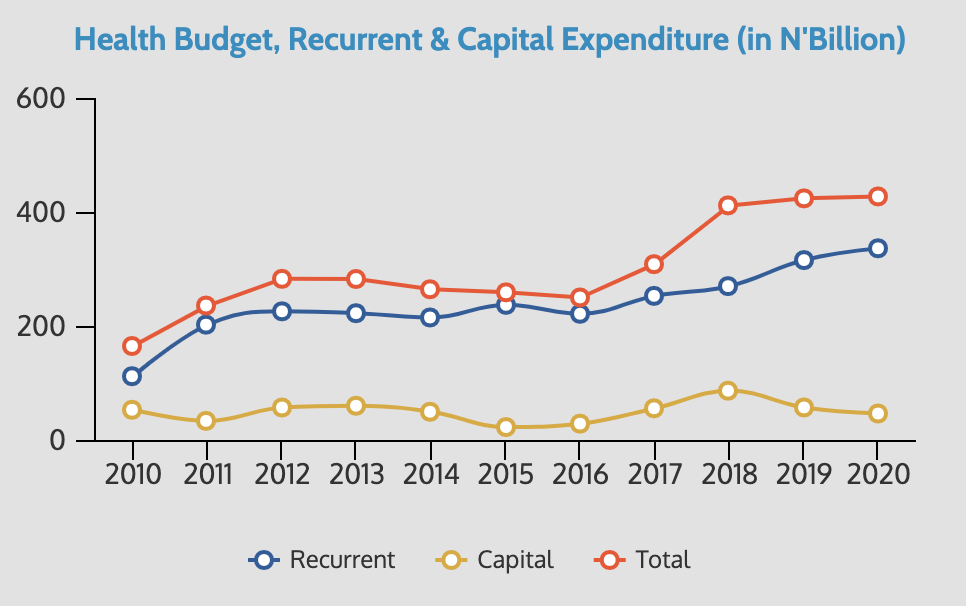
The trend analysis of budget allocation to the respective components of the Budget has revealed that though the total health budget continues to rise as well as the recurrent expenditure, the capital expenditure fluctuates and has been on a gradual decline for the last 2 years. While the capital budget increased from 28.65 billion naira in 2016 to 55.61 billion in 2017 and 86.49 billion nairas in 2018; but nosedived to 57.09 billion in 2019 and has further been reduced in the proposed budget to 46.48 billion naira against 2020.

This declining capital budget allocation is despite the continuously rising recurrent budget for the same period. As shown in the chart above and the table below, the recurrent health budget increased from 221.41 billion naira in 2016 to 252.85 billion in 2017 and 269.97 billion nairas in 2018. In 2019, the recurrent still rose to 315.62 billion in 2019 and has further been increased in the proposed budget to 336.32 billion naira against 2020.

Thus, even as the total health budget seems to be increasing annually, say from 250.06 billion naira in 2016 to the proposed 427.3 billion in 2020; it is clear the increase all goes to the recurrent budget and at a detriment to the capital allocation that sees to infrastructural investment in health.
Recommendations

It is highly recommended that the Federal government prioritize health as a key sector and a vital component of investing in Human Capital Development with great potential to turn the fortune of the nation around. This can be realised with an upward review of the health budget by the legislative arm even as the 2020 national budget goes through the appropriation process. This is necessitated by the country’s low-performance when measured against the Abuja Declaration benchmark.

More importantly, the government must make the increases reflect in the Capital Expenditure component and follow through with the timely release of the budgeted allocation. This is necessary to achieve prompt delivery of Healthcare promises to the people, to ensure the full utilization of released funds and to avoid an eventual return of funds to the Treasury.

It is necessary to work with the National Office of the Sustainable Development Goals (SDGs), as a major component of the Global Goal is “Good Health & Wellbeing”. Therefore, there must be synergy between the SDGs Office and the Federal Ministry of Health. Closely related is the need for the government to demonstrate its commitment to The Economic Recovery & Growth Plan (ERGP) by allocating funds to achieve the health component of the Plan.

In conclusion, the government must not relent in its plan to revamp and or construct the 10,000 Primary Healthcare Centres across the Nation, by this being reflected in the budget to the National Primary Health Care Development Agency.


This report was first published by Dataphyte and supported by the development Research and Projects Center (dRPC) under the Partnership for Advocacy in Child and Family Health At scale.

“Obviously, our Minister travels by air, Nigerians react to Fashola’s statement stating roads not bad

BABATUNDE Fashola, Minister of Works and Housing and former governor of Lagos state while addressing journalists after the Federal Executive Council meeting on Wednesday said Nigeria’s roads were not as bad as they were portrayed to be.

Dismissing reports on the bad states of the highways, Fashola was quoted “the roads are not as bad as they are often portrayed. I know that this is going to be your headline, but the roads are not that bad”.

Meanwhile, prominent Nigerians and other citizens disagreed with him, while many pleaded the Minister to not adding “salt to injury” in a series of comments on Twitter.

Remi Sonaiya, retired Professor of French and Applied Linguistics and former presidential candidate in 2015 general elections, commented on Thursday on her Twitter handle that she was disappointed in the minister to not believing in media reports that show the state of the country’s roads regularly.

“Now, that’s disappointing, coming from Fashola. What of all the daily reports on television and in the papers, he doesn’t believe them?” she tweeted.

Sonaiya asked him to be travelling frequently on the roads, particularly Ife-Ibadan expressway,  to understand the conditions. 

Femi Fani-Kayode, former Minister of Aviation, accused Fashola of being “intellectually dishonest” to have described the country’s roads not too bad.

“Obviously, our minister travels majorly by air,” tweeted a youth identified as Niyi Alade. He said if Fashola should travel to Ilorin from Lagos on road, he would know whether Nigerian roads are bad or not.”

Emeka Nnadozie, who described himself on his Twitter handle as Current Affairs commentator, said: ‘Nobody listens to Fashola anymore. He is an overhyped Lagos intellectual cum sycophant politician. Can he say same thing when APC was in opposition? We have had enough of these tricksters that are masquerading as progressives.”

Another user said the bad road made road users drive in a zigzag way in order to avoid potholes. 

“That’s why we can’t drive straight. And while avoiding these portholes, we also have to avoid the impatient Keke and bike riders so they won’t hit our side mirror!!!” 

He had complained that time spent on the road multiplies because, while the situation had resulted in deaths. 

The Minister in charge of Federal Roads in Nigeria should be taken to actually drive through every Federal road in the first six months after the swearing-in, then he can settle down and know what to do. Bad roads kill,” a user suggested.

Earlier Reports by The ICIR had noted how the bad roads in some parts of the country affected users and residents in such communities.

In October, the Nigerian Bar Association (NBA) Ogun State Branch protested against the deplorable conditions of roads in the state.

Tragi accidents have often occurred on the Nigerian roads. According to the Federal Road Safety Commission, more than 48,000 people died in over 78,000 road accidents across the country within 2007 and 2016.

FEC approves N58.48bn for Niger road project, link bridge to Kwara

0

THE Federal Executive Council has approved the sum of N58.48 billion for the Bida-Saachi-Nupeko Road project and the Nupeko-Pategi Bridge project, which link Niger and Kwara states.

The Minister of Works and Housing, Babatunde Fashola, disclosed this while briefing State House correspondents after the FEC meeting presided over by Vice President Yemi Osinbajo, on Wednesday at the Presidential Villa, Abuja.

He said it was an old contract, which was terminated and reviewed.

“You heard the project involved, the Bida-Saachi-Nupeko Road and we have attached bridge — the Nupeko-Pategi Bridge across the River Niger, to link Nupeko in Niger and Pategi in Kwara State together.

“And also facilitate connectivity from South West to North Central and North of Nigeria.

“It is an old contract, actually. It was awarded in 2013, terminated for non-performance, re-evaluated.

“It didn’t have a bridge then; we have added a bridge now; approved now for N58. 488 billion; and it is expected to take 30 months.’’

Fashola, who fielded questions from State House Correspondents on the state of roads across the country, said that the rainy season hampered road construction and rehabilitation.

He said it was not peculiar to Nigeria as cities had submerged and infrastructure affected in other parts of the world.

The minister said that what Nigeria experienced in 2019 was unusual, as it was not a good time to be in the transport system.

“We also want this season to quickly end so that we can go back to work during dry weather.

“And that takes me to preparation for the end of the year; you know we have the ember preparation.

“The team has already started work; we will be working with FRSC; we will also be working with our contractors.

“The plan is that in places where they have not yet constructed, they should do palliative works so that the heavy traffic movement during the end of the year is manageable and will reduce the inconvenience of commuters to the barest minimum,” he said.

(NAN)