Home Blog Page 2265

INVESTIGATION: How women in Rivers State suffer from AGIP’s nonstop gas flaring & oil pollution


In this investigation, ELFREDAH KEVIN-ALERECHI, a freelance Journalist, reports on how women in several communities in Rivers State suffer from 24 hour-non-stop gas flaring and regular oil spills from Nigerian Agip Oil Company facilities. These communities include Otua, Ibia, Okukaeze, Ubomanimi, otherwise known as Obiafor field, and Okwuzi community in Ogba/Egbema/Ndoni Local Government Area (ONELGA), of Rivers State.

“Health wise we have been sick. As I talk to you now, I have respiratory problem because of these gases I have inhaled and my eyes are itching.”

These were the words of Lady Martha Igwe (Not real name), who only spoke on the condition of anonymity, in Okwuzi community. She has been barely able to survive on her fish farming business in the last four years.

The skin on Igwe’s fish suddenly started peeling off, but she had no idea why the sudden change because she had been feeding them well, and their water was usually replaced on time. To deal with the problem, a neighbour advised her to do a water test.

The result was revealing. In her words, “The flaring has made our water to be so acidic. When I tested the water of my fish pond, the pH was 4.7. It started peeling their skin. And my cat fish skin started peeling. We thought they were injuring themselves, not until we did the test. Instead of losing them, I started treating my water”, she added.

Igwe was lucky to have a neighbour who was knowledgeable enough to recommend water test. What about other fish farmers who are suffering same as Martha but have no such information?

“As women, we are good at farming, and you need to see what this flaring has done to us. You need to see the hazard. If you look at our crops, you will see stunted growth. Colour of the leaves change. The flaring of gas has made some metals to sink into our water,” she lamented.

Igwe’s story is familiar to other women in other communities in Rivers State who suffer from gas flaring by different multinationals operating in the oil rich Niger Delta region.

The visits to the oil – rich communities of Otua, Ibia, Okukaeze, Ubomanimi, all in Rivers State, revealed that there is no school, no market, and hospital for residents. Bushes surround the communities, with few houses made with mud.

If any member of the community falls sick at night, he/she will have to wait till the next morning before crossing the Orashi River to Omuku town, the headquarters of Ogba/Egbema Local Government Area.

“Women sometimes have low birth weight. These things affect the baby in the womb. Sometimes, even deformity, and bleeding cases. It is horrible. This flaring must stop. The government should come and do something about it”, said a senior health worker at the General Hospital in Omoku said.

A 2017 research by Ann Gibbons reveals that babies born after natural gas extraction began in Pennsylvania, especially those living near freckling sites, had significantly lower birth weights and worse health than other babies.

Oil and gas exploration, a large scale problem

According to the information received via a Freedom of Information (FOI) request to the Rivers State Ministry of Environment, a total of hundred and eighty seven (187) oil spillage cases occurred in 2016 in the state. Inspection shows that the Nigerian Agip oil company Limited (NOAC) recorded the highest spillage, which occurred in Ogba/Egbema/Ndoni Local Government Area of the state.

In 2017, a total number of three hundred and nineteen (319) cases of oil and gas spillages were inspected and investigated by the State Ministry of Environment. The records show that Agip had the highest number of 186 which, occurred in Ogba/Egbema/Ndoni Local Government Area of Rivers State, Nigeria.

From January to November 2018, a total number of 335 cases of crude oil and gas spillage were inspected/investigated by the ministry and other regulators, the affected asset owners (companies) and the communities.

Agip recorded the highest number of oil spills at 159, with Ogba/Egbema/Ndoni Local Government Area having the highest number of crude oil spill/gas flaring cases at 135, followed by Ahoada West LGA-33, and Andoni as the least cases with two.

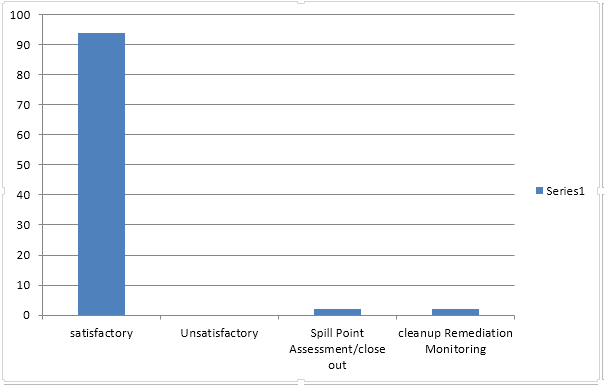
The post summary cleanup inspection of 2018 report by the Rivers State Ministry of Environment disclosed 94 satisfactory; two spill points assessment/closeout and two cleanup remediation monitoring.

The ministry’s report from 2016-2018 shows that a total number of 375 incidents were caused by illegal bunkering, vandalisation, hacksaw cut, and drilled hole (sabotage) across Agip facilities in River State.

Agip caused about 75% of the incidents. Bright Abali, President, Ogba Youth Council believes that the oil company, in trying to save cost, uses obsolete equipment.

RIVERS STATE MINISTRY OF ENVIRONMENT REPORT ON AGIP OIL SPILL CASES

RECORDED SPILL CASES IN ONELGA
JANUARY-NOVEMBER, 2018
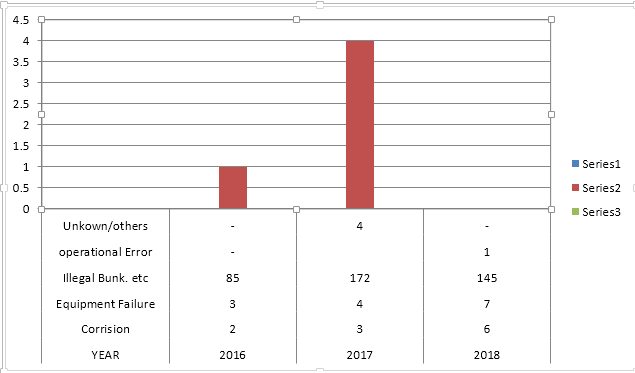
Summary of Oil Spill cases
From 2016-2018

2018 Summary of post cleanup inspection recorded as at November 20, 2018
Abali said that “some pipes are crossing the length and breadth of Ogba/Egbema LGA, they are long overdue, they are eroded, they are not serving the test of time’, he said.

For him, Agip lacks the capacity to put in place the actual global best practice of exploration.

“Go to the river side of Agip OML 61 and the neighbouring OML 58, you will see gas gushing out from the water, the people still drink from it, they do everything with the water, yet AGIP blames it on sabotage. They are not thinking of transforming flare to wealth,” Abali said.

This should all be blamed on the company’s failure to upgrade on the current global trends of exploration, he stated.

Indeed, when our reporter visited these communities, some oil and gas pipes were sited with rusty surface.
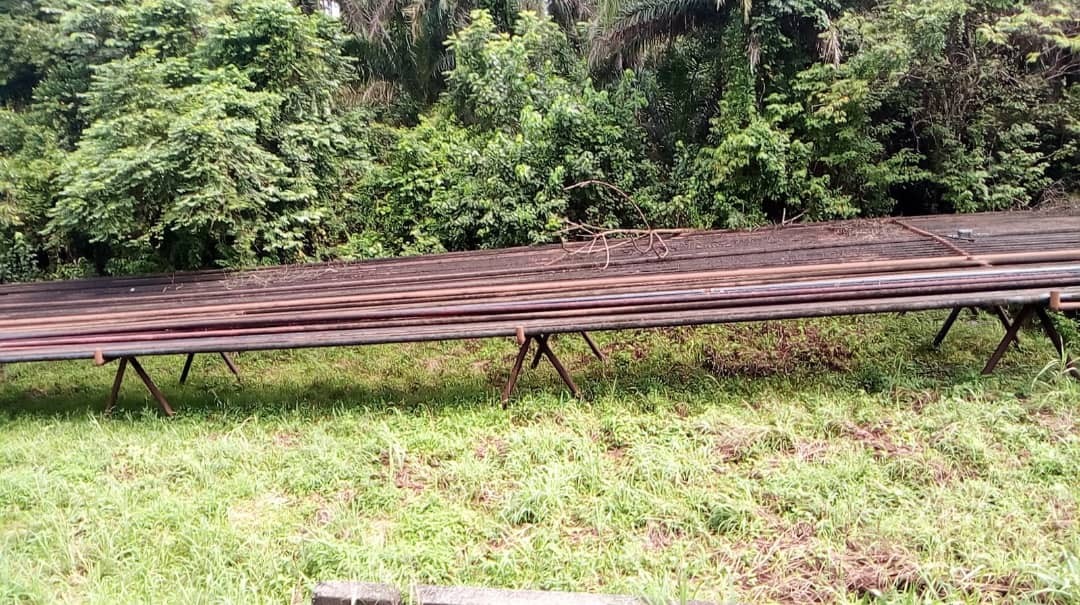
Agip Rusty oil and pipes. Photo Credit: Elfredah Kevin-Alerechi

A rusty and old oil pipe if not repaired can lead to equipment failure, loss of productivity, likely consequences of environmental degradation, oil leaks and thus oil spillage, said Mr. Kingsley Chibuzor Nwogbidi, Chairman, Nigerian Environmental Society, Rivers State branch.

From Omoku town to Obiafor is about 30 minutes drive, but motorists have no option than to leave their cars at Omoku, then cross the Orashi River with a canoe to get to Obiafor. Those with motorbikes and bicycles cross with their bike inside the canoe and pay N200.

On her visit, the reporter started feeling some hotness in the eyes while crossing the Orashi River. She met a young petty trader and asked if her eyes itch her too and she replied, “madam, we are used to it. You are feeling it because this is your first time of coming to this area. However, I usually see darkness whenever I am cooking”.
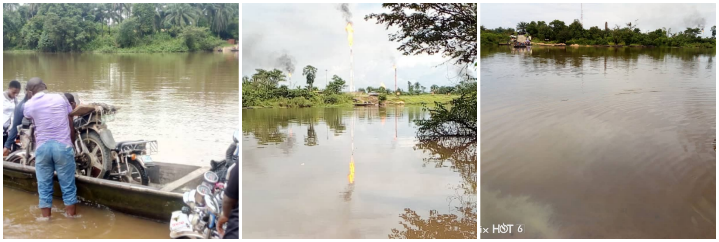
Residents crossing the Orashi River. Across the river is Omoku town where gas flaring flaring is visible. Photo credit: Elfredah Kevin-Alerechi

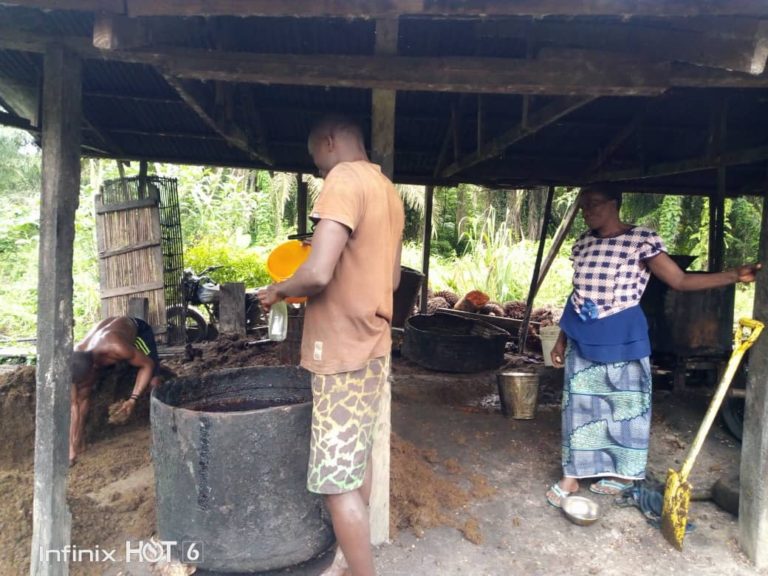
On the way to Obiafor, the reporter saw an old woman and her three boys in their palm oil mill who also spoke about the effect of gas flaring on residents.

“Each time I enter the bush with my children to cut palm fruits, our eyes are always dark”, said Mama Mercy, a palm oil miller

The chocolate complexioned woman, who resides at Otua community, has been doing her palm oil business for more than 32 years. Also, Mama Mercy, whose husband died 12 years ago, singlehandedly trained her nine children, though some dropped out of school due to finance.

The mother who cannot speak English lamented: “my challenge is the manner the smoke comes to spoil my roof. The smoke disturbs a lot. When we enter the bush to cut palm fruit, the smoke will cover our faces, we will be unable to see the palm fruit properly when cutting. The smoke affects me a great deal. When the smoke comes, I have to manage it. It sometimes makes me to cough, sometimes I can’t even breathe well.”
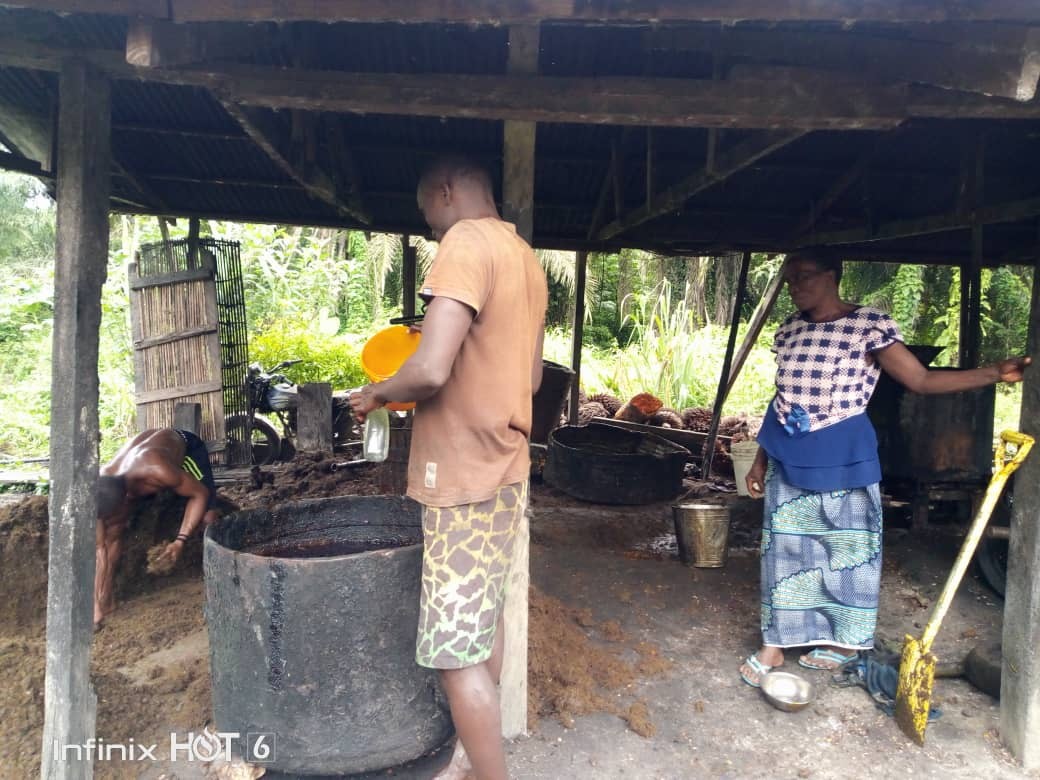
Mercy with her sons in her palm oil mill. Photo credit: Elfredah Kevin-Alerechi

EFFECTS OF OIL SPILLS IN ONELGA
Just like the Ogoniland, livelihood seems to have shut down in Obiafor due to oil spills in the fish pond where community buy and sell fish from.

One of Agip’s major flow stations is located here. Inside the flow station is a family fish pond from which they catch fish for consumption and make profit .

Precious Osiagu, who buys fish from the pond, lamented how oil spills have affected her business, compelling her to send her children to public schools.

“We are the traders, we buy fish. The oil has spoilt the fish. We can no longer see fish to buy in the water. We are now idle here, no fish, because of the oil spills in the pond”, she said.

“Before the water was polluted, the fish was always big, we buy and make gain, but we no longer see fish here again. It has weakened our business, Osiagu, added.

The young, pregnant, pimpled – faced Osiagu lamented that the situation has impacted badly on her family.

“It is through this river we buy fish and sell and train our children, but now it has been polluted, forcing us to pull them out from private school, and we are planning to put them in government school, and you know they don’t teach very well in government schools.”

When caught, the fish would be dried for days before it will be taken to the market, but it cannot stay longer again.

“Before, when we buy the fish from the river, we will dry and keep it till whenever we want to go to the city to sell it, even if it is one week, it won’t go bad. But now, the fish gets spoilt quickly,” she complained.

When asked what she wants from government and Agip, she said; “I want them to come and see the women buying fish from the camp. They should clean the place to enable fish return back to the river and for us to continue managing the way we have been. Our husbands don’t have work,” she urged.

“We have been getting water from this fish pond before it was polluted. We still get water from it with style,” said Nkiru Ibeh, another fish buyer from the camp.

Ibeh, light complexioned and skinny, with dark spots on her body, said “we get water from the fish pond before the pollution, we still get water from it with style. But, now that other companies are in the community, we walk three miles to get the water.

SCIENTIFIC TEST OF THE WATER FROM OBIAFOR FISH POND

The laboratory analysis of the water samples from the fish pond by our reporter at a popular Agro – allied company in Rivers State, reveals that it is polluted with 5.47 pH against the acceptable pH value of drinking water.

The pH is the indicator for acidity and alkalinity and indicates when the water is good or bad for drinking. The normal required pH usual falls between 7-8pH, said EBINIMI JOE ANSA, Director, African Regional Aquaculture Centre.

Flowing surface waters such as streams, rivers, and creeks that are not polluted have a good pH range of 6.5 to 7.5, this range is good for fish in their natural habitats in Rivers State, Ansa added.

World Health Organization says, exposure to extreme high pH values results in irritation to the eyes, skin and mucous membranes.

In 2010, 16 barrels of oil were spilled on our farm and till date Agip has not done any cleanup, said Eluozo Emmanuel, whose mother’s land was affected by the spill.

“The spills occur often, because the pipes have stayed for so many years. They don’t even care to do good cleanup and proper remediation”, he added.

This is contrary to the state Ministry of Environment 2018 post cleanup summary, which was 94% satisfactory with the cleanup done by Agip.

Emmanuel said that he was surprised when there was no compensation by AGIP or a cleanup, after receiving calls from the company to reduce the number of spills.

Emmanuel, whose mother still farms in the polluted land since there is no farm in Omoku town where she resides, added that “my mother still farms in the land, she has no other farm in Omoku, that is why we tell people that the land is a family land and not a community land”.

Emmanuel, who is married with children, narrated that there have been health issues due to gas flaring and pollution, which, according to him, are eye-related problems and cancer.

His words, “we have bad diseases which our old people do not have, even our roofs, we have coloured zinc here because of gas flaring and at the end we don’t benefit anything”

Incidentally while returning from Obiafor, our reporter ran into some Agip company staff amending some spoilt pipes.
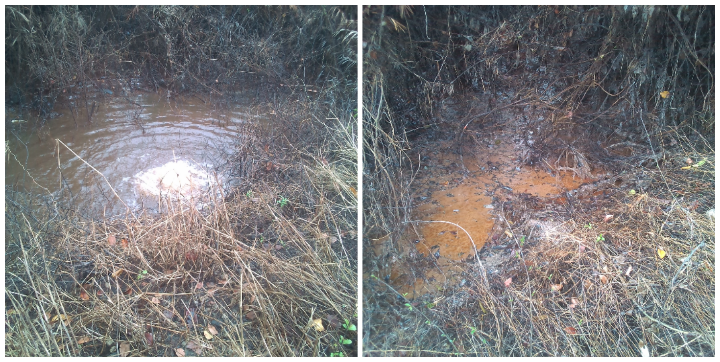
2010, 16 barrels spilled Photo: – Photo source”: Emmanuel Eluozo

When the reporter visited the farm where 16 barrels were alleged to have spilled, she could not enter as it was still full of water.

At about 10:30am one Tuesday morning in August 2019 in Okwuzi community, Ogba/Egbema/Ndoni Local Government, the morning sun was shining bright. Riding on a motorbike from Omuku town to Okwuzi, the reporter saw three pipes flaring gases, and her fixer informed he that the gas is flared every minute of every day all year round.

“This gas flaring is affecting us too much. I have suffered from catarrh, malaria, even my daughter has been having series of itching in her buttocks, pointing the little Ms Onuegbu, who has some black and pale spots”, said Mrs. Matthew Onuegbu

“Taking my daughter to the hospital is expensive and i cannot  it afford now,” said Mrs. Onuegbu

“Gas flaring is one problem that has refused to go. We have been fighting against gas flaring for over two years now. The oil companies have continued to flare gas as if nothing happens”, said Elder Dandy, Executive Director of Niger Delta Initiative, also an indigene of ONELGA.

Elder dDndy is a clean environment advocate who works with several environmental non-profit organizations across the Niger Delta states.

For him, the problem of Okwuzi community is that Agip had influenced all the community leaders by giving them businesses which made it difficult for them to complain in spite of the impact of gas flaring and oil spillage on lives and property in their community.

“The problem now is that the community cannot take Agip to court, because the company has somehow bought the mind of the community by influencing the leadership. By having business dealings with the AGIP, it has become difficult for the community to speak out against the oil company’s operations” Elder Dandy said.

“Gas flaring is a real problem to the people of Okwuzi. Zinc on our roofs has changed colour, once you build house within two years the zinc would change, the rain is acidic,” he added.

Residents recalled that before the Nigerian Civil War in the late ‘60s, they fetched rainwater for drinking, but lamented that today rainwater cannot be used for anything. The water is completely black.

“There is an emergence of unknown diseases in our area here of recent, like the eye problem as you can see I am putting on glasses. I have been putting on glasses for over ten years, but my late uncles at 70s & 80s he was able to read newspapers without glasses. Today you see younger people of twelve- and fifteen-years using glasses,” Elder Dandy lamented.

“There is skin irritation all over the place and other respiratory challenges that can be associated with the gas flaring. Even now the heat wave has increased. The temperature of this area is far above the temperature of other areas where there is no gas flaring. Even our rivers are highly polluted because when it rains, the acid goes into the river even to the underground water”, he added.

Unfortunately for the people of Ogba/Egbema/Ndoni Local Government Area of Rivers State, the environmental debacle in Ogoni has eclipsed other problems areas state and Niger Delta in general. All the attention of Federal Government and international community is on the Ogoni axis but here also, people are feeling the impact but attention on the Ogoni case has caused a big neglect here, Dandy opined.

The oil companies are the ones who give employment to people and they are so influential in the society that people generally do not  allow discussions on issues bothering their community and the company that employed them.

“The international community, multinationals, NGOs, federal government and individual should step out to other communities and come to our aid. We have no power to fight these big monsters. we have no voice. They control everything, there is anger among the few, we are helpless, that’s why we need external help,” Elder Dandy appealed.

According to a study carried out by Amadi Akobundu of the Geology Department, Federal University of Technology, Minna, gas-flaring constitutes a major source of water pollution in the oil producing region of Eastern Niger Delta. The results of the laboratory analysis of the water samples revealed that the water sources in the area have negatively impacted acid-rain and NO2, SO2 and CO2 from the burning gas.

HEALTH RISK OF GAS FLARING AND OIL POLLUTION
“When a car is parked outside for long and the acid rainfall on it, you will start seeing the colour defaced. When you compare it to humans, this is the same effects such water has on us especially when it has been used to cook,” said Daniel Onyetulem, Managing Director, Century Medicaid Services limited.

Onyetulem, a trustee at Stevenson Holistic Care Foundation, observed that these substances accumulate in the lungs, which starts to react.

He said that said precautionary method to reduce the impact of gas flare should be to “avoid acid rain, such water should not be used to cook or bathe. Avoid having contact with acid rain, do not allow it to touch you, avoid leaving around areas where gases are flared and boiling the water doesn’t mean you have treated the water”.

Respiratory tract infections are diseases that effects the nose, throats, oesophagus, while symptoms can look asthmatic. Some react adversely to the substance that is flared, sneezing, redness of the eyes, the persons becomes restless, which also result to excessive dry cough that is productive of any sputum.

WHAT THE LAW SAYS ABOUT ENVIRONMENTAL POLLUTION

In Nigeria, despite the plethora of laws dealing with pollution generally, when it comes to the issue of compensation for oil pollution, the only law that makes express provision for compensation of victims of such pollution is the Oil Pipeline Act CAP O7, LFN 2004.

Chima Williams, President Green Alliance Nigeria, who is also the Head of Legal Resources, Environmental Rights Action/Friends of the Earth Nigeria, also cited Sections 245 and 247 of Criminal Code Act Cap C39 LFN 2004, which makes provisions for prohibition and/or punishment for pollutions of various kinds, including that of petroleum, adding that the difference between them and the Oil Pipelines Act is that they see pollution from either criminal angles that should be punished by jail terms or be restituted by claims of damages or for compensation anchored on the ownership of land.

It is not the duty of everybody to know what the law says on every subject matter, therefore, victims of pollution of any kind should seek legal advice from those competent to know on their rights. Whether such pollution or polluting practices have breached their rights and if yes, what remedies are available to them and how can such be secured, he stresses.

He further calls for government and businesses that engage in polluting activities to follow principles of respecting Citizens rights.

“As every pollution impacts negatively on the rights of citizens in terms of breaching their rights to life, dignity of the human person, and right to live in an environment conducive for their development etc, one will advise both governments and business that engage in polluting activities to begin to follow the principles of respecting the citizens rights, protecting such rights and when in course of their operations such rights are violated, they must provide remedy”.

Problematic Agip
A letter dated October 7, 2019 sent to the Port Harcourt office of Agip on our findings has not been answered. The letter was duly submitted through the Public Affairs Department. When our reporter got to Agip offices in the Rivers state capital on October 7 at about 4.00pm,  a security man told her the officers to receive my letter had closed and asked her to return the next day at 8.00 am.

When I got to the gate of Agip Company in Port Harcourt, a security officer asked me to open my bag I did and they searched the bag and directed me to go behind the security post and look for Room 4. When I got there room 4 was locked, I saw some persons carrying different foodstuffs into different cars outside the corridor, it looks like they are heading for an event, both old, and young men and women.

She went back the next day at 8.00 am and was told by a security man, Mr Ogu, to drop the letter into the postal box of the Public Relations Department, with an assurance that staff of the unit would pick it up. Mr Ogu however declined to sign or stamp and acknowledgement copy of the letter, claiming that Agip does not acknowledge letters.

In the letter, the reporter had request the oil company to speak on the allegations by the people of ONELGA on the constant oil pollution without cleanup and compensation, as well as the continuous flaring of gas, which the people say adversely affect their health business and the environment.

Has the NOSDRA been active enough to ensure proper cleanup and penalise defaulters?The National Oil Spill Detection and Response Agency (NOSDRA) is a government owned agency saddled with the responsibility ensuring compliance with environmental laws in the petroleum sector. Data obtained from the Nigeria Oil Spill monitor, www.oilspillmonitor.ng, a website run by NOSDRA to keep track of oil spills in the country estimated about 8134,81251 spilled areas in ONELGA

“The Act empowers NOSDRA to receive reports of oil spillages and coordinate oil spill response activities throughout Nigeria but does not empower the agency to penalise for oil spillage,” said Cyrus Nkangwung, Port Harcourt Zonal Director, in an official letter dated September 25, 2019, quoting section 6(2) and (3) of the NOSDRA (Establishment) Act No.15, 2006.

Most stakeholders opined that the agency has not done enough to protect the environment and the rights of residents of oil producing communities.

This Investigation was facilitated by the Wole Soyinka Centre for Investigative Journalism (WSCIJ) under its Report Women! Female Reporters Leadership Programme (FRLP) implemented with support from Free Press Unlimited.
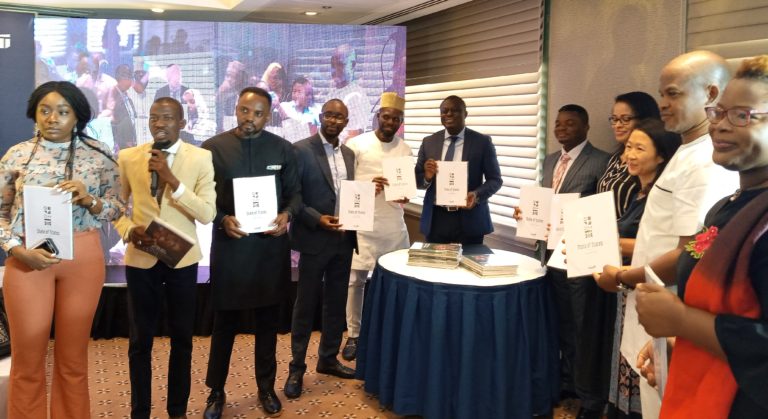
State of States 2019: Only Lagos, Rivers, and Akwa Ibom can finance their recurrent expenditure obligations with state-owned revenue

ONLY three states including Lagos, Rivers, and Akwa Ibom can meet and finance their recurrent expenditure obligation with states-owned revenue without receiving the monthly allocation from the Federal Account Allocation Committee (FAAC).

This was learned on Thursday, October 23 at the 2019 edition of the State of States report released by BudgIT, a civic organisation driven to make the Nigerian budget and public data understandable and accessible across every literacy span.

The State of States report that reveals the fiscal sustainability of Nigerian states is anchored on three key indices which are; Index A: states’ ability to meet their recurrent expenditures independently of the Federal Government (weighted average of 0.35 per cent), Index B: the state’s ability to meet their recurrent expenditures with both its internally generated revenue (IGR) and federal allocations (weighted average of 0.50 per cent), and Index C: how long it would take states to pay off their total debt stock (weighted average of 0.15 per cent).

The report shows that considering the ability of states to meet up with their recurrent expenditure obligation with their IGR, Value Added Tax (VAT), 13 per cent share of oil derivation paid to oil-producing states, states like Lagos with index 0.48, Rivers-0.73, and Akwa Ibom- 0.91 sit top in that index.

States like Kogi, Adamawa, Plateau, Taraba, and Osun with 4.34, 4.19, 3.60, 3.89, and 3.04 respectively as their indices on the ladder will have to rely so much on the federal allocation and also have to borrow to settle their recurrent obligations.

In the report, BudgIT stated that access to audited statements brought out some facts on the true state of recurrent expenditure in focus states.

“We discovered states, such as Delta, running huge recurrent expenditure reaching N200billion. Bayelsa, despite its size and population, has a high recurrent bill as high as N137billion, compared with Ebonyi with a recurrent bill of N30billion, Sokoto N38billion, Jigawa N43billion, Yobe N35billion etc,” BudgIT said in the report.

“However, we notice that Kogi lags behind due to its huge recurrent bill as at 2017, when it was still paying salaries for workers and also had high repayment bills for loans,” the report added.

BudgIT, however, said it believes that Nigeria needs to create incentives for states to expand growth and earning potential, thereby activating resources needed to improve the state of health, education, and access to opportunity.

It further said states can invest in their unique resources to boost their income by keeping their recurrent costs lean to free up more spending for social and economic infrastructure.

EXCLUSIVE: How father of seven died in a landslide at Dangote’s coal mining site

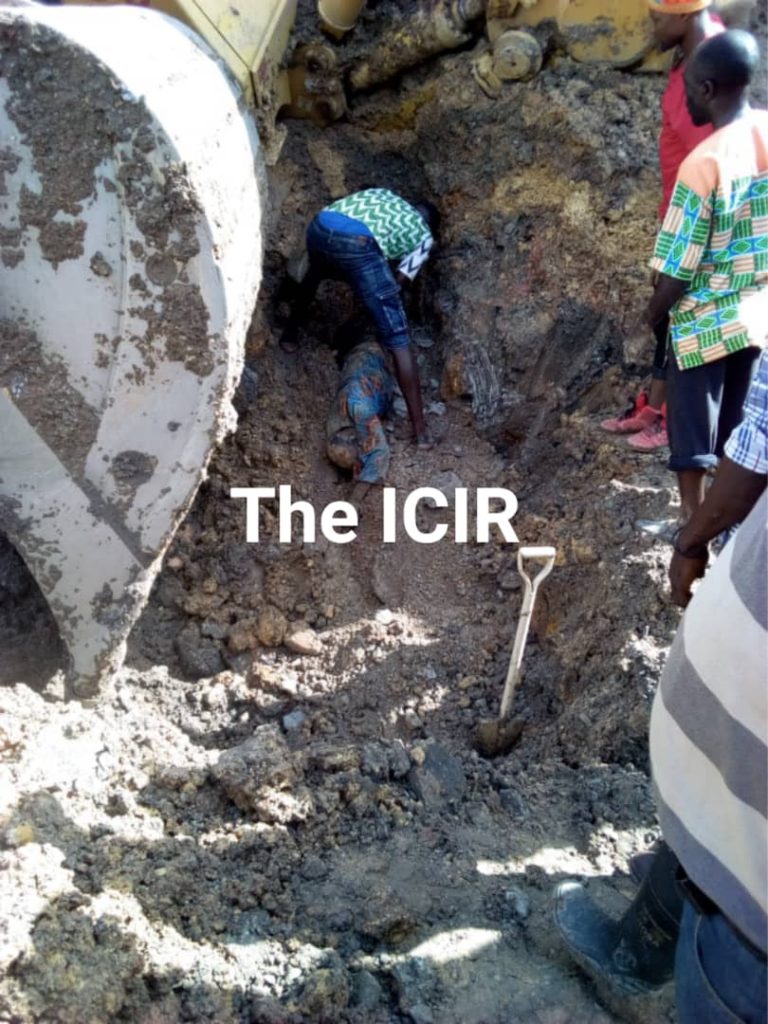
BENEDICT Etonu, a middle-aged man of about 50 years has been killed in a landslide that occurred at a Dangote Coal Mines Limited site located in Awoakpali Community, Ankpa Local Government of Kogi State, The ICIR can authoritatively report.

For almost 24 hours, Etonu was buried under mud—his body was found at about 2:28pm on Wednesday while the landslide took place at about 5 pm on Tuesday.

Two heavy-duty machines—a loader and bull-dozer were also covered by the landslide alongside the deceased, an eyewitness told The ICIR.

“Two excavators are currently working to exhume the body,” Fredrick Ahmadu, Awoakpali Community Representative to Dangote coal company informed our correspondent.

Narrating the incident, Ahmadu said the landslide occurred at about 5pm Tuesday evening while the deceased was trapped by excavated soil as he struggled to escape from the coal deposit site.

Location of the landlside where the Late Benedict Etonu was covered Photo Credit: The ICIR

“He was working as a dump man,”he said.

Describing late Etonu’s job as much of traffic warden, who controls the heavy-duty machines on where to dump excavated coals, the community representative said as of 1:30 pm on Wednesday his body was not found.

“Around 4:30 to 5pm, there is a machine called dumper coming towards his area. So, as he was controlling the vehicle on where to dump the sand, suddenly the ground opened where he was standing and he went in,” he recalled.

“He struggled to escape but the other heap of sand came down and covered him.”

According to Ahmadu, while the personnel of the Dangote mining company searched to remove the remains of the deceased in the mud, neither the police nor the Mines Inspectorate Department in the state were informed of the accident.

This is contrary to the provision of Part VIII, Section 84 (1) (a), (b) the Nigerian Minerals Mining Act (2007), which states that all operations should stop while the incident is reported to the police.

The Mining Act also states that such incident should also be reported to the Mines Inspectorate Department in the state – Kogi. After this, the incident will be probed by the Minister of Mine and Steel Development through a four-man panel of inquiry.

“The holder of mining lease or licence shall, if an accident occurs in any mine or in connection with the mining operations conducted under its lease, temporary title or licence granted under this Act involving loss of life or serious injury to a person, report the accident as soon as possible, with full particulars of the accident -:

“(a) to the nearest Police Station; or (b) to the office of the Mines Inspectorate Department in the State in which the accident occurred,” the Act states.


One of the heavy-duty vehicles that allegedly collapsed with the late Benedict.
Photo Credit: The ICIR

“The whole staffs are mourning, the management too is mourning. So what we are doing now is to exhume the body.”

Adejoh Samuel, former Community Representative of Awoakpali also acknowledged the incident. He also narrated how the two heavy-duty machines – a dumper and a bulldozer sank with the deceased

“The dumper and the bulldozer fell inside with the man…and the sand buried them,”  Samuel said.

As at the time he spoke with this reporter at about 12:35 pm, the company was still trying to exhume the corpse. “They only succeeded in removing one dumper around 12pm but the dozer is still there.”

According to him, some of the experts had to stay back from the site to avoid being lynched. But, he was not certain if the incident was already reported to the police.

The sad event both Ahmadu and Samuel disclosed has caused an uprising among the youths in the host community against the Dangote’s firm.

“I am going back to their office to meet my community boys so they won’t destroy things and keep them under control,” Ahmadu who spoke to this reporter on phone said as he ended the call.

The deceased 25-year-old daughter, Fadoje Etonu who spoke with The ICIR, expressed uncertainty on how her mother would take care of her six siblings.

She hinted that officials of the mining firm promised to visit the family of the deceased.

Dangote firm confirms incident

When contacted, management of the mining firm confirmed the incident. Though not much detail of what happened was provided.

“There was a landslide. We are trying to recover his body,” Hari Car, Senior General Manager of the firm told The ICIR.

“I cannot speak much on it, you can contact Alhaji Usman Jibrin, the coordinator of the mine.”

Car claimed the incident was reported to the Police Tuesday evening and also Wednesday morning. This contradicts the position of the Kogi State Police command which insisted that it was not informed of any accident on the mining site.

However, Williams Ovyeaya, Police Public Relations Officer, Kogi State Command did not answer repeated calls put to his line, neither did he return the calls.

But 10 minutes after receiving a series of text messages from this reporter, he denied knowledge of the incident he replied with a terse SMS that he was yet to receive such information.

“I have not received such information but I’ll find out,” Ovyeaya replied.

The site manager identified simply as Gowing was contacted but his line was placed on voice message all through the period.

Also, Usman Jibrin, the Mining Site Coordinator, who Car referred the reporter initially claimed ignorance of the incident when he was contacted.

“What happened,” he queried. The ICIR went further to brief him about the landslide incident and the victim, but he simply said, “your information is wrong”.

Later, he succumbed and said, “There was a landslide and he (the deceased) was standing uphill. There was no machine …..”. He went further to criticise initial claim of the reporter that the late Etonu was buried alive by sand and had not been found.

However, when asked if the deceased worker was alive, he shouted, “your information is wrong”.

“Please, I don’t know you. I can’t be discussing like this,” he stressed when further questioned if the incident was reported to the police and other appropriate authorities.

Again, The ICIR told him of picture evidence of the incident, then, he said, “Fine! use it. You can use it.” Thereafter, he advised the reporter to send his inquiry to the Corporate Affairs Department of Dangote Group.

Failed Response from Official Email to Dangote Group of Companies.
Source: Olugbenga Adanikin, The ICIR

A mail sent to the official mailbox of the company was however not delivered as it was returned as a failed delivery.

When Jibrin was told of how an earlier email sent to the  Dangote Group, Corporate Affairs Department – communications@dangote.com failed. But he simply said, “I am having a rest. I’m on the bed. I just woke up to pick your calls,” at about 12 noon.

Two phone numbers found in the media segment of the official website of Dangote Group, displayed for the public to contact the organisation were also unreachable.


NGOs to launch Red Card to Jungle Justice Campaign

A COALITION of Non Governmental Organizations is set to launch a campaign against jungle justice that is daily gaining ground in the country and across Africa.

The coalition comprising Devatop Center for Africa Development, Cleen Foundation and other civil society organisations said plans are on to organise a mass sensitization of Nigerians against unlawful killings of criminal suspects.

At a stakeholders meeting held in Abuja on Wednesday, Chairman, Cleen Foundation, Benson Olugbou stated that the idea of jungle justice was borne out of the demand of the people for justice due to failure of government to uphold its duty and responsibility to the citizen.

Olugbou explained that the campaign against jungle justice is aimed at reminding the government of its primary objective of securing lives and properties of every Nigerian.

“It increases lawlessness if people can just wake up and start to kill each other and it appears to show that there is failure of governance,” he said.

He lamented that there have been continued cases of jungle justice and extra-judicial killings in Nigeria, making reference to the recent killing of suspected one chance drivers in Abuja by angry mob.

Speaking on the need for the campaign, Osuigwe Joseph,  chairman of Devatop Center for Africa Development, stated that jungle justice has so far been under reported in Nigeria.

Joseph stressed the need for synergy between stakeholders to curb jungle justice in the country.

According to him, the planned campaign would be held  to commemorate the International Human Rights Day.

While speaking on the rationale behind ‘Red Card’, Joseph explained, “As used in football, the red card indicates dismissal of a footballer or player during a match, the red card is the same in the proposed campaign.”

James Ugochukwu, a representative of African Centre for Enterpreneurship and Information Development (ACEIDEV),  lauded the campaign, stating that jungle justice seems to have become an African culture.

Ugochukwu referred to an incident of a military colonel in Ghana, who was seen jogging in an unfamiliar terrain with his holstered pistol asking for directions but was presumed to be a thief by members of the neighborhood  who beat him to death.

This incident, he said reinforces the need to curb the spread of jungle justice across Africa, noting that if such fate could befall a military personnel, it could happen to anyone.

Goziem Onugha from Lawyers Alert stated that the issue of jungle justice is a circle stressing that those who carry out jungle justice are angry and feel the police is not doing enough.


Onumah files N100m suit against DSS for rights violation, unlawful detention  

CHIDO Onumah, the Executive Director of African Centre for Media and Literacy (AFRIMIL) has approached the Federal High Court, Abuja to sue the Department of State Security (DSS), and its Director-General Yusuf Bichi for violating his fundamental human rights.

In a motion filed on Onumah’s behalf by his Counsel, Moses Ideh,  Bichi stands as the first defendant while the DSS is the second respondent.

“Compensatory damages in the sum of N100, 000, 000 only, to the applicant for the violation of his fundamental human rights,” the motion reads.

“Exemplary damages in the sum of N50, 000, 000 only to the applicant for setback, trauma, psychological and emotional distress experienced and still being experienced.”

This follows his unlawful arrest and detention by the operatives of DSS on September 29 at the Nnamdi Azikiwe International Airport as he returned from Barcelona, Spain, where he had gone to defended his PhD thesis.

In the suit, the author and former journalist recalled how he was arrested and detained by the secret police on his arrival from Spain at the Nnamdi Azikwe International Airport, Abuja.

He said the DSS of unlawfully held him from about 5pm to 10:30 pm on the said date without a prior court order.

Onumah maintained that the action contradicts Section 35 and 41 of the 1999 Nigerian Constitution as amended.

However, he said his T-shirts were seized during the arrest while he also demanded that a thorough investigation should be conducted on the officers either directly or remotely responsible in the act.

“Declaration that the arrest and detention of the applicant at the NAIA on the 29th of September, 2019 at about 5:00pm to 10:30 pm by officials and/or agents of the respondents without lawful cause and without an order of court constitutes a violation of his fundamental human rights to dignity of his person, person liberty, freedom of movement, and freedom of expression as provided in Section 34, 35 and 39 of the 1999 constitution of the Federal Republic of Nigeria as amended,” the motion reads in part.

“Declaration that the unlawful seizure of the applicant’s T-Shirt and coercion to write an undertaking never to wear the said T-shirt again by officials and/ or Agents of the respondents amounts to violation of his right to own property and his right to freedom of expression as contained in Section 30 and 44 of the 1999 constitution of the Federal Republic of Nigeria as amended.

“Declaration that the mental and physical trauma which the applicant had to endure during the period of time he was held in detention by officials and/or agents of the respondents constitutes a violation of his right to dignity of his person as provided in Section 34 of the 1999 constitution of the Federal Republic of Nigeria as amended.”

Other parts of the motion include, “an order of mandamus compelling the 1st respondent to carry out a thorough and in-depth investigation and prosecution of all its officers and/ or agents directly or remotely responsible for the applicant’s unlawful arrest and violation of his rights.

“A written unreserved apology from the respondents to the applicant to be published in two national dailies for the harassments and unwarranted mental and physical trauma meted on the applicant while in custody of the respondents.

“An order for immediate release of the applicant’s T-shirt.”

Aside from seeking reliefs, Onumah also did an affidavit narrating how he was confined to a space during detention at the DSS office and also coerced to write an undertaking against his wish not to wear any t-shirt with the inscription “We Are All Biafrans”.

“I was in custody of the respondents for a period of five hours 30 minutes before the respondents released me.

“During my period of incarceration at the respondents’ facility, my freedom of movement was restricted, my telephone and international passports were ceased and I was treated like a common criminal,” the affidavit partly reads.

The ICIR earlier wrote on the incidence, followed by an exclusive interview detailing the drama that ensued and how he was eventually taken from the Abuja airport to the DSS Headquarters, in the guise of protecting him from purported agitators.

Pay new minimum wage before 2020, including arrears from April, FEC directs finance minister

THE Federal Executive Council (FEC) on Wednesday instructed the Minister of Finance, Zainab Ahmed, to begin the payment of the new minimum wage structure “on or before December 31, 2019”.

The Nation Newspaper reported that the Labour Minister Chris Ngige disclosed this resolution after the weekly FEC meeting held at the Presidential Villa, Abuja.

The minister also said the council approved that the payment should be effected from April 18, when President Muhammadu Buhari signed the amendment into law.

With Buhari in Sochi, Russia for a three-day Russia-Africa Summit, Vice President Yemi Osinbajo presided over the meeting.

The Trade Union side of the Joint National Public Service Negotiating Council (JNPSNC) had urged the government in a statement released on Monday to ensure all arrears of the minimum wage from April are paid “so as not to trigger off another avoidable round of agitation”.

According to The Nation, Aviation Minister Hadi Sirika also disclosed after the meeting that N1.7 billion was approved for the purchase and installation of communication equipment to be used at airport towers in Zaria and Katsina.

The contract, projected to be completed within eight months, is aimed at ensuring safety and efficiency.

Ogbonnaya Onu, the Minister of Science and Technology, said the council equally approved the use of methanol, a chemical used as fuel and derivable from natural gas, in local industries.

With the FEC’s decision, the chemical can now be used for cooking and as transportation fuel, as a way of reducing gas flaring.

Onu emphasised that methanol is a cheap and safe alternative which will not only curb environmental pollution but also reduce deforestation. Ensuring its use becomes widespread will be done with the support of the private sector, he said.

The council also approved a name-change for the Ministry of Communication, which is now to be referred to as the “Federal Ministry of Communication and Digital Economy”.

ICPC arrests suspected certificate forgers in UNIPORT

0

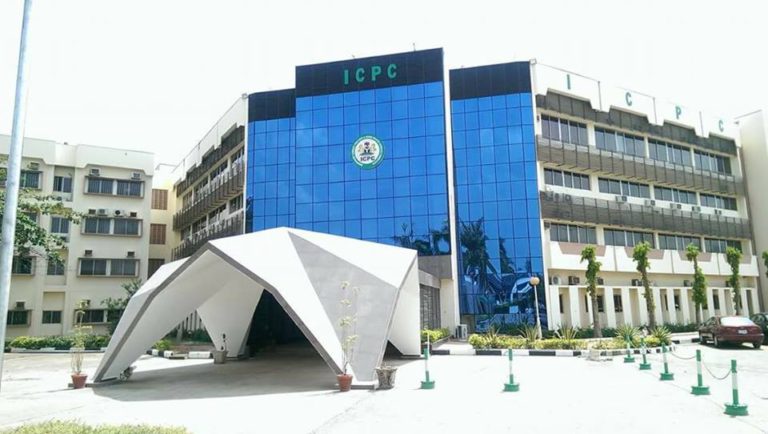
THE Independent Corrupt Practices and Other Related Offences Commission (ICPC) says it has arrested two suspects who specialise in forging school certificates at the University of Port-Harcourt (UNIPORT), Rivers State. 

A statement by the Commission disclosed that the suspects – Onosemuode Roland and Jacobson Ubong Jonathan were  nabbed through a sting operation successfully carried out by  its operatives at the Choba Campus of UNIPORT.

According to the Commission, the suspects specialized in forging school leaving result, diploma and degree certificates.

it stated that ICPC undercover operatives approached Roland and requested him to produce an original Bachelor of Engineering Certificate in Chemical Engineering to aid in employment into one of the oil servicing companies which he agreed to do for the sum of N45, 000. 

“Roland was arrested after producing forged degree certificate and on receiving the balance sum of N25, 000.00 marked money,” the statement read.

The ICPC said, subsequently, Roland volunteered a statement in the presence of one Atarhinyo Solomon Igho and a lawyer Dennis Enyi Nwokah, where he admitted the allegation of certificate forgery.

He also mentioned Jacobson Ubong Jonathan as a conspirator who was later arrested by ICPC operatives.

It noted that, with a further investigation ongoing in the matter, the suspects had been granted administrative bail.

“The suspects would be charged to court for allegedly committing offences that contravene Sections 15 and 25 of the Corrupt Practices and Other Related Offences Act, 2000,” the ICPC said.   

Renewed xenophobic attacks: We’re on top of the situation — FG

0

FOLLOWING the fresh xenophobic attacks on Nigerians in Mpumalanga Province, South Africa on Tuesday, the Federal Government says the country’s Consul General was on top of the situation as part of the efforts to curb the attacks.

Chairman Nigerians in Diaspora Commission (NIDCOM),  Abike Dabiri-Erewa said, in a statement issued by Head of Media Unit, Abdur-Rahman Balogun that government would ensure implementation of the early warning signal mechanisms recently signed between both countries to curb the attacks.

Dabiri said,  “the Consul General of Nigeria in South Africa, Godwin Adama, is currently in Widbank, Mpumulanga, meeting with the highest police authorities where the crisis happened.

She assured that the situation was under control adding that further developments at this stage would be taken up at the Ministerial level, between the two Ministers of Foreign Affairs of both countries.

It will be recalled that President Muhammadu Buhari had on October 3 to 5, led a delegation to South Africa on a two-day state visit on the xenophobic attacks on Nigerians.

Series of agreements and Memorandum of Understanding (MoU) were signed by the two African states to cement the relationship and nip the hostilities in the bud.

However on Tuesday, it was reported that South African citizens resumed xenophobic attacks against Nigerians living in Mpumalamga area of the country leaving three people injured.


One feared killed, several trapped in multiple accidents on Otedola bridge

0

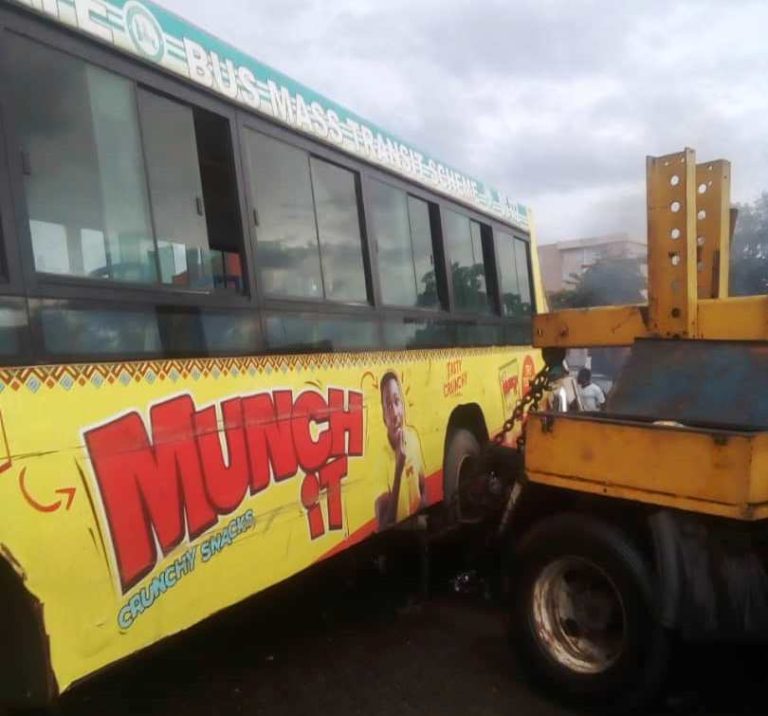
THE Lagos State Traffic Management Agency (LASTMA) says one person died in a multiple-car crash that occurred on the Otedola Bridge section of the Lagos-Ibadan expressway Wednesday morning.

The agency in a series of tweets said the accident involved a containerised truck and several cars.

The accident caused heavy traffic on the road and  also left travelers on the section of the highway stranded.

However, the details of the accident were sketchy as multiple sources including eyewitnesses said the accident claimed several lives and left some trapped, LASTMA confirmed one person dead so far.

According to the agency, the injured victims have been taken to various hospitals for treatment.

Other rescue team at the scene, include: Men of the Rapid Response Squad (RRS) of the Lagos State Police Command, Lagos State Fire Service, Federal Road Safety Ciro’s, FRSC, among others.

Photo source: Twitter

Otedola bridge  has become notorious  for fatal accidents in recent times. On September 20, 2019, a diesel tanker fell off while driving along the bridge.

While on October 12, 2019, a tanker with full capacity of 45000 litres of petrol fell off the same bridge. The fuel was immediately trans-loaded by Lagos State Emergency Management Agency to avoid explosion while causing major traffic.

Meanwhile, motorists have been urged to make use of alternative routes.

“Anyone going out of Lagos should take either Otedola under bridge or go through Ogba-Ojodu-Berger axis to connect the Lagos Ibadan Expressway and move on their journey,” LASTMA announced.


Gunmen abduct Federal High Court Judge, demand N50m ransom

0

ABDUL Dogo, a judge of the Federal High Court Abuja has been kidnapped by unknown gunmen.

The Nation reports Dogo was abducted on his way to Akure from the capital city, Abuja on Tuesday.

The gunmen had reportedly demanded a ransom worth N50million for his release.

“According to a source, he was coming from Abuja when he was waylaid by the gunmen and whisked away by the hoodlums,” the newspaper said.

It said an official of the court and two of the lawyers who were in his court for the hearing of their cases had confirmed the abduction of the Judge.

Both Frank Mba, Force Public Relations Officer (FPRO) and Anjuguri Manzah, the Federal Capital Territory (FCT) Police Public Relations Officer (PPRO) were not immediately available for comments.  Calls put across to Mba’s mobile  phones were not answered while Manzah’s line could not be reached. The SMS sent to each of them were not replied when this story was being filed.

However, at the time of filing this report, the General Secretary, Nigerian Bar Association (NBA), Jonathan Taidi told The ICIR he was currently in Minna and had no knowledge of the abduction.

“I haven’t got any information on that. I’m in Minna at the moment. But lemme find out from my fellow national officers and I will get back to you,” Taidi said.