Home Blog Page 2273

INVESTIGATION: Jonathan/Buhari administrations spent another N1.164 trillion on power in eight years, yet Nigeria remains in darkness

Nigerian Government, between 1999 and 2010, reportedly spent over N4.7 trillion on power, but the country remained in darkness. Eight years later, Jonathan and Buhari administrations invested another N1.164 trillion into the sinkhole through capital releases, yet homes and factories in Nigeria are yet to be provided with constant electricity supply.

Olugbenga ADANIKIN, in this investigation, reports about the investments and wastages in the sector.


Beatrice Ogbor, a six-year-old basic one girl with her two-year-old sibling, was born into darkness and has never shared in the joy of the popular exclamation “Up NEPA” that follows power restoration in Nigeria.

“We gave birth to her here in 2014,” her father, John Ogbor (45) says. “You will be surprised; they have never seen electricity since birth”.

Six-year-old Beatrice Ogbor and her sibling Eliesar (behind) who has never witnessed electricity since birth
Photo Credit: Olugbenga Adanikin, The ICIR


Ogbor is originally from Igede in Obi Local Government of Benue State. For the past 14 years, he has been living in Moro, a community along Sagamu – Ikorodu Expressway in Ogun State, after he left his original birthplace. But for almost seven years, his adopted community has been without electricity.

“We tried the little we can. As individual landlords, we contributed N40, 000 to try make this electricity of a thing a reality. They said we should pay the money to process this and that to give us a transformer, and we paid to Itesiwaju Area Community Council but in the end, nothing positive came out of it.”

For Ogbor, it has become almost hopeless waiting to access electricity in Moro, a community situated near the Nigerian Pipelines and Storage Company, a subsidiary of the Nigerian National Petroleum Corporation (NNPC) in, Mosimi. Aside from its energy need, the community lacks access to healthcare, potable water, road and schools, an indication of total neglect by the government.

“God can still send help though, we believe,” says John. He paused for a moment, took a deep breath while gazing at his two young children. “During campaign periods, we told them we don’t need rice, we don’t need money but electricity. That has been our only request.”

Similarly, Alasia, Iraye, Oremuti, Oponua, Likorodu, Imede and five other communities in Ogun State visited by The ICIR, shared the same fate or worse. For eight years, Oremuti community struggled to access power. Oponua has never been connected to the national grid for 10 years. These conditions are not peculiar to Ogun State but also other states across the country.

Erected poles since 1994 still stands but never connected to grid 
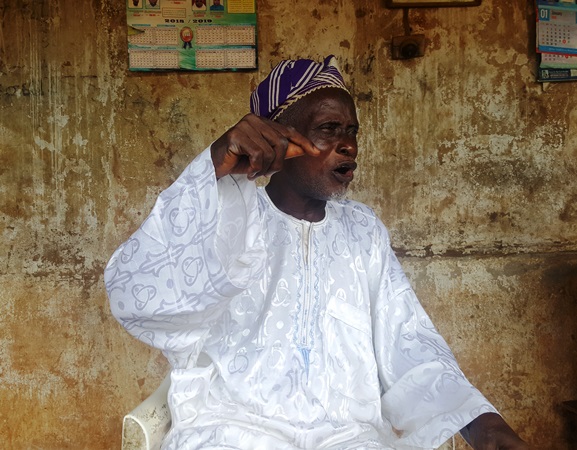
Rasheed Alimi Iraye Community Head who had waited for 25 years to be connected to the national grid
Photo Credit: Olugbenga Adanikin, The ICIR

In Iraye community, Sagamu Local Government Area, the first set of electricity poles, according to Rasheed Alimi, the community head was erected in 1994. To date, residents still live in darkness. A huge concrete platform constructed for the electrification project still lies adjacent the residence of Alimi when this reporter visited. It has neither transformer nor electricity cables except for about three electricity concrete poles sighted in the area.

Nearby is a multimillion Naira 10-bed health care facility built by the NNPC, but it is off-the-grid. Neglected and taken over by bush eight months after commissioning, the oil firm had installed a giant Mikano generator to service the clinic whenever it becomes operational but weeds also already have covered the generator.

Findings, however, revealed that the State Assembly under the administration of Sen. Ibikunle Amosun approved in the 2013 budget, the electrification of 32 communities, including Iraye. Closer look shows that the State Ministry of Rural Development and Rural Electrification in Annexure-II (B) listed the proposed benefitting communities but no such project exists today in Iraye.


Power generating set provided for Iraye Primary Health Care Centre by the NNPC due to no power supply
Photo Credit: Olugbenga Adanikin, The ICIR


Over N1 trillion invested in power in eight years

Nigeria generates its power via four main sources – hydro, gas, coal and natural gas. But for almost 20 years, huge unverified money has been expended into the sector. Specifically, The ICIR can authoritatively report that N1.164 trillion has been released to the power sector as capital budgets from 2011 to 2018, yet the power sector has not measured up – darkness still prevails. This figure was obtained from the Office of the Accountant General of the Federation.

Electrical power often generated is literally not commensurate with the huge investments. And returns on investments have largely been discouraging as the Federal Government continued to pump in more resources in terms of budgetary allocations, loans among other interventions to ensure the nation meet its energy need.

The Energy Business report (April 2016 vol. 15 no 160), shows that N6.52 trillion has been spent on Nigeria’s power sector in 16 years with no significant improvement.

For example, ex-President Olusegun Obasanjo, the report says, allegedly spent N3.52 trillion ($16 billion) during his tenure, though this figure has been contested.  Also, late President  Umar Yar’adua was said to have spent N1.183 trillion, while the former President Goodluck Jonathan during his administration reportedly expended N1.817 trillion and President Muhammadu Buhari reportedly spent N1.5 trillion in two years, as at September.

Infograph of Capital Releases to Power Sector 2011 to 2018
Source: Damilola Ojetunde, The ICIR

Meanwhile, findings by The ICIR revealed that between 2011 and 2018, the Office of the Accountant General of the Federation had released capital sum of N1, 164,278,006,846 for power projects in the country.

These huge sums, however, excludes capital releases to six agencies between 2016 and 2018 namely, Office of the Surveyor-General of the Federation, Federal School of Survey, Oyo, Federal Road Maintenance Agency (FERMA), Council for the Regulation of Engineering in Nigeria (COREN), Surveyor Council of Nigeria and Regional Centre for Training in Aerospace Survey when Buhari-led administration merged the power ministry with works and housing.

World Bank, AfDB, other loans/ grants to boost transmission capacity

In 2018, the Transmission Company of Nigeria (TCN) secured a total grant of $1.6billion from international donors-World Bank, the African Development Bank (AfDB), Japan International Cooperation Agency (JICA), among others for its Transmission Rehabilitation and Expansion Program(TREP). Likewise, the French Development Agency committed $170 million for the Abuja Transmission Ring Scheme.

The World Bank gave $486 million to upgrade most of the transmission substations through its Nigeria Electricity Transmission Access Project (NETAP), Ogun-Lagos Transmission Project supported by JICA with $238 million, AfDB $300 million and 25 million Euros for the Northern Corridor Transmission Project, another $410 million AfDB Nigeria Transmission Expansion Project among other non-lending supports. Most of these projects are either being implemented or at procurement stage, thus, not fully completed. For instance, the contract for the screening of 132KV lines NETAP project has been signed while the consultant is billed for mobilisation before end of the year. The $170m Abuja transmission ring project is being implemented.

In terms of grants, TCN got 25 million Euro non-lending supports from the EU as part of funds to realise Northern Corridor Solar project, $13 million grant from the Japanese government through JICA for capacitor bank installation in Apo and Keffi, while the other $21 million grant also from JICA is to rehabilitate and upgrade Apapa road 132KV substation and 330KV Akungba substation. “TCN is in discussion with JICA on more grant support from Japan,” the document from TCN read. It cannot, however, be established if these funds are part of the N1.5 trillion the current administration claimed it has spent on power in two years.

But reports also have it that while Rt. Hon. Dimeji Bankole was Speaker of the House of Representatives, 2,500 containers laden with imported power equipment allegedly worth $5 billion were left to rot at the Lagos Port with demurrage of N4 billion. “The containers were abandoned by incompetent contractors that were awarded projects beyond their capacities…some of the equipment were in demurrage for over 10 years,” TCN TREP document as at 31st August affirmed this, but put the figure of the containers at 800.

In a 2017 report by The Guardian, the Senate disclosed plan to probe alleged $1.35 billion power sector fraud in the country. The same report claimed $1 billion Eurobond was raised in 2013 to fund key power projects nationwide.

Comrade Princewill Okorie, APPA National President, in his speech delivered in July, in Abuja and obtained by The ICIR, further disclosed that about $35 million was set aside for the Afam East Power Projects and the sum was allegedly spent by Federal Ministry of Power officials without any undertaking any feasibility study.

“Out of the $1 billion Eurobond, $350 million was given to Nigeria Bulk Electricity Trading Company in 2014. $29 million was purportedly paid to General Electric for turbines while $6 million was paid to others.”

However, in June, the EFCC announced the possibility of probing the power projects, especially those awarded during Obasanjo administration. This ultimately is to unravel the complexity and alleged corruption that has enmeshed the sector.

Despite the estimated sums so far invested in the sector, stable, uninterrupted power supply to Nigerians remains difficult to realise.  Experts, as well as other stakeholders, have blamed this on poor investments, capacity and regulatory issues among others.  While Nigeria can conveniently generate up to 20,000 Mega Watts (MWs), transmission has the capacity for about 8,000MW and distribution is still struggling between 2,000 and 4,000MW.

Epileptic power crippling rural economies, small businesses

The importance of stable power as driver of any country’s economy cannot be overemphasised as it is capable of transiting Nigeria from an under-developed to the much desired developed status, especially when industries, Small and Medium Business Enterprises (SMEs) are supported. But, as at date, 90 million Nigerians still lack access to power, a situation that has crippled SMEs and industries.

Mrs. Apansile Ade, for instance, is an entrepreneur who operates water and paint factories. She had run the business for over five years but at a loss. She is currently operating the water factory because the paint business has gone under.

“We just stopped producing because the generator developed a fault,” she told The ICIR. “Last week I spent almost N75, 000 repairing generator. I had to stop my son from resuming school on Monday because the little money I would have given to buy books, beverages was no longer there”.

Unfortunately, the community she resides since 2010 has never been connected to the grid. As a result, she bought six generators to power her house and the water factory. The last power generating set just collapsed when The ICIR visited.

Mrs. Apansile Ade in her sachet water factory pleads for help to restore her business after spending fortunes on power generating sets including its maintenance and fuelling.
Photo Credit: Olugbenga Adanikin, The ICIR

“Let me say we have been struggling. As I’m speaking, we have generators that have packed up. We bought another generator recently since there is no electricity to run the business”.

She barely could account for profits made from the business, as effort was solely to satisfy her customers who, already, were tired of her inconsistent supply. “There is really nothing I can do since there is no electricity to boost the businesses,” she said.

“…just that we don’t want to lose customers. One was telling me yesterday that we don’t know how to run a business.”

The entrepreneur had bought four generators in five years of business. She listed unit costs of each as N500, 000, N300, 000, N400, 000 and N250, 000 summed to N1.450 million. She also spends N95, 000 monthly on fuel and N80, 000 on maintenance. This, however, implies that in five years, she had spent N10.5 million getting fuel for the generator as well as its maintenance.

Two streets from her house is a POS business point and computer business centre, both under lock in the normal business hours. Opposite the shop is another beauty salon opened but appeared less operational.

At the main street to Apansile’s residence is Engr. Abayomi Olusada’s welding workshop, situated opposite a tailor’s shop and divided by erosion threatened road. Apparently, the 56-years-old man was home when the reporter visited – there was no sign to show he had been in the workshop for days. He started welding business 35 years ago in Lagos, but since 2009 when he moved to Oponua community, it has been sad tales.

“Electricity has been a serious challenge for us in this community. Unfortunately, there is no one to finance us to get connected,” says Olusada. Apparently, the community resolved to facilitate and procure whatever material needed to get connected to the grid after years of waiting on government and power officials.

Shut welding shop of Engr. Abayomi Olusada a resident of Oponua community along Ikorodu Shagamu Expressway
Photo Credit: Olugenga Adanikin, The ICIR

“A lot of people have left this community; even landlords had to relocate leaving their homes. So, it’s really a big problem affecting my business. Though I may make use of generator when there is power outage, but electricity is vital,” Olusada added hitting his right fist at his left palm to drive home his point. “Even when I get contracts, I spend 50 percent of the money on fuel. In the process, the generator develops a fault and I had to start looking for money to fix it.”

Regrettably, beyond travails of small businesses, Nigeria is said to spend an estimated $13 billion to purchase generators annually, all to fix industrial, commercial and domestic energy needs. As of 2016, Energy Business says over N796.4 billion is spent on fuel to power those generators.

One of the foremost telecommunications companies in the country, MTN also claimed it spends N660 billion monthly to fuel 6,000 power generating sets which run daily for 19 hours. Likewise, the Manufacturers Association of Nigeria (MAN) revealed in 2017 that its members spent N213.77 billion on alternative power sources just in two years – 2014 and 2016.

Government hoards information

In order to ascertain the exact amount sunk into the power sector, FOI request was sent to the Federal Ministry of Power. The ministry acknowledged the receipt of the request and promised to respond. Weeks after, the ministry is yet to send a reply.

Freedom of Information (FOI) Response from Federal Ministry of Power.
Photo Credit: Olugbenga Adanikin, The ICIR

Efforts, through FOI requests from The ICIR to access a copy of the power sector share purchase agreement, which the federal government signed with the unbundled companies, failed. The power ministry acknowledged the same letter but referred to the National Electricity Regulatory Agency (NERC) and the Bureau of Public Enterprise (BPE). But, up till date, the document was not provided. BPE claimed one of the power agreements is being investigated by the EFCC. However, the EFCC has remained numb on the claim after several attempts of verify.


Failed, abandoned power projects limit Nigeria’s power ambition

In 2000, the Federal Government initiated the process of unbundling the electricity sector. National Electric Power Authority (NEPA) becomes partly privatised with the appellation – Power Holding Company of Nigeria (PHCN). The National Council on Privatisation (NCP) under chairmanship of Atiku Abubakar eventually led a 23-member Electric Power Sector Reform Implementation Committee (EPIC) that developed the National Electric Power Policy direction for a private-sector driven power development in the country.

“By our choice of privatisation, the framework for resolving the crisis that constituted a serious bottleneck in the past is being put in place,” says Olusegun Agagu, former Minister of Power and Steel in October 2000. “We are, through this policy document extending invitations to investors and other stakeholders in the power sector, the world over, to avail themselves of the abundant opportunities that the reform, restructuring, and privatisation of Nigeria’s electricity industry offer”.

However, in 2013, the privatisation takes effect with the federal government having a 40 percent stake in power distribution companies. NEPA unbundling led to Generation Companies (GenCos), 11 Distribution Companies (DisCos), Niger Delta Power Holding Company (NDPHC) National Independent Power Projects (NIPP) – owned by the Federal, State and Local Government, Transmission Company of Nigeria (TCN), Nigerian Bulk Electricity Company (NBET) and the recent metering companies.

It is believed that upon privatisation, power generation, transmission, and distribution would significantly improve, but that has not happened. Rather, findings showed that majority of the power infrastructure inherited by investors is obsolete. More so, they are either partially operational or left in ruins. For instance, Omoku and the second unit of Gbarain NIPP, as well as Egbema, have not been fully completed since 2005.

Abandoned NDPHC NIPP Power Plant in Omoku Community, Ogba/Egbema/Ndoni Local Government Area of Rivers State.
Photo Credit: Olugbenga Adanikin, The ICIR

A source at the Niger Delta Power Holding Company Limited (NDPHC) who pleaded anonymity, however, said Olorunsogo II, Geregu II, Calabar, and Alaoji have been completed and functional. But noted how four others – Omotosho, Benin, Ogorode, and Egbema were mostly shut down due to power rejection to the national grid. This, he said, puts the NDPHC at huge losses considering the cost of generating those powers including gas to power the NIPPs plants.

“Since NERC and TCN had issues a couple of years back on load transmission, the National Control Centre, at times does not pick the power generated because they want to avoid the blame game,” says the source. “Some of the DisCos also have their shortcomings which largely depend on their distribution capacities. For instance, if a substation is 33 KVA, the DisCos cannot definitely take anything above the 33KVA”.

Major hydropower projects such as the Mambilla and Kashimbilla remain uncompleted years after commencement.

Ironically, while the federal government strives to achieve significant fete on the outstanding power contracts, it is considering nuclear technology as a new power source.

Site visit: Armed soldiers guarding derelict project 

During the investigation, The ICIR visited Omoku Generation Company Limited 264.7MW and 225MW power project awarded to Rockson Engineering Company Limited, which is located in Omoku community, Ogba/Egbema/Ndoni Local Government Area of Cross River State.

The military and private security officials guarded the uncompleted facility, which was awarded 14 years ago. In November 2017, the NDPHC promised Omoku and three other plants – 750MW Alaoji, 338MW Egbema and 225MW in Bayelsa would be completed before the third quarter of 2018 but that’s not entirely the case.

The ICIR’s visit to Omoku project site which also accommodates a state-owned power project revealed that the facility had since 2018 been taken over by the Asset Management Company of Nigeria (AMCON).

Apparently, there are two power projects on the site. While one is operational, the other is not. At the main entrance is a giant blue gate manned by military personnel and private security. Opposite the gate, is green scenery beautifying the well-planned layout. But this reporter was not allowed access into the facility by the security men on duty. However, few workers retained by AMCON, who spoke anonymously, said the power project was taken over due to the inability of the contractor to deliver. “It’s been long they have been on the project and AMCON has taken it over,” a source said.

Meanwhile, earlier findings by the reporter revealed there is Omoku I and II gas-powered project. While the first 150 MW plant was listed as completed and ‘operational’, 225MW Omoku II power project is non-operational and uncompleted. But, the source insists, “This one is state, and the other which is on-going, is federal” stressing that the active project does not belong to the FG.

“As far as I’m concerned and what I know, it is only this one,” pointing at the state-owned project, “that is operational. The one of federal – nothing has been done there. Look, you will only see that building and some installations”.

“Nothing has been done,” expressing surprise at the reporter’s unawareness. “Except there is another but if it is this one, all they are saying is fallacy.”

The reporter made another attempt to persuade the source to allow him gain entrance into the premises but to no avail. “…The people in the camp are old Rockson staff like mechanics, drivers, and their internal security,” the source said. “Most times, they only visit and go back. AMCON officials too just come for inspection and go back…they took over early this year because of the lackadaisical work of the company. It appears they have not awarded it to a new company.” The source added and drove off.

Entrance to Omoku NDPHC power project Omoku community in Rivers State
Photo Credit: Olugbenga Adanikin, The ICIR

“I must say that the ones that have not been completed have been under one contractor, Rockson Engineering due to contractor delay. But we have found a way around the contractor issue now,” Chiedu Ugbo, NDPHC Managing Director had said in 2018.

According to him, NDPHC is working with AMCON, which has taken over the contractor under a receivership, to complete the projects.

“I cannot tell you details about the place but all I know is work has not started. The work is not yet completed. I cannot take you inside. I don’t have that mandate because I have my limit,” a retired police officer told The ICIR.

However, a look at the facility from the fence behind revealed rusty giant iron pipes and equipment. The NIPP project cannot be seen from the main entrance, except for the state-owned which Wisdom; a private security guard said was sold to First Independent Power Limited (FIPL).

Sustainable solutions to right the wrongs

In the face of these challenges various experts have argued the need for the government to embrace renewable energy. Some also called for the rehabilitation of obsolete power equipment. “To address the problems, stakeholders including the Federal Government must try and invest in key infrastructure such as gas pipelines, equipment used in the distribution, generation and transmission of electricity, and other facilities,” says Marcel Hochet, President Green Elect in an interview with The Nation newspaper.

“Of note is the use of obsolete equipment such as transformers, feeders, sub-stations and others that need to be replaced with new ones by power distribution companies (DisCos) to adequately supply power to the consumers. Since the operators are not having enough money to play around with, they need to bring in more investors into the industry to provide the fund needed to move the sector forward.”

The ICIR visited NDPHC headquarters to verify why some of the NIPP projects are not fully operational and others uncompleted but Yakubu Lawal, the firm’s General Manager Communication and Public Relations, was absent. Calls to his phone rang but were later put on voice mail. Text messages sent to him also were not returned.

However, two top sources in the NDPHC acknowledged the failed status of the Omoku Power project. One of them told The ICIR that the Economic and Financial Crimes Commission (EFCC) are currently investigating the contractor – Rockson Engineering Company Limited for its inability to successfully complete the project, years after it was awarded. He noted that the legal department of the company had filed a suit against the contractor, saying all projects handled by Rockson, the only local contractor, are poorly executed.

“AMCON is only trying to rescue the plant for us,” the source said, adding, “So far, NDPHC is working with AMCON. We are also following the case instituted by the EFCC against the contractor”.

President Muhammadu Buhari, had on September, instructed the anti-graft agency to probe and prosecute those involved in the failed project. As such, the EFCC officials picked two officers of the NDPHC while the alleged $16 billion is being probed. But several probes conducted by the National Assembly or the anti-graft agency have not produced any sanction. As a result, Civil Society Organisations challenged the EFCC to expedite action on the prosecution process.

However, as of 4th October, the source put the combined electricity generated from the eight NIPPS at 468.7MW but noted that only 200 to 300MW finally gets to the consumers.

At the Manufacturers Association of Nigeria office in Abuja, a top staff who preferred not to be mentioned said members of the association currently spends N93.1 billion annually on alternative power generation.

This, he said, discourages investors from venturing into businesses in the country. In a sane clime, manufacturers have no business generating power except to import machines and start production, he noted.

“When you are on power, equipment must not stop otherwise, it could damage the raw materials and the equipment itself,” the source said. “That is why most manufacturing companies run on alternative power source which cost them N93.1 billion annually.” Despite, all the concerns, MAN insists genuine privatisation remains the answer to addressing the nation’s power problem. “Foreigners with financial strength and good expertise should be allowed to manage the sector, not like the previous privatisation we had.”

In conclusion, there is need to have a paradigm change in approaches to the generation, transmission, and distribution of electricity in the country.

This report is part of a collaborative investigative series by Daily Trust, The International Centre for Investigative Reporting (ICIR), Premium Times and The Cable, facilitated by the Wole Soyinka Centre for Investigative Journalism (WSCIJ) under its Regulators Monitoring Programme (REMOP) for the Electricity Sector, with support from the John D. and Catherine T. MacArthur Foundation.
UNDERCOVER: Bribery, Bail For Sale… Lagos Police Station Where Innocent Civilians Are Jailed And Criminals Are Recycled (1)

0


Investigative journalist ‘FISAYO SOYOMBO spent two weeks in detention — five days in a Police cell and eight as an inmate in Ikoyi Prison — to track corruption in Nigeria’s criminal justice system, beginning from the moment of arrest by the Police to the point of release from prison. To experience the workings of the system in its raw state, Soyombo — adopting the pseudonym Ojo Olajumoke — feigned an offence for which he was arrested and detained in police custody, arraigned in court and eventually remanded in Prison. In the first of this three- part series, he uncovers how the Police pervert the course of justice in their quest for ill-gotten money.


It cost only N500 for a policeman to arrest me, and N1,000 for another to hurl me into a cell. Of course they didn’t know I was a journalist; I had assumed a pseudonym and grown my hair long enough — for 10 months — to blend with artificial dreads. My locks were tinted in gold and almost all my facial hair removed. I cut the profile of the kind of youth the Police indiscriminately railroad into their notoriously ramshackle vans for no reason, for onward transfer to their cells. One look at me and the typical policeman would have mistaken me for a compulsive hemp smoker, an incorrigible internet fraudster or a serial drug abuser.

The Police in Nigeria have a history of illegitimate arrests and extrajudicial killings. In July, Chinedu Obi, a musician better known as Zinquest, was accosted for spotting tattoos and shot in Sango, Ogun State. Only two months ago, policemen in Lagos shot two unarmed civilians — they died instantly — suspected of phone theft. In April, anti-cultism policemen killed Kolade Johnson, a civilian, at a football viewing centre in the Onipetesi, Mangoro area of Lagos. One bus driver in Ayobo, Lagos, was even shot dead by a policeman in May for refusing to part with his money. In Ifo, Ogun State, in April, a policeman shot a motorcycle rider during an argument over N100 bribe. All five incidents happened within the last six months; all six victims died in the end.

Therefore, it didn’t take too long after my arrest for me to begin to see the Police in their true elements. My supposed offence was that someone had sold me a car worth N2.8million in November 2018; however, after paying N300,000 cash, I began to avoid him — until I was eventually apprehended on Monday July 8. Once I was arrested and whisked into an innocuously passing danfo, I imagined I would be immediately taken to the cell of Pedro Police Station, Shomolu, Lagos. But it wasn’t that straightforward. I was first shoved behind the counter; and after half-an-hour, the Crime Officer (CO), Inspector Badmus, fetched me into a back office where I was grilled for close to two hours, culminating in a written statement from me that represented his thoughts more than mine. He asked me questions but only allowed me to write the answers that suited him; if the answers didn’t, he cut me short halfway. Afterwards, I was led to the expansive office of the Divisional Police Officer (DPO), a tall, dark, rotund, middle-aged man who pronounced me guilty in a matter of minutes. “This is one of the many criminals destroying this city,” he yelled after a long, menacing glance all over me. “Please hold him well!”

Armed with this new order, the CO, who had been relatively civil all along, groped for my trousers then grabbed me by the waist as we made the short return trip to the counter. It was a walk of no more than 50 metres, but by the way he held me, anyone would have thought we were walking over a thousand kilometres and there was the potential for escape.

The complainant was already registering the case with a policewoman by the time we returned, and soon after they were haggling over the fees. Chigozie Odo, the policewoman, had rejected his offer of N500. After some five minutes of talking, he handed her a N1,000 note. Immediately the money touched her hand, Odo turned on me: “Look at you. Fine boy like you; just look at yourself. Instead make you go find better work, you dey defraud people. Oya, come here!”

The suspects in the cell had gathered by the iron barricade, hungering for an entrant, clinging to the bars and chillingly rolling their eyes from the policewoman to me and then to the complainant. My heart began to pound: Are they going to pummel me? Would they accept it if I offered some cash in exchange for beating?

Odo stripped me of my shirt, singlet, belt, wristwatch, shoes and cash. “Look at his hair; na you gangan be Ruggedy Baba,” she said as she unlocked the cell and bundled me in.

A MINOR IN THE CELL

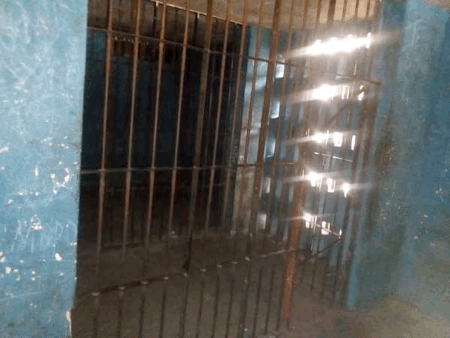
The gate of the main cell

As I take my first steps into the cell gate, I immediately attempt to ingratiate myself with my ‘new friends’ by asking what they want — food or drink? It endears me to them, and the policewoman immediately proclaims me the new “leader”. It didn’t take quite long for the food to arrive; it was around 3pm or thereabouts and they apparently hadn’t been fed that day yet. As they guzzle their food — rice for some, bread for others — I embark on a quick, surreptitious survey of the cell.

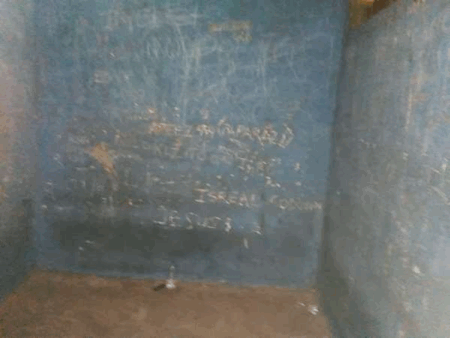
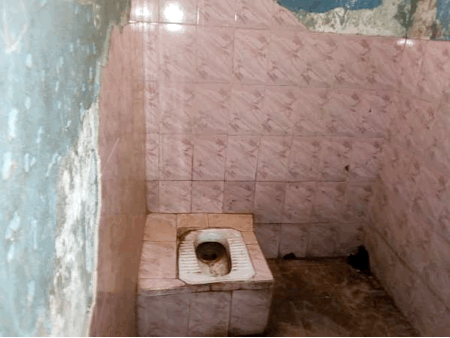
To the right is a small opening housing a bathroom and a latrine oozing with thick fecal stench, one I very quickly resolved my buttocks would never near. To achieve this, I would eat only  once daily — bread with a bottle of water or soft drink — throughout my stay. Opposite it is the smallest of the inner cells. Lying awkwardly on the floor is a mat too small to contain even one person; but every night, five or six cross-breathing inmates share it. Being the warmest inner cell, it proved the popular cell of choice — particularly at nighttime. Further ahead are two bigger cells, dingy and often damp, each measuring roughly 16 by 16 metres, with fading, defaced blue walls. Holding my head in my hands, I slump into one of the cells, enveloping myself with thoughts of the hardship to come.

“Do not disturb; the leader is in a very bad mood,” a faint voice arrests my thoughts. “Let’s come back to see him later,” adds another — that of a boy who, by his mien and slender build, couldn’t possibly be more than 15. What‘s a minor doing in detention? I motion them over.

Wetin happen?” asks Austin, the fair-skinned, slim-figured, natural dreads-donning leader I inadvertently deposed minutes earlier. In the prison and in police cells, “wetin happen” is the lingo for asking an inmate or prisoner how they landed in prison or detention. I give them my prepared line and hand them the baton.

Austin, a gate keeper at a small company in Lagos, was accused of illegal gun possession by his boss after an unlicensed pistol was reportedly found inside the gate house. He vehemently denied knowledge of the act, but his claims of innocence had been ruined by his previous backdoor sale of the company’s 50 litres of diesel for N8,000. Determined to let him rot in the police cell, the accuser left with Austin’s phone, obliterating any chance of phoning a friend or family to process his bail.

With Austin is Loris, the minor whose arrest and detention was masterminded by her sister. Loris had electronically withdrawn the sum of N23,500 from his sister’s account, without her knowledge, to pay for the General Certificate Examination (GCE) of the West African Examinations Council (WAEC). Since the exam actually costs N13,950, it is either Loris stole more than he needed or he registered at a special centre. The boy claims his sister declined his initial requests for the funds when he asked. Asked how he pulled off the funds transfer, unnoticed, he replies: “I know where she keeps her ATM; I also know the password.”

Also in the cell is Buchi, a young man accused — and he didn’t deny it — of stealing a phone. Small matter it may have been; but after the Police tracked him to his house with the same phone he allegedly stole, his accuser claimed N100,000 had also gone missing from the car where the phone was ‘moved’. Like Buchi, the fourth suspect is also accused of stealing a phone worth N17,000; too bad for him because the Police then went on to set his bail at N50,000.

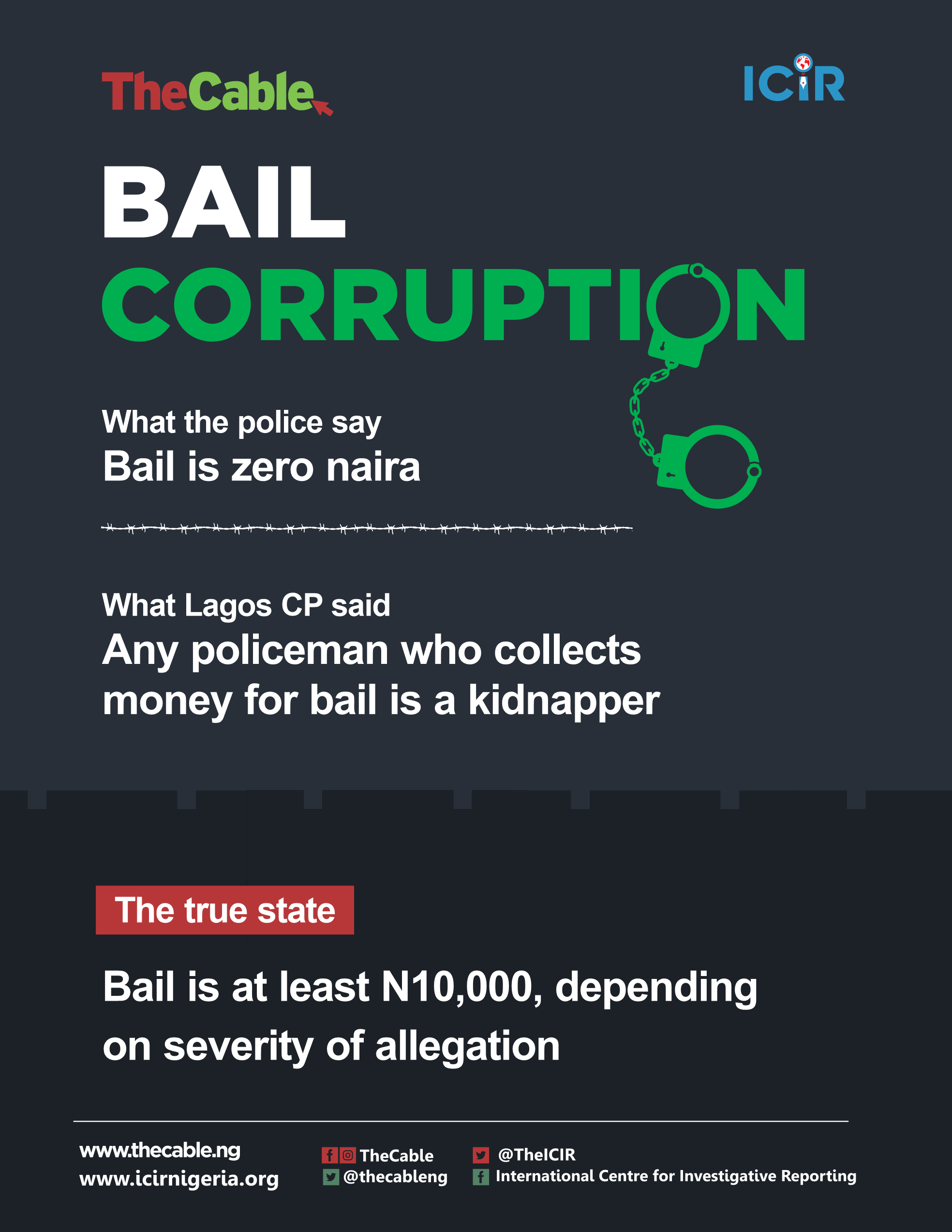
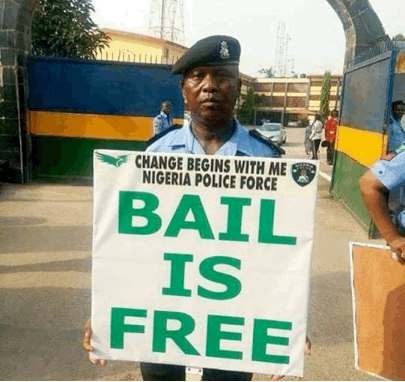
The Police have always insisted bail is free, but this has got to be the most barefaced lie of the century! In 2015, and again in 2017, the Police embarked on a nationwide bail-is-free campaign; apparently, it has been a futile experiment. Coincidentally, while I was in that cell, Zubairu Muazu, the Lagos State Police Commissioner, was busy saying “any policeman who collects money for bail is not different from a kidnapper; the only difference is that everyone knows where you keep the suspects”.

AN INNOCENT MAN IN POLICE CELL

Inner cell
An inner cell

We continue our chit-chat without the knowledge that two young men, one imminently, are primed to join us. The first, Uchenna, was accused of attempting to dispossess a motorcycle rider of his property. But he fiercely denies, insisting a quarrel only broke out between the duo because the rider could not provide the balance of his fare for the ride. “How can anyone say I tried to snatch a motorcycle in broad daylight yet no weapon was found on me?” he argues, to the bemusement of all. “I had no knife, no gun, no spade. No cutlass or machete. Do you rob in daylight without any weapon?”

Much later, sometime between 8pm and 9pm, another young man joins us. The accusation against him was that he stole a phone from a barbing salon. By his own admission, the CCTV had reportedly identified him as the culprit. Yet he denies any wrongdoing. “I swear I didn’t steal the phone,” he murmurs. “I swear!” Who’s this one fooling? The CCTV fingered you as the thief yet you say no? You think everyone here is a criminal? There’s a journalist here, you know? 

“Wait a minute,” I ask. “Didn’t they show you the CCTV footage? Didn’t the Police watch it before arresting you?”

“I didn’t watch it, neither did the Police,” he answers. “The Police arrested me because the phone owner said I was the thief. They didn’t watch any CCTV footage.”

I still do not believe him until the rest of us rouse from sleep the following morning to find  out he was gone. The CCTV footage had finally been watched, and it turned out the wrong man had been arrested! An innocent man had spent a night in jail over a crime he knew nothing about.

N50,000 BAIL FOR FIVE HEMP SMOKERS

A second inner cell

Five for the worth of one; that was the scenario on Tuesday when the phone-theft suspect was freed. Shortly before midday, five new suspects — one male, the others female — join us. The quintet — two of them are sisters — had been arrested at a hemp-smoking joint in Gbagada. On arrival, they all look subdued, their faces sunken, their hairs dishevelled. Off they are marched to the female cell, situated adjacent the male cell but close enough for communication and exchange of items with their man, Maxwell. Unlike the male’s, the female cell is less punishing

— just one room, bare but cemented, dry and generally habitable.

Maxwell makes no claim at sanctimony. “They caught the girls in the act, but me, they should never have arrested me,” he laments. “I f**ked up big time.”

Tall, fair and stunningly handsome, Maxwell had learnt of the arrest of his girls, and had sped to the scene only for residents to clandestinely signal the Police that he was one of them, in fact their ring leader. Maxwell was bullish in maintaining innocence as the Police tried to arrest him, but he would earn himself a succession of slaps after a strand of hemp was found in his wallet. “I no know say I get one tiny claro for my wallet,” he says. “I f**ked up, mehn.

When observed at close quarters, Maxwell cuts the picture of a man of two extremes. One minute he is mouthing obscenities, the next he is speaking with impeccable courtesy. Asked which of the girls is his girlfriend, he mutters: “None of them is my girlfriend but I f**k them all.” However, when any of the girls calls for his attention, his answers range from “yes, please” to “yes, darling” or “one minute, love.” And, usually, when he asks anything of anyone in the cell, it is hardly for himself but for one of his girls.

From time to time, Maxwell would dip his right hand into his crotch, and scratch away the poor thing with mind-blowing absentmindedness. Then he would run the same hand over his tinted hair, down through the thin threads of his hairy chest and back to his crotch. He was impulsive, too, once declaring, without prompting, “It’s been a long time I had measles like right now”, and abruptly informing us another time: “The Police have set our bail at N10,000 each.”

The father of the two girls shows up much later, upset, disappointed and threatening to let them rot in detention. He didn’t mean half of those things, though; the following day, he returns to settle the Police, and all five regain their freedom. It is unclear exactly how much he paid, but the Police had demanded N50,000 for all five.

HOW THE POLICE COOK UP CRIMES AGAINST SUSPECTS

The Police say no bath for me because I "stole" and "hijacked" a car. Meanwhile, the documented offence was that I didn't complete payment for the car.
The Police say no bath for me because I “stole” and “hijacked” a car. Meanwhile, the documented offence was that I didn’t complete payment for the car.

On Wednesday, I discover, in the crudest of ways, how the Police often exaggerate the allegations against suspects — to drive up their bail. It is evening and I have not had a bath all day, so I politely ask a policewoman, fresh from assuming duties, to open the cell so I can draw water from the tap servicing the cells.

“What is your name?” she first asks me, before shifting her gaze to a whiteboard detailing the offences of each suspect in the cell. “Ojo Olajumoke? Your offence doesn’t warrant you having a bath. Cell no be for enjoyment, abeg.

Crestfallen and unable to read the board from afar, I beckon a cellmate over for help. “Your offence reads ‘stealing and hijacking of car,’” he tells me. “Did you actually hijack a car?”

I hadn’t. The original complaint against me was that I’d bought a car worth N2.8million, paid only N300,000 and defaulted on the balance. Car hijacking? Stealing? By framing me, the Police violated Section 340 (f) of the Police Act 2004, which compels them to exhibit “strict truthfulness in the handling of investigations, and in the giving of evidence”.

Maxwell and the girls were framed up, too. On the whiteboard, they were designated as “cultists”, but their real offence was that they smoked hemp. They were picked up smoking hemp, not while engaging in cultism-related activities. Are all hemp smokers cultists?

“It’s the Police’s well-known way of bargaining for hefty bail sums from suspects,” Oto Omena, a lawyer with long-standing experience of dealing with policemen, would later tell me in late August. “They typically make suspected crimes bigger than they originally are; you know, the bigger the crime, the bigger the bail sum.”

INNOCENT DESTITUTE, DRUNKARD ARRESTED ON TRUMPED-UP CHARGES

A second inner cell

In the evening of Wednesday, Haruna joins us. He tells no lies about his offence: he and his brother were involved in a nasty fight during which he slashed his opponent’s neck with a knife. Brother landed in the hospital, Haruna ended up in the cell. Deserved maybe, but not for the next two suspects.

In the wee small hours of Thursday, Japheth and Sunday arrive, both having been picked up while sleeping at unauthorised locations in Gbagada. The Police accused them of lurking around to break into shops. It’s a robbery-prone location, they insisted. But we all know it’s a false claim.

It turns out Sunday is very known to many officers at the station. A chronic, foul-smelling, gibberish-spilling drunkard, this isn’t his first arrest and probably won’t be the last. Spirits and dry gins are his specialisation. His wife would show up at the break of dawn, cursing her luck at ending up with a man contributing no more than his manhood to the marriage, always disappearing for days on a drinking spree and reappearing, bearing no cash for her or the children.

Japheth, meanwhile, is a destitute. He had naively relocated from Benue to Lagos weeks back in search of greener pasture, with no real plans for feeding, housing and accommodation. In daytime, he roamed the streets hunting for odd jobs; at night, he slept wherever the call of nature found him. The Police knew he was harmless. Not one weapon was found on him, much like his co-suspect. With neither Japheth nor Sunday able to afford the N10,000 bail set by the Police, night falls on them in the cell.

Sunday’s innocence would become clear in the morning when a new batch of police officers takes over duty. “Mr. Sunday, they’ve picked you again!” one of them exclaims on sighting him. “What was your offence this time?”

Apparently, the Police know Sunday as someone who lives in the neighbourhood; they know him as a harmless but indiscriminate drunkard; not the robber they had lebelled him as. His arrest and detention was nothing more than a fundraising expedition.

POLICEWOMAN DEFRAUDS HER BOSS

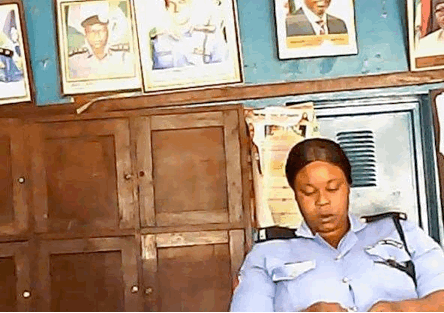
Policewoman Angelina Abubakar… collected N1,000 bribe but declared only N500 to her boss

In a matter of days, it becomes clear that all policewomen on duty at the counter are perpetually on the lookout for brisk business. Every visit to a suspect, even if it lasts no more than two minutes, is impossible without the payment of a N500 bribe. Charging one’s phones also costs N500 per time. Since roughly two people visit me daily, the policewomen can sometimes make a minimum of N1,500 off me in a day.

On Thursday morning, something interesting happens. Policewoman Angelina Abubakar’s voice rouses me from sleep. “Jumokeeeeeeeeee,” she bellows. “Do you have N500? I want to use it.”

Does she really think I have an option? I let her have it: a deduction from the sum of money seized from me at point of detention and deposited at the counter. Few hours later, with my phone out of battery charge, I request her attention, expecting her to for once grant me a free favour. “You’ll have to drop something,” she affirms. I decline, which means no phone for the rest of the night. How can I give you N500 in the morning and you can’t charge my phone for me in the afternoon for free? 

Less than half-an-hour later, her greed returns to haunt her. When Senami Kojah and Zainab Sodiq, my two visitors, brought breakfast in the morning, Angelina had collected N1,000 bribe from them. Apparently, she had lied to her boss she got only N500. Somehow suspicious that her boss doubted her and could ask my friends next morning, she begs me to appeal to them to insist they received N500 balance after parting with N1,000.

Well! Well!! Well!! Your sins have found you out. “My phone is not charged, so no way I can reach them,” I tell her. She speedily charges the phone and fetches it for me afterwards. Without a dime. Angelina’s boss is just as guilty, though; Section 355 of the Police Act 2004 prohibits an officer from receiving “any token from a subordinate in rank…”

THE EARLY-MORNING BAIL RITUAL

Friday morning, neither the Crime Officer nor any other policeman asks me if I want to call anyone to process my bail — clear indication I probably will be arraigned in court. By then, I’d become all too familiar with the Police’s early-morning bail shenanigans. In each of the previous days, at least one police officer asked almost every inmate first thing in the morning if there was someone they wanted to phone — a relative, friend — just anyone who could potentially show up at the station with cash for bail. Those mornings were the only times every suspect had the immediate attention of the officers at the counter. Every other time was a struggle — but not that early-morning call. Meanwhile, in all those days, repeated pleas by one of my lawyers for bail were flatly rejected by the Police.

The previous day, the CO had called out early in the morning to ask if I wanted to phone anyone. “Since you came here, we have not seen anyone mature come for your bail. Just those two small girls,” he had noted. Do you have any mature person you can phone? [Turning to the policewoman at the counter], please get him his phone so he can call anyone he wants to.”

Sometime just before 10am, a policewoman unlocks the main cell and asks me to step out. “The DPO said you should go and meet your IPO. You must leave this cell today anyhow; [it’s] either they arraign you or they let you go,” she informs me with glee in a thank-me-for-the-information manner. Actually, it was a big relief — because, by then, all my regular cell mates had been released, and I had become the longest-serving suspect. Austin was released on Thursday.

Taofeek, a man who joined us on Tuesday after his involvement in a scuffle over land, had regained his freedom since Wednesday after parting with N5,000 for bail. The same day, Austin and his four ‘wives’ were freed. Only four of us — Uche, Japheth, Sunday and I — were left.

For all of us, our detention for more than a day was illegal. Section 35 (5)(a) and (b) of the 1999 Constitution of the Federal Republic of Nigeria (as amended) are explicit: detention should be for a period of one day “in the case of an arrest or detention in any place where there is a court of competent jurisdiction within a radius of 40km”; and “in any other case, a period of two days”.

Detention can only be for a longer period if a court so decides. Meanwhile, a magistrate court is less than 15km from Pedro Police Station.

Soon, I would find out how much the complainant paid the Police to get me to court: N2,000 for typing, N2,000 for fuel, N1,000 for photocopying. So, either bail or court, and at the very worst scenario, the Police have devised a means of collecting at least N5,000 from every suspect and another N5,000 from the complainant at the point of leaving the cell.

Before long, a police van pulls over in the sweltering afternoon heat. The IPO handcuffs my hands and leads me into the van while the CO wheels it away, leaving behind a hail of dust, a station brimming with police officers filled with hate and a cell housing their preys.

This investigation was published with collaborative support from Cable Newspaper Journalism Foundation and the International Centre for Investigative Reporting, ICIR.

You may read the other part through the following link:

UNDERCOVER: Drug Abuse, Sodomy, Bribery, Pimping… The Cash- And-Carry Operations Of Ikoyi Prisons 2

Odinkalu challenges court over jurisdiction in alleged incitement suit by Governor El-Rufai

0

HUMAN rights activist, Chidi Odinkalu, has questioned the legal process in the case filed against him by the Kaduna State governor, Nasir El-Rufai at the Magistrate court in Kaduna, challenging the jurisdiction of the court to hear the case which has been held behind closed chambers since March.

El-Rufai has disagreed with Odinkalu, a former head of the National Human Rights Commission in February over the number of people killed in an attack in Kajuru, Kaduna State, and therefore instituted a criminal charge bordering on incitement and falsehood against the rights activist.

At the hearing on August 9, counsel to the defendant Gloria Mbaeiam Bellason had argued that the court lacked jurisdiction to hear the case because the case had no file record which means the conditions for filing the suit against Odinkalu did not follow legal procedure

“It is our submission, that the present case in which orders have been made in a case without a number is quite clearly incompetent and this Honourable court has been led into acting without jurisdiction,” she told the court.

She also countered the ex – parte motion filed by the Kaduna State government requesting the Police to investigate of the allegations levelled against Odinkalu by filing a preliminary objection to that effect alluding to the fact that the procedure was illegal.

The State government had filed an application to the court, on March 22, directing the Kaduna State command of the Nigeria Police Force to carry out an investigation on Odinkalu.

In a letter dated March 28, the Kaduna State judiciary wrote the deputy commissioner of police in charge of criminal investigation and intelligence department to affect the investigation.

In a phone conversation with The ICIR counsel to the defendant, Gloria Mbaeiam reiterated that the jurisdiction of the court was on a faulty premise with regards to hearing the case since the case has no file number.

“Without a case number assigned to a lawsuit it’s like saying there is no record of a court proceeding ever been held on that issue,” she said.

On October 11, Chief Magistrate of the State Magistrate Court, Ibrahim Musa had ruled that the state, had filed a counter – affidavit, had a right to respond on points of law.

Before the ruling, counsel to Odinkalu had drawn the Chief Magistrate’s attention to the fact that the case was not listed on the case list to be heard by the court.  The magistrate, nonetheless,  insisted that it wasn’t going to be a problem because his ruling was ready.

The case was therefore adjourned to October 16 for further hearing.

However, the direct criminal complaint filed by the Ministry of Justice, ex – parte motion, affidavits filed by the state and court orders by the magistrate had no case numbers apart from the complaint to the police where the case curiously developed a suit number out of the blues.

Abdul Mahmud, a lawyer said Kaduna State government is using its political power to bulldoze the judiciary in an attempt to override the judicial process.

“The court process numbers on cases indicate the jurisdiction of the court that is supposed to hear a particular matter but in a situation where the case number is not given to a case then no court has a legal right to hear that case,” he said.

El-Rufai in February had disclosed that about 66 Fulani residents were killed in the attack, but Odinkalu,  and many other Nigerians have  contested that claim.


United Nations may not have enough money to pay its staff next month

Guterres Antonio, United Nations secretary has warned that the UN may not have enough money to pay for staff salaries in the coming month if member states do not pay up what they owe.

Guterres said to make sure the General Assembly was held last month, several cut-backs on expenditures were made.

“This month, we will reach the deepest deficit of the decade. We risk … entering November without enough cash to cover payrolls,” said Guterres. “Our work and our reforms are at risk.”

The United States is the largest contributor – responsible for 22 per cent of the $2.85 billion regular budget for 2019, which pays for work including political, humanitarian, disarmament, economic and social affairs and communications.

Washington owes some $381 million for prior regular budgets and $674 million for the 2019 regular budget.

“The United States will be providing the vast majority of what we owe to the regular budget this fall, as we have in past years.”

“Overall the United States, as the largest contributor to the U.N., contributes roughly $10 billion annually in assessed and voluntary contributions across the United Nations system,” a US official from the U.S. mission said

Previously, Donald Trump, President of the United States has said Washington is shouldering an unfair burden of the cost of the United Nations and has pushed for reforms of the world body.

The US is responsible for nearly 28 per cent of the peacekeeping budget. However, Washington currently owes some $2.4 billion for peacekeeping.

U.N. spokesman Stephane Dujarric said 129 countries had paid their dues for 2019 so far, which amounted to almost $2 billion.

The top contributing countries are Ethiopia, India, Bangladesh, Nepal and Rwanda. They pay their troops according to their national salary scales and are reimbursed by the United Nations. As of July 2019, the United Nations paid $1,428 a month per soldier.

With the new financial set back the organisation might experience, Guterres said only essential travel is allowed, and some meetings may have to be cancelled or deferred.

U.N. operations in New York, Geneva, Vienna and Nairobi and at regional commissions will be affected.

U.N. peacekeeping missions are funded by a separate budget, which was $6.7 billion for  2019, and $6.51 billion for 2020 fiscal year which ended in June 30.


Soldiers capture Boko Haram commanders in Borno

0

THE Nigerian Army on Saturday announced the capture of 10 suspected key Boko Haram members at Bitta in Gwoza Local Government Area of Borno State, as they tried to escape during an attack,according to a report.

Aminu Iliyasu, Nigeria’s Army Operations Media Coordinator, a colonel, disclosed this in a statement in Abuja affirming that the sting operation conducted by troops of the 26 Task Force Brigade, which led to the arrest of the suspects, was a success.

In his statement, he confirmed that some of the arrested members have been identified to have operated combat vehicles during the infamous Boko Haram attack on Gwoza in 2014.

“The arrested suspects include Shettima Mustapha Umar, Abba Buji, Alhaji Bukar Madu-(KAHID – a Boko Haram Terrorists’ equivalent of a Brigadier General), Ali Hassan (Boko Haram Terrorist Imam) and Alkali Laminu.

“Others are Bukur Mustapha, Buba Umaru (alias Black Uhuru) also a KAHID, Madu Nosobe, Mustapha Hussain and Umar Jeddum all from Bama LGA of Borno State.

“It is gratifying to note that one of the arrested suspects, Alhaji Bukar Modu is Serial 89 on the high profile Boko Haram leaders wanted list published by the authorities of the Nigerian Army,’’ he said.

Iliyasu said that the troops of the Nigerian Army had raised up the bar on their operations across the nation to checkmate the activities of criminals, and the operations have been yielding results.

He also said that troops of 1 Division Garrison Tactical Headquarters, Kaduna, intercepted suspected cattle rustlers and recovered 23 rustled cows in Birnin Gwari Local Government Area.

According to him,  the army is making effort to identify the owners of the stolen livestock.

Iliyasu said five herdsmen complicit in the murder of one Haliru Yahaya on his farm in Birniwa in Jigawa State were arrested in a joint operation by the army and police.

The operations spokesman said the arrested suspects were currently in the custody of the Nigeria Police in Birniwa while troops maintain vigilance in the area to forestall escalation.

Armed robbers, kidnappers, vandals and oil bunkers were also arrested in Edo, Ondo, Ogun, Plateau, Delta and Rivers states in different operations of the army, Iliyasu said.

Dele Agekameh, Nigerian Veteran journalist is dead

Dele Agekameh, a Nigerian veteran journalist and writer has died at the age of 60 after almost a decade battle with kidney disease.

The award-winning journalist before his death on Friday in Lagos was a columnist for top Nigerian dailies and former Senior Editor in TELL in 2004 before setting up Quicklink International Network, publishers of The Capitol International Magazine.

According to the family of the deceased, Agekameh was first diagnosed in 2010 before seeking medical advice in India in 2012, where he underwent surgery. However, the medical practitioners had advice a kidney transplant as a permanent solution to his complication.

The son of the deceased Fabian Agekameh said his father lost his life due to the horrible state of the Nigerian health sector. He said his father after running series of check-ups and being on dialysis both in Kidney Solutions, off Adeniyi Jones in Ikeja and Babcock University Teaching Hospital (BUTH) was transferred to Lagos State University Teaching Hospital LASUTH upon complications on Friday.

“According to his assistant who was with him, around 5 pm, the decision was taken to transfer him to a bigger hospital. Several calls were made for an ambulance to no avail until they decided to hook him up to oxygen and transport him with his personal car.

“After fighting traffic to get to Lagos State University Teaching Hospital, there was another issue getting him into the emergency ward, as nurses who were finishing their shift refused to attend to him, based on the account of those with him.

They reportedly said the doctor that could attend to him was busy and they should wait. He was still in his personal car, clinging to life when a doctor went out there to pronounce him dead, the son told Premium Times.

Fabian said although the doctors had pronounced his father dead on arrival, his driver and personal assistant insisted he was still alive after they had reached the hospital.

The body has been deposited at the LASUTH morgue while awaiting an autopsy.

Before his death, Agekameh wrote many investigative reports and one of them for which he was recognised exposed the network of a cross-border car smuggling business.

Appeal court sacks Dino Melaye

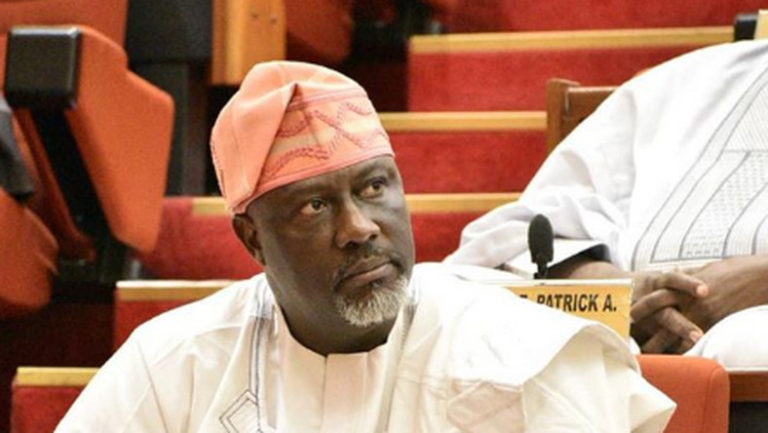
APPEAL court sitting in Abuja, on Friday sacked the Senator representing Kogi West, Dino Melaye and ordered a re-run of the election.

Dino Melaye appealed against the decision of the Kogi Election Petition Tribunal which ruled that the election that brought Melaye as a senator representing Kogi West for a second time in office be re-run.

Smart Adeyemi, the All Progressive Congress (APC) candidate approached the tribunal to nullify the election over the basis of over-voting, irregularities and non-compliance with the electoral act.
During the February 23 election in Kogi state, the PDP candidate Dino Melaye had 85,395 votes while APC candidate Smart Adeyemi had 66,092 votes.

However, the election has been nullified by the Kogi Election Petition Tribunal and the Appeal Court.

Dino Melaye also confirmed the news of his sack at the tribunal on his official twitter handle, urged his supporters to be law-abiding as they await the rerun of the election by November along with the Governorship elections of the state.

“I just lost my election at the Appeal Court and fresh election ordered. In all things, I give God the praise. He who started a good thing will definitely complete it. I ask my supporters to be law abiding as we shall always overcome. To God be the Glory,” he wrote.

Melaye and the PDP have been reported to be at loggerheads following his aspiration to contest as the gubernatorial candidate of PDP.

He expressed his displeasure at the primary elections after losing to Musa Wada as he also rejected the appointment as the Director-General of the Kogi State Campaign in 2019.

“Let me state categorically that I have turned down the position of Director-General of the PDP Kogi State Governorship Campaign Council. I wish PDP all the best. When truth is a casualty there is chaos,” he wrote on his twitter handle.


Report reveals govt officials stole Yellow Fever cards,  sell in open markets

NOT less than 80,000 of Yellow cards that are issued to Nigerians as a proof of being administered with the yellow fever vaccine before travelling out of the country are now being sold in the markets and streets, without the travellers taking the vaccine,  and causing the government to lose up to N200 million.

This was revealed in a report of an investigation carried out by Progressive Impact Organization for Community Development, PRIMORG, a civil society organization working in the areas of accountability and anti-corruption.

The report revealed that some top officials of the Federal Ministry of Health (FMOH) carted away some of the e-yellow cards printed by the Federal Government which are meant to be issued to individuals after they must have taken the vaccine at the designated clinics, airports and border posts.

The card which officially costs N2,500 is sold to prospective travellers at prices as high as N5,000 without taking the vaccine, thereby undermining the objective of the yellow fever immunization.

The government has been making efforts to recover all the stolen cards with little success.

A copy of the yellow card obtained by PRIMORG undercover reporter was marked B947006 bearing the Nigerian coat of arms and a scan code to verify the card’s authenticity while the medical detail in the card was pre-filled, indicating the type and milligram, the date and the official stamps of the “PORT HEALTH OFFICE, FMOH NIGERIA”.

Earlier in February, the federal government had approved the issuance of Yellow Card that could be read electronically to eliminate the incidents of forgery and sales of fake cards at designated locations.

Copies of the e-card obtained by Primorg reporter during the cause of the investigation. By the right is the one purchased at a black market. Photo credit: PRIMORG.

To kickstart the issuance of the new cards in April, the Health Ministry printed one million e-cards in two batches─ 500,000 copies each for the A and B categories. Government has hoped to make over N2 billion from the sales but as thousands were stolen, the projected revenue reduced and the yellow diseases increase.

“Some unscrupulous staff stole a chunk of the cards from batch B and began sales of it in the open market to travellers who do not go through the process of vaccination,” the report stated.

“We gathered that the Ports Services Unit has not exhausted the yellow cards in the Batch A category. But the containers housing batch B was violated and bulks of them stolen by some of the health officials who were mandated to keep them safe.

“It is believed that the cards at the black market will be worth more than N200 million,” said PRIMORG.

Though the government has identified those who cart away the printed cards, no serious actions have been taken against them.

An official that had stolen 11,000 cards at Kano was only removed from the issuing desk of the Port Health Services Unit of the Federal Ministry Health to another unit.  That means the official carted away goods worth N27.5 million at the official price of N2,500.

“The incident in Kano has not been properly investigated as some of the indicted officials have tapped on high-level connections in government to silence the senior Ministry officials in Abuja to achieve a cover-up,” PRIMORG reported.

According to the World Health Organisation, Yellow Fever is a viral haemorrhagic disease transmitted by infected mosquitoes to humans. Symptoms of yellow fever include fever, headache, jaundice, muscle pain, nausea, vomiting and fatigue. 

It could become deadly for individuals not vaccinated.  It could affect the liver and the kidneys. It could also cause jaundice- yellowing of the skin and eye, dark urine and abdominal pain with vomiting. Bleeding could occur from the mouth, nose, eyes or stomach.

“Half of the patients who enter the toxic phase die within 7 – 10 days,” said WHO.

Meanwhile, the disease is prevented by vaccine. The vaccine provides effective immunity within 30 days for more than 99 per cent of people vaccinated.

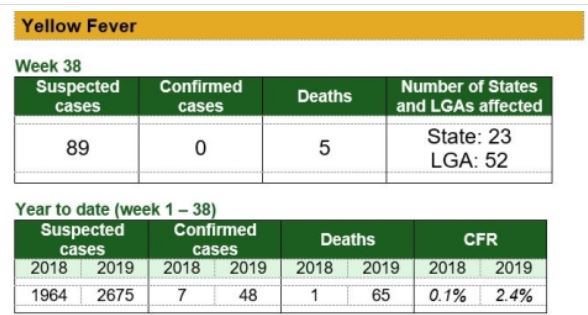
The cases of Yellow fever in Nigeria as of September 22, 2019. Credit: NCDC.

Nigeria has a high prevalence of yellow fever with an increase in 2019.

According to the weekly epidemiological report published by the Nigeria Centre for Disease Control for the Week 38 in 2019, Nigeria has recorded 2,674 suspected cases of yellow fever, and 65 of the people have died as against one death recorded  in the whole of 2018.

Ethiopian PM Abiy Ahmed clinches Nobel Peace Prize for bringing twenty years war to a halt

0

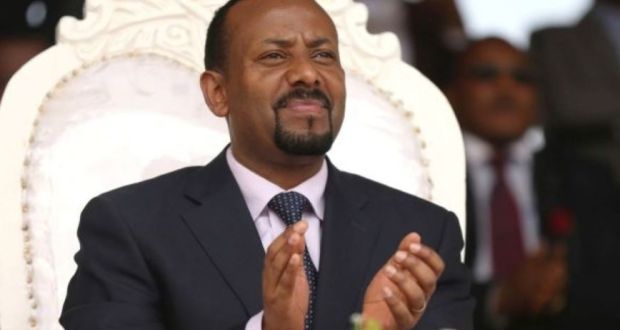
ON Friday, Abiy Ahmed, the prime minister of Ethiopia, was conferred the 2019 Nobel Peace Prize by the Nobel committee for his peacemaking efforts which ended twenty years of hostility between his country Ethiopia and Eritrea.

Ahmed, the first Ethiopian to be awarded a Nobel Prize was commended by the Nobel committee for his efforts in restarting the peace talks with Eritrea that ultimately resolved the crisis between the two countries.

“In Ethiopia, even if much work remains, Peace Laureate Abiy Ahmed has initiated important reforms that give many citizens hope for a better life and a brighter future. As Prime Minister, Abiy Ahmed has sought to promote reconciliation, solidarity and social justice,” the Nobel committee stated in a Twitter post.

The two nations have ethnic and cultural ties, but decades of animosity between them had torn families apart and worsened Eritrea’s isolation as a repressive country.

Over 100,000 people were estimated to have been killed in cross-border attacks between the two countries in twenty years.

A peace treaty was signed by both countries at a summit that took place between July 8-9, 2018 in Eritrea, leading to a gradual and beneficial friendship between both countries.

It is the second year in a row an African is being named as winner of the prestigious prize. Ahmed will become the 100th Nobel Peace Prize in Oslo, where he will receive the award in December.

The 2018 Nobel Peace Prize was jointly awarded to Nadia Murad and Denis Mukwege. Murad, a 26-year-old Yazidi woman, was honoured for her support towards women who survived sexual and domestic violence from Islamic State militants.

Mukwege is a Congolese gynaecologist, who was honoured for treating thousands of women and other victims of the violence in the Congo.

The Nobel committee said this year’s peace prize also honoured those who contributed to resolving the cross-border conflicts across East Africa.

Pushed beyond borders: Rice, foreigners are easily smuggled into Nigeria when Immigration and Customs officers receive bribes(3)

With Nigeria’s porous borders and corrupt law enforcement officers, anyone can conveniently cross into and leave the country or smuggle in goods without having to answer questions or present relevant documents—until a border closure was announced in August.


“OKAY, let us pray,” announces the cab driver. For years, the forty-something-year-old has safely conveyed passengers through the three-hour distance between Kanga, a border town in Benin Republic, and Abeokuta, Ogun State.

“In the name of Jesus… Thank you, father, that you have made this journey hassle-free for us,” he continues passionately, at the same time steering his old-model Mazda 626 through the untarred road.

“If we have committed any sins that may hinder our prayers from getting answered, father, holy spirit, forgive us. Make us holy. If there are forces, seen or unseen, that may want to sabotage today’s journey, forces of witches and ritualists, blood-spilling forces, in the name of Jesus, nip them in the bud. All enemies of progress on this path, go into oblivion! All spirits must bow in the name of Jesus!”

After four minutes of praying and mumbles of ‘amen’ from the passengers, the driver, whom many—including himself—simply prefer to call ‘pastor’, soon stops to receive one bag of rice, which he places in the trunk. “It is so I can have something to buy fuel with,” he explains with a smirk.

In 2018, President Muhammadu Buhari stated that rice importation has been cut by about 90 per cent and praised improvements in the local agricultural sector for this. The figures from the Thai Rice Exporters Association showed that while in 2015 the Asian country exported 644,131 metric tons (MT) of parboiled rice to Nigeria, this dropped to 58,260MT in 2016 and then 23,192MT in 2017.

Rice exports to Benin Republic, however, skyrocketed by an even greater measure within the same period.

Benin imported 805,765MT of rice in 2015, but this figure grew to 1,811,164MT as of 2017. This is in spite of the 2013 Benin Coarse Grains and Rice Report stating that the country only requires 385,000MT for local consumption. The bulk of the rice received into the francophone country—as admitted also by former agriculture minister Audu Ogbeh—is therefore smuggled into Nigeria.

‘Pastor’ struggles to move 50kg of rice to his trunk.

Rice smuggling is quite profitable and is done by many taxi drivers operating at the Ilara-Kanga park to make extra cash. According to one of the drivers, a bag of rice in Benin costs N9,700 while the selling price in Nigeria is as high as N17,000. The driver who smuggles it in from Ilara has an average cut of N2500 per bag.

But it is not only rice that is smuggled into Nigeria. Bringing in migrants without papers is another lucrative practice; and, usually, all goes well as long as the palms of border patrol officials are well greased. While a Nigerian coming into the country is asked to pay a fare of N1500, Beninese are charged as high as double that amount.

This reporter travelled to Bohicon, Benin Republic, on Thursday, August 8, and returned to Nigeria on Saturday, August 10, via the border at Ilara without an international travel passport. Yet, he was not queried anywhere along the road—despite the presence of numerous security checkpoints every few kilometres.

‘Pastor’ gripes that across the stretch of road there are six checkpoints manned by operatives of the Nigeria Immigration Service (NIS) and nine belong to the Nigeria Customs Service. There are a few other checkpoints too where we have officers of the Nigerian Army and Nigeria Police. In all, this reporter counted no less than 26.

N200 note: the new travel passport

In February 2018, Nigeria’s ambassador to Benin, Kayode Oguntuase, pointed out that there are 42 illegal checkpoints between the border at Seme and Mile 2, Lagos, and that security personnel at these places extort money from travellers. Transporters who ply the route have also complained of losing between N9,000 and N10,000 to extortion in trying to cross the border. But this problem is evidently not limited to the Seme cross-border route.

There seems to be a long-standing tradition between the smugglers and security operatives regulating how much the charge is per bag of rice or illegal immigrant. But this is subject to negotiation. ‘Pastor’ who picked up only a bag of rice has to pay officials of the NIS and Customs N200 at every stop.

On the other hand, policemen, whose checkpoints are closer to the Abeokuta end of the stretch, could be offered N100. One of them, at a checkpoint about 15 kilometres from Ogun State’s capital, had on a blue uniform with a name tag ‘Otu Rasheed’.

During the trip, while the driver always states correctly that he has only one bag of rice in the car, he is not as honest about the number of Beninese passengers. “I only have two Egun people [used generally to refer to migrants from Benin Republic],” he says at the third checkpoint. “The rest are Yoruba.” Whereas, a headcount he conducted at the start of the trip had established that there are two Yoruba passengers and four from the neighbouring country.

At another security checkpoint where a relative of his is on duty, the driver escapes paying by declaring he has only Yoruba passengers.

In many cases, the illegal exchange of money is not done under the table but so openly that passers-by also witness it. In one instance, a law enforcement agent, in fact, asks if there’s still room in the car for another bag of rice.

* * *

“Collect N200 from him,” an NIS official donning black tee-shirt and jeans cries at the fourth checkpoint. “Sefiu, I said collect N200 from him. He doesn’t have a choice.”

“I am not fighting with you, we are only doing our work,” he adds. “If you carry one bag of rice here, we’ll collect our money. The same thing if you carry 10.”

‘Pastor’ explains as he starts the engine that he recently conveyed the officer and insisted on charging him N2,000, the same fare paid by everyone else. The officer had since vowed to make all the money back through extortion.

“In smuggling rice, to enter Ilara there is simple. To move from Ilara to Abeokuta is where the problem is,” the driver says, to no one in particular.

Halfway into the journey, a few kilometres before we get to Obada Idi-Emi, the driver is lucky to be stopped by a generous official who has on a black long sleeve shirt with a blue collar.

“Don’t be angry sir, I was able to carry only Yoruba people today. I have one bag of rice too. Please, oga mi; this is what I have left. I still have to settle immigration,” the driver pleads.

After he is signalled to proceed, he goes on to brag about the importance of being cunning.

“My people, it takes wisdom,” he says with self-satisfaction.

“The bible says we should combine wisdom with faith and combine faith with knowledge. The operatives are ready to collect all you have with you. They don’t give any considerations. Don’t they know how many checkpoints we pass through before getting to their place?”

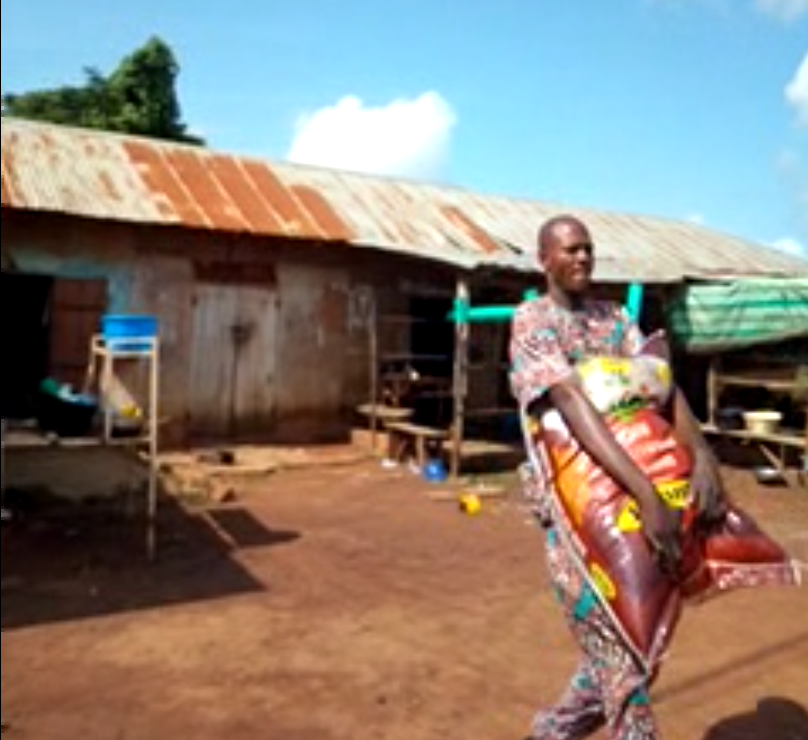
A motorcyclist tranporting several bags of rice crosses the border into the Nigerian territory at Ilara.

A border where business booms

A new arrival at Ilara, a border town between Nigeria and Benin, is likely to first notice two things aside that signposts are written in French language: huge trucks and warehouses at every turn. It is a goldrush and everyone is struggling to have a share, but this time the trending commodity is not a hoard of gold. It is rice.

The trucks are used to transport rice from the coastal city of Cotonou to the border communities, where warehouses of various sizes abound. The bags are then loaded on top of motorcycles and taken into smaller stores in Nigeria, from where the cabbie-smugglers take over.

Traders and drivers in the town are reluctant to share insights into how the business is run because of the fear of unknowingly implicating themselves. One of the big warehouse owners recently ran into trouble with law enforcement agents and had to pay in respect of eight truckloads of rice, narrates one of them.

A sales boy at a smaller shop, trying to wriggle out of the conversation, says the shop was just recently established and he doesn’t know much about the business.

“But if you check this route here,” he adds dramatically while pointing to his left, “there are a lot of magazines [trucks]. A lot!”

“If you go to the other end of the road too,” he says, now pointing to his right, “there are a lot of them. This untarred road leads directly into Nigeria.”

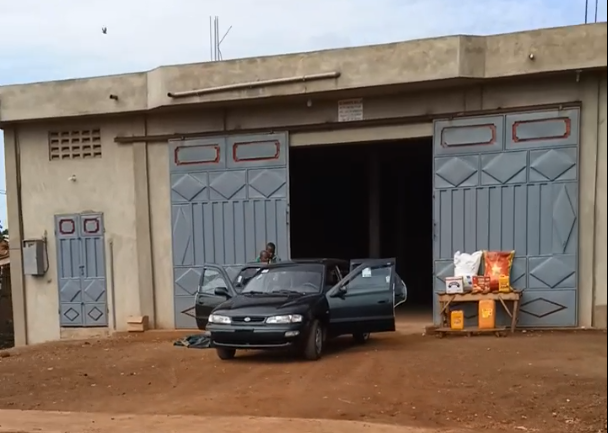
Bags of rice are offloaded from a huge truck and stored at a warehouse at Ilara-Kanga.

Nigerian govt. intervenes 

In August, Nigeria partially closed its western border with Benin, triggering protests from the Economic Community of West African States (ECOWAS).

Though statistics from the World Agricultural Supply and Demand estimates suggest the country hardly produces half of its local consumption need, President Buhari has said the closure is meant to curb the “alarming” rate of rice-smuggling.

The recent reinforcement of border security, codenamed Exercise Swift Response, has according to the NIS led to many arrests of people attempting to come in through unlawful routes.

“The border is tight now,” remarks NIS spokesperson Sunday James in an interview with The ICIR. “Nobody enters into this country without a valid document and nobody exits the country without valid documents.”

He also explains that the agency has put in place standardised machinery to check excesses at the border. One of them is the migrant e-registration.

“We are registering all migrants residing in Nigeria whether regular or irregular,” he says.

“That is another way of controlling the entrance and exit of people into the country. And if within the country we are controlling non-Nigerians by virtue of registration, you should know definitely that anybody that is going to come from outside the country must go through clearance and checks.”

He says the project, flagged off on July 12, has documented a total of 4,733 of migrants as of Friday, September 6.

Foreigners generally have to get a visa before they can come into Nigeria, James explains, and then citizens of the ECOWAS member-countries “must come with valid travel documents: ECOWAS travel certificate and ECOWAS National Biometric Identity Card”.

That was, however, not the reality at the border weeks ago.

‘Pastor’, during a later phone conversation with this reporter, confirms it is now very difficult to smuggle in either bags of rice or foreigners.

“Rice can be transported from Cotonou to Ilara but getting it into Nigeria is very difficult. As a matter of fact, they don’t allow us to bring even one bag,” he laments.

He says there are however drivers who still smuggle in items. But they do this at great risk through the forest routes. If caught, the smuggled commodities would be confiscated. He tells this reporter that travel documents are also checked under present circumstances.

In his words, “If you are going to bring in anyone without a passport, it’ll have to be fayawo [through secret detours].”

‘Pastor’ is hopeful though that the borders will be re-opened soon and it will be business as usual.

“Even if it is one trailer-load of rice you need from Cotonou or half… We know how to do it without a problem,” he says confidently. “But I will advise we exercise some patience.”


* This investigation is supported by the Institute of War and Peace Reporting and the International Centre for Investigative Reporting, ICIR.

You may read the other parts through the following links:

Pushed beyond borders: A peek into the dark world of child trafficking between Benin and Nigeria (1)

Pushed beyond borders: Why Nigeria’s worsening economy isn’t stopping young Beninese migrants from seeking a better life (2)