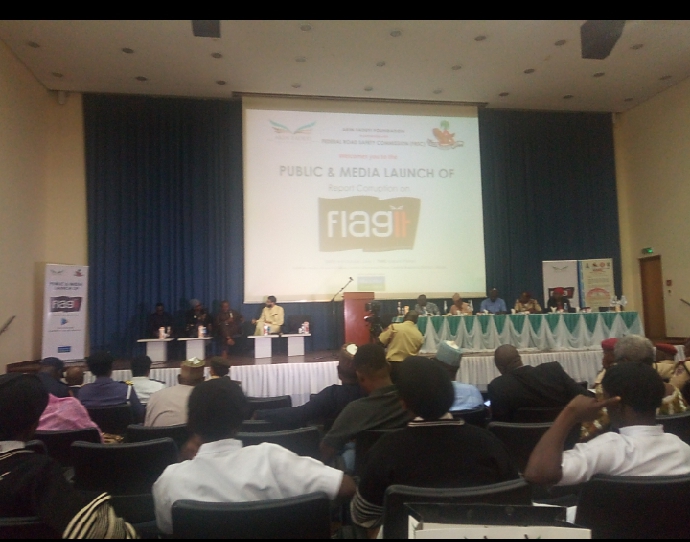
AKIN Fadeyi Foundation and the Federal Road Safety Corps (FRSC) on Thursday held the public and media launch of an anti-corruption application called FLAG IT on Thursday.
The launch which was held at the Shehu Musa Yar’adua Centre in Abuja was attended by dignitaries from civil society, government agencies and the press.
Vice President Yemi Osinbajo represented by the special adviser on rule of law, Rasheedat Waziri, said the initiative aligns with the vision of the Federal Government on the fight against corruption. Corruption, the VP said, slows down development goals in Africa.
The Corp Marshall of the Federal Road Safety Corps, Boboye Omoyemi during his address said corruption has occupied a large space in the country and that FRSC has been working on plans to ensure that the agency is rid of corruption.
“In terms of rescue services, this is one of the places that the FRSC has been receiving commendations, we have recovered millions of naira, pounds sterling and dollars from road accidents and no one has ever complained.
“Since my appointment, we have terminated the appointment of 72 staffs 52 are under trial and by the next meeting of FRSC board of directors, the board will confirm the disengagement of another 42,” he said.
He said the FRSC has a functional establishment unit, Servicom and desk office to work with the anti-corruption agencies like ICPC and EFCC.
A welcome address was delivered by the founder of the Cable, Chairman Board of Trustees, Akin Fadeyi Foundation, Simon Kolawole, who read the speech of Akin Fadeyi, the founder of Akin Fadeyi Foundation.
According to him, the Flag-It initiative is a measure to enhance accountability and report corrupt practices as well as excellent services.
“Earlier this year EFCC boss Ibrahim Magu said between 2015 and this year about 1.3 trillion naira has been stolen by 32 individuals and one third of the amount using world bank rate and cost can construct 500kilometer road, build close to 200 school, educate about 4000 child from primary to tertiary institution at 25 million per child, 20000 unit of 2 bedroom flat across the country.
“The culture of corruption that has been created over the years have become very difficult to fight, we must start by talking to the man in the mirror by asking what is my role in fighting corruption and building a Nigerian nation of our dream,” he reiterated.
He added that with this initiative, the fear of Flag-It will become the beginning of wisdom.
Kole Shettima, Director, Africa Office, MacArthur foundation appreciated the Akin Fadeyi Foundation and FRSC for the event. He mentioned how he read an article on Thisday that brought his attention to Akin Fadeyi Foundation, then he said they must look out for them to see whether they can support the work that they do. “I was inspired by the fact that they are challenging all Nigerians that they also have a responsibility for ourselves, our children and the nation.
“They are not just pointing fingers at the government but also at ourselves by saying that we as citizens have a responsibility to make this country what we want, its not just enough to look up to the president, governor or local government chairmen for their actions but we have a responsibility to do all we can to ensure a better nation.”
Chairman of the Presidential Committee on Corruption, Itse Sagey represented by Kelechi Amadi, said people are compelled to pay for the services they ought to get for free but this has not been possible because of corruption. The political economy of the nation has been producing overnight billionaires who are called leaders by the day, said Sagay.
Nigeria Representative of United Nations on Drugs and Crimes (UNODC), Oliver Stolpe lamented about how corruption is eating up Nigeria.
“In 2016, the UN and the National Bureau of Statistics (NBS) carried out a survey on bribery and it was found out that bribery is on high level in the country especially among traffic management agencies”.
Flag-it, therefore, is an important tool in the arsenal of the anti-corruption war he said.
During the Panel discussion which consisted of Ademola Henry Adigun, an oil governance consultant , Ramotu Umar Bako, head of influencing and public engagement at Oxfam, Auwal Rafsanjani, Executive Director, civil society legislative advocacy centre, Ajuri Nagale, Special Assistant to the president on public affairs and Chido Omonuah who was the moderator of the discussion, the panel opined that there is need for partnership between the government agencies, the civil societies, the media and as well as the private sectors.
Auwal Rafsanjani added that the fight against corruption should be institutionalized and should not be a personal thing so that when a government leaves, the anti-graft fight will not leave with it.
Dapo Olorunyomi, the publisher of PREMIUM TIMES spoke about furthering the role of investigative media in Nigeria’s search for accountability.
He stressed the need to nurture investigative journalism and how technology can help to drive it.
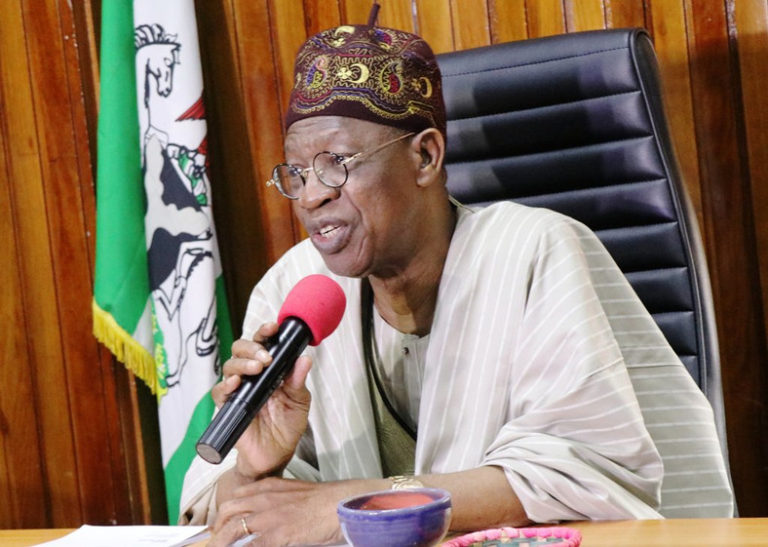
LAI Mohammed, minister of information and culture, in Abuja on Thursday, said online news platform will soon be regulated.
During the inauguration of a seven-man committee set up charged with the implementation of reforms in the National Broadcasting Commission (NBC), the minister said the committee is to implement recommendations supposedly approved by President Muhammadu Buhari.
Mohammed said the president has approved an amendment to the NBC act which would enable the committee license WebTv and radio stations, including foreign broadcasters beaming with wide reach or coverage that extends to the country.
“The terms of reference of the committee are as follows; To establish and publish a new regulation for the licensing of web and internet broadcasters/international broadcasters in Nigeria.
“To immediately commence work on all statutory, legal and regulatory framework for further legislative action on the review of the NBC act by the national assembly.
“To work out the modalities for a competitive and reasonable salary, wages and other welfare needs of the staff of the commission.
“To establish necessary protocols for the establishment or appointment of professionals or technocrats (non-partisan personality) to run the agency, and appointment into the board of the NBC.”
The minister said the president also approved the upward review of fines from N500,000 to N5 million for breaches relating to hate speeches and the upgrade of political comments as ”Class A” offence in the broadcasting code.
“I do not doubt that this committee, which comprises highly-experienced professionals and administrators, will carry out a thorough job that will reposition the NBC as an effective and efficient regulator,” he said.
The committee is comprised of Armstrong Idachaba, NBC director of monitoring (chairman); Godfrey Ohuabunwa, acting chairman of the Broadcasting Organisations of Nigeria (BON); J.K. Ehicheoya, director, legal services, ministry of information and Culture; Binta Adamu Bello, secretary, Association of Local Governments of Nigeria (ALGON); Ibrahim Jimoh, director of administration, FRCN; Agbo Kingsley Ndubuisi, NBC board member and Joe Mutah, chief press secretary, ministry of information and culture (secretary).
A Federal High Court sitting in Abuja on Thursday ordered the final forfeiture of N550 million and N51 million, identified as being proceeds of fraudulent practices belonging to Titus Okunrinboye.
The presiding judge, Justice Giwa Ogunbanjo granted the prayer of the Economic and Financial Crimes Commission, EFCC, to make a final forfeiture of the monies to the Federal Government.
The trio of Titus Okunrinboye, Vincent Odafen and Muara Muhammed Gambo are being prosecuted by the EFCC for allegedly operating companies, which were alleged to have been used to siphon public funds under the façade of contracts and consultancy.
In June, the EFCC had applied for interim forfeiture before Justice Giwa, who granted the application and stipulated that the Commission should place the application in a national newspaper.
Prosecution counsel, M.S. Abubakar, told the court that the Commission had complied with the judge’s stipulation by advertising the interim forfeiture application.
“We have complied and we’re now back to apply for final forfeiture and the affidavit in support of the motion on notice, as the defendant has not filed any counter,” he said.
Justice Giwa asked the prosecution counsel to serve the defendant the notice on the motion. He urged Abubakar to make sure that the account number filed by the prosecution for the forfeiture is thoroughly verified to be a Central Bank account number and must be supported with documents to ensure that where the funds would be transferred is a genuine federal government’s account before adjourning to October 10, 2019, for ruling on the final forfeiture application.
At the resumed hearing today, the prosecution counsel urged the court to grant EFCC’s prayers since there was no counter-affidavit against the application.
The motion on notice filed by the EFCC for the final forfeiture reads “A final order of this honourable court for forfeiture to the Federal Government of Nigeria of funds lying in the Zenith Bank Account No:208383581 (Okunrinboye Tomsin Titus).
“A final order of this honourable court for final forfeiture to the Federal Government of Nigeria of the funds lying in the Zenith bank account No. 1004702420(Okunrinboye Tomsin Titus). An order of this honourable court directing Zenith Bank to forthwith transfer the forfeited funds to the Central bank of Nigeria,” it reads.
Justice Giwa granted the request of the prosecution and placed an order, directing Zenith Bank to transfer the forfeited funds into the Cash Assets Final Forfeiture of the Central Bank of Nigeria.
MENTAL health advocates have claimed that the prevalence of depression, substance abuse, molestation and sexual harassment —all which sometimes drive the victim to commit suicide— in Nigerian societies (especially campuses) may be due, partly, to the loss of the culture of counselling and proper guidance in secondary and tertiary institutions.
Oluwakemi Omole, a doctor of psychology and coordinator of the Counseling and Human Development Centre in Federal University Oye-Ekiti (FUOYE) and Taiwo Alao who is the founder of Gifted Foundation that advocates women’s sexual and reproductive health rights noted that counselling helped in combating mental and sexual related challenges in Nigerian institutions.
While speaking to The ICIR on the occasion of the World Mental Health Day, Omole said the counselling department plays a major role in any institution or organisation to address the mental health challenges.
Omole noted that there is an unduly huge rate of female students being sexually abused.
But the culture of silence among students continues to foster a fertile ground for this crime to germinate and grow.
“The roles of the counsellor are many. Counsellors help people to deal with and overcome difficult situations,” she said.
However, Omole said people are not speaking up is a major challenge to addressing mental and sexual related issues.
“What does a counsellor do when victims don’t turn up or speak up? This is the big question and usually the challenge for many counsellors,” she wondered.
To break the barrier of silence, Omole said counsellors should not wait till victims open up. She noted that they could now rely on hints from fellow students and colleagues of affected students.
She added that sometimes by monitoring WhatsApp status among other posts, one could deduce that a student isn’t in a perfect state of mind and with that exposition, they devise ways to reach out to the person without explicitly revealing how they got the information.
Omole who is a staff of FUOYE counselling unit added that she normally offer virtual counselling to students.
“I organised a walk to raise awareness and remind the FUOYE community that the counselling department exists,” she also recounted her activity of August 23 while speaking to The ICIR.
“With the walk, we are bringing counselling to the forefront” for people to know that “there is what is called counselling,” she said.
An increase in interpersonal relationships and physical communications were also described to be a good way to improve mental health among people instead of people resulting in social media communications.
She said parents have a crucial part to play in ensuring the mental health of their wards.
“Parents need to change and not be static,” she said. “We need to go beyond stereotypic judgement; we need to change rigid beliefs; enough of handing over outdated information”.
Taiwo who advocates women’s health also noted that secondary school students in Ekiti State, particularly the rural areas, were not enlightened on the role of counsellors in guiding them through whatever challenges they were facing.
An awareness based on women’s health in Ekiti Secondary School.
She said her foundation outreaches to secondary schools in rural communities in Ekiti made her realise that the students have poor knowledge on the impact of counsellors to them.
Rape, sexual harassment and molestation, although often underreported, are also common phenomena in Nigerian institutions. Some lecturers take undue advantage of their students and often request sex for marks or upgrades.
BBC Africa Eye through a ‘sex-for-grades’ undercover documentary exposed the reality in the University of Lagos, Nigeria and the University of Ghana, Accra where lecturers sexually abused female students. The video narrated the experience of a female student of UNILAG that attempted suicide four times because she was sexually abused.
A report by Daily Trust found that 42 persons committed suicide within the first and second quarters of the year. Out of that 42, 11 were deaths of students. It also found that many of the suicide was through the use of an agrochemical product named sniper.
One of the students who committed suicide was Chukwuemeka Akachi, a final year student of English and Literary Studies at the University of Nigeria, Nsukka. Akachi took his life after taking Sniper in an uncompleted building.
He was said to have posted on Facebook before he committed the act. Here is his post: Forgive me. In case you are the one who found the body, I am really sorry. It had to be someone you know. I have chosen Jo Nketaih’s poem as my suicide note: “They said you came looking for me. I don’t drown, I was the water. Where do atheists go when they die? Lol. Amen”.
Punch Newspaper has also reported the case of Samuel Elias, a student of Religion and Culture from the University of Nigeria, Nsukka who also took sniper in order to terminate his life. These are two of the several cases reported this year.
IN a bid to increase its oil revenues, the Federal Government is set to reclaim $62 billion from five major international oil companies working in Nigeria through a Supreme Court ruling that allows it lay claim to income from the production-sharing contracts.
A Bloomberg report referenced a document from the attorney general’s office and the Ministry of Justice stating that the oil companies failed to comply with a 1993 contract requirement that the state should receive a balanced share of revenue earned by the oil firms when the oil price exceeds $20 per barrel.
Currently, oil companies take 80 per cent of the profit from these deep-offshore fields, while the Federal Government receives 20 per cent according to the document.
“The 1993 law required that its provisions be reviewed after 15 years and subsequently every five years. The attorney general’s office insists that the provision for a higher share of revenue doesn’t require legislative action to take effect,” the document affirms.
The firms involved include Royal Dutch Shell Plc, ExxonMobil Corp, Chevron Corp, Total SA and Eni SpA which were signatories to the production-sharing contract that funds the exploration and production of deep-offshore oil fields on the basis that they would share profit with the government after recovering their costs.
A bulk of deep offshore crude oil being pumped from Nigeria is carried out by the five oil firms operating joint ventures and partnerships with the Nigerian National Petroleum Corporation, NNPC.
A Supreme Court ruling followed a lawsuit by states in the oil-producing region seeking the interpretation of the nation’s production-sharing law. The states argued that they weren’t receiving their full due.
The court ruled in their favour and asked the Attorney General and justice minister, Malami Abubakar to take steps to recover the outstanding revenue.
Royal Dutch Shell Plc, proceeded to the Federal High Court to dispute the Federal government’s claim that they owe the state any money, arguing that the Supreme Court judgment doesn’t allow the government to collect arrears.
Shell’s head of upstream Andy Brown in an interview hinted that the company wasn’t party to the court ruling in 2018 and shouldn’t be subject to the ruling.
“It is something that has gone through the courts in Nigeria which relates to an original clause within the original PSCs (production sharing contracts). We will have to take it seriously but we think it has no merits,” he said.
Several multinational firms have been fined by the Federal Government in recent times. In 2019, MTN Group Ltd paid an estimated $1 billion for failing to disconnect undocumented SIM-card users, while JPMorgan Chase & Co were also sued by the Nigerian government in a corruption scandal.
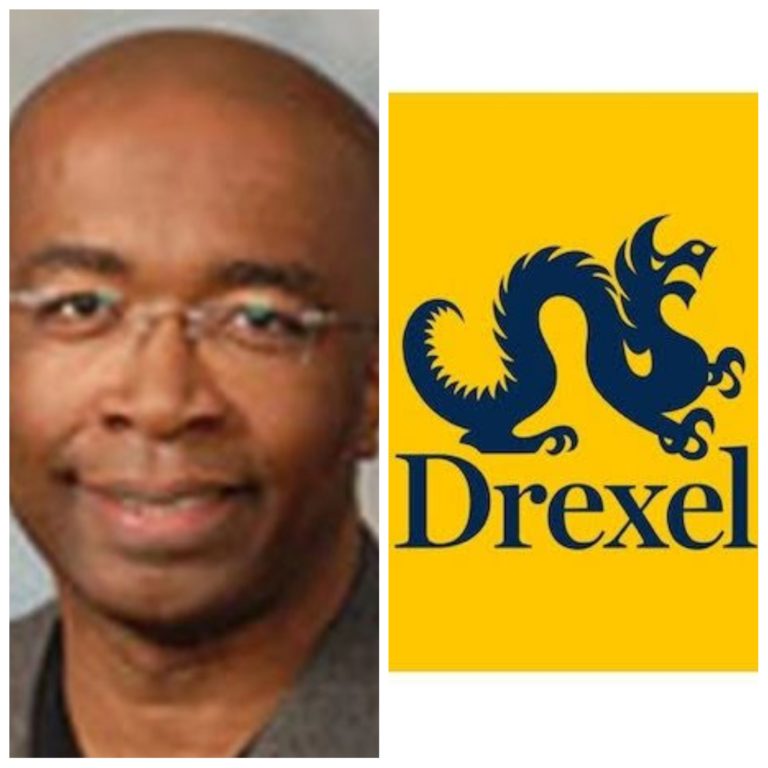
CHIKAODINAKA Nwankpa, a former Drexel University professor and of Nigerian origin blew nearly $200,000 of federal grant money in strip clubs and on other ‘improper purchases’, United States Department of Justice revealed Monday.
For more than a decade, Nwankpa aged 56, reportedly misappropriated funds issued by the Navy, the Department of Energy, and the National Science Foundation, to pay off hefty tabs at ‘gentlemen’s clubs’ and sports bars in the Philadelphia area while he worked as head of the Department of Electrical and Computer Engineering.
The University discovered the alleged fraud in 2017 during an internal audit and blew the whistle on the improper charges to eight federal grants.
“This is an example of flagrant and audacious fraud and a shameful misuse of public funds. The agencies providing these grants expect them to be used towards advancements in energy and naval technology for public benefit, not for personal entertainment,” said US Attorney William McSwain.
When investigators opened their probe later the same year, they’re said to have found that Nwankpa had been less than subtle about his extracurricular escapades and had other charges made against his federal grants billed at strip clubs, Cheerleaders, and the Tacony Club, spanning from 2007 until 2017.
Findings also revealed he had been misspending government-issued funds in sports bars and on iTunes.
In total, Nwankpa was found to have misspent a total of $189,062, which had been intended for energy, science, and naval research.
The culprit admitted to making unauthorized expenses and resigned from his post when confronted by officials and have agreed to pay back $53,328 — less than a third of the overall sum he had squandered.
Drexel has agreed to pay $189,000 to resolve its potential civil liability in the case. The university said it fully cooperated with the government investigation and since then it has improved its auditing controls.
“Drexel takes allegations of unethical or unlawful business conduct on the part of many members of the university community very seriously and remains committed to being in full compliance with all billing regulations and requirements,” the statement reads.
McSwain praised the university for reporting the matter but expressed disappointment that the professor’s misconduct ‘went unnoticed for so long.’
Nwankpa who worked for 27 years before his resignation has been barred from federal contracting for six months, persecutors say, but he has not been charged with a crime.
He was considered among the university’s top contractors of research grant funds, boasting in his faculty bio that he landed more than $10 million in research money across his career.
An online profile for Nwankpa says he is now self-employed as an engineering consultant.
Though Nigeria’s economy is yet to fully recover from the 2015 recession, young Beninese immigrants seem not to mind. For them, any life away from the extreme hardship back at home has to be good enough. ‘Kunle ADEBAJO reports.
GYAUME Gohoundgi had to drop out of primary school after his father passed away in 2003. One in 10 Beninese children reportedly has lost one or both parents, thus orphans are found almost everywhere, especially in impoverished towns such as Zakpota where Gohoundgi lived. And, like others, the 12-year-old had no one to help with his school fees or even daily upkeep. Then he saw a path that held the promise of survival and financial stability. That path led to Nigeria.
Despite his young age, Gohoundgi travelled to Nigeria the following year, hoping to acquire skills that could help him earn a living. He spent the next four years at a tailoring shop in Ibara-Orile, Abeokuta, learning all there was to know about the trade. Then, when he discovered that he needed capital to establish his own business, he got a motorcycle on hire-purchase and ventured into okada-riding to raise money.
Fortunately, he had two elder brothers already in Nigeria working as commercial motorcyclists as well as manual labourers on farms and quarries. Finally, in 2017, he returned to Zakpota and set up his own tailoring business, Goodness Couture.
Today, 28-year-old Gohoundgi has four young apprentices. Not only is he transferring his skills, he also has to feed three of them who otherwise have no means of fending for themselves.
Seeing someone like Gohoundgi return from Nigeria with good clothes, a motorcycle, and sizeable amount of money, many children in Zakpota also long for a chance to try their luck in Nigeria.
“We are trying to get some of my juniors in school, but they say they want to go to Nigeria,” Gohoundgi says, sitting cross-legged under a tree shade somewhere in Zakpota as three of his apprentices and other children stand around him.
“I tell them our people in Nigeria are working really hard; they are suffering. A brother of mine spent numerous years in Nigeria, but when he got back, he didn’t come with anything. If I didn’t learn a skill in Nigeria and I’d ventured in farm work or quarry work, I would have had to start afresh.”
But such counsel fails to discourage many young people in Zakpota.
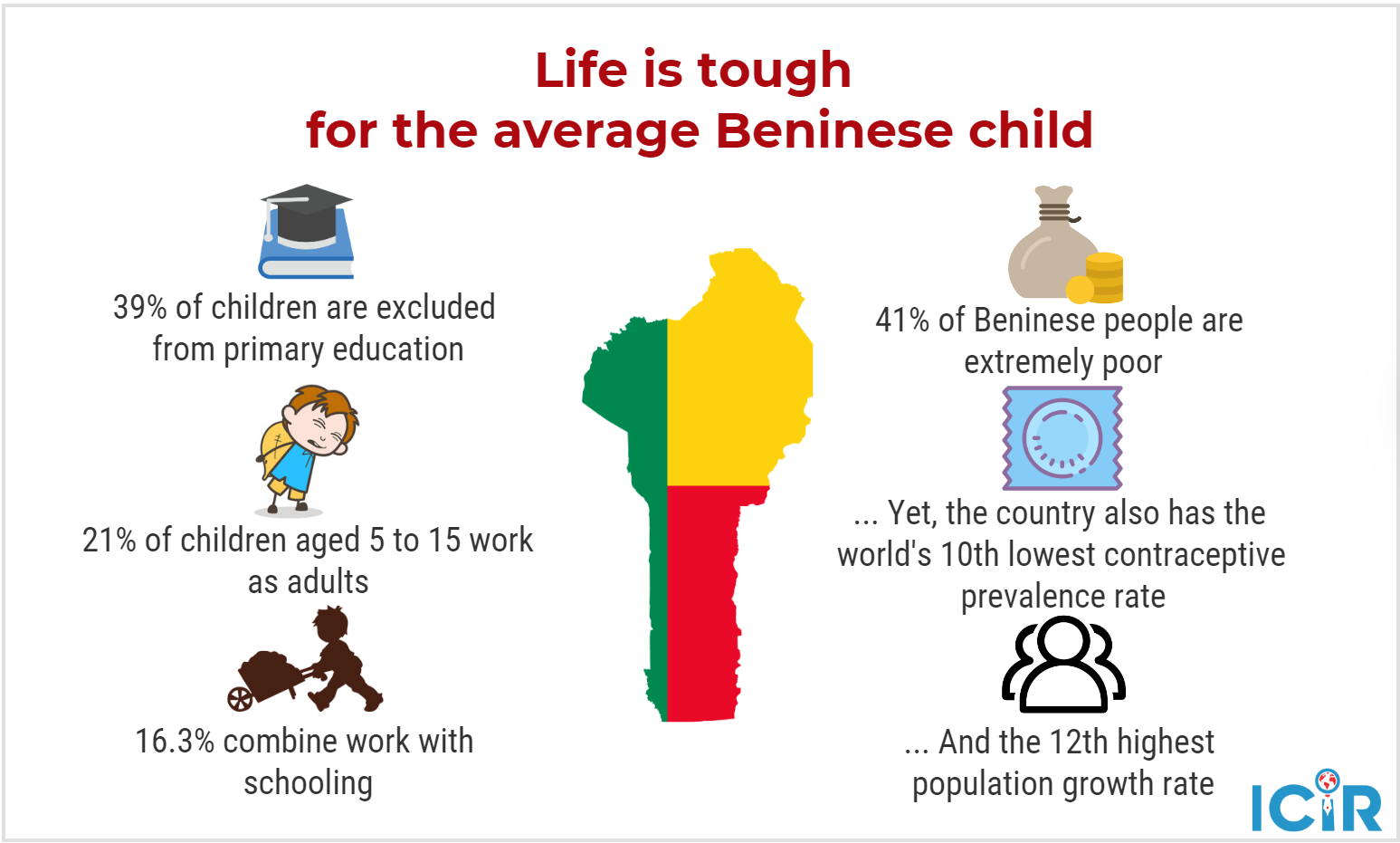
Life is tough for the average Beninese child. Despite making primary education free in 2007 and recording improvements in enrolment, nearly half a million (39 per cent of) children are still excluded from primary education, according to the United Nations Educational, Scientific and Cultural Organisation. Especially in low-income communities like Zakpota, engaging children in hard labour is a norm. Provisions of Benin’s Labour and Child Codes stipulating 14 years as the minimum age for work nonetheless, 21 per cent of children aged between five and 14 have been found to work as adults while 16.3 per cent are combining work with schooling.
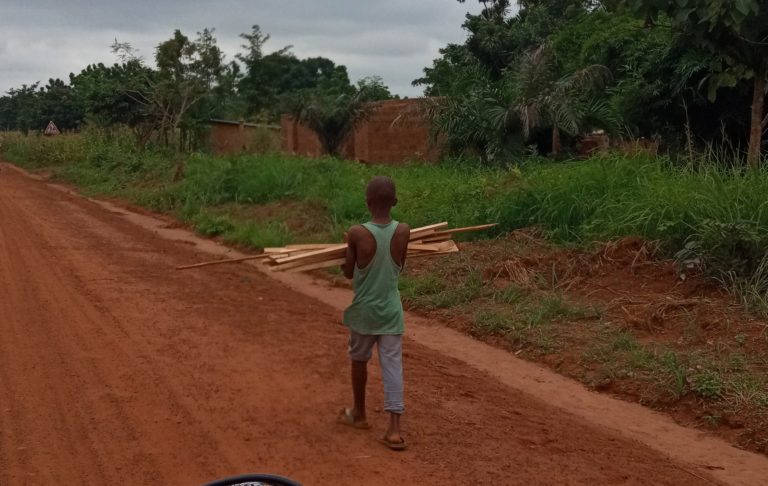
Every year, hundreds of children are trafficked to Nigeria. Unlike Gohoundgi, most of them are used as domestic helps, street vendors, or are forced to work on remote farmlands and quarries. The trend has continued even though working in Nigeria is not as profitable as it was in the past.
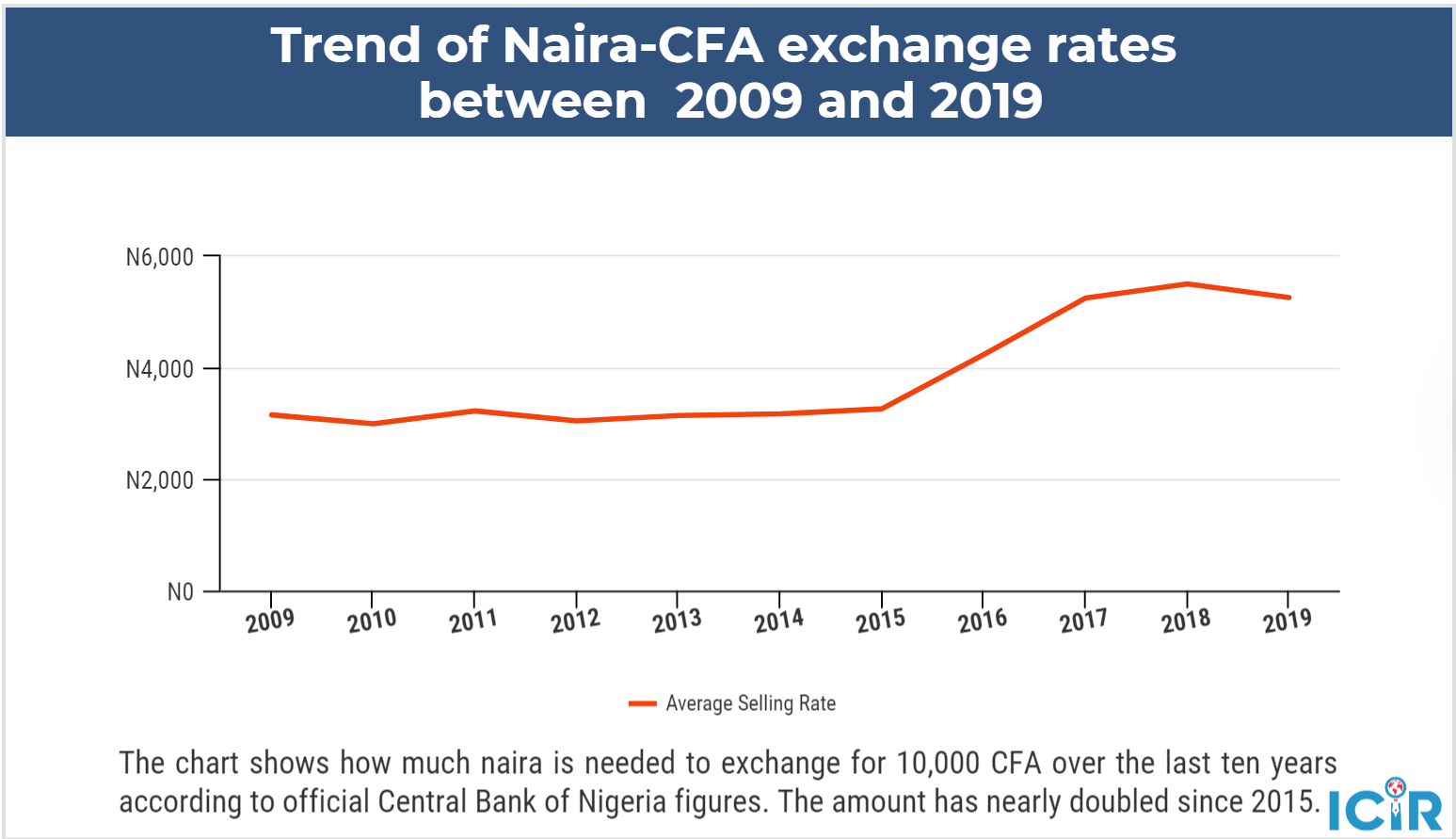
In 2015, according to exchange rate figures provided by the Central Bank of Nigeria, one could exchange N3,260 for 10,000 CFA. But today, to get that same amount, you’ll need over N6,000.
The circumstances of travel vary from child to child: some are forced to travel by their parents, some have no parents, some move to Nigeria while school is on vacation to raise fees for the next academic year, and there are those who even sneak away without their parents’ approval. But one factor that connects nearly every one of them is abject poverty.
Asides having the world’s 26th worst human development index, the World Poverty Clock notes that over 5.1 million people in Benin live in extreme poverty. This is nearly half of a population of 11.2 million. The United Nations Development Programme, UNDP, also stated in a 2019 report that 41 per cent of people living in the country are suffering from severe multidimensional poverty while 14.7 per cent are vulnerable to the condition.
Young children attached to various artisans to pick up skills in Zakpota.
Why trafficking remains an option
In many agrarian African communities, children are seen as a blessing. The traditions strongly encourage a family to have multiple children —especially because more hands are available to work on vast farmlands. But having more hands to work also means having more mouths to feed; and with dwindling resources, the duty of raising children properly is becoming increasingly difficult.
Stakeholders in development circles agree that the source of many of Zakpota’s troubles is the lack of family planning. With each woman giving birth to an average of five children, Benin is ranked as having the 12th highest population growth rate in the world.
“The first problem is that our parents are having too many kids,” admits Victorin Adekoute, President of the Union of Beninese in Nigeria, Ogun State chapter. “Ah! Some men may marry up to five wives. Some wives can give birth to up to ten or eight children. Or more than that even.”
The chapter’s vice president, Hounmenoun Jean, notes that parents who sired many children have themselves not fed satisfactorily.
“If, for instance, someone gives birth to 16 children, for that family to sit down to eat in the morning, afternoon, and night will be difficult,” he explains to The ICIR.
“So, they start thinking perhaps some of the children should go and become house helps. If it’s three that are left, at least those ones will go to school. The money from those serving as house helps will be used to cater for the remaining children at least to some extent.
“Our own problem is that when our men marry, they make sure they deliver the woman of all the children in her body till she reaches menopause. There is nothing like family planning.”
Though Gabriel Azagbe, 15, still has both of his parents alive, his life is no different from that of an orphan. His mother has remarried. His father, a returnee from Nigeria, married five wives and has given birth to 20 children. Two are dead because of inadequate care, the teenager says.
To survive the hardship, he decided to learn photography. During the week, he goes to Zakpota-based Adis Photography Studio to improve his skill, and during weekends he engages in manual labour on farmlands to make some money. With this, he buys garri to eat for the following week at work.
Local laws and customs that frown at abortion and the use of contraceptives encourage Benin’s high fertility rate. The country has the 10th lowest contraceptive prevalence rate in the world. Though abortion is legal in cases of risk to the woman’s life, rape, incest, even in these cases, legal or medical authorisation is required.
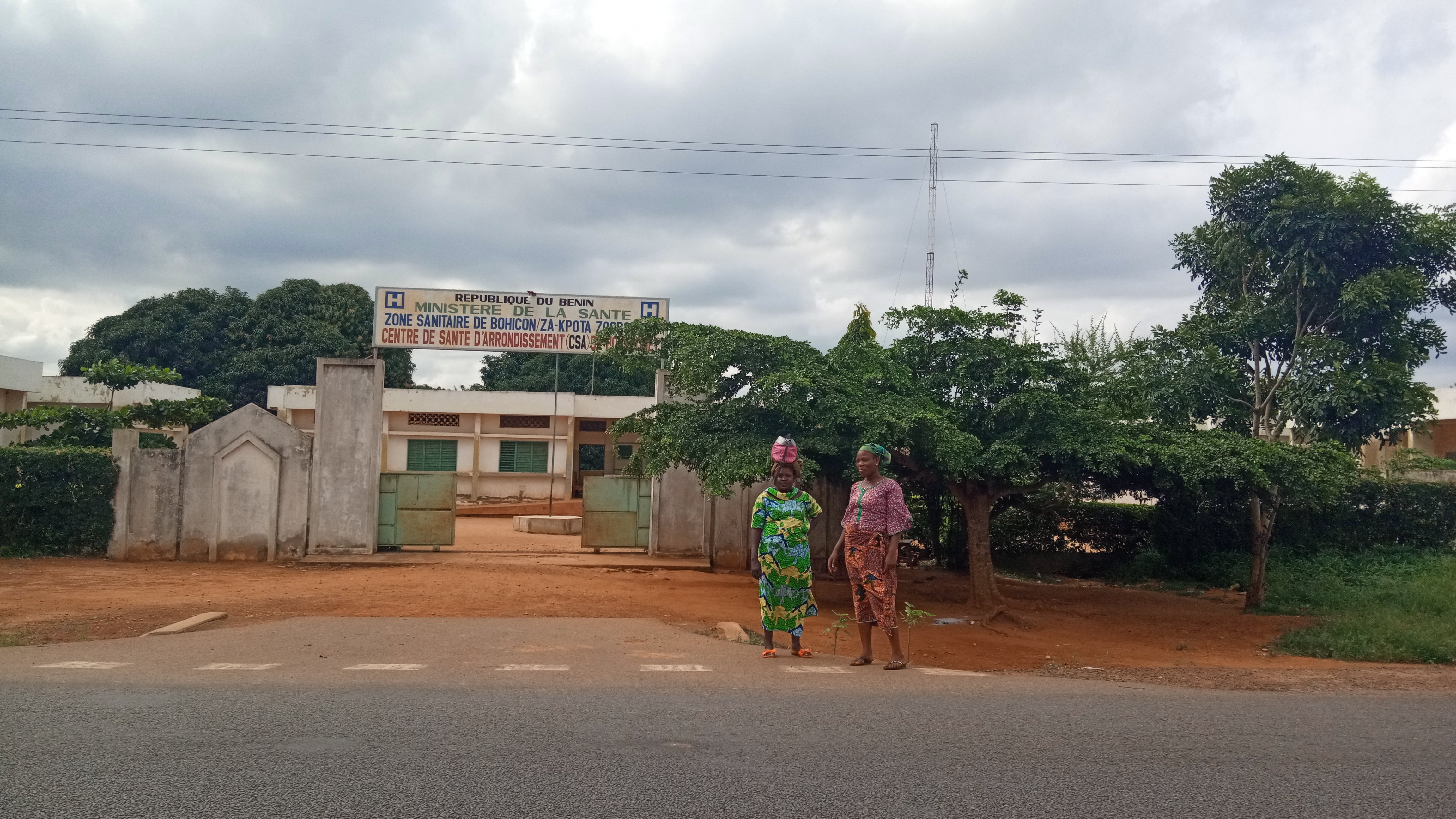
Ministry of Health, Sanitary Zone of Bohicon-Zakpota.
Another factor driving many Beninese to neighbouring countries is the loss of arable land for farming. Soil infertility is a gnawing problem especially in the rural communities where most depend on farming for food and income. This is as a result of monocropping, frequent flooding incidents since 1970 according to the World Bank and, some suspect, excessive use of fertilisers.
Adekoute estimates that a piece of land capable of yielding up to three bags of cassava in Nigeria cannot produce more than one in many places in Benin. The crops have also been observed to have significantly smaller sizes.
“People farm on the same spot for several years and do not have any other place to go. Whereas, children are increasing in number. That is the problem,” Jean notes.
Having no reliable means to earn money, many families are unable to enrol their children in school. As a result, the country has the seventh worst literacy rate in the world. Children are also reluctant to work as apprentices, having no money to buy food for sustenance.
And for the few who did attend and graduate from school, they are prevented by high unemployment rates from getting decent jobs. Ganguisou Vinceur, a photographer and resident of Zakpota, who himself spent his youthful days labouring in Nigerian quarries, laments that there are not enough factories around. There is, in fact, none in the local government, he says—“It is only schools we have.”
His son, Fadele, got a degree in German Language over three years ago but has since found no place to work, despite promises from the government.
Vinceur is grateful to Nigeria where he learnt photography. “Nigeria is taking care of us o!” he exclaims. He notes that if not for interventions by international non-governmental organisations such as Terres des Hommes and Bonne Fontaine, the population of Zakpota would have taken a greater hit.
“As they are chasing us from Nigeria, we are going back there because wherever there is corn, you’ll find chickens. There is no food in this place [Zakpota]. We are suffering a lot,” he says.
“It’s not our desire to take the children to Nigeria but… I am suffering, children too are suffering; we all sleep on empty stomachs. Is it good? … Are we going to die here?”
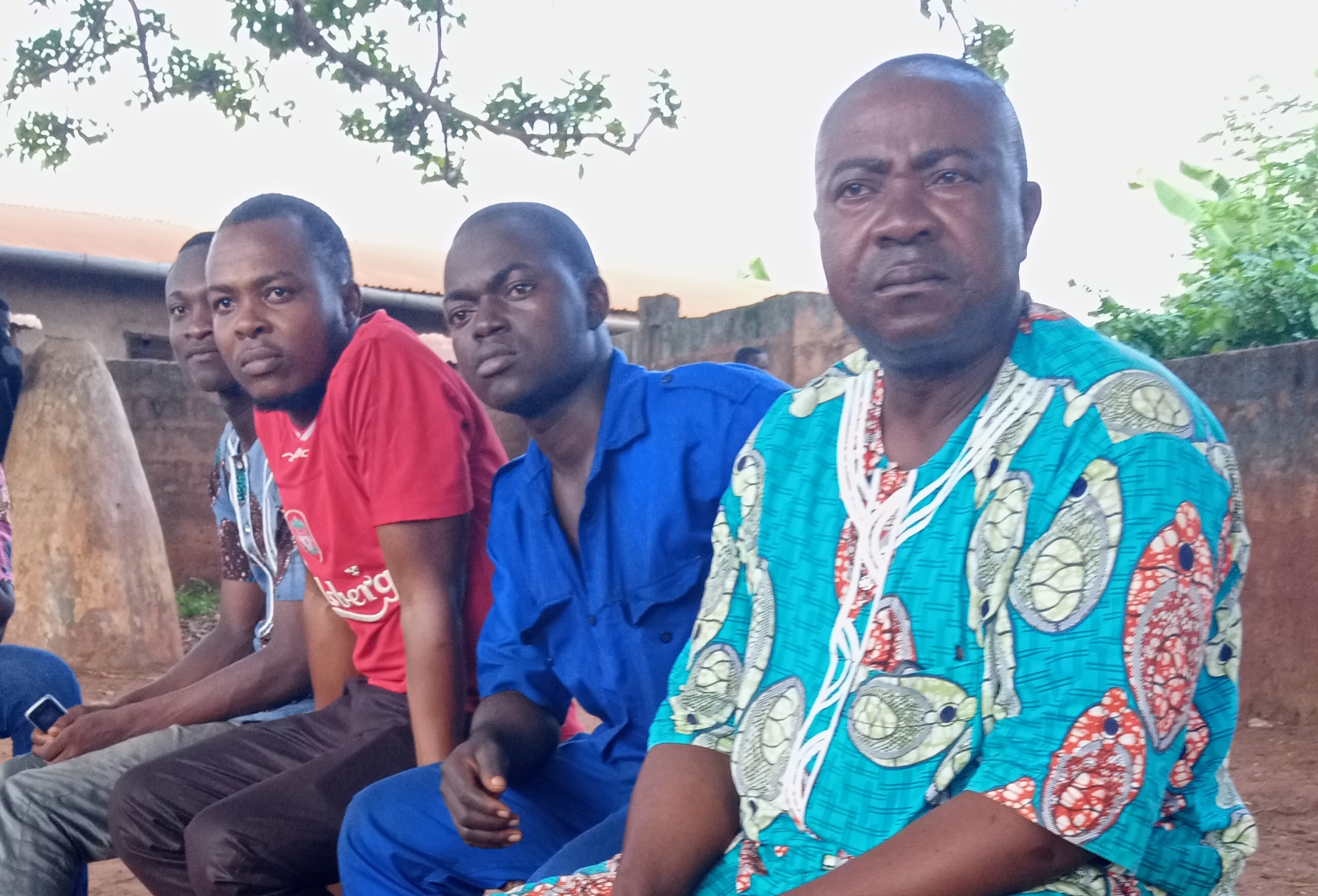
Ganguisou Vinceur (R) sits with other artisans in Zakpota.
Though Zakpota is notorious as a home to victims of trafficking, the problem cuts across all regions of the country. The United Nations Office on Drugs and Crime reported there is also a high prevalence of child trafficking in Zogbodomey and Glazoué. And, in the south, Zou, Mono-Couffo, and Ouémé-Plateau have been found to be high recruitment zones.
Government making matters worse
As a child, Didie Kloue had no support, no one to enrol him in school or guarantee him adequate feeding. He had to engage in manual labour to raise money for food and learn tailoring. Now, president of the association of artisans in Zakpota Local Government, he has vowed to uplift as many children as possible who find themselves in similar circumstances.
For years, he has been operating a vocational training centre for young people: the Centre D’appui a la Formation Professionnelle des Artisans de Zakpota (CAFPAZ). Presently, it has 22 people enrolled: 18 girls and four boys. Out of this number, 10 have parents who relatively cater to them. He gives food and shelter to the others, many of whom are orphans, using his personal resources.
“I can’t help as much as the government or well-to-do parents would. But I try to make sure they don’t sleep hungry and are learning,” Kloue says.
His centre has, however, been facing several challenges since Beninese President, Patrice Talon, came into office in April 2016. Educational materials which the previous administration distributed to the children for free were no longer shared. These materials, he states, made it easy for the students who had received some formal education to grasp the lessons.
A government-run training centre in the community was closed down too and a programme, where teachers commissioned by the government taught the children how to read and write, was stopped. Another programme that sponsored artisanal leaders to travel, give talks, and train people in various communities was also discontinued.
He says the change in policy is affecting all of Zakpota.
“We have many children who are willing to learn a skill but have no support, no person to give them food, and it is the lack of this support system that makes them go to Nigeria to do what they are not supposed to do,” he adds.
“When this government came on board, all assistances rendered were stopped. If people go to the government for help, they would reply that it is the people who are supposed to help the government, not the other way round.”
Kloue’s Support Centre for Vocational Training of Craftsmen in Zakpota (CAFPAZ)
Kloue’s Support Centre for Vocational Training of Craftsmen in Zakpota (CAFPAZ)
Kloue’s Support Centre for Vocational Training of Craftsmen in Zakpota (CAFPAZ)
Kloue’s Support Centre for Vocational Training of Craftsmen in Zakpota (CAFPAZ)
Kloue’s Support Centre for Vocational Training of Craftsmen in Zakpota (CAFPAZ)
Kloue’s Support Centre for Vocational Training of Craftsmen in Zakpota (CAFPAZ)
Benin is ranked as a tier-2 country by the 2019 Trafficking in Persons Report. This means its government does not fully meet minimum standards in protecting victims of trafficking but is making significant efforts to comply.
More help needed
Neither the Beninese government nor people are shy about admitting their inadequacy. Benin already has the 32nd highest foreign aid per capita in Africa. It is receiving more development assistance by the year—and this trend is not likely to change soon.
Speaking to The ICIR, Vigan Olivia, Assistante Sociale at the Centre de Promotion Sociale (Centre for Social Promotion) in Zakpota, appreciates the United Nations Children’s Fund (UNICEF) for supplying needed materials to children enrolled in schools.
The government-run centre, established in 1987, receives returnees from neighbouring countries and assists some children in schooling and getting technical skills. But its activities are heavily dependent on humanitarian support.
“We still need help from other NGOs,” Olivia pleads. “We are trying but the help from NGOs is reducing. Those who have heard are benefitting us, but there are some who have no idea what is happening here. We need further assistance so the work can continue.”
She says the centre is willing to monitor grants or loans given to families in the community by NGOs to ensure that they are properly utilised. If the families are empowered financially, she explains, children will not have to go hungry.
“We just pray that NGOs come to assist the children so that those already in school don’t end up dropping out. During this holiday especially, we’ve been praying about this.”
Adagbe Oussou Celestin, General Secretary of the Zakpota City Council, believes that NGOs can also intervene in the area of the richness of farmlands. He says this is because some of them have the expertise to test the soil and determine what it is suitable for growing or how to replenish it.
“If there is a means of fertilising the soil without spoiling it or taking so much time before results are seen, that’ll be great,” he says.
Asked what steps the Benin government is presently taken to curb the problems, Celestin said that the government’s revenue is limited and cannot all be spent on child development. The government builds schools while expecting help from non-governmental organisations in providing necessary materials, he says. It also repairs roads, he adds, and funds other infrastructures meant for the betterment of everyone.
Adekoute submits that the government needs to do more in promoting family planning in the communities. He would also like to see more NGOs coming around to support the children with opportunities for quality education and skills acquisition, as well as financial empowerment.
26-year-old Elize Azandjo beams as he shares his success story.
This model has worked in the past. For instance, after his apprenticeship in 2013, Elize Azandjo, 26, who is from a poor family background received two sewing machines from Terres des Hommes. Today, six years on, he has bought two additional machines for his workshop, built a house, and bought a piece of land as well as a motorcycle. He also has under his care, six young apprentices.
“I am happy with what Terres des Hommes did for me,” he says, grinning.
“Today, it is they who have made me somebody. And I want them to continue. That is why I am doing what I’m doing with the children so they too can gain in the future.”
* This investigation is supported by the Institute of War and Peace Reporting and the International Centre for Investigative Reporting, ICIR.
You may read the other part through the following link:
THEOrganisation of Petroleum Exporting Countries, OPEC, crude production prescription is likely to be disregarded by Nigeria as its 2020 budget proposal does accommodate the terms of the agreement.
This development was disclosed in a report stating that Nigeria was granted a reprieve by OPEC in July, where it was agreed that OPEC’s initial crude oil production target be raised from 1.685 million bpd to 1.774 bpd as the initial production ceiling was unsustainable for the Nigerian economy.
OPEC and a Russia led oil-producing nations formed an alliance known as OPEC+ which had agreed to cut down inventories and remove 1.2 million barrels per day of crude oil from global markets on January 1, in a bid to raise oil prices.
Nigeria had been exempted of the OPEC/non-OPEC production cuts, for not adhering to its output ceiling, due to disruptions in the Niger Delta.
According to the report, OPEC revised the target limit mainly because of the new operated Egina oilfield which started oil production in January was not included when the initial quota of 1.685 million bpd was calculated.
Egina’s production will also classify as condensates, meaning more of Nigeria’s output would not count towards the new cap.
Condensates are an ultra-light type of crude oil that doesn’t fall under the OPEC+ cuts agreement.
The move was aimed at increasing the nation’s revenue base from crude oil which was below its 2019 fiscal projections, as crude oil prices were falling globally Nigeria reduced its oil benchmark price to $55 per barrel from $60 per barrel, stating the intention was “to cushion against an unexpected price shock.”
Records from OPEC also show that Nigeria’s crude production was 1.866 million bpd in August reflecting that its crude production was higher than the new target according to OPEC’s figures and industry surveys.
In a Bloomberg interview, Minister of State for Petroleum Resources, Timipre Sylva admitted that Nigeria’s crude oil production was pegged at 1.8 million bpd which was way above the current OPEC target hinting that full compliance to OPEC’s cut would take place in October.
However, this is unlikely considering the recently proposed budget released by the Presidency to the National assembly on Tuesday did not reflect the new limits by OPEC.
At the presentation of the 2020 proposed budget by President Muhammadu Buhari, the crude oil benchmark was fixed at $57 per barrel with a production capacity of 2.18 million barrels per day.
President Buhari emphasised that of the N8.2 trillion estimated revenue in the proposed budget huge chunk of the budget would be for debt payment to show the country’s commitment to meeting its obligations.
“Debt service is estimated at N2.45 trillion, and provision for Sinking Fund to retire maturing bonds issued to local contractors is N296 billion,” President Buhari said.
With a Gross Development Product, GDP, growth forecast of 2.9 per cent and an expected single-digit inflation rate, N8.2 trillion is estimated as the total Federal Government revenue in 2020.
This comprises N2.6 trillion as oil revenue, N1.8 trillion from non-oil tax revenues and other revenues of N3.7 trillion.
Oil production which makes up 32.4 per cent of the total revenues in the 2020 proposed budget is the largest revenue contributor to the economy in the 2020 fiscal year. This implies that if Nigeria is going to comply with OPEC’s cuts then the economy is going to suffer a setback that may further worsen condition of Nigerians.
OPEC’s 14-member nations agreed with non-OPEC partners led by Russia in 2018 to curb global crude production by 1.2 million bpd from the start of this year in an attempt to raise prices.
OPEC’s share of the cut was pegged at 800,000 bpd, with Venezuela, Iran and Libya exempted. It is not clear whether this figure or any other countries’ targets have been adjusted to accommodate Nigeria’s currently increased quota.
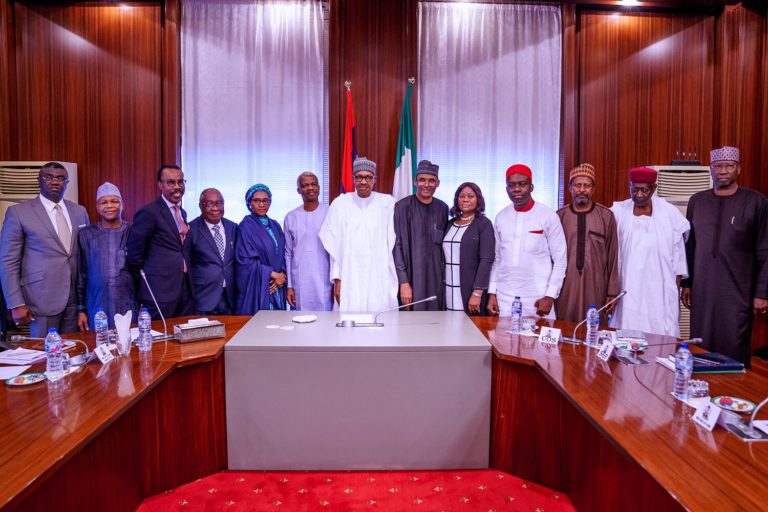
PRESIDENT Muhammadu Buhari has charged the Presidential Economic Advisory Council (PEAC), to conceive home-grown solutions to boost the economy and meet the national ambition of collective prosperity.
The president disclosed this during the inauguration of the PEAC on Wednesday.
Buhari urged the eight-man advisory council to produce sustainable and suitable initiatives for the country to bring to reality, the goal of lifting a hundred Nigerians out of poverty in ten years.
According to him, the country has exited recession, but the economy was lagging sustainable initiatives for her local context.
Also, in a series oftweets on the nation’s twitter handle @NGRPresident Buhari urged the PEAC to prioritize the collection of primary data to help set up realistic plans.
According to him, most of the statistics quoted about Nigeria are developed abroad by the World Bank, IMF and other foreign bodies. He said they are wild estimates that bear little relation to the facts on the ground.
He said, “We must domesticate our policies to reflect our local realities”.
Buhari noted his government was taking serious steps towards improving the quality of data available for policymaking.
“While we very much welcome the cooperation and support we are getting from our friends abroad, it is important to make it clear that Nigeria can only truly move forward with homegrown solutions,” Buhari said.
However, he expressed his gratitude over their consent to serve the country while stating his hope on receiving baseline studies that will help shape the holistic economic effort of the government.
He noted that all key MDAs will be available to meet with the council to liaise on conduits for creating a Nigeria that works.
Recalled, the PEAC was constituted on September 16 by the president, replacing the Economic Management Team (EMT) headed by Vice-President Yemi Osinbajo.
The PEAC is to advise the president on fiscal analysis, economic growth, internal and global economic issues whilst finding better ways to work with the relevant cabinet members and heads of monetary and fiscal agencies.
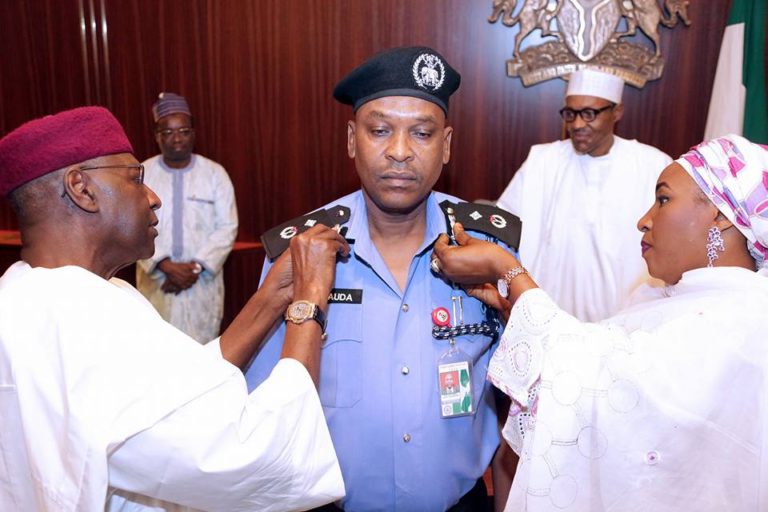
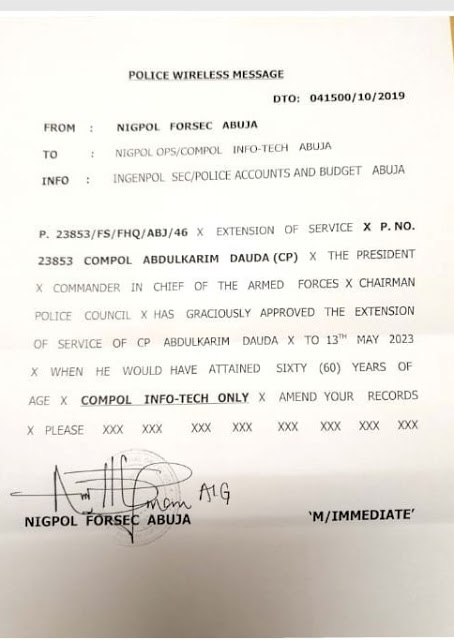
A SECRET memo shared on social platforms has shown how President Muhammadu Buhari allegedly extended the public service of Abdulkarim Dauda, a Commissioner of Police who works as his Personal Chief Security Officer (PCSO) to 13th May 2023, two weeks to his handover.
Dauda, who is due for retirement this year from active service, allegedly got an additional four years extension as contained in a memo from the Nigerian Police FORSEC, Abuja.
So far, the chief security officer has been promoted by Buhari twice in two years – June 2016 and July 2018.
Dauda reportedly lobbied Mike Okiro, former Inspector General of Police (IGP) for promotion in 2018.
The memo released by Farooq Kperogi, a US-based Nigerian professor, Wednesday showed that the president approved the service extension today, which invariably implies that the police officer would remain in service beyond 35 years stipulated by the Police Service Commission.
In the letter with reference no: DTO:041500/10/2019 addressed to the Nigeria Police Operations/COMPOL Info-Tech Department, the department was directed to amend its record regarding the service extension.
Secret Memo on Abdulkarim Dauda Source: Farooq Kperogi
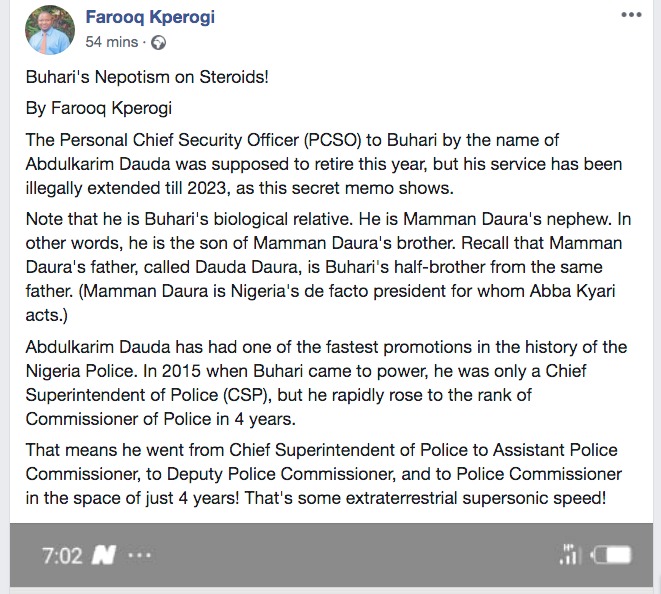
“Note that he is Buhari’s biological relative. He is Mamman Daura’s nephew,” Kperogi wrote on his Facebook wall.
Continuing, he said; “Abdulkarim Dauda is actually Mamman Daura’s blood brother and Buhari’s nephew. That means, like Mamman Daura, Buhari is his uncle.”
According to the professor and newspaper columnist, “Abdulkarim Dauda has had one of the fastest promotions in the history of the Nigeria Police. In 2015 when Buhari came to power, he was only a Chief Superintendent of Police (CSP), but he rapidly rose to the rank of Commissioner of Police in 4 years.”
“That means he went from Chief Superintendent of Police to Assistant Police Commissioner, to Deputy Police Commissioner, and to Police Commissioner in the space of just 4 years! That’s some extraterrestrial supersonic speed!”
Source: Farooq Kperogi
In June 2016, Dauda, a graduate of Public Administration was promoted to a DCP by the President. He was promoted alongside ACP Kayode Akande. Dauda joined the force in 1985 while Akande was enlisted in 1990.
When The ICIR contacted the Force Public Relations Officer, Deputy Commissioner of Police Frank Mba for reaction, his aide said he was in a meeting, and therefore could not answer calls. He advised the reporter to call back at 8:00 pm.
“This is his orderly on the line. He is in the middle of a conference. I don’t know if you can reach out to him later. You can call him around 8 pm.”
When told about the urgency of the call, he instead advised The ICIR to send a text message, which was delivered shortly after, but there was no response till the time of this publication. At about 7:22 pm, another message accompanied by the police signal was shared with Mba but there was still no response. At 8:07 pm The ICIR called again, no response.
Meanwhile, a top rank police officer with whom The ICIR shared the police signal, confirmed that the document is genuine.