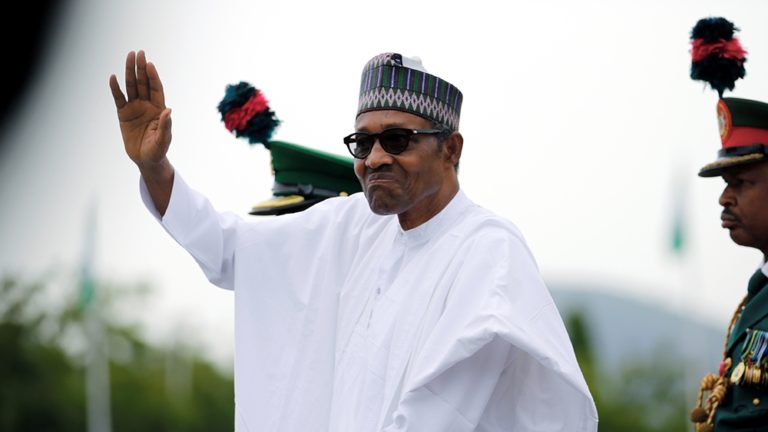
NIGERIA PRESIDENT, Muhammadu Buhari is set to depart Abuja for South Africa on Wednesday, a day after the independence day celebration.
Buhari will be in South Africa for three days on invitation of South Africa President, Cyril Ramaphosa to discuss the welfare of Nigerians and find common grounds for building harmonious relations between the two nations.
In a statement made available by Buhari’s Special Assistant on Media & Publicity, Garba Shehu, He noted that the visit will come against the background of recent Xenophobic attacks, the evacuation of hundreds of Nigerians and the exchange of visits by special Envoys of Buhari and Ramaphosa.
While in South Africa, Buhari is also set to hold a town hall meeting with Nigerians in South Africa to assure them of his administration’s commitment to the protection of their lives and properties and also in peaceful co-existence.
Buhari and his host will preside over the South Africa/Nigeria Bi-National Commission, during which a progress report will be presented and at the end of the meeting, both leaders will sign a joint communiqué.
The delegation will include Nigerian business representatives who will participate at a South Africa-Nigeria Business Forum with their host counterparts.
President Buhari will be accompanied by Kano State governor, Abdullahi Umar Ganduje, Plateau State Governor, Simon Lalong and Ebonyi State governor, David Umahi.
With other delegates including Minister of Foreign Affairs, Geofrey Onyeama, Minister of Defence, Bashir Magashi Minister of Power, Saleh Mamman, Minister of Interior, Rauf Aregbesola,Minister of Mines and Steel Development, Olamilekan Adegbite.
Minister of Police Affairs, Maigari Dingyadi and Minister of State, Industry, Trade and Investment, Mariam Katagum.
He also mentioned that the National Security Adviser, Babagana Monguno, Director-General, National Intelligence Agency, Ahmed Rufai Abubakar and Chairman/CEO Nigeria Diaspora Commission, Abike Dabiri are also part of the team for the three days visit.
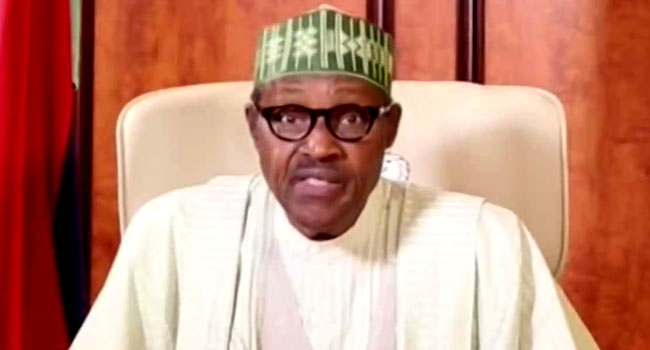
IN commemoration of Nigeria’s 59th Independence jubilee, President Muhammadu Buhari said his government would “take firm and decisive action” against those who threaten to undermine the country’s national security.
The president made this warning in a speech delivered on Tuesday, marking the country’s fifty-ninth year independence anniversary.
“Our attention is increasingly being focused on cyber-crimes and the abuse of technology through hate speech and other divisive material being propagated on social media.
“Whilst we uphold the Constitutional rights of our people to freedom of expression and association, where the purported exercise of these rights infringes on the rights of other citizens or threatens to undermine our National Security, we will take firm and decisive action,” the president said.
The president said though the ongoing national discourse on various political and religious issues is healthy and welcome, he charged Nigerians not to forget the lessons learned from the past while urging them to exercise restraint, tolerance and mutual respect in airing their grievances and frustrations.
“The path of hatred and distrust only leads to hostility and destruction. I believe that the vast majority of Nigerians would rather tread the path of peace and prosperity, as we continue to uphold and cherish our unity,” Buhari said.
The president also reiterated the plan of his administration to curb the scourge of insecurity ravaging various parts of the country, noting that good governance and economic development cannot be sustained without enabling an environment of peace and security.
He said his administration in the last four years had combated the terrorist scourge of Boko Haram and crisis in other regions across the country’s borders through the efforts of security personnel.
“The capacity of our armed forces to defend our territorial integrity continues to be enhanced by the acquisition of military hardware as well as continued improvements in the working conditions of our servicemen and women,” he said.
To enhance internal security, the president said the Ministry of Police Affairs will be overseeing the development and implementation of security strategies.
Buhari said his assent to the Nigerian Police Trust Fund (Establishment) Act had created a legal framework to support the Police with increased financial resources to enhance their law enforcement capabilities.
This, he said, is being implemented by the ongoing recruitment 10,000 constables into the Nigeria Police Force, which had shown the government’s commitment to arrest the incidence of armed robbery, kidnapping and other violent crimes across our nation.
In securing the oil and gas facilities in the Niger Delta, Buhari said his government remains resolute in its effort to combat militant attacks that had desolated that region. He also explained his plan to speed up the Ogoni Clean-up to address long-standing environmental challenges in that region.
“The recent redeployment of the Niger Delta Development Commission from the Office of the Secretary to the Government of the Federation, to the Ministry of Niger Delta Affairs underscores our commitment to enhancing the living standards of our communities in the Niger Delta, through coordinated and appropriate programmes,” he said.
The country had been faced with a myriad of insecurity issues, ranging from kidnapping, communal clash, banditry to mention but a few, which had left scores of individual displaced, living without hope of survival.
PRESIDENT Muhammadu Buhari on Tuesday in his speech to mark Nigeria’s 59th Independence Anniversary in Abuja blamed previous governments for the economic woes experienced in the country; he, however, noted that the country is recovering.
The President in his speech was critical of past administrations for their failure to invest in the non -oil sectors of the economy despite the high economic growth at the time which would have created more jobs across the country.
“This Administration inherited a skewed economy, where the oil sector comprised only 8 per cent of Gross Domestic Product, GDP, but contributed 70 per cent of government revenue and 90 per cent foreign exchange earnings over the years.
“Past periods of relatively high economic growth were driven by our reliance on oil sector revenues to finance our demand for imported goods and services,” he hinted in his speech.
“Regrettably, previous governments abandoned the residual Investment-driven Non-Oil Sector, which constituted 40 per cent of Gross Domestic Product and comprised agriculture, livestock, agro-processing, arts, entertainment, mining and manufacturing activities that provide millions of jobs for able-bodied Nigerians and utilize locally available raw materials and labour for production,” he said.
He also expressed the desire of his administration’s to significantly save the country’s oil incomes and increase investments in its non- oil sector to build Nigeria’s critical infrastructure
“Learning from the mistakes of the past, this Administration is committed to responsibly managing our oil wealth endowments. We will continue to prudently save our oil income and invest more in the non-oil job-creating sectors,” he said.
On the passage of the Petroleum Industry Bill, he promised to facilitate the process speedily in a bid to promote private sector investments.
“We will be working with the Legislature soon to pass the Petroleum Industry Bill and amendments to the Deep Offshore Act and Inland Basin Production Sharing Contracts Act into law, to ensure Government obtains a fair share of oil revenues, whilst encouraging private sector investment,” he said.
Buhari maintained that his administration would also continue the fight against illegal bunkering of crude oil and the smuggling of refined petroleum products across the borders.
He said this would include the diligent prosecution and conviction of offenders found guilty of these acts.
“Whilst Nigeria remains committed to free and fair continental and international trade, we will not hesitate to take all necessary steps to tackle illegal smuggling, transhipment and other predatory trade practices that destroy jobs in our country.
“We will also continue our fight against illegal bunkering of crude oil and the smuggling of refined petroleum products across our borders, including the diligent prosecution and conviction of offenders found guilty of these acts,” he added.
He emphasised that the country was on the verge of recovery from the recession it fell into in 2015 attributing the success to his economic plan.
“This medium-term development plan charted the trajectory for our economy to exit from recession and return to the path of sustainable, diversified and inclusive growth for Nigerians.
“Pursuant to these reforms, the economy has recovered and we have had 9 successive quarters of growth since our exit from recession. The exchange rate in the last 3 years has remained stable, with robust reserves of $42.5 billion, up from $23 billion in October 2016,” he said.
OILFIELDS across Nigeria’s resource-abundant Niger Delta spew high flames that blur the difference between day and night in the so-called host communities, like Ebedei in Delta State. The oil industry still burns off some 700 million standard cubic feet of associated gas that comes with oil during production daily at over 170 sites.
Including non-associated gas, the other natural gas that exists in reserves independent of oil, Nigeria’s proven reserves of natural gas are up to 202 trillion cubic feet, TCF, and about 600 trillion TCF unproven reserves, bringing Africa’s largest economy among the first ten largest gas producers in the world.
The vast gas resource – added to the limitless renewable resources, namely hydro, wind and solar – thrusts to spotlight the generous presence of inherent attributes necessary for optimal electricity delivery, which can unlock economic prosperity and development.
“The electricityplatform is central to the rest of the economy since it overlaps with almost all other systems,” commented Emmanuel Ezekwere, a sector expert with decades-long experience gained from senior roles at NEPA, PHCN, and NERC.
“Basically shameful”
But in today’s reality, between the country’s energy potential and development, at least, of a sort accomplished in equally Global South countries like India and Brazil, there lies a barrier: electricity constraints resulting from policy and financial mismanagement, ever-present “tariffschizophrenia,” low investment, neglect, infrastructure deficit, and customers disloyalty.
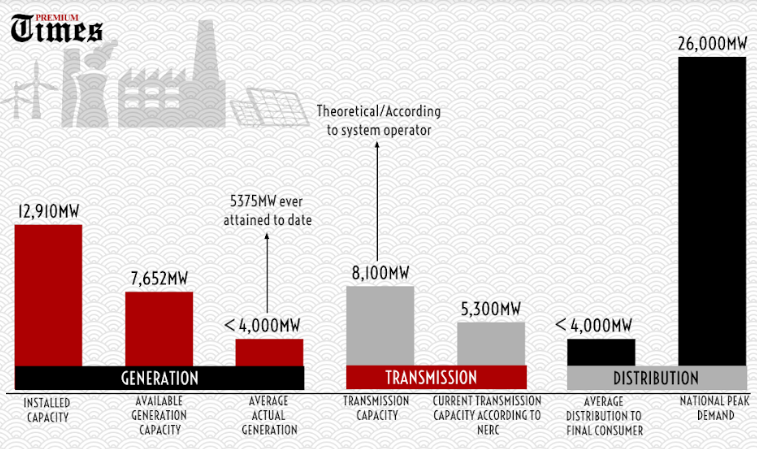
After several billions of dollars “investment” and dawns of dashed hopes, including the Obasanjo administration’s 10 thousand megawatts, MW, capacity by 2007 and the Jonathan’s 24,961 MW by 2019, Nigeria, in now mostly privatised electricity industry, is only able to deliver less than four thousand MW to 202 million people, about one third of what Singapore supplies 5.6 million people.
Nigeria’s electricity operational scorecard
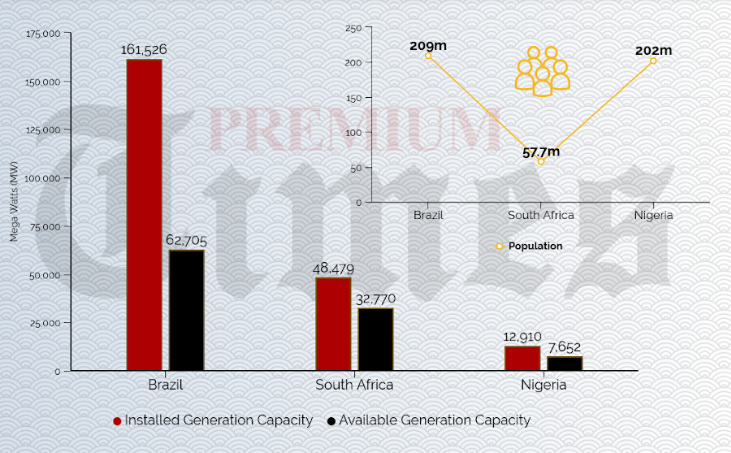
Consequently, while per capita electricity consumption in Nigeria is 145 kWh, it is 8,845 kWh in the tiny Asian city-state, acclaimed for accomplishing one of history’s greatest transformational tasks. Continental rival, South Africa, with about 57 million people, just little over a quarter of Nigeria’s population, has installed generation capacity of 48,479 MW (compared to Nigeria’s 12,910 MW) and per capita consumption of 4,198 kWh.
“After first generating electricity in 1898, we should now be talking about 40,000, 60,000, 100,000 megawatts available generation capacity,” said Sam Amadi, who headed the industry regulator, NERC, between 2010 and 2015. The first electricity generation mentioned by Mr. Amadi was 60 KW installation mainly for colonial officials in Marina, Lagos, in 1898, just 17 years after the world’s first public electricity supply in Goldaming, England.
Installed/nameplate generation capacity vs available capacity: Nigeria, South Africa, and Brazil
Nigeria and Brazil have roughly similar population size but there is an alarming gap between the two Global South nations: 12,910 MW vs 161,526 MW in installed generation capacities, respectively. Further, while less than half of Nigeria’s population is connected to grid electricity, 100 per cent of Brazilians have access. The following table illustrates the differences in the capacities of Nigeria and three other countries selected from Asia, Africa, and America.
“I am not sure this is an embarrassment as that presupposes that you are surprised or have found the situation unexpected. It is our lived reality and it is basically shameful,” further stated Mr. Amadi, speaking in an interview with PREMIUM TIMES. He decried historical neglect and infrastructural deficit, which translated to “no capacity by the time we started reforms in 2000.”
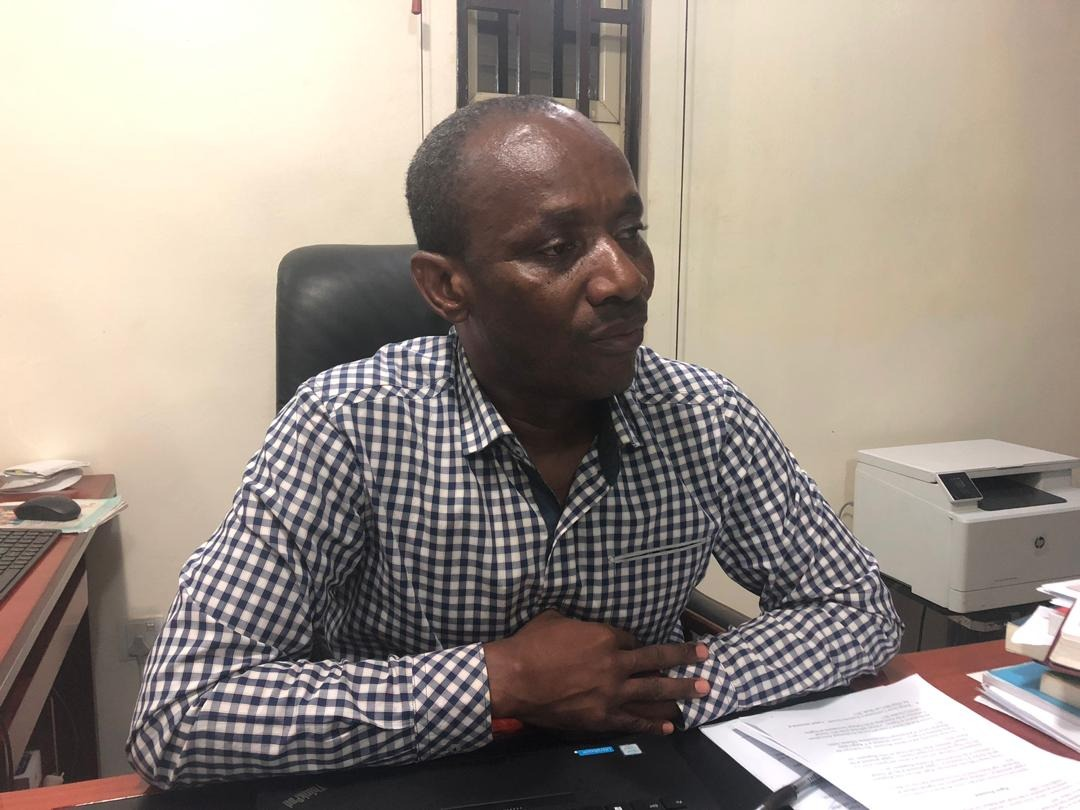
Sam Amadi
Costs of electricity deficit
To date, only 40 per cent of the country’s population has access to grid electricity, the power ministry’s permanent secretary, Louis Edozien, told PREMIUM TIMES, disclosing “the estimate extrapolated from a detailed grid power supply and mapping of served and underserved communities and clusters in five states.”
This statistic indicates that as the population expands the rate of access decreases. Data obtained from the World Bank says 44 per cent of Nigeria’s then 119 million population had access to grid electricity in 1999, the year democracy returned. 20 years after, 2019, with about 200 million people, only 40 per cent are connected to the grid electricity, according to official disclosure by Mr Edozien.
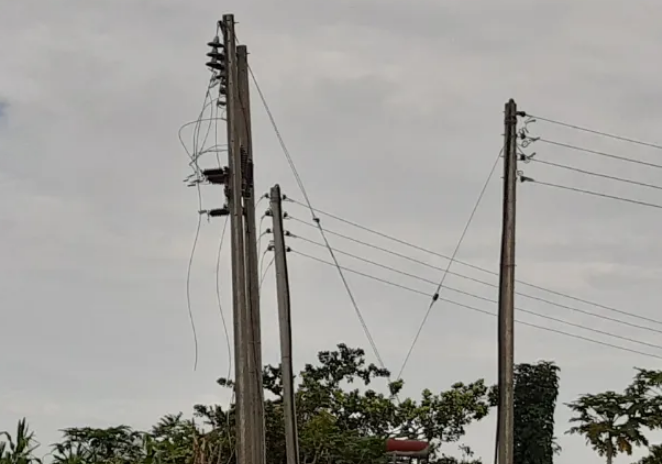
Several parts of Abuja, the nation’s capital, such as Gomani, Dogon Ruwa and Kutara, are among areas not connected to electricity.
Picture: On the way to Gomani community, Abuja, cable connection stopped, cutting people from grid electricity
But even for the populations served, blackouts are common with varying effects depending on the type of final consumers. Residential customers have to incur the cost of self-provided lightings such as candles, torches or gasoline for generators to watch TV or power water-pumping machine. For commercial customers, effects can include the inability to meet demands, the cost of fuel for back-up generators, and the challenge of scaling and expanding productivity.
Whether small enterprises of “hustling” young Nigerians trying to scrape together some money through fashion designing or digital marketing and creativity to stave off poverty or even bigger businesses involved in manufacturing, the country’s electricity problem affects the productivity of these important segments of the national economy, thereby causing GDP losses and driving the soaring nature of the country’s poverty and joblessness.
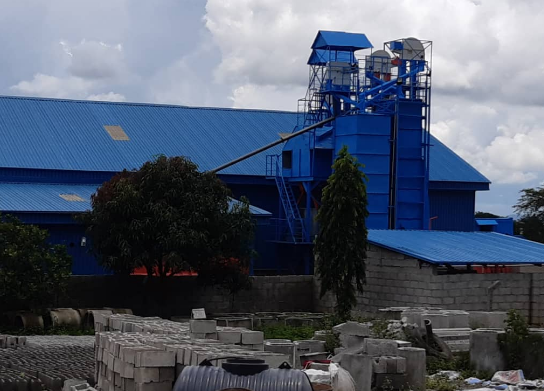
“It is woeful and not helping the system,” replied Emmanuel Adebayo, the manager at a Karshi-Abuja electric pole-making company, Sunny Kunns, when asked to comment on the impact of electricity supply on his company’s productivity. “…Just about four hours a day and we have to depend on diesel, which increases the cost of production.”
As the company incurs an extra cost to get diesel to power its generator, Mr. Adebayo said this raises the price of products. “High tension pole is 37 thousand Naira but it can be between 27 thousand and 30 thousand Naira if we use grid electricity mostly. So, as the price is higher and that affects sales, the electricity situation affects our productivity. If electricity improves, we will produce more as the price will go down and sales will equally go up, and we will employ more people.”
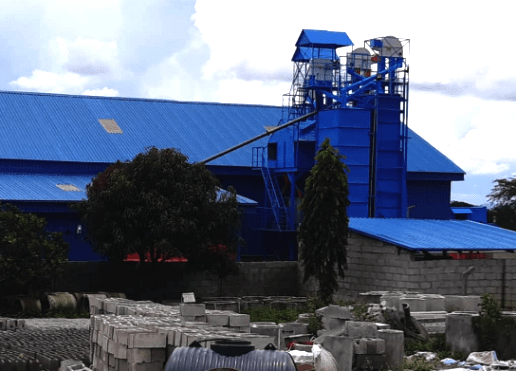
Sunny Kunns factory, Karshi, Abuja.
Meanwhile, big manufacturers may avoid Nigeria’s grid electricity to smoothen their operations by obtaining independent power generation licence from NERC. Nestle (Energy Company of Nigeria), Unilever (Unipower Agbara) and PZ (PZ Power Company) are among the companies that have adopted this option since 2011.
But for SMEs or other companies with lower margins, independent power generation is commercially prohibitive, and this is the reality for most of Nigeria’s businesses across scales.
“There are some of our soap making machines that our diesel generator can’t handle,” Zuwaira Shuaib, who runs Amal Botanicals Natural Baby Skin Solutions in Lagos. “When we do not have (grid) power, it can really affect us badly as we have to make the liquid soaps in small batches making it a long process for production.”
Adeleye Adeyemi of DLX Fashion in Lagos enjoys “a good supply of about 16 hours daily” at AIT Estate, Alagbado, Lagos. “This has really helped our growth,” Mr Adeyemi said. “Imagine if it is more regular than we currently have.”
A European Union-supported May 2019 report by the Capacity Building and Technical Assistance Programme, CaBTAP, says 52 percent of households and 91 per cent of SMEs use generators for at least four hours a day. Apart from the financial costs, this has environmental implication such as climate change as a result of carbon emissions. There are also health impacts: injurious effect of fumes and families having to spend on powering generators some money that should be freed up for healthcare or more food.
In 2014, a study by London-based CSL Stockbrokers put at $252 billion per year the cost of Nigeria’s electricity deficit to the GDP, up from $130 billion estimated by the Presidential Taskforce on Power in 2010.
However, considering the possibilities the current global economic dynamics present and Nigeria’s barely changing electricity deficit, the loss to the economy may now in the current year be in excess of $252 billion.
In 2014, the available generation capacity, according to the System Operator, was 7,139 MW, whereas the peak demand was 14,630 MW. In the current year 2019, while the peak demand has risen to 25,790 MW as the population continues to grow astronomically, the available capacity is still not more than seven thousand MW, the 2014 level. Also, for both periods 2014 and 2019, the actual generation capacities ever attained were 4,517.60 MW and 5,375 MW, respectively.
Journey to “terrible” new century
Between 1968 and 1990, Nigeria had completed several power generation projects, including Kainji, Jebba, and Shiroro hydropower plants, and Afam, Ughelli, Egbin, and Sapele thermal plants. By the turn of the 21st century, the combined nameplate or installed generation capacity of all these infrastructures – now either privately owned or concessioned to private operators such as Mainstream Energy in the instances of Kainji and Jebba – was in excess of 5,500 MW, according to information obtained from NERC.
However, in the year 2000, the actual capacity was down to “a terrible” 1,600 MW, from 1,700 MW in 1993. “Only 19 out of the 79 generation units were in operation, and of those 19, none was operating near to their design capacity,” stated Liyel Imoke, who headed the technical board of the defunct state monopoly NEPA and later power ministry. “As a result of an underdeveloped grid, the transmission infrastructure was badly constrained, while the distribution network was weak and fragile.”
Nigeria’s state of electricity at the beginning of the century followed the mismanagement at NEPA, society’s “growth-stifling” actions, and non-provision of finances for expansion and maintenance in the pre-1999 years under dictator Ibrahim Babangida and late kleptocrat Sani Abacha, according to persons with an informed understanding of the development.
“The expansion rate declined mainly as a result of funding problems,” said Mr. Ezekwere, then a senior NEPA official. “After Egbin was commissioned in 1986, no more investment for seventeen years in a situation where consumption was already growing by 19%. Good maintenance culture suffered as this was not given priority attention as a policy.”
Blaming NEPA, Mr. Ezekwere said, “It allowed itself to stray away from its operational standards, rules and procedures, therefore, permitting a culture of anything goes.” But Mr. Amadi, former NERC boss, was categorical about decrying the corruption at NEPA. “NEPA did not have audited accounts.”
At this period, Mr. Ezekwere said, the rate of payment for electricity was as low as 30 per cent and “there was a high level of energy theft.”
Mr. Imoke, in a submission to the House of Representatives, said the six-day nationwide blackout at the beginning of 2000 caused the urgency for reforms under former President Olusegun Obasanjo and the constitution of the NEPA technical board.
NIPP … billions for what?
The most significant yet controversial power intervention under Mr. Obasanjo was the National Integrated Power Project, which was a government-funded plan decided in 2004. The administration wanted to raise generation capacity to ten thousand MW by 2007 by building new plants (including Gbarain, Ihovbor, Odukpami, and Sapele, now under the Niger Delta Power Holding Company).
Earlier in 2002, the government had planned to build new plants at Geregu, Omotosho, Papalanto (Olorunshogo) and Alaoji. But according to Mr. Imoke, due to policy uncertainties as the government was expecting the passage of sector reform bill and the privatisation of NEPA, the four did not start as planned and were later added to the NIPP.
The NIPP also included four gas supply projects, over 100 transmission projects and 300 distribution projects. Although critics claim the Obasanjo administration’s spending on the NIPP was in excess of $12 billion, Mr. Imoke said the total projected cost was $4.5 billion and only $3 billion was “committed in the form payment to contractors, and the establishment of Letters of Credit, etc.”
But findings by this newspaper from interviews and several documents relating to the workings of the Obasanjo administration show that the NIPP was fraught with procurement irregularities and poor planning, which ultimately resulted in the failure to meet the 10 thousand MW target in 2007.
In one case, 10 contracts for transmission projects were awarded without feasibility studies, project costing by consultants and environmental impact assessments, according to a 2005 Budget Monitoring and Price Intelligence Unit, BMPIU, correspondence.
The contracts together cost N90.4 billion and were cleared by the BMPIU, the precursor to the public procurement bureau, then headed by Kunle Wahab, a professor. “There is a need to build transmission infrastructure as quickly as possible,” Mr. Wahab said in justifying the approval despite the inadequacies he noted.
In an apparent desperate effort to deliver the NIPP before the end of his administration in 2007, Mr. Obasanjo in February 2006 granted Mr. Imoke’s request to waive due process certificates for payments to contractors, the same way the former president had earlier granted anticipatory approvals for contract awards, according to a correspondence we saw.
A former minister, who served under Mr. Obasanjo and asked not to be named, said Mr. Imoke was giving the former president false impressions and “when we went touring the sites before the end of our administration in 2007, we discovered some were not even cleared yet.”
Mr. Imoke could not be reached for comment on his former colleague’s claim. But in a 2009 submission to the House of Representatives, he said most of the engineering and procurement phases of each of the projects had completed by 2007, remaining only construction, which is the phase physically seen and “less than 20% of the contract sum.”
Between 1999 and 2007, the Obasanjo administration’s spending on the NIPP and running of PHCN was $5.25 billion, according to Mr. Imoke. But in 2010, Nigeria’s actual generation capacity was still an average of 2,500 MW, meaning less than 1000 MW added to the 1999 capacity, according to former power minister Bart Nnaji. The Obasanjo administration had raised the capacity at Afam in 2002 and completed Geregu, Omotosho, and Olorunshogo (all now privatised) in 2007.
The Yar’Adua administration (2007-2010) that followed Mr. Obasanjo defocused the NIPP, abandoning imported equipment at ports. “Yar’Adua’s policy knocked out the sector hugely but the misdirection and corruption started under Obasanjo,” said Mr. Amadi. It was Mr Jonathan that restarted the NIPP and completed Geregu, Alaoji, Ihovbor, and Odukpami, and Gbarain NIPPs leaving Nigeria with over 11 thousand installed capacity.
Ihovbor NIPP, also called Benin Generation Company, Edo State
Privatisation: “We are stalled”
The reforms that started with the adoption of the National Electric Power Policy in 2001 and then the enactment of the sector reform law culminated in the privatisation of the power sector – the six successor GenCos and the 11 DisCos – in 2013 under Mr Jonathan, leaving only the transmission service for the government. However, though still wholly government-owned, the Transmission Company of Nigeria is now managed by Manitoba.
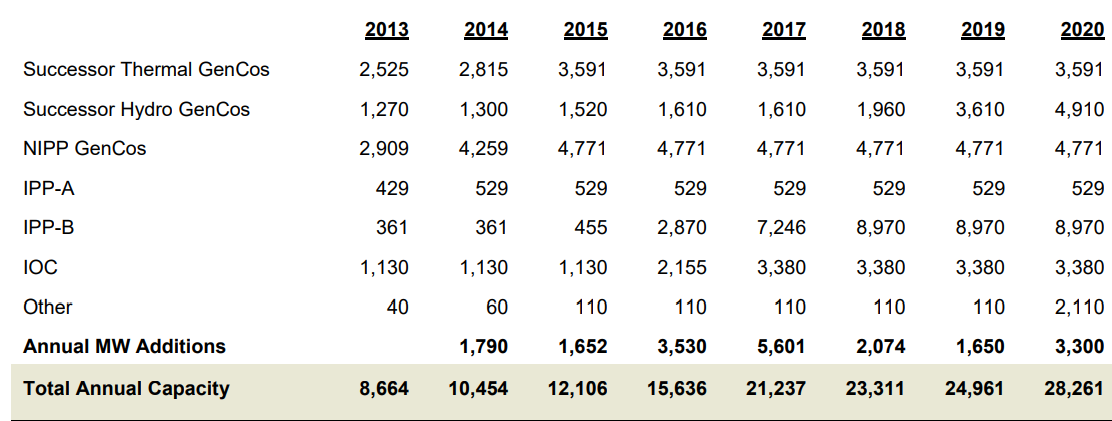
The Presidential Task Force on Power, PTFP, had in August 2013 projected 24,961 MW in installed generation capacity by 2019 and 28,264 by 2020 with expectations the industry would attract private financing for expansion. Six years after the privatisation, Nigeria is only able to achieve nearly 13 thousand MW with about 25 grid-connected GenCos, from 8,664 MW in 2013. Yet less than four thousand MW reaches the final consumers through the DisCos.
PTFP installed generation projection, August 2013. Source: CSL Stockbrokers citing The Roadmap to Power Sector Reform – Revision I, August 2013, Presidential Task Force on Power (PTFP).
The low operational performance has happened amid falling expectations of private investment for expansion, and this, which is the consensus of operators, experts and the regulator consulted for this report, has a circularly causal relationship with the sector’s commercial performance.
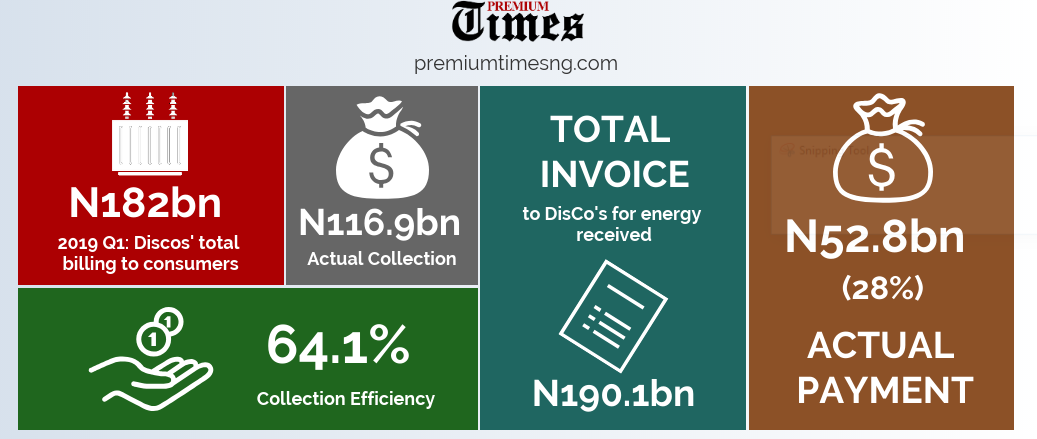
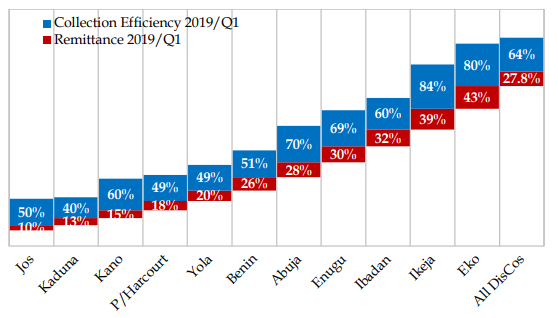
“Financial viability is still the most significant challenge threatening the sustainability of the electricity industry,” said NERC in its Q1 2019 report. “The liquidity challenge is partly due to the non-implementation of cost-reflective tariffs, high technical and commercial losses exacerbated by energy theft, and consumers’ apathy to payments under the widely prevailing practice of estimated billing.”
Commercial performance of the sector for Q1 2019Source: NERC, Q1 2019 report
Bulk electricity trader, NBET, has been covering the market shortfall using public funds to shore up the revenue of the GenCos to prevent the collapse of the system. In 2018, N701 billion was released for this purpose from the CBN for 2017-2019 period.
“At the start of the privatisation, investors thought the sector was going to be self-sustaining,” said the Managing Director of Nigeria’s independent power producer, Azura, Edu Okeke, making a case for a cost-reflective tariff. “Investors cannot rely on government subsidy. It is not a reliable incentive.”
Azura currently owns the 461MW independent power plant commissioned in 2018 in Ihovbor, near Benin City. But that is just the first phase of a 1,500MW facility planned. Mr Okeke told PREMIUM TIMES that the company’s plan was to continue with the second phase immediately after the delivery of the first, which was built in two years between 2016 and 2018.
“We thought the EPC (Engineering, Procurement, and Construction) contractor would just move to the next phase without demobilising,” he said. “But because of the Nigerian environment, rather than looking at phase II (in Edo, Nigeria), Azura is now investing in another country (Senegal).”
Azura IPP, Ihovbor, Edo State.
Last Thursday, Azura confirmed the acquisition of the 115 MW Tobene power plant in Senegal, investing funds Mr. Okeke said would have been deployed in Nigeria.
Clearly, the capacity projected at the beginning of the privatisation by Mr Jonathan’s taskforce is now realistically impossible amid fears about return on private investment, underscoring another dashed hope.
For Nigeria’s electricity sector to perform well, there must be technical and commercial alignment, said Sunday Oduntan, an executive director of the Association of Nigerian Electricity Distributors, ANED. “If you want DisCos to distribute 10 thousand MW, you must install generation infrastructure that produces 10 thousand MW and transmission infrastructure for 10 thousand MW, and to make the investment that brings this level of capacity, you must have confidence you will recoup your investment.”
“We are now stalled,” said Mr Amadi, commenting on the state of the industry. “We were carried away by privatisation drive in 2010. We were privatising what did not exist. We should have first concentrated on building our capacity. The other countries like Brazil first built their capacity to have sufficient product (power) before reforms towards privatisation. You can’t expect the private sector to develop the capacity within a short period.”
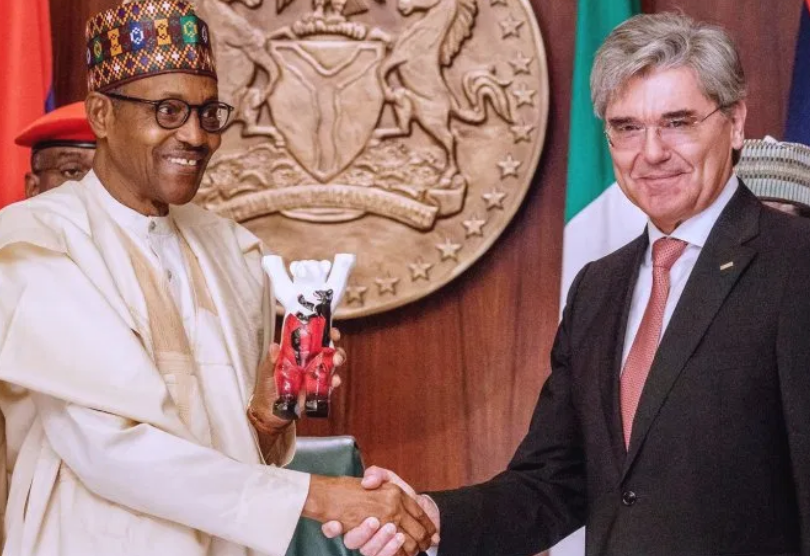
Fresh hope is now raised. The current administration of President Muhammadu Buhari is eyeing 25,000 megawatts of operational capacity in the electricity system through a new three-phase plan designed by tech giant Siemens AG.
President Buhari and Siemens chief
Agboola Akinola, a social development activist, was asked to comment for this report as he sat with his twin nephews in Oyo Town to guide them on their school assignments. It was a night in September 2019 and the bulb for lighting needed for the assignments was powered by a gasoline generator. “In the year 2000 when I was a schoolboy like these kids, this was my experience; no electricity for my assignment and I had to use a kerosene lantern,” said Mr Akinola. “No change.”
This report is part of a collaborative investigative series by Daily Trust, the International Centre for Investigative Reporting (ICIR), Premium Times and TheCable, facilitated by the Wole Soyinka Centre for Investigative Journalism (WSCIJ) under its Regulators Monitoring Programme (REMOP) for the Electricity Sector, with support from the John D. and Catherine T. MacArthur Foundation.
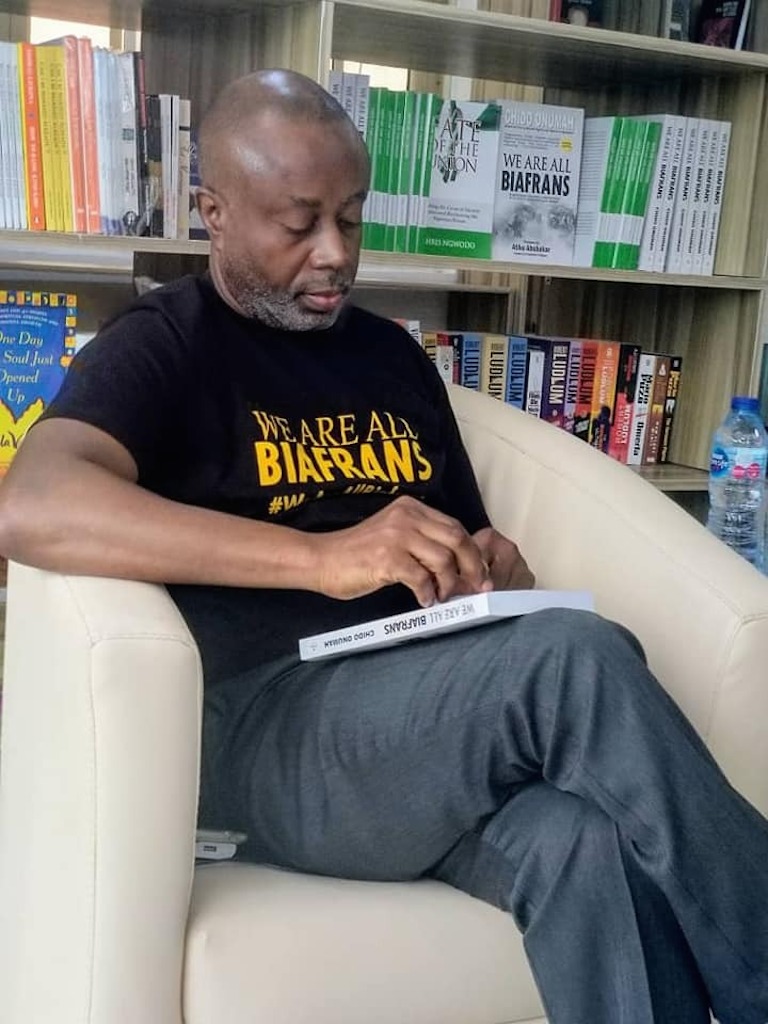
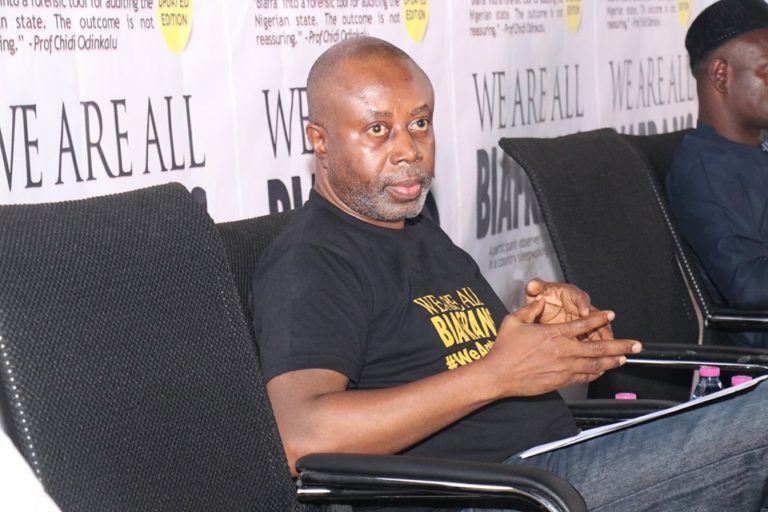
Chido Onumah, Journalist, Author and Executive Director of African Centre for Media and Information Literacy (AFRICMIL) in this interview with Olugbenga ADANIKIN, condemned actions of the DSS for his arrest Sunday night for wearing a branded T-shirt with inscription ‘We are all Biafrans’. According to him, We are all Biafrans, a title of his s book is a metaphorical statement of challenges confronting Nigerians as a people which ordinarily should not cause his undue detention. Excerpts:
Why were you detained by the DSS?
FROM the DSS point of view, again, from the statement, they issued this morning that I was detained to save me from possible mob action. They mentioned this briefly while I was with them and I tried to ask, who and which people were trying to attack me? They didn’t say. They kept saying oh, we have an intelligent report that some people who were opposed to the T-shirt I was wearing and I kept asking, why would anybody be opposed to the T-shirt I was wearing. This T-Shirt is not a call to arms. It’s not calling for a Biafran Republic; it’s just saying that we are all Biafrans which is the title of my book. So that was the explanation they gave. I can’t go into their hands to understand the reasons but my feeling is that I’m sure some people who felt troubled, either by the book or by extension, the T-shirt may have alerted the DSS at the airport. It is possible. Maybe people in the plane hinted something to that effect that people may be planning something and this guy was coming into the country to be part of it. But I told them I don’t belong to any violent movement or any movement pushing for insurrection in the country – IPOB, or any other variant of those fighting for the actualisation of the Biafran republic and so on.
I was a bit surprised that they really didn’t do any much background check on me, even if people tipped them off about what I was wearing because I kept referencing the fact that this T-shirt is the title of my book which came out three years ago and I have been wearing the T-shirts ever since. Most times, when I travel…I have been out of the country about five times in the last two months, so each time I go out because it’s convenient for me. I just put on my jeans and T-shirt and I travel. So, it was a bit shocking and really worrying when it happened because it was a long trip for me. I have been traveling through five cities in four different countries, so, for them to have stopped me when I was looking forward to coming home to rest. More importantly, I have some friends who came in from Accra, Ghana for the Cuban-African conference that took place last week. I begged them to wait for me. We had fixed dinner for 8 pm yesterday and that dinner couldn’t hold because of the arrests.
Once they started interrogating me both at the airport, where I spent close to 2-hours, then at their main office where I spent maybe four hours, the questions that kept coming up were questions I found really unnerving. The guy takes my passport, my phone and he says you are a Biafran, how come you have a Nigerian passport.
I said I beg your pardon, I am a Nigerian and that’s why I have a Nigerian passport, that there is no country like Biafra, so I can’t possibly have a Biafran passport. He then said but that is not what is written on your T-shirt. I said what is written on my T-shirt is we are all Biafrans and it’s the title of my book.
They were making phone calls, going back and forth for almost two hours; they then took me on Hilux vehicle to their office and kept me there. It was still very late, at about 9 pm, then somebody came and told me about mob action, people were planning something and they didn’t want me to get entangled, and if I wore the T-shirt to town, some persons were planning to attack me.
Did you believe their claim?
Of course not, because I asked them who are these people? They refused to say and I told them I have been wearing the T-shirt for three years since the book came within Nigeria and abroad. I have taken pictures with prominent Nigerians. When the book first came out in 2016, it was the former Vice President, Atiku Abubakar, who was the keynote speaker at that event. When we re-launched the book two years ago, it was Seriake Dickson, the Governor of Bayelsa State. If you go to my social media page and all of that, you will see the picture of both the book and myself and everything.
So what was your experience like while in DSS custody?
For me, it’s not new. I have had experience of being detained by the DSS when I was a journalist during the Abacha era. I was detained by the DSS when I was a student at the University of Calabar, so I know the drill. I know their routine. When they picked me up, I didn’t shout or cause any commotion. The only thing was to alert one or two of my colleagues that I was in their custody. Once I was able to do that, I just sat there and was reading my book while they were doing their thing. I had this book I bought at the airport. It’s Born a Crime by Trevor Noah. I was so engrossed. I started reading it in the flight. It was such a good read that I didn’t even worry about them until they came to ask questions, and I will respond and return to my book. So, we went from there to their office. Once we got there, it was the same thing. I didn’t give them the impression that I was scared or worried because there was really nothing to be worried about. I have not committed any crime anyway. They will come ask me one question and go back, another person will come but they were quite friendly, I will give it to them. Nobody tortured or harassed me, even when they were discussing with me, it was calm but we disagreed seriously on a number of issues. I had to be firm that this thing you guys are doing is an attempt to curb free speech, freedom of association and movements. You can’t just pick somebody because of what you say. My T-shirts say we are all Biafrans. It hasn’t said anything in an awkward statement. It didn’t say we want to achieve Biafra. Even if it says that it is not something to detain anyone in my estimation. I was trying to push that point. When they now said we have to take the T-shirt from you, I said I don’t mind but I’ll inform you that I have many of these T-shirts, which is true. In fact, I have two extra of the T-shirts I wore while outside the country in my bag. I told them I had more, I had given these shirts to friends who requested for it. Obviously, they weren’t interested in that, it’s this one that I have, so I had to take off the T-shirt and I pulled out another shirt from my bag. I told them again this is the title of a book and I’m not just wearing this, I’m not being flippant about it. But they said the book and the T-shirts are different.
What was the rationale for that inscription and title of the book?
I have been asked this question several times…the whole thing started three years ago. There was a public conversation or debate by academicians, journalists and public intellectuals in Nigeria about the whole Biafra and that was when the whole Nnamdi Kanu thing caught fire in the early days of Buhari administration. So, I wrote this essay titled we are all Biafrans and the gist of the essay basically was that, whether we like it or not, the Biafran thing is an issue that needs to be addressed frontally. But beyond being addressed, we can use Biafra as a metaphor for the many problems that beset us as a nation, whether we are talking about people who are pushing for Oduduwa, Arewa Republic or Niger Delta militancy. We are all suffering. Wherever we found ourselves in the country, everybody has one issue or complaint against the country, so to that extent, we are all Biafrans. So it is a metaphorical explanation of the problems we found ourselves. That was just the basic idea behind the title.
Chido Onumah/photo taken from his Facebook wall
Do you see your fundamental human rights being infringed upon in the wake of the incident?
Of course, no doubt about that, if I’m the kind of person that is overtly agitated and maybe had caused a commotion at the airport, or office, and started screaming, they might begin to manhandle me or try to arrest me but because I was very calm. In fact, whatever they asked me…they said give me your phone, I gave them though calls were coming. They said give me your passport, give me your T-shirt and I gave them. I didn’t want to create any scene or commotion but clearly to answer your question, of course. To imagine I have been on a long trip…almost left the airport at 10 pm on Saturday to go to the airport because my flight was early morning at 6 am. And where I was staying was a bit far away from the airport. I slept at the airport 10 pm, arrived Frankfurt 8:30, three hours layover in Frankfurt till 11:30 when I caught the flight from Frankfurt to Abuja, almost six hours flight, so I was really exhausted and tired to be accosted and arrested for no just reason. It was really crazy for me. More fundamentally, I raised this question with them, I see this as an attempt to curtail…..because you can’t just say because you are DSS, you are doing your job, I am doing my own as a journalist and you stopped me from moving around or wearing a particular shirt from going around. This shirt is not calling for the death or destruction of anybody or violence against any group or interest and so on. I think I see it as part of a larger plot to cow people, to limit the frontiers of press freedom and rights of people in the country which is something I don’t think they can achieve whether they like it or not.
People are calling me across the globe to request for copies of the book and the T-shirt, and I’m sure people will cash-in on that and start printing and selling it to make money.
But the point I want to make fundamentally is that, inadvertently, they have opened up the space for discussion about Nigeria. What you can say and what you can’t say. What you can wear and what you can’t wear. And I’m happy the way Nigerians responded to all of these, hopefully, it can become the basis for a bigger discussion about our country, our democracy, our right as a people. I mean, Yele Sowore has been in detention now for almost two months. We don’t know how this will pan out. It’s really not about me but that bigger picture about us starting to ask questions why Sowore remains in detention, particularly after the court had granted him bail and they had kept him for 45 days trying to get evidence against him and so on. It is something that is troubling, not just the media, civil society activists but Nigerians as a whole need to be concerned about.
Do you plan to take legal action?
I don’t think so. I have spoken to a number of my friends who are lawyers and we have to have some conversations. We have to have conversations around that maybe when I have time to rest and think through but I can’t rule that out. They really have to, for whatever it worth to…so people will know to what extent they can go as Nigerians. What you can say or do. Legal action is a possibility, definitely but we will see how it goes.
Will you say the Nigerian press currently enjoys more freedom compared to the military era?
I think to a great extent, but it’s not just about the nature of the government as a military versus civilian but more importantly, the nature of media itself, the expansion of media and information and communication technology which has created the opportunity. See what happened yesterday, I think the DSS buckled under social media pressure. People were calling and pushing this thing from around the world. I think to that extent, one can say the Press has ample space for robustness to push materials but in terms of the concrete, whether journalists are being detained, it appears not much has changed. There is a whole list, Sowore is a journalist, Jones Abiri. In fact, we had a conversation about his case while at the DSS facility yesterday. Increasingly, it’s a worrying trend that is taking prominence. In terms of infrastructure, the press has more space to function, even within that small space we have, how much can we say?
Now, it’s not just newspapers or television alone, if you say something on Facebook or Twitter, somebody can pick you up, somebody can detain you. We had read of Governors asking people to delete pictures from their phones – very ridiculous thing. So, if you look at that, you will say not much has changed, even with the privilege that journalists enjoy in terms of the ability to use different platforms and medium to express themselves in the concrete sense of how much materials or contents they can do without getting into trouble – not much has changed. In fact, it appeared to be worse now because those days, we have only a newspaper, radio and television. So for you to be arrested, there must have been a clear case of, say you have this picture or article in a newspaper. But these days, it could just be a picture, tweet, Instagram or Facebook post and you could just be picked. Sometimes, it could even be a private conversation between you and a friend via WhatsApp group and somebody picks you up. These are really dangerous trends that we need to be concerned about.
Do you think the NUJ has a role to play in this regard?
Of course, now is the time for the Nigerian Union of Journalist (NUJ) to engage journalists and more importantly, engage the government and say, look, this is not the kind of democracy we fought for. Democracy is hinged on the rule of law, freedom of the press, freedom of association. So, for our democracy to thrive, as you mentioned, 59 years of independence we are no longer a young nation no matter how you want to think about it. For democracy to thrive, the first rule has to be freedom of the press, freedom of the citizens within that democratic space.
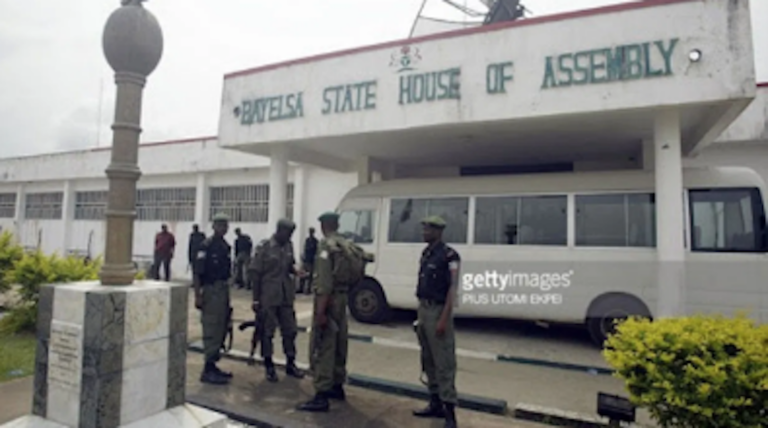
THE SPEAKER of the Bayelsa House of Assembly, Emmanuel Tonye Isenah has been impeached on Monday morning following series of gunshots in the State House.
The Assembly was invaded by hoodlums who allegedly fled with the mace while the police responded with gunshots.
In preparation for the November 16 governorship election, Isenah has been rumored to resign on Monday following pressure by some People’s Democratic Party (PDP) leaders who clamored for political balance of equation.
He was reported to have adjourned the plenary indefinitely in a bid to avoid his removal as the Speaker of the House.
Leaders asking for Isenah’s removal were reported to have instructed some lawmakers loyal to them to reconvene and then replaced Isenah with another lawmaker, Monday Obolo, who is representing Southern Ijaw Constituency 2, after the gunshot.
However, Media aide to Isenah, Ranami Afgha said the impeachment cannotstand as it was done against the provision of the house.
Afgha said the mace had been taken away by thugs and the process of impeachment was done in the absence of the mace which represented authority and that without the mace, the action is illegal and unconstitutional.
Some PDP leaders have been rumoured to have been mounting pressure on Isenah to resign his post as Speaker of the House for someone from Southern Ijaw constituency since the emergence of Douye Diri as the party’s candidate in the November 16 governorship election.
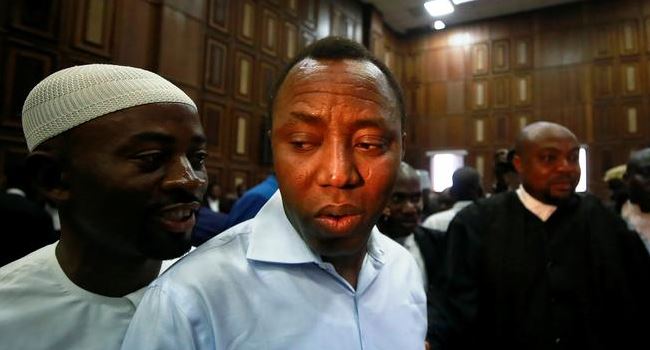
THE FEDERAL High Court in Abuja has on Monday ordered the remand of the Publisher of Sahara Reporters and #RevolutionNow Convener, Omoyele Sowore along with his co-defendant Olawale Bakare in the Department of State Security DSS custody.
The Presiding Judge, Ijeoma Ojukwu gave the ruling after reading to them seven counts of treason, cyberstalking, abusing president, money laundering among others.
Sowore and Bakare, however, pleaded not guilty after the charges were read by the Judge.
Defendant’s counsel, Adeyinka Olumide-Fusika (SAN) maintained that the arraignment should not be allowed to proceed because the Department of State Services, had been keeping them in custody since August 3 and has not allowed the defendants to consult their lawyers since the charges had been filed.
Olumide-Fusika also added that the court should not allow the arraignment to proceed since the Department of State Security refused to obey the court order on September 24, 2019, that ordered the release of Sowore.
Prosecution council led by Hassan Liman pleaded to the court to dismiss the objection on the ground that what was more important was that the defendants had been served with the charges.
Liman also added that the order for the release of the defendants had lapsed since the defendants had been produced in court for arraignment.
However, Olumide prayed to the court to allow the bail earlier granted to Sowore continue and Bakare granted a fresh bail.
Justice Ijeoma Ojukwu said the bail earlier granted Sowore was not given on the charges on which he was arraigned on Monday, that a fresh bail had to be applied for.
She added that if she would have to grant them fresh bail, it had to be based on the formal written application and not oral.
Ojukwu asked the defendants counsel to file a formal bail application, and adjourned the hearing to Friday.
AMIDST increasing inequality, insecurity and perceived injustice and alleged disregard for the rule of law, the Vice President, Prof. Yemi Osinbajo on Sunday expressed optimism about a new Nigeria.
“The new Nigeria is here,” says Osinbajo in his verified twitter handle.
“Many say it is impossible for Nigeria to change due to corruption, ethnic and ‘religious divisions are deep’, corruption has no end, politicians are too selfish and mischevious”
Resorting to divine hope, he said only God could address the numerous challenges confronting Nigeria.
When God spoke about the Promised Land, spies that were sent in came back with reports of how impossible it was to take the city and enter the Promised Land. But God used Joshua & Caleb who had a different spirit to take down the well-fortified city of jericho with just a shout.
“The Almighty God is the builder of nations and the Bible tells us that he promised the children of Israel that he would take them from bondage, suffering and slavery into the Promised Land, a land flowing with milk and honey.
“When God spoke about the Promised Land, spies that were sent in came back with reports of how impossible it was to take the city and enter the Promised Land. But God used Joshua & Caleb who had a different spirit to take down the well-fortified city of Jericho with just a shout”.
“God has promised us a new Nigeria, a peaceful Nigeria, a prosperous Nigeria, a united Nigeria, where the different tribes and tongues are not wedges of separation, but the joyful textures of our togetherness.”
The country, he noted, is also blessed with different resources capable of developing it.
“But like Caleb & Joshua, we declare that these problems are merely bread for us, we will enter the promised land.
“God almighty has taken away the protection of the enemies of this nation. He has taken away their powers, the noise we hear, the turbulence we experience, are the last gasps of a defeated foe. The day of freedom is at the door.
“I shared all of this and more at the 59th Independence Day interdenominational church service. Nigeria will prevail. God bless the Federal Republic of Nigeria,” he said
Nigeria’s 59th Independence Day is billed for Tuesday, 1st October.
THE African Centre for Media & Information Literacy (AFRICMIL) has confirmed the arrest f its Coordinator, Chido Onumah by operatives of the State Security Service (SSS) also known as Department of State Service.
The ICIR had earlier reported how Onumahwas picked up at the Nnamdi Azikiwe International Airport as he returned from Barcelona, Spain, where he had just successfully defended his PhD thesis.
Abdulaziz Abdulaziz, AFRICMILprogramme manager, in a statement made available to The ICIR expressed alarm at the arrest, saying that waylaying law-abiding citizens should not be the preoccupation of an entire security outfit.
The statement read, “The African Centre for Media & Information Literacy (AFRICMIL) is alarmed over the arrest of its Coordinator, Chido Onumah, this evening, by operatives of the State Security Service (SSS).”
“Onumah was picked up at the Nnamdi Azikiwe International Airport, Abuja, on his return from a trip abroad.
“AFRICMIL condemns in strong terms the unjustifiable arrest of Onumah and demands his immediate and unconditional release.
“Waylaying law-abiding citizens should not be turned into the preoccupation of an entire security outfit.
The arrest of Onumah, coming at the heels of harassment of other critical voices, smacks of grotesque days of the Nigerian history that Onumah and his comrades fought steely against.”
Chido Onumah, Executive Director of the African Centre for Media and Information Literacy, AFRICMIL, has been arrested men believed to be personnel of the Department of State Services, DSS, The ICIR has learnt.
Onumah was picked up at the Nnamdi Azikiwe International Airport as he returned from Barcelona, Spain, where he had just successfully defended his PhD thesis.
It is still not known why Onumah, the author of several books, including We Are All Biafrans, was arrested. a journalist and activist, Onumah is the brain behind Corruption Anonymous, a whistleblower protection advocacy initiative.
He arrived from Spain at about 4.30pm Sunday and was picked up as soon as he got to the immigration desk but was able to make one phone call alerting a friend of his arrest by the DSS, before he was became unreachable. Calls for his phone have not been answered since.
Onumah left Nigeria about three weeks ago to attend a whistleblower conference in Scotland before proceeding to Spain, where he defended his doctoral thesis.