Home Blog Page 2282

Contractors complete abandoned projects after investigation commissioned by The ICIR

1

By Chinwe AGBEZE

ONE of the series of investigations commissioned by The ICIR with MacArthur funds has yielded an immediate impact as the contractors featured in the report have returned to complete the abandoned projects.

Earlier in November 2018, the Education Minister, Adamu Adamu, had disclosed that the federal government set aside N7billion between 2017 and 2018, to secure 104 unity schools in the country.

According to the Minister, the funds were being used “to provide perimeter fence for the schools that have none, CCTV cameras, solar-powered streetlights, and modern security gates.”


READ ALSO:

However, in June 2019,  a two-part investigation commissioned by The ICIR with MacArthur funds , revealed that the Unity Schools in Anambra, Ebonyi, Imo and Enugu State, are not equipped with the security facilities listed above.

Out of the nine unity schools in the four States visited, only four schools—Federal Science and Technical College, Awka; Federal Government Girls’ College, Ezzamgbo; Federal Government Girls’ College, Lejja and Federal Government Girls’ College, Owerri, have partially benefited from the security project.

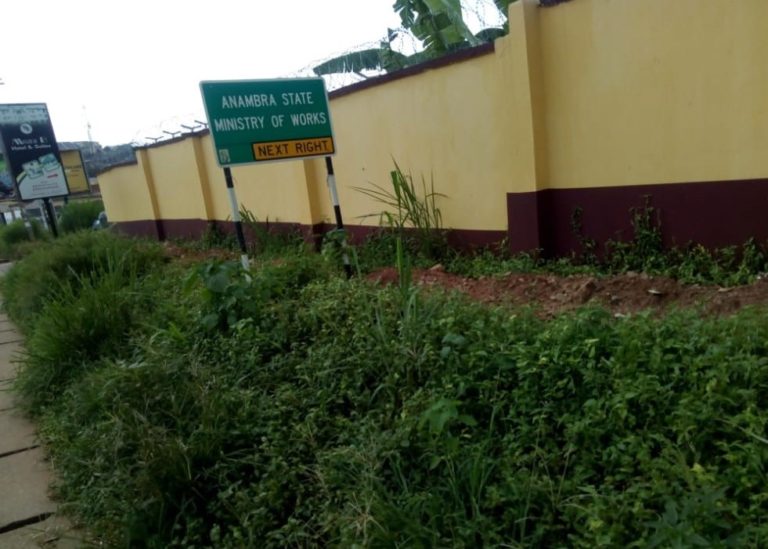
On May 10, when this reporter visited Federal Science and Technical College, Awka in Anambra State, the fence was abandoned midway.

The contract sum of N59 million was awarded to AE & E Nigeria Limited, to provide 25 solar streetlights, 10 CCTV cameras and perimeter fencing in this school.

The streetlights and CCTV cameras were installed, but the fence was abandoned halfway creating an avenue for people to move in and out of the school unchecked.

“The principal kept calling them to come and finish the fence they abandoned since January. The workers resumed work on April 14, the day we went on holiday. When we resumed on May 6, we met the fence in a similar state,” Sharon, a staff of the school told this reporter on May 10.

Mrs. Nyah Margaret, the school principal, said: “The school had fence before, but it was weak and falling off. The workers are fixing the parts that fell off. Nevertheless, they are not fast. Since we resumed school, they have not come to work.”

When this reporter revisited the school on September 23, the fence had been completed and barbed wires mounted.

“The workers came back in June and started working on the fence. They continued until they finished the fence in July,” Nyah said.

At Federal Government Girls’ College, Ezzamgbo, the barbwire was poorly mounted on a first visit in May.
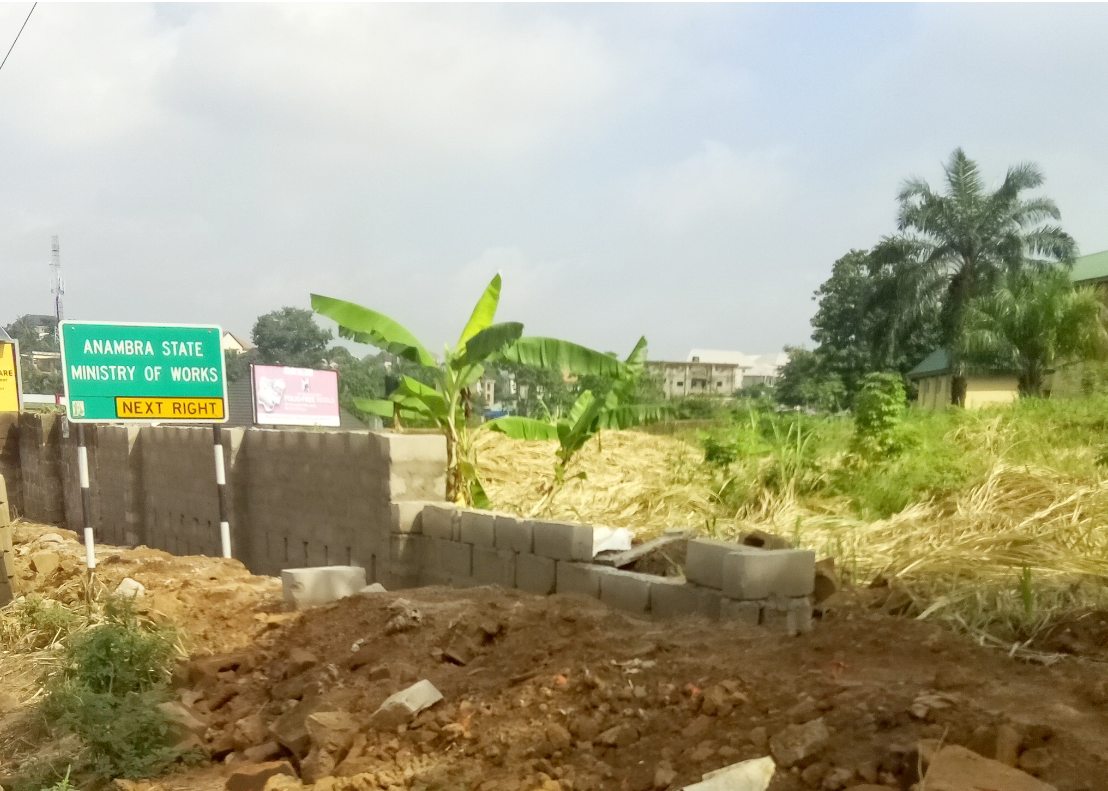
Abandoned fence at FSTC, Awka

Blue Anchor Agency Limited was awarded N41,805,818.78 million to provide 10 solar streetlights, complete the fence and install barbwire in this school.

The solar streetlights were mounted and fence completed but, the barbwire was shabbily done.

“The workers used ordinary sand from the farmland without cement to hang the barbwires. When the wind blew, the wires fell off,” Ede Dennis, the school bursar complained on May 9.

Benjamin Dawhare, the project officer at the school said: “The contractor hurriedly did the whole project in December, 2018. He did the coping, but it fell off. I complained to him two months ago (March), and he said he will come.”

Few weeks later, Michael Aikpitanyi, the contractor of the project was contacted to know when he plans to fix the coping.

“I did my job according to the scope I was given. I finished the job over four months ago and I have been paid,” Aikpitanyi told this reporter on May 27.

However, when this reporter returned to the school on Tuesday September 24, 2019, the barbwire had been properly installed.

“Everything is Okay now,” Dawhare said.

At Federal Government Girls’ College, Lejja in Nsukka area of Enugu State, the school complained that some of the streetlights stopped working shortly after installation.

The security project in this school was contracted to IQ International services Ltd.

“I went around in the night and spotted nine that were not lighting. The streetlights at the gate is not working, but it worked when it was installed. At some point, the lights became faint and was not giving out the proper illumination. Then, it stopped lighting,” Umahi, the project officer at the school said on May 6.

Corroborating, Abui Audu, the vice principal administration at the school said that the light close to the gate was no longer working.

“That’s the one I’m sure of,” Audu told this reporter on May 6.

Jude Ezeogwu, vice principal, special duties at the school said he “called the contractor on Friday (May 3), and he promised to be here this week (May 6). We have not seen him.”

When reached, Daniel Asekhamen, the contractor in-charge of the project, insisted that he had completed the work.

“We finished the work about a month ago. We did all we were supposed to do, and the school can attest to that,” Asekhamen said on May 17.

On another visit on September 25, this reporter learnt that the contractor had repaired the streetlights.

On May 13, when this reporter visited Federal Government Girls’ College, Owerri, the school was not satisfied with the security work done.

We told them (workers) to change the position of this camera,” Stella Azike, the school principal said on May 13, pointing at one of the cameras on the monitor in her office. “And we showed them where to install it, but they ran away.”

The contract sum of N39,662,437.50 million was awarded to Dips XL Plus Limited, to provide 25 solar streetlights, 24 CCTV cameras, 3.5KVA inverter, complete with six batteries, and 1.5KVA inverter, with four batteries, in this school.

“The illumination does not go beyond the place it (streetlight) is installed,” the vice principal, special duties, who identified herself simply as Mrs. Ogueri complained in May.

On a second visit on Thursday September 26, 2019, the camera and lights had been redone. But, the school still had challenges.

“They did them (camera and streetlights) again, but the challenge we have now is the CCTV camera,” Ogueri said. “The camera cannot playback.”


Right to Know Day: Eight years after passage of FOI law, govt agencies frustrate access to public information

AS the world celebrates the international right to know  day, public institutions in Nigeria have continued to deny and frustrate access to public information in their custody despite the passage of the Freedom of Information Act (FOIA) in 2011 – eight years ago.

The Right to Know Day, otherwise called the International Day for the Universal Access to Information, was inaugurated by the United Nations in 2015 and was first observed on September 28, 2016.

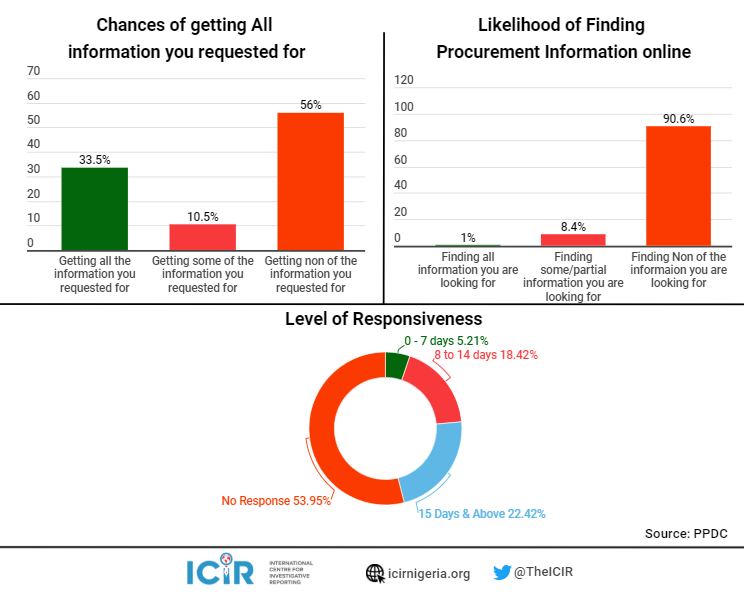
Data from the Public and Private Development Centre (PPDC), shows how public institutions disregard the freedom of information law by hoarding public information. The annual FOI compliance ranking of public institutions, which was co-organised with five other Civil Society Organisations, comprising of BugdIT, Connected Development (CODE), Right to Know (R2K), Basic Right Watch (BRW) and the Media Rights Watch (MRW) shows that in 2018, inaccessibility to public information requested under the FOI law is high, about 56 per cent. The data also shows that the chance of getting all information requested for is just about 33.5 percent, while the chance of getting a partial response to the information requested for is just about 10.5 percent.

On responsiveness of public institutions to FOI requests, in 2018, the PPDC and other CSOs indicate that over 50 per cent of the public institutions did not respond to FOI requests sent to them thereby, militating against the possibility of gaining access to information, and undermining open, transparent, and accountable governments.

Section 2(4) of the FOI Act provides that public institutions should ensure that information is widely disseminated and made readily available to the public through various means, including electronic and online sources, in other words, proactively disclosing information.

“A public institution shall ensure that information referred to in this section is widely disseminated and made readily available to members of the public through various means, including print, electronic and online sources, and at the offices of such public institutions.”

Data from the PPDC concludes that it is unlikely to get procurement-related information on websites of public institutions. A breakdown of the data shows that there is only one percent likelihood of finding procurement information on online; 90.6 percent likelihood of not finding the information online, while there is just 8.6 percent chance of getting partial information on websites of public institutions.

The data also shows that only 5.2 percent of public institutions respond to requests sent to them within 0-7 days of receipt. This means that over 90 percent of public institutions do not respond within the time frame stipulated by section 4 of the FOI act.

The ICIR in the last one year has filed over 70 FOI requests and can say authoritatively that over 60 percent of requests were denied or not responded to.

Also, according to Section 29 of the FOI Act, every public institution must submit its annual report on or before February 1 of each year to the AGF on all applications of FOI request they received.

For 2017, only 73 out of 900 public institutions in Nigeria complied to that provision of the FOI act. This amounts to about only 8.1 percent compliance to section 29 of the FOI act by public institutions. and the situation has not increased in the subsequent years.

The ICIR in 2018 reported how budget provisions meant for the implementation of FOI request have not been utilised fully to ensure compliance with the FOI Act.

President Buhari tells Court to strike out suit challenging his trip to UK without handing over to his Vice

PRESIDENT Muhammadu Buhari has approached the Federal High Court, Ikoyi, Lagos, to nullify the suit challenging his decision to travel abroad without handing over to his vice, Prof. Yemi Osinbajo last April.

Buhari was reacting to the case, FHC/L/CS/763/2019, filed by Inibehe Effiong, Lagos-based lawyer against him and the Attorney-General of the Federation, arguing that the lawyer lacks the “locus standi” to institute the case or appear in court.

But the lawyer had insisted need for the court to query Buhari’s action if it was unconstitutional and to ascertain if, in view of Section 145 (1) of the Constitution whether the President could travel outside the country at will for any length without transmitting a written statement to the legislature for his Vice to assume the position of Acting President until his return.

However, in an affidavit made available to Punch, Buhari said, so long his stay abroad would not exceed 21 days, the nation’s constitution does not make it compulsory to send such declaration to the National Assembly (NASS), ultimately for Osinbajo to occupy the Presidential office in an acting capacity.

“It is a fact that the 1999 Constitution (as amended) regulates the performance of the duties of the President of the Federal Republic of Nigeria in situations where the President is proceeding on vacation or is otherwise unable to discharge the functions of the office.

“That it is a fact that where the President embarks on vacation or otherwise is unable to discharge the functions of his office and fails to transmit a written declaration to that effect, he will be considered not to have complied with the constitution (as amended).

“That the time within which the President has to transmit a written letter to the President of the Senate and the Speaker of the House of Representatives of the Federal Republic of Nigeria is 21 days.

“That the President’s foreign trip lasted for nine days from April 25, 2019, to May 5, 2019. The President did not exceed the 21-day period required by the constitution. It is in the interest of justice to dismiss the claims of the plaintiff,” the affidavit reads in part.

The case being handled by Justice A.O Faji of the Ikoyi FHC would hold on Monday, 7th October.

Nigeria’s revenue threatened as biggest oil buyer shifts demand to alternative market

0

NIGERIA is on the verge of losing one of its major oil customers, India, as the world’s third-largest oil importer has found a new market in cheap crude oil supplies from Iraq according to a Reuters report.

India oil imports from Iraq increased to a record high for the first time as it bought about 1.32 million barrels per day, bpd, of Iraqi oil in August. This was  29 per cent higher than its August imports in 2018.

Its crude oil imports from Nigeria, Angola, Cameroon and Chad which are known for its sweet crude also dropped significantly in August by 18.3 per cent which amounts to 764,500 barrels of crude oil drop as its prices rose.

India became Nigeria’s biggest export destination for its crude oil from 2013 after the US made a shift in crude oil demand by turning its attention to shale production.

Statistics from the Observatory of Economic Complexity (OEC), an international trade database tool that visualises data about countries and the products they exchange, showed that from 2008 to 2018, Nigeria earned $96 billion from crude oil exports to India.

Top ten oil producing nations in the world.

However, this oil trade partnership between Nigeria and India is likely to be threatened with Iraq’s cheap oil type called Basra heavy crude which is sold to India at a lower premium price compared to the grade’s official selling price, OSP, through tenders.

This puts Nigeria’s oil sale in a precarious state which depends on proceeds from crude oil that constitutes about 90 per cent of the country’s total revenue the shift of its biggest oil partner due to the proximity of Iraqi’s crude to India and its cheap prices.

“In the spot market, Saudi and the UAE (United Arab Emirates) barrels are not available while Iraqi oil was easily available in spot markets at attractive prices, prompting refiners to maximize purchases of Iraqi oil,” according to a Reuters report.

The Organisation of Petroleum Exporting Countries, OPEC, and its allies have agreed to cut production by 1.2 million barrels per day through to the end of the first quarter of 2020, but U.S. sanctions on Iran and Venezuela have decreased crude oil supplies.

This action has enabled Iraq, OPEC’s number six oil producer, to gain its crude oil market share in India.

Currently, Iraq’s crude oil output is at 4.8 million, bpd, above OPEC’s target of 4.5 million, bpd, while Saudi Arabia has been producing below the targets to attacks on its oil installations.

Indian refiners are set to maximise production of very low-sulphur fuel oil (VLSFO) to supply ships from 2020 in compliance to Jan. 1, 2019 deadline by the International Maritime Organization, IMO, to ban ships from using fuel with more than 0.5 per cent sulphur to reduce air pollution.

“Some complex Indian refiners like Reliance can even produce very low-sulphur fuel oil with high-sulphur oil like Basra Heavy,” a Reuters report states.

Indian oil-based industries doubled Iraqi oil imports in August from the same month last year to about 1.8 million tonnes, the report hinted.

This indicates that India’s crude oil demand from Nigeria is expected to reduce to accommodate Iraqi’s crude oil supplies.

India is reputed to be the world’s third-biggest crude importer, meeting 83 per cent of its demand from imports from the Middle East and other countries such as Nigeria, Mexico, Venezuela and the US according to a report by S & P Splatts.


Peace restored at FUTMinna following clash between students, truck drivers — Police  

0

By VINCENT  Ufuoma


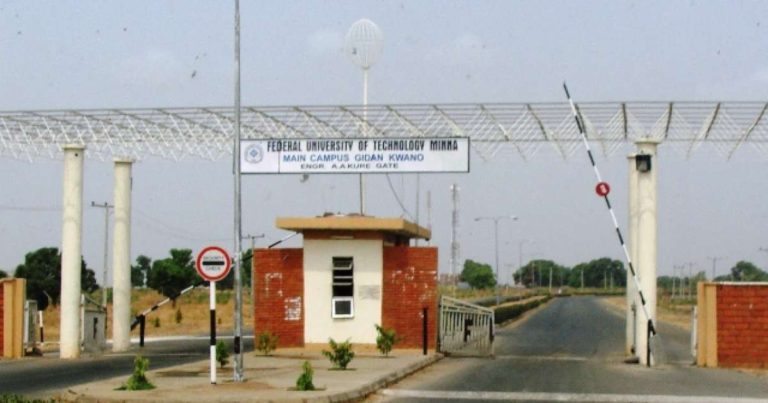
THE Niger State Police Public Relations Officer, Abubakar Danila, has assured the people of the state that peace has been restored to the community where students of the Federal University of Technology, Minna (FUTMinna) and truck drivers clashed.

He said, on Saturday, that law enforcement officers were drafted immediately to prevent the escalation of the fight and, through the intervention of the deputy governor, Ahmed Mohammed Ketso, and the Commissioner of Police, they have resolved all the issues between both parties.

“The anti-riot Police and other law enforcement officials earlier drafted on 26/09/2019 contained the situation against escalation,” he wrote in an emailed response to this reporter.

“The fracas was resolved amicably in the early hours of Friday, 27th September, 2019 through the intervention of the deputy governor of Niger State  and Heads of Security Agencies led by the Commissioner of Police Niger State Command, CP Adamu Usman who promptly visited the scene for on-spot assessment, met with warring parties, resolved their differences and restored normalcy through dialogue.”

Danila added that, however, “Some Police and other law enforcement officials are still stationed in front of the University to beef up the security of the school while some are patrolling student off-campus accommodations and the entire environs to forestall resurgence of the fracas. Everyone is going about his lawful businesses without any apprehension.”

Several persons were left injured on Thursday following an altercation between tanker drivers and students of FUTMinna.

A tanker collided with a van conveying some students to a political rally of one Bello Abubakar who is vying for the Student Union Government’s social director office. Many students were injured.

According to City Round, “At least three cars and many motorcycles were burnt while the mayhem reportedly paralysed academic activities”.

The driver of the truck that collided with the students’ van was reported to have fled, causing aggrieved students to protest and block the federal highway.

Kabir Okegbenro, the director of Media and Communication, National Association of University students in Nigeria told this reporter on Friday that the students were looking for the driver when they discovered tanker drivers in the town had gone to mobilise with some thugs to fight with them.

He said: “The students protested and attempted to get the driver which made them block the federal highway where the incident occurred. It was quite unfortunate that the truck drivers and other hoodlums put calls to themselves and mobilise themselves with full force to the school gate to attack students.”

Kabir told this reporter the tanker drivers launched another attack on the students the following day, leaving several people injured and hospitalised.

“As of today the tanker drivers are attempting to attack the students who wish to enter the school and they injured some students but who are all responding to treatment including postgraduate schools,” he said.

He accused men of the Nigerian Police in Minna of beating and harassing some of the students.

In a separate interview, the Students Union President, Fajoye Ayodeji confirmed that one of their students was hit by a tanker belonging to A.A. Rano. He said the situation was further aggravated when the driver told the students at the scene of the accident that he will clear and kill all of them if they should stand on the road.

“A tanker belonging to A.A. Rano hit some students in the front of our school gate. One of them who was severely injured was immediately rushed to the hospital for treatment,” he said.

“The whole thing got escalated when the tanker’s driver to the angry students that he will run over and kill all of them if they should stand on his way. In protest, the students blocked the federal highway.”

Corroborating Okegbenro’s narrative, the SUG President said the tanker drivers mobilised themselves to the school gate with cutlasses, knives, and sticks the following day to beat up students, leaving many with sustained injuries.

He also accused the police who came of intimidating students by firing gunshots and teargas canister on the air and at the students.

He confirmed that normalcy has since been restored through the interventions of the deputy governor and the state’s commissioner of police.

FLASHBACK: 12 times Buhari spoke about rule of law, promised to respect human rights

0

NIGERIA’s Department of State Services (DSS), an intelligence agency operated under the presidency, has refused to release Saharareporters’ founder Omoyele Sowore on bail despite a court order instructing it to do so.

Justice Taiwo Taiwo of the Federal High Court had, on Tuesday, ordered the agency to release Sowore who was arrested at about 11 pm on August 2 by its operatives and detained for 45 days.

On Thursday, the court threatened to convict the DSS Director-General, Yusuf Bichi, of contempt if Sowore is still held in detention. The DSS, despite this, refused to be served the court order the following day.

The Saharareporters’ founder is not the first victim of the federal government’s disregard for court judgements. Under the administration of President Muhammadu Buhari, prominent Shi’a Muslim leader Ibrahim El-Zakzaky, former National Security Adviser Sambo Dasuki, and IPOB leader Nnamdi Kanu have also been kept in detention in spite of court orders.

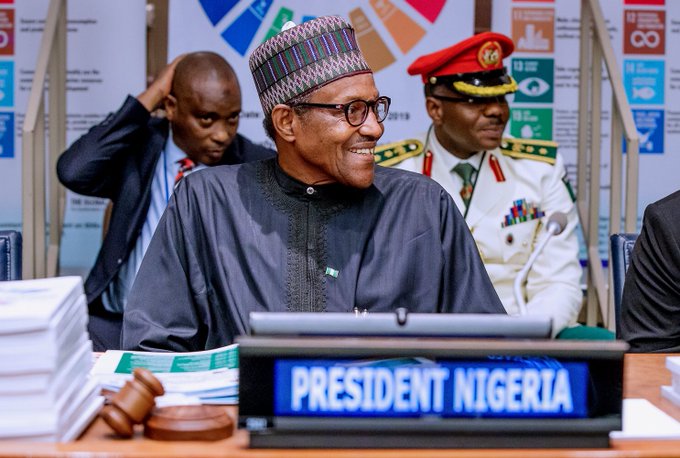
Meanwhile, President Buhari, who has just returned from the United Nations General Assembly (UNGA) in New York, has made several commitments to democracy, fundamental human rights, and the rule of law, both home and abroad. When he came to power in 1983 as a military ruler, one of the reasons he, gave for the coup was the Shagari administration’s disrespect for “most of the checks and balances in the constitution”.

Also, addressing the UN General Assembly on Tuesday, Buhari paid tribute to sacrifices made by millions all over the world “in defence of freedom, tolerance and the rule of law”.

“In Nigeria, we have made significant strides to put our own house in order. We will work tirelessly to uphold due process. The rule of law remains the permanent, unchanging foundation of the world order,” he told other heads of state.

“Freedom, tolerance and the rule of law are universal values and underline the best that this General Assembly represents. And that binds us all.”

The ICIR compiles excerpts from 11 other speeches delivered by Nigeria’s president mostly within the last five years, where he pledged loyalty to the ideals of rule of law, freedom, and democracy.

Speech at Brookings Institution, 2005

(Titled “Nigeria: Democracy and Conflict Resolution”, a speech delivered at the Saban Center for Middle East Policy, Brookings Institution, Washington DC.)

As a system of governance, democracy provides for constitutionalism and consultation. In other words, it calls for respect for the popular will, separation of powers and the application of effective checks and balances on the exercise of that power. All this is supposed to be done within the context of the rule of law and assured equality of all people before the law which is guaranteed and applied by a judiciary that is independent.

Formal declaration for the presidency, 2014

We in APC are resolve to bring change to Nigeria. We plan to do things differently. We plan to put priority on: Protection of lives and property, pursuing economic policies for shared prosperity and immediate attention on youth employment … Last, (but not the least or final) respecting the constitutional separation of powers between the executive, legislatures and judiciary and respecting the rights of citizens.

Acceptance speech, 2014

As such, I make these five pledges regarding the government if we are elected next February; a. We will govern Nigeria honestly, in accordance with the constitution b. We will strive to secure the country and efficiently manage the economy…

Inaugural speech, 2015

There is now a national consensus that our chosen route to national development is democracy. To achieve our objectives we must consciously work the democratic system. The Federal Executive under my watch will not seek to encroach on the duties and functions of the Legislative and Judicial arms of government. The law enforcing authorities will be charged to operate within the Constitution. 

… It is only when the three arms act constitutionally that government will be enabled to serve the country optimally and avoid the confusion all too often bedevilling governance today.

… As far as the constitution allows me I will try to ensure that there is responsible and accountable governance at all levels of government in the country. For I will not have kept my own trust with the Nigerian people if I allow others abuse theirs under my watch.

Independence Day Speech, 2015

I would like to end my address this morning on our agenda for change. Change does not just happen. You and I and all of us must appreciate that we all have our part to play if we want to bring change about. We must change our lawless habits, our attitude to public office and public trust. We must change our unruly behaviour in schools, hospitals, market places, motor parks, on the roads, in homes and offices. To bring about change, we must change ourselves by being law-abiding citizens.

Speech at US Institute for Peace, 2015

The Government that I lead is committed, and will do whatever it takes, to free Nigeria from the menace of terrorism. No matter how long it takes, we will reclaim every inch of Nigerian territory that is under the control of Boko Haram. We shall continue to do these within the framework of the rule of law and in compliance with our international and domestic human rights obligations.

… Ladies and Gentlemen, the fight against corruption is a full-time job that the Federal Government will carry with sustained resolve. I have always maintained zero tolerance for corruption. I am even more committed to fighting this number one enemy decisively because I am convinced beyond any shadow of a doubt that the much-needed impetus for our country’s survival is held back by corruption. I will not allow this to continue. Again, as with every action of the government that I lead, we would be fair, just, and scrupulously follow due process, and the rule of law, as enshrined in our Constitution.

… The Federal Government is well aware that building a strong economy will help us build a prosperous, stable, and secure country; a nation where democracy will thrive, businesses will flourish, and where citizens can live and pursue their dreams with dignity and freedom under the protection of the law. 

Speech at Chatham House, 2015

(Titled “Prospects for Democratic Consolidation in Africa: Nigeria’s Transition”.)

It is much more important that the promise of democracy goes beyond just allowing people to freely choose their leaders. It is much more important that democracy should deliver on the promise of choice, of freedoms, of security of lives and property, of transparency and accountability, of rule of law, of good governance and of shared prosperity. It is very important that the promise embedded in the concept of democracy, the promise of a better life for the generality of the people, is not delivered in the breach.

Statement at 71st UNGA session, 2016

Nigeria has continued to combat terrorism based on the established rules of engagement and in conformity with international best practices. I take this opportunity to reaffirm Nigeria’s commitment to human rights norms and International Humanitarian Law in our efforts to counter terrorism and violent extremism. I also wish to restate the assurance that the Federal Government of Nigeria is employing all our judicial tools to investigate and treat reported cases of human rights violations.

Independence Day Speech, 2016

In fighting corruption, however, the government would adhere strictly by the rule of law. Not for the first time I am appealing to the judiciary to join the fight against corruption.

Speech at 20th Anniversary of ICC, The Hague, 2018

Our cooperation with the Court is borne out of our strong belief in the respect for the rule of law and human rights, and in our firm commitment to the sanctity of fundamental freedoms at international and domestic levels, as ingrained in the objectives for establishing the Court.

Speech after receiving certificate of return, 2019

I, therefore, want to assure that we will continue to engage all parties that have the best interest of Nigerians at heart. Our Government will remain inclusive and our doors will remain open. That is the way to build the country of our dream; safe, secure, prosperous, and free of impunity and primitive accumulation by those entrusted with public offices.

The hard work to deliver a better Nigeria continues, building on the foundations of peace, rule of law and opportunities for all. We will roll up our sleeves afresh, and give it our all. We have no other motive than to serve Nigeria with our hearts and might, and build a nation which we and generations to come can be proud of.

World Tourism Day: UK, Canada, USA tag Nigeria “no-go-area”

0

AS the global community celebrates the World Tourism Day on Friday, Nigeria is counting its loss in tourism market due to low arrival of foreign visitors as some countries warn their citizens to see Nigeria as a “no-go-area” except for important businesses.

September 27 of every year is set aside by the United Nations (UNWTO) to promote the value of tourism as a driver of economic growth, inclusive development, and environmental sustainability.

Current travel advisories provided by the governments of the United Kingdom, Canada, and United States of America (USA) encourage their citizens to avoid visiting Nigeria save for “essential” reasons due to issues of insecurity ranging from kidnapping, violence, and terrorism to diseases such as Zika virus.

However, while  Nigeria had been identified with evidence of Zika virus transmission prior to 2015, there is no available data that shows the virus is a current threat.

These countries also advise their citizens not to set their feet on the soil of some states in the country, if they had to come at all.

The Foreign and Commonwealth Office (FCO) of the UK government indicated in its travel advisory updated on September 18 that the UK people should not travel to states including Borno, Yobe, Adamawa, and Gombe states.

It added that the riverine areas of Delta, Bayelsa, Rivers, Akwa Ibom, and Cross River should be avoided likewise.

In addition, the UK listed that only essential travel should take its citizens to Bauchi, Zamfara, Kano, Kaduna, Jigawa, Katsina, Kogi, Abia and non-riverine areas of Delta, Bayelsa, and Rivers.

“There’s a high threat of kidnap throughout Nigeria,” a part read. The UK said there were reports that Boko Haram and the Islamic State’s West Africa Province (ISWAP) are continuing to actively plan to kidnap foreigners.

Also, it mentioned that terrorists, prominent in the Northeast, were likely to carry out attacks in Nigeria, “particularly in Borno, Yobe and Adamawa States”. “Further attacks are likely,” it warned.

The UK stated that protests by members of the Islamic Movement of Nigeria (IMN) have the potential to turn violent. Meanwhile, the Nigerian government had on July 22 proscribed activities of the IMN.

On a four-scale travel advisory of the United States of America, Nigeria is placed on the third. This means that any US citizen planning on visiting Nigeria should reconsider due to crime, terrorism, civil unrest, kidnapping, and piracy. While 15 countries including Nigeria are ranked on level 3, 12 others such as Pakistan, and Iran were ranked on the fourth.

Borno state, Yobe state, and northern parts of Adamawa state were classified under “do not travel”.

Likewise, Canadians are advised by their government to avoid non-essential travelling to Nigeria due to the security situation which it described as “unpredictable.”

According to the statement, “There is a significant risk of terrorism, crime, inter-communal clashes, armed attacks and kidnappings.”

The Canadian government encourages its citizens not to travel to Adamawa, Bauchi, Borno, Gombe, Kaduna, Kano, Plateau, Yobe, Abia, Akwa Ibom, Anambra, Bayelsa, Delta, Imo Sokoto, Zamfara and Rivers States (with the exception of Rivers’ capital city, Port Harcourt, where it advises against non-essential travel).

It, however, added that travel destinations are the final decision of its citizens and its mandate is only to provide “credible and timely information” for them to make well-informed decisions regarding travelling abroad.

As these nations discourage their nationals from coming to Nigeria, tourist arrivals which contributes to the economic growth of the country are low compared to other African countries such as South Africa and  Morrocco.

According to the United Nations, World Tourism Organisation’s 2019 World Tourism Highlights, the earnings Nigeria generated from tourism was lower in 2018 than in 2017. In 2017, the UN agency estimated that Nigeria earned $2.5 billion on tourism, which is 6.8 per cent of total African revenue on tourism. But in 2018, the revenue reduced to $1.9 billion.

The report made provision for the number of people visiting a country each year. However, the last available data for Nigeria was in 2016. That year, 1.89 million people visited the country.

UNWTO estimated that 1.5 million people paid a visit to Nigeria in 2010. The data shows that in six years, between 2010 and 2016, Nigeria had only increased with 334,000 tourist arrivals.

Meanwhile, the Federal Government, through the foreign affairs ministry, had stated its determination to make the country a “prominent tourism destination in Africa”.

When The ICIR checks the portal of the Nigerian Bureau of Statistics, there is no available data showing the contribution of tourism to the country’s GDP.

GIJN 2019: Absence of reliable data,biggest challenge of Africa fact checkers

AS the 11th Global Investigative Journalist Network conference proceeds in Hamburg, Germany, the challenges faced by fact-checkers, especially journalists in Africa were examined.

Fact-checking which is an act of in-depth verification of assertions (non-fiction) to establish the veracity and accuracy of the factual statements in a text, audio or video content over the years has become a specialised form of reporting in the media landscape in the world.

At the rate which fake news and disinformation are shared across social media platforms, it has become the duty of the journalist as a gatekeeper to monitor as well as debunk misleading information in the public space.

Samba Dialimpa, Editor-in-Chief at Africa Check at the 2019 GIJN fact check session pointed out that although fact-checking in West African nations is of great importance, the investigative journalist who is on a mission to debunk assertions- especially- made by political leaders often have to deal with the unavailability of reliable or credible statistics.

“When you do not have access to credible sources or data, it becomes very difficult to fact check claims that are being made.

“And when you do find data, the credibility of such data is another issue. The methodology used in the collection of this data are things to be questioned to make sure it is not coming from someone with a propaganda he or she is pushing,” he said.

Dialimpa also notes that with the help of certain verification tools, journalists are still able to carry out their investigations, however, he also pointed out some limitations of such tools.

In the end, he said that the best tool that an African journalist still has is herself.

“It is best to use different tools both technology and human resources as well. I think fact-checking is not all about technology.” 


MRA hails European Court ruling on Right to be Forgotten

0

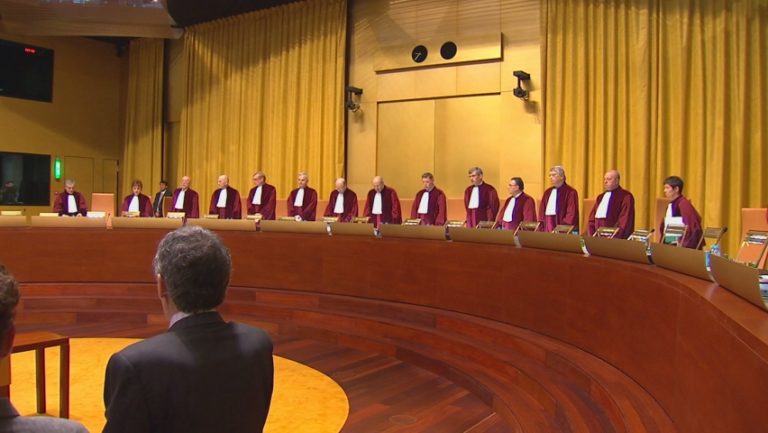
THE Media Rights Agenda, MRA, today commended the landmark judgement of the Grand Chamber of the Court of Justice of the European Union, CJEU, which on September 24, resolved the dispute over Google’s responsibility to remove information from the Internet, frequently referred to as the “right to be forgotten”.

In a judgment regarded as important in advancing freedom of expression globally, the court, which is the supreme court of the European Union, EU, in matters of EU law, held that de-referencing requests under the EU Directive can only be applied within the EU, but not worldwide.

Edetaen Ojo, MRA’s executive director, noted that the legal victory was significant because it removed an unwarranted restriction on the right to freedom of expression, arguing that the implementation of the French regulator’s 2015 decision demanding the removal of information from the Internet could result in censorship and an unjustifiable interference with the right to freedom of expression in many countries outside the EU.

The ruling arose from a dispute between Google and French privacy regulator, la Commission nationale informatique et libertés, CNIL, which in 2015, ordered the Internet giant to globally remove search result listings to pages containing damaging or false information about a person.

The matter was referred to the CJEU by France’s Conseil d’Etat, to which Google appealed over the CNIL decision. The issue for determination by the Court was: where a regulator in one EU country requires information to be removed from the internet, should that be given effect in that one country, across the EU or globally?

Concerned about the serious implications of the CNIL’s decision for freedom of expression, particularly in the developing world, 18 NGOs which specialise in the defence of human rights and online freedom of expression in Africa, Asia, Latin America and Europe, including Media Rights Agenda, initially intervened before the Conseil d’Etat in France, while 13 of them, including MRA, also intervened before the CJEU.

The NGOs were  represented by barristers Caoilfhionn Gahhagher QC, Jude Bunting and Jennifer Robinson of the London-based internationally renowned law firm, Doughty Street Chambers, as well as French lawyer, Thomas Haas.

The 13 NGOs argued before the CJEU that global de-listing will have grave ramifications, far beyond the impact on the rights of Google and that it will undermine freedom of expression and human rights activism around the world.

The 13 NGOs provided a unique perspective as they are based in countries as diverse as Brazil, Colombia, India, Mexico, Nigeria, Pakistan, Senegal, South Africa and Uganda.

In its judegment, the court agreed with the NGOs, adopting the position put forward by them.

The Court recognised the interveners’ argument about the importance of free speech and that the right to be forgotten is not recognised around the world, remarking that “it should be emphasised that numerous third States do not recognise the right to de-referencing or have a different approach to that right. Moreover, the right to the protection of personal data is not an absolute right, but must be considered in relation to its function in society and be balanced against other fundamental rights, in accordance with the principle of proportionality… Furthermore, the balance between the right to privacy and the protection of personal data, on the one hand, and the freedom of information of internet users, on the other, is likely to vary significantly around the world.”

The court also adopted the interveners’ concern that, to date, there has not been proper consideration of the balancing test between the right to privacy of an individual in an EU Member State, from which the right to be forgotten flows, and freedom of speech in a global context, saying: “While the EU legislature has, in Article 17(3)(a) of Regulation 2016/679, struck a balance between that right and that freedom so far as the Union is concerned …, it must be found that, by contrast, it has not, to date, struck such a balance as regards the scope of a de-referencing outside the Union.

Accordingly, the Court found that there was no requirement to de-reference information outside of the EU.

Reacting to the judgment, one of the lawyers to the NGOs, Caoilfhionn Gallagher QC,  said: “All too often debates about internet regulation focus on Europe and North America only, ignoring the global ramifications. Our clients are a global and diverse coalition which spans the globe – from the Internet Freedom Foundation of India, to Junction in Senegal, and the Institute of Technology and Society of Rio.”

According to her, “They rely on freedom of expression and on the free exchange of ideas and information online so as to carry out their important work protecting human rights around the world. Many are based in countries with repressive press laws, where free access to the Internet is critical in protecting human rights and enabling NGOs to campaign for change.”

Ms. Gallagher stressed that “The decision of the European Court today sets an important precedent for freedom of speech. The right to be forgotten is not universally recognised around the world. No state should be permitted to remove information from the internet with global effect. To do otherwise would trigger a ‘race to the bottom’: where the information available online to internet users everywhere would be determined by the state with the most repressive and draconian laws.”

The NGOs who intervened in the CJEU case are: Internet Freedom Foundation, India
Software Freedom Law Center, India; Collaboration on International ICT Policy for East and Southern Africa, CIPESA; Digital Rights Foundation, Pakistan; Unwanted Witness, Uganda;
Paradigm Initiative, Nigeria; Association for Progressive Communications, South Africa (with members from 77 countries) and I-Freedom Uganda Network, Uganda.

Others are: Jonction, Senegal; Media Rights Agenda, Nigeria; Sierra Sustainable Technology; The Institutio Beta for Internet and Democracy, Brazil; The League of cyberactivists for democracy, Africtivistes, Senegal; The Karisma Foundation, Colombia; Global Voices, United States;  The Institute of Technology and Society of Rio, Brazil; Red en Defensa de los Derechos Digitales, Mexico and The Center for Information Technology and Development (“CITAD”), Nigeria.


Correctional Service frees 681 inmates, weeks after FG changed prison name

0

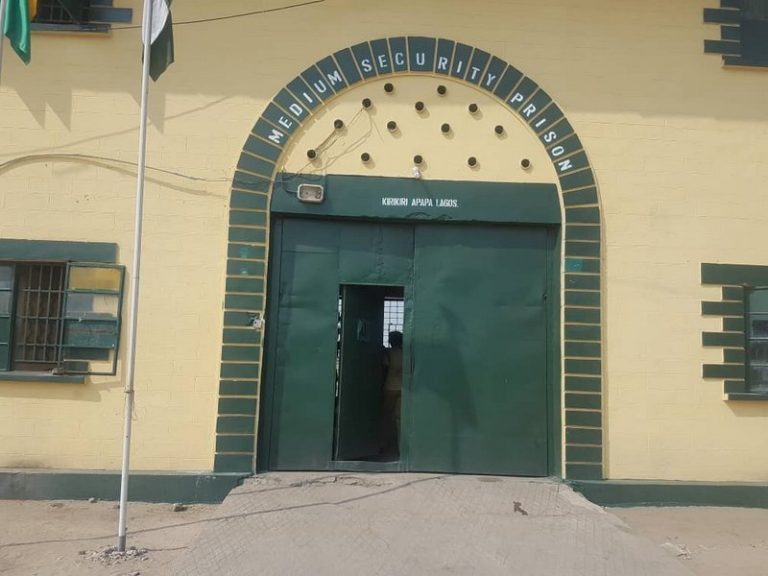
WEEKS after the Federal Government said it would decongest the country’s overpopulated prisons, a total of 681 prison inmates in prisons across the country have gained freedom.

A prison stat by the Correctional Services at September 26, revealed 681 inmates have been released since the President changed its name from what it was formerly known for.

President Muhammadu Buhari had on August 14 approved the bill seeking to change the name of Nigerian Prison Services to Nigerian Correctional Service.

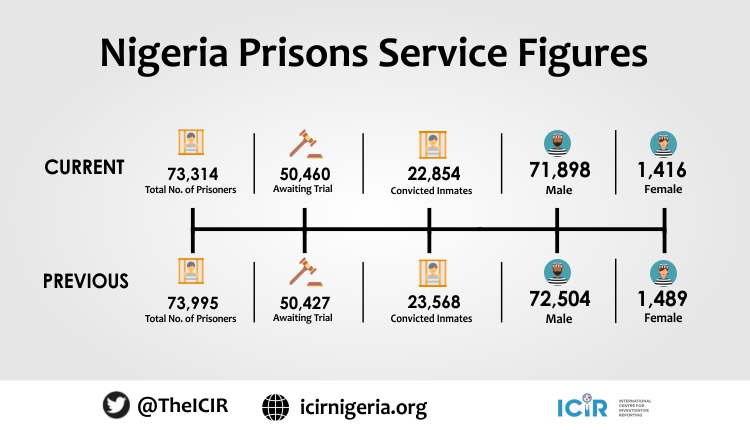
There were 73, 995 inmates in Nigerian prisons as at the time the new name of the service took effect. However, as of September 26, there has been a reduction in the total number of inmates to 73,314.

According to the report, the number of male inmates reduced from 72,504 to 71, 898 while there was an also decline in the number of female inmates from 1,489 in July to 1,416 in September.

Also, the total number of convicted inmates decreased from 23, 568 as of July 22 to 22, 854 as of September 26.

However, the number of inmates awaiting trial increased from 50,426 to 50, 460 inmates.

Meanwhile, the Comptroller of Correctional Service, Francis Enobore in a phone conversation with The ICIR highlighted reasons for the reduction of inmates within the period of time.

According to him, the reduction in the number of inmates in the various prison could result from a state-to-state review of inmates’ case file, by the Presidential Committee on Prison Decongestion and Reformation.

He noted that such review is aimed at ascertaining how grievous the offences of inmates are, stating that once an inmate has no absolute reason being behind bars, such an inmate is released immediately.

Enobore said sometimes judges of state, equally visit custodian centre, to carry out  ‘J-Delivery’ (A chief judge of a state, visiting a particular custodian centre, with other magistrates under his jurisdiction).

“They will go to a particular detention centre, which is a custodian centre and then they review the cases of all the persons that are there,” he explained.

He noted that the visit of the chief judge is an opportunity to carry out an “undistorted review of the work the magistrates under him were doing”.

The comptroller said such frequent visit could also amount to drop in population of the inmates in a particular state or custodian centre.

Other reason could be, that some inmates had completed their jail term; had exhibited good behaviours overtime; had become very productive in their vocational acquisition and certified valuable to his/herself and the society, then such could be released─ Humph Chuks, the Federal Capital Territory (FCT) Correctional Service spokesperson told THE ICIR.

“If there is a decrease in the number of inmates, I think it is a plus to the Service and the society,” Chuks said.