Home Blog Page 2282

FLASHBACK: 12 times Buhari spoke about rule of law, promised to respect human rights

0

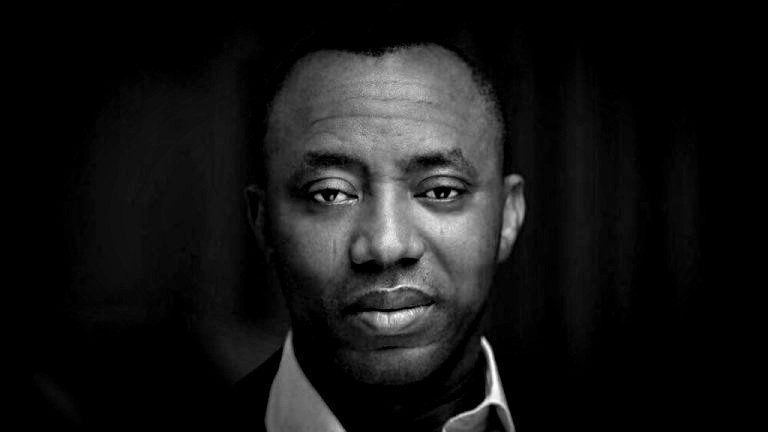
NIGERIA’s Department of State Services (DSS), an intelligence agency operated under the presidency, has refused to release Saharareporters’ founder Omoyele Sowore on bail despite a court order instructing it to do so.

Justice Taiwo Taiwo of the Federal High Court had, on Tuesday, ordered the agency to release Sowore who was arrested at about 11 pm on August 2 by its operatives and detained for 45 days.

On Thursday, the court threatened to convict the DSS Director-General, Yusuf Bichi, of contempt if Sowore is still held in detention. The DSS, despite this, refused to be served the court order the following day.

The Saharareporters’ founder is not the first victim of the federal government’s disregard for court judgements. Under the administration of President Muhammadu Buhari, prominent Shi’a Muslim leader Ibrahim El-Zakzaky, former National Security Adviser Sambo Dasuki, and IPOB leader Nnamdi Kanu have also been kept in detention in spite of court orders.

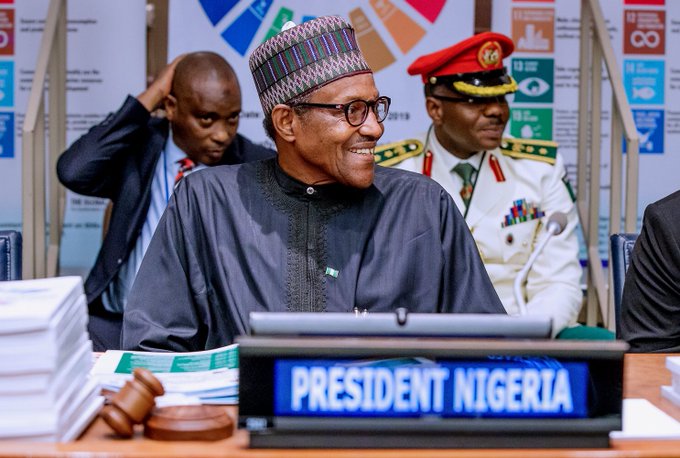
Meanwhile, President Buhari, who has just returned from the United Nations General Assembly (UNGA) in New York, has made several commitments to democracy, fundamental human rights, and the rule of law, both home and abroad. When he came to power in 1983 as a military ruler, one of the reasons he, gave for the coup was the Shagari administration’s disrespect for “most of the checks and balances in the constitution”.

Also, addressing the UN General Assembly on Tuesday, Buhari paid tribute to sacrifices made by millions all over the world “in defence of freedom, tolerance and the rule of law”.

“In Nigeria, we have made significant strides to put our own house in order. We will work tirelessly to uphold due process. The rule of law remains the permanent, unchanging foundation of the world order,” he told other heads of state.

“Freedom, tolerance and the rule of law are universal values and underline the best that this General Assembly represents. And that binds us all.”

The ICIR compiles excerpts from 11 other speeches delivered by Nigeria’s president mostly within the last five years, where he pledged loyalty to the ideals of rule of law, freedom, and democracy.

Speech at Brookings Institution, 2005

(Titled “Nigeria: Democracy and Conflict Resolution”, a speech delivered at the Saban Center for Middle East Policy, Brookings Institution, Washington DC.)

As a system of governance, democracy provides for constitutionalism and consultation. In other words, it calls for respect for the popular will, separation of powers and the application of effective checks and balances on the exercise of that power. All this is supposed to be done within the context of the rule of law and assured equality of all people before the law which is guaranteed and applied by a judiciary that is independent.

Formal declaration for the presidency, 2014

We in APC are resolve to bring change to Nigeria. We plan to do things differently. We plan to put priority on: Protection of lives and property, pursuing economic policies for shared prosperity and immediate attention on youth employment … Last, (but not the least or final) respecting the constitutional separation of powers between the executive, legislatures and judiciary and respecting the rights of citizens.

Acceptance speech, 2014

As such, I make these five pledges regarding the government if we are elected next February; a. We will govern Nigeria honestly, in accordance with the constitution b. We will strive to secure the country and efficiently manage the economy…

Inaugural speech, 2015

There is now a national consensus that our chosen route to national development is democracy. To achieve our objectives we must consciously work the democratic system. The Federal Executive under my watch will not seek to encroach on the duties and functions of the Legislative and Judicial arms of government. The law enforcing authorities will be charged to operate within the Constitution. 

… It is only when the three arms act constitutionally that government will be enabled to serve the country optimally and avoid the confusion all too often bedevilling governance today.

… As far as the constitution allows me I will try to ensure that there is responsible and accountable governance at all levels of government in the country. For I will not have kept my own trust with the Nigerian people if I allow others abuse theirs under my watch.

Independence Day Speech, 2015

I would like to end my address this morning on our agenda for change. Change does not just happen. You and I and all of us must appreciate that we all have our part to play if we want to bring change about. We must change our lawless habits, our attitude to public office and public trust. We must change our unruly behaviour in schools, hospitals, market places, motor parks, on the roads, in homes and offices. To bring about change, we must change ourselves by being law-abiding citizens.

Speech at US Institute for Peace, 2015

The Government that I lead is committed, and will do whatever it takes, to free Nigeria from the menace of terrorism. No matter how long it takes, we will reclaim every inch of Nigerian territory that is under the control of Boko Haram. We shall continue to do these within the framework of the rule of law and in compliance with our international and domestic human rights obligations.

… Ladies and Gentlemen, the fight against corruption is a full-time job that the Federal Government will carry with sustained resolve. I have always maintained zero tolerance for corruption. I am even more committed to fighting this number one enemy decisively because I am convinced beyond any shadow of a doubt that the much-needed impetus for our country’s survival is held back by corruption. I will not allow this to continue. Again, as with every action of the government that I lead, we would be fair, just, and scrupulously follow due process, and the rule of law, as enshrined in our Constitution.

… The Federal Government is well aware that building a strong economy will help us build a prosperous, stable, and secure country; a nation where democracy will thrive, businesses will flourish, and where citizens can live and pursue their dreams with dignity and freedom under the protection of the law. 

Speech at Chatham House, 2015

(Titled “Prospects for Democratic Consolidation in Africa: Nigeria’s Transition”.)

It is much more important that the promise of democracy goes beyond just allowing people to freely choose their leaders. It is much more important that democracy should deliver on the promise of choice, of freedoms, of security of lives and property, of transparency and accountability, of rule of law, of good governance and of shared prosperity. It is very important that the promise embedded in the concept of democracy, the promise of a better life for the generality of the people, is not delivered in the breach.

Statement at 71st UNGA session, 2016

Nigeria has continued to combat terrorism based on the established rules of engagement and in conformity with international best practices. I take this opportunity to reaffirm Nigeria’s commitment to human rights norms and International Humanitarian Law in our efforts to counter terrorism and violent extremism. I also wish to restate the assurance that the Federal Government of Nigeria is employing all our judicial tools to investigate and treat reported cases of human rights violations.

Independence Day Speech, 2016

In fighting corruption, however, the government would adhere strictly by the rule of law. Not for the first time I am appealing to the judiciary to join the fight against corruption.

Speech at 20th Anniversary of ICC, The Hague, 2018

Our cooperation with the Court is borne out of our strong belief in the respect for the rule of law and human rights, and in our firm commitment to the sanctity of fundamental freedoms at international and domestic levels, as ingrained in the objectives for establishing the Court.

Speech after receiving certificate of return, 2019

I, therefore, want to assure that we will continue to engage all parties that have the best interest of Nigerians at heart. Our Government will remain inclusive and our doors will remain open. That is the way to build the country of our dream; safe, secure, prosperous, and free of impunity and primitive accumulation by those entrusted with public offices.

The hard work to deliver a better Nigeria continues, building on the foundations of peace, rule of law and opportunities for all. We will roll up our sleeves afresh, and give it our all. We have no other motive than to serve Nigeria with our hearts and might, and build a nation which we and generations to come can be proud of.
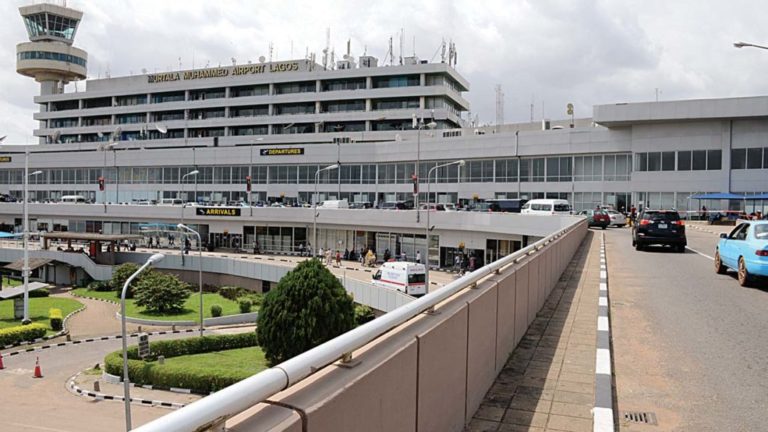
World Tourism Day: UK, Canada, USA tag Nigeria “no-go-area”

0

AS the global community celebrates the World Tourism Day on Friday, Nigeria is counting its loss in tourism market due to low arrival of foreign visitors as some countries warn their citizens to see Nigeria as a “no-go-area” except for important businesses.

September 27 of every year is set aside by the United Nations (UNWTO) to promote the value of tourism as a driver of economic growth, inclusive development, and environmental sustainability.

Current travel advisories provided by the governments of the United Kingdom, Canada, and United States of America (USA) encourage their citizens to avoid visiting Nigeria save for “essential” reasons due to issues of insecurity ranging from kidnapping, violence, and terrorism to diseases such as Zika virus.

However, while  Nigeria had been identified with evidence of Zika virus transmission prior to 2015, there is no available data that shows the virus is a current threat.

These countries also advise their citizens not to set their feet on the soil of some states in the country, if they had to come at all.

The Foreign and Commonwealth Office (FCO) of the UK government indicated in its travel advisory updated on September 18 that the UK people should not travel to states including Borno, Yobe, Adamawa, and Gombe states.

It added that the riverine areas of Delta, Bayelsa, Rivers, Akwa Ibom, and Cross River should be avoided likewise.

In addition, the UK listed that only essential travel should take its citizens to Bauchi, Zamfara, Kano, Kaduna, Jigawa, Katsina, Kogi, Abia and non-riverine areas of Delta, Bayelsa, and Rivers.

“There’s a high threat of kidnap throughout Nigeria,” a part read. The UK said there were reports that Boko Haram and the Islamic State’s West Africa Province (ISWAP) are continuing to actively plan to kidnap foreigners.

Also, it mentioned that terrorists, prominent in the Northeast, were likely to carry out attacks in Nigeria, “particularly in Borno, Yobe and Adamawa States”. “Further attacks are likely,” it warned.

The UK stated that protests by members of the Islamic Movement of Nigeria (IMN) have the potential to turn violent. Meanwhile, the Nigerian government had on July 22 proscribed activities of the IMN.

On a four-scale travel advisory of the United States of America, Nigeria is placed on the third. This means that any US citizen planning on visiting Nigeria should reconsider due to crime, terrorism, civil unrest, kidnapping, and piracy. While 15 countries including Nigeria are ranked on level 3, 12 others such as Pakistan, and Iran were ranked on the fourth.

Borno state, Yobe state, and northern parts of Adamawa state were classified under “do not travel”.

Likewise, Canadians are advised by their government to avoid non-essential travelling to Nigeria due to the security situation which it described as “unpredictable.”

According to the statement, “There is a significant risk of terrorism, crime, inter-communal clashes, armed attacks and kidnappings.”

The Canadian government encourages its citizens not to travel to Adamawa, Bauchi, Borno, Gombe, Kaduna, Kano, Plateau, Yobe, Abia, Akwa Ibom, Anambra, Bayelsa, Delta, Imo Sokoto, Zamfara and Rivers States (with the exception of Rivers’ capital city, Port Harcourt, where it advises against non-essential travel).

It, however, added that travel destinations are the final decision of its citizens and its mandate is only to provide “credible and timely information” for them to make well-informed decisions regarding travelling abroad.

As these nations discourage their nationals from coming to Nigeria, tourist arrivals which contributes to the economic growth of the country are low compared to other African countries such as South Africa and  Morrocco.

According to the United Nations, World Tourism Organisation’s 2019 World Tourism Highlights, the earnings Nigeria generated from tourism was lower in 2018 than in 2017. In 2017, the UN agency estimated that Nigeria earned $2.5 billion on tourism, which is 6.8 per cent of total African revenue on tourism. But in 2018, the revenue reduced to $1.9 billion.

The report made provision for the number of people visiting a country each year. However, the last available data for Nigeria was in 2016. That year, 1.89 million people visited the country.

UNWTO estimated that 1.5 million people paid a visit to Nigeria in 2010. The data shows that in six years, between 2010 and 2016, Nigeria had only increased with 334,000 tourist arrivals.

Meanwhile, the Federal Government, through the foreign affairs ministry, had stated its determination to make the country a “prominent tourism destination in Africa”.

When The ICIR checks the portal of the Nigerian Bureau of Statistics, there is no available data showing the contribution of tourism to the country’s GDP.

GIJN 2019: Absence of reliable data,biggest challenge of Africa fact checkers

AS the 11th Global Investigative Journalist Network conference proceeds in Hamburg, Germany, the challenges faced by fact-checkers, especially journalists in Africa were examined.

Fact-checking which is an act of in-depth verification of assertions (non-fiction) to establish the veracity and accuracy of the factual statements in a text, audio or video content over the years has become a specialised form of reporting in the media landscape in the world.

At the rate which fake news and disinformation are shared across social media platforms, it has become the duty of the journalist as a gatekeeper to monitor as well as debunk misleading information in the public space.

Samba Dialimpa, Editor-in-Chief at Africa Check at the 2019 GIJN fact check session pointed out that although fact-checking in West African nations is of great importance, the investigative journalist who is on a mission to debunk assertions- especially- made by political leaders often have to deal with the unavailability of reliable or credible statistics.

“When you do not have access to credible sources or data, it becomes very difficult to fact check claims that are being made.

“And when you do find data, the credibility of such data is another issue. The methodology used in the collection of this data are things to be questioned to make sure it is not coming from someone with a propaganda he or she is pushing,” he said.

Dialimpa also notes that with the help of certain verification tools, journalists are still able to carry out their investigations, however, he also pointed out some limitations of such tools.

In the end, he said that the best tool that an African journalist still has is herself.

“It is best to use different tools both technology and human resources as well. I think fact-checking is not all about technology.” 


MRA hails European Court ruling on Right to be Forgotten

0

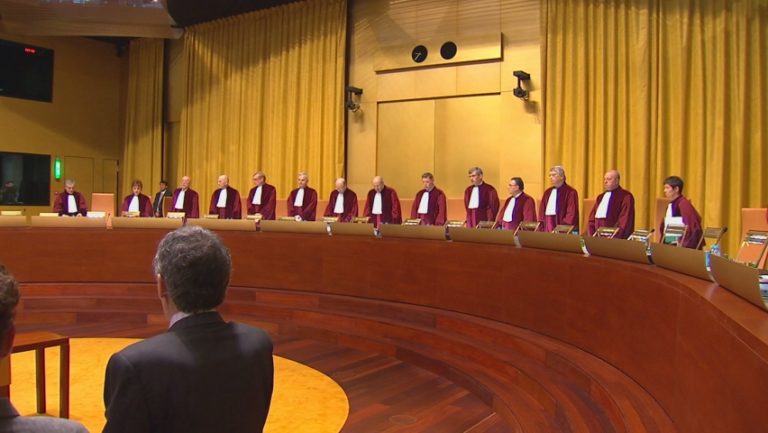
THE Media Rights Agenda, MRA, today commended the landmark judgement of the Grand Chamber of the Court of Justice of the European Union, CJEU, which on September 24, resolved the dispute over Google’s responsibility to remove information from the Internet, frequently referred to as the “right to be forgotten”.

In a judgment regarded as important in advancing freedom of expression globally, the court, which is the supreme court of the European Union, EU, in matters of EU law, held that de-referencing requests under the EU Directive can only be applied within the EU, but not worldwide.

Edetaen Ojo, MRA’s executive director, noted that the legal victory was significant because it removed an unwarranted restriction on the right to freedom of expression, arguing that the implementation of the French regulator’s 2015 decision demanding the removal of information from the Internet could result in censorship and an unjustifiable interference with the right to freedom of expression in many countries outside the EU.

The ruling arose from a dispute between Google and French privacy regulator, la Commission nationale informatique et libertés, CNIL, which in 2015, ordered the Internet giant to globally remove search result listings to pages containing damaging or false information about a person.

The matter was referred to the CJEU by France’s Conseil d’Etat, to which Google appealed over the CNIL decision. The issue for determination by the Court was: where a regulator in one EU country requires information to be removed from the internet, should that be given effect in that one country, across the EU or globally?

Concerned about the serious implications of the CNIL’s decision for freedom of expression, particularly in the developing world, 18 NGOs which specialise in the defence of human rights and online freedom of expression in Africa, Asia, Latin America and Europe, including Media Rights Agenda, initially intervened before the Conseil d’Etat in France, while 13 of them, including MRA, also intervened before the CJEU.

The NGOs were  represented by barristers Caoilfhionn Gahhagher QC, Jude Bunting and Jennifer Robinson of the London-based internationally renowned law firm, Doughty Street Chambers, as well as French lawyer, Thomas Haas.

The 13 NGOs argued before the CJEU that global de-listing will have grave ramifications, far beyond the impact on the rights of Google and that it will undermine freedom of expression and human rights activism around the world.

The 13 NGOs provided a unique perspective as they are based in countries as diverse as Brazil, Colombia, India, Mexico, Nigeria, Pakistan, Senegal, South Africa and Uganda.

In its judegment, the court agreed with the NGOs, adopting the position put forward by them.

The Court recognised the interveners’ argument about the importance of free speech and that the right to be forgotten is not recognised around the world, remarking that “it should be emphasised that numerous third States do not recognise the right to de-referencing or have a different approach to that right. Moreover, the right to the protection of personal data is not an absolute right, but must be considered in relation to its function in society and be balanced against other fundamental rights, in accordance with the principle of proportionality… Furthermore, the balance between the right to privacy and the protection of personal data, on the one hand, and the freedom of information of internet users, on the other, is likely to vary significantly around the world.”

The court also adopted the interveners’ concern that, to date, there has not been proper consideration of the balancing test between the right to privacy of an individual in an EU Member State, from which the right to be forgotten flows, and freedom of speech in a global context, saying: “While the EU legislature has, in Article 17(3)(a) of Regulation 2016/679, struck a balance between that right and that freedom so far as the Union is concerned …, it must be found that, by contrast, it has not, to date, struck such a balance as regards the scope of a de-referencing outside the Union.

Accordingly, the Court found that there was no requirement to de-reference information outside of the EU.

Reacting to the judgment, one of the lawyers to the NGOs, Caoilfhionn Gallagher QC,  said: “All too often debates about internet regulation focus on Europe and North America only, ignoring the global ramifications. Our clients are a global and diverse coalition which spans the globe – from the Internet Freedom Foundation of India, to Junction in Senegal, and the Institute of Technology and Society of Rio.”

According to her, “They rely on freedom of expression and on the free exchange of ideas and information online so as to carry out their important work protecting human rights around the world. Many are based in countries with repressive press laws, where free access to the Internet is critical in protecting human rights and enabling NGOs to campaign for change.”

Ms. Gallagher stressed that “The decision of the European Court today sets an important precedent for freedom of speech. The right to be forgotten is not universally recognised around the world. No state should be permitted to remove information from the internet with global effect. To do otherwise would trigger a ‘race to the bottom’: where the information available online to internet users everywhere would be determined by the state with the most repressive and draconian laws.”

The NGOs who intervened in the CJEU case are: Internet Freedom Foundation, India
Software Freedom Law Center, India; Collaboration on International ICT Policy for East and Southern Africa, CIPESA; Digital Rights Foundation, Pakistan; Unwanted Witness, Uganda;
Paradigm Initiative, Nigeria; Association for Progressive Communications, South Africa (with members from 77 countries) and I-Freedom Uganda Network, Uganda.

Others are: Jonction, Senegal; Media Rights Agenda, Nigeria; Sierra Sustainable Technology; The Institutio Beta for Internet and Democracy, Brazil; The League of cyberactivists for democracy, Africtivistes, Senegal; The Karisma Foundation, Colombia; Global Voices, United States;  The Institute of Technology and Society of Rio, Brazil; Red en Defensa de los Derechos Digitales, Mexico and The Center for Information Technology and Development (“CITAD”), Nigeria.


Correctional Service frees 681 inmates, weeks after FG changed prison name

0

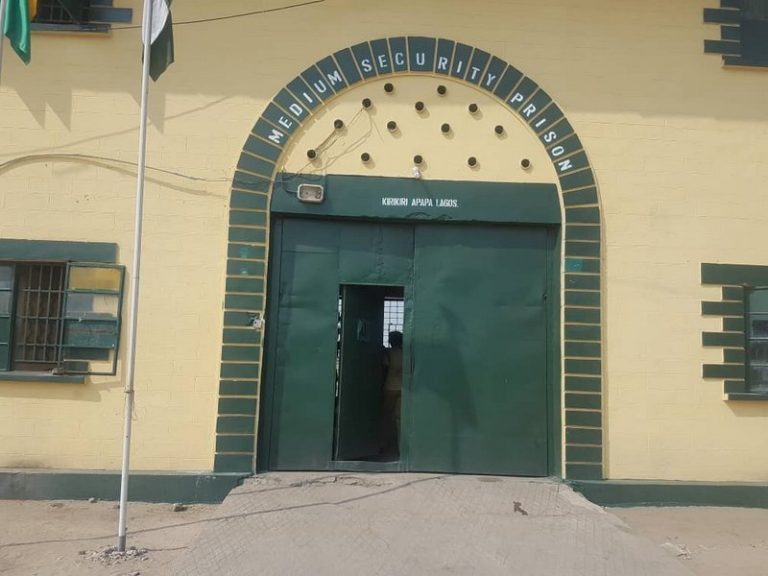
WEEKS after the Federal Government said it would decongest the country’s overpopulated prisons, a total of 681 prison inmates in prisons across the country have gained freedom.

A prison stat by the Correctional Services at September 26, revealed 681 inmates have been released since the President changed its name from what it was formerly known for.

President Muhammadu Buhari had on August 14 approved the bill seeking to change the name of Nigerian Prison Services to Nigerian Correctional Service.

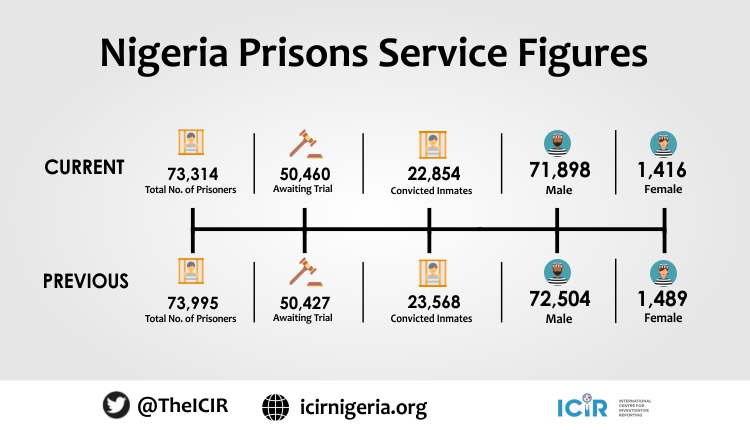
There were 73, 995 inmates in Nigerian prisons as at the time the new name of the service took effect. However, as of September 26, there has been a reduction in the total number of inmates to 73,314.

According to the report, the number of male inmates reduced from 72,504 to 71, 898 while there was an also decline in the number of female inmates from 1,489 in July to 1,416 in September.

Also, the total number of convicted inmates decreased from 23, 568 as of July 22 to 22, 854 as of September 26.

However, the number of inmates awaiting trial increased from 50,426 to 50, 460 inmates.

Meanwhile, the Comptroller of Correctional Service, Francis Enobore in a phone conversation with The ICIR highlighted reasons for the reduction of inmates within the period of time.

According to him, the reduction in the number of inmates in the various prison could result from a state-to-state review of inmates’ case file, by the Presidential Committee on Prison Decongestion and Reformation.

He noted that such review is aimed at ascertaining how grievous the offences of inmates are, stating that once an inmate has no absolute reason being behind bars, such an inmate is released immediately.

Enobore said sometimes judges of state, equally visit custodian centre, to carry out  ‘J-Delivery’ (A chief judge of a state, visiting a particular custodian centre, with other magistrates under his jurisdiction).

“They will go to a particular detention centre, which is a custodian centre and then they review the cases of all the persons that are there,” he explained.

He noted that the visit of the chief judge is an opportunity to carry out an “undistorted review of the work the magistrates under him were doing”.

The comptroller said such frequent visit could also amount to drop in population of the inmates in a particular state or custodian centre.

Other reason could be, that some inmates had completed their jail term; had exhibited good behaviours overtime; had become very productive in their vocational acquisition and certified valuable to his/herself and the society, then such could be released─ Humph Chuks, the Federal Capital Territory (FCT) Correctional Service spokesperson told THE ICIR.

“If there is a decrease in the number of inmates, I think it is a plus to the Service and the society,” Chuks said.

Revolutions that “fired” young Leftists

0

By Edwin Madunagu

I FEEL the need to begin with some clarifications on the title that has been constructed for this piece: “Revolutions that ‘fired’ young Leftists.” This need will be more than adequately met if a specific meaning can be attached to the word, “revolution”, as used in the article, and if the period under reference can be indicated—at least broadly. There is also the need to indicate the immediate inspiration for the discussion.

Assuming that it is now understood that the word “revolution” generally means a process of radical and fundamental transformation of a social order, its special meaning in this piece appears as the point in that process, the point known as “insurrection”, where the old regime collapses (or is overthrown) and a new one emerges (or is installed).  Historically, this “point” has been a couple of hours, a single day or, at most, a couple of days. Beyond this, the situation may require a new characterization: perhaps a “civil-war-in-revolution” or a “revolution-in-revolution.” (The latter is owed to Regis Debray). The history of revolutions illustrates this situation abundantly. The new regime may be a single power, a dual power or a multiple power. Of course, none of these possibilities can be “stable”.

In the Russian Revolution the “point” defined in the preceding paragraph was November 7, 1917 (October 25 in the Old Calendar); in the Chinese Revolution it was October 1, 1949; in the Cuban Revolution it was January 1, 1959; and in the Iranian Revolution—the one that became known as Islamic Revolution—it was February 11, 1979. Although we were greatly influenced by the history of modern revolutions in general and socialist revolutions in particular, the four revolutions listed above had the greatest impact on the consciousness of young Nigerian Leftists between the mid-1970s and the mid-1980s.

It was not just what happened at those revolutionary points that “fired” our consciousness. We were also “fired”, in particular, by how it happened, at what moments it happened, and the roles played by particular groups and individuals in what happened. Indeed, in some cases, and for many young Nigerian Leftists, the roles of particular individuals (and their latter fates) became the most critical factors in the overall assessment of a particular revolution! Although in real life it is difficult to separate the political biographies of great personalities from the political histories of the nations they led at their founding, we now know that for revolutionaries and students of revolutions efforts must be made at some separation.

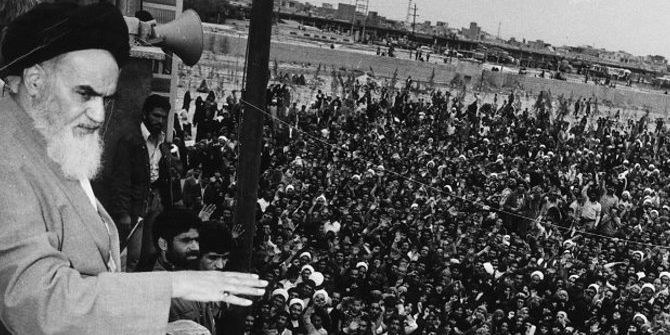
In the Russian Revolution the “great personalities” were Vladimir Lenin and Leon Trotsky; in the Chinese Revolution it was Mao Tse-Tung (now written Mao Zedung); and in the Cuban Revolution the personages were Fidel Castro and Che Guevara. In the Iranian Revolution the iconic personality was Ayatollah Ruhollah Khomeini. Whereas Lenin, Trotsky, Mao, Castro and Guevara were secular revolutionaries, Khomeini was a frontline religious leader. The point here is that they were all “worshipped” by young Nigerian Leftists—including those that professed atheism—during certain phases of the Leftists’ development.

We now come to what inspired this piece. A couple of weeks ago, the Nigerian state was reported to have accused a detained leader of a religious sect in Nigeria of planning to stage an Iranian-type Islamic Revolution in Nigeria. According to this report, the government made the allegation via a court affidavit. About the same time, in a different context, the government was also reported to have accused a Nigerian Leftist detainee of not just planning a revolution but also planning to link his revolution with the Islamic Revolution mentioned earlier. These, for me, are laughable cases. However, since they have now gone beyond mere rumours, the nation eagerly awaits the proofs of three charges: two individual “criminal” charges and one charge of “criminal collusion”!

The public responses these allegations evoked showed that many in the current generation of young Leftists may not be aware of the roles of secular Leftists in the making of what ended as an Islamic Revolution and the part played by that revolution in the further radicalization of the Nigerian Left in that period. It struck me that students of Marxist dialectics and theory of history have, in that story, a rich, modern and accessible material for case studies. This reflection was the origin of the present article. And it is to it we now return.

Older Nigerian Leftists may recall, and those not so old may have learnt that in September 1978, Nigeria’s military regime under General Olusegun Obasanjo carried out a fascist-like purge of Nigeria’s university system. This was done through arrests, rustications and dismissals of several Leftist students, lecturers and administrators over the “Ali Must Go” students’ protests of the previous April. The state had violently suppressed the protests. The national students’ body, the National Union of Nigerian Students (NUNS), which had been formed in 1956, before the country’s independence, was also proscribed. (NUNS was, before long, replaced by the current students’ movement, the National Association of Nigerian Students, NANS).

By February 1979, the Nigerian Left in general and the Leftist movement in Calabar, in particular, had largely recovered from the shock administered by the Nigerian state. The Calabar Group of Socialists (CGS) and the University of Calabar-based Movement for Progressive Nigeria (MPN), formed in the University in August 1977 and named after a similar but older formation at Ahmadu Bello University (ABU), Zaria, had resumed their revolutionary struggle. It was at this point, February 1979, that the Iranian Revolution exploded.

Every young Nigerian Leftist in the period under consideration (mid-1970s to mid-1980s) was compelled to study the history of revolutions, among other subjects. It was in the course of this study that aspects of the Russian, Chinese and Cuban revolutions “fired” our consciousness. This result was expected and almost “natural”. But what of the Iranian Revolution of 1979? For most of us who came into revolutionary socialist and Marxist consciousness at home in Nigeria, and who did not study history and political science as formal subjects in the university, the Iranian revolution of 1979 came upon us with the suddenness of an earthquake. The impact of two aspects of this particular revolution on our consciousness helped our final recovery from the shock brought by the fascist blow we suffered in 1978. These aspects were the tenacity and audacity of Ayatollah Khomeini and the heroism of the masses—especially students, rebel soldiers and youths—in one of the most dramatic of modern history’s “revolutions from below.” That revolution remains a classic.

Most of us were not, at first, bothered about the specific roles of the Iranian Left in that revolution. Even when we later learnt of these roles, our focus was still on Ayatollah Khomeini, students, workers, women and rank-and-file soldiers as if these segments of the population were mere autonomous agents of history. It was when we learnt, first, that the Left was under attack and, then, that Iranians had voted massively for the establishment of an Islamic Republic, that some of the older Leftists succeeded in forcing a serious internal debate on the Iranian Revolution in the Calabar Movement.

Even then: the apprehension generated at this point was mitigated or deflected later in the year when the Iranian students who invaded the American Embassy in Tehran on November 4, 1979 started sending us, directly and through third parties, volumes and volumes of previously classified information they captured.

This information included names and deployments of CIA agents in Nigeria in general and in Calabar in particular! The rest is history, they say. A point that remains indelible, however, is that the Iranian Revolution is a study in dialectics of history—like all great revolutions, some would say.

Madunagu, mathematician and journalist, writes from Calabar, Cross River State, Nigeria.

2019 FOI ranking: NERC, Federal Fire Service emerge winners

0

NIGERIA Electricity Regulation Commission has emerged as the winner of the 2019 National Freedom of Information(FOI) Compliance Ranking in an event held at the CBN International Training Institute, Abuja on Thursday 26, September.

Infrastructure Concession Regulatory Commission (ICRC), Nigeria Investment Promotion Commission came second and third respectively.

Federal Inland Revenue Service (FIRS), came fifty-seven while Independent National Electoral Commission (INEC) came one hundred and sixty according to the ranking.

In the Security Sector, Federal Fire Service came first, and 2018 winner Nigeria Security and Civil Defense Corps (NSCDC) came second while the Police Service Commission (PSC) came third.

Meanwhile, staff members of Independent National Electoral Commission, National Orientation Agency, (NOA), National Information Technology Development Agency (NITDA)  have opposed the ranking, claiming that their agencies deserve to have ranked better than they were rated.

Nkem Ilo, who gave an overview of the FOIA ranking,  said the parameters for the ranking were proactive disclosure, responsiveness in the request for information, level of disclosure, FOI training, and timeliness. Other parameters used include the establishment of  FOI desk Office in MDAs, publication, and submission of annual FOIA compliance report to the office of the Attorney General of the federation.

She noted that the process is focused on promoting accountability and transparency by encouraging timely access to information.

National Co-ordinator of Right to Know, Ene Nkwankpa in her opening remarks, said the 2019 ranking was co-organised by six Civil Society Organizations,   the Public & Private Development Centre (PPDC), BugdIT, Connected Development (CODE), Right to Know (R2K), Basic Right Watch (BRW) and  Media Rights Agenda (MRA) so as to give room for a robust evaluation across agencies.

She reminded the audience that the success of  FOIA is a collective responsibility, “because at the end of the day it is for the benefit of us all because we are all Nigerians and we cannot run away to Canada, and as we have noticed nations are driving us away”.

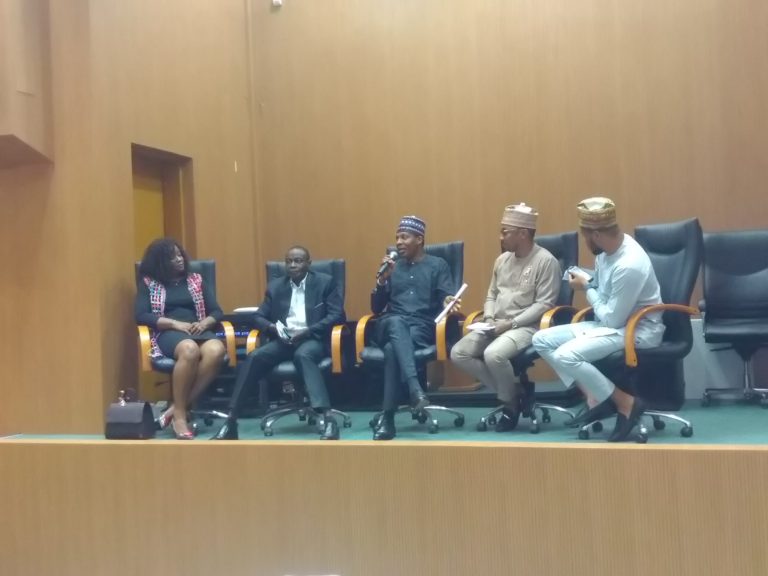
During a panel discussion moderated by Stanley Achonu of Open Government Partnership Nigeria Secretariat – Federal Ministry of Justice, panelists examined the prospects and challenges of FOIA in Nigeria under the topic: Data, Institution and Good Governance.

Chioma Agwuegbo, Founder of TechHer, attributed poor FOIA compliance of MDAs to staff deficiency in the use of technology. Most government bureaucrats, according to her, lack knowledge of technology, and could not develop long-term policy and identifiable goal that could help in keeping the public record.

She also blamed the Ministry of Justice, the agency responsible for enforcing compliance with FOIA of high handedness, particularly in the transparency case involving Cable Newspaper Journalism Foundation.

The Nigeria Investment Promotion Commission representative and panelist, Sabo Isiaku said public Institutions because of the nature of their work may not be able to meet up with the seven days requirements of the FOI Act and should endeavour to publish information on their website before they are asked for.

“Some ministries comply well with FOI act, some don’t  but with gatherings like this, I believe we’ll get to our desired destination.”

Edwin Daniel from OneCampaign also said one of the reasons government policies are failing is due to lack of information, noting that Data is at the heart of challenging poverty.

“How do you make policies for people that you don’t know their population? when was the last population census conducted?” he asked.

When asked why media organisations fail to invoke FOIA more frequently, editor of The ICIR, Ajibola Amzat, one of the panelists highlighted the challenges faced by newsrooms requesting public information using FOIA. The ICIR, he said, has submitted more than 70 FOI requests in the last one year to various public institutions, and more than 60 percent were turned down.

He said The ICIR experience is similar to other newsrooms. “As at yesterday, The Cable was in court with the Ministry of Justice about the information on Abacha’s loot. Sometimes ago, Premium Times also had to initiate a court process because of denial of access to information.”

One of the attendees, Chibuzor asked about the position of the civil service rule as against the full implementation of the FOI act, Isiaku said, the public/civil service rule is not a law, the FOIA is a law and thus it overrides the civil service rule.

‘​All you profess are lies and deceit’… ASUU replies FUOYE VC, alleges multiple misconducts

0

THE ACADEMIC Staff Union of Universities (ASUU), Akure Zone, has accused Kayode Soremekun, Vice-Chancellor of the Federal University of Oye-Ekiti (FUOYE), of deceit, cover-up of academic fraud, gross violation of university laws, among other wrongdoings.

It said this in a statement written in response to remarks made by Soremekun during an interview with The Guardian Newspaper published on Sunday.

“In the ’80s and ’90s when the compensation system was very poor, ASUU was very compelling and very necessary… But at the moment, there are some form of perennial faceoff between the unions on one hand and the management on the other hand and this is not good for the system,” the Vice-Chancellor had said.

“Moreover, some ASUU members think that they can just get away with anything in the name of ASUU activism. Whereas, the original members of the ASUU that we know stood for a fearless and honest interrogation of reality, but that is no longer the case.”


READ ALSO:

He also accused prominent members of ASUU of embarking on “short-run personal reliefs” and “hustling” for contracts from his school’s head of procurement.

Reacting, the staff union accused Soremekun of gross ineptitude and administrative impunity, adding that the “interview was carefully tailored with lies to mislead the general public”.

Its statement, obtained by The ICIR, was signed by Olu Olufayo, zonal coordinator of ASUU, Akure Zone; Adeola Egbedokun, chairperson of ASUU, OAU; Yinka Awopetu, chairperson of ASUU, FUTA; Kayode Arogundade, chairperson of ASUU, EKSU; and Akinyemi Omonijo, chairperson of ASUU at FUOYE.

The union said the university management has done nothing significant to address issues it has always brought to its attention.

The management, it said, looks on as members are victimised, frauds are covered up, the university’s rules are violated, and illegal recruitment, promotions and passages are done. It also said FUOYE has inadequate facilities and the Vice-Chancellor has “illegally” retained the Acting Bursar in violation of the institution’s norms.

“The interview granted by the Vice-Chancellor was very shallow and evasive. It could best be described as disconnected ramblings of a confused personality managing the affairs of conscious individuals,” ASUU said.

ASUU, in August, had urged President Muhammadu Buhari to set up a visitation panel to investigate the crisis at the university and “correct all ills and anomalies and transform the university that both staff and students can be proud of.”

The full press release:

The leadership of the Academic Staff Union of Universities (ASUU), Akure Zone read with abject consternation, the press interview granted by Prof. Kayode Soremekun, Vice-Chancellor, Federal University, Oye-Ekiti (FUOYE) in “The Guardian Newspaper” of Sunday, 22nd September, 2019 and resolved to rouse him from somnolence to face the reality of the matters that the union has been interrogating and his gross ineptitude as a University Administrator. The said interview was carefully tailored with lies to mislead the general public as has been the trademark of the errant Vice-Chancellor. 

Casting aspersion on the members of our union is a very cheap blow below the belt. We have observed that rather than engage on the issues raised by the Zone, his interview was laden with excuses – flimsy, uncoordinated, sloppy, un-academic and unintelligent. Comparing FUOYE with other public Universities is a misnomer in this case and we would like for the umpteenth time to set the records straight. The administrative impunity of the Vice-Chancellor has been catalogued in our earlier press interactions and till now, nothing significant has happened in addressing the issues.

Such impunities include victimization of our members, academic patronage and sycophancy, illegal recruitment, promotions and passages. Others include inadequate facilities; cover-up of academic fraud, licentiousness, vandalization, gross violation of University statutes and illegal retention of the Acting Bursar against University norms. Till date, the failure of the University Administration to investigate allegation of salary fraud by the Deputy Vice-Chancellor, Prof. Abayomi Sunday Fasina is still lingering. 

The interview granted by the Vice-Chancellor was very shallow and evasive. It could best be described as disconnected ramblings of a confused personality managing the affairs of conscious individuals. How and why the government up till now has not sent in a visitation panel to the university is still a wonder (or is he a sacred bull?). None of the issues raised was addressed; rather he tried unintelligently to paint some of our members in bad light while saluting a few national leaders in patronage? Let Prof. Soremekun be told that he does not have the moral right nor the impetus to mention their names let alone claim to be their associates. The likes of Comrades Olorode, Fashina and Jega are far too cerebral, principled and focused to be cajoled by your frivolity. Please ply your trade elsewhere!

Our Union remains steadfast and the membership ever conscious to resist agents of the denigration like you who are power-drunk and lack any constructive focus for our ivory towers. Though a professor, it is shameful that all you profess are lies and deceit. At this juncture, we would like to ask Prof. Kayode Soremekun, to tell the general public the circumstances that surrounded his hasty retirement from the Obafemi Awolowo University (OAU), Ile-Ife and the reason behind his unceremonious exit from the University of Lagos (UNILAG). His response to the above will determine whether he deserves to occupy the position of the Vice-Chancellor. 

Irrespective of the docility of the Federal Government, we shall continue to cry out to the public and remain ever vigilant as Vanguards of our ivory towers across the country. We shall continue to resist the vituperative remarks of Kayode Soremekun and his cohorts, while we continue to champion the course of a non-chaotic administrative system in FUOYE.

Finally, we want to advise that the Federal Government should take into cognisance the mental health of individuals before assigning them to positions of responsibility, especially at the ivory towers. Similarly, dubious characters should not be appointed into offices that require integrity, transparency and accountability. 

Thank you.

#RevolutionNow: Court threatens to arrest DSS boss if Sowore is not released from jail

0

THE Federal High Court, Abuja, on Thursday has threatened to jail the Yusuf Bichi, Director-General of the Department of State Services, over his refusal to release Omoyele Sowore, the organiSer of #RevolutionNow campaign.

The Federal High Court had ordered the immediate release of Sowore from prison on Tuesday after ruling that there was no longer a valid reason to detain him any further.

But he is still kept in detention more than 24 hours after meeting his bail condition as set by the Abuja court on Tuesday.

“Take notice that unless you obey the order of the Federal High Court, Abuja Division delivered on September 24 which ordered you to release the applicant, you will be guilty of contempt of court and will be liable to be committed to prison,” the document read.

Sowore was arrested in Lagos on August 3, for planning to organise a protest- #RevolutionNow- but was charged with a seven-count charge bordering on treasonable felony, money-laundering and insulting President Muhammadu Buhari.


Nigeria to pay UK court $200 million to hear appeal in $9.6 billion P & ID lawsuit

0

ON Thursday, a United Kingdom Court permitted Nigeria to appeal the enforcement of the Commercial Court judgement in London granting Process & Industrial Developments, P&ID authority to seize assets worth $9 billion from the Nigerian government.

The Nigerian government had requested that the court issue a stay of execution of the arbitral award and also an appeal against the enforcement of the judgement.

However, the judge granted Nigeria’s request for a stay on any asset seizures while its legal challenge is been awaited, but ordered it to pay $200 million to the court within 60 days to ensure the stay.

The legal battle between the Nigerian government and P&ID over the failed 2010 gas supply deal to develop a gas-processing plant is coming to a hilt. Currently, Nigeria alleges the contract was enmeshed in corruption and the project was never meant to succeed but P&ID denies any wrongdoing.

On Tuesday, President Muhammadu Buhari in an address to the UN General Assembly in New York had described the P & ID contract as a scam to defraud the country.

“We are giving notice to international criminal groups by the vigorous prosecution of the P&ID scandal attempting to cheat Nigeria of billions of dollars,” he said.


READ ALSO:

Nigeria’s attorney general Abubakar Malami in the interview had stated that he was considering using the fraud allegations in court as part of its defence

A federal high court in Abuja had convicted representatives of the company of economic sabotage and ordered the forfeiture of assets linked to the firm.

The judgement of the high court formed part of the grounds of the country’s lawsuit.

Grace Taiga had been accused of facilitating the controversial contract and securing gratification to the tune of over $20, 000 while she served at the ministry in 2010.

Nigerian prosecutors said they had evidence of two bank transfers totalling $20,000 made by Dublin-based Industrial Consultants (International) Ltd – part of the P&ID group of companies. The payments, in 2017 and 2018, were made from an Industrial Consultants account at AIB and were purportedly for “medical costs”.

She is yet to be released on bail after failing to meet the bail conditions which involved paying a bail bond of N10 million and providing sureties resident in Abuja who are public servants not below directorate cadre.