THE President of Christian Association of Nigeria (CAN), Samson Ayokunle has appealed to the leadership of both Jukum and Tiv in Taraba and Benue states to sheathe their swords and embrace peace as no society can develop without peace, tolerance and harmony.
Ayokunle made the appeal on Thursday in a statement issued by his Media Assistant, Adebayo Oladeji.
He noted that hostilities between the two tribes have led to the death of hundreds of people, expressing concerns that the two warring parties were still agitated and reluctant to give peace a chance.
The CAN president further urged the leaders of Tiv and Jukum to, as a matter of urgency, convene peace meetings among all relevant stakeholders with a view to finding lasting solution to the feud.
“From the information available to us, majority of Tiv and Jukum are Christians and ordinarily, one would have expected them to come together in unison and resolve their differences, no matter how bitter they are, as commanded us by Jesus Christ who is the Prince of Peace.
“Apart from this, we are aware that the two tribes are inter-twined because they exist side by side and have for long time inter-married,”he said.
According to him, such mutual hostility between the two ethnic groups led to the gruesome murder of a Catholic Priest, Rev Fr David Tanko, recently while making a reconciliation effort.
He said, “This evil wind has, sadly, claimed several innocent lives”.
Ayokunle lamented, traveling on Wukari and Katsina-Ala highways has become dangerous and suicidal as travelers who belong to either of the tribes are arrested, killed or set ablaze, just exactly the way the Catholic priest was killed.
The Christian body, he disclosed, has been making efforts behind the scene with both the Federal Government and the two-state governments on how to reconcile the two factions at a peace meeting to be hosted as soon as practicable.
The clergyman appealed to the two tiers of government to accelerate the process of an enduring peace process in which CAN is ready to be involved.
“We need to remember that violence and bloodletting will not benefit any of the warring parties; rather, it is the people, states, entire country and humanity that are at loss.
“May peace reign not only between the Tivs and Jukuns but in our nation Nigeria in the name of Jesus Christ our Lord and Saviour,” Ayokunle said.
Recall that President Muhammadu Buhari on Wednesday promisedto end the communal conflict between the Tiv and the Jukum people of Benue and Taraba states.
Represented by the Secretary to the Government of the Federation, Boss Mustapha in a stakeholder’s meeting with the governors of both states on Wednesday, Buhari assured, that peace would be facilitated among the warring parties.
“We will ensure we facilitate peace. We will not trivialize issues that have to do with emotion because we can’t allow this conflict to continue.”
Buhari urged leaders to promote peace in their actions and utterances, saying the Federal Government would not fold its hands and allow miscreants to take over the country.
At the event, both governors of Taraba State, Darius Ishaku and Benue State, Samuel Ortom disagreed over the causes of communal clashes.
Ortom said the crisis was strictly between the Tiv and Jukum people in Taraba, stating that the traditional institutions in Wukari – a city in Taraba and predominantly Jukun – had failed to protect the interest of the Tiv, who are settlers from Benue State.
“The history or tradition cannot supersede the constitution; we are all Nigerians. People have come from different places to settle in Nigeria.
“The constitution remains sacrosanct and we must obey it. The issue of describing some people as settlers is where we get it wrong,” he said.
Ortom called on the Federal Government to set up a commission of inquiry on the lingering crisis since it was a matter between two states.
However, Ishaku said there was a plot of silence among the Tiv, spreading lies against his government, even after gaining immensely from his government.
Ishaku, said the people could not sacrifice their history for a constitution copied from a foreign country without regards to the ethnic composition and peculiar nature of the country.
He said, “I can’t disregard history because of the constitution. I’m a Jukun and my wife is a Tiv. You said I should drop my history because of constitution? No! No! No!
“I employed 3000 teachers and over 400 were Tivs. Do you want me to carry the whole state and give it to one tribe?” he said.
The Tiv and Jukum have a long history of a communal clash, alleged to have resulted from the fear of domination; land resources and ownership; unequal representation in political positions.
COMING after attacks were recorded on businesses believed to be owned by South Africans in Nigeria, the country has announced a temporary closure of its embassy in Abuja and Lagos.
Naledi Pandor, the South African Foreign Affairs Minister, said the decision to shut the mission was based on concerns for the safety of the staff following received threats.
Speaking to Reuters on the sidelines of the ongoing World Economic Forum (WEF), the minister acknowledged the existence of “Afrophobia”, which she described as a complex phenomenon.
“There is Afrophobia we are sensing that exists, there is resentment and we need to address that,” she said.
“There is a targeting of Africans from other parts of Africa, we can’t deny that. But, there is also criminality … because a lot of this is accompanied by theft.”
Lunga Ngqengelele, South African Foreign Ministry Spokesperson, confirmed that the closure of the diplomatic missions took effect on Wednesday, and said they will be re-opened when “necessary”.
“After receiving reports and threats from some of the Nigerians, we decided to temporarily close while we are assessing the situation,” Ngqengelele said.
“A group of people… came and tried to force themselves in” at the consulate in Lagos, he explained. “It was on those basis that we felt we need to protect the employees and shut it down”.
Oby Ezekwesili, Nigeria’s former education minister, who is attending the World Economic Forum, described the wave of xenophobic attacks in South Africa as “sordid”.
“I think there has to be a very distinct session for us to discuss the issues of our collaboration as Africans,” she said during a panel discussion on Wednesday.
“This is the issue. We cannot have Africa Continental Free Trade Agreement and, yet, we have a situation where there is black-on-black violence in this country. So, I do hope that we are going to go beyond the marginal conversations of it and get to the heart of the matter of what kind of integrated Africa we want to drive forward.”
Vice President Yemi Osinbajo who was scheduled to address a Thursday panel at the forum was withdrawn, in protest, by the Nigerian government from participating.
Zenith Bank Chairman Jim Ovia who was at the forum on Wednesday has also announced his withdrawal from further activities “following the hypersensitivity of the issues surrounding the lives and well-being of Nigerian citizens living in South Africa”.
The Chairman of Zenith Bank Plc, Jim Ovia,on Thursday, pulled out of the World Economic Forum (WEF) holding in South Africa as part of protest against xenophobic attacks on Nigerians and other foreign nationals in the country.
Both Ovia and Oby Ezekwezili, former Minister of Education and a presidential candidate in the last general elections were attending the Forum which the Nigerian government pulled out of on Wednesday to register its protest in solidarity against xenophobic attacks on its citizens in South Africa.
Their continued participation at the Forum as panelists came under criticisms from Nigerians on social media on Wednesday.
President Muhammadu Buhari’s Personal Assistant on New Media, Bashir Ahmad, had tweeted that Vice-President Yemi Osinbajo was to represent Nigeria at the WEF, but “he had called it off in reaction to these gruesome attacks on Nigerians.
However, the Cable reported that the Zenith Bank Chairman said he was withdrawing from the summit to lend voice to calls for the safeguard of foreigners in South Africa in a statement issued on Thursday.
‘’Following the hypersensitivity of the issues surrounding the lives and well-being of Nigerian citizens living in South Africa and to contribute his voice against the poor state of security regarding foreign nationals living in Africa, the Founder/Chairman of Zenith Bank Plc, Mr. Jim Ovia has withdrawn from further activities at the World Economic Forum Africa 2019, taking place in Cape Town, South Africa,’’ the statement read.
Before his exit from the Forum, Ovia also made a case for youth empowerment and better government policies as a strategy to curb incessant attacks on persons living within and outside Africa, to foster positive change in the continent.
In the growing list of persons that have exited from the summit is Felix Tshisekedi, President of the Democratic Republic of Congo, Paul Kagame, President of Rwanda and their Malawian counterpart, Peter Mutharika, had also pulled out of the event arising from the acts of violence against foreigners in South Africa.
Though, the World Economic Forum (WEF) Africa said it did not know why Rwandan President Paul Kagame and his Malawian counterpart Peter Mutharika were attending the conference.
Reports said the leaders, including Democratic Republic of Congo President Félix Tshisekedi, have snubbed the conference because of the ongoing xenophobic attacks.
WEF head of communications Oliver Cann was quoted as saying the presidents’ schedules change all the time.
“We were made aware on Saturday that President Kagame wasn’t going to join us and the president of Malawi notified us the previous week,” Cann said.
“If you have noticed we were not promoting their names or mentioning them in our press release from Monday.”
The Nigerian government on Wednesday says Air Peace, a local airline has offered to evacuate its citizens from South Africa following continued xenophobic attacks on Nigerians and other Africans.
This is coming shortly after Landwey Investment, a local real estate company, made a similar announcement.
Federal Ministry of Foreign Affairs in a press statement issued by Ferdinand Nwonye, its Spokesperson, disclosed that the evacuation would commence of Friday September 6, while the ministry urged Nigerians who wish to return to the country to take advantage of the opportunity.
According to Nwonye, in the statement with reference number No: MFA/PR/2019/42, relatives to Nigerians in South Africa are advised to inform their families ahead of time.
Describing the gesture of Allen Onyema, Proprietor of Air Peace, as laudable, he said interested Nigerians should meet with the Nigerian Embassy in Pretoria.
“The Ministry of Foreign Affairs wishes to inform the general public that following the recent unfortunate xenophobic attacks on foreign nationals, including Nigerians in South Africa, the Proprietor of Air Peace Airlines Chief Allen Onyema, has volunteered to send an aircraft from Friday 6th September 2019 to evacuate Nigerians who wish to return to Nigeria free of charge.
“The general public is hereby advised to inform their relatives in South Africa to take advantage of this laudable gesture. Interested Nigerians are therefore advised to liaise with the High Commission of Nigeria in Pretoria and the Consulate General of Nigeria in Johannesburg for further necessary arrangement,” it reads.
Also, on Tuesday, Landwey Investment announced that it is offering Nigerians in South Africa a one-way ticket back to the country.
“In our stance against xenophobia, we extend a hand of love to helping Nigerians in South Africa willing to return home on a one-way ticket with our formerly allocated funds for the company vacation in South Africa,” it said on its social media accounts.
All those interested are urged to contact the company using the email address: communications@landweyinvestment.com.
The Nigerian Government following the attack sent a delegate to the South African government. The delegate is expected to arrive today.
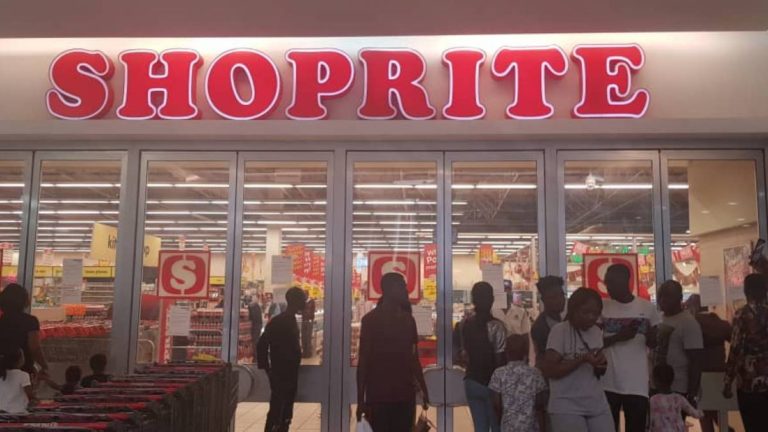
FOLLOWING recent xenophobic attacks and violent reactions in Nigeria that have seen properties of companies believed to be owned by South Africans being damaged in protest, some have claimed that Shoprite, one of the affected companies, is a franchise brand and local stores are owned and managed by Nigerians.
“Shoprite in Nigeria is not owned by a South African,” one Twitter user, @HustlerVibez, with 23,900 followers wrote.
“Nigerians own it!! It’s a fucking franchise. Y’all are hurting your own people. You Nigerians should read more cause some of y’all are just plain stupid.”
The tweet has been liked over 3,600 times and shared by over 2,300 users. Several other users of the social media platform have made similar statements. But checks by The ICIR show that the claim is incorrect.
Our findings
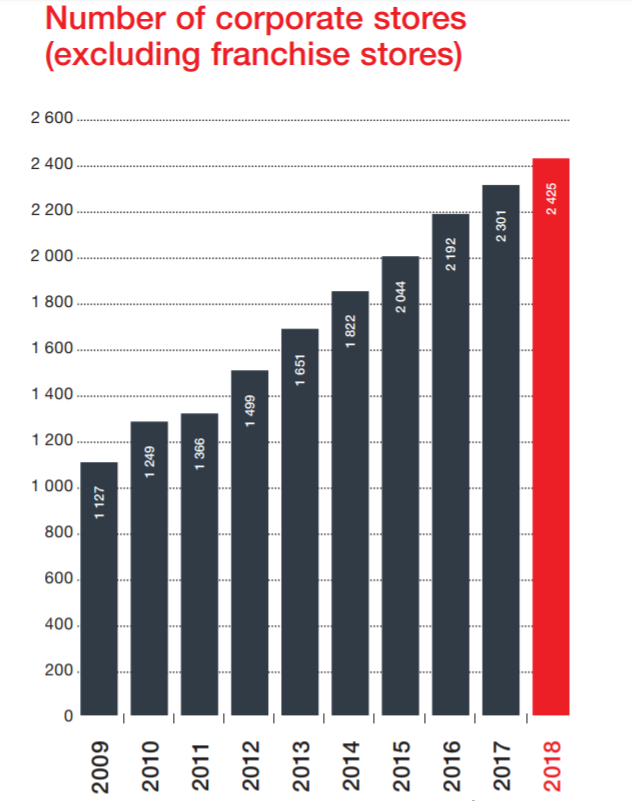
The Shoprite Group has repeatedly referred to its stores in Nigeria and other countries as corporate stores. It did so in its 2017 integrated report, where it stated that it has 2,301 corporate stores across Africa, with 23 of them located in Nigeria. It also did the same thing in its integrated report of 2018 when the number increased to 2,425 across Africa and 24 in Nigeria.
At the end of June 2019, Shoprite operated a total of 2,934 outlets in 15 countries: including 2,319 corporate stores, 25 of which are in Nigeria (24 Shoprite stores and one Usave store).
Source: Shoprite Holdings 2018 Integrated Report, p. 43
Corporate stores are different from franchise stores. According to Stefon Walters, author of Finessin’ Finances, in the case of retail franchising, a company “licenses its intellectual property, business procedures, business model and brand to a franchisee who then owns and operates the store”. He explains that the franchisee pays an upfront cost and then subsequently pays royalty fees to the brand owner. He must also uphold the corporate policies agreed upon.
On the other hand, in the case of corporate stores, “the parent company is solely responsible for all stores’ business-related activities. From picking retail locations to hiring employees to operations to tax planning, they handle it all”. This is also the explanation of Encyclopedia Britannica and US-based franchise consulting firm Accurate Franchising.
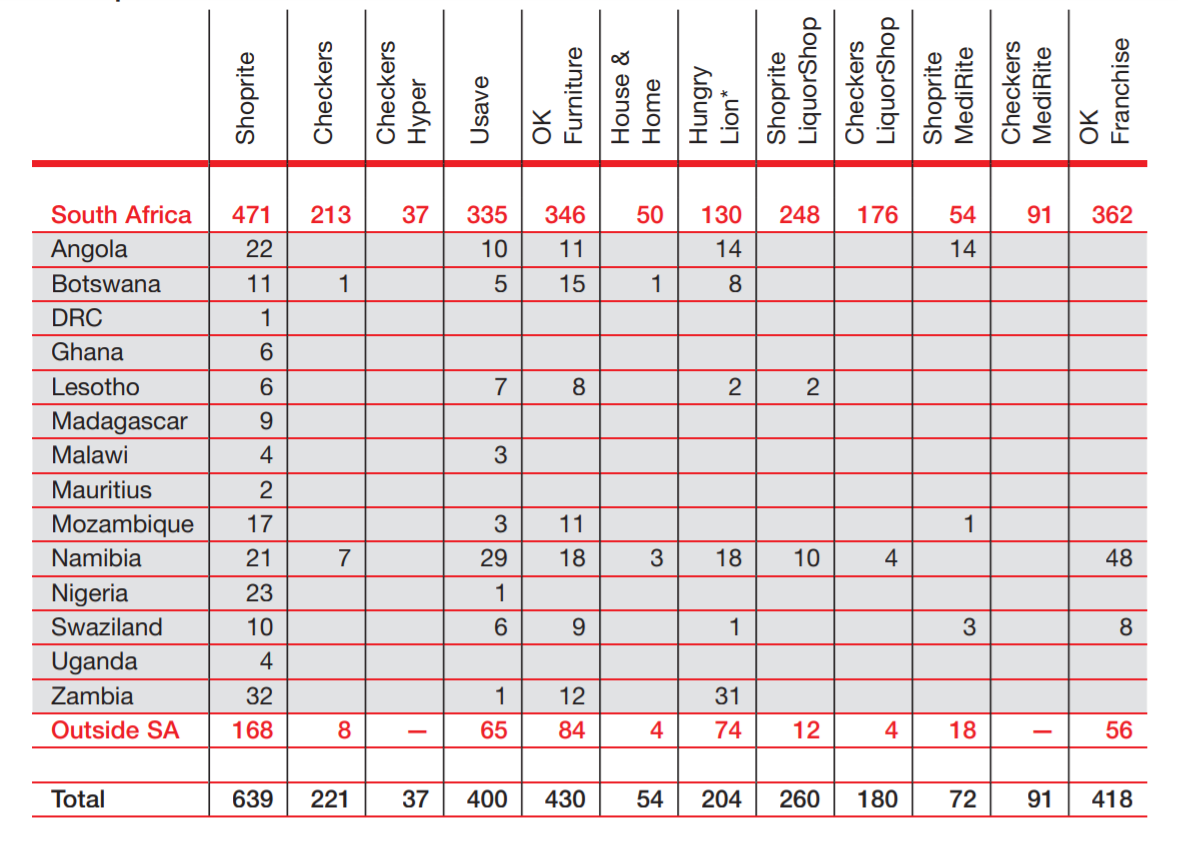
Shoprite, however, also has up to 418 franchise outlets, but these are not in Nigeria. Its OK Franchise Division, existing in South Africa, Namibia and Swaziland, franchises “five different types of retail formats (OK Foods, OK Grocer, OK MiniMark, OK Express & Sentra), a liquor outlet (OK Liquor) and a wholesale outlet (Megasave)”.
Source: Shoprite Holdings 2018 Integrated Report, p. 43
1.5 per cent of Shoprite staff in Nigeria
While Shoprite generally employs 147,478, over 2,000 of these are staff in Nigeria. The local subsidiary states that 99 per cent of its workers are Nigerian citizens and it has built a relationship with “over 300 leading Nigerian suppliers, small businesses, and farmers”.
Indirect subsidiary
Retail Supermarkets Nigeria Ltd is listed as an indirect subsidiary of Shoprite Holdings Limited in its financial statements of 2018, unlike some of its companies in South Africa and Mauritius. This was registered in Nigeria, according to the Corporate Affairs Commission, in 2004, and is based in Victoria Island, Lagos.
Parent companies do not have complete control over indirect subsidiaries and do not have enough interests to entirely affect their operations. An instance of this is a joint venture where one of the founding companies has more than 50 per cent interest. Indirect subsidiaries may be formed in order to raise capital or attract skilled partners.
Verdict
While it is incorrect to say Shoprite stores in Nigeria are owned and run by Nigerians, they are managed by an indirect subsidiary of the parent company. This means other individuals or corporate bodies have financial stakes in the venture.
It is also the case that Shoprite employs over 2000 people in the country, mostly Nigerians, and sells products from Nigerian farmers and local businesses.
ON September 2, Signal, an online newspaper designed to produce exclusive reports on politics, policy, governance among others posted a claim that projected Bongani Mkongi, former South African Deputy Minister of Police, as a current cabinet member of Cyril Ramaphosa, President of the former apartheid country.
The claim which came with a two-minute-and-a-half-long video showed Mkongi condemning the influx of foreigners into South Africa.
In the video, Mkongi also expressed his worries about the influx, warning that in a matter of years foreigners might eventually emerge as South African President.
The footage came up on social media following the xenophobic incidents against Nigerians and other foreigners in the country.
WATCH | “You won’t find South Africans in other countries dominating a city up to 80%… we cannot surrender South Africa to foreign nationals.” ~ South Africa Deputy Minister of Police Bongani Mkongi #XenophobicAttacks#Xenophobiapic.twitter.com/vSUwzytRv9
“We are surrendering our land and it is not xenophobia. To talk true, we fought for this land from the white minority. We cannot surrender it to foreign nationals. As a matter of principles, we fought for this country, not only for us but for the generations of South Africans,” he stated.
“The arms that are being used here are arms of war, which are not licensed. The high-jacking of buildings here is a sign of taking overpower. The question of dominance of foreign nationals in illegal trading and businesses here in Hillbrow is economic sabotage taking place against our people that ought to be running those businesses…”
Aside from the reportage, the claim also generated a lot of reactions from social media users beyond South Africa and Nigeria.
Moreover, former Aviation Minister, Femi Fani Kayode, also shared the tweet with a link to his personal and verified Facebook Account. He further made comment on the tweet which had also generated 910 Likes and 379 Retweets with comments.
Findings
The ICIR visited the official website of the South African parliament and discovered that the portfolio for the ministry was assigned to Bhekokwakhe Cele as the main Minister and supported by Cassel Charlie Mathale as Deputy Minister.
There are other documents that showed Mkongi is no longer a serving cabinet member.
Verdict
Based on the available evidence, the caption accompanying the video tweeted by the online newspaper is FALSE.
Also, having been put out after the recent attacks, the video was obviously situated in the context of the most recent acts of violence and that is also dubious. It was discovered that the video was filmed on July 14, 2017 as shared by Eye Witness News, a South Africa news organisation.
AMNESTY International says South African government’s years of impunity for xenophobic crimes were the forces driving the latest attacks against foreign nationals and their properties in the country.
The global human rights organisation noted that the ongoing and escalating attacks against refugees, asylum seekers and migrants, and looting of foreign owned shops in South Africa, was a direct consequence of years of impunity and failures in the criminal justice system that have left this vulnerable group exposed and unprotected.
It categorically stated that South African authorities have been fuelling xenophobia in their desperate attempt to win political support.
“South African authorities cannot say that they didn’t see this rampant violence coming. For many years refugees, asylum seekers and migrants have been targeted for who they are and what they look like, Shenilla Mohamed, Executive Director of Amnesty International South Africa said on Wednesday.
They have also served as convenient scapegoats for unscrupulous politicians who have pushed the insidious narrative that foreign nationals have stolen jobs and are to blame for everything that is going wrong in the country,”
Five people have been confirmed dead as violence between locals and foreigners continues to escalate in Johannesburg and other parts of the country.
Mohammed added that “The first major outbreak of xenophobic violence witnessed more than 11 years ago which resulted in the killing of more than 60 people, should have been a wake-up call for the authorities to root out hatred against refugees and migrants and hold those responsible to account.”
“Their lack of action has resulted in the subsequent and recurring attacks we’ve seen.”
South Africa has been experiencing systematic looting and burning of businesses belonging to foreign nationals, largely in Pretoria and Johannesburg, for weeks.
Businesses belonging to Nigerians and other foreign nationals have been targeted in the two cities, with stock and possessions worth millions burnt to ashes.
The violence dramatically escalated last week following confrontations between locals and foreigners, marked by horrific attacks and killings.
Amnesty International emphasised that the government has largely failed to address past xenophobic, violent outbreaks across the country, instead often continuing to scapegoat foreign nationals for high levels of crime, putting a strain on government services and operating illegal businesses.
“South African authorities must stop fueling xenophobia in their desperate attempt to win political support. Rather, they must build a country that is rooted in respect for human rights and the rule of law that protects everyone,” said Mohamed.
“South African authorities must come up with a security plan to ensure the safety of all refugees and migrants and seek to end these attacks once and for all. That begins with holding suspected perpetrators of past xenophobic crimes to account and breaking this cycle of impunity.”
Since 2008 there have been numerous outbreaks of violence against refugees, migrants and asylum seekers in South Africa.
In some cases, xenophobia has been fuelled by the hate-filled rhetoric of authorities and politicians.
For example, in December 2016, the Executive Mayor of City of Johannesburg Herman Mashaba labelled foreign nationals living in Johannesburg “criminals” who had hijacked the city. He blamed them for the high levels of crime in the city.
In November 2018, the then minister of Health, now minister of Home Affairs, Aaron Motsoaledi accused “foreign” nationals of what he called burdening the country’s health system.
Residents of Dada and other communities in Ilorin, Kwara State engage in indiscriminate dumping of refuse and open defecation due to the failure of the state government to provide dumpsters in public places and therefore live in perpetual fear of an epidemic outbreak, Abiodun JAMIU reports.
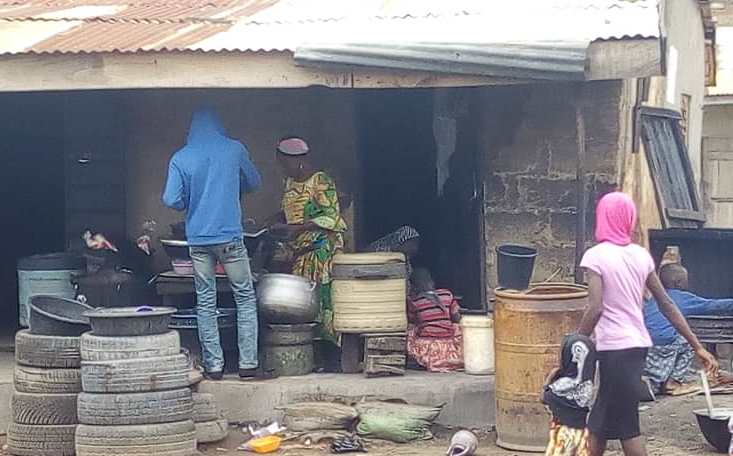
SOFT sunlight illuminates the dark corridor outside Iya Sikiru’s shop. With a plate and spoon in hand, she ladles three spoonfuls of rice into the plate.
Suddenly, she scowls, battling with flies so that they would not to perch on the plate of rice in her hand.Balancing the weather beaten plate on the wooden chair beside her, Iya Sikiru, as she is popularly known by motorists, began to lurch her hands side by side to drive the flies away.
Iya Sikiru’s food canteen: She battles flies everyday due to the nearby refuse dumpsite. Photo Credit: Abiodun JAMIU
“They are irritating (referring to the flies). There is no way you can chase them away,” she soliloquises.
Now facing the direction of this reporter, she adds, “they would still come back. This is what we deal with on a daily basis.”
“If not for God that is looking on us …” she coughed, unable to complete the statement.
Iya Sikiru, a food vendor, recounted the number of years she has spent at the popular Garaji Ondoko, a motor park at Dada Community in Ilorin, Kwara State.
But, aside the flies, she agonises even more about the indiscriminate dumping of refuse by residents of the area but like every other person, she hopes heaps of refuse that dot the community would be cleared soon to avert an impending epidemic.
“Garaji Ondoko is my second home. I have been in this garage for some years, selling ewa (beans). People come from different places to dump their refuses here including faeces,” she bemoans the unhygienic waste disposal habit of people of the community.
Pointing to a nearby soccer field, she said, “If not for the boys that play football there, it would have covered the whole field as well.”
Dada Community in the throes of garbage and filth
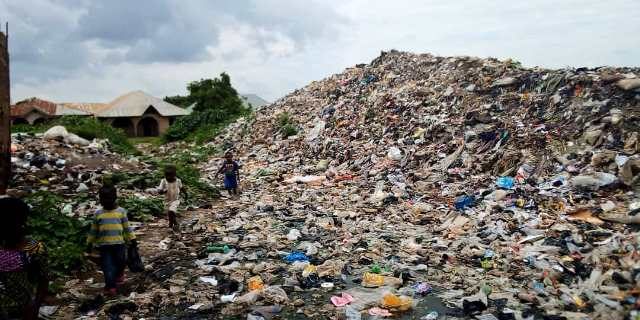
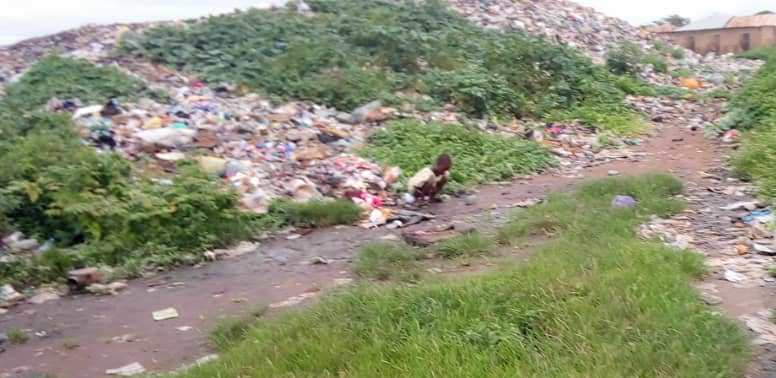
An old woman walks through Dada dumpsite. Photo Credit: Abiodun JAMIU
The ugly story of Dada community’s rise to infamy begins with the common sight of garbage.
Just off the main road that leads to Kwara State Specialist Hospital,the community is left at its own ruins. It is best described as a community synonymous with heaps of refuse dumps.
Known for its rich pottery and artistic exploits, Dada community is fast losing these beauties to heaps of refuse and it has not attracted government attention to evacuate the filth.
Open defecation and poor sewage system remain part of environmental and health concerns in the community.
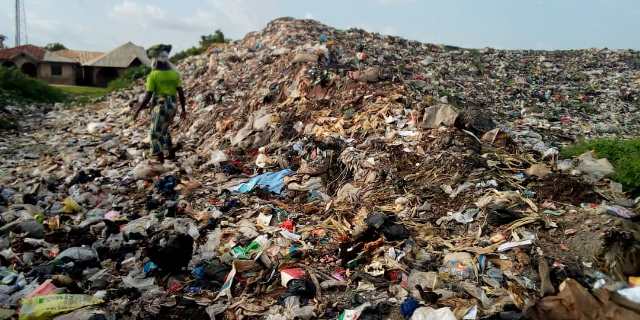
Open defecation is a common sight in Dada community. Photo Credit: Abiodun JAMIU
Sustainable development goal 6 (SDG6) of the United Nations, seeks to ensure “availability and sustainable management of water and sanitation for all” by 2030. The targets – to be achieved by 2030 – include: achieving universal and equitable access to safe and affordable drinking water; access to adequate and equitable sanitation and hygiene for all and end open defecation; improve water quality by reducing pollution, eliminate dumping and minimise the release of hazardous chemical.
There have been several attempts by international organisations to end open defecation – and largely poor sanitation – in Nigeria by 2030 but with little progress so far.
According to WaterAid Nigeria, an international non-governmental organisation focused on water, sanitation and hygiene (WASH), one in every three people, totalling 59 million people, do not have access to clean water while seven in 10 people, a staggering 70 percent, making 123 million people of the world’s population, do not have access to decent toilet. lso, 59,500 children under the age of five die a year due to poor water and sanitation.
Though the Kwara State Environmental Protection Agency (KWEPA) is charged with waste management in the state, the services of the agency had never been extended to the community. This is what emboldens residents to use an open field to dispose of their domestic wastes and also defecate.
“Though people do complain of the vile odour coming from the heap, we have no choice. We hope a day would come that it would be cleared,” says a resident named Ade.
Coming into the community, a visitor struggles with flies taking off from faeces that litter almost everywhere, and smells of rotten food displayed by the roadside.
According to the World Health Organisation (WHO) in 2014, open defecation – and largely poor sanitation – is a leading agent of diarrhoea death.
WHO fact sheet reveals that an average of 2,000 children under the age of five die every day from diarrhoea. The residents of this community remained unruffled as they ignorantly contribute to this figure with their actions.
No alternative to Dada’s magnificent dump site
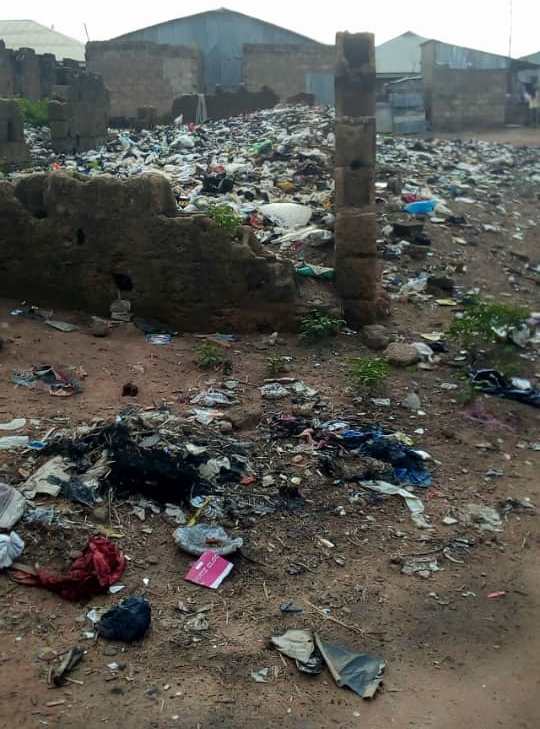
Residents of the Dada community say they are forced to turn their domestic waste to what has now become a mountain of refuse because there is no alternative.
Abandoned uncompleted buildings are not spared by residents. Photo Credit: Abiodun JAMIU
“Often, we throw the waste into gutter when it rains,” says Abdulhakeem Amolegbe, a commercial motorcyclist. “But once there is no rain, all of us take our refuse to the dumpsite near the motor garage.”
Now they bear the consequences of their action, because, as Amolegbe complains, the fresh air in the area is polluted by the presence of the huge refuse dumpsite.
“It is frustrating,” he said, “We dare not come out in the afternoon to receive fresh air, the odour from the heap is usually frustrating.”
Again, there are no public toilets in the community, and this, residents argue contribute to why people resort to open defecation.
Sidikat, a mother of two who lives in a “face-me-I-face-you” apartment near the illegal dump site, does not allow her kids to play outside when the sun goes down owing to the pervasive odour from the heap.
She fears the thick odour is infectious and unsafe for them. According to her, the odour permeates even closed windows.
“If not for the fact that it just rained, you wouldn’t have met us outside” Sidikat told this reporter.
“I don’t allow them (the kids) to play outside during the day. If they don’t go to ‘ile kewu’ (an Islamic school) after returning from school, they would rather stay inside. Who knows? They might go there to play. The odour is just too much for us to bear”
No one controls the indiscriminate dumping of refuse at the dumpsite, Sidikat laments. “No one stops them from dumping there” she gestures towards the heap of refuse fronting her house.
“If we want to, they would say the land belongs to the government. Even people from other communities come with cars to dump their wastes here” She added.
This is fuelled by the claim that there is no other place to dump their waste. “We dump the refuse from my shop here. It is a routine,” says Toheeb Raji (not real name), an apprentice, as he made his way to dump a sack he was holding.
Abdul Wasiu, a resident, recalls that even people come with cars to dump refuse in the area particularly when it is noon. He berated the government for not providing the necessary facilities that would serve the community.
“This heap attracts dumpers from neighbouring communities. In fact, some people come with cars and ‘Okada’ to dump refuse here in the night,” he said.
Government is blamed by the residents for not providing basic infrastructure for waste collection including incinerators.
For ailing Issa Abdulraheem, a resident, the odour from the heap contributed gravely to his illness. Wearing a gloomy face, he unbuttoned his shirt to show a healing wound on his pelvis.
“It is affecting us, wallahi. If I had known where they would help us to clear it, I would have gone there to show them the wounds I’m battling with until it is cleared,” he said.
Isa confirms what Sidikat said about the stench from the refuse dump during the afternoon. “Once it is noon, the odour is usually thick and frustrating; in fact, the odour is the major cause of diseases in this community,” Issa said as he managed to yawn.
Hopeless but not crippled, the least residents of the community could do is to set fire on the refuse dump once the raining season is over.
Mama Onikoko an elderly woman living close to the dumpsite said the heap would be burnt once the raining season ends. Her words: “You can see how I sent the boys away. No one will chase them, and that’s how it expanded.
“But once the rain is over, it would be set it on fire”
Not Dada alone
Checks by this reporter, however, revealed that Dada is not the only community in Ilorin where illegal dumpsites are common sights.
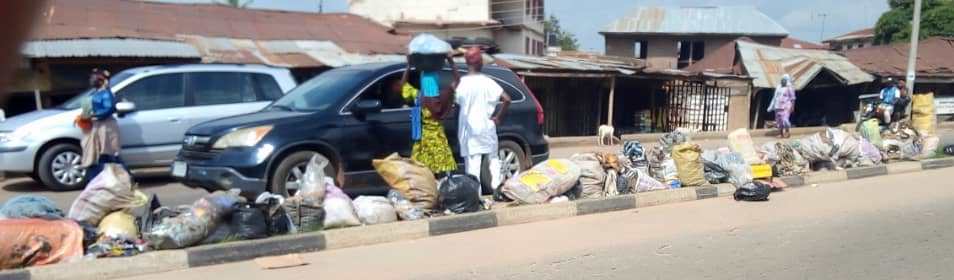
Along Balogun Fulani Road in Ilorin, refuse is laid at interval along the street, while the canal along Challenge Road overflows with dirt and fills the air with an offensive odour. Ipata Market, in front of Balogun Gambari Micro Finance Bank is also littered with refuse dumps.
Balogun Fulani road littered with refuse. Photo Credit: Abiodun JAMIU
Residents revealed there were waste bins stationed at designated areas across the city before. They said the bins were often times filled and spilling over before being evacuated by men of the state environmental protection agency.
But as at the time of filing this report, no wastes bins could be found at designated points across the city anymore.
Another heavy dump site shares a barricade with Bukola Saraki Junior Secondary school, Amule Iya Balogun, Okelele Road, Ilorin East Local Government.
With students vulnerable to diseases such as diarrhoea, intestinal worms’ infection, typhoid, cholera, hepatitis and polio, a canal which runs through Oke Amule to Shamsudeen with its putrid odour is left unpacked, posing threat to the academic community.
Ismail Bukola, a bricklayer and resident of Shamsudeen along Sobi Road, expressed disappointment at the ineptitude of the state waste management agency over the littering garbage in the city. He contends that the unreliability of the sanitation exercise which holds every last Saturdays of the month worsened the situation.
“People engage in indiscriminate dumping because there is no other option. Before, they dumped their refuse in waste bins provided by the state government,” he said.
“But now that there is no waste bin at the designated points, those that can burn it do so and those that couldn’t, dump in the open, uncompleted buildings and canals.”
On the monthly sanitation exercise, Ismail said that people no longer engage in the cleaning of their environment due to weak enforcement by the authorities.
According to Solihu Ridwan, a student and resident of Okelele, erecting an illegal dumpsite owing to lack of waste bins is a common practice among residents of the community.
He, therefore, implored relevant authorities to immediately provide waste disposal options across the state in order to prevent an epidemic.
Agency reacts
Reacting, to the situation, the Head of Department, Waste Management of the Kwara State Environmental Protection Agency (KWEPA), Adebayo Akinwale, attributed the challenge to inadequate manpower.
He faulted illegal waste collectors in the state for the growing of illegal dumpsites, revealing that a task force has already been constituted to clamp down on these individuals.
“We all know evacuation of waste is also one of the responsibilities of the government. Some of these people have reported to us and we have also directed the complaint to the Ministry of Environment and Forestry for onward evacuation,” Akinwale said.
“The lapses are as a result of inadequate technical staff. Provided we have enough, we would be able to reach out to the nooks and crannies of not only Ilorin metropolis but also the whole state.”
He continued: “Most of these illegal dumpsites are caused by illegal waste collectors in the state. At the moment, we are committed to curbing the menace and clamping down on the illegal collectors
Speaking on the immediate evacuation of the dumpsite in Dada, Akinwale assured that it would be looked into.
“We now have a working governor who is committed to ensuring a healthy atmosphere in the state. We would definitely forward it to the ministry for inspection and evacuation. When we remove waste like this, we would urge the residents to be vigilant and erect signage to warn defaulters”
Akinwale added that the poor usage of the waste bins informed the agency decision to recall the damaged bins and revealed that the waste bins would not be distributed to the designated points.
“We discovered that the waste bins placed at strategic locations across the city are misused by the public. While some would go as high as dumping dead animals or ashes in it, others would dump refuses on the ground,” he said.
“This damaged most of the containers and thus necessitated the recall.”
According to him, a waste collection contractor has been charged with collecting wastes across the metropolis.
What experts say could happen
Experts have warned that there could be an outbreak of epidemic if indiscriminate dumping of refuses and open defecation are not checked and controlled.
Auwal Gambo, a microbiologist, attributed poor sanitation to inadequate sanitary facilities and awareness among communities in the rural communities.
He said that poor sanitation has been a major cause of outbreaks in the country and therefore cautioned relevant authorities to make amends in order to avert preventable epidemics.
“Open defecation and indiscriminate dumping of garbage is a two-sided phenomenon,” Gambo explained.
When people defecate in an open environment there are implications, the microbiologists stated.
Explaining further, Gambo said the faeces which contain pathogenic microorganisms may be flushed away by rain into the stream/rivers and can be used as a source of water for drinking and cooking and other house chores.
It might be carried by flies and insects and when these land on food and water, they serve as a vehicle of transmission of diseases. Consuming food and water contaminated with faecal material is the major cause of most outbreaks in Nigeria, among which cholera is.
Also, Ummah Muhammad, a medical microbiologist, said indiscriminate dumping facilitates outbreaks which would have adverse effects on the health and socio-economic life of the country.
She said that lack of effective waste disposal and evaluation framework by the government aided the spread of the menace.
“People indulge in open defecation and illegal dumping owing to lack of proper refuse disposal/evacuation strategy by the government,” Mohammed pointed out.
Where toilet facilities are available, they suffer lack of repair and are overburdened due to overpopulation, she added.
She, therefore, urged the government to embark on a pragmatic campaign towards ending the scourge of open defecation in the country.
FOLLOWING attacks on Nigerian in South Africa in the past few days, the Nigerian Government has pulled out of the World Economic Forum slated to hold in Cape Town and recalled its High Commissioner to the country.
Nigeria’s withdrawal from the forum holding from today until Friday came after a meeting between President Muhammadu Buhari, Vice President Yemi Osinbajo and Geoffery Onyeama, Foreign Affairs Minister, on the xenophobic attacks on Nigerians.
In a sign of deploring diplomatic relations between Nigeria and South Africa, News Agency of Nigeria (NAN) also reported that Ambassador Kabir Bala, High Commissioner to South Africa has been recalled and asked to head home.
Earlier, Felix Tshisekedi, President the Democratic Republic of the Congo, Paul Kagame, President of Rwanda and their Malawian counterpart, Peter Mutharika, have all already pulled out of the event arising from the acts of violence against foreigners in South Africa.
The Special Assistant to the President on New Media, Bashir Ahmad, on his Tweeter handle, has confirmed Nigeria’s withdrawal from the World Economic Forum meeting in Cape Town.
Yes sir, Nigerian government has boycotted the World Economic Forum holding in Cape Town, South Africa, but some individuals from Nigeria including a former Minister are attending on their own. https://t.co/txMvLee3L3
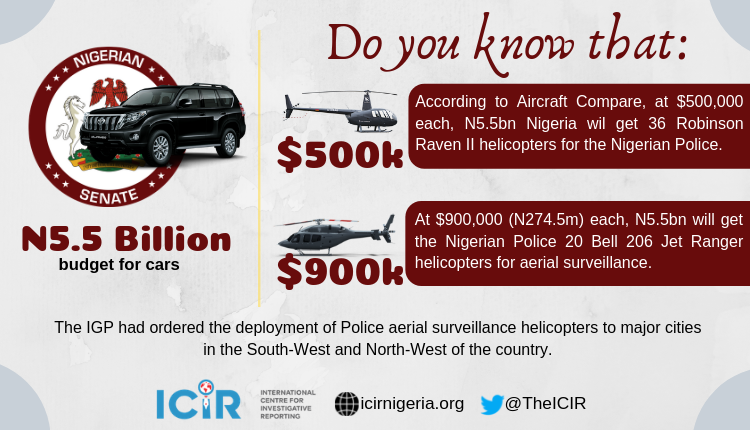
THE N5.5 billion budget for the purchase of new cars for senators of the ninth assembly will get the Nigerian Police Force at least 36 Robinson R-44 Raven II helicopters, at $500,000 each, meaning that each state can get one. Even if Nigeria goes for the more expensive Bell 206 Jet Ranger at $900,000 each, it would still be able to get 20 helicopters with state of the art equipment to deploy for aerial surveillance and tackle some of intractable security problems.
But, in a country ravaged by insurgency, banditry, kidnapping and other forms of crimes, the lawmakers are more interested in buying luxury cars.
The ninth senate under the leadership of Senator Ahmed Lawan plans to spend N5.5 billion to purchase new Toyota Land Cruiser Sports Utility Vehicles (SUVs) for committee chairmen, their deputies and other principal officers of the red chamber at the cost of N50 million each (this is inclusive of the returning members).
The Bukola Saraki-led eighth senate spent about N4.7 billion to purchase the same brand of vehicles at the cost of N36 million. About N1.3 billion was expended on procuring vehicles for senators in 2012. At the time, 109 cars were bought for the lawmakers, each costing N11.07 million.
In the past three senates, the upper chamber of the National Assembly has spent N11.5 billion on purchase of cars. Specifically, in 2011, the senate earmarked N1.2 billion, 2015; NN4.7 billion and now it has earmarked N5.5 billion.
There are senators who have repeatedly enjoyed this largesse. Example of such is the current Senate President, Ahmed Lawan, who was first elected a senator in 2007 under the sixth national assembly. Other senators who have enjoyed from this largesse include Senators Enyinnaya Abaribe, Ali Ndume, Ajayi Boroffice, Dino Melaye, Oluremi Tinubu just to mention few of the returned senators who have enjoyed from the ‘free gift’.
This recent development has attracted severe public criticism from the Nigerian public, including Civil Society Organisations, CSOs, who are asking for the justification for the purchase of new vehicles at a time when the nation’s economy is floundering.
The Socio-Economic Rights and Accountability Project (SERAP), BudgIT, Enough is Enough (EiE) and 6,721 concerned Nigerians have filed a lawsuit against the release of N5.550 billion for purchase of luxury cars for principal members of the ninth Senate.
SERAP and others, in the suit, are asking the Federal High Court to restrain and stop the National Assembly Service Commission from releasing the money until the downward review of the amount proposed by the senate.
Car luxury amidst high level of insecurity
Many commentators have spoken on the matter against the backdrop of the increasing wave of insecurity in the country which has overwhelmed apparently overwhelmed the security forces. According to Armed Conflict Location & Event Data (ACLED), an organisation that collects, disaggregate, and analyse data based on types of violence, its location, the actors involved and fatalities, the number of death arising from crisis-related matter between January and July 2019 stands at 3,950.
Recently, the Inspector-General of Police (IGP), Mohammed Adamu, ordered the deployment of Police aerial surveillance helicopters to major cities in the South-West and North-West of the country.
This he did in response to the murder in Taraba State of David Tanko, a Catholic priest, and the increasing incidence of kidnapping in many parts of the country.
How N5.5 billion can buy 20 police helicopters
The N5.5 billion that the senate plans to expend on cars can boost the police’s response capacity, particularly in combating the scourge of kidnapping, if the money is diverted to buying surveillance helicopters for the security forces, this website learnt.
Aircraft Compare, an e-commerce website that specialises in the sale of aircraft, including, airplanes and helicopters has a price of list of different aircraft.
At almost $500,000, Nigeria will get 36 Robinson R-44 Raven II helicopter. This can be deployed to the 36 states of the federation.
If Nigeria is to go for the helicopter with the lowest price of Bell helicopters, a Bell 206 Jet Ranger will cost Nigeria about $900,000 (N274.5 million) at the official N305 to a $1.
At this cost, this would mean that the N5.5 billion luxury car budget of the Nigerian senate would get the Police Force 20 of these elite helicopters. This can be deployed across the states of the federation for richer surveillance as against the aerial surveillance of two regions the IGP ordered for.
If Nigeria is to get Bell 429, which is of the same quality with that of the Metropolitan Police, London and the New York Police Department (NYPD), USA, it will cost the country about $7.5 million to $8 million (N2.28 billion to N2.44 billion) to get one. At that cost, Nigeria will get two Bell 429 helicopters.
However, the spokesperson of the senate, Adedayo Adeyeye described the lawsuit by the civil society groups as an effort in futility on Channels Television
The senator said he was not aware of any plan to purchase vehicles for the lawmakers with such a huge amount.
He said, “It (planned legal battle) is an exercise in futility; a complete exercise in futility. Even I as a Senator have not heard anything about that.
“So why will people be relying on rumour and newspaper reports? I wouldn’t know and in any case, if the senate is going to spend that (amount); if it is budgeted for, then it means it is purely legal.”
The lawmaker noted that every new administration budgets for vehicles for public officeholders. Adeyeye also said it is a norm for the three tiers of government, while lamenting the public outcry against the senate.
“So why will the National Assembly be different? Why are they focusing on the National Assembly and not looking at the executive, judicial arms of government?
“All of these people are entitled to official cars and do use official cars. Directors of agencies, even minor officials in agencies use official cars. So why will the National Assembly be different?
“Why should it be a problem that the National Assembly is entitled to cars, to use official cars?”
He wondered why the purchase of cars for senators was viewed from a negative perspective, adding that he could not imagine himself in a vehicle used by a former member.
He said, “Some of the vehicles they bought four years ago were no longer serviceable while others have probably been sold to their users.
“The mischief makers should desist from attempting to destroy the National Assembly because doing so would amount to destroying the nation’s democratic process,” Adeyeye said.