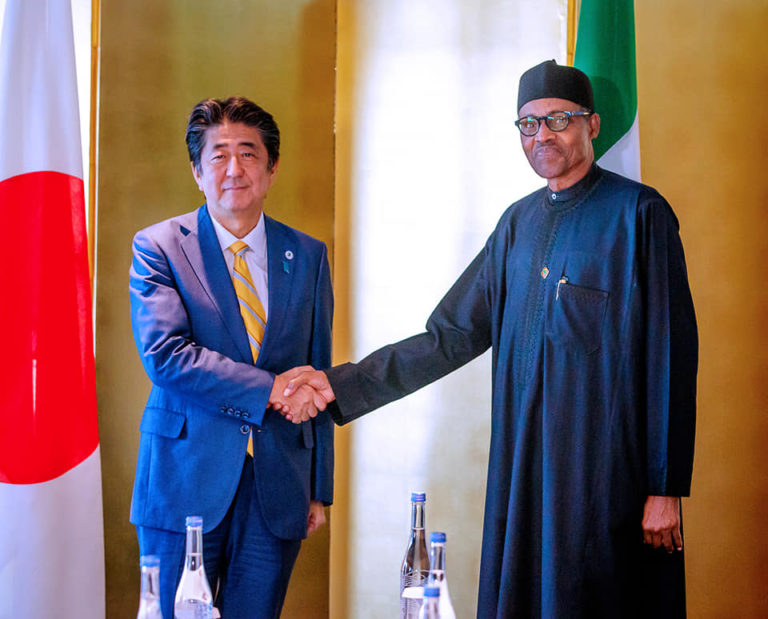
PRESIDENT Muhammadu Buhari on Thursday said that the few Nigerians abroad indulging in criminal activities do not represent the values of the majority of the people of the country.
He disclosed this during a meeting with leaders of the Nigerian Community living in Japan on the sidelines of the Seventh Tokyo International Conference on African Development (TICAD7).
“Let me also say that there are few Nigerians in the Diaspora that are giving us a bad name by engaging in criminal activities. These Nigerians are a minority, they do not represent the values of our country, and I plead with them to change their ways.”
According to him, “We will not condone any crime whether at home or abroad, and we will also not allow these Nigerians define us as a people with a reputation for criminality.”
In a statement shared by the president’s special adviser on Media and publicity, Femi Adesina, Mr Buhari urged Nigerians in Japan to be good ambassadors of their fatherland.
“I am personally very happy that there are millions of Nigerians all over the world, like you here, who are truly making us proud,” he said, describing the majority of the over 17 million Nigerians in Diaspora as “the face of Nigeria globally and our ambassadors for good.”
President Buhari, however, urged his audience to continue to contribute their quota by helping to develop their host country and Nigeria as well.
“I look forward to your inborn gift, ability, and capacity in taking up this challenge,” he said
ON Thursday, Waripamo-Owei Dudafa, former senior special adviser on domestic affairs to ex-President Goodluck Jonathan has been discharged and acquitted of an allegation of N1.6bn fraud.
The Federal High Court in Lagos discharged Dudafa alongside a banker, Joseph Iwuejo since the Economic and Financial Crimes Commission (EFCC) failed to prove the charges against them beyond reasonable doubts.
According to the judgment by Justice Mohammed Idris, EFCC through his counsel, Rotimi Oyedepo, failed to prove the charges against the defendants beyond reasonable doubts.
Justice Idris further held that the prosecution failed to call “material witnesses”, such as Jonathan, one Somprei Omeibi, the Central Bank of Nigeria Governor and ex-National Security Adviser, Sambo Dasuki, who were essential to the proving of the case.
So, he said convicting the duo was difficult, as prosecution case did not measure up to the expected minimum requirement to secure a conviction, The PUNCH report.
The judge said the failure of the EFCC to call the witnesses was lethal to the case of the prosecution. He mentioned the case was based on misgivings, and not grounded to secure a conviction.
Judge Idris dismissed all 22-counts against Dudafa and Iwuejo, discharged and acquitted them, saying the EFCC had not concluded inquiry before rushing to court.
However, the EFCC has vowed to appeal the judgment at the Federal High Court sitting in Ikoyi, Lagos.
The duo was docked by the EFCC before Justice Idris of the Federal High Court Lagos on 22-counts of charge bordering on money laundering of over N1.6bn while performing his duties as a top aide to the former president.
They laundered the funds through the accounts of four companies – Ebiwise Resources Limited, Avalon Global Property Development Company Limited, Rotato Inter-Link Services Limited, and Pluto Property and Investment Company Limited.
Dudafa allegedly received the assistance of the second defendant, Iwuejo, a branch manager of a new generation bank, who was in charge of the said accounts.
WATERWIDE, a non-profit organisation that tracks government spending and international aids for water, sanitation and hygiene (WASH) in rural communities in Nigeria joins to commemorate World Water Week organized by SIWI an annual focal point for global water issues.
We strongly believe that water is key to future prosperity and that together, we can achieve a water-wise world.
The human need for water can never be overemphasized. Water is a transparent, odourless, colourless and tasteless chemical which is the major constituent that makes up the earth. Water is vital in almost everything we do and it plays an important role in the world economy. At the national level, water helps in virtually everything we do; drinking, cooking, bathing, washing, food processing, building, transportation and so many other things.
However, water is highly polluted and unpolluted water is hard to come by; studies show that only 0.003 per cent of water in the world is unpolluted. Some of the few causes of water pollution are littering, oil spillage and chemical dump from factories.
In rural areas, water happens to be a very scarce commodity and even the one that is available is not well purified for the basic needs of the community. Over time, several means of purifying water have been used to make it safe and pure enough for consumption, though these means of purification have not reached most rural areas.
The rural dwellers still consume polluted water which results in diarrhoea, liver problems and skin diseases. One may wonder why people would consume something harmful to them. This, however, is due to the lack of information about the dangers attached to the consumption of polluted water. Most people in rural communities are not aware of the need to consume clean water and do not even know that the consumption of polluted water might be the cause of some diseases and few deaths amongst them.
A roundtable discussion during the ongoing World Water Week event organised by SIWI. Photo credit: Waterwide.
Therefore, the first step to tackle the issue of consumption of polluted water is to create awareness in the rural community about the dangers of polluted water. Members of the rural community may find it strange being that they have consumed this water their whole life and are being told it’s dangerous to their health.
Hence, it does not stop at creating awareness about polluted water but as a society, we can proffer solutions that will help to keep our water pure. Organizations that are out to reach the rural community can start by giving lectures on how to purify water.
Some of the cheapest and safest methods of water purification include boiling, filtering and treating it with chemical or chlorine.
Boiling and filtering are quite easy to do since it does not involve any long process. Boiling your water involves heating it in a fire till it gets to 100 °C. Everyone has access to a fire and to purify water in the rural community it is good to engage in this simple method of water purification and store it for drinking and cooking.
Filtration is straining the water through a clean cloth or a sieve, while the use of chemicals is putting in a certain amount of water purification chemical for a period of time to help purify the water. However, the use of chemicals and filtration may not give the same result as boiling the water to 100 °C; therefore boiling is recommended for those at the rural communities.
There are several other means of water purification used in urban areas and as the rural area develops, these methods should be introduced for the good of everyone.
As we commemorate World Water Week 2019, we all have the duty to amplify the need to achieve sustainable development goal six (SDG 6), the world needs to know that.
Water is the source of life and as vital as water is, consuming polluted water is endangering to not just the individual but also to the society; therefore the goal is for everyone to have access to clean and pure water in order to lead a healthy life.
THE acting Chairman of the Economic and Financial Crimes Commission (EFCC), Ibrahim Magu, has challenged the Corporate Affairs Commission (CAC), the government agency responsible for company registration to be alert to the existence of proxy companies.
Magu told Nazir Sani, Head of CAC office, Borno State to ‘speed up response time’ and better cooperate with the EFCC on its anti-graft war.
In a statement issued on Thursday, he emphasised that their cooperation remains vital to investigate and prosecute companies involved in suspicious activities.
“The Corporate Affairs Commission is doing a very good job in responding to requests put to it by the EFCC, but we want to urge you to speed up the response time, in order not to delay our investigations and possible prosecution,” says Magu.
Magu, represented by Lawrence Iwodi, the EFCC Regional Head stressed the need for the CAC to ensure due diligence while performing its responsibilities. He promised to help checkout companies established mainly to perpetrate frauds.
“While we urge you to respond promptly to our requests, it is necessary for you to carry out due diligence, especially as it relates to Know Your Customer, KYC, and when there is a need for an update on a company’s address”.
According to the statement, some proxy companies were being set up in Borno and Yobe states, with the sole aim of siphoning public funds.
He restated the commitment of the commission to go after such companies.
“As stipulated in the EFCC Establishment Act 2004, the CAC is a member of the EFCC Board. It is an essential partner with the anti-corruption agency in the fight against corruption.”
In his reaction, Sani assured the EFCC of the CAC’s continuous support.
“We will continue to give the EFCC topmost priority in responding to request sent to the Corporate Affairs Commission,” he stated.
THE Twitter Handle of Aisha Yesufu, Co-founder of #BringBackOurGirls (BBOG), campaign @AishaYesufu was on Thursday frozen by the social media firm but released a few hours later.
“Caution: this account is temporarily restricted. You are seeing this warning because there has been some unusual activity from this account,” the statement from Twitter read.
The account was, however, restored shortly at about 12:27 pm with details of why it was suspended.
In a direct response to her personal email, with reference number 0122675480, Twitter explained it suspected it as an automated spam twitter account, thus flagged. But the tech firm later apologised to Yesufu for the inconveniences.
“We are writing to let you know that your account is now unlocked. We are sorry for the inconvenience,” Twitter stated.
“A little background: We have systems that find and remove automated spam twitter accounts, and it looks like yours was flagged as spam by mistake. This can happen if an account exhibits automated behaviour in violation of our rules.
“We apologize for the mixup, and hope to see you back on Twitter soon.”
Response from the social media platform further excited Yesufu, as she extended her gratitude to her more than 100, 000 followers for lending their voices.
Thank you everyone for your voices. I have gotten a mail from @Twitter and I am back. I will continue to be a voice. My voice is not for myself alone but for so many others who unfortunately did not get that education that so many of us take for granted to have a voice.
THANK YOU pic.twitter.com/uZ4g8TXZul
“….I have gotten a mail from Twitter and I am back,” she stated. “I will continue to be a voice. My voice is not for myself alone but for so many others who unfortunately did not get that education that so many of us take for granted to have a voice. Thank you.”
Within a short period, the response from twitter had garnered over 1400 likes and 445 retweets with 221 comments as at the time of filing this report.
However, Yesufu’s handle was not the first to be suspended by Twitter. The account of Prof. Yemi Osinbajo, Nigeria’s Vice President, was unverified a couple of weeks ago.
It was suspended based on false claims that he was tactically using the account to lure votes through the TraderMoni scheme, months away to the Bayelsa State governorship poll.
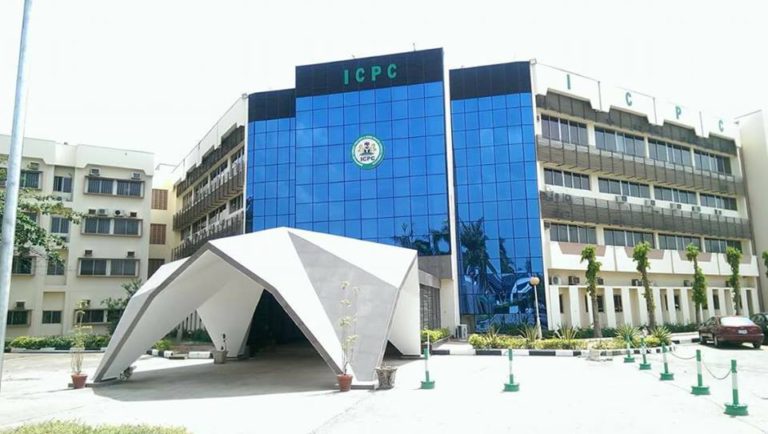
AT least four officials of the Independent Corrupt Practices and Other Related Offences Commission (ICPC) have been dismissed by the management of the Commission for various disciplinary offences ranging from insubordination to compromise of investigation, The ICIR can report.
Eighteen officials of the Commission in a document sighted by our correspondent had been sanctioned by the antigraft agency.
The document dated August 20, 2019, was issued by Lodam S, DC (Human Resources Management) at the ICPC and was titled “Decision of the Commission on Disciplinary Cases”.
The cases for which disciplinary actions were taken against the erring officials included, immoral and unruly behaviour, violation of oath of secrecy, refusal to take or carry out lawful instruction from superior officer, negligence, deliberate delay in treating official document, receipt of unlawful allowance, compromising investigation, dishonesty and refusal to go on transfer.
While the document said some of the affected officials were investigated and exonerated of the misconduct brought against them, five of them were either dismissed or have their appointments terminated.
The affected officials were either demoted, suspended without pay, warned or exonerated.
Some of those dismissed included Celsus Ukpong whose misconducts were refusal to proceed on transfer or to accept posting, absence from duty without leave and other conducts unbecoming of a public officer.
Recall that Ukpong, a former staff of the Commission was re-deployed to the Special Presidential Investigation Panel for Recovery of Public Property (SPIP) on an ad-hoc basis.
According to the Commission, Ukpong who had been re-deployed alongside five other ICPC staff to serve with the SPIP in 2017, and was dismissed after due disciplinary procedure had been adhered to.
The ICPC internal memo showed that he had had a history of committing official misdemeanours – one of which was that he was recalled along with other officers from the SPIP but only he did not comply.
Ukpong was later posted to one ICPC state office in an administrative exercise that involved many other officers in December 2018 and was paid his due relocation allowance which he collected but still did not report to the headquarters nor to the new location of posting.
Also, Gloria Elit was dismissed by the Commission for compromising investigation and other act unbecoming of a public officer, while Ayobami Adepoju’s appointment with the Commission was terminated for insubordination, false claim against a government official, unauthorised disclosure of official information.
Saidu Ali was also dismissed for dishonesty and other act unbecoming of a public officer. The document said Ali whose dismissal was from July 2, 2019, would be handed over to the police for investigation and prosecution.
Iroha Kalu Collins was demoted from Grade Level 15 to Grade Level 13 with effect from June 10, 2019, for dishonesty and refusal to carry out lawful instruction from superior officers. In his case, S.P Binga was sanctioned with the reduction in salary step to the first step for compromising investigation.
AS is typically the case, United States President, Donald Trump, was again in the news recently for what he wrote about Baltimore, Maryland’s main city. Following Congressman Elijah Cummings’ reprimand of American immigration officials for the living conditions in some of the country’s holding centres for migrants seeking refuge in the US, as reported in electronic and print media, Trump slammed Cummings in a tweet where he questioned the sense of decency of people and residents of Baltimore which Cummings represents in America’s law making body.
“Rep. Elijah Cummings has been a brutal bully, shouting and screaming at the great men & women of Border Patrol about conditions at the Southern Border, when actually his Baltimore district is FAR WORSE and more dangerous. His district is considered the Worst in the USA…,” Trump said, adding “As proven last week during a Congressional tour, the Border is clean, efficient & well run, just very crowded. Cumming District is a disgusting, rat and rodent-infested mess. If he spent more time in Baltimore, maybe he could help clean up this very dangerous & filthy place,” he declared, further stating that “no human being would want to live” in Baltimore.
Refuse by the roadside along Igando-Ikotun way, Lagos CREDIT: The ICIR
As shocked or disgusted as many may have been with Trump’s views, coming from a president about his own people, the man was not without his supporters. One of them, replying Trump’s tweet, said “Once again POTUS (President of the United States) is right whether you want to hear it or not. I lived in Baltimore for three years. It’s a series of row houses where if you make one wrong turn for two blocks you’re dead. And God forbid you have to go to Johns Hopkins. It may as well be in the middle of Ramadi.”
A bully himself, Trump’s tweets, to me, are usually neither exciting nor inspiring but this one struck a chord and got me thinking. My first impulse was to google Baltimore, a city I had never visited, to learn more about the place, and as I did, I wondered to what extent – given Trump’s penchant for exaggeration and misinformation, he was right.
Days after my first search, I did a follow up check, and the search revealed something interesting that probably lends credence to Trump’s taunts. It is that some sanitation volunteers from some American states had stormed Baltimore to help clean up the city and make it more appealing.
Thinking about Baltimore thereafter, I did wonder to what extent it compares to Lagos, Nigeria’s most populous city and one of the world’s mega centres with an estimated 21 million population. Is Baltimore similar, worse or less than Lagos in filthiness?
I had lived in Lagos since 2005 and during which time I traversed its nooks and crannies as a resident and reporter and became familiar with its landscape. I had often wondered about the city and how many of its residents live but what I saw in my tour of many of the municipalities in Lagos late last year to early this year for a reporting project funded by International Centre for Investigative Reporting and MacArthur Foundation, will live with me forever. Filth, stench and degradation of the worst kind. Nowhere, in all my years of travelling around Nigeria – and I boast substantial knowledge of the country – have I beheld such sight. The only place that comes close is Okpoko area of Onitsha, Anambra State, where, in some parts of the town six I visited years ago, I saw humans and pigs literally competing for space with heaps of refuse and putrid smell from soggy land, in what was supposed to be human habitat. In fact, so massive was one of the refuse heaps in Okpoko that it spilt over and damaged a fence and sections of a primary school close to a market with no one doing anything about it in a state that supposedly had a commissioner for education and active governor in Peter Obi. But Okpoko is just one district compared to countless Lagos municipalities. A ride around Lagos, a city that officials of the state hail as Nigeria’s centre of excellence, could end up troubling one, given the state of the environment. And so, following Trump’s tweet about Baltimore, I wondered what he would say about Lagos were he to visit it today. What would he say about Ketu, Oshodi, Lagos Island, Surulere, Ajegunle, Ebute-Metta, Oworonshoki, Victoria Island, Bariga, Somolu, Ikoyi, Ikeja, Ogba, Yaba, Iyana Ipaja, Agege, Apapa, Mushin – everywhere? What would he say about the many slums in the city, about makeshift structures in waterfront settlements littered with refuse, with no drains and toilet facility for inhabitants; about stagnant drainages all over the city choked with debris, where bulgy rats, rodents, cockroaches, mosquitoes and snakes, to talk of just these, dwell? What would he say about the diseased waters in this aquatic state, from where fishermen make a living and the public get served their products daily? What would he say about unpaved roads all around the city that turn messy during rainy seasons? What would he say about open defecation and excreta that litter the environment? What would he say about a city without a clean, reliable mass transport system for residents?
A 2016 article by the UK Independent newspaper, reveals that Lagos placed third among the 9 worst cities in the world by the Economist Intelligence Unit report, which ranks the best and worst cities to live in the world.
According to the report, “The EIU’s Global Liveability Ranking provides scores out of 100 for lifestyle challenges in 140 cities worldwide. It looks at which cities have the best living and worst living conditions. The ranking takes into account healthcare, education, infrastructure, safety, and the threat of terrorism. It then gives an overall mark out of 100.”
Without a doubt, the state of Lagos today is such that would make Sir William Macgregor, Governor of the Lagos colony between 1899 and 1902 to wonder, were the dead able to, what became of his darling city. Macgregor, according to a 2018 book titled, Urban Planning Processes in Lagos, “introduced a number of very significant drainage and sanitation measures” when Lagos “population was around 40, 000.” His effort was evidently not followed through by successive administrations which explains the environmental disaster that the state is today.
The rot didn’t happen overnight but it’s amazing that successive administrations in the state since the return to civil rule in 1999 particularly, consider the state so clean as not to declare an emergency for it. The combined efforts of successive APC governments in Lagos amounts to no more than scratching the surface. Getting people to sweep major roads in the state, as one gets to see here and there without reaching adjoining streets and having a vision of clearing choked drains makes no sense and amounts to nothing.
During my reporting trip last year, ahead of the gubernatorial election in Lagos, I saw campaign posters of Babajide Sanwo-Olu, then governorship aspirant of APC, lavishly displayed in some squalid neighbourhoods in Lagos Island. The man went on to win the election and is now the governor of the state. My question for him then is: what can you do to change the face of Lagos?
What different strategy do you have? What can you do to overhaul the system, a system that has continually failed the people? There’s something about the Lagos system that just won’t deliver a clean environment. Given the extent of rot in the state, it would require huge manpower, a change of attitude by both the government and people to turn things around, and work has to start immediately.
Here’s my modest proposal on how to begin to turn things around: recruit as many willing hands from every Lagos neighbourhood – and this won’t pose a challenge given the high level of joblessness in the state and Nigeria generally – for a monthly fee, to help collect, dispose and manage waste. Prior to the 2016 American election, and as his own strategy to check migration to the US, Trump talked of building a wall along the border with Mexico and get Mexicans to pay for it, an idea that has remained a pipe dream as the man now seems to have run out of ideas on how to realise it, but engaging Lagosians to take charge of their environment is one idea that residents of the state may be willing to pay for if they see and feel government’s sincerity of purpose. It will be different from merely creating jobs for political thugs as top politicians in the state and elsewhere, including governors are renowned for, something that at times makes nonsense of even good intentions. Such initiative as getting people involved in cleaning and safeguarding their environment should be a continuous process that could checkmate the rot and stench avalanche in the state, give it the uplift it deserves and place it among the world’s most liveable cities in no distant time.
Anthony Akaeze is an award-winning freelance investigative journalist
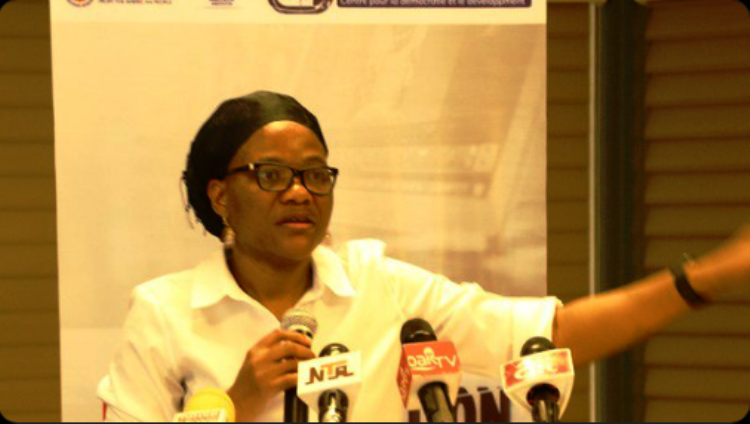
AS part of the efforts to check the spread of misinformation and disinformation Idayat Hassan, the Executive Director of the Centre for Democracy and Development (CDD) on Wednesday has advocated greater investment in good journalism practice.
“We need to increase support for good journalism. We have spoken on different initiatives but left out support for the journalists. So, there is so much need to invest in good journalism – print, radio and television,” says Hassan.
“It is still well trusted, then digital literacy, civic education and training for journalists, not only on fact-checking but critical thinking, disinformation and misinformation.”
She made this call at Day-2 of the conference on fake news held in Abuja, themed: “How to Combat the Threat of Fake News to the Democracy in Nigeria.”
CDD recommends new strategies to discourage dissemination of fake news, stressing the need for information resilience against the menace.
Citing Finland and the United Kingdom as instances where children from the stage of infants were reportedly taught how to decipher fake news, Hassan called for a system that could promote better civic education against the consumption of false information.
She said there is a need to design a system of fact-checking in local languages for people in various communities, in addition to the efforts of newsrooms such as The International Centre for Investigative Reporting (ICIR), Cable and Premium Times.
“Fact-Check should not just be done by civic groups but maybe in more partnerships with journalists who are already in it. We have to start calling out names, which is something that doesn’t quite happen…”
She said investing in fact-checking initiatives in the local language is very key because most of those fact checks done in English are not accessible to people in local communities.
“We have to start thinking of how to do that in local and state government level with more languages.”
In a report released at the conference, titled: ‘Sorting Facts From Fiction: Nigeria’s 2019 Election’, CDD recommended more study on the direct impact of fake news in Nigeria.
It identified need to promote digital literacy at all tiers of government and need for greater commitment from technology companies such as Facebook to help in the fight against false news.
THE Federal Government on Wednesday has approved the reduction of visa charges payable by US citizens travelling to Nigeria.
The announcement comes after the United States increased the cost of visa application for Nigerians.
According to the earlier report by the consulate, Nigerians will be required to pay for all applications for nonimmigrant visas in B, F, H1B, I, L, and R visa classifications. However, the issuance or reciprocity fee is different from the application fees as this will be charged in addition to the nonimmigrant visa application fee.
However, the Minister of Interior, Rauf Aregbesola in a statement by the Director Press and Public Relations, Mohammed Manga, said that “the Ministry acknowledges that there were engagements with the United States Embassy on the issue and in the aftermath, a Committee was set up to conduct due diligence in line with the Ministry’s extant policy on reciprocity of Visa fees.
The attached file
“The attention of the Ministry of Interior has been drawn to the introduction of reciprocity of Visa Fees by the United States of America.
“Accordingly, the Comptroller-General of Nigeria Immigration Service (NIS), Muhammad Babandede, has been directed to implement the decrease in Nigeria’s Visa charges to US Citizens to USD 150 with effect from Thursday, 29th August, 2019,” the statement concluded.
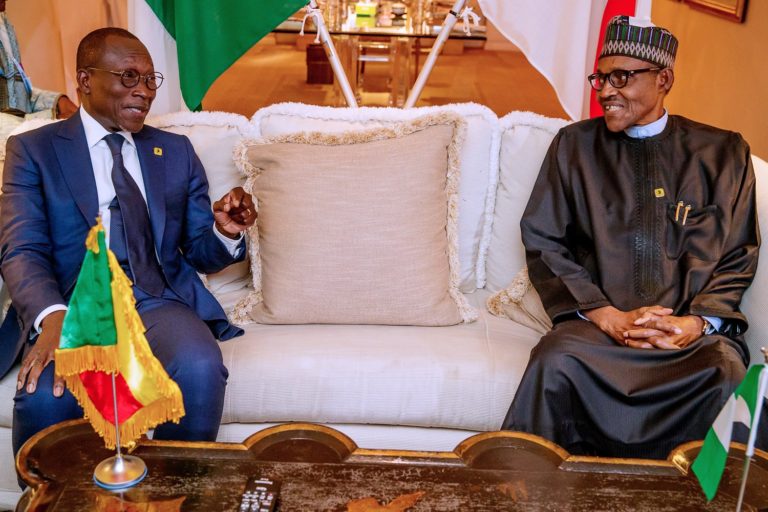
PRESIDENT Muhammadu Buhari on Wednesday told his colleague, Patrice Talon from the Benin Republic that Nigeria can no longer allow smuggling of agricultural commodities such as rice into the country.
He explained that the Nigeria-Benin border was partially shut due to the persistent smuggling activities.
Buhari disclosed this on the sideline of the Seventh Tokyo International Conference for African Development (TICAD7), held in Yokohama, Japan.
“Now that our people in the rural areas are going back to their farms, and the country has saved huge sums of money which would otherwise have been expended on importing rice using our scarce foreign reserves, we cannot allow smuggling of the product at such alarming proportions to continue,” says Buhari in a statement issued by Femi Adesina, his Special Adviser on Media and Publicity.
He said the smuggling activity is threatening the self-sufficiency efforts of the Federal Government, especially in rice production, which his administration committed to checking through the Agricultural Promotion Policy (APP).
According to him, the limited closure of the country’s western border was to allow Nigeria’s security forces develop a strategy on how to stem the dangerous trend and its wider ramifications.
The Nigerian government though did not make a formal announcement on partial border closure until Nigerian citizens and other individuals complained about the situation.
Porous borders lead to an influx of substandard farm produce, illegal immigrants and weapons, a source told The Nigerian Tribune.
.
PMB: “Our people in the rural areas are going back to their farms, and ???????? has saved huge sums of money which would otherwise have been expended on importing rice using our scarce foreign reserves, we cannot allow smuggling of the product at such alarming proportions to continue.”
However, Buhari said he had considered concerns of the Beninoise President and as such the border would soon be opened. It also disclosed plans to meet both presidents of Benin and Niger to further discuss sustainable ways to check illegal imports across the borders.