ON Wednesday, Environmental Rights Action/Friends of the Earth Nigeria, ERA/FoEN, urged the Nigerian government to desist from its agreement with the Russian owned company, Rosatom, to build nuclear power stations, citing safety concerns.
The group’s Head of media, Philip Jakpor, who disclosed this in a statement in Lagos cautioned the Nigerian government that building nuclear power plants to boost power generation might result in likely mishaps difficult to control similar to the Arkhangelsk region nuclear explosion in Russia.
“We restate our aversion to throwing nuclear plants into the energy mix in Nigeria. The explosion in Russia even with their expertise is enough indication that it is not the path to go,” the statement read.
On August 8, Russian scientists were working on miniaturised sources of nuclear energy when a rocket engine exploded which led to a spike in radiation levels and mass evacuation of communities near the facility.
The explosion had killed five people and caused radiation readings in neighbouring cities which was over 20 times above their normal level in half an hour
“The details are scary enough. We reject the nuclear option for power generation because they are dangerous and we do not have the capacity to manage the potential disaster a nuclear breach may cause, “it states.
In 2017, Russia’s state-owned Rosatom and Nigeria signed a Memorandum of Understanding, MOU, for the construction and operation of a nuclear power plant and research centre in Kogi, Akwa Ibom, and Abuja.
The decision and the process involved in choosing the sites has been criticized by civil society groups and communities in Itu, Akwa Ibom State warning that siting the nuclear plant in their community does not have their endorsement.
The agreement provides for the construction of a centre with the two-circuit pool-type reactor of the Russian design and a nominal power rating of 10 MW in Sheba-Abuja.
Four nuclear plants that Rosatom will build will cost about $80billion, with the first plant expected to be ready by 2025, while the others are due to be completed by 2035.
Akinbode Oluwafemi, Deputy Executive Director of the group, advised the authorities to thread with caution by taking the host communities along in its decision.
“Once again we have another reason to ask the Nigeria government to halt the nuclear misadventure spearheaded by the Nigeria Atomic Energy Commission, NAEC, without the consent of Nigerians,” he said.
Oluwafemi explained that with the global community’s drive to pursue clean and safe energy options including wind and solar technologies, Nigeria was still stuck with nuclear power that neither clean nor safe nor cheap.
“We have not shown sufficient capacity to manage our hydro and gas-fired plants, yet we are plunging into the uncharted waters of nuclear power. This plan should stop immediately,” he affirmed.
The 23 Industrial Development Centres (IDCs) designed and built to service small and medium scale enterprises (SMES) in Nigeria are derelict and abandoned despite Federal Government’s plan to use the facilities to boost small scale local business in the country. YEKEEN Akinwale who visited centres in Lagos, Port Harcourt, Abuja and Kano reports about the dilapidated condition of the multi-million infrastructure built across the country.
Edited by Ajibola AMZAT
THE Nigeria’s Industrial Development Centres (IDCs) in Abuja, Lagos, Port Harcourt, and Kano have been taken over by miscreants, farmers and herders, and the supervisory agency, Small and Medium Scale Enterprises Development Agency of Nigeria (SMEDAN) is not unaware of this, but could only do little or nothing, The ICIR can report.
Though the Federal Government made repeated promises to rehabilitate the moribund 23 industrial centres across the states after admitting in 2016 that they have been abandoned and dilapidated for too long.
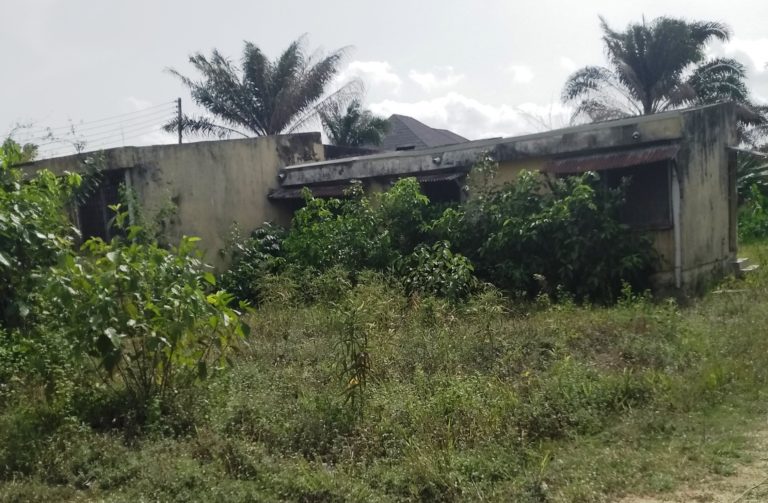
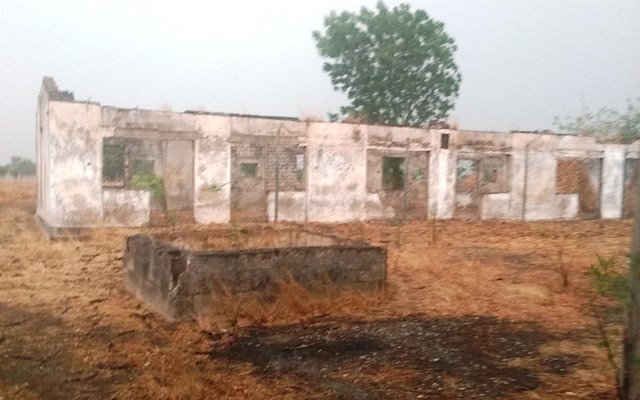
Abandoned: One of the administrative blocks at Port Harcourt IDC Photo. Credit: YEKEEN Akinwale
The 23 industrial centres established by past government were to serve as a support system for Small and Medium Scale Entrepreneurs (SMEs) in the country but none of them functions currently.
The first IDC was established in Owerri in 1965 by the former Eastern Nigeria government, Ministry of Trade and Industry, and was taken over in 1970 by the Federal Government including the one in Zaria, Northern Nigeria, which was established in 1969.
The emergence of the centres followed the Nigerian government’s yearning to strengthen SMEs in the country. The centres were established and located where the country has a comparative advantage of natural resources.
Experts who carried out feasibility studies recommended that the government should concentrate on five areas namely; woodwork, metalwork, automobile repair, textiles, and leatherwork.
When establishing the centres, the Federal Government spent huge funds providing workshops, machines, offices, and vehicles.
Though the centres were previously under the Ministry of Industry, Trade and Investment, they were later handed over to the Small and Medium Enterprise Development Agency of Nigeria (SMEDAN) in 2011.
However, due to years of neglect by the government, the centres are currently wasting away.
The current administration under President Muhammadu Buharilaunched an MSMEs clinic across the states to fast-track development of SMEs but did not articulate any action plan in the clinic for the revival of the supporting centres.
Visits to the centres in 2017 by the Senate Committee on Industry did not yield any results despite lamentations by members of the committee about the sorry state of the centres.
The IDCs wereestablished to provide extension services to the SMEs in such areas as project appraisal for loan application, training of entrepreneurs, managerial assistance, product development, production planning and control, as well as other extension services.
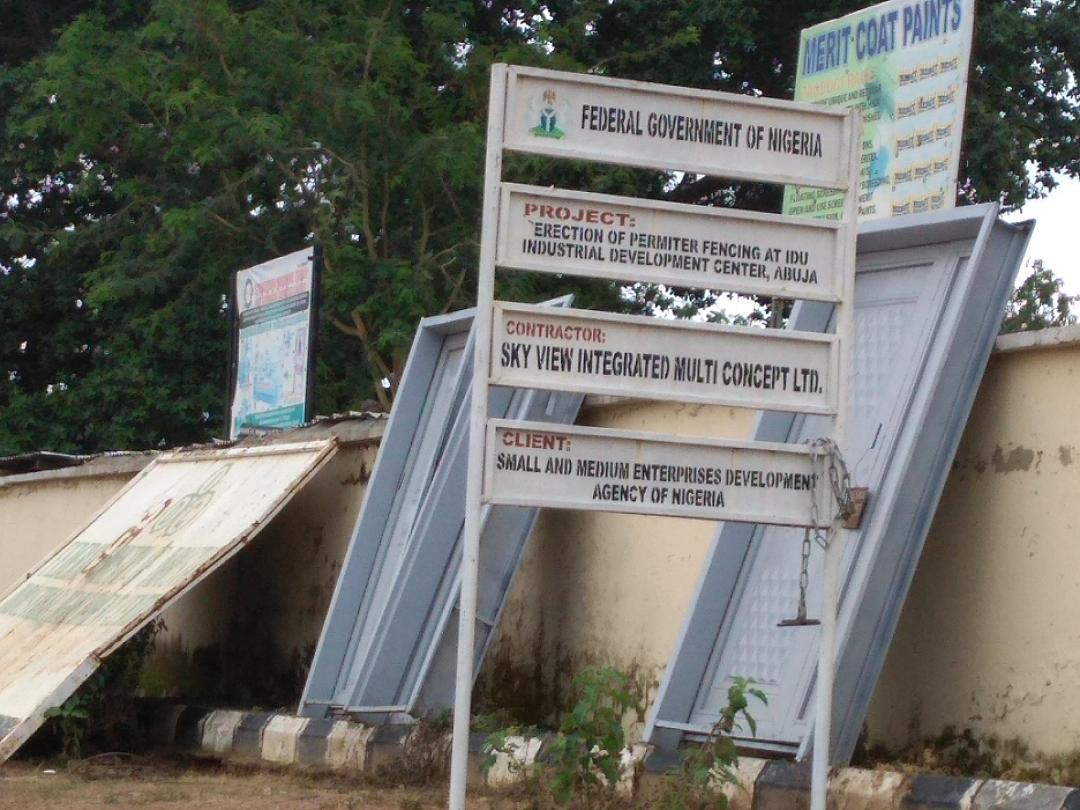
In 2017 and 2018 budgets, SMEDAN allocated N600 million to rehabilitate 12 centres. The amount was spent to construct fences around some of the facilities and to complete other renovation works.
SMEDAN has spent N600million on the rehabilitation of the IDCs between 2017 and 2018. Some of the works include erection of perimeter fences around the centres. Photo Credit: YEKEEN Akinwale
According to Ibrahim Kaula Mohammed, the Head Corporate Affairs Department at SMEDAN, the agency inherited the dilapidated centres from the Ministry of Industry, Trade and Investment.
“When we inherited these IDCs, that’s how almost all of them were, dilapidated,” Mohammed told The ICIR in an interview.
On why the agency has failed to revive the centres and allowed them to deteriorate, Mohammed, said, “We didn’t receive any kobo at this agency for IDCs in terms of budgetary allocation until 2017. Any improvement you see on any IDC is only from 2017 and 2018.”
The agency, in 2017, fenced the premises of IDC Benin, Katsina, Ikorodu, Owerri and Abuja. In Zaria it did a general renovation of the 3-in-1 workshop. At the IDC Idu, Abuja the roof was renovated.
In 2018, he said the agency bought complete automotive component of waste to wealth equipment in Idu, Zaria and fenced Kano, Makurdi, Jos and Abeokuta centres.
Despite all this spending, he said the IDCs would be demolished any time soon. A viability study has shown that despite the rehabilitation —they will be replaced with what is now known as industrial clusters.
SMEDAN and Africa Development Bank (AfDB) carried out a study of all the IDCs, which comes in two stages: Outline Business Case (OBC) and Full Business Case (FBC).
The ICIR gathered that the OBC has been completed and submitted to the AfDB which has the final say to go ahead with the second stage, FBC.
He said the management would engage auditors to examine the work.
“That is what is remaining and we have done procurement in that respect. An auditor has been selected. It is now for AFDB to agree with what we have done. Once AfDB is satisfied with all the processes, we would now sign a contract with the auditor,” he added.
For the second part of the AfDB case, the FBC is going to demolish all those workshops (even those rehabilitated) because that is what the consultant who carried out the study proposed.
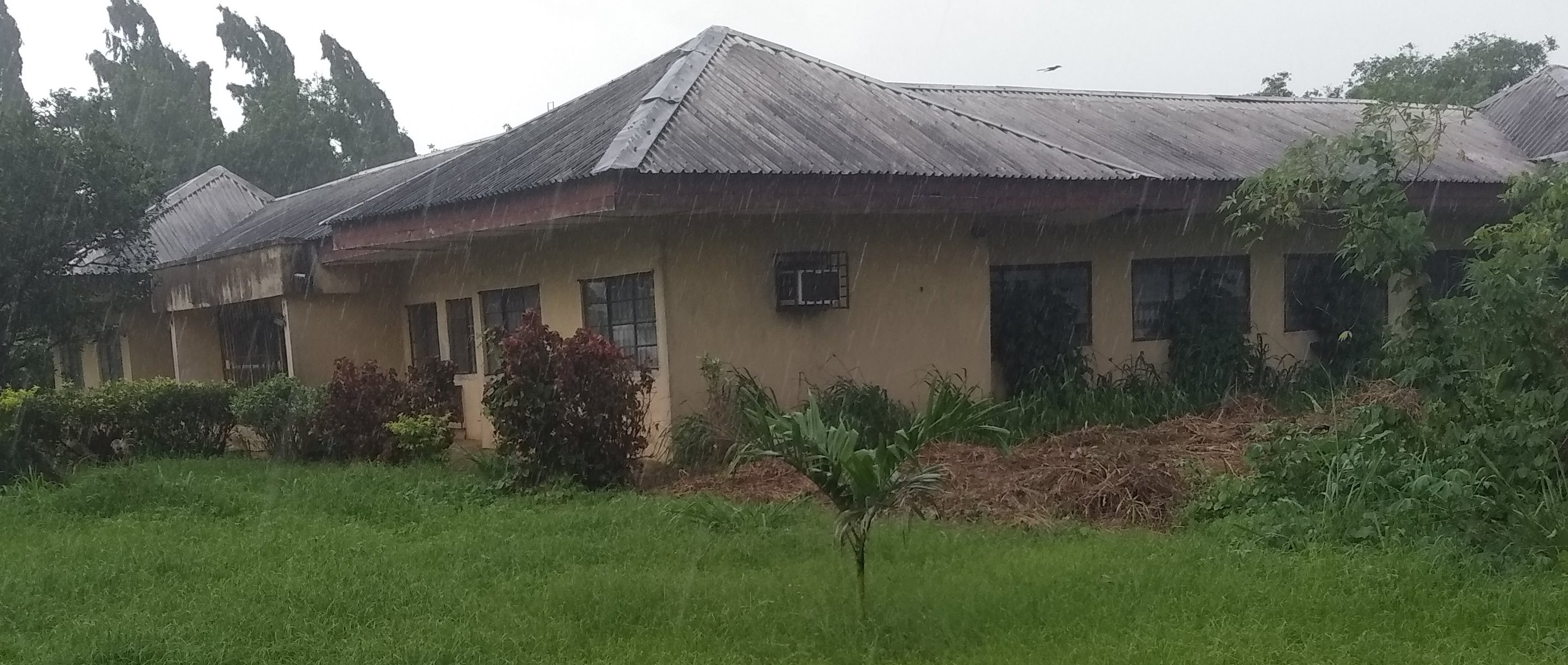
Renovated staff quarter at Lagos IDC, but will be demolished under the proposed industrial cluster. Photo Credit: YEKEEN Akinwale
Based on the proposal, there would be a vertical cluster that would accommodate more SMEs.
The spokesperson said the concept all over the world is an industrial cluster— a group of interrelated business in one place making use of a common facility and infrastructure.
Six centres—Abuja, Lagos, Sokoto, Port Harcourt, Owerri and Maiduguri are said to be in the pilot stage of the proposed industrial clusters.
Mohammed said all the 23 IDCs are viable, according to the study.
“But we cannot start with the whole 23, we have assigned the cluster type to each of the six. The selection is based on the competitive advantage of each of the states,” he said.
Lagos will focus on Fast Moving Goods (FMGs), while Port Harcourt will focus on chemicals and oil products because of the availability of petroleum there.
In Nigeria, small scale businesses constitute 85 per cent of all firms operating in the economy, Hassan Ayinde and Olaniran Olawale wrote in “Developing Small Business Entrepreneurs through
Assistance Institutions: The Role of Industrial Development Centre, Osogbo, Nigeria,” published in the journal of the Canadian Center of Science and Education.
Like in most other developing countries, small scale businesses employ the largest number of workers. It is the official policy of the government to develop the economy and fight poverty through the development of small scale businesses.
Four times SMEDAN promised to rehabilitate the industrial centres and failed
A file picture of Dikko Radda, DG of SMEDAN
In January 2016, a former Director-General of SMEDAN, Bature Masari, said the agency was working towards theupgrade and conversion of its IDCs to enterprise centres and MSME cluster parks in an effort to facilitate the speedy development of MSMEs to enhance economic empowerment and employment generation.
He gave the names of the IDCs slated for conversion to include those in Ogun, Ondo, Bauchi, Edo, Kano, Borno, Niger, Cross Rivers, Osun, Rivers, Sokoto, Adamawa State, and Kaduna states.
Bature also disclosed that IDCs in Enugu, Abuja, Lagos, Kwara, Plateau, Katsina, Imo, Akwa Ibom, and Taraba States would be converted into Enterprise Zones because of their size to offer common facilities and workspaces to MSMEs in those states.
He said SMEDAN was into partnership with Osun and Kano state governments for the redevelopment and upgrade of IDCs in Oshogbo and Tiga respectively where huge funds were being committed by the two state governments on the upgrade and conversion of the facilities.
Though when this reporter visited Kano IDC there was no sign of any redevelopment. Like other centres, it was deserted and dilapidated.
Bature pointed out that while the Tiga IDC was in the process of being converted to a world-class leather cluster park, more than N200 million has so far been expended on the improvement of facilities and rehabilitation of the Oshogbo IDC by the Osun State government under an MOU with SMEDAN.
Since then, nothing has happened to the centres; but the empty promises by the government did not stop.
This was despite Nigeria’s growingunemployment rate which stood at 23.1 per cent of the workforce in the third quarter of 2018, up from 18.1 per cent a year earlier, according to the National Bureu of Statistics, NBS.
“As of Q3 2018, the calculated unemployment rate was 23.1 per cent, the underemployment rate was 20.1 per cent, and the combined unemployment and underemployment rate was 43.3 per cent,” the NBS report stated.
In his message at the opening ceremony of the Lagos Leather Fair, the new DG of SMEDAN, Dikko Radda, like his predecessor said the agency wascollaborating with Kano State Government to redevelop a N12 billion IDC in Tiga town of the state into a world-class leather cluster park and training centre, but with Public-Private Partnership (PPP) with stakeholders of the leather industry, including potential investors to embrace the project.
He spoke through the agency’s Director of Engineering, Technology, Innovation and Infrastructure, David Abu Ozigi. That was in June 2017.
Ironically, Kano IDC in Tiga town is currently a grazing field to herders’ cattle. There are no signs of any new investment at the centre when it was visited by The ICIR.
A year after— precisely, June 2018, Radda, again, announced that the Federal Government had put in motion the process of rehabilitating all the IDCs across the country.
Radda whose office supervises all the 23 IDCs in Nigeria said the government had plans totransform the centres into world-class enterprise clusters for rapid economic development geared towards job and wealth creation.
He disclosed that SMEDAN in collaboration with the African Development Bank (AfDB) carried out a study of the viability of the centres. The bank, according to him, sponsored the study at a cost of more than $600,000 for the six months period; the report of which he disclosed had been submitted to the government.
While nothing has been done since then, Radda would also in November of the same year re-echo that the Federal Government had put in motion the process of rehabilitating all the IDCs.
He was leading members of the Senate Committee on Industries on an oversight function to the Owerri Centre, and said the agency hadcommissioned a study in collaboration with the AfDB) on how to rehabilitate the centres.
“I believe that by the end of June, the project with the bank will come to a conclusion. What we are waiting for is the submission of the full business scale for six out of the 23 centres,’’ he said.
Kano IDC—receives only empty promises—now a cattle grazing field
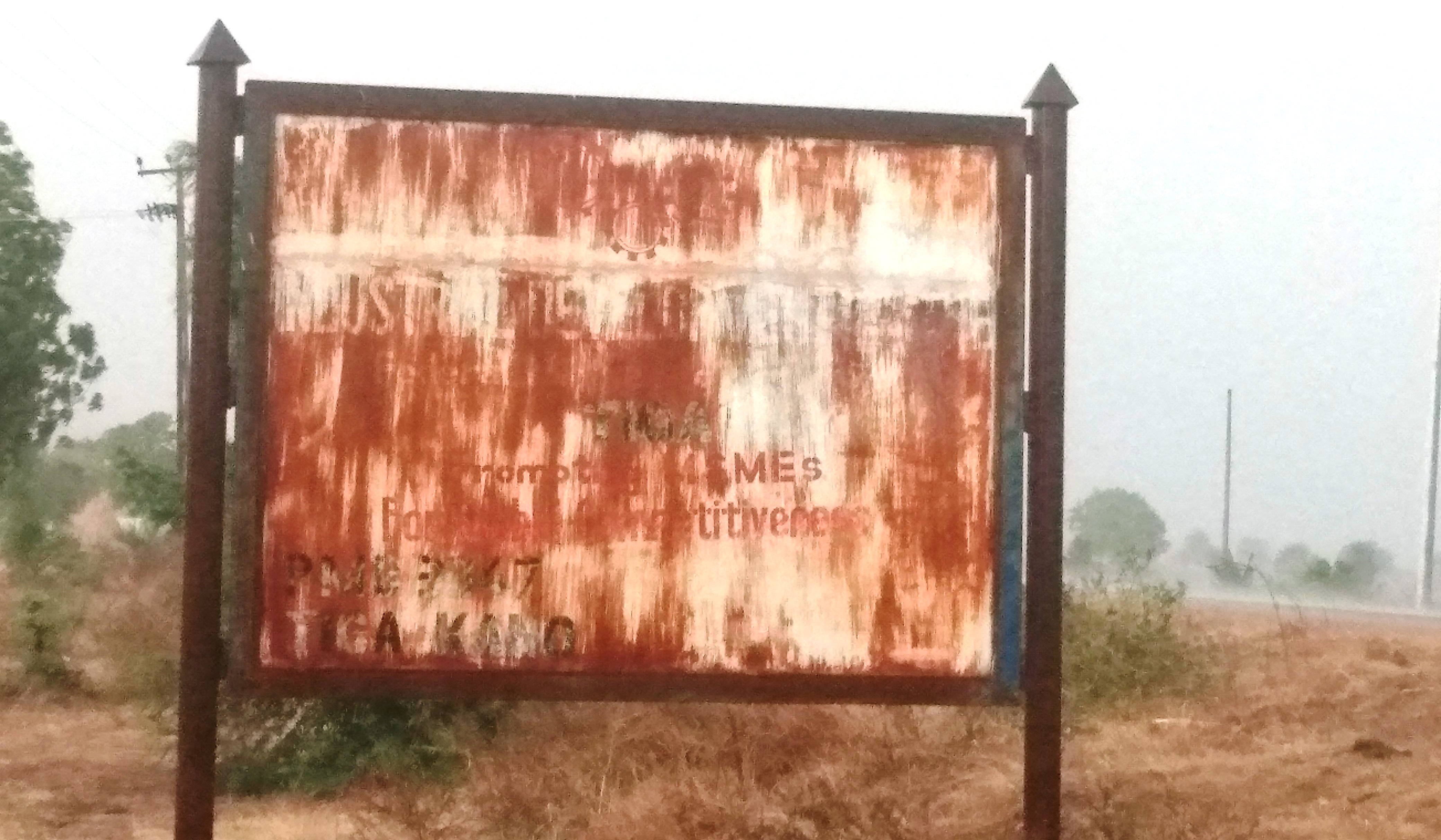
Faded signpost of Kano IDC at Tiga. Photo Credit: YEKEEN Akinwale
Kano Industrial Development Centre in Tiga town off Kano, Zaria road collapsed in 1999, says Ahmad Yaro, an Administrative Staff at the centre.
Yaro is one of the remaining six workers at the IDC as it is called by people of Tiga. The centre was established in 1982 but suffered a great setback when the Federal Government under former President Olusegun Obasanjo ordered a downsizing of the civil service.
Inside its wide expanse of land were cattle grazing on dried grasses while structures with blown roof stood derelict. Offices were covered in dust, ceiling, doors and windows were broken. There were no signs of life on the premises.
A dilapidated structure at the Kano IDC, no activities taking place at the centre. Photo Credit: YEKEEN Akinwale
“At the initial stage of my appointment, here was booming but all of a sudden, everything crumbled during 1999 rightsizing and downsizing activities of the Federal Government,” Yaro recalled with nostalgia.
“No activity has taken place here since 1999,” he added.
Asked about the machines at the centre, Yaro said, there were machines but they were not functioning because they were all obsolete.
According to him, six employees are currently working at the centre, including its Coordinator whose office is in Zaria, Kaduna State.
Due to the peculiarities of Kano for leather production, the IDC was intended to be a hub for leatherwork, but Yaro said the centre which also ought to carry out business appraisal has not witnessed any productive activities for years.
This is despite claims by SMEDAN that the Tiga IDC was in the process of being converted to a world-class leather cluster park.
That’s not the only thing that is wrong with the centre, its location is also part of the reasons for its abandonment. The Centre is located the outskirts of Kano, making it difficult to access. the location is hundreds of kilometres away from the heart of Kano city.
After spending more than two hours searching for the industrial centre, this reporter got help from an official of the Kano State Chambers of Commerce and Industry who gave a hint of its location. He simply said the IDC is located in Tiga town —but without giving a specific address or a landmark.
Before then, officials of Industrial Training Fund (ITF) in the city could not even make sense of the name Industrial Development Centre when asked. None among those asked had heard of it before, likewise artisans along Hadeija road in the city.
Situated on Kilometre 1 along Tiga Hydro Electric Power Project, Kano IDC stood forsaken by the roadside. It is a shadow of its old self.
The signpost that welcomes visitors has long faded. Only eagle-eyed visitors could see it from afar.
At Port Harcourt —Farmers now resident in the industrial complex
Hidden signpost of Port Harcourt IDC. Photo Credit: YEKEEN Akinwale
Farmers are the ones tending the abandoned Rivers State IDC located in Port Harcourt. While the Federal Government continue to sloganeer about rehabilitation without taking action, those interested in crop production are not allowing its fertile soil to waste away.
The centre has been long abandoned, overtaken by weeds and parts of it already converted to farms by some people who tend the facility.
The reporter saw four farmers taking rest in one of the workshops after the day’s work. It had just rained that afternoon, and the farmers were snacking on pawpaw.
Apparently, the centre has not worked or used for any industrial purpose in a long while. The ICIR was reliably informed that equipment—mostly fabricating machines— installed at the centre were never used up till most of them were vandalised, stolen, or became obsolete.
A farmer peeling pawpaw at the Port Harcourt IDC. Photo Credit: YEKEEN Akinwale
The roof of the workshops is partly blown off by storm while an old Volkswagen car sits in the middle of the hall. The large workshop is littered with remnants of obsolete wooden and metal works equipment. The entire premises is covered with overgrown grasses.
Tired of idleness, staff at the centre, it was learnt, have stopped coming to work. When there is training to be organised, trainees are usually taken elsewhere due to lack of appropriate machines for practical work, The ICIR learnt.
Asked about the procedure to secure a space allocation by an entrepreneur, one of the men taking shelter in the large workshop responded that no one has been given any space in a long time.
“We have not received any information from Abuja about the allocation of space to anybody,” he said.
He insisted that order must come from Abuja before anything can be done.
“Here, we cannot do anything, we don’t have that power to do anything and nobody has been given any allocation here as you can see,” he says.
The Centre has been abandoned for so long that no local seems to know its location in Port Harcourt, including those who live around or operate businesses along NTA Road, Ozuoba where it is located. Nobody could say the type of activities that take place within the large premises.
“The place is called ‘Industrial Gate’,” says a middle-aged woman who roasts ripe plantain adjacent the centre, though there are no signs of any industrial activities taking place there at the time.
Only a few locals know it as ‘Industrial Gate’—the large almost faded signpost rests somewhere on the fence near the pedestrian gate, covered by trees nearby which make it hardly noticeable for passers-by.
Sam Egwu, a former Chairman Senate Committee, once likened the centre to a mechanic workshop when he led members of the committee on an oversight function visit. He said the visit showed that the IDC only exists in name.
This investigation was supported by the International Centre for Investigative Reporting (ICIR) and the Ford Foundation.
For the Nigerian Left, the strongest lesson of what may now be called Nigeria’s #RevolutionNow—that is, the August 5 mass protests organized by some young fragments of the movement—may be formulated as a warning: If Nigeria survives long enough from the current battering of the country’s ruling class, variants of what was attempted on August 5 may be attempted again and again until a spark leads to a national conflagration or a successful popular revolution resulting from a better conceived, planned and executed strategy.
Such a successful popular revolution will present to every Left entity—organization or individual—the choice of joining the revolution as an active participant, thereby ending this long stalemate. An implicit premise of this proposition is that Nigeria’s present ruling class has refused to, or indeed cannot mobilise the social forces necessary to pull the nation out of its ever-expanding crisis.
One may start the story of #RevolutionNow by recalling the 2019 general elections conducted earlier this year. The official result of the presidential contest showed that President Muhammadu Buhari of the APC won while the other presidential candidates, including Omoyele Sowore of the Leftist AAC, lost. This point should be conceded.
However: It is a long-established and tested principle of political strategy that in a non-democratic setting such as Nigeria, a Left-wing formation or a formation with a Leftwing leadership may organize itself, its programmes and its activities in distinct but connected levels, or in concentric circles.
This simple principle “prima facie” explains and justifies, ideologically and historically, the link between Sowore’s presidential contest and his “involvement in” or “leadership of” #RevolutionNow. Sowore himself may not be acutely aware of this. But Sowore’s lawyer, radical human-rights lawyer, Femi Falana, should theoretically be aware of the principle. In any case I have seen that Falana endorses its application in the present case if the term “revolution”, as used in #RevolutionNow, is demystified and given its factual, true and contextual meaning.
We may briefly go to some background: Omoyele Sowore was the president of the students’ union of the University of Lagos for a period during the long military dictatorship of mid-1980s to late 1990s. He was a radical, Left wing and popular students’ leader. He also commanded attention in the national students’ movement. He was however ideologically and organizationally outside the Marxist core that maintained and exercised hegemony in the national students’ movement during that period. It was a measure of its success in strategy and tactics that on several campuses, this Marxist core managed to strongly “influence” students’ politics without insisting that the official leaderships be revolutionary Marxists.
Now, how do we assess #RevolutionNow? We may begin by asserting that proclamations of revolutions are not new. In fact, in certain circumstances, a proclamation is necessary, if not mandatory—if it is a “people’s revolution” or a “revolution of the people.” But this proclamation is made not to herald a revolution-in-general (which the masses ought to have known) but to announce the start of a new stage, such as armed struggle.
For historically tested reasons, a proclamation is made not before the commencement of the new stage. On the other hand, in order not to confuse the people and put them in prolonged suspense, a proclamation is not delayed for too long after the commencement. The proclamation of the start of a new stage is made after the first definitive acts—if these are deemed successful.
It is this tradition of proclamation of people’s revolution that right-wing coup makers copy and bastardise. The content, tone and language of a revolutionary proclamation make the statement indelible in the history of the liberation of the people. Finally, it should be obvious that at the point of making a proclamation, the leadership should be unreachable.
Does #RevolutionNow, in its broad ideological and political amateurishness, have precedents in Nigeria? Yes, it has precedents in Nigeria. Have I taken part in the organization and leadership of any? Yes, I have taken part in more than one. Which one is the freshest in my memory? The “revolution” of January 1975 in Lagos: that is in pre-internet and pre-social media Nigeria. Were mistakes committed in it? Yes, grave mistakes were committed—although these were not the fundamental reasons the “revolution” did not succeed in its illusory ultimate objective!
Those old enough may remember that between late 1974 and early 1975 there was a wave of strikes and mass protests throughout the country—but especially in Lagos which was then the federal capital of Nigeria. The general issues included corruption, “bad governance” and the shifting of the promised date for disengagement of the military from governance. But the particular national issue was the long-awaited wage reviews. Among the radical groups which participated in the struggle was Anti-Poverty Movement of Nigeria (APMON), a revolutionary Marxist formation, a mass mobiliser with an unknown operational base and a shadowy leadership.
At the start of the struggle I was transiting from being a graduate student to being a lecturer in the Department of Mathematics, University of Lagos. Comrade Bene was a graduate student of Botany in the same university. Bene and I were both in the leadership of APMON. In addition, I was the Secretary of APMON and my office in the department was APMON’s coordinating centre—unknown to anyone outside the leadership. I was 28 and Bene was 27. In crisis periods, the link between this coordinating centre and members of APMON’s leadership outside the campus and outside Lagos was provided by the late Comrade Tony Engurube, a revolutionary Marxist of Ijaw parentage but very fluent in Yoruba, French and a certain Swedish language—in addition to English, of course.
One evening, during the particular struggle under reference, we stumbled on a rough document carrying what was claimed by the author or authors to be a proposed wage structure for the army. The figures were scandalously high. An emergency meeting of APMON’s leadership was called the next day. The unanimous decision of this fateful meeting was that the production of an agitational publication in support of striking dock workers and medical doctors should be stopped for the “uncovered” military wage structure to be added as an appendix.
About 400 copies of the revised publication were to be produced and distributed covertly at strategic locations in Lagos. The decision was carried out immediately. That was it! The publication, to use a modern language, became “viral” within 72 hours. The effect was electrifying. My banker-senior brother with whom I was squatting in Lagos came back from work to show me a paper “some people” were distributing in Lagos Island! We both shouted!
Security agents poured out in search of “subversive” and “unpatriotic” people, “enemies of the nation”. Another emergency meeting of APMON’s leadership was called. However, the decision this time was not unanimous. But the majority opinion—which was supposed to be binding—was that the organization had achieved its realizable maximum objective and should suspend all public and private agitation, with or without the “document”.
As the meeting was dispersing, it could be observed that some comrades were still not happy with the decision. They believed that the “revolution” was nearing victory and required only a final push! In fact, earlier that day, a particular comrade, with some APMON cadres, had gone to Nigeria’s land border with Benin Republic at Idi-Iroko to urge border guards not to allow certain senior state functionaries to escape from the country!
Three days later, soldiers swooped on him as he was agitating at Lawanson Bus Stop! And two days later, two comrades, one from a well-known Ondo family, and myself, not knowing that we had been uncovered and were just being lured and trailed, drove into the military police headquarters at Apapa. We went there in a prestigious Volvo car to secure the release of our detained comrade! The gates closed behind us for six months.
Madunagu, mathematician and journalist, writes from Calabar, Cross River State, Nigeria.
THE Federal High Court has granted bail to Abdullahi Babalele, the son-in-law to Atiku Abubakar, presidential candidate of the Peoples Democratic Party (PDP) and former Vice-president of Nigeria.
Babalele was granted bail in the sum of N20 million with one surety in like sum on Thursday.
The Economic and Financial Crimes Commission (EFCC) arraigned him on two-count charges bordering on money laundering of $140,000 (more than N50m) during the 2019 general elections.
The anti-graft agency alleged that he aided the cash payment of the sum of $140,000 in February 2019 without going through a financial institution.
Besides Babalele, a former associate of Atiku, Uyiekpen Giwa-Osagie who is also a lawyerwas sued on a similar case. He was alleged of laundering a sum of $2million in the build-up to the general elections.
Both had pleaded not guilty to the charges before Justice Nicholas Oweibo at the high court.
Speaking on the bail conditions at the hearing on Thursday, the judge ruled that Babalele should provide N20 million with one surety in like sum. He added that the surety must be a resident of Lagos with evidence of means through an affidavit.
The court also directed him to deposit his passport, which had been with the Economic and Financial Crimes Commission (EFCC), with the court.
Also, Giwa-Osagie was directed to provide N20 million naira with one surety as his bail condition.
The two defendants were ordered to remain in the custody of the EFCC pending the fulfillment of the bail terms.
The trial of both cases was adjourned to October 8.
The Federal Government of Nigeria has announced that it has changed the name of its handle on Twitter.
On the verified Twitter handle, the government made it known in a tweet on Thursday, noting that the handle now has the name @NigeriaGov and is no longer @AsoRock.
The government in the tweet said that the change of name was necessary to reflect the fact that the handle represents the Federal Government of Nigeria and exists on its behalf.
The tweet read, “NOTIFICATION: Twitter Handle Change | From @AsoRock to @NigeriaGov, to more accurately reflect the fact that this handle represents, and exists on behalf of, the Federal Government of Nigeria.”
NOTIFICATION:
Twitter Handle Change | From @AsoRock to @NigeriaGov, to more accurately reflect the fact that this handle represents, and exists on behalf of, the Federal Government of Nigeria.
It will be recalled that few days ago, there were several attempts to hack Vice President Yemi Osinbajo’s official Twitter account @ProfOsinbajo which resulted into the account losing its verification.
Laolu Akande, Senior Special Assistant to the Vice President on Media and Publicity on Saturday had tweeted about a failed attempt to hack into the Vice President’s Twitter account.
“Yesterday, there were failed external attempts to gain unauthorized access to the Vice President’s Twitter Account. Since, we have been in contact with Twitter, securing the account, and forestalling a reoccurrence. The VP will continue to actively communicate with our citizens,” Akande said in the post.
Yesterday, there were failed external attempts to gain unauthorized access to the Vice President’s Twitter Account. Since, we have been in contact with Twitter, securing the account, and forestalling a reoccurrence. The VP will continue to actively communicate with our citizens.
OBINNA Amaefula, the businessman who allegedly swindled his girlfriend of N4.5 million and also terminated her five-month pregnancy was on Thursday, remanded by the Ogudu Magistrate Court, Lagos.
He was remanded by the presiding magistrate Ejiro Kubeinje after the accused pleaded not guilty on charges brought against him which border on assault, stealing and obtaining money under false pretence, an offence which violates Sections 171, 236, 287 and 314 of the Criminal Law of Lagos State, 2015.
Insp. Lucky Ihiele, the prosecuting counsel for the Police, told the court how Amaefula committed the atrocity on 20th May, at Atunrase Estate, Gbagada, Lagos.
He said the accused repeatedly lied over the ‘tokunbo’ vehicles he promised to import on behalf of his girlfriend, slapped the victim and also drugged her which led to her losing the said pregnant.
“The defendant collected the sum of N4, 550, 000 from his girlfriend and the complainant, Ese Odobo, on the pretence of purchasing three `tokunbo’ cars for her business, a representation he knew to be false.
“He fraudulently obtained the money and kept lying to her and giving excuses why the said cars had not arrived,” he said in a report by Punch.
According to him, “The complainant suspected a foul play and demanded her money but she was assaulted by the defendant with a series of slaps, and he knew she was pregnant for him.
“The defendant went further, after some days of assaulting the complainant, to drug her and unlawfully aborted her five months pregnancy”.
However, the magistrate adjourned the case until August 28 for substantive hearing.
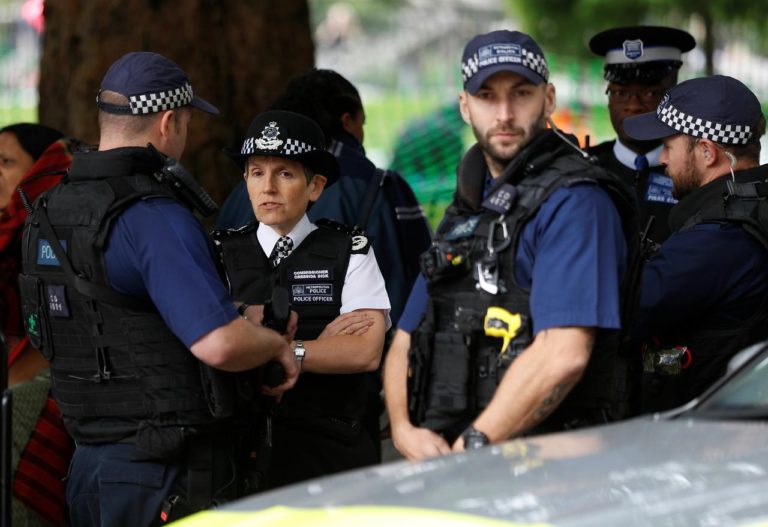
BRITISH police have frozen eight bank accounts containing a total of more than 100 million pounds ($121 million), which is suspected to have derived from bribery and corruption overseas.
Reuters reported that the National Crime Agency (NCA) said on Wednesday a London court had approved the Account Freezing Orders (AFOs), the largest granted to date, and that police would recover the funds if investigators proved it had been intended for unlawful use.
The NCA said it could not provide any details that could identify individuals related to the accounts.
AFOs and Unexplained Wealth Orders, that allow police to freeze assets until property owners account for their wealth, are part of a toolbox introduced last year to help stem a tide of suspected corrupt cash washing through the country.
London has long attracted corrupt foreign money, especially from Russia, Nigeria, Pakistan, former Soviet states and Asia, and the NCA estimates that around 100 billion pounds of dirty money are moved through or into Britain each year.
“The NCA is … seeking to … convince the NCA’s foreign counterparts that even if they cannot prosecute untouchable oligarchs at home, if they have assets here, these can be attacked,” said David Corker, a partner at law firm Corker Binning.
NOT LESS than six states across the Federation recorded 93 per cent of all confirmed cases of Lassa fever in the country, the Federal Government has disclosed.
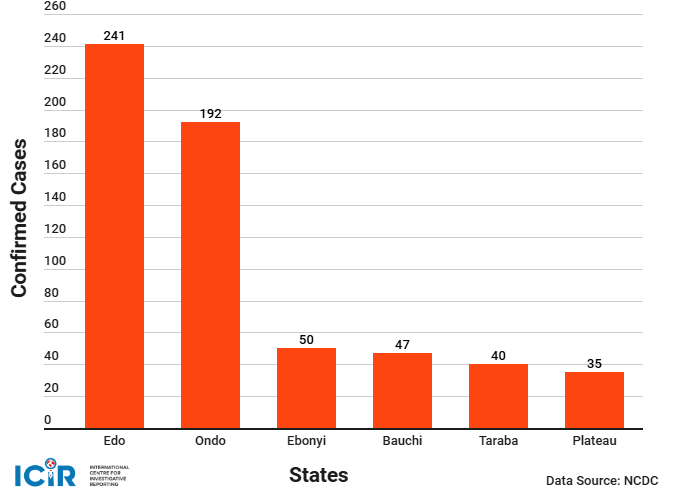
This casualty figure (93 per cent) accounts for 241 persons in Edo State representing 37 per cent, followed by 192 casualties in Ondo representing 30 per cent and Ebonyi state with eight per cent, directly placed on the Case Fatality Rate (CFR) with 50 confirmed cases.
While Edo and Ondo states shot-up far beyond the acceptable CFR margin, Bauchi, Taraba and Plateau fall below the fatality rate. However, the three states have so far recorded 46, 40 and 35 confirmed casualties representing seven, six and five per cent respectively.
According to the latest Nigeria Centre for Disease Control (NCDC) Situation Report on the Lassa fever outbreak, most recent among the casualties were 11 confirmed cases reported from Edo (7), Ondo (3) and Bauchi (1) between 29th July and 4th August.
The report also notes that since the onset of the 2019 outbreak, 145 deaths have been recorded from the confirmed cases.
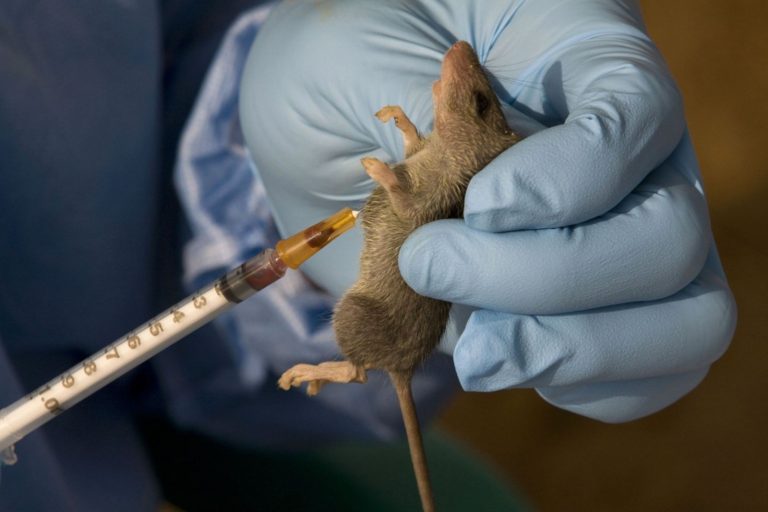
The World Health Organisation (WHO) describes Lassa fever as a viral haemorrhagic fever transmittable to human through contacts with household items already contaminated with rodents urine or faeces.
“Person-to-person infections and laboratory transmission can also occur…early supportive care with rehydration and symptomatic treatment improves survival,” it states.
Confirmed Cases of Lassa Fever in Six States in Nigeria as at 4th August 2019. Infograph by Olugbenga Adanikin, The ICIR
Since the outbreak, the federal government through the Federal Ministry of Agriculture and Rural Development, NCDC, WHO and other international organisations have deployed awareness creation measures to sensitise the public on how best to prevent the infection.
Moreover, from 1st January to 4th August, the federal government noted that 3,303 suspected cases were reported from the 22 states placed under surveillance by the NCDC. “Of these, 651 were confirmed positive, 18 probable and 2,634 negatives,” the report states.
The states are Edo, Ondo, Bauchi, Nasarawa, Ebonyi, Taraba, Federal Capital Territory (FCT), Adamawa, Gombe, Kaduna and Kwara.
Others include Benue, Rivers, Kogi, Enugu, Imo, Delta, Oyo, Kebbi, Cross River and Zamfara States.
The affected pre-dominant age-group according to the report is between 21-40 years.
“In the reporting week 31, no new health care worker was affected. A total of eighteen health care workers have been infected since the onset of the outbreak in ten States – Edo (6), Ondo (4), Ebonyi (1), Enugu (1), Rivers (1), Bauchi (1), Benue (1), Delta (1), Plateau (1) and Kebbi (1) with two deaths in Enugu and Edo States
“Sixteen (16) patients are currently being managed at various treatment centres across the country: Irrua Specialist Teaching Hospital (ISTH) treatment Centre (9), Federal Medical Centre, Owo (6) and Bauchi (1).
“A total of 8121 contacts have been identified from the nine states. Of these 745 (9.2%) are currently being followed up, 7,299 (89.9%) have completed 21 days follow up, while 12 (0.1%) were lost to follow up. 127 symptomatic contacts have been identified, of which 65 (51.2%) have tested positive”. It states further.
On May, WHO, development partners and the NCDC announced the end of the emergency phase of the Lassa fever outbreak in Nigeria since it broke in 2018 killing 129 persons.
The incident led the Federal Government to activate Emergency Operation Centres (EOC) across the 21 states, recording 578 confirmed cases as at 26th May.
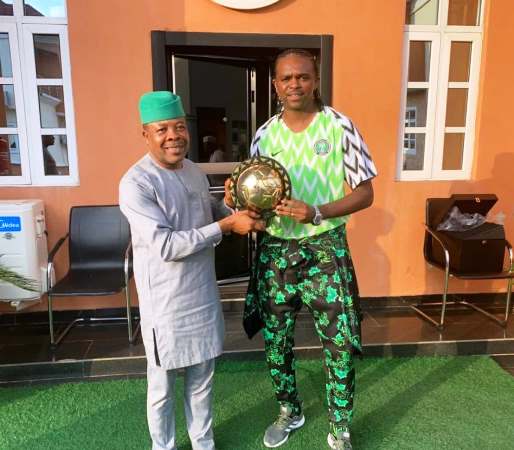
FOR his contributions in the sports industry, Emeka Ihedioha, has announced the appointment of Kanu Nwankwo, former captain of the Super Eagles national team as his Senior Special Assistant on Sports matters.
Ihedioha, a former Deputy Speaker of the House of Representatives gave the appointment when Nwankwo visited the Government House, Owerri the State Capital to present his most recent CAF award to the Imo State Government.
In a statement issued on Thursday by Izuchukwu Akwarandu, aide to the Governor on New Media, the football star visited the governor Wednesday, August 14th to make the presentation.
“The governor, Emeka Ihedioha, received one of the country’s football legends, Kanu Nwankwo, at the Government House, Owerri, on August 14, 2019.
“Papilo, as fondly called by his fans, came to present his most recent CAF award, which was given to him at the just concluded Nations Cup in Egypt, to the sports-loving governor of Imo State. The star also presented a branded jersey to the governor,” the statement reads.
“The governor while welcoming the former Super Eagles goal poacher, announced Kanu Nwankwo as his Senior Special Assistant on Sports.”
Aside from playing for the National Team, Nwankwo was a star player in Arsenal International Football Club before he retired from professional football career in 2010 following Nigeria’s exit from the 2010 World Cup in South Africa.
He took part in the 1998 and 2002 FIFA World Cups and also was recognised as African Footballer of the year 1996 and 1999.
Dana Air, owner of Sri Sai Vandana Foundation, a Non-Governmental Organisation (NGO) and WEMA Bank Nigeria may be prosecuted by the anti-graft agency for the airline’s inflight donation collected between 2014 and 2018 without following due process.
“The EFCC will take it up. We will investigate and prosecute the crime element once prima facie is established,” the acting spokesperson to the Economic and Financial Crimes Commission (EFCC), Tony Orilade told The ICIR.
Dana started Nigeria’s Sri Sai Vandana Foundation in 1995 and commenced the inflight donation in partnership with the Sickle Cell Foundation of Nigeria. But after the airline suffered amajor crash in Lagos in 2012 in which 153 persons died, it ceased the collaboration, ‘re-strategised’, and solely ran the inflight donations.
The ICIR earlier reported how Dana through Sri Sai Vandana Foundation, got the inflight donations between January 2014 and October 2018, raking in millions of naira deposited into the Wema Bank account number 0121291839 without due registration with the Corporate Affairs Commission (CAC), a prerequisite for complying with theSpecial Control Unit against Money Laundering (SCUML) regulations.
When asked if it is the board or the organisations that would be sanctioned, “The company itself,” the EFCC official added.
“When there is a vacuum that is when we will lift the veil.”
He further explained what he meant by ‘Lifting the veil’: “The company cannot run without humans. So, it is when everyone denies being members of the company that we go after the individuals.”
Envelop shared to passengers by Dana airline during flight. This particular envelope was collected by a passenger in April File Copy
In line with the Money Laundering Prohibition Act, it is mandatory every Designated Non – Financial Institution, DNFI, to register with SCUML in order to legally operate in Nigeria. This is not true
Drama at SCUML Headquarters
At the SCUML headquarters, the reporter inquired about the implication of an NGO not registering with the Unit and operating a bank account as Sri Sai Vandana Foundation did, and an official told the reporter that it is a “jailable offence”.
“Are you bothered about the years of imprisonment?” she responded when asked the likely jail term. “You are going to put the person into a big problem because they are all corporate. First, the account officer that opened the bank account is in problem because he has committed a criminal offense against the government.”
“How are you able to open the account in the first place when you don’t have the corporate document?” she queried.
SCUML is charged with the responsibility of monitoring, supervising and regulating the activities of DNFIs, which includes NGOs. In fact, the Unit works in collaboration with the EFCC for the enforcement of the provisions of the anti-money laundering law through the prosecution of non-compliant DNFIs.
SCUML’s responsibilities also align with the provisions of the Terrorism (Prevention) Act (TPA) 2011 and functions under the Federal Ministry of Industry, Trade and Investment provisions.
What the law says
Contravening the SCUML guidelines have some specific penalties, including “suspension or revocation of license, fines or imprisonment or both,” according to Sections 15 to 17 of the Money Laundering (Prohibition) Act 2011 (as amended).
It stipulates a maximum of 14 years jail term for an individual but, in the case of a corporate organisation, the law says such organisation would pay “a fine of not less than 100 percent of the funds and properties acquired as a result of the offense committed” and would also have its license withdrawn.
Precisely, the law defines the unlawful act listed in subsection (2) of the Act to include “corruption, bribery, fraud, counterfeiting, and piracy of products…or any other criminal act specified in this Act or any other law in Nigeria.”
As such,Wema Bank officials involved in Dana’s account opening process may as well be prosecuted by the anti-graft agency, as soon as SCUML forwards its findings to the EFCC.
The Federal Government set up SCUML in2005as part of measures to track illicit financial flow and monitor likely funding of terrorism activities to enforce the Money Laundering (Prohibition) Act 2011 (as amended).
But all through the years under investigation, findings revealed that Dana contravened the SCUML guidelines, the Money Laundering (Prohibition) Act 2011 (as amended), and yet succeeded in running a bank account with Wema Bank.
Acting EFCC Chairman, Ibrahim Magu File Copy
In June, Ibrahim Magu, the Acting EFCC Chairman during a workshop in Abuja described DNFIs assafe havens for money laundering and terrorism financing, due to poor supervisions and regulatory function. “As a result of lack of adequate supervision and regulation of Non-Profit Organisations (NPOs) and by extension DNFIs, criminals have now turned their focus on the DNFIs sector to perpetrate money laundering and terrorism financing,” said Magu, who was represented by Francis Usani, the Head of SCUML.
“The DNFIs has been identified as the most vulnerable sector in money laundering and terrorism financing because criminals no longer use conventional financial systems like banks to launder their ill-gotten wealth.”
DANA – It’s a learning process, we are committed to giving back
In response to questions from The ICIR, Kingsley Ezenwa, Media and Communications Manager of Dana Air said the entire situation was a learning process for the organisation, restating airline’s commitment to give back to the society. On why it failed to register the NGO, he rather emphasised on the zeal of Dana’s commitment to its Corporate Social Responsibility (CSR).
Kingsley Ezenwa, Dana Corporate Communications Manager Photo Source: Whistler NG
“When you work on certain things, you learn along the line,” says Ezenwa.
He explained further, “After the accident, we were not even carrying loads (passengers). We were trying to rebuild. We did not even do it [Inflight donation] in 2014 at all. We felt that as a management team, considering our commitment and the incident of 2012, we needed to focus on re-strategising our CSR.”
This was also his narration on reasons Dana terminated its partnership with the Sickle Cell Foundation.
“We looked at it, conducted research and felt cancer is something we should focus on; got organisations working on cancer awareness, so we adopted Project Pink Blue and started supporting them.”
“We have been supporting Project Pink Blue and it’s been like that since 2015.”
The spokesperson’s response apparently showed a lack of understanding between the airline’s charity work through Sri Sai Vandana Foundation and its corporate social responsibility, as he appeared to confuse the two.
When asked if Pink Blue Project, an NGO devoted to providing cancer awareness and counselling to Nigerians, Runcie Chidebe, the project director said, indeed, Dana Air had assisted it, by offering free tickets for some of its activities.
“Since 2015, we have been partnering with Dana Air and working together and it is amazing seeing corporate organisation support us from 2015 till today (July 22 2019). We are also working with them on a programme called Port Harcourt Cancer Walk. I just arrived from the Dana Air flight from Port Harcourt to Abuja.”
“I can’t really say emphatically now but they actually have been providing flight tickets for us, the medical team and our patients to receive medical treatments anywhere Dana Air flies,” the cancer awareness advocate said when asked specific amount the airline offered since 2015 till date.
A look into the NGO’s 2015 annual report, as at 31st July identified only five donors excluding Dana. The airline was only listed among the supporters.
Donors are those organisations and individuals that donate money to the Cancer-fighting group, while supporters are those who render free services or provide food for the NGO among other non-financial supports.
Prostate Cancer Awareness organised by Project Pink Blue with supports from Dana Air Photo Source: Dana Air
The 2016 annual report revealed that Dana also supported with free air tickets. The airline was excluded among the four major donors which include Tony Elumelu Foundation, Union for International Cancer Control, Pfizer Oncology and Civicus World Alliance for Citizen Participation. Dana Air tops the list of 18 supporters in the report, though there was no financial commitment.
In 2017, the annual report prepared by K. E. Onuoha and Co. (Chartered Accountant) showed 17 donors and Dana was also not part of the list. The following year, the report, prepared as at 31st July 2018 by the same auditor had a list of 17 donors. Only 11 made financial support including the United States Embassy, Nigeria. Dana Air was also not included. This understandably is part of the airline’s corporate social responsibility but it would be dubious for the airline to claim that it pays itself for these free tickets from donations by Nigerians meant for charitable purposes.
Asked how it was able to open an account with WEMA without registration, Ezenwa responded that his focus as a Public Relations (PR) person was not where the money goes but its right utilisation. “As a PR person, my focus is to ensure that the CSR is carried out, which is what the money is meant for based on the commitment of the organisation since 2012. And that’s why I’m giving you information on what we have done and what we will continue to do.”
“My business is not with how an account was opened but we have re-strategised our job to ensure the money is used for its purpose.”
He refused to comment on if Dana’s chairman was a director in WEMA, as it is assumed that the chairman used his position to open the purported account. “I am not aware of that,” he said.
However, Ezenwa made available pictures of projects, which he claimed were implemented by the airline either independently or in partnership with other NGOs. He also disclosed that the airline would henceforth send detailed reports to the email of the passengers on how the inflight donations are spent.
Project Pink Blue Cancer Awareness Campaign Supported by Dana Air Photo Credit: Dana Air
Some of the projects he listed include: Free breast cancer screening organised in partnership with the Project Pink Blue in 2016 at Lagos Television, Agidingbi, Ikeja; Walk, Race and Cycle Against Cancer 2017 organized by Project Pink Blue in partnership with Dana Air, on Allen Avenue, Ikeja Lagos; Free Prostate Cancer Screening, Awareness walk in Lagos 2018 and a few others.
Ajide Shola, Convener, Divine Eagle Support Ministry, was listed among those whose NGO was used to reach orphanages. The ICIR contacted Ajide via a text message after repeated unanswered calls and he listed the orphanages. They are Ijamido Children Home, Sango Ota, St. Monica Orphanage (Catholic Orphanage Home) Iju-Ishaga, Light for the Lost Orphanage Alagbado and Navidad Home for the Orphanage and Less Privileged, also in Sango Ota, Ogun State.
Divine Eagle ministry, he said, is the supporting arm of Divine Eagle Civil Solutions Limited but he refused to say if the NGO was registered. But findings by The ICIR revealed the company was registered but the NGO was not.
“We approached Dana Air when I organised this outreach for the less privileged in 2017 and they supported all the orphanages that came with bags of rice, household materials, toiletries, noodles etc.” Shola said. “We also organised the event in 2018 and Dana gave the same support. We are looking to approach them again, hopefully, this year. We hope to have more of passionate firm supporting the needy.”
However, he said ‘cash’ was not given to the orphanages. He also did not respond to other specific questions on how he received the bags of rice, the quantity and number of other items offered including pictorial evidence.
Checks on social media showed no information relating to the NGO. The only Christian group found on Facebook, which bears a similar name is owned by a woman based abroad and it has a non-profit arm known asDaughters of Esther Charity.
However, further searches revealed that Ajide does have a Facebook account in the name of Ajide Sola joseph (Divine Eagle), where he promotes the work of his ministry, including Divine Eagle Civil Solutions. However, there is no mention of any Dana Air supported activity or anything relating to the outreach to orphanages.
Ezenwa further listed support offered to a team of United States-based Doctors, led by Dr Mfon Essiet, a Nigerian based abroad, to engage in a free surgery in Uyo communities. “…Dana Air provided free round trip tickets for our medical professionals between Lagos and Uyo once we landed from USA,” says Essiet in a Direct Message sent to The ICIR via social media. She added all the Doctors were from the US. We got support for “12 round trip flights. Originally planned for 22 tickets but some team members did not make the trip.”
Mfon Essiet (with black top) alongside members of the team arriving in Uyo for the Surgical, Medical, Dental, Optometry Mission Photo Source: Global Image Foundation
Search by The ICIR also showed short footage of medical assistance and surgeries offered to 1,784 patients by her NGO –Global Image Foundation in Akwa Ibom State.
It further showed a similar surgical, medical, dental and optometry mission the NGO – Global Image Foundation held in Akwa Ibom state at St. Luke Hospital, Anua in late May.
“Join us! Seeking medical professionals and volunteers for our second annual surgical, medical, dental and optometry mission in Nigeria on May 27-31, 2019”.
Every other question asked especially on SCUML registration, compulsory filing to the CAC, SCUML and NFIU, he said they are being taken care of.
But, from the list of NGOs DANA claimed it supported, only four were registered while others are not. The registered ones are Ijamido Children Home, St. Monica Home for the Elderly, Light for the Lost Orphanage Home and Project Pink Blue – Health and Psychological Trust Centre.
The ICIR could not reach out to three of the registered NGOs as their contacts were missing from the company name searches conducted at the Corporate Affairs Commission (CAC). They were as well not visible on social media. They include Stella Ifeoma Willoughby (Secretary) Ijamido Children’s Home; Umunmwagho Omosede Onuwaje (Secretary) St. Monica Home for the Elderly and Lady Evangelist Glory Ebenezer (Secretary) Light for the Lost Orphans Home.
WEMA Bank remains indifferent on offence
Oluwafunmilayo Falola, Wema Bank Brand and Marketing Communications Manager Picture Source: Social Media
However, Wema Bank declined to comment regarding the allegations, except for a terse response by the bank’s Brand and Marketing Communications Manager, Oluwafunmilayo Falola, “…Please note that Ramesh Hathiramani is not on the board of the bank,” she wrote in an e-mail. The ICIR’s check showed that Hathiramani was a board member until 2014. This implies that Hathiramani left Wema as Director about six months after Dana ended its partnership with the Sickle Cell Foundation to start operating its inflight donation for Sri sai vandan foundation.
Falola referred The ICIR to the bank’s Chief Compliance Officer as the right authority to respond to the questions about account opened for Dana’s NGO. “Given that this issue involves account opening documentation, our chief compliance officer will provide a response in due course,” she said.
She, therefore, promised to inform the chief compliance officer to call back. Three days after, no response came from her or the compliance officer. The ICIR later sent a reminder, and she promised the Bank’s chief compliance officer would respond ‘soon’. On July 19, nearly a month later, there was still no response. Another reminder was sent and she replied saying, “In truth, we would rather you do not proceed with the story. Recall you had published one at a time and it really put us in a bad light, we would rather we do not continue with this line.”
The ICIR insisted via a reply to her email demanding an explanation as to why the bank opened the account for Dana’s NGO without the appropriate document, then she responded, “You have published this story in the past, are you republishing it?
“I do not have an update to the last time inquiries, except that Mr Ramesh resigned his appointment since 2014.”
“In response to your mail on Mr Ramesh Hathiramani, kindly be informed that Mr Ramesh Hathiramani resigned his appointment with the Bank effective July 31, 2014. He was a Non-Executive Director,” She earlier said in response to the question about when Hathiramani ceased to be a director in Wema Bank.
But as at the time of filing this report, there was no response from Wema’s chief compliance officer.
The ICIR also observed that as at July Dana still solicited and collected in flight donations from passengers for charity purposes.
Experts react
Barrister Uchena Amuleo, a human rights lawyer, described the operation of Dana’s NGO as deceitful which should be investigated by the anti-graft agencies.
“It is a fraud and criminal,” says Amuleo. “Since they were not registered, they could be picked and prosecuted. A lot of that is going on in Nigeria as we speak.”
“Are you sure they did that and were collecting money… It is a corrupt practice. We can write to ICPC so that they account for the money they illegally collected from people between those periods.”
Mrs Lauretta Ugwoke, a barrister opined it would be difficult to register an account for an NGO without the CAC registration, except, “maybe the bank made a preference for them.” But she doubted such a possibility. “Or they are using individual account or account of one of the trustees.”
“It is not actually legal because it cannot be traced back to the NGO. It is not the right thing to do because there won’t be any connection to it (the NGO).”
Hadiza Gamawa, Head, External Cooperation of the EFCC, during a recent event themed “Effective Implementation and Regulations of AML/CFT within the NPO Sector” called for a national risk assessment of the sector. She said it helps identify weaknesses and gaps within the system and also offers likely solutions.
She believed good compliance will foster more Foreign Direct Investments (FDIs) but regretted DNFIs ranked highest in vulnerability to money laundering in the 2016 risk assessment with a miserable score of 0.77.
Ibinabo Mary Amachree, Head Information and Data Management of SCUML, while doing an overview of relevant standards on AML/CFT, as it relates to NPOs, called for proper supervision as lapses could aid terrorist organisations that pose as legitimate corporate entities.