Home Blog Page 2326

WHO calls countries to scale up funds in elimination of hepatitis

THE World Health Organisation (WHO) has called on member countries to scale up investments in the elimination of Hepatitis disease.

WHO Director-General, Tedros Adhanom Ghebreyesus made this call on Friday ahead of the World Hepatitis Day coming up on Sunday, July 28.

By investing in diagnostic tests and medicines for treating hepatitis B and C, Tedros said countries could save lives and reduce costs related to the treatment of serious complications like liver cancer and cirrhosis (scarring of the liver).

“On World Hepatitis Day, we’re calling for bold political leadership, with investments to match. We call on all countries to integrate services for hepatitis into benefit packages as part of their journey towards universal health coverage,” said Tedros.

Viral hepatitis B and C affect about 325 million people globally, causing 1.4 million deaths. It is the second major killer infectious disease after tuberculosis. Nine times more people are infected with hepatitis than HIV.

A new study conducted by WHO published on The Lancet Global Health found that a total of $59 billion is needed annually in 67 low and middle-income countries to avert premature deaths of 4.5 million people by 2030. This means new hepatitis infections would be reduced by 90 per cent and deaths by 65 per cent.

WHO said as of today, 80 per cent of people living with hepatitis could not get the services they need to prevent, test for and treat the disease.

“Some countries are already taking action,” WHO statement read in part. “The Government of India, for example, has announced that it will offer free testing and treatment for both hepatitis B and C, as part of its universal health coverage plan” it added.

WHO also mentioned that the Pakistan government has also procured hepatitis C curative treatment at similarly low prices.

It urged all countries to invest in eliminating hepatitis through costing, budgeting and financing of elimination services within their universal health coverage plans. “…with 124 out of 194 countries developing hepatitis plans, over 40 per cent of country plans lack dedicated budget lines to support elimination efforts,” the health agency noted.

It also released online calculators  (www.hepccalculator.org and www.hepbcalculator.org) to help decision-makers in evaluating the cost-effectiveness of their hepatitis treatment programme. 

In Nigeria, hepatitis is a common disease. The WHO estimated that 11.2 per cent of Nigeria’s population is hepatitis B positive.

The figure indicates that 20 million Nigerians are living with the viral infection, meaning that one in nine Nigerians has this incurable but preventable disease. For hepatits C, which is curable, about two per cent of the population lives with it.

In 2017, former minister of health, Isaac Adewole expressed the determination of Nigerian government to eliminate hepatitis B infection by 2021.

Checking through the 2019 budget of the Federal Ministry of Health, N28 million was budgeted for the “acquisition of recombinant DNA technology for the local production of vaccines (HPV, hepatitis b/c, pediatric vaccines)”. No money was budgeted for the viral infection awareness.
Presidency assures efforts on release of abducted aid workers

THE presidency on Friday said efforts are being made to ensure the release of the six aid workers of the Action Against Hunger (ACF) abducted by suspected Boko Haram militants.

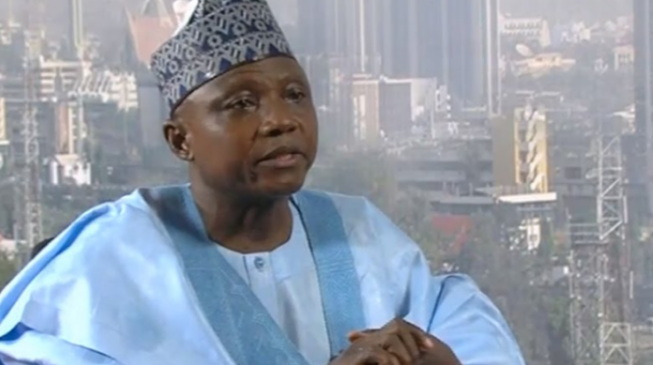
Senior Special Assistant to the president on Media and Publicity, Garba Shehu stated this in a series of tweets on his official Twitter handle @GarShehu.

The ACF staff were abducted on their way back from humanitarian fieldwork, at Damasak close to the border with Niger on July 18, 2019.

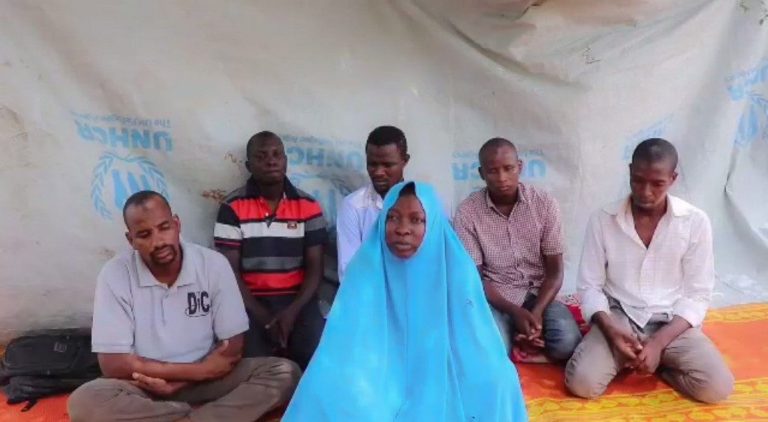
In a video released on Thursday, the six abducted workers were seen pleading to the Nigerian government for their release, quickly, before the unimaginable happens.

The presidential spokesperson however, said the government was making contacts, in the hope that the captors would have no reason to visit hardship or even harm on the innocent individuals.

He noted there has been engagement on previous cases on abduction, such as that of Leah Sharibu, a religious leader and many others sequel to the abduction of the ACF staff.

Shehu, however, said, that the latest incident had brought urgency to the efforts been made by the secret services.

“Presidency has been given assurances that contact is being made and the captors are being talked to,” he said.

The Paris based humanitarian organisation, ACF  had confirmed that the video released showing a woman and five men were their staff members.

ACF on its part had demanded the release of its staff members, noting that their abduction fully contradicts International Humanitarian Law and internationally recognised standards for the protection of humanitarian workers and organisations.

There have been reports that the hostages are believed to be held in an ISWAP enclave on the shores of Lake Chad.

Villagers said the kidnapped aid workers were seen with their armed captors passing through the villages of Chamba and Gatafo on the day of their abduction.

ISWAP is a splinter group of jihadist group Boko Haram that swore allegiance in 2016 to IS leader Abu Bakr al-Baghdadi.

It has repeatedly attacked military bases and targeted aid workers in northeast Nigeria.

Herders/Farmers Crisis: Stop illegal herders from crossing Nigerian border, Fayemi tells immigration

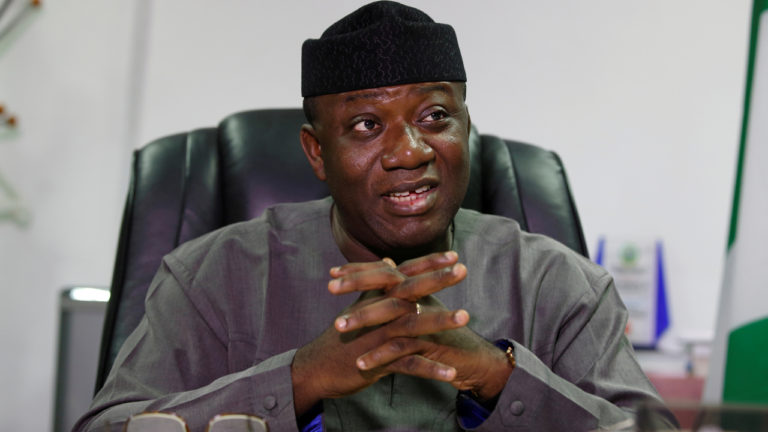
THE Ekiti State Governor, Dr Kayode Fayemi on Thursday advised the Nigerian Immigration Service (NIS) to ensure herders from neighbouring countries have the right travel documents, else they should be denied entry into the country.

The former Minister of Mines and Steel Development also said foreigners ‘must’ respect State laws against open-grazing where applicable stressing that trans-human crossing is inevitable.

Fayemi disclosed this while delivering a paper titled “Farmer-Herder Conflicts in Nigeria: Implications for National Security” at the National Institute for Security Studies (NISS) Executive Management Course, held in Abuja.

Human movement across our national borders is an inevitable occurrence and has been in place even prior to the adoption of the 1978 ECOWAS Protocol on Free Movement of Persons and Goods. Despite this, immigration authorities need to ensure that only persons with valid travel documents can cross borders with livestock,” says Fayemi.

“Where state legislations are in place to regulate grazing, those from outside Nigeria must respect the laws, and must conduct themselves in accordance with the relevant legislation.”

Nigeria is reported to have over 1, 400 porous borders considered to pose a security threat to the country, except for the 140 legal entry points.

As a result, the Federal Executive Council (FEC) chaired by the Vice President, Prof. Yemi Osinbajo approved N52 billion for the construction of electronic border points. The contract is expected to cover 86 border posts and the 1400 illegal routes.

The spate of insecurity in the nation has also been partially attributed to the problem of porous borders.

Meanwhile, Fayemi claimed that the nation loses $14 billion annually to the herders farmers clash, thus need for proper legislation from the Federal Government and the state to check the menace and loss of lives.

The governor who insisted that such laws would foster peace and unity said it would as well develop the nation’s socio-economic potentials.

“As political and policymakers, we must be humble enough to admit that the messaging around the farmer-herder crisis, in terms of being mindful of sensitivities and the use of polarizing terminologies and concepts leaves room for improvement.

“From the evolution of the discourse on major issues such as the Anti-grazing laws which have been passed into law in Ekiti, Benue and Taraba States, to colonies, the Ruga settlement phenomenon, the ranching options, we have not done enough to properly manage the various narratives or interpretations that emerged from this problem.

Had government at all levels accorded due priority to the right messaging and perceptions in these sensitive issues, the often useful ideas proposed to resolve the problems would not give been subjected to blatant misinterpretation and politicization,” he stated in a report by The Nation.


Don: Why children’s communication disorder persists in Nigeria

A professor of Linguistics in Child Language and Communication Disorder at the National Open University of Nigeria (NOUN), Shirley Yul-Ifode says there is lack of attention in the area of children’s communication pattern and disorder in Nigeria.

This, she explained has made the inculcation of societal values and traditions in the children difficult and thereby breeds the resultants social vices.

While presenting her Inaugural Lecture on the topic: “The Child Beyond the Breath of Life: Our Corporate Concern,” at the NOUN headquarters in Abuja, Yul-Ifode urged authorities and community leaders to prioritise the need to develop child language and continue to pay deserving attention to language disabilities and general communication disorder for a proper child upbringing.

The lecture, which the Vice-Chancellor of the university, Abdalla Uba Adamu, said was the university’s 14th in the series, was part of the requirement of any lecturer who attains the rank of professorship in the academic journey.

Yul-Ifode said the consequences of a communication disordered person transcend the communication activity, “because of the relationship between the developing child and his language, the medium of communication, which is an index of normal/healthy development, maladjustment, as well as some developmental disorders.”

“Any family that goes beyond the breath of life and pays attention to the language development of a child will be able to identify deviations not only in the communication patterns, when they arise, but also in other areas of the development of the child for early intervention,” she added.

She admonished parents to quickly provide help and support to a child identified with such disorders to minimise the effect of the attendant limitation placed on people with communication disorder.

The university don lamented that the various organisations involved with persons with disabilities have continued to operate in isolation in the country, leaving stakeholders with only occasions as World Disability Day, Children’s Day, World Autism Day to meet.

She advised that interdisciplinary and multidisciplinary forum should be organised to brainstorm on the way forward for the special children in Nigeria.

The NOUN Vice-Chancellor, Adamu, while commenting on the lecturer, described her as someone who took an unusual step presenting her Inaugural Lecture by developing her research into reality.

He urged the Faculty of Arts of the university to think of establishing a Research Centre of Communication Disorders, due to the critical need of such to address the ubiquitous instances of language disabilities and communication disorder.

Adamu said with about N90 million funds reserved for institutions based researches by the Tertiary Education Trust Fund (TetFUND), other faculties of the university should begin to develop ways of partnerships towards relevant researches on specific areas of learning.

He described the topic as apt, stressing that “we all faced language disorder in our lives and with our children,” which made the presentation “absolutely wonderful and inspiring.”


First freely elected Tunisian president dies at 92

0

TUNISIA’s President Beji Caid Essebsi is dead. He died at the age of 92 on Thursday after suffering a health challenge.

Essebsi was one of the world’s oldest leaders and a prominent figure in Tunisia since the overthrow of  Zine El-Abidine Ben Ali who ruled Tunisia for 23 years, autocratically in 2011, according to BBC.

He died at the Tunis military hospital in the morning, where he had been admitted at the hospital a day before.

Essebsi was reportedly suffering from serious health crisis as he was admitted in late June, spending a week and re-admitted on Wednesday but later died on Thursday.

Seven days of national mourning have been declared in the country. The speaker of parliament, Mohamed Ennaceur, will take over as interim president.

Parliamentary elections are expected to be held on October 6, and a presidential election on  November 17. However with his death, the elections scheduled could change, according to the country’s electoral commission.

They will be the third set of polls in which Tunisians can vote freely following the 2011 revolution.

Before his death, he had said in a meeting held by his political party called Nidaa Tounes Party that someone younger should be in charge of ruling the country, clearly stating he would not be running for the November 17 election. ” It is time to open the door to the youth, Essesi recently announced.

EFCC wants DPR’s support to dispose forfeited petroleum products, trucks

THE Economic and Financial Crimes Commission (EFCC), has sought the support and technical expertise of the Department of Petroleum Resources (DPR) in the disposal of petroleum products forfeited to the Federal Government of Nigeria by individuals and companies convicted of illegal dealing in petroleum products.

This request was made in Port Harcourt, Rivers State by Secretary to the EFCC,Olanipekun Olukoyede who paid an official visit to the  DPR, Port Harcourt Zone.

According to him, the EFCC needed the technical expertise of officials of DPR to sell off petroleum products carried by trucks forfeited to the government, as contained in a final forfeiture order recently granted the Commission by a Federal High Court sitting in Port Harcourt.

“We have a court order empowering the EFCC to conduct the sale of petroleum products carried by 244 trucks forfeited to the government,” he said.

“As you know, the extractive Industry is technical. We need your support in the process of disposal of the products. We need to determine the status and volume of the products. We need your technical expertise in this regard.”

Responding, Port Harcourt’s Zonal Coordinator of DPR, Bassey Nkanga thanked Olukoyede for his visit and expressed readiness of his Department to support the EFCC in carrying out the sale of the products.

“We know the importance of EFCC. We are ready to collaborate with you. That is what we have been doing and we will continue to do so,” he said.

The forfeiture of the trucks was contained in an order granted by Justice I. M Sani of the Federal High Court sitting in Port Harcourt, Rivers State on July 5, 2019.

Meanwhile, in furtherance of the assessment of the forfeited trucks to the EFCC, Olukoyede made physical sighting of the trucks in various locations at 6 Division, Nigerian Army, Port Harcourt.

He was received by officers and men of the Division who took him on a guided tour of the locations where the trucks are kept.

The Commission Secretary expressed satisfaction with the custody of the trucks and promised that the EFCC will liaise with relevant agencies to ensure accelerated sale of the trucks and the products they were carrying in line with court pronouncement.

Action Against Hunger asks for release of aid workers sighted in released video

INTERNATIONAL aid organisation, Action Against Hunger has asked for the release of its members of staff shown in a video released by the Boko Haram terrorists.

The Paris-based humanitarian organisation last Friday confirmed that a driver was killed and six other workers were abducted on Thursday July 18 when the terrorists ambushed their convoy when moving to Damasak in Borno State

In  a statement on Thursday, Action Against Hunger confirmed that a video released on the evening of Wednesday, July 24 shows a female Action Against Hunger staff member alongside five companions (drivers and health workers engaged in a humanitarian programme run by Action Against Hunger in Damasak region, Borno State).

It said they were “apparently in a good condition of health.”

“Action Against Hunger strongly requests that our staff member and her companions are released,” the organisation said.

“They are humanitarians and health workers and they chose to dedicate their lives to support the most vulnerable communities in Nigeria. They were only in pursuit of solidarity, humanity and neutrality.”

The organisation further noted that “their abduction fully contradicts International Humanitarian Law and internationally recognised standards for the protection of humanitarian workers and organisations.

“All Action Against Hunger teams and staff express their full support and comfort to our colleague and to her companions who are being detained, as well as to their families and friends.”

The video shows one of the aid workers, a female wearing a blue hijab.

Surrounded by five men believed to be her colleagues, the woman says her name is Grace, and calls on the Nigerian government and international community to intervene.

Grace in the video, recounted their ordeal on how they were kidnapped on their way back from a field mission.

“My name is Grace, I work with Action Against Hunger an NGO in Borno state. My base is Damasak. We went to work on Thursday the 18th of July 2019 outside Damasak.

“On our way to going back to Damasak, by Kinnari Chamba ward in Damasak we were caught by this army called the Khalifa. They brought us here and actually we don’t know where we are,” she said.

Holding back her tears, she said they all have families and feared being killed, calling on the ACF to do something about their freedom.

She begged the Nigerian government to act on their release, to avoid being killed as in the cases of some “ladies caught, Hauwa and Kabura, that were told to ask to be released but because Nigeria did not act they were killed.”

“I also want to call on Nigeria that we are Nigerians; we are also working for Nigeria. I beg that the Nigerian government should please, and please,” she said.

Grace who spoke on behalf of the other five male abductees, also called on the Christian Association of Nigeria (CAN) to help see to their release, as she is the only Christian among them.

No group has claimed responsibility for the abduction of the aid workers and the released video.

However, the footage of the abductees, according to THE PUNCH, authenticated by AFP on Thursday, was released through the same channel as previous videos from the IS-affiliated jihadists.

The hostages are believed to be held in an ISWAP enclave on the shores of Lake Chad.

The Islamic State West Africa Province (ISWAP) is a splinter group of jihadist group Boko Haram that swore allegiance in 2016 to IS leader Abu Bakr al-Baghdadi.

It has repeatedly attacked military bases and targeted aid workers in northeast Nigeria.

It’s over ten months after Saifura Ahmed, a UNICEF employee who was kidnapped alongside Hauwa Liman, was executed by Boko Haram in September, and Hauwa herself was killed on October 2018.

The Federal Government had been successful in negotiating the release of some Boko Haram hostages, including some of the Chibok schoolgirls, the University of Maiduguri lecturers, some policewomen abducted on their way to a colleague’s funeral, and abducted Dapchi schoolgirls.

But somehow, the government appeared helpless in the cases of Saifura Ahmed and Hauwa Liman.

Two other humanitarian workers still remain with the Boko Haram namely Alice Ngaddah, who was abducted in Rann alongside Hauwa, and Leah Sharibu, the Dapchi schoolgirl that was not released alongside her colleagues because she refused to convert to Islam.


GOODBYE: “Eager to learn, smart, shy”— friends recall moments shared with Precious Owolabi, slain Nigerian journalist

 By Yusuf AKINPELU

 BARELY two months to end his service to fatherland, Precious Ayoola Owolabi, 23, was slain on a ‘murder land’, in the vicious hand of a stray bullet that ruptured his stomach in a gruesome manner during a Shiites protest in Abuja.

As has become public knowledge now, he was a corps member with the Channels Television when his love for work and fatherland saw him to the land of no return.

Some have described July 22, a Monday, as a dark day in the history of journalism in Nigeria. It is more than that, especially for friends with whom Precious shared his days. It is a dark day in the history of Nigeria.

However, he had flickers of light which he had lit before he took his last breath. Hassan, a roommate of his and his best friend during his undergraduate years, is one of those flickers. Hassan could not hold back his pain to tell this to the world.

“For everything I have ever attained in life, Ayo (Precious) was there, life and direct,” Hassan wrote in a kind of dirge on his WhatsApp status. “For every dream I have ever had, Ayo was there. I couldn’t be there for my guy,” he lamented.

A similar grouse, another friend, Ekinne Olufemi, took to the doorstep of the president himself.

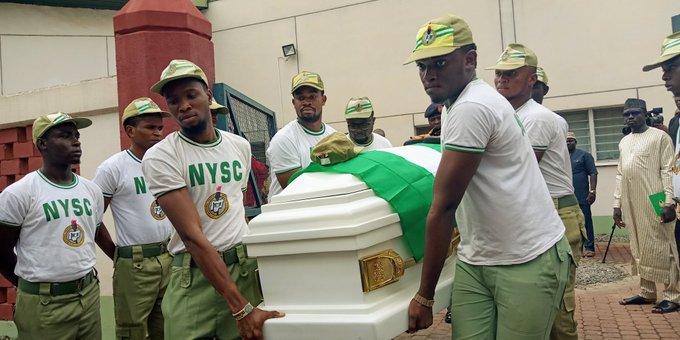
Body of Precious being conveyed in a casket from the mortuary by fellow corp members. Photo Credit: Twitter

Olufemi’s disappointment stems from the fact that Precious, who had an immense influence on his flair for painting was no more. Being a painter, Olufemi hardly believed in the art because it is stressful and doesn’t pay well.

“He’d tell me he is interested,” he said of Precious’ comment about his paintings. “He said he is in love with the technical aspect of the theatre and he wanted to learn. Even after telling him that the pay isn’t enough, he said he doesn’t want the money; he wants to do it for the fun of it. So before the resumption of final year we painted almost 15 hostels together.”

By all accounts, that was who Precious was: always eager to learn and to help. Again, Ayodele Oyindamola, another roommate of his in his school days recalled a scene between himself, Olufemi and Precious.

“I was surprised the day I called Phemozzy (Olufemi) that I wanted to paint my room and saw Ayo (Precious) behind him. I said “baba don see sey school no go pay again him won learn work” (he wanted to learn painting because schooling doesn’t pay as much). And he smiled and said “black fool, shut up. I am learning how to paint because I want to be a good technical director for my group.”

“He would have paid people to do this for him but because this guy is too kind he stoop so low to become an apprentice under his classmate just to make his group members happy. I am sure no one was available to cover that event and he took it upon himself to go instead.”

Very shy indeed he was that a classmate of theirs had a crush on him but he couldn’t talk to her. Olufemi had to broker a middle course in the matter. Possibly as a result of his shyness, he doesn’t take pictures. The only kind of pictures he takes are his shoes, fingernails, his friend, Oyindamola, told The ICIR.

This particular trait of his, plus his insatiable thirst for learning endeared him to many. While in the University of Ilorin where he graduated from in 2018, studying Performing Arts and Media, Bature, as he was popularly known then, was described by more friends with whom  The ICIR spoke with as one who was “gentle”, “kind”, “easy going”, “doesn’t behave like a regular guy”, “quick to say sorry”.

More than that, Ayodele Oyindamola, in fact, broadened the peep into Precious’ life more. Oyindamola described Precious as someone always ready to help, a cheerful giver. Although he graduated as a performing artist, Precious could not sing, act or dance well because he was shy and reserved. He makes up for this with his intelligence, equanimity, humility, and his writing dexterity.

“I have never seen Ayo talk back at anybody, nor fight. I could remember, vividly, during drama major’s visit to Lagos, Oyindamola said of him.

“He was close to me. We were dissing each and suddenly he asked me if I could help him tell the driver if he can drop and ease himself. I said no, that he should talk himself. Ayo said he does not want to disturb anybody.”

Precious was an indigene of Ibadan, Oyo State but was born and bred in Zaria, Kaduna. He spoke English fluently and understood Hausa better than he spoke it.

All these are in the past now. Precious has taken a bow into another realm beyond human comprehension. But he left us with issues we must learn to comprehend if more lives are to be saved and not lost.

One of such is what some media personnel have called protective wears for journalists covering humanitarian crisis scenes. Precious’ death has re-echoed the need to give this its needed attention.

Borne out of agitations for the release of Ibrahim El-Zakzaky, a foremost Nigerian Shiite cleric who was taken into confinement four years ago, Monday’s protest by members of Shiite Islamic Movement of Nigeria (IMN) is one too many. Precious’ death has shown that, in the interest of the nation, no time is better to resolve the conflict than now.

Precious’ memory may lurk in our mind for long — and may not. But what will certainly not be forgotten is that he died of a preventable death. How many more people will die before the government of the day thinks of changing its tactics in dealing with this conflict? Just how many more Precious soul will die?


YIAGA Africa criticizes exclusion of youths in ministerial list

THE Youth Initiative for Advocacy, Growth, and Advancement (YIAGA) Africa, has criticised the list of ministerial nominees sent to the National Assembly by President Muhammadu Buhari as lacking representation of Nigerian youths.

The advocacy group which among other stakeholders have been at the forefront of calls for inclusion of young people in the government said the ommision of youths in the ministerial nominees’ list negates the purpose for which the  Not- to-young- to run-bill’ was enacted into law

A statement by the Director of the group, Samson Itodo, said the absence of young people on Buhari’s ministerial nominee’s list was disappointing despite their giant stride in politics and leadership.

Itodo said the omission came as a ‘Big Surprise’, owing to public commendations of the youths by the president, as those who have left marks on entrepreneurship, sports, technology, and several other fields.

He noted that the president had ignited readiness in the youths when he said, “Young people of Nigeria are now set to leave their mark on the political space…” however, never “included any person below age 35, worthy of any ministerial position.”

According to him, while portfolios are yet to be assigned to the ministerial nominees, it was obvious from the list, the minister of youth and sports will not be a youth.

He noted that the emergence of young Nigerians in various principal positions in State houses of assembly exemplifies that credibility even in ministerial positions.

Itodo said while the country waits on Buhari’s cabinet is over, the wait for youth inclusion in his cabinet still lingers.

The group, therefore, called on state governor in the country to appoint young competent people with character and capacity to lead various commissions in the state.

It would be recalled, that the president on May 31, 2018, signed into law, the Not-to-young-to-run-bill, after mass agitation for the inclusion of young Nigerians into political positions in the country, spearheaded by YIAGA Africa

The bill, passed by the National Assembly last year, altered Sections 65, 106, 131, 177 of the constitution, aimed at reducing the age qualification for president from 40 to 30; governor from 35 to 30; senator from 35 to 30; House of Representatives membership from 30 to 25 and State House of Assembly membership from 30 to 25.

As compared to the post-colonial environment, which witnessed the emergence of young people, under 40 in government, including Aguiyi Ironsi (42), Yakubu Gowon (31), Murtala Muhammed (37) and Olusegun Obasanjo (38), the country after 19 years of democracy still experiences a huge gap in the integration of youths in key areas of her polity.

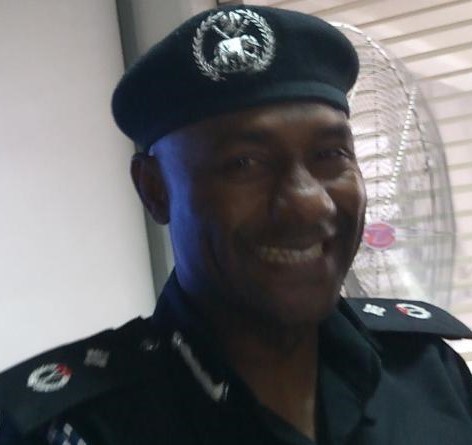
Late DCP Usman —the super cop who pacified protesters in May but killed in another protest in July


By Yusuf AKINPELU

THE agitation was rife. It was a protest for women right, and more importantly, human rights. Women, who were arrested in a raid on an Abuja nightclub, were allegedly raped by policemen using pure water sachet as condom.

The raid, which occurred in April, was carried out by the Federal Capital Territory Administration (FCTA) Joint Task Team, comprising of the Department of Development Control, Abuja Environmental Protection Board (AEPB) and the Social Development Secretariat.

For that, Nigerians— men and women alike— took to the roads of Abuja to vent their anger at the manner the raid was done, and women molested. With the tension high, and rage fierce, it was not the easiest of job to douse the running emotions in such situations. But one police chief, Usman Umar, a Deputy Commissioner of Police (DCP) did this with tact and finesse.

May this year, a Twitter user who tweets @aloinett shared a video  of him pacifying the agitated protesters. Speaking in the video, DCP Umar was seen swarmed by the protesters, some of whom placed him on record.

“They should be paraded,” a section of his interlocutor demanded, referring to the policemen found culpable of the rape allegations. To that, he responded: “This will be done as soon as possible.”

With the assurance well received, Umar tabled his own demand: “I’m also urging you… yes, so far so good, you have been very very law abiding. I will urge you to continue this way: being law abiding. Don’t take the laws into your hands. We are here to serve you. After all, we are paid with your taxes.”

“What’s the assurance that it won’t happen again?” came the question he was to deal with this time around.

“There’s no more assurance better than this one. We are telling you that those that did what has happened, if at all, we are able to prove it, will be punished. And (inaudible) we’ll not allow others to do it. This we assure you, please.”

Those words did the magic. So much that the Twitter user who shared the video hoped everyone else in the police force was like him.

“This is the moment when the DCP addressed us. He appeared to be a very gentle, patient, and soft-spoken man. He listened to us and responded respectfully. If only everyone else in the Nigerian Police was like him. #SayHerNameNigeria #AbujaPoliceRaidonWomen,” the tweet reads.

However, this was not to be in July when another protest broke out between the Nigerian Police and members of Shiite Islamic Movement of Nigeria (IMN). The latter agitate the release of their leader, Ibrahim El-Zakzaky, who has been in confinement for four years.

The police boss was reportedly on the scene to, as usual, pacify the protesters before horror struck through his head. Pictures of him available on Twitter is gory, to say the least. It shows a man whose head was ruptured, from the rare to the fore.

On learning about this, one of the protesters who was impressed by the tact he used in handling the May protest and tweets @ibrahimu14, tweeted:  “During our last protest regarding the arrest of some women by environmental task force in Abuja, DCP Umar was the one that received us at the command, gentleman to the core and a professional officer. Rest In Peace DCP Usman Umar.”

“The death of DCP Usman Umar really a sad one for me. He was a personal friend. He served as DPO Utako Division. Principal Staff Officer to the former Inspector General of Police, Head of Operations, FCT Command,” was how another described.

The late DCP Usman Umar has since been buried Tuesday, but Nigerians have not stopped wondering why the crisis is yet to be nipped in the bud.