Dr GHAJI Bello, Director General of National Population Commission (NPoPC), on Wednesday, said the Commission would use electronic enumeration method to determine the actual population of Nigeria.
Bello said that Nigeria presently has an estimated population of about 198 million people, adding that the commission was determined to conduct a reliable and accurate census in the near future.
The Director-General spoke with the News Agency of Nigeria (NAN) in Abuja ahead of the World Population Day on Thursday.
He called on the Federal Government to support the commission to conduct a comprehensive and reliable census to ascertain the country’s actual population.“We arrived at the estimated 198 million after elimination of all the variables like mortality rates,” he said.
According to him, the commission will capture people’s fingerprints in the coming census using machines programmed to reject any double counting. The Director-General noted that another round of census was long overdue, 10 years after the last exercise was conducted in the country. Bello, who expressed confidence in the capacity of the commission to conduct accurate census, called on government to make it realisable. NAN reports that the 2019 World Population Day would be marked in Abuja on Thursday.
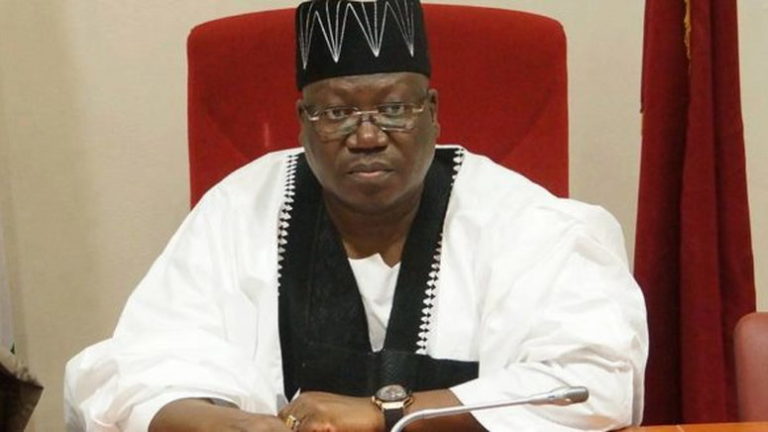
PRESIDENT Muhammadu Buhari might name his ministerial nominees this week, the Senate president Ahmad Lawal announced on Wednesday during a plenary session.
Over a month after President Buhari’s inauguration, Nigerians have been waiting for the list to be made public.
Senator Bassey Akpan representing Akwa-Ibom North-east had asked Lawan to compel President Buhari to carry out his constitutional duty on time.
“Based on our own calendar, I think we should be proceeding on our long annual vacation in the next two weeks and I also know that in line with your vision for a new Nigeria, you believe that we should return the country to January to December budget fiscal period.
“It means we have to put ourselves under pressure…There is a need for you to urge Mr President to send the list of ministerial nominees,” he said
Lawan assured the senators that the executive is working on the list and could transmit it before the end of the week.
“I think this is to inform this Senate that the executive arm is working hard to get the list to the Senate. I can imagine that before this week runs out, we could get the list. But I want to assure you that once we get the list, every senator here has shown the desire to stay long enough to screen and confirm the nominees in the interest of this country,” he said.
Buhari was re-elected four months ago, but the country has been without a sitting cabinet since the ministers serving during his first term stepped down in May.
In another development, the Senate asked its ad hoc committee to probe the recent Rivers State explosion and also extend its scope to last week’s pipeline explosion which occurred in Ijegun area of Lagos State.
The decision was arrived at due to the similarities and occurrence of the two incidents within the same period.
The senators observed a minute’s silence in honour of Nigerians who lost their lives in the Ijegun explosion. It also urged its Committee on Petroleum Resources when constituted, to intensify efforts on the Petroleum Industry Bill to discourage vandalisation of oil pipelines.
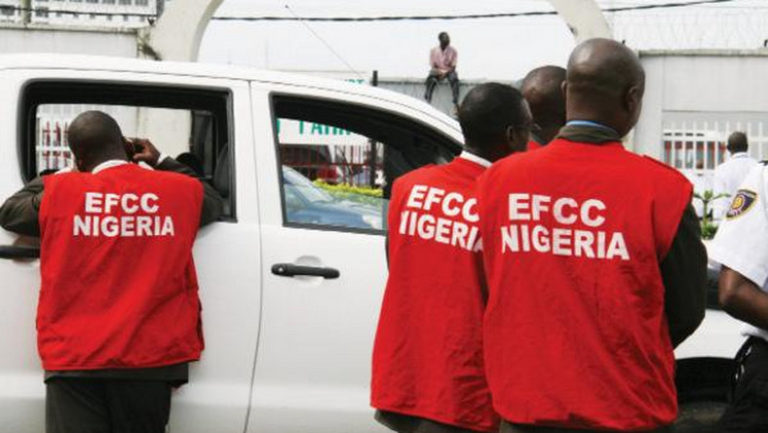
IN a court sitting today, Olubunmi Odeniyi, provost of the Ikeja branch, Nigerian Bar Association (NBA) has testified against Adesina Ogunlana and Yinka Farounbi, former chairmen of the branch whom the Economic and Financial Crimes Commission (EFCC) arraigned for stealing N20.1 million.
The commission disclosed this in a press release made available to journalists on Tuesday. The release was signed by Tony Orilade, the EFCC’s Acting Head of Media and Publicity.
Both Ogunlana and Farounbi were arraigned alongside Kappo Aderinola, a former Treasurer in May 22, based on a 30-count charge. The charges tantamount to conspiracy of committing felony, money laundering and stealing to the tune of N20, 100, 000, property of the NBA.
Farounbi functioned as Chairman NBA, Ikeja Branch between 2014 and 2016 with Aderinola serving as treasurer. Ogunlana was the branch boss between 2016 and 2018.
At the resumed hearing today, The NBA provost told the court that insurance premium funds paid by members of the association were not remitted to any insurance company during the administrations of the ex-NBA heads, contrary to their claims.
He said his investigation showed that both Farounbi and Aderinola, who were signatories to the accounts signed some cheques at different times without appropriate authorisation. While they also gave some cheques to Ogunlana, Farounbi’s successor, to cash fraudulently.
Continue in his testimony, Odeniyi said his claims were based on investigation he had carried out on the activities of the defendants. And he found out the abnormalities in the insurance premium funds during the tenures of the defendants.
But under cross-examination by the defence, Odeniyi clarified that his investigation was limited to findings on the insurance premium and not signing of cheques. And that he was not aware if Ogunlana signed some cheques after the expiration of his tenure as the chairman.
Another EFCC witness, Caroline Iwayoyanfe who is a former vice chairman, in her evidence narrated in the court that between 2016 and 2018, the executives rarely held meetings. When meetings held, she said there was never a time the defendants authorised the signing of any cheques or discussed such issues.
Iwayoyanfe noted that EFCC had called her to testify in court on the case.
“I was invited by the EFCC to talk and write regarding authorisation of some financial transactions and signing of cheques by the defendants,” she opened up.
“I went to the EFCC office and wrote a statement, informing the Commission that I know nothing about any authorisation of any transaction or signing of cheques carried out by the defendants.”
During cross-examination, Iwayoyanfe admitted that she was not aware of any payment to the first defendant’s account.
“The expenses of the Association were silently done by the second defendants,” she added.
Justice Mojisola Dada of the Special Offences Court sitting in Ikeja, Lagos, adjourned the case till Wednesday for the continuation of trial.
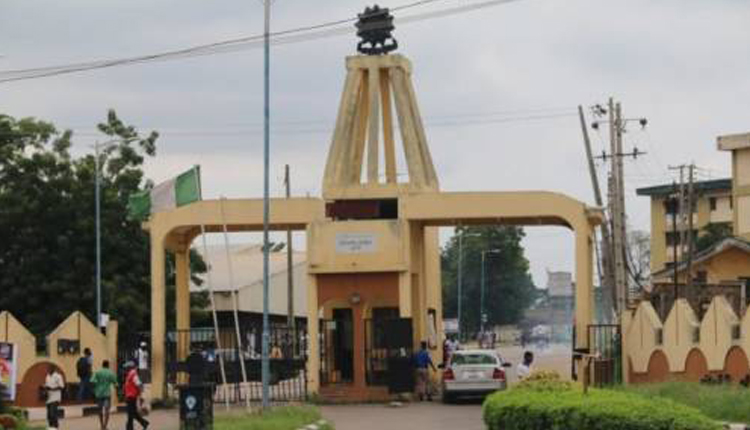
Aside cultism, extortion of students by the academic staffs of The Polytechnic Ibadan, Oyo state has been a major concern for a long time. But the story has been under-reported. In this part, Uthman SAMAD chronicles the corrupt practices of the academic staff of the institution revolving around extortion, sale of handouts at exorbitant prices and grade inflations amongst other rackets.
“BUYING handouts for this course is a prerequisite to passing your test, your ticket to entering for the exam. Pay to your group leader and he should bring the money to me. It’s just 1k [N1,000]”.
These were the exact words of Mr. Olubukola Adio during an early morning class of National Diploma II students of the Department of Mass Communication held in a one thousand- sitter lecture theatre of Ibadan Polytechnic in Oyo state.
Though the class was noisy, Adio’s message seemed audible enough for all the students in attendance as they all chorused their approval. This reporter waded through the teeming class of students to get a copy from the lecturer.
Adio who teaches Photography and photojournalism opened the boot of his Mercedez Benz 190 to hand over a bundle of handouts to the group leaders.
This reporter tried to pay Mr. Adio directly for the handout but was told by the head of the class in a low tone that the lecturer does not collect payment from individual students.
Sale of handouts is a norm at the Polytechnic Ibadan, and the practice has never been stopped by the school authorities or the Students’ Union, despite the fact that the management never approved of it.
According to one of the Students’ Union executives who pleaded for anonymity, the exco members frown at the sale of handouts, but none of them could confront the school authorities. Even when they do, by the time the executives are given their own share, everyone keeps quiet, he added.
The Polytechnic Ibadan was, established 48 years ago in Ibadan in the old Oyo State, with satellite campuses located in neighboring towns of Saki and Eruwa.
In 2014, the two satellite campuses became full-fledged institutions and renamed The Oke-Ogun Polytechnic, Saki and the Ibarapa Polytechnic, Eruwa respectively. Since then, different management has headed these institutions independently.
The Polytechnic, Ibadan is divided into north and south campuses and comprises five faculties housing 23 departments with over 19,000 students.
Buying of handouts as safe way to pass examination
Students who failed to buy handouts shared their experience with this reporter. Salam and Aderanti (last name withheld to protect them) narrated how they were sent out of the examination hall after they failed to buy a handout for one of their courses.
Salam, an HND 1 student of Public Administration recounts his experience while sitting for one of the exams during his final exam at National Diploma level.
“I have been seeing students talking about this in other departments but I was shocked when the lecturer was using handouts he sold to students as a pass into the exam hall,” Salam said.
“I begged this man for over thirty minutes out of the two-hour exam duration, until I had to run around to get the N1,000. I didn’t even get the handout, I just paid before I could be allowed to enter.
“We had always been told in classes whenever this man came that we should submit our assignments with the handout for grading. Those of us that didn’t buy the handout, our assignments were not collected, and we did not get a grade.
“This was during my ND1 second semester. We all thought it was a joke until we saw the reality when this man asked us to show our handout for the course before we could be admitted into the exam hall. My brother, we bought it all, and when there was no more handout to sell, the lecturer collected the money and admitted us into the hall,” Aderanti recounted her experience.
Also, a Public Administration student, Kabir, narrated how the Research Methodology lecturer came into the class and announced that no student would sit for his exam or test except such students purchase the Research Methodology textbook from him, and not from elsewhere, even though the school rule says that students should buy from the school bookshop.
“The lecturer made this declaration less than 3 weeks to the exam. Why not at the beginning of the semester if truly he loves us and wanted us to pass?
“They wanted to market the book indirectly because they know that the only way to do that is to force us to buy the textbook because no one will buy it after the exam. What they later did was that they forced us to buy the textbook from them. It was even a handout, but it was branded like a textbook. Our lecturer said without buying it, we were going to fail the course.
“Everybody was scared of failure at that time. But for me, I dared him that he should go on and do his worst. I could remember we sat for the exam at the 1000-capacity hall. When we got to the exam hall, surprisingly I was checked in, but others that didn’t buy the handouts were sent out of the hall.”
ND2 students of Mass Communication also confirmed that their lecturer, Mr. Adeniran told students to submit their assignment by a week after the exam, together with handouts for grading. This assignment costs 20marks.
Mr.Bamishaye Olatunji Abiodun, a junior lecturer of the department of Mass Communication teaches Newspaper Editing and Production and Public Relation Media and Methods.
When this reporter visited his office, he was caught telling one of his students that each handout for his courses attracts 20 marks.
Bamishaye Olatunji Abiodun, a lecturer at the Department of Mass Communication teaches Newspaper Editing and Production and Public Relation Media and Methods
This reporter witnessed how the ‘awoof’ 20 marks are awarded. Assignment question will be written on the first page of the handout of Public Relation Media and Methods by the lecturer. This means a student that fails to buy the handout will not be able to get the assignment question nor has the submission ‘grace’.
An investigation conducted across five departments of the institution confirmed this practice to be a norm.
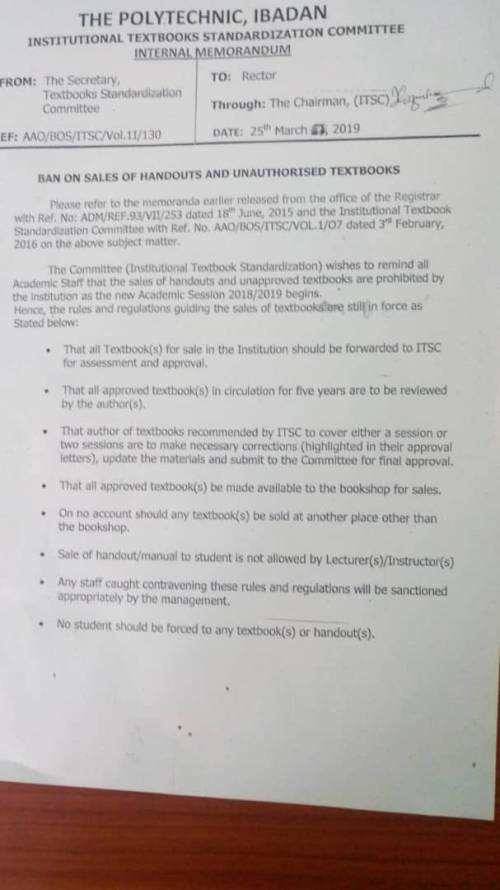
Investigation also shows that handouts are sold between N800 and N1, 500, and a student spends an average of N12, 000 on handouts in a semester, student sources told the reporter. And some of these mass- produced handouts are printed without reference pages or ISBN, but nobody cares. In an internal memorandum dated 25th of March 2019 with reference number AAO/BOS/ITSC/vol.11/130 signed by one Mrs. Agboola, the secretary of the Textbook Standardization Committee and sent to the rector through the chairman of the committee titled “Ban on sales of Handout and unauthorized Textbooks”, the institution prohibited the sale of handouts and textbooks.
Memo banning the sale of handouts in The Polytechnic Ibadan
It was also noted the approved textbooks by this committee should only be made available at the school bookshops and on no account should it be found anywhere else. The circular also shows that any staff that contravenes these rules and regulations will be sanctioned appropriately by the management of the institution as no student should be forced to buy any handout or textbooks.
But this is a good policy on paper because no lecturer has been sanctioned on account of handout sales, the students said.
Meet Ajao, the “Contractor”
Ajao, as popularly called by students, is a Mass Communication ND2 student of the Polytechnic. He is also the Public Relations Officer 2 of the student union, and popular among student especially for connection with lecturers across various departments.
This reporter met with Ajao and asked him whether he could help speak to a lecturer to upgrade his result in a computer course. The latter agreed and gave his number for future communication. Three days after, when this reporter called, he advised that the reporter should speak to the lecturer directly.
“Go and meet the woman, she is a close paddy, she said everyone should be coming to her.
“You will just buy the handbook we bought last semester again and you get your pass straight – abi wetin you want again?” Ajao said.
At the end of the discussion, Ajao promised to always help if the reporter runs into trouble with any of course in as much as he always cooperates.
How students pay for grade
On a Wednesday afternoon in June, this reporter joined a long queue of students who had problem with “Introduction to Computing”- a general course from the Department of Computer Science. The issues range from missing exam scores to omission of test scores.
“I have been here since 10 a.m., I don’t know those of us that have problem with this course are many,” a female student who was later referred to as Muibat by a colleague commented.
“You tell her your problem, you pay for the workbook and she pens down your name,” another student explained to her what to do when she is in Mrs. Ganiyu’s office.
Muibat was happy about the tip until she heard it would cost her double the amount paid for the same workbook. “I only have N200 with me now! I have been warned not to come home for this week again, I don’t know what to do right now,” Muibat lamented.
Hours later, the lecturer came out to say she would no longer attend to students by 2 pm. “Now you will have to take numbers. Only 15 persons will be allowed, the remaining will come tomorrow,” she said.
Without any means of identification, this reporter was counted as the number 7th person on the queue. When called in, “check your name on the list,” Mrs. Ganiyu instructed.
After two minutes checking for nothing in the list, the reporter told Mrs. Ganiyu that he couldn’t find his name. She then told the reporter to write his name with his matriculation number and pay to a lady by the corner in her office who was busy playing Bubble game on her Hot6 phone.
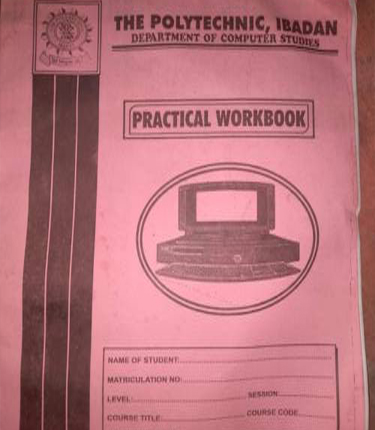
After writing a pseudo name and matric number, the reporter gave the lady by the door N500 as instructed by Mrs Ganiyu and collected a workbook. The 10-page practical handbook was sold N350 earlier in the semester.
A female student was also made to pay N500 to the woman by the office corner before she was given a workbook.
Workbook sold to students at N500 by Mrs. Ganiyu. Purchase of this workbook is a guarantee for higher grade
No Receipt, No File Submission
This is a popular phrase by the students of Poly Ibadan. Checks by this newspaper show that students are not allowed to submit registration form each semester until dues are paid in full.
Though school management has never made the payment of dues compulsory, students’ files will not be collected for submission except it contains all the receipts for the payment. This reporter observed the registration process and confirmed that forms are compulsorily submitted with receipts for various association dues.
A requirement for students registration issued by faculties
Section 40 of the 1999 Nigerian Constitution as amended states that membership of association and groups should be voluntarily and not by force as in accordance with the fundamental human rights.
The mandatory payment of fees and compulsory inclusion of association due proof of payment is, therefore, a breach of the constitutional provision.
A source confirmed to this paper that associations send part of their collection to the school management. “Don’t sweat on that. Even when I was here years ago, as a student, the system was like that. From a long time, there is these returns associations pay on accrued money to the management purse that’s why they continue to make It compulsory for students who want to submit his/her file,” the source said.
During submission hours at the Department of Mass Communication, this reporter was able to witness how the officer in charge emphasized the need for students to include all the listed receipts in their file.
Porous database
Aside this illegal collection by the academic staffs of the institution, this investigation also confirms the porosity of payers’ database in the institution.
Though tuition fee in Poly Ibadan is paid through the electronic portal, other dues are paid in cash. These dues range from students’ Union due, state of origin association due, the town of origin association due, religious organization association due, students’ departmental association due, students’ faculty association due, faculty association, amongst others. And some of the dues were paid for without proper accountability mechanism put in place.
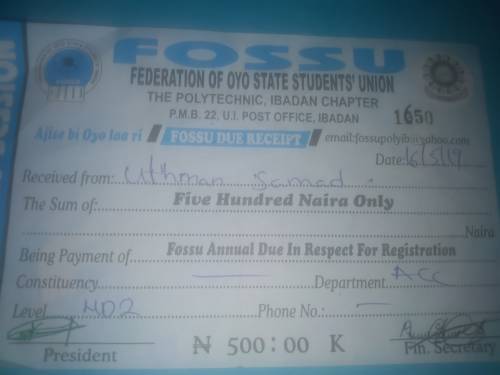
For instance, this reporter paid for the Association of Students Communicators, Department of Mass Communication (ASCOM) departmental due, Association of Students Communicators, Department of Mass Communication (ASCOM) Students’ Association due, Faculty of Financial Management Studies Students’ Association (FFIMSSA) due, Federation of Oyo State Students’ Union (FOSSU) due and Federation of Ibadan Students’ Union. These dues were paid by this reporter without matriculation number, only the payee name. And there was no database to validate the name of the payer.
Management denies, promises to investigate
In an interview with the Public Relations Officer of the institution, Mr. Soladoye Adewole he denied the management’s endorsement of selling handouts by the academic staff and distanced the management also from the compulsory payment of dues.
“It is illegal for anyone to sell handouts in The Polytechnic, Ibadan. And we have consistently maintained that and told students that if any lecturer sells or anybody attempts to sell, they should make a formal report. Even a memo was circulated to that effect. And this was made known to them during their matriculation orientation, that it is illegal for anybody to sell handout to them or intimidate them.
“I featured recently on inspiration FM and I told the whole world on the issue of the handouts in The Polytechnic. If they are doing that (students buying handout), that is stupidity, because the management had told them and insisted that they are not supposed to buy any handout from anybody.”
“I will be grateful if you can provide me with their information, they (lecturer) will be sent out of the system, this is very absurd. I can tell you we don’t know about this.”
When told about Mr. Bamishaye who grades assignments of only those who buy handout, Mr. Soladoye said: “This is very unfortunate; you have given me a name now, when I get to the office, I will investigate. The school knows nothing about the selling of handout?
When the reporter pressed further, he said: “I just told you now that it is illegal. You know they are not selling it for the management, they will not be selling it to the fellow lecturers nor the administrative officers, they are selling it to students and students have been told a thousand times ‘don’t buy handout from anybody’.
“If any lecturer has any academic material, the lecturer should submit such to the committee so that the committee ensures that they publish it as a book and any student that find it interesting will buy it and if not, it is not compulsory.”
However, while being quizzed about the management’s effort to halt the corrupt practices, the PRO, vowed that the management of Poly Ibadan would investigate the allegation of students.
“You are just giving me the information if I am able to investigate, the school will take action. Let me explain something to you, here in The Polytechnic, Ibadan, the students when they commit offense here, we have student disciplinary committee for it, also if a staff commits an offense, we have a disciplinary committee for senior staff and another one for junior staff. So nobody is above the law,” he said.
On the payment of arbitrary association dues, he said: “The institution has nothing to do with all these receipts like indigenous association receipt in student files. Nobody can force anybody to join any indigenous association.
“Apart from students’ union receipt, there’s no other receipt tenable in the file, all these religious body receipts and the likes are not made compulsory.
They are not supposed to pay because those payments have nothing to do with the institution. They are voluntary bodies. Either you pay the due or not, it is of no concern to the management.”
We are not selling handout- ASUP covers up for lecturers
One of the association receipts
A former executive member of the Academic Staff Union of Polytechnics, The Polytechnic, Ibadan branch who served during the last administration before being suspended by the management of the institution due to internal crises, said: “We are not selling handout. The Polytechnic, Ibadan is an institution of reputation and a first-class institution. The selling of handout has been abolished a long time ago.”
“I was a product of this institution, I was once a student here, even when I was a student, two or three decades ago no one sold handout.”
When he was shown proofs of lecturers selling handouts in the institutions, his position shifted, but not completely.
He said: “That’s very absurd! I don’t know about that. I am happy as an investigative journalist, you were able to say there are minimal or fewer cases of selling handouts in my department of Science Laboratory and Technology. Out of 12 disciples of Jesus Christ, there’s one Judas.
“If you have discovered anything or you have discovered any negative action, then notify the appropriate authority. I am telling you that there could be some black sheep among us but it is not every lecturer that sells handout. Our lecturers here are men of integrity. Majority of them that I know will not engage in such nefarious activities. I can’t claim ignorance of lecturers here selling handouts.”
Students Union sitting on the fence
The students’ union president, Akadiri Bayonle, has been evasive on allegation of academic corruptions in the institution. While on one side asserting that the lecturers sell handouts in the institution, he also denied being aware of it, hence contradicting himself.
He said: “I am aware of the fact that lecturers sell handout in some departments and not in some departments. What I mean is that it is not a general practice. I am not really aware of that at the National Diploma level. But I can tell you it doesn’t exist with us at the higher national level. The students’ union is not in support of it, and no lecturer should force any student to buy a handout.”
NBTE vows to investigate
The National Board for Technical Education, the institution that oversees polytechnics, monotechnics, and technical schools across the country, has frowned at the selling of handouts to students.
“The sale of handouts has been prohibited. That is why the Tertiary Education Trust Fund (TETFUND) has been giving them library intervention fund. So, there is no reason why they should sell handouts. No reason! It is not allowed. I can promise you the commission will take action. We will investigate and we will get back to you,” Masaud Adamu Kazaure, the NBTE secretary promised.
This report was done with support from Ford Foundation and the International Centre for Investigative Reporting, ICIR
MEMBERS of the Islamic Movement of Nigeria, IMN, Shiite sect on Tuesday stormed the National Assembly premises, clashing with police officers and other security operatives with the number of casualties yet to be officially ascertained.
The members of the sect who were demanding the release of their leader, Ibrahim El-Zakzaky, succeeded in gaining entry into the complex before allegedly disarming a policeman and used his gun to shoot two others.
The protesting members also damaged some vehicles including a police van in the complex, injuring a policeman in the process.
Manza Anjuluri, Federal Capital Territory, FCT, Police Police Public Relations Officer in a statement stated that officers of the police force had put the rising tension under control.
“The FCT Police Command has foiled a violent move by members of the El-Zakzakky Islamic Movement of Nigeria, IMN, to forcefully invade the National Assembly on Tuesday, 10th July 2019.”
“Members of the sect during the violent protest shot two (2) police personnel on the leg, while clubs and stones were used to inflict injuries on six other policemen. The injured policemen have been taken to the hospital for prompt medical attention.
“Meanwhile, forty members of the sect have been arrested in connection with the violent protest while investigation is in progress,” he stated.
El-Zakzaky has been arrested since December 2015 after soldiers clamped down on his supporters and killed at least 347 of them. The soldiers accused the Shiite group of blocking a major road that was to be used by army chief Tukur Buratai.
Since the December 2015 incident, El-Zakzaky and his wife Zeenah have been in detention, first without trial for about a year. They were eventually charged with murder for the death of a soldier during the December 2015 incident.
Dozens of other Shiite members have been killed in different protests mainly in Abuja and Kaduna since the December 2015 incident.
The security agencies have often accused the Shiites of instigating violence by using various weapons including petrol bombs, allegations the Shiites have denied.
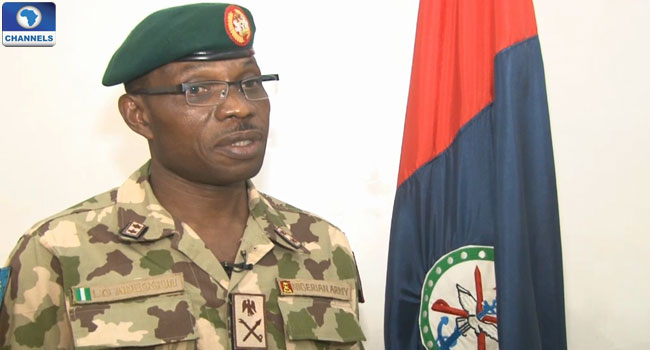
PRESIDENT Muhammadu Buhari has approved the promotion of Lamidi Adeosun, the Nigerian Army Chief of Training and Operations from major general to Lieutenant General which is the same rank with Tukur Buratai, the country’s Chief of the Army Staff.
This was made known in a statement released by the Nigerian Army on Tuesday.
Apart from Adeosun, Buhari also approved the promotion of Brigadier General Abdulmalik Biu who is the General Officer Commanding 7 Division in Maiduguri, to the rank of Major General.
According to the statement, the two senior army officers were promoted for their patriotic and committed role in ending Boko Haram insurgency in the country’s north-east region.
“The present administration of President Muhammadu Buhari has continued to demonstrate total and unflinching support to the Armed Forces of Nigeria in the bid to effectively contain the security situation in the country especially activities of terrorists in the North East,” the statement read in part.
“The two senior officers are Major General LO Adeosun, the Chief of Training and Operations at Army Headquarters who has been promoted to the rank of Lieutenant General and Brigadier General AB Biu, General Officer Commanding 7 Division and Commander Sector 2 Operation LAFIYA DOLE Maiduguri, promoted to the rank of Major General. Also, promoted to the rank of Captain is Lieutenant AJ Danjibrin of 211 Demonstration Battalion Bauchi.”
The Nigerian Army noted that the two officers displayed “extraordinary feats, courage, exemplary leadership, loyalty, uncommon commitment and valour in the counter-insurgency operation in the Northern region”.
Buhari charged them to continue to be shining examples to their colleagues.
Meanwhile, Buratai, on behalf of officers and soldiers of the Nigerian Army,has extended his best wishes to Adeosun and others promoted, the statement indicated.
Lieutenant General position of the Nigeria Army is the second most powerful rank, besides the General rank which is the highest. Until Adeosun promotion, Buratai was the only Lieutenant General of the nation’s Army, thereby holding the position of the Chief of Army Staff.
WHEN security footage showing him assaulting a nursing mother at an Abuja adult toy store got leaked last week, many were hearing the name, Elisha Abbo, for the first time. Very little was known about the 41-year-old senator and online searches didn’t offer much help either. Persons who have had interactions with him have, however, been opening up about what they know of the lawmaker’s unfamiliar past. One of them is Eunice Nkechi Ojukwu.
Eunice, Abbo’s sister-in-law and junior sister of his deceased wife, messaged after reading The ICIR‘s report about him. She had observed that her “late sister never had any kids for” him. What followed was a half-hour-long interview where she narrated the ordeal her sister, Uche Eucharia Ojukwu, went through before her death in 2013.
She felt offended after seeing Abbo’s televised apology. She thinks it was pretentious and full of lies, and this pushed her to finally speak up.
“[However] whatever I’m telling you now is what a dying person told me and the little I know about him when I saw him physically,” Eunice warns.
Domestic violence
Uche is the fifth child in a family of nine. She studied Economics at the University of Lagos and subsequently enrolled at an institution in Yola for a Master’s degree. It was while she participated in the National Youth Service Corps (NYSC) programme in Nasarawa that she met Abbo, whose first wife already had a son for him and left. Then in 2009, they got married in Mubi, Adamawa.
During their marriage, Abbo was said to be frequently abusing his late wife.
“On several occasions, my junior sister has been called to come, that my sister’s husband was hitting her and all that,” Eunice recalls.
“There was even a time they went there and he had torn her dress, brought her out half-naked in front of the compound, and locked her out. It was the neighbour who gave her wrapper to cover herself and all that.”
At another time, Eunice reports that her siblings told her, he brandished a pistol to scare them off, but the gun wasn’t found when a friend eventually arrived to help. “I wasn’t there, I can’t even tell. But I know the two can’t be lying against him.”
Whenever Uche was urged to leave her husband, she would insist on carrying her cross and trying to fix her marriage. The lawmaker’s in-law says, sometimes when she helped her sister to clean up, she would notice new scars. “She’ll be like one of those days,” she adds with a shaky voice and then sniffles.
“It’s just terrible. It’s just terrible,” she continues, still sobbing quietly. “It’s just terrible that somebody can do this to a human being and he’s just walking the street so freely, and he has the gut to come on national television and open his dirty mouth to say he is a Christian.
“I’ve never hated any human being in my life, but this guy I’ve hated him since my sister died, and I’ve always wished him dead. But I know I’m a Christian, I’m not supposed to be doing that.”
Infected with HIV, medical complications
When Uche and Abbo married in 2009, she had no idea he was HIV positive. He didn’t inform her. She told her elder sister that, when the issue was raised, he refused to go for a test with her. He later went to a different hospital and returned with a result. Uche kept having one medical complication or the other but eventually died of kidney failure.
When she was diagnosed with osteomyelitis “as a result of trauma to the bone”, Eunice put the pieces together and figured it must be as a result of the frequent assaults she suffered.
“An open wound from trauma (post-traumatic wound) over a bone can lead to osteomyelitis,” confirms John Cunha, a U.S. board-certified Emergency Medicine Physician. “With an open fracture, bacteria may come in contact with the bone that punctures through the skin.”
The condition has also been directly linked to domestic violence in a 2014 study. “When they brought up the issue, I knew he was molesting her, do you understand? He kept beating her and all that; so when they brought up this story about trauma to the bone and all that, I said it makes much sense because he was beating her. He must’ve caused it,” Eunice says, heaving a sigh.
She explains that it seemed the bone infection “then led to the anaemia she had”, which caused her to lose a lot of blood.
The Sexual Offences Bill, passed in 2015 by the Senate, criminalises the act of intentionally infecting another person with a life-threatening sexually transmitted disease such as HIV. Such person, it adds, “shall be guilty of an offence, whether or not he or she is married to that other person, and shall be liable, upon conviction, to imprisonment for a term of not less than twenty years but which may be enhanced to imprisonment for life”.
A husband (not) in need
At first, Uche received treatment at the National Hospital in Abuja. But then, her husband was “forgetting” to send her food supplies—sometimes a whole day, sometimes two days. When she called home, they would arrange for friends residing in Abuja to prepare food and give to her. Eventually, they knew she had to be transferred closer to home.
“On one occasion, she called and there was no food… the excuse he gave was he was going to watch a football match between Arsenal and I-don’t-know-what-other team. You understand that; so I don’t know which kind of human being does a thing like that,” Eunice says.
From April 2013 until death in October, Eunice stayed with her sister at the Nnamdi Azikiwe University Teaching Hospital, Nnewi, Anambra State. Not a day within those six exhausting months did Abbo visit. He also did not contribute financially to her treatment and “was busy gallivanting, campaigning for a position in Adamawa.”
“I didn’t even know how to go about it because I don’t know anywhere in the world. I couldn’t have gone to the north to find somebody. And I was the daughter of a nobody, so I didn’t know where to start. When my sister was dying, I put it up on Facebook and pleaded for money. Nobody answered me,” she says.
“All these things are now bringing back the memories,” she adds mournfully.
Their dad eventually had to sell his land to pay her hospital bills.
According to the sister, Uche’s last wish was not to be taken back to Mubi and to be buried there in Nnewi. This wasn’t what Abbo wanted though because, after she passed away, he requested for her corpse to be sent northwards.
“How would we allow him take her corpse away,” Eunice asks sobbing, “when he wasn’t even there when she was alive?”
Nigerians should know the truth about him
Eunice says she simply wants Nigeria to find out the truth about the senator. She also thinks someone like Abbo is not fit for the lawmaking role he has been placed in.
“In the Senate, you put people who are supposed to secure our rights and our dignity; not people who are animals like him,” she says.
“That’s not the first time he has done it and he has lied on national television that he has not done it before, but he will be doing it again and again. I swear to you, this he just did, Karma has just used that to bring him out. He’s going to do more. He’s going to do more.
“…What kind of human being does that? Then somebody screens him and puts him as a senator to go and represent us. Which kind of calibre of people do they screen and put into the Senate? Is that what it is supposed to be? They are supposed to be decent people.”
‘Not ready to disturb her rest’… Abbo responds
In response to a text sent to his phone, Abbo said he will not be reacting to the allegations levelled against him and looks to God to expose the plots.
“My brother, I am not responding to such allegations I read on the newspapers,” he wrote.
“My wife died about 7 years ago and I am not ready to disturb her rest. God that sees the hearts and intentions of men will expose this conspiracy.”
BEFORE the presidential election tribunal on Tuesday, the Katsina state chairman of the People’s Democratic Party (PDP), Salisu Maijigiri, testified that Atiku Abubakar, his party presidential candidate, polled the highest in Katsina.
Maijigiri said the results collated by the PDP in the state showed that Muhammadu Buhari of the All Progressives Congress who has since May 29 sworn in as the president, had 872,000 votes in Katsina.
This is in contrary to the result announced by Independent National Electoral Commission (INEC) where APC polled a total of 1,232,133. PDP, according to INEC, got 308,056 total votes. Thus, Buhari won in his state of origin after giving Atiku a difference of 924,077.
Atiku and the PDP have petitioned the tribunal on the result of the 2019 election, stating simply that Atiku won the 2019 presidential election held on February 23. The PDP had supported the claim with a result alleged to have gotten from the electoral commission electronic server.
At the presentation of the case today before the five-man tribunal led by Justice Mohammed Garba on Tuesday, the eighth witness who was Maijigiri said he served as the party’s collation agent in Katsina state for the presidential election. And he said the PDP won in the state after it secured a total of 905,000 votes, while APC had 872 thousand votes.
“We ( the PDP) are the one who won the election, not the APC,” Maijigiri said. “The APC scored 872,000 and PDP scored, 905,000.
“These are our own results we collated in our state not the ones from the server.”
According to INEC in February while announcing Katsina state result, the total number of accredited voters in the state are 1,628,865, while the total number of votes cast equals to 1,619,185. The total valid votes were 1,555,473: Buhari had 1,232,133 votes, Atiku got 308,056 votes. A total of 63, 712 votes were rejected.
When the Kastina result was announced by INEC in February, the PDP had rejected the result. The party alleged that there were some election irregularities committed in some local government areas of the state during the election such as uncustomised result sheets used to enter results.
“The world is debating local solutions to global problems using the Sustainable Development Goals (SDGs) and Agenda2063 as a benchmark in accelerating inclusive development that fosters economic growth” ~ Hamzat.
A MODERN state must be capable of providing socio-economic services; driving structural reforms and economic transformations, and mobilizing citizens for social change. Conversely, an underdeveloped state is characterized by (at least) the following dysfunctions: a hyper-centralization of authority and administrative decision-making; an over-dependent citizenry, powerless and incapable of serious engagements with political executives.
Inevitably, these dysfunctions produce corruption, clientelism and rent-seeking; neo-patrimonial redistribution of public resources; and opaque administration of coffers by officials which they consider a normal extension of their personal wealth. Indeed, great challenges present great opportunities!
In Nigeria, this is the picture of the Federal (central) government in general, and Local (grassroots) governments in particular. Public infrastructure in disarray; widespread and extreme poverty; and deep social inequality. Specifically, health care, basic education, economic opportunities, social protection, etc. are poorly delivered and/or broken. Critically, the situation is dire but neither hopeless nor incurable.
Since politics is local; solutions to broken politics are not unfamiliar principles. As far back as 1914, the British colonial masters had fully recognized the need for a local government system to serve as the foundation for a democratic political system at the centre. The system was to be efficient enough to run the services required by the people, representative so as to endure and local – close to the people, in order to be beneficial and meaningful.
Therefore, the local government system as we know it today in Nigeria can be traced back to the system of indirect rule instituted by the Lugard’s government in 1914. By simple logic, this was for convenience – to effectively govern the vast territory created by the amalgamation policy.
Consequently, in July 1975, as part of its political programme preparatory to the transition to civilian rule, the military government of General Murtala Mohammed announced a commitment to a systematic and deliberate re-organization of the local government system.
Accordingly, General Olusegun Obasanjo, who took over from General Murtala reinforced the policy that “the local government reforms are based on the need to stabilize and rationalize government at the local level which entails the decentralization of some functions of the state government to the local levels in order to harness local resources for rapid development and ensure grassroots participation in our developmental process”. For the first time, the local government was officially recognized as the Third Tier of government in Nigeria. Such was the spirit of Local Government Reforms of 1976.
The 1999 constitution of the Federal Republic of Nigeria (FRN) recognizes 774 Local Government Areas (henceforth LGAs). Financially, the LGAs are supposed to generate internal revenue through property, capitation and general rating. However, statutory allocation from the Federal and State governments form the main support of the LGAs. Under the current sharing formula, the Federal Government takes the lion’s share – 52.68% from the Federation Account. The 36 states take 26.72% while the 774 LGAs make do with the remaining 20.60%.
Howbeit, because the 36 state governments operate a State Joint Local Government Account (SJLGA) with the LGAs, state governors control the cumulative 48% of federation revenues that are allocated to the states and LGAs. Although the 1999 constitution of the FRN recognizes LGAs as the Third Tier of government, it is not treated as an autonomous body in a great number of respects. First, the functions performed by the LGAs in most states are those “permitted” by the state government rather than those specifically listed in the constitution. Second, the Federal government’s channelling of local government budgetary allocations through the SJLGA (instead of sending it directly to the LGAs) is a tacit subscription to the notion of non-autonomy. This provision – fiscal non-autonomy, became the bane of local government administration in Nigeria, up till today.
Potable water is a kind of luxury commodity for most rural dwellers. For domestic uses, water is sourced from open wells and consumed directly without treatment. A vibrant local government administration can end the water crisis and save thousands and/or millions from waterborne diseases.
It is in efforts to debottleneck the administration of LGAs and ensure financial independence that the Nigerian Financial Intelligence Unit (NFIU) Guidelines of May 2019 was pronounced by the central government. Prominent Nigerians and legal luminaries have expressed informed views – both in morality and constitutionality, on the new guidelines. Under the current revenue sharing (Federal Allocation) arrangement, and obvious constitutional technicalities, state governors possess tremendous fiscal power and freedom but little accountability in the use of the monies under their control. There are few checks and balances because state legislatures are typically weak. State governors exercise undue influence and most legislators serve, regrettably, as political pawns.
Surprisingly, the constitution provides for immunity for governors while in office, making it difficult (almost impossible) to hold them answerable and/or accountable. In the 20 years of democratic government (fourth republic) in Nigeria, only a very few governors behave in a fiscally responsible manner as required of them by Nigerian statutes. They run their cabinet meetings and conduct official matters (budgets, strategic policy documents, audit reports, etc.,) like occultism or esoteric organizations. As active citizens, if you insist on a few hard questions on fiscal transparency through legal instruments e.g. Freedom of Information Act 2011, some governors do not mind sending armed personnel against you – for intimidation and suppression.
An abandoned primary healthcare centre (PHC) in Mgbele community, Oguta LGA, Imo State. Funds were budgeted under Niger Delta Development Commission (NDDC) but the project remains undone. Reconstruction of abandoned PHCs can be properly handled by local governments but they often lack funds.
Generally, because of rabid politics, the legality of the new NFIU guidelines remains largely argumentative. In the meantime, permit that we defer the constitutionality of the policy to the courts since lawsuits have been appropriately instituted. Whatever the outcome of the judicial challenges, the moral foundation of the policy must not be hastily sacrificed. What is democracy without dividends? What is development without inclusion? Grassroots populations remain the most marginalized segments of the Nigerian society, abandoned and neglected in most instances. Propositions for fiscal autonomy of LGAs are not for semantics. From the history of national development, they are genuine and compelling. While they are not one-size-fits-all, it does possess potential as a game-changer.
For the second time, after 1976 Local Government Reforms, a government and/or regime appears passionate and committed to rapid and inclusive rural development seen by her policy interventions, notably by the National Social Investment Programme (NSIP) and Fiscal Autonomy for LGAs. The point is simple: the spirited intentionality of Fiscal Autonomy for LGAs to strategically cause a disruption in the administration of the financially-starved third tiers of government will surely accelerate grassroots revitalization and rapid rural development. Another laudable policy option that needs widespread public support and reinvigorated political will is Financial Autonomy of State Legislature and State Judiciary.
At this very point in our national life, one of the obligations we – patriotic citizens, owe those we have entrusted with political powers is constructive engagements. At one time, we rebuke bad public policies, at the other time we provide popular support for transformative reforms and public choices. Such is the spirit and the very essence of civic participation and democratic governance. For it is often said: precepts upon precepts, a house is built. God bless Nigeria!
In part 2 of this report, Evelyn OKAKWU spotlight the condition of the victims of poor administration of justice in Kaduna prison.
CHUKWUDI Onyeamachi was remanded at the Augwu police station, Enugu, in November 2018 for allegedly trying to poison his brother who was in police custody.
“How does one explain that the reason for his detention is an alleged attempt to poison his own brother and benefactor?” the 20-year-old said in a telephone conversation with PREMIUM TIMES after his release.
“I was shocked when I saw the charge,” he continued.
Mr Onyeamachi, however, said his real offence was protesting against a N2,000 bribe demanded by police officers at the station to allow him visit his detained brother in prison.
When he visited his brother, Ezinna, at the police station in Enugu State on August 26, 2018 to deliver food and anti-malaria drugs to the detainee, Mr Onyeamachi had hoped the visit would be his last and that his brother would be allowed to return home.
Mr Ezinna had been detained over a fight in public with another young man.
But at the station, Mr Onyeamachi said a female officer, identified as Uche O. A, who was the sergeant on duty, demanded N2,000 before he could see his detained brother.
“When I saw that they were bent on extorting me, I called Charles Ekene, who is a popular civil rights activist in my area.”
Mr Ekene was the first to inform this newspaper about his subsequent arrest along with Mr Onyeamachi.
He said he had advised Mr Onyeamachi to stand his ground on not give the bribe. He said when he arrived the police station, Mr Onyeamachi had been detained for two days.
To secure Mr Ezinna’s bail, the activist said the divisional police officer, Raymond Oguejiofor, demanded another bribe of N20, 000. Mr Oguejiofor retired from the force in September 2018.
Mr Ekene said he reminded the officers of the general information from the police that bail is free. He began calling the Rapid Response Team of the police to ensure the release of Mr Ezinna.
That action, considered an affront by the police officers, resulted in a fresh allegation against Mr Ekenne and the man he was at the station to rescue.
In an interview with PREMIUM TIMES, their lawyer, Fidelis Onuma, said the two were later arraigned “for allegations that they attempted to poison Mr Onyeamachi’s brother.”
The Enugu State Police Command, Amarizu Ebere, did not respond to calls or text messages by this newspaper on the allegations.
Messrs Ekene and Onyeamachi were charged before a magistrate court in Enugu State that August. They were later remanded by an order of the magistrate, Laurence Ukpai, in November, 2018.
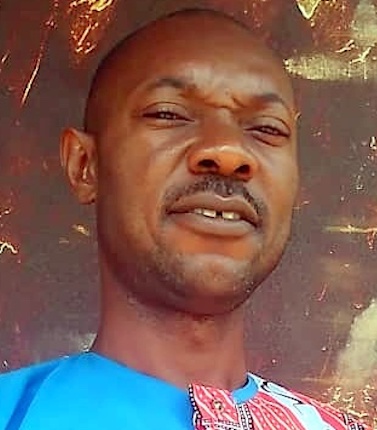
Charles Ekene, a prison inmate awaiting trial
They were detained till January, before their release after the prosecution withdrew the charge against them.
On his observations in the prison, Mr Ekene said: “Prison officials detain inmates for years without taking them to court, even when they have cases in court.
“They lock them up and would not go to court with them unless the prisoners pay for their transportation. If you dare to complain, they will beat you blue-black.”
Mr Ekene said he was beaten up in prison for the same reason.
He decried the general condition of the prison.
“Whenever the toilet is full, they ask inmates to go and clear the place. I don’t understand that,” he added.
UGLY TREND
Mr Ekene’s account is similar to those of 150 inmates this newspaper and a group, the Committee for the Defense of Human Rights, (CDHR), spoke within four prisons across Nigeria.
The inmates at the Kaduna Central Prisons, Kirikiri Minimum Prisons in Lagos, Warri Prisons in Delta State, as well as Kuje Prisons in Abuja narrated harrowing experiences in the prisons.
“The food we eat is not fit for dogs,” said an inmate who requested not to be identified,” he said.
“They give us watery beans in the morning, garri in the afternoon and, sometimes, Semo in the evening with a bad draw soup. Many of us try to find other ways of feeding ourselves because the food is just tasteless.
“We have nothing to wash our toilet. All we use is ash to try and reduce the smell. I have not spent two weeks here without having one infection or the other,” he added.
“We do various labour in this prison to make ends meet. But you cannot survive here, unless you have a kind of a godfather. These godfathers are inmates like us who have strong ties with some officers.”
Although efforts by this reporter to reach the female inmates was not successful, some prison officials who spoke with PREMIUM TIMES said their situation is not different. According to information provided by the Nigerian Prisons Service, the country’s prison population include seven per cent of women awaiting trial.
Prison Population
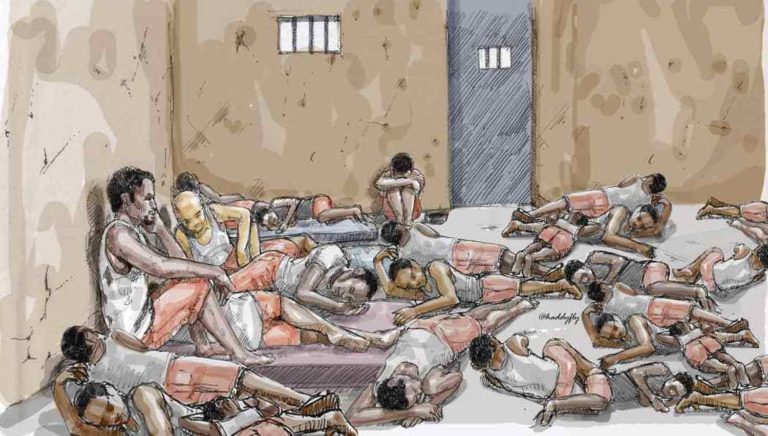
Nigerian prisons are overcrowded and are poorly equipped. PREMIUM TIMES’ and interviews with 150 inmates prove those challenges.
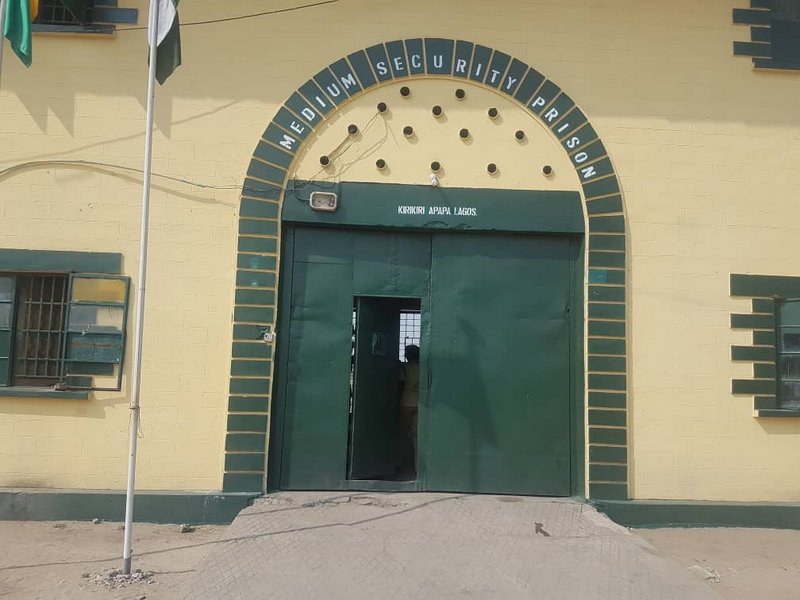
For example, the official record of the Kirikiri Prisons in Lagos gave credence to the claims of the inmates that they are forced to sleep on each other for lack of sleeping space. According to the records, the 1,700-capacity facility has 3, 912 inmates.
Kirikiri Medium Security PrisonFirst-Chart
108 of the 150 inmates this newspaper visited had been unable to contact their families for at least one month.
A 24-year-old inmate, Haruna Shuaibu, who has been held at the Kaduna State Central Prisons since February 2015, had not met his family till December 2018 when this newspaper spoke with him at the prisons. Another inmate, Bello Mainasara, 40, was also only able to contact his family after two years in prison.
Also, 106 inmates, or 80.3 per cent of the inmates, had a problem getting good lawyers. While some of them claimed to have been defrauded by some lawyers, others said they could not afford the fees of good lawyers.
Ninety-eight of the inmates, or 65.3 per cent of them, are within the ages of 19 and 35 years. Some were obviously brought in before they were 18.
The charges against most of those in the groups stated above ranged from robbery to drug trafficking, with the former being the reason for most of the arrests.
Many of the people in this group have been held for the failure of their families to provide their bail bonds or reach a reasonable conclusion on the requirements for their bail. One of such persons, John Odumare, who was accused of murder. He told PREMIUM TIMES that his co-accused had since been released on bail. That point was restated by his mother, Victoria Govina, in an interview with PREMIUM TIMES.
The remaining 52 inmates, 34.6 per cent, are within the ages of 36 to 55 years, with many of them held for alleged rape.
Out of the 73, 248 inmates in Nigerian prisons, 23, 373, or 32 per cent, have been convicted, while 49, 875, about 68 per cent, are awaiting trial.
More Challenges
This newspaper and civil rights group, the Centre for Social Justice (CSJ), observed that a common challenge inmates face is their cases being abandoned midway and their case files misplaced.
One of the lawyers with the CSJ, Gregory Okere, said he abandoned the case of Yusuf Umar, who is at the Kuje Prison awaiting trial because the man’s case file could not be traced.
“Mr Umar had told me that he was arraigned at the Jabi High Court. I went there with the hope that I would find his file, but after searching all the places I could think of, his file was nowhere to be found,” Mr Okere said.
The lawyer worked to ensure the release of nine other inmates from those visited during this report at the Kuje Prisons, Abuja.
Even in cases where the files are known and offences clearly stated, the causes of protracted detention in Nigerian prisons are endless.
PREMIUM TIMES had reported how 39-year-old Inalegwu Ochife was held by officers of the Special Anti-Robbery Squad (SARS) from January 2018 till April 2019 before a case was filed against him at a high court in Abuja.
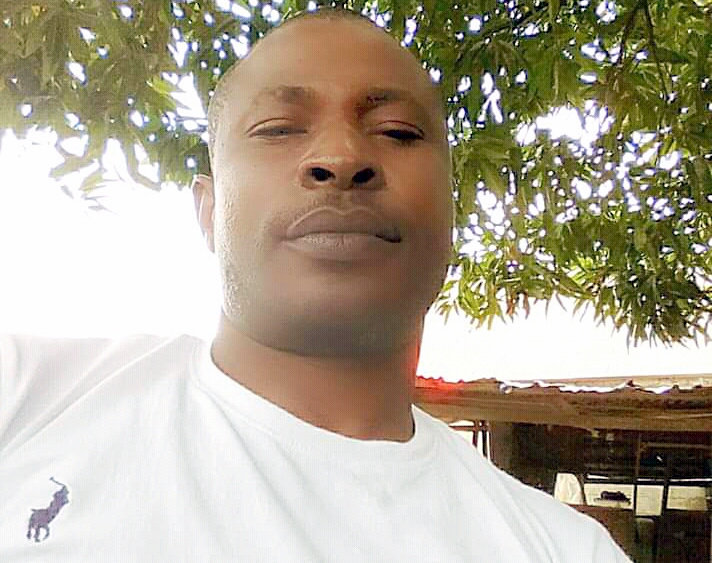
Inalegwu Ochife, a prison inmate awaiting trial
Not even a court order issued in October 2018 for the release of Mr Ochife was respected by the security operatives.
Mr Ochife and other accused persons were arrested for alleged robbery at the residence of the acting Chairman of the Economic and Financial Crimes Commission (EFCC), Ibrahim Magu.
After their arrest, the accused persons were detained for over two months before the police paraded them before the media for alleged robbery.
Over a year after that illegal parade, the suspects were left in SARS custody, without any charge preferred against them till April, when a fierce struggle by Mr Ochife’s family and lawyers for his release resulted in a fresh charge at a high court in Kwali, a suburb of Nigeria’s federal capital.
Reactions to Allegations
Responding to the issues raised by the inmates, the spokesperson of the Nigerian Prisons, Francis Enobore, said although some of the claims were being checked, most of the allegations could not be true.
“The prison population is such that you may have from 15 to 24 in a cell room; that is when it is not congested. A part of the room is carved out for their convenience. The door is usually a short door, not isolated from the toilet, for security reasons. And it’s always water system. It cannot be true that the toilet will smell so bad,” Mr Enobore said.
Mr Enobore was reacting to claims that some of the inmates are locked up in smelly toilets to serve as punishments, among other allegations.
He also refuted the allegations that inmates were made to clear the sewage cans when it is filled up.
“We have sewage trucks, I don’t know whether we will leave sewage trucks and ask them to start packing the toilet. Where will they take the waste to? However, when the sewage trucks are working, a few of them may be asked to join them in either controlling the hose, which any other person does. I have done it in my own house. And when they finish, they are asked to clear the place to keep it neat.
“You know that one of the natural odour killing instruments is charcoal. I do it in my house, so there is no big story that you are asked to use wood ash or charcoal to douse the smell,” Mr Enobore said.
According to the 2018 budget, N1billion was appropriated for the general maintenance of prisons across the country.
On the repeated complaints by the inmates about poor feeding, Mr Enobore explained how food is provided and distributed to the inmates.
“What the federal government approved is N450 per day. N300 for foodstuff and N150 for gas per person daily. The money was increased from N200 per inmate, per day in 2016,” Mr Enobore said. His explanation implies that government spends N100 per meal on an inmate.
Mr Enobore said that the service is currently embarking on a large-scale food production programme to reduce the burden of lack of food.
In the 2018 budget, N15, 335, 541, 250. 00 was allocated for general foodstuff and catering supplies for the service in 2018.
More Reactions
Regarding the allegations that inmates pay for their movement to court, Mr Enobore had this to say:
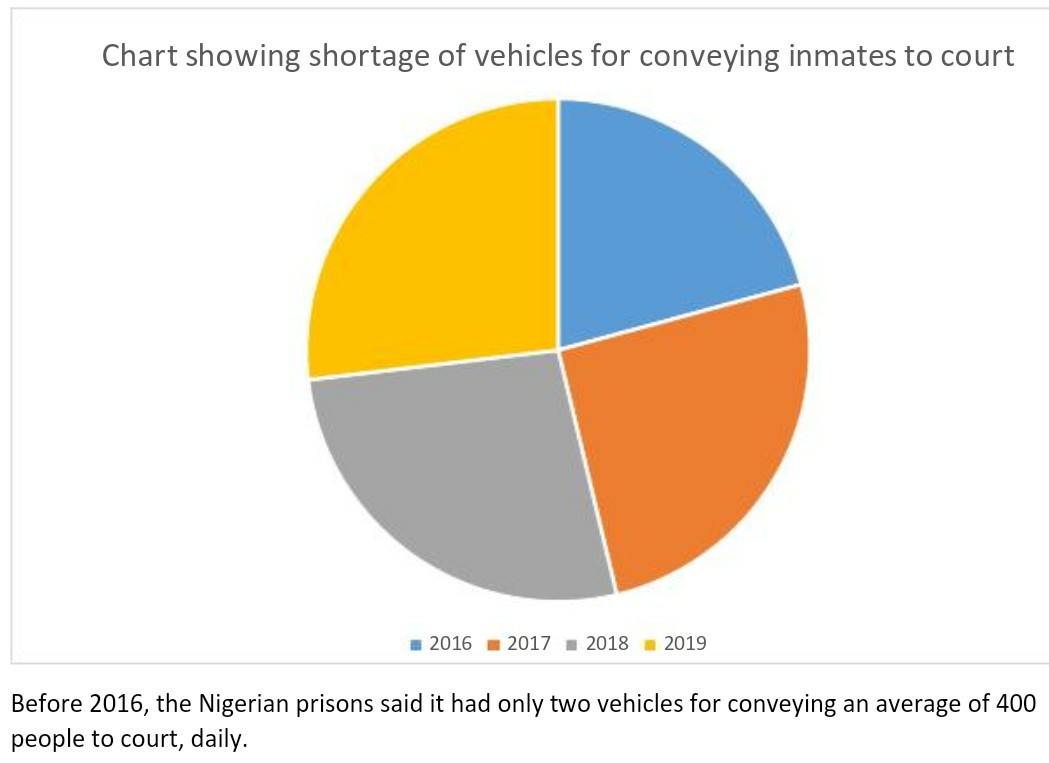
“We were having an acute shortage of logistics. In Kuje, for example, a prison that will need to take at least 400 inmates per day to court will have only two vehicles. You should know without much calculation that that is impossible.
“The officers in charge will discuss with the courts to fix the trials at dates that will make it possible to ensure that the inmates can come to court. However, their families will sometimes insist that they cannot wait till such a time. They were making arrangements for their inmates to be taken to court early.
“When they make such arrangements, we provide security even at the risk of our personnel’s lives. It continued like that until 2016 when the federal government gave us money to buy 217 operational vehicles, then we were able to increase our fleet. Then in 2017 we added another 49 vehicles and in 2018, we added another 115 operational vehicles. So I can tell you boldly that there is no prison where an inmate will be asked to pay for them to be taken to court. If you observe any such thing, call me,” Mr Enobore said.
According to the 2018 budget; N160, 000, 500 was allocated for maintenance of motor vehicles and transport equipment, across the country.
The spokesman added that the service has also made adequate provision for drugs so that inmates are not asked to pay for drugs whenever they come to the health centres within the prisons.
Absence of official data
PREMIUM TIMES wrote the Nigerian Prisons Service in November, 2018 for detail of inmates detained and those released in the last 15 years from the four prisons visited.
After tracing the letter in vain for weeks, Mr Enobore requested a more concise application for the said data.
A further request for a similar data, to cover five or ten years, was not granted by the service.
The subsequent letter was also lost between the statistics and operations units of the service.
The head of the statistics department maintained that he had sent the copy of the letter to the operations unit for further actions. At the operation’s unit, the officer in charge, Abubakar Talba, however, told PREMIUM TIMES that the letter was not in his office.
Justice Ministry evades comments
In a similar vein, the department of the Federal Ministry of Justice responsible for prison decongestion declined responses to calls text messages and emails by this newspaper regarding its efforts.
At a meeting with the head of the decongestion unit, Leticia Eniola-Daniels, she asked this reporter to send an email containing our inquiries to the official email address of that office as well as her personal mail.
After weeks of calling and texting her, Mrs Eniola-Daniels failed to respond either to the mails or to subsequent messages sent to her phone line.
This investigation was supported by the Institute for War and Peace Reporting and the International Centre for Investigative Reporting (ICIR).