Home Blog Page 2334

Nigeria rakes in over USD $25bn dollars in export value, spends close to $10bn on imports within eight years in West- Africa

NIGERIA is considered the largest economy in Africa with a Gross Domestic Product change rate of 1.9 per cent in 2018 and projected to hit 2.1 percent by the International Monetary Fund in 2019, thereby making her a huge potential beneficiary of African Continental Free Trade Area (AfCFTA) agreement.

Globally, The Observation of Economic Complexity ranked Nigeria 49th in the world with an export value of about $47billion and 58th in the world with an import value of $34.2billion.

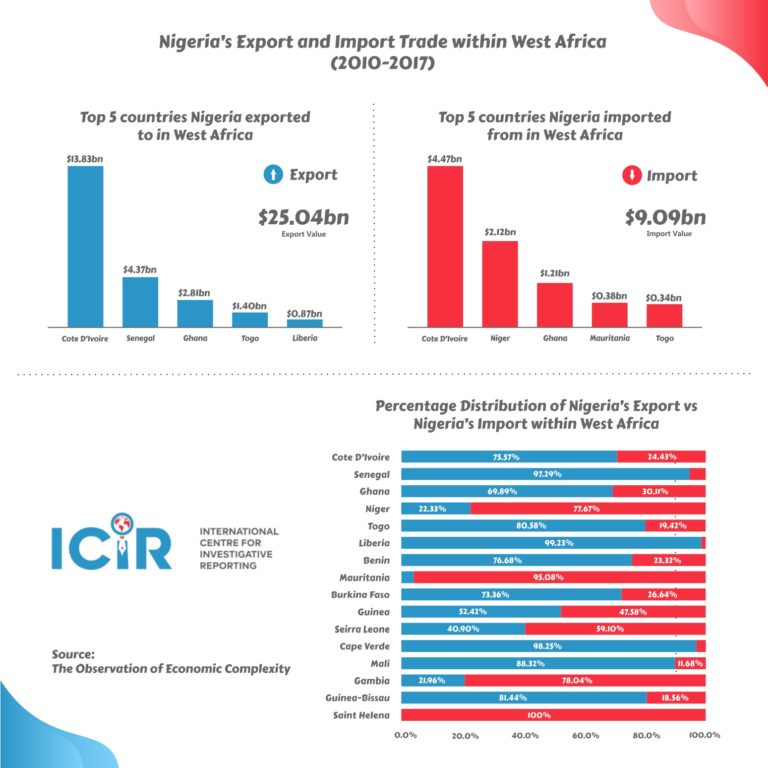
In West-African, from 2010 to 2017, Nigeria raked in over $25 billion from her export activities with other West –African nations. Cote D’Ivorie comes top amongst nations to which Nigeria sell, contributing a total sum of almost $14billion dollars, followed closely by Senegal at over $4billion dollars, Ghana at $2.8billion, Togo $1.4bn and Liberia, $870million.

The countries make the top five West-African states from which Nigeria benefit more doing business with.

However, with Nigeria as a signatory to AfCFTA,  the country’s level of importation is expected to rise even as her exports gain momentum as lesser tariff plans would make the movement of goods amongst the borders easier and predictably would lead to more imports into Nigeria for her teeming population.

Also, in eight years, Nigeria had spent almost $10billion dollars on importations within the region. Cote D’Ivoire tops the list of five countries from which Nigeria imports in West Africa, with export values amounting to $4.47billion, followed by Niger, $2.12billion; Ghana, $1.21 billion; Mauritania $383million; and Togo, $338million.

‘‘As African leaders, our attention should now focus on implementing the AfCFTA in a way that develops our economies and creates jobs for our young, dynamic and hardworking population

‘‘Our consultations and assessments reaffirmed that the AfCFTA can be a platform for African manufacturers of goods and providers of service to construct regional value chains for made in Africa goods and services,” the Nigerian president had said after signing the trade treaty in Niamey, Niger on 7, July 2019.

Nigeria also recorded 100 per cent of importation ratio from Saint Helena, Mauritania 95.08 per cent, Gambia 78.04 per cent and Niger 77.67 per cent from 20110 -2017.

With the import ratio rate recorded with the British overseas territory, Nigeria has however never reported exports to the territory.

GT Bank clinches Euromoney best bank award in Africa

GUARANTY Trust Bank Plc on Wednesday was named the Best Bank in Africa 2019 by Euromoney at its annual Awards for Excellence which held at the Hilton Hotel, Park Lane, London.

The Nigerian Bank was also named the Best Bank in Nigeria for a record ninth time, reflecting the Bank’s position as one of the best managed financial institutions in the country.

Segun Agbaje, the Chief Executive Officer of the bank, in his vote of thanks said that the award for the financial institution serves to indicate the progress been made to ensure the delivery of the best banking experience that captures what customers want.

“They are also a testament to our leading role in driving world-class corporate governance standards, excellent service quality and innovation in Africa’s banking industry.

“At GT Bank, we are passionate about building the bank of the future by leveraging the best of technology to add real value to our customers’ lives, and these awards illustrate the hard work and commitment of our staff, management, and board towards achieving this goal,” Agbaje added.

GT Bank brand is regarded by industry watchers as one of the best run financial institutions across the continent and serves as a role model within the African financial service industry.

The bank, reportedly recorded modest growth in key performance indicators for the full year 2018 with profit before tax for the 12 months rising to N215.59 million.

Key financial extract of the bank last audited report and account for the year ended December 31, 2018, showed that that gross earnings rose to N434.7 billion in 2018 as against N419.23billion recorded in 2017.

It boasts of an assets base of $6.8 billion, making it one of the biggest banks in Nigeria.

GT Bank’s assets are worth about $11.77 trillion.

DBS was named as the world’s best bank for 2019, while JP Morgan won world best investment bank of the year and Andreas Treichl, the chief executive of Austria’s Erste Group, was named Euromoney’s banker of the year. Erste’s Treichl recognised as the banker of the year.

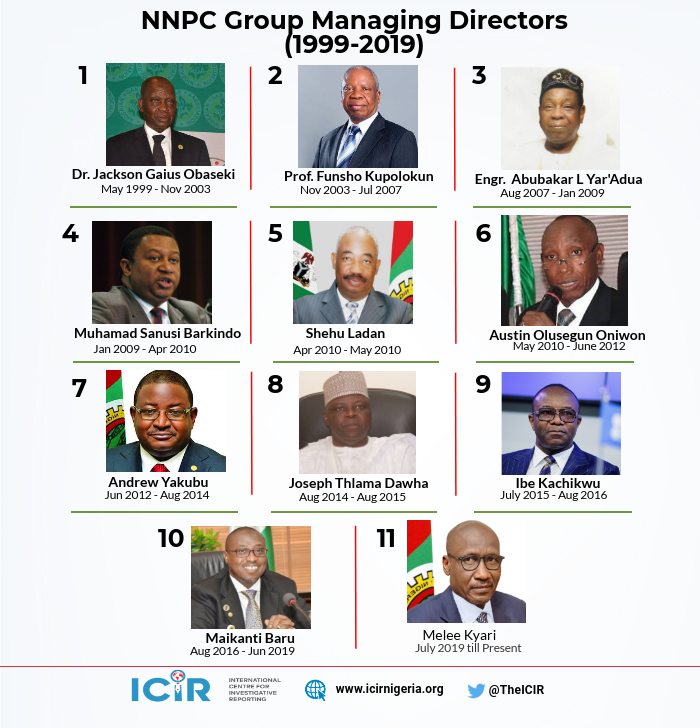
GMDs of the NNPC who had managed Nigeria’s oil “cash cow” since 1999

THE newly appointed Group Managing Director of the Nigerian National Petroleum Corporation, NNPC, Melee Kyari, on Monday, took charge as the boss of the national oil company.

With this appointment, Kyari joins the long list of Nigerians who had held sway at the NNPC since Nigeria’s return to civil rule in 1999.

The ICIR profiles the eleven Nigerians who have managed Nigeria’s state-run oil firm from 1999 to date.

Jackson Gaius Obaseki (May 1999- November 2003)

Gaius-Obaseki served as Group Managing Director of the Nigerian National Petroleum Corporation, NNPC, from May 1999 to November 2003. He hails from Edo State and graduated from the University of Ibadan, having studied Geology.

He joined the NNPC in 1972 and rose through the ranks until he was appointed Group Managing Director of the corporation in 1999.

Obaseki changed NNPC’s external oil marketing strategy and, acting on President Obasanjo’s order, he announced the cancellation of all annual sales contracts for crude oils and fuel oil. Obaseki’s aim was to cut out the middlemen and limit term contracts to bona fide end-users and large volume traders.

Funsho Kupolokun (November 2003 – December 2007)

Born in 1947, he holds a first degree in Mechanical Engineering from the University of Lagos where he studied as a Shell scholar in 1971.

He was on training attachment to the Algerian National Oil Company where he worked as Production Engineer in Sahara Desert Oil field of Hassa-Messand from 1973 to 1974 before joining the Nigeria National Oil Corporation currently the Nigerian National Petroleum Corporation, NNPC.

Occupying strategic roles within NNPC, which includes Head of Special Projects in the NNPC JV, Head of Petroleum Engineering Department, Group General Manager and Head of NNPC’s London office, Group Executive Director, Commercial & Investment.

He was instrumental in developing a fiscal policy document famously known as MOU, to salvage the economy when a crash in oil Organisation of Petroleum Exporting Countries, OPEC,  price structure resulted in low prices.

The structure guaranteed a steady income for the country and encouraged operations to thrive for the low operating cost to promote efficiency in the industry and earnings from oil operations.

Appointed as Special Assistant to President Olusegun Obasanjo on Petroleum Matters in 1999, he was subsequently appointed the Group Managing Director of the Corporation in 2003 to drive the reform of the oil & gas sector until he was relieved of his appointment in 2007.
Abubakar Lawal Yar’Adua (August 2007- January 2009)

Abubakar Yar’Adua was born in July 1949 in Katsina State. He never worked anywhere outside the NNPC after joining the Corporation as a member of the National Youth Service Corps, NYSC, at the Kaduna Refinery and Petrochemical Company, KRPC, in 1976.

A graduate of Chemical Technology from Sofia University, Bulgaria in 1974, from where he also obtained a Masters degree in 1976. Yar’Adua rapidly rose to become Executive Director of KPRC in August 1995 and then Managing Director from June 1999 to January 2000.

He was the Executive Director, Refining and Petrochemicals of the NNPC before he was appointed to run the affairs of the corporation.

Mohammad Sanusi Barkindo (January 2009- April 2010)

Born in April 1959. Barkindo who hails from Adamawa State bagged a bachelor’s degree in Political Science from Ahmadu Bello University in Zaria, and a master’s degree in Business Administration from Southeastern University in Washington, DC.

He served as Deputy Managing Director of Nigerian Liquefied Natural Gas, a joint venture between NNPC, Shell, Total and Eni. Earlier in his career, he was Special Assistant to former Minister of Petroleum Resources and OPEC Secretary General, Rilwanu Lukman.

Barkindo also worked in several key roles at OPEC between 1986 and 2010. In 1986, he was appointed to Nigeria’s delegation to OPEC, and from 1993 to 2008, served as Nigeria’s National Representative on the Organization’s Economic Commission Board.

From 2009 to 2010, he served as Group Managing Director of the NNPC,

Shehu Ladan (April 2010- May 2010)

He holds the reputation as the shortest tenured GMD of the NNPC, considering he was fired 7 weeks after his appointment by President Goodluck Jonathan.

After his call to the Nigerian bar, Ladan’s NYSC primary assignment was the State Ministry of Justice, Kano. He proceeded to serve as Staff Solicitor of the Federal Mortgage Bank of Nigeria. He was also Legal Adviser Kaduna State Rural Electrification Board, REB, and Assistant Director Federal Legal Aid Council of Nigeria, Jos.

Ladan was appointed as Commissioner of Education in 1987. In 1989, he was appointed Attorney General and Commissioner for Justice. He moved to the oil and gas sector in 1990 where he held various positions then rose to become NNPC’s Group General Manager of Human Resources in 2004.

In 2006, he was appointed the Deputy Managing Director/CEO of Nigerian Liquefied Natural Gas, NLNG, Ltd, a joint venture company that has NNPC, Shell, Total and Agip as shareholders.

In April 2010, he was appointed the Group Managing Director of the NNPC after he took a brief recess from the industry.

Austine Oniwon (May 2010- June 2012)

Oniwon who hails from Kogi State was born on April 1, 1951. He holds a bachelors degree in Chemistry from the Ahmadu Bello University, Zaria.

He started his working career with the NNPC in 1977 and rose to become Head of Planning at the Warri Refining and Petrochemicals Company in 1987. From 1988 to 1991 he was the technical assistant to the Group Executive Director, GED, Downstream and later Head, Engineering and Technical Services Department, ETSD, of Kaduna Refining and Petrochemicals Company from 1991-1992.

Oniwon was General Manager, GM, Information System, Engineering and Technology Directorate before moving on to function as Senior Technical Assistant to the GMD and GM, Information Systems Department at the GMD’s office.

He was appointed GMD of the NNPC in May 2010 and retired having attained the mandatory retirement age of 60 in 2011.

Andrew Yakubu (June 2012 – August 2014)

Yakubu was the 15th NNPC chief. He was a 1979 graduate of Chemical Engineering from the Ahmadu Bello University, ABU, Zaria and joined the NNPC after completion of his youth service programme.

He rose through the ranks to become Managing Director of Warri Refining and Petrochemicals Company and GED in charge of Exploration and Production. He is an indigene of Kaduna State and a Fellow of the Nigerian Society of Engineers, NSE.

Under his watch, the NNPC went through a series of corruption allegations that threatened its integrity and accountability as a state-owned oil company.

Joseph Thlama Dawha (August 2014 – August 2015)

Joseph Thlama Dawha served as Group Managing Director of the NNPC until August 2015. He had also served as acting GED of Exploration & Production at Nigerian National Petroleum Corporation in March 2014.

Dawha served as the Managing Director of Integrated Data Services Ltd, IDSL, since 2005. He hails from Borno State and served at IDSL diligently over the years in various capacities, in the upstream and downstream sectors of the industry.

Ibe Kachikwu (July 2015 – August 2016)

He was born in December 1956, in Onicha-Ugbo, Delta State. Kachikwu is a graduate of the University of Nigeria, Nsukka, and Nigerian Law School. Also, he obtained a Master’s and Doctorate Degree in Law from Harvard University.

Ibe Kachikwu has 30 years of experience in various management positions in the oil industry. He was also a general counsellor ExxonMobil in Nigeria. Ibe Kachikwu was appointed as the Nigerian National Petroleum Corporation Chief Executive in August 2015.

Maikanti Baru (August 2016 – June 2019)

Born in July 1959, he hails from Jama’are in Bauchi State. He attended Ahmadu Bello University, Zaria, where he obtained a Bachelor of Engineering (Mechanical) with first class honours. He also bagged a Ph.D. in Mechanical Engineering.

He served as director of the NNPC-owned Carlson Services, UK, Limited between December 2004, and January 2007. He was appointed Special Adviser (Upstream) to the Minister of State for Petroleum before been elevated to the position of GMD of the NNPC.

He was NNPC’s chief technical negotiator on the West African Gas Pipeline project from July 1999 to April 2004 and was Group General Manager, National Petroleum Investment Management Services, NAPIMS.

Melee Kyari (July 2019 till Present)

Kyari is the 19th GMD of the NNPC with outfield pedigree in petroleum economics and crude oil and gas trading.

He had a bachelor of science B.Sc degree in Geology and Earth Science from the University of Maiduguri. He completed his youth service as a Well Site geologist with the Directorate of Foods, Roads and Rural Infrastructure, DFRRI, between 1987 and 1988.

Between 1988 and 1991, he worked with the Nigerian Geological Survey Agency before joining the NNPC subsidiary, Integrated Data Services Limited, IDSL, where he worked as a Seismic Data Processing Geophysicist in the Data Processing Department.

In 1998, he was appointed the Exploration Geophysicist Production Sharing Contract, PSC, of NAPIMS until 2004 before he was placed in charge of the Abuja NAPIMS office.

In 2006, he was appointed the Supervisor PSC, Crude Oil Marketing Department, COMD, of the NNPC, from where he rose to the position of Head, and later Manager of Production Contracts Management of the COMD between 2007 and 2014.

Kyari was appointed General Manager Oil Stock Management, COMD where he worked till 2015 before being appointed Group General Manager, COMD and later Nigeria’s National Representative at OPEC.

During the handover ceremony, he said the corporation under his leadership would make all the four refineries in the country working before 2023, a goal none of his predecessors was able to realise in their time.

Time will tell whether the new GMD will make good his promise.

Court jails ex-DG Shamonda over diversion of N603m rehabilitation fund

A FOMER Director General of the Nigeria Hydrological Services Agency (NIHSA), John Ayoade Shamonda, has been convicted for diversion of N603milion meant for the rehabilitation and replacement of damaged hydrological equipment.

The Independent Corrupt Practices and Other Related Offences Commission, (ICPC) in May 2016 arraigned Shamonda before Justice Ademola for alleged mismanagement of the intervention funds earmarked to rehabilitate and replace damaged hydrological equipment across the country due to the 2012 flooding.

A statement by the Spokesperson of ICPC, Rasheedat Okoduwa, explained that the former DG was arraigned on a 10-count charge bordering on knowingly making false statement and virement without approval.

Okoduwa said the offences were contrary to and punishable under sections 16; 17(1)(c) and 22(5) of the Corrupt Practices and Other Related Offences Act 2000.

While the convict had pleaded not guilty to all the charges, the prosecution during the trial presented seven witnesses while 26 documents were admitted as exhibits.

According to her, the court was also told that Shomonda, while being the DG of NIHSA, had written to the then Minister of Water Resources,  Sarah Ochekpe, requesting for N603million for the rehabilitation and replacement of damaged hydrological equipment across the country following the devastating incident of flood in 2012.

“Furthermore, the court was informed that the former DG in disbursing the money, did not follow the ‘procurement plan’ for which the money was released,”Okoduwa said.

“Instead, Shamonda approved that N2, 767, 500.00 be used for “Sallah welfare package” which was paid to all staff of the agency. Also, he spent N25, 749, 390.60 on a National Stakeholders Workshop.”

“Shamonda was also alleged to have purchased two Toyota Prado jeeps and two Hiace buses totaling the sum of N49, 157, 955. 00,” she added.

In his judgment, Justice Ademola found the accused guilty, and convicted him on counts 5, 7, 8, 9 and 10 to one year imprisonment or an option of fine of N50, 000 on each count which sentences are to run concurrently, while he was discharged and acquitted on counts 1, 2, 3, 4 and 6.

Justice Ademola in the ruling said, “This is no doubt a very unfortunate case as all the witnesses had testified that no money was traced to the personal account of the convict. It seems to me that the convict is merely answering to his over-zealousness. However, ignorance of the law is no excuse.

“The essence of sentencing is not only to punish the convict but to send a warning signal to the general public”, he concluded.

Okoduwa stressed that the offence of virement at S. 22(5) of the Corrupt Practices and Other Related Offences Act 2000 is a strict liability offence for which public officers will be convicted not minding whether the money so diverted was utilised for a legitimate need or not.

“The conviction sounds a note of warning to all public officers to steer clear of unauthorised virement,” she said.

“It is important to note that the mischief the section the seeks to curb is the tendency of public officers to embezzle public funds.”

Shamonde hails from Fiditi town in Oyo State and had his secondary education at Olivet Baptist High School. He also attended University of Ibadan.

World Population Day 2019: How many people really live in Nigeria?

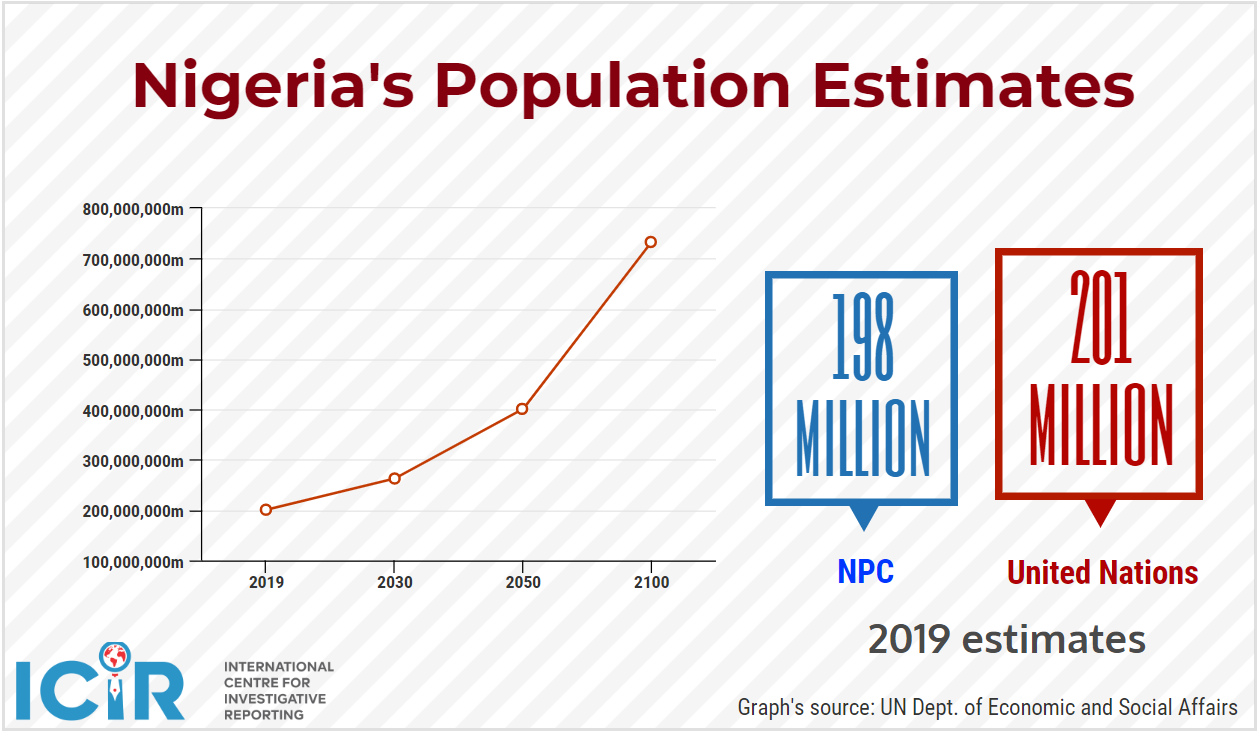
DIRECTOR-GENERAL of the National Population Commission (NPC), Ghaji Bello, on Wednesday, said the estimation of Nigeria’s population presently stands at about 198 million.

The NPC was set up by the federal government to collect and publish data on population, so it is the topmost authority on the subject.

“We arrived at the estimated 198 million after elimination of all the variables like mortality rates,” Bello told the News Agency of Nigeria, ahead of the World Population Day marked globally today.

But the agency gave the same figure well over a year ago.

Eze Duruiheoma, a Senior Advocate of Nigeria (SAN) and NPC’s immediate past chairman, made the disclosure in April 2018 while delivering a talk at the 51st session of the Commission on Population and Development in New York.

“Nigeria remains the most populous in Africa, the seventh globally with an estimated population of over 198 million,” he said.

Whereas, in 2017, the commission’s Director-General had given the country’s population as 182 million. That estimate, he had explained, was based on “the population of 140 million recorded in the last census a decade ago, using an annual growth rate of 3.5 per cent weighed against other variables such as rising life expectancy and a declining infant mortality rate”.

So, is it that Nigeria’s population has remained the same since 2018 or has the NPC simply failed to update its data to reflect the country’s growth rate?

What is Nigeria’s true population estimate?

The website of NPC has been inaccessible for a while and the data reports and publications previously uploaded could not be extracted.

However, data from the commission first published as a gazette in 2009 and titled “Population Figures and Growth Rate Based on 2006 Population and Housing Census” has been made public by the National Bureau of Statistics.

The document shows population estimates between 2006 and 2016 based on the last census conducted by the commission. An analysis of the data shows that the progression over the years since 2006 are all based on the assumption that there’s a constant growth rate of 3.25 per cent.

The NPC projected that Nigeria’s population as of 2016 would be an estimated 193.4 million. Using the same growth rate figure, then the country’s population in 2019 should be 212.9 million. But international organisations have formed a different assessment.

The United Nations’ Economic and Social Affairs, in its 2019 World Population Prospects Data Booklet, has stated that Nigeria’s mid-year population is 200.9 million in 2019, will be 263 million in 2030, and 401 million come 2050. The growth rate adopted by the agency, for 2019, is also a modest 2.6 per cent.

So, is the NPC wrong to have maintained that Nigeria’s estimated population is 198 million even since April 2018? Bola Lukman Solanke, a senior lecturer at the Obafemi Awolowo University with a Ph.D. in Demography and Social Statistics, does not think so.

“We should understand that all population projections all over the world are based on assumption. The way we do it technically is we have low variant, medium variant, and high variant,” he explained to The ICIR.

“That 198 million he is talking about is the medium variant. He is not talking about the high variant. He is just being realistic. It is an average person that will say because it is a new year, we expect the population to increase.

“But when you are talking in terms of the aggregate, the increase or the reduction are not that obvious. So you want to play safe by holding on to the 198 million which they reported last year. Aggregating population to determine increase or decrease is not done per month or per quarter; we do it yearly … I believe that’s why the NPC director is not going beyond that.”

Solanke also said the accurate estimate of Nigeria’s population depends on who is making the estimate and what assumptions they rely on to make projections, based on 2006 census figures.

“Roughly now, what we adopt, we are talking in terms of about 198 to 200 million, based on the growth rate obtained from the 2006 census,” he said.

Awaiting an overdue census exercise

One fundamental reason for the conflicting reports about Nigeria’s population estimates is that no population count has been conducted since 2006. The United Nations Population Fund has recommended that a national census is conducted every 10 years.

“Though it is a very laborious and costly operation, it is a vital one. Only a census can provide the fine-grained and accurate data needed by analysts and policymakers to make informed, evidence-based development policies,” it states.

“A series of censuses allow experts to assess the past, describe the present and estimate for the future.”

Nigeria’s constitution does not state how frequently censuses are to be taken in the country, but only empowers the NPC to undertake “periodical enumeration” of the population using surveys and censuses. This is however not the case in some other countries. For instance, the constitution of the United States mandates that a census be done every 10 years.

The NPC had said the census proposed to be held in 2018 and projected to gulp N222 billion could not go as plan due to poor funding, but it assured last weekend that one will be done before the end of President Buhari’s second term.

Solanke blames what he calls “political pressures” for the delay of census-taking and inflation of figures in Nigeria.

“Ordinarily, it’s supposed to be a routine statistical exercise, but in Nigeria, it is politicised. I understand that there are aspects of the constitution that provide that states of the federation, they receive money from the federation account based on the population,” he noted.

“And then the Independent National Electoral Commission also delineates constituencies based on population, so every politician wants to struggle to make sure that his area or his constituency has an inflated figure. That has been the problem we have, but we are supposed to take the census only as a statistical exercise without political involvements.

He added that Nigeria is already behind schedule and needs to have another census soon, whether emphasis is placed on politics or technicality.

“We need this information to update our national database for administration. A lot of new things are emerging. If we really want to administer this country efficiently, we need this accurate population census.”

Sim Registration: Senate to summon NCC as connected lines hit over 249m 

THE Nigerian Senate on Thursday resolved to summon the National Communications Commission (NCC) over weak performance in the area of poor registration of the Subscriber Identity Module (SIM) cards and dropped calls.

Ahmed Lawan, President of the Senate, also vowed to blacklist telecommunication operators in the country for poor services delivery, where necessary.

The decision came following a motion moved on the floor on the House over the increasing rate of dropped calls, among other unwholesome practices by the telecom operators.

They argued that Nigerians are being denied of their resources, thus sought refunds for cases of disrupted calls caused by the operators’ inefficiencies. Major mobile operators in Nigeria are MTN, 9Mobile, Airtel and Globalcom.

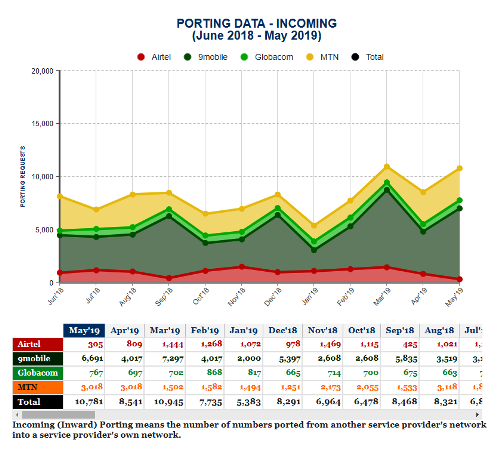
However, between June 2018 and May 2019, for instance, most Nigerian phone users ported from one telecom operator to another, usually as a result of poor services. In March 2019, 10,945 subscribers ported to another network while two months after, it reduced to 10, 781.


Data of Incoming and Outgoing SIM Porting                          Data Source: NCC


The NCC which is the regulatory agency for the industry has the mandate to issue licenses to telecommunication operators and also check all manners of irregularities in the sector.

As required by law – Section 89, Sub-section 3(d) of the Nigerian Communications Act (NCA 2003), the commission is expected to regularly monitor and report on the state of the telecom industry while operators are as well, obligated to provide such data for the purpose of the analysis.

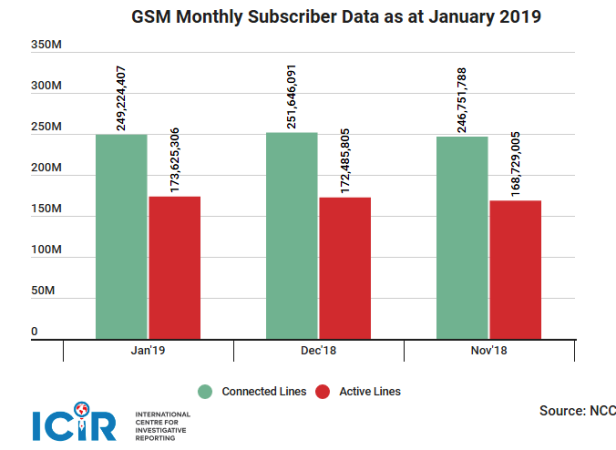
According to the NCC, as at January, there are 249, 224, 407 connected mobile lines in the country, but only 173, 625, 306 are active.

However, the decision to summon the NCC is because the Senate believes the agency has not lived up to its regulatory responsibilities, Channels has reported.

Meanwhile, this is not the first time the National Assembly will summon telecom operators. The 8th National Assembly also summoned the operators for poor services. The lawmakers indeed queried MTN on the allegation of profit reparation to the parent company in South Africa.

Lawan has pledged to take practical action on the matters this time.

Kaduna Assembly rejects commissioner nominee over social media comments

THE Kaduna State House of Assembly on Thursday rejected the Commissioner nominee for Agriculture, Alhaji Aliyu Jaafaru, sent to the Assembly by Gov Nasir El-Rufai.

The nominee, who appeared before the assembly for screening was, however, rejected by the lawmakers due to his alleged criticism of the El-Rufai administration.

The Speaker, Alhaji Aminu Shagali, who presided over the plenary, said the rejection was as a result of his criticism against the present government on his social media handles since 2017.

Shagali said Jafaaru had been criticising one of the best policies of the present administration on education since 2017, hence the issue of disengagement of unqualified teachers in the state.

While quoting some of his posts, the speaker said “in your Facebook account, you said there was nothing like making Kaduna State great again.

“It is a deceptive clinch used by politicians to deceive the masses; we will make Kaduna great at the appropriate time.

“It is a responsibility for those who are truly sincere not for those who are inherently sarcastic.

“You also said El-Rufai must learn to tackle issues with a human face, you also said you are an advocate of change that goes to the root cause, not only the symptoms.

“You also said in the same post, stop comparing me with El-Rufai who thinks he is more intelligent than intelligence itself.

“You, however, said you are a humble human being that believes that all that glitter is not gold hence there is nothing authoritarian in insisting on the truth and never speak the truth.

“I detest insincerity as there are better ways of genuinely solving problems.”

Briefing journalists shortly after the plenary, the Chairman, Assembly Committee on Media and Public Affairs, Alhaji Tanimu Musa, said the rejection of the governor’s nominee was as a result of his criticism of the present administration.

He said: “The evil that men do live even after them, Jaafaru has been a critic of this administration on social media.

“He has been criticizing the government, so why did he want to work with the government you have been criticizing,” Musa said.

Other nominees screened include, Mr. Thomas Gyang – Commissioner for Planning and Budget, Alhaji Hassan Mahmud – Commissioner in the governor’s office for Riots, Damage, Rehabilitation and Resettlement and Alhaji Atiku Musa as Auditor General.

The House urged the auditor general to ensure that the audited account of each local government in the state was up to date.

Meanwhile, the speaker also announced that the Deputy Governor, Hajiya Hadiza Balarabe would serve as the acting commissioner for Health pending when the substantive commissioner was appointed.

(NAN)

South Africa Ignores Nigeria, Grants Visa-Free Status To Ghana

GHANA is the latest country to be granted a visa-free status by the South African government, according to the SA Minister of Home Affairs, Hon. Aaron Motsoaledi.

While delivering his speech at the occasion of the Home Affairs budget vote Motsoaledi mentioned Ghana in the list of seven countries whose nationals will be permitted to enter South Africa visa-free.

Nigeria was conspicuously missing on the list despite the large volume of trade between the two countries. Nigeria is ranked 12th export destination for South Africa’s goods and is ranked 1st most important import source from Africa.

Out of the 193 countries that are member states of the United Nations, the Department has granted visa-free status to 75 countries, and 16 are in Africa, and 59 are from the rest of the world.

The new addition to the visa-free countries are: Qatar, United Arab Emirates, New Zealand, Saudi Arabia, Cuba, Sao Tome and Principe and Ghana.

The Minister promised to increase increase the number of people who process visas in Nigeria.

“We still have some homework to do for three countries whose combined populations make up close to 30 per cent of the world’s population i.e. China, India and Nigeria,” he said.

President Cyril Ramaphosa also has announced in  June that he would accelerate the implementation of e-visa system.

“The e-visa system will advance deployment of immigration as a tool for economic development outlined in the National Development Plan,” said the Minister.

Buhari approves N5bn for research in tertiary institutions

PRESIDENT Muhammadu Buhari has approved N5 billion for academic research in the country’s tertiary institutions.

Suleiman Bogoro, Executive Secretary of the  Tertiary Education Trust Fund (Tetfund) made this known during the inauguration of a national research fund screening and monitoring in Abuja. He said the money was the highest since the establishment of the National Research Fund (NRF) in 2009. 

Bogoro said the provision of the funds to scholars of tertiary institutions would allow them in conducting cutting edge research for the growth and development of the country.

He explained that the funds covered a series of disciplines including science, technology and innovation, as well as humanities and social sciences. As the money would be disbursed to academics by Tetfund through its NRF programme, Bogoro said the committee in charge would scrutinise research proposals’ application before recommending for grants.

He said the members of the committee were made up of seasoned academics of repute ready to devote their time and energy to critically review research proposals competing for the fund.

The Tetfund head urges the members to identify fundable proposals through various mechanisms for sponsorship.

Olufemi Bamiro, chairman of the committee, pledged to commence work in order to allow researchers to access the research funds promptly. He also vouched to provide outcomes that can move Nigeria to the next level of development.

Many scholars in Nigeria have consistently recommended that the government should release funds to tertiary institutions for research purposes. And when released, the funds should be monitored to avoid diversion.

NRF, according to Bogoro in 2015, was introduced to address the paucity of funds for research activities in tertiary institiutions.

Instagram moves to stop social media bullying using new feature

INSTAGRAM recently announced the launch of a new feature on its app that would help counter social media bullying.

The video and photo sharing platform also owned by Facebook revealed that the company have employed the use of artificial intelligence to detect bullying and other harmful content in comments, photos and videos.

The new addition called ‘Restrict’ hide demeaning comments from the public, which would only be visible to the receiver.

“Restricted people won’t be able to see when you’re active on Instagram or when you have read their direct messages, said Adam Mosseri, Head of Instagram in a statement.


READ ALSO:

“Our mission is to connect you with the people and things you love, which only works if people feel comfortable expressing themselves on Instagram. We are committed to leading the industry in the fight against online bullying, and we are rethinking the whole experience of Instagram to meet that commitment.

“These tools are grounded in a deep understanding of how people bully each other and how they respond to bullying on Instagram,” the statement read in part.

The new feature is much more deliberate, allowing users to hem in their bullies, away from the rest of their followers and targeted teens as they are less likely to report online bullying even when they are the ones who experience it the most.