Home Blog Page 2370

‘One chance’ robbery attacks rise in Abuja, and ‘police are not helpful’

“IT’S like a pharmacy in here,” said Atoo, 43, attempting to break the ice as he welcomed visitors into his living room in the Apo Resettlement area of Abuja, the federal capital city.

On the armrest of a Chesterfield sofa lied a drug sachet containing vitamin C tablets. And right across the room was a green desk with an eye drop, a number of other drug packs, prescription notes, and a polythene bag from a popular pharmacy.

Three days before this visit, Richard Atoo had been a victim of armed robbery carried out by men who disguised as taxi drivers and passengers. By the time they were done with him, Atoo was left with over 30 knife wounds that nearly ended his life.

His right eye was still bloodshot while adhesive bandage covered almost all of the left section of his head.

“I least expected that I’ll fall a victim,” he said. 

A mass communication graduate of the University of Jos and father of two, Atoo has been in and out of Abuja since 1994 and decided to settle in the city to work in 2007 because of the many opportunities. And not once in all those years was he ever robbed, until the night of Tuesday, April 23.

The time was minutes to 8 pm. Tired and heading towards the Area 3 junction, he had flagged down a taxi along Ogbomosho Street, Area 8, Garki. The cab appeared to have two passengers, one sitting beside the driver and the second at the back. Nothing about the men or the vehicle appeared suspicious, but as soon as Atoo boarded, the tinted glasses were wound up.

He was pinned down by the robbers.  Men, well-built and in their late 30s,  forcefully collected his two smartphones and searched for bank alerts. Their victim’s Automated Teller Machine (ATM) card was however not on him, and so they could not withdraw the huge sums of money they saw.

“I guess that infuriated them,” Atoo said, fidgeting with a bandage plastered above his lip. “They started stabbing me in many places. They had a gun too. I think at a point they thought I was dead because there was blood all over the car. The whole place was messed up. Anytime they struck me, I would feel blood splattering everywhere!”

After snatching his cash and phones, worth well over N100,000, they pushed him out of the vehicle roughly at the same spot he was abducted. No one helped him despite his cries until a taxi driver pulled over, picked him up, and dropped him at the gate of Wuse District Hospital, where they stabilised him, sutured his wounds, and prescribed medications.

His only regret from the entire experience, he lamented, is that he could not get the phone number of the taxi driver who saved his life.

A sustained increase

One chance robbery is a growing threat to security on the streets of Abuja. Residents of the capital city lose their assets to the criminals nearly every day. From the accounts of victims and hospital sources, the people robbed end up losing their phones, money and, sometimes, lives.

 When asked how frequently Wuse District Hospital’s Accident and Emergency Unit receives one chance victims for treatment: “Everyday!” replied a healthcare worker. The medical director, Sa’ad Idris told The ICIR the hospital’s head of nursing also fell prey in April, two days to this interview.

Kubwa General Hospital. Credit: People Magazine/Bridgette Matjuda

Okey Mbaleme, a Consultant Orthopaedic Trauma Surgeon at the hospital informed this reporter they get an average of 20 cases each month一but “that would be conservative,” he made sure to add.

“It is a very very big problem,” Mbaleme said thoughtfully. “It is very rampant. It used to be seasonal, but now it has heightened. There has been a sustained increase.”

The hospital at times can admit as many as two or three victims in a night. Some of them sustained severe injuries to their brain, deep fractures, spinal cord injuries, paralysis, trauma, and “terrible cuts”.

An optometrist at the Kubwa General Hospital, who for safety concerns asked not to be named, also confirmed the frequency of the attacks, adding that her cousin was recently assaulted by the criminals, and lost her savings.

“The rate at which we see victims in this eye clinic is too much. The thing is too much,” she said repeatedly. “It is alarming and it wasn’t like this in previous years. Something needs to be done.” She noted that robbers often go for the eyes in attacking their victims and some of the patients become permanently blind after the incidents.

The dark spots the robbers frequently operate include Wuye junction, Galadimawa roundabout, Gwarinpa junction, Federal Housing junction Kubwa, Wuse Market, Area I, Airport Road Lugbe, among others.

Different tactics, same goal

One chance robbers have two things in common. They all make use of cars and are after their victims’ money or other valuables. Though their tactic varies; it is aggressive.  Most victims report that the attackers are within the age bracket between 20s and 40s.

At times they make use of Point-of-Sale machines to withdraw from their victim’s account, and at other times they use ATMs while the account owner is still taken hostage. Often, they operate in the early morning hours, or early evening from 6 pm till late into the night.

They either make use of private cars disguised as taxis or, green commercial taxis registered in Abuja. The car could have only men as passengers or include one or two females to reduce suspicion, a trick that worked in the case of Roheemat, a fashion designer when she boarded what she thought was a taxi in April at Gwarinpa junction.

One chance either ply the restricted routes known locally as “Along”, or ride freely to specific destinations based on instructions. On one Tuesday night in 2015, Chidinma Okwudiri, a media consultant and scriptwriter, was a victim of robbers who fell into the second category. It was a commercial taxi, green golf car, boarded at Wuse II. Minutes into the trip, another person emerged from the trunk of the car and joined the passengers at the back seat.  After beating her, the robbers snatched her bag, necklace, and wristwatch.

Okwudiri recalled her experience in the hand of the robbers.

“The driver was struggling at the trousers trying to take it off. I didn’t know what he was trying to do, and that was the point when I got scared.

“When they got to an area in Zone III, the driver was on speed but they just opened the door and pushed me out of the car without slowing down. Then they sped off. I still have the scar on my right knee where I landed. It never left.”

There are also those who make use of taxis and reportedly charms commuters without resorting to violence. They try to convince their victim that one of them was able to steal a huge amount of money from a rich client or employer and then persuade him or her to accompany them to a supposed ritualist to “cleanse” the money so they could share equally. Counting on the greed or fright of their victim, the ritualist asks each of them to bring a sum of money for his services.

A female corps member, new to Abuja, who narrated her experience to The ICIR said she boarded one of such vehicles at the Central Business District in April, hoping to return to her host’s residence in Lugbe. One of the fraudsters, a lady, started discussing with her in Yoruba and convinced her to play along and leave since they would injure her since she might snitch. She observed that while the driver was a Northerner, the second passenger was an Ibo man.

She followed them to a remote area to meet the traditional medicine expert, “Mama Gwari’s son”, who asked them to bring N210,000 for the cleansing. She lied she did not have her ATM card, and convinced them to take her to Lugbe junction to retrieve the card in order to withdraw.

“This is our opportunity to become rich,” the lady passenger had told her in Yoruba during the return trip. “Even if you don’t have up to that N210,000, just bring N50,000. We can persuade the baba to collect it.”

Chigbo, nicknamed Simba, an area boy at Berger junction, one of Abuja’s most vibrant bus-stops, said though they do not know who the criminals are, they have ways of suspecting when they are operating. Usually, he explained, they don’t stay close to the bus-stops where there are crowds.

He added: “They only park along and say remain one, remain one. And sometimes when the passenger wants to enter, one of those inside would claim he has an injury, come down, and then they’ll put the new person in between four people. And then they often ask where you are going, instead of you asking them. If you say you are going anywhere, they would say they are going there too.”

Passed on

Not all victims have been lucky, as Atoo. In December, one of the ushers at the EYN Church of the Brethren, Utako, died on the way to the hospital after he was robbed and stabbed. He had gone to Apo to drop his car with an auto mechanic for repair, called his wife to inform her he would soon be home but fell into the wrong hands. The pastor-in-charge and chief security declined to speak on the incident “because of its security nature”.

Another resident who spoke to this reporter disclosed that his neighbour also lost his life around on December 20 to similar circumstances. He explained that, having lost their breadwinner and a sense of safety, the family decided to relocate from Abuja.

Then again, three days to Christmas, a young lady posted to Abuja for the compulsory National Youth Service Corps scheme became a victim. On December 14, she was abducted by the mobile armed robbers and shot after she was shoved out of the vehicle. There are numerous other cases of lives lost to the menace, most of which do not make the headlines.

FCTA painted taxis sometimes used for “one chance” robbery

Traumatised

Some of those who escaped death in the hand of one chance robbers show signs of emotional distress, hyperarousal, and hypervigilance. Atoo, for instance, mentioned that he has felt jumpy since his close shave with death.

“When I sit down, I have a feeling like they are grabbing me,” he said with an upset look. “You know, I will just jump. And I’m still feeling it. I’m still feeling it … The shock is still very much alive.”

Joseph Olayanju, administrative manager at the International Centre for Investigative Reporting who was robbed on March 14 and battered on the face, related similar experiences. He is afraid of being close to other humans, except people he trusts or knows.

“Anytime I find myself in a commercial vehicle, the next thing is I begin to assume the people inside are criminals,” he said. “Then if I’m going to Kubwa, when I look in a vehicle and the people appear normal, I quickly enter regardless of where the car is going, even if it won’t get to my destination.”

Olayanju added that, unlike in the past, he has learnt to leave the office early and feels uneasy anytime nightfall approaches.

It takes time before many victims recover emotionally. Okwudiri estimated that she was messed up by the incident for at least “one good month”. “I was traumatised badly. I lost some weight. I was a walking shadow of myself for a while,” she said.

For over two weeks, she could not sleep without a knife under her pillow and a friend had to remove it. Now, she checks the driver’s seat and trunk before boarding any taxi.

“It has happened that at times when I tell them I want to see their trunk they just speed off. It happened to me two or three times,” she added. “Still, when I enter a car at night, I’m always at alert. Everything in me is alert. I want to see anybody’s next move and what is going to happen. Even if I check the trunk and everywhere else, I am always very alert.”

Nine in 10 residents have been victims or know someone who was

As many as nine in 10 residents of Abuja who participated in a poll conducted by The ICIR, to measure the prevalence of ‘one chance’ incidents in the city among other indices, have either had an encounter with the robbers or know someone who has.

15.6 per cent of the respondents said they themselves have been victims of the menace, while 59.4 per cent replied that they know persons who were victims. 12.5 per cent said they have both been victims and know others who have as well, and only 12.5 per cent belong to none of the categories.

Seven in 10 (66.7 per cent) of the respondents said they do not “feel safer living in Abuja today, compared to previous years”. Only 8.3 per cent replied otherwise, while 25 per cent is undecided.

On the effectiveness of the Nigeria Police in tackling the crime on a case to case basis, 66.7 per cent of the relevant respondents said the police were not helpful “at all” in tracing the criminals and recovering stolen assets. No one thinks the police were “very helpful”, 3.3 per cent said they were fairly helpful, and 30 per cent said they did not bother to contact them.

Some of the victims who spoke to The ICIR complained of the police not following up on information provided by them, and others fear that going to the police will only cause them to lose money in two places without obtaining justice.

Maliq Aina, whose sister, Aishat, was robbed of N500,000 in March, said they gave up hope of getting back the money after noticing the police’s strange reluctance to act—though they had gone to the bank to temporarily freeze the recipient’s account, identified the account owner and got his picture from the ATM security camera, and also paid a lawyer N100,000 to get a court order.

“The police was informed of the incident and were given the criminals name and picture for easy identification but they claimed they couldn’t apprehend them,” Aina told our reporter.

“The interesting part is when we got a court order for the reversal of the money and we thought we were the only one who had the copy, we discovered the police somehow had it too. And when the bank said the money is no more there, they [the police] went silent about it.”

GT Bank confirms withdrawal and sends image of robber to Aina’s lawyer

Abuja streets: a safe haven for crime

The inadequacy of streetlights in Abuja may have contributed in no small measure to the rise of criminal activities in the city. Many parts, including major road networks, are dark at night.

The reporter observed this trend for instance on the Murtala Mohammed Expressway linking Berger junction to Kubwa, a route particularly notorious for frequent one chance attacks. While a couple of the streetlights at the junction are working, a major part of the road stretching to Kubwa, a trip of over 30 kilometres, are dark.

A few street lamps are still functional around  Gwarinpa junction, one km after Starview Palace Hotel, but the rest of the road is dark except for illumination from roadside filling stations, halogen lamps from nearby factories, and headlights of passing vehicles.

Vendors at Berger junction confirmed that the police patrol vehicle stationed at the area often parades on the Berger-to-Kubwa lane in the night. However, taxi drivers, including James who has travelled the Berger-Kubwa route regularly for over five years, said not once have they been stopped by policemen on the road for a random security check.

The absence of Closed-Circuit Television (CCTV) cameras also has contributed to the difficulty in tracking and arresting robbers. The ICIR reported in 2017 that security cameras planted on major roads in Abuja did work for long after their installation, though as much as N76 billion was spent on the project. Many of them have since been vandalised and stolen by hoodlums.

A bank source, however, told the reporter that, in cases where ATMs are used to withdraw from the victim’s account, the face of the culprit is captured by the machine’s camera and this image may be requested for by the account owner or police. Where a transfer is made instead, the recipient’s account can be frozen for a maximum of 48 hours. A court order is required to either extend the freezing period or reverse the transaction.
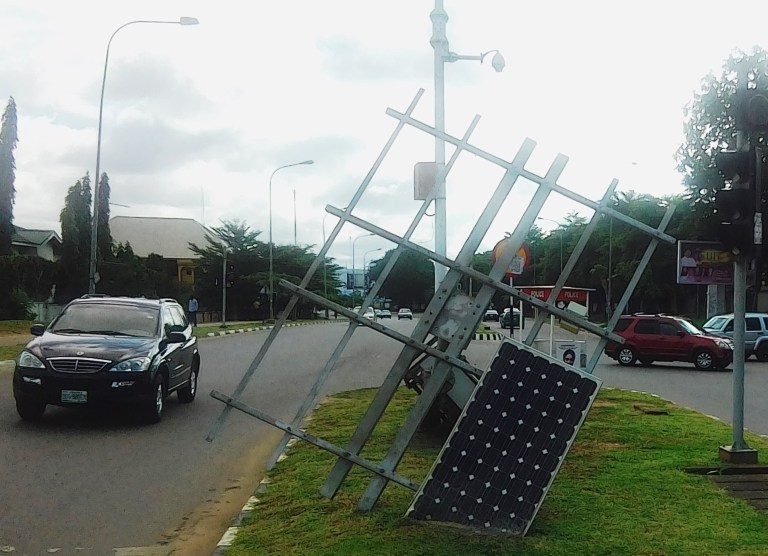
Damaged CCTV camera installed on major Abuja road, adjacent Radio House and International Conference Centre. Credit: ICIR/Yekeen Akinwale

‘The police isn’t sitting around,’ says FCT Command

In a bid to deal with the menace, the FCT Police Command recently established an Anti-One Chance Squad headed by a chief superintendent of police. But the squad is yet to nip the crime in the bud.

Danjuma Tanimu, the Command’s Deputy Public Relations Officer, told this reporter the police is doing all it can to arrest the robbers and raise awareness among the populace on how to remain safe. He also said they enjoy a good relationship with the commercial banks, from whom they get useful information.

“We have strategic checkpoints across the city,” Tanimu said in response to a question about preventive measures. “We provided more Rapid Response Squad (RRS) vehicles. If you go round, you will see them. They are there, except if there is an emergency they must attend to.”

Asked if he thinks the lack of functioning CCTV cameras is impeding the fight against one chance, the deputy PRO replied in the negative.

“That we don’t have working CCTV is not contributing to one chance,” he said after a brief pause. “If an individual has the mindset to commit a crime, he will commit a crime. If the CCTV is not working, we have our gadgets like walkie-talkie. It’s working 24 hours … So CCTV cannot stop police from checkmating the activities of criminals.”

He urged the public to inform the police anytime they see something suspicious and assured them of the officers’ readiness to act promptly. Police emergency numbers that may be called include 09052397880, 08024130926, 09051488448, and 07014951751. “The moment they call, they will be connected to the control room, which is available for 24 hours.”

‘The FCT administration is fully aware’

The FCT Administration’s Director of Security, Adamu Gwary, has said the government is “not unaware” of the emerging trends and the FCT minister has recently approved certain proposals aimed towards finding solutions.

“The minister has directed the commissioner of police to come up with remuneration in terms of financial inducement to those who provide actionable intelligence on criminal hideouts or black spots within the FCT,” he said.

He disclosed that the administration is also partnering with media organisations, such as Brekete Family and Sports Radio, to better inform and orient residents, as well as sister agencies in neighbouring states. He mentioned a surge in population as a possible factor that has led to increased criminality.

Gwary also said there are plans to better regulate the operations of unpainted taxis, otherwise called kabukabus, and every driver will have to be registered under a licensed transport operator.

The FCT administration, he further noted, has taken special interest in deploying mobile streetlights to dark areas of the town, and also hopes to expand already existing pilot CCTV projects to other parts of the FCT.

“Very soon,” he concluded, “residents of the FCT will heave a sigh of relief with regards to issue of emerging security threats within the territory.”

Ifeanyi Ughamadu, PRO to FCT Transport Secretary, also agreed that the spread of unpainted taxis is a huge push to one chance incidents. The previous administration recorded some success in registering and regulating these cars but compliance has since dropped, he said.

He added that a meeting of stakeholders in the transport sector will be held in May. “The essence is to discuss all relevant problems in the transport sector in the FCT after which we will come up with resolutions that will be binding,” he said.

With all hands on deck …

The problem of one chance is one that can be cut back with the right amount of commitment, discipline, and collaboration between the public, government and security agencies. This is the view of Ben Okezie, a security analyst, columnist, and chief executive officer of BRANE Security.

Residents boarding taxis should note number plates, especially at the rear, and avoid vehicles in which the boots and back seats are connected such that someone hiding in the trunk can easily batter the passenger.

“Then the security agencies, the police and Road Safety Corps, should ensure they are present on all those areas designated as Along,” he said.

He also urged the government to amend criminal laws to make sure vehicles used for robberies are impounded once suspects are arrested and prescribe severe penalties to dissuade criminals. It is also important to create jobs to keep the country’s teeming young population productive, he said.

Okezie stressed the need for research into modern methods and the incorporation of technology, especially security cameras and biometric data, into crime fighting.

“It is very important,” he added. “What electronics can do is greater than what 100 or 500 policemen can do. We should invest in it.”

Mbaleme also pointed out the need to have universal health insurance coverage so that victims can get immediate attention from all hospitals, and then a public transportation network to reduce reliance on private cabs.


*Not real name.
NFIU vs State governors: What constitution says about financial autonomy for LGs

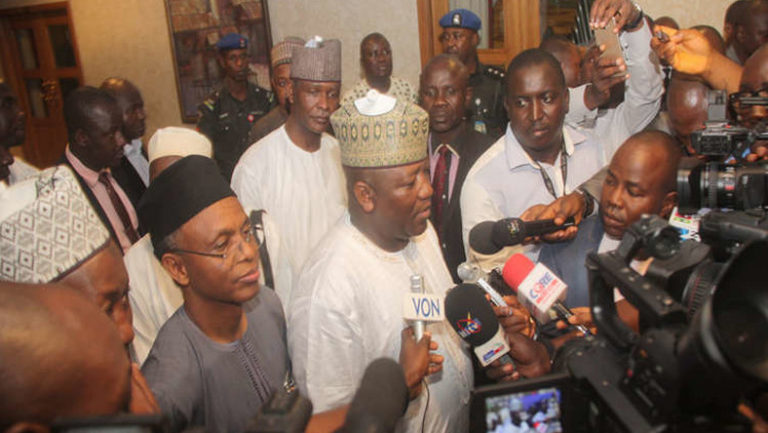
A faceoff seems to be brewing between the National Financial Intelligence Unit (NFIU) and state governors following a directive by the former that governors would no longer be allowed to access funds meant for local governments in their states.

The NFIU had set June 1, 2019, as the take-off date for the new regulation but the governors, under the aegis of the Nigerian Governors’ Forum (NGF) would have none of it, insisting that the NFIU was reaching beyond its authority.

Both the NFIU and the NGF are quoting sections of the Nigerian constitution to back their arguments for and against the new regulation.

In a statement on May 15, the NFIU said its directive to banks to ensure that governors no longer have access to LG funds was based on “its understanding of the 1999 constitution that no debit is allowed on any local government funds unless and until the funds are credited to and reach the bank accounts of a local government in any state of the federation”.

However, in a petition to President Muhammadu Buhari, Governor Abdulaziz Yari of Zamfara State, who is also the Chairman of the NGF, accused the NFIU of “stoking mischief and also deliberately seeking to cause disaffection, chaos and overheat the polity”, and urged the President to order the Unit to quit “encroaching on or even breaching constitutional provisions”.

What the constitution says about revenue allocation

Section 162 of the 1999 constitution prescribes how revenue should be distributed between the three tiers of government namely, the federal, state and local governments, as well as the judiciary.

Sub-sections three to eight of Section 162 read as follows:

(3) Any amount standing to the credit of the Federation Account shall be distributed among the Federal and State Governments and the Local Government Councils in each State on such terms and in such manner as may be prescribed by the National Assembly.

(4) Any amount standing to the credit of the States in the Federation Account shall be distributed among the States on such terms and in such manner as may be prescribed by the National Assembly.

(5) The amount standing to the credit of Local Government Councils in the Federation Account shall also be allocated to the State for the benefit of their Local Government Councils on such terms and in such manner as may be prescribed by the National Assembly.

(6) Each State shall maintain a special account to be called “State Joint Local Government Account” into which shall be paid all allocations to the Local Government Councils of the State from the Federation Account and from the Government of the State.

(7) Each State shall pay to Local Government Councils in its area of jurisdiction such proportion of its total revenue on such terms and in such manner as may be prescribed by the National Assembly.

(8) The amount standing to the credit of Local Government Councils of a State shall be distributed among the Local Government Councils of that State on such terms and in such manner as may be prescribed by the House of Assembly of the State.

It does appear, going from the sections of the constitution cited above, that state governments are in charge of local government funds and disburses to them according to the prescription of the state assemblies.

There is no particular clause in the National Financial Intelligence Unit Act (2018) that gave the Unit express authority to determine how states and the local governments under them manage their funds.

Arguments for and against the new guidelines

Spokesperson of the NFIU, Sani Tukur, in an interview last week, maintained that the NFIU has authority, based on its enabling Act, to issue the guidelines.

“Any bank that connives with governors or local government chairmen to breach the directives will face the necessary sanctions,” Tukur said

He also added that if an international fraud was committed using the joint state and local government account, international anti-graft agencies could sanction the financial institution in which the account was domiciled instead of sanctioning Nigeria as a country.

Tukur maintained that the NFIU was not advocating for the abolition of joint state and local government accounts. “That account has a constitutional backing,” Tukur said. “What we are pushing for is that the account should not be used by state governors for withdrawals and payments; it should be used for the distribution of funds to local government councils.”

The National Union of Local Government Employees (NULGE) also supports the move for LG autonomy. Ibrahim Khaleel, NULGE’s National President, said the NFIU directive was in order and did not contravene the constitution.

“The guideline issued by NFIU is to protect funds that are allocated from the federation account for the development of LGAs from unnecessary diversion and siphoning by governments of the state. If any state government is not comfortable with this guideline, it means the state government is tampering with funds meant for the LGAs because if it is not so, it will not have any reason to go against what the guideline is talking about,” Khaleel was quoted by ThePunch as saying.

However, the PDP Speakers’ Forum agrees with the NGF that the NFIU had no business interfering with how states disburse funds to the local governments under them.

“They (the NFIU) are meddlesome interlopers. They are going into an area they have no jurisdiction over and my advice is that the Federal Government and the National Assembly should focus more on creating a true constitutional autonomy for local government areas,” said John Gaul Lebo, a lawyer and the Speaker of the Cross River State House of Assembly. Lebo is also the chairman of the PDP Speakers’ Forum.

“NFIU is not the National Assembly and, therefore, cannot make laws. They cannot give a deadline on such matter because the constitution does not recognise NFIU for that,” Lebo told ThePunch.

We saved Imo State N5 billion this election period… EFCC

THE Economic and Financial Crimes Commission (EFCC) says it saved Imo State about N5 billion that would have been used by the incumbent governor, Rochas Okorocha, to influence election results.

According to the head of EFCC’s South East Zonal Office, Usman Imam, the money was part of the N8 billion Paris Club Refund paid to Imo State by the federal government to assist it in the payment of workers’ salaries.

Imam, during a chat with journalists, said Okorocha had deliberately refused to use the funds for what they were intended only to start distributing cash a few days to the election.

He said the EFCC had initially prevented the governor from accessing the entire N8 billion, but following persistent pressure, the commission allowed N2 billion to be withdrawn for salaries to be paid.

“About N7.9 billion is what had been blocked, although with pressure, subsequently, about N2.5 billion was released for salaries,” Imam narrated to newsmen. “On the whole, we have over N5bn of those funds blocked; we are following up to see what actually happened.

“Honestly, what we discovered was that within two days, N700 million was withdrawn in cash; N200m on the first day and N500 million on the second day and all these monies were disbursed in a manner that was honestly unpalatable.

“Distribution to school teachers; I don’t know, schools that you were not funding and you woke up on the eve of the election and withdrew N500 million cash and start distributing N1000 each or so to teachers. Whatever that means, I don’t know.

“When we came in, we were able to save about seventy something million of the funds that we discovered were not disbursed, we also blocked it. People are still answering questions as to who asked them to move those monies, monies that were blocked at the banks.

“The sad story about this was that these monies were the intervention funds; the bailout funds that the Federal Government released to states to pay salaries when they were having problems paying salaries.

“They didn’t utilise that money to pay the salaries; they warehoused it and kept it until the election period, they started attempting to draw down the money.

“Whatever happens, we have saved over N5 billion of that money, as we talk, two weeks to handover. Probably, the next government would have that money to use it better.

“There are a lot of other general investigations going on in Imo right now.”

The Acting EFCC Chairman, Ibrahim Magu, had confirmed that Okorocha is being investigated, but he would not give more details, saying that more information would be given at the appropriate time.

Nigeria’s GDP drops in first quarter, following shrink in oil sector – NBS

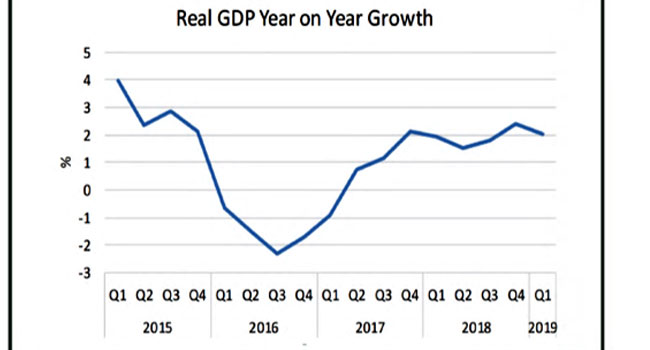
NIGERIA’s economy grew by 2.01 per cent in the first quarter of 2019 as the nation’s oil sector which is the economic mainstay shrank, according to records obtained from the website of National Bureau of Statistics, NBS, published on Monday.

The growth rate also called the Gross Domestic Product, GDP, is the benchmark for the size of the economy which is expressed quarterly to show a periodic measure of how the economy is faring.

Within the period, the non – oil sector grew by 2.47 per cent while the oil sector contracted by 2.40 per cent indicating a drop from the last quarter of 2018 pegged at 2.38 per cent which was likely to have been boosted by state spending in the run-up to February and March elections the report states.

“It is worth noting that general elections were held across the country during the first quarter of 2019 and this may have reflected in the strongest first-quarter performance observed since 2015.

“Aggregate GDP stood at N31.79tn in nominal terms. This aggregate was higher than in the first quarter of 2018 which recorded N28.44tn, representing a year-on-year nominal growth rate of 11.80 per cent. The aggregate was, however, lower than in the preceding quarter of N35.23tn, by -9.75 per cent,” the report reads.

The report for the first quarter of 2019, showed that the GDP grew by 2.01 per cent in real terms in the first quarter, compared to 2.38 per cent in the fourth quarter of 2018. While the growth rate in the first quarter of 2018 was 1.89 per cent appreciating by 0.12 per cent.

Real GDP is the economic output of a country adjusted for the effects of inflation.

The Central Bank of Nigeria, CBN, earlier in the year had predicted a forecast growth of 3 per cent for 2019 partly due to projections driven by higher crude oil prices.

Analysis in a Bloomberg report shows that a decline in growth could increase pressure on the Central Bank to cut interest rates further when it announces its policy decision which might increase lending rates.

The report also revealed that the non-oil sector contributed 90.86 per cent to the nation’s GDP in the first quarter of 2019, which is slightly higher than 90.45 per cent recorded in the first quarter of 2018 but lower than the fourth quarter of 2018 which was put at 92.94 per cent.

INTERPOL issues arrest warrant against Nigerian for ‘parental abduction’ of 9-year old from Brazil

0

By Damilola BANJO

THE International Criminal Police Organisation, also known as INTERPOL, has issued a  REd Notice against Mr. Michael Olusegun Akinruli, a Nigerian who used to live in Brazil, for parental abduction of a 9-year old girl he had out of wedlock with Ms. Laurima De Jesus Pires, a Brazilian woman.

A Red Notice is issued for fugitives wanted either for prosecution or to serve a sentence. It is a request to law enforcement worldwide to locate and provisionally arrest a person pending extradition, surrender, or similar legal action.

The notice came 3 months after Mr. Akinruli defied a court order that mandated him to return Atinuke Folasade Pires Akinruli to the custody of his mother in Brazil, on or about February 3, 2019.

A Magistrate Court in Minas Gerais, Brazil, granted a 25-day travel authorization to Mr. Akinruli to visit Nigeria with his daughter, Atinuke, between January 9, 2019, and February 3, 2019, but Mr. AKinruli had since remained in Nigeria with the girl, in contravention of the Brazilian Court order.

On the February 4, Ms. Pires, the mother of the child, said rather than return to Brazil with the child, Mr. Akinruli sent her an email notifying her of a court injunction obtained from a Lagos State Magistrate Court, granting him full custody of Atinuke.

Ms. Pires, who has now taken residence at the Brazilian Embassy in Nigeria till she locates her child, said she has been denied access to the daughter and has no clue of her ex-lover’s whereabouts in Nigeria.

Love waxes cold

Ms. Pires met Mr. Akinruli in 2005, at the City of Belo Horozonte in the Minas Gerais. Their young love grew and they moved in together shortly after that. During this period of cohabitation, Atinuke was conceived and born in February of 2009.

However, three years after Atinuke’s birth, the love the two shared had begun to wax cold. “In 2012 I made a decision to separate because I could not bear to live with so many of his lies,” Ms. Pires said. “Living with someone who lies all the time is not easy at all.”

Ms. Pires moved out of their shared apartment with Atinuke, who was then 3-years old, and went back to her parents’ house. According to her, Mr. Akinruli had full access to baby Atinuke. “Michael always had contact and always participated in the life of our daughter,” she said.

In 2013, Mr. AKinruli, still living in Brazil, married a Nigerian woman but Atinuke remained in the custody of her mother. The battle over Atinuke’s custody, however, began in 2016 when Ms. Pires married another man.

“In the year 2016, I got married to my current husband,” she said. “In that same year 2016, Michael entered the justice system requesting that the guard of Keke was shared and also proposed to assume all the expenses with the studies of Keke”.

The court case in Brazil

In accordance with the Brazilian Family law, joint custody of Keke, Atinuke as fondly called by her mother, was granted. Ms. Pires said this was their living arrangement until Mr. Akinruli approached the court for a permit to bring Atinuke to Nigeria to continue her studies.

In a judicial order of a Court of First Instance in Minas Gerais, Ms. Pires claimed that Mr. Akinruli had previously filed for authorization to bring Atinuke to Nigeria for the period of two years. The mother denied granting the travel’s authorization, arguing that the father does not intend to return to Brazil.

However, while this proceeding was still on, Mr. Akinruli filed for a new permit, in limine, requesting to bring Atinuke to Nigeria for 30 days for the purposes of “leisure and familiar visit during the period of school vacation”.

Most motions in limine are filed by a party to limit or prevent certain evidence from being presented by opposing counsel at the time of trial. The purpose of a motion in limine is to prevent the introduction of matters at trial which is irrelevant, inadmissible or prejudicial.

The motion in limine was granted and, according to Ms. Pires, she only got to know of the order through a phone call from Atinuke at the airport. Mr. Akinruli’s Nigerian wife and the daughter he had with the Nigerian woman travelled to join him in Nigeria on February 1, 2019, two days before the mandatory return of Atinuke.

In obtaining the travel relief which was granted in limine, Mr. Akinruli presented to the court a return ticket and evidence that he had enrolled both Atinuke and her stepsister in a school in Brazil.

According to the court papers: “The father produced evidence of fixed residence in this Capital, which consisted of an incorporated company legally registered. He, furthermore, proved to exercise the function of the consul of Nigeria in Belo Horizonte. He proved to be a graduate student of ‘Pontifícia Universidade Católica de Minas Gerais’ (PUC-MG). He evidenced enrollment of both daughters (Atinuke and the sister Iwalewa) in a private school (Colégio Santa Maria). He evidenced the purchase of round trip tickets, with departure foreseen for 9 January 2019 and return foreseen for 3 February .2019.

“The Father represented that the purpose of the trip was to provide the conviviality of the daughters with the extensive paternal family and make her participate in the culture, habits, customs, religion and language of his country. The father had evidenced to be the president of ‘Instituto Iorubá’, which aimed to promote Iorubá’s culture and religion in Brazil. At last, he supplies (sic) the telephone and address of his sister (Paternal aunt of the infant’s), where he stated that he intended to be hosted during their stay in Nigeria.

“He requested the interlocutory relief, arguing to have to buy the tickets and the need of the occurrence of the trip during the school vacation of the infant. He argued that not granting of the interlocutory relief would bring serious financial damages, besides making the trip of the daughter with the father and paternal sister unviable.

“The request was considered, in limine, as a leisure travel’s authorization, with a familiar and cultural purpose, without the intention of fixation of residence abroad. The motives of the request (plausibility of material right) were understood as relevant, as well as there might be the possibility that the occasional granting of the request, only in a final decision, could prevent the intention of the trip. Therefore, the case would stop being useful to the fulfilment of the interest of the requesting party and of the infant’s. The effects of the interlocutory relief of the custody were granted in limine, to authorize the infant’s trip abroad.”

The court case in Nigeria

 Upon arriving in Nigeria, Mr. Akinruli, again approached the Lagos State Magistrate Court in Yaba with an ex-parte motion, seeking guardianship of Atinuke.

According to legal dictionary, ex-parte refers to motions, hearings or orders granted on the request of and for the benefit of one party only. Ex-parte matters are usually temporary orders (like a restraining order or temporary custody) pending a formal hearing or an emergency request for a continuance.

The court, not being aware of the full facts of the case, granted Mr. Akinruli guardianship of Atinuke in an ex-parte order issued on February 4, 2019, a day after Atinuke ought to have returned to Brazil.

On March 12, 2019, Ms. Pires filed a Preliminary Objection, praying the court to strike the ex-parte order for lacking in jurisdiction. The mother, through her lawyer, laid bare the fact of the case, while informing the court that there is a joint custody arrangement in Brazil.

Mr. K.O. Ogundare, the presiding Magistrate, not minding the plethora of reliefs sought by both parties, thereafter struck out the case for lacking in jurisdiction.

Ms. Laurima De Jesus Pires

Where is Atinuke?

The endless battle for the custody of Atinuke has continued in Nigeria with her mother in total darkness about her whereabouts. “I have only spoken with Keke two times since she came to Nigeria,” an emotional Ms. Pires said, unable to fight back tears.

On one hand, in the Red Notice issued by INTERPOL, Mr. Akunruli’s home address in Lagos was given as 26 Aladesuru Street, Papa­Ajao, Mushin, Lagos State – Nigeria.

Visit to this address revealed that it is in fact not Mr. Akinruli’s current home address but his friend’s apartment where he used to squat until recently.

The friend, who refused to give his name, said Mr. Akinruli no longer stays in the apartment. “He has got his own apartment and moved out of here,” he said. Although, neighbours claimed that Mr. Akinruli still visits the apartment regularly and sometimes stays for days.

On the other hand, in the court papers filed at the Lagos State Magistrate Court, said Atinuke now lives in Akure, Ondo State where she is allegedly schooling.

 Ms. Pires said she is ready to stay in Nigeria until she finds her daughter and return home safely with her.

INEC re-assigns 25 certificates of return following court orders

THE Independent National Electoral Commission (INEC) says it has withdrawn 25 certificates of return issued to some candidates who won during the 2019 general elections. The decisions to withdraw the certificates were based on court orders.

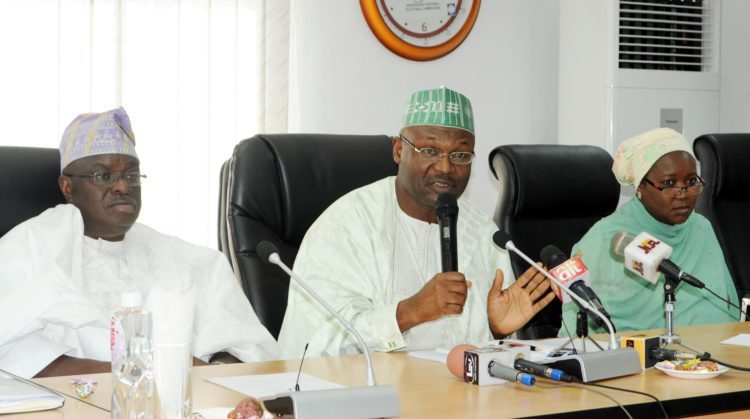
Chairman of the Information and Voter Education Committee (IVEC), Festus Okoye, said this at a ‘Forum on Media Coverage of 2019 General Elections’ held in Enugu on Monday.

Okoye said that 20 of the 25 certificates-of-return were withdrawn from All Progressive Congress (APC) members and given to other APC members; while two from People Democratic Party (PDP) members were withdrawn and issued to other PDP members.

He said the other three were withdrawn from APC and PDP and given to other political parties.

“Before we left INEC national headquarters on Friday; the commission has withdrawn 25 certificates of return from the first owners to their new owners following court orders to do that,’’ he said.

Okoye, however, lauded the media for its openness and robust engagement with the commission before, during, and after the election. He said the media had become critical stakeholders for the success of future elections.

He noted that the media had become the first line of reach of the masses as well as the platform for the explanation of INEC political and electoral decisions.

Okoye, therefore, called on the media and its practitioners to dig deep into the Electoral Act to ensure that the import of the recently amended sections is made known to the public.

“The media should also centre on the aspect of using Alternative Dispute Resolution (ADR) to resolve electoral issues especially at the party levels instead of going to the court,’’ he advised.

Speaking, President of the Nigerian Union of Journalists (NUJ), Chris Isigozu, said the media and its practitioners enjoyed a vast and robust relationship with INEC before, during, and after the elections.

Isigozu said INEC performed creditably well given the resources and length of co-operation from other stakeholders involved in the electoral processes.

“However, we are here to evaluate the entire process and see where we can strengthen our engagement and better the electoral system.

“We would be open and say it as it; so that the electoral and democratic processes can be better even as we go into off season elections,’’ he said.

In a welcome address, Enugu State’s Resident Electoral Commissioner (REC), Emeka Ononamadu, noted that evaluation of processes of the elections would help better the electoral processes as well as strengthen institutions and stakeholders involved in the entire processes.

“INEC wants to hear from the media, security agencies, civil society organisations, Non-Governmental Organisations etc on how the election fared. Whether there are avenues to improve on what we have.

“So, INEC is open to receive your objective deliberations and its outcome and we definitely take a critical look at your outcomes in order to better the electoral processes,’’ Ononamadu assured.

(NAN)

Hip hop rising star, Naira Marley remanded in prison for alleged internet fraud

UPCOMING Nigerian hip hop artiste, Azeez Fashola, popularly known by his stage name, Naira Marley, has been remanded in prison by the Federal High Court, Lagos, following allegations of internet fraud, commonly referred to as yahoo yahoo.

The Economic and Financial Crimes Commission (EFCC) filed an 11-count charge against Marey after he was arrested alongside four other upcoming hip hop musicians last week.

After investigations, however, the other suspects were released while Naira Marley remained in detention.

He was arraigned before Justice Nicholas Oweibo on Monday morning and he pleaded not guilty to the charges against him.

The matter has been adjourned to May 30 for the hearing of the bail application filed by Naira Marley’s counsel.

In one of the charges against him, Naira Marley was accused of conspiring with one Yard Isril, who was said to still be at large, to use a debit card belonging to someone else to “obtain gain” to themselves.

According to the EFCC, the offence is contrary to Section 27 (1)(b) of the Cyber Crimes (Prohibition, Prevention) Act 2015 and punishable under Section 33(2) of the Same Act.

The suspect risks a jail term of seven years or more on conviction or a fine of N5 million as well as the “forfeiture of the advantage or value derived from his act”.

Naira Marley came to limelight with his 2017 hit song titled ‘It’s a goal’, but it is his latest single ‘Am I a yahoo boy’, as well as his posts on social media which appear to be supporting internet fraud, that may have landed him in trouble. 

Many musicians have criticised Naira Marley’s perceived pro-internet fraud stance saying there should be no justification for engaging in criminal activities.

The EFCC has upped its clampdown on suspected internet fraudsters across the country. The commission has carried out raids on suspects’ hideouts in different regions in the country, arresting dozens of alleged yahoo boys and confiscating their property which included laptops and luxury cars.

EFCC confirms Imo governor, Okorocha is under investigation


IBRAHIM Magu, Acting Chairman of the Economic and Financial Crimes Commission (EFCC) has confirmed that the outgoing governor of Imo State, Rochas Okorocha, is under investigation.

However, Magu, who is currently in the United Kingdom on an official function, declined to give further details about the ongoing investigation so as not to jeopardise the process.

“Definitely”, was Magu’s response when Channels Television asked whether Okorocha was being investigated.

“Of course, we are doing a couple of checks and investigations here and there. We are investigating almost everybody,” Magu added.

He further explained that what was being reported on social media was different from the facts available to the EFCC hence people should disregard the false reports making the rounds. It is only when the EFCC had gotten to a certain stage in the investigation would the public be notified of the development, Magu explained.

In March this year, ThePunch reported that EFCC arrested the acting Accountant General of Imo State, Uzoho Casmir, on allegations that he laundered the sum of N1.050bn for his principal, Okorocha, through an unnamed new generation bank.

Casmir had worked as a director of finance in Okorocha’s government before he was made accountant-general.

The EFCC suspects that the money was meant to be used for the purposes of vote buying as Casmir was said to have withdrawn the money in three tranches on Tuesday and Thursday leading up to the governorship election.

Okorocha did not contest the governorship election having completed his two-year tenure. However, his son-in-law, Uche Nwosu was on the ballot as the candidate of the Action Alliance (AA). The governor instead supported his son-in-law, abandoning Hope Uzodimma, the candidate of the All Progressives Congress (APC) to which Okorocha belongs.

Both Nwosu and Uzodimma were defeated at the polls by Emeka Ihedioha, candidate of the Peoples Democratic Party (PDP).

Okorocha himself contested and won a seat to represent Imo West Senatorial District in the National Assembly. However, he is yet to be issued with a certificate of return without which he could not assume his position.

The Independent National Electoral Commission (INEC) said Okorocha’s electoral victory was declared under duress and would not be recognised.

For years, Dana Air received donations from Nigerians for illegal charity

For many years, Dana Air, a domestic airline operator in Nigeria, raised millions of naira through inflight donations to Sri Sai Vandana Foundation, an illegal organisation that was not registered until October last year after The ICIR started its investigations into the airline’s charity business.


ABOUT halfway through the Lagos-Abuja Dana Air flight, after serving snacks and beverage, a plea comes for passengers to donate to charity and a member of the cabin crew thereafter goes through the aisle, handing down envelopes to passengers that indicate interest. 

On one side of the envelope is a superimposed picture of four kids, one has stunted hair growth, another has bulging eyes and all four of them show signs of deprivation with a bold print that pleads with the passenger, “Please give to change my life”. The other side of the envelope shows evidence of what the donation achieves – pictures of children with disability being catered for in an orphanage, plus a detailed explanation about the organisation that receives the donation and its charitable activities.

The passengers’ donation goes to Sri Sai Vandana Foundation, which claims to be a charitable trust founded in 1995 in Nigeria through which the Dana group of companies fulfils its corporate social responsibility. But when The ICIR started investigating the utilisation of the inflight donation, it discovered that the foundation was not registered with Corporate Affairs Commission (CAC), a fundamental requirement for running a Non-Governmental Organisation, NGO, in Nigeria.

All registered NGOs in the country are required to file annual returns to CAC, thus serving as monitoring and regulatory mechanism. Apart from the CAC registration, NGOs in the country are also obliged to get certification from the Special Control Unit Against Money Laundering, SCUMUL, a unit of the Ministry and Trade and Investment, which works closely with the Economic and Financial Crimes Commission, EFCC.

In July last year, The ICIR sent an email and text messages to the Dana Group, asking if the foundation was registered with CAC, how much had been raised from the inflight donation, the names of the organisations that the foundation claimed it has partnered with in delivering charitable activities, and how much each of these organisations received from the foundation.

The Dana Group declined to respond but two months later, specifically on October 19, Sri Sai Vandana Foundation was registered with CAC. That was after many years of its illegal operation in the country and unlawfully receiving donations from Nigerians.

Charity or greed?

One of the pictures on the inflight envelope donation showing charitable activity by Sri Sai Vandana Foundation at the celebration of Nigeria’s 54th Independence in an orphanage in 2014.

The inflight envelope donation was initiated on Dana Air in 2009, about a year after the airline commenced operation in Nigeria. Investigations show that it was the idea of Sickle Cell Foundation Nigeria, carried over from the defunct Bellview Airline.

“We introduced that scheme [inflight envelope donation] in Nigeria,” Ebenezer Adeleye, programme coordinator of Sickle Cell Foundation Nigeria, told The ICIR last week in his office in Lagos. “We started with the defunct Bellview. It was when Bellview folded up that Dana took it up but apparently they saw it as some sort of lucrative thing. They edged us out and started their own.”

Sickle Cell Foundation Nigeria’s partnership with Dana Air started in September 2009 and ran till June 3, 2012, when the airline’s plane crashed in Lagos, killing  159 people. Nigerian aviation authorities consequently suspended the airline.

When Dana Air resumed full commercial flight operation in January 2014, the Dana Group had decided to discontinue the partnership with the Sickle Cell Foundation Nigeria and printed its own inflight envelope donation to raise money for a foundation.

“By the time we asked if they still wanted to do that [the partnership] they said no,” Adeleye said. “Actually, people on that flight told us that ‘they are seeing envelopes on Dana Air but it is no longer Sickle Cell Foundation envelopes.’”

Adeleye disclosed that about N18 million was raised from the inflight donation for nearly two and a half years period that the partnership lasted. Then, the Sickle Cell Foundation printed and branded the envelopes with key messages on sickle cell, a genetic disease that has more people living with it in Nigeria than anywhere else in the world.

Adeleye explained that the partnership with Dana Air then was transparent. The Sickle Cell Foundation’s staffers would jointly remove the donated money from the envelopes with Dana staffers. The money would be jointly counted, recorded in a logbook and deposited into the foundation’s account.

“We are proud to say that all the monies to build this centre were from Nigerians, not a kobo from outside,” Adeleye said, adding that if the partnership with Dana Air had continued, the foundation could have achieved more.

The Sickle Cell Foundation Nigeria has its impressive Sickle Cell Centre opposite the University of Lagos Teaching Hospital and runs dedicated sickle cell clinics in four states. The centre has a laboratory that runs prenatal screening for sickle cell. “Those are some of the things such money [donation] should be doing,” Adeleye said. “We are just filing gap that the government is found wanting.”

At the time of the launch of the inflight envelope donation, Ramesh Hathiramani, chairman of Dana Group, said the collaboration was to raise money for the Sickle Cell Centre. “We believe that the contributions of our passengers will go a long way towards funding some of the projects of the Centre and ensuring that all persons affected by the disorder can live normal, pain-free lives,” he said.


The ICIR reporter was prevented from seeing those in charge of Sri Sai Vandana Foundation

Chasing passengers’ donation

The ICIR obtained three different envelopes that the foundation has used to solicit money from Dana Air passengers since it started its own charity scheme. The ICIR could not establish the year each of the envelopes was printed. Nevertheless, the changes in the envelopes contain invaluable information.

The first envelope did not have an account number and phone number. It simply refers passengers to  “further donation by cheque can be addressed to our office”.  The envelope also has a picture of a group of children with special needs. Underneath the picture is “some of our staff with the underprivileged children at Sai Orphanage-Ajah, Lagos.” The ICIR could not trace the location of this orphanage and could not find it in the list of registered orphanages in Lagos.

The envelope was later replaced by another one, which contains a phone number for further enquiries and an account number at Wema Bank with the name of the foundation. However, a reference to Sai Orphanage is missing in this second envelope.

Meanwhile, providing an account number raises a fresh question. How can an entity that is not registered to operate in the country open a bank account? For NGO to open an account with any bank, it has to provide evidence of legal registration with the CAC. For a few years now, banks have also requested for SCUML certification for NGOs before they can open bank accounts.

The ICIR sent enquiries to Wema Bank to explain how the bank opened an account for a non-profit organisation that was not registered with the CAC then. Both Funmi Falola, the bank’s head of Brand and Marketing Communications and Tunde Mabawonku, the bank’s Chief Finance Officer, declined to respond.

When The ICIR reporter met Falola at the bank’s headquarters in Marina, Lagos, she confirmed that she received The ICIR’s enquiries but she ignored them because she did not have a response. “Yes, I received the SMS but I still do not have a response,” she said.

The ICIR discovered that Ramesh Hathiramani, chairman of Dana Group, is a director in Wema Bank, with substantial shareholding. He is, in fact, one of the longest-serving directors at the bank.

The current envelope which is the third in its development adds a misleading email address that enquiries can be sent to. The email address is sathyasainigeria@gmail.com. But Sathya Sai is an international non-denominational voluntary organisation, founded by a spiritual teacher, Sathya Sai Baba. It originated from India and has branches in many countries, including Nigeria. The ICIR discovered that Ramesh Hathiramani, chairman of Dana Group, is the chair of Zone 9A (Africa) Sathya Sai International Organisation.

The ICIR asked the Dana Group to account for the inflight donation from Dana Air passengers since July 2018, but the request had been ignored until recently.

Envelop shared to passengers by Dana airline during flight. This particular envelope was collected by a passenger on May 18

Okwudili Ezenwa, Media and Communications manager at Dana Air told The ICIR that the questions about the expenditure of the inflight donation would take a long time to respond to. He, however, agreed to meet the reporter at Dana House in Isolo, Lagos to talk about some of the questions raised by The ICIR. But two days to the appointment, Ezenwa called on phone to say that he had to travel and would not be available for the interview again.

The ICIR had asked Ezenwa to send the annual reports of the Sri Sai Vandana Foundation, even if other requests would take the foundation longer time to respond to. Although he agreed to attend to the request, The ICIR has not received any official response from the Dana Group and its foundation.

After Ezenwa cancelled the appointment, The ICIR reporter still went to Dana House to see the coordinator of the foundation but was turned away at the gate after the security officer called someone to ask for permission.

The reporter had earlier called the phone number on the inflight envelope donation which was answered by a man with a thick Indian accent who identified himself as Kumar and the coordinator of the foundation. Kumar had promised to get back to the reporter with the requested information but he never did. The phone number is registered in the name of Rahul Patil, former deputy IT manager at the Dana Group who has returned to Mumbai, India since 2016.

The ICIR reached out to Tony Usidamen who was the head of Corporate Communications and Corporate Social Responsibility at the Dana Group during the time that the inflight envelope donation was launched in 2009, but he declined to talk about the inflight donation.  “I believe a serving official would be in a better position to answer any questions you might have,” Usidamen insisted.

The Dana Group has diversified trading and shipping businesses, as well as interests in pharmaceutical, food and beverage, plastics and auto industries, among others. The conglomerate which is family-owned was founded by its current chairman, Ramesh Hathiramani. He is an Indian, born in West Africa in 1950, according to the Dana Group.

From trading in the 1970s, Ramesh founded a pharmaceutical company which became the springboard for the Dana Group. He has handed the operation of Dana Group to his children: Jacky Hathiramani, group managing director and Gautam Hathiramani, group executive director.

Multiple registration: FG declares war on examination syndicates

FOLLOWING the mind-boggling examination malpractice uncovered in the conduct of the 2019 Unified Tertiary Matriculation Examination (UTME), Minister of Education, Adamu Adamu says the Federal Government would spare no effort to confront syndicates involved in examination malpractice in the country.

Adamu also directed all examination bodies to ensure the clean-up and sanitation of their registration process just like the Joint Admission and Matriculation Board (JAMB).

“Sadly, the youths that should be the hope of the future of the country are deeply involved in the canker. I wish to restate clearly that the Federal Ministry of Education will assist JAMB to ensure that the syndicate in the examination industry is frontally confronted in the overall interest of the country,” the Minister stated this in Abuja at the weekend while opening the refurbished headquarters of JAMB which reportedly cost about N45million.

“I hereby direct that all public examination bodies ensure the clean-up and sanitation of their registration process just like JAMB,” he added.

Represented by the Executive Secretary of National Universities Commission (NUC), Abdulrasheed Abubakar, the Minister said the recent ‘painstaking effort’ of the board at scrutinizing the process of  UTME and its relationship with intent, plans and execution of examination was not a misplaced one.

The outcome of the exercise, he said, had revealed that there was a lot of rot in the education system, which he added, was unfortunate, as it was practised mostly by the youths whom he said, are the country’s hope.

He also stated that the Federal Ministry of Education was in full support of JAMB’s efforts, noting that the government was impressed with the way the Board had been prudent in expending its resources and getting value for same, while also calling on the staff and community to use the facilities efficiently.

Adamu commended the management of JAMB for ensuring service delivery to the public.

“This has continued to be the flagship of the education sector in terms of transparent and honest service delivery,” he said

“There is no doubt about it that the motto of the Board which is Service and Integrity had long visualised the current leadership of the organisation.”

Adamu noted that President Muhammad Buhari’s second term would be an opportunity to consolidate on the gains recorded in the first term, while also improving in areas that average results had been recorded.

“I, therefore, congratulate Dr. Emmanuel Ndukwue, the Chairman of the Governing Board and his team for a wonderful job.”

The ICIR reported that a total of 15,145 results of candidates who were found to have identical data were withheld by the board when it announced the release of the result of 2019 UTME while 59,667 candidates were absent from the examination.