THE Association of Resident Doctors of Chukwuemeka Odumegwu Ojukwu University Teaching Hospital (COOUTH) Amaku Awka, Anambra State, says the indefinite strike action embarked upon by members of the association will continue.
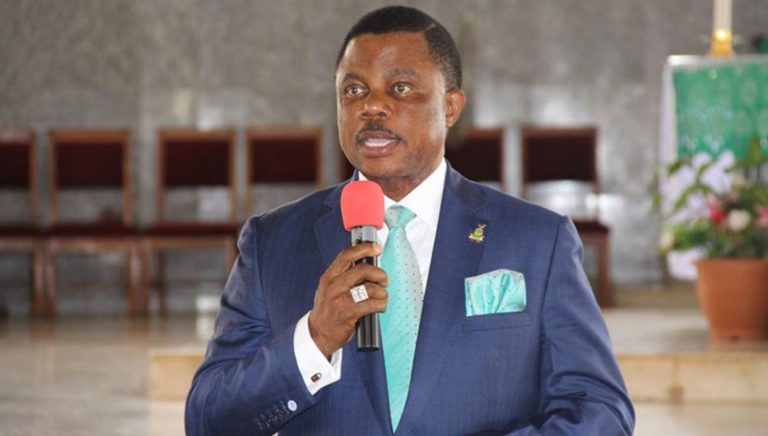
Obinna Anigbaoso, President of the association, told The ICIR that a meeting between the association and Governor Willie Obiano on May 16, did not yield the desired results.
Anigbaoso said some of the issues raised by the association during the meeting with Governor Obiano include the partial payment of doctors and the denial of service training to qualified medical personnel, among many others.
“We met with the governor on Thursday (May 16), he wanted to know our challenges and we made our challenges known to him, which were partial salary payment to doctors as we get 40% of the full salary, contrary to what others are paid,” Anigbaoso said.
“The governor expressed empathy, in terms of the partial payment facing doctors. He told us he is aware that doctors and even other workers earn badly, that the pay is poor, and that he is concerned.
“He claimed that if he had the fund, he would try to pay everybody the commensurate salary but he has some limitation. He said the current expenditure was on the high side, and the government is having challenges increasing the IGR (Internally Generated Revenue) due to debt and embezzlement.
“He said the IGR hasn’t come to the level that he would want, and at the implementation of the new minimum wage the current expenditure would come up some more.
“He said once they implement the new minimum wage and its guidelines are out, he would add N12, 000 for all civil servants in state since the minimum wage has come up from N18,000 to N30,000”.
Anigbaoso said the governor promised to revisit the doctors’ case after a year, hoping that the IGR would increase by then.
The outcome of the meeting with the governor was not acceptable to the members of the association and during their meeting on Monday, May 20, they resolved to continue the indefinite strike until the government honours the agreement it signed with them in January promising to commence full payment of their salaries by April.
“We were not happy, about the resolution. Yesterday there was a general meeting fixed, I did my best to convey the general message, and the response in the house was unanimous, nobody was happy,” Anigbaoso told The ICIR on Tuesday.
“They found it unacceptable saying the new minimum wage is not an offer, as their payment structure has nothing to do with it.
“So we pass a unanimous resolution that the indefinite strike would continue until the government adheres to our demands. We can’t go back and wait for another one year.”
All attempts to get the reaction of the Commissioner for Health in Anambra State, Dr. Joe Akabuike, have yielded no result. Repeated calls to his phone line kept ringing out and a text message sent to him has not been replied as at the time of this report.
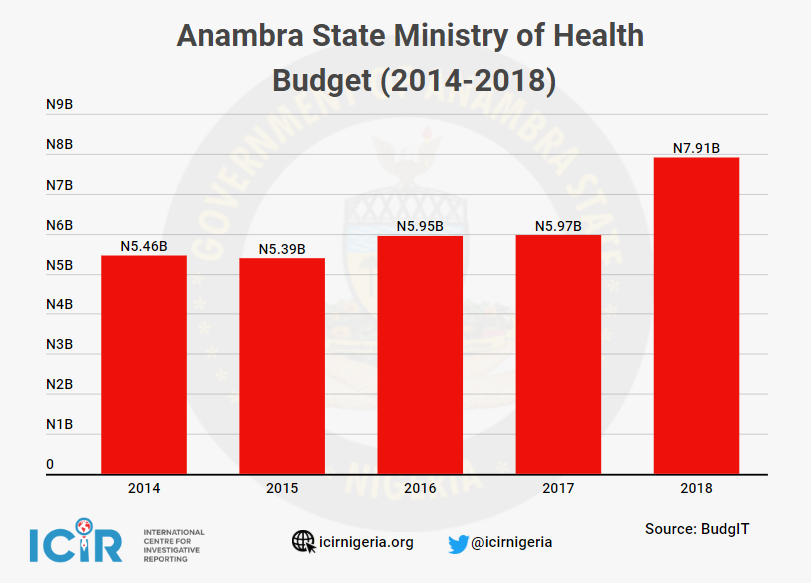
A look at the budgetary allocation to the health sector in Anambra State since the Obiano administration took office in 2014 shows that the sector has received a total of N30.68 billion.
In 2015, it received the sum of N5.39 billion, in 2016, N5.95 billion, in 2017, the budget rose slightly to N5.97 billion, and in 2018, N7.91 billion was allocated to the health sector.
However, despite the seeming increase in the budgetary allocation to the health sector in the past six years, the striking doctors say there has not been any significant improvement in health services in the state or in the welfare of medical practitioners.
The association had noted earlier in their statement to the press that these challenges have lingered for about seven years, resulting in an exodus of doctors to other states and a professional stagnation of doctors, due to lack of adequate wages and service training.
It is not clear yet when the resident doctors would call off their industrial action but one thing is certain, it is the citizens of Anambra state that would be the worst hit as the face-off between the state government and the doctors drags on.
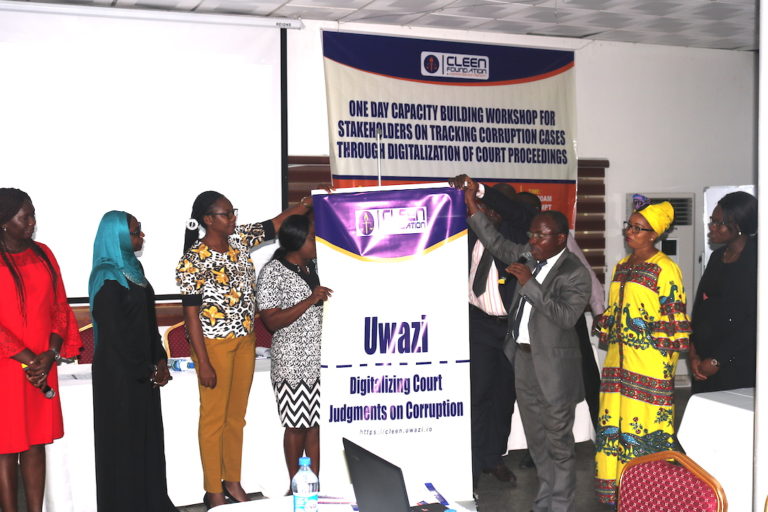
THE CLEEN Foundation, a non-governmental organisation promoting public safety and access to justice, has launched an online platform that enables the digitisation of and public access to court judgements, known as Uwazi.
The launch took place on Tuesday at a one-day capacity building workshop for stakeholders held in Abuja.
Funded by the MacArthur Foundation, Uwazi was designed by the Human Rights Information and Documentation Systems (HURIDOCS), a data-based human rights organisation.
Benson Olugbuo, the NGO’s executive director, in his opening remarks read by Ruth Olofin, the programme manager, noted that CLEEN Foundation has worked with the justice sector since its establishment in 1998.
He said the broader goal of the new initiative, tagged Promoting Accountability and Transparency in the Criminal Justice System, is to end corruption, ensure effective justice delivery, and improve the country’s criminal justice system. It is also expected to promote accountability and transparency in the fight against corruption.
“It will be recalled that before the 2019 general election, we collaborated with the Nigerian Police Force and other security agencies to train security officials deployed for election duties.
In addition, during the general election, we deployed technology to monitor the activities of security agents under our Election Security Management Project. We were able to report to Nigerians real-time development from the field,” Olugbuo said.
Believing that technology is the way to go in solving some of Nigeria’s problems, he said Uwazi boasts of functionalities that include search, filter, tracking of documents, cross-referencing, and the viewing and downloading of court rulings within the reach of the public.
“It is important to note that the concept of digitisation of court cases is not new,” the executive director said.
“It is being practised in Nigeria and other countries. For instance, electronic legal documentation has been firmly established and stable in Austria since 1999. And in the United States, digitising court proceedings and electronic online case files have been the standard in their federal courts in over a decade.”
Olofin said CLEEN Foundation has two data collectors in each of eight states: Abuja, Anambra, Ekiti, Enugu, Kaduna, Lagos, Ondo, and Oyo; but is on the lookout for more personnel and volunteers. The data collectors observe court proceedings, especially ones related to corruption, get a copy of the judgement, and then upload on the platform.
“We are bringing an angle to the project where the public, legal practitioners, and scholars can go online and access the court cases that we have uploaded on the platform,” she explained. “As we speak now, we have about 262 cases on the Uwazi platform, including those on corruption and financial crime.”
She said the foundation plans to establish resource centres where people can get hard copies of the documents that have been uploaded on the platform, especially for those without internet access. The first of such centres will be launched in Oyo State in June.
In a hands-on technical session, Gabriel Akinremi, a senior IT officer at CLEEN Foundation, took the participants through a step-by-step process of tracking and uploading cases on the platform. In response to a question from The ICIR, he said lawyers and members of the public interested in collecting data for the platform are welcome to apply with CLEEN Foundation.
Also in attendance at the launch were Tolulope Agunloye, a project manager with BudgIT who spoke on how ICT may be applied in fighting corruption; Amina Salihu, Senior Programme Officer at MacArthur Foundation; as well as representatives from the Ministry of Justice, Federal High Court, and Nigeria Police.
Going through the Uwazi platform, The ICIR observed that as of the time of writing there are 137 cases on the website related to financial crimes, 106 related to corruption, 15 related to accountability, and 62 “other related cases”. Also, 234 cases have been decided, 18 are subsisting, and six are pending.
The majority of these cases (70) were decided or are ongoing in the Federal Capital Territory, closely followed by Anambra with 47 cases and Enugu with 46.
Some of the documents scanned and uploaded, through the use of Optical Character Recognition (OCR), can be easily copied if previewed; but this is not the case for all the uploads. For the latter category, the words in the court judgements are displayed as part of search results.
Currently, the platform does not allow users to upload documents on court proceedings or provide additional information about uploads.
Though there are filters according to court type, case type, case status, state, and originator of the document, it is difficult for users to narrow the search results to specific judges, accused persons, prosecuting agency, length of the case, and so on.
VICE President Yemi Osinbajo, Secretary to the Government of the Federation, Boss Mustapha, and former Lagos State Governor, Bola Tinubu, are some of the dignitaries expected to grace the book launch in honour of Dapo Olorunyomi, publisher of Premium Times.
This is contained in a statement issued on Tuesday by Chido Onumah, Coordinator of Africa Centre for Media Information and Literacy (AFRICMIL).
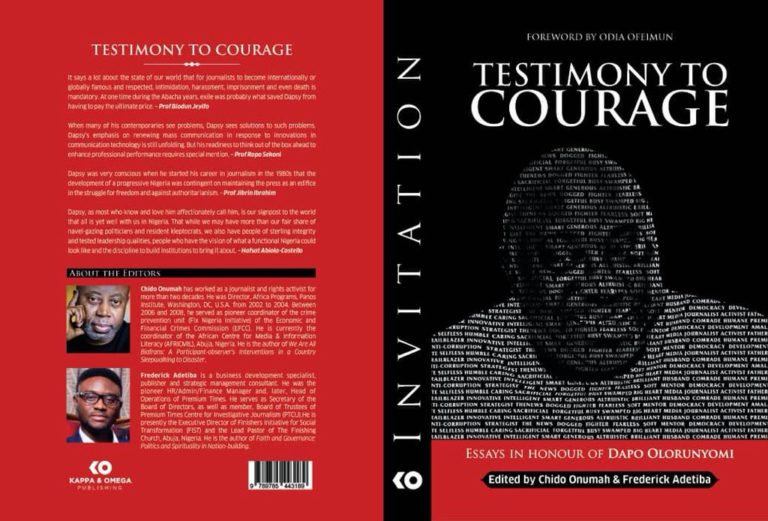
The book, titled ‘Testimony to Courage’, is a collection of essays in honour of Olorunyomi’s accomplishments in Nigeria’s media sphere. It was edited by Chido Onumah and Frederick Adetiba, has over 90 contributions from a spectrum of Olorunyomi’s teachers, colleagues, associates and mentees.
The date for the book launch is Monday, May 27, at the Shehu Yar’Adua Centre, Abuja.
Other dignitaries expected to grace the event include Chris Anyanwu, a serving member of the Nigerian Senate; Ekiti State governor, Kayode Fayemi, who will also deliver the keynote address, and Kabiru Yusuf, publisher of Daily Trust newspaper, who is expected to chair the occasion.
According to Onumah, “the book of essays was conceived after Olorunyomi’s 60th birthday in November 2017”.
“Among the contributors are Asiwaju Bola Tinubu, Mallam Nuhu Ribadu, Ogbeni Rauf Aregbesola, Prof Biodun Jeyifo, Prof Ropo Sekoni, Prof Umaru Pate, Prof. Lai Oso, Femi Falana, SAN, Dare Babarinsa, Kunle Ajibade, Dr Sola Olorunyomi, and Dr. Tunde Akanni.
Others include Dr. Tobi Oluwatola, Dr. Kole Shettima, Jude Ilo, Abdul Mahmud, Lanre Idowu, Ibim Semenitari, Idowu Obasa, Dr. Jibrin Ibrahim, Hafsat Abiola-Costello, Gbemiga Ogunleye, Richard Akinnola, Sunday Dare, Eze Anaba, Azu Ishiekwene, Owei Lakemfa, Oke Epia, Prof. Farooq Kperogi, Ohimai Godwin Amaize and Lara Owoeye-Wise.
“The book has a foreword by celebrated poet and author, Odia Ofeimun, and will be reviewed by Dr. Chidi Odinkalu.
“Dapo is a symbol of how through an independent media and vibrant civil society citizens can press for a better deal.
“The idea behind this book is to celebrate people while they are here with us. We feel that someone like Dapo who has sacrificed his all for us deserves to be honoured while alive.
“As readers will note in essay after essay, more than 90 persons came up with their individual testimonies about this man; his courage, integrity, dedication, selflessness and brilliance.”
Beyond the launch, the book would be made available throughout the country, and beyond, Chidoh stated.
THE Federal Government on Tuesday announced it has reviewed downward the charges paid at Unity Colleges from N83,000 to N49,500.
Outgoing Minister of State for Education, Anthony Anwukah made the announcement at a valedictory press conference held in Abuja.
He also said that the government had pegged Parents Teacher Association (PTA) levy at N5,000 across the board, thereby ending arbitrary charges of N75,000, which nearly inhibited access to unity colleges.
Anwukah disclosed that President Muhammadu Buhari had approved the establishment of a Secondary Education Commission that will oversee the operations of secondary schools in the country.
He explained that the current administration has spent a total of N7billion to provide security in all the 104 Unity Schools across the country.
“The Buhari administration had spent a total of N7billion on the provision of security infrastructure in the last four years,” Anwukah said.
‘‘Against the backdrop of insecurity in the north-east, affected by ‘Boko Haram’ as well as incidents of kidnapping in parts of the country, the Federal Government decided to provide basic security facilities in all unity schools.
The Minister reiterated that the Unity schools in the country would continue to exist as long as the Buhari administration is in power.
He disclosed that the government had embarked on the construction and rehabilitation of classrooms, hostels, laboratories among others across the schools.
‘‘Having taken this position, we embarked upon the rehabilitation of unity colleges in all the ramifications required,” he said.
‘‘In spite of the economic downturn, we have done well in terms of investment in capital expenditure.”
He also expressed optimism that the Federal Government would expeditiously look into the recommendations that have been made in terms of improving funding for the education sector.
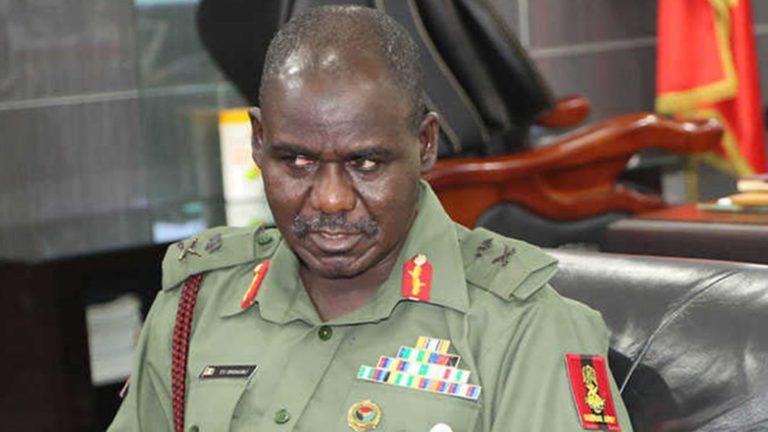
THE Nigeria Army says it is not under any obligation to let a disengaged officer know the reasons for his or her dismissal.
This was made known by David Ighodaro, an officer in the legal services department of the Nigeria Army, while giving witness during the hearing of a suit filed by Mohammed Suleiman, one of the 38 senior army officers that were compulsorily retired in 2016.
Many of the officers said they were not issued any query or reprimand neither did they undergo any kind of internal disciplinary measure before their controversial dismissal. Some of them said they saw their names on national television and newspapers before their dismissal letters got to them.
Mohammed Suleiman, one of the affected officers, had dragged the Army before the National Industrial Court (NIC) asking the court to declare his dismissal null and void and order his reinstatement.
Appearing before the court as a defence witness on Monday, Ighodaro said the army reserved the right to hire and fire any of its officers who goes against his condition of service.
“The army reserves the right to hire and fire its officers including the claimant for actions, conducts, among others which bother on indiscipline, unprofessionalism, threat to national security, among other reasons,” Premium Times quoted Ighodaro as saying.
“The army council has no obligation or duty to even give reasons for the compulsory retirement of the claimant.”
This claim is, however, false. Checks by The ICIR reveal that an officer could only be dismissed after having gone through a court-martial, according to the Armed Forces Act.
Under cross-examination, Ighodaro said he was not aware if Suleiman was ever subjected to any internal disciplinary measure before he was summarily dismissed.
Following Ighodaro’s testimony, the prosecution counsel informed the court that it was closing its case and would await the judgement of the court.
The case was subsequently adjourned to September 26, 2019, for adoption of written addresses.
A similar case involving a dismissed army officer, Danladi Hassan, had been decided in favourof the claimant in January this year.
In that judgement, Justice Sanusi Kado of the National Industrial Court ruled that the letter of dismissal issued to Hassan was null and void, and ordered the Nigeria Army to reinstate him with all his rights and privileges.
GOVERNMENTS have a responsibility to protect their citizens against external aggression and internal violence. The first is usually the responsibility of the military. The second duty falls on the police.
But in Nigeria, the government often deploys the military to restore order and to keep the peace. This is largely due to the inability of the police to contain violent conflicts, particularly in areas where armed groups are active.
This is the situation in Jos, the capital of Plateau State in the centre of Nigeria, just north of the administrative capital Abuja. The military has been used to maintain security since violence broke out between Christians and Muslims in September 2001.
The violence has evolved into one of the most enduring conflicts in Nigeria. Initially, angry young people used crude implements such as axes, sticks and machetes. Now various organised ethnic and religious militias wield small arms and light weapons. The conflict has spilled over into most parts of the state, with a pattern of hit-and-run attacks developing.
Several studies have indicated support the use of the military as a “necessary evil” to ensure the return to peace in the region.
But my study found that using the military to quell internal conflicts and restore order causes several problems. These included undermining the legitimacy of the military mission, as well as failing to quell the violence. In my PhD thesis I concluded that the conduct of soldiers only worsens the security situation for ordinary people.
I identified two factors as responsible for the problems. The first was a lack of military professionalism. Soldiers often intimidate and coerce civilians. They also engage in corruption and extortion, especially at military checkpoints. Some soldiers also subject civilians to psychological and emotional abuse. Yet others engage in blatant and flagrant acts of sexual and gender-based violence.
The second factor I identified was the fact that the command-and-control structure of the military is at odds with the way society operates.
These problems could be addressed with effective civil control of the military. But the study argues that civil control is weak in the country.
The use of the military
The response of the Nigerian government to growing levels of insecurity has increasingly been to use the military. Several peace and security conferences and commissions of inquiry have been instituted. But these yielded little or no result due to the lack of political will by the government to implement the recommendations.
The military has been deployed because of the weaknesses and inadequacies of the Nigerian police. Inadequate training, shortage of manpower as well as policing equipment, coupled with excesses have added to the erosion of public trust in the police and their legitimacy.
But the use of the military has introduced a host of new problems.
In my study I set out to understand whether the Nigerian state is exercising adequate civil control of the military to ensure that it doesn’t become a threat to the citizenry and exacerbate insecurity. I conducted 55 one-on-one interviews with civilians in six local government areas in Plateau State.
The study found that civilians see the military as exacerbating insecurity. For example, increased militarisation has led to people’s movements and activities being severely restricted. And several emergency rules have been declared. These have involved suspending civilian government and replacing it with military administrators.
Another finding was that dereliction of duty is rife among soldiers, with some choosing which distress calls from citizens to respond to or not.
On top of this, there’s tension between military culture and civilian values. The military operates a culture which follows an authoritarian leadership style, and is combat-focused. For their part, civilians are more likely to seek resolution to issues and to use the criminal justice system to adjudicate problems.
This has led to relations between civilians and the military becoming severely strained.
Lack of civil control
A bigger problem is the weak civil control over the Nigerian military. This has led to a lack of accountability and compliance with rules of engagement.
Nigerian law subordinates the military to civil control and parliamentary oversight. Ideally, this should ensure that the military acts within its mission and mandate. But, the problem lies with implementation. The culture of civilian supremacy over the military is not as yet well institutionalised.
The result is that citizens counteract abuse by the military in various ways. One way is to simply comply with the demands and orders of the soldiers, even when they are illegitimate. Another entails non-violent resistance or non-compliance. For example, it’s common for civilians to refuse to cooperate and share information with the military.
A third way is to collaborate with compromised soldiers. The fourth is to use various forms of violent resistance. This involves people either aligning with armed groups, or forming their own. This proliferation of armed groups worsens insecurity.
My study also showed a sharp difference of opinions between people of different religions. Christians contended that the military was biased in favour of Muslims. For their part, Muslims didn’t share this view.
What needs to happen
The use of the military is not an effective intervention against internal armed conflict. This is especially so in states with weak institutional control over the military as is the case in Nigeria.
The more recent setting up of a peace building agency is a more plausible alternative towards bringing the violent conflict to an end through effective mediation and peace education. The use of the military needs to be reconsidered and the peace building agency should focus on reuniting people and bridging the gap between the reactive security measures with proactive conflict prevention strategies. This is the only way in which trust and relative peace can be restored in this once peaceful Nigerian state.
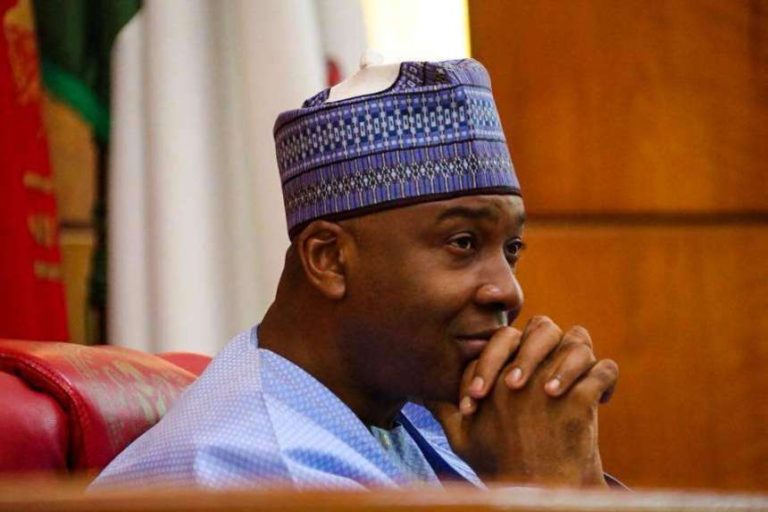
SENATE President, Bukola Saraki, says he is not aware of the new set of guidelines on media accreditation which was issued by the National Assembly on Monday.
Saraki said the document did not emanate from his office or from the office of the Speaker of the House of Representatives, Yakubu Dogara, and that it would be investigated.
“The attention of the President of the Senate, Dr Abubakar Bukola Saraki, has just been drawn to a story that is circulating on social media about the National Assembly issuing new guidelines to journalists. These alleged guidelines have not emanated from either the Senate President or the Speaker, and will be promptly investigated,” read a statement issued on Tuesday by Olu Onemola, Saraki’s Special Assistant on new media.
“The public should note that the 8th National Assembly has been committed to the freedom of the press as exemplified by its work to bring governance closer to the people through live streams and live tweets.
“This is because the leadership of the 8th National Assembly believes strongly in the freedom of the press and in carrying the Nigerian public along. Hence, the Senate President and all his colleagues will continue to work to ensure that these freedoms remain unhindered.”
The Nigerian Guild of Editors (NGE) had criticised the new NASS guidelines, accusing the eighth National Assembly of attempting to put the press in chains.
“The guild is disappointed that the same 8th National Assembly which benefited immensely from free press in its moments of trial has turned round to put the same press in shackles and chains,” the NGE said via a statement on Tuesday.
“We reject this crude abrasion of our constitutional rights to freely disseminate information. It cannot stand,” the statement read in part.”
Also, the National President of the NUJ, Christopher Isiguzo, described the new NASS guidelines as “satanic, draconian, anti-press freedom, and anti-democratic” and urged the authorities of the National Assembly to withdraw it within 24 hours.
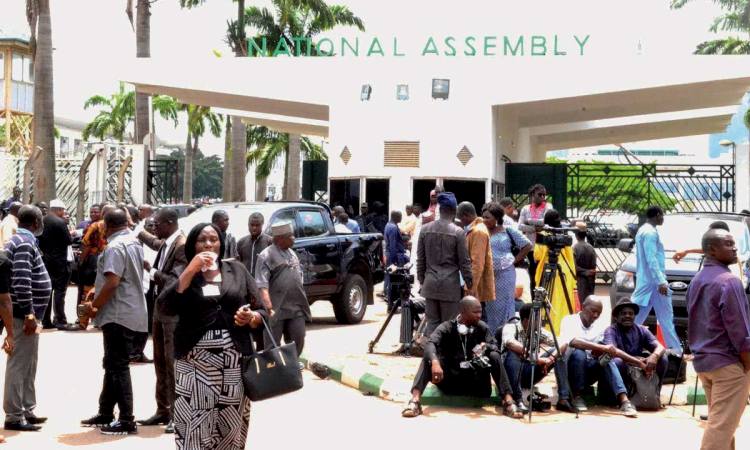
THE Nigeria Union of Journalists (NUJ) has rejected the new guidelines issued by the National Assembly which the legislative arm of government said must be met before a media house is accredited to cover legislative activities in Nigeria.
The new guideline was contained in a statement issued on Monday by the National Assembly Director of Information, Agada Emmanuel, and it would come into effect by June 11, 2019.
Speaking to The ICIR on Tuesday, President of the NUJ, Christopher Isiguzo, described the new guidelines as “satanic, draconian, anti-press freedom and anti-democratic”, and asked the leadership of the National Assembly to withdraw it in the next 24 hours.
Isiguzo said it was disheartening that the legislative arm of government which is being looked upon to enact relevant laws for the country in keeping with the principles of democracy, is now the one seeking to impede the freedom of the press.
“It is so sad that the legislature, which is, of course, a strategic arm of government in a democracy, could be the one that is now trying to gag the media,” Isiguzo said.
NUJ President, Christopher Isiguzo
“We will not accept it. We have asked them to withdraw the satanic guidelines within 24 hours, after that we intend to call an emergency meeting of our Federal Working Committee and, of course, we would know the next line of action.
“But in the immediate, we reject the purported guideline as released by the National Assembly Management.”
Isiguzo said he would be on live television later in the day to discuss more on the latest development.
Similarly, the Nigerian Guild of Editors (NGE), in a statement on Tuesday, also rejectedthe new NASS guidelines for media accreditation describing it as intended only to serve “the myopic interest of its chroniclers and purveyors”.
“The guild is disappointed that the same 8th National Assembly which benefited immensely from free press in its moments of trial has turned round to put the same press in shackles and chains. We reject this crude abrasion of our constitutional rights to freely disseminate information. It cannot stand,” the statement read.
According to the NASS guidelines released on Monday, television stations are required to present only one reporter and one cameraman for accreditation, radio stations are allowed only one reporter, while online media organisations are allowed one reporter and one photographer each. Also, those classified as “independent producers” are allowed one reporter and one cameraman each.
Media organisations to be accredited must, among other things, show evidence of membership of professional bodies, while the journalists must produce evidence of their membership of the Nigeria Union of Journalists (NUJ).
For online media houses, they must have at least 5000 viewership per day and the site must have been in operation for 5 years.
Below is the complete guidelines as released by the NASS authorities on Monday”
NEW GUIDELINES FOR THE ACCREDITATION OF MEDIA ORGANISATIONS, JOURNALISTS/ CORRESPONDENTS COVERING THE NATIONAL ASSEMBLY
1.0 NUMBER OF JOURNALISTS/CORRESPONDENTS TO BE ACCREDITED FOR PRINTS, ELECTRONIC AND ONLINE MEDIA FOR SENATE AND HOUSE OF REPRESENTATIVES RESPECTIVELY.
1.1 Television – 1 Reporter and 1 Cameraman
1.2 Radio 1 Reporter
1.3 Independent Producers – 1 Reporter and 1 Cameraman
1.4 Online Media 1 Reporter and 1 Photographer
2.0 CLASSIFICATION OF ACCREDITATION
2.1 Permanent Accreditation
2.2 Temporary Accreditation
2.3 Foreign/international Media Houses
2.4 Freelance
3.0 REQUIREMENT FOR PERMANENT ACCREDITATION OF JOURNALISTS/CORRESPONDENTS FOR PRINT, ELECTRONIC AND ONLINE MEDIA ORGANISATIONS
3.1 Evidence of certificate of incorporation of the media organisation.
3.2 Evidence of membership of professional bodies for media organization.
3.3 Proof of membership of Nigeria Union of Journalists (NUJ) with registration number.
3.4 Code of certification from the National Library for the media organization.
3.5 Functional Bureau in Abuja (Staff Strength not less than 5 Editorial staff and daily circulation of 40,000 copies for the print media with evidence to support the claimed circulation figure.
3.6 Media Houses must be publishing daily and on weekend (Applicable to Online Media).
3.7 Re-certification form must be signed and endorsed by the Chief Executive Officer (CEO) of the Media organization Bureau Chief, City Editor as the case may be.
3.8 The Media organization concerned must have experience of covering proceedings of the National Assembly for at least two (2) years before applying for permanent accreditation.
3.9 All media organization will submit a copy of its income tax return for the last two years.
3.10 All online media must have at least 5000 viewership per day, the site must have been in operation for 5 years and provide satisfactory evidence to this effect with clippings of the news utilized (especially parliamentary news).
3.11 Only television stations with national coverage and specific independent producers with current running programme on the National Assembly will be allowed access into the Chambers on a permanent basis (All the production crew will be accredited as an entity).
3.12 All correspondents must attach a photocopy of letter of appointment of the media organization on whose behalf request has been received for grant of accreditation.
3.13 All freelance journalist seeking permanent accreditation must show evidence of not less than 5 years coverage of the National Assembly proceedings/full editorial focus and publication on parliamentary reportage.
4.0 It is only Journalists and correspondence whose media organisations meet the above requirements for Permanent accreditation that will be entitled to carry National Assembly Identity Card/Membership of the respective Press Corp.
5.0 All other media organization who do not meet the above requirement will be captured under the Temporary accreditation status and they will not be entitled to carry National Assembly Identity Card/Membership of the Press Corp of the Senate and House of Representatives.
6.0 All Temporary accredited media houses, journalists/correspondents shall be allowed permit into the National Assembly for specific coverage not exceeding one (1) week in the first instance and not more than twice in a month.
7.0 All foreign/international media houses seeking accreditation shall abide by all the Diplomatic Protocols established by the Ministry of Foreign Affairs for foreign media organizations, the Code of Ethics for Nigerian Journalists and security clearance before accreditation will be considered upon the recommendation from the Ministry of Foreign Affairs.
8.0 All permanently accredited journalists/correspondents shall submit a recertification letter from the Chief Executive Officer (CEO) of their media organization on a sessional basis failure to which accreditation shall be withdrawn forthwith.
9.0 All accredited media organization will be considered as a single entity in the issuance of passes irrespective of their membership of Senate and House of Representatives Press Corp.
10.0 This new accreditation guidelines shall come into effect from June 11 2019.
UNTIL August 2017, I was the Director-General of the Bureau of Public Service Reforms (BPSR), with the daunting task of reforming Nigeria’s Federal Public Service. As part of that role, I sought to move the focus of Public Service Reforms away from the Public Service unto the public. This was a deliberate tactical approach that sought to change the approach to public service reforms from inputs to outcomes. Problems with the Public Service are often complex and intractable. There are various reasons why Public Service Reforms are difficult in most environments and are particularly difficult in developing countries, such as Nigeria.
In countries such as ours, the public service reformer is often dealing with myriad systemic input problems in the organisation he is trying to reform, including lack of electricity, insufficient financial provision, lack of working tools, poor internet access, poor staff motivation and systematic corruption. The combination of these, and any one of them for that matter, is sufficient reason to explain away a lack of improvement in public service delivery. Focusing on the outcome expected, rather than the problems with the inputs, gives the reformer a better chance of driving reforms in dysfunctional environments.
The need to deliver the outputs expected forces the system to align the required inputs to achieve the expected outcomes, rather than focusing on the difficult task of trying to solve all the input problems before we can get the improvements in service delivery that the public expects and deserves. We will use the tortious issue of obtaining a Nigerian passport as a demonstration of how it could be done.
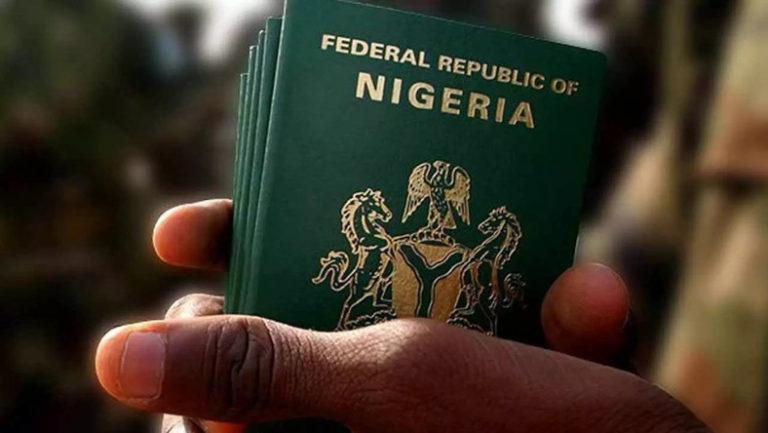
Many Nigerians go through a painful, dysfunctional and extortionate process when they try to obtain an international passport. Given its population and the absence of a focus on outcomes by the Comptroller-General, Lagos residents suffer the most. It is virtually impossible to obtain a Nigerian passport in Lagos without “knowing someone” and paying above the official rate of N15,000 for a 32-page passport and N20,000 for a 64-page passport. Even after paying more than double the official price and making obeisance to god-like Immigration officials, applicants are still confronted with the claim that “there are no booklets.”
The Comptroller-General of Immigration often makes a categorical, but hollow, assertion that there are sufficient booklets nationwide, but the experience of citizens is clearly contrary to that claim. It is either that the Comptroller-General is being economical with the truth or that his officers are deliberately making things difficult in order to derive corrupt benefits from the dysfunction, and that the Comptroller-General is not interested in doing anything about it.
Overcoming this logjam is relatively straightforward. Nigerians can obtain an international passport in a week without needing to know anybody and without paying a kobo more than the official price. In the next few paragraphs, I will outline how this can be done.
The first step is for the Presidency to demand from the Immigration Service the service standards for issuing Nigerian passports. The last time, that I am aware of, such service standards were set for passport issuance was under the SERVICOM regime in 2004. At that time, the Immigration Service undertook to provide international passports within one week, but expectedly within 72 hours.
Most people, including the Immigration Service, currently appear not to be aware of this service standard. Nobody monitors performance against these standards, and although passport issuance is part of the Ease of Doing Business initiative, the Presidential Enabling Business Environment Council (PEBEC) has achieved little or nothing in this regard.
It is important for the Immigration Service to commit to this standard, or revisit the standard and set a more realistic one and make the targets publicly-known, and for PEBEC and the National SERVICOM Office to publicly report the performance of the Immigration Service against these standards. In order to meet the existing performance standard, or whatever new standard is set, it is necessary to take a number of straightforward actions.
First, all payments must be made online. Notionally, this is already the case, but in practice, citizens are often unable to make online payments, forcing them to have personal contact with Immigration officers and their touts, who extract corrupt rents for “helping” people. The payment systems are often unavailable, either due to weaknesses in technical infrastructure or as a result of deliberate sabotage. Indeed, those that “stupidly go and pay online” are made to suffer interminable delays and forced to regret their attempts to do things properly.
The Comptroller-General and PEBEC should be monitoring the frequency of “network” downtimes by location and tackling cases where the downtimes are as a result of deliberate sabotage. The good thing about technology is that there is always an audit trail that tells you who has done what to the system, at what time, in which location. They should also be monitoring how quickly applicants that pay in advance online receive their passports.
Even when an applicant successfully pays online, another major pinch-point is the capture process. Nigeria does not really have a passport renewal process. Every passport application is deemed to be a new application requiring fresh biometric capture. This would ordinarily not be a problem, particularly given the sensitive security nature of international passports. The process of being “captured” is, however, another corruption ‘toll gate.’ It should be possible to simply book an appointment for capture online, appear on the appointed date and time and be captured within 15 minutes.
Currently, the appointment system tends to give you an appointment in 6 years’ time when the validity of the passport you are applying for is only 5 years! This forces you to seek out an Immigration officer that will “help” you, of course in the expectation of “appreciation.” There does not seem to be any willingness on the part of the Immigration Service to apply the simple technical fix required to make the appointment system work.
The Immigration Service knows the number of passport applications that it gets each year. It also knows that Nigeria’s population growth rate is 2.6%. How hard can it be to ensure that we have enough booklets to cover all applicants? I mean really! Unlike National Identity Cards, passports are not issued for free but for a fee. The Federal Government should configure the Treasury Single Account to ensure that the fees generated from passport issuance is used to ensure the availability of passport booklets at all times.
If, as a result of exchange rates, the price of the passport is too low, especially as it is currently printed abroad, the Immigration Service should review the price and gradually increase it over time. Passport issuance is not a social service. Having said that, every effort should be made to print passports in the country.
Every Nigerian knows that if you give enough cash to Immigration officials, you can get your passport in less than 6 hours. We also know that Nigerians like to leave things late, often applying for a passport within just days of needing to travel. Of course, pressure of time on the applicant is a compelling reason why they would pay for “help.”
It is easy for the Passport Service to put in place an Emergency Fast Track process that charges four times what the normal rate of passport application is. Those that are in a hurry can pay N60,000-N80,000 per booklet to government, rather than into the private pockets of Immigration officials, and the funds can be reinvested into improving the passport process and even incentivising Immigration officers. Those that are not in a hurry and can wait a week, or whatever the new service target that the Service sets, can pay the normal price and get their passports without begging or bribing anyone.
Finally, the recent data integration between the Nigeria Immigration Service and the National Identity Management Commission (NIMC) is commendable. When a Nigerian has a National Identity Number issued NIMC, there is really no reason why they should not be able to obtain their passport within one week of submitting all required documentation. They should be able to pay online, book an appointment for biometric capture, get captured within 15 minutes without begging or bribing anybody, and be given an appointment for when to collect their passports.
The performance of the Immigration Service on each of these steps should be monitored and publicly reported. Until this is possible, the One-Government mantra in Executive Order E001 is simply hollow rhetoric and the Vice President’s recent charge that Nigerians should not pay a bribe to obtain a passport simply a political statement.
These suggestions are not new. They were given to the Immigration Service in 2017as part of a BPSR study on removing the bottlenecks to passport issuance when I was the BPSR Director-General. Before then, a SERVICOM assessment of the Passport Service in June 2006 came to pretty much the same conclusions. The Immigration Service seems to lack the willingness to address the issue and appears to have the power to get away with it.
The Vice President, who is the head of PEBEC, should use the power of his office to ensure that they implement these recommendations and that the Passport Service does not continue to get away with the current dysfunction in passport issuance, to the detriment of Nigerians.
Dr Abah is the former Director-General of the Bureau of Public Service Reforms. He is currently the Country Director of DAI, a global development company. He tweets @DrJoeAbah. This article was originally published by Business Day.
NIGERIAN government has once again failed to explain the reason why a foreign oil vessel, MT Anuket Emerald, with International Maritime Organisation Registration Number 9393644, earlier convicted of oil bunkering in Nigeria by Justice Ibrahim Buba of the Federal High Court, has continued to evade justice.
The Panama Flag-flying ship, crewed by three Russians, three Ukrainians, Eight Filipinos, and one Georgian, was said to have violated Section 19 (6) of the Miscellaneous Offences Act Cap M17, Law of the Federation of Nigeria, 2004, an offence punishable under Section 17 of same Act, and it has been duly convicted and forfeited to the Federal Government of Nigeria in June 10, 2015.
According to EFCC investigation, its conviction followed the offences committed by the ship on February 27, 2015, and its owners: Combe Shipping Limited, Monjasa DMCC, and Glencore Energy UK Limited, among others.
The judgment reportedly was subject to the incontrovertible evidence presented at the hearings and proved beyond reasonable doubts by the Prosecution Counsel, Rotimi Oyedepo, defence counsel, Babajide Koku, EFCC’s Senior Detective Superintendent, Abdullahi Alaya and the captain of the tanker, Artur Pakhladzhian.
The ship, whose crewmen were each bailed the tune of N750 million because of their inability to provide Nigerian sureties, also lost it Appeal on January 15, last year, when Justice Garuba Haruna of the Federal Court of Appeal, Lagos Division, upheld their conviction and the forfeiture of their vessel by Justice Buba.
Names of the crewmen, according to the court charge sheets, are Artur Pakhladzhia, Sergo Abbgarian, Vasily Shkundich, Vitaliy Bilour, Hlarion Regipor, Laguta Oleksiy and Cadavis Gerarado.
Others are Kretov Andry, Badurian Benjamin, Chepikov Olksan, Naranjo Antero, Patro Christian, Alcayde Joel and Caratiquit Beyan.
But instead of facing the wrath of the law, by being impounded and forfeited to the government of Nigeria, as ordered by both courts, Anuket Emerald appears to sail in freedom.
Usually, when a foreign ship is accused of whatever criminal offence, as it is in MT Anuket Emerald’s case and pronounced convicted and or forfeited through a judgment of the court of competent jurisdiction, the law, according to the investigation, takes effect immediately.
This means, the Nigerian Navy, through a notice from the Ministry of Justice, would swing into action, impound the vessel, take possession or transfer it to either the Nigeria Maritime Administration and Safety Agency (NIMASA), Nigeria Port Authority, Shippers’ Council or the Special Presidential Investigation Panel on Recovery of Public Property (SPIP), as the case may be.
Its content is also supposed to have been taken over by the Nigeria National Petroleum Commission (NNPC).
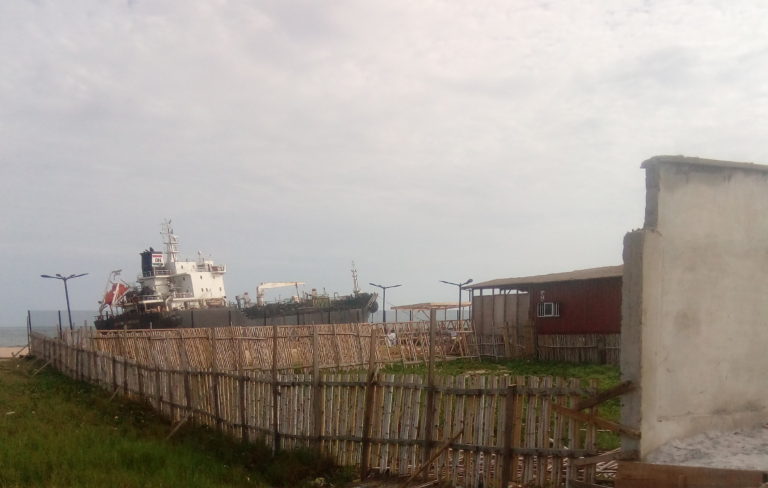
But MT Anuket Emerald’s case appears to be an exception, as the ship has been spotted twice, docked in Elegushi Beach, a private resort in Lekki, Lagos State, engaging in a yet another suspicious transaction.
As earlier reported by The ICIR, the Panama-flagged Ship was again sighted at Elegushi beach on Friday, April 19, carrying out some trans-loading operation.
At the distance of about 100meters, the vessel was seen being sucked off through six different pumping hoses, offloading its 1.5million tonnage content into waiting petrol tankers.
Most of the tankers were branded NIP Oil.
This reporter observed that the suspicious activities around the ship are being protected by the personnel of the Nigerian Navy, the agency mandated by the law to enforce the court judgment. The naval men were supported by the Elegushi special security operatives as well as members of Oodua People’s Congress (OPC).
Findings revealed that the ship’s operation may not only constitute economic sabotage; it also comes at a huge ecological cost to the environment as a huge measure of black oil were seen being discharged into the waters, thereby polluting the lagoon and endangering the marine lives in it.
On the stretch of about half of the beach shoreline, oil spillage, covering about as long as 12 fits in-between the waves and the shoreline was conspicuously seen.
Special factory rocks used to barricade the dangerous spots for picnic swimmers have all been darkened by the spillage.
Unsuspecting picnickers who dived into the water soon withdrew, angrily, when they notice oil stain on their bodies.
“Yes, I know the water is oily; too bad. But I have to swim. I travelled all the way to Lagos for the Easter Holiday and more particularly to enjoy the beach life here in Elegushi,” said Daniel, one of the frustrated picnickers sighted at the beach during this reporter’s visit.
But unlike Daniel, many other people won’t take such a risk.
“Who will go to Elegushi Beach again? God forbid! That beach that has been taken over by black oil,” said Miss Chidinma Nwapka, a Pharmacist and a one-time regular visitor to the resort until the Anuket Emerald birthed at beach disposing of its toxic content.
Bad business for beach traders
Nwakpa’s discomfort is shared by many others, including business owners’ at the beach, who are said to be operating under stringent conditions.
“We have complained to the authority about the oil spillage by the ship. But they didn’t take any action,” said one of the stall owners, who pleaded anonymity because of possible backlash.
“As you can see, this is Friday, Good Friday of Easter. On a good day, everywhere is supposed to have been taken over by picnickers, and we are supposed to be in good business.
“But beach lovers appeared to have all deserted us because of the activities of that ship that contaminate the water and ruin our businesses,” the business owner continued, pointing at Anuket Emerald Vessel, some 100 meters away as he vented his frustration.
As this reporter explores the beach, he called the attention of one of the commercial photographers at the beach to give him some photo shots, in an attempt to capture the image of the vessel, using it as a photo background.
As this was being done, a lanky, oil-soaked Hausa man came rushing, shooing them off.
“Please leave this place. Don’t put me in trouble,” he warned.
“Put you in trouble! How,” this reporter probed.
“See, the (Nigerian) Navy gave me instruction to make sure that nobody takes the photo of this ship or the offloading activities going on here,” he explained, begging us to leave.
The explanation that our reporter is a picnicker who just wants to enjoy himself and have a variety of beachside photos fell on the deaf ears.
“That is how they have been doing since January,” the photographer, who identified himself as Jamiu Adedeji, found his voice, accusing the Nigerian Navy of overzealousness.
“If they catch me photo shooting you near the ship, they will arrest me, arrest you and cease my camera,” Jamiu warned this reporter.
But the Nigerian Navy authorities has exonerated itself of any wrongdoing. Rather it said all enquiries should be directed to the Ministry of Justice, which it claims is supervising the operation.
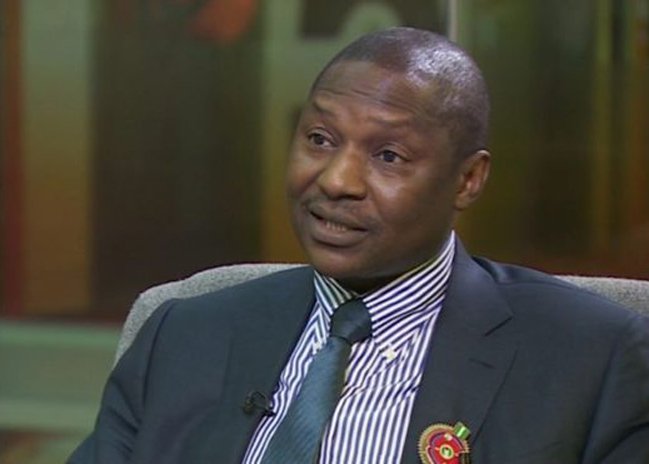
File photo: Attorney General of the Federation, Abubakar Malami (SAN) ordered the Navy to secure the ship.
Speaking with The ICIR on phone, the Director of Information for the Nigerian Navy, Commodore Suleman Dahun, who acknowledged that he was aware of the operation of MT Anuket Emerald in Elgushi Beach, explained that the Attorney General of the Federation, Abubakar Malami (SAN) is not only in charge of the operation, but expressly ordered the Navy to secure it.
“Actually, the whole process is driven by the Federal Ministry of Justice. The evacuation of the product in the vessel, to be specific, is being conducted by the Federal Ministry of Justice. The Navy’s responsibility is to ensure the physical security of the vessel, making sure it is not stolen or ambushed,” Dahun said.
The reporter asked whether the naval spokesman is aware of the conviction and forfeiture judgment on the said vessel, he said “yes, we are aware of it. And like I have said before, our role on it is restricted to ensuring the physical security of the vessel; nothing more nothing less.
“The evacuation of the content is being supervised by the Federal Ministry of Justice,” Dahun insisted.
Not satisfied, the reporter further asked whether the evacuation of the ship at Elegushi is preparatory to the enforcement of the court judgment, the Navy PRO’s response was less revealing this time.
“It would be better to seek more clarifications from the Ministry of Justice if you want to know more about the whole issue.
“What I know and been reliably informed is this simple fact that we [the Nigerian Navy] are responsible for the security of the vessel. Any legal or another dimension to it should be referred to the Ministry of Justice,” he added.
But there are mounting questions surrounding the legality of the operation of MT Anuket at Elegushi beach. Why has the ship remained on Elegushi Beach, a private resort in Lagos for the past five months? Why is its content being evacuated secretly and to where is it taken to? Why carrying out such operation in a private beach? Is the operation preparatory to the final forfeiture of the ship? How long does it take to impound a forfeited foreign ship and the process? These are questions yet to be answered by the concerned authorities.
On May 3 and 5, the reporter attempted to follow the trucks to their destination where they off-load the oil, but it turned out that the truck departs the beach only at night, making the surveillance difficult. One of the trailers is branded Total Oil, and the other branded IVECO.
The Minister of Justice and Attorney General of the Federation, Abubakar Malami (SAN), was contacted for an interview in order to verify the Navy’s claims on his ministry’s involvement, but no response was provided.
Calls, text and WhatsApp messages sent to his personal GSM were all ignored.
When contacted, Spokesman of the Economic and Financial Crimes Commission (EFCC), the agency that investigated and led the prosecution of the convicted ship, Tony Orilade, was not forthcoming about the MT Anuket Emerald Ship. He told The ICIR that he was not familiar with the matter but asked for time to make proper findings and get back.
As at the time of filing this report, he was yet to get back with his findings.
However, a senior official of the Commission who pleaded for anonymity said the matter is far beyond the EFCC. According to him, the Office of the Minister of Justice and Attorney of the Federation had instructed the anti-graft agency to hands off the matter.
“The man in charge of the case explained the politics involved so much so that the Office of the Attorney General of the Federation came up with a letter purported to be from the presidency instructing that we hand off the matter,” he said.
“The minister came up with a letter from the presidency that ought to be for a specific directive and now he is using it for the general directive.
“Once it happened that way, there’s nothing we can do, said the EFCC official who apparently was lamenting the tight corner the Commission has been boxed into by the Minister’s directive.
The EFCC source also noted that there has been an age-long rivalry between the Commission and the Office of the Minister of Justice and Attorney General of the Federation over the handling of high profile cases.
“It happened when Aodoaaka was the Minister, even when Adoke was the Minister and now it is repeating itself,” he lamented.
“They always don’t give the Commission free hand to work. That’s where we are.”
The Office of the Minister of Justice and Attorney General of the Federation has in recent past taken over high profile cases from both the EFCC and ICPC. Many of such cases have been settled out of court and a similar fate may be waiting for the MT Anuket Emerald Ship’s case.
Government officials stonewalling
The Nigerian Ports Authority’s Marina headquarters was also visited in the course of this investigation.
The NPA, which assumes the Landlord duty of all the nation’s seaports, in spite of whatever concessions that may be in place with private operators, was contacted to understand why the MT Anuket Emerald Ship chose to offload its content at a private beach, having been convicted and forfeited to the government of Nigeria.
Suwaid Isah Ali, Assistant General Manager, Corporate and Social Responsibility, Industry and Port Promotion of NPA, declined to give an answer.
Ali, who noted the inquisitions on Friday afternoon, April 26, promised to forward same to NPA central operating centre where all inbound-outbound Ships are being monitored; and get back to us.
According to him, “…we are working on your questionnaire and hopefully, we should be responding soon…”
He has not gotten back as at Monday, May 21, 2019.
Also, the Nigerian Maritime Administration and Safety Agency (NIMASA), the body responsible for the administration of the nation’s marine activities, including the safety and security of the waters, was contacted over the estranged vessel.
But the agency also appeared clueless on the matter, as it offered no scintilla of useful information on the inquisition.
Instead, its public relations officer, Isiche Osamgbi, who initially told this reporter that he would “check the data and revert” regarding questions sent to him on Thursday, April 24, never did as at Friday, May 21, 2019. He didn’t pick his calls afterwards.
Mr. Okoi Obla, Chairman, Presidential Special Investigation Committee on Public Property (SPIP) was contacted on phone by The ICIR on the matter and he promised to confirm same with the Ministry of Justice before getting back.
He has not got back as at the time of filling in this report. All the calls put through to him afterwards were also ignored.
As one of the partakers in the suspicious transaction, the Palace of the Oba of Elegushi, HRM, Oba Saheed Elegushi, when contacted, gave some “responses” that were never consistent with facts available.
According to the Personal Assistant to the King, Mr Temitope, “the ship in question had some technical issue, which resulted in the break [at the Beach]
“All the relevant agencies of the Federal Government are aware and making efforts to move it away…,” he said.
Meanwhile, a frontline Maritime Lawyer, Barrister Osuala Emmanuel Nwagbara has pleaded that it was in the interest of the public good for the government officials to educate Nigerians and be transparent accordingly on the status of the said ship.
Nwagbara, one of the maritime arbitrators in the country explained that “a ship is a chattel and like any other chattel, once it is forfeited, it becomes the property of the beneficial country.”
According to him, “It is very important to state that once a ship is forfeited, being a chattel, possession is immediately taken of it for the purpose of control. It would be unlawful to allow any person to trade with such a vessel on a commercial basis.”
Nwagbara added that “once a vessel is forfeited to a country, especially Nigeria in this case, the law allows two things to happen. One, the government may appropriate such vessel to public use such as deploying it to the Navy as a sovereign asset or for a specific public purpose.
“The other thing that may happen to a forfeited vessel is that it is sold through an open and transparent bidding process. Any person who buys such ship is free to put it to commercial use as the person deems fit.
Calling for further investigation into the matter, Nwagbara said his sense of curiosity was aroused by the report of the ship’s activities at Elegushi Beach, given “the fact that government does not engage ordinarily in the commercial distribution of petroleum products in such manner report.”
Meanwhile. many tankers are still being driven to Elegushi Beach almost on a daily basis to get a refill from MT Anuket Emerald, and the detail of the operation remains a secret.