Home Blog Page 2390

NJC forwards findings on Onnoghen, Tanko investigations to Buhari

THE National Judicial Council says it has forwarded to President Muhammadu Buhari, its findings on the investigation carried out into the allegations levelled against both the suspended and Acting Chief Justice of Nigeria, Walter Onnoghen and Tanko Mohammed respectively.

This was contained in a statement issued by the Director of Information of the NJC, Soji Oye, on Wednesday. The NJC, however, added that it did not investigate the allegation of false asset declaration against Onnoghen because the matter was already in court and therefore subjudice.

“Council reached a decision on the petitions written by Economic and Financial Crimes Commission (EFCC) and others and conveyed its decision to President Muhammadu Buhari, GCFR,” the statement read.

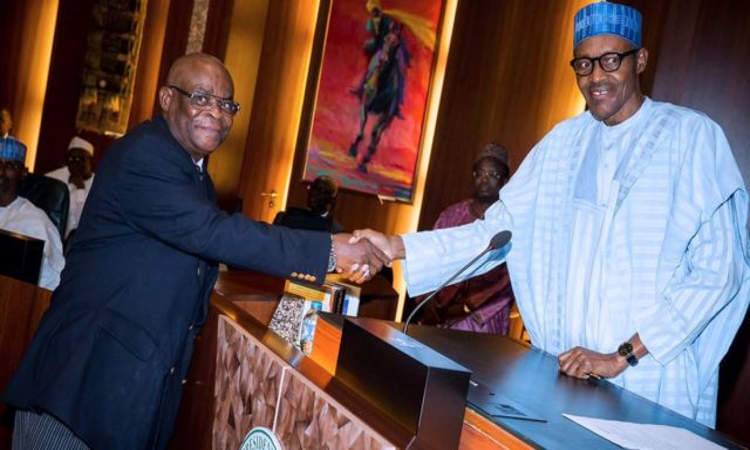
President Buhari congratulates Tanko Mohammed after swearing him in as acting CJN, shortly after suspending Onnoghen.

“Council also resolved that, by the nature of the decision reached, it would be inappropriate to publicise it before conveying it to Mr. President.

“Council decided that the allegations relating to assets declaration that were levelled against Hon. Mr. Justice W. S. N. Onnoghen, GCON were subjudice and therefore abstained from considering them.”

The Economic Financial Crimes Commission (EFCC) had filed a petition against Onnoghen, accusing him of several offences bothering on bribery, false assets declaration, conversion of public finances for personal use and misconduct.

On the other hand, Mohammed, who took over from Onnoghen, albeit on acting capacity, was accused by Olisa Agbakoba, a Senior Advocate of Nigeria, of lending himself to constitutional infraction by the executive arm of government.

Agbakoba stated that Mohammed, who was part of an NJC panel that sanctioned Justice Obisike Orji of Abia State for allowing himself to be sworn-in as Abia State Chief Judge by the state’s governor without the recommendation of the NJC, ought not to have accepted the appointment of CJN from President Muhammadu Buhari without the recommendation of the NJC.

INEC returns Nyesom Wike as Rivers State governor-elect

MORE  than three weeks after the gubernatorial election was held in Rivers State, the Independent National Electoral Commission (INEC) has finally concluded the process and declared the incumbent Governor, Nyesom Wike the winner of the election.

Wike, the candidate of the Peoples Democratic Party (PDP), polled a total of 886,264 votes to defeat his closest challenger, Awara Biokpomabo of the African Action Congress (AAC) who scored a total of 173,859 votes.

Teddy Adias, the Returning Officer for the Rivers State guber election, announced that Wike, having satisfied the requirements of the law and having scored the highest number of valid votes is declared the winner and returned elected.

After the election which held on March 9, collation of election result was suspended due to an outbreak of violence at the various local government collation centres. Armed soldiers were reported to have stormed several collation centres and disrupted the process. Some people were also reported to have lost their lives in the violence.

When INEC decided to resume collation, the candidate of the AAC filed a case before the Federal High Court in Abuja, seeking that INEC should be restricted from recommencing collation. The suit was, however, struck out by Justice Inyang Ekwu who ruled that the federal high court lacks the jurisdiction to entertain a post-election matter.

The All Progressives Congress (APC) was not on the ballot for the Rivers election as infighting prevented the party from conducting a valid primary election within the period stipulated by INEC.

However, Rotimi Amaechi, the Minister of Transportation, who is a leader of the APC in the state, threw his weight behind Biokpomabo and urged all APC supporters to vote for him.

Malabu oil deal: Award of OPL245 to Shell, ENI, flouted local laws, lawyer tells court in Italy

THE contract award of Oil Prospecting License (OPL) 245 to Shell and ENI, did not follow Nigerian legal provisions, Dayo Ayoade, a Nigerian legal practitioner told a court in Milan, Italy on Wednesday.

Ayoade said this during his lead presentations to prosecutors in the ongoing case of the Malabu oil deal which had to do with the controversial and illegal selling of one of Nigeria’s most promising oil well, OPL 245, to two giant international oil companies (IOCs), Shell and ENI.

A staff of the Department of Law, University of Lagos, Ayoade was hired by Milan prosecutors to ascertain Shell and ENI corporate and legal obligations.

In his presentation in court on Wednesday, Ayoade told the court that “the award process for OPL245 to Shell and ENI did not follow the procedure established in the Petroleum Act, Petroleum (Drilling and Production) Regulation and DPR Guidance Notes for Prospective Bidders”.

“Failure to follow the relevant laws, policies and regulations is fatal to the legality of the OPL 245 award (Zebra Energy Ltd V FGN (2002),” he said.

“It is my considered view that the license award on the basis of an FGN Resolution Agreement is anomalous and unprecedented in the Nigerian Oil and Gas Sector.”

Under examination by the prosecutor, Fabio DePasquale, Ayoade further expressed shock at the condition for the acquisition of the lucrative bloc by the IOCs. In his oral testimony, he said he was “surprised that everything around the Resolution Agreements destabilises established petroleum laws and regulations in Nigeria”.

“Contrary to the laws and standards, the Office of Attorney General of the Federation supervised the resolution processes and agreements on OPL245 deal as against the Ministry of Petroleum Resources,” Ayoade further told the court.

“The Minister of Petroleum Resources does have sufficient powers to award oil licences, but this must follow established procedure, and the Minister must perform his statutory duties in the public interest. The public interest is obviously missing in the OPL 245 award and subsequent Resolution Agreements.”

Recall that a court in Milan has already convicted and jailed the two facilitators of the deal, Emeka Obi and Gialuca DiNardo through accelerated hearing in September, last year.

The main presentation of experts’ report, examination and cross-examination of the experts resumed on Wednesday after an agreed break to enable the preparation and translation of reports into Italian by all the parties.

While the experts of the Nigerian Government are expected to make written and oral presentations on Thursday, April 4, the presentation by the ENI experts are expected by next week, April 10.

The issue of OPL245 started in started in 1998 during the military regime of Sani Abacha. There was a policy that was aimed at encouraging indigenous participation in the upstream sector of the oil and gas industry. Oil blocks were allocated to indigenous companies at a giveaway signature bonus of $20 million.

Malabu Oil Company, owned by Dan Etete, who was the Minister of Petroleum Resources at the time, was allocated OPL245 but the company paid only $2 million as part payment, and brought in Shell as its technical partner.

The deal was later annulled in 1999 by then President Olusegun Obasanjo who subsequently assigned OPL245 to Shell. This led to a series of legal actions which lasted until 2006 when the parties – Malabu and Shell – decided to settle out of court. Eventually, OPL245 was returned to Malabu.

In 2017, however, the Economic and Financial Crimes Commission (EFCC) resurrected the issue and filed a case before the court asking that OPL245 should be returned to the federal government.

Int’l Fact-Checking Day: How public figures react to fact-checks in Nigeria and why we should bother

FACT-CHECKING no doubt has become an important area of journalism globally and is increasingly taking centre stage across many newsrooms.

In Nigeria, not only are major news agencies releasing fact-checks on a regular basis, establishing fact-check desks and empowering their reporters with advanced tools for research and verification, organisations, such as Africa Check and Dubawa, have been set up solely for the purpose of combating information disorder.

And it is not a one-way street. It has also been observed that Nigerian readers generally take a special interest in finding out if claims made by public figures or circulated widely on the Internet are true. As the public grow more sceptical, politicians also become more thoughtful in what statements they make.

We seize the occasion of the International Fact-Checking Day, celebrated every 2nd of April since 2017, to go over our fact-check reports in the past year and see how the people scrutinised reacted to being called out.

The good

In August, the White House’s Council of Economic Advisers and chief press secretary, Sarah Sanders, apologised for ‘miscommunication’ at a press briefing, following fact-checks by various media organisations. However, this hardly happens elsewhere, especially Nigeria. It is rare for Nigerian public figures and politicians to openly admit they were mistaken, and apologise over inaccurate claims.

What we have are instances where individuals and institutions have deleted public statements, claims, and data, after their attention has been called to their untruthfulness. In April 2018, it was discovered that the National Bureau of Statistics, NBS, had pulled down inaccurate education-related statistics from their website after a fact-check by The ICIR published the previous month, without a public apology.

The figures, which originated from the Federal Ministry of Education as part of the third edition of Nigeria Digest of Education Statistics, had wrongfully claimed enrolment in public and private early childhood education dropped between 2015 and 2016.

Likewise, in December, then vice presidential candidate of the People’s Democratic Party, Peter Obi, had deleted his tweet containing false figures about the country’s foreign direct investment.

“In 2015, we generated $41 billion in Foreign Direct Investment, but now we attracted only $12 billion last year,” he wrote, repeating a claim made at the vice presidential debate hours earlier.

“Even our stock market has lost over N2 trillion in one year. You can’t shut down your shop and be chasing criminals.”

After it was fact-checked, including by media aide to the president, Tolu Ogunlesi, who replied the tweet, Obi pulled down the post and released a new claim, but he did not apologise for misinforming Nigerians.

Obi has also been observed to adjust his claims following fact-checks. During the vice presidential debate organised by the Nigeria Elections Debate Group (NEDG) in December, the former Anambra State governor had stated that Nigeria’s GDP per capita is “under $1,900” as against $2,500 in 2015; but later adjusted this to “below $2000”.

The bad

It is not in all cases statistical reports are retracted for adjustment or where claims made are indirectly admitted as false through their deletion or alteration.

In February, for instance, in the build-up to the general elections, a video was circulated by many, including Paul Ibe, media adviser to former vice president Atiku Abubakar, and Reno Omokri, former aide of ex-president Goodluck Jonathan.

It showed that Buhari was supposedly booed during his campaign rally in Lagos; but an examination of the facts by CrossCheck Nigeria established it as doctored and misleading. In spite of this and even though Ibe was challenged by a reporter as to the truthfulness of his claim, tweets by both personalities—now with over 82,500 views, are still available on the Internet. They left the false information unadjusted.

Another example is a claim shared on Twitter by Lauretta Onochie, media aide to the president, where she said Atiku Abubakar distributed cash and food at his rally that took place in Sokoto State in December. The claim was discovered to be false as the attached picture had been uploaded to the Internet since February 2017 under very different contexts.

This was pointed to her through fact-checks and by numerous Twitter users in the comment section, but the claim has remained untouched. The same goes for Onochie’s claim that over 12 million jobs have been created in the rice production industry under the present administration, for which there is no shred of evidence.

Recent tweets claiming President Muhammadu Buhari budgeted N79 million on haircut expenses for 2019 are also still accessible online, despite a report confirming them to be false.

The ugly

The fact-checking journey in the past few months has not been all smooth and steady. There have been ugly and awkward incidents as well, especially involving a back-and-forth between reporters and some individuals who were fact-checked.

In November, Oby Ezekwesili, former education minister and 2009 presidential candidate of the Allied Congress Party of Nigeria (ACPN), stated, “From the year 2000 till today – that is a period of 18 years – the only time that the number of Out-Of-School children in this country reduced was when I was education minister.”

According to findings by The ICIR, this claim is inaccurate: “Based on the data from the UNESCO Institute for Statistics … Nigeria recorded a steady decrease in the percentage of out-of-school children from the year 2000 to 2007. The percentage, however, shot up from 28.4 per cent in 2007 to 35.1 per cent in 2008. But it reduced to 34 per cent in 2009 and 2010.”

Two days after, a response finally came authored by Ozioma Ubabukoh, senior media consultant for Ezekwesili’s presidential campaign, which basically capitalised on the difference between “numbers of out-of-school children” and “percentage of out-of-school-children”.

While calling the news agency wrong-headed and the fact-check “terrible … journalism at its worst”, the six-paragraphed statement failed to mention what authoritative records Ezekwesili relied on in making her claim.

In December, a similar episode transpired involving Tope Fasua, 2019 presidential candidate of the Abundant Nigeria Renewal Party (ANRP). He had claimed that “90 million people are food poor in this country”, a claim that was found to contradict figures from the Food and Agriculture Organisation (FAO). According to FAO, 21.5 million Nigerians suffer from undernourishment and 46.1 million have severe food insecurity.

The ANRP presidential candidate took to the Centre’s Facebook page to show his displeasure and argue that his statistics is correct.

“What kind of nasty reporting are you guys doing at ICIR?” he’d asked. “If you want to play James Bond, better get your fact right. According to worldpoverty.io, we have 89m people EXTREMELY POOR. What is extremely poor if not food poor? Dudes, get your act right if you want to go to town rubbishing people.”

Checks showed, however, that food poverty cannot be equated to extreme or absolute poverty in this manner.

Again, in March, Fasua, arguing in favour of a multi-party political system, wrote that there are 89 parties in the United States, 1600 in India, 40 in the United Kingdom, and 68 in South Africa. Gazettes and websites belonging to the electoral commissions in these countries, however, declared the true figures to be 45, 2099, 405, and 599 respectively.

After this fact-check was published, Fasua replied on Twitter to say he thinks the newspaper is “run by neophytes” and has a style that is “really immature and preposterous”. He went on to provide his sources, that included four links: two to Wikipedia articles that contain a list of parties in the US and South Africa, one to a RationalWiki article, and the last to a 2015 report by Times of India.

“I rounded off India to 1600 because they are too many. Actually, it’s growing daily and around 1866 now,” he added, still citing the 2015 figure that has since been updated to over 2000.

The implications

Fact-check experts in Nigeria say it is of big concern that public officials are often undisturbed when their claims are proven to be untrue and make no moves to make amends. Akintunde Babatunde, Dubawa’s lead researcher and programme officer with the Premium Times Centre for Investigative Journalism, said the country’s bad value system, allowing people to get away with atrocities, is to blame for this trend.

He also said, on most occasions, politicians are not bothered by fact-checks because they intentionally throw out misleading claims to promote an agenda.

On the other hand, Babatunde cited Obi’s tweet deletion to show that public figures are conscious of getting fact-checked.

“Another instance was when the Minister of Agriculture, Audu Ogbeh, said Nigeria stopped importing rice from Thailand and then it led to several rice mills collapsing in the country,” he added. “When we did the fact-check, he later apologised at the Federal Executive Council meeting, and said he was so sorry. That apology never made the news, but we got the feedback.”

Because fact-checks are still new in the country and politicians often got away easily with stating fake figures, they should not be expected to adapt immediately, he explained. “So I think all hope is not lost. We will continue to release our fact-checks and I think, at the end of the day, we will have a saner clime.”

Idayat Hassan, director of the Centre for Democracy and Development (CDD), an Abuja-based policy advocacy and research organisation, observed that government agencies and officials respond to the centre’s reports either positively or negatively, depending on if their interests are promoted.

“When it favours them, they are always quick to acknowledge it, share it, publicise it. But when it doesn’t, they always rebut it and make us look as if we are just peddling fake news ourselves,” she told The ICIR.

“I will use the Buharimeter as an example. When we did the first Anchor Borrowers Programme report, it was the ministry of agriculture that was busy tweeting it. By the time we did the second one and we exposed the rot in the programme, they called us fake news and accused us of trying to bring down the government of the day.”

Hassan predicts that, rather than become more open-minded to fact-checks, the government is more likely to set its own pseudo fact-checking organisations that will report in their favour; and then the burden would be to ensure there is professionalism, objectivity, and quality in all the reports.

Generally, the CDD director is positive about how fact-checks are received in Nigeria. “The kick is that accountability is on the rise, and everybody is watching, everybody is monitoring, to see that they are not fact-checked wrongly,” she noted approvingly.

Over 58,000 female teachers needed in Northern Nigerian rural schools – UNICEF

THE United Nations Children and Education(UNICEF), says a total of 58,121 female teachers are needed to bridge the gender parity in rural classrooms in Northern Nigeria.

“To achieve gender parity in rural classrooms, the number of female teachers would have to increase four-fold, meaning that additional 58,121 female teachers would need to be hired,” UNICEF said in a research conducted in 2018 in eight northern states titled “What is the effect of female teachers on girls enrollment and retention in Northern Nigeria.

The research linked the increasing rate of out-of-school children in the country, particularly in Northern Nigeria, which is estimated at over 10 million to the inadequate number of female teachers in the education system.

The eight Northern states are, Bauchi, Gombe, Katsina, Kebbi, Niger, Sokoto, Taraba and Zamfara.

The research is one of the two commissioned and conducted by UNICEF as part of its Nigeria Girls Education Project, Phase 3(GEP3).

Findings of the two studies were presented to stakeholders in Abuja on Wednesday at the opening of a two-day dissemination workshop.

According to the research findings, female teachers have substantial positive effects on girls’ educational outcomes.

“Across the eight Northern Nigeria states included in this study, 33 per cent of rural schools have at least one female teacher,” UNICEF said of the research findings.

“In these rural schools, we find a positive correlation between the presence of at least one female teacher and girls’  enrollment.”

The study also revealed that there is a huge demand for more female teachers in rural communities.

It noted that the higher the percentage of all teachers who are female, the higher the enrollment rate is for girls in rural schools.

UNICEF said a key qualitative data revealed that parents strongly prefer female teachers for their daughters because they provide safety and security for the pupils.

Speaking at the workshop,  a UNICEF consultant, Noel Ihebuzor said Federal Government should employ more female teachers in order to improve access, retention and quality learning in schools.

He stressed that employing more female teachers across the country would close the gap of the workforce in the education sector.

Ihebuzor added that the report revealed that female teachers can change behavioural patterns of students positively, including retaining more pupils in schools.

“The presence of female teachers is a positive influence on parents’ decision to enroll their girls in school, by implication more girls will come to school, learn better and contribute to growth in society, “the study indicated,” he said.

Presenting the findings of the second research, “Communication for Development (C4D) Assessment in Basic Education (CABE) in Nigeria, UNICEF C4D specialist,  Ogu Enemaku said the findings indicated that sometimes the presence of female teachers in school is a determining factor whether parents will send their children to school or not.

Enemaku noted that access, quality and accountability were essential for any society to develop its education system.

He said the study was conducted by an international consultant who came in from Pakistan to carry out the research.

”If the quality of education is improved, it becomes an attraction for parents to send their children to school,” he said.

According to him, the study also revealed that Boko Haram is not the main reason why parents do not send their wards to school in the North.

”Before Boko Haram, many families did not send their children to school. General security, poverty could also hinder parents to send their wards to schools, ”he said.


Ndume calls APC’s bluff, unveils campaign, agenda for Senate president position

FORMER Majority Leader of the Nigerian Senate, Ali Ndume, has kicked off his campaign for the position of Senate President by unveiling what he described as his nine-point agenda if he wins.

This is in spite of the position of the All Progressives Congress (APC) that its candidate for the number three position in the country is Ahmed Lawan, who is the current Senate Majority Leader. Both Ndume and Lawan are members of the APC and both hail from the North East region of the country.

In the document where he listed his agenda, Ndume pledged to reduce the unnecessary privileges attached to the office of the senate president, thereby making it less attractive. He also said he would prioritise the completion and passage of the constituency development bill so that constituency projects would be more transparent and efficient.

“We will make laws that will block leakages, (and) devise improved means of generating revenue, especially through the amendment and review of our tax laws which will help to reduce reliance on local and foreign loans to finance budget,” the document read.

“We will run the 9th Senate transparently, through open accountability with full participation of all senators.

“For example, we will transfer the approving powers of the privileges of the senators like foreign travels, allowances to Senate services committee or a new committee to be known as “ways and means committee.”

Despite apparently going against his party’s directive by contesting the Senate president position, Ndume stated in his campaign document that if he emerges victorious, his leadership of the Senate would uphold the principles and policies of the APC, and that activities of the upper legislative chamber would be in agreement with the ‘Next Leve’ agenda of the second tenure of the President Muhammadu Buhari presidency.

Recall that shortly after the announcement of Lawan as the favoured candidate for the Senate presidency by the APC National Chairman, Adams Oshiomhole, Ndume expressed his disappointment over such “imposition” of a candidate without recourse or consultation to other members of the party who may be aspiring for the same position.

“Even among children of the same age group, they usually choose from among themselves who would be their leader, much less the Senate of the Federal Republic of Nigeria,” Ndume said during a chat with newsmen shortly after Lawan’s endorsement.

The APC leadership had also ‘anointed’ Femi Gbajabiamila to become the next Speaker of the House of Representatives.

Leave a legacy, approve Tobacco Control Regulations before you leave, groups urge 8th NASS

THE Environmental Rights Action/Friends of the Earth Nigeria(ERA/FoEN) and the Nigeria Tobacco Control Alliance (NTCA) have called on the leadership of the National Assembly to approve the draft National Tobacco Control Regulations before the end of the 8th assembly on June 6.

This was the thrust of a peaceful protest organised by the two Non-Governmental Organisations at the entrance of the National Assembly complex on Wednesday, to reawaken the consciousness of the lawmakers to the necessity of approving the regulations which would further strengthen the enforcement of the National Tobacco Control Act signed into law by former President Goodluck Jonathan just before he left office in 2015.

In a letter jointly signed by Akinbode Oluwafemi, the Deputy Executive Director of ERA/FoEN, and Oluwaseun Esan, Programme Monitor of NTCA, and addressed to both the Senate President, Bukola Saraki, and the Speaker of the House of Representatives, Yakubu Dogara, the groups charged the lawmakers “to resist attempts by tobacco corporations and their allies to water down the provisions of the regulations, and to ensure its speedy passage”.

A protester displaying an anti-tobacco placard.

As a signatory to the World Health Organisation’s Framework Convention on Tobacco Control (FCTC), Nigeria “is bound by that convention’s article 5.3 to place public health and tobacco control above the commercial interests of the tobacco companies and their allies”, the letter read.

“We are aware that the current session of the National Assembly will end on June 6 thereby necessitating that the National Assembly needs to approve the draft Regulations within weeks.

“Nigerians will count this as a legacy achievement of the current leadership and members of the National Assembly.”

The draft national tobacco control regulations were mapped out by the federal ministry of health, headed by Isaac Adewole, in order to enable better enforcement of the Tobacco Control Act 2015. But the regulations would require the approval of the National Assembly in order to become enforceable.

Some of the protesters on the road leading to the National Assembly.

The regulations include:

  1. Prohibition of the sale of tobacco products to and by anyone below the age of 18.
  2. Ban of the sale of cigarettes in single sticks; cigarettes must be sold in packs of 20 sticks only.
  3. Smokeless tobacco shall be sold in a minimum of a pack of 30 grammes.
  4. Ban of sale or offer for sale or distribution of tobacco or tobacco products through mail, internet, or other online devices.
  5. Prohibition of interference of tobacco industry in public health and related issues.
  6. Prohibition of smoking anywhere on the premises of a childcare facility, educational facility, and healthcare facility. Other places prohibited for smoking include playgrounds, amusement parks, plazas, public parks, stadia, public transport, restaurants, bars, and other public gathering spaces.
  7. Prosecution of owners or managers of any of the places listed above who permits, encourages or fails to stop smoking in the above-listed places.
  8.  Prohibition of tobacco advertising, promotion and sponsorship of any kind.
  9.  Compliance with specified standards for content.

Among other things, the National Tobacco Control Act 2015 provides for a fine of between N50,000 and N200,000 for persons who are found guilty of violating sections of the Act, or a prison sentence of not more than 6 months.

Also, companies or businesses that go against certain provisions of the Act are liable to fines of between N200,000 and N4,000,000.

Why I published public disclaimer against ‘Funke Phillips – Ruona Meyer

Additional reports by Chikezie OMEJE and Yekeen AKINWALE


FREELANCE consultant and journalism trainer, Ruona Meyer, has said she took all necessary steps, including giving a 72-hour ultimatum, before going public with her observations about Olufunke Phillips’ criminal records.

Meyer had on Friday, March 15, revealed that Phillips, who describes herself as a digital strategist and social commentator, faced cocaine smuggling charges in 2009 and, according to the National Drug Law Enforcement Agency (NDLEA) in a statement published two years later, had jumped bail.

The two had entered into business relations, under the name ‘The Beverage Space’, until Meyer did a background check and found out about the questionable past of her former partner.

In a phone interview with The ICIR, Meyer described as a lie the allegation that she did not do anything when she discovered the truth in 2016, before her latest public disclosure.

“First of all, I did my own independent research and discovered that indeed Phillip’s documents are public. So it’s not as if I went somewhere to unearth something very drastic. I mean in 2009, a case has been brought up against her by the federal government,” she said.

“Then 2011, the NDLEA went on the record in a newspaper that was published to say she was among people that fled. So immediately, I contacted people who were in court. That was when I discovered that court dockets are actually online in Nigeria. The case is there for anyone or journalists who want to see.”

She said she, soon after, brought the information to Phillips’ attention in a WhatsApp chat, and Phillips described the criminal charge as “the work of her enemies” without providing evidence of her acquittal or conviction and the time served.

“I told her she needed to give herself up to the law. This was all in the chat. Be that as it may, I cannot do business with you.”

Meyer then told Phillips they needed to terminate the partnership and make sure she didn’t have anything to do with the business as people, especially contacts of Meyer they already met, would assume they still work together.

She then proceeded to block her on e-mail and social media platforms, delete pictures of them together, bring down the company’s website, and pay off the contributors. She also handed over the information she had to a senior lawyer, whom she encouraged to approach the authorities at his discretion.

Recently, Meyer who has been living in Germany before Beverage Space was formed later discovered that Phillips still continues with the business idea and is running it on a much larger scale, only slightly changing the name (from The Beverage Space to The Beverage Room). The Beverage Room was officially launched in 2017. Having a lot at stake if she is suspected of keeping a business partnership with a fugitive, Meyer messaged Phillips on Facebook and gave her 72 hours to take down the platform and disclaim her.

“But she did not [comply],” Meyer said.

Why go public at all?

Meyer considers the case particularly delicate because it involves drugs. Proving one’s innocence once a relationship has been established with a drug suspect, she said, is more difficult than in cases of murder for instance, and she could easily pass for an accomplice.

“Everybody knows that drugs move through people and places,” she told The ICIR. “It doesn’t matter if I’m abroad then I could have been her money launderer, that’s what somebody would say.”

“You see the way these drugs are able to rub off on people, for instance, the people they claim she was working with as a volunteer or whatever. You know it rubbed off on them. So because of that, I didn’t want to be linked in any way.

“In Germany where I am, it would only be a matter of time. All they need to say was that in my thirties, 10 years ago or three years ago, it doesn’t matter even after I’m dead, I was associated with a drug dealer. You see the way I know my country Nigeria, it’s the way I know my country Germany too. They won’t tolerate it. They will ask me what did you do as somebody who knows that someone else broke a law. Did you disclaim yourself publicly? So I had to do what I had to do because there is another type of standard here.”

She explained that she was also being careful because of the huge amount of cocaine found in Phillips’ possession.

“You cannot joke with someone who is associated with 3.1kg of cocaine,” she said. “Common, I weighed 1.5kg at birth and I’m a twin. Both of us weighed 1.5kg. Two babies’ worth of powder is not a joke. I am not a criminal but common sense will tell you that anybody that is given the weight of two babies in powder is not a newcomer, is not a small person [in drug business].”

Heading to court?

Yes, Meyer replied to the question of whether she intends to institute a court case against Phillips. “There is only one problem: it appears she has gone into hiding.” But Meyer insisted she would go ahead nonetheless.” If not for anything, but to set a precedent and also to undo my slight mistake which was, not going public earlier,” she said.

If she is still unable to trace her, she added, she may resort to serving her the court processes on newspaper pages.

“I am not going to wait for her for that long. Because already it will take some time to even get the case to court because paperwork has to be done by the court. I need to sort this fast because I don’t ever want it to be that there will be one day and I cannot defend myself. And then something will come up. And that’s part of why I am doing this,” she said.

Since her disclaimer, Meyer said, she has received reports from many individuals who told her they had thought all along that she was still a silent partner in the company. With litigation, she hopes to compel Phillips to delete her company’s Facebook group and pull down the website.

“No matter what the outcome of the court is, we’ll go to court also for the same reason I did the disclaimer. So that the record shows we went to the full length of the law, to legally dissociate myself. And that’s what I am going to do.”

Threats from strangers

Meyer told The ICIR she has been threatened by persons whose identity she doesn’t know since her disclosure two weeks ago. Her brothers have, for example, received strange calls from people who drop the calls immediately they answered.

“I have also had people come up to me and say, ‘Ruona, where are you exactly?’ I said I was in Germany. They said are you on a visit because these people know I shuttle to and fro. And I said no, I am actually back home here. And they said, ‘Ruona, you know what, just stay there’. And these are people I know that they don’t joke,” she recounted.

She added that the threats do not bother her, “not yet anyway”, and she has resolved not to live in fear of whoever the people are.

Olufunke Phillips
Not ready to speak now, replies Phillips 

Phillips, in a reply sent to The ICIR’s inquiry on Wednesday, has said she is not prepared to present her side of the story but would get in touch when this changes.

“Thanks for your email. I am not talking on this matter,” she wrote. “When I am ready, I will let you know.”

According to a 2011 media report, Phillips was among over 26 suspected drugs barons and traffickers who were standing trial at the Federal High Court in Lagos, and then jumped bail after they were released from Ikoyi and Kirikiri maximum prisons.

Ahmadu Giade, then NDLEA chairman, had vowed to ensure their re-arrest and declared them and their sureties wanted for prosecution, but nothing has happened since then.

A cause list of the Federal High Court shows that Phillips was arraigned before Justice P.I. Ajoku on March 21, 2011. The NDLEA’s spokesperson, Jonah Achema, said on Sunday that the agency does not yet have a position on the issue.
NDLEA responds
However, a senior staff of NDLEA who spoke to The ICIR on condition of anonymity shifted the responsibility for jumping bail to the court. “If NDLEA took the suspects to court and they jumped bail, are you going to blame us? The problem lies with the court, not us. If somebody jumps bail, the court should declare the offender wanted. We have done our job. Go ask the court why the suspect jumped bail.”
Although a lawyer who spoke to The ICIR said it is still the responsibility of the prosecutor (NDLEA) to ensure that Phillips is diligently prosecuted by reminding the court that the suspect had jumped bail and ensuring that the bail is revoked.
Phillips was a volunteer in Sanwo-Olu’s campaign team – Media Aide explains

When contacted for his reaction the Media Aide to the Governor-elect of Lagos State, Gboyega Akosile described Olufunke Phillips as one of over 5000 volunteers that worked for Babajide Sanwo-Olu during the election campaign.

Akosile told The ICIR in a telephone conversation that the office of the governor-elect was not ” carrying any liability for anybody.”

He said that the campaign team which Phillips was a part as a volunteer has since been disbanded after the election was won.

“Funke worked as a volunteer and if you watch the media trend very well, about a week ago when the campaign ended we disbanded the entire campaign team,” Akosile said, adding, “So we are not carrying any liability for anybody.”

“There are over 5000 volunteers and every one of them came because they believed in the vision of the man. It wasn’t like there was a proper engagement or employment, no. This is a political season, it is a norm everywhere in the world, people just volunteer.”

“It might even interest you that Mr. Sanwolu does not know many of them, they just donated their time and talents.”

UPDATE: In the previous publication, The ICIR reported that Meyer and Phillips did not answer messages sent to them. We later discovered that the messages were not received by the two sources. We regret the lapse. 


NAFDAC warns about fake cholera vaccine

THE National Agency for Food and Drug Administration and Control (NAFDAC) has raised an alarm over the existence of a fake cholera vaccine in Bangladesh.

This is coming just a day after a report by the Norwegian Refugee Council over an imminent deadly cholera outbreak in the North East region of Nigeria due to lack of sanitation in the Internally Displaced Persons (IDP) camps.

Moji Adeyeye, the Director-General of NAFDAC, in a statement on Tuesday, said the packaging of the fake vaccine bears texts in English and French language, adding that the World Health Organisation (WHO) had already confiscated some of the falsified vaccines.

“We are raising this alert to health care providers and the society at large about the existence of falsified Dukoral Oral Cholera vaccine circulating in Bangladesh,” the News Agency of Nigeria quoted Adeyeye as stating.

“The WHO Country Office and Health Authorities in Bangladesh have quarantined the 8,000 falsified packs of Dukoral Oral Cholera vaccine so far identified.

“The details of the falsified Dukoral Oral Cholera vaccines identified in Bangladesh are as follows:–Product Name: Dukoral Oral Cholera Vaccine/ Vaccin Oral contre le Cholera
Batch Number: KV8262B1
Expiry Date: 2020-04
Stated Manufacturer: Valneva Canada Inc.“Note that the logo of the manufacturer Crucell is also displayed,” she said.

Adeyeye explained that the manufacturer of original Dukoral Oral Cholera Vaccine was Valneva Sweden AB, formerly Crucell Sweden AB, adding that according to the manufacturer “the combination of the manufacturers, Valneva Canada Inc and Crucell should not exist on any packaging of the vaccine in the market”.

“Dukoral Oral Cholera vaccine manufactured by Valneva Canada Inc is not registered by NAFDAC,” she stated.

“All importers, wholesalers and retailers are implored to desist from illegal importation, distribution and sale of the falsified vaccine.

“NAFDAC has also heightened surveillance to prevent distribution and sale of the falsified vaccine.

“Healthcare providers and other members of the public are advised to be vigilant and contact the nearest NAFDAC office with any information on the falsified Dukoral vaccine.

“Anybody in possession of the falsified vaccine should submit it to the nearest NAFDAC office.”

Adeyeye enjoined the general public to report any adverse event related to the use of vaccines to the nearest NAFDAC office via – NAFDAC PRASCOR 20543 (toll-free from all Network ) or through the email address pharmacovigilance@nafdac.gov.ng.

CAN to Elders Forum: Your stand on our visit to Buhari baseless

FOLLOWING the outburst by the National Christian Elders Forum (NCEF) over the visit of the leadership of the Christian Association of Nigeria ( CAN ), to President Muhammadu Buhari, the Christians’ umbrella body says it has no business with the NCEF.

“We visited Buhari as a constituted body, not a political party, neither do we share political interest as an association,” said CAN’s Director of Legal and Public Affairs, Samuel Kwamkur while reacting to the NCEF attack.

He described the development as baseless in a statement issued in Abuja on Tuesday even as he maintained that leadership of CAN visited the president because he was declared the winner by the Independent National Electoral Commission (INEC).

The NCEF on Monday had described the visit of CAN leaders to president Buhari as evidence that the Christian Association has unholy ties with the ruling All Progressives Congress (APC).

The NCEF has had a long-standing dispute with the CAN, which resulted in the Christian association denouncing the forum and severing ties with it last December.

In its statement on Monday, NCEF accused CAN of partisan politics. It said CAN was treading a path that would destroy the future of Christianity in Nigeria.

But reacting to the NCEF statement, Kwamkur said the forum which has been disbanded by the leadership of CAN almost a year ago has no right to fault the decision of CAN.
He said it was right for CAN to visit and congratulate president Buhari who has been declared the winner of the just concluded 2019 presidential election by the Independent National Electoral Commission (INEC).
“I was part of the delegation of CAN, it is getting to one year now since CAN disassociated itself from the activities of the National Christian Elders Forum (NCEF),” he said.
He added that the decision to visit the president was not supposed to be with the Forum’s knowledge since its members were no longer part of CAN.
“CAN has disbanded NCEF and they have no reason to join issues with CAN. If CAN is going right they will go left. CAN has no business with the elders’ forum on this matter,” Kwamkur said.
“Most of the leaders of CAN were in that team who went to see President Muhammadu Buhari. The five blocs constituting CAN was fully represented by the leaders of the blocs.”
He explained that the Catholic Secretariat was represented by the Secretary of the body alongside other respected leaders from the bloc as against the falsehood that Catholic was not part of the visit.
According to him, CAN works with the authority that be, and “if INEC is the constituted authority with the mandate to conduct elections and declare the winner what reasons do we have to say ‘no’ to it? It means we are been partisan if we go against the decision of INEC.”
Kwamkur further stated that Christians were advised to respect authorities arguing that the bible did not say respect the leaders that love you or behave well to you.
“There is no condition to that admonition in the bible. There is nothing wrong with the opposition going to court. In fact, we appreciate the moves to avoid crisis after the election,” he said.
“If the court later decided in favour of the opposition, CAN will also go and congratulate the person again. We have also taken the decision to see the opposition and share with them to encourage the rightful moves.”
“I do not see why we should be fighting over this. We have been confronting this administration with the truth. How can the elders’ forum want to summon the CAN president and direct him on what to do? It is not proper.”