AN APPEAL Court sitting in Port Harcourt has stayed the execution of Federal High Court’s ruling which prevented the All Progressives Congress, APC from fielding its candidates in the forthcoming general elections in Rivers State.
Following an appeal filed by APC in the state to stay the execution of the judgment of the Federal High Court delivered by Justice Kolawole Omotosho, the Appeal Court granted one of its prayers and stayed the execution of the judgment.
Reading the ruling, Mohammed Mustapha stated that all parties affected by Justice Omotosho’s judgment have appealed it; therefore, it would be unjust not to grant the application to stay the execution of the ruling.
In January, Justice Kolawole Omotosho of the Federal High Court in Port Harcourt had nullified both the direct and indirect primaries conducted by two factions of the party. He also restrained INEC from recognising any candidates of the APC for the 2019 general election in the state.
While a faction of the party loyal to former Governor Rotimi Amaechi had produced Tonye Cole as its candidate from its primary, the other loyal to Senator Magnus Abe produced him as its own candidate.
The national secretariat of the party recognised Cole as the authentic candidate of the party and forwarded his name to INEC.
Ruling on a suit filed by Abe, the court observed that both the direct and indirect primaries were held while the suit at the Rivers State High Court was pending. Omotosho held that the APC conducted the indirect primaries in disregard of the pending suit before the court.
The court, therefore, held that the names sent by the Amaechi faction and the National Working Committee of the APC to INEC for the 2019 general elections were illegal and should be disregarded.
ABUBAKAR Atiku, presidential candidate of the opposition Peoples Democratic Party (PDP) was actually banned from entering the United States of America for several years and was merely granted a temporary waiver for his recent visit to the country.
According to a report by the Reuters News Agency, Atiku and the PDP had to had to hire two top US lobbyists to make a case for him to be issued a visa in spite of the entry ban placed on him pursuant to two corruption cases he had something to do with in the country.
“Holland & Knight (a lobbying firm) was hired by Atiku personally in December to help him secure a visa… It has been paid $80,000 so far,” the report read. Similarly, “Ballard Partners was hired by Atiku’s political party (the PDP) at a rate of $90,000 per month in September, before Atiku emerged as the party’s candidate”.
The ICIR had reportedhow the PDP struck a $1 million deal with Ballard to help the party with the 2019 presidential election.
The lobbyists who worked to get Atiku the waiver to enter the US, according to the Reuters report, had argued that the gesture would show that the United States wanted to encourage free and fair elections in Nigeria.
The report quoted a source familiar with the matter as saying that “Atiku was allowed to enter because the United States saw little benefit to creating bad blood with the man who might be the next leader of Africa’s most populous nation and the continent’s biggest oil producer”.
Atiku’s ban from the US had to to with the case of a former U.S. Congressman, William Jefferson, who, in 2009, was convicted and sentenced to 13 years imprisonment for trying to bribe Atiku over a technology business in Nigeria. However, Jefferson’s sentence was later reduced.
Also, in 2010, a U.S. Senate committee accused one of Atiku’s wives, Jennifer, of helping him to transfer over $40 million into the United States from offshore shell companies. Part of the money was said to be bribes paid by a German technology company, Siemens AG. The company had pleaded guilty to the bribery charges and agreed to pay $1.6 billion in fine.
However, Atiku has consistently denied the charges, always pointing out that neither he nor his wife was charged with any criminal charges either in Nigeria or in the US.
Also, Atiku’s supporters, as well as the PDP, have used his recent US trip to try to refute the corruption allegations against him.
In an interview, Nigeria’s Senate President, Bukola Saraki, who doubles as the Director General of the PDP presidential campaign, saidthe Atiku decided to travel to America in order “for us to address the problem (of corruption allegations) and put it behind us” especially as “the other party (APC) was using it as propaganda”.
A GROUP of Nigerian professionals, YG-Consult, has made a strong case that Nigeria is missing out huge growth opportunity in agriculture, transportation and electricity generation due to its failure to exploit River Niger and River Benue.
The group believed that by just having more agricultural activities through irrigation along the rivers and other economic activities, over four million youths across 14 states would be redeemed from unemployment.
“These jobs will come from the small and medium scale enterprises clusters that will grow from the infrastructural development and economic activities around the rivers,” said Gabriel Yakubu Aduku, a former minister who led the group on briefing journalists in Abuja on Sunday.
Speaking on “Unlocking the Potentials of River Niger and Benue for Sustainable livelihood and Inclusive Development,” Aduku said: “if we consider the fact that currently 96 per cent of all businesses in Nigeria are MSMEs providing 60-70 per cent of the total number of employed Nigerians, it becomes easy to realise that stimulating more activities in the MSMEs sector will ultimately improve human capital investments and positively impact the Nigerian economy.”
He said the enormous advantages both rivers have can create economic diversity and empowerment of the populace regardless of geographical, religious, and political affiliations.
He urged the federal government to invest fully in the dredging and development of shipping ports across the 14 contiguous states in the northern and southern parts of the country as this would help reduce the frequency of heavy-duty vehicles moving goods over long distance and equally serve as a check on Nigeria’s over independent on oil as the main source of revenue.
“It is no longer news that less than 30 years from now, Nigerian oil reserve would have depleted. This means that we can no longer pay lip service to divest our economy from its current near-total dependence on oil.
“The building of the ports can spiral into large exportation of farm produce and food security. Not only for Nigeria, but for our region and make it easy to maintain our roads and cut down the current high rates of accidents,” he said.
Aduku also pointed out that the two rivers are not only nature’s gifts but also an avenue to promote economic growth, especially the power sector.
He said that modern and innovative projects around these rivers could catapult Nigeria hydroelectric generation status level to that of China with the world’s largest hydroelectric complex with the capacity of 22.5GigaWatts (22,500MW).
He pointed out that the River Niger has been a major trading route across the western-Sahara and centre of Sahelian kingdoms of Mali and Gao.
However, he expressed unhappiness over the federal government’s snail-paced work towards the completion of the N36 billion dredging project of the River Niger commenced by the late president Umaru Yar’Adua government in 2009.
Aduku charged the federal government to amend and harmonise related laws to support the development of the project as this would attract Foreign Direct Investment (FDI).
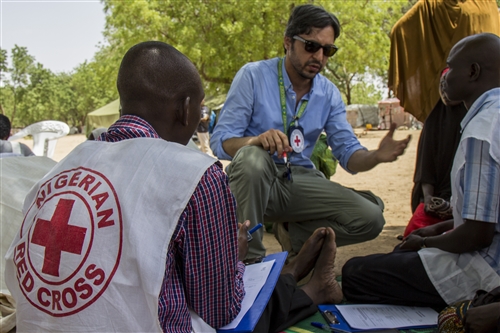
THE International Committee for the Red Cross (ICRC), on Monday, expressed ‘extreme concern’ on the rising humanitarian crisis in northeast Nigeria, stressing that the spate of insecurity has remained unabated.
The humanitarian group said thousands of civilians paid with their lives, adding that the recent attack by the Boko Haram insurgent in Rann, Borno State had caused the largest human displacement since 2017.
As a result, it stated that Maiduguri already hosts more than one million Internally Displaced Persons (IDPs) in 14 camps as well as host communities.
According to reports, the attack was mainly on unarmed, already displaced civilians, who were just recovering from the effects of years of insurgency, in the north eastern part of the county.
The Borno State Government further claimed about 100, 000 people have been reportedly killed and over 2 million displaced as at December 2016.
However, there are concerns especially from the Amnesty International (AI) that the rising insecurity in the region may eventually result in a war crime.
“Thousands of families caught in between the fighting have had to flee for their lives. Parents with their children, taking the little they could, escaped into the bush and slept in the open air. Some managed to reach places — ‘camps’ — where they can receive some assistance, but what about the others?” said Markus Dolder, the head of ICRC’s office in Maiduguri.
In a press statement issued by the ICRC Communication Officer, Eleojo Esther Akpa, in Abuja, the burned-down health facility in Rann was where two ICRC midwives, who were killed in captivity last year once worked.
Not less than 60 people were reportedly killed in the recent attack in the outskirt community of Rann which is about 110 miles away from Maiduguri, the Borno state capital.
“We are extremely concerned by the worsening humanitarian situation in north-east Nigeria. Civilians should be spared by all parties to the conflict, as per international humanitarian law,” Dolder added.
The ICRC maintained that, “55,000 people have been reportedly displaced in the last two months, over 30,000 of whom arrived in Borno’s capital, Maiduguri. Maiduguri already hosts more than one million IDPs in 14 camps as well as host communities. Because the existing camps cannot cope with the sudden influx, the authorities are in the process of opening a new IDP camp.”
The international humanitarian body further said it has launched an emergency response in Maiduguri in coordination with other humanitarian actors and the authorities.
“The building of temporary shelters for 1,500 households is underway, the distribution of essential household items and one-off cash support for all new arrivals, scattered in the various IDP camps, have started.”
DANLADI Umar, Code of Conduct Tribunal Chairman, has adjourned the trial of Walter Onnoghen, Chief Justice of Nigeria on the grounds of his absence at the court.
The trial, scheduled to hold on Monday, February 4, has been rescheduled for February 13.
Umar declared that the suspended CJN must be in the tribunal court himself as the case cannot proceed in his absence.
The allegation against Justice Onnoghen has been that he failed to comprehensively declare his assets which resulted in his suspension by the presidency as advised by the Code of Conduct Tribunal.
Meanwhile,yielding to the interference of the National Judicial Council, the Senate, today issued a directive to terminate the case it filed over the suspension of the jurist at the Supreme Court.
The Senate made known its intention to withdraw the case in a press statement signed by Yusuph Olaniyonu, Senate President’s Special Adviser on Media and Publicity. The statement recorded that the Senate has resolved to allow the NJC to handle the issue.
On January 28th, Sarakihad gone to the Supreme Court to inquire into Onnoghen’s suspension, demanding to know the legality of the President Buhari’s decision to suspend Onnoghen and replacing him with Ibrahim Tanko Mohammed.
According to the statement, “This decision also affirms the confidence of the Senate in the ability of the NJC to successfully and creditably resolve the issues.” Hence the case is withdrawn from the highest law Court for the NJC to take over.
PROJECT Pink Blue— A Nigeria cancer-fighting non-governmental organisation said Nigeria does not prioritize the health of her citizens because the health insurance is not mandatory in the country.
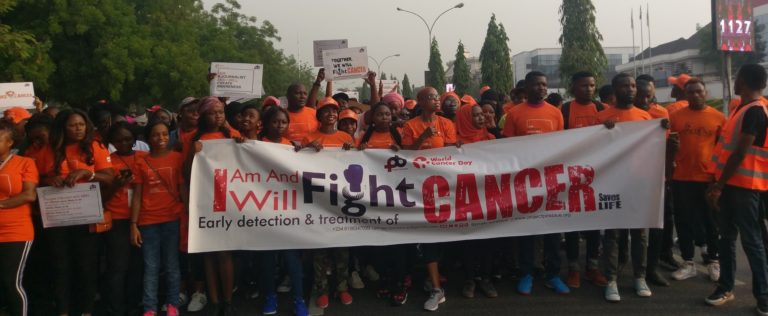
Chidebe Runcie, the executive director of the organisation raised this observation during a press briefing at a multi-sporting: cycling, skating, jogging and walking event on Saturday to commemorate the 2019 World Cancer Day.
World Cancer Day is an international day marked on February 4 targeted to raise awareness on cancer: its prevention, treatment, and reduce death caused by the disease.
Runcie lamented on how the health insurance scheme only covers small percent of the Nigeria population. “How can we live in a country where health insurance is not mandatory but vehicle insurance is mandatory,” he questioned. The cancer activist said the country’s priorities is to save cars and forsakes humans’ lives.
According to World Health Organisation (WHO), the health insurance in Nigeria covers less than four per cent of the total estimated population of 190 million people, while the 1999 constitution that set up the National Health Insurance Scheme did not make health insurance compulsory.
At the cancer awareness programme, Runcie cried over the rate at which people die of cancer in Nigeria. He called on the government to take intentional action against cancer. “As we speak today, cancer treatment in Nigeria is highly limited, so many of the facilities are all broken down. This means when someone has cancer, one is just on its own,” he said.
“We are losing our mentors, our mothers, and children to a disease that other parts of the world are curtailing.”
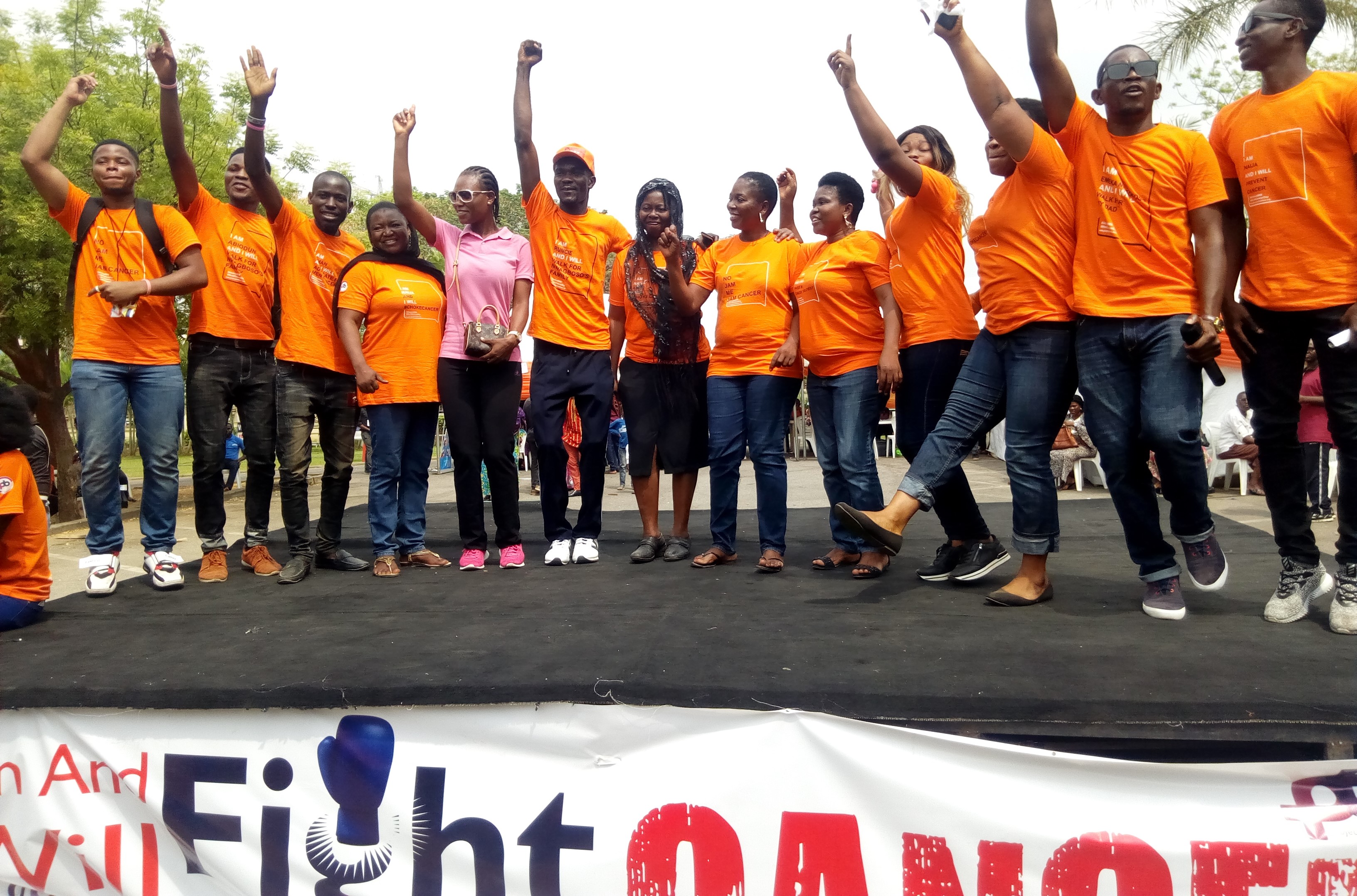
6th left: Runcie Chidebe ED, project PINK BLUE and convener of cancer awareness walk with some volunteers and cancer survivors on Saturday at Transcorp Hilton Hotel, Abuja. Photo credit: ICIR/ Rebecca Akinremi
Cancer is the second leading cause of death globally, and is responsible for an estimated 9.6 million deaths in 2018, in a WHO report. Globally, about 1 in 6 deaths is due to cancer.
The WHO approximated that 70 per cent of deaths from cancer occurs in low and middle-income countries which include Nigeria.
The Nigeria National Cancer Control Plan Cancer (NCCP) 2018-2022 stated that cancer is responsible for 72,000 deaths in Nigeria every year. In Nigeria, an estimated 102,000 new cases of cancer are recorded annually.
Reports have shown that breast and cervical cancers are the two major types of cancer affecting women in Nigeria, while prostate cancer is the leading type of cancer among men.
The situation caused the Project PINK BLUE in collaboration with Transcorp Hilton hotel to organize free screenings for breast, cervical and prostate cancer on Saturday at Transcorp Hotel, Abuja.
Contributing at the press briefing, Owen Omogiafo, the Managing Director, Transcorp Hilton Hotel Abuja, said early detection is the best way to address cancer.
Being a cervical cancer survivor, Omogiafo urged people to get tested and not think they are too young to have cancer. She narrated that she was able to avoid a full blown cancer because she detected it early.
“I, standing here, at the age of 29 was able to avoid full-blown cervical cancer because I went for my pap smear when it was discovered that I was a stage away from full-blown cancer. But today after going through a series of treatment I am free,” she said.
Omogiafo pleaded those who have a family history of cancer to go for a regular checkup.
Speaking in the same vein, Okaima Ohizua, the Executive Director of Transcorp Hilton plc who lost her father on January 31 to prostrate cancer and her sister 10 years ago to breast cancer urged people to go for a constant checkup as early detection could have saved her father and sister.
While she lamented on a high cost of treatment and lack of treatment facilities in the country, Ohizua called on the government and private sector to intensify effort to reduce the sufferings of people battling with cancer in Nigeria.
A cancer survivor, Gloria Orji who was diagnosed in 2010 of breast cancer also encourage people to have themselves screened as early detection and adequate treatment can save a life. She said the disease awareness needs to be spread to everyone, including those in rural communities.
The WHO, on its website states that the cancer burden can be reduced through early detection of cancer and management of patients who develop it. Many cancers have a high chance of cure if diagnosed early and treated adequately.
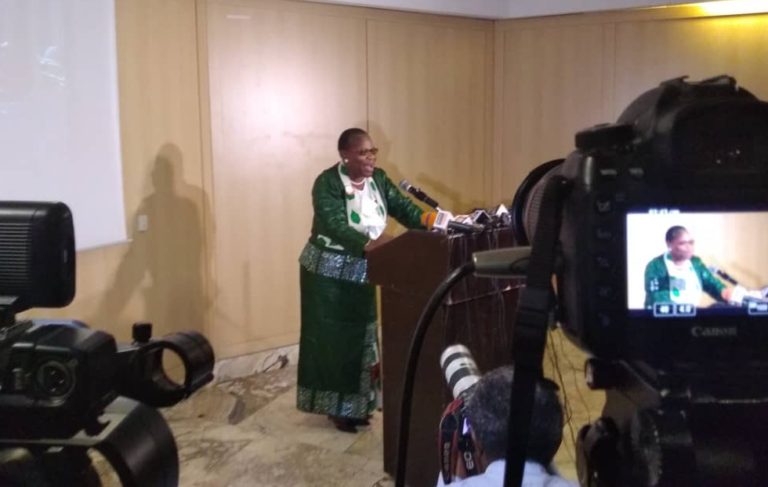
FORMER presidential candidate of the Allied Congress Party of Nigeria (ACPN), Obiageli Ezekwesili, has described allegations against her by the leadership of the party as “the height of political comedy” as they are “baseless and puerile”.
Ezekwesili, a former minister of education, as well as solid minerals, said this while addressing a press conference in Abuja on Monday, the first since she announced that she was quitting the presidential race.
The ACPN, led by its National Chairman, Abdul-Ganiyu Galadima, who was also Ezekwesili’s running mate, had lambasted her after she announced her withdrawal from the 2019 presidential election. He said that Ezekwesili wanted to use the campaign to lobby for a ministerial position, and also accused her of embezzling the millions of naira that Nigerians had contributed for her during the campaign.
Reacting to the allegations on Monday, Ezekwesili said those were all false and fabricated claims, adding that she could not have been lobbying for a ministerial position when she had rejected several similar offers from the federal government since she decided to leave public office in 2007.
“One of the more laughable moments of the past week was hearing allegations that my presidential candidacy was a scheme to negotiate for a ministerial role. This is the height of political comedy, I must say,” Ezekwesili said.
“As an official of the government of Nigeria, I took a 90 per cent salary cut in order to serve this great country. I left government with my integrity intact and my name untainted. In all my years in the public, private, or development sector, there has never been any allegation of corruption against me. Not one.
“If I remained incorruptible in government, would it not be senseless and cruel for me to suddenly be the kind of person that would divert funds and donations received from well-meaning Nigerians who believed enough in our vision for the country’s future to contribute financially to my campaign?”
Ezekwesili apologised to her supporters for her error of judgement “that made me run on the platform of the quality of people that ACPN turned out to harbour”.
She explained that she only joined politics after her declaration to run for office in October 2018, and having been approached by the ACPN leadership who begged her to contest on the party’s platform, and having been assured that her personal values and vision for Nigeria were in accordance to the party’s objectives and aspirations of the party, she agreed to run as an ACPN member.
“I knew that along the way I will face tests of my values, but I didn’t expect it so soon and not from the party members who had assured me privately and publicly that they were on the same page with me. In truth, our values were poles apart,” she said.
She added that she owes the ACPN nothing as she had returned her membership card, party flag and other paraphernalia “in order to signpost my complete separation”.
Nevertheless, Ezekwesili insisted that her three-month presidential campaign was a serious one to which she committed all her time, energy and resources, but from which she decided to pull out from in the overall interest of the common good.
She also explained that her joining the presidential race in the first place was partly due to the failure of the first attempt by a group of young presidential aspirants to reach an agreement and present a consensus candidate.
Recall that a group known as the Presidential Aspirants Coming Together (PACT) − comprising Kingsley Moghalu of the Young Progressives Congress (YPP), Omoyele Sowore of the African Action Congress (AAC), and Fela Durotoye of the Alliance for New Nigeria (ANN) among other − had invited Ezekwesili to monitor the process that was supposed to lead to the adoption of a consensus candidate. However, the attempt failed after the candidates failed to accept Durotoye’s emergence from the mock election they held.
“The sad saga of PACT was most unfortunate and in turn became a contributory factor to my ultimate decision to enter the Presidential race,” Ezekwesili said.
But, going forward, Ezekwesili said she would rechannel her energy in ensuring that there emerges a coalition candidate from amongst the other candidates running for the presidency asides from the two dominant parties in Nigeria namely: the All Progressives Congress (APC) and the Peoples Democratic Party (PDP).
“Since the suspension of my campaign, I have taken actions to reach out to six of the key alternative candidates and sought the involvement of one of our most respected elders in getting them to the place of sacrificial leadership required to ensure a workable consensus from among them,” she said.
“Citizens wish to see them make this sacrifice, and my sincere charge to the alternatives is to do all it takes to form a coalition of the willing with one strong candidate that will bear the mandate of those who seek good governance for Nigeria.”
TO dispel the rumours making the round that Nigerian internet fraudsters, popularly known as “Yahoo boys” steal female underwears to make money, Olusola Adeyeye, Chief Whip of the Senate says he will donate his wife’s panties and hairs including that of his children to anyone who needs them for money rituals.
Adeyeye, in a statement on his social media on Monday, said that recent uproar about the stealing of panties, sanitary pads and urine by online fraudsters for money rituals are just “mere superstitions and arrant hogwash”.
The Chief Whip lamented that as the rest of the world is embracing science and technology as a means of societal development, it is unfortunate that Africans are yet to grow past superstitious beliefs and stagnant reasoning.
“Africans stagnate their minds in ancient taboos and silly ignorance, anyone that needs hairs, urine and panties to make money should come to me.
“I will donate all my hairs, as much of my urine as the person wants, and all my old underwear. I will also donate hairs, urine, and panties of my wife, all my children plus those from Kemi, Bayo, and Seyi,” he said.
Adeyeye said that he is also willing to donate that of his siblings whom he said are not bound by the spirit of fear.
He described it as a shame that most educated people in Africa still believe in what he called metaphysical manipulations.
“Let me repeat that all my hairs are available for anyone who needs them for rituals. I will, in fact, add my pubic hairs from my armpit,” he said.
In this investigation, The ICIR reveals how herbal doctors in the Federal Capital Territory, FCT Abuja scam cancer patients to buy drugs for a disease that yet has no cure.
HERBAL doctors in Abuja contradict the views of the World Health Organisation, WHO reports on its website that says cancer has no cure yet. The herbalists claim in their frequent advertisements that they proffer a cure for cancer, though without documented evidence to substantiate this claim.
Posing as a client, seeking help for a non-existent aunt diagnosed with breast cancer, The ICIR reporter visited three major herbal clinics within Abuja metropolis to investigate their operations and treatment methods and the position of herbal medicine regulatory agencies on the practices of herbal doctors.
Exposing the deceit of Abuja herbal medics that “cure” cancer
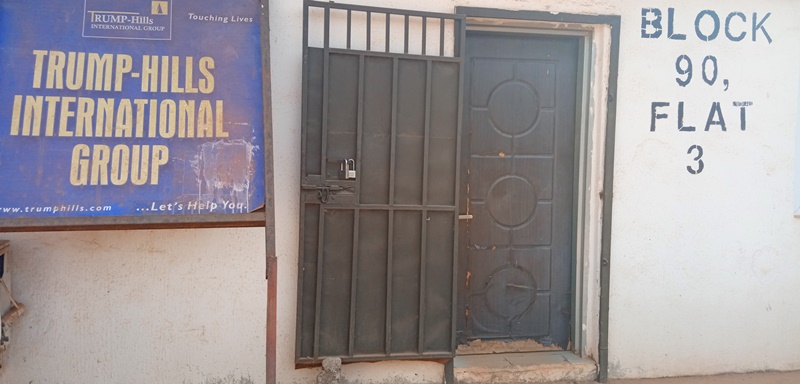
Arriving at the supposed location of Halamin Herbal centre in Karu, Abuja at exactly 2:37 pm on Friday, 18 January, The ICIR reporter couldn’t recognise the building from the address the herbal practitioner who identified himself as Timothy gave.
The inscription on the wall of the building reads “Trump – Hills Investment Int’l Ltd” which was different from the business name that appeared on its website that portrayed it as a herbal clinic.
The ICIR searched for the company name, “Trump – Hills Investment Int’l Ltd” which eventually turned out to be a real estate company based in Abuja that acts as an agent for prospective house buyers.
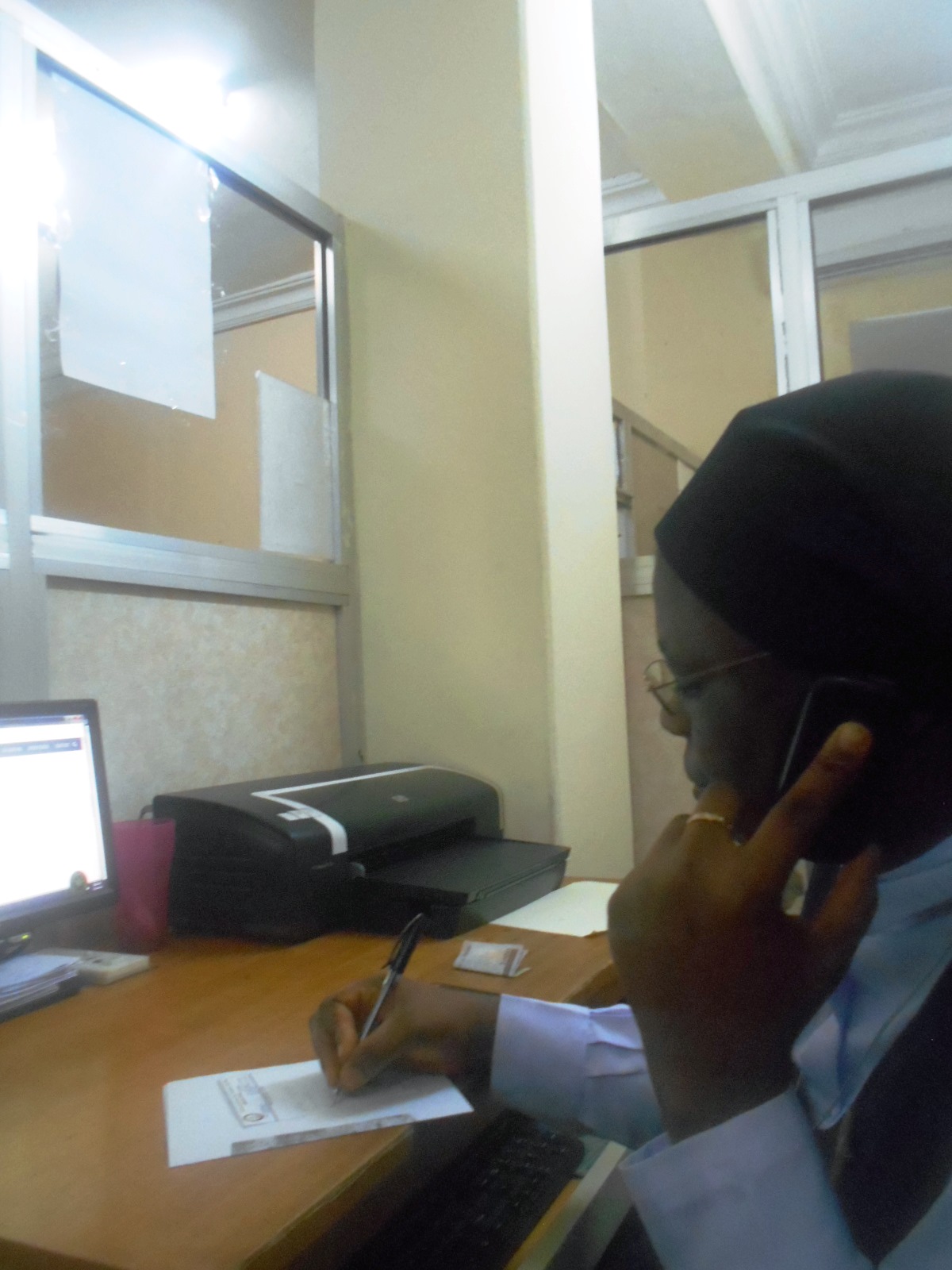
After waiting for about thirty minutes, Timothy, arrived apologising for coming late and welcomed The ICIR reporter with an all-too-familiar gesture, “How long have you been here? Welcome my brother, I’m sorry my car was bad and the mechanic took a long time fixing it,’’ he said.
His office was a two-room sparsely -furnished apartment, comprising of tables, chairs, and shelves showing a scanty office space that could be vacated in a hurry.
“So what are the issues,” Timothy asked, almost with the genuine curiosity of an expert.
Direct from the horse’s mouth
The ICIR reporter gave a long talk about his relative who did not exist, diagnosed with breast cancer and has decided to try herbal medicines due to financial constraint and the fear of the effect of chemotherapy.
First, Timothy made inquiries about the name, age and phone number of the cancer patient which he wrote in a big notebook without demanding for a physical examination of the patient to know the extent of the cancerous tumour or a laboratory test result to confirm the reporter’s story.
The premises of Halamin Herbal Center at Karu Site, Abuja.
“My aunt had been on herbal remedies, which consist of garlic and beetroot, but it didn’t improve her condition,” The ICIR reporter said to get more information from him.
“Well, we don’t give garlic, we give refined herbs,” Timothy said, pulling out a container containing capsules of the herbs before handing out some to the reporter.
Timothy was eager to discuss the cost of his herbal remedies rather than seeking information about the medical history of the cancer patient he claimed he would cure.
“I am certain she will get cured only if she follows the instruction. We charge ₦60, 000 per month for the drugs because the treatment will take four months which is a total of ₦240, 000 but if you’re paying cash for the whole four months we will give a discount of ₦10,000,” he said.
The ICIR, agreed with Timothy on a fixed price of N216,000 after a discount of 10 per cent was granted. A few hours later, he sent a First Bank account number with the name “Trump – Hills Investment Int’l Ltd” to the reporter to pay the money.
When Timothy was informed of the patient’s desire to come to his office for evaluation, he declined but agreed to maintain correspondence with the reporter via WhatsApp platform where he would convey instructions on how the drugs could be taken.
The code of advertising practice according to the Advertising Practitioners Council of Nigeria (APCON) created by Law No 55 of 1988 reaffirms the provisions of the Food and Drug Act that prohibits medical personnel from offering diagnosis, advice, prescription or treatment by correspondence.
Timothy might be unaware of the law that restricts him from offering treatment through Whatsapp but he was clearly confident about the type of service he offers.
“She doesn’t need to come here to see me, as you can see this is not an office where we can run diagnosis or lab operations. It is strictly, dispensing operations we run here, we can’t start running checks because she can do that in the hospitals. Whatever result you get from the hospital we take over from there,” he said to The ICIR.
When he was asked about successful cases of cancer patients his herbal drugs had been able to cure to get some level of assurance before the transaction is sealed, Timothy answered quickly, “So many people have been cured, and this is not a trial thing; our drugs work. As far as you are able to use the drugs meticulously and follow the rules,” he said.
In an attempt to convince The ICIR, he checked his phone to produce proof of people cured of cancer using his herbal medicine but was unable to come up with any, except the picture of a man on his phone whom he claimed was a medical doctor cured of colon cancer using his drugs. He also could not provide any medical documentation to show as proof.
“When he started taking the drugs he was pale already but you can see from the picture how strong he is.
“Orthodox medicines don’t work, that is the reason most medical doctors are coming this way, exploring the use of herbal medicines,” Timothy said.
The ICIR was able to get in touch with Timothy’s boss who owned the herbal centre, Ben Amodu, a self-acclaimed pharmacist and in a phone conversation with The ICIR, he confirmed the claims of Timothy that his drugs had been tested by the World Health Organisation, WHO, and could cure cancer.
“My drugs have been tested in the US and be sure that whatever kind of cancer you bring to us, it can cure,” he boasted.
In Nigeria’s herbal medicine industry, Timothy is one among thousands of herbal doctors who claim to have a cure for terminal diseases like cancer, HIV, without any documented evidence to show. Yet their claim, which many time has proven to be exaggerated or outright false, has put unsuspecting Nigerians at the risk of threatening complications or death as The ICIR investigation reveals.
Catholic-run herbal clinic that cures cancer with ₦8,500
The two-story building that sits on a busy Bangui street in Wuse II, Abuja is Deus Caritas Pax Herbal Centre. The ground – floor rooms are occupied by a thriving business centre and a herbal drug store, managed by the Holy Sisters of the Needy, a Catholic charity organisation. The centre caters for the underprivileged in society.
The ICIR placed calls to the herbal clinic to know if they had a cure for a diagnosed cancer patient and the reporter was assured they had drugs to solve the problem.
Unlike other herbal clinics The ICIR reporter visited, Pax Herbal Center was a serene and organised business environment with Reverend Sisters in attendance.
Sitting in a small cubicle that serves as her office, the soft-spoken Sister Oluchi who was responsible for treating cancer patients at PaxHerbal Center, Abuja attended to The ICIR.
After listening to The ICIR’s story, she requested for details about the cancer patient including the diet she was currently on.
Reverend Sister Oluchi writing the prescription for the supposed cancer patient.
She proceeded to prescribe herbal products sold at the pharmacy unit of the clinic for The ICIR.
The sale of any herbal drug advertised to the Nigerian public as treatment or cure for cancer is a crime under the Nigerian Food and Drug Act since there is no known cure such claims are likely to be false.
Section 2 of the Food and Drug Act CAPS 150 1990 prohibits the sale of any food, drug, cosmetic or device that is represented on the label or is advertised to the general public as a treatment, preventive or cure for any of the diseases, disorders or abnormal physical states specified in the said First Schedule to this Act.
The list on the first schedule of the act includes cancer, hepatitis among other terminal diseases without a known cure.
“Presently, we don’t have Special Averone ( a special drug for cancer sold in their pharmacy) for cancer patients but you can buy this Averone I’ve written it so that when this other type arrives then you can change it,” she said handing the prescription list to The ICIR.
She should always eat organic foods and make sure she doesn’t eat foods that are fertilized with inorganic fertilizers,” she advised.
At PaxHerbal the pharmacy unit is also a religious bookshop.
When asked, how the cancer patient would be able to identify organic foods not fertilized with inorganic fertilizers.
She suggested that the cancer patient should get in touch with farmers to get farm produce straight from the source.
Normally, we don’t treat cancer patients here we refer them to our head office in Edo State but if she can’t go to Edo State, then she can continue to use these drugs. If she doesn’t have access to soursop then she should eat at least one bulb of onion daily,” she explained to The ICIR.
At the herbal pharmacy where their drugs are sold, the cost of the drugs was ₦8,500.
Doctor Wonder in a lucrative business
According to a Reuters report, data obtained from a study carried out by Market Research a specialized research agency, on the global herbal medicine market predicts an increase in revenue for herbal medicine globally from 2017 – 2023 based on the current market scenario and future status of herbal medicine within the forecast period.
The study reveals that the global herbal medicine market revenue is expected to hit $111 billion at the end of 2023, with China, India, Europe, Middle East and some African nations playing key roles in projecting a 7.2 per cent increase in earnings globally.
Esther Okonkwo, popularly called “Doctor Wonder” hopes to benefit from this money-spining industry.
Her herbal clinic which also serves as a beauty clinic is located in Garki 2 International Market, Abuja where the cost of renting a shop ranges minimally from ₦300,000 to ₦1, 000,000 per year.
The ICIR’s explanation about a relative who did not exist that was diagnosed with breast cancer who was looking for herbal solutions worked like magic, as Esther’s facial expression brightened at the prospect of having a new client.
“It’s no problem. There is a drastic measure to fight such cancer in a natural way so that the abnormal cells will die. Most times chemo is not the best because it will kill the good cells and the bad ones at the same time but what I am going to give you will produce good cells that will boost the immune system and kill the bad cells,” she explained patiently.
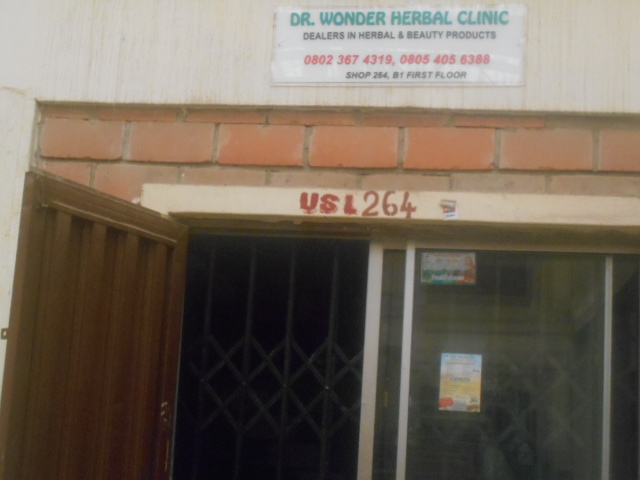
Dr. Wonder Herbal Clinic at Garki International Market, Abuja.
“Cancer sucks sugar but if you are able to know what to do, what to eat and how to suppress the sugar then cancer will not survive.
“My treatment will take three months and it will cost ₦500, 000 but you can pay monthly, within three months your cancer will disappear but it might extend to four months. After taking my herbal products for one month you will see the results,” she assured The ICIR with a smile.
A report on the catastrophic health fund for oncology care by Pink Oak, a non – profit organization in Abuja which focuses on fighting cancer puts the spending of women on breast cancer in Nigeria at ₦2.1 million to ₦29.2 million to treat breast cancer depending on the type of breast cancer.
This could include eight series of diagnosis that cost between ₦232, 000 to ₦311,000; three surgeries which cost ₦670,000 to ₦3.3 million; 10 sessions of chemotherapy that cost about ₦916,000 to ₦2.6 million and finally 10-23 sessions of radiotherapy, which may cost ₦138,000 to ₦360,000.
A failed miracle cancer drug
Hannah Igba, a cancer patient contributed to the herbal medicine industry before she later was confronted with ultimate reality. She was diagnosed with breast cancer at age 52 and had hinged her survival chances on the knowledge of doctors at the Federal Medical Center, Makurdi, who promised to get rid of the tumour.
Doctors at the hospital had told her she would need to have single mastectomy which is a medical procedure to remove her entire right breast that was affected by cancer as this would ensure that cancer would not cause damage to other vital organs.
She was, however, sceptical about the procedure not because her doctors were unsure the cancerous tumour would not grow in the future but the cost of the surgery would gulp over ₦2 million.
This amount was beyond her means being a widow whose livelihood depended on earnings from her small farm. Hannah, therefore, decided to take a herbal treatment.
A friend who claimed her mother was cured of cancer using herbal medicines directed her to the herbal medicine practitioner who administered the treatment. Israel, who is also a medical doctor and dabbles into herbal medicine, assured her that her cancer would be cured within six months if she maintained a natural diet and took the herbal drugs regularly.
Hannah was desperate to live. After consulting with her only son she started taking the drugs religiously, spending over ₦250, 000 in the purchase of the medicine.
What she was not told, however, was that the herbal medicines had not been proven scientifically to provide a cure for cancer and there were no clinical trials conducted to test the efficacy of the herbal drug.
Seven months after using the herbal drugs, the cancerous tumour on her breast had metastasized. Sometime in December 2017, she called her only son Francis to give him her final blessings. A few days later, in the late afternoon, she passed away.
A 2018 data from the International Agency for Research on Cancer (IARC) rated Nigeria 157th among 185 countries with a high incidence of cancer.
The death rate in Nigeria tends to be higher, mainly because cancers are not discovered early and are not easily treatable given the limitation in the Nigerian healthcare system.
According to the global report, one in five men and one in six women will develop cancer at some point during their lifetime, and it is expected to become the leading cause of deaths.
Speaking to The ICIR, Francis said his mother’s greatest fear made her try various herbal remedies from different sources but none worked.
“My mother was always afraid of dying,” he said.
Expert’s perspectives
A pharmacist at the National Hospital, Abuja, Mshelia Richard, who spoke to The ICIR pointed out why Nigerians should be wary of “miracle drug” peddled by herbal medicine dealers who claim to have the cure for cancer.
“Cancer is a disease that has different stages but the chances of cancer being cured is when it is at stage one. If the cancer is at an advanced stage it can only be managed but some people believe that medical science has failed them when you tell them there is no known cure for cancer,” he said.
“The science of orthodox medicine emanates from herbal medicine but the difference is the dosage and calibration and that is why I can’t take away herbal medicine. I would not discourage or promote herbal medicine but I want Nigerians to verify the claims of these people who say they have a cure for cancer before taking their drugs. Check for those who have been cured,” he warned.
Fatima Uba, a radiation oncologist based in Abuja said the expensive cost of treating cancer leads cancer patients to seek alternative medicine.
“It is very difficult for Nigerians who can barely afford to earn ₦100, 000 yearly to spend over ₦2 million in treating cancer using orthodox drugs when they can’t feed properly. They will look for an alternative source of treatment that is cheaper and if the herbal medicine doctors claim to have the solution to cancer they will fall head over heels to patronise their services,” she said.
Ebunola Anozie, the founder of non – profit breast cancer support network Care Organization Public Enlightenment, COPE, advised against the sole use of herbal remedies in treating cancer.
“Well, herbal medicines can boost the immune system of cancer patients but I would recommend cancer patients to make use of proven treatment methods to be on the safe side,” she said.
Regulatory agencies reactions
The Food and Drug Act establishing the National Agency for Food and Drug Administration Control (NAFDAC) empowers to monitor, regulate and control the manufacture, importation, exportation, advertisement, distribution, sale and use of food, drugs, cosmetics, medical devices, chemicals and packaged water in Nigeria.
The ICIR investigations revealed that most of the drugs sold in these herbal stores are duly licensed by NAFDAC as they have registration numbers on them.
The NAFDAC seals on the herbal products afford the herbal practitioners boldness to lure unsuspecting Nigerians on the efficacy of their drugs to cure Cancer, HIV, Hepatitis among other terminal illnesses whose cure has not been scientifically proven.
Spokesperson of the agency, Abubakar Jimoh said, “Herbal medicine registration by NAFDAC has a listing status it is not full registration, it is effective for a one year period while other scientific pharmaceutical products have the full registration period that lasts for five years.”
Speaking further, “There have been cases of people having kidney cases, liver cirrhosis, and other issues from taking herbal products, NAFDAC is not against herbal medicine but what we are saying is do it properly. We are not aware of anybody who is saying he has a cure for cancer, NAFDAC has not licensed any herbal drug to cure cancer, such claims are false,” he said.
He also acknowledged that herbal medicines were vouched for by NAFDAC based on their safety to human health and not its efficacy.
“Well, in the past herbal medicines were given licenses because of their safety not because of their efficacy, you know the placebo effect. How can you tell people that this drug won’t harm you but it will not cure your illness? As a communicator, I told them it doesn’t make sense, but NAFDAC has partnered with NIPRD to effectively test herbal drugs, a committee was set up but I don’t know how far they have gone because it was relaxed until the current DG picked it up,” he concluded.
The Director General of the Nigeria Natural Medicine Development Agency, NNMDA, Sam Etatuvie, confirmed to The ICIR that there has been no herbal drug made for cancer yet as the agency’s cancer project is ongoing.
“We are still working on it, what we have, has a lot of potentials and it is still being subjected to clinical trials. These developments take years before you can authoritatively come out boldly to say you have a cancer drug.
“From our observational studies, test subjects are responding positively to the drug, and we will unveil it at the end of the year if it becomes feasible until that time there is no cancer drug produced from herbal medicine approved by the NNMDA,” he said.
This story was updated on 18th, February 2019 to reflect the additional information obtained from Halamin Herbal Centre.
ON first encounter, you might think she was due to have a baby. With a protruding belly as big as that of a nine-month-old pregnant woman, Immema John waddled along the street whileneighbours and passers-by would call out to her as ‘Mama Ejima’ (mother of twins).
But Imemma, a 40-year old native of Akwa-Ibom State in the south-south part of Nigeria, was neither conceived of a child nor was she married. For over 11 years, she suffered fibroid
“I found out that I had fibroid and would often bleed longer than I should when I was menstruating. Sometimes, I would bleed for two to three weeks and it made me very weak that I was always rushed to the hospital.
“I took two to three pints of blood whenever this happened, which was like on a monthly basis, my blood level at such times was often at three per cent, that I would need the blood transfusion for my blood level to go up to seven per cent,” Immema recounted.
Fatima Ali one of the doctors that operated on Immema told The ICIR that the major hindering factors for people undergoing surgeries are funding, however, after Immema witnessed two women lose their lives during surgery, money became the least of her worries.
She said she could not trust that she would make it out alive anytime she entered the theatre, despite assurance from the doctors.
“When I found out in 2007 that I had fibroid and was asked to make a down-payment of N100, 000 (One hundred thousand nairas) for the surgery at Gwagwalada Specialist Hospital, Abuja, it was not that I didn’t have the money then, days before I was to be operated on, two women died in the theatre and they both went in for fibroid removal surgeries.
“I got scared and would not go in for the operation, in fact, I packed my things, left the hospital and never went back again,” she said, taking a deep breath.
For more than 10 years she said she moved about with the fibroid still growing in her uterus as her stomach kept protruding while she started fishing for information on different self-prescribed herbal remedies from friends and family members.
At that time she said her medical bills were paid from money earned through a small Buka (restaurant) that she owned.
“I took different concoctions and drugs. None of the many treatments I had gone through was lower than N50, 000 (fifty thousand nairas) but none of the treatments worked for me because my stomach kept protruding and people kept calling me ‘Mama Ejima’ (mother of twins) wherever I go. My stomach was that big that I looked like a nine-month pregnant woman.
Unfortunately, as she kept seeking for remedies through every avenue apart from the hospital, Immema said she had to close down the restaurant when the financial demand for herbal treatments became quite high that she couldn’t afford to operate the restaurant anymore.
By October 2018, when Immema had exhausted all avenues and was ready to have the fibroid surgically removed, she had no money for the surgery and had to depend on contributions and goodwill of family and friends.
“I used to be in a relationship with someone that I thought could lead to marriage, but he never contributed for my hospital bills or the treatments that I had been taking all along, he was not supportive in other ways either, emotionally, he wasn’t there at some point. I knew the best thing was to call off the relationship, I felt he was relieved when I did,” Immema said.
Breaking the myth of fibroid
Uterine fibroids, also known as Leiomyomas or Myomas, are the most common form of benign uterine tumours. Experts have identified abnormal bleeding, pelvic masses, pelvic pain, and infertility as some of the symptoms that often manifest before patients seek help or go for surgeries.
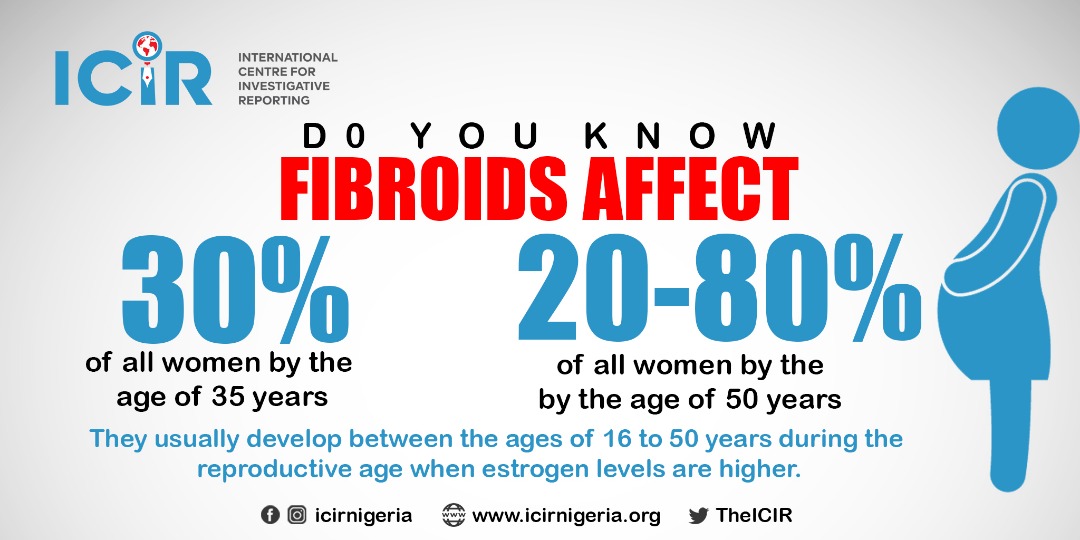
Research has shown that Fibroids affect around 30 per cent of all women by the age of 35 years, and from 20 to 80 per cent by the age of 50 years. They usually develop between the ages of 16 to 50 years during the reproductive age when estrogen levels are higher.
Fibroids are benign tumours that are non-cancerous often found in the uterus. In most cases, if growth occurs within the intramural wall of the uterus it could affect fertility.
Doctor Benjamin Olowojebutu, a Maternal Health Specialist and founder of the Benjamin Olowojebutu Foundation (BOF), who has carried out over 323 free fibroid surgical operations in more than six states in Nigeria under the 36 goals agenda of BOF, said that there are no known causes of fibroid, but risk factors which includes obesity, prolonged dysmenorrhea, and familial (hereditary).
Against popular beliefs that fibroid is an ailment for aged women, the plight of Okechukwu Kelechi, a 24-year-old youth corp member refutes this narrative.
KC, as she is fondly called, started observing abnormal hormonal changes which made her question the state of her health.
“My menstrual flow was off the charts. It was such that I bled profusely for close to two weeks, which is abnormal because normal for me was three to four days, this was happening in my 3rd year as an undergraduate in the University.
“I was 22 years old, preparing for final exams and projects, I emaciated a lot, this was more pronounced each month after my monthly period which often lasted for two weeks, I would lose lots of blood, but somehow, I kept telling myself that maybe it was normal, probably it runs in the family.
“But after my final exams in November 2016, when I finally went in for medical tests, the doctors confirmed it was a fibroid,” she said.
Episodes of fear, pain, and stigma
Kelechi had to go through a hysterosalpingogram (HSG) scan before the doctors could carry on with the surgery.
“I was very scared because my first time of seeing anyone that was suffering from fibroid was on TV, where a nine-year-old girl was pleading for financial assistance to carry out surgeries from the public, she was looking malnourished and very tired I believe she died afterwards so when I got that diagnosis I was scared.
“On the day that I went into the hospital to schedule a date for the scan, I saw a lady that had come for the same test and while she was being checked, there were lots of screams from the hall, really heartbreaking screams. She went in on her feet but was brought out on a wheelchair, she was weeping as if she was going to lose her life.
“I was assured it wasn’t going to be painful, that I should take lots of painkillers before coming, which I did,” she narrated, laughing at this point.
“Little did I know that I was going to face a worse fate than what she went through, the scan was a very painful one, it had to do with the uterus and that comes with a lot of contractions and lots of pains.
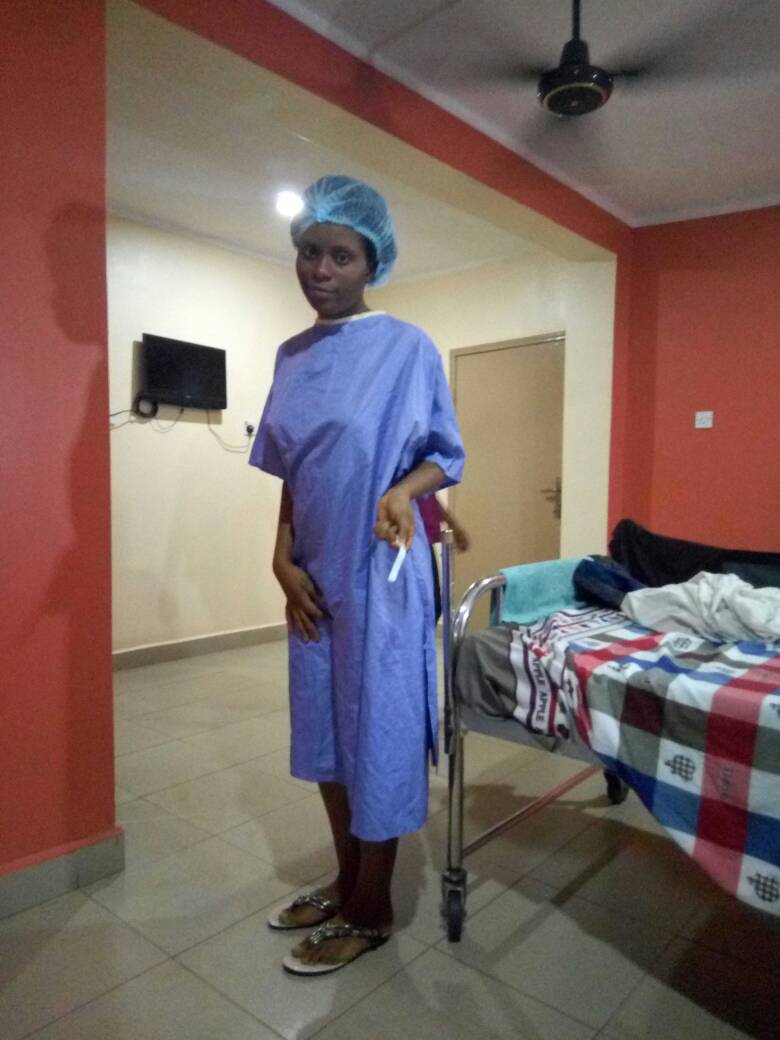
Kelechi Okechukwu in the hospital
The HSG procedure is a special type of x-ray examination of the fallopian tubes and uterus. The entire test takes about 45 minutes. During the procedure, a thin catheter is inserted through the cervix into the uterus, and a special radio-opaque contrast material dye is injected. The dye allows the shape of the uterus and fallopian tubes to be seen. The progress of the dye is followed through the fluoroscopic x-ray to see how it moves through the reproductive system.
“During the scan the deeper the catheter went, the more uncomfortable I got, at some point, I started feeling my uterus contract, though the nurses kept teaching me breathing exercises to keep me calm, that didn’t help either.
“I felt like I was being torn apart, I puked and was rolling in my own vomit. It was so painful that I passed out.
“Fibroid is not what I wish anyone to go through, I was scared, panicked, and anxiety almost got the better part of me. At some point I almost gave up because of the pain,” she said.
After the test, KC was bedridden for days, to escape the excruciating pain, she started abusing painkillers, but that still didn’t provide the escape she yearned for as the contractions lasted for about a week.
It’s estimated that globally around 62 million people had a drug use disorder in 2016 — two-thirds were male (40 million) and one-third female (20 million). A good number of these people abuse painkillers.
Medical practitioners say drug abuse could lead to organ damages, cognitive impairment, and suicidal ideations or in a more severe case, death.
Being part of a society where marriage and fertility often are some of the parameters that some would say gives a true definition of a woman, KC said she experienced social stigma and angry outbursts from some people who blamed her for having a fibroid.
“Most people told me that I was too young to have a fibroid, others were of the opinion that if I was sexually active that I shouldn’t have a fibroid. Actually, a close friend called me on the phone and advised me to just get married very fast.
“She advised that I should just marry anyone asking for my hand in marriage at that time so that I can get pregnant, else fibroid will take the space in my womb meant for my children,” KC said, her voice trembling as she narrates her ordeal.
However, she said that some people would ask her what she had done that could have possibly lead to her having fibroid tumours as if she was the author of her own misfortune.
She told The ICIR that after her surgery, she shared her experience and testimony on social media with picture evidence to encourage others going through a similar experience, but got reprimanded by friends and some members of her family.
“It was really challenging for me as I tried not to listen to them, I just focused on my God, and I carried out researches on my own to understand what I was going through.
“Even after the surgery when I posted some of the pictures of the surgery and the fibroid tumour that was removed, some of my friends and family members called and told me that I shouldn’t do something like that, they said it was wrong,” she said.
Exploring alternative routes
Kelechi said she was advised by a friend to drink aloe vera gel instead of going for a surgery that the tumour will dissolve on its own and she will pass it out in her stool or it might just melt away.
“I consumed lots of liquid aloe vera, but at some point, I stopped because I felt it was not working,” she recounted.
It wasn’t until after the fibroid was removed through surgery did she learn from the doctors that the aloe vera was effective but not quite the way she wished for. The gel only made the tumour degenerate within its own caucus and was staying put.
“It would have busted inside my uterus and things could have gone downhill from there,” KC said.
Her narrative is same with Immema who said she has more than 20 collections of different herbal remedies apart from various herbal powders she had to consume.
“I also think the herbal drugs I drank kept escalating my health condition because I don’t always have blood.
“Before I was operated on, the doctors told me to stop taking those drugs so they can monitor the state of my health before the operation,” she said.
Fibroid tumuor removed from Kelechi
Degenerated tumour
Kelechi on hospital bed after the surgery
The health care system that failed us
Kelechi said her guardian had spent close to N1, 000,000 (One million naira) for her fibroid treatment and even though she was registered with the National Health Insurance Scheme (NHIS), she said she was not covered by the scheme.
She cited a near-death situation where she was rushed into Wuse General Hospital, Abuja, by 1.am in the morning due to the sharp contractions.
“In the haste to get me to the hospital because I was almost losing my life, my father forgot the NHIS card, though I already have a file in the hospital, the nurses and doctors on duty refused to attend to me or administer first aid treatment.
“I was bleeding and everywhere was smelling and my father was almost crying, we had to place calls to some doctors who vouched for us it wasn’t until this was done that I was able to get any form of attention, at this point, I was almost giving up on life, I thought that I will die,” she said, as she tried to suppress tears.
Kelechi is not the only one that had been left at the mercy of a health system that doesn’t give a hoot about the patients.
Theresa Lanshima
Theresa Lanshima, a fibroid patient also told The ICIR how she was first misdiagnosed and how her treatment was stalled for a month due to a medical strike.
“I was first diagnosed with appendicitis, but after further scans, the doctors said it was an ovarian cyst and an unknown tumour they couldn’t identify, that had to be surgically removed, they still did not know it was fibroid at that time.
“The scan showed that the tumour was eight centimetres at the time of the diagnosis but there was a two-week strike by the government medical body in the country, I had to go home.
“I went back after the strike was called off, but by then, the tumour had grown to 24 centimetres, the scan showed that my uterus was pushed out of the right position and my organs were somewhat displaced, they were not in the normal positions. The pain was excruciating.
“In fact after each scan, more than two doctors will have to look at the scans to make sense of what they were seeing, because everything was in disarray.
“In fact, I was advised by the doctors to either get pregnant or undergo a hysterectomy,” she said with a rueful smile.
Theresa said her situation had worsened so much that when she goes in for an examination, the gynaecologist could feel the tumours through the vulva.
Apart from health complications, Theresa also had to work seven hours a day, and the constant trips to the hospital for check-ups and the health leaves she kept asking for was putting her employment status in jeopardy.
“I was taking permissions to go to the hospital quite often that at a point, I was told that if I was not fit for the work that I should quit.
“I didn’t want to lose my job, and because I was not looking emaciated as most people will assume that I should look when I tell them I am suffering from fibroid, it was quite hard to put up a convincing excuse at work most times. I stopped going to the hospital, unfortunately, I still lost that job,” she said.
Theresa said she is currently having the tumours removed through evacuations two years after her first surgery.
“I have had more than 15 fibroid tumours and cysts removed already, even at that, most people don’t believe me because my stomach is quite flat, I guess they are expecting something bigger than this,” she laughed, pointing at her abdomen.
Fibroid and cyst with fluid
Tess after an evacuation session
Fibroid tumuor and cyst removed from Tess
She prayed the tumours don’t grow back again as she is not sure she can handle the unending pressure and advice from different quarters asking her to get married.
“I actually started making plans to have my eggs frozen, I felt that was my only shot at having children in the future,”
“I hope they don’t grow back again because the pressure that comes with people telling you to get married is no joke,” she said.
Where experts disagree
Isma-il, popularly known as Baba-Aisha herbal medicine is one of the herbal medicine doctors The ICIR consulted in the course of the investigation that promised 100 per cent cure of fibroid without surgery or pharmaceutical drugs.
When the reporter approached the herbal doctor for fibroid treatments, the excited doctor hurriedly switched off the loudspeaker that was blaring out litanies of cures that his medicines offer, for the different type of ailments, ranging from Malaria to Sexually Transmitted Diseases (STD’s).
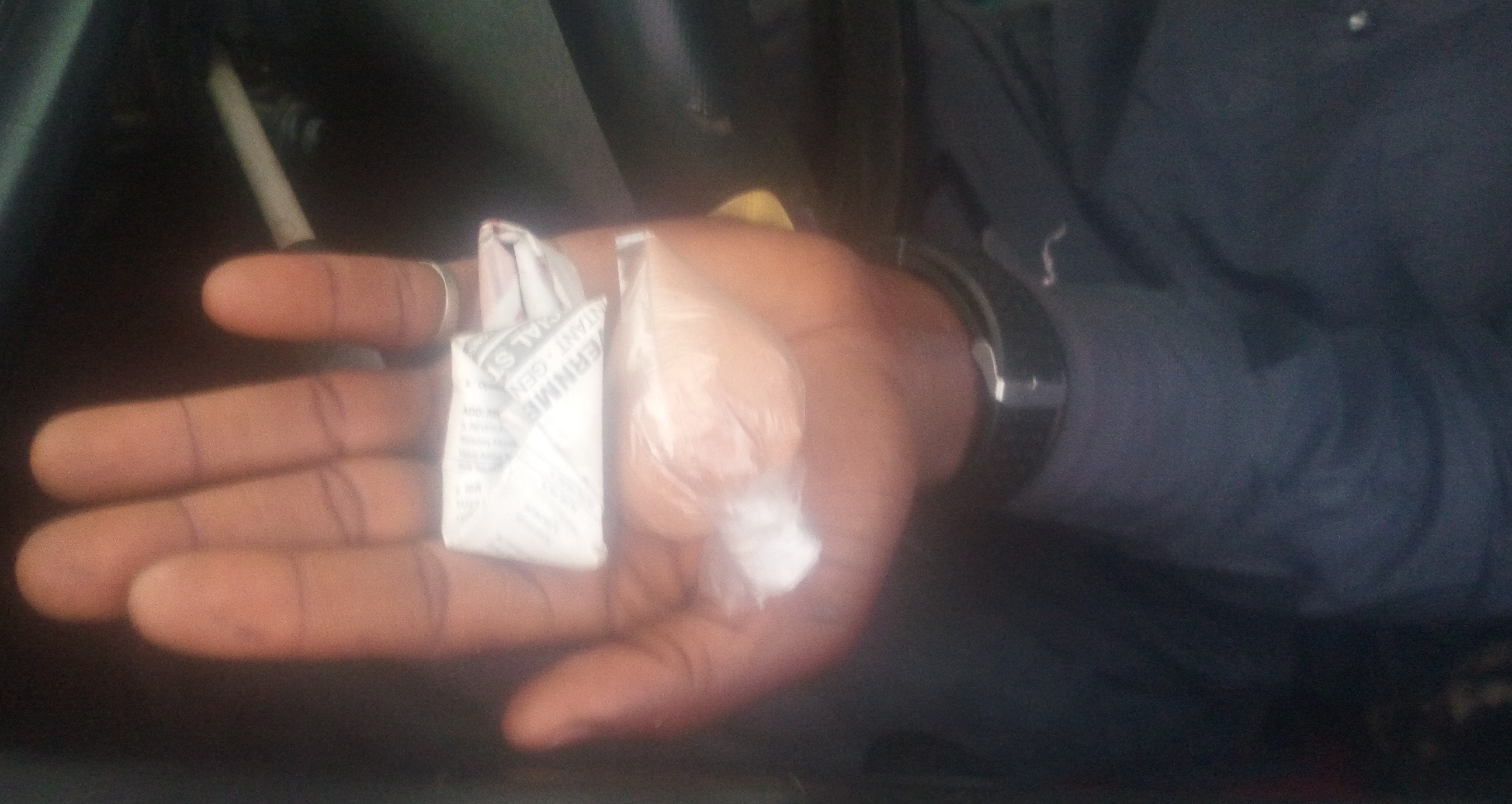
He gave the reporter three wrapped powdery mixture without names or NAFDAC registration number to be taken by the patient at the cost of N800 (eight hundred nairas).
“One dose is enough to cure the fibroid no matter the level, this one is Antsi and the other one is Senyar, he explained when the reporter asked for the names and ingredients contained in the drugs.
“Just give it to your sister, she will be fine,” he said with assurance.
Initially, he wanted to know exactly how the patient was faring but relented when he was told that the patient was not in the same city but would have the drugs mailed over.
“If only I can see the patient it will be better, but take this drug, it is the end of fibroid, he added still showing the reporter some of the other drugs that he has for other ailments.
Some of the drugs advertised were also drugs for sexual organ enlargement remedies.
Baba- Aisha herbal remedy for fibroid
Another herbal remedy doctor who is notorious for advertising his herbal remedies, which he claims can cure cancer, fibroid and STDs, with the use of graffiti in highbrow areas and the suburbs in Abuja, identified as Tim Abel on the Tru-Caller identity application told the reporter over the phone that he could cure any type of fibroid without carrying out a scan or surgeries at the cost of N120, 000, 00.
He said, “I have drugs for fibroid but it is N30, 000, 00 for a dose and you need to take it for four months, but you can get cured before that four months, but you must take it for complete four months.’’
Abel promised that the medicine can be delivered to any destination the reporter wants, he gave his address at Block 90, flat 3, opposite Karu Shopping Complex, Abuja.
Abel also told the reporter to check the company’s Facebook account for more testimonies on recorded cures @halaminherbalcentre
However, when The ICIR checked the social media account, it was related to a real-estate page with the same address as the herbal centre. The real- estate page had the same name as that of the account number sent by Mr Tim for the payment of the drugs to be purchased.
However, Doctor Oladuni a Gynaecologist and obstetrics (O&G), told The ICIR that herbal remedies are not recommended in the treatment of fibroid, he said that many women sometimes put their lives in danger by inserting different toxic things into their private parts.
He also said that there are some drugs that can be used to shrink the fibroid, however, Oladuni advised that the tumours are removed to avoid regeneration and this he said can be done only through surgery.
Also contradicting what the herbal doctors have said is Doctor Olowojebutu, who said that out of the 323 women he has operated on, about 70 per cent were initially on unorthodox treatment which he said only worsened the situation.
Olowojebutu also said that the idea of herbal remedies shrinking fibroid is absurd.
“It is just like saying you want to shrink a baby in the womb, the question now is, even if you manage to shrink it, does it stay inside the stomach, how exactly would you bring it out?
“Surgical removal of fibroids does not guarantee that the tumours won’t grow back, but chances are that before a tumour grows back, the woman might have conceived. No herbal medicine can shrink fibroid, some of these women have been cajoled, they have been wooed by people that just want to keep stealing their money,” he said.
Lovely Nwakpo, also a medical doctor in Ebonyi State who has carried out several fibroid evacuation surgeries was of the same opinion with Olowojebutu and Oladuni, she said that herbal remedies do not cure fibroids and advised that ladies get married early, or after surgical removal of the fibroids as the removal does not guarantee that the tumours won’t grow back again.
“I don’t think taking herbal medicine can remove the fibroid or shrink it, and if it did, most of the ladies that come to the hospital to have their fibroid tumours removed won’t come, because they use these things before coming in for treatment,” she said.
Nigeria does not have national data on the number of women suffering from fibroid or the numbers that have received treatment for this sickness either, but many women have died because they could not afford to pay for the surgery.