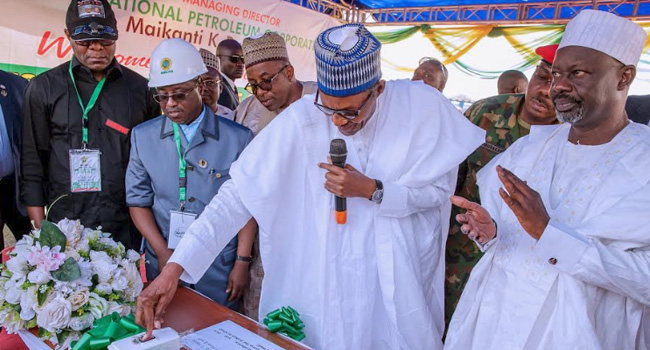
PRESIDENT Muhammadu Buhari has flagged off the oil exploration process in Kolamani River in Gongola Basin in Bauchi State, saying that oil and gas remain critical to Nigeria’s economy.
Buhari said the flag-off of the spud-in was in fulfilment of his promise to keep growing Nigeria’s economy.
According to Investopedia, “spudding is the process of beginning to drill a well in the oil and gas industry”.
The flag-off is coming 18 months after the federal government suspended oil exploration activities in the Lake Chad Basin following a Boko Haram attack on the team comprising staff members of the Nigerian National Petroleum Corporation, as well as lecturers from the University of Maiduguri.
Several persons were killed in the attack, most of the soldiers and policemen that provided security for the team. Three of the lecturers were also kidnapped by the insurgents but were releasedmonths after.
Speaking at the flag-off ceremony on Saturday, Buhari paid tribute to the people that lost their lives in the Maiduguri attack while commending the security operatives that continued to risk their lives in order to ensure a smooth exploration process.
“I am delighted to be here this morning at this important event of the spud-in of the Kolmani River-II well in the Gongola basin of the Benue Trough,” Buhari said.
“Oil and Gas remain critical to the Nigerian economy of today and the future. It remains key to the successful implementation of our budget at all levels of government. The golden era of high oil prices may not be here now but oil and gas resources still remain the most immediate and practical keys to our aggressive efforts at diversifying the economy.
“As important as it is to ensure that other critical sectors of the economy are supported to grow and contribute more to the Nation’s economy, we still need a virile oil and gas industry to take care of the challenges of the moment and to invest for the future.”
President Buhari and the NNPC GMD, Maikanti Baru.
Buhari charged the NNPC “to aggressively intensify its exploration campaign in the Inland Basins with a view to discovering new hydrocarbon reserves that will boost oil and gas production and extend economic benefits to the people within those basins and the nation at large”.
He also promised to expand oil exploration activities across all the nation’s frontiers namely: “the Chad Basin, Gongola Basin, Anambra Basin, Sokoto Basin, Dahomey Basin, Bida Basin and Benue Trough”.
Also present at the event were the Minister of State for Petroleum Resources, Ibe Kachikwu, the Group Managing Director of the NNPC, Maikanti Baru, and the Governors of Bauch and Gombe States, Mohammed Abubakar and Ibrahim Dankwambo respectively.
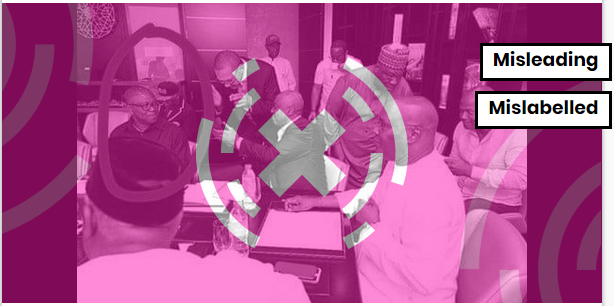
A number of Facebook posts have shared a photo claiming that the embattled Chief Justice of Nigeria, Justice Walter Onnoghen, met with the leading opposition presidential candidate, Abubakar Atiku, in Dubai.
CrossCheck Nigeria, a collaboration of newsrooms in Nigeria which includes The ICIR, has confirmed that the claim is false: the photo is mislabeled, and actually shows Atiku meeting with his vice presidential candidate Peter Obi.
In the photo, Atiku is sitting with several men during a meeting. A red circle is drawn around Peter Obi, but the caption misidentifies him as CJN Onnoghen.
The claim was first made by two Facebook pages, “Hausa Press” and “I Will Go Slow And Steady ‘PMB & Nasir El-Rufa’I'” on January 30, 2019.
As of 3:00 pm on February 1, 2019, the post had been shared on two Facebook pages over 450 times and had garnered nearly 200 reactions. Hausa Press has over 157,731 followers while the other page has 56,616 followers.
Upon investigation, CCN found the claim to be misleading and mislabelled for the following reasons:
On October 29, 2018, when the picture was taken and shared on the twitter page of Senator Ben Murray-Bruce, Justice Walter Onnoghen was in Nigeria and not in Dubai as claimed by the Facebook pages.
The person which the Facebook pages referred to as CJN Walter Onnoghen was actually Mr. Peter Obi, the vice-presidential candidate to Atiku Abubakar, PDP’s presidential flagbearer in the coming general election. Obi was seen in same cloth in another photo shared by Senator Murray-Bruce who was also at the Dubai meeting.
The original photo was posted by a serving Senator, Ben Murray Bruce, who was among the Atiku/Obi presidential campaign team during their strategic meeting at Dubai, United Arab Emirate (UAE) by 7:34 pm on October 29, 2018. It has been retweeted 949 times and had garnered 389 comments and 3,686 likes.
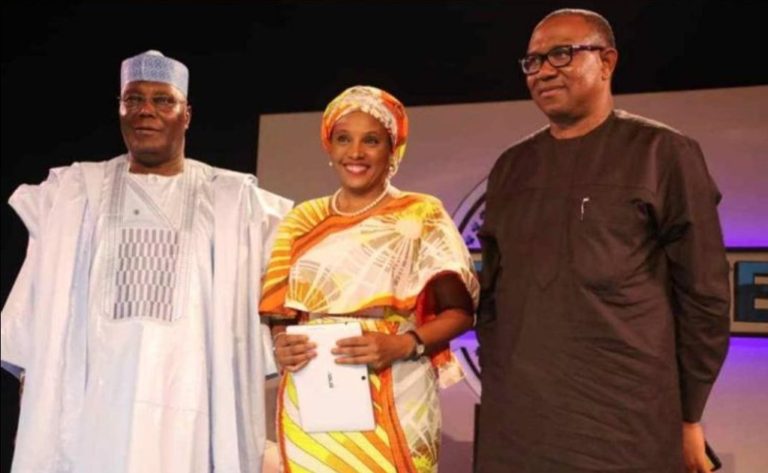
ON Wednesday, the presidential candidate of the People’s Democratic Party (PDP), Atiku Abubakar, and his running mate, Peter Obi, were hosted on The Candidates, a town hall meeting where candidates respond to questions bordering on their capabilities and policies.
It was the programme’s final session, following similar ones in the past where candidates from the Young Progressives Party, Africa Action Congress, and the All Progressives Congress, were also given nearly two hours to share their manifestoes.
In this fact-check, The ICIR takes a look at some of the claims made by Atiku and Obi, and assesses them based on available facts. Meanwhile, it was observed that, following previously published fact-checks, the party’s vice presidential candidate adjusted some of his earlier assertions, which were repeated during the interview.
For instance, during the vice presidential debate organised by the Nigeria Elections Debate Group (NEDG) in December, Obi had mistaken Iraq for Iran as one of two countries below which Nigeria is ranked on the Global Terrorism Index. This error was not made at the recent town hall meeting.
Also, at the NEDG debate, the former Anambra State governor stated that Nigeria’s GDP per capita is “under $1,900” as against $2,500 in 2015. Last week, he increased this figure to “below $2000”.
Atiku: Insecurity was restricted to the Northeast when Buhari came in
“When we come to the issue of security, at the time they [APC] came in the security challenge was restricted to the Northeast. Today, it has spread to two other Northern regions: Northwest and North Central. I don’t think that’s a good performance.”
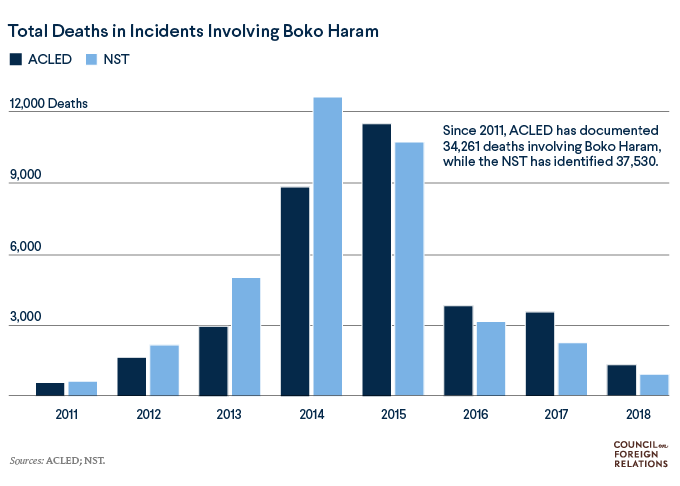
While, under this administration, terrorist attacks and clashes have taken place, it is not true Boko Haram’s violent attacks were restricted to the Northeast prior to Buhari’s presidency. There are many examples of attacks outside the region under the Goodluck Jonathan-led federal government, for instance.
The bombing of the United Nations headquarters in August, 2011 which left 21 dead and 312 injured, took place in Abuja. Four months after this incident, there was a bomb blast at St. Theresa’s Catholic Church in Madalla, Niger State. In January 2012, there was a series of terror attacks in Kano State, that left at least 185 dead, including 29 police officers. There have also been similar attacks in Kogi and Kaduna states within the period.
Source: Institute of Security StudiesSource: CFR’s Nigeria Security Tracker (NST) and the Armed Conflict Location and Event Data Project (ACLED)
Atiku: (On the allegations against his wife), she has neither been indicted nor been charged
“The company was fined for a number of offences committed, not necessarily on the issue of my wife’s account. What I can tell you is that my wife has never been indicted and she has never been charged. So there is no way you can hold my wife accountable. My wife is an American, mark you. There is no way they would not have charged her to court or indicted her.”
In the sense that he used the words, “indicted” and “charged”, it may be inferred that Atiku meant to use the former word in the sense not related to the latter, which is to accuse somebody of wrongdoing. Thus, while it is true that Jennifer Douglas-Abubakar, the former vice president’s fourth wife, has not been charged by the United States of America, it is incorrect to suggest that she has not been directly alleged to have violated the law.
While she was in the US, not only were her financial transactions highly suspicious and inappropriate, many times banks questioned the huge amounts of cash flowing to her from offshore corporations sending her funds and decided to close her accounts. Each time, she would open new ones at other banks with the help of her lawyer, Edward Weidenfeld.
Also, in 2008 the U.S. Securities and Exchange Commission alleged “in a formal complaint against Siemens AG, a German company, that, among other actions, in 2001 and 2002, Siemens wire transferred $2.8 million in bribe payments to a U.S. bank account belonging to Ms. Douglas as part of a scheme to bribe Nigerian officials.” This is according to the 2010 bipartisan report of the U.S. Senate on foreign corruption.
“In response to this and other legal actions, Siemens admitted to engaging in widespread bribery payments, pleaded guilty to criminal violations and settled civil violations of the U.S. Foreign Corrupt Practices Act, and agreed to pay over $1.6 billion in civil and criminal fines,” the report also noted.
“Ms. Douglas has denied any wrongdoing, but the subcommittee has obtained financial records showing the transfer of over $1.7 million from Siemens AG to Ms. Douglas’ account at Citibank.”
Verdict: The claim is misleading.
Obi: Our GDP per capita is below 2000, and GDP in 2015 was $520 billion
“We have heard issue of fighting corruption and the noise associated with it, where you took over an economy that was $520 billion with a per capita for every Nigeria of $2,500, and you abandoned about growing the economy and was busy chasing what seemingly does not exist … and you ended up not recovering even $5 billion, and the economy has lost $120 (something) billion, where now every Nigerian per capita is below $2,000. So we have all lost $500 while you are busy not achieving anything.”
Quoting from a previous fact-check by The ICIR, “Information on the IMF website states that Nigeria’s Gross Domestic Product (GDP) per capita in 2015 was $2,763, in 2016 it dropped to $2,207, and it dropped even further to $1,994 in 2017. The GDP per capita, in 2018, has however risen to $2,050, and the IMF projects that it will continue to rise till it gets to $3,317 in 2023.”
Also, Nigeria’s GDP according to the International Monetary Fund (IMF) in 2015 was $494 billion, and not $520 billion. Today, the figure has dropped to $397.5 billion, meaning the country has lost $97 billion in economic output, and not over $120 billion as claimed by Obi.
Verdict: The claim is false. Though the vice presidential candidate is closer to the truth than he was at the NEDG debate in December, his claim about the country’s GDP per capita is still slightly inaccurate.
Atiku: Our agricultural output under PDP was much higher
“Our major plan is to create jobs, and the greatest job creation sector in this county is the agricultural sector … In fact the PDP was doing it better. When we introduced the purchase of fertiliser on your mobile phone. Our agricultural output was much higher than the present administration’s.”
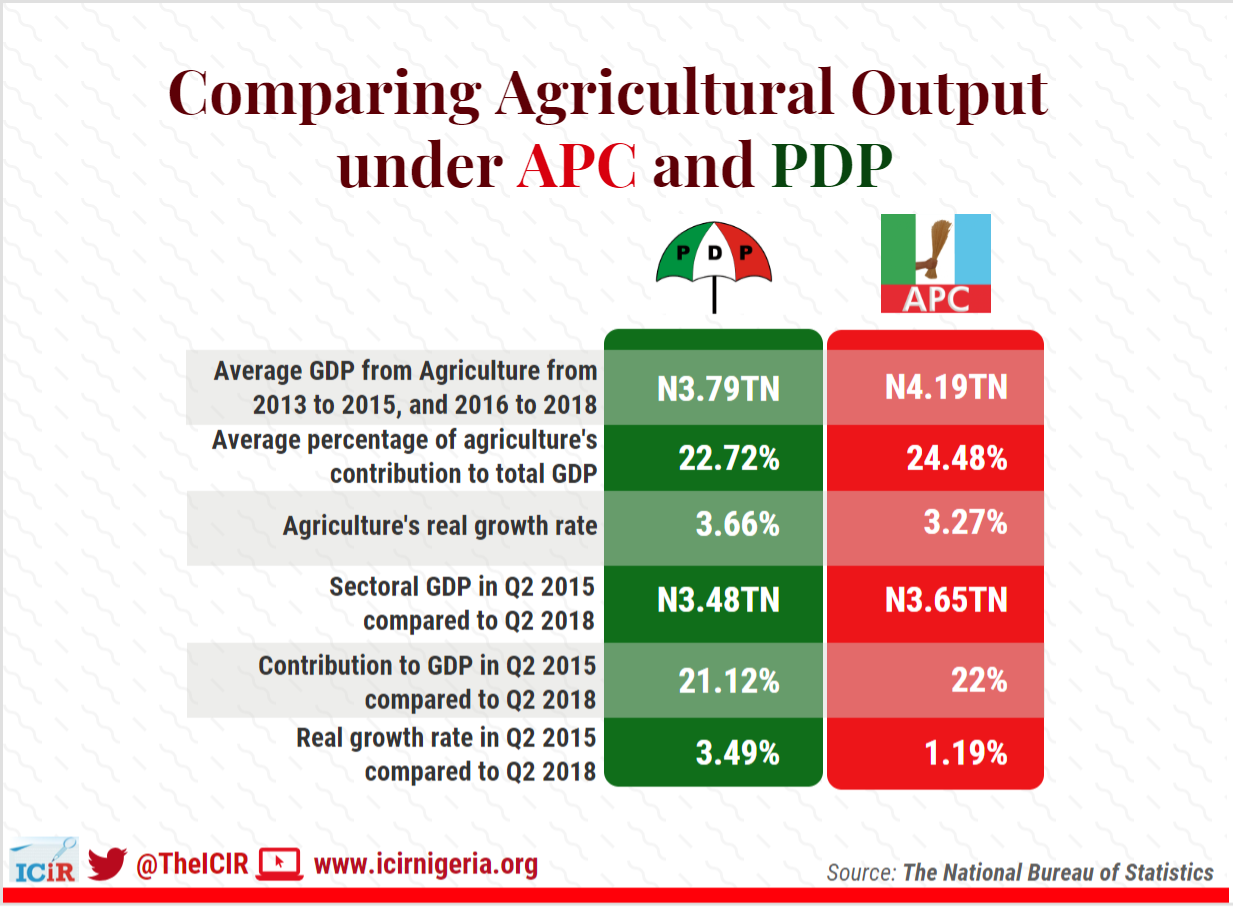
A recent study conducted by The ICIR has shown that agricultural outputs have slightly increased under the present administration. It may be deduced from statistics obtained from the National Bureau of Statistics that, under PDP rule, the average GDP from agriculture was N3.79 trillion, and between 2016 and 2018, the figure rose to N4.19 trillion.
The average percentage of agriculture’s contribution to the country’s aggregate GDP, in relation to other sectors such as industries and services, has also increased from 22.72 per cent to 24.48 per cent.
In the second quarter of 2015 when the PDP handed over, agriculture’s contribution to the GDP, real growth rate, and sectoral GDP were 21.12 per cent, 3.49 per cent, and N3.48 trillion respectively. For the second quarter of 2018, the figures respectively were 22 per cent, 1.19 per cent, and N3.65 trillion.
Verdict: The claim is false.
Obi: I never deported beggars from Akwa Ibom
“Never. Somebody deported from Lagos and I challenged it… I never took beggars to Akwa Ibom. In fact, they are welcome because they are citizens of the state. Do you know my wife is from Akwa Ibom? How can I deport people to their state. People from Akwa Ibom are welcome to my state… I have never in my life discriminated against any human being, and I will never.”
Actually, available reports appear to indicate otherwise. According to a Leadership Newspaper report of December 4, 2011, the Anambra state government, under Peter Obi, issued “a warning to all street beggars, especially children used by their parents to beg for alms, to vacate the streets or be arrested”.
“29 of such women who displayed their children as strategy for getting alms have already been arrested in Awka and Onitsha, and repatriated to their home states; Ebonyi and Akwa Ibom states,” the report added.
Another report by Champion Newspaper cited by PremiumTimes in a 2013 ‘throwback’ quoted the then Director of Child Development at the Ministry of Women Affairs and Social Development, Emeka Ejide, as making similar statements.
Ejide, it reported, said “the Ministry has repatriated more than 29 women begging with children to their various states and would not hesitate to deal with parents who still engage in such acts”. There are no reports of either the Anambra State government or former governor Peter Obi openly denying these reports, until recently.
Verdict: The claim cannot be substantiated using available media reports, and in fact conflicts with such reports.
REPORTS just filter in that Vice President Yemi Osinbajo was involved in a helicopter crash in Kabba town, Kogi State Saturday afternoon.
This was announced by his media aide, Laolu Akande in a tweet. Osinbajo and others on board were reportedly unhurt.
The Vice President was in the helicopter with his wife, a serving senator, Babafemi Ojudu and his personal physician.
VP Osinbajo's Chopper crash lands in Kabba, but he and the entire crew safe. He is continuing with his engagements and plans for the day in Kogi State.
A tweet by Akande reads: “VP Osinbajo’s Chopper crash lands in Kabba, but he and the entire crew are safe. He is continuing with his engagements and plans for the day in Kogi State.”
The Vice President has been touring the country delivering the Next Level message to Nigerians as part of campaigns for the February 16 elections.
ONE achievement President Muhammadu Buhari is always eager to flaunt wherever he speaks publicly is his administration’s efforts to improve the agricultural sector and boost local crop production.
During his state visit to the United Kingdom in April 2018, he seized the opportunity to boast about the government’s perceived feats to his friend the Archbishop of Canterbury, Justin Welby, and the British Prime Minister, Theresa May.
“I am very pleased with the successes in agriculture,” he said to May. “We have cut rice importation by about 90 per cent, made lots of savings of foreign exchange, and generated employment. People had rushed to the cities to get oil money, at the expense of farming. But luckily, they are now going back to the farms. Even professionals are going back to the land. We are making steady progress on the road to food security.”
Again during an interview granted to journalists in January, the president insisted that under his watch Nigeria has “virtually achieved food security”, accusing the media of not fully appreciating the strides.
“We made fertilizer available at virtually half the price we met it, and we are producing it locally. We work together with another African country, Morocco. I’m sure you have felt it. We don’t import rice, virtually, anymore. We don’t import rice, we have stopped importing rice, and we are even exporting grains,” he said.
But the opposition party does not agree with these claims. The People’s Democratic Party presidential candidate, Atiku Abubakar, said during a town hall meeting on Wednesday that, despite the government’s policies, agricultural output under the PDP was much higher than what the country now has.
In this fact-check we put both claims to test, contrasting them with available figures from the National Bureau of Statistics, NBS, which harmonises and publishes statistics from all the federal ministries, departments and agencies, State Statistical Agencies, as well as Local Government Councils (LGCs).
Calculating agricultural output
In assessing output from the agricultural sector, The ICIR mined data from 35 quarterly reports released by the NBS, providing Gross Domestic Product (GDP) estimates four times every year. The agency started releasing the reports at the end of 2011 and has given out data from the first quarter of 2010 to the third quarter of 2018.
The aim of the reports, also called Quarterly National Accounts or Quarterly Establishment Survey, is to describe the entire system of production in the nation and to provide “a picture of the current economic status of the economy”.
The GDP is used as the “broadest quantitative measure of a nation’s total economic activity; [and] represents the monetary value of all goods and services produced within a nation’s geographic borders over a specified period of time.” And NBS’s quarterly GDP reports contain such information as what percentage of the GDP is contributed by the agricultural sector and the percentage of growth experienced in the sector.
Using the former figure and total monetary value of the country’s real GDP in a particular period, one is able to determine how productive the agricultural sector is, not just in relation to other sectors but in isolation. The sector comprises activities on crop production, livestock, forestry, and fishing.
Three things should be noted to start with. One, agriculture is a highly seasonaleconomic element, witnessing regular fluctuations in performance due to plant seasons and natural disasters, and it’s been observed that its share in the third quarter is often the highest.
Secondly, in 2014, the NBS revised its current and constant prices using 2010 estimates, which led to a sharp fall in agricultural productivity indices. Before this year, the bureau used estimates from 1990. Because of this, it would be unwise to blindly compare pre-2014 figures and those churned out for the 2014 and later reports.
Finally, though the APC government at the federal level was handed over in May 2015, for the purpose of this fact-check the line between the two administrations was drawn from the first quarter of 2016. This is because policies of the new government cannot reflect immediately following the inauguration, its first budget was not passed until the following year, and then President Buhari did not appoint his cabinet ministers until November, 2015.
Based on this premise, agricultural outputs have slightly increased under the present administration. Numbers mined from 11 quarters of PDP rule show that the average GDP from agriculture was N3.79 trillion, and between 2016 and 2018, the figure has risen to N4.19 trillion.
The average percentage of agriculture’s contribution to the country’s aggregate GDP, in relation to other sectors such as industries and services, has also increased from 22.72 per cent to 24.48 per cent.
It is, however, noteworthy that the tables turn when we consider the average, real growth rate of agriculture, which has dropped from 3.66 per cent to 3.27 per cent.
In the second quarter of 2015 when the PDP handed over, agriculture’s contribution to the GDP, real growth rate, and sectoral GDP were 21.12 per cent, 3.49 per cent, and N3.48 trillion respectively. For the second quarter of 2018, the figures respectively were 22 per cent, 1.19 per cent, and N3.65 trillion.
Conclusion
Based on available data, it is not true that agricultural output was higher before the All Progressives Congress took control of the presidential villa. The claims of the present administration with respect to food security and crop production have also been greatly exaggerated.
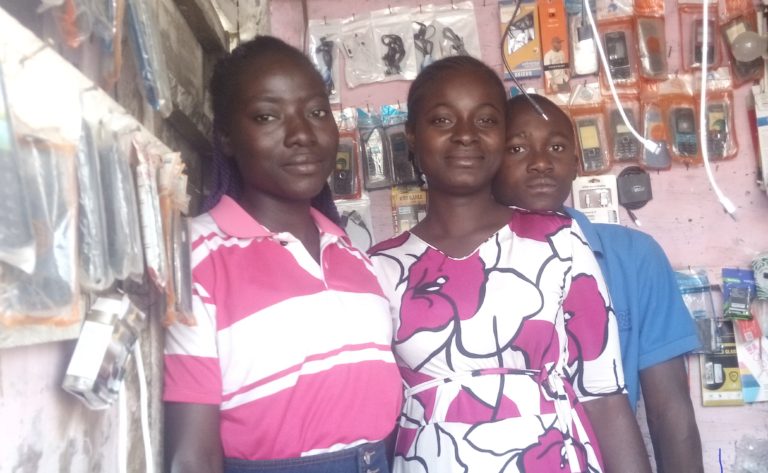
AMAKA Raphael, 33, is your everyday lady who defies the norm to survive and thrive. She is competing in a field once regarded as the exclusive preserve of men—mobile phone repairing.
“Growing up, I had been an explorer as I loved trying new things but the breaking point of my exploration was inspired by my joblessness, “she said.
A single mother of two, Amaka, from Anam, Anambra West Local Government of Anambra state, currently lives and operates a shop at Ushafa, a town under Bwari Area Council of Abuja, where she ekes out a living by fixing faulty phones.
Her clients refer to her as ‘engineer’, —and she is truly one with her dexterity in dissecting faulty mobile phones and fixing them.
“I am just an everyday lady from a below average home who doesn’t mind defying the norm to not just survive but thrive,” she says while dismantling a faulty phone.
‘‘I have a normal life like every other lady. I wake up in the morning, do my chores and off I go to my workshop where I repair all kinds of phones, including iPhones.”
Unable to continue her education to the tertiary level due to lack of funds, Amaka narrated the story of how she searched for menial jobs without success, including enlisting for the proposed Nigerian Peace Corps in 2015.
“Depending on welfare packages from my church to take care of my family and myself was no longer realistic so I ventured into phone engineering sometime in November 2017,” she said.
At first, her trainer mocked her and told her she won’t be able to cope in the business because she is a female.
“When I approached my ‘Oga’ then to be his apprentice, he had a very good laugh at me and said I would not be able to cope in the business because I am a female,” Amaka said.
“He asked me to come back when I was ready anyway. It was when I paid my apprenticeship fee that my Oga became convinced I meant business.”
After six months into the training, she graduated and opened her own shop where at the moment, two apprentices learn under her tutelage.
Amaka and her two apprentices
“I earn between N1, 000 and N2, 500 daily which is not so much for my family of five since I am the breadwinner, she said of her daily proceeds.
She is planning to expand her capacity in order to expand the scope of her business. “I will learn the integrated circuit (IC) part of phone repair to increase my capacity base and my customers as well,” Amaka said.
A Facebook post from Dailymail gist shows the scene of a disrupted event, claiming that locals in Kukara, Taraba had chased out the APC gubernatorial candidate at an event in the village.
The post had garnered an engagement of 319 shares as of 06:35 pm, January 31.
CrossCheck Nigeria confirms that the claim is misleading, as the picture shared in the post is an old Kogi East ADC senatorial rally that was disrupted 10 days earlier.
To check this, CrossCheck Nigeria , a collaboration of newsrooms in Nigeria which includes The ICIR, google searched some leads in the comment section of the post which led to photographs from a disrupted senatorial rally which had happened earlier.
The report published by one blog,Yes International on January 21, reveals that the picture was that of a Kogi East ADC senatorial campaign, allegedly disrupted by ‘APC thugs’.
A Facebook search for the account of the Kogi East ADC senatorial district candidate also confirms that the picture was shared by a page Dr. Victor ALEWO Adoji 2019 on January 21, at 03:58 pm.
PEOPLE in the remote town of Rann in Borno State are once again burying scores of residents, following another deadly attack by Boko Haram a day after the troops of the Multinational Joint Task Force (MNJTF) and the Nigerian Army withdrew from the town on 27 January.
With no military around to protect the civilians, Boko Haram freely moved into the town, killed at least 60 people and injured tens of others. Witnesses said that they further destroyed the clinic and burned thousands of settlements.
Amnesty International calls for urgent action
In a statement on Friday, Amnesty International condemned the attack, which it described as the “deadliest yet by Boko Haram”, and lambasted the Nigerian Army for withdrawing troops from the community.
“We have now confirmed that this week’s attack on Rann was the deadliest yet by Boko Haram, killing at least 60 people. Using satellite imagery we have also been able to confirm the mass burning of structures as Boko Haram unleashed a massive assault on Rann, most of which is now destroyed,” said Osai Ojigho, Director of Amnesty International Nigeria.
“This attack on civilians who have already been displaced by the bloody conflict may amount to possible war crime, and those responsible must be brought to justice. Disturbingly, witnesses told us that Nigerian soldiers abandoned their posts the day before the attack, demonstrating the authorities’ utter failure to protect civilians.
“Amnesty International is calling on Nigerian authorities to investigate the alleged withdrawal of security forces of the Multi-National Joint Task Force (MNJTF) from Rann, which may have left tens of thousands of civilians exposed to this latest deadly attack.
“Boko Haram has consistently and deliberately targeted civilians in Rann, which makes the Nigerian authorities’ failure to protect people all the more unacceptable.
“The authorities on both sides of the border must provide the supplies and safety that these people require. The Cameroonian authorities must also desist from forcing people to return until conditions are safe and they choose to do so voluntarily.”
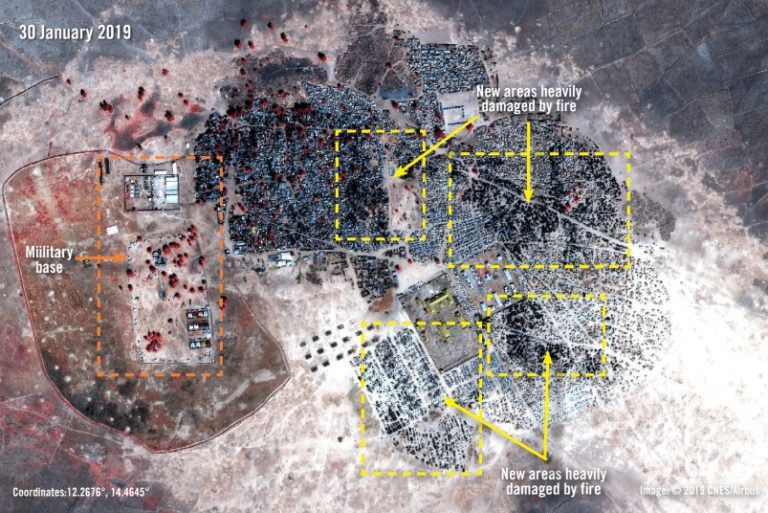
According to satellite images analysed by Copernicus, since September 2018 at least 3,300 houses, tents and shelters, making up a third of the town, have been destroyed or damaged in four attacks by the armed group Boko Haram.
Satellite images obtained by Amnesty Internationalappear to show most of the damage was done in the last attack on 28 January 2019.
The false-colour image above highlights the near-infrared band. Healthy vegetation appears red while unhealthy or burned areas appear black or brown. A closer look at one burned area on 30 January 2019 shows the severity of the damage. Many of the structures are new since 2017 suggesting they are shelters for IDPs living in the town.
Witnesses told The ICIR that on 27 January, the MNJTF troops who had come to secure Rann residents in the aftermath of the Boko Haram attack on January 14 left the town. The MNJTF reinforcement withdrew when they felt the situation had stabilised, it was learnt.
Witnesses confirmed that the soldiers used a commercial truck to pack their belongings and moved Gamboru. A few soldiers who remained in Rann later travelled via Cameroon to Gamboru.
A Civilian Joint Task Force (CJTF) member who left on Sunday with the military said: “The soldiers told us that they are not equipped to protect Rann, with only their guns and one armoured tank. After the MNJTF left, the military said ‘we can’t stay’. Boko Haram had already taken the rest of the equipment of the military in the January 14 attack.”
Their departure was followed by a mass exodus by the IDPs who had come to Rann to the security promised by the Nigerian army.
On 28 January, Boko Haram attacked the town, burning, looting and slaughtering people. At least 11 were killed inside the town while approximately 50 people were killed as they attempted to escape.
One witness who escaped on Monday to Cameroon said: “After the military left, people became very scared, everybody thought ‘there is no security with us’. Some people started packing and left to Cameroon. In the morning on Monday, Boko Haram came. They started firing, killing people, so everyone was running. They put fire in houses. Up to now, we haven’t been back.”
Other witnesses confirmed to The ICIR that Rann is currently deserted.
Another witness of the attack who escaped to Cameroon said: “First Boko Haram went to the military barracks. They saw it was empty and then they came to the town. It was around 8 am, they started firing, killing people, slaughtering people. More people ran away to Cameroon. Boko Haram followed them on their motorcycles and killed people on the road, even on the road to Cameroon there were corpses. I couldn’t count the people who died, but it is definitely more than 40.”
According to another CJTF member, the military is currently encouraging people to return. But many questions agitate the minds of development workers in the region as well as residents. Should residents come back, is the military going to protect them? What guarantees can the government give that they will fulfil their obligation to protect civilians from attacks by armed groups like Boko Haram?
Under international humanitarian law, civilians are a protected group; Boko Haram’s targeted attacks on civilians are war crimes. But the government under humanitarian law is also obliged to protect civilians, and in particular, those that they have agreed to host in IDP camps.
Numerous IDPs have said that in hard to reach areas in northeast Nigeria, the military compelled them to leave their homes and move to camps for displaced persons, such as the camp in Rann. Upon arrival in these camps, most civilians were screened and many men of fighting age detained.
The displaced persons were then held in camps with severe movement restrictions. IDPs have described numerous deaths due to starvation because they could not leave the camps to farm or search for food.
The military set up the displaced persons’ camp in Rann in April 2016, and all farmers living in surrounding villages were instructed to come to the camp for their own safety.
The stories IDPs from Rann described to The ICIR all paint a harrowing picture of the suffering, hunger and thirst in the months that there is no access for humanitarian organisations.
Since January 2017, when the Air Force bombed the camp which resulted in over 170 deaths, the displaced persons have experienced at least seven deadly Boko Haram attacks.
Early this year, Rann hosted some 75,000 displaced people, according to IOM. Thousands left following the deadly Boko Haram attack on 14 January, during which at least 14 civilians were killed.
Displaced people that spoke with The ICIR had little words to express their desperation and feeling of total neglect. One man who came to Maiduguri after the 14 January 2019 attack told The ICIR: “In Rann, there is nothing. In the past two years, we have been there. The air force dropped a bomb. Our children died, we became handicapped, our elderly died. We were attacked. All these things happened to us. Nobody spoke and said they are sorry. What do we do?”
He is now waiting to be reunited with his wife and children, who escaped Rann on 27 January and are currently in Cameroon.
Another man who also came to Maiduguri before the latest attack said: “There is nothing we can do about Boko Haram, but I am very surprised that a terrorist can come, enter the military barrack, take the property, enter our town, kill civilians, take our animals. Now is the time for election, but Boko Haram doesn’t want democracy. In my understanding, they don’t want people to vote.”
Days before the military withdrew from Rann, there was an election campaign event in the town. The residents said they were very pleased to see that they as well were visited by the candidates. A man said: “The authorities have told us that they would hold elections in Rann. Everyone who gets the chance to vote will vote to improve our situation.”
But after the latest attack, which made most displaced people refugees in Cameroon, and the mass destruction of the town, it is doubtful if the people from Rann will be able to vote.
INVESTIGATION has revealed how All Progressive Congress (APC) may have been privileged by a breach of data privacy of Nigerians ahead of 2019 general elections.
The ruling party, through its Campaign Call Centre located in Abuja, has been found to unduly access data of the prospective electorate and using it to find and canvass votes for President Muhammadu Buhari.
Findings by The ICIR revealed that the APC may have collaborated with the Nigerian Communication Commission (NCC) and the Independent National Electoral Commission (INEC) to access personal information of potential voters without their consent.
The information gathered is used to locate a prospective voter and the area he or she had registered to vote, and then solicit a vote for President Buhari.
One of such callers who identified herself as Lily reached out to a staff of the International Centre for Investigative Reporting, ICIR on January 25 asking him to vote for President Buhari.
The caller disclosed that she got the detail of the ICIR staff through the assistance of NCC.
Caller: “My name is Lily, I’m calling you from the APC campaign call centre Abuja. The President will first love to wish you a happy new year and want to know the issue affecting you in your area.”
Out of curiosity, the respondent queried whether the caller knows his residence and his number, she responded, giving the actual area council, “Yes sir, Kuje Area”.
The respondent queried further if the caller was at Kuje, “No! I’m calling from the campaign call centre, central area, Abuja,” she noted.
“We have your details sir,” Lilly stressed, adding that the APC campaign office got respondents details from the NCC.
Audio Recording of Lily
The caller then continued to persuade the respondent to vote for president Buhari in order to “continue with the good works he is currently doing.”
Voters’ education and persuasion of electorates are no violation of any law, but what is condemnable is acquiring people’s data without their consent. In 2015 while it was still an opposition party, the APC did same but met large public criticism.
“When I pretended as if I did not know what NCC means, the caller spelt out the name in full: Nigerian Communication Commission (NCC),” The ICIR staff said.
“I then wondered why would the NCC breach its law and give out private information of citizens, such as address, to the campaign office of the ruling party.”
In recent times, Nigerians and civil society organisations have repeatedly condemned the influx of unsolicited calls, messages including emails majorly from online businesses, thus demanded legislation to curtail the trend.
But years after the demands, the ruling government that has the responsibility to protect citizens’ privacy appears to be a major defaulter.
Experts have also condemned the act, describing it as an invasion of privacy which the government should take seriously.
Barr. Lauretta Ugwoke, in her remarks, condemned the act, so long there was no consent of the rightful owners. The database, she explained further were not public documents and as such should not be obtained without due process.
“Such documents are not public documents. If they are not public documents, then it is an invasion of privacy. They are not supposed to be used but if they are public documents, it is open for anybody to obtain. If the due process is followed, it can be obtained.
“But once they are not public documents, that means you have invaded somebody’s privacy by doing that and whoever did that can be sued actually. If you are able to get the evidence of who and how they obtained such information.”
On unsolicited emails, “Actually, I don’t think there is any law in place now stopping you from sending such information into peoples email. Even though you are invading somebody’s privacy actually but in Nigeria presently, there is no law against it right now.”
A few days after The ICIR staff’s encounter with APC call centre, another campaign staff in the APC office called with the number 07054958451, and here is the conversation that took place.
“President Buhari will like to know if you are in need of anything in your location sir, such as electricity, water, power, jobs.”
Responding, the recipient said the social amenities were not readily available. The caller identified herself as Precious Ezelioha. She enquired further if the respondent has decided to vote in 2019, “I am still contemplating,” the respondent stated.
Audio Recording 2
Caller: “Were you able vote in 2015,”
Respondent: “Yes I voted.”
Caller: “Who did you vote for?”
Respondent: “I voted for my candidate.”
Caller: “Okay sir. So this year, you don’t know who you are supporting?
Respondent: “Not that I don’t know but now that you are calling me, I will not want to express who I’m voting for.”
Caller: “No..no…It’s okay. It’s your right. But I will like you to vote for President Muhammadu Buhari.” Respondent: “Okay!’
Caller: “Yes Sir.”
Respondent: “Why do you want me to vote for President Buhari? ”
Caller: “Because he needs your vote to continue what he has already started. He needs your vote to make Nigeria a better place. Your votes count, so he needs your vote….”
Respondent: “You asked of what we need in my area but you did not ask of the location?”
Caller: “I’m calling Kuje. Are you not staying in Kuje?”
Respondent: “I am in Kuje. How do you know?”
Caller: “I know. We call based on location and local government….I got your number, you registered for voters’ card…”
Respondent: “So you got my number from the polling unit I registered?”
Caller: “Yes. Everything is there. We are trying to call Kuje people to find out what you guys need”.
Respondent: “It’s a good development. As you these, it means you are concerned.”
Caller: “President Buhari is working you might not see the result now but trust me he is working. I believe in the next two years, Nigeria will be in a very good condition so we need your votes.”
Respondent: “Definitely! But is it from the INEC office you got my phone number?”
Caller: “Yes.”
Respondent: “So they gave you people access to their database to extract voters’ data?”
Caller: “It is for your own importance; it is for your benefit so we are trying to find out your needs,” she added.
In his reaction, the respondent further queried why the electoral commission would release public contact for campaign purpose, and asked if there will be other benefits aside from the calls. She responded saying, “For now it’s just calling, don’t worry, we will get back to you on that….”
Nigeria’s effort to building citizen’s database
The last administration of President Goodluck Jonathan witnessed series of government initiatives meant to capture public data of the citizens in the country. The essence, which varies was mainly to develop a comprehensive database, such that the nation can reliably provide authentic data for planning, security purpose and national development.
Among the several initiatives are National Identification Number (NIN), being administered by the Nigerian Identity Management Commission (NIMC). The Independent National Electoral Commission (INEC) also developed its database with over 70 million people registered as at then, currently 84.2 million after gathering biometric information of individual voters to produce the Permanent Voters Card (PVC).
Apparently, the INEC biometric registration and subsequent issuance of the PVC is to reduce fraud, increase transparency in the electoral process, especially the issue of under-age voting. More so, is the Federal Road Safety Corps (FRSC) database developed for eligible drivers, including the proposed database by the National Population Commission (NPC).
Eventually, the presidency had to wade in to see to the harmonisation of the data following the proliferation of data capturing activities from various public institutions.
However, most vital and compulsory among these was the CBN bank customers registration and GSM telecommunication users registration, as ordered by the Nigerian Communication Commission (NCC).
As at November 2018, the NCC already recorded a total of 248,115,152 connected lines from which 169,104,830 million are actively connected. This was an increase compared to 144 million active lines recorded in December 2017. The monthly subscriber operator data displays the number of subscribers and teledensity for mobile and fixed telephony services in the country.
Active Mobile Lines as at Nov 2018
Are there data protection laws?
Meanwhile, except Chapter 4, Section 37 of the Nigerian Constitution which guarantees the privacy of citizens telephone conversations, telegraphic communication etc and the NCC Nigeria Code of Practice Regulation (2018), there is currently no specific or comprehensive data privacy protection law in the country.
Part Vi of the NCC Act – Nigeria Code of Practice Regulation, which details protection of consumer information tasked operators to ensure the safety of personal data and make such data available to the regulator.
“(1) Every Licensee shall, at the point of registration of subscriber information pursuant to the Registration of Telephone Subscribers Regulations, provide the consumer with the terms and conditions under which personal data is to be held and processed.
“(2) A Licensee shall ensure that a consumer is kept informed of consumer data being processed by it and the purpose and duration for which the data is being processed.
“(3) A Licensee shall ensure that appropriate measures are taken by it to prevent unauthorised access to communication and data in order to protect the confidentiality of consumers.”
Aside, the The National Information Technology Development Agency (NITDA) Guideline also attempted to place restriction on federal, state, and local governments, including the private sector and other institutions of government from divulging private data.
“any information relating to an identified or identifiable natural person (data subject); information relating to an individual, whether it relates to his or her private, professional or public life. It can be anything from a name, address, a photo, an email address, bank details, posts on social networking websites, medical information, or a computer’s IP address”.
Data mining for political purpose isn’t new
Data mining is not a new trend. It is also not peculiar to Nigeria. In 2007 and 2015, prior to the emergence of the ruling administration, the PDP, was accused of contracting foreign lobbyist and data harvesting firm to mop-up data of eligible voters on the internet for political gain.
In connivance with an Israeli firm, the data miners were paid to also harvest data on the current president.
The firm, Cambridge Analytical was specifically fingered to have accessed data of over 50 million Facebook users across some nations, including Nigeria. Owned by Robert Mercer, the firm was blamed to have also influenced American election. Though, the Federal Government in April 2018, set up a committee to probe the matter but a year after, nothing is being heard about the resolution.
In the course of this investigation, The ICIR gathered that pro-Peoples Democratic Party (PDP) organisations, was also sending unsolicited emails to the public, canvassing for votes .
Names of recipients were clearly spelt out in the direct emails, copies made available to The ICIR. It was projected in form of voter’s education but with a picture of the PDP candidate affixed at the bottom.
Email Campaign from the PDP
“Honestly, I feel so bad knowing that a public or private institution shared my personal information without any form of consent, I didn’t sign up for any political party’s newsletter and as such should not receive such emails from them.
“The rate at which personal information is shared without the owners’ consent is increasingly alarming and there should be a law that protects customer personal data,” Wilson Atumeyi lamented.
But, Kasim Afegbua, spokesman Atiku Campaign Organisation, could not be reached for his reaction. Several calls to his phone were unsuccessful. Text message sent to him was not returned as at the time of filing this report.
The Director, Strategic Communication for APC Presidential Campaign Council, Festus Keyamo denied knowledge of the campaign centre. “I have no knowledge about that and I have no response about that.”
Mallam Lanre Issa-Onilu, spokesperson of the APC claimed the party could not have mined data illegally to campaign for Buhari’s re-election but asserted the use of legal means such as interpersonal campaign strategy. He also denied knowledge of the APC campaign call centre.
“I am not aware of that. Anything that is illegal, APC is not involved in it but if it is contacting voters, of course, we are using every platform to reach voters in very legal way. We are using our projects to illustrate why we should have a renewal of mandate. There is nothing illegal about that.
“But hacking into websites and other sources, that we are not supposed to do, you won’t find APC in it.”
He later acknowledged the centre, saying “we have many centres where we are interacting with the people…..if they are truly attached to the APC, then whatever they are doing is legal.”
Asked to speak on the source of data obtained by APC call centre from NCC and INEC, he said: “I have no response to that because I don’t know anything about that.”
He also declined knowing about the existence of APC call centre, and how they access voters’ data.
Rotimi Lawrence, chief press secretary to the INEC chairman terminated several calls made to him. He later requested for a text message which was sent promptly; in his response, he described the news as” a very serious allegation and whoever is making it should own up to it.”
“Since you are investigating, complete your investigation and confront me with your findings,” he added. The ICIR later disclosed the finding to him, but he is yet to respond as at the time of filing the report.
Spokesperson of the Nigerian Communications Commission (NCC), Mr. Nnamdi Nwokike, denied the claim saying the data was not in custody of the commission. He added that the NCC could not have shared subscribers data with the campaign call centre.
“I’m sorry, I’m not aware of that. NCC won’t give out data of Nigerians. We don’t have it. NCC wouldn’t do that.” He stated.
Beyond Nigeria, developed nations including the European Union have been developing measures and new laws to protect data of their citizens against invasion. A good instance is the European Union General Data Protection Regulation (GDPR) which came into implementation on 25th May 2018 and was widely accepted by the people.
THE Federal Government of Nigeria will rake in as much as N67.7 billion (US$187 million) over a one year period from the new taxation policy on tobacco in the country, a report has revealed.
The report, authored by Grace Onubedo and Precious C. Akanonu, both Senior Research Fellow and Research Fellow at Centre for the Study of the Economies of Africa (CSEA), Abuja was the outcome of a study by the Centre titled “ A Scoping Study of Nigeria’s Tobacco Market and Policy.
In June 2018, the new tax policy on tobacco kicked off. According to the Federal Government, the new excise duty rates would spread over a three-year period from 2018 to 2020 in order to moderate the impact on prices of the products.
Under the new rates for tobacco, in addition to the 20 per cent ad-valorem rate, each stick of cigarette will attract one naira specific rate per stick; that is N20 per pack of 20 sticks in 2018.
In 2019, tobacco will attract two naira specific rate per stick or N40 per pack of 20 sticks.
By 2020, tobacco would begin to attract N2.90 kobo specific rate per stick or N58 per pack of 20 sticks.
The Centre commended the government for this move as “a step in the right direction,” but noted that duty remains below the standard recommended by the World Health Organization (WHO).
CSEA study highlighted that support for tobacco taxation increases by 17 per cent, if earmarking is introduced, especially among smokers.
“Most of the respondents view tobacco taxation and earmarking as a means to help smokers quit and improve the wellbeing of citizens,” the report said.
“In terms of the wellbeing, respondents prioritize earmarking for public health programmes including treatment of tobacco-related diseases, and social programmes for poor households (such as cash transfers).”
It revealed also that all other government parastatals support adding tobacco revenue to the pool of government revenue except the Ministry of Health.
What 50 per cent of N67.7 billion can do for the health sector
Nigeria currently has one of the lowest budget allocations to the health sector. The AU’s Abujadeclaration of 2001, stipulates that 15 percent of the national budget should go to the health sector, but Nigeria only allocates 3.9 percent of total budget to the health sector in 2018.
This implies that government spends a meager sum of N1,888 on each citizen’s health care need for the whole year. This reflects negatively on Nigeria’s health indices; the WHO ranks Nigeria 187th out of 191 countries in terms of health care delivery.
Following the arguments of pro-earmarks, earmarking tobacco revenue ensures a continuous, regular source of funding that are not subject to annual budgetary review.
From the CSEA’s stakeholder analysis, 25percent -50 percent of tobacco tax revenue is proposed as the earmarking benchmark. Applying 50 percent to N67.7billion expected revenue would yield an additional N33.9billion of earmarked revenue to the health sector over a one-year period.
This will result to 9 percent increase to the sum allocated for citizen’s health care. Similarly, earmarking tobacco taxes can provide a sustainable source of financing for tobacco control. In 2017, about 0.028 per cent of the Federal Ministry of Health budget was allocated for setting up tobacco control unit (TCU) in 2017. However, the TCU received no funds in 2018 due to the ministry’s budget constraints.