In this concluding part of last Saturday’s report on failed 2016 constituency projects in Ekiti State, INNOCENT DURU sought the comments of the contractors, lawmakers, contracting government agency and experts on why the borehole projects failed and exposed the residents of affected communities water–borne diseases as they resort to using and drinking unclean water from any sou
IN 2016, lawmakers representing various parts of Ekiti State in the National Assembly facilitated the execution of borehole projects to their communities. In Ido Osi/Moba/Ilejemeje axis, the lawmaker representing the area in the House of Representatives, Hon. Thaddeus Aina facilitated the construction of 22 hand-pump boreholes in various communities. The boreholes were constructed by Alliance Boots Limited with the Benin Owena River Basin Development Authority as the client.
Benin Owena River Basin Development Authority was also the client of 51 ‘productive’ hand-pump boreholes facilitated by Senator Fatimat Raji Rasaki in Ekiti Central Senatorial District. Mid-South Development Investment Limited constructed the boreholes.
In Ekiti South Senatorial District, Senator Abiodun Olujimi facilitated two solar-powered borehole projects. Again, Benin Owena River Basin Development Authority awarded the contract, which was executed by Candid Oil Limited.
Our reporter’s visits to some of the communities revealed that the boreholes stopped functioning shortly after they were sunk. And controversy has been trailing the award and execution of the contracts.
The manager in charge of the 22 hand-pump borehole projects constructed by Alliance Boots Limited, Apeh Monday, while denying that inferior materials were used in the construction, alleged that the client, Benin Owena River Basin Development Authority, engaged in underhand deals in giving out funds for the project.
He said: “The brand of the entire materials I used is India 2, so the issue of using inferior materials does not arise. The job was well done and certified by the Benin-Owena team. About a year after we executed the project, they sent us a letter saying that about 17 of the pumps were not working.
“We took our engineers to the site and found that it was 13 of them that were not functional and we rectified 12. We told them to pay our retention fee so that we could have funds to fix the last one but nobody listened to us.
“Hand pump is not like borehole; it requires constant repairs. There was no agreement that there would be constant maintenance of the projects.
”Benin Owena is still owning us about N1.8 million since then. When you do a community borehole, there is what we call capacity building. The money for this is part of the agreement, but they took over this money too.
“They are supposed to use that money to train one or two people in those communities on how to repair the boreholes. Nobody did that community empowerment. That is why we are having these problems.”
Apeh disclosed that his company got N25 million for the 22 boreholes. Each of the boreholes cost about N950, 000 in addition to other charges.
“ There are some money in Bill One. Bill One money is what they call project admin, which requires you to bring cash and give to them [government officials].
“You have to remove this money and give it to them in cash before they give you the contract money. But it is the accumulation that makes up the contract money. I think I paid them about N5 million from that Bill One money. They said it is for their administrative use. If you don’t pay it, you won’t get your money.”
Lekan Olaleye, Candid Oil Services boss, whose company handled the solar borehole projects in Ise-Ekiti, said there had not been a formal report to the company about the boreholes.
“It is not true that inferior materials were used for the projects. The projects have been done and the water was flowing. It flowed for more than a year, but I don’t know whether they are still working or not,” he said.
Olaleye said is not the duty of the company to maintain the project, adding: “The maintenance is supposed to be done by Benin Owena River Basin Development Authority after we handed over.”
He said that no money in the name of Bill One was paid to the client.
“It didn’t happen,” he said, adding that he didn’t know the amount the company collected for the project offhand.
Olaleye ruled out the possibility of returning to site to repair the boreholes.
“The period of the contract has elapsed. It is more than two years,” he said.
The efforts the reporter made to reach out to the management of Mid-South Development Investment Limited on the phone were unsuccessful as the boss’s mobile phone was switched off. A message also sent to the company’s email was yet to be replied to at press time.
Benin Owena Development Authority’s management avoids response to questions
Attempts made by the reporter to get the response of the management of Benin Owena Development Authority were also frustrated. The agency awarded all the contracts in question
Officials of the agency referred the reporter to the headquarters in Benin and later to its Ekiti office.
When a call was put to the mobile phone of the Public Relations Officer of the agency in Benin, he promised to call back after he was briefed about the purpose of the call.
When he eventually called back, he requested that the reporter should get in touch with the area office manager in Ekiti, Mr Francis Adetiba. When the reporter got through to Adetiba, the manager of the Ekiti office, he requested for the questions the reporter wanted a response to with a promise to respond later.
The story, however, changed when Adetiba called in the night to say that the information the reporter sought could only be supplied from the headquarters.
“For you to be able to get what you want, I will advise you to go to Benin to get the approval of the Managing Director who would direct you to the appropriate quarters where this information could be gotten.
“At the area office, we don’t know how much they are taking this contract job. The monitoring team is from the headquarters, not from the area office. All the information about the cost is from the headquarters.”
Adetiba said maintaining the projects becomes a function of the community six months after its completion and not that of the authority.
Asked if it amounts to the end of a project if it fails after it is handed over, Adetiba responded: “It shouldn’t be. The community can write to the authority and there could be room for rehabilitation or renovation of existing projects if there is provision for it. For you to get the authentic information, go to the headquarters.”
Adetiba dismissed the allegation by the manager of Alliance Boots Limited that officials of the authority collect money before releasing project funds.
“I don’t believe that is possible. Let me tell you categorically that it is not at the state office that contracts are awarded. It is at the headquarters,” he said.
Subsequent calls made to the mobile phone of the Public Relations Officer (PRO) at the headquarters of the authority were neither answered nor returned.
Lawmakers react
When our reporter reached out to Hon. Thaddeus Aina who facilitated the execution of 22 borehole projects in Ido Osi/Moba/ Ilejemeje axis, he denied knowing anything about the contract.
“Thanks. When I come back to the country, I will react on the points raised. But get one thing right: questions of the award of the contract, I knew nothing about it. The agency will tell us about it,” he responded in a text message.
Senator Fatima Raji Rasaki, in a telephone interview, said she did not receive any report to the effect that the boreholes were no longer functional.
She said: “When you do your constituency project, you hand over to the community because you cannot be there forever. It is their own.
“I handed over all the projects that I did to the community. And they know the meaning: if I am no longer a politician, would I be coming to repair it for them forever and ever? Would the contractor be going there forever and ever? It is for the community to take care of the projects. They shouldn’t allow small children to start playing with the projects.”
When she was told that the community members complained that the boreholes only worked for a few months, she retorted: “The community people have an office and I have my office. They are supposed to go there and complain. I even learnt that the contractors are going round to take stock. Tell the community leaders to get in touch with the office.”
On her part, Senator Abiodun Olujimi did not respond to the calls, text message and email sent to her.
Cost of borehole, by experts
A director of a popular borehole drilling company in Ekiti State, who did not want his name or that of his company mentioned, blamed the failure of most public borehole projects in the state on corruption. Explaining why constituency borehole projects don’t last, he said: “We are in Nigeria (laughs). When politicians want to get the contract, they can get it for N10, but they would want to pay N4 or N5 for it, and the contractor does exactly a job of that sum for them and leaves. In no time, the borehole fails and the community is back to square one.
“If it is a private thing, you can negotiate with them by making them understand that if you do it this way, this would be the outcome. Most of the private people can easily chase you around. But if it is a project by politicians, once it is spoilt, it is spoilt.
“Nobody will run after you because when it backfires
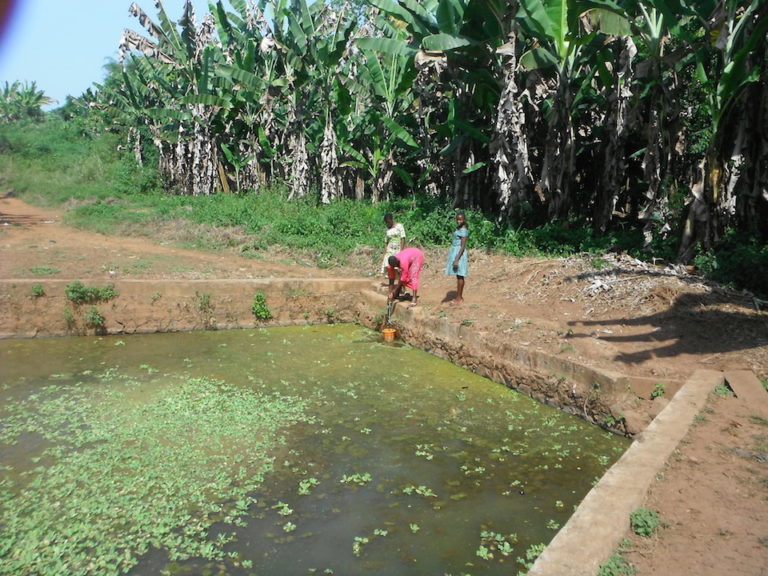
A solar borehole in Ise-Ekiti has stopped functioning.
the person who contracted it out won’t be found anywhere. He would have eloped.”
On the cost of drilling boreholes, he said: “We don’t do hand-pump boreholes, but we do solar borehole. If you want the solar borehole, without the borehole components, the solar components and by that I mean the number of the panels, the quality of the pump you want to use, on the average, you can have it for between N1.2 million and N1.3 million.
“If you add the borehole components, it will close up at about N2 million. Whether it is for public or private use, the cost is the same.”
Another engineer, Bankole Owolabi, in a telephone chat explained why boreholes quickly develop faults within a short period of constructing them.
He said: “When you install the machine to the bare ground of the 150ft that you have dug, the mud inside the borehole will make the machine to get stuck. It rarely comes out on its own. But an expert in the field can bring it out.
“If a basement is also not well done, it could make sand to enter the machine and consequently cause it to collapse.
“To know the cost, you have to do a geophysical study of the place to know the depth to attain. This determines the price.
“On the average, a hand-pump borehole should cost about N600, 000. The difference between solar borehole and others is that they use solar energy to power it. But it is the same process.”
The Executive Director Krestfield Limited, Engineer Saeed Alagbe, said borehole construction does not have a fixed price anywhere.
He said: “The cost depends on the area and the nature of the place. That is why you do a geometric survey before you commence the drilling. It is that survey that will give you the depth that you will get clean water.
“If you have rocks there, you may need to blast those rocks. One cannot state the cost unless a study of the area is done. If I am blasting a rock, I can give you a bill of N12, 000 or N15, 000 per metre, and it can be as low as N5,000 per metre. “The cost of solar borehole depends on the panel you are using.”
This investigation was supported by the John D. and Catherine T. MacArthur Foundation and the International Centre for Investigative Reporting, ICIR
NIGERIA’s first executive president, late Shehu Usman Aliyu Shagari remains probably, the only Nigerian who had held more ministerial positions in the history of Nigeria.
Shagari, in the space of 16 years, between 1959 and 1975 held sevendifferent Ministerial portfolios before becoming Nigeria’s first elected president in 1979 under what was known as the Second Republic.
He died on Friday at the National Hospital, Abuja at the age of 93.
Foray into politics
Encyclopaedia Britannica described Shagari as one of the few northerners to show interest in national politics before independence. His first contact with active politics was in 1951, when he became the secretary of the Northern People’s Congress (NPC) in Sokoto, and held the position until 1956.
In 1954 contested and was elected to the federal House of Representatives and represented Sokoto West. He would later be part of every administration after Nigeria’s independence in 1960.
Four years later, precisely, in 1958, Shagari was appointed as parliamentary secretary, though he left the post in 1959 for the Nigerian Prime Minister, Sir Abubakar Tafawa Balewa.
He would in the same year serve as the Federal Minister for Commerce and Industries.
Between 1959 and 1960, Shagari was redeployed to the Ministry for Economic Development, as the Federal Minister for Economic Development. And between 1960 and 1962, he was moved to the Pensions Ministry as the Federal Minister for Pensions. From 1962-1965, Shagari was made the Federal Minister for Internal Affairs. From 1965 up until the first military coup in January 1966, Shagari was the Federal Minister for works.
After the Nigerian civil war, from 1970-1971, Shagari was appointed by the military head of state General Yakubu Gowon as the Federal Commissioner for Economic Development, Rehabilitation and Reconstruction. He took over from late Obafemi Awolowo who he later ran against and narrowly defeated in 1979 presidential election.
From 1971-75 he served as the Federal Commissioner (a position now called minister) of Finance. During his tenure as the commissioner of finance for Nigeria, Shagari was also a governor for the world bank and a member of the International Monetary Fund (IMF) committee of twenty.
Retirement after politics
After he won the keenly contested presidential elections in 1983, the poor state of the nation’s economy and mind-boggling corruption in his administration led to a coup de tat on December 31, 1983, spearheaded by General Muhammadu Buhari and his cohorts. Shagari was arrested but was cleared of personal corruption charges and released from detention in 1986. He was however banned from participation in Nigerian politics for life and he retired to his Shagari village in Sokoto State.
THOUGH he is more popularly known as a foremost politician and ultimately Nigeria’s only president during the second republic, Shehu Usman Aliyu Shagari was also many other things prior to his passing on Friday at the age of 93.
Born to Aliyu and Mariamu Shagari on February 25, 1925, he hails from Shagari, a village (now local government area) in Sokoto State. The village was founded by Ahmadu Rufa’i, his great-grandfather, who headed the village and adopted its name also as his family name.
Shagari is the sixth child in a polygamous family. His father, who later became the Magajin Shagari (Head of the Village), was a herder, farmer, and also engaged in trading activities. He died in 1930, five years after the birth of Shagari, and Bello, the young Shagari’s elder brother, had to take over as the village head.
In 1992, the Sultan of Sokoto, Siddiq Abubakar III, conferred upon him the title of Turaki (officer of the sultan’s court) of the Fula Sokoto Caliphate. He was also, at other times, given chieftaincy titles from other regions, including the Ochiebuzo of Ogbaland, the Ezediale of Aboucha, and the Baba Korede of Ado-Ekiti.
At a young age, Shagari was enrolled into a madrasah (Quranic school), before moving in with relatives at a nearby town where he attended a Catholic institution, Yabo Elementary School, between 1931 and 1935. From 1936 to 1940, he attended middle school in Sokoto, and then proceeded to Kaduna College where he studied Science of Education between 1941 and 1944.
In 1952, he graduated from the Teachers Training College, Zaria, Kaduna. From there, in 1953 and for the five years that followed, he was employed as a visiting teacher in Sokoto Province. Around the same period, he was a member of the Federal Scholarship Board.
Before venturing into politics in 1951 and his election into the federal House of Representatives three years later, Shagari was a teacher. He remained a professor at the college after obtaining his degree. He also taught in several other places, including the Middle School in Sokoto as a Professor of Science.
He was appointed as the director of a primary school in Arungu in 1951. In 1953, he travelled to the United Kingdom and spent a year in the country to complete his teacher training programme.
In all, he got married to three wives: Amina, Aishatu and Hadiza, with whom he had several children, including Captain Muhammad Bala Shagari, his eldest son and a retired captain of the Nigerian Army, and Aminu Shehu Shagari, who represents the Shagari/Yabo federal constituency at the House of Representatives. Aishatu Shagari died in a hospital in London after a brief illness on August 24, 2001.
Narrowly defeating Obafemi Awolowo at the election, Shagari served as Nigeria’s head of government between 1979 and 1983 after the Olusegun Obasanjo-led military regime handed over power to a civilian government. Between 1958 and 1975, he had served multiple times as federal minister and commissioner in various capacities.
He was, however, overthrown and arrested shortly into his second term in office through a coup, after his government became unpopular due to rising corruption, worsening economic conditions, and allegations of electoral malpractices in the 1983 election.
Two years ago, at a prayer session conducted at his home to commemorate his 91st birthday, Shagari had counselled Nigerians to continue to live in unity, while sustaining peace.
“We should continue to live in peace with each other irrespective of our diverse religious, ethnic and cultural differences. God has His reasons for creating us together as a nation and our differences are aimed at cementing our unity,” he had said.
In 2015, the former president was rumoured to have passed on but his personal assistant, Atiku Nuhu Koko, quickly dismissed the false claim.
Shagari died on Friday, December 28 at the age of 93.
The ICIR investigations show that hundreds of millions of naira released for HIV campaigns, counselling and testing services may have ended in private pockets of contractors and government officials, as companies were specifically registered to siphon funds meant to save the lives of the infected.
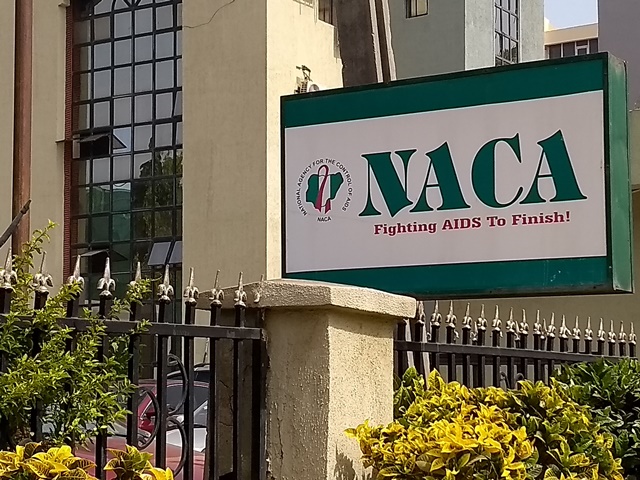
IN October of 2015, National Agency for the Control of AIDS (NACA) awarded 38 contracts to 23 firms at the cost of N1.2 billion. Their shared responsibilities were to conduct HIV counselling, testing and demand creation for HIV services in 26 out of Nigeria’s 36 states.
That year, NACA broke its own fiscal record as its capital budget of N1, 930,500,120 was fully released and spent to the last kobo. Three years down the line, The ICIR investigations reveal, the award of contracts for these services were a smokescreen to siphon public funds. No services were meant to be rendered and none were eventually delivered. Yet, monies were released from state coffers and supposedly accounted for.
In the global efforts to rid the world of HIV, the Acquired Immune Deficiency Syndrome (AIDS), causative agent, reports say that new HIV infections are not going down in Nigeria and, thus, still poses a public health threat. Advocates continue to argue that prevention and treatment programmes need to be scaled up.
But rather than scale up prevention in the country, The ICIR investigations show the companies NACA awarded contracts are, to a large extent, questionable. In addition, three of these firms made away with N289 million, without executing any traceable HIV counselling and testing services.
Two of the companies – Duxford Integrated Services Limited (DISL) and Carsons Global Services Limited (CGSL) were, according to records scrutinised, registered with the Corporate Affairs Commission (CAC) on the same day – May 2, 2014. The third company, Corn Idea Limited (CIL), was registered on November 26 of the same year.
Another striking discovery was that the three companies have common ownership and are located in the same address. Ifeanyi Iyizoba, doubles as a director and majority shareholder in all, while Afunanya Jude Chinweze is the sole secretary of the three companies.
Each of the companies has N1 million share capital. In the breakdown, Iyizoba has N600, 000 shares each in Duxford Integrated Services Limited and Carsons Global Services Limited, while a different person, named Martin Samuel, owns the remaining N400, 000 share capital each.
In the third company, Corn Idea Limited, Ifeanyi Iyizoba is found to be the main shareholder with N900, 000 share capital, while a new name, Ndubuisi Iyizoba, owns just N100, 000 shares in the company.
Also, DISL and CGSL have the same main objective: “to carry on the business of trading of general contracts, sales and distribution of general goods”.
The third company, CIL, has a different objective: “to carry on the business of communication, telecommunication services and software design”.
Thus, none of the three companies that secured contracts from NACA to conduct HIV counselling and testing services in nine states renders any form of health services as their main objectives indicate.
A breakdown of the contracts awarded to the three companies by NACA shows that DISL got N37 million for Kebi, N27 million for Imo, and N29 million for Benue state. CGSL got two contracts at N32 million for Bayelsa and N34 million for Plateau states.
Corn Idea Limited received the highest number of contracts with N27 million for Katsina, N37 million for Federal Capital Territory (FCT), N38 million for Bauchi, and N28 million for Zamfara states.
Procedure violation
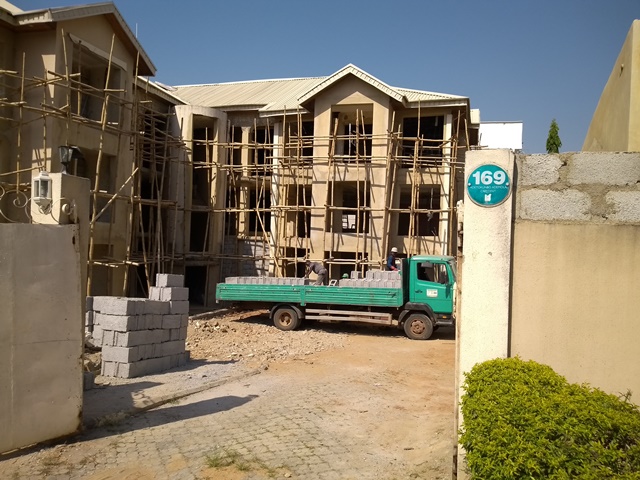
The companies’ address at 169 Ademola Adetokunbo Crescent, Wuse 2, Abuja was a residential apartment now being converted to a plaza. Photo by The ICIR
By the awards of these dubious contracts, NACA did not only violate requirements of the Public Procurement Act (PPA) of 2007, the agency also disregarded its own laid down procedures and processes.
Earlier in July 2015, NACA advertised expressions of interest from competent firms. The requirements were that interested companies should be ones with high knowledge and experience in HIV services. They were asked to apply for the contracts in order to enhance rapid scale-up of HIV services in the communities as well as Prevention of Mother-to-Child Transmission (PMTCT) of HIV/AIDS.
A key factor in NACA’s eligibility criteria was that prospective applicants must have completed at least three successful similar consultancy services.
However, findings by The ICIR show that the three companies never handled any project or service of any kind prior to their getting the HIV counselling and testing contracts from NACA.
Even till date, there is no record to ascertain that the three companies being investigated have done any works since they were registered. The only ‘credible’ information about them was that they were awarded contracts for which they lack professional competence by NACA.
In advertising the contracts, NACA asked applicants to provide: “evidence of tax payment for the past three (3) consecutive years; that is, for years 2012-to-2014, evidence of VAT registration and proof of past remittances, and audited statement of account for same previous three (3) consecutive years of 2012-to- 2014.”
But, evidently, the three companies were found not to have been able to meet the specified requirements because they were only established the previous year 2014. In fact, CIL which got the highest contracts was registered eight months before NACA advertised for the expression of interest.
Furthermore, NACA asked applicants to provide “detailed company profile, technical experience/qualification of key personnel, registered address, name, functional location, telephone numbers, and e-mail address” to boost their eligibility to bid for the job. Surprisingly, the only item that attests to the companies’ existence is the proof of registration with CAC.
When The ICIR traced the address of the three companies located at 169, Ademola Adetokunbo Crescent, Wuse 2, Abuja, as filed in their registration with CAC, extensive reconstruction was ongoing in the building. The building’s foreman who identified himself as Lewis said the structure was a residential apartment converted into a plaza.
After having a phone conversation with someone whom he believed knew about the previous residents, Lewis later told our reporter that the person said neither the companies nor the individuals mentioned ever rented any work space in the building.
An amazing twist in the course of investigation is that Ifeanyi Iyizoba, the beneficial owner of the companies, could not be identified till the time of this report. All attempts to trace him on social media amid other media drew blank. In fact, a NACA official told The ICIR that no staff of the agency admitted about knowing whom Iyizoba is.
The ICIR also contacted several staff of other organisations that provide HIV services but none of them knew Iyizoba. Even few journalists reporting the heath beat said they too did not know Iyizoba.
Similarly, on the social media, accounts associated with Ifeanyi Iyizoba appear inactive making his online presence hazy. In particular, a Facebook account with his name was last updated in 2014. The profile picture by the name remains the only uploaded photo on the account till date. Also, other three names associated with the companies do not have reliable online presence.
Every effort made by TheICIR to ascertain the reality of the companies’ existence as well as the credibility of the persons behind them led to a dead end. Available facts show that the individuals behind the companies remain faceless.
As popularly known in the procurement circle, the stance of these companies fit into the picture of “briefcase companies”, a term used to describe those offices operating from their portfolios. They also assume that these kinds of companies are commonly registered and sponsored by public civil servants to award contracts to themselves under feigned names.
Shielding the fraud
John Idoko, former Director General of NACA between 2009 and 2016. Photo credit: The Guardian website
After two months of investigations, The ICIR found no evidence that the companies that were awarded contracts by the NACA conducted any form of HIV counselling and testing services in the supposed states.
The ICIR earlier reached out to NACA by sending Freedom of Information (FOI) request to seek clarification on the status of the contracts with the companies. But the agency delayed to respond to the request to provide the exact names of the communities or health facilities where the companies administered the HIV counselling and testing services.
Not only that NACA hesitated, but also that The ICIR was not the first organisation that NACA denied information on the details of the HIV counselling and testing contracts.
The Auditor General for the Federation, Anthony Ayine, in the 2016 audit report submitted to the National Assembly (NASS) in June 2018 noted that: “during the examination of sampled payment vouchers, it was observed that contracts for HIV counselling and testing outreach and campaign at the community level across the states and the FCT were awarded to various contractors during the year 2015.” He added that “all efforts made to obtain the contract files for audit scrutiny were not successful.
Ayine noted that the implications of his being denied access to the contract files is that, “NACA broke the law.”
He stressed: “This was a violation of Section 85(2) of the Constitution of the Federal Republic of Nigeria, (1999) and Financial Regulation 110 which expressly provide that my Office will have unfettered access to all required documents, accounts and other records.”
The AGF then urged the NASS to compel the Director General (DG) of NACA to make available all the relevant contractors’ files for audit scrutiny. But the NASS, according to findings, has not yet acted on Ayine’s request.
John Idoko was the DG of NACA in 2015. Before becoming NACA’s DG from April 2009 to August 2016, Idoko was a professor of medicine at the University of Jos in Plateau State and President, Nigerian AIDS Research Network. He was replaced by the current DG, Sani Aliyu.
NACA, established in 2001, initially named National Action Committee on AIDS, was set up to coordinate multi-sectoral response to HIV/AIDS, including collaborating with international organisations. It became an agency of the Federal Government in 2007, under the presidency and directly supervised by the Secretary to the Government of the Federation.
Trailing the HIV projects in the states
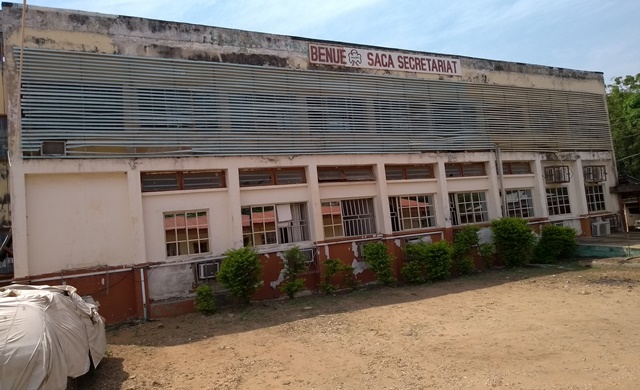
Office building of Benue State Agency for the Control of AIDS in Makurdi. Photo by The ICIR
Not giving up on the intent to unravel the truth of the situations, The ICIR trailed the purported HIV counselling and testing services coordinated by the three companies – DISL, CGSL and CIL to three states and the FCT. Amazingly, no such services were rendered in the specified states.
A Community Mobilisation Specialist in the Federal Capital Territory Agency for the Control of AIDS, Angela Emenalo, told The ICIR that she never heard of Corn Idea Limited.
“No organisation by that name has ever done any such HIV work in the nation’s capital,” she affirmed.
Emenalo continued: “If any HIV project was done by the company you mentioned in any part of FCT, I will know because the mobilisation officers in the six area councils report to me.”
Emenalo explained that every HIV projects will have reports on the number of people tested and contacts of those that tested positive, and concluded emphatically, “I insist, I don’t know anything about this contract you are talking about. I never heard of it. Go and ask NACA for the report.”
Similarly, Ileimokumo Ogregade, Director General, Bayelsa State Agency for the Control of AIDS , could not find records of a 2015 NACA’s N32 million contract of HIV counselling and testing activity purportedly conducted by any company called CGSL in the state.
Ogregade, who was by 2015 not the DG, instructed his monitoring and evaluation officer to run through their archives. Again, there was no reference to any HIV activity by CGSL in Bayelsa State. There were also no staff of the agency who had ever heard of the company.
In Bauchi State, the director of HIV and AIDS programme, Danladi Mohammed, said he had no knowledge of N38 million contract awarded to CIL by NACA in the state. Mohammed referred The ICIR back to NACA as he noted: “I think the best thing is maybe you ask the agency to specify exactly when they conducted this activity and where.”
Then, after calling his predecessor to enquire about the project, Mohammed was told that NACA once came to Bauchi to implement HIV-related activities, but the state did not have the record of any activity by the company being investigated.
The DG said: “we cannot say Corn Idea Limited was here. And we’ll not be fair to them if we say they were not here. Honestly, we all need clarification from NACA.”
He took The ICIR through the way they operate. He explained that health facilities take record and upload data on HIV counselling and testing to the National Health Management Information System (NHMIS).
So, for them to know the number of people tested in a particular month in the state, Mohammed said, “I will simply check the NHMIS platform.”
He emphasised that any organisation that conducts HIV testing in a community must share the data with the nearest health facility there. The health facility will then record the names and contacts, as well as basic biological information of those that tested positive into its HIV testing services register.
Director General, Benue State Agency for the Control of AIDS, Gideon Dura, refused to confirm or refute whether a 2015 NACA N29 million HIV counselling and testing project awarded to DISL ever held in the state or not.
“If you ask me about HIV prevalence in Benue State, I will begin to elaborate on it. But when you come specifically for a particular organisation whether came and did something here, you don’t have a letter from those people up there, I will not attend to you,” Dura said sternly.
Insisting that he needed to see a letter from either NACA or Federal Ministry of Health before he could confirm whether the company did HIV counselling and testing in the state, Dura said: “in Benue State, I’m the eye of DG of NACA. And as you know, we don’t answer journalists like that. It is deadly to answer journalists without due approval from the top.”
A few days later, The ICIR contacted a subordinate staff who helped to rummage through files in the office. He later confirmed that the state never had dealings with DISL on any HIV activity.
Conflicting data
To get a reaction from the agency, The ICIR shared its findings with Toyin Aderibigbe, Head of Corporate Communication for NACA.
But rather than respond directly to the findings in the states, NACA sent its reply to the FOI request it had earlier ignored. The ICIR, had on November 13 sent the FOI request to NACA. On November 20, a copy of the FOI acknowledgement receipt was presented to Aderibigbe to facilitate prompt response.
In a letter signed by Adeolu Aiyewumi, Head of Legal Unit, NACA, and dated December 17 but received by The ICIR on December 21, the agency apologised for not providing the requested information within the seven days specified by the FOIA “as these activities were conducted in 2015 and a manual of our archived files had be done to retrieve the information required to provide you with a robust response.”
Aiyewumi acknowledged that The ICIR specifically requested for the names of communities or health facilities where the companies conducted HIV counselling and testing but he provided only the Local Government Areas (LGAs) where the activities were purportedly conducted.
He also confirmed that NACA engaged the companies to conduct HIV counselling, testing and demand creation for HIV services in nine states in 2015.
According to Aiyewumi, the companies submitted reports with the following results:
S/N
Company
State
Community
No. TESTED
No. REACTIVE
1
DUXFORD NIGERIA LIMITED
KEBBI
DANDI
5,784
41
BENUE
GWER WEST
7,128
132
IMO
MBAITOLU
6,396
57
2
CORN IDEA NIG. LIMITED
ZAMFARA
ISAFE & BUGUDU
5,058
24
KATSINA
HAYIN MAJINDADI
6,345
39
FCT
MPAPE
6,326
75
BAUCHI
GUDUM
5,398
27
3
CARSONS GLOBAL NIG. LIMITED
BAYELSA
YANAGOA
5,638
127
PLATEAU
MANGU
5,893
67
However, NACA’s data stands in sharp contrast to the realities found in the visited states. It also fails to address The ICIR’s original request which was for the names of communities or health facilities that the HIV counselling and testing services took place.
In the data provided by Aiyewumi, only names of LGAs were presented as communities thereby making the document vague, given that respective LGAs has about 10 wards with hundreds of settlements.
And, were the HIV counselling and testing services actually done as NACA claimed, records of those that tested positive would have been given to the nearest health facilities to commence treatment. And if the counselling and testing were done in health facilities, those health facilities would have the records of those that tested positive in their registers.
To resolve the disparities, NACA’s spokesperson, Toyin Aderibigbe, promised to facilitate a meeting between The ICIR and NACA on December 24 to address the fresh concerns to jointly examine the reports purportedly submitted by the three companies. Come this day, NACA’s spokesperson reneged on her pledge to arrange the meeting.
NACA’s reply to FOI request did not answer why states’ agencies did not know about the companies and the HIV activities claimed to have been conducted in their locale. It also did not provide the names of the communities or the health facilities that the counselling and testing took place. This slip has also made confirming the figures a difficult task.
In the face of the contradictions, the suspicious figures purportedly submitted by the three companies could have formed part of the 7,238,594 persons that were claimed to be counselled and tested across Nigeria in 2015.
It was out of this number that NACA also presented in its annual report that 264,476 tested HIV positive. Consequently, Nigeria may not yet have dependable figures on numbers of persons counselled and tested for HIV.
Health experts say HIV data dilemma limits the fight against the virus and that is why the world’s largest ever population-based HIV/AIDS survey is currently being conducted to determine the distribution of the disease in Nigeria. Also, the result of the donor-funded Nigeria HIV/AIDS Indicator and Impact Survey, which began in June, is expected to be released in the first quarter of 2019.
NACA’s position
On December 26, NACA’s long awaited response to The ICIR’s findings was e-mailed to the reporter. The agency reiterated its stand that the companies conducted HIV counselling and testing services in the states. Here is the NACA’s full statement:
“In your follow-on email to our Head of Corporate Communication dated 5th December 2018, you shared the findings of your investigation. We commend your organisation for conducting an independent investigation and sharing the findings with us. We have reviewed your findings and wish to provide the responses below. It is our hope that these responses will further enrich your report and support the good work you are doing to promote accountability and transparency in the use of public funds in Nigeria.
S/N
Finding
NACA’s Response
1
The companies were registered a few months before the contracts were awarded and the three companies are owned by one person, suggesting that there is a collusion with NACA in awarding the contracts.
In line with the Bureau of Public Procurement (BPP) Act 2007, NACA advertised a general procurement notice on July 3rd, 2015, requesting interested companies to respond to the numerous Lots, including that for HIV Counselling and Testing (please see Annex 1). Numerous companies responded and submitted the required documents listed in the advert, including the three companies in question. NACA at this stage has no evidence of collusion by the procurement evaluation committee that reviewed the submissions. Nevertheless, as you are aware, these activities took place before the appointment of the current Director General, Dr. Sani Aliyu. The new DG has already directed that a forensic audit of the entire contract award be undertaken, and a full report submitted to him in the coming weeks. In the event that allegation of collusion with any staff of NACA is substantiated, the staff member(s) involved will not be spared and the full weight of the law will be applied. NACA will not condone any act of misdemeanour or corruption by any of its staff.
We are pleased to inform you that NACA management is fully committed to transparency and accountability of public funds. Our contract award process is robust and strictly follows due process. The DG has instituted a multi-layered evaluation process to ensure any error of omission or commission by the first evaluation team are picked up and rectified by the second level evaluators who are usually discreetly selected and are independent of the first set of evaluators. This process is unique to NACA and has ensured that any errors or collusions as a result of conflict of interest are promptly identified and dealt with. We have also included the submission of CAC Forms C02 and C07 which will enable us identify companies with same directors. Furthermore, in line with new directive by the Bureau of Public Procurement (BPP), every company is required to print the names and countries of origin of its directors on their letterhead (please see a sample of our recent advert for contracts in Annex 2).
2
The companies have no capacity to do HIV counselling and testing or health related services based on their main objectives
The companies submitted proposals in line with our terms of reference and their proposal was considered sound enough to deliver the results desired within the contractual framework. The reports submitted by the companies showed good results in line with the objectives and targets of the contracts. These activities were also monitored by NACA staff to ensure technical soundness of the interventions.
3
The contracts were not executed but the money was released 100 per cent by NACA
These activities were duly executed and were monitored by NACA staff. Please see reports of the activities attached as Annexes 3,4 & 5.
4
There are no records of HIV testing and counselling conducted by these companies in the states they purportedly did so
Please see reports of the activities attached as Annexes 3,4 & 5.
“We wish to once again commend your organisation for taking up this noble cause which aligns with NACA’s core values and the current administration’s zero tolerance for corruption. While this contract took place prior to the coming of the current DG, we are committed to ensuring that all contracts in NACA follow due process, are transparent and free from any undue interference by external or internal conflicted parties, in line with the DG’s principles of justice, fairness and a level-playing field for all. We are always available to support you in any way feasible in this regard. Should you require additional information on this matter, please do not hesitate to contact the undersigned. Please accept the warm assurances of the Director General.”
NACA’s e-mailed statement was signed by Adeolu Aiyewumi, Head of Legal Unit. The ICIR received hard copies of the reports submitted to NACA by the companies on 28 December.
The reports did not mention communities or health facilities where the HIV counselling and testing services took place. The reports did not also contain the names of the health facilities where those that tested HIV positive were referred to.
Based on the reports, there was no information that could lead to confirm that the companies conducted the HIV services they claimed they did.
This investigation is supported by the John D. and Catherine T. MacArthur Foundation
A few years ago, the Nigerian police paraded a gang of male armed robbers headed by a woman in front of journalists, and photos of these seven alleged criminals who had terrorised a part of Lagos were published.
I was shocked to identify the petite, light-skinned woman allegedly leading this deadly gang as a former secondary school classmate, with whom I had maintained sporadic contact over the years.
The Federal Government Girls College, Owerri, has produced a number of outstanding Nigerian females, including World Bank Vice-President Arunma Oteh and outspoken MP Nnenna Elendu-Ukeje. But the leader of a dreaded gang of robbers was a first for us, and the news quickly spread to our alumni across the world.
On a whim, I dialled the alleged gang leader’s phone number a few weeks later. She was pleased to hear from me, but was driving and would call back later, she said.
The din of the surrounding Lagos traffic was proof that she was indeed not locked up in a police cell.
When she did call back, she dismissed the police’s accusations, insisting that she was innocent and had simply been “set up”.
She has not been convicted of the alleged crimes and is still walking free, despite being paraded before the media and having her reputation irredeemably soiled.
The proclivity to parade suspects by the Nigerian security services and declare them guilty before the media, without a lawyer present or trial by a competent court, came to the fore recently in a heartbreaking video that has been widely published.
‘You will not do this to me!’
Nigeria’s spy agency, the DSS, said a woman who they identified as Amina Mohammed posed as the wife of a state governor to gain entry to the presidential villa in the capital, Abuja.
The officers forced her to face the camera and confess her alleged crimes.
But, she refused. Instead, she covered her face with her veil, screaming: “You will not do this to me!”
In the effort to get her to cooperate, security officials yanked her veil away from her. The woman knelt on the floor, weeping.
I have covered the undemocratic parading of 'suspects' by security agencies in #Nigeria, and this is easily one of the worst cases of indignant abuse on a citizen presumed innocent until proven guilty.
Clearly, the woman was dreadfully aware of how many Nigerian citizens have had their reputations irreparably ruined by this process.
Typically, the suspect makes a full confession before the cameras, the bruises on their faces and the presence of stern security personnel leading you to wonder exactly what might have inspired the so-called admission of guilt.
For years, Nigerians have been treated to one such show after another, but this is hardly ever followed up by news of actual convictions.
The security agents appear more keen to be perceived as having done a good job, even when they may have little evidence to convict.
Similar dramas have been the major characteristic of President Muhammadu Buhari’s much-touted anti-corruption war.
Prominent Nigerians accused of incredible levels of corruption have been filmed in handcuffs, the case against them detailed in the media, with public opinion immediately declaring them guilty.
Yet, almost four years after President Buhari took power, the majority of these alleged treasury looters still roam free.
Only a few mostly insignificant convictions have been recorded. The same has been the case for high-profile Boko Haram members captured and paraded by the military.
It is possible that these media parades are an attempt by the security personnel to squeeze water out of stone, to exact some punishment for offenders since the Nigerian judiciary is notoriously slow and riddled with corruption.
The reasoning seems to be “let’s ruin their reputation even if we can’t get a conviction”.
‘Dictatorial tendencies’
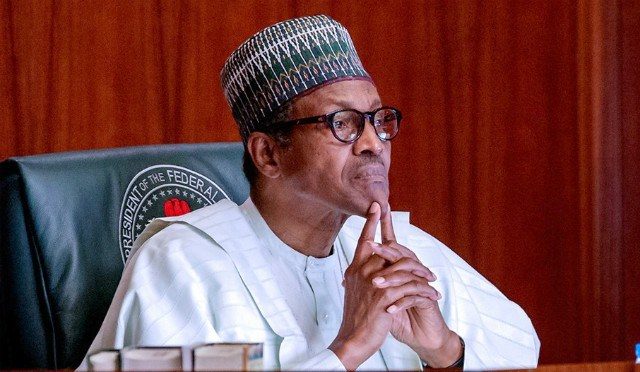
President Buhari had said that sometimes human rights can take second place.
President Buhari has complained publicly about our country’s judiciary, which he appears to view as a stumbling block to his dealing with offenders.
In a keynote address at the annual conference of the Nigerian Bar Association in August, he said: “Rule of law must be subject to the supremacy of the nation’s security and national interest.
“Where national security and public interest are threatened or there is a likelihood of their being threatened, the individual rights of those allegedly responsible must take second place, in favour of the greater good of society.”
This comment and others like it led to outrage from Nigerians, many of whom are only too aware that our democratically elected president once presided over a military government characterised by a number of notorious decrees that violated human rights.
The most telling evidence that President Buhari’s conversion from dictator to democrat may not yet be complete is the continued incarceration of Sambo Dasuki, a former national security adviser who is accused of squandering billions of dollars meant for the prosecution of the war against Boko Haram.
He pleaded not guilty and over and over again, the courts have granted Mr Dasuki bail. Yet, he remains behind bars three years after he was arrested, and has still not been convicted of the alleged crimes.
Mr Dasuki played a role in President Buhari’s arrest back in 1985 when he was removed as head of state during a military coup, and Nigerians cannot help wonder if that little fact may not be linked to this administration’s continued defiance of court orders that the man be granted bail.
This article by Adaobi Trcia Nwabuani was firstpublished by the BBC as part of its ‘Letter from Africa’ series.
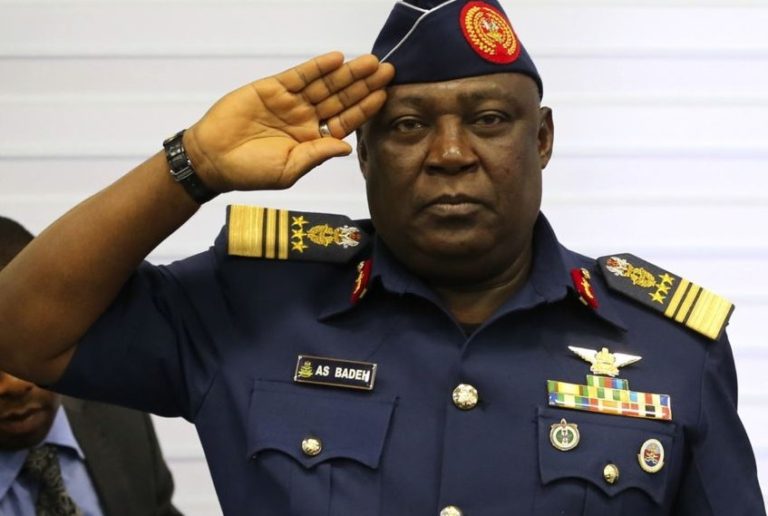
A SUSPECT allegedly involved in the murder of former Chief of Defence Staff (CDS) Air Chief Marshal Alex Badeh (Rtd) yesterday revealed, in a video confession, that the general was killed after they got a tip-off that he was bringing money to pay for a newly purchased parcel of land.
The one-minute thirty-second confessional video shows the suspect, a 25-year-old Shuaibu Rabo saying Badeh was killed in an attack to rob him of money meant for the purchase of farmland.
A person who seems to be a police officer while avoiding the camera conducted an interview with the suspect in Hausa language.
He narrated the incident led to the killing of the retired general: “One day, Yaya went to Gitata market and met Ciroma who gave him a hint that the retired general (Badeh) had bought new farmland and he was bringing the money on a particular day.”
He said Ciroma then told Yaya that they should plan on how to go and rob them of the money. He said on the day of the incident, they laid an ambush along the road. He said it was Ciroma who confirmed Badeh’s vehicle when it was approaching.
“We blocked the road. And some of us were trailing his car. When he reached us, he (Badeh) did not show any intention of turning back. In fact, he acted as if he was going to knock Ciroma down. When Ciroma realized that, he jumped off the road and opened fire on him (Badeh),” Rabo explained.
He said thereafter, they ransacked the vehicle and carried a bag of money in local currency.
The police yesterday during a press conference at the Force Headquarters in Abuja also said five suspects have been arrested in connection to the murder of the former CDS.
Police spokesman, DSP Jimoh Moshood said the Joint Police Investigation Team, the IGP Intelligence Response Team and the Special Tactical Squad arrested two principal suspects and three other suspects in connection with the crime.
He said they are now in the police custody undergoing investigation, as the search to arrest others continues.
Moshood said the parade of the two principal suspects and the three other gang members now in police custody would not come up today so as not to jeopardize the on-going investigation.
“All the suspects will be paraded before the media and the public on completion of an investigation into the matter,” he added.
Badeh was killed by gunmen along the Keffi – Abuja road, on December 18. during an attack on his vehicle while returning from his farm.
THEFederal Government has proposed the sum of N138 billion as the 2019 budget for the agriculture sector, representing 1.56 per cent of the national budget as against 10 per cent recommended by the Maputo Declaration of 2003.
If approved, the ministry would get N80,290,007,947 as its capital budget with total recurrent expenditure pegged at N57,677,415,129.
President Muhammdu Buhari in his budget presentation to the Joint Session of the National Assembly recently in Abuja, though restated his commitment to developing the agriculture sector by refinancing the Bank of Agriculture (BOA) and the Bank of Industry (BOI) with N15 billion and additional N10 billion respectively.
In 2018, the ministry proposed N53.8 billion as recurrent expenditure and N149.19 billion as capital budget as against N31.75 billion recurrent and N103.79 capital expenditure in 2017.
But the N80.29 billion proposed for the capital projects in the agriculture ministry is much lower than the proposed budget in 2018 (N149.19 billion) representing 2.2 per cent and N103.79 billion in 2017 representing 1.38 per cent.
Moreover, the agric budget for more than a decade has been marginal to really reflect the government’s seriousness to feed its growing population projected by the UN to hit about 398 million by end of 2050.
In July 2003, the Federal Government agreed to the African Union (AU) Maputo Declaration on Comprehensive Africa Agriculture Development Programme (CAADP), aimed to set aside ten per cent of the annual budget to develop the agriculture sector and ensure food security in member countries.
The decision was made at the second ordinary assembly of the AU as an integral part of the New Partnership for Africa’s Development (NEPAD) but 16 years after, Nigeria still lags behind.
The highest budgetary allocation Nigeria ever recorded is 2 per cent and that was in 2018.
Since the inception of his administration, President Buhari promised to reposition the economy and drive the nation’s revenue through an alternative source – the non-oil sector which is mainly agriculture.
Though, the agriculture ministry ranks among 12 top Ministries, Departments and Agencies (MDAs) with high Capital Expenditure Allocations in the 2019 proposed budget but previous budgets have not entirely reflected government’s seriousness to the AU agreement.
International organisation and civil society organisations such as Actionaid Nigeria has repeatedly argued that if the federal government was serious about food sufficiency, it would respond to the AU declaration through its unveiled Economic Recovery Growth Plan (ERGP) and the Agricultural Promotion Policy (APP) also known as Green Alternative.
Agriculture is regarded as the second largest contributor to Nigeria’s Gross Domestic Product (GDP) making up 23 per cent of the country’s GDP.
Actionaid in its analysis of the 2018 budget observed the gradual increase in appropriation between 2014 – 2018 from 0.9 to 2 per cent yet still far from its pledge at the Maputo declaration.
A report on the Community Participatory Assessment of Government Expenditure on Agriculture on Smallholder Women Farmers Access to Extension Services revealed that smallholder farmers dominate the agriculture sector and produce 90 per cent of the output, yet have difficulties accessing agricultural extension services.
Cisse Lo, Speaker of the Economic Community of the West African States (ECOWAS) Parliament at the 1st ECOWAS People’s Agriculture Budget Summit, held recently in Abuja, frowned at the inability of Nigeria and other member countries to fulfil its 10 per cent commitment to the agriculture sector.
“Despite the 2014 Malabo Declaration and recommitments to the CAADP principles by the African Union Heads of States, Public investment to the sector has not substantially increased to be able to drive the 6 per cent growth. Between 2008 and 2014, Western Africa saw a decline in agricultural GDP by nearly 1.5 per cent”
“In many cases where the budgetary allocation has been maintained, they have been characterized by untimely or non- releases of allocated resources within each financial year depriving the agricultural sector the needed growth and contribution to economic development and poverty reduction,” she added.
African nations with over 10 per cent annual budgetary allocation to agriculture sector include Senegal, Ethiopia, Mali, Niger, Zimbabwe, Madagascar, Malawi etc.
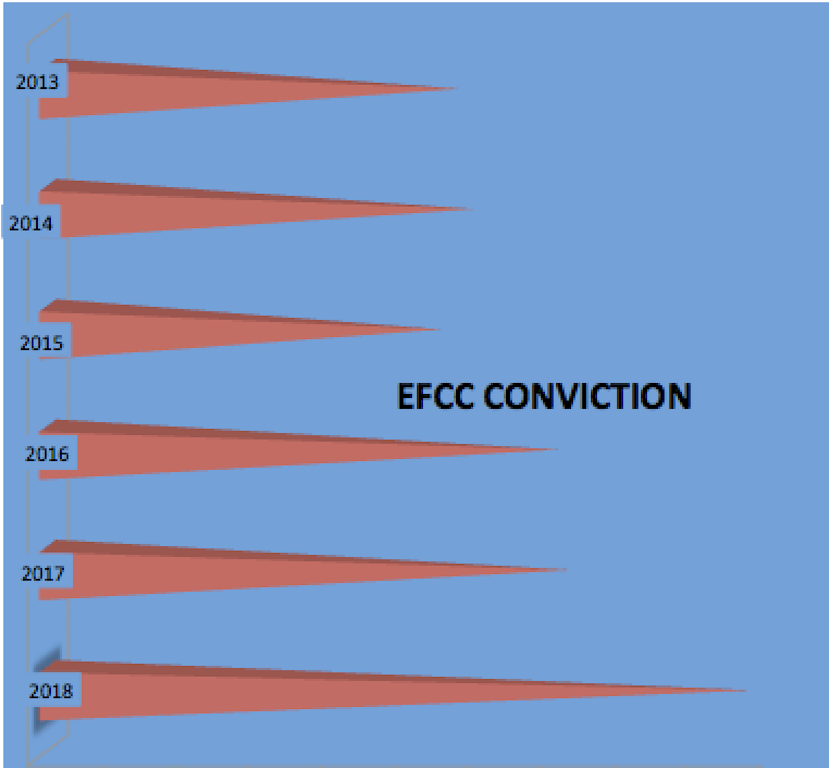
THE Economic and Financial Crimes Commission, EFCC, has secured a total of 312 convictions between January and December 2018, which is the highest conviction rate secured by the commision since President Muhammadu Buhari-led government started the anti-corruption campaign in 2015.
The record of convictions is a significant improvement from the 189 convictions recorded in 2017.
Also, compared to 117 convictions in 2013, 126 convictions in 2014, 103 convictions secured by the EFCC in 2015 and 182 convictions recorded in 2016, the 2018 success rate is the highest.
The high profile convictions recorded this year include that of two the politically exposed persons such as Jolly Nyame, a former governor of Taraba State and Joshua Dariye, a serving Senator and a former governor of Plateau state. Both are currently serving jail terms at Kuje Prison.
A Senior Advocate of Nigeria, Joseph Nwobike, has also been stripped of the highly revered legal title, he was convicted this year for perverting the course of justice.
Dariye and Nyame, who were sentenced to 14 years in prison had approached the Court of Appeal to challenge the “guilty” verdict handed down on them by a Federal Capital Territory High Court, Gudu presided over by Justice Adebukola Banjoko.
However, while upholding their convictions, the Appellate Court commuted Dariye’s jail term to 10 years, and that of Nyame to 12 years with a fine of N495 million.
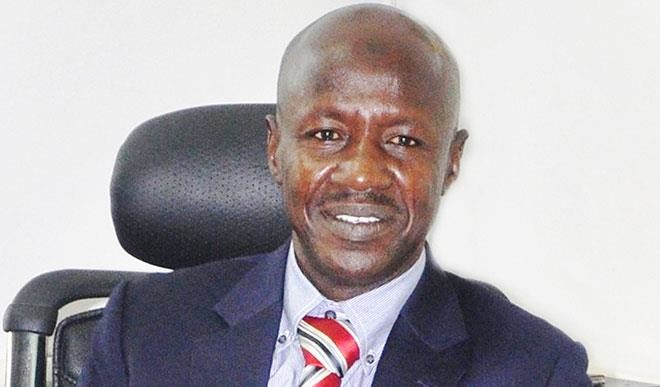
The acting spokesperson of the EFCC, Tony Orilade stated the resolve of the Commision to change the narrative of corruption in the country.
“With the convictions, the EFCC, led by Ibrahim Magu as the acting Chairman, has remained consistent in its concerted efforts aimed at ensuring that the negative narrative of pervasive corruption in the system is changed for the better, and the perception that some persons are above the Law is altered,” he said.
The record of convictions in 2018 cuts across the various offices of the EFCC with Lagos securing 85 convictions, Abuja with 53, followed by Kano with 36. Port Harcourt secured 33 convictions, Gombe recorded 28; Benin had 27; Enugu, 15; Maiduguri, 11; Ibadan, 10; Uyo, 8, and Kaduna, 6.
BUBA Galadima, former National Secretary of the now defunct Congress for Progressive Change (CPC) says there is no basis for people to refer to President Muhammadu Buhari as a person of integrity.
The CPC was one of the parties that came together in a merger to form the now ruling All Progressives Congress (APC) in the run-up to the 2015 general election. It was on the platform of the CPC that Buhari contested and lost the election.
However, Galadima has since left the APC. In fact, he was the one who formedthe Reformed-APC (RAPC), a split that led to the defection of many of the party’s former members to other parties.
Speaking on a Channels Television programme on Wednesday, a clip of which was shared on Twitter, Galadima said Buhari has no integrity because he continues to condone corrupt people around him and has chosen to look the other way as his relatives enrich thems via corrupt ways.
“I can’t see any integrity whatsoever on the side of Mr President. Which integrity?” Galadima queried.
“Somebody who condones corrupt people around him? We know of his relatives, we know of his friends who were bankrupt before 2015. We know of his relatives who take N2000 transport money from us to go to Kaduna, today, they are multibillionaires. They have assets, they have estates all over the world.
“I can show anybody that wants to know.
“So, the issue of integrity with this government is not an issue. Go to Daura GRA (Government Reserved Area), all the houses that are looking like, you go there and you feel like you are in Dubai, or you are in London, or you are in Beirut, are built by whom? To whom do those properties belong?
“So please, I don’t want anybody, any APC man to talk to me about integrity. Please, this should be the last time anybody that is engaging me in a debate will talk about integrity. I will take them to the marketplace.”
Opposition political parties have consistently accused the presidency of carrying out a one-sided anti-corruption campaign. They say the president has deliberately turned a blind eye to several acts of corruption by members of his own party.
An example is the case of the former Secretary to the Government of the Federation, Babachir Lawal, who was found guilty by a panel headed by Vice President Yemi Osinbajo of awarding contracts worth several millions of naira to a company he owns.
It was on the basis of the Osinbajo panel report that Lawal was removed from office, but many had expected the matter to be taken up by the anti-corruption agencies to prosecute the matter to a logical end, and perhaps to serve as a strong deterrence to other top government officials. But this has not happened.
On the contrary, Lawal is currently one of the APC chieftains coordinating Buhari’s re-election campaign.
“BANDITS” have emerged as the new bogeyman for insecurity in Nigeria, joining a long (and still growing list) that includes Boko Haram, cultists, herdsmen, kidnappers and militants. In different parts of the North-West, from Birnin-Gwari in Kaduna to Tsafe in Zamfara, Bandits are offered as the trope for an intolerable carnage and the inexplicable haplessness of a federal government that doesn’t appear to care for much else in an election season. As this lamentable state metastasizes, it may be worthwhile to reflect on banditry in Nigeria.
In different parts of Nigeria, banditry is used to describe different variants of outlawry. In reality, the usage conflates two underlying problems – ineffective law enforcement in Southern Nigeria, and the crisis of ungoverned spaces in Northern Nigeria. Since Independence, successive governments have had to confront variants of these trends. The evidence over time suggests a link between governance, its failures, and banditry.
In This Present Darkness, his history of organized crime in Nigeria, Stephen Ellis traces post-independence banditry in Nigeria to “shortly before the civil war, when government broke down in some parts of the Western Region and there was a blurred line between political violence, crime, and organized insurgency.” At the end of the war, the military regime of Gowon failed to manage demobilization. As demobilized combatants from the war returned home to nothing to do, outlawry became appealing.
In Southern Nigeria, which comprises a mere 29% of Nigeria’s nearly 924,000 km² of landmass, urban banditry ensued. Unsurprisingly, armed robbery in built-up areas of the country was an early manifestation. An early exponent of this was Ishola Oyenusi, a high-school dropout who chose to be called “the Doctor” and terrorized Lagos at the end of the Civil War. In response, the military government introduced mandatory death by firing squad for convicted armed robbers. The first set of public executions took place in front of Bar Beach, in Victoria Island, Lagos on 26 April 1971. Less than four and a half months later, on 8 September 1971, Oyenusi was executed at the same location.
Urban banditry was not confined to southern Nigeria. In April 1970, three armed men robbed a bank in Kano of £27,750.
The pace of public executions quickly escalated. By 1976, over 400 armed robbers had been publicly executed by firing squad. In 1984 alone, under the regime of Major-General Muhammadu Buhari, there were at least 338 such executions. In 12 years between 1984 and 1996, over 1,200 of such executions took place. Around the same time, drug trafficking emerged as a major factor in outlawry in Nigeria.
It appeared that each succeeding decade saw an intensification of urban outlawry in different parts of southern Nigeria. In the 1980s, the poster-boy was Lawrence Anini, another school drop-out who concatenated indiscriminate violence with a touch of the Robin-Hood marinated in advocacy for the downtrodden. Anini’s reign of terror in the then Bendel and surrounding states was facilitated by the complicity of some senior police personnel who helped to provide his gang with intelligence and made evidence against them disappear. When two members of his gang were convicted in mid-1986 following effective police work, Anini turned his guns against the police in an intense rampage of mass killing, during which 10 police officers in Bendel State died between August and October 1986. That would prove to be his undoing. Military President, Ibrahim Babangida, turned up the heat on then Inspector-General of Police, Etim Inyang, famously asking him during a meeting of the then ruling military council in October 1986: “where is Anini”? Two months later, in December 1986, the police arrested Anini and dismantled his gang, which included Monday Osunbor, a Police Superintendent. In March 1987, they were executed.
In the 1990s, Shina Rambo terrorised parts of south-west Nigeria with similar escapades. In south-east Nigeria, the Otokoto case in Owerri, Imo State, in 1996 revealed a netherworld of ritualized human sacrifice. By the 2000s, commercial kidnapping, political violence and assassinations would emerge as dominant forms of outlawry. The best-known exponents included a man known as Osisikankwu (Obioma Nwankwo) in Abia State and resource militants in the Niger Delta. In Abia State and parts of south-east Nigeria, government broke down and security was taken over by a bandit, vigilante horde, known as Bakassi Boys.
Three additional factors collaborated in launching this new phase.
First, public universities became fertile breeding grounds for outlaws. The story of how this came about lies in the history of competition between university-based confraternities. The Pyrates Confraternity, the oldest of these confraternities in Nigeria would be forced to leave the universities about 1986. The Supreme Eiye Confraternity (National Association of Airlords) emerged in Lagos around 1965 as rival to the Pyrates. In Ibadan, the National Association of Sealords, better known as the Buccaneers, followed by 1972. University of Calabar produced the Klansmen Confraternity and in the University of Port Harcourt, the Vikings emerged. The growth of these groups coincided with the emergence of articulate civic activism in the universities led by the National Union of Nigerian Students (NUNS), later known as the National Association of Nigerian Students (NANS). Military rulers co-opted these cults to disrupt official student activism. Competing groups in the politics of university administration also found them useful. In the Niger Delta, Stephen Ellis recalls, they “became a factor in the region’s politics.”
Second, Babangida’s transition to civil rule programme created a mutual support network between politicians, robbers and cults. By 2008, Mujahid Asari Dokubo, asked how the armed youths who traded in violence acquired their weapons, answered the Rivers State Truth and Reconciliation Commission presided over by former Supreme Court Justice, Kayode Eso, that “the guns were purchased with money disbursed by politicians.”
Third, mismanagement of natural resources exploitation in both the North and the South energized the transition from urban to rural banditry. Mismanagement of the economy did the rest. Southern Kaduna, for instance, had always been rich in gemstones, including diamond, sapphire, quartz, ruby, temaline, and aquamarine. In the early-to-mid 1980s, this set off a mad rush of artisanal gemstone rustlers who would invade communities in Jema’a. The rustlers came from as far as Mali, Senegal and Sudan in search of shiny gemstones that the locals called “devil stones”. In 1986, Newswatch Magazine’s Aniete Usen reported “cases of eliminating by kidnapping, sudden disappearance of dealers and diggers and a whole range of other blood-chilling tales. The barons, agents and diggers became fanatically…. fully armed with automatic weapons.” The weapons they brought into Southern Kaduna would feature prominently in the first Kafanchan crisis in 1987. Their methods have been evident in the descent from artisanal mining to organized banditry in Birnin-Gwari and Zamfara three decades later.
In the Niger Delta, the military government of General Abacha introduced guns to quell civic advocacy for resource justice. In 1994, they deployed the Joint (Military) Task Force. Nearly a quarter of a century later, the guns are everywhere and the JTF is mired in an interminable mission.
In a little-noticed release on 21 December, Nigeria’s Defence Minister, Mansur Dan-Ali, a retired one-star General, himself also from Zamfara State, complained: “the issue of (sic) drug abuse, unemployment and governance amongst others contributes to the deplorable security situation in Zamfara State.” The best the current administration has done is the launch in December 2018 of a Presidential Advisory Committee on the Elimination of Drug Abuse. Chaired by retired Brigadier Buba Marwa, its membership also includes the wives of both the President and the Vice-President. This looks more like a token than a policy response.
Quite clearly, successive regimes in Nigeria have in different ways made efforts, mostly futile or counter-productive, to address the different kinds of banditry that they confronted. The difference this time, it seems, is the government of the day appears not to be much bothered by the rising human toll of the descent into an ungoverned country, nor does it care to tell the country why it can’t afford to be bothered.