Home Blog Page 2465

Zamfara Killings and nine other times Buhari talked tough to end violent attacks in 2018

0

PRESIDENT Muhammadu Buhari had on Monday written to condemn the recent attacks on villages in the Birnin Magaji area of Zamfara State, which according to reports left 25 dead and many others injured. In the press statement, Buhari promised “to flush out the bandits from wherever they are” — but it is not the first time the president has talked tough but acted weakly.

“This violence must stop,” said the statement, issued by senior presidential spokesperson Garba Shehu.

“The President … reassured residents of States plagued by armed bandits, including Zamfara, Sokoto, Kaduna, Niger and Taraba, that their safety is an enduring commitment of his administration and he will continue to ensure that security agencies worked round the clock to protect local populations.

“To this end, a major operation by the Nigerian Armed Forces, Police, Department of State Services and the Nigerian Security and Civil Defence Corps, is being considered to restore peace and stability in the region…These measures, among others, will be intensified to flush out the bandits from wherever they are.”


READ ALSO:

Checks reveal that similar statements have been released by the Commander-in-Chief of the Armed Forces through different channels in the past, especially Twitter, yet the spate of violence against harmless civilians does not appear to ebb.

On killings in Zamfara, others: “Perpetrators will face full wrath of law”

Using his personal Twitter handle on Friday, February 16, President Buhari condemned the murder of Nigerians in Zamfara and promised to bring the offenders to book.

He tweeted: “The perpetrators of all of these senseless attacks on innocent and defenceless Nigerians, in all parts of the country, will be made to face the full wrath of the law. May the souls of the dead Rest In Peace.”

He also said he had directed the Minister of Defence to visit the state for an on-the-spot assessment of the situation and expressed condolences to the bereaved families.

Two days earlier, suspected cattle rustlers had attacked Birane villa in Zamfara State’s Zurmi Local Government Area. According to the police, the attack left 18 persons dead.

Premium Times had observed the president’s tweet to be his “quickest so far to frequent cases of mass killings that have dogged his administration for months.”

On attacks in Benue: “We are doing everything to end them”

On March 12, during his visit to Makurdi, Benue State, in the heat of clashes between farmers and herdsmen, Buhari said the level of insecurity experienced in certain states was a concern to his administration, vowing to put an end to it “very soon”.

“I cannot overlook the killings in Benue or any other part of Nigeria. I cannot do that. I am genuinely worried about the attacks in Benue and we are doing everything to end them,” he said.

The president had also confessed to not knowing the Inspect-General of Police, Ibrahim Idris, did not obey his order to relocate to Benue until the crisis stopped — in spite of earlier media reports.

On farmers-herdsmen clashes: “Culprit will face the full wrath of law”

While delivering the customary democracy day speech on May 29, one of the key things the president mentioned was his government’s commitment in addressing “the unfortunate incidences of kidnappings, herdsmen and farmers clashes in several communities which have led to higher number of fatalities and loss of properties across the country”.

He also assured Nigerians that “the identified culprits and their sponsors shall be made to face the full wrath of the law” and that all tiers of government are engaging with the affected communities and religious bodies to ensure that peace is restored.

On Plateau Killings: “We won’t rest until murderers are incapacitated”

After reportedly over a hundred people lost their lives to suspected herdsmen attacks in Plateau State on Saturday, June 23, President Buhari took to Twitter the following day to appeal for calm, assuring that the perpetrators would be brought to book.

“The grievous loss of lives & property arising from the killings in Plateau today is painful and regrettable. My deepest condolences to the affected communities. We will not rest until all murderers and criminal elements and their sponsors are incapacitated and brought to justice,” read one of the tweets.

On Boko Haram attacks: “We will not allow them to succeed”

Delivering his speech to commemorate the 58th anniversary of the country’s independence from British rule on October 1, President Buhari said the government’s prayers are with the victims of Boko Haram attacks.

“We will not allow them to succeed,” he said.

“As their Commander-in-Chief, I assure these our gallant men and women [members of the armed forces] that I will continue to empower them by deepening their professionalism and providing all the necessary force multipliers and enablers required for them to prevail on the field,” he continued.

“I am looking into all reported cases of inadequacies in relation to their entitlements, their welfare and those of their families.”

On killing of Hauwa Liman: “We will protect all residents of the North East”

Following the murder of Hauwa Liman, a humanitarian worker of the International Committee of the Red Cross (ICRC), on Monday, October 15, President Buhari took to his Twitter account to assure the world that the federal government tries its best to save her life, describing the incident as tragic and regrettable.

He also appealed to the ICRC to continue to provide services in Nigeria despite the series of executions affecting their members.

Finally, he said: “I am reassuring everyone that the Fed Govt will continue to do all within our power to protect not just humanitarian workers, but also everyone working or living in the North East. I salute our military, who continue to fight and strive hard to permanently neutralize Boko Haram.”

On Boko Haram attacks: “We will destroy them.”

While hosting entertainers from Kannywood at the statehouse on Thursday, October 18, the president, speaking in Hausa, said no group will be allowed to terrorise innocent people under the guise of religion.

“You cannot be shouting Allahu Akbar (Allah is Great), Allahu Akbar, and be killing innocent citizens and destroying properties all in the name of God,” he lectured.

“It is either you don’t know what you are saying or you don’t even believe in the existence of God Almighty. God has nothing to do with injustice.”

He also said the federal government is now confronting them “and by the grace of God we will destroy them.”

On violence in Kaduna: “They will not go scot-free”

While on official visit to Kaduna State on October 30, President Buhari said his government will make moves to ensure those who fuelled and orchestrated the recent violent attacks in Kasuwan Magani will be prosecuted.

“If in the past, they got away scot-free, we shall now hold everyone to account for these latest killings,” he said at the Musa Yar’Adua Sports Complex during a meeting with stakeholders.

“It is unacceptable that criminal elements can visit on citizens the wanton killings recorded in the Kasuwan Magani incident of 18th October 2018 and the unrest around Kaduna metropolis a few days later. This must stop,” he added.

On Matele attack on soldiers: “No responsible commander-in-chief would fold his hands”

Following the November 18 terrorist attack on the 157 Task Force Battalion in Matele, Borno State, by Boko Haram members, where 118 soldiers were reported killed and numerous others missing, President Buhari released a statement six days after to express shock over the incident, “assuring at the same time that immediate measures are being taken to ensure that loopholes which led to the fatalities are blocked once and for all.”

“No responsible Commander-in-Chief would rest on his oars or fold his hands to allow terrorists to endanger the lives of its military personnel and other citizens,” the statement quoted Buhari as saying.

“There is nothing I can do”: Buhari resorts to prayers

Apart from the characteristic tone of the president’s statements during or after attacks againt Nigerians was a remark credited to him during his June visit to Plateau State over recent killings in various communities within Barkin-Ladi and Riyom Local Government Areas.

“There is nothing I can do to help the situation except to pray to God to help us out of the security challenges. What has happened is a very bad thing. The bottomline is that justice must be allowed to take its course,” he is reported to have said.

“Fulani herdsmen are used to carrying sticks during grazing but the herders of these days carry AK 47. Anybody caught with weapon should be arrested.”

Amnesty International (AI), a non-governmental organization focused on addressing human rights violations, has repeatedly accused the federal government of doing too little to address the country’s insecurity challenges. It recently noted that 2,082 deaths occurred in 2018 alone as a result of clashes between farmers and herders compared to 814 recorded in 2016, and 745 in 2017.

During its launch of a report on the clashes in Abuja, Amnesty International said “the Nigerian government has displayed what can only be described as gross incompetence and has failed in its duty to protect the lives of its population and end the intensifying conflict between herders and farmers.”

Seun Bakare, the organisation’s Programmes Manager in Nigeria, also urged the government to end impunity because “the only reason why these attacks have continued is because people become bolder and bolder by the day when they are not held accountable for rights violations”.
Employees’ compensation scheme: Did Olejeme rob Nigerian workers?

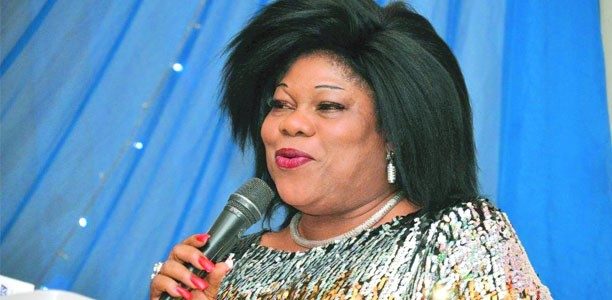
THE  former Chairman of Board of Nigerian Social Insurance Trust Fund (NSITF), Ngozi Olejeme is in the eye of the storm.

She is alleged to have betrayed the trust she swore to uphold, diverting funds from the employees’ compensation scheme.

Olejeme, who was also the Deputy Chairman, Finance Committee of the Goodluck Jonathan Campaign Organisation in the 2015 presidential election is wanted in a case of criminal conspiracy, abuse of office, diversion of public funds and money laundering.

It was Olejeme who was appointed chairman of NSITF board, in June 2009 by late President Umaru Musa Yar’Adua, that facilitated the successful enactment into law of the Employees’ Compensation Act in December 2010, and the setting up of necessary human and physical infrastructure for the implementation of the Act, which was signed by former President Goodluck Jonathan.

Olejeme is also the widow of late Felix Obuah, a former Chief Security Officer to Jonathan, and was said to have fled the country shortly after her sacking by President Muhammadu Buhari in 2015.

She was the convener of the Subsidy Reinvestment and Empowerment Programme sub-committee on Public Works and Road Rehabilitation.

About Employees Compensation Act 2010

As found on the official website of NSITF, the Employees Compensation Act was passed into Law in December 2010 by the assent of former President Goodluck Jonathan, to give statutory backing to the mandate given by section 71(2) of the Pension Reform Act (PRA) to NSITF for the provision of Social Security Insurance Services by operating the ECS.

The transition between the NSITF Scheme and the commencement of the Employees Compensation Scheme in 2011 was a period that was devoted to mainly strategizing and ensuring that the Employees Compensation Scheme became a reality.

The objectives of the Act are:  To provide for an open and fair system of guaranteed and adequate compensation for all employees or their dependents for any death, injury, disease or disability arising out of or in the course of employment;  to provide rehabilitation to employees with work disability as much as possible; to establish and maintain a solvent compensation fund managed in the interest of employees and employers; to provide for fair and adequate assessments for employers; to provide an appeal procedure that is simple, fair and accessible, with minimal delays; and  to combine efforts and resources of relevant stakeholders for the prevention of workplace disabilities, including the enforcement of occupational safety and health standard.

The funding of the scheme is based on 1 per cent of the payroll of employees remitted to the Fund.

In addition, the Fund, under Section 71 of the Pension Reform Act, 2004, is to provide “every contributing citizen Social Security Insurance Services other than Pension in accordance with the NSITF Act, 1993”. The Fund has commenced the process of putting in place the necessary infrastructure to implement Social Security Benefit to the aged, unemployed, child welfare and the physically challenged.

To this end, a bill for an amendment to the provisions of the NSITF Act to provide basic social security services to all Nigerians is before the National Assembly for passage into law.

EFCC findings that indicted Olejeme

Six months after it was signed into law, the scheme took off on July 1, 2011. By that, all employers of labour were mandated by the law to contribute one per cent of staff total monthly pay into a pool of fund designed for the scheme. Consequently, funds started flowing into NSITF account as a contribution from the Federal Government and private sector employers of labour including take-off grant from the Federal Government.

However, after the dissolution of the board by President Muhammadu Buhari, the Economic and Financial Crimes Commission (EFCC) found out that there have been several diversions of funds from the account of NSITF.

In a preliminary report, the Commission in December 2017, said: “It was discovered that the NSITF accounts in First Bank of Nigeria and other banks have witnessed a total turnover of over N62, 358,401,927 between 2012 and 2015 from the Employee Compensation Scheme contributions.”

It revealed that out of the N62billion, the Federal Government contributed N13,600,000,000 while the sum of N48,758,401,927.80 was contributed by the private sector. That there were several payments to individuals and companies from the NSITF bank accounts for purported contracts or consultancy services.

Also, the report said that some individuals and companies that received these payments, in turn, transferred part of the monies directly to the NSITF officials while others transferred huge sums to bureau de change operators who changed them to dollars.

Of N62.3billion fraud discovered in NSITF, $48,485,127 was allegedly credited to Olejeme.

The EFCC’s report on preliminary investigation further revealed, “That through this process, Dr. Ngozi Olejeme, the then NSITF board chairman, has collected a total sum of $48,485,127 from Mr. Chuka Eze (her account officer at FBN), which cash he collected on her behalf being the dollar equivalent of monies paid to BDCs by NSITF contractors.

The money was said to be the Federal Government’s contribution to the take-off grants and Employees Compensation Scheme (ECS) for Ministries Departments and Agencies (MDAs).

More discoveries by EFCC

Exactly one year ago, the EFCC traced 38 houses allegedly belonging to Ngozi Olejeme. Then, the Commission said it had obtained an interim forfeiture order from the court to seize the properties until the conclusion of the case against her.  It also secured a warrant authorising her detention for two weeks for further interrogation.

This, the Commission explained, would allow it to complete the first round of the investigation and her arraignment.

But Olejeme reportedly took ill and was admitted to a private hospital in Abuja, where she’s being watched by EFCC operatives.

In a report the anti-graft agency said it recovered over 40 properties, out of which 38 belong to the ex-NSITF chairman, including the property at No. 51, Kainji Crescent, off Lake Chad Crescent in Maitama District.

However, the Commission also arraigned Umar Munir Abubakar, a former Managing Director of NSITF, and four others for alleged diversion of N18billion.

The others were Henry Ekhasomi Sambo, Adebayo Adebowale Aderibigbe, Richard U. Uche and Aderemi Adegboyega.

“She and others also diverted huge cash allocated for allowances of its staff and compensation to contributors. Detectives actually traced some of the NSITF funds in the personal accounts of Olejeme and the former MD, Umar Abubakar.

“For instance, Abubakar and others dishonestly converted to N18billion, being a contribution from the Federal Government of Nigeria as take-off grants and Employees Compensation Scheme (ECS) for MDAs.

“The said sum was diverted into personal accounts by an e-payment mandate jointly signed by Umar Munir Abubakar and Henry Ekhasomi Sambo,” EFCC said.

EFCC frozen 30 accounts, seized 27 assets of Olejeme

In March 2018, the EFCC  said it has frozen 30 accounts and seized 37 assets allegedly belonging to the Ngozi Olejeme. The report was carried by the Nation newspaper.

In the report, the agency listed the properties and their addresses.  It stressed that The ex-NSITF, who was grilled in January, is still placed on administrative bail with a responsibility to report fortnightly for interaction.

But it added that Olejeme was yet to admit that she committed any fraud while in office.

She insisted that she was innocent of all the allegations against her in spite of the fact that her Account Officer, Chuka Eze has spilled the bean.

The assets and their locations

Plot R/151(No. 30A) Kingsway Road, Old GRA, Enugu. Registered at Enugu Land Registry as No. 5 Page 5 in Volume 1659
Parcel of land measuring 4833.241 Sq. Metres located at Uberi Bush along Mbiama Road, Yenagoa, Bayelsa State
Parcel of land located at Igbanadan Bush, Emeya 2 Town Ogbia LGA in Bayelsa State.
Properties located at 196, Melford Okilo Road, Amarata-Epie, Yenagoa, Bayelsa State
Properties located at No. 25, Kainji Crescent, Off Lake Chad Crescent, Maitama , Abuja.
Property located at Plot No. 933 Cadastral Zone B01, Gudu District, Abuja
All that piece/parcel of land with C of O No. DSTR 1227 and the properties therein also known Umuezeafada family land located at KM 9, Asaba-Benin Express Road, Asaba, Delta State.
Plot 124 Cadastral Zone A02 Wuse Known as No. 30, Tunis Street, Off Lusaka Street, Wuse Zone 6, Abuja
Plot 3115 Cadastral Zone A04 Asokoro, Abuja.
Plot 2271 Cadastral Zone E12 Orozo, Abuja.
All that piece of land with C of O No. DTSR638 and the properties therein also known as Plot 101, Phase 1, Block 1 Core Area, Asaba Delta State
All that piece /parcel of land also known as Plot 1c, 3 and 4 Phase IV, Block 111 Core Area, Asaba, Delta State with C of O No. DTSR 1194.
No. 20 DBS Road, Asaba, Delta State
House/Flat 86, 11 Crescent, Kado Estate, Abuja
All that Piece/parcel of land and properties therein located at Ogbe Onishe Village in Umagwu Quarters, Asaba, Oshimili South LGA of Delta State also known as Luxury Suites and Resort Hotel, located off Nnebisi Road, Asaba
Properties located at No. 204 Nnebisi Road, Asaba beside STANBIC IBTC Bank
All that piece or parcel of land and properties thereof located at Elibujor Layout, Opp DLA office, Asaba Oshimili South LGA of Delta State. NSITF office located at Asaba Benin Expressway by Nuel Ojay Junction, Asaba.
Plot Nos 29 and 31 of Umonyia Ejedeofor Family Layout Ibusa Road located along Benin-Asaba Expressway, Asaba, Delta State
All that piece/parcel of land with C of O No. DSTR 16326 and the properties therein also known as Plots 104 and 105, Block IV, Phase V, Core Area, Asaba, Delta
All that piece/parcel of land with C of O, No. DSTR 55853 and the properties therein also known as Plot 34. Phase 111, Block IV, Core Area. Asaba, Delta State
Properties located at No. 17, Ebenuwa Street, Off Nnebisi Road, Asaba, Delta State
No. 3D Opolo, Old Commissioners Quarters, Yenagoa, Bayelsa State
All that piece/parcel of land also known as plots 7,8,11,12,15,16,19, 20,23, and 24 Phase IV, Block 111, Core Area, Asaba, Delta State with C of O No. DSTTR1194
All that piece/parcel of land with C of O No. DSTR15303 and the properties therein also known as Plot No. 16 Central Spine Phase IV, Asaba, Oshimili South LGA of Delta State
All that piece/parcel of land with C of O No. DSTR 16325 and the properties therein also known as Plots 109 and 110, Block IV, Phase V, Core Arae, Asaba Delta State
All that piece/parcel of land with C of O No. DSTR 13807 and the properties therein measuring 80.532 hectares in Aboha-Ogwashi-Uku(Layout) at Aniocha LGA. Delta State.
All that piece/parcel of land with C of O No. DSTR 15046 and the properties therein also known as Plots 96, 97, and 98 Layout Survey of Block 1, Bridge-Head, Asaba, Oshimili South LGA of Delta State measuring 6.684 hectares
All that piece/parcel of land and the properties therein located at No. 42 Lawrence Road Akintola via Okpe Road, Sapele, Delta State measuring 1274.95 Square Meters and registered at Land Registry Asaba as No. 8 at page in Vol at 8
All that piece/parcel of land and the properties therein located at Orugbe Bush, Emeyal 11 Town Ogbia LGA, Bayelsa measuring 3, 625.493 Square Metres.
All that piece/parcel of land and the properties therein located at No 6 Sir C.A. Aghara Drive off Okpanam Road by NNPC Filling Station, Asaba, Delta State
All that piece/parcel of land and the properties therein located at Oduke, Off Uche Nwembu Road, off Asaba-Benin Expressway, Asaba Delta State.
All that piece/parcel of land and the properties therein located at No. 3, Ogwa Godspower Avenue, Oshimili LGA, Asaba, Delta State.
All that piece/parcel of land and the properties therein located No. 11 Chiweta Street, off Ezenie Avenue, Asaba, Delta State.
All that piece/parcel of land and the properties therein located at James Odeta Street, Oshimili South LGA, Asaba, Delta State.
All that piece/parcel of land and the properties therein located at No. 8, Thomas Chukwunike Street, Oshimili South LGA, Asaba, Delta State.
All that piece/parcel of land and the properties therein located at No. 11 Mokolo Close, Off Summit Road, therein located at No. 8, Thomas Chukwunike Street, Oshimili
All that piece/parcel of land and the properties therein located at No. 11, Okadigbo Street, off Nebisi Road, Asaba, Delta State.

Closing-in on Olejeme, EFCC seizes  46 houses from Jonathan’s ally

The Commission’s investigation reached another crescendo into the alleged N62billion fraud against Olejeme when a  Federal High Court in Abuja ordered the temporary forfeiture of 46 properties allegedly belonging to her. She reported at the EFCC on Monday after which she was detained.

The properties in addition to those that were listed in March 2018 were said to be in several locations in Abuja, Delta, Enugu and Bayelsa states.

The properties comprise 27 buildings, including a bank, office buildings and houses, at various stages of development and several pieces of undeveloped land.

They also include a twin duplex office building – Plot R/151 (No. 30A) Kingsway Road, Old GRA, Enugu State – a parcel of land measuring 4833.241 sq. metres located at Uberi Bush along Mbiama Road, Akenta, Yenegoa, Bayelsa State; and a parcel of land located at Igbandaden Bush, Emeya 2 Town, Ogbia LGA, Bayelsa

Others include properties located at 196, Melford Okilo Road, Amarata-Epie, Yenegoa, Bayelsa State (six units of one bedroom apartments, one unit of five bedroom bungalows, a block of six units of office space); a mansion at 24 Kainji Crescent, Maitama, Abuja and a bank building (former Intercontinental Bank) located at Plot No. 933 Cadastral Zone B01, Gudu District, Abuja

Olejeme was appointed as a director on the board of Ajaokuta Steel Company Limited by President Olusegun Obasanjo, and was later appointed the chairman of the board of NSITF) in June 2009 by late President Umar Yaradua.  She was also the Chairman of the Board of Trustfund Pensions Plc, and the convener of SURE-P sub-committee on Public Works and Road Rehabilitation during the administration of President Jonathan. She was also a board member of Sheraton Hotel and Towers.

She contested in the 2007 PDP gubernatorial primary election in Delta State.


Investigation: Free feeding fraud in Benue, Taraba, Plateau schools

By  Terkula Igidi  

A PLATE and spoon in hand, five-year-old Lember Iorhemen stood by  the door of the next class, salivating over a plate of palm oil-garnished spaghetti in front of the pupils of Primary 2 at NKST Primary School, Akile, Benue State

She was one of many pupils who may not get their rations for the day. The bright July morning sun was scorching their innocent faces, even as they,  in Tiv language, chorused for  food: “Give us food; we are hungry.”

It was the time of the year when folks in the rural areas struggle to feed because mid-season crops were not yet ready for harvest.

Not fewer than 303 schools are excluded from the free meals scheme in Benue State

Little Iember was one of the few pupils who were enrolled in school when the Federal Government in collaboration with the state government started the Home Grown School Feeding programme.  The programme captured about 8.5 million pupils in 24 states of the federation with over 90,670 catering staff engaged, according to the government record at the time of this investigation

The programme, which was conceived to improve nutrition, encourage enrollment of pupils as well as grow smallholder farmers’ economy, among other objectives, has failed to achieve most of these. In almost all the schools our reporter visited, the food served the school kids did not look nutritious and some children looked malnourished.

Despite spending N49 billion on the free meals in two years, not many school pupils are frequently fed, even when they are fed, the quality of the food is poor. Data collected from three states of Benue, Taraba and Plateau showed the existence of ghost schools on the scheme and underpayment of cooks. In most cases, the cooks also play truancy. But where the feeding has been taking place, enrollment has increased. The Federal Government has put the increase at 30 per cent.

Not fewer than 303 schools are excluded from the free meals scheme in Benue State. The state has 2,755 schools but only 2,452 are currently benefitting from the free meals.

At NKST Primary School, Akile, the free meals were served six months after the programme was flagged off in Benue in June 2017.

The school is about 16 kilometres away from Makurdi, the state capital, but there is a world of difference between what happens in schools in the capital and what obtains in this suburban school.

While St. Catherine’s Primary School, High-Level Makurdi, has 10 vendors cooking for 380 pupils from Primary One to Six, there are just three vendors cooking for 240 pupils in Primary One – Three at Akile.   The vendor feeding Primary Three at St Catherine has 36 pupils in her class but on the official list, there are 91. The reverse is the case at Akile, where the vendor feeding Primary Two feeds about 100 pupils but she is being paid to feed 63 pupils.

A teacher at NKST Primary School, Akile, who preferred anonymity for fear of being victimized, said the vendor who cooks for Primary One at Akile plays truancy.

“She doesn’t come every day. She comes whenever she feels like and even when she does come, the food hardly goes around. Sometimes the headmaster has to come and ration the food himself so that it can go round the pupils. When that happens, the pupils get small rations,” she said.

She said the pupils come with plates from home and the food is tasteless. “If it is rice, the vendors only put salt, palm oil and seasoning on the food and there is no meat or fish,” she added.

She also said the pupils don’t often get juice and biscuits which are supposed to be served every Friday. “When they do get, it is either a child gets biscuits or juice but not both.”

Mchivir Yandoo, a 5-year-old Primary One pupil at NKST Akile, told our reporter that she looks forward to eating the food but that it was not served every day. “The ration is also small and the food is not sweet,” she said.

However, the headmaster of St. Catherine’s Primary School, Mr. Moses Aondoakaa, spoke well of the programme. He said, “As far as my school is concerned, the programme is a success. It has increased enrollment and attendance; it motivates the pupils and has enhanced learning. The little challenge is that there are breakages in the feeding process, sometimes they stop for two weeks before they resume. It should be continuous.” He said enrollment has increased by 2.2 per cent; from 370 pupils to 380 in one year.

Our reporter learnt that vendors are engaged on the basis of political affiliation and patronage.  A source who preferred to be anonymous said most of the vendors are highly connected and they are ‘important people’ who did not want to go to rural schools.

But the focal person of the Social Investment Programme in the state, Dr Terries Damsa, denied the allegations, saying the programme was insulated from political influence in the state. He also explained that during mappings for the programme, figures of pupils obtained from the benefiting schools were given by the schools’ authorities randomly, which was why there were inconsistencies with the number of pupils in class and those on the feeding list.

He also explained that N39.00 is deducted out of the N70.00 per child per day, for the juice and biscuits and paid to the contractor who supplies the biscuits and juice.  Why the pupils do not get up to the value of the money deducted, was something the office did not explain.

Further investigations revealed that there are at least three ghost schools benefitting from the programme in Benue State. A source privy to the operations of the school feeding programme showed our reporter the distribution list for food items of Vandeikya Local Government in which there were three ghost schools.

The list indicated that NKST Primary School Abanyi has 80 pupils with Philomena Akawe as the food vendor; LGEA Primary School Maduen has 77 pupils with Mgunengen Maduen as the vendor, while LGEA Primary School Adamu is allocated 72 pupils with Tyozenda Teryila as the vendor. Our reporter who was in the local government could not trace the schools and residents said the schools were not physically on the ground.

The programme, having been run in the state for up to a year as at the time our reporter made the investigations, it, therefore, means that the school feeding took place for nine months, minus three months of vacations, then N2, 885, 400 (Two million, eight hundred and eighty-five thousand, four hundred naira) would have been spent on the ghost pupils.

Number eight on the list is a ghost school.


Again, Damsa denied knowledge of the ghost schools but promised he would root them out once he found out they existed.

Many vendors across the state, who spoke to our reporter in confidence, said they were being short-changed. A vendor who

was enlisted into the programme by her son’s godfather, an aide to the governor, regrets accepting to participate in the programme. She said she was at home when the governor’s aide brought the vending form for her to fill.

“I applied in December 2017 and I was engaged in May 2018 to cook at RCM Mishi, Ikpayongo, Gwer LG. I was paid N45,000 to cook for 65 pupils for 20 school days,’ she said.

If the threshold of N70.00 per child per day is used, then the woman was supposed to get N91,000 for the 20 days and not N45,000. But if money was being deducted for biscuits and juice, N39.00 for every N70.00, it would be N10,140 for the four Fridays that are in a month and there would be a shortfall of N35,860. The vendor said she had always been in the dark about the deductions and had not summoned the courage to ask. Several other vendors made similar allegations.

When Dr Damsa was asked to account for the shortfall in the vendors’ payment in August, he said he was recently appointed and was trying to clean up the mess left behind by his predecessor.

At LGEA Primary School, Ashinya, Vandeikya, the feeding took place very well, according to the head teacher of the school, Mrs Christiana Chia. She said enrollment has increased up to 17 per cent since the free feeding started. The school now has 132 pupils as against the 110 it had before the programme started. She, however, said all the vendors were not from the community and that made it difficult for them to be consistent.

The Parent Teachers Association (PTA) chairman of the school, Mr. Ityoakaa Akosu, said the programme has increased enrollment which has put pressure on the school infrastructure and made learning difficult.

“Instead of feeding the pupils, the government should have improved teacher quality, infrastructure and provided teaching materials. These are more important to the education of a child than a free meal in a day,” he said.

Taraba ghost schools

Our investigations also uncovered three ghost schools on the programme in Takum Local Government of Taraba State.

A crumbling mud house with battered rooftop was where Universal Basic Education Authority Primary School, Kanshio, was situated about four years ago. But now, the rainstorm ravaged school in Chanchanji ward of the local government has been turned into a worship centre.

When our reporter visited the place in August, he saw benches and drums in the decrepit building and was told by locals that the school closed down since 2014.

Number 62 on the list is a ghost school.

“As from 2014, teachers stopped coming to the school so pupils too stopped attending. Parents were forced to take their children to Peva and Sati. By 2016, rainstorm destroyed the building which was donated by the community for the establishment of the school. When it was abandoned for some time, the people decided to convert it to a church,” Mlumun Tyosaregh Damsa, a villager said.

Findings revealed that the wife of the chairman of the local government, Christy Shiban, is a food vendor at the school and she supposedly feeds 61 pupils.

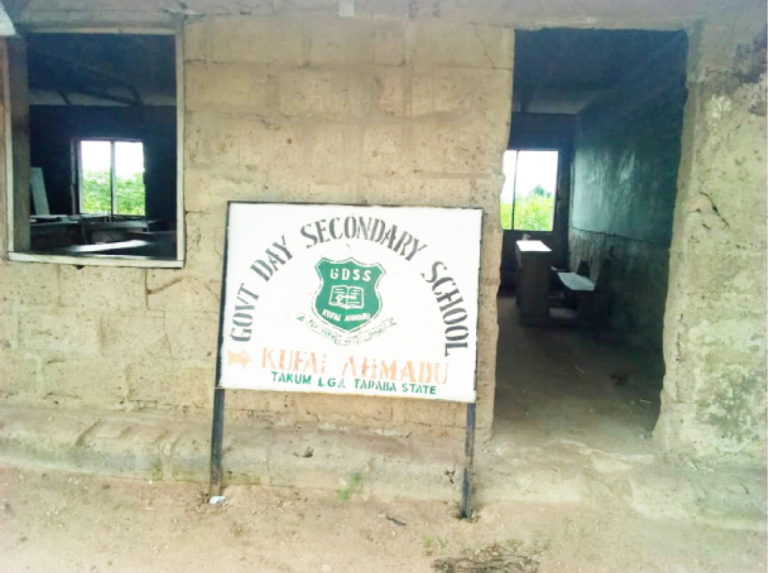
At UBEA Nukpoba, our reporter learnt that since Government Day Secondary School Kufai, Amadu, opened in 2007, the primary school ceased to exist.

Mr. Joshua Ulantyo, who finished from the primary school in 1994, said no child had gone to school there since September 2007.

‘There are no pupils, no teachers there, so who will the vendors serve? We know that the school exists on paper but it had ceased to exist in reality since 2007,” he said.

Another resident of the area, Patrick Kiva Ahmadu, collaborated what Ulantyo said, insisting that the school had ceased to exist.

A source at the desk office of the school feeding programme in Takum confided in our reporter that there is a similar situation at UBEA Gidan Ukwe. According to the source, the school does not exist but it is on the list of schools benefitting from the programme.

He lamented that while cooks were posted to ghost schools, real schools did not have cooks. Our reporter gathered that pupils at UBEA Primary Schools Kav,  Aleva, Fio and Kpenfu, all in Takum Local Government, were not being fed because there were no vendors to cook for the pupils.

Besides, 9.4 per cent, 154 schools are not covered by the programme. The state has a total of 1,631 public primary schools but only 1,477 are being served free meals.

At Salisu Dogo Primary School Jalingo, pupils in Primary One to Three were being fed. A vendor who cooks for primary one said she had been doing it for the past year.

Stella Lukong said she feeds 63 pupils and she is paid N80,000 to do so for 20 days. She is, however, unaware that she was supposed to get N88,200 for feeding 63 pupils.

When contacted, the Focal Person for the Social Investment Office in Taraba State, Ms Beatrice Kitchener, asked the Secretary of the Programme, Idris Goje, to forward a letter the acting education secretary of Takum Local Government wrote to them to our reporter

In the letter, dated October 31, 2018, the acting secretary explained that vendors who were posted to the ghost schools had been transferred to other primary schools because of herdsmen crisis in the area.

The office did not deny the existence of the ghost schools.

Response from Taraba’s Office of Education Secretary

Plateau State pupils underfed

The programme has suffered setbacks in Plateau State and many pupils are not fed, especially in Jos. The free meals for pupils are not served in many schools since the programme took off in June of 2017, even where it started, investigations have revealed it was not sustained beyond one month or one term. Only 57.9 per cent, 1,402 out the 2,420 schools in the state are served food. In 1,018 schools (42.1 per cent of public primary schools in Plateau), pupils do not know how the free meals taste.

When our reporter visited Olusegun Obasanjo Model Nursery and Primary School Hwolshe, teachers there said they were not even aware that the programme was being run in the state. They declined making further comments saying it was only the head teacher who could speak to the press. But the head teacher was not available for comments.

At a nearby school, Obasanjo UBE Primary School (B), the headmaster, who preferred to be called Mr. Adams, said only 140 pupils out of 629 pupils were fed in July of 2017 when the programme came on board.

“When the programme started, the two vendors assigned to my school were to feed 70 pupils each and they did that for one month in the third term of 2016/2017 session. Since then, the vendors have not been coming again and I gathered that they were disengaged while the school was on holiday.

“The programme is provocative because they are not feeding all the children and those that do not get the food hate the teachers, they feel it is the teachers that are responsible for them not eating the food,” he said.

He also said the vendors were from Kuru so serving the food at Hwolshe was quite a difficult task, as most of the days they came late.

When our reporter spoke with two of the cooks, they said they both fed the pupils for only one month.

Kaneng John Pwajok said she started cooking for 70 pupils on July 4, 2017 but was disengaged from the programme when school vacated on July 28, 2018.

Martina Gyang Ngyem on her part said she started serving at the school on July 5, 2017 but when school resumed in September, she was not paid and when she made inquiries, she was asked to wait and she had been waiting for one year now.

Our reporter learnt that the programme was not faring any better in rural schools in the state. At Pilot Science School, Shiwer, Kanke, vendors served food for just two weeks in the third term of 2017/2018 session.

The headmaster of the school, who preferred to remain anonymous, said the cooks were far from the school, which made it difficult for them to be regular. The cooks who spoke with our reporter said they were not paid regularly and they cooked only when they were paid.

Dr Fadimatu Hamza Sumaye, the Focal Person Plateau State Social Investment programme said the school feeding has fared very well in the state.

“We have started and engaged some cooks who are feeding pupils in Primary 1, 2 and 3. Besides that, it has impacted on the cooks and also the school system. Some of the cooks have shared their personal stories with us. It has impacted on their economic status, some have reinvested as a result of the little gains they make,” she said.

She, however, said since the programme took off last year around June-July it had hitches in some places because of Biometric Verification Number mismatch.

“You know, the issue of school feeding is that in a school if you have eight vendors, you find out that only two have valid BVN numbers and they will be the ones feeding the pupils. So the school will be feeding but not all the pupils will be fed. That is the situation we find ourselves in.

“We have a serious challenge of BVN and valid account numbers. These are rural women and they don’t know the implication of borrowing account numbers.  When their names were sent with their account numbers to National Inter-banks Settlement System (NIBSS), there was BVN mismatch and so only 2,006 cooks have been paid stipends,” she explained.

This investigation is supported by the John D. and Catherine T. MacArthur Foundation and the International Centre for Investigative Reporting, ICIR.

Staff accuse NILS boss, Ladi Hamalai, of severally violating Code of Conduct Act

0

‘CONCERNED staff’ of the National Institute for Legislative and Democratic Studies (NILS), in a letter sent to The ICIR, have alleged that the Director-General, Ladi Hamalai, is contravening the Code of Conduct for public officers by accepting two full-time jobs concurrently.

The workers, who said they had to speak after having exhausted all internal mechanisms to seek resolution, pleaded to keep their identities anonymous “to prevent any negative reprisals”. The DG, they said, “has a track record of punishing former staff of the institute who dared to report her for violations of federal civil service rules” — citing the example of Kanayo Oguijiba.

They pleaded that the Code of Conduct Bureau investigates the allegation that Hamalai has accepted two full-time jobs without resigning her current job.

“In the year 2017 and 2018 respectively, Mrs. Ladi Hamalai was appointed as a professor of political science by both the Nasarawa State University and the University of Benin respectively,” they wrote.

“She has continued to hold these two positions without resigning her position as the Director-General, a position that she has held since the year 2011.”

Meanwhile, section 6 of the 1991 Code of Conduct Bureau and Tribunal Act provides that a public officer shall not “receive or be paid the emoluments of any public office at the same time as he receives or is paid the emoluments of any other public office”.

The section’s second paragraph prohibits, for public officers employed on a full-time basis, the participation in the management of any private business, profession or trade outside farming.

The ICIR has not been able to independently verify the claim as student sources in the departments in both schools are not familiar with the recent employment of Hamalai. It is however known that NILS is accredited by the National Universities Commission to run a post-graduate programme in affiliation with the University of Benin.

This covers Master’s Degrees and Postgraduate Diplomas in Legislative Drafting, Legislative Studies and Parliamentary Administration. Findings show that Hamalai is a faculty member for this programme and also serves as a project supervisor.

The NILS staff members also alleged “the use of public funds and federal government vehicles to convey persons from Abuja to Mubi in Adamawa State to attend the coronation ceremony of the Ladi Hamalai” the previous weekend.

As reported and celebrated on the NILS website in August, she was bestowed with the title of Jakadiya Mubi by the Emir of Mubi, Alhaji Abubakar Isa Ahmadu “in recognition of her contribution to the Mubi community, Adamawa State”.

The Jakadiya is a traditional title of inheritance given to females of a lineage in Adamawa. The person on whom it is bestowed is symbolically a leader of female servants as she is entitled to see the king anytime and is an intermediate between him and his wives. She is an integral part in the royal household and palace community, and her influence in the household has political significance.

Sources who spoke to The ICIR, including a chieftain of Gumel emirate in Jigawa, explained that, though the relevance of the Jakadiya has dwindled over time, it is still regarded as a chieftaincy title and most kings in Northern Nigeria have someone occupying the role.

The conferment of this title on the NILS DG appears to contradict a circular, with reference number HCSF/062/S.I/V/1/7, issued by Bukar Goni Aji, former Head of the Civil Service of the Federation.

“It has come to the attention of the Office of the Head of the Civil Service of the Federation that some Civil Servants are in the practice of soliciting chieftaincy titles and other sundry neutrality which are core values of the Civil Service,” the circular, issued on June 20, 2013, states.

“Accordingly, serving officers are hereby banned from accepting chieftaincy titles until after retirement from service. This is to stem the observed abuse in the award of these titles and shield the civil servants from unnecessary distraction from our core responsibilities.

“However, where a civil servant must hold a traditional title bestowed on him/her by inheritance or receive any award, due clearance must be obtained from the Secretary to the Government of the Federation through the Office of the Head of the Civil Service of the Federation (OHCSF). This circular takes immediate effect.”

It is not clear if Hamalai obtained clearance from the Office of the Head of Civil Service as stipulated. Calls placed to the office were not answered and texts sent on Thursday, December 13, have not been replied. When The ICIR contacted Lawrence Ojabo, (former) Press Director of the OSGF, he explained that he is retired from service and does not know about the required information.

Another similar issue of concern raised by the workers is that Hamalai accepted to be inducted as a fellow of the Institute of Directors (IoD) of Nigeria. This, they said, has possibly violated federal civil service code and regulations — specifically a circular issued on April 6, 1998, with reference number 58358/S.5/C.1/32.

Signed by then Secretary to the Government of the Federation, Gidado Idris, the circular reads: “The government has observed with concern that the time honoured practice of honouring deserving persons with honourary degrees, diplomas, fellowships, etc. is being abused.”

It adds: “Accordingly, serving public officers are hereby banned from accepting honorary degrees, fellowships, etc. from local or foreign universities, polytechnics and other higher institutions. This, of course, does not apply to fellowships and memberships awarded by accredited professionals bodies to their bonafide members.”

However, checks by The ICIR show that there is no violation at play. This is because, according to information available on the institute’s website, the fellowship grade is open to members who, among other requirements, have been in the institute “for a minimum of 10 years with unblemished character”.

Though the IoD also confers honorary fellowship awards, Tola Ekundayo speaking on behalf of the institute confirmed to our reporter that Hamalai is a “full-blown fellow”, which is only for someone who has been a member for a period. The final exception in the circular available for fellowships “awarded by accredited professionals bodies to their bonafide members” is therefore applicable to her.

All attempts made by The ICIR to get a statement from Hamalai were not successful. An aide close to her, who requested not to be named because he does not have clearance to speak on the subject, said the Director-General is aware of the allegations.

He also said there is nothing in the story that cannot be defended and “there is no substance to any of those things”, adding that he will seek authorisation to speak formally as soon as he resumes work when the holidays come to an end.

The NILS boss was in the news in February 2016 over allegations of plagiarism levelled against her by Kanayo Oguijiba, a senior research fellow in the institute. Oguijiba, whose employment has since been terminated, wrote a petition to the senate accusing the DG of vicitimising him due to his knowledge of the plagiarism charge against her by a foreign publishing company.

Maurice Fangnon: A radical on trial

0

By Anthony Akaeze

I met him six times, between 2017 and 2018, three of which were in the most unlikely place-court. Well, unlikely, for someone unfamiliar with him. Truth is, anyone who knows Maurice Fangnon well, who follows his work or antecedent won’t consider his appearance or trial in court unlikely or strange. For Maurice Fangnon courts trouble. He does.

When a 61-year-old man, who should be content spending and enjoying time with his family or savouring the fruit of his labour, prefers, as it seems, to fraternize with oppressed or poor residents of Lagos who have been at the receiving end of Lagos State government’s might and determination  to possess their land, it isn’t unlikely he could end up in court one day. That was what happened this month- December 6 and 20 –  when Fangnon appeared before an Igbosere Magistrate Court in a suit instituted against him. It wasn’t, however, the Lagos State government that dragged him to court but the police based on a petition allegedly written by the  Elegushi royal family which claimed that Fangnon had maligned their name in a matter involving Otodo Gbame community.

Otodo Gbame used to be a fishing community in Lekki, Lagos. It was a poor fishing community in a rich neighbourhood.   Both the poor and rich within that part of Lekki appeared to co-exist until the Lagos State government headed by Akinwunmi Ambode came up with a plan to rid the state of slums.

In October 2016,  Ambode announced his government’s intention to “start demolishing all shanties on waterfronts across the state within 7 days.” A week after issuing the order, Ilubirin, a waterfront community in the state, was demolished. The threat had become reality. Efforts by a non-governmental organisation, Justice and Empowerment Initiatives-Nigeria, JEI, lawyers to some waterfront settlements in the state to stop the Lagos State government from demolishing more waterfront communities, amounted to nothing as the Lagos State government carried out more demolitions, including the one of April 9 last year, when it let loose its security officials to attack and set fire to Otodo Gbame. Armed security officials invaded the community at dawn while shooting sporadically.

That caused a pandemonium that led to residents of Otodo Gbame, many of whom were asleep at the time of the invasion, fleeing their homes on canoes. By the time the chaos and fire subsided and many of them returned to assess their homes, they found nothing but debris. Gone with the fire were properties that took years and sweat to acquire. It was incredible. Nigeria isn’t new to bizarre incidents and cases of arson by government officials.

Many still remember the case of Fela Anikulapo Kuti, whose Kalakuta home in 1977, was burnt down by what a commission of inquiry later described as ‘unknown soldiers.’ But what happened in Otodo Gbame on April 9, 2017, was unprecedented.

Thousands of residents of a community lost their homes in one swoop with no alternative accommodation provided by the Lagos State government, and not just that, two persons reportedly died in the process from police bullets. One of them was Daniel Ayer, a 25-year-old man, who left behind, a wife and two children. Following his death, I met and interviewed Ayer’s wife days after the incident. This was on the same day the Otodo Gbame case came up for hearing at a Lagos High Court after JEI filed a suit on the matter against the Lagos State government.

Though the court, months later, ruled in favour of Otodo Gbame victims, declaring their displacement unconstitutional and ordering the Lagos State government to resettle them, Ambode’s administration appealed against the ruling.  Final judgement on the matter is yet to be given.  I had, before my interview with Ayer’s wife, met and interviewed Fangnon at Igbosere court, my first encounter with him. He was one of those who came to witness the trial. He expressed strong views that day, saying it was an irony that Ambode, who committed terrible crimes against Otodo Gbame people, should be walking the street free when people who had committed far lesser crimes, are in jail.

Some Otodo Gbame residents outside Igbosere Court in solidarity with Fangnon and his lawyer.

Before the April 2017 destruction of Otodo Gbame, however, there had been a series of attacks or disturbances in the community which led to the death of some residents. Some Otodo Gbame residents blame the crises in their community on outside forces seeking to dispossess them of their land. Given its choice location, some Otodo Gbame residents suspected that some people, including land speculators, had set their eyes on acquiring their land. Among those suspected were the Elegushi royal family in Lekki, which had some of its members, HRM Oba Saheed  Elegushi, Olusegun Elegushi, Wasiu Elegushi, Anofiu Olarewaju Elegushi, and two others, Ogunyemi John, Joke Adebayo Chukwuma fingered by some members of Otodo Gbame community as revealed in a police report dated March 15, 2017, and signed by Assistant Inspector General of Police,  C.K Aderanti.

The suspects, based on a 2014 disturbance, were accused of arson, murder and forceful eviction of Otodo Gbame indigenes from their land. According to Aderanti’s report, Hennu Solomon, the chairman of Otodo Gbame, said the community  “engaged the services of an NGO( Centre for the Defence of Human Right and Democracy in Africa led by Fangnon) who came to their aid when virtually all security agencies failed them.”  Solomon was further reported as saying that “the NGO reported on their behalf the attack of 11th September, 2014 that led to the death of three members of their community to the commissioner of Police, Lagos State Command who directed the State CIID Panti Lagos to investigate which they judiciously did until the Elegushi family used(their) influence to transfer the case to FCIID, Alagbon Lagos, where those detained were released without prosecution.”

Fangnon, who’s the Secretary-General of the Centre for the Defence of Human Right and Democracy in Africa, in a separate police statement,  admitted that his NGO wrote a petition in 2014 to the Lagos State police commissioner, informing him of the killing that took place in Otodo Gbame after thugs invaded the community. However, Aderanti, in his March 15, 2017 report, states that  “the allegations of arson and murder leveled against Wasiu Elegushi and others in the alleged attack of 11th  and 17th September 2014 had been knocked out by the Department of Public Prosecution(DPP) in their report No. LSP/HOM/2015…dated 23rd April 2016 wherein he was completely exonerated” and that “there is no evidence to either indict or link HRM Oba Saheed Elegushi, High Chief Olusegun Elegushi directly or remotely to any of the alleged attack.”

Probably based on this report,  Fangnon was arraigned in court on December 12, 2017 and subsequently,  including  December 6 and 20 this year which I witnessed, for giving a false report. He was now a defendant as the police and counsels to the Elegushis sought to prosecute him based on the DPP report. Fangnon wasn’t the only one as the police also charged Bamidele Friday, a resident of Otodo Gbame, along with him. They are now standing trial and were both in the dock on December 20 in Court 14 presided over by Mrs. Osinbajo. The case was later adjourned to January 14,  2019. Professor Akin Ibidapo-Obe, lawyer to Fangnon and Friday was however not in court at the December 20 sitting. When he arrived after the court sitting, Ibidapo-Obe filed a preliminary objection challenging “the competence of the institution of the criminal prosecution.” He noted that “the prosecution failed/omitted to seek nor obtain the Legal Advice of the Lagos State Ministry of Justice as stipulated in sections 74 (1) (2) (3) of the Administration of Criminal Justice Law of Lagos State, 2011.”

In my conversation with Fangnon at the court premises on December 20, he told me the funny story of how, in December 2017, on the same matter, the magistrate (not Osinbajo) asked that he be remanded in prison. He was then taken to a holding centre in the court awaiting transfer to prison. When the time for him to be moved to prison came, a prison official who probably knew his antecedent asked him which of the prisons – between Ikoyi and Kirikiri – he would like to be taken to and Fangnon replied that since he already has an idea how Kirikiri looks, having previously spent time there when he was arrested by the police over a protest by retrenched maritime workers, he would prefer to go to Ikoyi. I could not but smile to this. That was how Fangnon and Friday were driven to Ikoyi prison. Friday said he and Fangnon spent two weeks at Ikoyi Prison and that while he was released on December 21, 2017, Fangnon was released the next day, December 22.

In all, I spent over six hours at Igbosere court on December 20, as the day’s proceeding was longer than that of December 6. That included time spent waiting for Fangnon and his lawyer, professor Ibidapo-Obe, after the court session. In between the wait, I recalled the last time Fangnon and I visited Ibeju-Lekki, on August 4 this year,  to meet with some residents of the area who claim that they are yet to be compensated by the Lagos State government which acquired their land where the Dangote refinery is currently being built. On our way back from Ibeju-Lekki, we witnessed a terrible accident that left its victim with a broken leg and arm, such that reminded me again how nasty life is. That day, Fangnon wore a suit atop a T-shirt with the picture of Gani Fawehinmi, the late radical lawyer, and the words “Our Hero Lives on” inscribed on it. He told me he knew Gani personally and that the lawyer’s death is a huge loss to Nigeria. I feel so too.

Like Gani, Fangnon and his Centre for the Defence of Human Right and Democracy in Africa  champions the cause of the poor and oppressed in the society and the number of people, former residents of Otodo Gbame who came to identify with him in court on December 6 and 20, in a sense, shows that some people appreciate his effort.  They came, bearing a banner stating: “Genocide in Lagos: Otodo Gbame People Demand Justice!! Withdraw All Trumped-Up Charges Against Professor Maurice Fangnon!”

Amnesty International, also consider Fangnon a brave man “risking everything to shine a light on injustice” and demanding that all charges against him be dropped.

A native of Benin Republic who has lived in Nigeria since 1981, after escaping the claws of Mathieu Kérékou, then military leader of his country for his activism, Fangnon has fought many battles in Nigeria and Benin. He says jokingly that while he ran to Nigeria for safety decades ago, he now freely visits his country, a way of asserting that he outlived his enemies as Kérékou, who quit power in 2006 after his third stint in the saddle, died in 2015.  How Fangnon’s current case will end is unknown but the man says he won’t give up the battle for a better world. He considers the court case instituted against him by the police and Elegushi royal family a ploy by his “traducers and their agents” to silence him as they have “boasted that they will keep me personally occupied with legal cases and criminal exposure to the point of surrender” but says he cannot be cowed.   “I will never give up, never. I will fight to the end,” he says, in an unmistakably defiant tone.

Anthony Akaeze, is a Nigerian freelance journalist.

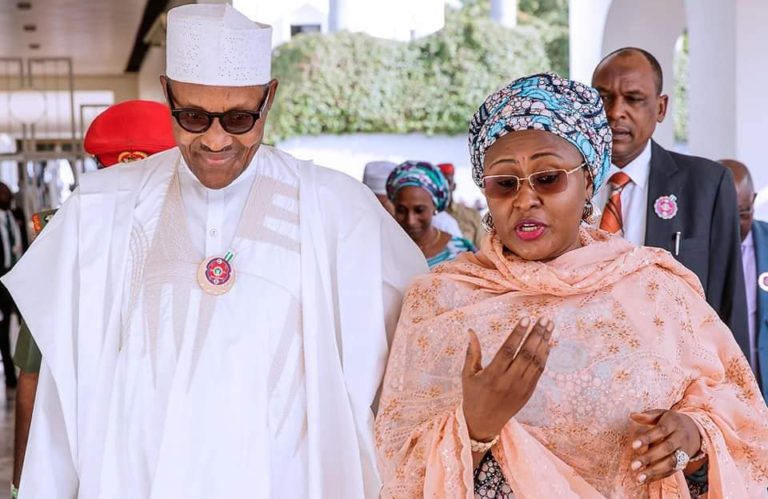
Buhari vs Buhari: President ‘disowns’ wife’s claims about cabal in charge at Aso Rock

PRESIDENT Muhammadu Buhari has disowned his wife, Aisha’s comments that one or two persons, other than the president, was in charge of affairs at the presidency.

Buhari, while speaking to the Hausa Service of the  Voice of America, said he is still in charge and that Aisha’s claims were “her business”.

The president’s wife had expressed disappointment with “Nigerian men” who, rather than brave up and challenge the so-called cabal, go about licking their feet.

“If 15.4 million people can bring in a government and only for the government to be dominated by two people or three people, where are the men of Nigeria? Where are the Nigerian men? What are you doing? Instead of them to come together and fight them, they keep visiting them one after the other licking their shoes,” Aisha had said.

But in the interview, part of which was shared on Twitter on Dec 24 by a VOA journalist, Saleh Shehu Ashaka, Buhari said the fact that even his wife can make uncomplimentary comments about his administration shows that he is a “real democrat”.

“That’s her business… This shows I am a real democrat… What they are saying is different from what is happening. They should come out and say those things they feel was staged managed by the cabal. What the cabal force to me to do. They should mention just one thing.”

Aisha Buhari had in 2016 made a similar statement during an interview with the BBC Hausa version. She said at the time that President Buhari “does not know 45 out of 50, for example, of the people he appointed and I don’t know them either, despite being his wife of 27 years. Some people are sitting down in their homes folding their arms only for them to be called to come and head an agency or a ministerial position”.

She refused to mention any names of the people she claimed were in charge of the government other than her husband. “You will know them if you watch television,” she said.

Aisha insisted that “if things continue like this up to 2019, I will not go out and campaign again and ask any woman to vote like I did before. I will never do it again”.

INVESTIGATION: Enugu public libraries in ruins despite huge budgetary allocations –Part 2

In this concluding part of the series on the budgeted for, but not funded Enugu State libraries; the searchlight is beamed on Awgu, Amufie and Ibagwa-Aka. Libraries here remain in sorry states due to lack of funding. Many questions remain unanswered as our reporter, PATRICK EGWU, continues his exploratory quest to unearth reasons for the poor state of the three remaining public libraries in Enugu state despite huge budgetary allocations.


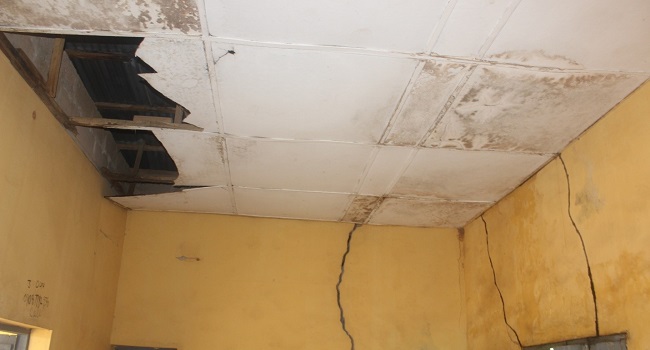
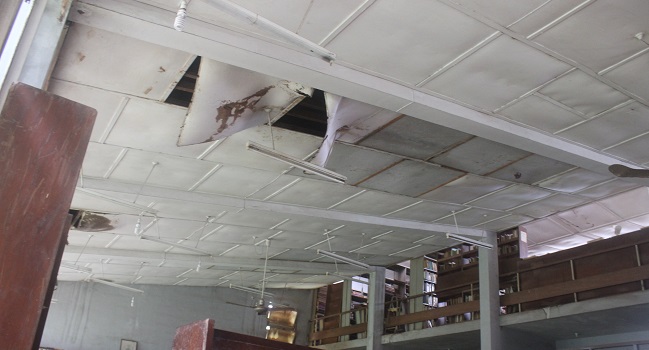
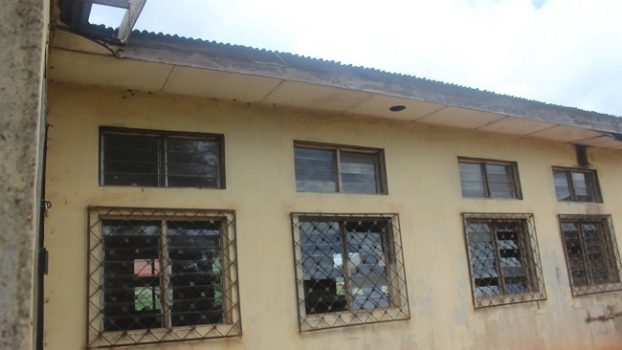
JUST as the previous libraries featured in the part one of this investigative report; Awgu LGA library is at its final stage of total collapse. Its walls are cracked. Its roofs are falling apart. As for its ceilings, they are drippy.

The library located in the state where the Deputy Senate President, Ike Ekweremadu, hails from, regrettably is in a shambles. Needless to repeat, it’s In a poor infrastructural state coupled with lack of reading materials and basic necessities to make it a library indeed. As for the shelves, they are almost empty while exhibiting a few outdated books.

Established in the 1980s, Agwu library’s poor state provides an attraction for miscreants and hoodlums who have turned it to their operational base and hiding place largely due to its bad state.

The library’s principal officer, Georgina Udeh, bemoaned,“Our library is crumbling. We lack basic facilities – the windows and doors are all damaged and we even have no toilets. The worst are the big cracks on the walls. Look at the grounds like it’s going to cave in like an earthquake someday soon. We are daily in fear of our stay here as it seems a looming danger for staff, students and other library users.

“Here, dreaming of new books acquisition is like expecting ‘Alice in wonderland’. Just take a look at our shelves to grasp the full extent of what I am talking about. We can only call on the deputy senate president and other government officials to come and rehabilitate this library,” Udeh pleaded.

In a circumstance similar to the experience of other previous library officials, Udeh said: “We have written letters to the library Board for intervention. But since then, no help has come our way.” Showing copies of the letters as proofs, she adds: “Nothing has happened after these letters were delivered to them. Nothing, like I told you before.”

An immediate past councillor

Georgina Udeh showing one of the copies of letter sent to the state government for intervention in the library

, Agwu LGA, and currently a user of the library, Michael Kelle, took this reporter down memory lane of its history. His narration: “This building was established by the Second Republic government of the late former President, Shehu Shagari since the 1980s. Then later, they decided to equip it as a library. But the building was not fully put into any meaningful use until around 1997. Then, the State Education Commission decided to establish the Awgu-zone of the Post-Primary School Management Board (PPSMB). So they used this place as the takeoff point.

“By the time the then government was ready to establish a library in the area, they considered this place a better choice. That’s when they transmuted the structure from the PPSMB and converted it to a full-time library. And that’s rightly so because it was originally built for the library. Also, it was much easier for the State Library Board to locate their zonal library office here since this is an existing structure meant for that purpose. The gloomiest part of the whole story is that, since then, about thirty-eight years ago, this building has not been given any form of makeover or refurbishment, but rather left fallow and almost roofless as every portion of it leaks. In addition, children and miscreants now use it as their playground and hideouts. But where else can we go to use? That’s why you see that the staff and users still use the place,” he recounted.

Kelle added that despite the poor situation of the library, “users, especially students, still throng the facility as there is no other better one to go. It’s just kind of empty now because schools are on vacation. All the same, this should not be an ideal excursion library for school children. It has nothing to show them in terms of knowing what a library should look like. And that’s why we are calling on the government to fix this place and upgrade it to what a standard library should be,” Kelle said, as he flipped through a file in front of him.

“In fact, every library official here has tried their best beckoning on the government to come to their aid. Some months ago, the education commissioner visited to assess the situation of things. He claimed not to be happy and promised that the government will look into it. He also advised us to ensure that the local government partakes in making the library wear a new look. But, that’s all to it. All barks but no bites! We’ve not seen anything till date. It could be they are still doing the paper works. Mind you, we’re talking about the only library that serves a wide range of communities users come from. It’s so unfortunate.”

Kelle further noted that due to security concerns, “some types of equipment and infrastructure cannot be fixed in the library because the building lacks perimeter fencing. Until the building is rehabilitated and fortified to ensure security, high quality books and equipment cannot be brought in yet. But when everything is in its proper shape, indigenes can be persuaded to donate to the library. For now, nobody would be willing to contribute anything.”

Tracking the monies

In the 2016 budget, where N43,033,152 was budgeted for the library at Agwu, N1,500,000 was slated for the construction of 1 block of 4 toilets and another N6,500,000 allotted for the rehabilitation of the zonal library. Up till the filing of this report, nothing close to renovation or infrastructural upgrade has been done on the library.

Likewise, in the state’s 2017 overall budget of N54,370,000 to the library Board; N5 million was recurrently planned for the same Agwu zonal library rehabilitation. Another N1 million budgeted for the construction of the same 1 block of 4 toilets as done in the previous year still featured again. However, despite these monies, none of the projects mentioned saw the light of the day as this reporter went round to scrutinize the entire library surrounding.

Again, in the 2018 budget of N37,500,000, N2 million was slated for the exact rehabilitation of Awgu library, with another N1 million again, earmarked for construction of toilets as was the case in the previous years’ budgets. Yet as before, the toilet, government has failed to release funds for these allocations. Users resort to doing easing themselves in nearby bushes.

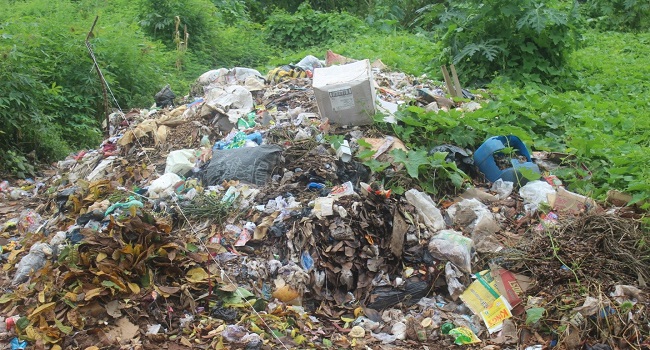
A refuse dump site few meters away from the Awgu library

As if the poor state of the Agwu library is not bad enough, in a scenario akin to adding pepper to injuries, this reporter saw a huge refuse dump site oozing out stench that poses a potential health hazard to library officials, users and even close-by residents.

Ibagwa-Aka and Amufie libraries – not faring better

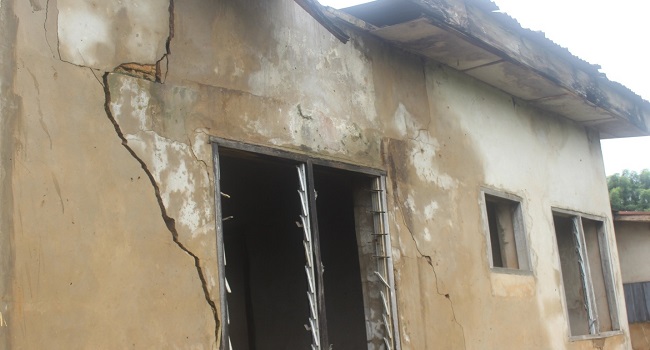
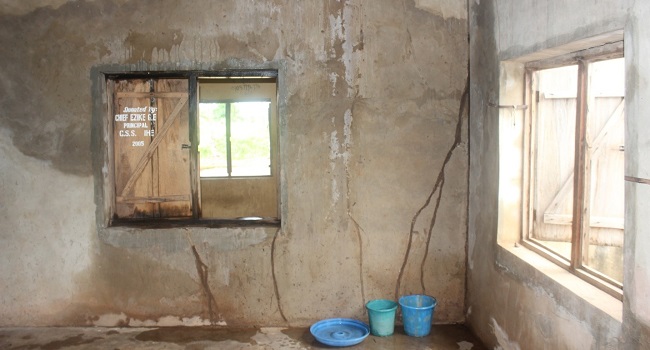
THE reporter’s visits to these last two libraries reveal similar tales of woes. Nothing impressive was seen about any of them. They are all ramshackle buildings with fallen roofs and empty shelves amid bushy environments. As for the staff, their countenance conveyed disappointment and hopelessness.

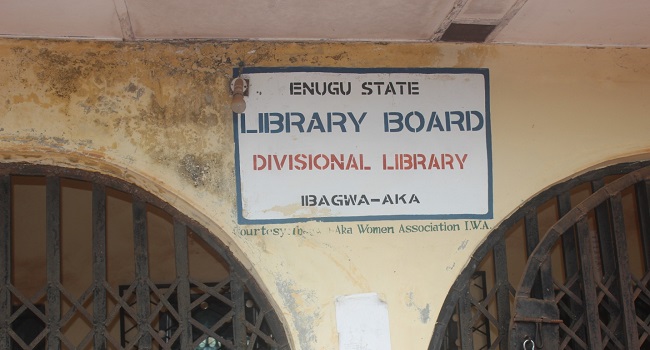
A narration about the divisional library revealed that it was established in 2005 and located in Ibagwa-Aka in Igboeze South LGA of the state. It was started as a monthly fixed-rate rented apartment by the library board. And just as others before, this library boasts of a total absence of library needs for its teeming users of students and visitors. And, it is located in a remote area with poor road networks, no electricity and toilet facilities.

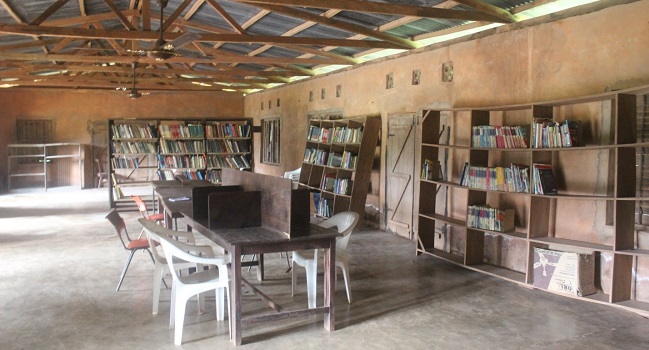
The library, which has a 24-seat capacity, is not only ancient in looks, it is very poorly ventilated with no ceiling fans or electricity. It has no sections like bindery, children and reference expected of a typical library. In addition, with the absence of electricity, installation of computers and desktops to access online materials and databases becomes needless.

Divisional library Ibagwa-Aka is housed in a three-bedroom apartment with a fixed rent. Like others, the library is poorly equipped

Lamenting, Livinus Eke, the library assistant, told the reporter: “Users barely come here because of our remote location. The only time we see them are close to, or during their exam periods. Then, those from neighbouring villages also come sometimes to use the library. Other times, we stay here without having anybody to come around.”

Fate of Amufie library

“LIBRARIES in Enugu are in a financial mess. All library management have approached the state government severally at different states, but nothing positive has been received on our outcries. Without mincing words, urgent assistance is needed to revamp them. We need you to communicate our plights to the government for speedy intervention,” Eze pleaded.

A clerical officer, Patience Ugwu, who has been working at the library since 2006, also added her voice to the pleas. She said: “The abject lack of essential library necessities discourage users from coming all the time as they never get their quest for deeper knowledge met.”

Their lamentations tally with the similar realities seen at the Amufie library located in Igboeze North LGA, as it has no basic supplies. The building was once a community-owned town hall. It was later donated to the government to use as the library. Worse still is that the inside is so oven-hot that users who visit for one academic purpose or the other, run for their lives.

It is merely a hall without sections, wooden seats and reading desks which are not only old, but in a bad shape and surrounded by bushes. On its shelves, few old books were displayed. With about 25-30 sitting capacity, there was no user at the time of visit. The security man, who simply gave his name as Samson, ushering in this reporter, said users and students in the area hardly patronize the library.

No ceiling and electricity thereby making it hot and unconducive for users

When asked the whereabouts of the librarian-in-charge, Samson said she had gone to the bank for some transactions and would soon return. But after about 2-hours of waiting for her, this reporter took his leave.

This reporter spoke with a Professor of Library and Information Science at the University of Nigeria, Nsukka, Professor Charles Omekwu, who said regrettably that the society does not cherish education.

“We are living in a culture in which the value and importance of information and knowledge are yet to be treasured. But the painful aspect is that you cannot be more powerful than the information and knowledge you possess. Every library is an institution, a place people visit to access information, acquire knowledge and improve themselves. So when a nation, state or university has poorly equipped library infrastructure and facility, it is most likely going to translate to a citizenry that is not well informed and knowledgeable,” he stated.

Omekwu said the result of this unfortunate scenario is that “information-rich countries will continue to dominate information poor countries. We must accept that the world is currently running on a knowledge-based economy and a library is the storehouse of basic gen and understanding for our people to match up.”

And until funds meant for the revamping and stocking of Enugu State public libraries are judiciously utilized or those responsible held to account, the conditions of these libraries will continue to remain poor and in a bad shape, rundown and inoperable for needful users.

No louvres on the window, big crack on the wall and a fallen roof

But the cheery news here is that, the library security personnel told this reporter that a new structure is currently under construction by the library board to replace this old one.

Trailing the Money – 2016-2018

WHILE the back-and-forth persists regarding where the monies for Enugu libraries are; the reporter went to the State Ministry of Finance with the intent to trail the cash in the government coffers. Sadly, he met the absence of Finance and Economic Development Commissioner, Mrs. Eucharia Uche-Offor. He then made an attempt to speak with the Ministry’s Permanent Secretary, Dr Benedeth Ezema. But he too, was reportedly absent.

The reporter then commenced a thorough inquiry into how library funds have been allotted in the last two years.

In the 2016 budget, the sum of N43,033,152 was earmarked for the Enugu State Library Board. It was intended for the total overhauling of the five libraries including rehabilitation, renovation and construction of toilets, procurement of different ICT facilities, e-books and journals for the libraries. Out of the total sum, N7,500,000 was budgeted for the renovation of the ECL and N5 million for its ICT centre.

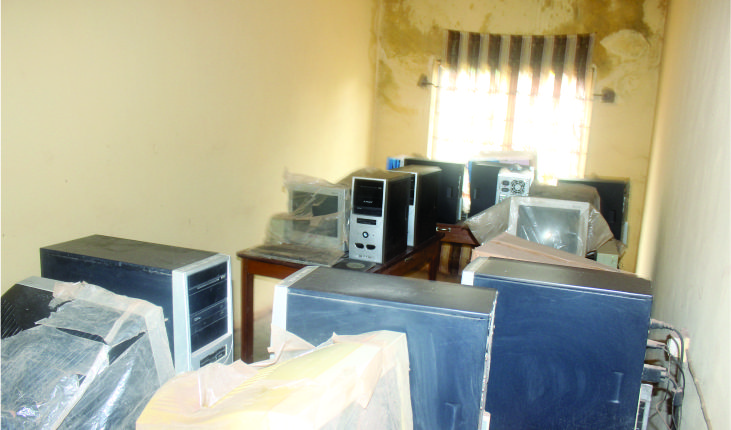
However, as the library currently stands, even the blind could visibly tell that there’s no sign of an ICT centre. Indeed, not even a single mouse or computer can be sighted also as this reporter closely observed. The overall state of the library shows no sign of renovation with its fallen roofs, ceilings, broken windows and bad toilets. Offor maintained: “We don’t have an ICT section and money has never been released to us from the budget as I affirmed.”

Aside that, another N1,848,000 was allocated for the procurement of one printing machine for the bindery section and 15 ceiling fans and one laminating machine. Thorough scrutiny also revealed that none of these items were procured for the library when the reporter visited. Also in the budget was the sum of N750,000 earmarked for the purchase of 30 sets of staff seats and tables with a separate N5 million repeated for the same purpose in 2017. Investigations sadly revealed that till date, available seats in the library remain rickety, termite-infested and in pitiable conditions.

Whenever it is raining, the library staff use old buckets scoop water and prevent it from flooding the reading hall

The tales didn’t fare any better in the 2017 budget in which N10 million was budgeted for the rehabilitation of the Enugu Library. A repeat of N5 million still features for the construction of an ICT centre earlier budgeted for in the 2016 fiscal document.

However, in the 2018 budget, from the reporter’s studies of the financial plan, it was discovered that nothing was budgeted for the Enugu Central Library. The only mention of library money was the N2,500,000 meant for the purchase of office equipment such as printers, laminating machines and an unspecified number of ceiling fans for the bindery section across the libraries.

Asked, however, if there was any money the library board got for the current year, Offor retorted: “Nothing! And I tell you that even the N15 million and N25 million earmarked for a library bus in 2017 and 2018 budgets respectively, never got to us. As we speak, we don’t have an operational vehicle here as our own. The one bought twelve years ago has broken down and to repair it is a big problem.”

Also speaking on these findings, deputy director, library Board, Ms. Angela Aroh, said: “Serious lack of funds remain a basic challenge affecting library staff and services as there is equally no single amount of money for the purchase of books. Previously, government used to give book grants. But that is no more. The little money they give cannot even pay salaries and we are running short of staff. That’s aside the fact that many have retired and there is no money to hire new ones. In fact, the retirees are being owed.”

Aroh further corroborated Offor’s submissions that letters had been written to the government for intervention, “but nothing has happened till date. The library is really backward in Enugu while some other libraries in the South East are doing well. You can see our reading rooms are in a bad shape,” she said pointing to a broken down reading desk. She went on: “There is no light and we cannot pay our bills. We have a big generator given to us by a former governor, but it is bad now and we cannot fix it. And even if it is fine, we cannot buy the diesel to run it. We tried to have an e-library here but we couldn’t pay the network providers.”

Puzzled at the untraceable huge sums of monies mentioned much as the reporter endeavoured to unravel the knotted riddles, his probing mind still yearns for answers. In the light of denials and counter-denials, his main question remains: Where are these monies held or kept and with whom, since clear claims are that they are not demanded for and/or released?

All eyes and ears are continuously on the authorities concerned and mentioned in the report in hope that they can proffer needed responses.

…This investigation was supported by the John D. and Catherine T. MacArthur Foundation and the International Centre for Investigative Reporting, ICIR.

What is the logo of your Benz?

0

By ‘Fisayo Soyombo

THOSE who believe in God know that there are times He uses the unworthy vessel to work wonders. One was Moses the stammerer, who considered himself unqualified but was nevertheless picked to lead the Israelites to the Promised Land. Another was Saul, the man who went about arresting believers of Jesus but then not only turned one himself but also spent his time seeking converts.

Please ignore the opening paragraph if you’re an atheist or your religious leaning isn’t Christianity. Here’s the summary: sometimes the wrong person preaches the right message. Sometimes, too, and without waiting to be called, the wrong person preaches the wrong message, but in a way that serves as an unintended wakeup call for the people — if they are smart enough — to seize the initiative and seek out the right.

As it happened last week, musical artistes Olamide and Lil Kesh propagated a message that just doesn’t stop at being wrong but calls for renewed national introspection. The duo — each popular among secular music lovers despite their notoriety for releasing songs low in content but high on lurid lyrics, obscene videos and danceable beats — combined to release what will go down as the most repulsive song of the year, titled ‘Logo Benz’. Without listening to the song, a mere look at the cover says it all: the round insignia of global automobile marque, Mercedes-Benz, strapped together on three ends by a G-string. The song preaches riches by hook or crook. “I pray to Jesus, I pray to Allah, to make money,” reads a loose Pidgin-English translation of the song. “But if money doesn’t come, I’ll do ‘blood money.’” In other parts, it urges ladies to let go of their pants to guys in need of them for Benz-buying rituals.

Expectedly, the public reaction has been largely critical. But why is anyone shocked about a song applauding the use of ladies’ pants for quick-money-making rituals? Olamide/Lil Kesh’s ‘Logo Benz’ is the story of our society — one so ‘dangerously’ lacking in values, depth, substance, conscience and perseverance.

Here in Nigeria, the biggest way to command respect is to have money, regardless of how you made it. Just open your mouth and speak gibberish; as long as you have money, there’s an audience waiting to clap for you. While I do not think money should attract automatic condemnation, one basic qualifier for me is that it must be ‘honestly made’.

Not too many people care, though; dishonestly-made money is money all the same, and it rules. You’ll find young men who date ladies/women SOLELY because of money, and vice versa; people who take jobs SOLELY because of money; people whose choices of their life partners are SOLELY motivated by money; people who dispense respect ONLY according to the pocket of the next fellow; people who class themselves aside and wouldn’t mix with others simply because, as Wizkid said, ‘my money and your money no be mate’.

We can’t succeed as a nation if we do not rein in the extent to which people go to make money. The scale of greed pervading the public governance space is already well-documented, but the private sector — even though under considerably lesser scrutiny —­ is not any holier. Too many CEOs and top executives have skeletons in their cupboards; we’ve seen this in the past with the supposed management staff who mismanaged Intercontinental Bank and Oceanic Bank. There are numerous anti-corruption and pro-accountability non-governmental and civil society organisations that are nothing more than money-making ventures — organisations calling for openness in the National Assembly and the oil and gas sector yet the heavens would fall were their CEOs or accountants or admin heads to be probed. This doesn’t mean honest men no longer exist; only the shining lights among us have been overcrowded by too many people around trying to outsmart the system as part of the maddening desperation to get rich.

We are largely a value-impoverished society, and this is first and foremost because the family is shirking its responsibilities as the first societal unit. To digress a bit, from time to time, I come across people with certain character flaws that are strictly down to deficient upbringing. Not that anyone, not least the writer, is perfect. But there are certain values that, if not picked up as part of family training, are hardly retrievable later in life. The unfortunate thing is that people with character flaws of this nature do not even realise they have a problem, that they need help.

There is a lot of work to be done if we must address the gaping value deficit afflicting us. The family is the first basis. Parents need to realise they’re raising not just their kids but the country’s ambassadors. We must address the ephemerality that has come to define marriages; if homes keep breaking up children will bear the brunt. Something is usually missing when a father or mother is absent in the formative years of a child, due to single parenthood or divorce. There usually are gaps with children raised by grandparents such as a retired teacher or an ‘old soldier’; it’s just not the same. Religious institutions must play their part. Enough of hero-worshipping moneybags; enough of presenting the church as dumping ground for ill-gotten wealth.

We need more religious leaders like Sarah Omakwu, senior pastor, Family Worship Centre (FWC), Wuye, Abuja, renowned for her advance rejection to congregants intending to pay tithe with stolen money. Subjects that teach honesty, integrity and incorruptibility should be introduced to the curriculum, from primary school till tertiary level. And the National Orientation Agency (NOA) should get involved as well. This is a national emergency; if the depravity of now is left to continue growing at its current pace, it would be irreversible in probably a few decades — that is if it still is.

Until we fix the family especially and the general values upon which our lives are woven, musical artistes of the ilk of Olamide and Lil Kesh will continue to occasionally propagate evil in the name of money-making. I hope someone sings it loud into Olamide’s ears: money is good; very important, in fact. But it is NOT the most important thing in life. For everyone who comes to us with a Benz, we must not celebrate until we have first asked: “What is the logo of your Benz?” Pants, blood, corruption, crime? Or sweat, hard work, ingenuity, creativity? And ill-gotten wealth should NEVER be celebrated — because the dishonestly wealthy man is poorer at heart than the poorest but honest man alive.

Soyombo, former Editor of the TheCable and the International Centre for Investigative Reporting (ICIR), tweets @fisayosoyombo

Still Loading: How slow internet speed under-develops Nigeria’s economy, stifles SMEs growth

Nigeria’s leapfrogging of some technology evolution, migration and upgrade of internet facilities have not been a blessing because the curse of slow internet speed undermines investments and developments, BAYO AKINLOYE reports.


MICHAEL Avbenagha paced up and down his living room. He leaned forward to look at the laptop on the table. He sighed in frustration. He took a second look at the 10-inch tablet in his hand and shook his head in resignation. He had been going back and forth in the room since 6:00 am. By 7:30 am., the files he tried to email were still loading. He ran downstairs and knocked on his neighbour’s door.

“By that time I was shaking with fury. My neighbour’s mobile device didn’t have any internet signal,” Avbenagha recollected.

He ran back to his flat to put on a top and then dashed across the street to a cyber cafe. It had not opened. He rushed to the next street the cafe there too had not opened. He sped to yet another one until the fifth one.

“I forgot it was a Thursday – Lagos shops and small businesses wouldn’t open until 10:00 am,” he said. “I had lost out. I was just trying to apply for a grant of $30,000. The files I was trying to upload were three – each not more than 240kb. If I didn’t experience that, I wouldn’t believe if someone else had told me this story.”

Sola Nwafor lost a contract that could have taken care of her family for two months also because of the slow internet speed in Nigeria.

“I was naive. I felt I had time on my hand. I was contacted by a client to do a structural drawing for his new building. The file kept loading until the following day. But the client wanted the drawing ASAP (as soon as possible). By the next day, with my laptop switched on all night, the file was still loading. I live in the outskirt of Lagos – precisely, Shimawa (in Ogun State) – and I was contemplating going to Lagos to use a cyber cafe. But the dread of the Lagos-Ibadan Expressway made me think the file would eventually load and the file would be sent,” she narrated.

Eventually, Nwafor was able to upload the file.

“I heaved a sigh of relief. But as I tried to click the send button the internet signal went off! To cut the long story short, I lost that deal. Internet connectivity or penetration in this country is just another fraud,” the anguished woman pointed out.

Avbenagha and Nwafor’s stories illustrate the painful cost  Nigeria’s internet users bear more often than not.

“What you pay for is not what you get,” Ade Adejuyigbe said. “The service providers promise you a load of data that you can’t use. It’s what it is: empty promise. They should all be jailed – their CEOs; from MTN, Glo, 9Mobile, Airtel and the rest!”

Counting the cost

Facebook CEO, Mark Zuckerberg, when he visited a kids coding camp at the at a Tech Hub in Lagos. Photo used for illustrative purpose.

Slow internet speed is said to have a direct impact on productivity and revenue. For example, in 2015, research commissioned by the business communications firm, Daisy Group, found that unreliable connections cost the United Kingdom economy £11 billion a year in lost productivity. In addition to that, a study by TRAC Research found that $4,100 is the average revenue loss for an hour of slowdowns.

In Nigeria, as you may know, statistics (accurate or inaccurate) are difficult to come by. Yet, there have been accounts by various Nigerians lamenting opportunities lost because of poor internet connectivity that did not allow a money transfer to sail through thus ending a business deal, among other issues.

If the GSMA Head of Sub-Saharan Africa, Akinwale Goodluck, is to be believed a lot is at stake in the economy with the country’s slow internet speed.

According to him, the mobile industry contributed $21 billion to GDP in 2017, representing 5.5 percent of Nigeria’s total GDP. In addition, the growth of Nigeria’s digital economy resulted in the creation of nearly 500,000 direct and indirect jobs.

If anything, slow internet speed is endangering such opportunities as the country slides further down “in the Internet of things.”

According to the 2018 global ranking report for worldwide broadband speed released by Cable (one of the world’s leading broadband magazines), Nigeria is currently ranked 152nd among 200 countries.

The rankings are based on about 163 million broadband speed tests conducted in 200 countries over a 12-month period (May 30, 2017, to May 29, 2018). It examined the mean average download speed of the countries by taking note of how long it would take to download a 5GB HD movie, and thus placed them on a league based on the results.

Nigeria dropped 57 places from its previous 95th position in 2017. With an average download speed of 1.86Mbps, it took an average of six hours, seven minutes and 38 seconds to complete the download of a 5GB file compared to the 3.15Mbps recorded in 2017. At such slow speed, Nigeria’s Internet is drawing the angst and anger of businesses and individuals.

“If policies don’t keep pace with the needs of society and technological innovation, there is a risk that citizens will be left behind and productivity and competitiveness will suffer,” said Goodluck.

Why Nigeria’s slow internet speed

Umar Danbatta, CEO of the Nigeria Communication Commission, the government agency that oversees the telecommunication industry.

With a large landmass, population and the slow acceptance of a digital economy, Nigeria’s snail-pace Internet speed trails the world in terms of broadband penetration and speed. The success of the highest ranked African country, Madagascar (22nd) with an average speed of 24.87Mbps is as a result of its underwater cables that supply the island with fibre broadband speeds.

This is not the case for Nigeria as it relies on Wireless (WiMAX, 3G, and 4G) connectivity rather than broadband cables to cover vast area and population. Madagascar is the fastest African nation, clocking in at an average speed of 24.87Mbps, placing it 22nd globally. This is thanks to the underwater EASSy cable that supplies the island’s urban centres with respectable fibre broadband speeds. Nigeria is not so fortunate.

“While there has been some development in terms of the rollout and uptake of the latest technology in some countries like Nigeria and Kenya, more still needs to be done regarding infrastructure to bolster broadband penetration and speed,” the Cable report noted.

Slow internet speed equals slow economic growth

The World Bank identified broadband internet connectivity as a vital means for economic growth with every 10 percent increase in connectivity enabling a 1.38 percent growth in GDP.

The President of the Association of Telecommunications Companies of Nigeria (ATCON), Olusola Teniola, said that “over the past three years, the country has stagnated on the GDP growth and seen a drastic drop in GDP per capita ratio that reflects a mono-product economy overly dependent on oil receipts. This effectively means that any growth in broadband penetration has not been sufficient to create an ecosystem large enough to diversify the economy and have a massive impact on the citizens.”

President of the Association of Telecommunications Companies of Nigeria (ATCON), Olusola Teniola

Reflecting on the country’s internet speed, he admitted that “we simply haven’t been able to generate those speeds to fuel an e-digital economy that drives massive efficiencies across all value chains and drives innovation which translates into a highly productive society.”

The International Telecommunication Union estimated that at the end of 2018, 1.2 percent of the global population, or 3.9 billion people would be using the Internet, noting that 51 percent of the world’s population is online. The strongest growth was reported in Africa, where the percentage of people using the Internet increased from 2.1 percent in 2005 to 24.4 percent in 2018.

Among the Internet users, a significant number of individuals regularly use the web for financial transactions, such as paying bills and money transfers (3.4 percent of them at least once a day and an additional 3.0 percent at least once a week) or to purchase a product or service (2.3 percent of them at least once a day and 3.0 percent at least once a week).

Despite the total estimated worldwide contribution of the Internet being $1,672 billion (2.9 per cent of global gross domestic product, GDP), Internet connectivity is still in its early stages in Africa – the Internet’s contribution to overall GDP is approximately 1.1 per cent in 2013. Especially in Nigeria and other Sub-Saharan countries, there is a large room for expansion.

The McKinsey Global Institute estimated that, by 2025, Internet-related productivity and efficiency gains (including cost savings, consolidated supply chains and digitised payment collections) in the African retail sector will be between $16 billion and $23 billion.

Despite the tremendous potential and impact of the Internet in Nigeria, many people claim that has come at a cost and with a curse.

Marta Guerriero, an international internet expert noted: “In 13 countries in Sub-Saharan Africa, the cost of the Internet is greater than 50 percent of GNI (Gross National Income) per capita. In Togo, Madagascar, Nigeria, Burundi, Malawi and Rwanda, the cost of fixed-broadband is also more than 100 percent of GNI per capita four years ago. Despite mobile-broadband penetration in Africa is higher than fixed-broadband, a similar story can be told in relation to its prices.”

Guerriero added that the average prices for a computer-based mobile-broadband service with 1GB monthly data allowance and a handset-based plan with 500MB monthly allowance are more than 22 percent and 15 percent of GNI per capita in Africa, respectively. In the rest of the world, average prices for mobile-broadband are less than 10 percent of GNI per capita.

What other IT experts say

Scott Nnaghor, an expert in information and communication technology, also worries about the quantum of investments that will be lost to slow internet speed.

“It would greatly reduce not only the investment opportunities in the IT sector as well as other sectors, but also the development and progress of IT infrastructure in Nigeria. Top IT companies like Apple, Microsoft or IBM would not like to set up servers or facilities since the data transfer nowadays are mostly done on the Cloud servers. Transfer of data can be small or large and time which is the most important attribute in business or IT development can make it unbearable for the company or the developers as well,” he said.

Nnaghor further stated that developers might progress slowly since the Internet speed would make it difficult to “quickly stream or download valuable resources from the Internet to improve their skills or applications of the company.

Weighing in on the potential economic crisis of the country’s internet speed, Paradigm Initiative’s Programme Manager, Digital Rights, Adeboye Adegoke explained that the issue affects the banking, healthcare and other key sectors of the nation.

“When transactions are delayed because of poor connectivity, time and money is lost – and talking about financial inclusion, the success or otherwise if deepening this rest largely on fast internet services. Ability to host remote meetings relies on the quality of the internet. In healthcare as well, prospects of remote access depend on the quality of internet service. Education and knowledge acquisition in the 21st century thrives on reliable internet services,” said Adegoke.

Impact on SMEs growth

SMEs are important drivers of economic development.

Small- and medium-sized enterprises (SMEs) are important drivers of economic development in Nigeria, where it is estimated that they account for about 90 percent of all businesses. They are, for example, 91 percent of formal businesses in South Africa, 92 percent in Ghana and 98 percent in Mozambique. Some studies have suggested that Internet usage contributes to profitability, productivity, competitiveness and survival of SMEs.

In Nigeria, the initiative ‘Get Nigerian Businesses Online’ has helped small businesses gain an online presence, bringing more than 25,000 businesses onto the web since 2011, driving marketing and awareness, and consequently business growth in the Nigerian SMEs sector.

In 2011, the Central Bank of Nigeria pushed for the implementation of Cashless Initiative Nigeria, which aimed at encouraging the use of Internet banking, the point of sale terminals and mobile money payment systems. As a consequence, the number of Internet banking transactions increased to over 1.5 million in 2011, with a total value of over N2 billion, the number of POS terminals rose to 103,000, and the apex bank experienced savings of about N1.2 billion.

However, there are indications that the excitement for “everything Internet” is waning in the country as subscribers, both corporate and individuals lament the sorry internet speed.

Changing times

On the African continent, 38 percent of online page views are from mobile devices, and mobile continues to grow as a source of Internet traffic with mobile Internet usage in Africa increasing by at least 18 percent, between May 2013 and May 2014; and Smartphone penetration is 31 percent in Kenya, 29 percent in Nigeria and 47 percent in South Africa. Despite double-digit growth over the last few years, fixed-broadband penetration in Nigeria and other African countries remains slow.

An important issue regarding internet connectivity in Nigeria is related to the reliability of the Internet connection. In the country, there are cross-country and cross-city differences in broadband speed. Even African countries with the fastest connectivity are far from the world averages.

According to a survey of over 1,300 businesses across Ghana, Kenya, Nigeria and Senegal, more than 80 percent of SME owners believe that their businesses benefit from the Internet, and 70 percent of them expect this would lead them to hire new employees as a result of such a business expansion.

The Head, Software Engineering of Fabnesis Int’l Nigeria, Olaoluwa Fabuyi, compared what Nigeria is losing to the grim possibility facing Amazon. Fabuyi said: “Slow internet speed has a direct impact on productivity. It was recently determined that Amazon would lose £1.6 billion in sales from a one-second delay in loading time of pages. A slow connection leads to an unhappy economy, a decrease in profits and slow applications. Having slow and unreliable broadband affects the local economy and has really deep implications.”

Getting things moving…faster

Uninterrupted power supply, mandatory nationwide optic fibre infrastructure, and software development and engineering capacity building should be our topmost priority as a country.

“First, our total ICT ecosystem challenge is more or less an epidemic! We must not be carried away with the current state of ICT deliverables which serves the minority of our people – leaving the majority in digital poverty. However, there are sustainable solutions,” Chris Uwaje, an IT expert stated.

While acknowledging that Nigeria’s ICT infrastructure has come a long way, “jumping from one inconclusive road-map” to another, power is its albatross.

“In my opinion, uninterrupted power supply and alternate power, mandatory nationwide optic fibre infrastructure deployment and software development and engineering capacity building should be our topmost priority. I insist that our nation’s core competence is software.

“Therefore, there is the need to create a National Software Commission and Software Engineering Academy. Also, there is an urgent need for the crafting of a National ICT Framework Bill/Legislation and Establishment of the Office of The ICT General of the Federation – all of which are fundamental to resolving our long-term ICT challenges,” Uwaje stated.

The GSMA said it has identified support for and release of a harmonised spectrum and a modernised licensing framework as fundamental building blocks for Nigeria’s digital future.

“The harmonisation of 1427-1518 MHz and 3.3–3.6 GHz makes them critically important bands for mobile operators seeking to offer new mobile services to consumers and businesses,” said Goodluck. “A future-fit licensing regime will help promote market growth, boost investor confidence and enable increased connectivity.”

That is not all. Some IT experts want all stakeholders on the supply side to collaborate and ensure the building of a homogeneous fibre backbone network that is “built on the true principles of open-access and interoperates” to allow digital channels of local content information to co-exist with locally hosted digital content and “a demand side that is driven by a workforce that has skills based on science, technology, engineering and mathematics (STEM) educational foundation”.

Teniola said: “We also require the government to create and harness an enabling environment that will support the creation of many local businesses to be the employers of the future. More spectrums should be made available at affordable costs to the service providers that will translate to higher broadband speeds at cheaper prices to the consumer.”

The federal government may well have its sight set on that future as the Executive Vice-Chairman of the Nigeria Communications Commission (NCC), Umar Danbatta, said: “We’re looking at 2020. One trial is taking place in the Atlantic City Lagos. We are working towards ensuring productivity and efficiency. We are putting in place infrastructure that would support 3G, 4G LTE, and 5G. (The year) 2020 is the D-day of 5G in Nigeria.

“The mobile industry is not only a significant contributor to the economic activities of Nigeria but also towards the growth of other sectors of the economy.”

This report was written with support from The Ford Foundation and the International Centre for Investigative Reporting, ICIR.

INVESTIGATION: Enugu public libraries in ruins despite budgetary allocations –Part 1

0

The Enugu State Library Board between 2016 – 2018, budgeted a total sum of N134,903,152 for the renovation, rehabilitation, reconstruction and procurement purposes for the libraries. But these projects, which have since received various monetary allocations of N43,033,152 in 2016, N54,370,000 in 2017 and N37,500,000 in 2018 respectively, still remain decrepit with leaky roofs and empty shelves. Their worn-out structures and a shortage of staff depict a glaring betrayal of the huge amounts so far expended by the Board within a three-year period. 

PATRICK EGWU, who visited the five libraries, reports.

DISGUISED as a student who needs to use the library, gaining entrance to the Enugu State Central Library only cost this reporter a modest annual registration fee of N1,000. Once in, the reporter began to do a swift observation of the poor state of the library, taking in every little detail.

It is located at a place called “Holy Ghost” in one of the busiest markets in the state. Thousands of motorists ply the road opposite the library, daily. Next to the library are scores of transportation companies, tooting their horns and using mega speakers as they bellow to woo commuters.

Added to the boisterous scenario close to the library, are hawkers, in their large numbers, who also litter the vicinity. The general menace inflicted on the teeming library users daily is appalling. A much needed but notably deprived essential of the library, silence, was not given any consideration.

Back in time

In 1958, the Enugu Central Library (ECL) was established by the United Nations Educational, Scientific and Cultural Organization (UNESCO), as part of a viable pilot scheme for public library models in Nigeria. Not long after, it became the first public library in West Africa and was handed over to the then Eastern government. Then adjudged the best in West Africa, it attracted users from different parts of the country who visited it for studies and research purposes. But today, the story has changed – for the worse.

ECL – Legacy in ruins

Current realities at the ECL are worrisome. Sited at the heart of the state, the library exhibits a very big building with large reading halls and offices. But despite its size, everything from the structure to the shelves, archives and expected 1,000 users’ sitting capacity, are in ruins. The roofs and ceiling boards are leaky and already falling off – posing a potential source of harm to unsuspecting users. The ceiling fans are very old and rusty giving a clear proof that no new procurement was made in any recent past.

Books and journals displayed on the shelves are outdated, dating back to over 30-years. A closer scrutiny by this reporter shows most of the books with 1960 – 1970 imprints. Worse still, there are no current journals at the library at the periodicals section.

As this reporter expressed shock, a user close-by volunteered: “You must be new here. I usually come with my own books as I haven’t ever found the books I want. As you can see, those in the shelves are very old.”

The user, who gave his name as Okike Chike, a Financial Studies’ student at the National Open University of Nigeria (NOUN), Enugu, added: “If you check the shelves further, you will discover the seriousness of what I’m talking about. I just wish something fast can be done about it soon.”

He said he has never seen the ceiling fans work since he started using the library over a year ago. “It is always hot in here and there is no electricity to start with,” he said.

The leather covering the outer surface of the reading seats are rusty, old and wearing-off. The desks are not any better. Some parts of the windows are in bad shape, looking unkempt with dirt and cob-webs and some parts broken.

Enugu’s five libraries

WHILE Enugu State has five public libraries, only six librarians inter-changeably handle the day-to-day activities in all the libraries as discovered from interactions with the library Board. Explaining the reasons for it, Mr. Jude Offor, acting director, Enugu Library Board (ELB); who is also in-charge of all the public libraries in the state, said: “We don’t have librarians in the other libraries apart from this one,” referring to the main library.

Continuing, he adds: “What we have at other places are clerical staff because there is no money to employ more hands. We have only six librarians in the whole library and they are all here at the main library.

“On the need for government’s intervention, we have written many letters to them detailing our needs in addition to seeking increase in the subvention we currently get, from N3.7 to N6 million to boost the day-to-day running of the five libraries. The state governor has visited twice. He told us to write and we wrote. Once, he directed the Commissioner for Education to go round the libraries and verify the state of things to give him a first-hand report. The Commissioner did as he was directed but we have not seen or heard anything thereafter.”

ECL official – Insufficient money given

APPARENTLY, for lack of any alternative, knowledge-seekers still throng the library. “That’s why I continued from where others stopped,” said Offor.

Speaking on the situation of the library, he said: “Our first problem here is that the N3.7 million subvention we receive every month is not enough to carry out the works to be done. For instance, we owe a lot of people running into millions. What my predecessors saw is what I am seeing except that now, government is giving us money but it is not enough to carry out our responsibilities.”

Offor said pensioners who had worked at the library instead of receiving their complete payments every month, are paid once in four months because of paucity of funds. “For example, we have 64 pensioners helping out and instead of paying them monthly, we pay them once in four months. We also owe staff leave allowances of up to eight years since 2009. And it increases as the years run by. We expend the money on keeping vehicles running, fueling and other incidentals for all the five public libraries in the state. It hardly goes by.”

Offor also made efforts to justify his administration’s prudence in the judicious disbursement of the N3.7million monthly allocations to the library. He said, “But despite the poor state of the libraries across the state, no embezzlement charges can be laid on our laps because we use the funds given to us judiciously. Nobody can say that a dime, as in, one kobo, has entered my pocket. We use the money exactly the way it should be – for salaries, electricity bills, vehicle charges and monthly rents for staff under the payroll of the Board.”

Funds budgeted for libraries never released

INVESTIGATIONS show that though funds were allocated to the library Board in the budgets under review, they were never released. When asked about the monies budgeted for the Board in the state budgets, Offor responded: “The problem is that these monies are not usually released. And this happens, not only in Enugu state, but also elsewhere. In fact, from the beginning of the library, funds budgeted for it have never been released. Others who were here before me have done everything to collect the money, but they were unsuccessful.”

Stressing further on the library Board’s budgetary allocation, the acting director said: “If these monies were ever released to us, we would have renovated the libraries. In fact, special consideration would have been accorded the Enugu Central Library in particular. Remember, it was the first public library built by UNESCO in the whole of Africa before other libraries followed.

“The only money that gets released to us is the recurrent expenditure whilst the capital overheads are not usually released because it seems difficult. And when you complain, they will tell you to go and work it out,” he intones, “whatever that means.”

When this reporter contacted the commissioner for education in the state, professor Pat Uche Eze, to ask why funds budgeted for the Board are not released as the director had claimed, Eze said “I am not a budget expert so I cannot discuss the budget. So, let’s not talk about what happened in the past. Budgets are based on identified challenges. We have done a study. When we reported it to let the governor know the extent of the challenges, that will help him know how much will be allocated.”

Still, the commissioner was prodded further. He said “when you have your budget, you implement it. I’m sure that the acting director must have accessed the budget. Did he show you the memo he wrote? As I was saying, for you to access a budget, for instance, if it is capital, you have to do a memo. You have to apply in order to get it and you have to justify that there is a need for it. And when you do all these things, it will still be discussed before action can be taken in that regard.”

When told that the Library Board acting director said he had written letters; Eze sidetracked the conversation, saying “I want to tell you that government is quite aware of the issues relating to public libraries in the state. Some months ago, it was an issue discussed at the State Executive Council meeting. There-and-then, I was directed to do a status report on the libraries because the governor is determined to give them a facelift. In fact, provisions have already been made for complete renovation of the state library.”

The education commissioner was also asked about the need for an increase in the N3.7 million Library Board monthly subventions, he sharply responded: “I don’t have to comment on that because the director has to convince the government that this is what he has done with the one he was given and this is why he needs another increase. For me, he has not been able to make that case.”

However, the director insisted: “The issue in focus is not about writing letters. The main concern is about releasing monies for the needful as far as the libraries are concerned after receiving the letters we wrote. And this has not been done since I started as the director.”

Nsukka Library – Lifeless despite budgets

IT was a rainy morning when this reporter visited the Nsukka library. On the inside, ten users were seen reading some printed texts. Others walked around the shelves, scanning through available but mostly outdated books lined up on the shelves dating back to 20-30 years ago without any recent literature or journals. This library has about 300 sitting capacity. The children section lies practically fallow.

Established in 1989, the Nsukka Zonal Library serves the Nsukka town which hosts Nigeria’s first indigenous tertiary institution – the University of Nigeria, Nsukka. It was discovered, that students throng the library to research or study in preparation for their examinations.

The roof and windows of the library are falling off with every wind storm

Despite the very important purposes it serves its essential users within Nsukka and beyond, the library is currently in shambles. Its structure and infrastructure are dilapidated, a situation that has been declared a major challenge to library users.

This reporter was told that the number of users dropped drastically as they now seek for other better reading places. Some even resort to online researches to fulfill their desires for updated knowledge. However, a few users still defy the odds to visit the library.

“This place used to be very lively with students all over the place. Sadly, this has changed because of the current state of the library, said Angela Ezema, the library assistant. “And it is getting worse every year.”

In the 2016 budget for the Library Board, the sum of N5,600,000 million was appropriated for the overhauling of the Nsukka Zonal Library. It was to include the re-roofing for an undisclosed amount.

Also, N12,580,152 million was allotted for the stocking of books and journals annually for the libraries. But investigations showed that this was not the case as library officials say they never received journals aside only two copies of newspapers, daily.

Another sum of N1,500,000 million was budgeted for the construction of one block of four toilets. Whereas now, the library has no convenience rooms for both staff and users. This reporter only saw three uncompleted structures with no doors, windows or water cistern designated as latrines for users. Its floors are not merely concretized with cements.

Shaking her head in sadness, Ezema, said the shanty toilets have actually been under construction for more than five years. “That is the way it has been for over five years. We don’t even use it to avoid contracting lavatory diseases that never get healed.”

Four toilet blocks for the library has been under construction for the past five years without completion despite budgetary allocations

Others library officials also chipped in that there are no desktops or laptops provided for them to work with even though the money for these items were provided in the 2016 budget.

In the 2017 budget, N54,370,000 million was budgeted for the state libraries. Sums of N5,000,000 and N2,500,000 were respectively slated for rehabilitation and re-roofing of the Nsukka library. But none of this has reflected in the library’s exterior or interior amenities.

Ezema hinted that heavy downpour in recent months also destroyed most parts of the library’s roof causing other major damages. “The rains came with heavy winds and blew off the roof, opening up everywhere. As you can see, we now use bucket and plastic bowls to scoop water whenever it is raining,” she said as she showed this reporter a bucket positioned directly under the leaking spots.

She said appeals for the repairs of the fallen structure have not been answered and the damage is getting worse. “We took pictures and called Enugu State government to inform them so they can help us with resources to fix the damages but nothing has been done.

“On June 1, 2018, the Commissioner for Education, accompanied by some state officials came to the library for on-the-spot inspection and assessment in the hope of major interventions. He took notes while assessing the level of damage and promised to send engineers to embark on repairs and equipping the library to standard. But neither the commissioner nor the team of engineers were ever seen again.”

While this reporter was still at the library, another torrent of rain began to fall which enabled him to witness the library staff as they scampered to get buckets and position at the leaky holes to prevent water from flooding the reading halls.

Then, towards procuring printing and laminating machines with 15 sets of ceiling fans for the bindery section of the library, the sum of N1,790,000 was allotted. That was a shortfall of the N1,848,000 budgeted in 2016.

However, nothing in the bindery section of the library could attest to any new equipment being procured. Rather, the librarian showed the reporter a computer room with 10 desktop processors and printers which were procured and donated by the local government area chairman since 2008.

Almost ten years after the procurement, the procured desktops have never, for once, been used since they were brought to the library. Reason is there has been no electricity supply to power the computers. Cobwebs and dust have covered the items packed in a water-logged room since about a decade ago.

Set of desktops donated to the library have not been used for the past ten years because of lack of power supply

“We have 10 desktop computers but none of them is working because there is no power supply. They promised they will bring a big generator for us but we are yet to see it. So, we don’t know if the computers have expired or not,” Ezema said.


Budget of Enugu State Library

MOST of the items in the 2016 and 2017 budgets of N37,500,000 million for the Library Board were repeated in the 2018 budget.

Items such as procurement of printer, laminating machine and ceiling fans for the bindery section of the library; budgeted below N2 million in the previous budget, was listed at N2,500,000 million in the budget 2018.

Renovation of the library in the 2018 budget, however, got a downward review of N2 million as against the N5 million it received in the previous years. Construction of one block of four library toilets was repeated in the 2017 and 2018 budgets at N1,000,000 respectively. Still, the library has no readily available toilets. Users resort to nearby bushes and open spaces when they need to relief themselves. Some make use of public toilets where they pay token fees to access the facility.

Promise Asogwa, who started using the library five months ago said: “I step out to pee whenever I want to because there is no toilet inside. And though I see all the books I need here, the library is not up to standard. I have never seen power supply here. It’s bad.”

Despite the yearly recurring budgetary allocations, there was no sign of procurement of ceiling fans which was listed in the three budgets. A two-year library user, Ebubechukwu Agboeze, told the reporter she has never seen power supply to enable the ceiling fans to work. “I have not even seen light for once,” said Agboeze, who is preparing to study medicine in the university. “Everywhere is just dusty. But we are managing it like that as there is no other one around where we can go.”

Agboeze’s expression corroborates the librarian’s submission who said they have not seen light for a very long time and neither is there provision for a stand-by generating set to supply power as promised.

“We need perimeter fencing here for security reasons,” said Christiana Egbo, the library’s data processor. “This is a state library and not private. It is in a mess compared to other libraries. But the state seems to be doing nothing about it. Nothing here is new or modernized or working. The building, seats, tables and books are all outdated. Anambra State Library is far better than ours.”

This investigation is supported by the John D. and Catherine T. MacArthur Foundation and the International Centre for Investigative Reporting, ICIR.