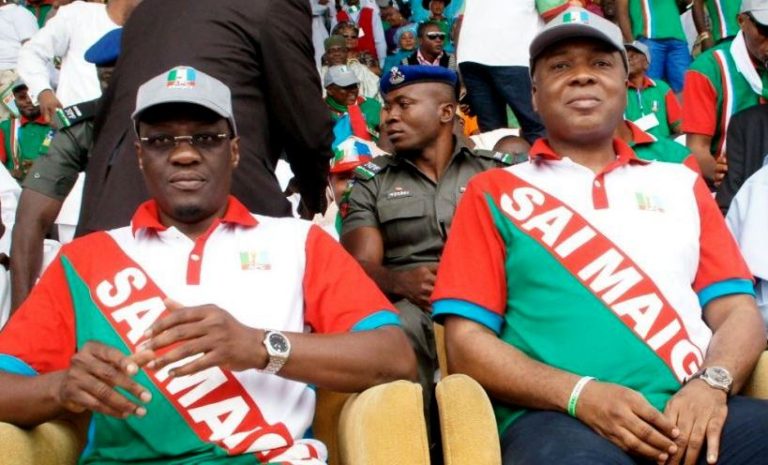
PRESIDENT of the Senate, Bukola Saraki has revealed how in 2015 he bribed electorate to win votes for President Muhammadu Buhari, while campaigning for his election as the president of the country.
In a leaked audio clip where Saraki was addressing some youths in Ilorin, Kwara State capital, he recalled how he offered millions of naira to voters in 30 of the 36 states of the Federation to secure votes for President Buhari during the election.
The authenticity of the voice in the in the leaked clip could not be immediately ascertained.
The Special Assistant on New Media to Saraki, Oluwole Onemola, in a statement, described the clip as a “doctored recording.”
In the 33-minute and 56-second audio clip, the Senate President spoke of how he was moving with the presidential candidate of the All Progressives Congress (APC) from one state to another and up to the last day to the election giving instructions to banks to release money to ‘settle’ electorate.
“What is happening from the top, use me as an example, in 2014 to 2015, we moved out of PDP and carried APC issue on our heads. We went round and there is no state in Nigeria that I didn’t campaign for Buhari,” he said in the video that was recorded in Yoruba language majorly.
“Up to the time we were conducting election in 2015, I was still with him from Tuesday, Wednesday, Thursday and Friday to the Saturday that is the election day, out of 36 states, 30, 30 I paid for the election; those that took N300million, those that N400million and those that took N200million. The only six states which I don’t know anything is South West.
“There is no other state I didn’t spend money. I was calling banks on phone.”
Saraki also said he left the ruling party because, despite investing hugely into the electoral campaign of President Buhari, there was nothing to show for it by him and his state, Kwara State particularly in the areas of federal appointments.
He said his thought “was that once we finished doing that and won the election,”the majority of his people from Kwara State would be given federal appointments.
“If you remember, I used to joke with them that all of you will follow me to Abuja. That some of them will be MDs of agencies either road maintenance, NITDA, NPA among others.
“Because I know, if a son of Kwara State is even just ED [director ] of UBEC, I know the kind of work he can sign from his desk either N1million or N2million. But for the first time, when you have a President of the Senate, even a speaker cannot appoint a cleaner. I’m not talking about board appointment, that’s different where someone is appointed a director, that is non-executive.–who just collect money per sitting.”
The video which was first tweeted by Kayode Ogundamisi, a public commentator and blogger on Friday, November 16, has since gone viral on the social media.
Saraki lamented that the last three and a half years of President Buhari’s administration were not easy noting that some of the causes were “human factors” as well as the will of God, adding that his agenda has been how to ensure the growth of youths.
“I agree that the last three and a half years were not easy at all.”
“Now what has changed in the last three and a half years, some are human-based factors, majority of them, for me, I see as divinely designed by God because you are saying yours comparing the time I was governor to now, and wondering that all the youths who are struggling, I know it is not good.”
“What is going on, what is our benefit from this government as youths, or what did we benefit in the last three and a half years, “Saraki asked.
He bemoaned his ordeal in the hands of the administration during which he said: ” I went to court 1, court 2, court 3, court 4; for three and half years!”
The Senate President has been in a running battle with the leadership of APC since he won the Senate President seat against the wish of the party’s top echelon in 2015.
Despite all the efforts we made and what we have been through, what they rewarded us within the party (APC) was the result from the top that you are experiencing, the difficulty.
“If you look at the agencies they appointed executive positions, what do you want me to say? Or when you labour and spend billions and things fall in place…even if you aren’t going to offer us appointments, let us have our peace.”
He told his audience he never deceived them, adding that his agenda was to ensure the growth of the youth in the state through ‘empowerment’.
The Senate president urged PDP members in Kwara State to work for the success of the Peoples Democratic Party (PDP) presidential candidate, Atiku Abubakar even as he vowed to ensure that Buhari is not re-elected as the president of the nation in 2019.
According to him, many of those who worked for the ruling APC have since regretted their actions, citing examples of politicians who invited him into the party ahead of the 2015 general elections like the Ogun State Governor, Ibikunle Amosun; and Zamfara State Governor, Abdulaziz Yari.
When The ICIR called Mr. Yusuph Olaniyonu, he referred the reporter to Mr. Onemola, SA Online Media to the Senate President. “Speak to Mr. Onemola, he has reacted on behalf of the Senate President. He has my approval to react.”
Onemola, on his Twitter handle, said the audio clip was probably part of the mix of manipulations that APC decided to employ for today’s bye-election in four Local Government Areas in Kwara South.
“For the record: we always restrain from responding to inconsequential issues that we can otherwise ignore. However, in order to put this issue to rest so that we can move on to real issues, these are the facts:
“The audio recording that is being circulated online by known anti-Saraki henchmen is a doctored recording. It was probably part of the mix of manipulations that APC decided to employ for today’s bye-election in four LGAs in Kwara South,” he said
Meanwhile, the Socio-Economic Rights and Accountability Project (SERAP), has sent an open letter to the Chairman Independent National Electoral Commission (INEC), Mahmood Yakubu, requesting him to “promptly, thoroughly and effectively investigate allegation that Saraki spent between N200m and N400m in every state, except the six South-West states, to influence the outcome of the 2015 elections APC.
THE CIA has concluded that Saudi Crown Prince Mohammed bin Salman personally ordered the killing ofJamal Khashoggi, despite the Saudi government’s denials that the prince was not involved, according to The Washington Post.
TheCIA’s conclusion is based on a recording provided by the Turkish government and other evidence, including American intelligence, among them a phone call between the prince and his brother who is the US ambassador to the United State, the senior US official told CNN on Friday.
The ambassador, reportedly acting on the order of the prince, told the late journalist that he would be safe to go to the consulate in Istanbul and get divorce papers he applied for, in order to complete marriage procedure with his Turkish wife.
US intelligence officials also believe an operation such as the one leading to Khashoggi’s death would not have happened without the knowledge of bin Salman.
The CIA’s disclosure is the most categorical statement linking the crown prince to the killing.
But a Saudi Embassy spokeswoman has described claim in the CIA’s assessment as false.
“We have and continue to hear various theories without seeing the primary basis for these speculations.”
President Trump who has described Saudi Arabia as “spectacular ally” is yet to make comment on the report.
Khashoggi was a contributing columnist with The Washington Post before his assassination in October 2 at the Saudi Consulate in Istanbul, Turkey by a 15-man gang.
“We have not seen flooding like it occurred this year,” said most victims of the recent flooding incident in the North-central part of Nigeria. The disaster is reported to have afflicted hundreds of thousands of Nigerians across different states, leaving many dead and many more displaced. For four days, The ICIR‘s ‘Kunle ADEBAJO visited Niger and Kogi states including the FCT, some of the worst-hit areas, to feel the pulse of the direct victims. In this two-part report, he shares how what is seen as an act of God coupled with the actions and inaction of government has driven various communities to starvation, homelessness and despair.
AT past three in the afternoon, after observing the Moslem Friday prayer, Shuaibu Sidi Alli rides through a vast expanse of farmland on his old, black Jincheng bike. The narrow, sometimes bushy, path leads to his village, Adabode, one of the over 60 communities affected by flood in Kogi Local Government Area.
With his home wrecked by the flooding incident of 2012, Alli no longer lives in Adabode, but he still farms in the small village until September. Now, his farm was among several hectares of rice and cassava plantation laid to waste by the recent flood.
During a visit to the village, one could see what used to be a delightful stretch of green crops, now a dull sight of brown, slender stems, wilting corn ears and collapsed sheds. “All these areas are cassava farms,” Alli said as we drove past a desolate piece of land. “The flood swept everything away,” he mutters.
The people of Adabode community, because of their closeness to the Niger River, are among the most affected whenever there is flooding. And they suffer neglect from the government when it comes to rehabilitation efforts.
After the 2012 flooding disaster which left 2.1 million Nigerians displaced, the local government guesthouse along Okparake Road, which was under construction at the time, was given to displaced persons as shelter. Some of the displaced, including Alli and the community chief, whose houses were destroyed decided to seek refuge in the guesthouse, while others went back home.
In September, when the waters swept across the town with greater force, the guesthouse once again became a place of refuge for most residents of Adabode. But not only is the space extremely insufficient; the government does not recognise the shelter as an IDP camp and therefore did not provide relief materials to the IDPs.
He said the people have never received anything from the government since the last flooding. Their farmlands have all been destroyed. And the shelter is inadequate to accommodate the displaced. “We are here suffering,” Alli laments.
The guesthouse, consisting of four bungalows with rooftops the colour of desert sand had no ceilings, doors or windows. The displaced persons occupying the buildings have had to cover it themselves using aluminium roofing sheets, wood and sacks. In the period immediately after the flood, as many as fifteen to twenty people could share a single room before dispersing at daybreak in search of food.
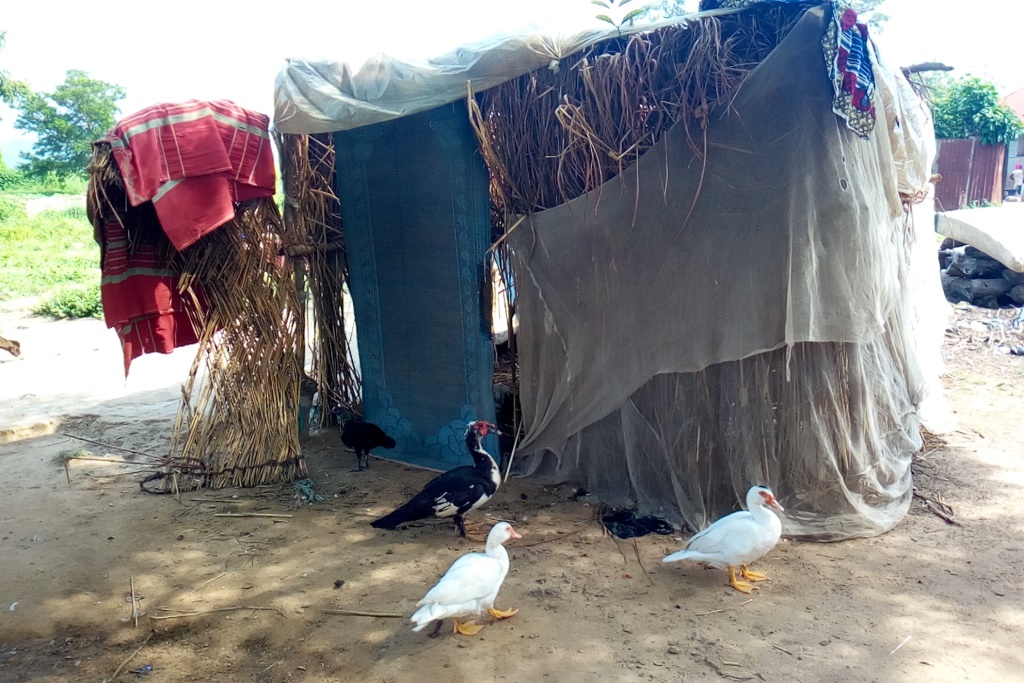
Asides the bungalows, the displaced people have also built a contraption made of wood, mats and palm fronds to serve as shelter. Women of varying ages were seen lounging around the open space as children appeared amused by the sight of a visitor.
One of the makeshift sheds where displaced persons sleep at the Adabode camp, Kogi state.
“We have no food, money” — IDPs cry out, despite approved N3b
On September 16, the National Emergency Management Agency (NEMA) announced that N3 billion has been released to it by the Federal Government to respond to flood disasters in many states.
According to Mustapha Maihaja, the agency’s Director General, the sum was approved by President Muhammadu Buhari for the first stages of preparedness and response disaster mitigation, and this has motivated NEMA to immediately swing into action.
About a week after this declaration, Vice President Yemi Osinbajo also paid Koton-Karfe a visit in September to sympathise with flood victims and assure them of the federal government’s support.
“I am here to look at what has gone wrong and what has happened,” he said. “Land and properties are underwater and after this period when the water recedes, that is really when the hard work begins because those who have lost farmlands need to be restored somehow and need to be compensated including those who have lost houses and property.”
He also said in the following weeks, the government should have been able to assist the victims in returning to their homes and farmlands, and added that it is the duty of the federal and state governments to ensure people are adequately catered for.
Nearly two months after this reassurance, the victims say the government has done very little to alleviate their pain. The need to survive forced many out of their various camps to the marketplace, begging for alms.
“We have many difficulties at the camp,” says Suleiman Musa, 72.
He spoke about accommodation and feeding problem. He said they are yet unable to harvest anything from their rice and maize farms, and as a result have no means to feed themselves or earn income.
“The flooding brought starvation for us … We are in hunger. Our children have all been sent away from school. No food, not to talk of school fees.”
Suleiman says though they hear on the radio that food items will be brought for flood victims; their community is always excluded while other villages get a share. He also recalls that the government promised, in 2012, to allocate land to occasionally house victims of the flood but nothing has been done about this till date, “that is why we are just hanging around.”
Idris Musa Kareem, an IDP from Irenodu ward who spoke to The ICIR, says his ward is one of the worst-hit and cannot be accessed till date unless with the help of a boat. He says the residents have been unable to access relief materials meant for victims till date, also alleging discrimination.
Muhammad Adamu also confirms that there is an unequal treatment of communities in the local government as materials brought for distribution don’t ever go round.
“We need help,” he pleads. “The little government donated to us has finished. Now, we are in hunger. As we go, there is nothing like foodstuff. Nothing again, even on the farm.
“We are hungry. They should help us more so that when we are going for this dry season farming, we will be able to get something to last us. If we have something to manage till that time, we will be very happy.”
Muhammad also laments how some of the IDPs’ children have dropped out of school and their homes have fallen to ruins. He prays the government to assist with fishing nets so that they can feed their family.
“We are in hunger”: Suleiman Musa, IDP, Konton-Karfe, Kogi State
Billions of farm products lost to the flood
The remote communities of Kogi Local Government are not the only places submerged in water while the flood lasted. The deluge also affected communities skirting the Lokoja-Abuja Highway where farmlands and houses are completely destroyed.
The principal of Government Science Secondary School in Koton-Karfe, Muhammed Usman Adamu, and an indigene of Akpako community showed the reporter around the area to observe the level of damage caused by the flood.
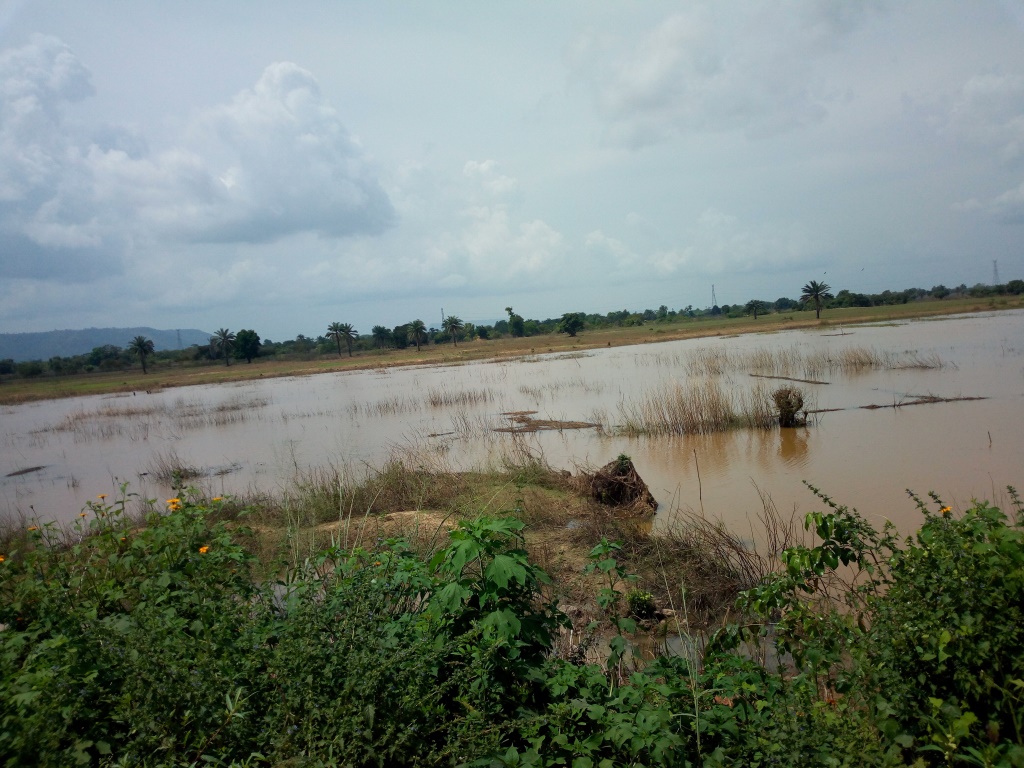
A vast pool of water left by the receding river could still be seen on the land surrounding the Murtala Muhammed Bridge. The land ordinarily serves as a farm for the planting of rice.
“This happened in six wards of the local government,” says Muhammed. “It’s happening also at South East, Girinya, up till the Muye Area. Most of the crops were not ready for harvest before the flood came; and the farmers lost billions of naira. This is just a segment. If you look at the other side, across the road, you’ll see another section of the farmland extending as far as you can see.”
Apart from farmlands, other properties such as houses and machines also were damaged by the flood.
Gimba Abdullahi, a security guard at one of the residences, tells The ICIR a motorcycle parked within the compound stopped working following the flood. For over a month, occupants had to move to the adjoining storey building.
Muhammed commends the governments for coming to the aid of IDPs, but expects more than what was offered. According to him, the government intervention during the 2012 flooding was better.
Traces of the flood still visible on a large expanse of rice farmland in Koton-Karfe, Kogi State
Motorcycle damaged by 2018 flooding disaster in Koton-Karfe. Kogi State
One of the houses by the expressway completely engulfed in water during the flood
Relief items pocketed by local authorities?
One of the community leaders in Adabode, who prefers to remain anonymous for the fear of attack, tells The ICIR that the vice president donated a sum of money to Koton-Karfe during his September visit, which was not accounted for.
“Till this very moment, we have not heard anything from the local government administrator or the Emir about that money,” he says disappointedly.
“And when we even asked,” he continues, “they were deceiving us that Osinbajo packed phones inside two bags for us. They never disclosed it was money, but those who know the details, including a local chief close to the monarch, said it was money.”
He also says people were threatened with arrests should they report that Osinbajo came to the town empty-handed. According to him, unlike his predecessor, the incumbent Ohimegye of Igu Kingdom, AbdulRasaq Isa-Koto, has not treated the communities fairly.
The Ohimegye, he says, claims there are 66 affected communities in area though the total number is only 45 “so that the money they get will be for that number and the rest will be for them”. In one instance witnessed by him, he adds, His Royal Majesty directed that a Hilux vehicle be filled with relief materials and driven to the palace. According to him, a similar vehicle was also filled up for one Hajia Salamatu Iyami Tatu, a local women leader.
“The day before Osinbajo came,” the community leader further alleges, “we were mobilised to go and sleep there so that when he comes, he’ll see that we have made a camp. But these are people you do not care for until the day Osinbajo is to come so that you’ll exploit them, and that’s just what happened.
“Akpaku people refused to come there. There is a day the governor was passing by, he dropped for them N3 million. The local government administrator ordered the chief to give him the money, and that one yielded. That occurrence provoked the Akpaku community, and that’s why they refused to join others at the emergency camp. They said even if Osinbajo drops anything, they will not be considered for anything and it’s true.”
A philanthropist from Fidelity Bank also donated mosquito nets to the communities through the Emir, he narrates, but the nets were instead sold at a rate ranging from N1800 and N2000. One of those who bought the net at the latter price was his younger brother, who had attempted handing it to him after purchasing. “They said where is the evidence that said this thing is donated free.” He advises organisations and government agencies donating subsequently to deal directly with the people.
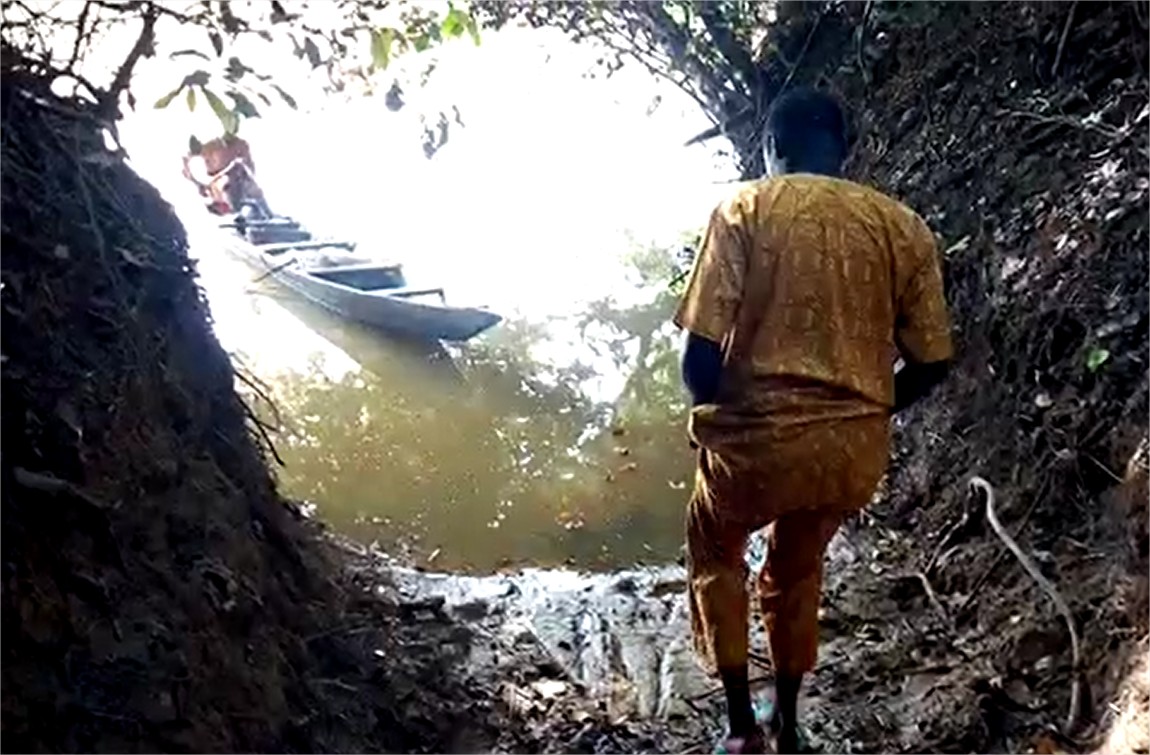
The route leading to Adabode is still not accessible except with a boat
The sidelined community of Adabode
Adabode is one of the communities in the local government which can still not be accessed except through a canoe. Though with an original population of close to a thousand, only a handful men presently live there. Others, explains Adams Alli, one of the few who remain, have gone to seek succour in Jamata.
“It is because of what to eat we ran back to this place,” Fatima Alli, Adams’ wife, adds.
Adabode is littered with several traces of what used to be complete buildings, now dilapidated.
In one of such cases, caused by past flooding, the owner of the destroyed structure, a family man with two wives and six children, decided to pick up the zinc roofing sheets and join them together for a temporary abode.
Leaders of the community complain about total inattention from the government. They host officials on a yearly basis but have never benefited from various rehabilitation attempts.
“This is not the first time our community will be flooded; but we don’t see anything,” Yinusa Mohammed laments. “Just as you’ve come, others have also come in the past; but nothing comes out after the visits. The government has done nothing for us. Nothing.”
“Look at where this man sleeps,” he adds, referring to Shuaibu Usman Dakko and pointing to a nearby tent made with torn fabric and sticks. “Even politics, all of us do it. There is no party without a presence in our village and we vote frequently, but we don’t get anything from the government.”
Effects of flooding on Adabode Community, Kogi LGA
Effects of flooding on Adabode Community, Kogi LGA
Effects of flooding on Adabode Community, Kogi LGA
Effects of flooding on Adabode Community, Kogi LGA
Effects of flooding on Adabode Community, Kogi LGA
Effects of flooding on Adabode Community, Kogi LGA
Effects of flooding on Adabode Community, Kogi LGA
House built by the owner using the zinc roofing sheets of the old one ruined by flood
The village Madaki, Yusuf Kaisa, corroborates Yinusa’s observations, lamenting that members of the community no longer have sufficient food to eat.
“We need help,” he pleads. “Government should help us, because as we are now it is only God that can help us. There is no food; we don’t have anywhere we can look for food. Every five days we go to buy garri, elubo [yam flour]… after we have hustled and entered bush to hunt. Even money is difficult to get now. We need government to help us because of God … because of God.”
Fatima, who is also the village’s women leader, protests how the leaders and residents of urban areas took advantage of the community. “When disaster comes”, she says, “they’ll be crying for us, but the moment help comes, they’ll just hijack it. Before you get to town, they’ll say the materials have already been distributed.”
Ebagi: A border community no one bothers about
While Kogi may be the greatest loser to the tragedy of flooding due to its geographic location, losses are not exclusive to the state. An hour drive away from Koton-Karfe is the area council of Abaji which welcomes travellers into the Federal Capital Territory (FCT).
Buried deeply in this local government is a community known as Ebagi, roughly 10 kilometres away from Pandagi. It has a population of close to 2000; and it is one of the oldest communities around according to residents, as people, most of them full-time farmers, have lived there for many decades.
The community has a health centre, which conducts periodic immunisation for children, a primary school, and a litter of houses, mostly built using mud bricks. The flooding incident of 2018 has left their massive farmlands devastated. The volume of the water was such never before experienced by most adults.
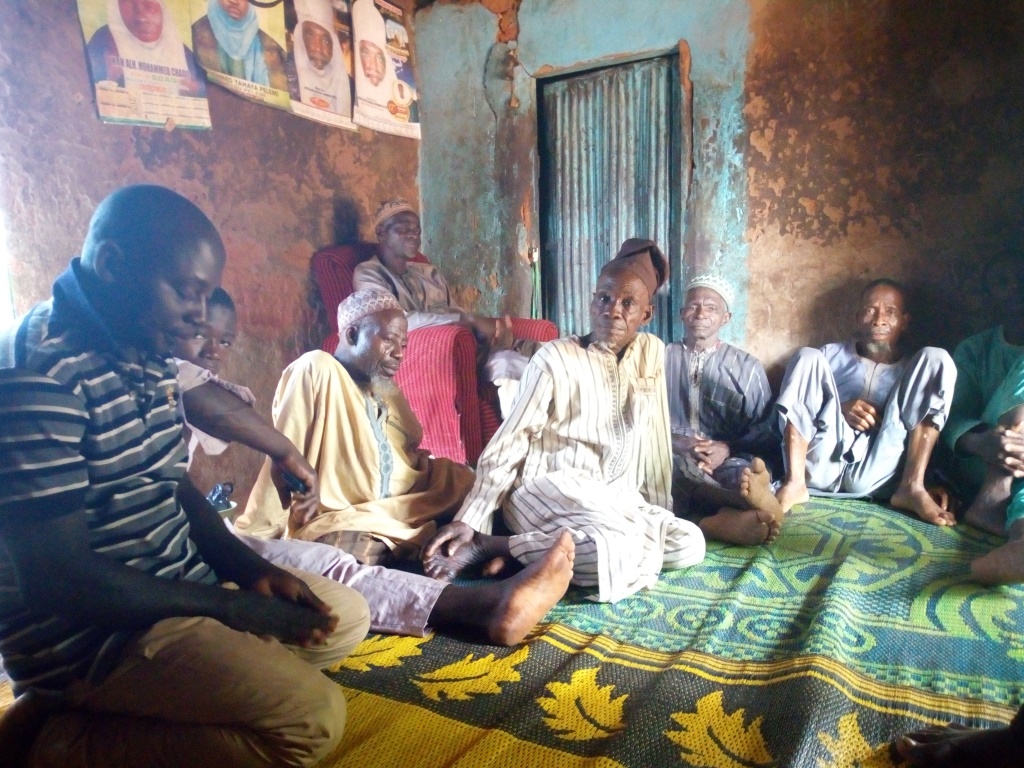
Community leaders during a meeting at the residence of the Etsu of Ebagi
At a meeting with twelve community leaders at the Etsu of Ebagi’s home, Shuaibu Lara who started school in 1976 says he has not seen flooding of this nature since his birth.
“This year’s flood is the worst,” Abdullahi Suleiman, a young man from the community, agrees.
“Because where the river used to come and stop, it didn’t stop there,” he explains. “We’ve never experienced something like this before. The river has finished all our properties.”
Muhammed Chado, one of the oldest in the room and the only one reclining on an armchair instead of a mat, is the village head. Speaking in a Nupe dialect, Chado appeals to the government to assist the community through the supply of food and building materials as the village is back to ground zero with the destruction of their crops.
Some of the buildings in the village, especially the mud houses, collapsed under the weight of this year’s downpour. Only a few brick buildings are left standing, some under construction, but the majority of the people cannot afford such a luxury.
“Most of our farms are by the riverbank, that’s why we’ve been greatly affected,” says Suleiman, who took this reporter on a tour of the village where the flood has wrecked havoc. “We could not pick anything. The farms were completely submerged for over a month between August and September.”
A spread of river sand is seen across several metres of land, formerly used for the planting of crops ranging from plantain, cassava to rice; and two middle-aged “irrigation farmers”, one of them holding a sack and manual trap, make efforts to manage the damage caused.
After a few minutes of walking, we come across a wooden store where harvested crops are temporarily kept by various farmers. Major cracks on the cement floor are the effect left by the deluge. But that’s not all; farm products including cassava, maize and plantain, stored in the shed before the flood were also destroyed. A ravaged canoe rests outside the store. According to Suleiman, there used to be two. The second had been swept away.
Suleiman says, are agricultural products running into tens of millions of naira as well as five months of hard work were lost to the disaster because the planting season had started sometime in April. A report has been sent to the government from the village and, in September, a delegate from the local government had been there to assess the damage.
“But up till now, we have not heard anything from them,” Suleiman confirms in a forlorn tone.
A thick spread of river sand is seen across several metres of land
Several hectares of rice, plantain and cassava farmlands lie in ruins
Damage caused by heavy downpour in Ebagi, Kogi State
Damage caused by heavy downpour in Ebagi, Kogi State
“You cannot see the Ohimegye”
One of the most influential rulers in the Koton-Karfe community is the Ohimegye of Igu, Abdulrazak Gambo Isa Koto, ruler of what is said to be one of the oldest kingdoms in North Central Nigeria and the cradle of Egbira civilisation.
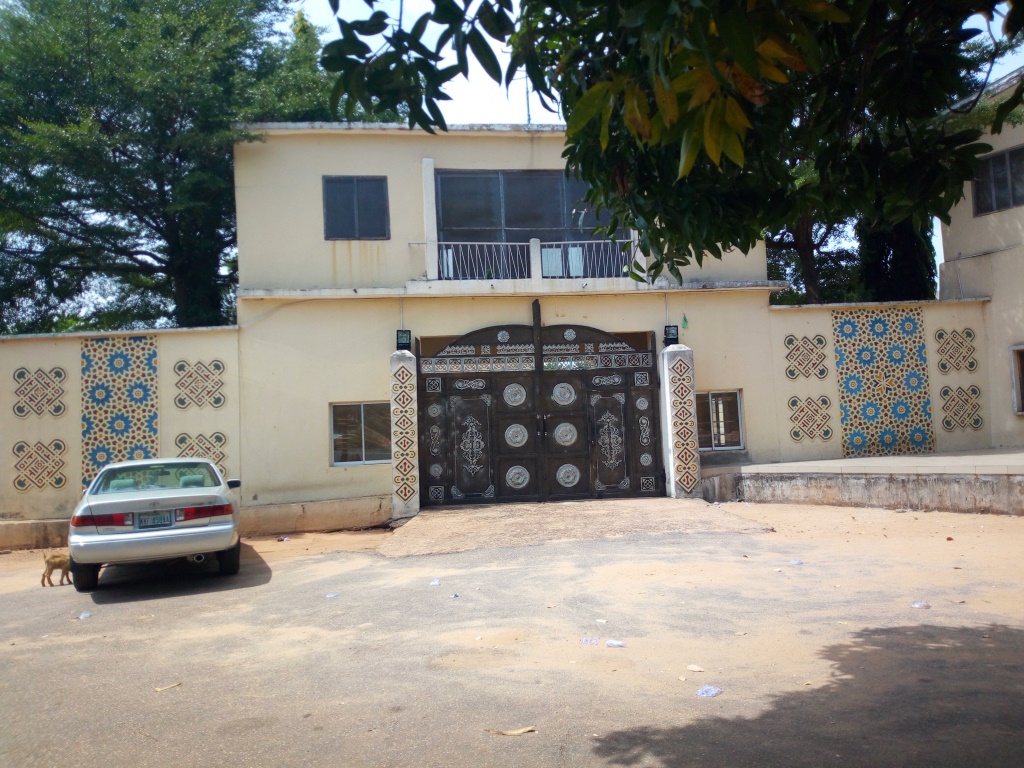
His palace is fenced with tall, elaborately decorated walls and an iron gate. It is also protected by a number of palace guards wearing a traditional uniform of bright red and yellow colours. At the time of visit, a politically themed lecture, amplified with loud speakers, seemed to be ongoing.
After asking to see the Ohimegye and making it clear the visit is about the recent flooding, this reporter was asked to wait outside and was eventually told he could not.
“You didn’t inform us you were coming,” explains a middle-aged man dressed in an overflowing white kaftan.
“That is the way we do things here,” he continues. “You have to inform us formally. You would have written, then we would give you date. What if he is not prepared? Honestly, you have to inform us first. There has to be prior notice.
“You should have written us on your letter head so it will be on record. You understand; it is not a place that you can just walk in and say you want to see His Royal Highness. He will not allow that.”
“He will not welcome you,” he adds, repeating the statement twice for emphasis.
Ohimegye’s palace, Koton-Karfe, Kogi State
FEMA: We have not started distributing relief materials
A look through the website and social media accounts of the FCT Emergency Management Agency (FEMA) appear to suggest that little or no action has been taken in reaction to incidents of flooding in the country’s capital territory.
The website has not been updated in 2018 except in September “as a result of earth shakings around some settlements in Abuja – FCT”. The only public statement released by FEMA and related to flooding is a tweet of September 11, acknowledging the death of one person and advising that people adhere to early warnings to avert loss of lives and property.
Some communities in the FCT were ravaged by flood disaster killing one person. We advised that people should strictly adhere to the early warning issued to avert loss of lives & Property. pic.twitter.com/kEUyoVvrwd
FEMA Director-General, Abbas Idriss, declined comment on how the agency intends to rehabilitate flood victims in the FCT. Instead, he directed the reporter to meet with Rachael Alkali Y., the agency’s Director of Relief and Rehabilitation.
Alkali in turn asked that the reporter be taken to see another official of the agency, who said he does not know whether an assessment has been carried out in Abaji and called in yet another employee for possible answers.
“We are working on so many things now,” said the other employee, who declined to provide his name because he does not want to be quoted.
“I was there last Friday, in the area council. You know government thing is a process. There are so many things. So, we are on it. And you can see the proactiveness, I was there on Friday and that was where I did all my work,” he added with hesitancy.
He said though there are “so many interventions” that were supposed to take place, the communities have yet to receive any relief materials. He added that Kwali and Abaji are the two primarily affected area councils, with many smaller communities tucked under them.
He replied in the negative when our reporter asked if he knows how soon the distribution of materials will take place.
“When I’m not the government,” he said. “I work with them, that it is. I have a minister, a director-general, a director. It is their work I’m doing, and I have been proactive. There’s a push to get things done. When? I don’t know. How soon? I hope soonest because it is overdue.”
Meanwhile, a document sighted by The ICIR, signed by FEMA’s Social Welfare Officer, Shuaibu Usman, and written to the Director of Relief and Rehabilitation, provides what it calls a follow-up update assessment on flooding in the FCT.
The document, dated November 12 2018, confirms that IDPs in the capital territory need the distribution of relief materials and says most of them are unwilling to return to their home states because of safety concerns. It also states that there is a “visible presence of IDPs” at various settlements in Abaji, and recommends the provision of food and non-food relief materials to those affected.
Silence from VP, Kogi govt.
On November 6, The ICIR contacted Laolu Akande, Senior Special Assistant to the Vice President Yemi Osinbajo on Media and Publicity, to confirm how the federal government intends to keep the vice president’s promises made during his visit to Koton-Karfe.
He did not answer calls or reply to text message.
Likewise, Kingsley Fanwo, director-general on media and publicity to Yahaya Bello, governor of Kogi State, neither answered calls nor responded to texts sent to his phone on November 8.
FORMER Governor of Rivers State, Peter Odili, has sued the former Chairman of the National Human Rights Commission (NHRC), Chidi Odinkalu, for allegedly defaming him in a new book he co-authoured.
The book titled “Too Good To Die: Third Term and the Myth of the Indispensable Man in Africa” which was written by Odinkalu and Ayisha Osori, tried to unravel what led to the failure of the notorious third term agenda of former President Olusegun Obasanjo.
But Odili, in the suit filed by his lawyer, Kanu Agabi, said the book have earned him public ridicule and scorn. He said that as a recipient of numerous local and international awards, there was no way he could have been involved in the numerous crimes Odinkalu and Osori accused him of in their book.
For instance, the book narrated the story of the late Harry Marshal, a politician that was assassinated shortly after he fell out with Odili. The book cited a letter that Marshal wrote to the police at the time to report the many violent attacks against his party, the All Nigerian Peoples Party (ANPP). Marshal, in the letter, said that the attackers were thugs loyal to Odili and were being supported by the police.
The book also claimed that the bulk of the funds which Obasanjo used to canvass for his failed third term bid were supplied by Odili and Adamu Muazu, who at the time were the Governors of Rivers and Bauchi States respectively.
Odili demanded that Odinkalu and Osori pay him N1 billion in damages, as well as a published apology and an end to further publication of copies of the book.
When contacted, Odinkalu said he could not react to the development as he was not aware of the suit.
Osori and Odinkalu are currently working with the Open Society Initiative West Africa (OSIWA) as the Executive Director and Senior Legal Officer respectively.
THE Bayelsa State chapter of the All Progressives Congress (APC) has described the state airport project being undertaken by the Seriake Dickson administration as a “cesspit of fraud”.
Doifie Buokoribo, the Publicity Secretary of the APC in Bayelsa State, made the allegation in a statement, saying that the project “is a fraudulent scheme put up by Governor Seriake Dickson to facilitate the syphoning of state funds”
Buokoribo said the cargo airport project has no economic value to the state and that the total cost has been over bloated.
He said the governor borrowed N40 billion from a bank to begin work on the project, but the same governor, during a visit to Amassoma community in Southern Ijaw Local Government Area, told the people that the sum of N80 billion has so far been spent on the project.
Buokoribo said the N80 billion loan, when added to the N32 billion interest it will accrue, “the cost comes to N112 billion”.
“It is clearly the most expensive airport project in Nigeria, as none of the 26 owned by the Federal Government or the eight owned by States is near that figure,” the statement read.
“The Bayelsa International Airport project does not make any economic sense. A total interest of N32 billion (to be serviced within eight years) is a crippling repayment burden to the State.”
The Bayelsa APC spokesman further alleged that the conceptualization of the Airport was faulty as it leaves the airport without a standard road network or connecting rail system.
Dickson responds
In a statement forwarded to the ICIR on Friday by the Bayelsa State Commissioner of Information, Daniel Iworiso-Mackson, the state government said: “it would only take a band of unconscionable political desperadoes to criticize the well conceptualized and effectively executed Bayelsa International Airport”.
He urged the public to disregard the APC which, according to him was being manipulated by Timipre Sylva, former Governor of the State.
However, Iworiso-Mackson did not address any of the allegations raised in the APC statement.
The Bayelsa Cargo airport was scheduled to be commissioned by President Muhammadu Buhari in August this year, as announced by the State Government in July, but that did not happen.
At the time, the airport was said to be 95 per cent completed, as the runway and terminal were already in place.
How much does a new airport cost?
The ICIR does not know the total cost of the Bayelsa Airport project. Calls to Iworiso-Mackson were not answered, and when a text message sent to him asking for the information, he simply referred to the press statement already quoted above.
However, in April this year, the Minister of State for Aviation, Hadi Sirika, told a joint National Assembly committee that it would cost an upward of N67 billion to construct a second runway for the Abuja International Airport.
It is not clear how long the proposed new runway will be, but the Bayelsa Airport runway is said to 3.5 kilometres long. Assuming the new Abuja airport runway will be the same distance as that of Bayelsa, the cost could be higher given the location.
In April 2017, the Prime Minister of Dominica Republic, Roosevelt Skerrit, said it would cost the country $220 million to construct a new international airport. That is about N67.1 billion, using the official rate of N305 to $1.
According to africanaerospace.aero, several airport projects are springing up across Africa, each estimated to gulp hundreds of millions of dollars.
Rwanda is constructing the Bugesera International Airport at $818 million, the construction to split the Blaise Diagne International Airport in Dakar, Senegal, into two phases, is expected to cost $560 million, Tanzania’s new US$300 million terminal is due to open in June 2019, while the Zambian government is planning to spend US$500 million in airport construction projects in Lusaka.
OBY Ezekwesili, the presidential candidate of the Allied Congress Party of Nigeria (ACPN) has faulted The ICIR’s fact check on her claim that from the year 2000 till date, Nigeria has never reduced the number of out-of-school children except the period she was the minister of education between 2006 and 2007.
Ozioma Ubabukoh, the senior media consultant for OBY4PRESIDENT2019 wrote in response to the story on Friday that The ICIR needed to educate itself on the mathematics of numbers and rates.
“Omeje and the ICIR need to educate themselves on the mathematics of numbers and rates. The rate of OOSC is the number not enrolled in school as a percentage of the population of school age kids. Rates can drop even if the absolute numbers are increasing, depending on how many more children are entering into the school-age population,” Ubabukoh said.
He explained that: “all these data sources corroborate Ezekwesili’s facts on the progress made in just 10 months under her deliberate leadership, yet Omeje and his editors at ICIR were so bent on propagating a false narrative that they ignored all of that. Instead of analysing the accurate facts she gave about the NUMBERS of OOSC, they chose to fact-check her on the RATES of OOSC, something she did not reference at all in her entire speech
“Let us attempt a quick maths class for Omeje and the ICIR: If there are 6 out of 9 school-age children out of school in a small town this year, and next year the number of out of school children increases from 6 to 7 while the number of school-age children increases from 9 to 11, it means that the percentage/rate has dropped from about 68% to 64% even though the absolute numbers actually increased.
“Ezekwesili was clear about what she was measuring – the absolute NUMBERS – but Omeje and the ICIR were so bent on pushing an agenda that it blinded their eyes to her point. Again and again, the poor ICIR story kept repeating claims about “the percentage of out-of-school children,” and it left us all bewildered. How did the fact-checking shift from the first paragraph of the story which was talking about “numbers” to manufactured claims about percentages?
“A call from the campaign to the author of the piece explaining that there is a difference between percentages/rates and absolute numbers was not enough to convince the ICIR on the wrong-headedness of its claims. That is journalism at its worst and the ICIR needs to do better.
“For a start, we demand a retraction of that terrible story and an apology from the ICIR to the ACPN candidate. This must be given as much prominence as the shoddy story. Going forward, the platform needs to do a better job at its reporting and editing, especially in a high-stakes season like this when falsehoods can spread faster than facts.”
The ICIR’s position
It is true that Ezekwesili did not refer to percentage in her claim in the reduction of the number of out-of-school children but there is no reliable actual figures of out-of-school children in Nigeria. Basing her claim on actual figure is misleading. And this is why.
First, the UNESCO’s estimation started from 1999 to 2010. There is no record from 2011 to 2018. However, Ezekwesili’s claim is from the year 2000 to 2018. Therefore, how do we get figures from 2011 to 2018 to back up her claim?
Second, the UNESCO’s estimation was based on the Multiple Indicator Cluster Survey (MICS). MICS gives a percentage of out-of-school children based on the sample population. MICS is conducted at five years interval.
Third, UNESCO made an estimation that there were 10.5 million out-of-school children in Nigeria in 2010. The UNESCO’s estimation gave actual figures of out-of-school children from 1999 to 2010. However, in 2014, UNESCO reversed its earlier estimation. The new estimation now shows that Nigeria had 8.7 million out-of-school children in 2010.
Fourth, The ICIR could not access the models that the UNESCO Institute for Statistics used to arrive at the actual figures from 1999 to 2010. The actual figure of out-of-school children can be gotten by extrapolating the percentage of out-of- school children from the estimated population of school-age children in the country. There are different statistical modelling which will give different figures of out-of-school children based on the percentage of out-of-school children.
Fifth, since the UNESCO’s estimation stopped at 2010, the official available records are the MICS of 2011 and 2016/2017. The 2016/2017 MICS, the fifth of its kind in Nigeria, indicates that 27.2 per cent of 33, 647 sampled children were not attending any of preschool, primary and secondary school.
Sixth, no other credible organisations have made projections like UNESCO did between 1999 and 2010 to arrive at the actual figures from 2011 to 2018. Therefore, to examine the number of out-school-children, the most reliable means is the percentage of out-of-school children. The ICIR’s fact check clearly showed that Nigeria recorded the highest reduction in the percentage of out-of-school children in 2007 but it was not the only time the country did so. There was a steady decrease in the percentage of out-of-school children from the year 2000 until it shot up in 2008.
Seventh, it is misleading for Ezekwesili to use the estimation by UNESCO to claim achievement when the UNESCO’s estimation stopped in 2010. UNESCO even had to reverse its estimation once and arrived at different figures. Based on the available official records, the most reliable means to show the reduction of out-of-school children is the percentage. With this percentage, different figures of out-of-school children can be arrived at based on certain statistical modelling.
Eight, The ICIR reached out to Ezekwesili to refer it to the records that back up her claim. She replied in text message the next day, asking for an email. The email was sent to her but she never sent any email even when she was later reminded after about five hours.
Ninth, if eventually Ezekwesili sends the records that back up her claim that “from the year 2000 till today – that is a period of 18 years – the only time that the number of out-of-school children in this country reduced was when I was education minister,” The ICIR will make corrections on the fact check.
THE Court of Appeal has reduced the 14 years imprisonment sentence handed to the former Governor of Plateau State, Joshua Dariye, to 10 years.
Dariye was sentenced to seven years imprisonment each on two counts of corruption charges brought against him by the Economic and Financial Crimes Commission (EFCC). He was accused of helping himself to Plateau State’s Ecological Funds while he was Governor of the State.
At the time he was convicted in June this year, Dariye was a serving Senator representing Plateau Centra Senatorial District.
But on Friday, the Appeal Court held that Dariye, being a first time offender, ought not to have received the maximum punishment for the crime of which he was convicted.
The court ruled that the Administration of Criminal Justice Act (ACJA) stipulates that a first time offender should be given a lighter sentence, hence it reduced the 14-year jail sentence to 10 years, five years each for the two of the charges.
THE Independent Corrupt Practices and Other Related Offences Commission (ICPC) says it is investigating the Nigerian Broadcasting Corporation (NBC) over the alleged misappropriation of a N2.5 billion seed grant released to the agency by the federal government for its digital switch-over programme.
The Minister of Information and Culture, Lai Mohammed, and the Director General of the NBC, Modibbo Kawu, were said to have approved payment to a private company for the digital switch-over programme, in contravention of a government directive that the process should be handled by government-affiliated companies.
Though the funds had been released, there was no evidence that the job for which it was released was carried out.
According to a statement issued on Thursday by the ICPC spokesperson, Rasheedat Okoduwa, the federal government released the sum of N10 billion in 2016 to the Ministry of Information and Culture for the digital switch-over programme which was aimed at migrating telephone lines from analogue to digital platforms.
To actualise the programme, a white paper was issued by the information ministry, directing that the process should be handled by government-affiliated companies.
Two companies were nominated to handle the process, one of which was ITS, an affiliate of the Nigerian Television Authority (NTA), and the sum of N1.7 billion was released to it as a grant for the commencement of the switch-over.
According to ICPC’S spokesperson, Rasheedat Okoduwa, investigations revealed that the process was fraught with alleged corrupt practices, as the NBC DG, Kawu, allegedly recommended a private company called Pinnacle Communications Limited, to the Minister, Lai Mohammed, to do the job.
The sum of N2.5 billion was released to the company, paid into its Zenith Bank account between May and June 2017, against the guidelines contained in the white paper.
In the course of the investigation, Kawu, as well as some other top management staff of the NBC were invited by the ICPC to explain their involvements in the alleged misapplication of the fund, but he could not satisfactorily explain why he flouted the directives contained in the white paper and released money to an unqualified company.
Also, during interrogation, the Managing Director of Pinnacle, Dipo Onifade, confirmed that money was released to his company, but he could not justify that the money was used for the purpose of digital switch-over.
“The Commission through investigation discovered several suspicious transfers of large sums of funds from the account of the company into the bank accounts of several organisations and individuals,” stated ICPC’s spokesperson, Okoduwa.
“It found out that N100 million of the fund was paid into the personal bank account of Mr. Onifade in Zenith Bank which he claimed was for legal services that he had rendered to the same Pinnacle Communications where he is employed.
File Photo: Mohammed and Kawu approved payment of N2.5 billion to a private company for the digital switch-over programme, in contravention of a government directive, says ICPC.
“Also investigation revealed that another N450 million was transferred into the account of Sabdat Investment Limited, a Bureau de Change, which then converted the money into dollars and handed it over to the Chairman of Pinnacle Communications Limited, Mr. Lucky Omoluwa, in his Kaduna residence as he usually did with other funds.”
The ICPC statement added that Omoluwa refused to honour invitations to come and explain his role in the alleged fraud. He rather filed a lawsuit before the Federal High Court, Abuja, seeking to stop the investigation as well as unfreeze the Zenith Bank account of the company that was frozen by ICPC.
The court, however, ordered him to first present himself to the ICPC before the next adjourned date of 3rd December 2018.
“In compliance with the court order, Omoluwa has appeared before the Commission where he made useful statements to investigators,” Okoduwa stated.
The ICIR called Mr. Mohammed several times between 7:56 pm and 8:13 pm but he did not answer the calls. He also did not respond to the SMS sent to him at 20:06 pm.
THE immediate past President of Nigeria, Goodluck Jonathan will be launching his latest book, an autobiography titled ‘My Transition Hours’ on Tuesday, November 20, 2018.
When the book is eventually made available to the public, it will be the first comprehensive first-hand narrative of the happenings in the Nigerian presidency which culminated in Jonathan conceding victory to President Muhammadu Buhari having lost the 2015 presidential election.
Of the books that have been published on the Jonathan presidency by individuals who played significant roles in the administration, three stand out. One is titled “Against The Run of Play: How an incumbent president was defeated in Nigeria“, written by Olusegun Adeniyi, a spokesman to the late former President, Umaru Yar’Adua.
Adeniyi’s 221-page, 12-chapter book told the story of the remote and immediate, human and institutional factors that saw the then ruling Peoples Democratic Party (PDP) ousted from power. It was a major hit when it dropped.
But Jonathan describedthe book as containing “many distorted claims on the 2015 Presidential election”, and assuredthat “at the right time, the main characters in the elections including myself will come out with a true account of what transpired”.
The other book with the title, “Facts Versus Fiction: The True Story of the Jonathan Years, Chibok, 2015 and the Conspiracies“, was authored by Reno Omokri, who served as a Special Adviser to Jonathan on New Media.
Reno Omokri was Jonathan’s Special Adviser on New Media.
The book received Jonathan’s endorsement when it was released in June 2017, as the ex-President describedit as containing “the whole truth and nothing but the truth about my administration”. The book was rated among the top 20 books of 2017, according to Channels Television.
The third book was written towards the end of 2017, titled “On a Platter of Gold: How Jonathan won and lost Nigeria”. It was written by Bolaji Abdullahi who served in Jonathan’s cabinet as the Minister for Youth Development, and later, Minister for Sports. The book told the story of Jonathan’s meteoric rise from a humble University lecturer to the highest office in the land.
Abdullahi was removed from office in 2014 and followed his “godfather”, Bukola Saraki, to the APC at the height of the politicking that heralded the 2015 general election. Both men, however, are back in the PDP at present.
One thing that can be guaranteed with the forthcoming release of Jonathan’s latest book is that it will throw up issues that will form topics for discussions and analyses leading into the 2019 general election.
NIGERIANS have expressed worry over the non-release of the 2018 unemployment data by the National Bureau of Statistics (NBS), but the head of the bureau, Yemi Kale, said lack of funds was stalling the process.
The last time the unemployment data was released was that of the third quarter of 2017, and it showed that Nigeria’s unemployment rate stood at almost 19 per cent (18.8 per cent precisely), the highest since 2010.
It also showed that the unemployment rate has more than doubled since 2015 when President Muhammadu Buhari took power. It’s been more than one year now since that data was published.
Many say the Buhari administration is deliberately refusing to release the current unemployment data because the figures must have increased further, which would be bad news for an administration that claims to have done so much especially with regards to job creation and reducing unemployment, and is using that as a basis for seeking a second term in office.
Graph of the unemployment figures in Nigeria as at Q3 2017. Graph by Bloomberg.com
On Monday, a Nigerian whose Twitter username read simply as ‘Chxta’, took the issue to the social media when he tweetedthe following: “These are facts: Under this government, Nigeria’s economy has shrunk. Under this government, unemployment has doubled from 9.9 per cent in mid 2015 to 18.8 per centin Q3 2017. Since then, no more unemployment reports. They will try to distract you, but eye on the ball. We are worse off.”
Chxta (whose real name was later revealed by Yemi Kale as ‘Cheta’) was supported by Boasan Omofaye, a popular business journalist and broadcaster who currently heads the business desk of Channels Television. Omofaye tweetedthat the government “dare not release our quarterly unemployment report”, adding that “by the time Trader Moni is well circulated, you will see the millions of new jobs figures that would be rolled out.”
To the above tweets, Yemi Kale, the Director General of the NBS, replied that there was no politics in the non-release of unemployment so far in 2018, but that the process was being stalled because of lack of funds.
“Nobody is calling me to manipulate any data or not to release any data. The work can’t be completed due to budgetary releases. It’s not hard to confirm when last we got data funding and how much,” Kale tweeted.
Kale went on to try to justify FG’s inability to make funds available to his agency. He said “there are other equally or even more important work competing for same limited funding. I assume when funds are available we will be funded”.
NBS Budget
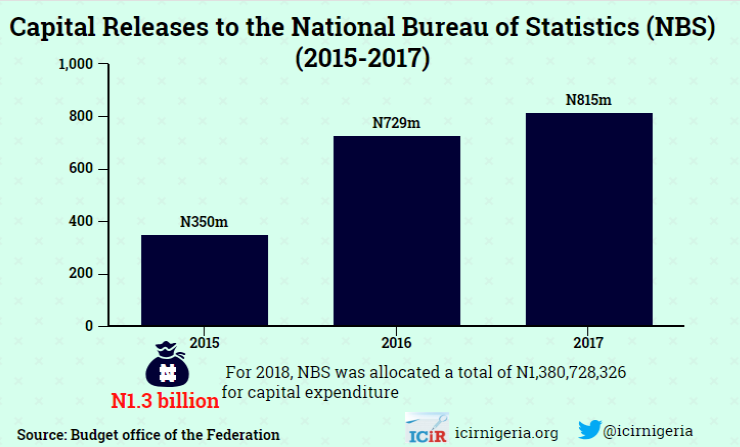
In the 2018 budget, the NBS was allocated a total of N1.38 billion for capital expenditure. This is about N300 million higher than the N1.03 billion that was budgeted for the Bureau’s capital expenditure in 2017.
Out of the 2017 capital budget, about N815 million or 79.1 per cent was released to the NBS, and all was spent, according to documents from the office of the Accountant General of the Federation.
The figures also show that the NBS got almost all its budgetary allocation for capital expenditure in 2016 – N729.6 million out of the budgeted N730.3 million–, and all of the N350,000,000 capital allocations in 2015.
TheICIR is not certain how much that has been released to the NBS so far in 2018, as the fiscal year just commenced with the signing of the appropriation bill into law in July.
What is more important than data?
Assuming Yemi Kale is right that lack of funds was stalling the undertaking of critical researches to generate accurate data to aid government’s policy and decision making, Nigerians are asking what higher priorities the government have that trumps the generation of accurate data?
“All works are important but some are ‘more important'”, tweeteda user by the name Earthtribeboy. “Without data, we’re like the blind. We can’t know which sector is doing well and which needs help. Ministers can’t develop job policies,” he added.
Another tweetby AfricaUpdates read: “This is very alarming. Lack of funding to such a vital part of the Government. So how does the Government even plan without having or using reliable Data from its main statistics body? You wonder if the lack of funding is by design in order to allow the graft to flourish.”
And yet another Twitter user wrote: “Timely release of such important data contributes to improved investor confidence for one. Policymaking without crucial data is like running blindfolded. This makes you wonder what the government has been using as a guide for its policy decisions.”
Perhaps, it was the tweet by one Ayo Alabi that offered a more believable reason as to why the NBS lacks funds to carry out its responsibilities.
He wrote: “We know you cannot manipulate figures. But any average person on the street knows unemployment is on the rise and NO JOBS are being created under this government. If the government is creating jobs, they will definitely be eager to release the figure (and fund your agency).”


![Kogi flood victims who lost everything are still homeless, broke despite govt. promise… [1]](https://www.icirnigeria.org/wp-content/uploads/2018/11/IMG_20181102_121337-e1542011318231-boost-768x455.jpg "Kogi flood victims who lost everything are still homeless, broke despite govt. promise… [1]")









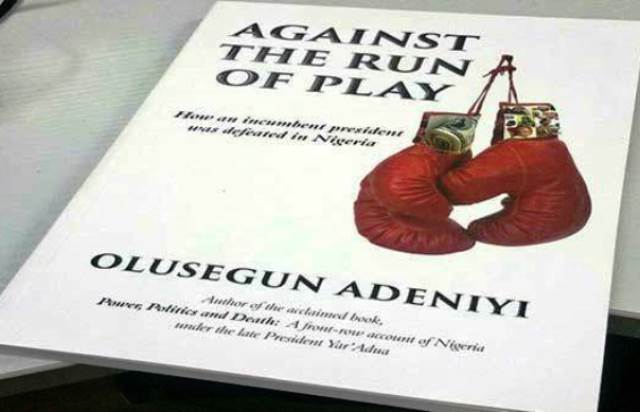 Adeniyi’s 221-page, 12-chapter book told the story of the remote and immediate, human and institutional factors that saw the then ruling Peoples Democratic Party (PDP) ousted from power. It was a major hit when it dropped.
 Abdullahi was removed from office in 2014 and followed his “godfather”, Bukola Saraki, to the APC at the height of the politicking that heralded the 2015 general election. Both men, however, are back in the PDP at present.