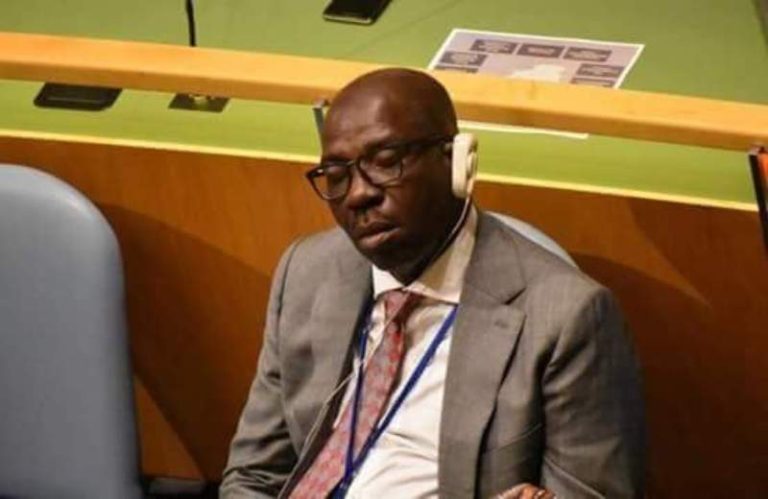
CRUSOE Osagie, the special adviser to the Governor of Edo State, Godwin Obaseki, on media and communication strategy, has described the pictures of Obaseki sleeping at the United Nationa General Assembly (UNGA) as the handiwork of “idle hands and mischievous minds”.
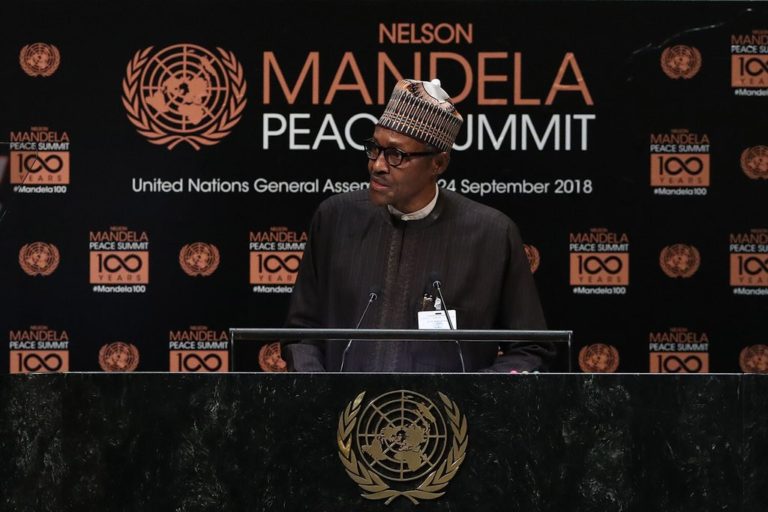
Obaseki was pictured yawning tiredly and dozing off while President Buhari was delivering his speech at the event, but Osagie said his principal was just being human. He noted that the governor, having had a lot of work to do in Edo State, and also enduring a long flight to New York, could not help but give in to the force of nature.
“Our attention has been drawn to a mischievous campaign designed to smear the image of the Edo State Governor, Mr. Governor Obaseki,” Osagie stated.
“The disparagers have populated the internet with photographs of the governor when he momentarily succumbed to fatigue after a long flight, preceded by a chaotic itinerary in Edo State before heading to New York for the 73rd session of the United Nations General Assembly, in the United States of America.
“The idle hands and mischievous minds behind the smear campaign against governor Obaseki are clearly not people to be taken seriously.”
Osagie criticised the people sharing pictures of the sleeping governor, wondering why they would not share pictures of the governor when he was carrying out his duties. He also pointed out that pictures of renowned world leaders dozing off during major world events abound on the social media.
Obaseki is one the politicians that accompany President Buhari to the 2018 UNGA, taking place in New York, United States of America. Also accompanying the president on the trip are his wife, Aisha, and several ministers.
THE Independent National Electoral Commission (INEC) has clarified the reports about one of its staff alleged of tearing a result sheet of a particular local government area during the inconclusive governorship election in Osun State on Saturday, September 22.
Olusegun Agbaje, the State’s Resident Electoral Commissioner, gave the clarification via a press statement he issued on Tuesday.
The ICIR had reported how an INEC official, Salau Kolawole, was arrested for allegedly tearing the result sheet of Ayeedade Local Government Area where the PDP had been reported to score more votes than the APC.
But Agbaje said the report was a misrepresentation of events. He explained that there was an error in the result that was earlier pasted at the polling unit, and Salawu was instructed by his superior, Aderinoye Alice, to remove the erroneous copy and paste the correct one. But a mob attacked Salawu while he was carrying out the directive and started humiliating him.
During the interrogation of Kolawole which was widely shared in the social media, the suspect did not say the result was removed because it was fraught with error, as Agbaje later explained.
Read Agbaje’s full statement below:
Gentlemen of the Press
The Commission wishes to put the record straight in respect of the issues that have gone viral on the conduct of one of our staff, Mutiu Salawu, in Ayedaade LGA on Sunday 23′ September 2018 at the St. Patrick Grammar School Gbongan around 8am after the submission of Results of the Election by the Ayedaade Local Government Collation Officer at the State Collation Centre.
The Electoral Officer for Ayedaade LGA Mrs. Aderinoye Olukemi Alice, on the information she received from the Local Government Security Chief (LGSC), that there was an error on the Form EC 60 (E) INEC PUBLICATION OF RESULT OF POLL Poster, pasted at the Local Government Collation Centre i.e St. Patrick Grammar School Gbongan, and after crosschecking the results sheet for the collation EC 8C to confirm the information, called her staff Mutiu Salawu, to remove the pasted EC 60 (E) poster with error and replace it with a correct one.
Mr. Mutiu Salawu being a dutiful staff went to carry out the lawful instruction of his boss when he was accosted by a mob that rough handled him before they took him to Adelani Rafiu Oyediran Ajanaku’s house along the New Gbongan Osogbo Road. There he was humiliated, harassed and subjected to take manipulated photographs that were sent to various social digital platforms. He was then brought to the INEC State Office where he was harassed by some section of the media.
Let me at this juncture put the record straight and inform the good people of Osun State and Nigerians, the correct position of the event:
The LGA Collation Officer Prof. Adeagbo accepted the fact that there was an error in the EC 60 (E) pasted at the LGA Collation Centre especially the figure (10,836) recorded for PDP on the poster which is different from the actual votes scored (9,836) by the PDP.
It should be noted that the INEC staff, Salawu, Mutiu Kolawole did not destroy the Result Sheet for the said election for they are intact in the custody of the Commission and copies of same are with agents of the 48 Political Parties that contested the Governorship Election.
The Commission is displeased with the conduct of a section of the press that repeatedly broadcast the event maliciously without proper investigation to know the true position of things. This attitude has misinformed the public and INEC has been misrepresented in the narrative.
Let me also clear the misconception about the number of Registered Voters in the Polling Units where we are going to have the supplementary election on Thursday, 27 September, 2018 between the hours of 8:00am and 2:00pm:
S/N
LGA
RA
RA
CODE
PU WHERE ELECTION WAS NOT HELD/ CANCELLED
NUMBER
OF REG.
VOTERS
REASON
1.
Ife North
Oyere II
10
002 Alapata Village
353
Number of votes was more than accredited voters
2.
Ife South
Olode
07
012 Adereti Village
812
Disruption of election by hoodlums who shot sporadically and in the process of scampering for safety the Presiding
Officer misplaced the
form EC8A for the PU and all efforts to get it proved abortive
3.
Ife South
Osi
08
010 Alutu Erin Primary School, Albert village
502
Manual accreditation
4.
Orolu
Olufon Orolu H
08
001 Kajola village
393
Hijacking of materials by thugs
5.
Orolu
Olufon Orolu H
08
004 !di lya village
387
Hijacking of materials by thugs
6.
Orolu
Olufon
Orolu I
09
003 Gbogbo Primary
School
167
Hijacking of materials by thugs
7.
Osogbo
Ataoja E
05
017 Adewole Street
884
Abscondment of the Presiding Officer
TOTAL REG. VOTERS
3,498
Registered voters in PUs where election did not hold/cancelled
On this note, I want to reassure all Stakeholders in the Osun Governorship Election that the present INEC under the leadership of Prof. Mahmood Yakubu will never jeopardize the goodwill and credibility which the Commission has attained in the conduct of elections in Nigeria. We will continue to ensure that every vote counts and access will be given to all in the process.
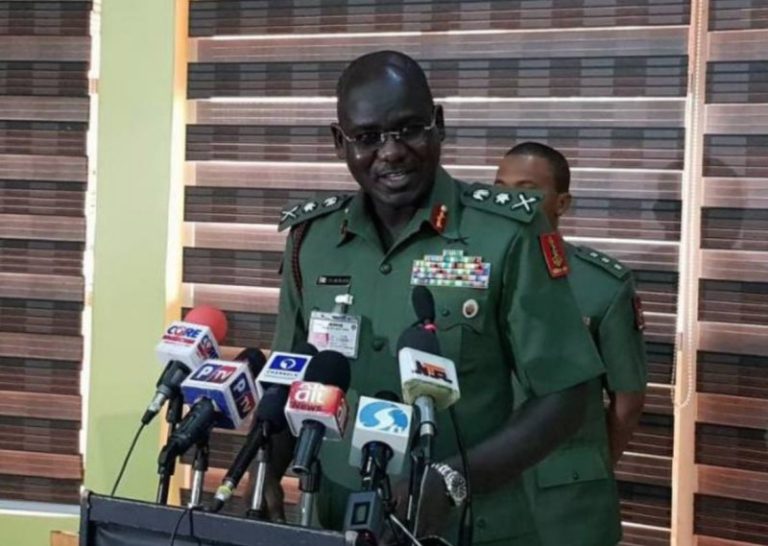
THE Chief of Army Staff (COAS), Tukur Buratai, says he will pay more attention to the issue of inadequate kits and protective gears for soldiers in the fourth quarter of 2018.
Buratai said this during his opening speech at the Chief of Army Staff combined second and third quarters conference in Abuja on Tuesday.
Soldiers taking part in counter-insurgency operations in the North East have complained about lack of kits and gears, some saying that they have had to go into the battlefront wearing ordinary slippers because they had no boots.
In a recent investigation sponsored by the ICIR, soldiers in Borno State lamented that they were being owed several months in Salary allowances and that they were once told that the monies being owed them would be used to procure uniforms and protective gears for them.
“We were even once told that part of the money owed us would be used to buy our uniforms. We were also assured of getting camouflage T-shirts, rather, what we were given were Etisalat branded T-shirts. And when the uniforms came, if you get a trouser, you will not get the shirt. If you get camel bag, you will not get knee guard,” a soldier who pleaded anonymity said.
“In NAPEX (Nigerian Army Post Exchange), the store where military uniforms are being sold, each goes for about N25,000. But then, how much is an average soldier’s salary? So, that is why we put on anything we have. And we do that even in the war front. Soldiers who don’t have desert boots and can’t buy a canvass, wear slippers.”
But on Tuesday, Buratai said all that will soon change as he will prioritise the issue of improved welfare, kitting and protective gears for soldiers, especially those taking part in several operations across the country.
He said: “I am aware of the logistics constraints affecting our operations across the country particularly operation LAFIYA DOLE. I am glad to inform you that the President, Commander-in-Chief has assured that all our requests will be given priority and expeditious approval.
“I, therefore, want to emphasize that kitting, protective gear, additional equipment/platforms, accommodation, welfare and other logistics provisioning would be one of my top priorities in the procurement plan for the fourth quarter of the year.
“I must add that it is a command responsibility to ensure good maintenance of equipment and sound administration as well as the welfare of troops and their families
“The Army Headquarters will continue to provide the needed logistics for all ongoing operation. Commanders must also ensure the maintenance and serviceability of equipment in their charge.”
Buratai insists that the war against Boko Haram, as well as the several operations to curb all other forms of crime in the country, has recorded “tremendous achievements”. He called the commanders of the operations to ensure that “these successes must be sustained and consolidated”.
Buratai also frowned at the incidences of drug and substance abuse by officers and men of the Nigerian Army, saying that it poses a serious threat to the operational capabilities and effectiveness of the force.
“There is the need for commanders to be more proactive in identifying the perpetrators of drugs and substance abuse and applying the right sanction to serve as deterrence to others,” he said.
The COAS also announced the establishment of the Nigerian Army Women Corps, which is aimed at “reorganizing the women in order to derive the maximum benefit from their contribution to the defence and security architecture of our country”.
“It is also meant to exploit the inherent competencies and capacities of the female officers and soldiers to meet the contemporary security as well as operation environment in line with best military practice. It would also enable them to aspire to get to the peak of their career without inhibition,” Buratai said.
THE impeachment of the Imo State Deputy Governor, Eze Madumere, from office has been declared illegal by the State High Court on Tuesday.
Madumere was impeached from office on July 31 of this year by 19 out of the 27 members of the State House of Assembly following an allegation of misconduct.
He was accused of abandoning his duties for a long time and refusing to carry out official duties assigned to him by the governor, as well as an alleged concealment of felonious acts in the United States.
The high court sitting in Owerri, Imo state capital, ruled that the impeachment did not follow due process, therefore making it illegal.
The presiding judge, Justice Benjamin Iheka, who made the announcement on Tuesday, ordered Madumere to resume office as the Deputy Governor of the state.
Justice Iheka blamed the state’s Chief Judge Pascal Nnadi who set up a seven-man committee against Madumere and Miletus Nlemadi, the commissioner of Justice for not complying with 188 sub-section 5 of the 1999 constitution as amended.
The constitution stipulates that the Chief Judge must set up a 7-man panel of inquiry within 7 days but on the contrary, the Chief Judge did after 9 days, which according to the constitution makes the impeachment process invalid, null and void.
There has been a crisis between Madumere and governor Rochas Okorocha, following the former declaration to vie for the post of the governorship in 2019. While Mr Madumere insists on running for governor on the platform of the governing APC, Mr Okorocha reportedly backs his son-in-law, Uche Nwosu who is also the current chief of staff as his likely successor.
THE Trade Union Congress (TUC) says the organised labour would commence an indefinite strike from the early hours of Thursday, September 27, due to the failure of the federal government to honour its ultimatum on the new minimum wage.
This is according to a statement issued by the Secretary-General of the union, Musa-Lawal Ozigi, in Abuja on Tuesday. Ozigi said the decision was sequel to the resolution of the Central Working Committee of TUC on Monday.
“Strike is hereby declared to commence from early hours of Thursday, Sept. 27, 2018,” Ozigi stated, adding that the TUC leadership would take all necessary action to effect the ultimatum on the new minimum wage in collaboration with other stakeholders.
Ozigi called on state councils of the TUC to form joint strike implementation committees that would also include members of the Nigerian Labour Congress (NLC), and other stakeholders in the state to ensure effectiveness.
He called on union members to be alert for a further directive on or before Thursday.
The organised labour, in a meeting on September 12, had urged the federal government to show more commitment and hasten the implementation of a new minimum wage.
The NLC President, Ayuba Wabba, at the time, said that Labour was not pleased with the Minister of Labour and Employment, Chris Ngige, who had asked the negotiating committee to adjourn indefinitely to give room for further consultations with the government on the new minimum wage.
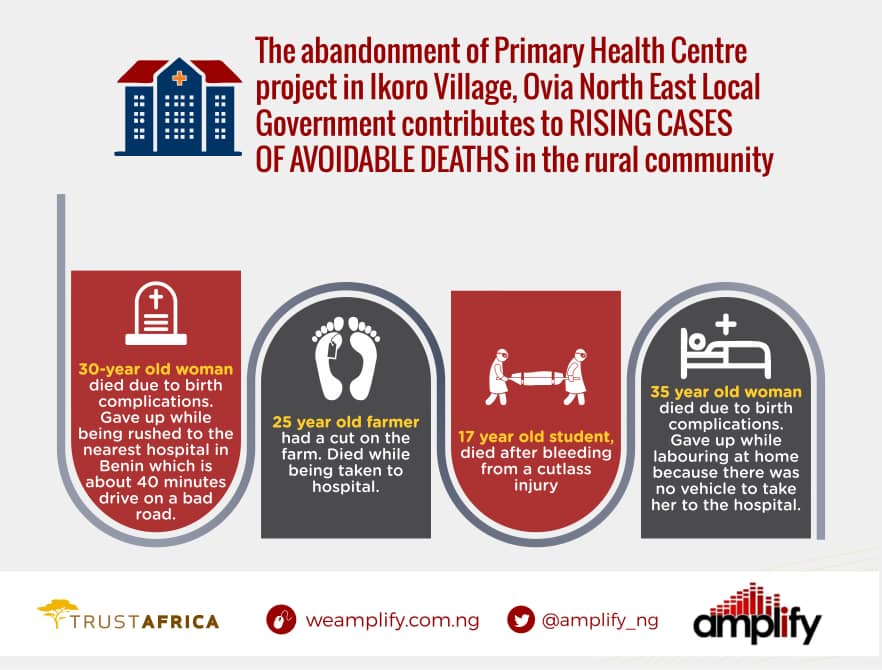
ELIZABETH was only four when death forcefully took her from the hold of her ageing parents, Mr and Mrs Patrick. She had suddenly developed typhoid. But as they rushed her to the nearest hospital in Benin, which was miles away, the young girl passed on, leaving her loved ones and the entire community with deep sorrow.
In March, Raphael Pamonghan, a 34-year-old timber farmer also unexpectedly bade his wife and children goodbye. While felling trees on his farm, he had an accident and fell unconscious. His breath ceased during the long, bumpy ride to a healthcare facility.
Precious Oweduette, a 17-year-old boy, was in primary six when he also died in similar circumstances after sustaining a cutlass injury.
Like Elizabeth, Raphael and Precious, many residents of Ikoro community, both young and old, have died unexpectedly. From 2-year-old Blessing Patrick who died of measles to 30-year-old trader, Bibi Moses, who died during childbirth — it is estimated that over thirty persons have died since 2014 directly as a result of lack of prompt medical attention.
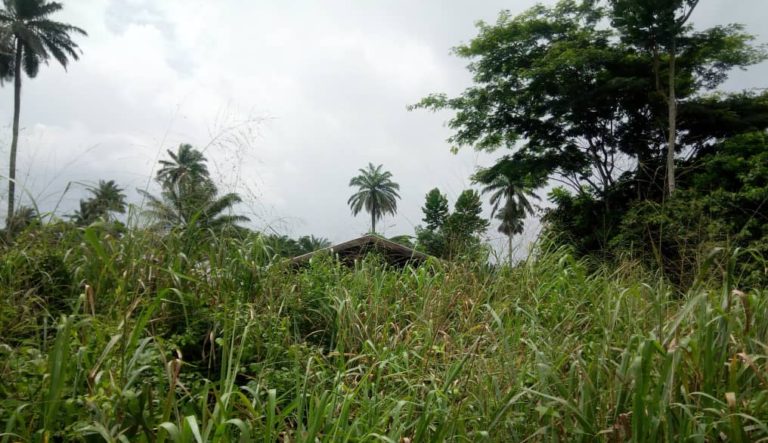
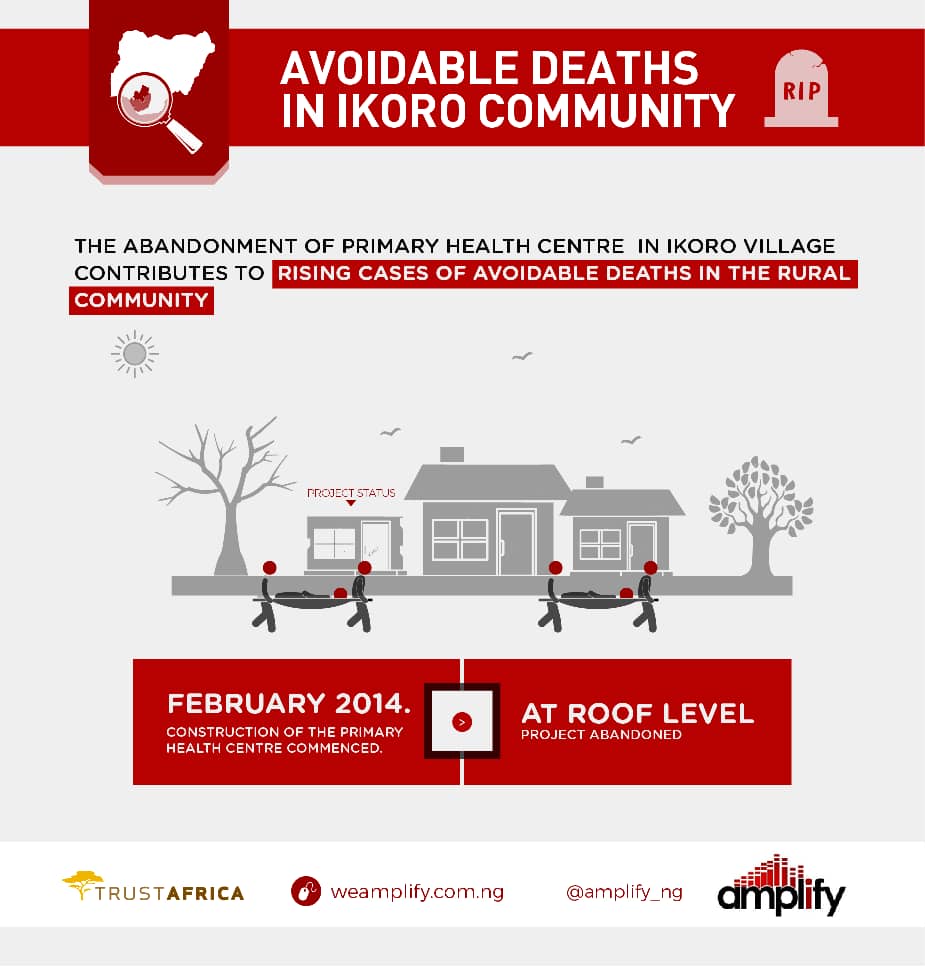
Some of these deaths could have been prevented had the Primary Healthcare Centre (PHC) in the community been functioning. Constructed by the Edo State Oil and Gas Producing Area Development Commission (EDSOGPADEC) in 2014 up to the level of roofing, the facility has been abandoned ever since.
Photo credit: Amplify
There is no longer an access road to the major clinic located at Ikoro, a community in Ovia Northeast Local Government, Edo State— and with each passing day, it is fast becoming a wasted facility.
Segun Sero, a native of the community who also serves as its secretary, told The ICIR that EDSOGPADEC only built the centre halfway and then abandoned it. As a result, he said, women in the community mostly give birth using the traditional method which has in some cases led to the loss of life.
There are cases of women falling into labour, and giving up the ghost before they are rushed to the nearest hospital in Benin — about an hour away. “Not only is the distance very far, but the road is also in deplorable conditions.”
He added that, as palm-wine tapping is a popular occupation in the area, it is common to see tappers sustain injuries after a fall, “and before we rush them to the hospital, they are gone.”
Abandoned Primary, Secondary Schools
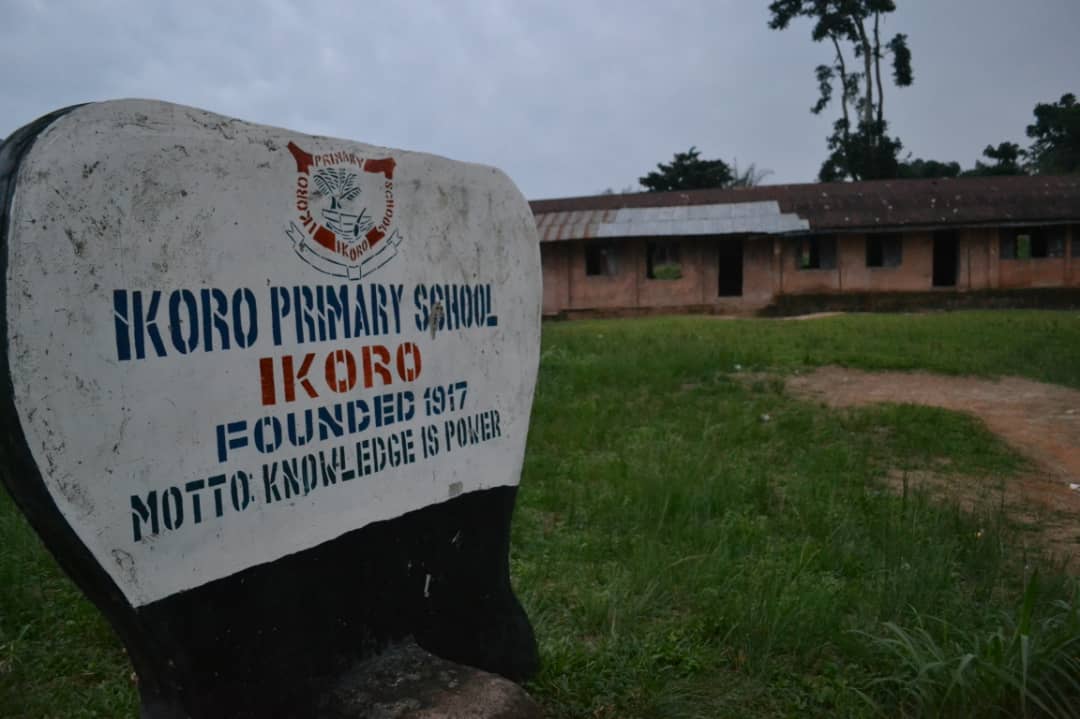
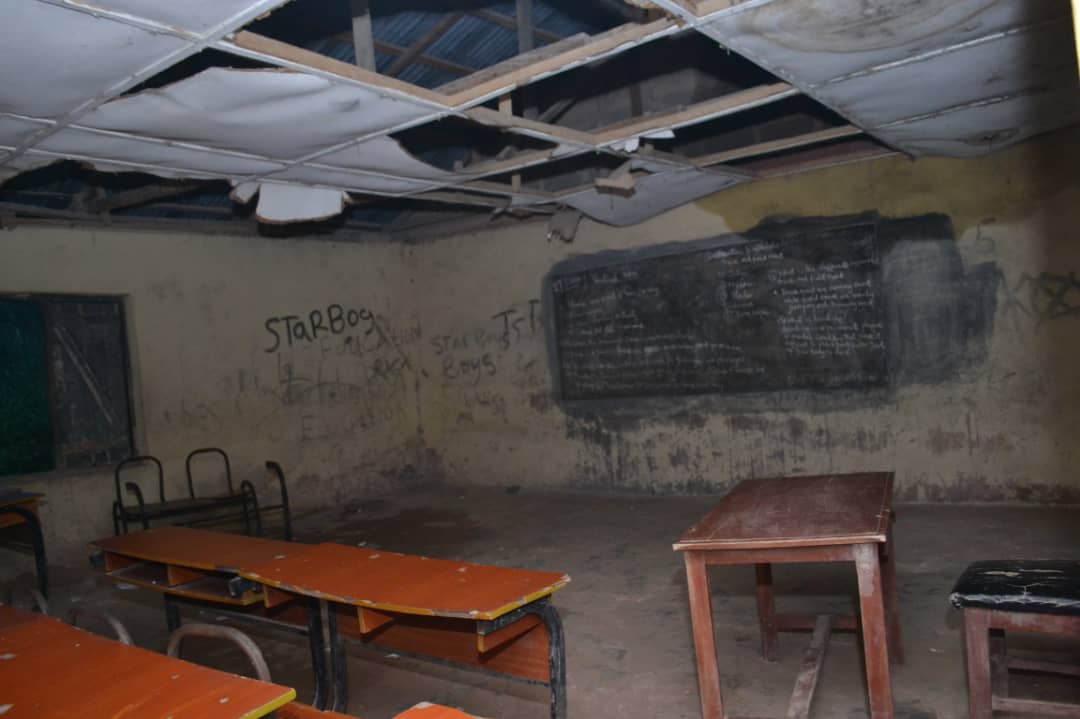
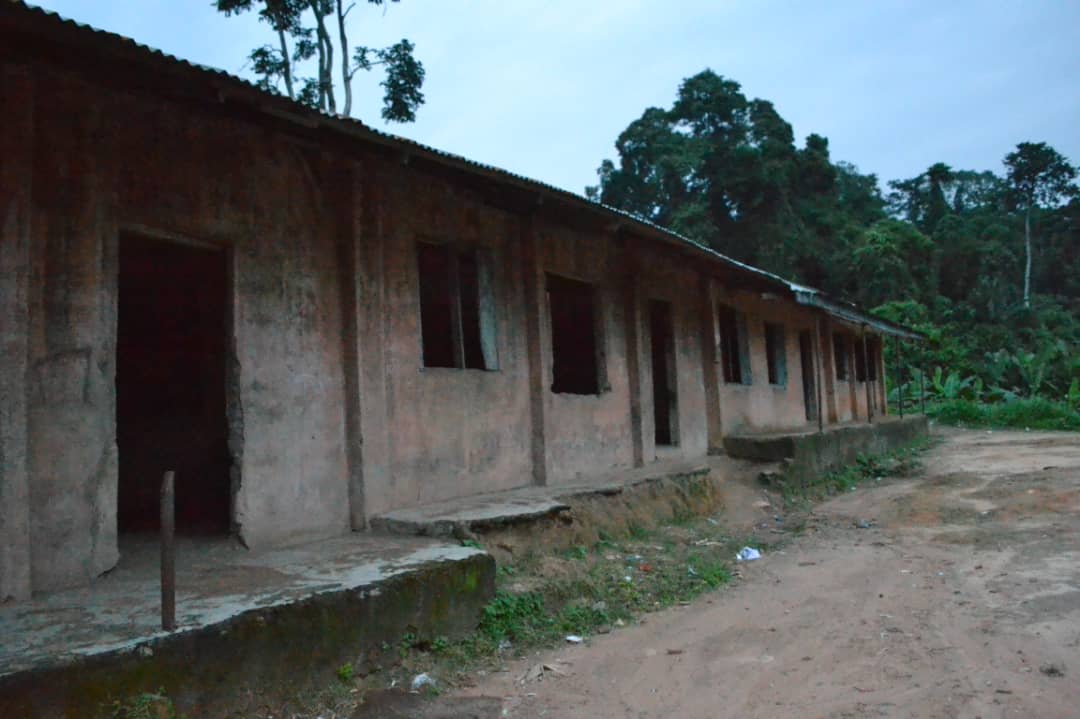
The abandoned Primary Healthcare Centre is not the only representation of the government neglect in the community. The Ikoro Primary School, founded in 1917, and the public secondary school in the community are also in a deplorable condition. At the former, the floors are broken, the ceilings are sagging, the furniture items are shaky, therefore confining the school authorities, staff and students to only one block of classrooms.
The schools serve about thirty-two smaller communities in the riverine area of Ikoro, which are estimated to have a population running into tens of thousands.
Ikoro Primary School, founded in 1917, is now a shadow of itself. Photo credit: Amplify/Awede Taiwo
Sero, who also teaches at Ikoro Primary School, told The ICIR that even the classrooms which are in use are not conducive for learning. He thinks the community is marginalised because natives are “from the Ijaw extraction” while the Binis make up the majority in the senatorial district.
“They just come to campaign and gather our votes,” he lamented. “Once they are successfully elected, that is all.”
He explained that the school is in desperate need of furniture as well as a means of transportation, such as motorbikes to swiftly convey teachers who mostly live in surrounding urban areas and speedboats for the students. Children have to paddle canoes from their various locations to the school everyday, and this delays academic activities.
The only government staff member posted to the secondary school is the principal, and so the community has had to find means of employing more hands to support him. They have in the past raised funds to pay new teachers, but they soon discovered that the approach is unsustainable.
“There was a time we even engaged the services of NYSC members,” Sero said. “But after they left, they’ve not given us a new batch of corps members.”
Peter Edenwa, the community vice chairman told The ICIR that not only is “the building of classrooms in a sorry state”, the primary school in fact “looks like a place where you train mad people.”
According to a compilation of contracts awarded by the commission as at September 2015, EDSOGPADEC supplied 120 double-unit school chairs and desks to the primary school in July 2014. This was confirmed by Sero though he added that the items they received were no more than 100.
The document also states that a contract for the renovation of the Ikoro Primary Health Centre was awarded in April 2012, and construction was 25% completed at the time of the report.
One of the classrooms at Ikoro Primary School. Photo credit: Amplify/Awede TaiwoOne of the classrooms at Ikoro Primary School. Photo credit: Amplify/Awede TaiwoA block of classrooms at Ikoro Primary School. Photo credit: Amplify/Awede Taiwo
Rot, crisis in EDSOGPADEC
The Edo State Oil and Gas Producing Area Development Commission (EDSOGPADEC) was established to address the needs of oil-producing communities in the state, including Ovia Northeast Local Government.
The board was first constituted in February 2012 and had its tenure extended in 2015. Its activities have however been marred by irregularities. In December, following a request from Godwin Obaseki, Edo State governor, the commission’s board was dissolved by the state assembly over allegations of gross misconduct.
“The board members have failed in their responsibilities to the people in the oil producing communities. The board has not deemed it fit to submit the commission’s financial report to the house since they were constituted,’’ Roland Asoro, the houses’ majority leader had said.
On Friday, Obaseki inaugurated a new set of board members and chairman for the commission, at a ceremony conducted at the government house.
PHC deficiencies responsible for infant, maternal mortality — expert
Primary healthcare is the cornerstone of healthcare systems all over the world and cannot afford to be deficient. It must be made accessible and affordable to all individuals, families and communities, regardless of location. This was the submission of Greg Oko Oboh, a public health physician, biostatistician and epidemiology specialist.
“It is particularly important for Africa, specifically for Nigeria and Edo State because the healthcare system we are operating right now is not functioning across board,” he said.
“And the main factor making it not to function is basically human resource for health. As we speak now in Edo State, there are no doctors manning PHCs. The only doctors at the local government level are the administrative doctors. We also have middle or intermediate-trained healthcare workers known as the CHEWS (Community Health Extension Workers), or midwives.”
The lack of qualified healthcare workers and the resort to traditional healing methods, he said, has led to the increasing infant and maternal mortality rates in the country. Many of these deaths, he added, are not documented, “so even the figures we have at the state level are underestimated”.
Oboh also lamented the politicisation of establishing healthcare centres. According to him, politicians especially in Edo state site centres in their localities, not considering whether such facilities already exist in the place.
“So we have five PHCs in some local governments, while others have nothing. For instance, in Egor Local Government, we have an uneven concentration of PHCs close to the Local Government Headquarters in Uselu and its environs, while in the very remote parts there are no PHCs.”
Photo credit: Amplify
Government needs to cease further loss of lives
Dotun Olutoke, Project Lead of Amplify, a civic organisation that advocates for sustainable development in rural, underserved Nigerian communities, has urged the Edo State government to pay attention to the Ikoro community. His organisation paid a visit to the community in July to train residents on tracking project implementation and ensuring effective service delivery.
“We heard from the community that many emergency cases that could have been attended to by first aid care of little medical attention have led to death in the community,” Olutoke told The ICIR.
This is worrisome, he said, “not only that the absence of a PHC in this community is cutting short the lives of people, but it is also affecting the life expectancy of the general populace in the community.”
He noted that, in the 2018 state budget, N60 million was allocated for the construction of a maternity in the community alongside other projects. Work is however yet to commence though it’s being nine months since the budget was signed.
“We are urging the Edo State government to complete this centre so that people in Ikoro community can have easy access to basic and affordable healthcare services, and the spate of avoidable death that has become a norm in this community can be avoided.”
Meanwhile, Obaseki, in January, announced that his government had arranged to remodel 200 Primary Healthcare Centres across the state, 25 of which would be rebuilt by the end of April. The project was proposed to take up to 24 months, but it is not clear if the Ikoro health centre is part of the 200 centres set for remodelling.
The Edo State government could however not be reached by The ICIR for comments. Messages sent through the social media were ignored, and enquiries mailed to the governor have likewise not been replied.
This report received the support of TrustAfrica and Amplify, a civic tech organisation projecting the voices of rural underserved people and advocating for sustainable development in Nigeria’s forgotten communities.
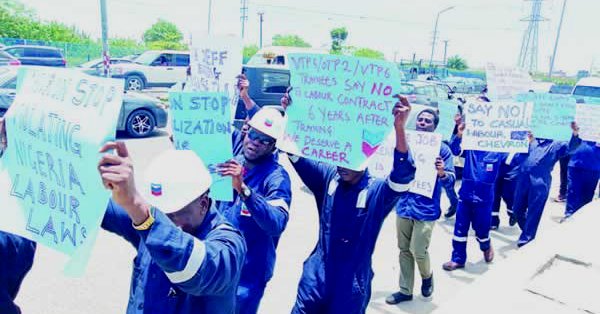
SOME trainees of Chevron Nigeria Limited, one of the giant international oil companies operating in Nigeria, have taken to the street in protest, condemning what they described as slavery by the company.
The protesters, numbering about 150, thirty of whom, according to colleagues, graduated with a first class, marched along the Lekki expressway in Lagos, bearing placards and chanting solidarity songs.
They said they were recruited by Chevron since 2013 following a rigorous exercise, but that Chevron offered them two years training contracts after which they would be regularized, but five years later, they have remained contract staff.
“In 2013, we were mobilised to Chevron Nigeria Limited. We got offers through a recruiting agency. Initially, we did not know it was Chevron; we were only told an oil and gas company needed workers,” one of the protesters, Okunufa Mandy, told the Punch.
“Upon attending the interviews, we discovered that it was Chevron. We were told that we were being mobilised for operators and technician roles in the company. We were informed that four sets had been mobilised before us and employed. We came in under the Vocal Training Programme (VTP 5).
“We went to Ogere, Ogun State, for training. The company told us that it would be handing us over to a training provider, who would train us for two years, after which we would be employed in their facilities.
“This is 2018, Chevron, in an act of wickedness has continued to roll out continuous training contracts. Each time a training contract expires, we get something like, ‘Due to your performance, we are extending your contract.’ We have asked them several times if it means we all failed or we are not trainable.
“While all this so-called training was on, we have continually worked in Chevron facilities. I am a mechanical technician. I have worked in different roles; some of us have worked as lead technicians and others moved from maintenance to operations departments. They have used us to fill their operational needs over the years while refusing to take on the responsibilities that come with it.”
Many of the protesters also lamented that some of them had to leave their jobs where they were already doing well in order to take up the Chevron offer, while some even had to abandon the postgraduate studies.
“If we were casual workers, it would have been better. But we have been enslaved. We were lied to and told we were going through a training process in 2013 when most of us left our career jobs and academics. Some of us were studying for PhD when they said we should come for this job. After about six years of casualisation, they are telling us that they have nothing to give us,” said Lawal Solomon, one of the protesters.
According to Solomon, even the Offshore Petroleum Industry Training Organisation (OPITO) certificate which they ought to have been issued after their two-year training, was not given to all of them. “A few of us said they got copies of the certificates, but when they tried to verify them from the issuing organisation, the certificates were disclaimed,” he said.
“We have been working on their fields as slaves, they should fulfil the promise they made to us in 2013 when most of us were leaving our career jobs. And if they cannot employ us, then they should pay compensations.”
The Falana and Falana Chambers, a law firm owned by popular human rights activist, Femi Falana, a Senior Advocate of Nigeria, had written to Chevron, giving the company a 14-day to fulfil its promise of employing the trainees.
“Your company took advantage of the expectations of our clients to be staffed and hiding under the VTP/OTP training, subjected them to unfair labour practice contrary to our laws and international best practices. Worst still is the fact that you deny our clients any official reference from your company to at least show that they had worked for your company for over five years so as to have prospects elsewhere. It is disheartening to realise that young, intelligent and first class Nigerians like these are subjected to this level of humiliation,” the letter read in part.
Chevron had earlier announced that the contract with all its manpower service providers would expire by October 2018, but the announcement did not go down well with the two major trade unions in the oil and gas sector, namely: NUPENG (National Union of Petroleum and Natural Gas Workers) and PENGASSAN (Petroleum and Natural Gas Senior Staff Association of Nigeria ). Both unions have threatened to go on strike if Chevron lays off its contract staff.
PRESIDENT Muhammadu Buhari has condemned racism, racial discrimination, xenophobia, and related intolerance in different countries of the world, stating that they were the opposite of freedom, justice and peace in the world.
According to NAN, Buhari spoke on Monday evening at the declaration of Nelson Mandela, former South African President, Decade of Peace at the UN headquarters in New York in commemoration of the centenary celebration of the late anti-apartheid icon.
“We recognize that racism, racial discrimination, xenophobia, and related intolerance present the very opposite of the noble purposes of the United Nations,” said President Buhari.
In his address, the President lauded Mandela for his rare virtues. And he indicated the need for the global community to live up to Mandela’s indelible legacies by being accountable to the values and principles and hope for the declaration through striving for a just, peaceful, prosperous, democratic, fair and inclusive world.
He said Nigeria recognizes the equal and the inalienable rights of all citizens and all peoples of the world. He said such recognition would be the foundation of freedom, justice, and peace in the world.
“Nigeria is committed to the promotion and protection of the rights of all women,” Buhari said
According to him, Nigeria acknowledges that tolerance of cultural, ethnic, racial, and religious diversities is essential for lasting peace, understanding and friendship among peoples, nations, cultures, and individuals.
The president noted that the country is ready to move beyond words in the promotion of peaceful, just, inclusive and non-discriminatory societies, stressing the importance of the equal participation and full involvement of women and the meaningful participation of youth in all efforts for the maintenance and promotion of peace and security.
However, critics have accused the President Buhari’s administration of nepotism and tribalism which undermines the principle of diversity that he preaches abroad. In the security sector of the country, most agencies were headed by the northerners in disregard for the principle diversity and the federal character. For instance, the Nigerian Police, Nigeria Army, Nigeria Air Force, Nigeria Intelligence Agency and Department of Security Services (DSS) are all headed by the Northerners.
Many Nigerians have particularly condemned the recent of appointment of Yusuf Bichi a retiree and a northerner, as the Director-General of DSS by President Buhari, in replacement of Matthew Seiyafa, the former acting DG. They described the President’s action as being tribalistic, given that Seiyefa is from Southern Nigeria and Bichi is from the North.
THE Independent Corrupt Practices and Other Related Offences Commission (ICPC) has arraigned a former Director General of the Small and Medium Enterprises Development Agency of Nigeria (SMEDAN), Bature Masari, before an Abuja High Court for alleged bribery.
According to Rasheedat Okoduwa, ICPC’s spokesperson, Masari was accused of receiving a total of N119.8 million in bribes from several contractors handling Constituency Projects and four federal legislators. He was said to have committed the offences between April 2014 and July 2015.
Counsel to ICPC, Henry Emore, told the court that the ex-DG received N50 million on November 27, 2014, from Hamshakin Ventures Ltd for Herman Hembe, Emmanuel Udende, Benjamin Aboho and Oker Jev, who were all members of the House of Representatives from Benue State; and a contractor, Kike Engineering Services, before awarding a constituency project contract to the said Hamshakin Ventures.
The court was also told that Masari received different bribes ranging from N800, 000 to N20, 000, 000 from 12 contractors. The bribe monies were allegedly received through Masari’s Diamond Bank and Guaranty Trust Bank accounts.
The ICPC said the Masari’s actions were contrary to Section 10 (a)(i) and punishable under Section 10(a)(ii) of the Corrupt Practices and Other Related Offences Act, 2000. His offence further violates Section 19 of the same law and punishable under the same section.
The accused pleaded not guilty to the charge, and following the application of his counsel, Mahmood Magaji (SAN), the court granted him bail in the sum of N50 million with two sureties in like sum who must be directors in the employment of either the federal civil service or any federal agency; or the Federal Capital Territory or any of its agencies. The sureties are also expected to deposit an ‘affidavit of means’ including being residents of the Federal Capital Territory.
In the meantime, the trial judge, Adebola Adeniyi, ruled that Masari should be remanded in Kuje prison pending the fulfilment of his bail conditions while the matter was adjourned to November 26 to 29, 2018 for continuation.
Visa fraudster pleads guilty, gets one-year suspended sentence
In another development, the ICPC has secured a one-year suspended prison sentence against one Giwa Ishola who was accused of visa racketeering, forgery and making false statements.
Ishola was said to have provided misleading information to the United States of America (USA) consulate in Lagos with the intent of procuring a visa; an action which is contrary to relevant sections of ICPC Act and the Criminal Code respectively.
The ICPC arrested Ishola on the day he came to have his visa interview at the US Embassy in Lagos. Documents retrieved from him include a United Bank for Africa (UBA) letter conveying approval for his annual leave, and a Guaranty Trust Bank (GTB) statement of account.
Investigations revealed that Ishola was not a staff of UBA as claimed and that the content of the statement of account he presented was not a true representation of his account with GTB.
It was also discovered that the visas for United Kingdom, Republic of Benin, Republic of Togo and Ghana contained in his international passport were fake.
When he was charged to court, Ishola agreed to a plea bargain and pleaded guilty to the three-count charge brought against him.
As a result, the trial judge sentenced him to pay a fine of fifty thousand Naira only on each count instead of being made to serve a prison sentence.
The court also made Giwa undertook to be of good behaviour for a period of one year and to execute a bond to this effect with the High Court Registry in the sum of Three Hundred Thousand Naira (300, 000.00).
The money would be forfeited should the convict breach the terms of his undertakings, and then he would be made to serve the one-year jail term.
THE governor of Migori in Kenya, Okoth Obado, was charged with murder on Monday following the death of his young lover whose body was found dumped in a forest.
Obado who initially denied having an affair with the 26-year old student, Otieno Sharon, was arrested after the DNA testing confirmed he was the father of the seven-month-old fetus that died with her, the Kenya Broadcasting Corporation (KBC) reported.
Obado, before the court, pleaded not guilty to the killing of the university student.
Though he admitted to having a sexual relationship with Sharon but denied any involvement in her gruesome murder.
He was remanded at Industrial Area prison pending the hearing of his bail application on Tuesday.
Sharon was found dead at a thicket on September 4 after she was kidnapped.
The autopsy report revealed that she was stabbed eight times and strangled while the seven-month-old foetus in her womb was also stabbed to death.
Kenya’s chief prosecutor, Noordin Haji, said in a statement that his office is committed to ensuring that all perpetrators of the heinous act are subjected to the due process of the law.
Obado, his personal assistant, his bodyguard, two local officials, and a taxi driver were arrested in connection with the murder.
The bodyguard, John Chacha, was arrested after his phone was traced to have been around the scene of the murder.

 “The disparagers have populated the internet with photographs of the governor when he momentarily succumbed to fatigue after a long flight, preceded by a chaotic itinerary in Edo State before heading to New York for the 73rd session of the United Nations General Assembly, in the United States of America.