Home Blog Page 2519

Osun Decides 2018: Is Oyetola leaving APC before re-run election?

0

FOUR days to the scheduled re-run governorship election in Osun State, the All Progressives Congress (APC) candidate in the election, Gboyega Oyetola may not take part in the election, The ICIR has gathered

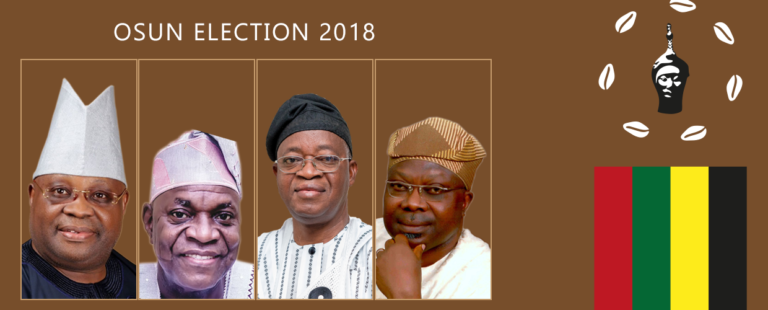
Oyetola polled 254,345 votes behind the candidate  of Peoples Democratic Party (PDP) Ademola Adeleke with 254,698 votes.

The ICIR gathered that Oyetola had threatened to withdraw from the re-run election because the out-going governor, Rauf Aregbesola “did not support him.”

A party chieftain close to the APC candidate but did not want his name mentioned said the governorship candidate had accused the governor of insincerity and lack of support for him during the election.

Oyetola, the source said, particularly accused Aregbesola of not working for him as expected during the inconclusive election last weekend noting that the governor was not happy with his candidature.

“Oyetola discredited Aregbesola for failing to win four local governments in his federal constituency and 10 local governments in his senatorial district as a sitting governor of the state,” he said

“He [Oyetola] is begging the APC National leadership to set up committees to look at the outcome of the election, else he will not participate in the remaining seven units that were declared inconclusive by INEC.”

Governor Aregbesola failed to deliver his home base of Ijeshaland to the APC candidate in the election as the opposition PDP swept almost all the local councils.

The PDP won Obokun LGA by a large margin of 10,859 votes to 7,229 garnered by the APC. But APC won the Ilesa East with 9790 votes. PDP got 8244 votes. APC also lost Ilesha West LGA to PDP, getting 7251 votes to PDP’s 8286 votes.

APC won Atakumosa East with 7073 votes against PDP’s 5218 votes. PDP snatched Atakumosa West with 5401 votes against APC’s 5019 votes.

Part of the allegations by Oyetola against Aregbesola was his failure to release enough money for the election.

“In 2014 election during Ogbeni Rauf Aregbesola re-election N700,000k was released to each polling unit, but Aregbesola found it difficult to release N200,000k per unit for 2018 election,” the source quoted Oyetola as said.

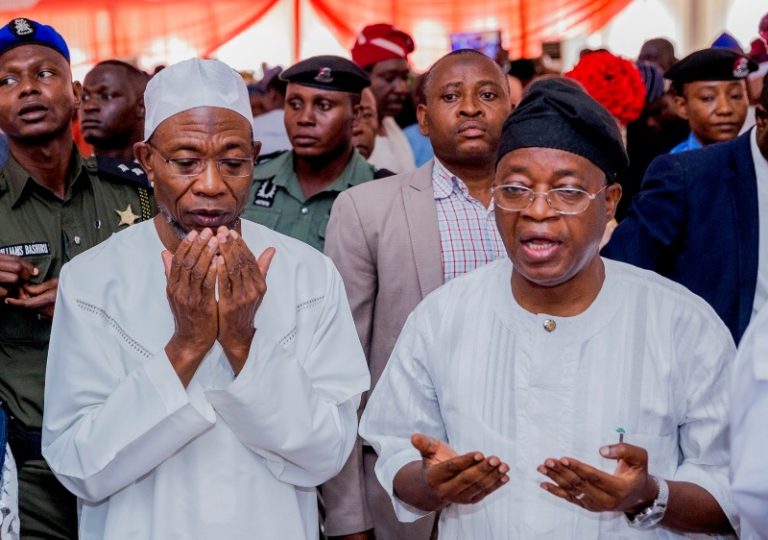
According to the APC chieftain, Oyetola also blamed Aregbesola of failing to reconcile aggrieved party stalwarts like Alhaji Fatai Diekola,  Adeoti,  Akere Sunday, Lasun Yusuff, Peter Power,  Bayo Salami and other members of the party that defected before the election.

He alleged that the governor deliberately neglected those party members till they left so that APC could lose the election.

The ICIR gathered that Action Democratic Party (ADP) party and others are already in talks with the PDP ahead of Thursday’s election.

A party leader revealed to our correspondent that they have agreed to support PDP instead of APC. And that Saraki is presently speaking to the candidate of Social Democratic Party (SDP), Iyiola Omisore in order to also bring in SDP, the party with third largest votes in the governorship election.

Osun Decides 2018: Omisore agrees to support Adeleke for Thursday’s rerun

THE candidate of the Social Democratic Party, Iyiola Omisore, may have agreed to support Ademola Adeleke, candidate of the Peoples Democratic Party (PDP) in the supplementary election which will hold on Thursday, September 27. 

The election was declared inconclusive on Sunday because the number of cancelled votes in some polling units were higher than the margin between Adeleke and Gboyega Oyetola of the All Progressives Congress (APC). 

Adeleke has 254,698 while Oyetola has  254,345 votes, a difference of only 353 votes.

However, Omisore, who placed third in the election with a little over 122,000 votes, is believed to have more supporters in the local government where the re-run elections will hold. And since it is no longer mathematically possible for Omisore to catch up with the two leading candidates, the PDP quickly swooped in to woo him to their side.

Omisore was a PDP member and served as a deputy governor, as well as a two-time senator on the party’s platform, hence the ease with which he reportedly agreed to support the party’s candidate rather than that of the APC.

The truce is believed to have been brokered by Senate President Bukola Saraki.

Also on Monday evening, a PDP chieftain and former aviation minister, Femi Fani-Kayode, shared a picture of Omisore and Adeleke sharing a side hug, saying that both men have agreed to work together.

Iyiola Omisore, Ademole Adeleke, and Femi Fani-Kayode

“Iyiola Omisore will not let us down. He is my cousin and I have spoken to him. We are together,” Fani-Kayode tweeted, adding that “we are going to end the APC’s reign of tyranny in the rerun on Thursday. PDP’s Demola Adeleke shall prevail”.

Earlier, a chieftain of the Action Democratic Party (ADP) told the ICIR that his party will support the PDP candidate during the re-run election on Thursday.

Earlier, former Vice President Abubakar Atiku had urged Omisore to remember the past and support the PDP. “I call on Senator Omisore to remember the PDP, which believed in him and gave him its ticket in 2014. I urge him to join with all who want to deliver Osun from negative change and support,” Atiku posted on Twitter.

Kogi, Bayelsa, Anambra… States that had inconclusive elections due to vote cancellations

THE Saturday’s governorship in Osun State was declared inconclusive and will now  be concluded on Thursday, September 27. The Independent National Electoral Commission (INEC) explained that the number of registered voters in polling units where voting was cancelled, was higher than the difference between the two top candidates in the election.

Ademola Adeleke, candidate of the Peoples Democratic Party (PDP), got the highest votes of 254,698. Candidate of the All Progressives Congress (APC), Gboyega Oyetola, came close with 254,345 votes.

However, the total number of registered voters in the five polling units where elections were cancelled is 3,498 votes,  higher than the 353 votes’ difference between Adeleke and Oyetola, hence the need to have a re-run election.

While many, especially supporters of the PDP, have been crying foul and insisting that INEC should declare Adeleke winner of the election, others have applauded the returning officer of the election, Joseph Fuwape, for demonstrating commendable courage to do the right thing.

The ICIR takes a look at previous elections that were declared inconclusive as a result of vote cancellations, lending credence to the actions of the Osun governorship election returning officer.

Anambra 2011

The late Dora Akunyili, contesting for the Anambra Central Senatorial seat in 2011, on the platform of APGA, was in the lead with 66,273 votes. Her opponent, Chris Ngige, of the then Action Congress of Nigeria (ACN) was trailing with 65,576 votes, when the election was declared inconclusive.

According to the returning officer, Charles Esimole, voting had been cancelled in several wards of the senatorial district, and the number of registered voters in those wards was higher than the 697 votes difference between Akunyili and Ngige.

Eventually, Ngige won the re-run election with a total of 69,725 votes to Akunyili’s 69,236 votes.

Anambra 2013

The Anambra governorship election of 2013 was declared inconclusive notwithstanding that Willie Obiano, candidate of the All Progressives Grand Alliance (APGA), had taken a huge lead with 174,710 votes. His closest challenger, Tony Nwoye of the PDP, had polled a total of 94,956.

As it stood, Obiano’s votes was higher that of Nwoye’s with 79,754 votes, but the number of votes that was cancelled in about 15 local government areas of the state totalled 113,113, higher than the number of  votes Obiano was leading with. As a result, the returning officer, James Epoke, then Vice-Chancellor of the University of Calabar, declared the election inconclusive, to allow for a supplementary election in the places where voting was cancelled. Obiano went on to win the election.

Bayelsa 2015

With Seriake Dickson of the PDP leading the polls with 105,748 votes, and Timipre Sylva of the APC trailing with 72,594, INEC declared the 2015 Bayelsa governorship election inconclusive.

Dickson had won the election in six out of the seven local government areas in the state, and Sylva had won just one LGA, but the election was declared inconclusive following the cancellation of the entire votes in Southern Ijaw LGA as a result of massive electoral malpractice and violence.

The number of registered voters in Southern Ijaw LGA was put at 120,000, which was above the difference between Dickson and Sylva’s total votes.

Dickson went ahead to win the election.

Kogi 2015

Abubakar Audu, candidate of the APC in the November 2015 Kogi governorship election, was already coasting home to victory with 240,867 votes. The PDP’s candidate and incumbent Governor at the time, Idris Wada, was trailing with 199,514 votes. But the number of cancelled votes was 49,953, higher than Audu’s victory margin of 41,353 votes.

Hence the returning officer, Emmanuel Kucha, declared the election inconclusive.

Unfortunately, Audu, the leading candidate, died of heart attack, that same evening, but Yahaya Bello, who had come second in the APC governorship primary, was tapped to complete the race on Audu’s behalf. He (Bello) was later declared winner.

Imo 2015

The 2015 governorship election in Imo State was also declared inconclusive as a result of vote cancellations due to electoral malpractices.

At the time, Rochas Okorocha, who was running on the platform of APGA, was leading PDP’s Emeka Ihedioha with 385,671 votes to 306,142, a margin of 79,529 votes.

However, votes that had been cancelled in several polling units across the state totalled 144,715, leaving the returning officer, Ibidapo Obe, no choice but to declare the election inconclusive.

What the law says

Section 53 (2) of the electoral act stipulates that “where the votes cast at an election in any polling unit exceed the number of registered voters in that polling unit, the result of the election for that polling unit shall be declared void by the Commission and another election may be conducted at a date to be fixed by the Commission where the result at that polling unit may affect the overall result in the Constituency.”

Section 53 (3) added thus: “Where an election is nullified in accordance with subsection (2) of this section, there shall be no return for the election until another poll has taken place in the affected area.”

UPDATED: Osun Decides 2018: INEC declares governorship election inconclusive

THE Independent National Electoral Commission (INEC) has declared the Osun governorship election inconclusive.

Ademola Adeleke, candidate of the Peoples Democratic Party (PDP), and Gboyega Oyetola, candidate of the All Progressives Congress (APC) ran neck to neck in the election.

Adeleke polled 254,698 votes to be in the lead while Oyetola trailed behind with 254, 345 votes.

Adeleke led with only 353 votes.

The election is purportedly the closest in governorship election history  in the country.

With this result, INEC has announced a rerun of the election in pooling units where voting was cancelled.

“Unfortunately as the returning officer, it’s not possible to declare anybody as the clear winner of the election on the first ballot,” said Joseph Fuwape, the presiding officer of the election at the INEC headquarters in Osogbo, the state capital.

He said number of registered voters in the polling units where elections were cancelled is 3,498, adding that since the figure is higher than the difference between the votes of the leading candidate, a re-run election will be conducted.

The rerun election will now take place on September 27 in the affected pooling units in Ife North, Ife South, Osogbo and Orolu local government areas.

Candidates from 48 political parties participated in the keenly contested election.


Osun Decides 2018: Electoral officer arrested for tearing result sheet

0

AS Nigerians await the announcement of winner of Osun governorship election, an electoral officer who tore the result sheet of Ayeedade Local Government Area has been arrested by the police.

The electoral officer who was identified as Salau Mutiu Kolawole confessed to have collaborated with a senior official of the Independent National Electoral Commission (INEC) to tear the result of the local government which has been disputed by the People’s Democratic Party (PDP).

INEC had announced that PDP recorded 9,836 in Ayeedade but earlier result announced in the local government showed that PDP got 10,836 votes, a slash of 1000 votes from that of the PDP.

However, the result of 10,861 votes for All Progressives Congress (APC) in Ayedaade was not tampered with.

Kolawole who was captured in a video with the tore result sheet said he was instructed to do so by a senior INEC official.

He was subsequently taken into police custody.

All the results of the 30 local government areas in the state have been collated while the official declaration of the winner of the governorship election by INEC is being awaited.

National service and matters arising

0

By Simon KOLAWOLE

IFnot that we politicise everything in Nigeria, the Kemi Adeosun saga should provoke a genuine public debate on reforming the National Youth Service Corps (NYSC). The constitution and other laws are supposed to be living, not embalmed, documents. No constitution is perfect. Through practice, we encounter the flaws. This dynamism allows us to modernise our laws in tandem with global standards. The process of fine-tuning makes democracy and rule of law so sweet. It does not mean Adeosun would benefit from any new amendment, but it does mean we are learning and the grey areas and faulty provisions in our laws can be resolved in favour of common sense.

The issues of national service and citizenship have been brought to the fore in connection with the case of Mrs Adeosun, the former minister of finance who recently resigned her appointment. Adeosun, a very smart woman who made her mark during her stint in President Muhammadu Buhari’s cabinet, was accused of dodging national service and presenting a forged certificate of exemption in an investigative report by Premium Times,the online newspaper. The certificate saga dragged on embarrassingly for over two months before Adeosun finally fell on her sword. I was sorry to see her go, such an innovative lady, but we can learn useful lessons and improve our policies.

We were still screaming at each other over the Adeosun case when it turned out that Alhaji Adebayo Shittu, the minister of communications, also did not do national service. It appears we have more cases in our hands than we presumed. If we are to scrutinise every person who has served or is serving in government over their NYSC record, we may have a major national crisis in our hands. I won’t be surprised if the chambers of the national assembly become virtually empty. Even Buhari’s cabinet may be heavily hit. Governors? State legislators? Commissioners? There would be an earthquake. Dodging national service is a crime in most countries, including Nigeria.

In the case of Adeosun, there are two issues at play. One, at what age did she become a Nigerian? Two, should she have been exempted from national service? According to the NYSC Act, national youth service is compulsory for Nigerians who are below 30 upon graduation. If you are 30 or above, you are entitled to exemption. Basically, with effect from 1973, every Nigerian graduate must have an NYSC certificate — either the one affirming service or confirming exemption. The argument is that having never had the Nigerian passport until she was 34, Adeosun was not really a Nigerian as at the time she earned her first degree at 22. Is this argument acceptable?

When Miss Folakemi Oguntomoju was born on March 9, 1967 in London, UK, was she born a Nigerian or a Briton? This is a tricky part of the equation. As at that time, she was a citizen of two countries: the UK and Nigeria. All children born in the UK, irrespective of the nationality of their parents, were automatically British citizens until Mrs Margaret Thatcher started curtailing immigration in the 1980s. By our laws too, Folakemi was automatically born a citizen of Nigeria because her parents were Nigerians. If they had renounced their Nigerian citizenship before she was born, Folakemi would not have been born a Nigerian.

Section 12 of the 1963 constitution, under which she was born, said any person born outside Nigeria after September 30, 1960 “shall become a citizen of Nigeria at the date of his birth if at that date his father is a citizen of Nigeria”. The constitution allowed dual citizenship to an extent. Section 13 provided that “any person who, upon his attainment of the age of twenty-one years, was a citizen of Nigeria and also a citizen of some country other than Nigeria, shall cease to be a citizen of Nigeria upon his attainment of the age of twenty-two years”. By 1989, then, Folakemi would automatically cease to be a Nigerian at 22 without lifting a finger.

But the 1979 constitution came along and replaced that of 1963. Section 26 (1) said “a person shall forfeit forthwith his Nigerian citizenship if he acquires or retains the citizenship or nationality of a country other than Nigeria”. She didn’t acquire British citizenship — she was born into it. But she was not expected to retain it beyond the age of 21 if she was still interested in being a Nigerian. Section 26 (3) provided that she must forfeit her Nigerian citizenship by age 21 or by September 30, 1980 — whichever was later — if she retained some other nationality. By 1988, therefore, she was deemed by law to have lost her Nigerian citizenship at 21.

The 1999 constitution, thankfully, allows dual nationality. But could she benefit from it, having lost her citizenship in 1988? This issue is very complicated as far as I am concerned and we may need a judicial pronouncement for future purposes. Someone would argue that she was qualified since section 25 (c) of the 1999 constitution simply says you are a Nigerian “by birth” if you were born outside Nigeria but either of your parents is a citizen of Nigeria. But someone else would argue that she could no longer claim the citizenship having lost it. The option open to her would be naturalisation or registration as a spouse of a Nigerian, assuming the husband also has Nigerian citizenship. It is complicated.

Some have argued that her Nigerian citizenship was only “dormant” and she “activated” it by collecting the Nigerian passport in 2001. But there is no single provision in the constitution on how to activate citizenship “by birth”. Indeed, nowhere does the constitution require any further action for you to become a Nigerian citizen “by birth”. Interestingly, the constitution says you can renounce your citizenship. If we argue that she got back her citizenship on May 29, 1999 at the age of 32 when the new constitution became operational, the next question is: did she still need to serve since she was above 30?

A more complicated view, though, is that she was not even a Nigerian when she got the passport in 2001 and she should not have benefited from dual citizenship. This is another one for the courts because of other people that might be in a similar situation. We really need help here. However, the notion that she only became a Nigerian by collecting the passport at the age of 34 is awkward. Legally, getting a Nigerian passport is not what makes you a Nigerian. There is no such law yet. Rather, you get the passport because you are a Nigerian.

You wear the hood because you are a monk; you are not a monk because you wear the hood! Let me make it simpler. Even if you don’t have a Nigerian international passport, a national ID card, a PVC or a driving licence, you are still a Nigerian. The passport is not what makes you a Nigerian. There are millions of Nigerians without the passport. If a Nigerian couple without British citizenship or permanent residency has a child in the UK today, they will need to go to the Nigerian High Commission to get a passport for the baby to travel. If they don’t, the child can’t travel out of the UK. But the child is still a Nigerian, with or without a Nigerian passport.

There is still a problem. When she applied for exemption from national service, did NYSC reply her? What was their response? That would have put all this argument to rest. I assume her application was not granted. That was why an “associate” would arrange a certificate for her. I believe her when she said she did not know the certificate was forged. Nigeria and forgery are twins. Ignorance is definitely not an excuse in law. If she is charged to court, a lenient judge could, nevertheless, take our peculiar circumstances in Nigeria into consideration. For the record, I am not justifying forgery of any kind. I am just saying judges may look at the gravity and the circumstances.

My concluding remarks. Beyond Adeosun, does it make any sense that you only need secondary school education to become president of Nigeria but you are not qualified to run even if you have a PhD because you didn’t do national service? That’s rubbish, pardon my French. Also, can you imagine an accomplished Nigerian in Diaspora is not qualified for appointment because of NYSC, whereas a stark illiterate can be effortlessly appointed because he does not need to show any certificate of national service? We are denying ourselves valuable human resources when we shut out Nigerians — who have lived and worked abroad — because they did not do national service.

This is not about Adeosun. The deed has been done. But the government must seize this opportunity to rethink the NYSC Act. The waivers should be extended to a category of talents that might have escaped the NYSC net by the circumstances of their birth, education or career. We are short-changing ourselves at the expense of national development. We must not waste this Adeosun experience. In 2010, the terminal ailment of President Umaru Musa Yar’Adua taught us to adjust our laws for the vice-president to automatically become acting president in the absence of an official presidential communication to the national assembly. We must learn from our experiences.

AND FOUR OTHER THINGS…

OSUN POLLS

As a Nigerian with enormous interest in how the country can achieve peace, unity and development, I was happy with the way the governorship election in Osun state went yesterday. My first fear in every election in Nigeria is the likelihood of violence. We have lost too many lives to elections in this country and I believe strongly that no politician is worth dying for. Anytime I hear of death and destruction, it breaks my heart. It is usually the ordinary people that bear the brunt. There were a few instances of ballot-snatching and all, but the Osun election was devoid of bloodletting. I care next-to-nothing about who wins. Let the will of the people be done. Positive.

THE OBLA SAGA

Meanwhile, police are yet to invite Mr. Okoi Obono-Obla, senior special assistant to the president on prosecution, over his own case of certificate forgery. His O’level WASCE result is “invalid”, according to Mr. Femi Ola, deputy WAEC registrar. Ola told the house committee investigating Obono-Obla that “available evidence indicates that [his] results were altered and therefore invalid.” He reportedly did not write Literature in English but managed to get C6 in the “result”. If he could get C6 in a paper he did not write, he would have got A1 if he did! Indeed, how many public officers in Nigeria are parading forged certificates? Can we launch operation show-your-credentials? Shame.

FOR LEAH AND OTHERS

Saifura Ahmed, one of the humanitarian workers abducted in Rann, Borno state, was recently heartlessly executed by the Islamic State West Africa Province, a faction of Boko Haram. The mother-of-two was abducted at a military facility on March 1, 2018. The terrorists appeared to be sending a warning signal to the federal government with this latest extreme act of wickedness. My heart bleeds for Leah Sharibu, the Dapchi schoolgirl, and other Nigerians still in their captivity. Government must do anything within its power to secure the release of the captives. The killing of Ms Ahmed is so heartbreaking I don’t want to imagine what could happen to others. Distressing.

AND FINALLY…

The Independent National Electoral Commission (INEC) has banned the use of smartphones inside polling booths. This is a welcome development, even though those who can’t see reason are imputing a sinister motive. The practice in the last few years is that voters had to take a shot of their thumb-printed ballot paper in order to qualify for “stomach infrastructure”. In the past, voters would collect money from all sides when they could only vote for one candidate. The politicians started demanding proof before payment. Smart alecs. The beneficiaries of INEC’s new policy will be the voters: now they can collect “stomach infrastructure” from every candidate again. Market.

Simon Kolawole is the founder and CEO of TheCable. He tweets @simonkolawole.

Osun Decides 2018: Police arrest fake INEC official, vote buyers

THE Nigerian police have arrested a man who was posing as an official of the  Independent National Electoral Commission (INEC).

The impersonator, who is said to be an ‘O’YES Cadet’, was arrested at Ife South Local Government Area, Ward 2, Polling Unit 4, during the tour of the Commissioner of Police in charge of Ile-Ife Area Command, Iliyasu Hammed.

He was identified as a fake official after he failed to produce his identity card to prove that he was an authentic INEC official.

O’YES is an acronym for Osun Youth Empowerment Scheme, a programme initiated by the Osun State government to empower youths in the state.

Similarly, the police also arrested two agents of one of the political parties involved in the governorship election for alleged vote-buying.

According to a statement released by the police on Saturday, the middle-aged men were arrested in Iwo Local Government Area and the sum of N604,000 was recovered from them.

The account by the police was corroborated by the Osun State Resident Electoral Commissioner, Olusegun Agbaje, during an interview with journalists.

“At Iwo, we got a report that security agencies arrested someone with about N600,000 cash near their polling unit. It was earlier this morning. The person was arrested and he is already with the police,” Agbaje said.

He however said he does not know the political party the arrested suspects were working for. “We are not interested in any party, we are interested that somebody came there, that is why the police are investigating. The person is already with the police”, he said.

“We said it that people should not bring money near a polling station. Anybody that does that, would be arrested.”

Osun Decides 2018: Vote buying persists in Osun, despite INEC’s warning

0

Independent National Electoral Commission, INEC though has warned political parties against vote buying in the Osun election, but politicians have become wiser in the way they offer a bribe to voters.

The ICIR reporters visited the secretariat of the People’s Democratic Party in Biket area, Osogbo on Friday and witnessed how voters were being paid electronically in exchange for the promise to vote PDP on Saturday.

Around 1:30 pm on the eve of the election, people were trooping to the Secretariat to register their names under a programme known as Adeleke Youth Empowerment Scheme – A YES, and some of them have long passed the age of a youth.

At the secretariat, prospective voters are offered a form to fill after showing his/her Permanent Voter Card, PVC to a group of young boys called the coordinator. Other details required from voters are names and account numbers.

A young woman who spoke to The ICIR confirmed that the party pays N5000 to anyone who is willing to show PVC, as well as register for A – YES. She came to the Secretariat when she heard that she could make N5000 just to register for A– Yes and vote PDP on Saturday.  The ICIR asked whether she would eventually vote PDP after collecting her money. “Of course I will, it will be ungodly to collect money and not vote, though I don’t think they will have a way of knowing If I don’t vote, but I will vote.”


While she was filling her form, a middle age woman brought a phone to her to help confirm whether she has received an alert of N5000. She has not.

A youth corps member serving in Osun State, Alabi Kuburat Ajoke, who also came to fill the A-YES form confirmed that many people have already gotten an alert. She advised The ICIR reporter to promptly collect the form before it finished.

A night before, The ICIR received a Whatsapp message from an Airtel number +2348120569530 asking eligible voters to send bank details, age, ward and unit.

Several people who had come to the secretariat said they also received a WhatsApp message asking them to register for A YES. And those who responded earlier were already receiving alert of N5000 at the time of The ICIR visit to the secretariat.

The ICIR visited the Secretariat of Social Democratic Party at Ogo-Oluwa area in Osogbo on Thursday.  Party coordinators were also seeing compiling names and account numbers of party members.

The reporter asked whether he could register his name, the coordinator requested that he should go and bring his PVC before he could be registered. One of the boys said the party was offering N10,000 to eligible voters. But there was no way of confirming the claim because most party members have been cautioned to be discreet, having learnt a lesson from Ekiti election.

Meanwhile, reports by other media also confirmed that the ruling, APC is also distributing bribe electronically.

A voter said an anonymous caller with number  08169144642 asked whether she would vote for APC. And when she responded that she would if APC greases her palm, the caller asked her to send account number and a screenshot of her PVC.  She is yet to receive an alert as at the time of this publication. 

Message from an anonymous source on WhatsApp sent on Thursday

The ICIR called the number, and a male voice answered. He simply introduced himself as APC agent, and said money had already been released to different wards, he told The ICIR to go ask his ward leaders and if he did not get anything he should call back after the election. Then he cut off the phone. Several calls put to him later was declined.

Victim narrates how she was raped by former Bayelsa governor’s aide

THE rape trial of Richard Kpodo, a former security adviser to ex-governor of Bayelsa State, Timipre Sylva, continued on Friday with the victim narrating to the court how she was assaulted.

Kpodo was first arraigned before Justice E. Eradiri of the Bayelsa State High Court, Yenagoa, on July 27, 2018, on a two-count charge of unlawful detention and rape of the victim, a 26-year-old female cashier at a hotel owned by the accused. The crime was allegedly committed on June 8, 2018.

At the resumption of trial on Friday, the victim (name withheld) testified alongside her uncle (a police officer) and a medical doctor who had examined her on June 9, a day after she was allegedly raped.

In her testimony, the victim narrated, amidst sobs, how the accused person had on several occasions touched her inappropriately, but that she had refused his advances. She said she complained to the agency that helped her to get the job, and she was advised to talk to the accused person and see whether he would stop.

According to her, after talking to the accused person, he stopped harassing her for a while, only to invite her into to his office in the hotel at about 8 pm on another day, locked the doors, overpowered her and raped her.

He then threatened her saying that he was the initiator of a local security outfit – ‘Fantangbe Security – which held sway during Timipre Sylva’s administration.

The trial judge had to suspend the hearing twice to enable the victim, who would break down in tears as she told her story, to regain composure.

“I was employed as a cashier and whenever I go to submit cash to him he touches me and I reported it to the employment agency that helped me get the job, and they advised me to talk to him to stop it,” she told the court.

“I talked to him that it is a sin, he stopped for some time and he started again. That day, he locked up the door and forcefully had sex with me, I shouted and also pleaded and he said he would not leave me until he was satisfied.

“So when he finished, he asked me to clean myself and bring his food. He did not use a condom and I was injured, he removed my trousers and I kept struggling with him until he finished.

“I called my uncle who is a policeman and he came and took me home, the next day we went to report to sthe police and they gave me a medical report form which I took to hospital.

“The hospital conducted HIV test on me and prescribed some drugs which I have taken.”

Ikenna Nwanna, a medical doctor working with the Diete Koko Memorial Hospital, Opolo, Yenagoa, also testified before the court on Friday. It was Nwanna who examined the victim after she was allegedly raped.

He told the court that the patient complained of pains in her pubic area and walked with difficulty when she came to the clinic on June 9, 2018.

“The patient complained that she was raped by her boss and I examined her in the presence of a female nurse and there were bruises in her vulva, and due to the pains she did not allow me to touch her vaginal area.

“There were also whitish discharge which I suspect to be semen although did not conduct any further tests, the observations tally with the complaint of violent sexual assault,” Nwanna said.

After the witnesses had given their testimonies and were cross-examined by the defence counsel, Julius Iyekoroghe, the prosecuting counsel, Samuel Arthur sought for an adjournment to enable him to call two more witnesses.

The defence counsel, however, complained to the judge that his client was still being denied access to medical care, despite an order already issued to that effect.

In his response, Justice Eradiri reiterated that his earlier order granting the accused person access to medical attention at a government hospital be complied with. He subsequently adjourned the case to October 5, to listen to the testimonies of two additional prosecution witnesses.

Kpodo is currently remanded in prison after the trial judge refused to grant him bail, despite an application by the defence counsel that his client has medical issues that required treatment.

Justice Eradiri had ruled that the medical report presented by the defence counsel did not indicate that the case was beyond the expertise of the Federal Medical Centre, Yenagoa. He ordered that the accused person should be receiving medical attention at the FMC from prison custody.

Skye Bank takeover: A journey from Afribank to Polaris Bank

0

THE Central Bank of Nigeria (CBN) announced on Friday that it has taken over the Skye Bank over the inability of the bank to meet its banking obligations.

CBN said the bank has been under stress since 2016 and the shareholders of the bank had failed to recapitalise it.

To protect the customers of the bank, CBN established a bridge bank, Polaris Bank, to assume the assets and liabilities of Skye Bank. “The strategy is for the Asset Management Company of Nigeria (AMCON) to capitalise the bridge bank and begin the process of sourcing investors to buy out AMCON [Polaris Bank],” said Godwin Emefiele, the CBN governor.

As CBN revoked the licence of Skye Bank, it assured the customers of the bank that their deposits are safe and normal banking services will continue on Monday under the new name.

This exact scenario played out in 2011 when the CBN revoked the licence of Afribank and a bride bank, Mainstreet Bank took over the operation of the bank.

Afribank survived the banking consolidation of 2005 when 89 commercial banks in the country were required to recapitalise with N25 billion. Most of the banks were merged or acquired. At the end, 25 banks emerged successfully after the consolidation.

Afribank was established by French investors in 1959, just a year before Nigeria’s Independence from Britain. The bank retained its name until 2011 that its licence was revoked by the CBN over the similar challenges that Skye Bank faced.

Mainstreet Bank, the bridge bank that took over Afribank under AMCON, was sold to Skye Bank in 2014. And in 2016, just two years after acquiring Mainstreet Bank, Skye Bank started failing to meets its minimum thresholds in liquidity.

Five legacy banks merged in 2005 to form the Skye Bank. The banks were Prudent Bank, EIB International, Bond Bank, Reliance Bank, and Co-operative Bank.

Just like the way AMCON acquired the assets and liabilities of Afribank in 2011, customers of Skye Bank may not have to worry about their deposits. Afribank customers did not lose their deposits but continued banking from Mainstreet Bank to Syke Bank.