VOTING has commenced in various parts of Osun State as the people of the state elect who will be the state’s chief executive for the next four years.
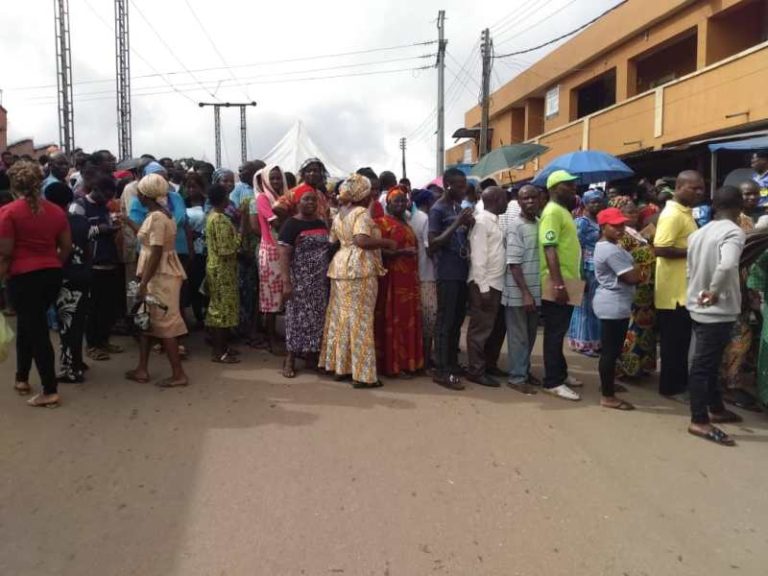
The ICIR reports that voters’ turnout for the exercise was quite impressive across the various polling units visited in Osogbo, the State capital. The atmosphere so far has been calm and officials of the Independent National Electoral Commission (INEC) have been up and doing.
However, some issues of malfunctioning of smart card readers were reported in some of the polling stations visited by the ICIR.
At Ogidan Primary School, Osogbo, voters started arriving as early as 6am, but when the accreditation exercise commenced, the two smart card readers deployed at the polling units did not work. Some members of the National Youth Service Corps (NYSC) who are serving as INEC ad-hoc staff were seen making calls in an effort to get personnel that could fix the card readers. As at 8:42, many of the voters had checked their names on the voter register, but no one was able to vote as the card readers were not functioning.
When the ICIR visited the polling unit at Salvation Army Primary School, Alekuwodo, Osogbo, voting had already started as at 8:30 am. All the card readers were working. It was the same situation at another polling unit at Akindeko area, Alekuwodo, Osogbo.
Security agents, including policemen and officers of the Nigerian Security and Civil Defence Corps (NSCDC), were seen gently controlling the crowd, making sure that voters are queued up in an orderly manner.
More to come…
Here are some photos of how the election is going:
A voter drops his ballot into the ballot boxNYSC members working as INEC ad-hoc staff, and security agents looking on as a voter thumbprints her ballot paper at the voting cubicle.The INEC ad-hoc staff marks the thumb of a voter with ink to indicate that she has votedAn impressive turnout of voters, gently and peacefully standing in a queue awaiting their turn to vote.A middle-age voter searches frantically for her permanent voter card as security agents watch on.
TODAY is International Day of Peace. September 21 of every year has been set aside by the United Nations to remind people the importance of building a culture of peace.
This year’s Peace Day celebrates the 70th anniversary of the Universal Declaration of Human Rights.
As the world celebrates this day, Nigeria is still wallowing in a series of crises that has reduced the level of peace in the country.
According to the Global Peace Index (GPI) 2018, Nigeria ranks 148 out of 163 countries in the World Peace ranking.
The GPI which is the world’s leading measure of global peacefulness measured the state of peace using three thematic domains: the level of societal safety and security; the extent of ongoing domestic and international conflict; and the degree of militarisation.
Without Cape Verde, Nigeria is the least peaceful country in West Africa. While in 44 Sub-Saharan Africa countries stated in the report, Nigeria ranks 40. This makes Nigeria one of the five least peaceful countries in the continent.
The GPI shows that the state of peace in Nigeria is very low. On the snapshot of the global state of peace, Nigeria is represented by a red colour which indicates that its state of peace is very low.
The Boko Haram Insurgency which began in 2009 has caused massive displacement of people in the North East part of the country.
Aside the Boko Haram insurgency, clashes between farmers and herders have killed many people and displaced a record number of people in the Middle Belt part of the country.
According to Global Terrorism Index, the Fulani herdsmen undertook more attacks and were responsible for more deaths than Boko Haram in 2016. These two deadly groups are the biggest security threats Nigeria has been battling over the years.
The UN Secretary-General, Antonio Guterres, encouraged nations on Friday to live up to the words of the Universal Declaration of Human Rights, which recognizes the inherent dignity and equal and inalienable rights of all members of the human race.
He said that peace takes root when people are free from hunger, poverty, oppression and can thrive and prosper.
THE National Emergency Management Agency (NEMA) says more than N12 billion is needed to cater for the over 327,000 people that were affected by flood disasters across 12 states and 50 local government areas in the country.
Of this amount, only N3 billion is available, while over N9 billion remains unmet.
This was contained in a situation report published by the agency on Friday, which showed that four out of the 12 states that experienced flooding recently have been declared national disaster. They include Anambra, Delta, Kogi and Niger states.
“There are 327,052 people affected in the flooded States. National and Territorial Emergency Operating Centers (EOCs) are activated to facilitate the response in the States and collect information on critical gaps and needs,” the situation report read in part.
“70 casualties have been reported so far and… the numbers are expected to increase. Damaged shelters are yet to be ascertained in some areas as the flooding has not yet subsided.”
Data source: NEMA
The number of people that sustained injuries as a result of the floods has been put at 151, while 3,544 houses were destroyed or damaged, and 60,208 hectares of agricultural land were destroyed.
“There are reports of malaria and possibility of water-borne diseases. The displaced population are currently being hosted in emergency shelters1 such as LGA offices, schools, stadiums, churches and an IDP hostel built by Presidential Committee on Flood Relief and Rehabilitation,” the report added.
“The extent of the damage is expected to increase once floods have receded. Power and telecommunications are reported to be down in some locations.”
The report, however, added that asides the support services being rendered by the Presidential Committee on Flood Relief and Rehabilitation, several other international humanitarian organisations such as United Nations Office for the Coordination of Humanitarian Affairs (UNOCHA), the World Food Programme (WFP), and the International Organization for Migration (IOM), have deployed their staff to support the operations, especially through the provision of information management and GIS mapping.
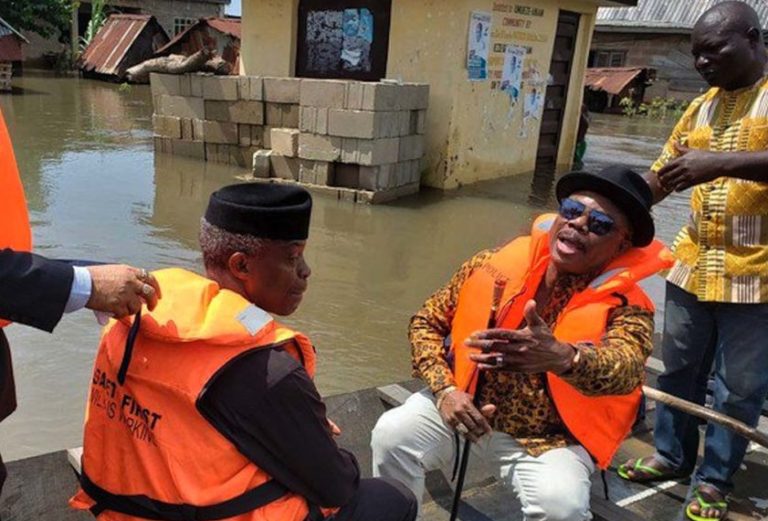
On Thursday, Vice President Yemi Osinbajo visited flooded communities in Anambra and Delta states and assured residents of the federal government’s commitment to their welfare.
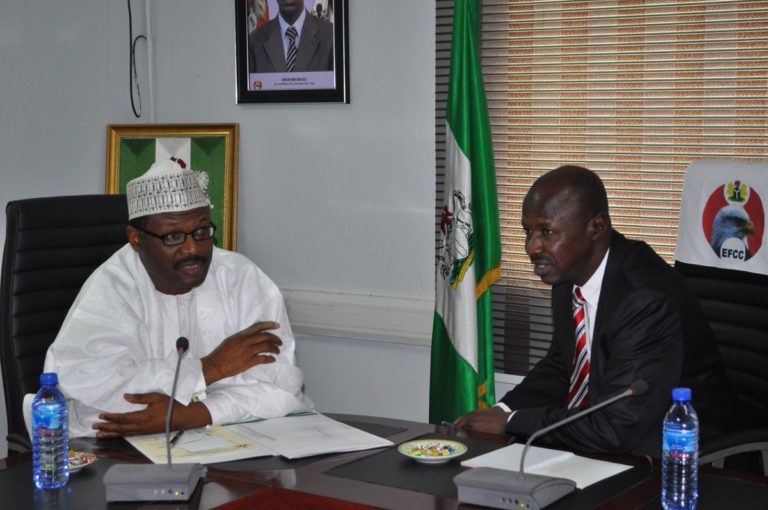
ACTING Chairman of the Economic and Financial Crimes Commission (EFCC), Ibrahim Magu, says the commission will ensure that nobody who collects money to rig elections in Nigeria goes scotfree.
The spokesman of EFCC, Wilson Uwajuren,made this known in a statement on Friday, adding that the commission has launched “a massive but discreet” surveillance on the movement of funds by politicians as part of its proactive measures to check vote buying.
Uwajuren said the tracking process, which includes politicians from all the political parties in the country, will continue until the elections are concluded.
He said that the commission is determined to restore the integrity of the electoral process and prevent the exercise from being used as an avenue for money laundering.
Uwajuren, quoted the Acting Chairman of the EFCC, Ibrahim Magu, as saying that the commission will join forces with other law enforcement agencies to enforce compliance with the electoral act which criminalises financial inducement by political parties and their candidates.
“Those who offer bribes for votes are as guilty as those who receive such gratifications. My candid advice to the electorates is to be vigilant and resist the temptation to sell their votes,” Magu said.
“The 2019 general election offers Nigeria the opportunity to deepen her emerging democratic culture that is free and participatory. We must guard this process by shunning all forms of electoral malpractices. No one who collects money to rig election will be spared.”
Earlier in February, Magu had said that the EFCC would partner with INEC to monitor campaign spending ahead of the 2019 general elections. Monitoring the flow of funds during elections, Magu said, will help to improve the quality of governance as it will ensure that only “good candidates are elected not moneybags”.
GANDOKI, a corporal with the special force unit of the Nigerian army, walks out of a sport betting shop, scans through the ticket in his hands, then nods as his face widens into a smile. The corporal and many other soldiers fighting Boko Haram insurgents in the north-east do not receive their operation allowance regularly. They find means of survival by gambling, using as low as N50 to predict results of games that could—if by chance their predictions hit it right— enrich them with a few thousands of naira.
“For months now, we’ve not been paid our allowance. How would we have survived if not for the small money that we see from this sport betting?” Gandoki asks, smiling his way to a bar close to where his unit is camped. His predictions on matches in European football league have so far won him almost half the amount of allowance owed him by the Nigerian army.
A few bottles of beer and a plate of pepper-soup are enough consolation for this special force soldier who has just a few days left in Maiduguri, Borno state capital, before returning to the frontline, where the fight continues.
SOLDIERS WEAR SLIPPERS TO WAR FRONT
A standard soldiers’ footwear is dark green camouflage shoes but some who are fighting Boko Haram walk into battle with open-toe slippers. Soldiers in the trenches would reveal that being ‘poorly kitted’ in the army is an understatement.
“Kitting of soldiers? You are on your own,” Gandoki jeers. Then, he yells: “We have our special uniforms that we use as special force soldiers. But nowadays, none of us is still that specially kitted.
“Soldiers now use any type of uniform they can afford. We were even once told that part of the money owed us would be used to buy our uniforms. We were also assured of getting camouflage T-shirts, rather, what we were given were Etisalat branded T-shirts. And when the uniforms came, if you get a trouser, you will not get the shirt. If you get camel bag, you will not get knee guard.
“When they bring the uniforms, they share it among themselves at the top. Even in Abuja, you will see officers that did not train with us being kitted with special force uniforms.
“In NAPEX (Nigerian Army Post Exchange), the store where military uniforms are being sold, each goes for about N25,000. But then, how much is an average soldier’s salary? So, that is why we put on anything we have. And we do that even in the war front. Soldiers who don’t have desert boots and can’t buy canvass, wear slippers.”
Many of the soldiers have not been given fragmental jackets (bullet-resistant vests) since they got drafted into the war theatre. In the bushes where the action takes place, the soldiers don’t expect a luxurious living. They simply want the authorities to provide them with camp beds.
“We buy the beds and tents with our money. Some of us went to Mali in 2013 for an operation where we were fully kitted. When we came back, and redeployed to operation Lafiya Dole, they collected the bed and fragmented jackets from us and were sent to the bush in Bama, at the time the insurgency was very hot. It was hell.”
“We go for parameter patrol without night vision goggles. We go in blindly, and because we are not equipped with these night vision goggles, Boko Haram will be approaching your camp in the night and you will not see them until they are already closer, firing at you.”
‘NOTHING SPECIAL ABOUT SPECIAL FORCES SOLDIERS’
Soldiers cutting vegetable as they prepare their meal.
Should soldiers whose unit bears the name special not be given preferential treatment?
Special forces are military units trained to carry out special operations, and in Nigeria, hundreds of soldiers from various divisions and battalions have been specially trained and drafted into this unit where the task is to fight Boko Haram insurgents.
“Anything they call special is supposed to be treated special because of the training you undergo, but there is nothing special in this operation we’ve been in here,” Gandoki says, his chin lowering from disappointment.
“We will be advancing to face the enemies, and all we are given to eat for days is popcorn and biscuits.”
He was a young soldier in one of the divisions in the south-east when a signal was sent to the armed forces; army, air force, navy and the police regarding the assemblage of a select few for special training.
“We were nominated from across battalions, and were assembled at the military cantonment in Jaji,” he said, adding that on arrival, they were told to see themselves as lucky to have been picked for the training. The soldiers saw it a privilege but none of them knew they would end up squaring up against Boko Haram in the north-east.
“The training was in Russia, and we were there for four months. We were supposed to stay up to six months, but there was pressure on us to return and fight.”
‘WE BEGGED OUR ENEMY FOR WATER’
Before departing for Russia, these would-be special force soldiers were given 30% of their training allowance, and assured of getting the remaining 70% upon their return. Sadly, the soldiers’ hopes were dashed as it never came forth.
They never got what they were promised.
Gandoki is in the first batch of the specially trained soldiers deployed to the operation in the north-east, and their first assignment, upon return in 2014, was to engage Boko Haram insurgents in Sambisa forest.
“We were about 200, advancing into Sambisa, and the first problem started when we weren’t given food or money to feed,” he says as his voice dropped again.
“On this first assignment to the bush, some died and, luckily, some of us returned alive. If you see the kind of food they would eventually give us, you will weep for us. There was a time we were begging our enemy for water, because we were going to die of thirst. The military helicopter, we were told, would bring water but wouldn’t be able to land because where we are is not safe for it. And, I would ask, what about us on the ground here?”
The insurgents may have killed quite a number of soldiers, but these fighters say lack of food and water should also be held responsible for soldiers’ death.
LIVING WITH PAIN
Gandoki, who has been in the operation for three years, has sustained injuries and not much has been done in taking care of him.
“I have two gunshot wounds on my body,” he says, reaching for his leg and back where the injuries are. “There is rubber inside my leg because the vein almost cut off so they have to brace it with rubber. And, nothing has been given to me to sort my medical bills, even when we heard that money was released to take care of some of us who have been affected.”
He is a victim of Damasak and Gashiga attacks in Borno. The task was to clear a Boko Haram hideout, and the special force battalion was to meet with a strike group in Abadam, still in Borno, where they were to proceed to collectively strike the hideout.
“We took off and on our way we had an issue with our vehicle, and we spent the whole day trying to fix it. In Gashiga, we entered Boko Haram ambush. We called our jet, and there was no response. We started a battle with the enemies and it was there I got hit with multiple bullets.”
Gandoki’s vehicle had run into the mines and while the soldiers were trying to pull themselves out, the insurgents started shooting at them. “With our injuries, we withdrew to Damasak, and after a while, we advanced again and this time, the attacks were overwhelming.”
Quarters where some of the soldiers live.
The insurgents outnumbered and then overpowered the “battalion”. “We call it a battalion but what we have is actually a company, yet those generals at the top get monetary allocations for a bigger battalion while the formation sent to fight in the bush is the smaller company.”
More than 40 soldiers were killed. The soldiers were not the size of a battalion that they should be, and then, the machines they were left to fight with were faulty.
“The two scorpions we had were not working,” Gandoki explains. “The general purpose machine gun (GPMG) mounted on the scorpions were faulty, too. I don’t know why they are not serviceable, and instead of the commanding officer to tell the theatre commander, he was pushing us to the frontline and there we got ambushed.
“They said it is a battalion, but let me tell you the truth, it is not a battalion that is deployed to Gashiga. It is a company. A company has about 200 soldiers as against a battalion of 800 soldiers. Those in authorities label us a battalion so they can get the money meant for about 600 soldiers.”
The soldiers had managed to fire one bomb before the machines stopped working. Advance, attack, withdraw and defense are the four phases of war, and since their machines were not forthcoming, they had to withdraw, but sadly, they couldn’t defend.
While some injured special force soldiers couldn’t get out alive, Gandoki had found himself in the hospital.
The morning after they were “dumped” at the hospital, Gandoki said the pain was becoming unbearable for him, and he started crying, calling for help. An officer who was moved by Gandoki’s plight came to him, helped him get on a wheelchair and he was wheeled to where his bullet-ridden leg got scanned. Even when the scan had showed bullets inside his leg, it took three days before he was moved into the theatre for surgery. He said throughout his stay alongside other soldiers at the 7 Division hospital, the army left them with no food.
Since the surgery, Gandoki says he has not had any post-surgery treatment. Apart from his leg injury, sounds of gunshots and IED explosions had affected his eardrums— such that until a word or phrase is repeatedly said, he can barely understand.
His left ear functions no more.
“From the army hospital, I was referred to the University of Maidugri Teaching Hospital,” he explains. “But, it is better you sit at home and find a way of treating yourself than go to any of these hospitals. You will spend money transporting yourself to and fro the hospital and you get there, sit for hours because nobody would attend to wounded soldiers. They will keep telling you doctor is coming. We will be there, tired, in pains and waiting on empty stomachs.”
If a soldier is wounded and goes for treatment and has not returned within three to five days, Gandoki says such soldier’s account would be frozen.
“They will say he has gone AWOL. If you sustain a bullet wound while fighting in the bush, you are supposed to RTU (return to unit). But now, they will ask you to return to front line.”
When Gandoki refused to return to the front line, he was slammed with a two-count charge; disobedience and failure to perform military duty.
Gandoki has lost hope in the hospitals. He had thought as a special force soldier, he would have enjoyed some special medical treatments. The strong-willed fighter now uses salt and water to mop his injured leg, a post-surgery treatment he can afford. And for his bad ear, he uses cotton wool to cover it.
SOLDIERS SLEEP INSIDE CLASSROOMS
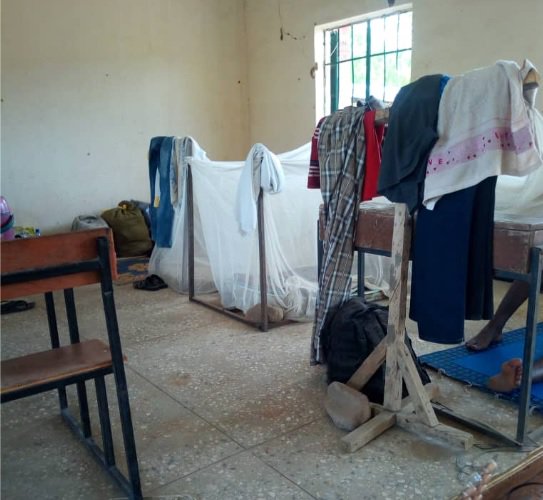
Classroom where some of the soldiers sleep.
Special force soldiers deployed for operation Lafiya Dole have been camped in classrooms of a secondary school along Gubio road, outskirt of Maiduguri.
“When we return from the bush, these are the classrooms we live in,” Gandoki says, shaking his head. “One has spent six months in the bush, and when you return to Maiduguri to shop for a few things— after being on the road for about 12 hours— you come to sleep on the floor of this classroom, because you have nowhere to sleep. Even when the commanding officer came and saw our condition, he shook his head, pitying us.”
He adds that soldiers who have mattresses got them from deserted villages.
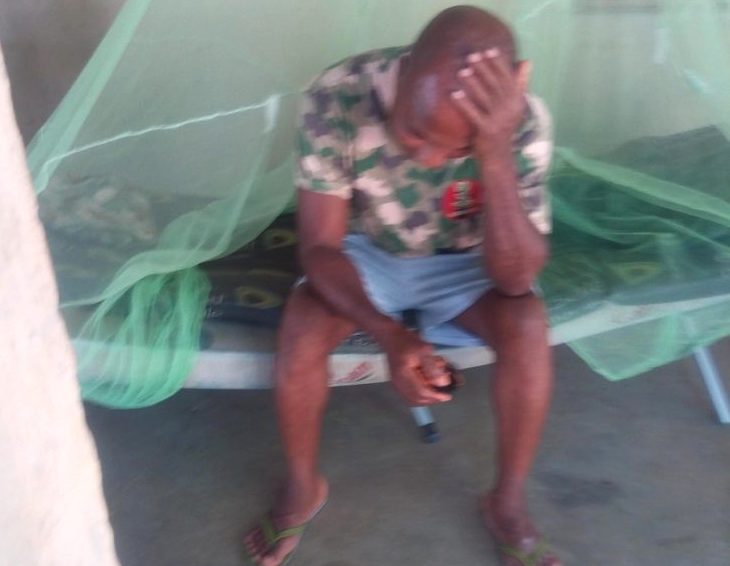
“I sleep inside the tank,” Gandoki’s friend who does not have a space in the classroom says. “We get mosquito net ourselves for N400, because if you wait for the army, mosquitoes will kill you here.”
‘IF I DO NOT WET THIS FLOOR, THE DUST MAY KILL ME OVERNIGHT’
Rusty zinc houses where hundreds of soldiers rest their heads are scattered on the dusty expanse of land inside the Maimalari barracks in Maiduguri.
One evening, Danje, one of the old serving soldiers in operation Lafiya Dole, returns from Konduga, tired but he still had to fetch water some metres away so he can wet the sandy floor of his zinc house.
“If I do not wet this floor, the dust may kill me overnight,” Danje says, flashing a smile as he drops his rifle and picks up a bucket. For three months, he has not been paid, too, but as soon as he gets his operational allowance, he intends to buy five bags of cement and fill the room with concrete.
“When we arrived here many years ago, with all our loads, we were told all the blocks of flats in the barracks have been occupied,” he explains. “And you know, as soldiers, we just have to find our way.” For almost a year, Danje says, he will spread his mat atop one of the abandoned and faulty vehicles at a mechanic workshop to spend the night. He did this until he was able to save enough money, like other soldiers, to construct his own zinc house.
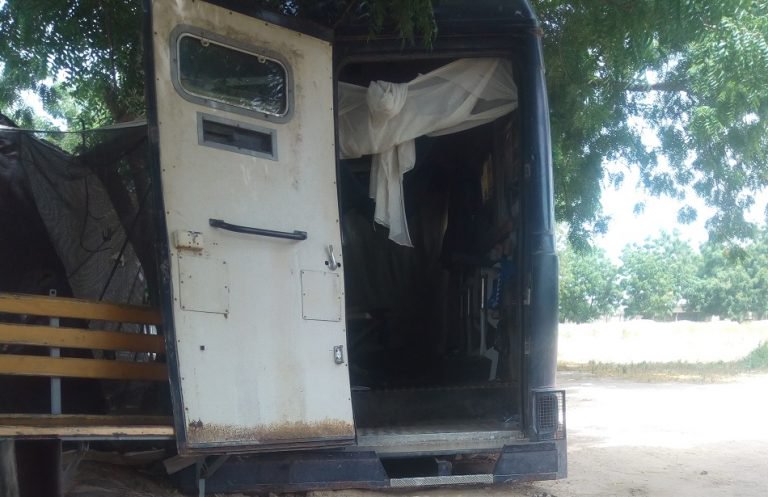
This is my own self-contained apartment, says one of the soldiers who sleeps in an old, abandoned bus.
“This is my own self-contain apartment,” he laughs. “I built this place myself, with my money and my hands. A sheet of fairly used zinc sells for N700, while the new goes for N1,000, we can only afford the former. And to put this whole structure together, you will spend at least N31,000 on zinc alone.”
Danje says soldiers have been abandoned and that the authorities do not make an attempt to refund them. “Soldiers would go to the bush to fight, and when some of us are lucky enough to return here, are we supposed to be spending our own money to construct where we will rest our heads? Is it not the responsibility of the Nigerian army to make provisions for our accommodation here?”
The soldier says his condition is better than some of his colleagues who still have nowhere to put their heads. “The system here is; carry your cross, I carry my cross.”
FOOD WITHOUT MEAT
Food is ready; a typical meal for Nigerian soldiers in the North East.
Willie has just been posted to Maiduguri. The young soldier is three weeks old at Giwa Barracks and he is struggling to come to terms with being served food without meat.
“Not once, in my three weeks here have I tasted meat,” Willie says, as he waves off the teeming flies on the wrap of semovita and watery soup by his side.
“All they give us here; beans, rice and semo, we have never eaten vegetables here. They will share food by 5:00 pm and if you do not rush, you will not get food.
“By right, our feeding timetable says every Saturday, I will eat food with soft drinks or bottle water or sachet water. We are also supposed to get fruits twice in a week, but we don’t get all of those. They said they will give one soldier one bag of water for a week but we don’t get it. Before, from theatre command, we heard they used to give soldiers popcorn and juice but not anymore, and we don’t know why.”
Once, the soldiers were to advance to the bush for a task and they “had to buy garri and take along, because we were not given food, and we were going to walk some 15 kilometres”.
The experience is the same with soldiers in Maimalari Barracks and those currently in the bush.
“Yesterday, they gave us one soup you cannot even describe as okra or ewedu,” Jacko, a soldier in Maimalari turns their feeding into a subject of mockery. “The food was tasteless, and this morning, they cooked beans and pap; the pap, oh my God, o my God!”
‘WE STARTED EATING HUMAN FLESH WHEN FOOD SUPPLY STOPPED’
His eyes are almost covered with blood clot, with his eyeballs uncomfortably positioned. He looks strange — like a character in a horror movie.
Gimzy, a sergeant, has spent the last three years, from one bush to the other in the dreaded Sambisa forest, and now he is back in Jimtilo Barracks, Maiduguri.
“I lived in Sambisa for three years,” he begins, adjusting the rifle dangling around his arm, and groping for a stick of cigarette from his chest pocket. Like many others, Gimzy and Motu, his brave wife who lived with him in Sambisa, have not had an accommodation in the barracks since they returned. “And, I don’t have any money, my wife and I just found one corridor to sleep when it’s dark. But, they keep telling the whole world we soldiers are fine that they are taking care of us, that they are paying us.”
Gimzy is more worried about food than accommodation. While in the bush, they were being supplied food, but at a point the food stopped coming and soldiers were left to fend for themselves.
“Normally, they bring in food for us with gun trucks and escort. And it takes days before they get to us, that is if they are not ambushed by the enemies. But for almost three months we didn’t get food and we had finished all we have, we gathered that the enemy had set ambush everywhere and it was hard to get food across to us.
“And they don’t use helicopter to supply us food, because the hovering helicopter would reveal our location to the enemies.”
MANY SOLDIERS HAVE EITHER SALARY OR ALLOWANCE PROBLEM
The administration of former President Goodluck Jonathan had re-initiated the integrated payroll and personnel information system (IPPIS) where payment of salaries and wages were to be directly paid into the government employees’ accounts. The main aim of the system is to pay accurately and on time with the statutory and contractual regulations.
About N75 million was appropriated to implement this. In September 2017, the presidential initiative on continuous audit (PICA) wrote to the armed forces to submit its payroll for migration to IPPIS, but soldiers at the frontline accused the army authorities of not responding as irregularities continue to dog their payment.
“We heard the navy and air force have submitted the payrolls of their personnel for IPPIS, but it does not appear the army has,” says Kazau, a soldier who is yet to get his two months pay.
“Our money comes through the army authorities, and before it gets to us, they would have cut from it. And that is why we have been praying they agree with the IPPIS so that we can get paid directly from the government.
“Seventy percent of soldiers in Maiduguri here either have salary or allowance problems. Some soldiers are owed nine months allowance, and you will still be sent to the bush despite the suffering because you don’t have an option.”
NO DANGER ALLOWANCE, SHORTCHANGED ON OPERATIONAL ALLOWANCE
For each soldier fighting insurgency, N45,00, they understand, is the approved sum for operational allowance. But, of this approved sum, N30,000 is what eventually gets to them. N20,000 is paid into their account, and N10,000, a hand-to-hand payment. A deduction of N15,000, the soldiers are told, is used for their feeding.
The soldiers feel cheated. They say their counterparts in the navy and air force who are also in the operation get the full N45, 000, and they are given food.
“In fact, we heard the operational allowance is originally N75,000 from which N30,000 is for feeding, and the remaining N45, 000 is to be paid to us,” a soldier in Baga explains.
“Apart from that, if a soldier is going on pass, he is supposed to be given transport allowance or a military vehicle drops him, but we don’t get that here.”
Soldiers who have been in the operation for over three years and are daily exposed to danger on the frontline have not, for once, been paid danger allowance, and this, the soldiers say they are entitled to.
BUT, WHAT HAS HAPPENED TO THE BILLIONS APPROPRIATED BY THE ARMY?
“We will devote a significant portion of our recurrent expenditure to institutions that provide critical government services. We will spend N369.6 billion in education; N294.5 billion in defence; N221.7 billion in health and N145.3 billion in the ministry of interior. This will ensure our teachers, armed forces personnel, doctors, nurses, policemen, fire fighters, prison service officers and many more critical service providers are paid competitively and on time,” President Muhammadu Buhari said in 2016 when he presented his ‘budget of change’ to a joint session of the national assembly.
Eight billion naira, N25 billion and N78 billion were appropriated for operation Lafiya Dole in 2016, 2017 and 2018 respectively.
In the 2017 appropriation, the ministry of defence budgeted N2.2 billion to rehabilitate barracks nationwide. There is also a separate budget of N1.7 billion for the construction/provision of barracks while another N1.6 billion is budgeted to construct special force barracks.
In the same budget, the Nigerian army is to purchase defense equipment for N5.8 billion, construct barracks for N5.2 billion while N51 million on is for rehabilitation of barracks.
N2.56 billion is budgeted for the provision of uniforms and other kitting items, and N670 million for the purchase of health/medical equipment.
N5.5 billion is for the provision of barracks and N1.4 billion for uniforms and kitting in the 2016 budget.
In spite of these huge budgeted sums, the soldiers at the end of the chain feel no effect.
ARMY AUTHORITIES NOT SAYING ANYTHING
Twice, the army refused to respond to a Freedom of Information (FoI) request sent for budgetary and fund release records. Same request was also sent to the office of the accountant-general of the federation, and there has been no response.
When contacted, the Nigerian Army Finance Corps asked TheCable to return to the army headquarters in Abuja. An officer at the corps office in Lagos who pleaded to be anonymous, however, said the top generals are to answer for these funds.
“Indeed, funds were released for our troops but they boys in the bush are being shortchanged,” he says. “Check out those generals, and ask them where they get money to build mansions and estate in Abuja and soldiers don’t have where to sleep when they come out of the bush.”
The information requested from the army were; a breakdown of amount released for the construction/rehabilitation of barracks across Borno, Yobe and Adamawa states; the name of each construction/rehabilitation project for which funds were approved from January, 2014 to October, 2017; a breakdown of total amount released to kit soldiers and officers in Borno, Yobe and Adamawa states from January, 2014 to October, 2017; a breakdown of total amount released as operational/danger allowance for soldiers and officers drafted into the Operation Lafiya Dole across Borno, Yobe and Adamawa states.
Interestingly, in the 2017 appropriation, the ministry of defence earmarked N20 million for a line item it called “implementation of FoI”.
Jude Chukwu, army spokesman wouldn’t hide his anger when he was reached for comment over the poor welfare of troops fighting insurgency.
“Which soldiers? I am with the soldiers you are talking about and I don’t know who is giving you that report,” he said with an unfriendly tone.
“Sometimes you people will just be asking some questions that one would just imagine how you people came about it. Do you know the meaning of a soldier? If you know the meaning of a soldier, you wouldn’t ask that question. You wouldn’t ask me whether a soldier can comfortably be taken care of or not. People are fighting war, and you are talking like this? Do people stay in the room and be fighting war?”
Chukwu, beating his chest, said no soldier ever complained of poor welfare.
“You journalists just pick up something. Soldier have enough, they have food to eat. No issue with welfare, I don’t know why you are asking.”
Chukwu, however, did not respond to why the army authorities failed to make available information on how funds have been spent on the soldiers’ welfare.
*Names and designation of soldiers have been altered to protect their identity.
This investigation is supported by the John D. and Catherine T. MacArthur Foundation and the International Centre for Investigative Reporting (ICIR).
THE International Centre for Investigative Reporting (ICIR) has announced the first set of successful grantees for its human rights project which includes journalists and civil society organisations (CSOs).
The announcement was made on Thursday at a round-table meeting of participants at Bolton White Hotel, Abuja.
The long-term initiative tagged ‘Human Rights Accountability and Justice Project’ is sponsored by the Institute for War and Peace Reporting (IWPR).
Beneficiaries of the first batch include Evelyn Okakwu from PremiumTimes, Ameh Ejekwonyilo from Authority Online Newspaper, and ‘Kunle Adebajo representing The ICIR.
Also on the list of awardees are two CSOs: Devatop Centre for Africa Development and the Sexual Offences Awareness and Victims Rehabilitation (SOAR) Initiative.
While the journalists are expected to investigate and report stories ranging from human trafficking to prison reforms, the CSOs will be implementing advocacy projects to create awareness around child labour and boy-child rights violations.
Speaking to The ICIR, Cynthia Ozioma Ifeanyi, a social worker at the Devatop Centre, said her organisation is delighted to have been given the opportunity.
“We hope to utilise the grant to reach a greater number of people,” she said, “create more awareness, and sensitise people via the Talk Am Radio Show we are trying to set up.”
She added that, with the money, Devatop Centre hopes to reach and sensitise remote communities who are more vulnerable to trafficking.
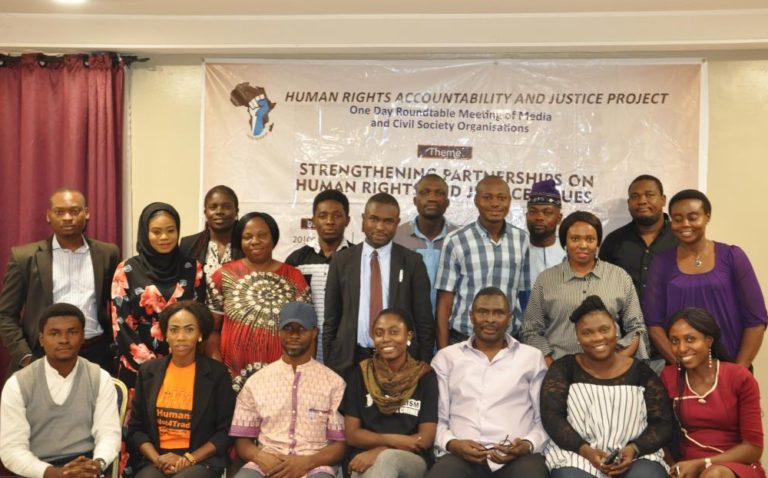
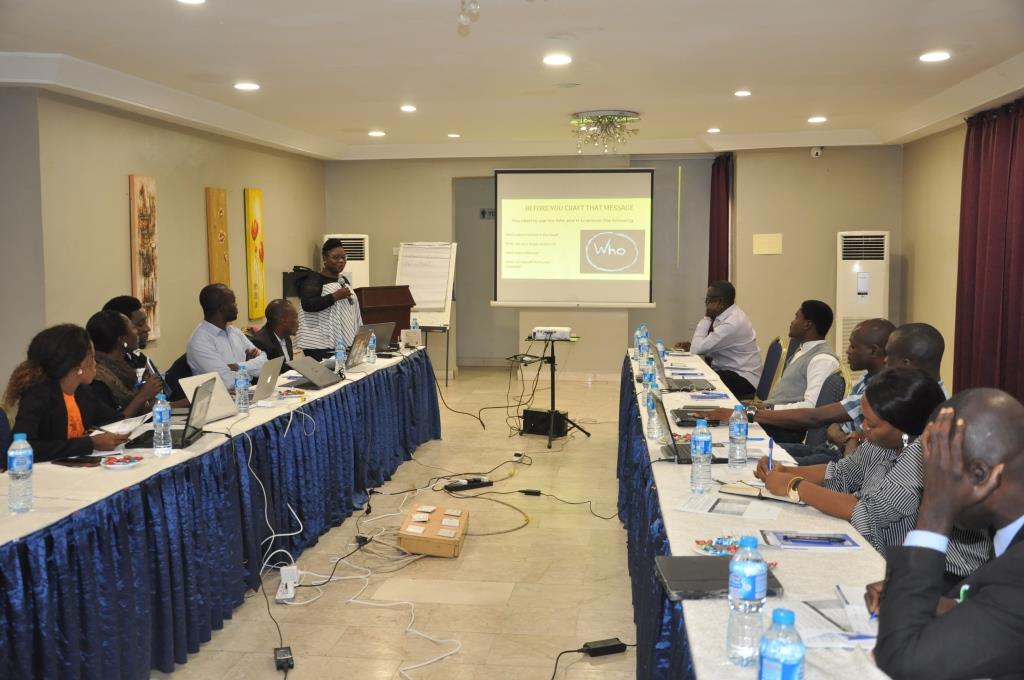
Cross-section of participants during one of the training sessions
According to Rosemary Otohwo-Olufemi, ICIR Senior Programme Officer, the selection was based on pitches earlier submitted by various participants. She admonished the various participating media and civil society organisations to collaborate and share resources to make the project a great success.
Also at the meeting were Funmi Ajala, travel storyteller and journalist, and Peter Nkanga, media consultant and former West Africa representative of the Committee to Protect Journalists (CPJ). They trained participants on effective messaging for audience engagement and online security respectively.
The first meeting was held in May and was followed by a two-day training where Thomas Baker, IWPR Programmes Coordinator, urged participants to make investigation the core of their work ethic.
AN outbreak of cholera has claimed 61 lives in Yobe State while 906 people have been infected with the disease.
Commissioner of Health in the state, Muhammad Kawuwa, made this known in a statement issued in Damaturu, the state capital, on Friday, according to the News Agency of Nigeria (NAN).
“Some of the AWD cases were caused by Vibrio bacteria, the bacteria that cause cholera,” Kawuwa stated.
“906 cases have been recorded in six local government areas of the state: Gujba, Gulani, Damaturu, Fune, Potiskum and Nangere in two months. Over 795 patients were successfully treated and discharged, 50 are still on admission in various health facilities across the state.
“Unfortunately, we lost 61 patients mainly due to delays in timely reporting to the healthcare facilities for life-saving treatment.
“In the light of this and due to our continued concern for the health of our people, the state government is, therefore, declaring outbreak cholera in the state.”
The commissioner the state has been working working in partnership with the World Health Organisation (WHO), the University of Maiduguri Teaching Hospital and the Nigeria Centre for Disease Control (NCDC), to find out the cause or causes of the outbreak.
However, Kawuwa identified poor personal hygiene, lack of proper sanitation facilities and flooding as possible causes of the outbreak. He called on all relevant stakeholders, including religious and traditional leaders to join hands together in tackling the outbreak.
Only three months ago, the Yobe State government had declared an earlier outbreak of cholera in five local government areas of the state . The previous outbreak affected 404 persons, out of which 16 died.
THE Saturday 22 September gubernatorial election in Osun State is going to be a different one, if not unprecedented.
In 2014, only 20 parties presented candidates for election, and the number was even fewer in the previous polls – 2007, 2003 and 1999. But the 2018 election will feature candidates from 48 political parties, the highest in the voting history of the state.
Also, over1.6 million people across the 30 local government areas have been registered to vote in 2018, according to the data published by the Independent National Electoral Commission, INEC in August. Compared to 1.4 million registered voters in 2014, more than 200,000 new voters have joined the electorate, and the 14 per cent addition may skew the election outcome on Saturday. It remains uncertain though how many of the registered voters would turn up on the election day as voter’s apathy appears to have risen.
Many government workers who were excited at the inauguration of the present administration in November 2010 are no longer enthusiastic due to the delayed salaries that lasted for more than two years and left many broke and frustrated.
In the last governorship election, more than 45 per cent of the registered voters did not come out to vote. The situation may not improve remarkably on Saturday, considering the number of people who have relocated in the last four years to other parts of the state or outside without being able to transfer their PVC.
According to the INEC, 21,685 voters requested for PVC transfer from one polling unit to another within the state. And while 7,688 transfers were made from other states to Osun, 3,015 transfers were made out of Osun State. These changes, however, will affect the outcome of tomorrow’s election.
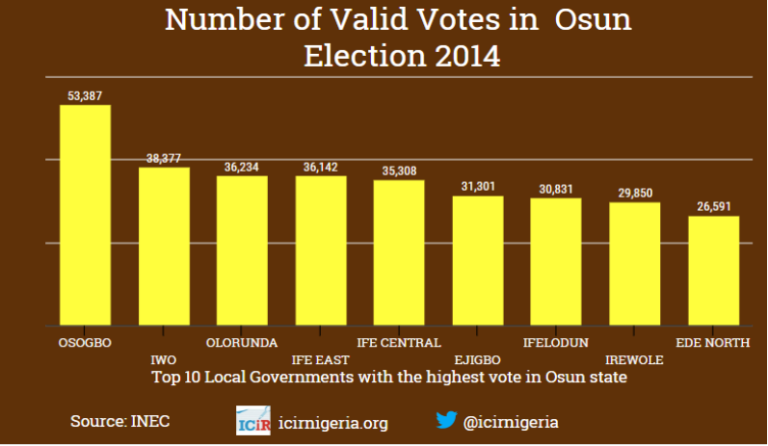
The Saturday election also will be unique in the sense that the local government areas where the current ruling party, APC, got a critical mass vote in 2014 are going to be closely contested. For example, Osogbo local government area where the APC scored, 39,983 votes, the highest in 2014, will be more keenly contested by the candidates of Action Democratic Party (ADP), Moshood Adeoti and Adeolu Durotoye who hail from Iwo and Osogbo LGAs respectively. The second largest votes(26,551) for APC in 2014 came from Olorunda,another local government area comprising a part of Osogbo town and its environs. APC, unlike 2014, will struggle to snatch victory in this area as well.
Add Iwo LGA, another stronghold of APC in 2014, where the party recorded the third largest votes of 20,827. There are strong indications that election results in Iwo may not remain the same on Saturday with the defection of Adeoti, a grassroots politician and a former APC stalwart. Adeoti hailed from Iwo, and he was instrumental to the electoral victory of APC in 2014 in his constituency, the reason he was retained as the Secretary to the State government after completing four years in the same office. Observers believe Iwo would give victory to ADP.
Another force that may upset the apples cart in the 2018 Osun election is the candidacy of Senator Ademola Adeleke, the flagbearer of the People’s Democratic Party(PDP). Adeleke hails from Ede, the town next to Osogbo, the state capital.
There are two local government areas in the old town (Ede North and Ede South), and each of them handed a significant victory to APC in 2014 when Governor Rauf Aregbesola slugged it out with the then PDP candidate, Senator Iyiola Omisore who is now the flagbearer of Social Democratic Party SDP.Seven per cent of the total votes scored by APC in 2014 came from Ede North and Ede South. It is unlikely APC will get that much in Ede in the next election, now that Adeleke is the PDP candidate.
Meanwhile, Ife (Central, East, South and North) that pulled the largest vote block of 68,038 for PDPagainst APC in 2014 may no longer vote for PDP candidate because of Omisore’s defection to SDP. It is conceivable that most of the votes from Ife will go to SDP instead of PDP or APC. Omisore is from Ife Central.
Olaoluwa, the hometown of Akinbade is one of the local government areas with the least valid votes in 2014 after Ifedayo, Boluwaduro and Atakumosa LGAs. And more than 50 per cent of the 15,735 votes were given to the ruling APC. That may not happen tomorrow because of Fatai Akinbade’s name on the ballot paper. But even if Akinbade, the governorship candidate of African Democratic Party, ADC obtains the majority of that vote on Saturday, it is unlikely the figure will put him ahead except he is able to get significant votes from other local government areas. And this is where his teaming with the retired justice Folahanmi Oloyede from Ilesha East may allow for greater traction in the 2018 election. The incumbent governor is also from Ilesha East, so the choice of Oloyede is to neutralise APC’s influence in Ilesha. Yet it would be tough for ADC to get significant votes from the victory deciders LGAs like Osogbo, Olorunda, Iwo and Ife.
In the final analysis, Gboyega Oyetola of APC is positioned to emerge victorious in the Saturday election, not necessarily because he is more popular than other leading contenders, but because his party has more resources to spend both for campaign and mobilisation. And more telling is the fact the opposition parties are unable to forge a coalition that can help deplete the votes of the ruling party in a more considerable way.
ANOTHER minister serving in President Muhammadu Buhari’s cabinet has been found to have skipped the mandatory national youth service scheme, an offence that may see him lose his position and earn him jail term.
The Minister of Communications, Adebayo Shittu, failed to participate in the NYSC scheme despite graduating from the then University of Ife (now Obafemi Awolowo University) at age 25, PREMIUM TIMES can authoritatively report.
The revelation about Mr. Shittu, who is currently angling to become Oyo State governor, is coming to light about a week after Kemi Adeosun was compelled to step down from her post as Nigeria’s finance minister after this medium reported that she skipped national service and then procured a fake exemption certificate to cover her tracks.
Months of discreet checks at the NYSC headquarters showed that the communications minister did not present himself for service after graduation and is yet to do so till date.
Contacted Tuesday, Mr. Shittu admitted that he did not serve but claimed he thought his first political post after graduation could suffice as national service, a claim lawyers and NYSC insiders consider as ludicrous and untenable.
Skipping the compulsory national service is an offence under the NYSC law, punishable with up to 12 months imprisonment.
Employers are mandated by law to always request NYSC certificate of national service from employees as part of the conditions for hiring.
Mr Shittu, born on March 23, 1953, studied law at Ife, graduating in 1978. He proceeded to the Nigerian Law School, Lagos, qualifying as a lawyer in 1979.
Having earned a bachelor’s degree at the age of 25, Section 2 of the NYSC Act expects Mr Shittu to have participated in the year-long national service.
The Minister speaks
Adebayo Shittu
Section 2 (1) of the NYSC Act mandates all Nigerians who earn degrees or higher national diplomas from tertiary institutions in Nigerian and abroad (effective 1972/73 session) to participate in the scheme.
Those exempted by the law are those who graduated after their 30th birthday, persons with national honours and individuals who serve in the military and intelligence organisations.
Rather than enlist in the national service, Mr Shittu went into politics after graduation, and was, in 1979, elected member of the Oyo State House of Assembly.
The minister said he believed that having been elected lawmaker, he needed not participate in the national service.
He said he deliberatively skipped the NYSC scheme because he was convinced that his membership of the state assembly was itself a “service”.
“The constitution provides for the qualification needed for state assembly members, NYSC is not there,” Mr. Shittu said. “I didn’t need it to become a member of the state assembly, and that is already a service,” he said.
Mr Shittu disagreed with our reporter who laboured to explain to him that the NYSC Act makes participation in the scheme mandatory for all graduates like him and that election or appointment to political office does not qualify as a basis for exemption.
What the Law Says
Mr Shittu’s argument does not appear convincing when placed against the letters of the NYSC law.
Section 2, subsection 1 of the Act makes it obligatory for “every Nigerian” who graduate at the end of academic year 1972-73 and subsequent years, “to make himself available for service for a continuous period of one year from the date specified in the call-up instrument served upon him”.
Subsection 2 of the same section enumerated instances of exemption from the national service, which did not include holding political office, as Mr Shittu claimed.
The four categories of individuals exempted from the national service, according to the NYSC law, are those who graduated above the age of thirty, and those who have served in the armed forces or the Nigeria Police for a period of more than nine months.
The third category covers staff of four security organisations, namely the Nigerian Security Organisation, the State Security Service, the National Intelligence Agency and the Defence Intelligence Service.
Exemption status is also conferred on individuals who bagged national honours before graduation.
Illegalities?
Despite not possessing certificate of national service, Mr Shittu went on from being a state lawmaker, to occupying important government positions, including his current post as minister.
Mr Shittu is a former attorney general and commissioner for justice in his native Oyo State. He also served as member of the Oyo State Judicial Service Commission from 2004 to 2007.
In 2015, he was nominated minister by President Buhari, and later assigned the communications portfolio upon legislative screening.
It is not clear how he scaled screenings by the Oyo State House of Assembly, the SSS, and the National Assembly, who are all expected to screen commissioner and ministerial nominees before their appointment.
Mr Shittu is now aspiring for governorship of Oyo State.
Section 12 of the NYSC Act mandates all employers to demand the national service certificate of prospective employees before hiring.
Section 12 of the Act reads: “For the purposes of employment anywhere in the Federation and before employment, it shall be the duty of every prospective employer to demand and obtained from any person who claims to have obtained his first degree at the end of the academic year 1973-74 or, as the case may be, at the end of any subsequent academic year the following:-
a copy of the Certificate of National Service of such person issued pursuant to section 11 of this Decree
a copy of any exemption certificate issued to such person pursuant to section 17 of this Decree
such other particulars relevant there to as may be prescribed by or under this Decree.”
Section 13 of the Act also criminalises skipping the national service as it prescribes 12 months imprisonment or fine of N2,000 or both, for such offenders.
Lawyers speak
Lawyers who spoke to PREMIUM TIMES said the minister is in the breach of the NYSC law for skipping the national service.
“His membership of the state assembly is not the same as national service,” said Huwaila Mohammed, a Kano-based practitioner. “He needs to serve, because the section of the law dealing with exemption did not include political office holders like him.”
Another lawyer, Abdul Mahmud, agreed with Ms Mohammed’s position, saying the minister “is a dodger who is in breach of the law”.
He said by the provision of Section 12 of the NYSC Act, Mr Shittu ought to have presented his certificate of national service before he was cleared as minister.
“The provision is clear,” Mr. Mahmud said. “It says (you must serve) before you get any job in the federation.”
Mr Mahmud, who chairs the Abuja-based pressure group, Public Interest Lawyers League (PILL), said Mr Shittu’s “case is worse than that of Kemi Adeosun because he deliberately refused to serve”.
“If we assume as a member of the Oyo House he (Mr Shittu) served, did it not defeat objective 4 (b) stated in Section 1 (4) (b) of the NYSC Act? Members serve in states other than their own,” he said.
The lawyer said Mr Shittu should be arrested immediately by the police and made to face the law.
All positions he has held are illegal and he should return all monies he earned from those posts to government coffers.
THE two middlemen in the controversial Malabu Oil deal has been sentenced to four years imprisonment, as well as confiscations of over €100 million by an Italian court on Thursday, the global witness reports.
The men, Emeka Obi (a Nigerian) and Gianluca Di Nardo (an Italian) were found guilty of corruption offences relating to Shell and Eni’s 2011 purchase of Oil Prospecting Licence (OPL) 245, which is believed to be one of Nigeria’s most promising oil licenses.
According to the report, the conviction is coming just days before the trial for the major bribery suit begins. Obi and Di Nardo had opted for a fast-tracked trial for their role in the deal. The fast-track process in Italian law offers a possible reduction in any sentence. A larger trial including Shell, Eni and 13 other defendants is ongoing. The prosecution will start presenting their evidence next Wednesday.
“Today sees the first men fall in the murky Malabu scandal. As Shell and Eni’s trial looms, time will tell whether it’s just the middlemen who pay the price for this epic crime against the Nigerian people,” said Barnaby Pace, anti-corruption campaigner at Global Witness.
“But one thing’s for certain: this judgment will send shivers down the corporate spines of the oil industry – and will surely alarm Shell and Eni employees and shareholders who have been repeatedly told that there was nothing amiss with the OPL 245 deal,” he added.
The larger trial involves many of Shell and Eni’s top executives, both serving and former. For years, Shell had claimed that it only paid the Nigerian Government for the OPL 245 oil block but in 2017, the company admitted it had dealt with Dan Etete who had awarded the OPL 245 oil block to his own secretly owned company, Malabu, while serving as Oil Minister.
The case against Eni and Shell, which was filed by the Milan Public Prosecutor, alleged that $520 million from the deal was converted into cash and intended to be paid to the then Nigerian President Goodluck Jonathan, members of the government and other Nigerian government officials.
Prosecutors further allege that money was also channelled to Eni and Shell executives with $50 million in cash delivered to the home of Eni’s Chief Operations and Technology Officer, Roberto Casula.
“Today’s conviction vindicates what the international and Nigerian civil society has claimed for years. OPL 245 was a corrupt deal,” Lanre Suraju, Chairman of the Human and Environmental Development Agenda, a Nigerian non-governmental organization, told the Global Witness.
OPL 245 was fraudulently acquired by Malabu, a company owned by Dan Etete, former Minister of Petroleum Resources. Etete reportedly paid a paltry $2 million dollars to acquire the oil licence, and then sold it for $1.3 billion to Shell and Eni, two international giant oil companies, in 2011.
About $800 million from the proceeds of the oil license was allegedly shared among some top government officials including ex-President Jonathan, former petroleum minister, Diezani Alison-Madueke, former Attorney-General of the Federation, Mohammed Adoke, and others.
Already, the Economic and Financial Crimes Commission (EFCC) has filed charges against Adoke with regards to the Malabu scandal, but the former AGF has maintained that all his actions in relation to the deal were as directed by Jonathan.
So far, all the parties in the scandal namely: Shell, Eni, Jonathan, Alison-Madueke, Etete and Adoke, have all denied any wrongdoing.