Home Blog Page 2521

Osun Decides 2018: Twitter analysis reveals campaign behaviours of leading candidates

TWITTER is one of the best social media platforms for conveying political messages in bite-size pieces to the electorate with decreasing attention span. 

The use of Twitter in politics has seriously changed the way campaigns are run; moreover, it has changed how politicians interact with their followers and community.

The power of Twitter is huge in regards to campaign messages going viral. Most politicians know the importance of being on Twitter. But being on Twitter is not enough. They choose different strategies in order to create their image on social media and achieve their goals.

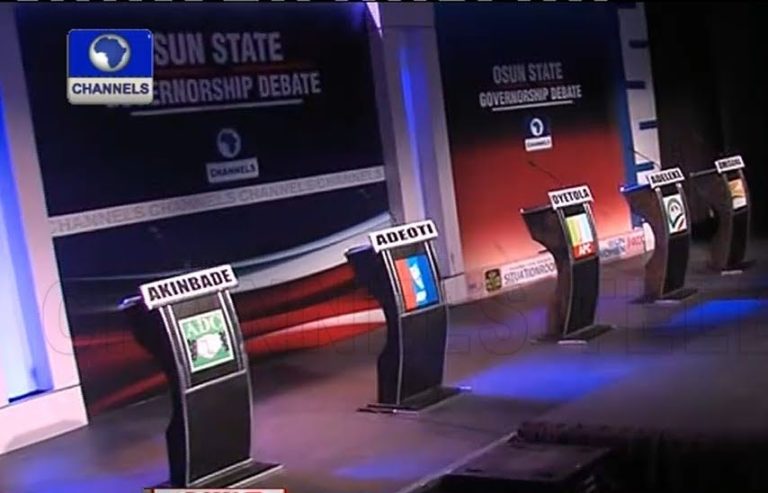
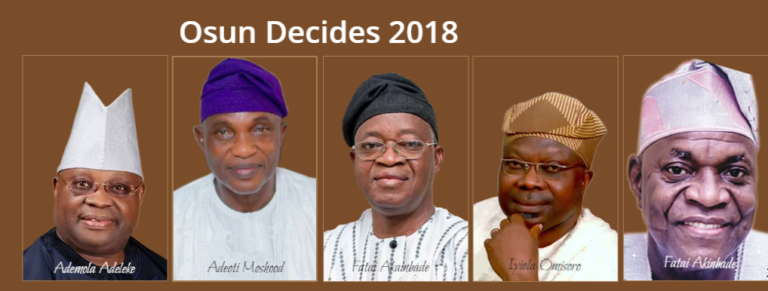
The ICIR has  considered the five leading candidates to include Fatai Akinbade , Moshood Adeoti , Adegboyega Oyetola , Ademola Adeleke  and Iyiola Omisore. In this regard, their Twitter activities have been analysed in the core areas of economy, education, heath, and youth inclusion.

The overall review of each candidates’ Twitter handle shows that the candidates are inactive on Twitter.

FATAI AKINBADE – AFRICAN DEMOCRATIC CONGRESS (ADC)

The candidate of the Action Democratic Congress (ADC), Fatai Akinbade is not popular on Twitter. His followers are just 450 since joining the platform on December 18, 2009.

Since joining Twitter, Akinbade has only tweeted 395 times, an average of just about 0.12 tweet per day. 128 of the tweets were retweeted, representing 32.41 per cent of his total tweets, 45 tweets favourited, representing 11.39 per cent, while just 8.35 per cent represents the number of tweets that got replies.

Considering the thematic areas under review, of the 395 total tweets since joining Twitter, Akinbade has only tweeted issues relating to the economy just nine times; health, once; education, ten times; and youth inclusion, three times.

The tweet that earned him the highest number of retweet was when he debunked the news about his defection to the Peoples Democratic Party (PDP)

“My purported defection to PDP is not only laughable but mischievous, PDP should use Omisore and Jelili’s name not Akinbade #OsunDecides”

Most tweets by Akinbade contain the statement about campaign towards the Osun election and not on specific issues relating to health or economy.

IYIOLA OMISORE – SOCIAL DEMOCRATIC PARTY (SDP)

 Senator Iyiola Omisore joined Twitter on October 16, 2016. He has a total number of 3,746 followers.

Since joining Twitter, Omisore has only tweeted 270 times, an average of about 8.03 tweets per day. Only 69 tweets were retweeted, representing 26.85 per cent of his total tweets, 82 tweets were favourited, representing 31.91 per cent, while none of his tweets got replies.

Considering the thematic areas under review, of the 270 total tweets since joining Twitter, Omisore has only tweeted issues relating to the economy just 12 times; health, two times; education, 11 times; and youth inclusion, eleven times.

The top retweeted tweet had ten retweets. The tweet said: “Zoning of elective post is lazy and myopic #OsunDebate #OsunDecides2018 #omisoreonchannelstv #omisorelawal2018 #restoration2018 #OmisoreForGov #SDPprogress #VoteForIyiYemi #VoteSDP @OlayemiHon”

As most of the tweets for Akinbade were not on specifics  issues around the socio-economic welfare of the people of Osun state, so are the tweets of Omisore.

MOSHOOD ADEOTI- ACTION DEMOCRATIC PARTY (ADP)

Alhaji Moshood Adeoti joined Twitter on April 28, 2018. He is the candidate with the lowest number of followers on Twitter. The number of people he follows is higher compared to the number of people who follow him. He has a followership count of 110 people while he follows 332 people.

Since he joined Twitter, Adeoti has made only 53 tweets, the lowest compared to other candidates. Averagely, Adeoti makes 0.37 tweets per day. Of the 53 tweets, 21 tweets were retweeted, representing 39.62 per cent, 29 tweets were favourited, representing 54.7 per cent. In addition, none of his tweets got replies.

Considering the thematic areas under review, of the 53 total tweets since joining Twitter, Adeoti has only tweeted issues relating to the economy just five times; health, two times; education, three times; and youth inclusion, once.

The top retweeted tweet had seven retweets. The tweet was made for the flag off the rally of his party, ADP.

“Official Action Democratic Party flag off rally, Ilesha. #OsunDecides2018”

ADEGBOYEGA OYETOLA – ALL PROGRESSIVES CONGRESS (APC)

The candidate of the All Progressives Congress (APC), Alhaji Gboyega Oyetola joined Twitter on July 18, 2018, two days before the APC governorship primary election. In the space of two months, Adegoyega’s followers rose to 410. So far, he has made only 82 tweets since joining Twitter. Averagely, Oyetola publishes 1.36 tweets per day. 39 tweets were retweeted, representing 44.83 percent of the total tweets, while 41 tweets which represented 47.13 per cent got favourited.

In all the 82 tweets made by Oyetola in the last two months, he has talked only on education just once, one tweet on health, eight tweets on the economy of the state. Youth inclusiveness seem to be the focus of Oyetola’s campaign. He has more tweets on youth inclusion compared to other issues under review. He has made ten tweets on youth inclusion.

The tweet that earned him the highest number of retweets was about youth inclusion. This indicates that his campaign tends to address issues relating to youth in the state.

“#AskGboyegaOyetola is an interactive session with the Youth of Osun. Let’s go beyond party boundaries. I want to meet with students, artisans, young business people etc. Enyi guys e wa ka soro.. Let’s Talk!”

ADEMOLA ADELEKE – PEOPLES DEMOCRATIC PARTY (PDP)

Senator Ademola Adeleke has an inherited Twitter account. The Twitter account originally belongs to his late brother, Senator Isiaka Adeleke who died in April, 2017. The Twitter account currently has a more than twenty-one thousand followers.

For the purpose of this analysis, The ICIR extracted tweets that were posted from July 12, 2017, when he took the oath office to replace his brother. Prior to the time, Senator Adeleke did not have a Twitter account.

From the total 1,248 tweets posted between when he became a senator and now, 1,222 tweets (97.9 per cent) were retweets he made from the Nigerian Senate Twitter handle, @NGRSenate.

Considering the thematic areas under review, Adeleke has only tweeted issues relating to the economy, just once; health, once; education, three times; and no single tweet on youth inclusion even while inviting  the popular young musician, David Adeleke, also known as Davido at most of his campaigns.

CONCLUSION: This analysis has shown that social media applications, most especially Twitter has not been widely incorporated in the publicity and public relations by the major candidates for the Osun State governorship election.

These politicians still rely heavily on traditional media (television, radio, newspapers, magazines etc) for most of their interactions with their party members, their followers, and the public.

NAPTIP dismisses six staff for demanding sex, bribes from suspects

0

The National Agency for the Prohibition of Trafficking in Persons (NAPTIP), says it has sacked six of its officers for corruption and official misconduct.

NAN and Premium Times report that NAPTIP’s head of press and public relations unit, Stella Nezan, disclosed this in a statement in Abuja on Thursday.

Nezan explained that the offences committed by the officers included arranging professional sureties for suspects for a fee and providing information about the operations of NAPTIP to outsiders for a fee.

She said the affected officers endangered the lives of their colleagues by so doing.

The spokesperson said some of the sacked officers were involved in the acceptance of bribes and aiding the escape of suspects.

According to her, others made sexual advances to victims of trafficking as a condition for rendering service to them.

She added that one of those sacked was absent from duty without official leave from July 2017 to May 2018, and was also involved in financial misconduct.

The spokesperson disclosed further that one officer was given compulsory retirement for various offences that were inimical to the operations of NAPTIP.

Nezan noted that the offences were categorised under corruption, divided loyalty, sabotage and gross indiscipline, contrary to the civil service regulations.

“This development followed the recommendation of the management of the agency who have found them culpable for various offences.

“This is in line with the disciplinary actions and in-house cleaning embarked upon by the present management to enthrone discipline, dedication, loyalty as well as enhance the operations of the agency,” she stated.

Nezan said the management’s action was the peak of a series of internal disciplinary measures earlier taken in strict compliance with the provisions of the civil service rules and other extant labour laws.

She said that the attorney-general of the federation and Minister of Justice, Abubakar Malami, had since approved the dismissal of the officers.

The spokesperson quoted the director-general of NAPTIP, Julie Okah-Donli, as expressing sadness over the development.

She said that the sack of the officers would enhance the global trust in the agency and serve as a deterrent to others.

“Though it was a difficult decision for management, the agency had to take it as a step in the right direction.

“I am particularly sad over the situation, but the laid down procedures must be followed. The agency is very important not to only the Nigerian government, but the entire global community.

“So we cannot afford to do anything less. I believe that other officers of the agency will take dressing from this development,” she stated.

‘We won’t leave Abuja without El-Zakzaki’: Hundreds of Shiite youths protest in Abuja

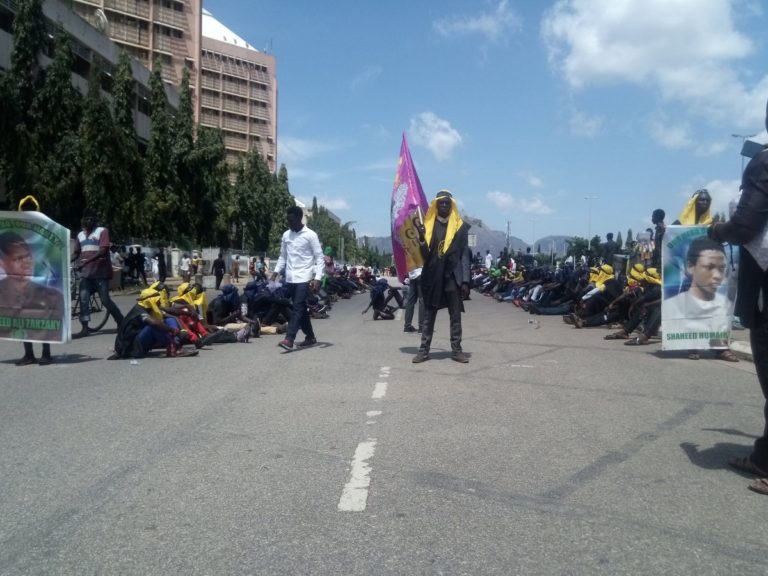
HUNDREDS of youths of the Islamic Movement in Nigeria (IMN), also known as the Shiite Islamic sect, converged on Abuja on Thursday to protest the continued detention of the leader, Ibrahim El-Zakzaki, by the federal government.

Kitted in black apron-like garments, with scarves of varying colours tied around their heads, and chanting on the top of their voices, the youths said they would not leave the Abuja City Centre without their leader.

“We are ready to die, we will never surrender, Allah is our defender, Zakzaki is more than a father to us, we will not leave Abuja without Zakzaki”, they chanted as they marched around the Three Arms Zone in Abuja.

The weather temperature in the Abuja City Centre on Thursday afternoon was 28 degrees Celsius, but the youths cared less about the scorching sun.  They sat along the major road leading into the National Secretariat, chanting their demands.

El-Zakzaky has been in the custody of the Department of State Services (DSS) since December 2015, following an incident in Zaria, Kaduna State, where members of the IMN clashed with the convoy of the Chief of Army Staff, Tukur Buratai. Over 300 Shiites were reportedly killed by Nigerian soldiers during that clash, according to official records, while one soldier was killed.

Subsequently, Governor of Kaduna State, Nasir El-Rufai, proscribed the IMN, declaring it an outlawed group, which means that members risk a lengthy jail sentence.

For his part, El-Zakzaky and his wife have remained in detention for almost three years. Six of his sons, according to a spokesman of the IMN who spoke to The ICIR on Thursday, had been killed in two separate attacks on the sect by the Nigerian soldiers.

“The Nigerian Army killed three [of Zakzaki’s sons] during Goodluck Jonathan’s regime. They opened fire on us during a peaceful procession. The remaining three were shot in front of their father, at Gelesu, Zaria, on 12 December, 2015,” said Abdulrahman Muhammad, one of the protesters who spoke to The ICIR.

There have been court judgements ordering the Nigerian government not only to release El-Zakzaky, but also to pay him monetary compensation, as well as provide comfortable accommodation for him and his wife in any state of his choice in Northern Nigeria.

Shiite protesters on Thursday in Abuja.

“We want the government to release the Sheikh (Zakzaky) as God had ordered since last year. He is in danger, his health is in danger. He was shot by the Nigerian army, in several places, up till now, he has bullets in his body. He has lost one of his eyes, and the other eye is also endangered.”

Muhammad said they  conwould continue to occupy the streets of Abuja until President Muhammadu Buhari orders El-Zazaky’s release.

“We don’t have a specific time. If they release our leader now, we will leave this place, but as far as they didn’t release our leader, we are here. They either kill us all here or they release our leader,” he said.

Security agents, including the Police, Army and Civil Defence, were seen all around the protest area, but none of them tried to stop the protesters, unlike what obtained during previous free-Zakzaky protests.

Even when the youths chanted anti-Buhari songs saying “death to Buhari, death to America”, the security personnel still maintained commendable decorum.

The DSS allowed El-Zakzaky to address the press in January as a proof that he is still alive.

In January this year, El-Zakzaky made his first public appearance since his arrest in December 2015; the DSS allowed him to briefly address journalists. This followed widespread reports that the Muslim cleric had died in detention. During the brief interaction with the media, El-Zakzaky, who wore a neck brace, said he was getting better and thanked Nigerians for their prayers.

Later, in May, El-Zakzaky and his wife were arraigned before a Kaduna State High Court, to face charges of culpable homicide in the killing of one Dankaduna, a soldier, in the convoy of the chief of army staff and for unlawful assembly.


How violation of traffic rules spikes road crashes in Abuja

0

THE data from the National Bureau of Statistics (NBS) shows that the Federal Capital Territory, Abuja, currently has the highest incidents of car crashes in Nigeria. From 2013 till date, there has been an uneven spike in the rate of road crashes within Abuja than busier roads in major cities like Lagos and Port Harcourt.

In the first three months of 2017, Abuja recorded 307 cases of road crashes, representing 12 per cent of the total crashes that occurred across the country within this period. From April to June this year, Abuja also had 346 cases of accident, representing 14 per cent of the total accidents in the country during the period.

This grim reality  is lost on Abuja motorists as they indiscriminately flout traffic rules, putting their lives and other road users at risk.

spent about an hour at Wuse Zone one junction, a connecting route in Abuja Central Area, to observe the snarling traffic that showed no signs of abetting.

The first thing that catches the sight of an onlooker at this spot, is an array of exotic trees on both sides of the pedestrian’s walkway but the beautiful scenery is made rowdy as motorists parked their cars on the pedestrian walkway or use it as an alternative route to beat traffic gridlock.

This obstruction is a violation of the Nigerian Highway Code as stated in Section 510 of the FRSC Act, 2007 which stipulates that “Obstructing any section of the road with vehicles or in any other way that may affect free flow of traffic or movement” is deemed a traffic offence and liable to prosecution of the offender by the Federal Road Safety Corps (FRSC).

I observed several cars switching between  lanes as they sped past an unmanned  traffic booth at the road intersection. Meanwhile, the indicator lights on the road were not working at the time as drivers tried to outpace one another with bustling speed creating a chaotic scene when the traffic was less.

However, normalcy was restored when a traffic warden came about thirty minutes into the time the reporter was at the spot, to direct traffic.A patrol vehicle of the FRSC was stationed across the road earlier, but they did little to address the situation on ground.

Abuja’s reputation as a city with high rates in car crashes has not changed the driving patterns of most motorists, who would drive on the highways with brazen disregard for traffic regulations.

Most motorists plying the Wuse Zone one axis are oblivious to traffic signs on that route, especially the Zebra crossing. Pedestrians standing on the Zebra crossing are likely to be hit because motorists do not slow down when approaching it.

But even pedestrians do not seem to know the usefulness of Zebra crossing. Dorothy Joel, a student of the University of Abuja me that “I think the markings on the road are meant for vehicles to stop when the traffic lights come on. They are for the vehicles.”

Another problem is that the pedestrian walkways have been overtaken by vehicles. Moribund buses bearing the insignia of the Federal Capital Territory Authority lined the pedestrian sidewalks around the the Berger Junction, as pedestrians have a hard time inching their way through.  Some young men have made the buses a dwelling place.

Several major streets in the Wuse district are not exempted from this trend as cars could be seen littering pedestrians walkways. However, on the FRSC website, there is a fine stipulated for road obstruction which is pegged at N3,00.  Given the scale of this violation, it seems that the punitive measure taken by the FRSC is timid and ineffective.

Osarentin Osagie, a sculptor who is a regular visitor to Abuja stressed  the need for public enlightenment on road safety.

“There is a need to enlighten road users on traffic rules and regulations to avoid casualties on our roads,” Osagie said.  “You see, most drivers  don’t have regard for traffic rules and when apprehended by road safety officials a bribe makes them turn a blind eye. So drivers are just an accident waiting to happen.”

Amos Abba is an intern with The ICIR.


2019 elections: Kwankwaso, Dankwambo, other presidential aspirants to debate plans for oil sector

0

ASPIRANTS to the office of President of the Federal Republic of Nigeria in 2019 will have a chance to marshal their plans and programmes for the oil and gas sector of the economy and convince the electorate of their capacity and readiness to ensure economic growth and development of the country.

Come Wednesday, September 26, 2018, OrderPaper Advocacy Initiative (OAI), will host the inaugural Development Dialogue Series (DDS) where aspirants across party lines will address industry experts, civil society leaders and the media on their understanding of the oil and gas industry and how they intend to turn the fortunes of the industry for the better. The high profile event will hold at the prestigious Eko Hotel in Lagos.

A statement by Oke Epia, Executive Director of OAI, said aspirants billed to attend the first in the series include Governor of Gombe State, Ibrahim Dankwambo, former Kano State governor and incumbent senator, Rabiu Musa Kwankwaso, and Professor Funmilayo Adesanya-Davies, all of the Peoples Democratic Party (PDP).

Others are Tope Fasua of the Abundant Nigeria Renewal Party (ARNP), Fela Durotoye of the Alliance for New Nigeria (ANN), Professor Remi Sonaiya and Adeshina Fagbenro-Byron of KOWA party, Dr. Yunusa Tanko of the National Conscience Party (NCP); and Comrade Jaye Gaskia of the Sustainable National Party (SNP). Also expected are Baba Datti-Ahmed (PDP); Omoyele Sowore of the Africa Action Congress (AAC) and Professor Kingsley Moghalu of the Young Peoples Party (YPP).

The statement noted that the stalled sector reforms reflected by the non-assent to the Petroleum Industry Governance Bill (PIGB) has brought the issues of growth, development and sustainability of the economy into sharp focus, thereby making it expedient for aspirants to the office of president in 2019 to address Nigerians on the matter.

“The situation with the PIGB indicates the need for deep reflection, introspection and fresh perspectives on the fate of both the reforms contemplated by the PIGB and indeed the entire oil and gas industry of the country,” the statement noted

It added that “Given the impending general elections and the inevitable opportunities it provides to rethink, reconsider and offer options for national development, those aspiring for the office of President should convince Nigerians that they have sufficient understanding of the oil and gas sector and have clearly thought out ideas of how to make the enormous wealth of the country work for the overall benefit of citizens.”

The Development Dialogue Series (DDS) is a modest contribution of OrderPaper Advocacy Initiative conceived to draw attention to and deepen conversations around key development themes in the ongoing transition process.

OrderPaper Advocacy Initiative is a development think-tank intervening on policy-related issues, especially legislative engagements that expand the frontiers of good governance and the deepening of democratic practice in Nigeria.

Osun Decides 2018: Exposing the fallacies, exaggerations, outright lies in governorship debate

IN the evening of Sunday, six days to the Osun State gubernatorial election, four of the prominent aspirants gathered in Osogbo to demonstrate preparedness for office at the Channels TV debate.

For over an hour, Fatai Akinbade of the African Democratic Congress (ADC), Moshood Adeoti of the Action Democratic Party (ADP), Iyiola Omisore of the Social Democratic Party (SDP) and Gboyega Oyetola of the All Progressives Congress (APC) all engaged each other in a war of words. Ademola Adeleke of the People’s Democratic Party (PDP) was absent.

Even though emotional statements and campaign clichés filled the debate atmosphere, occasional errors were committed nonetheless. In this fact-check, The ICIR scrutinises the suspicious claims by three of the candidates.

Gboyega Oyetola

GBOYEGA OYETOLA, APC

Claim: Osun state debt portfolio is about 141 billion

In reacting to claims from Omisore regarding Osun state’s debt profile, Oyetola said what he knew was that the state’s debt from Sukuk bonds and commercial loans is about N141 billion. He said the state will be free from liability on the bond by 2020. He added, in response to whether Osun’s debts are sustainable, that Nigeria’s debt to GDP ratio on the average is about 40 per cent, and “ours is still less than 6 per cent”.

Verdict: Partly true

According to 2017 figures from the National Bureau Statistics stating both external and domestic debt stocks of the various states of the federation, Osun State’s total debt is N167.7 billion. This comprises a domestic debt of N138.2 billion and external debt of $96.6 million.

Calculations by The ICIR confirm Oyetola’s claim that Osun State’s debt to GDP ratio is less than 6 per cent. 2012 estimates by Renaissance Capital give the state’s GDP as $9.4 billion. With this figure, its debt to GDP ratio is therefore 5.8 per cent. It is also true payment of the Sukuk bond is due by 2020.

However, it is not the case that the average debt to GDP ratio in Nigeria is about 40 per cent. According to a report of the National Bureau of Statistics, debts of the various states, that is sub-national debt, in relation to GDP rose from 2.4 per cent in 2014 to 4 per cent in 2016 — only ten per cent of Oyetola’s claim.

Claim: UNESCO supports Osun’s new 4-5-3-4 educational classification.

When Oyetola was asked if he would be regularising the school system which Osun State introduced  in 2011, he replied: “Even UNESCO [United Nations Educational, Scientific and Cultural Organization] acknowledged the fact that it is the best way to go. And that is the truth… It has not changed the curriculum anyway.”

Verdict: Misleading

After an educational summit organised in 2011, the old primary/secondary classification system was renamed and arranged into elementary, middle and high schools. Pupils in elementary school are those from grades, that is primary, one to four. Those in middle school are students from grade five to nine, that is primary five and six, as well as JSS one to three. Finally, high school,  under the new classification, is for SS one to three, which is grade ten to twelve in Osun State.

Grace Titi Laoye-Tomori, Osun State Deputy Governor and Commissioner for Education, has also said the new system is patterned after UNESCO standards. This claim is however misleading.

The 2011 UNESCO International Standard Classification of Education does not expressly classify schools according to elementary, middle and high, and does not recommend a 5-4-3-4 arrangement. Rather, it classifies schools according to pre-primary education, primary education, lower secondary education, upper secondary education and post-secondary non-tertiary education.

The document further allows for flexibility in local labelling. “Programmes classified at ISCED level 1 may be referred to in many ways, for example: primary education, elementary education or basic education,” it states. “For international comparability purposes the term ‘primary education’ is used to label ISCED level 1.”

Claim: There is a reasonable number of women in present Osun cabinet

In the concluding session of the debate, the moderator asked candidates about their position on female participation in governance and gender equality. While addressing the subject, Oyetola said: “Even the existing cabinet is pro-[women]. We have reasonable number of women in the cabinet.” But is this so?

Verdict: Misleading

A check through the list of cabinet members in the incumbent Osun State government reveals that, out of a total of 45, there are only seven cabinet members who are female: Deputy Governor, Commissioner For Human Resource & Capacity Building, Commissioner for Empowerment & Youth Engagement, Commissioner for Federal Matters, Commissioner for Women and Children Affairs, Special Adviser on Higher Education, Bursary & Scholarships, and Special Adviser on Culture and Tourism.

This amounts to only 15.5 per cent — a long way from absolute gender parity or even the 30 per cent affirmative action proposed by the National Gender Policy.

Iyiola Omisore

IYIOLA OMISORE, SDP

Claim: “IGR is about 7.7 per cent, debt outgoing is about 36.04 per cent… So there is a net deficit of 29 per cent ab initio [debt versus IGR]. Our budget of 2015 has 41 per cent deficit from the beginning: 2016 has 51 per cent deficit, 2017 has 62 per cent deficit, and 2018 has 82 per cent deficit.”

Verdict: An understatement

During his remarks, the SDP candidate often reeled off figures without properly putting each one into perspective. Part of his many statistics, which he said he arrived at “having done my own work”, are the budget deficits from 2015 to 2018. He said this to buttress his position of Osun State government’s fiscal indiscipline.

Available data, however, shows that the budget deficits between 2015 and 2017 are much more than what Omisore painted. The proposed budgets for 2015, 2016 and 2017 are N197.08 billion, 137.9 billion and 138.2 billion respectively, while the total revenue for those years were N28.3 billion, N14.8 billion, and N16.9 billion. Using these figures, the budget deficits are therefore 85.6 per cent, 89.2 per cent, and 87.8 per cent — not 41 per cent, 51 per cent, and 62 per cent.

Claim: There are no Opon Imo tablets in Osun State schools

Omisore described the famous Opon Imo (tablet of knowledge) project of the Aregbesola-led Osun State government as a scam, and blamed it for the state’s indebtedness. Not only that, he also claimed “there is no Opon Imo anywhere in this state”. After Oyetola denied his remarks, saying the tablets are available and functional, he said there are no tablets in circulation.

“They brought only a few hundreds and launched,” he said. “I have students that live with me, and I’ve not seen any tablet with them. So I don’t know where they are; maybe they are hidden in government office.”

Verdict: False

The Opon Imo project was introduced in 2013 by Rauf Aregbesola, Osun State governor, with the plan of giving out 150,000 units of e-learning tablets to senior secondary school students in order to improve learning and ICT literacy.

One reason that may explain why Omisore has not seen the tablet with students around him is that the state government now distributes it only to students in their final-year and then retrieves it after their final examination. Evidence abounds of the annual distribution and use of the tablets.

Claim: In 2010, Osun ranked fourth in secondary school performance.

Criticising the construction of “mega schools” in the state, Omisore remarked: “By 2010, Osun was in the fourth position. They built mega schools, they went to 29th position.” He  said the mega schools lack basic facilities such as science laboratories, and are not improving the quality of education in Osun.

Verdict: Unlikely

While it is true that records show Osun was ranked 29 in the state ranking of 2018 released by the West African Examination Council, there is no data online for as far back as 2010.

Reported WAEC performance data of the state covering ten years, however, shows an improvement of 113 per cent in the performance of students. According to the data, while about 7000 students passed with at least five credits in subjects including English and Mathematics in 2010, this figure shot up to about 17,000 in 2016. This was also confirmed, in June, by the state commissioner for education.

Osun state WAEC performance between 2006 and 2016

Claim: Nigeria signed treaty to appoint women into 33 per cent of political offices

During the last segment of the debate which addressed plans on minorities, Omisore was asked about his position on women in governance. In his response, he said Nigeria signed to the “Protocol of China”, which stipulates 33 per cent political positions for women.

“And as a law-abiding, my minimum will be that 33 per cent. Women will be very happy in the government coming.”

Following the senator’s response, Oyetola gave the figure, according to “the Beijing Convention”, as 35 per cent, and said that was the maximum. Adeoti jumped on the wagon and said he will ensure not less than 35 per cent of political appointments are reserved for women “because it is a resolution of an international body, the United Nations”. Akinbade also made a similar vow of at least 35 per cent .

But is there any such UN resolution proposing an affirmative action of 35 per cent?

Verdict: False

The Beijing Declaration of 1995 does not actually state 35 per cent as the minimum extent of female participation in governance. It merely encourages the equal participation of both genders.

Article 13 states: “Women’s empowerment and their full participation on the basis of equality in all spheres of society, including participation in the decision-making process and access to power, are fundamental for the achievement of equality, development and peace.”

The African Union Protocol on Human and People’s Rights on the Rights of Women in Africa (the Maputo Protocol) also makes no particular demands.

Nigeria’s National Gender Policy, however, stipulates that 30 per cent of political posts should be reserved for women.

Fatai Akinbade

FATAI AKINBADE, ADC

Claim: My business is already profitable

Verdict: No available evidence.

There is no available evidence showing that Akinbade’s company, the Owu Crown Hotel, has broken even and is profitable.  However, in June, the hotel was among 15 companies sealed off by the Oyo State Board of Internal Revenue for tax violations.

According to the board, the step had to be taken as a result of the companies’ “failure to pay outstanding professional/business registration/renewal fees”.

Gone with the wind: FG suspends Nigeria Air

THE Nigerian government has announced the suspension of the proposed New National Carrier, ‘Nigeria Air’, less than two months after its controversial launch.

Minister of State for Aviation, Hadi Sirika, had launched the project during the Farnborough Air Show in London, the United Kingdom, in July, but after the Federal Executive Council (FEC) meeting on Wednesday, the minister said the council “has taken the tough decision to suspend the National Carrier Project in the interim”.

Sirika gave no reason for the suspension of the National Carrier project but only added that “all commitments due will be honoured”.

Sirika had tried to allay the concerns raised by many stakeholders over the obvious unprepared inauguration of the National Carrier project.

As at the time of the inauguration, not even a website was in place for the proposed Nigeria Air. All the ministry did was to contract a company in Bahrain, From 6 Communications, to handle the branding for the project, including designing a logo.

Unconfirmed reports had it that the branding contract was worth $600,000 (N183 million).

But Sirika tried to allay the many concerns raised at the time, explaining that every necessary step had been taken to ensure the successful take-off of the project.

“In order to ensure the take-off of the airline in 2018, government will provide $55 million upfront grant/viability gap funding to finance start-up capital and pay commitment fees for aircraft to be leased for initial operations and deposit for new aircraft, whose delivery will begin in 2021,” he told newsmen at the time.

A detailed report published by the ICIR, shortly after the launch of the ‘Nigeria Air’ project, revealed that almost everything was wrong with the approach being adopted by the ministry.

Former Minister of Education, Oby Ezekwesili, said at the time that the ‘Nigeria Air’ project was bound to fail; an opinion for which she received criticism on the social media by supporters of the federal government.

ICPC recovers N7.5 million TETFund grant from Kadpoly lecturers

0

THE Independent Corrupt Practices and Other Related Offences Commission (ICPC), has recovered the sum of N7.5 million unused grant from 11 lecturers of the Kaduna Polytechnic, according to a statement by the spokesperson of ICPC, Rasheedat Okoduwa.

The money was part of the Tertiary Education Trust Fund (TETFUND) grant released to the school between 2010 and 2017 for staff capacity development through local and international trainings.

ICPC, through its North West Zonal office which coordinated the investigation on the utilization of TETFUND grants in the institution, found that the 11 lecturers failed to attend the trainings despite having received grants.

The trainings were scheduled to hold in Nigeria and three other countries, including the United States of America, Greece, and United Arab Emirates.

Some of the lecturers collected as much as N1.39 million while others collected between N149, 000 and N1, 337,000 under the Academic Staff Training and Development Project.

The Acting Chairman of the Commission, Musa Usman Abubakar who handed over the recovered funds to the Bursar of the institution, Garba Nabayi, said that ICPC would ensure tertiary institutions in the country stop the misuse of TETFUND and other grants.

Abubakar said that the investigation of the utilization of TETFUND grants was being carried out in 27 other tertiary institutions in the North-West geopolitical zone of the country to make sure that all grants were properly used, adding that those found wanting of misuse of the grant would be prosecuted.

He said, “Carting away of public funds is one of the things ICPC is fighting. Non-utilization of fund given to lecturers is a crime and lecturers as role models, are to show good behavioural conduct to their students. Beneficiaries of such grant must ensure they go for the training because ICPC will not only recover such funds but will prosecute anybody found culpable”.

He noted that the exercise would spread to institutions in other geo-political zones in the course of time.

Nabayi who received 11 bank drafts for each defaulting lecturer on behalf of the institution, commended ICPC for the prompt intervention that has led to the recovery of the money.

He asked the Commission to spread its investigation to other activities of tertiary institutions, especially the execution of capital projects.

ICIR advocates for collaboration between CSOs and media in Ghana

MORE robust collaboration is needed between the media and Civil Society Organizations (CSOs)  to promote the culture of accountability and transparency in governance in Africa.

This was the remark of the Executive Director of the International Centre for Investigative Reporting (ICIR), Dayo Aiyetan, during a recent event involving journalists and activists in Accra, Ghana.

The event was a roundtable discussion between The ICIR, CSOs, and journalists towards implementing an investigative project on media engagement with key civil rights groups in Ghana and Nigeria.

Aiyetan said that although the Ghanaian and Nigerian media spaces have good relationships with CSOs, it is important for such partnerships to be deepened in order to yield better results.

The event was funded by Ford Foundation under the theme, “Promoting Social justice and Accountability Issues in West Africa.”

It is hoped, Aiyetan said, that by amplifying social accountability issues, sustaining discussions on identified challenges, and pushing for policy change and or its implementation through investigative reporting, more meaningful and enduring impact will be achieved.

Journalists and activists were encouraged to focus attention on illicit cross-border crimes, embezzlement of funds by state officials, and human trafficking.

Aiyetan urged journalists not to focus only on money or the incentives they would receive, but rather, they should be driven by the fact that they serve as watchdogs of the society, assisting in the fight against corruption.

He advised that journalists should use the data gathered by CSOs as basis for their investigations, by highlighting how government failings or instances of corruption affect the ordinary citizens.

Aiyetan said such investigative, data-driven, watchdog reporting will keep both the leaders and the led in check, as well as push the agenda for punishing offenders.

Hours after WAEC cleared Adeleke of certificate forgery, police summon him over fresh charges

BARELY six hours after news broke that Ademola Adeleke, governorship candidate of the Peoples Democratic Party (PDP) in Osun State, has been cleared of allegations of certificate forgery, the Nigeria Police Force has made fresh charges of examination malpractice against him.

Earlier on Wednesday, the Daily Trust reported that the West African Examination Council (WAEC) had filed an affidavit before a Federal Capital Territory High Court, affirming that Adeleke sat for the Senior Secondary Certificate Examination (SSCE) of May/June 1981.

The affidavit was in compliance with the order of Justice Othman Musa asking WAEC to supply the court with the result. According to WAEC, Adeleke sat for the examination at Ede Muslim High School, with exam number 149 and centre no 19645. However, the records show that Adeleke only sat for English Language.

Meanwhile, the Force Public Relations Officer, Jimoh Moshood, in a statement later on Wednesday, made another allegation of malpractice against Adeleke, who is popularly known as the dancing Senator. Moshood said Adeleke had connived with the principal of a secondary school in Osun State to allow him to sit for the 2017  SSCE organised by the National Examination Council (NECO).

Moshood added that although Adeleke had denied the allegations when he was invited by the police in July this year, further investigations have revealed that indeed he has questions to answer.

The police, therefore, has summoned Adeleke and three others “to report to the Special Investigation Panel, Force Headquarters, Abuja immediately for arraignment in court”, Moshood stated.

This is coming barely three days to the Osun governorship election in which Adeleke is one of the leading candidates. The PDP had held its grand rally at Osogbo, the Osun State capital, on Wednesday, where a cheerful, dancing Adeleke was formally handed the party’s flag.

Read the full police statement below:

PRESS BRIEFING ON EXAMINATION MALPRACTICE CASE AGAINST SENATOR ADEMOLA ADELEKE

Examination Malpractice, Criminal Conspiracy, Personation, Breach of Duty, Aiding and Abetting against Senator Ademola Adeleke (PDP Governorship Aspirant in the 22nd September, 2018 Gubernatorial Election in Osun State) and four (4) others namely; MR Sikiru Adeleke, Alhaji Aregbesola Mufutau (Principal of Ojo-Aro Community Grammar School, Egbedore LGA, Osun State), Mr Gbadamosi Thomas Ojo (School Staff responsible for the registration of candidates for NECO), Mr Dare Olutope (School Teacher who facilitated the commission of the crime).

  1. On 21st July 2017, the Osun State Police Intelligence Bureau (SIB) received and acted on an actionable intelligence about an ongoing examination malpractice involving Senator Ademola Adeleke and Sikiru Adeleke at OJO/Aro Community Grammar School in Osun state.
  2. When the Police operative arrived at the school, only Sikiru Adeleke was found seated for the examination while Senator Ademola Adeleke seat was vacant and was suspected to have escaped before the arrival of the Police operatives.
  3. Further investigation revealed that both Senator Ademola Adeleke and his brother Sikiru Adeleke registered and were sitting for the National Examination Council Examination (NECO) 2017 as internal candidates impersonating students of the School at the ages of 57years and 42years respectively. This crime was facilitated by the principal of the school, and two other members of staff of the school for which they are under investigation and being charged to court.
  4. The Principal of the school, Alhaji Aregbesola Mufutau, the staff responsible for registration, Mr Gbadamosi Thomas Ojo and a teacher Mr dare Olutope were arrested on 21 July 2017. Senator Ademola Adeleke was arrested on 27 July 2017 and Sikiru Adeleke was arrested on 8 August 2017.
  5. Senator Ademola Adeleke made cautionary statement and admitted that he registered for the 2017 NECO examinations as an internal student in the said school but he didn’t sit for the examination.
  6. However, Police investigation revealed the following prima facie and culpability facts against Senator Ademola Adeleke and four (4) others.

i. Senator Ademola Adeleke made cautionary statement and admitted that he registered for the 2017 NECO examinations as an internal student in the said school and did not sit for the examination but have a result from NECO with Seven (7) Credit and One (1) Pass, a copy of which was obtained from NECO by the Police.

 ii. The Ojo/Aro 2017 NECO, SSCE school photo album (School’s copy), with Senator Ademola Adeleke and Sikiru Adeleke Photographs in school uniform in the said album. Senator Ademola Adeleke in the NECO 2017 Result obtained by the claimed that he was born on 12th June 1997 but in his statement to the Police, senator Ademola Adeleke wrote 13th May 1960 as his Date of Birth.

iii. The photographs of both Senator Ademola Adeleke and Sikiru Adeleke appearing side by side in the photo album have no NECO stamps on them.

  1. Senator Ademola Adeleke and four others were arrested, investigated, granted bail and being charged to court. Charges of Examination Malpractice, Criminal Conspiracy, Personation, Breach of Duty, Aiding and Abetting against Senator Ademola Adeleke (PDP Governorship Aspirant in the 22nd September, 2018 Gubernatorial Election in Osun State) and four (4) others namely; MR Sikiru Adeleke, Alhaji Aregbesola Mufutau (Principal of Ojo-Aro Community Grammar School, Egbedore LGA, Osun State), Mr Gbadamosi Thomas Ojo (School Staff responsible for the registration of candidates for NECO), Mr Dare Olutope (School Teacher who facilitated the commission of the crime) have been filed at the Federal High Court, Abuja under the Examination Malpractice Act, CAP E15, 2004 today, Wednesday, 19th September, 2018.
  2. Consequently, Senator Ademola Adeleke (PDP Governorship Aspirant in the 22nd September, 2018 Gubernatorial Election in Osun State) and four (4) others namely; MR Sikiru Adeleke, Alhaji Aregbesola Mufutau (Principal of Ojo-Aro Community Grammar School, Egbedore LGA, Osun State), Mr Gbadamosi Thomas Ojo (School Staff responsible for the registration of candidates for NECO), Mr Dare Olutope (School Teacher who facilitated the commission of the crime) are hereby advised in their own interest to report to the Special Investigation Panel, Force Headquarters, Abuja immediately for arraignment in court.

Ag. DCP JIMOH MOSHOOD

FORCE PUBLIC RELATIONS OFFICER

FORCE HEADQUARTERS